
Ruth 2:19

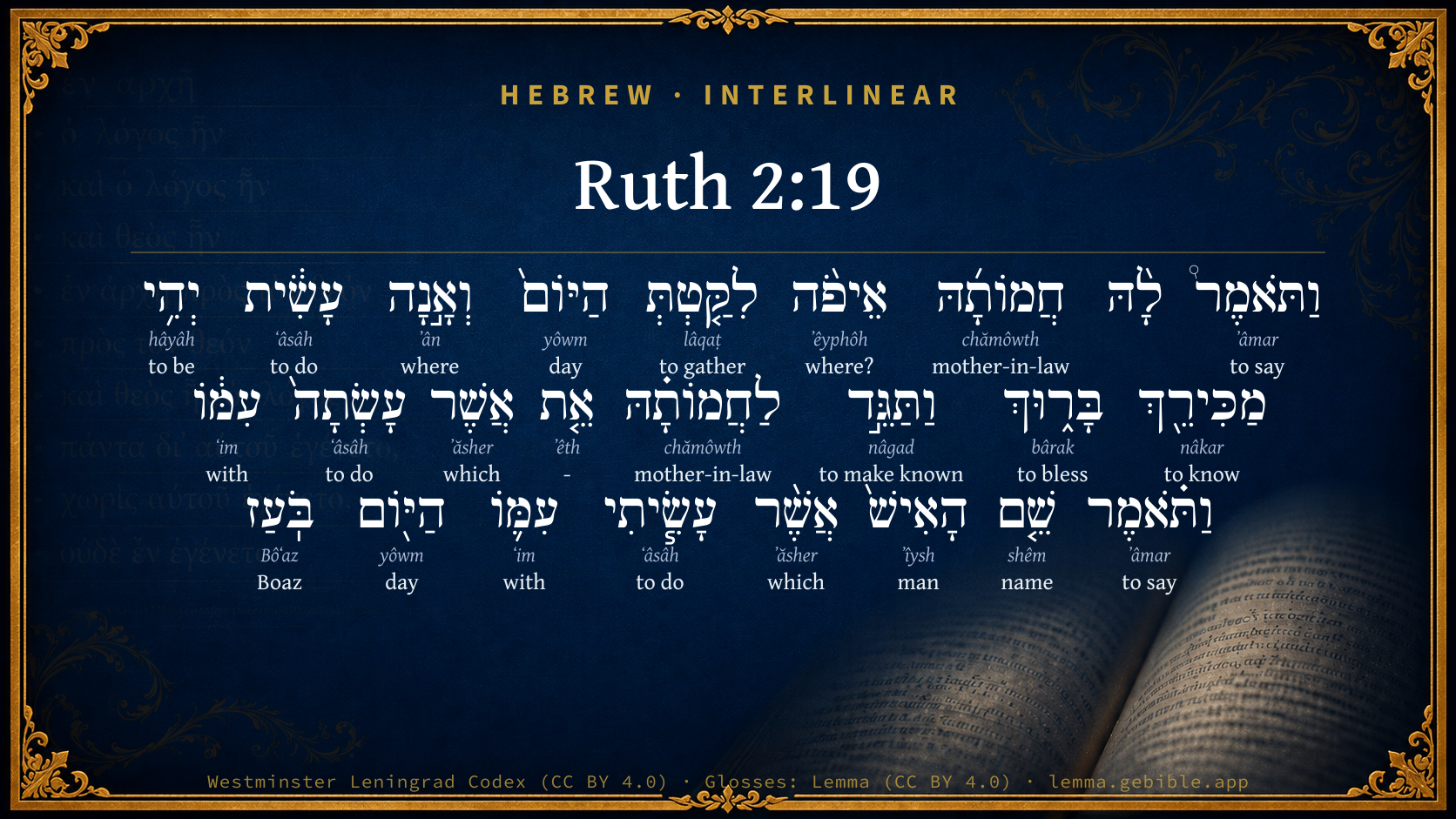
Hebrew (Westminster Leningrad Codex) Ruth 2:19 appears in the Hebrew Old Testament. The text above is from the Westminster Leningrad Codex. Each word links to its Strong’s number, a concise gloss, and parsing drawn from the Open Scriptures Hebrew Bible morphology. Click any word for its full Brown-Driver-Briggs (BDB) entry.
Download image
Cite this verse

Ruth 2:19 (World English Bible). Public Domain. Lemma interlinear Bible study tool, https://lemma.gebible.app/v/ruth/2/19.

Show BibTeX & RIS
BibTeX
RIS
English Translation
Her mother-in-law said to her, Where have you gleaned today? and where have you worked? blessed be he who did take knowledge of you. She shown her mother-in-law with whom she had worked, and said, The man's name with whom I worked today is Boaz.
World English Bible · Public Domain
Download a study sheet

One document with this verse’s original text, its word-by-word gloss line, the meaning frame, cross-references with their text, attributed commentary, and full source and license credits — printable, and it pastes into notes with its structure intact.

This verse Autodidact and up

Study sheet (.html) Plain text (.txt)

A passage Seminary Student

Up to 50 verses in one chapter. A passage sheet keeps up to 6 commentary sources and 12 cross-references per verse, in the order this page ranks them, and says so on the sheet whenever that leaves anything out. Ask for a single verse and you get the Autodidact verse sheet above.

Everything on this page stays free to read, with no account — the sheet is a download of what is already on screen, not access to it.

Want to remove ads? Support Godless Engineer
Compare translations 3

The same verse in 3 English versions, stacked beneath the original-language interlinear above. Click any original word for its lexicon entry.

Each is an independent rendering of the whole verse — the interlinear is not word-aligned to these translations.

Highlighted words mark where these versions differ — a whole-verse word diff, not a word-by-word alignment.

  • World English Bible Public Domain
    Her mother-in-law said to her, Where have you gleaned today? and where have you worked? blessed be he who did take knowledge of you. She shown her mother-in-law with whom she had worked, and said, The man's name with whom I worked today is Boaz.
  • King James Version Public Domain
    And her mother in law said unto her, Where hast thou gleaned to day? and where wroughtest thou? blessed be he that did take knowledge of thee. And she showed her mother in law with whom she had wrought, and said, The man's name with whom I wrought to day is Boaz.
  • unfoldingWord Literal Text CC BY-SA 4.0
    Then her mother-in-law said to her, “Where did you glean today and where did you work? May the one who noticed you be blessed.” Then she told her mother-in-law with whom she had worked. And she said, “The name of the man with whom I worked today Boaz.”

unfoldingWord Literal Text — © unfoldingWord, licensed CC BY-SA 4.0. Word-aligned USFM3 via Door43 (git.door43.org/unfoldingWord/en_ult).

Versions to compare (up to 4)

3 of 4 selected

Show all 18 translations

Every available English version of this verse, each an independent rendering of the whole verse.

  • World English Bible Public Domain
    Her mother-in-law said to her, Where have you gleaned today? and where have you worked? blessed be he who did take knowledge of you. She shown her mother-in-law with whom she had worked, and said, The man's name with whom I worked today is Boaz.
  • Berean Standard Bible Public Domain
    Then her mother-in-law asked her, “Where did you glean today, and where did you work? Blessed be the man who noticed you.” So she told her mother-in-law where she had worked. “The name of the man I worked with today is Boaz,” she said.
  • Majority Standard Bible Public Domain
    Then her mother-in-law asked her, “Where did you glean today, and where did you work? Blessed be the man who noticed you.” So she told her mother-in-law where she had worked. “The name of the man I worked with today is Boaz,” she said.
  • King James Version Public Domain
    And her mother in law said unto her, Where hast thou gleaned to day? and where wroughtest thou? blessed be he that did take knowledge of thee. And she showed her mother in law with whom she had wrought, and said, The man's name with whom I wrought to day is Boaz.
  • American Standard Version (1901) Public Domain
    And her mother-in-law said unto her, Where hast thou gleaned to-day? and where hast thou wrought? blessed be he that did take knowledge of thee. And she showed her mother-in-law with whom she had wrought, and said, The man's name with whom I wrought to-day is Boaz.
  • Revised Version (1885) Public Domain
    And her mother in law said unto her, Where hast thou gleaned today? and where wroughtest thou? blessed be he that did take knowledge of thee. And she shewed her mother in law with whom she had wrought, and said, The man’s name with whom I wrought today is Boaz.
  • Geneva Bible (1599) Public Domain
    Then her mother in lawe saide vnto her, Where hast thou gleaned to day? and where wroughtest thou? blessed be he, that knewe thee. And she shewed her mother in lawe, with whome she had wrought, and saide, The mans name, with whom I wrought to day, is Boaz.
  • Douay-Rheims (1899) Public Domain
    And her mother in law said to her: Where hast thou gleaned to day, and where hast thou wrought? blessed be he that hath had pity on thee. And she told her with whom she had wrought: and she told the man's name, that he was called Booz.
  • Young's Literal Translation Public Domain
    And her mother-in-law saith to her, `Where hast thou gleaned to-day? and where hast thou wrought? may he who is discerning thee be blessed.' And she declareth to her mother-in-law with whom she hath wrought, and saith, `The name of the man with whom I have wrought to-day `is' Boaz.'
  • Literal Standard Version CC BY-SA 4.0
    And her mother-in-law says to her, “Where have you gleaned today? And where have you worked? May he who is discerning you be blessed.” And she declares to her mother-in-law with whom she has worked, and says, “The name of the man with whom I have worked today [is] Boaz.”
  • Unlocked Literal Bible CC BY-SA 4.0
    Her mother-in-law said to her, “Where have you gleaned today? Where did you go to work? May the man who helped you be blessed.” Then Ruth told her mother-in-law about the man who owned the field where she had worked. She said, “The name of the man who owns the field where I worked today is Boaz.”
  • unfoldingWord Literal Text CC BY-SA 4.0
    Then her mother-in-law said to her, “Where did you glean today and where did you work? May the one who noticed you be blessed.” Then she told her mother-in-law with whom she had worked. And she said, “The name of the man with whom I worked today Boaz.”
  • Darby Bible Public Domain
    And her mother-in-law said to her, Where hast thou gleaned to-day? and where hast thou wrought? Blessed be he that did regard thee! And she told her mother-in-law with whom she had wrought, and said, The man's name with whom I wrought to-day is Boaz.
  • World Messianic Bible Public Domain
    Her mother-in-law said to her, “Where have you gleaned today? Where have you worked? Blessed be he who noticed you.” She told her mother-in-law with whom she had worked, “The man’s name with whom I worked today is Boaz.”
  • Webster's Bible Public Domain
    And her mother-in-law said to her, Where hast thou gleaned to-day? and where hast thou labored? blessed be he that took knowledge of thee. And she showed her mother-in-law with whom she had wrought, and said, The man's name with whom I wrought to-day is Boaz.
  • Free Bible Version CC BY-SA 4.0
    Naomi asked her, “Where did you pick up grain today? Exactly where did you work? Bless whoever cared enough about you to pay you some attention!” So she told her mother-in-law about who she had worked with. “The man I worked with today is called Boaz.”
  • Bible in Basic English Public Domain
    And her mother-in-law said to her, Where did you take up the grain today, and where were you working? May a blessing be on him who gave such attention to you. And she gave her mother-in-law an account of where she had been working, and said, The name of the man with whom I was working today is Boaz.
  • JPS Tanakh (1917) Public Domain
    And her mother-in-law said unto her: 'Where hast thou gleaned to-day? and where wroughtest thou? blessed be he that did take knowledge of thee.' And she told her mother-in-law with whom she had wrought, and said: 'The man's name with whom I wrought to-day is Boaz.'

Literal Standard Version (2020), Covenant Press — licensed CC BY-SA 4.0. Text via the HelloAO Bible API (eBible.org). Unlocked Literal Bible (unfoldingWord) — licensed CC BY-SA 4.0. Text via the HelloAO Bible API (eBible.org). unfoldingWord Literal Text — © unfoldingWord, licensed CC BY-SA 4.0. Word-aligned USFM3 via Door43 (git.door43.org/unfoldingWord/en_ult). Free Bible Version, Dr. Jonathan Gallagher — licensed CC BY-SA 4.0. Text via the HelloAO Bible API (eBible.org).

Word by word

More ways to search: Search by grammar → Find every occurrence → Compare this word →

Practice this passage: Drill this verse → Learn its vocabulary →

אֵיפֹ֨ה
ʼêyphôh
H375
“where?”
Particle, Interrogative
Part of Speech
Particle
Type
Interrogative
Full BDB Definition

Origin: from H335 and H6311

TWOT: 75h

where? - what kind?
  1. וַתֹּאמֶר֩ ʼâmar H559 “and · to say” Conjunction + Verb, Qal, Sequential Imperfect, 3rd Person, Feminine, Singular
  2. חֲמוֹתָ֜הּ chămôwth H2545 “mother-in-law · her” Noun, Common, Feminine, Singular, Construct + Suffix, Personal, 3rd Person, Feminine, Singular
  3. לִקַּ֤טְתְּ lâqaṭ H3950 “to gather” Verb, Piel, Perfect, 2nd Person, Feminine, Singular
  4. הַיּוֹם֙ yôwm H3117 “the · day” Particle, Definite Article + Noun, Common, Masculine, Singular, Absolute
  5. וְאָ֣נָה ʼân H575 “and · where” Conjunction + Adverb
  6. עָשִׂ֔ית ʻâsâh H6213 “to do” Verb, Qal, Perfect, 2nd Person, Feminine, Singular
  7. יְהִ֥י hâyâh H1961 “to be” Verb, Qal, Jussive, 3rd Person, Masculine, Singular
  8. מַכִּירֵ֖ךְ nâkar H5234 “knowing · you” Verb, Hiphil, Participle Active, Masculine, Singular, Construct + Suffix, Personal, 2nd Person, Feminine, Singular
  9. בָּר֑וּךְ bârak H1288 “blessed” Verb, Qal, Participle Passive, Masculine, Singular, Absolute
  10. וַתַּגֵּ֣ד nâgad H5046 “and · to make known” Conjunction + Verb, Hiphil, Sequential Imperfect, 3rd Person, Feminine, Singular
  11. לַחֲמוֹתָ֗הּ chămôwth H2545 “to/for · mother-in-law · her” Preposition + Noun, Common, Feminine, Singular, Construct + Suffix, Personal, 3rd Person, Feminine, Singular
  12. אֵ֤ת ʼêth H853 “-” Particle, Direct Object
  13. אֲשֶׁר ʼăsher H834 “which” Particle, Relative
  14. עָשְׂתָה֙ ʻâsâh H6213 “to do” Verb, Qal, Perfect, 3rd Person, Feminine, Singular
  15. עִמּ֔וֹ ʻim H5973 “with · him” Preposition + Suffix, Personal, 3rd Person, Masculine, Singular
  16. וַתֹּ֗אמֶר ʼâmar H559 “and · to say” Conjunction + Verb, Qal, Sequential Imperfect, 3rd Person, Feminine, Singular
  17. שֵׁ֤ם shêm H8034 “name of” Noun, Common, Masculine, Singular, Construct
  18. הָאִישׁ֙ ʼîysh H376 “the · man” Particle, Definite Article + Noun, Common, Masculine, Singular, Absolute
  19. אֲשֶׁ֨ר ʼăsher H834 “which” Particle, Relative
  20. עָשִׂ֧יתִי ʻâsâh H6213 “to do” Verb, Qal, Perfect, 1st Person, Common, Singular
  21. עִמּ֛וֹ ʻim H5973 “with · him” Preposition + Suffix, Personal, 3rd Person, Masculine, Singular
  22. הַיּ֖וֹם yôwm H3117 “the · day” Particle, Definite Article + Noun, Common, Masculine, Singular, Absolute
  23. בֹּֽעַז Bôʻaz H1162 “Boaz” Noun, Proper

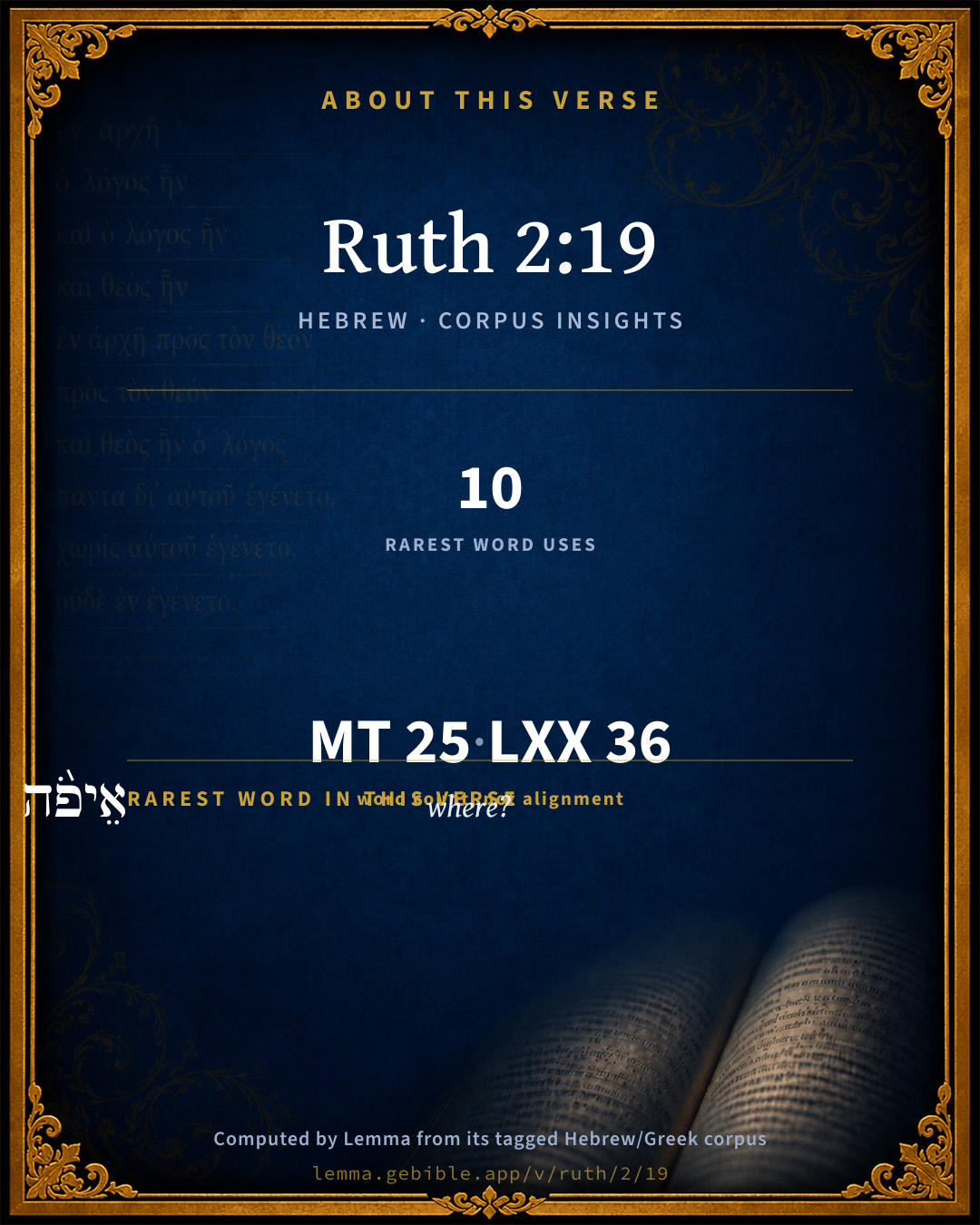
About this verse

These counts appear in no published source. They are computed here, from the morphology-tagged text and Lemma’s own curated glosses. What Lemma adds →

25
words
17
distinct lemmas
Historical
section

Notable vocabulary

The rarest word here is אֵיפֹ֨ה where? H375 — appearing just 10 times in the whole Hebrew Bible.

Shared distinctive vocabulary

אֵיפֹ֨ה where? H375 occurs in 10 verses of the Hebrew Bible. Also found in:

Grammatical profile

  • 10 verbs
  • 7 nouns
  • 3 prepositions
  • 1 adverb
  • 4 particles

Verb forms

  • וַתֹּאמֶר֩ Qal · Sequential Imperfect
  • לִקַּ֤טְתְּ Piel · Perfect
  • עָשִׂ֔ית Qal · Perfect
  • יְהִ֥י Qal · Jussive
  • מַכִּירֵ֖ךְ Hiphil · Participle Active
  • בָּר֑וּךְ Qal · Participle Passive
  • וַתַּגֵּ֣ד Hiphil · Sequential Imperfect
  • עָשְׂתָה֙ Qal · Perfect
  • וַתֹּ֗אמֶר Qal · Sequential Imperfect
  • עָשִׂ֧יתִי Qal · Perfect

Repetition

Words recur within this verse — often emphatic in Hebrew:

  • עָשִׂ֔ית to do H6213 ×3
  • וַתֹּאמֶר֩ to say H559 ×2
  • חֲמוֹתָ֜הּ mother-in-law H2545 ×2
  • הַיּוֹם֙ day H3117 ×2
  • אֲשֶׁר which H834 ×2
  • עִמּ֔וֹ with H5973 ×2

Hebrew & Septuagint length

In English translation the verse runs 45 words from the Hebrew and 47 from the Septuagint (LXX English) — closely comparable.

A rough comparison of the two English renderings, which tokenize alike — not a word-level alignment.

Word counts can differ between the Hebrew and the Greek without any difference in meaning — e.g. the Hebrew direct-object marker אֵת has no separate Greek word, and Greek often adds the article ὁ.

In the original languages it is 25 Hebrew tokens and 36 Greek tokens — but the two are counted differently (Hebrew bundles its prefixes and suffixes into one token; the Greek is in lemma form), so that isn’t a like-for-like length.

Cross-references

4

Topical passages linked to Ruth 2:19 in the Treasury of Scripture Knowledge — connected by theme and wording, ordered by reader-vote popularity; previews shown in the World English Bible.

  • Ruth 2:10 Then she fell on her face, and bowed herself to the ground, and said to him, Why have I found favor in your sight, that you should take knowledge of me, seeing I am a foreigner?
  • Psalms 41:1 Blessed is he who considers the poor: Yahweh will deliver him in the day of evil.
  • 1 Kings 7:21 He set up the pillars at the porch of the temple: and he set up the right pillar, and called the name of it Jachin; and he set up the left pillar, and called the name of it Boaz.
  • 2 Corinthians 9:13–15 seeing that through the proof given by this service, they glorify God for the obedience of your confession to the Gospel of Christ, and for the liberality of your contribution to them and to all;

Cross-references courtesy of OpenBible.info (CC BY 4.0).

Hebrew and Greek witnesses Masoretic Hebrew ↔ Greek Septuagint

The same verse in the two great witnesses to the Old Testament, shown verse-for-verse.

These are two independent witnesses, not word-aligned to each other, and the Septuagint is shown in lemma (dictionary) form.

Hebrew Ruth 2:19 Masoretic · Westminster Leningrad Codex

וַתֹּאמֶר֩ לָ֨הּ חֲמוֹתָ֜הּ אֵיפֹ֨ה לִקַּ֤טְתְּ הַיּוֹם֙ וְאָ֣נָה עָשִׂ֔ית יְהִ֥י מַכִּירֵ֖ךְ בָּר֑וּךְ וַתַּגֵּ֣ד לַחֲמוֹתָ֗הּ אֵ֤ת אֲשֶׁר עָשְׂתָה֙ עִמּ֔וֹ וַתֹּ֗אמֶר שֵׁ֤ם הָאִישׁ֙ אֲשֶׁ֨ר עָשִׂ֧יתִי עִמּ֛וֹ הַיּ֖וֹם בֹּֽעַז

Her mother-in-law said to her, Where have you gleaned today? and where have you worked? blessed be he who did take knowledge of you. She shown her mother-in-law with whom she had worked, and said, The man's name with whom I worked today is Boaz.

World English Bible · Public Domain

Greek LXX Ruth 2:19 Septuagint · lemma form

καί εἶπον αὐτός ὁ πενθερά αὐτός ποῦ συνλέγω σήμερον καί ποῦ ποιέω εἰμί ὁ ἐπιγιγνώσκω σύ εὐλογέω καί ἀποἀγγέλλω ρουθ ὁ πενθερά αὐτός ποῦ ποιέω καί εἶπον ὁ ὄνομα ὁ ἀνήρ μετά ὅς ποιέω σήμερον βοος

And her mother-in-law said to her, Where have you gleaned today, and where have you wrought? blessed be he that took notice of you. And Ruth told her mother-in-law where she had wrought, and said, The name of the man with whom I wrought today is Booz.

LXX2012 (modern English Septuagint) · Public Domain

Hebrew: Westminster Leningrad Codex (CC BY 4.0). Greek: Septuagint (public domain); English from LXX2012 (modern English Septuagint) (Public Domain). How the Septuagint differs from the Hebrew →

Commentary

Notes on Ruth 2:19 from classic Christian and Jewish commentators (each source and its license shown beneath its notes). The classic Christian expositions comment on the surrounding passage and are grouped to its opening verse, so a note may address several verses; the Jewish commentaries on the Tanakh (Rashi and others) are per-verse, so they appear only where the commentator wrote on this verse.

Lemma curates 59 commentaries, every one of them public domain or Creative Commons licensed, each selected and text-cleaned for this edition rather than reprinted as found. About our sources →

Trapp's Complete Commentary

John Trapp

Rth 2:19 And her mother in law said unto her, Where hast thou gleaned to day? and where wroughtest thou? blessed be he that did take knowledge of thee. And she shewed her mother in law with whom she had wrought, and said, The man’s name with whom I wrought to day [is] Boaz.

Ver. 19. Where hast thou gleaned today?] The recording of these small matters showeth how dear to God are his saints, and how he is taken with everything they say or do if not sinful.

John Trapp, A Commentary or Exposition upon All the Books of the Old and New Testament (1647–1656) — public domain. Text from a community e-Sword module.

The Biblical Illustrator

Joseph S. Exell

Rth_2:19

Where hast thou gleaned to-day?

Where hast thou gleaned to-day?

I. the sphere: lifes opportunities.

1. The law of labour is the law of life. In this world but little can be accomplished without energy and enterprise. In every department this is true.

2. To the open and eager eye openings invite and opportunities multiply. Let me now go to the field. I have set before thee an open door. The field is the world. (Isa_6:8.)

3. Forms of activity, how diversified they are. There is not only the reaper but the gleaner also. All works are good, and each is best when most it pleases Thee. Gather up the fragments, and despise not the day of small things.

4. Scope exists for all. How many serve, how many more may to the service come. Even I, in fields so broad, some duties may fulfil.

5. Each day brings its demands. To-day.

II. the service: our use or neglect of lifes opportunities.

1. Neglect possible. There is no compulsion. The parable of the talents. The field of the slothful (Pro_24:1-34).

2. Success attainable. Satisfaction in healthful industry. Beneficent results are an ephah of barley. Neither man nor work unblest wilt Thou permit to be. He shall doubtless come again bringing his sheaves with him. Enter into the joy of thy Lord.

3. Co-operation here desirable. Let fall some for her. Reproach her not. Community in labour. Unselfishly thinking of others and their work, without unkindliness or rebuke. Each worker pleases where the rest he serves in charity.

III. the scrutiny: direct investigation into our use of lifes opportunities.

1. The day, however, varying in incident and duration, soon goeth away. The shadows of the evening are stretched out. The night cometh when no man can work.

2. After that, the tribunal and award.

(a) The fact of judgment (Mat_25:19).

(b) Its characteristics.

(1) Personal and individual: Those.

(2) Practical: Where

(3) Precise: Each day and its doings.

How wise to let the inquiry here anticipate the inquiry hereafter. Day by day and every day should conscience put the question, Where hast thou gleaned to-day? (J. P. Allen, M. A.)

A good days gleaning

Let Naomi ask us this question, and let us answer, as far as we can, out of Ruths experience. Where hast thou gleaned?

1. The first thing I am impressed with is this--if you will allow Ruth to answer the question for us--no matter how dark may have been your past life, no matter through what changes and hardships you may have come, you are not justified in giving in to melancholy, much less to despair. Do not sit still; go on with your round. Cast about, go out and forage somewhere. Do the thing that lies next to your hand; go back to the ordinary common work-a-day world, and you will find relief. Where hast thou gleaned to-day?

2. If, in answer to my question, you would say that you are nobody, that you are of no account, and that all lifes plans and purposes have come to one swift catastrophe, I rebuke you from Ruths history. You may be poor and obscure; so was Ruth; but a new day had dawned. Keep up your heart; greater, if you only thought it, are the things behind the scenes in your favour than all that seems to be against you.

3. Then, when we stand here and ask, and answer, the questions that flew swift as a weavers, shuttle between Ruth and Naomi--does not this come out? You have not been working in vain, if you will tell the truth. If you look at things aright, and take yet another look, especially those who are down cast, tell me if you are not bound to admit that your history is beginning to show glints of sunshine, here and there, through its darkness and chaos. Somehow you are getting conscious of it that there is an upper light breaking in. Now, think of the man who came into the field, whose presence opened up a new chapter for Ruth, and opened a wonderful chapter in Gods purposes for a great while to come. On what small hinges do great doors hang! The world is still Gods acre. It is not a field of riot, of chance and haphazard. It is not true that this is a world in which only the fittest survive and the weakest go to the wall. It is not true that the race is to the swift and the battle to the strong. Dont you see how the gospel comes on the scene with the face of that man Boaz? He is always going about the field, this Boaz, this Kinsman, this Redeemer. His eyes are on you, and He knows more about you than you are giving Him credit for. Blessed is He who is taking knowledge of thee. Where hast thou gleaned to-day? and where wroughtest thou?

4. Again, looking at this as a fireside gathering, as it were, to-day, at the end of one week, and before the new one, with its activities, is fully upon us, does not this come out of the question and the answer--that, after all, you have had unexpected success? Ruths story shows us that, when we come across good times, when we come to what is called good luck, we are in danger then. Now, dont go away and say that that is come to you because you rose early and sat up late, because you were sharper than other people, because your wits are keener, because you have shuffled the per cents., so to speak, more cleverly. Put in God somewhere; give God the credit, give Him the praise, give Him the glory, for, I tell you, it is all His. (J. McNeill.)

Gleaning

There are some whose only chance of obtaining knowledge is by gleaning. Their education has been neglected. Their opportunities of attending a place of worship are few. Their time for reading is limited. In a word, they are not farmers, and can never show a stack: they can only gather by gleaning.

I. To such let me say, glean where the corn grows and lies near at hand. You will not find the corn by the wayside, or on the moor. You must go to the fields: it is only on the cultivated land you can find it. And so with the knowledge that is worth possessing. It is not to be found everywhere. For instance, it is not from every pulpit you hear the gospel: why go where Christ is not preached? It is not in all company that you may glean wisdom. He that walketh with wise men shall be wise. It would be well for us to bear in mind that we cannot be friendly with the ungodly without storing up some of the talk we hear, and that we thus store sorrow for the future. It is not every book from which we can glean corn. Reading a bad book is to gather poison.

II. To glean successfully we must be willing to stoop. Gleaning is stooping. The writer heard a man behind a counter say, The worst folks to deal with are those who know all you are going to say. This is true enough. A schoolboy who thinks he knows it all is the most hopeless of pupils. The apprentice who will not be told never learns his trade. Many a man would have risen if he could have afforded to stoop for awhile.

III. If we would glean a heap, we must be content with a little at a time. The woman who has gathered the largest bundle of corn never once picked up a handful. It was mostly in single ears: Here a little, and there a little. It is wonderful what may be done by never passing by a thing that is worth preserving. To note down, every day, each remarkable thing, would make a wonderful volume in time. To do this thoroughly, we must know the value of each grain of truth. Dont let the thought that it is only a little prevent your stooping, for stacks are made up of single straws, and London is made up of single houses, which were built a brick at a time.

IV. No one can glean well who is not able to persevere. Gleaning is tiring work. It means a back-ache. We must, if we mean to succeed, be willing to go on long after we are weary. We cannot expect to have it all our own way. If we were as willing to spur ourselves to perseverance as we are to urge on our weary horses, we should accomplish much more than we do. Abraham Lincoln was asked if he thought the war would be over while he was President. Cant say, sir. But, Mr. Lincoln, what do you mean to do? Peg away, sir--keep pegging away. And pegging away liberated millions of bondmen, and wiped the foul stain of slavery from Americas scutcheon. (T. Champness.)

A charity sermon

Consider the diffusion of pleasure and delight which arose from no great nor lasting act of charity. The hearts of Naomi and Ruth did sing for joy upon sight of a relief which would soon want another: and Boaz throbbed with more noble ecstasies, by as much as it is more blessed to give than to receive,

I. that the poor have a right to glean upon us, and that part of our substance, by the laws of God and nature, is their strict and proper due.

II. that the blessing of God and the poor is an ample retribution to the rich for suffering them to glean, and that they have as strict a right to that as the poor have to their gleaning, and much greater refreshments springing from it.

III. that in religious public ministrations it is far from vainglory to distinguish ourselves by our liberality. Then the more we give the more we may be truly said to promote the glory of God! Then the more we show the forwardness of our mind the more we profess subjection to the laws of Christ. (R. Coleire, M. A.)

Gleaners in Gods harvest field

What have we gleaned? What improvements in thought, character, or heart treasure to refresh us in the present and bring a glorious reward in the future? The world is Gods harvest field, and we are all gleaners. Some gather great swaths and bind heavy bundles, and some gather only a little bunch of grain here and there. The most poor and obscure may glean, and the richest and most prosperous can do but little more than glean. Each day God throws down great handfuls from Times garner. Let us take one day. Man rises from slumber in health and strength. He goes forth; nature welcomes him, the heavens are kindling with the dawn, the earth is teeming with beauty. He enters the bosom of his family; from loving voices, smiles and all, he gleans. The child and mother, from a narrow yet fruitful field, are daily learning lessons that shall last through all their future life. Nothing is trivial. God seems to say to us, Attend to the commonplace, not the heroic. It is grains that fill up our clays and aggregate the substance of our lives. Where have I been to-day? What company have I met? What have been my enjoyments? Whither have my affections turned? Some gather mean and base things on the highway of life, while others gather all that is beautiful. In the same pond the white and the yellow lily grow. The one from the surrounding elements draws whiteness, purity, and fragrance; and the other only yellow hues and no fragrance. What have we gleaned from this world for the world to come from men, from books, from our families, from work, from nature, and from God? If we would have our souls hunger satisfied and our spiritual life nurtured into vigour and beauty, Gods fields are open before us and we must glean. (J. Spencer Kennard.)

Confidence between kindred

It should be one of the first principles in the government of a family that the young shall be taught to tell their parents of all their movements, and that they shall in this way have another powerful motive always to act in such a manner as that they shall never have anything to conceal. It is one of the worst signs in the formation of character when a son has haunts which he is afraid to name, companions with whom he dreads to be seen, or books which he can only read by stealth. Such suspicious secrecy is always the sure and distinct indication of a progress downwards. When the ingenuous son is ready to make his father the trusted confidant of all his pursuits and plans, of all his companionships and amusements, there cannot have been any great divergence as yet from the paths of virtue. But when the parent must needs be duped and hoodwinked, and is thought of and treated as an inconvenient spy, the child has lost the first element of filial obedience by the loss of filial trust and love, and rather wants opportunity than inclination to come out as a villain or a profligate. (A. Thomson, D. D.)

The Biblical Illustrator, edited by Joseph S. Exell (c. 1880s–1900s) — public domain. Text from a community e-Sword module.

Joseph Benson's Commentary

Rth 2:19. Where hast thou gleaned to-day? — It is a good question to ask ourselves in the evening, “Where have I gleaned to-day?” What improvements have I made in grace or knowledge? What have I learned or done, which will turn to account?

Joseph Benson's Commentary on the Old and New Testaments (1811–1818) — public domain. Text from a community e-Sword module.

Tyndale Open Study Notes

Tyndale Open Resources

2:19 all this grain: Ruth could not normally have gleaned nearly as much as an ephah of barley (about two-thirds of a bushel).

Tyndale Open Study Notes — © Tyndale Open Resources, licensed CC BY-SA 4.0. Text via the HelloAO Bible API.

Ellicott's Commentary for English Readers

(19) Blessed be he that did take knowledge of thee.—Naomi easily perceives that the quantity of corn brought home is unusually large, and that therefore some special kindness must have been shown Her own, therefore, as well as her daughter’s thanks are due to this benefactor.

A Bible Commentary for English Readers, edited by Charles John Ellicott (1878–1897) — public domain. Text from a community e-Sword module.

The Cambridge Bible for Schools and Colleges

gen. ed. J. J. S. Perowne

19. blessed be he] Naomi invokes a blessing on the benefactor before she knows who he is; the author delights in such dramatic fitness, cf. Rth_2:12, Rth_3:11.

The Cambridge Bible for Schools and Colleges (gen. ed. J. J. S. Perowne; Cambridge University Press, 1878–1918) — public domain. Text from a community e-Sword module.

John Gill's Exposition

And her mother in law said unto her, where hast thou gleaned today?.... In what part of the field of Bethlehem? or on whose land, that she had gleaned so much? not that she suspected that she had got it in an illicit manner, but supposed she had been directed by the providence of God to a spot of ground where there was good gleaning; of that she had met with some hand, that had dropped ears of corn plentifully in her favour:

and where wroughtest thou? which is the same question repeated in other words, and shows that gleaning is a work, and a hard work too, closely followed, to be stooping and picking up ears of corn a whole day together:

blessed be he that did take knowledge of thee: she knew, by the quantity of corn she brought home, that she must have had kindness shown her by somebody; and especially she knew it by the food she brought home, and therefore pronounced the man blessed, or wished him happiness, before she knew who he was; though perhaps she might guess at him, or conjecture in her mind who it was that had taken notice of her:

and she showed her mother in law with whom she had wrought: that is, with whose reapers, men and maidens, she had wrought, whom she followed in gleaning, they working in one sort of work, and she in another, yet in the same field:

the man's name with whom I wrought today is Boaz; that is, in whose field, and with whose servants, she wrought; for Boaz wrought not himself, unless this can be understood of her eating and drinking with him; but the other sense is best.

John Gill's Exposition of the Whole Bible (1746–1763) — public domain (CC PDM 1.0). Text via the HelloAO Bible API.

The Pulpit Commentary

And her mother-in-law said to her, Where hast thou gleaned today! and where hast thou worked? May he who took notice of thee be blessed! The grateful eagerness of the mother-in-law to get full information overflows in a delightful redundancy. "Where hast thou gleaned today? and where hash thou worked?" She saw at a glance, from the magnitude of the load, from the bright and beaming countenance of her daughter-in-law, and from the delicious parched corn which the master had given with his own hands, that the day had been crowned with peculiar blessings. The lines had fallen in pleasant places. Hence her womanly and motherly interest to get full particulars. Ruth, on her part, would feel as if a kind of inspiration had seized upon her tongue. And she showed to her mother-in-law with whom she had worked, and she said, The name of the man with whom I worked today is Boaz. A thrill would shoot through Naomi"s heart as that once familiar name fell upon her ears.

The Pulpit Commentary (1880–1919), ed. H.D.M. Spence-Jones & Joseph S. Exell — public domain. Text from a community e-Sword module.

John Wesley's Explanatory Notes

Where hast thou gleaned today? - It is a good question to ask ourselves in the evening, "Where have I gleaned today?" What improvements have I made in grace or knowledge? What have I learned or done, which will turn to account?

John Wesley, Explanatory Notes Upon the Whole Bible (1754–1765) — public domain. Text via the GEBible commentary corpus.

unfoldingWord translationNotes

Door43 World Missions Community

Where have you gleaned today? Where did you go to work?

Naomi said almost the same thing in two different ways to show that she was very interested in knowing what had happened to Ruth that day. (See: Parallelism)

he be blessed by Yahweh

Naomi is asking God to reward Boaz for his kindness to Ruth and herself.

who has not left off his loyalty

"who has continued to be loyal." Possible meanings are 1) Boaz remembered his obligations to Naomi as a family member or 2) Naomi is referring to Yahweh, who was acting through Boaz or 3) Yahweh has continued to be faithful to the living and the dead. (See: Double Negatives)

to the living

"to the people who are still living." Naomi and Ruth were the "living."

the dead

Naomi's husband and sons were the "dead." This can be stated differently to remove the nominal adjective "the dead." AT: "the people who have already died" (See: Nominal Adjectives)

near of kin to us, one of our kinsman-redeemers

The second phrase repeats and expands the first. This is a Hebrew style of emphasis. (See: Parallelism)

kinsman-redeemers

A kinsman-redeemer was a close male relative who could rescue a childless widow from financial ruin by marrying her and having a child with her. He would also reacquire the land his relatives had lost due to poverty and redeem family members who had sold themselves into slavery.

translationWords

glean

bless

Ruth

Boaz

Yahweh

kin

redeem

unfoldingWord translationNotes — © Distant Shores Media and the Door43 World Missions Community, licensed CC BY-SA 4.0. Source: git.door43.org/Door43/en_tn.

Rashi

Rabbi Shlomo Yitzchaki (Rashi)

May he who took heed of you the owner of the field who showed you favor [and permitted you] to glean in his field.

Rashi on the Tanakh — English translations: “The Judaica Press complete Tanach with Rashi, translated by A. J. Rosenberg” (CC BY 4.0); “Pentateuch with Rashi's commentary by M. Rosenbaum and A.M. Silbermann, 1929-1934” (public domain); “The Metsudah Tanach series, Lakewood, N.J” (CC BY 4.0); and “The Book of Joshua, Metsudah Publications, 1997” (CC BY 4.0). Text via Sefaria.

Lesson kit

Teaching starters — assembled from the data on this page, not authored interpretation. Every prompt links to the verse data it draws on. Edit before teaching.

Ruth, in the Historical, opens this verse with 25 words (17 distinct Hebrew lemmas). Its most distinctive word is ʼêyphôh (“where?”). A historical commentator’s framing appears above. Read the whole chapter for the surrounding context.

Discussion questions

  1. The word ʼêyphôh carries the sense “where?.” How does it shape the verse?
  2. How does Genesis 37:16, which shares the word «where?», read alongside this verse?
  3. What does the repetition of “to do” (3× in this one verse) do in this verse?
  4. The translations on this page render this verse differently — a whole-verse word diff, not a word-by-word alignment. What might account for the different wordings?
  5. «וַתֹּאמֶר֩» is a Qal Sequential Imperfect verb. How does that grammatical form shape the action described?
  6. Compare how Trapp's Complete Commentary and The Biblical Illustrator read this verse. Where do they agree or differ?

Things to notice

Reading settings

Reading text

Shown beneath each verse's original-language words.

Old Testament
Old Testament edition

Read the OT as the Masoretic Hebrew (MT) or the Greek Septuagint (LXX).

English shown for the Greek Septuagint (in the Hebrew ↔ Greek comparison).

Comparing translations? Open the Compare panel on any verse page to stack up to four side by side.