
Deuteronomy 28:8

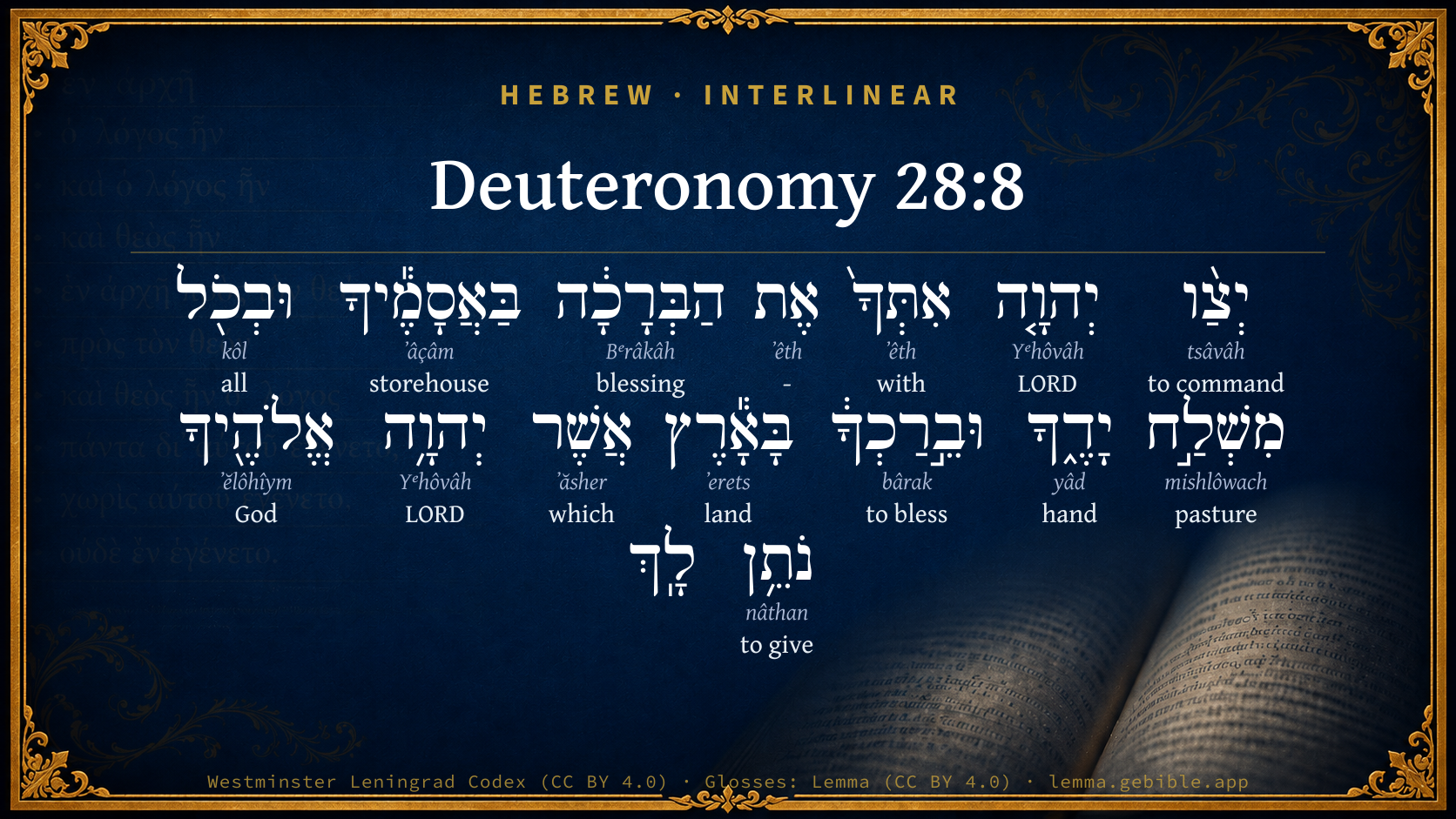
Hebrew (Westminster Leningrad Codex) Deuteronomy 28:8 appears in the Hebrew Old Testament. The text above is from the Westminster Leningrad Codex. Each word links to its Strong’s number, a concise gloss, and parsing drawn from the Open Scriptures Hebrew Bible morphology. Click any word for its full Brown-Driver-Briggs (BDB) entry.
Download image
Cite this verse

Deuteronomy 28:8 (World English Bible). Public Domain. Lemma interlinear Bible study tool, https://lemma.gebible.app/v/deuteronomy/28/8.

Show BibTeX & RIS
BibTeX
RIS
English Translation
Yahweh will command the blessing on you in your barns, and in all that you put your hand to; and he will bless you in the land which Yahweh your God gives you.
World English Bible · Public Domain
Highlights
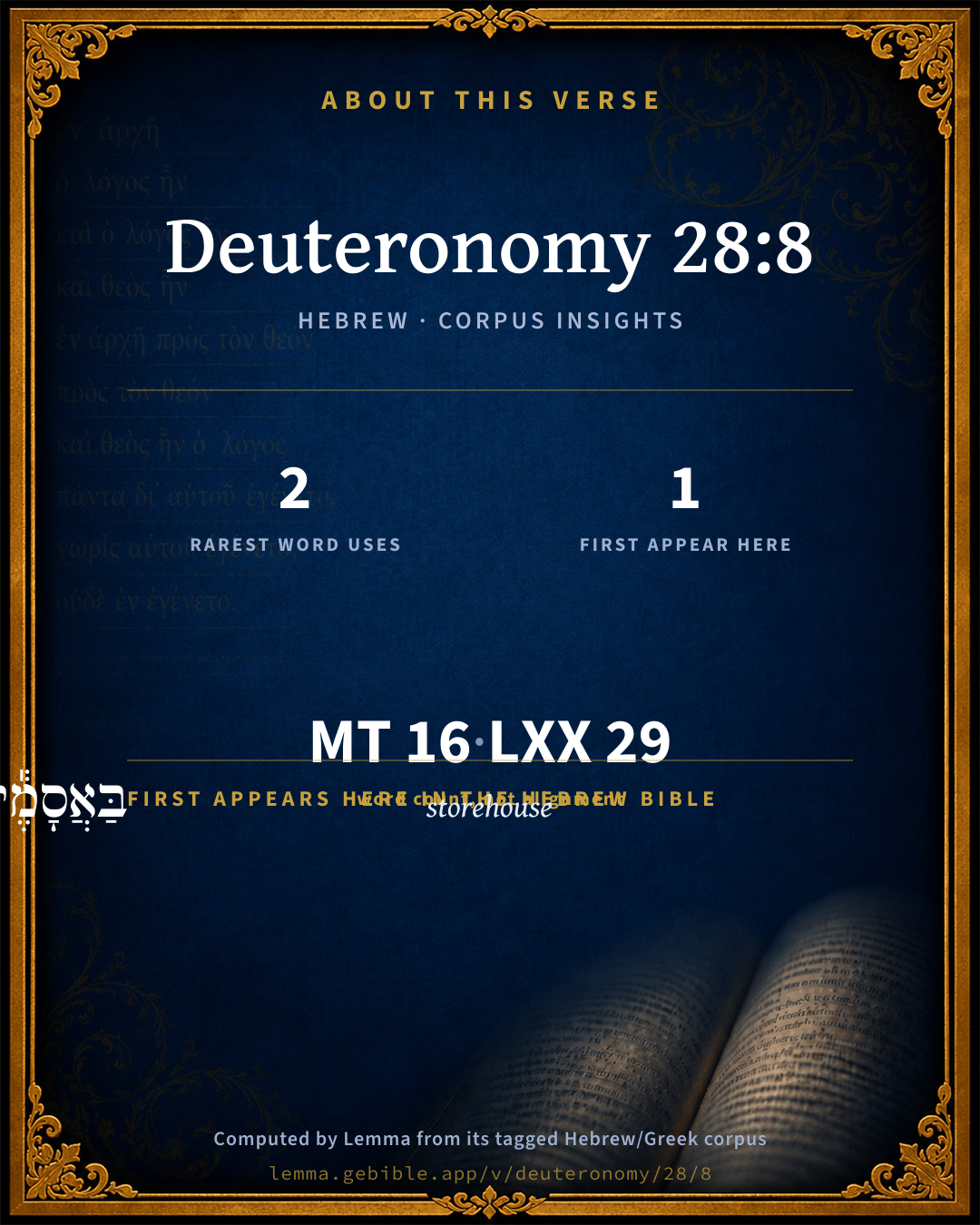
  • 1 first appearance in the Hebrew Bible
Full analysis ↓
Download a study sheet

One document with this verse’s original text, its word-by-word gloss line, the meaning frame, cross-references with their text, attributed commentary, and full source and license credits — printable, and it pastes into notes with its structure intact.

This verse Autodidact and up

Study sheet (.html) Plain text (.txt)

A passage Seminary Student

Up to 50 verses in one chapter. A passage sheet keeps up to 6 commentary sources and 12 cross-references per verse, in the order this page ranks them, and says so on the sheet whenever that leaves anything out. Ask for a single verse and you get the Autodidact verse sheet above.

Everything on this page stays free to read, with no account — the sheet is a download of what is already on screen, not access to it.

Want to remove ads? Support Godless Engineer
Compare translations 3

The same verse in 3 English versions, stacked beneath the original-language interlinear above. Click any original word for its lexicon entry.

Each is an independent rendering of the whole verse — the interlinear is not word-aligned to these translations.

Highlighted words mark where these versions differ — a whole-verse word diff, not a word-by-word alignment.

  • World English Bible Public Domain
    Yahweh will command the blessing on you in your barns, and in all that you put your hand to; and he will bless you in the land which Yahweh your God gives you.
  • King James Version Public Domain
    The LORD shall command the blessing upon thee in thy storehouses, and in all that thou settest thine hand unto; and he shall bless thee in the land which the LORD thy God giveth thee.
  • unfoldingWord Literal Text CC BY-SA 4.0
    Yahweh will command for you the blessing in your barns and in all the sending out of your hand, and he will bless you in the land that Yahweh your God is giving to you.

unfoldingWord Literal Text — © unfoldingWord, licensed CC BY-SA 4.0. Word-aligned USFM3 via Door43 (git.door43.org/unfoldingWord/en_ult).

Versions to compare (up to 4)

3 of 4 selected

Show all 18 translations

Every available English version of this verse, each an independent rendering of the whole verse.

  • World English Bible Public Domain
    Yahweh will command the blessing on you in your barns, and in all that you put your hand to; and he will bless you in the land which Yahweh your God gives you.
  • Berean Standard Bible Public Domain
    The LORD will decree a blessing on your barns and on everything to which you put your hand; the LORD your God will bless you in the land He is giving you.
  • Majority Standard Bible Public Domain
    The LORD will decree a blessing on your barns and on everything to which you put your hand; the LORD your God will bless you in the land He is giving you.
  • King James Version Public Domain
    The LORD shall command the blessing upon thee in thy storehouses, and in all that thou settest thine hand unto; and he shall bless thee in the land which the LORD thy God giveth thee.
  • American Standard Version (1901) Public Domain
    Jehovah will command the blessing upon thee in thy barns, and in all that thou puttest thy hand unto; and he will bless thee in the land which Jehovah thy God giveth thee.
  • Revised Version (1885) Public Domain
    The LORD shall command the blessing upon thee in thy barns, and in all that thou puttest thine hand unto: and he shall bless thee in the land which the LORD thy God giveth thee.
  • Geneva Bible (1599) Public Domain
    The Lord shall command the blessing to be with thee in thy store houses, and in all that thou settest thine hande to, and wil blesse thee in the land which the Lord thy God giueth thee.
  • Douay-Rheims (1899) Public Domain
    The Lord will send forth a blessing upon thy storehouses, and upon all the works of thy hands: and will bless thee in the land that thou shalt receive.
  • Young's Literal Translation Public Domain
    `Jehovah commandeth with thee the blessing in thy storehouses, and in every putting forth of thy hand, and hath blessed thee in the land which Jehovah thy God is giving to thee.
  • Literal Standard Version CC BY-SA 4.0
    YHWH commands the blessing with you in your storehouses, and in every putting forth of your hand, and has blessed you in the land which your God YHWH is giving to you.
  • Unlocked Literal Bible CC BY-SA 4.0
    Yahweh will command the blessing to come on you in your barns and in all that you put your hand to; he will bless you in the land that he is giving you.
  • unfoldingWord Literal Text CC BY-SA 4.0
    Yahweh will command for you the blessing in your barns and in all the sending out of your hand, and he will bless you in the land that Yahweh your God is giving to you.
  • Darby Bible Public Domain
    Jehovah will command blessing on thee in thy granaries, and in all the business of thy hand; and he will bless thee in the land which Jehovah thy God giveth thee.
  • World Messianic Bible Public Domain
    The LORD will command the blessing on you in your barns, and in all that you put your hand to. He will bless you in the land which the LORD your God gives you.
  • Webster's Bible Public Domain
    The LORD shall command the blessing upon thee in thy store-houses, and in all that thou settest thy hand to: and he shall bless thee in the land which the LORD thy God giveth thee.
  • Free Bible Version CC BY-SA 4.0
    The Lord will bless your income and everything you do. The Lord your God will bless you in the country he is giving you.
  • Bible in Basic English Public Domain
    The Lord will send his blessing on your store-houses and on everything to which you put your hand: his blessing will be on you in the land which the Lord your God is giving you.
  • JPS Tanakh (1917) Public Domain
    The LORD will command the blessing with thee in thy barns, and in all that thou puttest thy hand unto; and He will bless thee in the land which the LORD thy God giveth thee.

Literal Standard Version (2020), Covenant Press — licensed CC BY-SA 4.0. Text via the HelloAO Bible API (eBible.org). Unlocked Literal Bible (unfoldingWord) — licensed CC BY-SA 4.0. Text via the HelloAO Bible API (eBible.org). unfoldingWord Literal Text — © unfoldingWord, licensed CC BY-SA 4.0. Word-aligned USFM3 via Door43 (git.door43.org/unfoldingWord/en_ult). Free Bible Version, Dr. Jonathan Gallagher — licensed CC BY-SA 4.0. Text via the HelloAO Bible API (eBible.org).

Word by word

More ways to search: Search by grammar → Find every occurrence → Compare this word →

Practice this passage: Drill this verse → Learn its vocabulary →

בַּאֲסָמֶ֕יךָ
ʼâçâm
H618
“in/at · storehouses · your”
Preposition + Noun, Common, Masculine, Plural, Construct + Suffix, Personal, 2nd Person, Masculine, Singular
Part of Speech
Preposition + Noun
Type
Common
Gender
Masculine
Number
Plural
State
Construct
Full BDB Definition

Origin: from an unused root meaning to heap together, a storehouse (only in the plural)

TWOT: 139a

storehouse, barn
  1. יְצַ֨ו tsâvâh H6680 “to command” Verb, Piel, Imperfect, 3rd Person, Masculine, Singular
  2. יְהוָ֤ה Yᵉhôvâh H3068 “LORD” Noun, Proper
  3. אִתְּךָ֙ ʼêth H854 “with · you” Preposition + Suffix, Personal, 2nd Person, Masculine, Singular
  4. אֶת ʼêth H853 “-” Particle, Direct Object
  5. הַבְּרָכָ֔ה Bᵉrâkâh H1293 “the · blessing” Particle, Definite Article + Noun, Common, Feminine, Singular, Absolute
  6. וּבְכֹ֖ל kôl H3605 “and · in/at · all of” Conjunction + Preposition + Noun, Common, Masculine, Singular, Construct
  7. מִשְׁלַ֣ח mishlôwach H4916 “pasture of” Noun, Common, Masculine, Singular, Construct
  8. יָדֶ֑ךָ yâd H3027 “hand · your” Noun, Common, Both, Singular, Construct + Suffix, Personal, 2nd Person, Masculine, Singular
  9. וּבֵ֣רַכְךָ֔ bârak H1288 “and · to bless · you” Conjunction + Verb, Piel, Sequential Perfect, 3rd Person, Masculine, Singular + Suffix, Personal, 2nd Person, Masculine, Singular
  10. בָּאָ֕רֶץ ʼerets H776 “in/at the · land” Preposition, Determined + Noun, Common, Both, Singular, Absolute
  11. אֲשֶׁר ʼăsher H834 “which” Particle, Relative
  12. יְהוָ֥ה Yᵉhôvâh H3068 “LORD” Noun, Proper
  13. אֱלֹהֶ֖יךָ ʼĕlôhîym H430 “God(s) · your” Noun, Common, Masculine, Plural, Construct + Suffix, Personal, 2nd Person, Masculine, Singular
  14. נֹתֵ֥ן nâthan H5414 “giving” Verb, Qal, Participle Active, Masculine, Singular, Absolute

About this verse

These counts appear in no published source. They are computed here, from the morphology-tagged text and Lemma’s own curated glosses. What Lemma adds →

16
words
14
distinct lemmas
Pentateuch
section

Notable vocabulary

The rarest word here is בַּאֲסָמֶ֕יךָ storehouse H618 — appearing just 2 times in the whole Hebrew Bible.

First appearance in Scripture

This word makes its first canonical appearance in the Hebrew Bible here:

  • בַּאֲסָמֶ֕יךָ storehouse H618

Shared distinctive vocabulary

בַּאֲסָמֶ֕יךָ storehouse H618 occurs in 2 verses of the Hebrew Bible. Also found in:

Grammatical profile

  • 3 verbs
  • 9 nouns
  • 2 prepositions
  • 2 particles

Verb forms

  • יְצַ֨ו Piel · Imperfect
  • וּבֵ֣רַכְךָ֔ Piel · Sequential Perfect
  • נֹתֵ֥ן Qal · Participle Active

Repetition

A word recurs within this verse — often emphatic in Hebrew:

  • יְהוָ֤ה LORD H3068 ×2

Hebrew & Septuagint length

In English translation the verse runs 33 words from the Hebrew and 30 from the Septuagint (LXX English) — closely comparable.

A rough comparison of the two English renderings, which tokenize alike — not a word-level alignment.

Word counts can differ between the Hebrew and the Greek without any difference in meaning — e.g. the Hebrew direct-object marker אֵת has no separate Greek word, and Greek often adds the article ὁ.

In the original languages it is 16 Hebrew tokens and 29 Greek tokens — but the two are counted differently (Hebrew bundles its prefixes and suffixes into one token; the Greek is in lemma form), so that isn’t a like-for-like length.

Cross-references

16

Topical passages linked to Deuteronomy 28:8 in the Treasury of Scripture Knowledge — connected by theme and wording, ordered by reader-vote popularity; previews shown in the World English Bible.

  • Deuteronomy 15:10 You shall surely give him, and your heart shall not be grieved when you give to him; because that for this thing Yahweh your God will bless you in all your work, and in all that you put your hand to.
  • Leviticus 26:10 You shall eat old store long kept, and you shall move out the old because of the new.
  • Proverbs 3:9–10 Honor Yahweh with your substance, With the first fruits of all your increase:
  • Psalms 133:3 Like the dew of Hermon, That comes down on the hills of Zion: For there Yahweh gives the blessing, Even life forevermore.
  • Leviticus 26:4–5 then I will give you your rains in their season, and the land shall yield its increase, and the trees of the field shall yield their fruit.
  • Malachi 3:10–11 Bring the whole tithe into the store-house, that there may be food in my house, and test me now in this," says Yahweh of hosts, "if I will not open you the windows of heaven, and pour you out a blessing, that there shall not be room enough for.
  • Luke 12:18 He said, 'This is what I will do. I will pull down my barns, and build bigger ones, and there I will store all my grain and my goods.
  • Matthew 6:26 See the birds of the sky, that they don't sow, neither do they reap, nor gather into barns. Your heavenly Father feeds them. Aren't you of much more value than they?
  • Leviticus 25:21 then I will command my blessing on you in the sixth year, and it shall bring forth fruit for the three years.
  • Psalms 42:8 Yahweh will command his loving kindness in the daytime. In the night his song shall be with me: A prayer to the God of my life.
  • Haggai 2:19 Is the seed yet in the barn? Yes, the vine, the fig tree, the pomegranate, and the olive tree haven't brought forth. From this day will I bless you.'"
  • Luke 12:24–25 Consider the ravens: they don't sow, they don't reap, they have no warehouse or barn, and God feeds them. How much more valuable are you than birds!
  • 2 Kings 6:27 He said, If Yahweh doesn't help you, whence shall I help you? out of the threshing floor, or out of the winepress?
  • Psalms 144:13 Our barns are full, filled with all kinds of provision. Our sheep bring forth thousands and ten thousands in our fields.
  • Psalms 44:4 You are my King, God. Command victories for Jacob!
  • Matthew 13:30 Let both grow together until the harvest, and in the harvest time I will tell the reapers, "First, gather up the darnel, and bind them in bundles to burn them; but gather the wheat into my barn."'"

Cross-references courtesy of OpenBible.info (CC BY 4.0).

Hebrew and Greek witnesses Masoretic Hebrew ↔ Greek Septuagint

The same verse in the two great witnesses to the Old Testament, shown verse-for-verse.

These are two independent witnesses, not word-aligned to each other, and the Septuagint is shown in lemma (dictionary) form.

Hebrew Deuteronomy 28:8 Masoretic · Westminster Leningrad Codex

יְצַ֨ו יְהוָ֤ה אִתְּךָ֙ אֶת הַבְּרָכָ֔ה בַּאֲסָמֶ֕יךָ וּבְכֹ֖ל מִשְׁלַ֣ח יָדֶ֑ךָ וּבֵ֣רַכְךָ֔ בָּאָ֕רֶץ אֲשֶׁר יְהוָ֥ה אֱלֹהֶ֖יךָ נֹתֵ֥ן לָֽךְ

Yahweh will command the blessing on you in your barns, and in all that you put your hand to; and he will bless you in the land which Yahweh your God gives you.

World English Bible · Public Domain

Greek LXX Deuteronomy 28:8 Septuagint · lemma form

ἀποστέλλω κύριος ἐπί σύ ὁ εὐλογία ἐν ὁ ταμιεῖον σύ καί ἐν πᾶς οὗ ἄν ἐπιβάλλω ὁ χείρ σύ ἐπί ὁ γῆ ὅς κύριος ὁ θεός σύ δίδωμι σύ

The Lord send upon you his blessing in your barns, and on all on which you shall put your hand, in the land which the Lord your God gives you.

LXX2012 (modern English Septuagint) · Public Domain

On this verse, The Cambridge Bible for Schools and Colleges discusses the Septuagint’s reading. Read the note in Commentary ↓

Hebrew: Westminster Leningrad Codex (CC BY 4.0). Greek: Septuagint (public domain); English from LXX2012 (modern English Septuagint) (Public Domain). How the Septuagint differs from the Hebrew →

Targum (Aramaic paraphrase)

2

The Targum is the ancient Jewish Aramaic paraphrase of the Hebrew Scriptures — an interpretive translation, not the Hebrew text itself. Onkelos (literal) and Pseudo-Jonathan (expansive) render the Torah, and Jonathan the Prophets. Coverage is partial: where no permissively-licensed English translation exists for a verse, only the Aramaic is shown. This is verse-level text, not a word-by-word alignment to the Hebrew.

  1. Targum Onkelos Torah (Genesis–Deuteronomy)
    יְפַקֵד יְיָ עִמָךְ יָת בִּרְכְּתָא בְּאוֹצָרָךְ וּבְכֹל אוֹשָׁטוּת יְדָךְ וִיבָרְכִנָךְ בְּאַרְעָא דַיְיָ אֱלָהָךְ יָהֵב לָךְ

    (no public-domain English translation for this verse)

    Targum Onkelos — Aramaic: “Onkelos Genesis” (public domain); “Onkelos Exodus” (public domain); “Onkelos Leviticus” (public domain); “Onkelos Numbers” (public domain); “Onkelos Deuteronomy” (public domain). English: “Sefaria Community Translation” (CC0 1.0 (public-domain dedication)); “J.W. Etheridge. The Targums of Onkelos and Jonathan Ben Uzziel on the Pentateuch. London: Longmans, Green, 1862” (public domain). Text via Sefaria.

  2. Targum Pseudo-Jonathan Torah (Genesis–Deuteronomy)
    יְפַקֵיד יְיָ עִמְכוֹן יַת בִּרְכָתָא בְּאוֹצְרֵיכוֹן וּבְכָל אוֹשָׁטוּת יְדֵיכוֹן וִיבָרְכֵיכוֹן בְּאַרְעָא דַיְיָ אֱלָהָכוֹן יָהֵיב לְכוֹן

    The Lord will command the blessing upon you in your treasuries, and on all that you put your hands unto, and will bless you in the land which the Lord your God giveth you.

    Targum Pseudo-Jonathan — Aramaic: “Targum Jonathan on Genesis” (public domain); “Targum Jonathan on Exodus” (public domain); “Targum Jonathan on Leviticus” (public domain); “Targum Jonathan on Numbers” (public domain); “Targum Jonathan on Deuteronomy” (public domain). English: “The Targum of Jonathan ben Uzziel, trans. J. W. Etheridge, London, 1862” (public domain). Text via Sefaria.

Commentary

Notes on Deuteronomy 28:8 from classic Christian and Jewish commentators (each source and its license shown beneath its notes). The classic Christian expositions comment on the surrounding passage and are grouped to its opening verse, so a note may address several verses; the Jewish commentaries on the Tanakh (Rashi and others) are per-verse, so they appear only where the commentator wrote on this verse.

Lemma curates 59 commentaries, every one of them public domain or Creative Commons licensed, each selected and text-cleaned for this edition rather than reprinted as found. About our sources →

Trapp's Complete Commentary

John Trapp

Deu 28:8 The LORD shall command the blessing upon thee in thy storehouses, and in all that thou settest thine hand unto; and he shall bless thee in the land which the LORD thy God giveth thee.

Ver. 8. The Lord shall command the blessing.] Now if he send his Mandamus, who shall withstand it?

John Trapp, A Commentary or Exposition upon All the Books of the Old and New Testament (1647–1656) — public domain. Text from a community e-Sword module.

Geneva Bible (1599)

Geneva Bible translators

God will bless us, if we do our duty, and not be idle.

Geneva Bible (1599) marginal notes — public domain. Text via Bolls.life.

Adam Clarke's Commentary

Verse 8. The Lord shall command the blessing upon thee] Every thing that thou hast shall come by Divine appointment; thou shalt have nothing casually, but every thing, both spiritual and temporal, shall come by the immediate command of God.

Adam Clarke's Commentary on the Bible (1810–1826) — public domain. Text from a community e-Sword/MySword module.

Ellicott's Commentary for English Readers

(8) Thy storehouses.—The word is only found here and in Pro_3:9-10, “Honour the Lord with thy substance, and with the firstfruits of all thine increase: so shall thy barns be filled with plenty, and thy presses shall burst out with new wine.” There is the same kind of contrast here which has been already pointed out in Deu_28:5. The “gathering in” to the barn, and the “putting forth” of the hand—the income and the expenditure—are alike blessed. This contrast is clear in the Hebrew words employed.

And he shall bless thee in the land.—Fixity of tenure in the Divine inheritance is promised here.

A Bible Commentary for English Readers, edited by Charles John Ellicott (1878–1897) — public domain. Text from a community e-Sword module.

The Cambridge Bible for Schools and Colleges

gen. ed. J. J. S. Perowne

8. shall command] Heb. has the jussive, command; it is uncertain which we should read; upon thee, lit. with thee.

barns] Only here and Pro_3:10. Cp. above, Deu_15:10.

and he shall bless thee] LXX (except some cursives) omits.

The Cambridge Bible for Schools and Colleges (gen. ed. J. J. S. Perowne; Cambridge University Press, 1878–1918) — public domain. Text from a community e-Sword module.

John Gill's Exposition

And the Lord shall establish thee an holy people unto himself,.... Having separated them from all others, for his service, honour, and glory, should continue them as such, and settle them in the land, and confirm all their privileges, natural, civil, and religious. The Targum of Jonathan is,"the Word of the Lord shall establish thee, &c.''he that brought them out of Egypt, through the Red sea and wilderness, to the land of Canaan:

as he hath sworn unto thee: and to their fathers; see Deu 7:12,

if thou shall keep the commandments of the Lord thy God, and walk in his ways; by which tenure they held the land of Canaan, and their settlement and continuance in it, and enjoyment of all the good things thereof; see Isa 1:19.

John Gill's Exposition of the Whole Bible (1746–1763) — public domain (CC PDM 1.0). Text via the HelloAO Bible API.

Matthew Poole's English Annotations

Shall command, i.e. shall by his sovereign and powerful providence give it, even when it seems furthest from thee, and not likely to come to time without a word of command from God himself.

Matthew Poole's English Annotations on the Holy Bible (1683–1685) — public domain. Text from a community e-Sword/MySword module.

The Pulpit Commentary

The effect of the blessing should be seen, not only in the supremacy of Israel over all opposition, but in the abundance of their possessions, in the success of their undertakings, and in the respect in which they should be held by all nations. Storehouses. The Hebrew word ( which occurs only here and in Pro_3:10, is properly thus rendered. It comes from a root which signifies to lay up.

The blessing that maketh rich.

I FULL STOREHOUSES, WITHOUT GOD"S BLESSING, ARE NOT RICHES. God does not count a man rich further than the good things he has are of real and lasting benefit to him. Wealth unblessed of God is not to be desired.

1. Unblessed good is ill. (Ecc_5:10-15)

2. It turns to ill is not enduring, (Pro_13:22) takes wings and leaves, is a curse to offspring (Ecc_5:14, 15 6:2; Jam_5:1, Jam_5:2)

II GOD"S BLESSING, WITHOUT FULL STOREHOUSES, MAKES RICH.

1. It enriches the little we have. A man with a moderate competence, and peace and comfort in the use of it, may be richer than the man whose means are tenfold greater. (Psa_37:16)

2. It makes adversity a means of spiritual enrichment.

3. It is itself the best of all riches. J.O. (Hab_3:17-19)

The Pulpit Commentary (1880–1919), ed. H.D.M. Spence-Jones & Joseph S. Exell — public domain. Text from a community e-Sword module.

Lesson kit

Teaching starters — assembled from the data on this page, not authored interpretation. Every prompt links to the verse data it draws on. Edit before teaching.

Deuteronomy, in the Pentateuch, opens this verse with 16 words (14 distinct Hebrew lemmas). Its most distinctive word is ʼâçâm (“storehouse”). A historical commentator’s framing appears above. Read the whole chapter for the surrounding context.

Discussion questions

  1. How does “storehouse” (ʼâçâm) shape what this verse is saying?
  2. This is the first place “storehouse” appears in Scripture (first appears here). What does its debut here establish?
  3. How does Proverbs 3:10, which shares the word «storehouse», read alongside this verse?
  4. What does the repetition of “LORD” (2× in this one verse) do in this verse?
  5. These translations render this verse differently; the difference is in the English rendering, not the original. What questions does that raise?
  6. «יְצַ֨ו» is a Piel Imperfect verb. How does that grammatical form shape the action described?
  7. Compare how Trapp's Complete Commentary and Geneva Bible (1599) read this verse. Where do they agree or differ?

Things to notice

Reading settings

Reading text

Shown beneath each verse's original-language words.

Old Testament
Old Testament edition

Read the OT as the Masoretic Hebrew (MT) or the Greek Septuagint (LXX).

English shown for the Greek Septuagint (in the Hebrew ↔ Greek comparison).

Comparing translations? Open the Compare panel on any verse page to stack up to four side by side.