

1 Chronicles 17:27

Hebrew (Westminster Leningrad Codex) 1 Chronicles 17:27 appears in the Hebrew Old Testament. The text above is from the Westminster Leningrad Codex. Each word links to its Strong’s number, a concise gloss, and parsing drawn from the Open Scriptures Hebrew Bible morphology. Click any word for its full Brown-Driver-Briggs (BDB) entry.
Download image
Cite this verse

1 Chronicles 17:27 (World English Bible). Public Domain. Lemma interlinear Bible study tool, https://lemma.gebible.app/v/1-chronicles/17/27.

Show BibTeX & RIS
BibTeX
RIS
English Translation
and now it has pleased you to bless the house of your servant, that it may continue forever before you: for you, Yahweh, have blessed, and it is blessed forever.
World English Bible · Public Domain
Download a study sheet

One document with this verse’s original text, its word-by-word gloss line, the meaning frame, cross-references with their text, attributed commentary, and full source and license credits — printable, and it pastes into notes with its structure intact.

This verse Autodidact and up

Study sheet (.html) Plain text (.txt)

A passage Seminary Student

Up to 50 verses in one chapter. A passage sheet keeps up to 6 commentary sources and 12 cross-references per verse, in the order this page ranks them, and says so on the sheet whenever that leaves anything out. Ask for a single verse and you get the Autodidact verse sheet above.

Everything on this page stays free to read, with no account — the sheet is a download of what is already on screen, not access to it.

Want to remove ads? Support Godless Engineer
Compare translations 3

The same verse in 3 English versions, stacked beneath the original-language interlinear above. Click any original word for its lexicon entry.

Each is an independent rendering of the whole verse — the interlinear is not word-aligned to these translations.

Highlighted words mark where these versions differ — a whole-verse word diff, not a word-by-word alignment.

  • World English Bible Public Domain
    and now it has pleased you to bless the house of your servant, that it may continue forever before you: for you, Yahweh, have blessed, and it is blessed forever.
  • King James Version Public Domain
    Now therefore let it please thee to bless the house of thy servant, that it may be before thee for ever: for thou blessest, O LORD, and it shall be blessed for ever.
  • unfoldingWord Literal Text CC BY-SA 4.0
    And now, you have decided to bless the house of your servant, to be to your face forever. For you, Yahweh, you have blessed, so it will be blessed forever.”

unfoldingWord Literal Text — © unfoldingWord, licensed CC BY-SA 4.0. Word-aligned USFM3 via Door43 (git.door43.org/unfoldingWord/en_ult).

Versions to compare (up to 4)

3 of 4 selected

Show all 18 translations

Every available English version of this verse, each an independent rendering of the whole verse.

  • World English Bible Public Domain
    and now it has pleased you to bless the house of your servant, that it may continue forever before you: for you, Yahweh, have blessed, and it is blessed forever.
  • Berean Standard Bible Public Domain
    So now You have been pleased to bless the house of Your servant, that it may continue forever before You. For You, O LORD, have blessed it, and it will be blessed forever.”
  • Majority Standard Bible Public Domain
    So now You have been pleased to bless the house of Your servant, that it may continue forever before You. For You, O LORD, have blessed it, and it will be blessed forever.”
  • King James Version Public Domain
    Now therefore let it please thee to bless the house of thy servant, that it may be before thee for ever: for thou blessest, O LORD, and it shall be blessed for ever.
  • American Standard Version (1901) Public Domain
    and now it hath pleased thee to bless the house of thy servant, that it may continue for ever before thee: for thou, O Jehovah, hast blessed, and it is blessed for ever.
  • Revised Version (1885) Public Domain
    and now it hath pleased thee to bless the house of thy servant, that it may continue for ever before thee: for thou, O LORD, hast blessed, and it is blessed for ever.
  • Geneva Bible (1599) Public Domain
    Now therfore, it hath pleased thee to blesse the house of thy seruant, that it may bee before thee for euer: for thou, O Lord, hast blessed it, and it shalbe blessed for euer.
  • Douay-Rheims (1899) Public Domain
    And thou hast begun to bless the house of thy servant, that it may be always before thee: for seeing thou blessest it, O Lord, it shall be blessed for ever.
  • Young's Literal Translation Public Domain
    and now, Thou hast been pleased to bless the house of Thy servant, to be to the age before Thee; for Thou, O Jehovah, hast blessed, and it is blessed to the age.'
  • Literal Standard Version CC BY-SA 4.0
    and now, You have been pleased to bless the house of Your servant, to be before You for all time; for You, O YHWH, have blessed, and it is blessed for all time.”
  • Unlocked Literal Bible CC BY-SA 4.0
    Now it has pleased you to bless your servant's house, that it may continue forever before you. You, Yahweh, have blessed it, and it will be blessed forever.”
  • unfoldingWord Literal Text CC BY-SA 4.0
    And now, you have decided to bless the house of your servant, to be to your face forever. For you, Yahweh, you have blessed, so it will be blessed forever.”
  • Darby Bible Public Domain
    and now, let it please thee to bless the house of thy servant, that it may be before thee for ever; for thou, Jehovah, hast blessed [it], and it shall be blessed for ever.
  • World Messianic Bible Public Domain
    Now it has pleased you to bless the house of your servant, that it may continue forever before you; for you, LORD, have blessed, and it is blessed forever.”
  • Webster's Bible Public Domain
    Now therefore let it please thee to bless the house of thy servant, that it may be before thee for ever: for thou blessest, O LORD, and it shall be blessed for ever.
  • Free Bible Version CC BY-SA 4.0
    So now, please bless your servant's house that it may continue in your presence forever. For when you bless, Lord, it is blessed forever.”
  • Bible in Basic English Public Domain
    And now you have been pleased to give your blessing to the family of your servant, so that it may go on for ever before you; you, O Lord, have given your blessing, and a blessing will be on it for ever.
  • JPS Tanakh (1917) Public Domain
    and now it hath pleased Thee to bless the house of Thy servant, that it may continue for ever before Thee; for Thou, O LORD, hast blessed, and so let Thy servant be blessed for ever.'

Literal Standard Version (2020), Covenant Press — licensed CC BY-SA 4.0. Text via the HelloAO Bible API (eBible.org). Unlocked Literal Bible (unfoldingWord) — licensed CC BY-SA 4.0. Text via the HelloAO Bible API (eBible.org). unfoldingWord Literal Text — © unfoldingWord, licensed CC BY-SA 4.0. Word-aligned USFM3 via Door43 (git.door43.org/unfoldingWord/en_ult). Free Bible Version, Dr. Jonathan Gallagher — licensed CC BY-SA 4.0. Text via the HelloAO Bible API (eBible.org).

Word by word

More ways to search: Search by grammar → Find every occurrence → Compare this word →

Practice this passage: Drill this verse → Learn its vocabulary →

הוֹאַ֨לְתָּ֙
yâʼal
H2974
“to be willing”
Verb, Hiphil, Perfect, 2nd Person, Masculine, Singular
Part of Speech
Verb
Stem
Hiphil
Form
Perfect
Person
2nd Person
Gender
Masculine
Number
Singular
Full BDB Definition

Origin: a primitive root [probably rather the same as H2973 through the idea of mental weakness]

TWOT: 831

to begin, make a beginning, show willingness, undertake to do, be pleased, be determined - (Hiphil) - to agree to, show willingness, acquiesce, accept an invitation, be willing - to undertake - to resolve, be pleased, be determined
  1. וְעַתָּ֗ה ʻattâh H6258 “and · now” Conjunction + Adverb
  2. לְבָרֵךְ֙ bârak H1288 “to bless” Preposition + Verb, Piel, Infinitive Construct
  3. אֶת ʼêth H853 “-” Particle, Direct Object
  4. בֵּ֣ית bayith H1004 “house of” Noun, Common, Masculine, Singular, Construct
  5. עַבְדְּךָ֔ ʻebed H5650 “servant · your” Noun, Common, Masculine, Singular, Construct + Suffix, Personal, 2nd Person, Masculine, Singular
  6. לִהְי֥וֹת hâyâh H1961 “to be” Preposition + Verb, Qal, Infinitive Construct
  7. לְעוֹלָ֖ם ʻôwlâm H5769 “to/for · forever” Preposition + Noun, Common, Masculine, Singular, Absolute
  8. לְפָנֶ֑יךָ pânîym H6440 “to/for · face(s) · your” Preposition + Noun, Common, Both, Plural, Construct + Suffix, Personal, 2nd Person, Masculine, Singular
  9. כִּֽי kîy H3588 “that” Conjunction
  10. אַתָּ֤ה ʼattâh H859 “you” Pronoun, Personal, 2nd Person, Masculine, Singular
  11. יְהוָה֙ Yᵉhôvâh H3068 “LORD” Noun, Proper
  12. בֵּרַ֔כְתָּ bârak H1288 “to bless” Verb, Piel, Perfect, 2nd Person, Masculine, Singular
  13. וּמְבֹרָ֖ךְ bârak H1288 “and · blessed” Conjunction + Verb, Pual, Participle Passive, Masculine, Singular, Absolute
  14. לְעוֹלָֽם ʻôwlâm H5769 “to/for · forever” Preposition + Noun, Common, Masculine, Singular, Absolute

About this verse

These counts appear in no published source. They are computed here, from the morphology-tagged text and Lemma’s own curated glosses. What Lemma adds →

15
words
12
distinct lemmas
Historical
section

Notable vocabulary

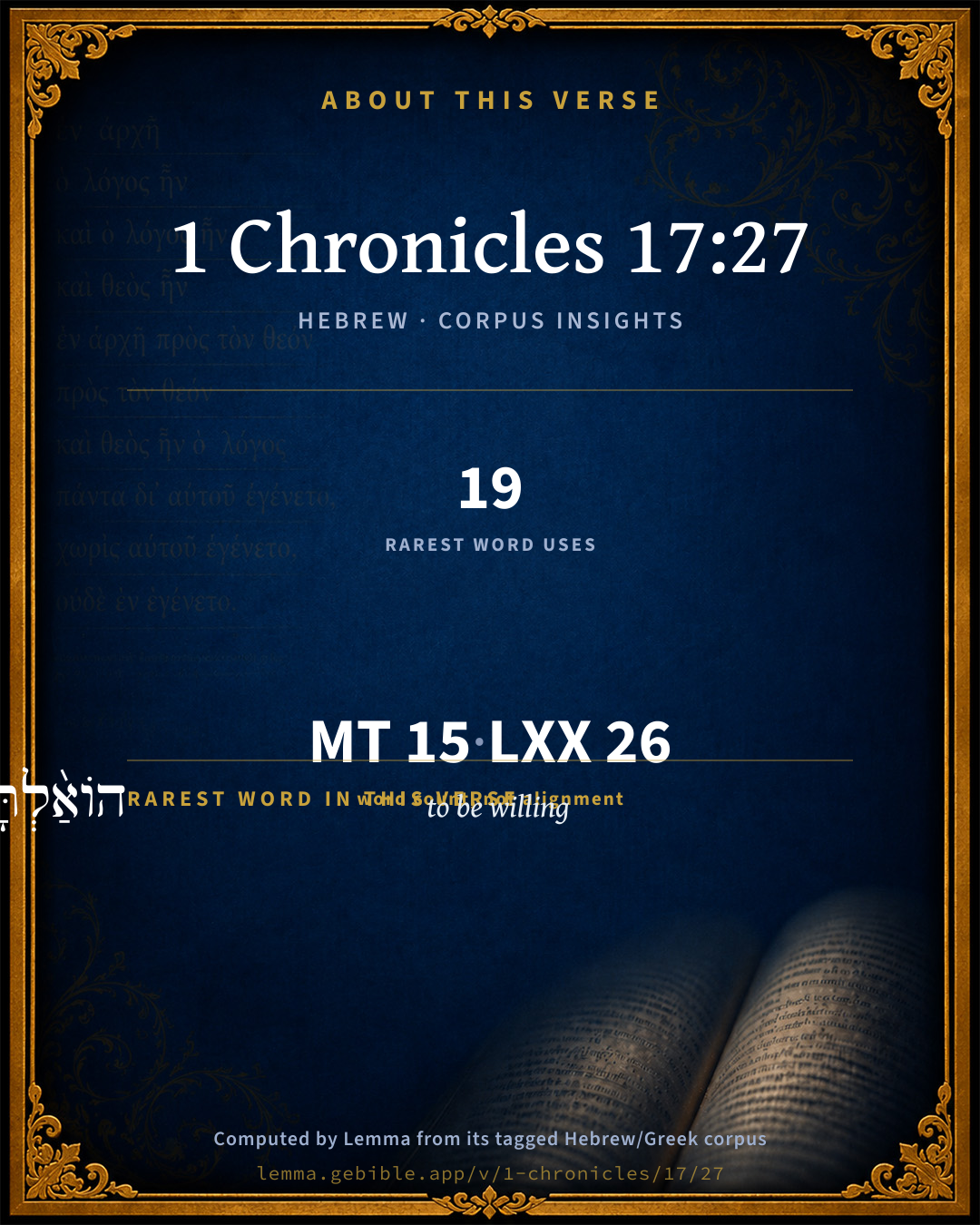
The rarest word here is הוֹאַ֨לְתָּ֙ to be willing H2974 — appearing just 19 times in the whole Hebrew Bible.

Shared distinctive vocabulary

הוֹאַ֨לְתָּ֙ to be willing H2974 occurs in 19 verses of the Hebrew Bible. Also found in:

Grammatical profile

  • 5 verbs
  • 6 nouns
  • 1 pronoun
  • 1 conjunction
  • 1 adverb
  • 1 particle

Verb forms

  • הוֹאַ֨לְתָּ֙ Hiphil · Perfect
  • לְבָרֵךְ֙ Piel · Infinitive Construct
  • לִהְי֥וֹת Qal · Infinitive Construct
  • בֵּרַ֔כְתָּ Piel · Perfect
  • וּמְבֹרָ֖ךְ Pual · Participle Passive

Repetition

Words recur within this verse — often emphatic in Hebrew:

  • לְבָרֵךְ֙ to bless H1288 ×3
  • לְעוֹלָ֖ם forever H5769 ×2

Hebrew & Septuagint length

In English translation the verse runs 30 words from the Hebrew and 34 from the Septuagint (LXX English) — closely comparable.

A rough comparison of the two English renderings, which tokenize alike — not a word-level alignment.

Word counts can differ between the Hebrew and the Greek without any difference in meaning — e.g. the Hebrew direct-object marker אֵת has no separate Greek word, and Greek often adds the article ὁ.

In the original languages it is 15 Hebrew tokens and 26 Greek tokens — but the two are counted differently (Hebrew bundles its prefixes and suffixes into one token; the Greek is in lemma form), so that isn’t a like-for-like length.

Cross-references

3

Topical passages linked to 1 Chronicles 17:27 in the Treasury of Scripture Knowledge — connected by theme and wording, ordered by reader-vote popularity; previews shown in the World English Bible.

  • Ephesians 1:3 Blessed be the God and Father of our Lord Jesus Christ, who has blessed us with every spiritual blessing in the heavenly places in Christ;
  • Romans 11:29 For the gifts and the calling of God are irrevocable.
  • Psalms 72:17 His name endures forever. His name continues as long as the sun. Men shall be blessed by him. All nations will call him blessed.

Cross-references courtesy of OpenBible.info (CC BY 4.0).

Hebrew and Greek witnesses Masoretic Hebrew ↔ Greek Septuagint

The same verse in the two great witnesses to the Old Testament, shown verse-for-verse.

These are two independent witnesses, not word-aligned to each other, and the Septuagint is shown in lemma (dictionary) form.

Hebrew 1 Chronicles 17:27 Masoretic · Westminster Leningrad Codex

וְעַתָּ֗ה הוֹאַ֨לְתָּ֙ לְבָרֵךְ֙ אֶת בֵּ֣ית עַבְדְּךָ֔ לִהְי֥וֹת לְעוֹלָ֖ם לְפָנֶ֑יךָ כִּֽי אַתָּ֤ה יְהוָה֙ בֵּרַ֔כְתָּ וּמְבֹרָ֖ךְ לְעוֹלָֽם

and now it has pleased you to bless the house of your servant, that it may continue forever before you: for you, Yahweh, have blessed, and it is blessed forever.

World English Bible · Public Domain

Greek LXX 1 Chronicles 17:27 Septuagint · lemma form

καί νῦν ἄρχω ὁ εὐλογέω ὁ οἶκος ὁ παῖς σύ ὁ εἰμί εἰς ὁ αἰών ἐναντίον σύ ὅτι σύ κύριος εὐλογέω καί εὐλογέω εἰς ὁ αἰών

And now you have begun to bless the house of your servant, so that it should continue for ever before you: for you, Lord, have blessed it, and do you bless it for ever.

LXX2012 (modern English Septuagint) · Public Domain

Hebrew: Westminster Leningrad Codex (CC BY 4.0). Greek: Septuagint (public domain); English from LXX2012 (modern English Septuagint) (Public Domain). How the Septuagint differs from the Hebrew →

Commentary

Notes on 1 Chronicles 17:27 from classic Christian and Jewish commentators (each source and its license shown beneath its notes). The classic Christian expositions comment on the surrounding passage and are grouped to its opening verse, so a note may address several verses; the Jewish commentaries on the Tanakh (Rashi and others) are per-verse, so they appear only where the commentator wrote on this verse.

Lemma curates 59 commentaries, every one of them public domain or Creative Commons licensed, each selected and text-cleaned for this edition rather than reprinted as found. About our sources →

Trapp's Complete Commentary

John Trapp

1Ch 17:27 Now therefore let it please thee to bless the house of thy servant, that it may be before thee for ever: for thou blessest, O LORD, and [it shall be] blessed for ever.

Ver. 27. Now therefore let it please thee.] Or, It hath pleased thee. Compare 2Sa 7:29. Prayers are often made in faith as if they were already done.

For thou blessest, O Lord.] His often mentioning of God in this holy prayer is an evidence of strong affiance in God, and of his great affection to him, as is well observed.

John Trapp, A Commentary or Exposition upon All the Books of the Old and New Testament (1647–1656) — public domain. Text from a community e-Sword module.

Joseph Benson's Commentary

1Ch 17:27. Let it please thee to bless the house of thy servant — He is therefore encouraged to ask a blessing because God had intimated to him that he had blessings in store for him and his family; thou blessest, O Lord — And therefore unto thee shall all flesh come for a blessing: unto thee do I come for the blessing promised to me. And he is therefore earnest for the blessing, because those whom God blesseth are truly and eternally blessed. Thou blessest, and it shall be blessed — Men can but beg the blessing, it is God that commands it; what he designs, he effects; what he promises, he performs; saying and doing are not two things with him. Nay, it shall be blessed for ever — His blessings shall not be revoked from the faithful, and the benefits conferred by them are such as will survive time and days. David’s prayer concludes as God’s promise did, (1Ch 17:14,) with that which is for ever. God’s word looks at things eternal, and so should our desires and hopes.

Joseph Benson's Commentary on the Old and New Testaments (1811–1818) — public domain. Text from a community e-Sword module.

Adam Clarke's Commentary

Verse 27. For thou blessest, O Lord] "Thou beginnest to bless the house of thy servant, therefore it shall be blessed for ever." - T.

THE reader is requested to refer to 2 Sam. 7, and the notes there for many particulars that belong to the parallel places here, and which it should answer no good purpose to repeat in this place.

Adam Clarke's Commentary on the Bible (1810–1826) — public domain. Text from a community e-Sword/MySword module.

Ellicott's Commentary for English Readers

(27) Now therefore let it please thee.—Rather, and now Thou hast willed to bless. Samuel: “and now be willing, and bless.”

For thou blessest, O Lord.—For Thou, Jehovah, hast blessed. Samuel is, as usual, fuller: “For thou, my Lord Jehovah, hast spoken [promised], and in virtue of thy blessing thy servant’s house shall be blessed for ever.” Num_22:6 illustrates our text.

A Bible Commentary for English Readers, edited by Charles John Ellicott (1878–1897) — public domain. Text from a community e-Sword module.

The Cambridge Bible for Schools and Colleges

gen. ed. J. J. S. Perowne

27. now therefore let it please thee … that it may be … it shall be blessed] R.V. and now it hath pleased thee … that it may continue … it is blessed.

thou blessest, O Lord, and it shall be blessed] 2Sa_7:29, thou, O Lard God, hast spoken it; and with thy blessing let the house of thy servant be blessed for ever.

The Cambridge Bible for Schools and Colleges (gen. ed. J. J. S. Perowne; Cambridge University Press, 1878–1918) — public domain. Text from a community e-Sword module.

Albert Barnes' Notes on the Bible

The marginal rendering is preferable.

Albert Barnes' Notes on the Bible (1834–1885) — public domain. Text from a community e-Sword/MySword module.

Haydock's Catholic Bible Commentary

Begun. Hebrew, "be pleased, (Haydock) or thou hast had the goodness to bless." Syriac, "I pray thee bless."

George Leo Haydock (1774–1849), Haydock's Catholic Family Bible and Commentary, 1859 edition — public domain. Excludes Psalms (Douay-Rheims chapter numbering differs from Protestant) and Deuterocanonical books (Catholic canon only).

The Pulpit Commentary

The marginal, It hath pleased thee, is the correcter rendering of the Hebrew here, though the parallel place exhibits the imperative mood. That it may be before thee for ever. The fulfilment of these words can be found in the Messiah alone. (comp Psa_2:6-12)

A father"s prayer.

This was a prayer founded upon a promise. God had declared his purposes towards the seed of his servant David, and David was honouring God"s faithfulness, as well as expressing his own heart"s desire, when he thus solemnly and confidently invoked the blessing of the Giver of all good upon his household and his posterity.

I FAMILY FEELING IS DIVINELY ORDAINED. Nations of warriors have sometimes regarded and treated such feeling as weakness. On the contrary, it is implanted by the Creator; and God, the universal Father, cannot but be pleased with fatherly sentiment and fatherly care on the part of the heads of human households.

II FAMILY FEELING IS HALLOWED BY RELIGION. Always a beautiful thing, a father"s love becomes a holy thing when it is sanctified by a spiritual tone of mind and a spiritual habit of life.

III FAMILY FEELING WILL PROMPT A FATHER"S PRAYERS. If it is natural to wish well to our children, it is religious to express those wishes before him who does so much to fulfil our best and purest desires. As it would be criminal in any parent to be careless as to his children"s future, so it would be monstrous in a Christian parent to omit to commend his offspring to the care and guidance, love and sympathy, of our Father in heaven.

IV FAMILY FEELING WILL LOOK FORWARD TO THE COMMON ENJOYMENT OF BLESSINGS DURING THE ENDLESS FUTURE. It is questionable whether the language of the text has any reference to the future state. In praying that his house might be "before the Lord for ever," and so "blessed for ever," David was probably contemplating the permanence of his throne and that of his descendants. His prayer has been answered in a manner deeper than he could have anticipated. But we are bound to seek for our posterity an immortal happiness, and to anticipate for our families reunion in the presence and in the service of the Eternal.

T.

The blessedness of God"s blessings.

David puts his desire and prayer into the one expressive word "bless," and that because he has such a full apprehension of what God"s blessing is to his people. For thou blessest, O Lord, and it shall be blessed for ever." Men ask for the summum bonum. David finds it in the enrichment and the satisfying of the Divine goodness. "The blessing of the Lord maketh rich." As the verse on which we are dwelling reads in 2Sa_7:29, "With thy blessing let the house of thy servant be blessed for ever." The word bless" is used with great frequency in the Old Testament, and evidently with a variety of meanings. It is difficult to fix upon a definition of the term which will express the essential idea that underlies the diversity of its forms. A distinction, however, is made in Psa_145:10, "All thy works shall praise thee, O Lord; and thy saints shall bless thee." From this choice of different terms we may learn that "bless" carries the idea of the intelligent agent who knows and loves the object with which he deals, and seeks for gracious adaptations to feeling as well as to need. If saints bless God, it means that they intelligently and lovingly apprehend the goodness of his dealings, and express their feelings of thankful love. If God blesses saints, it means that he intelligently considers their conditions, and finds and adapts grace precisely to their needs; and that whatsoever he does for them turns out to be for their ultimate good. We have come to use the term without due consideration, and as a mere formality. It often hides the fact that we have no precise petitions to present; and so we fall back upon the general prayer for blessing. We should be placed in extreme difficulty, if God were to say in reply to our prayer for blessing, "Say precisely what it is you want. Translate your word. Use exact terms. Ask for the very things which press upon your heart. For my blessing is this supply of all your needs out of my riches in glory. It may be well to show further what God"s blessing would be to a royal house or dynasty, and to a nation or people, noting the special features of that blessing as applied to David"s house and kingdom.

I "BLESS" STANDS FOR ALL KINDS OF REAL GOOD without venturing to specify any. It may fittingly be used in prayer when we have no specific desires, and only want to run into the shadow of God"s goodness. And it may be used when we are in difficulty, and do not even know what things we ought to ask. Sometimes we are afraid to ask definitely lest we should ask amiss; and then we may leave the form of the answer with God, only asking him to bless.

II "BLESS" THROWS THE MATTER WHOLLY BACK ON THE PERSON FROM WHOM THE GOOD IS SOUGHT. Compare the cry of Esau, "Bless me, O my father!" He could not tell what to ask, but left the matter with his father, and with full confidence in the fatherly love. So for us to ask God to bless us should be the expression of our full submission and entire surrender to his wisdom and grace in fixing the form which the good shall take; so it may be and should be a fitting expression of the right attitude and spirit of God"s people, who trust the whole matter of their temporal and spiritual good to him, and will not even seem to dictate to him. Enough for all true hearts to pray with David, "Let it please thee to bless us," "for with thy blessing shall the house of thy servant be blessed for ever.

III THE BLESSINGS WHICH GOD FINDS, FOR THOSE WHO THUS FULLY TRUST HIM, MUST MAKE THEM INFINITELY BLESSED. The things God sends will make them blessed, and their gracious moral influence on such recipients will make them double blessings. Christ"s miracles of healing were Divine blessings, and the healed ones were doubly blessed, in body and in soul. God"s gifts and providences now become double blessings; they order and hallow our lives; they help to meeten us for the "inheritance of the saints in the light." God still blesses with the eternal blessings. R.T.

The Pulpit Commentary (1880–1919), ed. H.D.M. Spence-Jones & Joseph S. Exell — public domain. Text from a community e-Sword module.

John Wesley's Explanatory Notes

Blessed forever - David's prayer concludes, as God's promise did, ver. 14, with that which is forever. God's word looks at things eternal. And so should our desires and hopes.

John Wesley, Explanatory Notes Upon the Whole Bible (1754–1765) — public domain. Text via the GEBible commentary corpus.

Rashi

Rabbi Shlomo Yitzchaki (Rashi)

for You, O Lord, have blessed You have blessed me.

and [he shall be] blessed forever That is to say, Your servant shall be blessed forever.

Rashi on the Tanakh — English translations: “The Judaica Press complete Tanach with Rashi, translated by A. J. Rosenberg” (CC BY 4.0); “Pentateuch with Rashi's commentary by M. Rosenbaum and A.M. Silbermann, 1929-1934” (public domain); “The Metsudah Tanach series, Lakewood, N.J” (CC BY 4.0); and “The Book of Joshua, Metsudah Publications, 1997” (CC BY 4.0). Text via Sefaria.

Lesson kit

Teaching starters — assembled from the data on this page, not authored interpretation. Every prompt links to the verse data it draws on. Edit before teaching.

1 Chronicles, in the Historical, opens this verse with 15 words (12 distinct Hebrew lemmas). Its most distinctive word is yâʼal (“to be willing”). A historical commentator’s framing appears above. Read the whole chapter for the surrounding context.

Discussion questions

  1. How does “to be willing” (yâʼal) shape what this verse is saying?
  2. Genesis 18:27 shares the word «to be willing» with this verse. How do the two illuminate each other?
  3. “to bless” occurs 3× in this one verse. What is the effect of the repetition?
  4. These translations render this verse differently. What is at stake in choosing one wording over another?
  5. The verb «הוֹאַ֨לְתָּ֙» is Hiphil Perfect. How does its form color the action?
  6. Reading how Trapp's Complete Commentary and Joseph Benson's Commentary read this verse, where do the two commentators agree and where do they part?

Things to notice

Reading settings

Reading text

Shown beneath each verse's original-language words.

Old Testament
Old Testament edition

Read the OT as the Masoretic Hebrew (MT) or the Greek Septuagint (LXX).

English shown for the Greek Septuagint (in the Hebrew ↔ Greek comparison).

Comparing translations? Open the Compare panel on any verse page to stack up to four side by side.