
Exodus 18:10

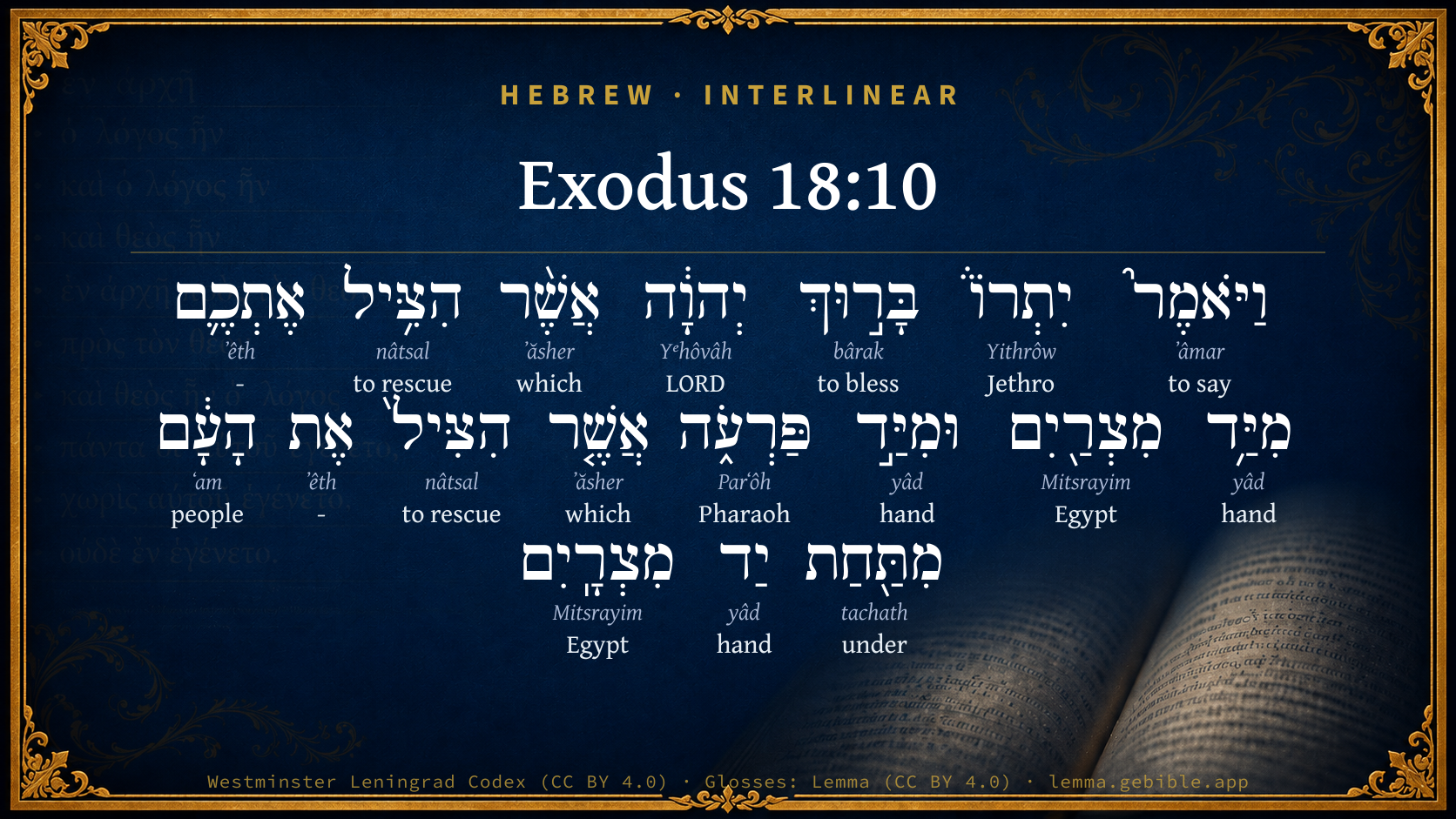
Hebrew (Westminster Leningrad Codex) Exodus 18:10 appears in the Hebrew Old Testament. The text above is from the Westminster Leningrad Codex. Each word links to its Strong’s number, a concise gloss, and parsing drawn from the Open Scriptures Hebrew Bible morphology. Click any word for its full Brown-Driver-Briggs (BDB) entry.
Download image
Cite this verse

Exodus 18:10 (World English Bible). Public Domain. Lemma interlinear Bible study tool, https://lemma.gebible.app/v/exodus/18/10.

Show BibTeX & RIS
BibTeX
RIS
English Translation
Jethro said, "Blessed be Yahweh, who has delivered you out of the hand of the Egyptians, and out of the hand of Pharaoh; who has delivered the people from under the hand of the Egyptians.
World English Bible · Public Domain
Download a study sheet

One document with this verse’s original text, its word-by-word gloss line, the meaning frame, cross-references with their text, attributed commentary, and full source and license credits — printable, and it pastes into notes with its structure intact.

This verse Autodidact and up

Study sheet (.html) Plain text (.txt)

A passage Seminary Student

Up to 50 verses in one chapter. A passage sheet keeps up to 6 commentary sources and 12 cross-references per verse, in the order this page ranks them, and says so on the sheet whenever that leaves anything out. Ask for a single verse and you get the Autodidact verse sheet above.

Everything on this page stays free to read, with no account — the sheet is a download of what is already on screen, not access to it.

Want to remove ads? Support Godless Engineer
Compare translations 3

The same verse in 3 English versions, stacked beneath the original-language interlinear above. Click any original word for its lexicon entry.

Each is an independent rendering of the whole verse — the interlinear is not word-aligned to these translations.

Highlighted words mark where these versions differ — a whole-verse word diff, not a word-by-word alignment.

  • World English Bible Public Domain
    Jethro said, "Blessed be Yahweh, who has delivered you out of the hand of the Egyptians, and out of the hand of Pharaoh; who has delivered the people from under the hand of the Egyptians.
  • King James Version Public Domain
    And Jethro said, Blessed be the LORD, who hath delivered you out of the hand of the Egyptians, and out of the hand of Pharaoh, who hath delivered the people from under the hand of the Egyptians.
  • unfoldingWord Literal Text CC BY-SA 4.0
    And Jethro said, “Bless Yahweh, who rescued you out of the hand of Egypt and out of the hand of Pharaoh, who rescued the people from under the hand of Egypt.

unfoldingWord Literal Text — © unfoldingWord, licensed CC BY-SA 4.0. Word-aligned USFM3 via Door43 (git.door43.org/unfoldingWord/en_ult).

Versions to compare (up to 4)

3 of 4 selected

Show all 18 translations

Every available English version of this verse, each an independent rendering of the whole verse.

  • World English Bible Public Domain
    Jethro said, "Blessed be Yahweh, who has delivered you out of the hand of the Egyptians, and out of the hand of Pharaoh; who has delivered the people from under the hand of the Egyptians.
  • Berean Standard Bible Public Domain
    Jethro declared, “Blessed be the LORD, who has delivered you from the hand of the Egyptians and of Pharaoh, and who has delivered the people from the hand of the Egyptians.
  • Majority Standard Bible Public Domain
    Jethro declared, “Blessed be the LORD, who has delivered you from the hand of the Egyptians and of Pharaoh, and who has delivered the people from the hand of the Egyptians.
  • King James Version Public Domain
    And Jethro said, Blessed be the LORD, who hath delivered you out of the hand of the Egyptians, and out of the hand of Pharaoh, who hath delivered the people from under the hand of the Egyptians.
  • American Standard Version (1901) Public Domain
    And Jethro said, Blessed be Jehovah, who hath delivered you out of the hand of the Egyptians, and out of the hand of Pharaoh; who hath delivered the people from under the hand of the Egyptians.
  • Revised Version (1885) Public Domain
    And Jethro said, Blessed be the LORD, who hath delivered you out of the hand of the Egyptians, and out of the hand of Pharaoh; who hath delivered the people from under the hand of the Egyptians.
  • Geneva Bible (1599) Public Domain
    Therfore Iethro sayd, Blessed be the Lord who hath deliuered you out of the hande of the Egyptians, and out of the hand of Pharaoh: who hath also deliuered the people from vnder the hand of the Egyptians.
  • Douay-Rheims (1899) Public Domain
    And he said: Blessed is the Lord, who hath delivered you out of the hand of Pharao, and out of the hand of the Egyptians, who hath delivered his people out of the hand of Egypt.
  • Young's Literal Translation Public Domain
    and Jethro saith, `Blessed `is' Jehovah, who hath delivered you from the hand of the Egyptians, and from the hand of Pharaoh -- who hath delivered this people from under the hand of the Egyptians;
  • Literal Standard Version CC BY-SA 4.0
    and Jethro says, “Blessed [is] YHWH, who has delivered you from the hand of the Egyptians, and from the hand of Pharaoh—who has delivered this people from under the hand of the Egyptians;
  • Unlocked Literal Bible CC BY-SA 4.0
    Jethro said, “May Yahweh be praised, for he has rescued you from the hand of the Egyptians and from the hand of Pharaoh, and delivered the people from the hand of the Egyptians.
  • unfoldingWord Literal Text CC BY-SA 4.0
    And Jethro said, “Bless Yahweh, who rescued you out of the hand of Egypt and out of the hand of Pharaoh, who rescued the people from under the hand of Egypt.
  • Darby Bible Public Domain
    And Jethro said, Blessed be Jehovah, who has delivered you out of the hand of the Egyptians, and out of the hand of Pharaoh; who has delivered the people from under the hand of the Egyptians.
  • World Messianic Bible Public Domain
    Jethro said, “Blessed be the LORD, who has delivered you out of the hand of the Egyptians, and out of the hand of Pharaoh; who has delivered the people from under the hand of the Egyptians.
  • Webster's Bible Public Domain
    And Jethro said, Blessed be the LORD, who hath delivered you out of the hand of the Egyptians, and out of the hand of Pharaoh, who hath delivered the people from under the hand of the Egyptians.
  • Free Bible Version CC BY-SA 4.0
    Jethro announced, “May the Lord be blessed, who saved you from the Egyptians and from Pharaoh.
  • Bible in Basic English Public Domain
    And Jethro said, Praise be to the Lord, who has taken you out of the hand of Pharaoh and out of the hand of the Egyptians; freeing the people from the yoke of the Egyptians.
  • JPS Tanakh (1917) Public Domain
    And Jethro said: 'Blessed be the LORD, who hath delivered you out of the hand of the Egyptians, and out of the hand of Pharaoh; who hath delivered the people from under the hand of the Egyptians.

Literal Standard Version (2020), Covenant Press — licensed CC BY-SA 4.0. Text via the HelloAO Bible API (eBible.org). Unlocked Literal Bible (unfoldingWord) — licensed CC BY-SA 4.0. Text via the HelloAO Bible API (eBible.org). unfoldingWord Literal Text — © unfoldingWord, licensed CC BY-SA 4.0. Word-aligned USFM3 via Door43 (git.door43.org/unfoldingWord/en_ult). Free Bible Version, Dr. Jonathan Gallagher — licensed CC BY-SA 4.0. Text via the HelloAO Bible API (eBible.org).

Word by word

More ways to search: Search by grammar → Find every occurrence → Compare this word →

Practice this passage: Drill this verse → Learn its vocabulary →

יִתְרוֹ֒
Yithrôw
H3503
“Jethro”
Noun, Proper
Part of Speech
Noun
Type
Proper
Full BDB Definition

Origin: from H3499 with pron. suffix

TWOT: None

Jethro = "his abundance" - father-in-law of Moses; also 'Jether'
  1. וַיֹּאמֶר֮ ʼâmar H559 “and · to say” Conjunction + Verb, Qal, Sequential Imperfect, 3rd Person, Masculine, Singular
  2. בָּר֣וּךְ bârak H1288 “blessed” Verb, Qal, Participle Passive, Masculine, Singular, Absolute
  3. יְהוָ֔ה Yᵉhôvâh H3068 “LORD” Noun, Proper
  4. אֲשֶׁ֨ר ʼăsher H834 “which” Particle, Relative
  5. הִצִּ֥יל nâtsal H5337 “to rescue” Verb, Hiphil, Perfect, 3rd Person, Masculine, Singular
  6. אֶתְכֶ֛ם ʼêth H853 “- · you” Particle, Direct Object + Suffix, Personal, 2nd Person, Masculine, Plural
  7. מִיַּ֥ד yâd H3027 “from · hand of” Preposition + Noun, Common, Both, Singular, Construct
  8. מִצְרַ֖יִם Mitsrayim H4714 “Egypt” Noun, Proper
  9. וּמִיַּ֣ד yâd H3027 “and · from · hand of” Conjunction + Preposition + Noun, Common, Both, Singular, Construct
  10. פַּרְעֹ֑ה Parʻôh H6547 “Pharaoh” Noun, Proper
  11. אֲשֶׁ֤ר ʼăsher H834 “which” Particle, Relative
  12. הִצִּיל֙ nâtsal H5337 “to rescue” Verb, Hiphil, Perfect, 3rd Person, Masculine, Singular
  13. אֶת ʼêth H853 “-” Particle, Direct Object
  14. הָעָ֔ם ʻam H5971 “the · people” Particle, Definite Article + Noun, Common, Masculine, Singular, Absolute
  15. מִתַּ֖חַת tachath H8478 “from · under” Preposition + Preposition
  16. יַד yâd H3027 “hand of” Noun, Common, Both, Singular, Construct
  17. מִצְרָֽיִם Mitsrayim H4714 “Egypt” Noun, Proper

About this verse

These counts appear in no published source. They are computed here, from the morphology-tagged text and Lemma’s own curated glosses. What Lemma adds →

18
words
12
distinct lemmas
Pentateuch
section

Notable vocabulary

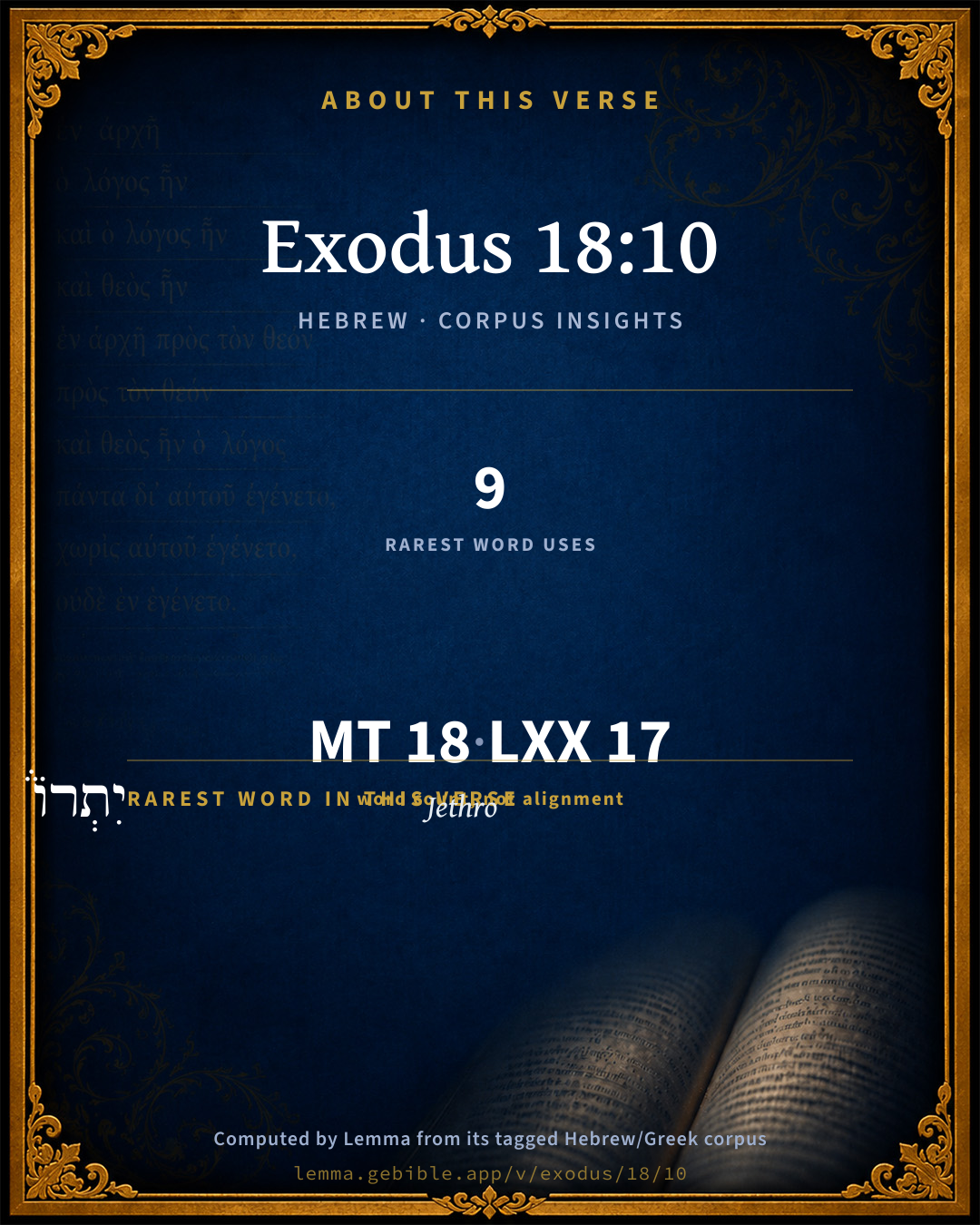
The rarest word here is יִתְרוֹ֒ Jethro H3503 — appearing just 9 times in the whole Hebrew Bible.

Shared distinctive vocabulary

יִתְרוֹ֒ Jethro H3503 occurs in 9 verses of the Hebrew Bible. Also found in:

Grammatical profile

  • 4 verbs
  • 9 nouns
  • 1 preposition
  • 4 particles

Verb forms

  • וַיֹּאמֶר֮ Qal · Sequential Imperfect
  • בָּר֣וּךְ Qal · Participle Passive
  • הִצִּ֥יל Hiphil · Perfect
  • הִצִּיל֙ Hiphil · Perfect

Repetition

Words recur within this verse — often emphatic in Hebrew:

  • מִיַּ֥ד hand H3027 ×3
  • הִצִּ֥יל to rescue H5337 ×2
  • מִצְרַ֖יִם Egypt H4714 ×2
  • אֲשֶׁ֨ר which H834 ×2

Hebrew & Septuagint length

In English translation the verse runs 35 words from the Hebrew and 26 from the Septuagint (LXX English) — closely comparable.

A rough comparison of the two English renderings, which tokenize alike — not a word-level alignment.

Word counts can differ between the Hebrew and the Greek without any difference in meaning — e.g. the Hebrew direct-object marker אֵת has no separate Greek word, and Greek often adds the article ὁ.

In the original languages it is 18 Hebrew tokens and 17 Greek tokens — but the two are counted differently (Hebrew bundles its prefixes and suffixes into one token; the Greek is in lemma form), so that isn’t a like-for-like length.

Cross-references

12

Topical passages linked to Exodus 18:10 in the Treasury of Scripture Knowledge — connected by theme and wording, ordered by reader-vote popularity; previews shown in the World English Bible.

  • Genesis 14:20 and blessed be God Most High, who has delivered your enemies into your hand." Abram gave him a tenth of all.
  • 2 Samuel 18:28 Ahimaaz called, and said to the king, All is well. He bowed himself before the king with his face to the earth, and said, Blessed be Yahweh your God, who has delivered up the men who lifted up their hand against my lord the king.
  • Luke 1:68 "Blessed be the Lord, the God of Israel, For he has visited and worked redemption for his people;
  • 1 Kings 8:15 He said, Blessed be Yahweh, the God of Israel, who spoke with his mouth to David your father, and has with his hand fulfilled it, saying,
  • Psalms 41:13 Blessed be Yahweh, the God of Israel, From everlasting and to everlasting! Amen and amen.
  • Psalms 68:19–20 Blessed be the Lord, who daily bears our burdens, Even the God who is our salvation. Selah.
  • Psalms 106:47–48 Save us, Yahweh, our God, Gather us from among the nations, To give thanks to your holy name, To triumph in your praise!
  • Ephesians 1:3 Blessed be the God and Father of our Lord Jesus Christ, who has blessed us with every spiritual blessing in the heavenly places in Christ;
  • 1 Thessalonians 3:9 For what thanksgiving can we render again to God for you, for all the joy with which we rejoice for your sakes before our God;
  • 1 Peter 1:3 Blessed be the God and Father of our Lord Jesus Christ, who according to his great mercy became our father again to a living hope through the resurrection of Jesus Christ from the dead,
  • Revelation 5:11–13 I saw, and I heard something like a voice of many angels around the throne, the living creatures, and the elders; and the number of them was ten thousands of ten thousands, and thousands of thousands;
  • Revelation 19:1–6 After these things I heard something like a loud voice of a great multitude in heaven, saying, "Hallelujah! Salvation, power, and glory belong to our God:

Cross-references courtesy of OpenBible.info (CC BY 4.0).

Hebrew and Greek witnesses Masoretic Hebrew ↔ Greek Septuagint

The same verse in the two great witnesses to the Old Testament, shown verse-for-verse.

These are two independent witnesses, not word-aligned to each other, and the Septuagint is shown in lemma (dictionary) form.

Hebrew Exodus 18:10 Masoretic · Westminster Leningrad Codex

וַיֹּאמֶר֮ יִתְרוֹ֒ בָּר֣וּךְ יְהוָ֔ה אֲשֶׁ֨ר הִצִּ֥יל אֶתְכֶ֛ם מִיַּ֥ד מִצְרַ֖יִם וּמִיַּ֣ד פַּרְעֹ֑ה אֲשֶׁ֤ר הִצִּיל֙ אֶת הָעָ֔ם מִתַּ֖חַת יַד מִצְרָֽיִם

Jethro said, "Blessed be Yahweh, who has delivered you out of the hand of the Egyptians, and out of the hand of Pharaoh; who has delivered the people from under the hand of the Egyptians.

World English Bible · Public Domain

Greek LXX Exodus 18:10 Septuagint · lemma form

καί εἶπον ιοθορ εὐλογητός κύριος ὅτι ἐκαἱρέω ὁ λαός αὐτός ἐκ χείρ αἰγύπτιος καί ἐκ χείρ φαραώ

And Jothor said, Blessed be the Lord, because he has rescued them out of the hand of the Egyptians and out of the hand of Pharao.

LXX2012 (modern English Septuagint) · Public Domain

Hebrew: Westminster Leningrad Codex (CC BY 4.0). Greek: Septuagint (public domain); English from LXX2012 (modern English Septuagint) (Public Domain). How the Septuagint differs from the Hebrew →

Targum (Aramaic paraphrase)

2

The Targum is the ancient Jewish Aramaic paraphrase of the Hebrew Scriptures — an interpretive translation, not the Hebrew text itself. Onkelos (literal) and Pseudo-Jonathan (expansive) render the Torah, and Jonathan the Prophets. Coverage is partial: where no permissively-licensed English translation exists for a verse, only the Aramaic is shown. This is verse-level text, not a word-by-word alignment to the Hebrew.

  1. Targum Onkelos Torah (Genesis–Deuteronomy)
    וַאֲמַר יִתְרוֹ בְּרִיךְ יְיָ דִי שֵׁזִיב יָתְכוֹן מִידָא דְמִצְרָאֵי וּמִידָא דְפַרְעֹה דִי שֵׁזִיב יָת עַמָא מִתְּחוֹת מַרְוַת מִצְרָאֵי:

    (no public-domain English translation for this verse)

    Targum Onkelos — Aramaic: “Onkelos Genesis” (public domain); “Onkelos Exodus” (public domain); “Onkelos Leviticus” (public domain); “Onkelos Numbers” (public domain); “Onkelos Deuteronomy” (public domain). English: “Sefaria Community Translation” (CC0 1.0 (public-domain dedication)); “J.W. Etheridge. The Targums of Onkelos and Jonathan Ben Uzziel on the Pentateuch. London: Longmans, Green, 1862” (public domain). Text via Sefaria.

  2. Targum Pseudo-Jonathan Torah (Genesis–Deuteronomy)
    וַאֲמַר יִתְרוֹ בְּרִיךְ שְׁמָא דַיְיָ דְּשֵׁזִיב יַתְכוֹן מִן יְדָא דְמִצְרָאֵי וּמִן יְדָא דְפַרְעה דְּשֵׁזִיב יַת עַמָּא מִתְּחוֹת מַרְוַת מִצְרָאֵי

    And Jethro said, Blessed be the Name of the Lord who hath saved you from the hand of the Mizraee, and from the hand of Pharoh, and hath saved the people from under the tyranny of the Mizraee.

    Targum Pseudo-Jonathan — Aramaic: “Targum Jonathan on Genesis” (public domain); “Targum Jonathan on Exodus” (public domain); “Targum Jonathan on Leviticus” (public domain); “Targum Jonathan on Numbers” (public domain); “Targum Jonathan on Deuteronomy” (public domain). English: “The Targum of Jonathan ben Uzziel, trans. J. W. Etheridge, London, 1862” (public domain). Text via Sefaria.

Commentary

Notes on Exodus 18:10 from classic Christian and Jewish commentators (each source and its license shown beneath its notes). The classic Christian expositions comment on the surrounding passage and are grouped to its opening verse, so a note may address several verses; the Jewish commentaries on the Tanakh (Rashi and others) are per-verse, so they appear only where the commentator wrote on this verse.

Lemma curates 59 commentaries, every one of them public domain or Creative Commons licensed, each selected and text-cleaned for this edition rather than reprinted as found. About our sources →

Trapp's Complete Commentary

John Trapp

Exo 18:10 And Jethro said, Blessed [be] the LORD, who hath delivered you out of the hand of the Egyptians, and out of the hand of Pharaoh, who hath delivered the people from under the hand of the Egyptians.

Ver. 10. And Jethro said, &c.] Cheerfulness makes thankfulness. {Luk 1:46 Jas 5:13}

John Trapp, A Commentary or Exposition upon All the Books of the Old and New Testament (1647–1656) — public domain. Text from a community e-Sword module.

Whedon's Commentary on the Bible

Daniel D. Whedon

10. Jethro said — Lange regards this utterance of Jethro as lyrical. Exo_18:10-11 may be thrown into poetic form as follows: —

Blessed be Jehovah,

Who delivered you from the hand of the Egyptians,

And from the hand of Pharaoh.

Who delivered the people from under the hand of the Egyptians.

Now know I that Jehovah is greater than all the gods;

For [he magnified himself] in the thing

In which they acted proudly against them.

Daniel D. Whedon (gen. ed.), Commentary on the Old and New Testaments (1874–1909) — public domain. Text from a community e-Sword module.

Geneva Bible (1599)

Geneva Bible translators

Whereby it is evident that he worshipped the true God, and therefore Moses refused not to marry his daughter.

Geneva Bible (1599) marginal notes — public domain. Text via Bolls.life.

Ellicott's Commentary for English Readers

(10, 11) Jethro said, Blessed be the Lord.—Heb., Jehovah. The Midianites, descendants of Abraham by Keturah, acknowledged the true God, and the Israelites could rightfully join with them in acts of worship. But it is scarcely likely that they knew God among themselves as “Jehovah.” Jethro, however, understanding Moses to speak of the supreme God under that designation, adopted it from him, blessed His name, and expressed his conviction that Jehovah was exalted above all other gods. The pure monotheism of later times scarcely existed as yet. The gods of the nations were supposed to be spiritual beings, really existent, and possessed of considerable power, though very far from omnipotent. (See Deu_32:16-17.)

A Bible Commentary for English Readers, edited by Charles John Ellicott (1878–1897) — public domain. Text from a community e-Sword module.

The Cambridge Bible for Schools and Colleges

gen. ed. J. J. S. Perowne

10. from under the hand] as 2Ki_8:20; 2Ki_8:22; 2Ki_13:5; 2Ki_17:7.

10, 11. Jethro is moved to bless and praise Jehovah for Israel’s deliverance.

The Cambridge Bible for Schools and Colleges (gen. ed. J. J. S. Perowne; Cambridge University Press, 1878–1918) — public domain. Text from a community e-Sword module.

John Gill's Exposition

Now I know that the Lord is greater than all gods,.... He knew the Lord before, and that he was the only true God, and greater than all that were so called; but now he had a fresh instance of it, a clear proof and demonstration of it, and so more plainly and fully knew it, and was assured of it, that he was greater than all the idols of the Gentiles, and particularly than the gods of the Egyptians; since he had saved his people Israel out of their hands, and when they could not protect and defend the Egyptians neither from plagues nor from destruction; nay, could not secure themselves, being all destroyed by the mighty Jehovah, see Exo 12:12, as also that he is greater than all that are called gods, kings, princes, and civil magistrates, than Pharaoh and all his nobles, generals, and captains, who were destroyed by him: for in the thing wherein they dealt proudly, he was above them; the idol gods, the gods of the Egyptians, the evil demons, Satan and his principalities, who influenced them, presuming and boasting by their magicians what they could do; but in those things Jehovah in the wonders he wrought appeared to be above them; they were overcome by him, and obliged to acknowledge the finger of God; and this sense stands best connected with the preceding clause: or else in those things, in which the Egyptians dealt proudly with the Israelites, pursuing after them in the pride and vanity of their minds, and giving out that they should overtake them and divide the spoil, and satisfy their lust upon them, when God blew with his wind upon them, the sea covered them, and they sunk as lead in the mighty waters, see Exo 15:9, and to the drowning of the Egyptians in the Red sea, the Jews commonly apply this: thus the Targum of Jonathan,"wherein the Egyptians dealt wickedly in judging Israel, by the waters, judgment returned upon them that they might be judged by the waters;''and to the same sense Jarchi: they suppose here was a just retaliation, that as the Egyptians drowned the Hebrew infants in the waters of the Nile, they were in righteous judgment drowned in the Red sea; this is the very thing, or is the same way they in their pride and malice dealt with the people of Israel; God dealt with them, and showed himself to be both "against them" (o), as it may be rendered, and above them.

(o) "contra eos", Pagninus, Montanus; "contra illos", V. L. Tigurine version; so Reinbech "de accent". Heb. p. 314.

John Gill's Exposition of the Whole Bible (1746–1763) — public domain (CC PDM 1.0). Text via the HelloAO Bible API.

The Pulpit Commentary

Blessed be the Lord. Compare Gen_14:20 Gen_24:27. The heathen blessed God no loss than the Israelites; but Jethro"s blessing the Lord (i.e. Jehovah) is unusual As, however, Moses had attributed his own deliverance, and that of Israel, entirely to Jehovah (verse 8), Jethro, accepting the facts to be.as stated, blessed the Lord. Who hath delivered you. Kalisch takes the plural pronoun to refer to Moses and Aaron; but Aaron seems not to nave been present, since he afterwards "came" (verse 12). It is better to regard Jethro as addressing all those who were in the tent with Moses. From them he goes on in the last clause to "the people." And out of the hand of Pharaoh. i.e. , especially out of the hand of Pharaoh, who had especially sought their destruction. (Exo_14:6, Exo_14:8, etc.)

The Pulpit Commentary (1880–1919), ed. H.D.M. Spence-Jones & Joseph S. Exell — public domain. Text from a community e-Sword module.

Rashi

Rabbi Shlomo Yitzchaki (Rashi)

אשר הציל אתכם מיד מצרים WHO HATH DELIVERED YOU OUT OF THE HAND OF EGYPT, a hard people,

ומיד פרעה AND OUT OF THE HAND OF PHARAOH, a hard monarch.

מתחת יד מצרים — Translate this as the Targum does: from beneath the authority of Egypt, taking יד as an expression of domination and authority; “the hand” spoken of here is the hand which they imposed heavily upon them — referring to the hard bondage.

Rashi on the Tanakh — English translations: “The Judaica Press complete Tanach with Rashi, translated by A. J. Rosenberg” (CC BY 4.0); “Pentateuch with Rashi's commentary by M. Rosenbaum and A.M. Silbermann, 1929-1934” (public domain); “The Metsudah Tanach series, Lakewood, N.J” (CC BY 4.0); and “The Book of Joshua, Metsudah Publications, 1997” (CC BY 4.0). Text via Sefaria.

Ramban (Nachmanides)

Rabbi Moshe ben Nachman (Ramban / Nachmanides)

BLESSED BE THE ETERNAL, WHO HATH DELIVERED YOU OUT OF THE HAND OF THE EGYPTIANS, AND OUT OF THE HAND OF PHARAOH; WHO HATH DELIVERED THE PEOPLE FROM UNDER THE HAND OF THE EGYPTIANS. mentioned twice? Why does Jethro first address himself directly to the people, saying, Who hath delivered you, etc., and then speaks of them in the third person, saying, Who hath delivered the people, etc.? Ramban first presents his interpretation, followed by that of Ibn Ezra. “He has done a great miracle for you in that Pharaoh and his people did not kill you, for it was on account of you that great plagues came upon them in their land.” This miracle was particularly great as far as Moses was concerned [because he frequently came to Pharaoh, as explained above at the end of Verse 1]. Therefore Jethro mentioned him [specifically] in the second person, together with everybody, saying, Who hath delivered you, meaning “you [Moses], and the people.” And He did another miracle: Who hath delivered the people from under the hand of the Egyptians, since they were in Egypt and they went out of there to everlasting freedom.Rabbi Abraham ibn Ezra said that Jethro first blessed G-d, Who hath delivered you, meaning Moses and Aaron, through whom the plagues came upon Pharaoh and the Egyptians. Afterwards, he blessed Him for how He hath delivered the people from under the hand of the Egyptians in Egypt and at the sea.

Ramban (Nachmanides) on the Tanakh — English translation: “Commentary on the Torah by Ramban (Nachmanides). Translated and annotated by Charles B. Chavel. New York, Shilo Pub. House, 1971-1976” (CC BY 4.0). Text via Sefaria.

Lesson kit

Teaching starters — assembled from the data on this page, not authored interpretation. Every prompt links to the verse data it draws on. Edit before teaching.

Exodus, in the Pentateuch, opens this verse with 18 words (12 distinct Hebrew lemmas). Its most distinctive word is Yithrôw (“Jethro”). A historical commentator’s framing appears above. Read the whole chapter for the surrounding context.

Discussion questions

  1. The word Yithrôw carries the sense “Jethro.” How does it shape the verse?
  2. Exodus 3:1 shares the word «Jethro» with this verse. How do the two illuminate each other?
  3. “hand” occurs 3× in this one verse. What is the effect of the repetition?
  4. These translations render this verse differently. What is at stake in choosing one wording over another?
  5. The verb «וַיֹּאמֶר֮» is Qal Sequential Imperfect. How does its form color the action?
  6. Reading how Trapp's Complete Commentary and Whedon's Commentary on the Bible read this verse, where do the two commentators agree and where do they part?

Things to notice

Reading settings

Reading text

Shown beneath each verse's original-language words.

Old Testament
Old Testament edition

Read the OT as the Masoretic Hebrew (MT) or the Greek Septuagint (LXX).

English shown for the Greek Septuagint (in the Hebrew ↔ Greek comparison).

Comparing translations? Open the Compare panel on any verse page to stack up to four side by side.