
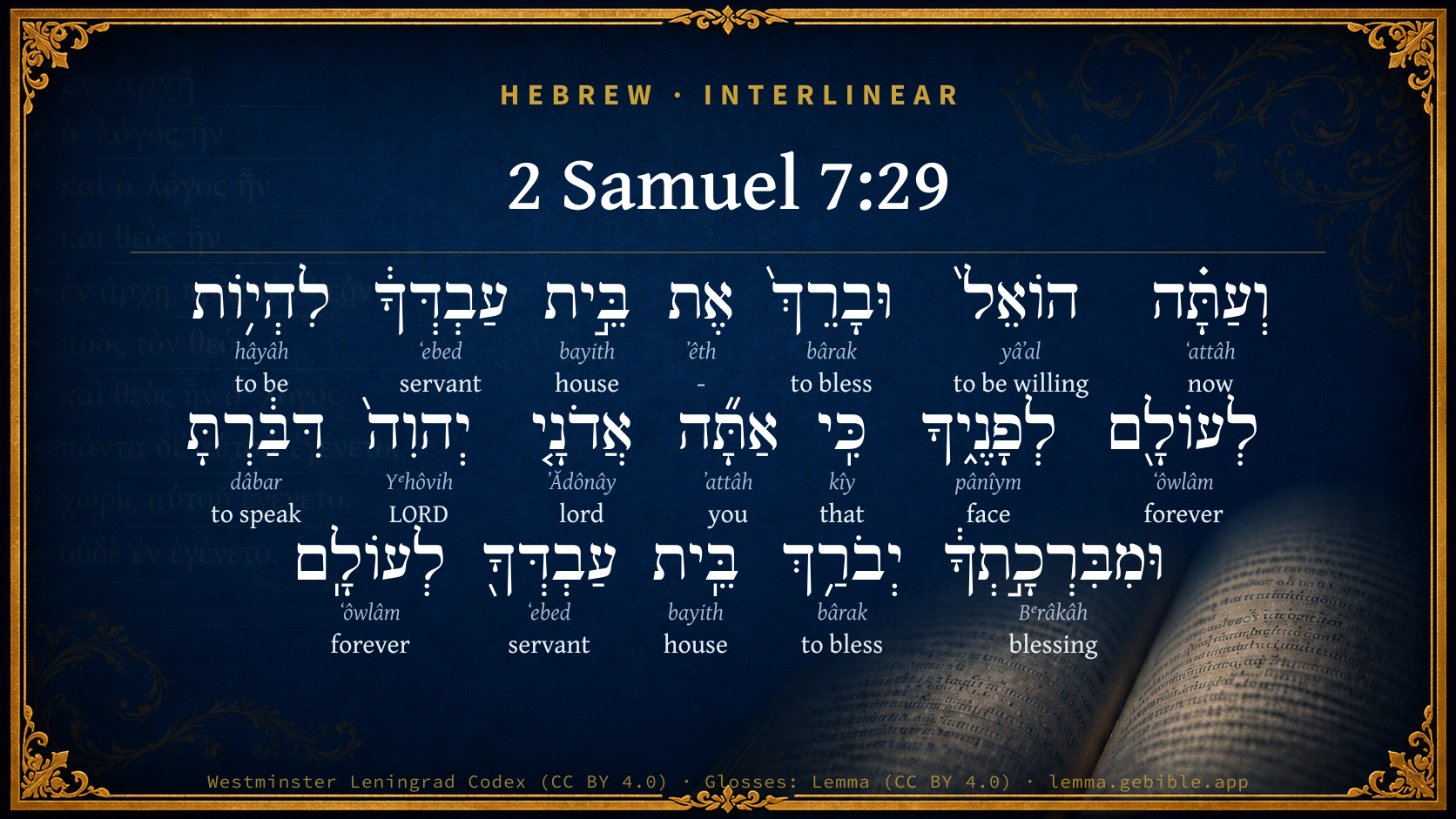
2 Samuel 7:29

Hebrew (Westminster Leningrad Codex) 2 Samuel 7:29 appears in the Hebrew Old Testament. The text above is from the Westminster Leningrad Codex. Each word links to its Strong’s number, a concise gloss, and parsing drawn from the Open Scriptures Hebrew Bible morphology. Click any word for its full Brown-Driver-Briggs (BDB) entry.
Download image
Cite this verse

2 Samuel 7:29 (World English Bible). Public Domain. Lemma interlinear Bible study tool, https://lemma.gebible.app/v/2-samuel/7/29.

Show BibTeX & RIS
BibTeX
RIS
English Translation
now therefore let it please you to bless the house of your servant, that it may continue forever before you; for you, Lord Yahweh, have spoken it: and with your blessing let the house of your servant be blessed forever.
World English Bible · Public Domain
Download a study sheet

One document with this verse’s original text, its word-by-word gloss line, the meaning frame, cross-references with their text, attributed commentary, and full source and license credits — printable, and it pastes into notes with its structure intact.

This verse Autodidact and up

Study sheet (.html) Plain text (.txt)

A passage Seminary Student

Up to 50 verses in one chapter. A passage sheet keeps up to 6 commentary sources and 12 cross-references per verse, in the order this page ranks them, and says so on the sheet whenever that leaves anything out. Ask for a single verse and you get the Autodidact verse sheet above.

Everything on this page stays free to read, with no account — the sheet is a download of what is already on screen, not access to it.

Want to remove ads? Support Godless Engineer
Compare translations 3

The same verse in 3 English versions, stacked beneath the original-language interlinear above. Click any original word for its lexicon entry.

Each is an independent rendering of the whole verse — the interlinear is not word-aligned to these translations.

Highlighted words mark where these versions differ — a whole-verse word diff, not a word-by-word alignment.

  • World English Bible Public Domain
    now therefore let it please you to bless the house of your servant, that it may continue forever before you; for you, Lord Yahweh, have spoken it: and with your blessing let the house of your servant be blessed forever.
  • King James Version Public Domain
    Therefore now let it please thee to bless the house of thy servant, that it may continue for ever before thee: for thou, O Lord GOD, hast spoken it: and with thy blessing let the house of thy servant be blessed for ever.
  • unfoldingWord Literal Text CC BY-SA 4.0
    And now, take pleasure and bless the house of your servant to be to your face forever. For you, my Lord Yahweh, you have spoken and from your blessing the house of your servant will be blessed forever.”

unfoldingWord Literal Text — © unfoldingWord, licensed CC BY-SA 4.0. Word-aligned USFM3 via Door43 (git.door43.org/unfoldingWord/en_ult).

Versions to compare (up to 4)

3 of 4 selected

Show all 18 translations

Every available English version of this verse, each an independent rendering of the whole verse.

  • World English Bible Public Domain
    now therefore let it please you to bless the house of your servant, that it may continue forever before you; for you, Lord Yahweh, have spoken it: and with your blessing let the house of your servant be blessed forever.
  • Berean Standard Bible Public Domain
    Now therefore, may it please You to bless the house of Your servant, that it may continue forever before You. For You, O Lord GOD, have spoken, and with Your blessing the house of Your servant will be blessed forever.”
  • Majority Standard Bible Public Domain
    Now therefore, may it please You to bless the house of Your servant, that it may continue forever before You. For You, O Lord GOD, have spoken, and with Your blessing the house of Your servant will be blessed forever.”
  • King James Version Public Domain
    Therefore now let it please thee to bless the house of thy servant, that it may continue for ever before thee: for thou, O Lord GOD, hast spoken it: and with thy blessing let the house of thy servant be blessed for ever.
  • American Standard Version (1901) Public Domain
    now therefore let it please thee to bless the house of thy servant, that it may continue for ever before thee; for thou, O Lord Jehovah, hast spoken it: and with thy blessing let the house of thy servant be blessed for ever.
  • Revised Version (1885) Public Domain
    now therefore let it please thee to bless the house of thy servant, that it may continue for ever before thee: for thou, O Lord GOD, hast spoken it: and with thy blessing let the house of thy servant be blessed for ever.
  • Geneva Bible (1599) Public Domain
    Therefore nowe let it please thee to blesse the house of thy seruant, that it may continue for euer before thee: for thou, O Lord God, hast spoken it: and let the house of thy seruant be blessed for euer, with thy blessing.
  • Douay-Rheims (1899) Public Domain
    And now begin, and bless the house of thy servant, that it may endure for ever before thee: because thou, O Lord God, hast spoken it, and with thy blessing let the house of thy servant be blessed for ever.
  • Young's Literal Translation Public Domain
    And now, begin and bless the house of Thy servant, to be unto the age before Thee, for Thou, Lord Jehovah, hast spoken, and by Thy blessing is the house of Thy servant blessed -- to the age.'
  • Literal Standard Version CC BY-SA 4.0
    and now, begin and bless the house of Your servant, to be before You for all time, for You, Lord YHWH, have spoken, and by Your blessing the house of Your servant is blessed for all time.”
  • Unlocked Literal Bible CC BY-SA 4.0
    Now then, let it please you to bless the house of your servant, so that it may continue forever before you. For you, Lord Yahweh, have said these things, and with your blessing your servant's house will be blessed forever.”
  • unfoldingWord Literal Text CC BY-SA 4.0
    And now, take pleasure and bless the house of your servant to be to your face forever. For you, my Lord Yahweh, you have spoken and from your blessing the house of your servant will be blessed forever.”
  • Darby Bible Public Domain
    and now let it please thee to bless the house of thy servant, that it may be before thee for ever; for thou, Lord Jehovah, hast spoken it; and with thy blessing shall the house of thy servant be blessed for ever.
  • World Messianic Bible Public Domain
    Now therefore, let it please you to bless the house of your servant, that it may continue forever before you; for you, Lord GOD, have spoken it. Let the house of your servant be blessed forever with your blessing.”
  • Webster's Bible Public Domain
    Therefore now let it please thee to bless the house of thy servant, that it may continue for ever before thee: for thou, O Lord GOD, hast spoken it: and with thy blessing let the house of thy servant be blessed for ever.
  • Free Bible Version CC BY-SA 4.0
    So now, please bless your servant's house that it may continue in your presence forever. For you have spoken, Lord God, and with your blessing the house of your servant will be blessed forever.”
  • Bible in Basic English Public Domain
    So may it be your pleasure to give your blessing to the family of your servant, so that it may go on for ever before you: (for you, O Lord God, have said it,) and may your blessing be on your servant's family line for ever!
  • JPS Tanakh (1917) Public Domain
    now therefore let it please Thee to bless the house of Thy servant, that it may continue for ever before Thee; for Thou, O Lord GOD, hast spoken it; and through Thy blessing let the house of Thy servant be blessed for ever.'

Literal Standard Version (2020), Covenant Press — licensed CC BY-SA 4.0. Text via the HelloAO Bible API (eBible.org). Unlocked Literal Bible (unfoldingWord) — licensed CC BY-SA 4.0. Text via the HelloAO Bible API (eBible.org). unfoldingWord Literal Text — © unfoldingWord, licensed CC BY-SA 4.0. Word-aligned USFM3 via Door43 (git.door43.org/unfoldingWord/en_ult). Free Bible Version, Dr. Jonathan Gallagher — licensed CC BY-SA 4.0. Text via the HelloAO Bible API (eBible.org).

Word by word

More ways to search: Search by grammar → Find every occurrence → Compare this word →

Practice this passage: Drill this verse → Learn its vocabulary →

הוֹאֵל֙
yâʼal
H2974
“be willing”
Verb, Hiphil, Imperative, 2nd Person, Masculine, Singular
Part of Speech
Verb
Stem
Hiphil
Form
Imperative
Person
2nd Person
Gender
Masculine
Number
Singular
Full BDB Definition

Origin: a primitive root [probably rather the same as H2973 through the idea of mental weakness]

TWOT: 831

to begin, make a beginning, show willingness, undertake to do, be pleased, be determined - (Hiphil) - to agree to, show willingness, acquiesce, accept an invitation, be willing - to undertake - to resolve, be pleased, be determined
  1. וְעַתָּ֗ה ʻattâh H6258 “and · now” Conjunction + Adverb
  2. וּבָרֵךְ֙ bârak H1288 “and · bless” Conjunction + Verb, Piel, Imperative, 2nd Person, Masculine, Singular
  3. אֶת ʼêth H853 “-” Particle, Direct Object
  4. בֵּ֣ית bayith H1004 “house of” Noun, Common, Masculine, Singular, Construct
  5. עַבְדְּךָ֔ ʻebed H5650 “servant · your” Noun, Common, Masculine, Singular, Construct + Suffix, Personal, 2nd Person, Masculine, Singular
  6. לִהְי֥וֹת hâyâh H1961 “to be” Preposition + Verb, Qal, Infinitive Construct
  7. לְעוֹלָ֖ם ʻôwlâm H5769 “to/for · forever” Preposition + Noun, Common, Masculine, Singular, Absolute
  8. לְפָנֶ֑יךָ pânîym H6440 “to/for · face(s) · your” Preposition + Noun, Common, Both, Plural, Construct + Suffix, Personal, 2nd Person, Masculine, Singular
  9. כִּֽי kîy H3588 “that” Conjunction
  10. אַתָּ֞ה ʼattâh H859 “you” Pronoun, Personal, 2nd Person, Masculine, Singular
  11. אֲדֹנָ֤י ʼĂdônây H136 “Lord · my” Noun, Common, Masculine, Plural, Construct + Suffix, Personal, 1st Person, Common, Singular
  12. יְהוִה֙ Yᵉhôvih H3069 “LORD” Noun, Proper
  13. דִּבַּ֔רְתָּ dâbar H1696 “to speak” Verb, Piel, Perfect, 2nd Person, Masculine, Singular
  14. וּמִבִּרְכָ֣תְךָ֔ Bᵉrâkâh H1293 “and · from · blessing · your” Conjunction + Preposition + Noun, Common, Feminine, Singular, Construct + Suffix, Personal, 2nd Person, Masculine, Singular
  15. יְבֹרַ֥ךְ bârak H1288 “to bless” Verb, Pual, Imperfect, 3rd Person, Masculine, Singular
  16. בֵּֽית bayith H1004 “house of” Noun, Common, Masculine, Singular, Construct
  17. עַבְדְּךָ֖ ʻebed H5650 “servant · your” Noun, Common, Masculine, Singular, Construct + Suffix, Personal, 2nd Person, Masculine, Singular
  18. לְעוֹלָֽם ʻôwlâm H5769 “to/for · forever” Preposition + Noun, Common, Masculine, Singular, Absolute

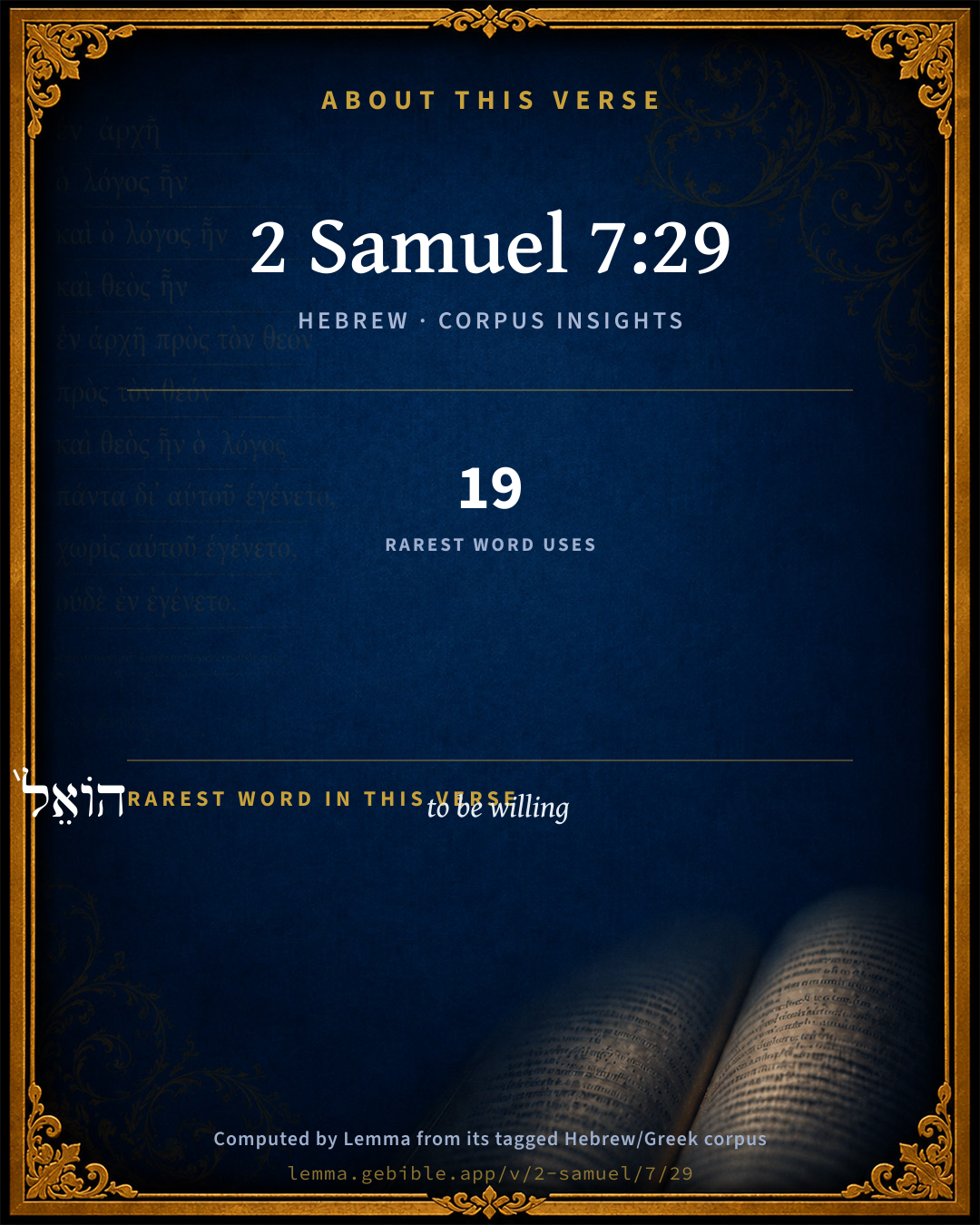
About this verse

These counts appear in no published source. They are computed here, from the morphology-tagged text and Lemma’s own curated glosses. What Lemma adds →

19
words
15
distinct lemmas
Historical
section

Notable vocabulary

The rarest word here is הוֹאֵל֙ to be willing H2974 — appearing just 19 times in the whole Hebrew Bible.

Shared distinctive vocabulary

הוֹאֵל֙ to be willing H2974 occurs in 19 verses of the Hebrew Bible. Also found in:

Grammatical profile

  • 5 verbs
  • 10 nouns
  • 1 pronoun
  • 1 conjunction
  • 1 adverb
  • 1 particle

Verb forms

  • הוֹאֵל֙ Hiphil · Imperative
  • וּבָרֵךְ֙ Piel · Imperative
  • לִהְי֥וֹת Qal · Infinitive Construct
  • דִּבַּ֔רְתָּ Piel · Perfect
  • יְבֹרַ֥ךְ Pual · Imperfect

Repetition

Words recur within this verse — often emphatic in Hebrew:

  • וּבָרֵךְ֙ to bless H1288 ×2
  • בֵּ֣ית house H1004 ×2
  • עַבְדְּךָ֔ servant H5650 ×2
  • לְעוֹלָ֖ם forever H5769 ×2

Hebrew & Septuagint length

In English translation the verse runs 40 words from the Hebrew and 44 from the Septuagint (LXX English) — closely comparable.

A rough comparison of the two English renderings, which tokenize alike — not a word-level alignment.

Word counts can differ between the Hebrew and the Greek without any difference in meaning — e.g. the Hebrew direct-object marker אֵת has no separate Greek word, and Greek often adds the article ὁ.

Cross-references

4

Topical passages linked to 2 Samuel 7:29 in the Treasury of Scripture Knowledge — connected by theme and wording, ordered by reader-vote popularity; previews shown in the World English Bible.

  • Numbers 6:24–26 'Yahweh bless you, and keep you.
  • 1 Chronicles 17:27 and now it has pleased you to bless the house of your servant, that it may continue forever before you: for you, Yahweh, have blessed, and it is blessed forever.
  • Psalms 115:12–15 Yahweh remembers us. He will bless us. He will bless the house of Israel. He will bless the house of Aaron.
  • 2 Samuel 22:51 Great deliverance gives he to his king, Shows loving kindness to his anointed, To David and to his seed, forevermore.

Cross-references courtesy of OpenBible.info (CC BY 4.0).

Hebrew and Greek witnesses Masoretic Hebrew ↔ Greek Septuagint

The same verse in the two great witnesses to the Old Testament, shown verse-for-verse.

These are two independent witnesses, not word-aligned to each other, and the Septuagint is shown in lemma (dictionary) form.

Hebrew 2 Samuel 7:29 Masoretic · Westminster Leningrad Codex

וְעַתָּ֗ה הוֹאֵל֙ וּבָרֵךְ֙ אֶת בֵּ֣ית עַבְדְּךָ֔ לִהְי֥וֹת לְעוֹלָ֖ם לְפָנֶ֑יךָ כִּֽי אַתָּ֞ה אֲדֹנָ֤י יְהוִה֙ דִּבַּ֔רְתָּ וּמִבִּרְכָ֣תְךָ֔ יְבֹרַ֥ךְ בֵּֽית עַבְדְּךָ֖ לְעוֹלָֽם

now therefore let it please you to bless the house of your servant, that it may continue forever before you; for you, Lord Yahweh, have spoken it: and with your blessing let the house of your servant be blessed forever.

World English Bible · Public Domain

Greek LXX 2 Samuel 7:29 Septuagint · lemma form

καί νῦν ἄρχω καί εὐλογέω ὁ οἶκος ὁ δοῦλος σύ ὁ εἰμί εἰς ὁ αἰών ἐνώπιόν σύ ὅτι σύ εἰμί κύριος ἐγώ κύριος λαλέω καί ἀπό ὁ εὐλογία σύ εὐλογέω ὁ οἶκος ὁ δοῦλος σύ εἰς ὁ αἰών

And now begin and bless the house of your servant, that it may continue for ever before you; for you, O Lord, my Lord, have spoken, and the house of your servant shall be blessed with your blessing so as to continue for ever.

LXX2012 (modern English Septuagint) · Public Domain

On this verse, Haydock's Catholic Bible Commentary discusses the Septuagint’s reading. Read the note in Commentary ↓

Hebrew: Westminster Leningrad Codex (CC BY 4.0). Greek: Septuagint (public domain); English from LXX2012 (modern English Septuagint) (Public Domain). How the Septuagint differs from the Hebrew →

Targum (Aramaic paraphrase)

1

The Targum is the ancient Jewish Aramaic paraphrase of the Hebrew Scriptures — an interpretive translation, not the Hebrew text itself. Onkelos (literal) and Pseudo-Jonathan (expansive) render the Torah, and Jonathan the Prophets. Coverage is partial: where no permissively-licensed English translation exists for a verse, only the Aramaic is shown. This is verse-level text, not a word-by-word alignment to the Hebrew.

  1. Targum Jonathan Prophets (Joshua–Malachi)
    וּכְעַן שְׁרֵי וּבְרִיךְ יַת בֵּית עַבְדָךְ לְמֶהֱוֵי לְעַלְמָא קֳדָמָךְ אֲרֵי אַתְּ יְיָ אֱלֹהִים מַלֵלְתָּא וּמִבִּרְכָתָךְ יִתְבָּרְכוּן בָּתֵּי עַבְדָךְ צַדִיקַיָא לַעֲלָם:

    (no public-domain English translation for this verse)

    Targum Jonathan — Aramaic: “Mikraot Gedolot” (public domain). English: “Sefaria Community Translation” (CC0 1.0 (public-domain dedication)); “London "Chaldee Paraphrase," 1871” (public domain). Text via Sefaria.

Commentary

Notes on 2 Samuel 7:29 from classic Christian and Jewish commentators (each source and its license shown beneath its notes). The classic Christian expositions comment on the surrounding passage and are grouped to its opening verse, so a note may address several verses; the Jewish commentaries on the Tanakh (Rashi and others) are per-verse, so they appear only where the commentator wrote on this verse.

Lemma curates 59 commentaries, every one of them public domain or Creative Commons licensed, each selected and text-cleaned for this edition rather than reprinted as found. About our sources →

Trapp's Complete Commentary

John Trapp

2Sa 7:29 Therefore now let it please thee to bless the house of thy servant, that it may continue for ever before thee: for thou, O Lord GOD, hast spoken [it]: and with thy blessing let the house of thy servant be blessed for ever.

Ver. 29. Let it please thee to bless.] Heb., Be thou pleased and bless. Another prophet hath it, "It hath pleased thee to bless." {1Ch 17:27} Prayers are often made in faith, as if they were done things.

Let the house of thg servant be blessed for ever.] This is to press and oppress the promises, as we are commanded to do, {Isa 66:11} till we have expressed the utmost sweetness out of them. David prevailed and prospered hereupon, as appeareth by the next chapter.

John Trapp, A Commentary or Exposition upon All the Books of the Old and New Testament (1647–1656) — public domain. Text from a community e-Sword module.

Geneva Bible (1599)

Geneva Bible translators

Therefore I firmly believe it shall come to pass.

Geneva Bible (1599) marginal notes — public domain. Text via Bolls.life.

Ellicott's Commentary for English Readers

(29) Let it please thee.—These words may be taken either in the optative, as in our Version, or better in the future, constituting a prophecy based upon the promise, “It will please thee.” Compare a similar possibility in the translation of the last clause of the Te Deum, “Let me never,” or “I shall never be confounded.”

Several of the Psalms have been referred by various writers to this point in David’s life; but while many of them take their key-note from the promise now made, and which was ever fresh in David’s thought, none of them have notes of time definitely determining them to the present occasion, unless it be Ps. ex., which seems like an inspired interpretation of the promise of the perpetuity of his kingdom, and at the same time might have taken its “local colouring” from his recent successful wars.

A Bible Commentary for English Readers, edited by Charles John Ellicott (1878–1897) — public domain. Text from a community e-Sword module.

The Cambridge Bible for Schools and Colleges

gen. ed. J. J. S. Perowne

29. let the house of thy servant be blessed] Or, shall the house of thy servant be blessed. David concludes with words of confident hope, on the ground that “Jehovah hath spoken it.” Cp. 1Ch_17:27.

The Cambridge Bible for Schools and Colleges (gen. ed. J. J. S. Perowne; Cambridge University Press, 1878–1918) — public domain. Text from a community e-Sword module.

John Gill's Exposition

Now therefore let it please thee to bless the house of thy servant,.... Not according to the merits of him or his family, but according to the sovereign will and pleasure of God; the Targum is, begin and bless; let the promised blessings begin to descend, that there may be some appearance of the performance of the promise, which may give encouragement that the whole will be fulfilled:

that it may continue for ever before thee; under his care and protection:

for thou, O Lord God, hast spoken it; whose words never fall to the ground, but have a sure accomplishment:

and with thy blessing let the house of thy servant be blessed for ever; even both with temporal and spiritual blessedness.

Next: 2 Samuel Chapter 8

John Gill's Exposition of the Whole Bible (1746–1763) — public domain (CC PDM 1.0). Text via the HelloAO Bible API.

Haydock's Catholic Bible Commentary

Begin. Hebrew, "please, or deign to bless." Septuagint and Jonathan, "begin." (Calmet)

George Leo Haydock (1774–1849), Haydock's Catholic Family Bible and Commentary, 1859 edition — public domain. Excludes Psalms (Douay-Rheims chapter numbering differs from Protestant) and Deuterocanonical books (Catholic canon only).

Matthew Poole's English Annotations

Thou, O Lord God, hast spoken it, and therefore wilt certainly do it, for thy words never fail.

Matthew Poole's English Annotations on the Holy Bible (1683–1685) — public domain. Text from a community e-Sword/MySword module.

The Pulpit Commentary

Let it please thee to bless; or, begin and bless. Literally, the verb signifies to make up the mind and set about the doing of the thing purposed. Thus David prays that the blessing may now at once begin to take effect. It is often rendered "please" in our version, because the verb is one used only of a determination resolved upon of the free will of the purposer. Its force is well seen in Job_6:9, where what Job prays for is that God would deliberate no longer, but decide the matter and set about destroying him. The Authorized Version was led, by the use of this verse "please," to adopt the optative form. Really, it is the language of firm faith, and should be rendered, And now there is no "therefore begin of thy own good will, and bless the house of thy servant.

A good man"s prayer for his family.

David"s prayer has especial reference to the promise given him that his family should continue forever to rule Israel. We may take the prayer as suitable to be used by any godly father for his children and children"s children.

I THE PRAYER. That God would bless the family. A Christian father offering this prayer would have regard to:

1. Temporal blessings. Prolonged life, good health of body and mind, success in worldly pursuits, competence. Asking for these as a blessing from God implies the desire that they should be granted only so far as they will be blessings; that they should come as the result of God"s blessing on upright means (not from fraud, injustice, or violence; see; (Pro_10:22) and that they should be accompanied with God"s blessing, so that they may not ensnare and injure the soul, but promote its prosperity and highest happiness. Thus regarded, such a prayer is not unbecoming the heart and lips of any good man.

2. Spiritual blessings. That the family may be worthy the name of a Christian household, all being truly the children of God, worshipping and serving him faithfully and to the end. A Christian parent will be more desirous that his house should be good than great in faith, and heirs of the kingdom" (Jam_2:5) rather than possessed of materialwealth. For such blessings he need not restrain his desires, as they are good in and for themselves, good always and forever. The poorest may seek these for his children, who may enjoy them equally with the wealthiest: they are open to all.

3. Eternal blessings. That he and his may "continue forever before God", (Gen_17:18) and "be blessed forever" numbered with the saints in the glory everlasting. The words translated, "let it please thee to bless," may be more literally rendered "begin and bless" (Revised Version, margin). As if David"s thoughts reverted from the distant future to the present; and he became acutely alive to the fact that, for the accomplishment of the promise in the future, it was necessary that Cod should be with him and his at once and all along. In the heart of a Christian the meaning may well be, "Let thy blessing come at once, without any delay, on my house, to correct what is wrong, to increase what is right, to produce those conditions which are most favourable to all good, as they most fully ensure thy constant favour.

II WHENCE IT ARISES.

1. Godliness. Sense of the value of God"s blessing; preference of it over all else; confidence in God"s fatherly love and sympathy with the love of earthly parents for their children; and faith in his promises.

2. Parental feeling. Love for his family; longing for their true and lasting happiness and well being.

3. Regard for his own happiness. Which is necessarily bound up with the goodness and happiness of his children.

Finally:

1. Such prayer, when real, will be accompanied by Christian instruction and training. (Eph_6:4)

2. Let children thank God for praying parents. Let them keep before them the image of their fathers and mothers daily kneeling before God, and imploring his blessing on them. Let them, however, not trust to their prayers as sufficient to ensure their salvation; but pray for themselves. (See more on 2Sa_6:20) G.W.

The Pulpit Commentary (1880–1919), ed. H.D.M. Spence-Jones & Joseph S. Exell — public domain. Text from a community e-Sword module.

John Wesley's Explanatory Notes

Continue forever, &c. - When Christ forever sat down on the right-hand of God, and received all possible assurance, that his seed and throne should be as the days of heaven, then this prayer was abundantly answered.

John Wesley, Explanatory Notes Upon the Whole Bible (1754–1765) — public domain. Text via the GEBible commentary corpus.

Rashi

Rabbi Shlomo Yitzchaki (Rashi)

Desire. Desire.

Rashi on the Tanakh — English translations: “The Judaica Press complete Tanach with Rashi, translated by A. J. Rosenberg” (CC BY 4.0); “Pentateuch with Rashi's commentary by M. Rosenbaum and A.M. Silbermann, 1929-1934” (public domain); “The Metsudah Tanach series, Lakewood, N.J” (CC BY 4.0); and “The Book of Joshua, Metsudah Publications, 1997” (CC BY 4.0). Text via Sefaria.

Lesson kit

Teaching starters — assembled from the data on this page, not authored interpretation. Every prompt links to the verse data it draws on. Edit before teaching.

2 Samuel, in the Historical, opens this verse with 19 words (15 distinct Hebrew lemmas). Its most distinctive word is yâʼal (“to be willing”). A historical commentator’s framing appears above. Read the whole chapter for the surrounding context.

Discussion questions

  1. How does “to be willing” (yâʼal) shape what this verse is saying?
  2. How does Genesis 18:27, which shares the word «to be willing», read alongside this verse?
  3. What does the repetition of “to bless” (2× in this one verse) do in this verse?
  4. These translations render this verse differently. What is at stake in choosing one wording over another?
  5. «הוֹאֵל֙» is a Hiphil Imperative verb. How does that grammatical form shape the action described?
  6. Compare how Trapp's Complete Commentary and Geneva Bible (1599) read this verse. Where do they agree or differ?

Things to notice

Reading settings

Reading text

Shown beneath each verse's original-language words.

Old Testament
Old Testament edition

Read the OT as the Masoretic Hebrew (MT) or the Greek Septuagint (LXX).

English shown for the Greek Septuagint (in the Hebrew ↔ Greek comparison).

Comparing translations? Open the Compare panel on any verse page to stack up to four side by side.