Job 2:5

Hebrew (Westminster Leningrad Codex) Job 2:5 appears in the Hebrew Old Testament. The text above is from the Westminster Leningrad Codex. Each word links to its Strong’s number, a concise gloss, and parsing drawn from the Open Scriptures Hebrew Bible morphology. Click any word for its full Brown-Driver-Briggs (BDB) entry.
Download image
Cite this verse

Job 2:5 (World English Bible). Public Domain. Lemma interlinear Bible study tool, https://lemma.gebible.app/v/job/2/5.

Show BibTeX & RIS
BibTeX
RIS
English Translation
But put forth your hand now, and touch his bone and his flesh, and he will renounce you to your face."
World English Bible · Public Domain
Download a study sheet

One document with this verse’s original text, its word-by-word gloss line, the meaning frame, cross-references with their text, attributed commentary, and full source and license credits — printable, and it pastes into notes with its structure intact.

This verse Autodidact and up

Study sheet (.html) Plain text (.txt)

A passage Seminary Student

Up to 50 verses in one chapter. A passage sheet keeps up to 6 commentary sources and 12 cross-references per verse, in the order this page ranks them, and says so on the sheet whenever that leaves anything out. Ask for a single verse and you get the Autodidact verse sheet above.

Everything on this page stays free to read, with no account — the sheet is a download of what is already on screen, not access to it.

Want to remove ads? Support Godless Engineer
Compare translations 3

The same verse in 3 English versions, stacked beneath the original-language interlinear above. Click any original word for its lexicon entry.

Each is an independent rendering of the whole verse — the interlinear is not word-aligned to these translations.

Highlighted words mark where these versions differ — a whole-verse word diff, not a word-by-word alignment.

  • World English Bible Public Domain
    But put forth your hand now, and touch his bone and his flesh, and he will renounce you to your face."
  • King James Version Public Domain
    But put forth thine hand now, and touch his bone and his flesh, and he will curse thee to thy face.
  • unfoldingWord Literal Text CC BY-SA 4.0
    However, just stretch out your hand and touch upon his bones and upon his flesh, if he will not bless you to your face.”

unfoldingWord Literal Text — © unfoldingWord, licensed CC BY-SA 4.0. Word-aligned USFM3 via Door43 (git.door43.org/unfoldingWord/en_ult).

Versions to compare (up to 4)

3 of 4 selected

Show all 18 translations

Every available English version of this verse, each an independent rendering of the whole verse.

  • World English Bible Public Domain
    But put forth your hand now, and touch his bone and his flesh, and he will renounce you to your face."
  • Berean Standard Bible Public Domain
    But stretch out Your hand and strike his flesh and bones, and he will surely curse You to Your face.”
  • Majority Standard Bible Public Domain
    But stretch out Your hand and strike his flesh and bones, and he will surely curse You to Your face.”
  • King James Version Public Domain
    But put forth thine hand now, and touch his bone and his flesh, and he will curse thee to thy face.
  • American Standard Version (1901) Public Domain
    But put forth thy hand now, and touch his bone and his flesh, and he will renounce thee to thy face.
  • Revised Version (1885) Public Domain
    But put forth thine hand now, and touch his bone and his flesh, and he will renounce thee to thy face.
  • Geneva Bible (1599) Public Domain
    But stretch now out thine hand, and touch his bones and his flesh, to see if he will not blaspheme thee to thy face.
  • Douay-Rheims (1899) Public Domain
    gut put forth thy hand, and touch his bone and his flesh, and then thou shalt gee that he will bless thee to thy face.
  • Young's Literal Translation Public Domain
    Yet, put forth, I pray Thee, Thy hand, and strike unto his bone and unto his flesh -- if not: unto Thy face he doth bless Thee!'
  • Literal Standard Version CC BY-SA 4.0
    Yet, put forth Your hand now, and strike to his bone and to his flesh—if not, he blesses You to Your face!”
  • Unlocked Literal Bible CC BY-SA 4.0
    But stretch out your hand now and touch his bones and his flesh, and see if he does not curse you to your face.”
  • unfoldingWord Literal Text CC BY-SA 4.0
    However, just stretch out your hand and touch upon his bones and upon his flesh, if he will not bless you to your face.”
  • Darby Bible Public Domain
    but put forth thy hand now, and touch his bone and his flesh, [and see] if he will not curse thee to thy face!
  • World Messianic Bible Public Domain
    But stretch out your hand now, and touch his bone and his flesh, and he will renounce you to your face.”
  • Webster's Bible Public Domain
    But put forth thy hand now, and touch his bone and his flesh, and he will curse thee to thy face.
  • Free Bible Version CC BY-SA 4.0
    But reach out and hurt his bones and his flesh, and he will definitely curse you to your face.”
  • Bible in Basic English Public Domain
    But now, if you only put your hand on his bone and his flesh, he will certainly be cursing you to your face.
  • JPS Tanakh (1917) Public Domain
    But put forth Thy hand now, and touch his bone and his flesh, surely he will blaspheme Thee to Thy face.'

Literal Standard Version (2020), Covenant Press — licensed CC BY-SA 4.0. Text via the HelloAO Bible API (eBible.org). Unlocked Literal Bible (unfoldingWord) — licensed CC BY-SA 4.0. Text via the HelloAO Bible API (eBible.org). unfoldingWord Literal Text — © unfoldingWord, licensed CC BY-SA 4.0. Word-aligned USFM3 via Door43 (git.door43.org/unfoldingWord/en_ult). Free Bible Version, Dr. Jonathan Gallagher — licensed CC BY-SA 4.0. Text via the HelloAO Bible API (eBible.org).

Word by word

More ways to search: Search by grammar → Find every occurrence → Compare this word →

Practice this passage: Drill this verse → Learn its vocabulary →

אוּלָם֙
ʼûwlâm
H199
“but”
Adverb
Part of Speech
Adverb
Full BDB Definition

Origin: apparently a variation of H194

TWOT: 47

but, but indeed (a strong adversative) - however, nevertheless
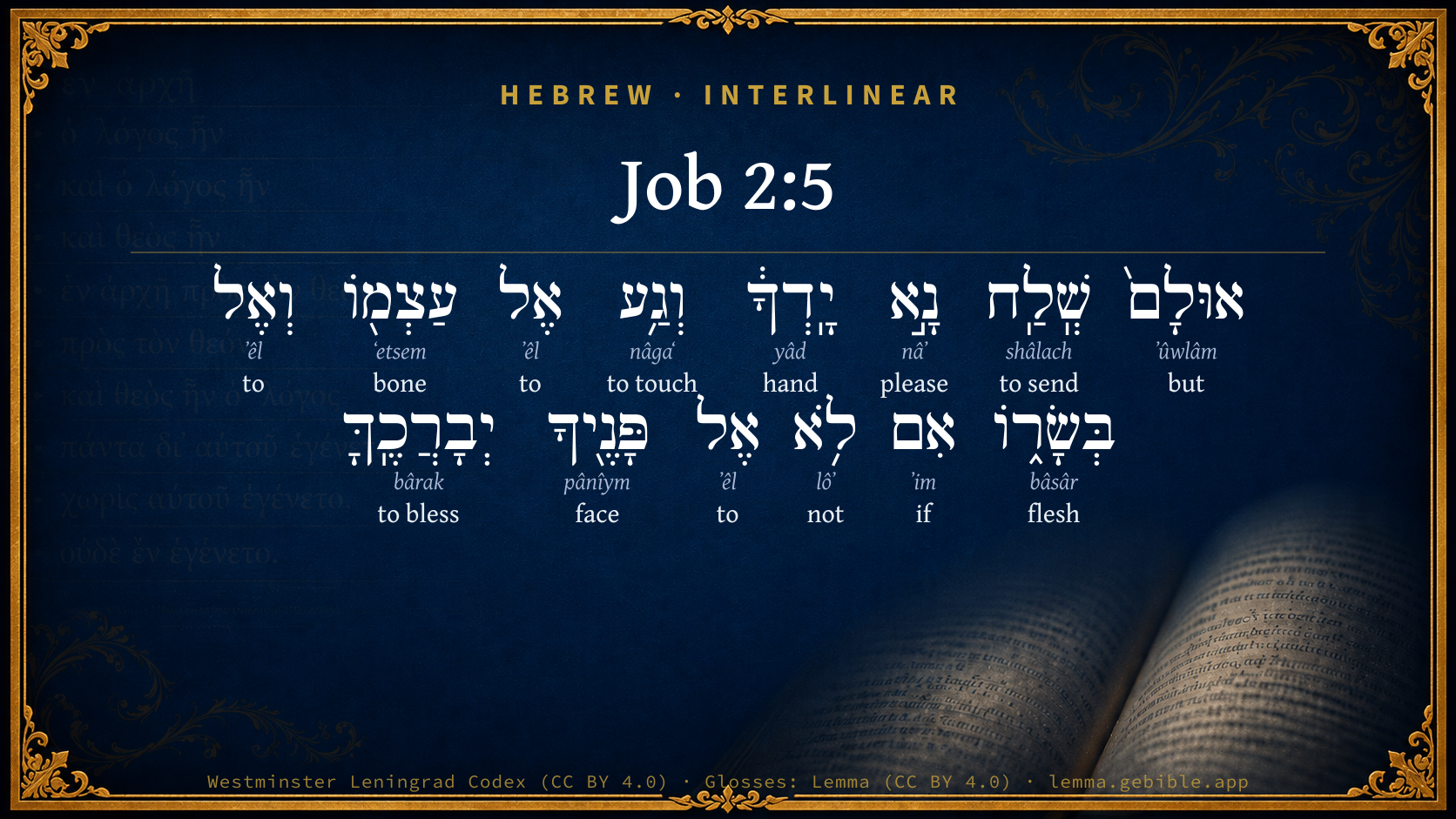
  1. שְֽׁלַֽח shâlach H7971 “send” Verb, Qal, Imperative, 2nd Person, Masculine, Singular
  2. נָ֣א nâʼ H4994 “please” Particle, Exhortation
  3. יָֽדְךָ֔ yâd H3027 “hand · your” Noun, Common, Both, Singular, Construct + Suffix, Personal, 2nd Person, Masculine, Singular
  4. וְגַ֥ע nâgaʻ H5060 “and · touch” Conjunction + Verb, Qal, Imperative, 2nd Person, Masculine, Singular
  5. אֶל ʼêl H413 “to” Preposition
  6. עַצְמ֖וֹ ʻetsem H6106 “bone · his” Noun, Common, Feminine, Singular, Construct + Suffix, Personal, 3rd Person, Masculine, Singular
  7. וְאֶל ʼêl H413 “and · to” Conjunction + Preposition
  8. בְּשָׂר֑וֹ bâsâr H1320 “flesh · his” Noun, Common, Masculine, Singular, Construct + Suffix, Personal, 3rd Person, Masculine, Singular
  9. אִם ʼim H518 “if” Conjunction
  10. לֹ֥א lôʼ H3808 “not” Particle, Negative
  11. אֶל ʼêl H413 “to” Preposition
  12. פָּנֶ֖יךָ pânîym H6440 “face(s) · your” Noun, Common, Both, Plural, Construct + Suffix, Personal, 2nd Person, Masculine, Singular
  13. יְבָרֲכֶֽךָּ bârak H1288 “to bless · you” Verb, Piel, Imperfect, 3rd Person, Masculine, Singular + Suffix, Personal, 2nd Person, Masculine, Singular

About this verse

These counts appear in no published source. They are computed here, from the morphology-tagged text and Lemma’s own curated glosses. What Lemma adds →

14
words
12
distinct lemmas
Wisdom
section

Notable vocabulary

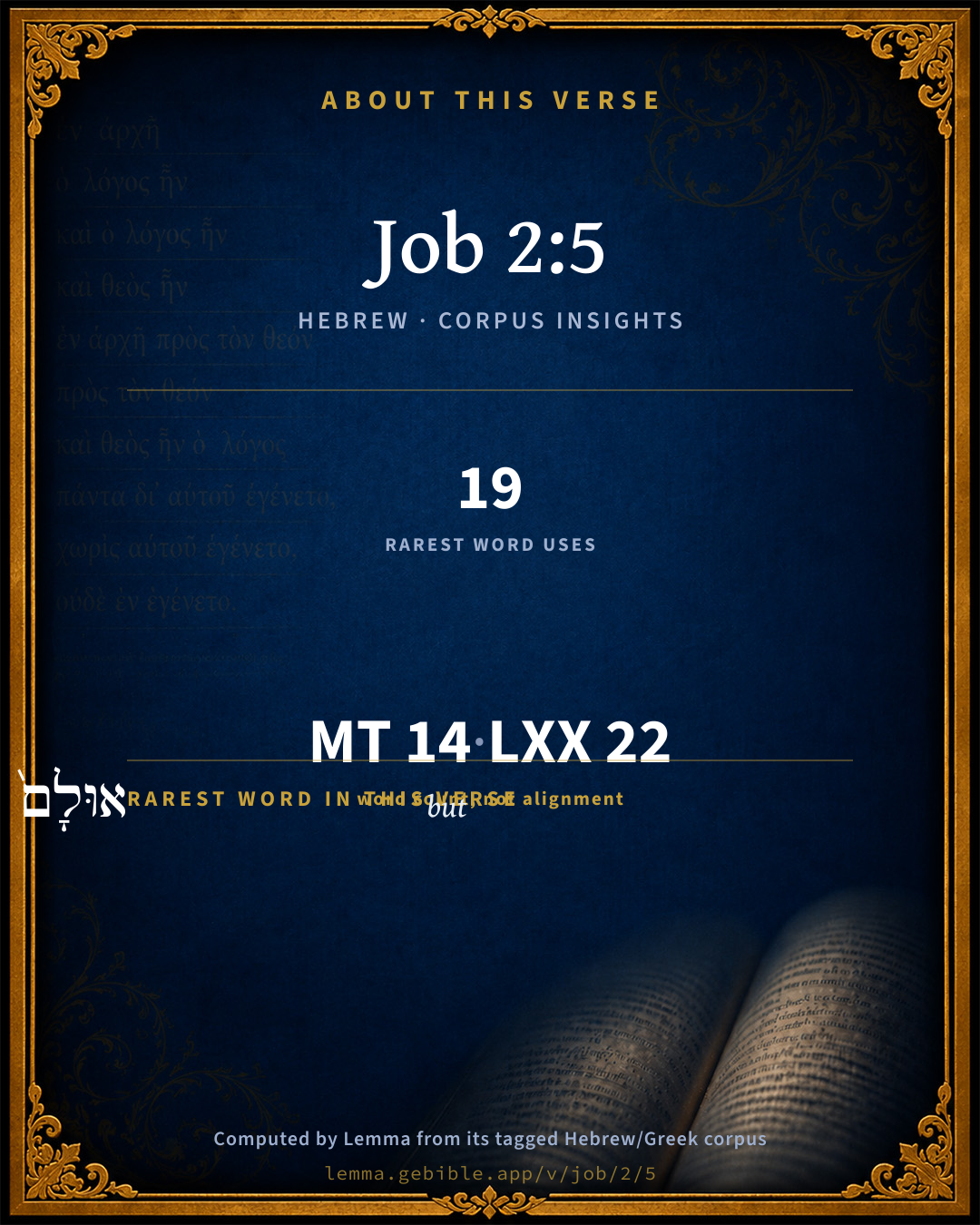
The rarest word here is אוּלָם֙ but H199 — appearing just 19 times in the whole Hebrew Bible.

Shared distinctive vocabulary

אוּלָם֙ but H199 occurs in 19 verses of the Hebrew Bible. Also found in:

Grammatical profile

  • 3 verbs
  • 4 nouns
  • 3 prepositions
  • 1 conjunction
  • 1 adverb
  • 2 particles

Verb forms

  • שְֽׁלַֽח Qal · Imperative
  • וְגַ֥ע Qal · Imperative
  • יְבָרֲכֶֽךָּ Piel · Imperfect

Repetition

A word recurs within this verse — often emphatic in Hebrew:

  • אֶל to H413 ×3

Hebrew & Septuagint length

In English translation the verse runs 21 words from the Hebrew and 21 from the Septuagint (LXX English) — the same length.

A rough comparison of the two English renderings, which tokenize alike — not a word-level alignment.

Word counts can differ between the Hebrew and the Greek without any difference in meaning — e.g. the Hebrew direct-object marker אֵת has no separate Greek word, and Greek often adds the article ὁ.

In the original languages it is 14 Hebrew tokens and 22 Greek tokens — but the two are counted differently (Hebrew bundles its prefixes and suffixes into one token; the Greek is in lemma form), so that isn’t a like-for-like length.

Cross-references

10

Topical passages linked to Job 2:5 in the Treasury of Scripture Knowledge — connected by theme and wording, ordered by reader-vote popularity; previews shown in the World English Bible.

  • Job 1:11 But put forth your hand now, and touch all that he has, and he will renounce you to your face."
  • Leviticus 24:15 You shall speak to the children of Israel, saying, 'Whoever curses his God shall bear his sin.
  • Job 1:5 It was so, when the days of their feasting had run their course, that Job sent and sanctified them, and rose up early in the morning, and offered burnt offerings according to the number of them all. For Job said, "It may be that my sons have sinned, and renounced God in their hearts." Thus did Job continually.
  • Job 19:20–21 My bones stick to my skin and to my flesh. I have escaped by the skin of my teeth.
  • Job 2:9 Then his wife said to him, "Do you still maintain your integrity? Renounce God, and die."
  • Psalms 32:3–4 When I kept silence, my bones wasted away through my groaning all day long.
  • Psalms 38:2–7 For your arrows have pierced me, Your hand presses hard on me.
  • Psalms 39:10 Remove your scourge away from me. I am overcome by the blow of your hand.
  • Isaiah 8:21 They shall pass through it, sore distressed and hungry; and it shall happen that when they shall be hungry, they shall fret themselves, and curse by their king and by their God, and turn their faces upward:
  • 1 Chronicles 21:17 David said to God, Isn't it I who commanded the people to be numbered? It is even I who have sinned and done very wickedly; but these sheep, what have they done? Please let your hand, O Yahweh my God, be against me, and against my father's house; but not against your people, that they should be plagued.

Cross-references courtesy of OpenBible.info (CC BY 4.0).

Hebrew and Greek witnesses Masoretic Hebrew ↔ Greek Septuagint

The same verse in the two great witnesses to the Old Testament, shown verse-for-verse.

These are two independent witnesses, not word-aligned to each other, and the Septuagint is shown in lemma (dictionary) form.

Hebrew Job 2:5 Masoretic · Westminster Leningrad Codex

אוּלָם֙ שְֽׁלַֽח נָ֣א יָֽדְךָ֔ וְגַ֥ע אֶל עַצְמ֖וֹ וְאֶל בְּשָׂר֑וֹ אִם לֹ֥א אֶל פָּנֶ֖יךָ יְבָרֲכֶֽךָּ

But put forth your hand now, and touch his bone and his flesh, and he will renounce you to your face."

World English Bible · Public Domain

Greek LXX Job 2:5 Septuagint · lemma form

οὐ μήν δέ ἀλλά ἀποστέλλω ὁ χείρ σύ ἅπτομαι ὁ ὀστέον αὐτός καί ὁ σάρξ αὐτός εἰ μήν εἰς πρόσωπον σύ εὐλογέω

Nay, but put forth your hand, and touch his bones and his flesh: verily he will bless you to your face.

LXX2012 (modern English Septuagint) · Public Domain

Hebrew: Westminster Leningrad Codex (CC BY 4.0). Greek: Septuagint (public domain); English from LXX2012 (modern English Septuagint) (Public Domain). How the Septuagint differs from the Hebrew →

Commentary

Notes on Job 2:5 from classic Christian and Jewish commentators (each source and its license shown beneath its notes). The classic Christian expositions comment on the surrounding passage and are grouped to its opening verse, so a note may address several verses; the Jewish commentaries on the Tanakh (Rashi and others) are per-verse, so they appear only where the commentator wrote on this verse.

Lemma curates 59 commentaries, every one of them public domain or Creative Commons licensed, each selected and text-cleaned for this edition rather than reprinted as found. About our sources →

Trapp's Complete Commentary

John Trapp

Job 2:5 But put forth thine hand now, and touch his bone and his flesh, and he will curse thee to thy face.

Ver 5. But put forth thine hand now] {See Trapp on "Job 1:11"} This God did at Satan’s motion, yet non ad exitium Iobi, sed ad exercitium; not for the destruction of Job but his training, Job’s temptation is of Satan, but his trial and invincible constancy is of God. God in a sense tempted Job. Satan also; even as the dog may be said to bait the beast, and the owner of the beast too, that suffered him to be baited.

And touch his bone and his flesh] Pinch him to the quick, that not his flesh only may feel it, but the marrow also in his bones, Psa 6:2; Psa 32:3; Psa 51:8. The bone and flesh are the chief materials of man’s body, which is fitly compared to a fabric, wherein the bones are the timber work, the head the upper lodging, the eyes as windows, the eyelids as casements, the brows as pent-houses, the ears as watch towers, the mouth as a door, to take in that which shall uphold the building, and keep it in reparations, the stomach as a kitchen, to dress that which is conveyed into it, the guts and baser parts as sinks belonging to the house, &c., as one maketh the comparison. Now in all these and the rest of his parts of body Satan would have Job to be smitten; and then he made no question of a conquest. Pain is a piercing shaft in Satan’s quiver of temptations; hence he stirred up his agents to tympanize and torment the martyrs with as much cruelty as the wit of malice could devise; but all in vain, Heb 11:35-36. Apollonia had all her teeth pulled out of her head (hence Papists make her the saint for toothaches). Blandina tired those that tortured her. Theodorus was cruelly whipped, racked, and scraped with sharp shells, by the command of Julian, but yielded not (Socrat. Theodor.). Rose Allen had her hand wrist burnt by Justice Tyrrell, who held a candle under it till the sinews brake that all the house heard them; and then thrusting her from him violently, said, Ah, strong whore, wilt thou not cry? thou shameless whore, thou beastly whore, &c. But she quietly suffered his rage for a time, at the last said, Sir, have you done what you will do? and he said, Yea; and if thou think it not well, then mend it. Mend it? said she; nay, the Lord mend you, and give you repentance, if it be his will. And now, if you think it fit, begin at the feet, and burn the head also; for he that set you awork shall pay your wages one day, I warrant you. As little got the devil by these worthies, as he did by Job’s boils and carbuncles. We are ashamed (said one of Julian’s nobles to him), we are ashamed, O Emperor, the Christians laugh at your cruelty, and grow the more resolute.

And he will curse thee to thy face] Heb. If he curse thee not to thy face, q.d. then damn me, send me to hell presently. This Satan holds in by an Aposiopesis,{a rhetorical device, in which the speaker comes to a sudden halt, as if unable or unwilling to proceed.} being therein more modest than our desperate and detestable God-damnmes: let them see how they gratify the devil who curse and blaspheme, or protest openly what they know to be false. This the devil did not.

John Trapp, A Commentary or Exposition upon All the Books of the Old and New Testament (1647–1656) — public domain. Text from a community e-Sword module.

Joseph Benson's Commentary

Job 2:5. But touch his bone and his flesh — That is, smite him, not slightly, but to the quick, to the bones and marrow, so that he may feel pain and anguish indeed: and he will curse thee to thy face — Will openly and daringly blaspheme thy perfections, and reproach the dispensations of thy providence, and so will let go his integrity. Satan knew, and we find by experience, that nothing has a greater tendency to ruffle the mind, and put its passions into disorder, than acute pain and distemper of body.

Joseph Benson's Commentary on the Old and New Testaments (1811–1818) — public domain. Text from a community e-Sword module.

Tyndale Open Study Notes

Tyndale Open Resources

2:5 take away his health (literally strike his flesh and bones): Bones were thought to be the seat of health.

Tyndale Open Study Notes — © Tyndale Open Resources, licensed CC BY-SA 4.0. Text via the HelloAO Bible API.

Geneva Bible (1599)

Geneva Bible translators

Meaning, his own person.

Geneva Bible (1599) marginal notes — public domain. Text via Bolls.life.

Adam Clarke's Commentary

Verse 5. He will curse thee to thy face.] Literally, If he will not bless thee to thy face or appearances. His piety to thee will be always regulated by thy bounty to him. See Clarke on Job 1:11.

Adam Clarke's Commentary on the Bible (1810–1826) — public domain. Text from a community e-Sword/MySword module.

John Gill's Exposition

And the Lord said unto Satan, behold, he is in thine hand,.... Well may a behold be prefixed to this, it being matter of wonder and astonishment that a saint and servant of God should be permitted to be in the hand of Satan; which yet must not be so understood; as if he was off of, and no more upon the heart of God; or as if he was out of the hands of God, and out of the hands of Christ; or as if he was become Satan's property, and a child of his; for neither of these can be true of a good man: nothing can separate him from the love of God; not Satan and all his principalities and powers; nor can men or devils pluck them out of his hands, nor out of the hands of his son; nor can those who are the children of God be any more the servants of sin, or the vassals of Satan; or in other words, nor can any of them be a child of God one day, and a child of the devil the next, which is the divinity of some men: nor is the sense of this passage, that Satan had leave to do with Job as he pleased, for then he would have utterly destroyed him; but the power granted him was a limited one, as follows:

but save his life: or "soul" (y); which some understand of his rational soul, that which remains after death, and which, Maimonides (z) observes, Satan has no power over; and according to some the meaning is, do not disturb his mind to distraction, so as to deprive him of his senses, and of the exercise of his rational powers, which through the influence of Satan men have sometimes lost; see Mar 5:4; this is barred against in the permission granted; for otherwise it would not have been a proper trial of Job's integrity; for, should he have been deprived of his reason, and uttered ever such bad things, it would have been no proof of his insincerity; as may be observed in good men in a delirium, they will utter bad words, and do or attempt to do bad things, which is not to be ascribed to their want of grace, but to their want of reason: but rather "life" is meant; not Job's spiritual life, for that was in no danger of being lost; all the devils in hell cannot deprive a truly good man of his spiritual life; grace in him is a well of living water, springing: up to eternal life; he can never die the second death; his life is hid with Christ in God, and is bound up in the bundle of life with the Lord his God, who so is out of the reach of Satan; but corporeal life, which the devil by permission may take away, and is said to have the power of death, which by leave he exercised over men, but here he is restrained from it: Job's life must be spared, that it might fully appear he got the victory over Satan, and stood in his integrity; and that he might still glorify God in a course of afflictions he was yet to endure, in the exercise of his faith, hope, love, patience, humility, submission, and resignation of his will to God; and besides, his appointed time was not come, he had many more days, months, and years, the number of which were with God, to live in the world, as he accordingly did.

(y) "animum ejus", Pagninus, Montanus, Cocccius, Schmidt, Schultens. (z) Moreh Nevochim, par. 3. c. 22. p. 398.

John Gill's Exposition of the Whole Bible (1746–1763) — public domain (CC PDM 1.0). Text via the HelloAO Bible API.

Albert Barnes' Notes on the Bible

But put forth thine hand now - Satan felt that he had no power to afflict Job without permission. Malignant as he was, he knew that God only could subject the holy man to this trial - another proof that Satan is under the control of the Almighty, and acts only as he is “permitted” to act in tempting and trying the good.

And touch his bone - See the note at Job 1:11. Afflict his body so as to endanger his life. The words “bone” and “flesh” denote the whole body. The idea was, that the whole body should be subjected to severe pain.

And he will curse thee to thy face - Notes at Job 1:11.

Albert Barnes' Notes on the Bible (1834–1885) — public domain. Text from a community e-Sword/MySword module.

Matthew Poole's English Annotations

Touch, i.e. smite him, not slightly, but to the quick, and to the bones and marrow, so as he may feel pain and anguish indeed, which is oft expressed by reaching to the bones, as Psa 6:2; 32:3; 51:8.

Matthew Poole's English Annotations on the Holy Bible (1683–1685) — public domain. Text from a community e-Sword/MySword module.

Whedon's Commentary on the Bible

Daniel D. Whedon

5. Touch his bone — Among the most painful diseases are those that have their seat in the bone. Job touchingly refers to this feature of his disease. (Job_30:17; Job_30:30.) The association of נגע, touch, with אל, (into or even to,) rather than ב, as in Job_1:11, Delitzsch has well remarked, “expresses increased malignity.”

Daniel D. Whedon (gen. ed.), Commentary on the Old and New Testaments (1874–1909) — public domain. Text from a community e-Sword module.

The Pulpit Commentary

But put forth thine hand now, and touch his bone and his flesh; i.e. "his person any part of his body. And he will curse thee to thy face. (see the comment on Job_11:11)

The Pulpit Commentary (1880–1919), ed. H.D.M. Spence-Jones & Joseph S. Exell — public domain. Text from a community e-Sword module.

Rashi

Rabbi Shlomo Yitzchaki (Rashi)

But Heb. אולם, but.

will he not Will You not see immediately that he will blaspheme You to Your face?

Rashi on the Tanakh — English translations: “The Judaica Press complete Tanach with Rashi, translated by A. J. Rosenberg” (CC BY 4.0); “Pentateuch with Rashi's commentary by M. Rosenbaum and A.M. Silbermann, 1929-1934” (public domain); “The Metsudah Tanach series, Lakewood, N.J” (CC BY 4.0); and “The Book of Joshua, Metsudah Publications, 1997” (CC BY 4.0). Text via Sefaria.

Lesson kit

Teaching starters — assembled from the data on this page, not authored interpretation. Every prompt links to the verse data it draws on. Edit before teaching.

Job, in the Wisdom, opens this verse with 14 words (12 distinct Hebrew lemmas). Its most distinctive word is ʼûwlâm (“but”). A historical commentator’s framing appears above. Read the whole chapter for the surrounding context.

Discussion questions

  1. What does “but” (ʼûwlâm) contribute to the verse as a whole?
  2. Genesis 28:19 shares the word «but» with this verse. How do the two illuminate each other?
  3. “to” occurs 3× in this one verse. What is the effect of the repetition?
  4. The translations on this page render this verse differently — a whole-verse word diff, not a word-by-word alignment. What might account for the different wordings?
  5. The verb «שְֽׁלַֽח» is Qal Imperative. How does its form color the action?
  6. Reading how Trapp's Complete Commentary and Joseph Benson's Commentary read this verse, where do the two commentators agree and where do they part?

Things to notice

Reading settings

Reading text

Shown beneath each verse's original-language words.

Old Testament
Old Testament edition

Read the OT as the Masoretic Hebrew (MT) or the Greek Septuagint (LXX).

English shown for the Greek Septuagint (in the Hebrew ↔ Greek comparison).

Comparing translations? Open the Compare panel on any verse page to stack up to four side by side.