
Psalms 145:2

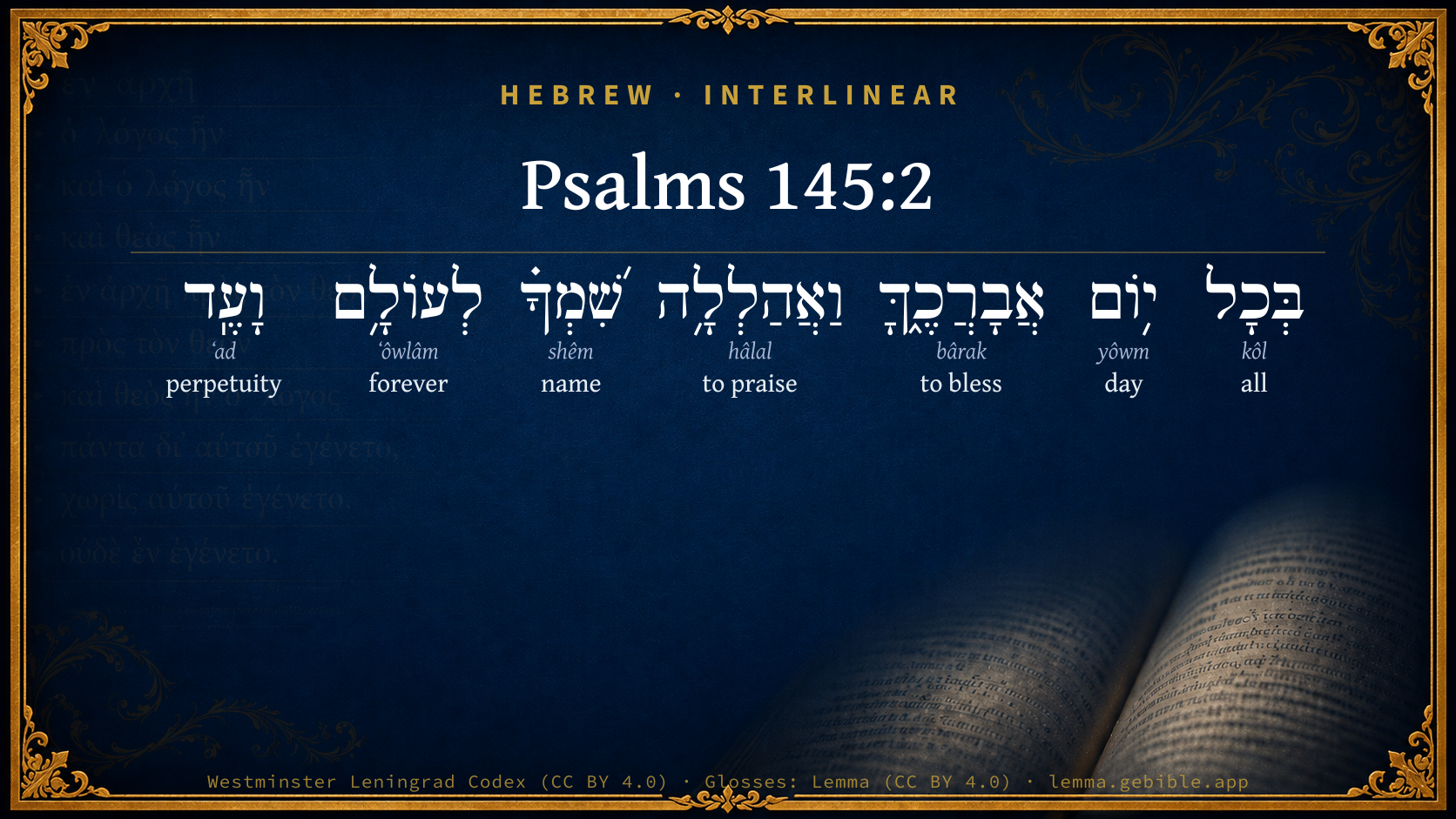
Hebrew (Westminster Leningrad Codex) Psalms 145:2 appears in the Hebrew Old Testament. The text above is from the Westminster Leningrad Codex. Each word links to its Strong’s number, a concise gloss, and parsing drawn from the Open Scriptures Hebrew Bible morphology. Click any word for its full Brown-Driver-Briggs (BDB) entry.
Download image
Cite this verse

Psalms 145:2 (World English Bible). Public Domain. Lemma interlinear Bible study tool, https://lemma.gebible.app/v/psalms/145/2.

Show BibTeX & RIS
BibTeX
RIS
English Translation
Every day I will praise you. I will extol your name forever and ever.
World English Bible · Public Domain
Download a study sheet

One document with this verse’s original text, its word-by-word gloss line, the meaning frame, cross-references with their text, attributed commentary, and full source and license credits — printable, and it pastes into notes with its structure intact.

This verse Autodidact and up

Study sheet (.html) Plain text (.txt)

A passage Seminary Student

Up to 50 verses in one chapter. A passage sheet keeps up to 6 commentary sources and 12 cross-references per verse, in the order this page ranks them, and says so on the sheet whenever that leaves anything out. Ask for a single verse and you get the Autodidact verse sheet above.

Everything on this page stays free to read, with no account — the sheet is a download of what is already on screen, not access to it.

Want to remove ads? Support Godless Engineer
Compare translations 3

The same verse in 3 English versions, stacked beneath the original-language interlinear above. Click any original word for its lexicon entry.

Each is an independent rendering of the whole verse — the interlinear is not word-aligned to these translations.

Highlighted words mark where these versions differ — a whole-verse word diff, not a word-by-word alignment.

  • World English Bible Public Domain
    Every day I will praise you. I will extol your name forever and ever.
  • King James Version Public Domain
    Every day will I bless thee; and I will praise thy name for ever and ever.
  • unfoldingWord Literal Text CC BY-SA 4.0
    I will bless you every day, and I will praise your name forever and ever.

unfoldingWord Literal Text — © unfoldingWord, licensed CC BY-SA 4.0. Word-aligned USFM3 via Door43 (git.door43.org/unfoldingWord/en_ult).

Versions to compare (up to 4)

3 of 4 selected

Show all 18 translations

Every available English version of this verse, each an independent rendering of the whole verse.

  • World English Bible Public Domain
    Every day I will praise you. I will extol your name forever and ever.
  • Berean Standard Bible Public Domain
    Every day I will bless You, and I will praise Your name forever and ever.
  • Majority Standard Bible Public Domain
    Every day I will bless You, and I will praise Your name forever and ever.
  • King James Version Public Domain
    Every day will I bless thee; and I will praise thy name for ever and ever.
  • American Standard Version (1901) Public Domain
    Every day will I bless thee; And I will praise thy name for ever and ever.
  • Revised Version (1885) Public Domain
    Every day will I bless thee; and I will praise thy name for ever and ever.
  • Geneva Bible (1599) Public Domain
    I will blesse thee dayly, and prayse thy Name for euer and euer.
  • Douay-Rheims (1899) Public Domain
    My mercy, and my refuge: my support, and my deliverer: My protector, and I have hoped in him: who subdueth my people under me.
  • Young's Literal Translation Public Domain
    Every day do I bless Thee, And praise Thy name to the age and for ever.
  • Literal Standard Version CC BY-SA 4.0
    Every day I bless You, || And praise Your Name for all time and forever.
  • Unlocked Literal Bible CC BY-SA 4.0
    Every day will I bless you; I will praise your name forever and ever.
  • unfoldingWord Literal Text CC BY-SA 4.0
    I will bless you every day, and I will praise your name forever and ever.
  • Darby Bible Public Domain
    Every day will I bless thee, and I will praise thy name for ever and ever.
  • World Messianic Bible Public Domain
    Every day I will praise you. I will extol your name forever and ever.
  • Webster's Bible Public Domain
    Every day will I bless thee; and I will praise thy name for ever and ever.
  • Free Bible Version CC BY-SA 4.0
    I will praise you every day; I will praise your character forever and ever!
  • Bible in Basic English Public Domain
    Every day will I give you blessing, praising your name for ever and ever.
  • JPS Tanakh (1917) Public Domain
    Every day will I bless Thee; and I will praise Thy name for ever and ever.

Literal Standard Version (2020), Covenant Press — licensed CC BY-SA 4.0. Text via the HelloAO Bible API (eBible.org). Unlocked Literal Bible (unfoldingWord) — licensed CC BY-SA 4.0. Text via the HelloAO Bible API (eBible.org). unfoldingWord Literal Text — © unfoldingWord, licensed CC BY-SA 4.0. Word-aligned USFM3 via Door43 (git.door43.org/unfoldingWord/en_ult). Free Bible Version, Dr. Jonathan Gallagher — licensed CC BY-SA 4.0. Text via the HelloAO Bible API (eBible.org).

Word by word

More ways to search: Search by grammar → Find every occurrence → Compare this word →

Practice this passage: Drill this verse → Learn its vocabulary →

וָעֶֽד
ʻad
H5703
“and · perpetuity”
Conjunction + Noun, Common, Masculine, Singular, Absolute
Part of Speech
Conjunction + Noun
Type
Common
Gender
Masculine
Number
Singular
State
Absolute
Full BDB Definition

Origin: from H5710

TWOT: 1565a

perpetuity, for ever, continuing future - ancient (of past time) - for ever (of future time) - of continuous existence - for ever (of God's existence)
  1. בְּכָל kôl H3605 “in/at · all of” Preposition + Noun, Common, Masculine, Singular, Construct
  2. י֥וֹם yôwm H3117 “day” Noun, Common, Masculine, Singular, Absolute
  3. אֲבָרֲכֶ֑ךָּ bârak H1288 “to bless · you” Verb, Piel, Cohortative, 1st Person, Common, Singular + Suffix, Personal, 2nd Person, Masculine, Singular
  4. וַאֲהַלְלָ֥ה hâlal H1984 “and · to praise” Conjunction + Verb, Piel, Cohortative, 1st Person, Common, Singular
  5. שִׁ֝מְךָ֗ shêm H8034 “name · your” Noun, Common, Masculine, Singular, Construct + Suffix, Personal, 2nd Person, Masculine, Singular
  6. לְעוֹלָ֥ם ʻôwlâm H5769 “to/for · forever” Preposition + Noun, Common, Masculine, Singular, Absolute

About this verse

These counts appear in no published source. They are computed here, from the morphology-tagged text and Lemma’s own curated glosses. What Lemma adds →

7
words
7
distinct lemmas
Wisdom
section

Shared distinctive vocabulary

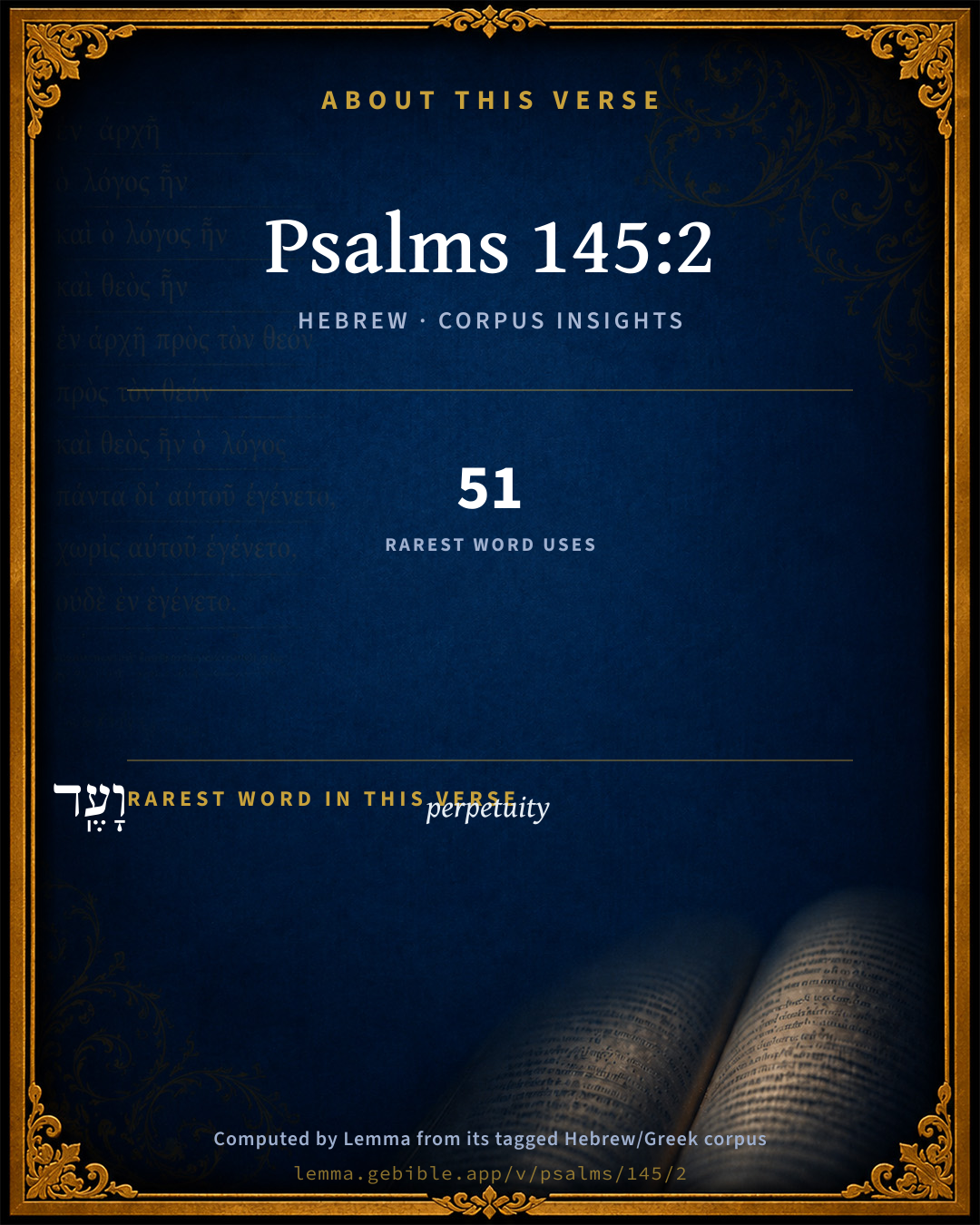
וָעֶֽד perpetuity H5703 occurs in 49 verses of the Hebrew Bible. Also found in:

Grammatical profile

  • 2 verbs
  • 5 nouns

Verb forms

  • אֲבָרֲכֶ֑ךָּ Piel · Cohortative
  • וַאֲהַלְלָ֥ה Piel · Cohortative

Hebrew & Septuagint length

In English translation the verse runs 14 words from the Hebrew and 16 from the Septuagint (LXX English) — closely comparable.

A rough comparison of the two English renderings, which tokenize alike — not a word-level alignment.

Word counts can differ between the Hebrew and the Greek without any difference in meaning — e.g. the Hebrew direct-object marker אֵת has no separate Greek word, and Greek often adds the article ὁ.

Cross-references

4

Topical passages linked to Psalms 145:2 in the Treasury of Scripture Knowledge — connected by theme and wording, ordered by reader-vote popularity; previews shown in the World English Bible.

  • Revelation 7:15 Therefore they are before the throne of God, they serve him day and night in his temple. He who sits on the throne will spread his tent over them.
  • Psalms 71:6 I have relied on you from the womb. You are he who took me out of my mother's womb. I will always praise you.
  • Psalms 72:15 They shall live, and to him shall be given of the gold of Sheba. Men shall pray for him continually. They shall bless him all day long.
  • Psalms 119:164 Seven times a day, I praise you, Because of your righteous ordinances.

Cross-references courtesy of OpenBible.info (CC BY 4.0).

Hebrew and Greek witnesses Masoretic Hebrew ↔ Greek Septuagint

The same verse in the two great witnesses to the Old Testament, shown verse-for-verse.

You’re reading Greek Psalm 144 (Hebrew Psalm 145). The Septuagint counts the superscription, so verse numbers can differ from the Hebrew — chapter-level alignment, not verse-by-verse. Numbering follows Rahlfs.

These are two independent witnesses, not word-aligned to each other, and the Septuagint is shown in lemma (dictionary) form.

Hebrew Psalms 145:2 Masoretic · Westminster Leningrad Codex

בְּכָל י֥וֹם אֲבָרֲכֶ֑ךָּ וַאֲהַלְלָ֥ה שִׁ֝מְךָ֗ לְעוֹלָ֥ם וָעֶֽד

Every day I will praise you. I will extol your name forever and ever.

World English Bible · Public Domain

Greek LXX Greek Psalm 144:2 Septuagint · lemma form

κατά ἕκαστος ἡμέρα εὐλογέω σύ καί αἰνέω ὁ ὄνομα σύ εἰς ὁ αἰών καί εἰς ὁ αἰών ὁ αἰών

Every day will I bless you, and I will praise your name for ever and ever.

LXX2012 (modern English Septuagint) · Public Domain

Hebrew: Westminster Leningrad Codex (CC BY 4.0). Greek: Septuagint (public domain); English from LXX2012 (modern English Septuagint) (Public Domain). How the Septuagint differs from the Hebrew →

Commentary

Notes on Psalms 145:2 from classic Christian and Jewish commentators (each source and its license shown beneath its notes). The classic Christian expositions comment on the surrounding passage and are grouped to its opening verse, so a note may address several verses; the Jewish commentaries on the Tanakh (Rashi and others) are per-verse, so they appear only where the commentator wrote on this verse.

Lemma curates 59 commentaries, every one of them public domain or Creative Commons licensed, each selected and text-cleaned for this edition rather than reprinted as found. About our sources →

Trapp's Complete Commentary

John Trapp

Psa 145:2 Every day will I bless thee; and I will praise thy name for ever and ever.

Ver. 2. Every day will I bless thee] No day shall pass me without a morning and evening sacrifice; besides, what is more, upon all emergent occasions. The Jews have above a hundred benedictions which they are bound to say over every day; and one among the rest, for the benefit of evacuation. If I were a nightingale, saith Epictetus, a heathen (In Encher.), I would do as a nightingale; but since I am a man, what shall I do? I will praise my Maker, and never cease to do it: I exhort also all men to do the like.

John Trapp, A Commentary or Exposition upon All the Books of the Old and New Testament (1647–1656) — public domain. Text from a community e-Sword module.

The Biblical Illustrator

Joseph S. Exell

Psa_145:2

Every day will I bless Thee.

A goodly occupation

I. The duty imposed.

1. It is purely voluntary. Whatever we do must be done not grudgingly, or of necessity. To do it against our will is to render mechanical service. In that there is no manhood.

2. It is personal. David appealed to others (verse 21), for he would have others similarly engaged. But he did not wait for them. Commenced himself: led the way. So must we.

3. In harmony with his understanding, judgment, and feelings. Only so far as there is this agreement or harmony is there any hope of a successful performance of this duty.

4. But how can we bless the Lord?

(1) By extolling Him.

(2) Praising Him.

(3) Loving Him.

II. The time set apart. Every day.

1. This possesses considerable advantage. Clocks that require winding up once a week, or once in eight or fifteen days, or longer period, are more likely to be neglected than watches and clocks which require daily attention. Then no need of reckoning up. Cannot well go wrong, for it is an everyday work.

2. This is comprehensive; for does not mean, as in case of watch or clock, a particular Nine, but all the time. In other words, that all our life should be devoted to this purpose.

3. Nor is this unreasonable; for only according to the measure whereby we have been blessed.

4. Therefore makes a business of it. Not occasional or spasmodic, but the regular, uninterrupted course. Conclusion--Keep, therefore, and do this, for this is your wisdom and your understanding. (J. H. Thompson.)

Daily devotion

I. An obligation. As such it calls forth--

1. Reflection. Providence is a great panorama; the Bible is a vast picture-gallery; the human race is an endless orchestra; and the whole an exhibition of infinite wisdom, power, and love. The true observer is filled with calmness, reverence, worship, and his soul ascends Godward in the incense of universal adoration.

2. Thanksgiving. We have peace with God through our Lord Jesus Christ, and in the calmness of our forgiven heart we look up to the Giver of all our perfect gifts. Every day we bless Him for the Bible, for the Saviour, for the guidance of His Spirit, for the communion of saints, and for the hope of life eternal.

II. A fit accompaniment to daily duties. The late Princess Alice chose for her personal motto the lark. Her reason for it was that the lark soared high in the heavens to praise its Maker, and then descended to make its nest on the ground. It was a beautiful sentiment, and will apply to the godly: Give us this day our daily bread--that is the cry of devotion to be followed by work. Sir Thomas More stipulated when he took office under the government first to look to God and then to the king.

III. Our stay in trial.

IV. A witness for Christ. Our places of worship are only open at stated times, and the Gospel preached at appointed hours, but he whose soul knows the blessedness of communion with God is a daily minister of religion. Fletcher of Madeley and his brother, when they were boys, went on Lake Geneva in a boat. After a while the mist swept down, and completely enveloped the lake. The boys soon lost their points, and kept on rowing about in the dark. At eight oclock all the bells in the town began to peal in honour of a great event. The boys heard the bells, turned their boat towards the sound, and were soon safely landed. Let every Christian peal the bells of grace to direct the mariners who are in the darkness towards the haven of rest. (D. Davies.)

Praise unintermittent

Suppose some one entering heaven were to say to the redeemed, Suspend your songs for a moment! ye have been praising Christ, lo! these six thousand years: many of you have without cessation praised Him now these many centuries. Stop your song a moment; pause and give your songs to some one else for a moment. Oh l can you conceive the scorn with which the myriad eyes of the redeemed would smite the tempter. Stop from praising Him! No, never. Time may stop, for it shall be no more: the world may stop, for its revolutions must cease; the universe may stop its cycles and the movings of its world; but for us to stop our songs--never! never! (C. H. Spurgeon.)

The Biblical Illustrator, edited by Joseph S. Exell (c. 1880s–1900s) — public domain. Text from a community e-Sword module.

J. A. Alexander on Psalms

Joseph Addison Alexander

2. (Psa 145:2) Every day will I bless thee, and praise thy name to eternity and per petuity. Compare Psa 68:19; Psa 69:30; Psa 92:2-3. Every day denotes constancy and regularity.

Joseph Addison Alexander, The Psalms Translated and Explained (1850) — public domain. Text from a community e-Sword module.

John Gill's Exposition

Every day will I bless thee,.... For new mercies had every morning; for fresh supplies of grace every day, which all come from the fulness of Christ, to whom all grace is given, and from whence it is received, and in whom all spiritual blessings are, and by whom they are bestowed;

and I will praise thy name for ever and ever; as long as he lived in this world, and to all eternity in the world to come. David understood the doctrine of the saints' perseverance, and knew he should not be an apostate and blasphemer of the name of Christ, but a praiser of it as long as he had a being; and that his principal service, and that of all the saints in the other world, will be praise; not praying, nor preaching, nor hearing the word, and attendance on other ordinances, which will be no more, but adoring and magnifying the riches of divine grace, Psa 104:34.

John Gill's Exposition of the Whole Bible (1746–1763) — public domain (CC PDM 1.0). Text via the HelloAO Bible API.

Albert Barnes' Notes on the Bible

Every day will I bless thee ... - Compare Psa 92:2; Psa 55:17. As we receive blessings from God every day (compare Lam 3:23), it is proper that we should render to him daily thanks; as God is the same always - “yesterday, today, and forever” - it is proper that he should receive from day to day the tribute of praise; as we are daily dependent on him - one day as much as another - our recognition of that dependence should be daily; and as he will always be unchangeably the same, it will be proper that he should be praised forever and ever. Two things are apparent from this verse:

(1) that a truly religious man “will” worship God every day;

(2) that it is the fixed purpose of a truly religious man to continue this forever.

Albert Barnes' Notes on the Bible (1834–1885) — public domain. Text from a community e-Sword/MySword module.

The Treasury of David

Charles H. Spurgeon

Ver. 2. Every day will I bless thee. Whatever the character of the day, or of my circumstances and conditions during that day, I will continue to glorify God. Were we well to consider the matter we should see abundant cause in each day for rendering special blessing unto the Lord. All before the day, all in the day, all following the day should constrain us to magnify our God every day, all the year round. Our love to God is not a matter of holy days: every day is alike holy to holy men. David here comes closer to God than when he said, "I will bless thy name": it is now, "I will bless thee." This is the centre and kernel of true devotion: we do not only admire the Lord's words and works, but himself. Without realizing the personality of God, praise is well nigh impossible; you cannot extol an abstraction. And I will praise thy name for ever and ever. He said he would bless that name, and now he vows to praise it; he will extol the Lord in every sense and way. Eternal worship shall not be without its variations; it will never become monotonous. Heavenly music is not harping upon one string, but all strings shall be tuned to one praise. Observe the personal pronouns here: four times he says "I will": praise is not to be discharged by proxy: there must be your very self in it, or there is nothing in it.

Ver. 2. Every day. Then God is to be blessed and praised in dark as well as bright days Johannes Paulus Palanterius, 1600.

Ver. 2. Every day (in the week) will I bless thee, the Psalmist seems to signify. As there are "seven spirits" peculiarly existing in nearness to God, David holds the seven days of the week like seven stars in his hand, or like a seven branched candlestick of gold, burning every day with his devotion. He calls the seven days to be as seven angels with trumpets. Thomas Le Blanc.

Ver. 2. I will bless thee: I will praise thy name. The repetition intimates the fervency of his affection to this work, the fixedness of his purpose to abound in it, and the frequency of his performances therein. Matthew Henry.

Ver. 2. Praise. If we are to define it in words, we may say that praise is thankful, lowly, loving worship of the goodness and majesty of God. And therefore we often find the word "praise" joined with "blessing" and "thanksgiving": but though all three are akin to each other, they are not all alike. They are steps in a gradual scalea song of degrees. Thanksgiving runs up into blessing, and blessing ascends into praise; for praise comprehends both, and is the highest and most perfect work of all living spirits. Henry Edward Manning, 1850.

Ver. 2. Every day; for ever.

1. Day by day for ever God and I will endure.

2. Day by day for ever our present relations will continue. He the God, I the creature; he the Father, I the child; he the blessing, I the blest.

3. Day by day for ever he shall have my homage. W. B. H.

Psalms 145:3*

Charles H. Spurgeon's The Treasury of David (1869–1885) — public domain. Psalms only. Text from a community e-Sword/MySword module.

The Pulpit Commentary

Every day will I bless thee; and I will praise thy Name for ever and ever. An emphatic repetition of the second clause of ver. 1.

The Pulpit Commentary (1880–1919), ed. H.D.M. Spence-Jones & Joseph S. Exell — public domain. Text from a community e-Sword module.

Lesson kit

Teaching starters — assembled from the data on this page, not authored interpretation. Every prompt links to the verse data it draws on. Edit before teaching.

Psalms, in the Wisdom, opens this verse with 7 words (7 distinct Hebrew lemmas). Its most distinctive word is ʻad (“perpetuity”). A historical commentator’s framing appears above. Read the whole chapter for the surrounding context.

Discussion questions

  1. How does “perpetuity” (ʻad) shape what this verse is saying?
  2. Exodus 15:18 shares the word «perpetuity» with this verse. How do the two illuminate each other?
  3. These translations render this verse differently. What is at stake in choosing one wording over another?
  4. The verb «אֲבָרֲכֶ֑ךָּ» is Piel Cohortative. How does its form color the action?
  5. Reading how Trapp's Complete Commentary and The Biblical Illustrator read this verse, where do the two commentators agree and where do they part?

Things to notice

Reading settings

Reading text

Shown beneath each verse's original-language words.

Old Testament
Old Testament edition

Read the OT as the Masoretic Hebrew (MT) or the Greek Septuagint (LXX).

English shown for the Greek Septuagint (in the Hebrew ↔ Greek comparison).

Comparing translations? Open the Compare panel on any verse page to stack up to four side by side.