
Deuteronomy 26:15

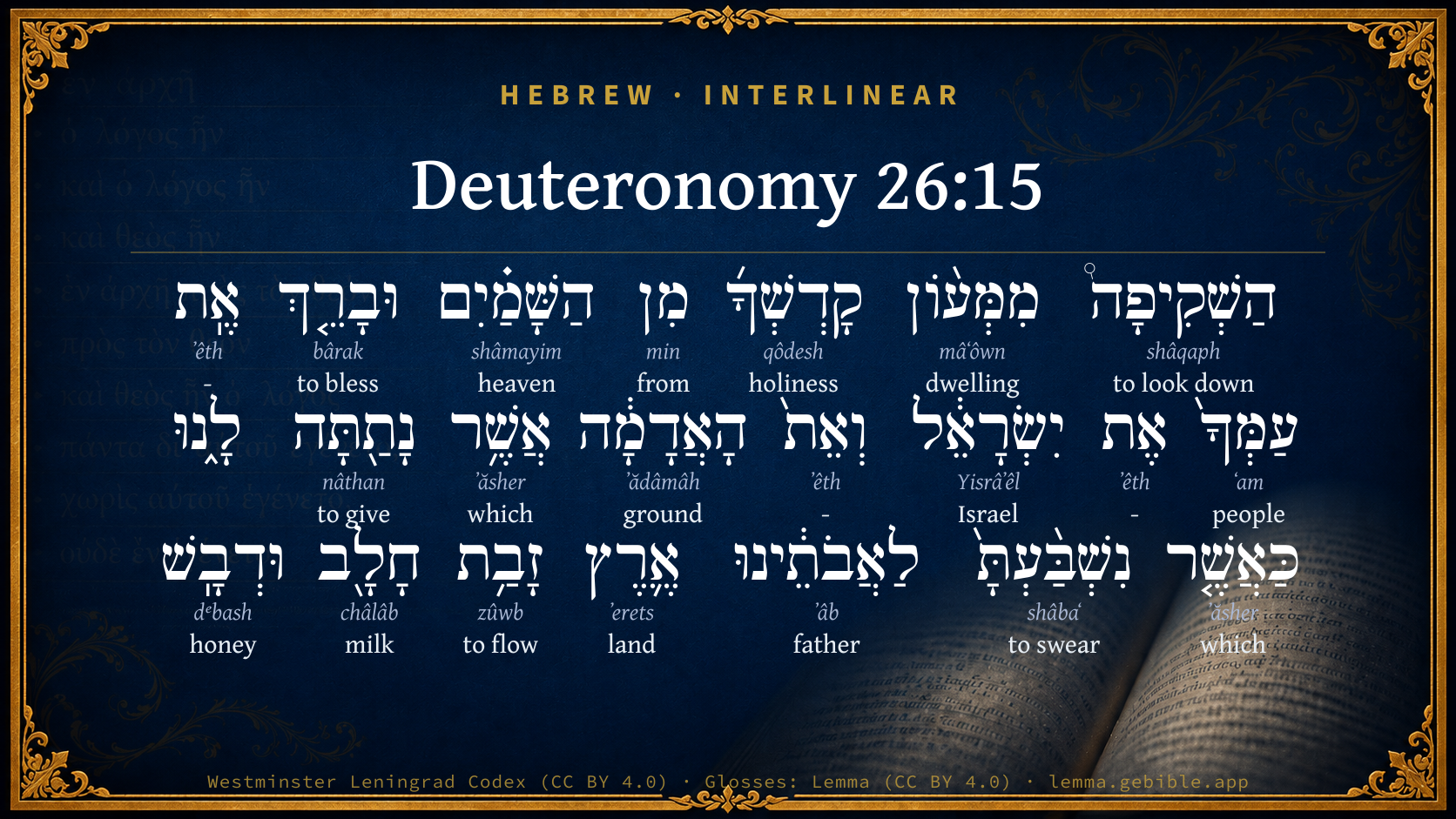
Hebrew (Westminster Leningrad Codex) Deuteronomy 26:15 appears in the Hebrew Old Testament. The text above is from the Westminster Leningrad Codex. Each word links to its Strong’s number, a concise gloss, and parsing drawn from the Open Scriptures Hebrew Bible morphology. Click any word for its full Brown-Driver-Briggs (BDB) entry.
Download image
Cite this verse

Deuteronomy 26:15 (World English Bible). Public Domain. Lemma interlinear Bible study tool, https://lemma.gebible.app/v/deuteronomy/26/15.

Show BibTeX & RIS
BibTeX
RIS
English Translation
Look down from your holy habitation, from heaven, and bless your people Israel, and the ground which you have given us, as you swore to our fathers, a land flowing with milk and honey.
World English Bible · Public Domain
Highlights
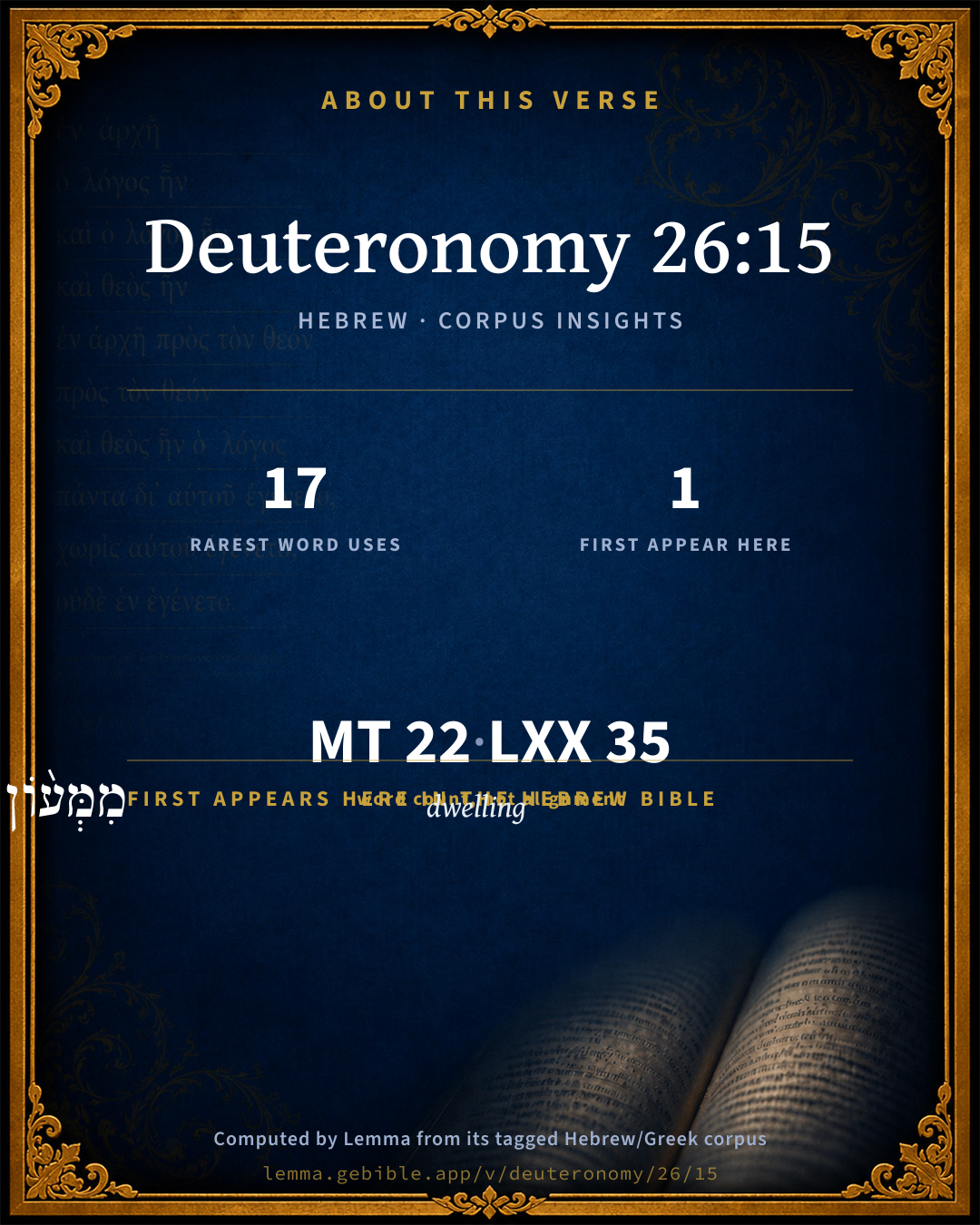
  • 1 first appearance in the Hebrew Bible
Full analysis ↓
Download a study sheet

One document with this verse’s original text, its word-by-word gloss line, the meaning frame, cross-references with their text, attributed commentary, and full source and license credits — printable, and it pastes into notes with its structure intact.

This verse Autodidact and up

Study sheet (.html) Plain text (.txt)

A passage Seminary Student

Up to 50 verses in one chapter. A passage sheet keeps up to 6 commentary sources and 12 cross-references per verse, in the order this page ranks them, and says so on the sheet whenever that leaves anything out. Ask for a single verse and you get the Autodidact verse sheet above.

Everything on this page stays free to read, with no account — the sheet is a download of what is already on screen, not access to it.

Want to remove ads? Support Godless Engineer
Compare translations 3

The same verse in 3 English versions, stacked beneath the original-language interlinear above. Click any original word for its lexicon entry.

Each is an independent rendering of the whole verse — the interlinear is not word-aligned to these translations.

Highlighted words mark where these versions differ — a whole-verse word diff, not a word-by-word alignment.

  • World English Bible Public Domain
    Look down from your holy habitation, from heaven, and bless your people Israel, and the ground which you have given us, as you swore to our fathers, a land flowing with milk and honey.
  • King James Version Public Domain
    Look down from thy holy habitation, from heaven, and bless thy people Israel, and the land which thou hast given us, as thou swarest unto our fathers, a land that floweth with milk and honey.
  • unfoldingWord Literal Text CC BY-SA 4.0
    Look down from your holy habitation, from the heavens, and bless your people, Israel, and the land that you have given to us, as you had sworn to our fathers, a land flowing with milk and honey.’

unfoldingWord Literal Text — © unfoldingWord, licensed CC BY-SA 4.0. Word-aligned USFM3 via Door43 (git.door43.org/unfoldingWord/en_ult).

Versions to compare (up to 4)

3 of 4 selected

Show all 18 translations

Every available English version of this verse, each an independent rendering of the whole verse.

  • World English Bible Public Domain
    Look down from your holy habitation, from heaven, and bless your people Israel, and the ground which you have given us, as you swore to our fathers, a land flowing with milk and honey.
  • Berean Standard Bible Public Domain
    Look down from Your holy habitation, from heaven, and bless Your people Israel and the land You have given us as You swore to our fathers—a land flowing with milk and honey.”
  • Majority Standard Bible Public Domain
    Look down from Your holy habitation, from heaven, and bless Your people Israel and the land You have given us as You swore to our fathers—a land flowing with milk and honey.”
  • King James Version Public Domain
    Look down from thy holy habitation, from heaven, and bless thy people Israel, and the land which thou hast given us, as thou swarest unto our fathers, a land that floweth with milk and honey.
  • American Standard Version (1901) Public Domain
    Look down from thy holy habitation, from heaven, and bless thy people Israel, and the ground which thou hast given us, as thou swarest unto our fathers, a land flowing with milk and honey.
  • Revised Version (1885) Public Domain
    Look down from thy holy habitation, from heaven, and bless thy people Israel, and the ground which thou hast given us, as thou swarest unto our fathers, a land flowing with milk and honey.
  • Geneva Bible (1599) Public Domain
    Looke downe from thine holy habitation, euen from heauen, and blesse thy people Israel, and the lande which thou hast giuen vs (as thou swarest vnto our fathers) the land that floweth with milke and hony.
  • Douay-Rheims (1899) Public Domain
    I have not eaten of them is my mourning, nor separated them for any uncleanness, nor spent any thing of them in funerals. I have obeyed the voice of the Lord my God, and have done all things as thou hast commanded me.
  • Young's Literal Translation Public Domain
    look from Thy holy habitation, from the heavens, and bless Thy people Israel, and the ground which Thou hast given to us, as Thou hast sworn to our fathers -- a land flowing `with' milk and honey.
  • Literal Standard Version CC BY-SA 4.0
    look from Your holy habitation, from the heavens, and bless Your people Israel and the ground which You have given to us, as You have sworn to our fathers—a land flowing [with] milk and honey.
  • Unlocked Literal Bible CC BY-SA 4.0
    Look down from the holy place where you live, from heaven, and bless your people Israel, and the land that you have given us, as you had sworn to our fathers, a land flowing with milk and honey.'
  • unfoldingWord Literal Text CC BY-SA 4.0
    Look down from your holy habitation, from the heavens, and bless your people, Israel, and the land that you have given to us, as you had sworn to our fathers, a land flowing with milk and honey.’
  • Darby Bible Public Domain
    Look down from thy holy habitation, from the heavens, and bless thy people Israel, and the land that thou hast given us as thou didst swear unto our fathers, a land flowing with milk and honey!
  • World Messianic Bible Public Domain
    Look down from your holy habitation, from heaven, and bless your people Israel, and the ground which you have given us, as you swore to our fathers, a land flowing with milk and honey.”
  • Webster's Bible Public Domain
    Look down from thy holy habitation, from heaven, and bless thy people Israel, and the land which thou hast given us, as thou didst swear to our fathers, a land that floweth with milk and honey.
  • Free Bible Version CC BY-SA 4.0
    Please look down from your home in heaven, and bless your people the Israelites and the country you have given us as you promised our fathers—a land flowing with milk and honey.”
  • Bible in Basic English Public Domain
    So, looking down from your holy place in heaven, send your blessing on your people Israel and on the land which you have given us, as you said in your oath to our fathers, a land flowing with milk and honey.
  • JPS Tanakh (1917) Public Domain
    Look forth from Thy holy habitation, from heaven, and bless Thy people Israel, and the land which Thou hast given us, as Thou didst swear unto our fathers, a land flowing with milk and honey.'

Literal Standard Version (2020), Covenant Press — licensed CC BY-SA 4.0. Text via the HelloAO Bible API (eBible.org). Unlocked Literal Bible (unfoldingWord) — licensed CC BY-SA 4.0. Text via the HelloAO Bible API (eBible.org). unfoldingWord Literal Text — © unfoldingWord, licensed CC BY-SA 4.0. Word-aligned USFM3 via Door43 (git.door43.org/unfoldingWord/en_ult). Free Bible Version, Dr. Jonathan Gallagher — licensed CC BY-SA 4.0. Text via the HelloAO Bible API (eBible.org).

Word by word

More ways to search: Search by grammar → Find every occurrence → Compare this word →

Practice this passage: Drill this verse → Learn its vocabulary →

מִמְּע֨וֹן
mâʻôwn
H4583
“from · dwelling of”
Preposition + Noun, Common, Both, Singular, Construct
Part of Speech
Preposition + Noun
Type
Common
Gender
Both
Number
Singular
State
Construct
Full BDB Definition

Origin: from the same as H5772

TWOT: 1581a

dwelling, habitation, refuge - lair, refuge (of jackals) - dwelling
  1. הַשְׁקִיפָה֩ shâqaph H8259 “look down” Verb, Hiphil, Imperative, 2nd Person, Masculine, Singular + Suffix, h
  2. קָדְשְׁךָ֜ qôdesh H6944 “holiness · your” Noun, Common, Masculine, Singular, Construct + Suffix, Personal, 2nd Person, Masculine, Singular
  3. מִן min H4480 “from” Preposition
  4. הַשָּׁמַ֗יִם shâmayim H8064 “the · heaven(s)” Particle, Definite Article + Noun, Common, Masculine, Plural, Absolute
  5. וּבָרֵ֤ךְ bârak H1288 “and · bless” Conjunction + Verb, Piel, Imperative, 2nd Person, Masculine, Singular
  6. אֶֽת ʼêth H853 “-” Particle, Direct Object
  7. עַמְּךָ֙ ʻam H5971 “people · your” Noun, Common, Masculine, Singular, Construct + Suffix, Personal, 2nd Person, Masculine, Singular
  8. אֶת ʼêth H853 “-” Particle, Direct Object
  9. יִשְׂרָאֵ֔ל Yisrâʼêl H3478 “Israel” Noun, Proper
  10. וְאֵת֙ ʼêth H853 “and · -” Conjunction + Particle, Direct Object
  11. הָאֲדָמָ֔ה ʼădâmâh H127 “the · ground” Particle, Definite Article + Noun, Common, Feminine, Singular, Absolute
  12. אֲשֶׁ֥ר ʼăsher H834 “which” Particle, Relative
  13. נָתַ֖תָּה nâthan H5414 “to give” Verb, Qal, Perfect, 2nd Person, Masculine, Singular
  14. כַּאֲשֶׁ֤ר ʼăsher H834 “like/as · which” Preposition + Particle, Relative
  15. נִשְׁבַּ֨עְתָּ֙ shâbaʻ H7650 “to swear” Verb, Niphal, Perfect, 2nd Person, Masculine, Singular
  16. לַאֲבֹתֵ֔ינוּ ʼâb H1 “to/for · fathers · our” Preposition + Noun, Common, Masculine, Plural, Construct + Suffix, Personal, 1st Person, Common, Plural
  17. אֶ֛רֶץ ʼerets H776 “land” Noun, Common, Both, Singular, Absolute
  18. זָבַ֥ת zûwb H2100 “flowing” Verb, Qal, Participle Active, Feminine, Singular, Construct
  19. חָלָ֖ב châlâb H2461 “milk” Noun, Common, Masculine, Singular, Absolute
  20. וּדְבָֽשׁ dᵉbash H1706 “and · honey” Conjunction + Noun, Common, Masculine, Singular, Absolute

About this verse

These counts appear in no published source. They are computed here, from the morphology-tagged text and Lemma’s own curated glosses. What Lemma adds →

22
words
18
distinct lemmas
Pentateuch
section

Notable vocabulary

The rarest word here is מִמְּע֨וֹן dwelling H4583 — appearing just 17 times in the whole Hebrew Bible.

First appearance in Scripture

This word makes its first canonical appearance in the Hebrew Bible here:

  • מִמְּע֨וֹן dwelling H4583

Shared distinctive vocabulary

מִמְּע֨וֹן dwelling H4583 occurs in 17 verses of the Hebrew Bible. Also found in:

Grammatical profile

  • 5 verbs
  • 10 nouns
  • 2 prepositions
  • 5 particles

Verb forms

  • הַשְׁקִיפָה֩ Hiphil · Imperative
  • וּבָרֵ֤ךְ Piel · Imperative
  • נָתַ֖תָּה Qal · Perfect
  • נִשְׁבַּ֨עְתָּ֙ Niphal · Perfect
  • זָבַ֥ת Qal · Participle Active

Repetition

A word recurs within this verse — often emphatic in Hebrew:

  • אֲשֶׁ֥ר which H834 ×2

Hebrew & Septuagint length

In English translation the verse runs 34 words from the Hebrew and 39 from the Septuagint (LXX English) — closely comparable.

A rough comparison of the two English renderings, which tokenize alike — not a word-level alignment.

Word counts can differ between the Hebrew and the Greek without any difference in meaning — e.g. the Hebrew direct-object marker אֵת has no separate Greek word, and Greek often adds the article ὁ.

In the original languages it is 22 Hebrew tokens and 35 Greek tokens — but the two are counted differently (Hebrew bundles its prefixes and suffixes into one token; the Greek is in lemma form), so that isn’t a like-for-like length.

Cross-references

18

Topical passages linked to Deuteronomy 26:15 in the Treasury of Scripture Knowledge — connected by theme and wording, ordered by reader-vote popularity; previews shown in the World English Bible.

  • Isaiah 63:15 Look down from heaven, and see from the habitation of your holiness and of your glory: where are your zeal and your mighty acts? the yearning of your heart and your compassion is restrained toward me.
  • Zechariah 2:13 Be silent, all flesh, before Yahweh; for he has roused himself from his holy habitation!"
  • 1 Kings 8:27 But will God in very deed dwell on the earth? behold, heaven and the heaven of heavens can't contain you; how much less this house that I have built!
  • 1 Kings 8:43 hear in heaven, your dwelling-place, and do according to all that the foreigner calls to you for; that all the peoples of the earth may know your name, to fear you, as does your people Israel, and that they may know that this house which I have built is called by my name.
  • Isaiah 66:1–2 Thus says Yahweh, heaven is my throne, and the earth is my footstool: what manner of house will you build to me? and what place shall be my rest?
  • Jeremiah 31:23 Thus says Yahweh of Hosts, the God of Israel, Yet again shall they use this speech in the land of Judah and in the cities of it, when I shall bring again their captivity: Yahweh bless you, habitation of righteousness, mountain of holiness.
  • Acts 7:49 'heaven is my throne, And the earth a footstool for my feet. What kind of house will you build me?' says the Lord; 'Or what is the place of my rest?
  • Deuteronomy 26:7 and we cried to Yahweh, the God of our fathers, and Yahweh heard our voice, and saw our affliction, and our toil, and our oppression;
  • Psalms 28:9 Save your people, And bless your inheritance. Be their shepherd also, And bear them up forever.
  • Psalms 51:18 Do well in your good pleasure to Zion. Build the walls of Jerusalem.
  • Psalms 90:17 Let the favor of the Lord our God be on us; Establish the work of our hands for us; Yes, establish the work of our hands.
  • Psalms 102:19–20 For he has looked down from the height of his sanctuary. From heaven, Yahweh saw the earth;
  • Psalms 137:5–6 If I forget you, Jerusalem, Let my right hand forget its skill.
  • Isaiah 57:15 For thus says the high and lofty One who inhabits eternity, whose name is Holy: I dwell in the high and holy place, with him also who is of a contrite and humble spirit, to revive the spirit of the humble, and to revive the heart of the contrite.
  • Isaiah 61:1 The Spirit of the Lord Yahweh is on me; because Yahweh has anointed me to preach good news to the humble; he has sent me to bind up the broken-hearted, to proclaim liberty to the captives, and the opening [of the prison] to those who are bound;
  • Matthew 6:9 Pray like this: 'Our Father in heaven, may your name be kept holy.
  • Hebrews 6:13–18 For when God made a promise to Abraham, since he could swear by none greater, he swore by himself,
  • Psalms 115:12–15 Yahweh remembers us. He will bless us. He will bless the house of Israel. He will bless the house of Aaron.

Cross-references courtesy of OpenBible.info (CC BY 4.0).

Hebrew and Greek witnesses Masoretic Hebrew ↔ Greek Septuagint

The same verse in the two great witnesses to the Old Testament, shown verse-for-verse.

These are two independent witnesses, not word-aligned to each other, and the Septuagint is shown in lemma (dictionary) form.

Hebrew Deuteronomy 26:15 Masoretic · Westminster Leningrad Codex

הַשְׁקִיפָה֩ מִמְּע֨וֹן קָדְשְׁךָ֜ מִן הַשָּׁמַ֗יִם וּבָרֵ֤ךְ אֶֽת עַמְּךָ֙ אֶת יִשְׂרָאֵ֔ל וְאֵת֙ הָאֲדָמָ֔ה אֲשֶׁ֥ר נָתַ֖תָּה לָ֑נוּ כַּאֲשֶׁ֤ר נִשְׁבַּ֨עְתָּ֙ לַאֲבֹתֵ֔ינוּ אֶ֛רֶץ זָבַ֥ת חָלָ֖ב וּדְבָֽשׁ

Look down from your holy habitation, from heaven, and bless your people Israel, and the ground which you have given us, as you swore to our fathers, a land flowing with milk and honey.

World English Bible · Public Domain

Greek LXX Deuteronomy 26:15 Septuagint · lemma form

καταὁράω ἐκ ὁ οἶκος ὁ ἅγιος σύ ἐκ ὁ οὐρανός καί εὐλογέω ὁ λαός σύ ὁ ἰσραήλ καί ὁ γῆ ὅς δίδωμι αὐτός καθά ὄμνυμι ὁ πατήρ ἐγώ δίδωμι ἐγώ γῆ ῥέω γάλα καί μέλι

Look down from your holy house, from heaven, and bless your people Israel, and the land which you have given them, as you did swear to our fathers, to give to us a land flowing with milk and honey.

LXX2012 (modern English Septuagint) · Public Domain

Hebrew: Westminster Leningrad Codex (CC BY 4.0). Greek: Septuagint (public domain); English from LXX2012 (modern English Septuagint) (Public Domain). How the Septuagint differs from the Hebrew →

Targum (Aramaic paraphrase)

2

The Targum is the ancient Jewish Aramaic paraphrase of the Hebrew Scriptures — an interpretive translation, not the Hebrew text itself. Onkelos (literal) and Pseudo-Jonathan (expansive) render the Torah, and Jonathan the Prophets. Coverage is partial: where no permissively-licensed English translation exists for a verse, only the Aramaic is shown. This is verse-level text, not a word-by-word alignment to the Hebrew.

  1. Targum Onkelos Torah (Genesis–Deuteronomy)
    אִסְתְּכִי מִמְדוֹר קוּדְשָׁךְ מִן שְׁמַיָא וּבָרֵךְ יָת עַמָךְ יָת יִשְׂרָאֵל וְיָת אַרְעָא דִי יְהַבְתְּ לָנָא כְּמָא דִי קַיֶמְתָּא לַאֲבָהָתָנָא אֲרַע עָבְדָא חֲלַב וּדְבָשׁ

    (no public-domain English translation for this verse)

    Targum Onkelos — Aramaic: “Onkelos Genesis” (public domain); “Onkelos Exodus” (public domain); “Onkelos Leviticus” (public domain); “Onkelos Numbers” (public domain); “Onkelos Deuteronomy” (public domain). English: “Sefaria Community Translation” (CC0 1.0 (public-domain dedication)); “J.W. Etheridge. The Targums of Onkelos and Jonathan Ben Uzziel on the Pentateuch. London: Longmans, Green, 1862” (public domain). Text via Sefaria.

  2. Targum Pseudo-Jonathan Torah (Genesis–Deuteronomy)
    אוֹדִיק מִמְדוֹר בֵּית שְׁכִינַת קוּדְשָׁךְ מִן שְׁמַיָא וּבְרִיךְ יַת עַמָךְ יַת יִשְרָאֵל וְיַת אַרְעָא דִיהַבְתְּ לָנָא הֵיכְמָא דְקַיְימִית לְאַבְהָתָנָא אַרְעָא דְפֵירָהָא שְׁמֵינִין כַּחֲלָב וְחַלְיָין כִּדְבָשׁ

    Look down from heaven, from the habitation of the glory of Thy holiness, and bless Thy people Israel, and the land which Thou hast given to us, as Thou didst swear unto our fathers, a land of fruits rich as milk and sweet as honey.

    Targum Pseudo-Jonathan — Aramaic: “Targum Jonathan on Genesis” (public domain); “Targum Jonathan on Exodus” (public domain); “Targum Jonathan on Leviticus” (public domain); “Targum Jonathan on Numbers” (public domain); “Targum Jonathan on Deuteronomy” (public domain). English: “The Targum of Jonathan ben Uzziel, trans. J. W. Etheridge, London, 1862” (public domain). Text via Sefaria.

Commentary

Notes on Deuteronomy 26:15 from classic Christian and Jewish commentators (each source and its license shown beneath its notes). The classic Christian expositions comment on the surrounding passage and are grouped to its opening verse, so a note may address several verses; the Jewish commentaries on the Tanakh (Rashi and others) are per-verse, so they appear only where the commentator wrote on this verse.

Lemma curates 59 commentaries, every one of them public domain or Creative Commons licensed, each selected and text-cleaned for this edition rather than reprinted as found. About our sources →

Joseph Benson's Commentary

Deu 26:15. Look down from thy holy habitation — Though God was pleased to dwell among them, by a glorious symbol of his presence, yet Moses well knew, and hereby teaches the Israelites to acknowledge, that he dwelt in more transcendent glory in the heavens, which all nations have believed to be the throne and peculiar habitation of the omnipresent God. And bless thy people — Thus, after that solemn profession of their obedience to God’s commands, they were taught to pray for God’s blessing; whereby they were instructed how vain and ineffectual the prayers of unrighteous or disobedient persons are.

Joseph Benson's Commentary on the Old and New Testaments (1811–1818) — public domain. Text from a community e-Sword module.

The Cambridge Bible for Schools and Colleges

gen. ed. J. J. S. Perowne

15. Look down, etc.] Cp. Isa_63:15; thy holy habitation, Jer_25:30, Zec_2:13.

and bless, etc.] with such care and gifts as are described in Deu_7:13 ff., Deu_11:12; Deu_11:14 ff.

as thou swarest, etc.] See on Deu_1:8, Deu_6:3.

The Cambridge Bible for Schools and Colleges (gen. ed. J. J. S. Perowne; Cambridge University Press, 1878–1918) — public domain. Text from a community e-Sword module.

John Gill's Exposition

Look down from thy holy habitation, from heaven,.... This is a prayer of the person that makes the above declaration annexed to it, desiring that God would vouchsafe to look with an eye of love, complacency, and delight, upon him and upon all his people, from heaven his holy habitation, though they were on earth, and unholy persons in themselves, and especially if compared with him; see Isa 57:15,

and bless thy people Israel; with blessings temporal and spiritual:

and the land which thou hast given us; with fertility and plenty of all good things, that it might be

as thou swarest to our fathers, a land flowing with milk and honey; See Gill on Deu 26:9.

John Gill's Exposition of the Whole Bible (1746–1763) — public domain (CC PDM 1.0). Text via the HelloAO Bible API.

Matthew Poole's English Annotations

After that solemn profession of their obedience to God’s commands, they are taught to pray for God’s blessing upon their land, whereby they are instructed how vain and ineffectual the prayers of unrighteous or disobedient persons are.

Matthew Poole's English Annotations on the Holy Bible (1683–1685) — public domain. Text from a community e-Sword/MySword module.

The Pulpit Commentary

cf. Isa_63:15 Isa_66:1

The Pulpit Commentary (1880–1919), ed. H.D.M. Spence-Jones & Joseph S. Exell — public domain. Text from a community e-Sword module.

John Wesley's Explanatory Notes

Look down - After that solemn profession of their obedience to God's commands, they are taught to pray for God's blessing whereby they are instructed how vain and ineffectual the prayers of unrighteous or disobedient persons are.

John Wesley, Explanatory Notes Upon the Whole Bible (1754–1765) — public domain. Text via the GEBible commentary corpus.

Rashi

Rabbi Shlomo Yitzchaki (Rashi)

השקיפה ממעון קדשך GLANCE DOWN FROM THE RESIDENCE OF THY HOLINESS.. [AND BLESS THY PEOPLE ISRAEL — “We have done what Thou hast laid upon us, do Thou now what has upon Thee to do, because Thou hast said, (Leviticus 25:3, 4) If ye walk in My ordinances … Then I will give you rain in its season etc.

אשר נתתה לנו כאשר נשבעת לאבתינו [BLESS THY PEOPLE ISRAEL, AND THE LAND,] WHICH THOU HAST GIVEN US, AS THOU SWAREST UNTO OUR FATHERS, to give it unto us, and indeed Thou hast kept Thy promise, giving us ארץ זבת חלב ודבש A LAND FLOWING WITH MILK AND HONEY.

Rashi on the Tanakh — English translations: “The Judaica Press complete Tanach with Rashi, translated by A. J. Rosenberg” (CC BY 4.0); “Pentateuch with Rashi's commentary by M. Rosenbaum and A.M. Silbermann, 1929-1934” (public domain); “The Metsudah Tanach series, Lakewood, N.J” (CC BY 4.0); and “The Book of Joshua, Metsudah Publications, 1997” (CC BY 4.0). Text via Sefaria.

Ramban (Nachmanides)

Rabbi Moshe ben Nachman (Ramban / Nachmanides)

WHICH THOU HAST GIVEN US, AS THOU DIDST SWEAR UNTO OUR FATHERS — “to give it ] lack a connecting word or phrase. Ramban will point out that “giving” is implicit in “swearing.” to us and Thou hast fulfilled [Thy promise by] giving us A LAND FLOWING WITH MILK AND HONEY.” This is Rashi’s language. If so, the order of the verse is [to be inverted as follows]: “and the Land which Thou hast given us, a Land flowing with milk and honey, as Thou didst swear unto our father.” And Rabbi Abraham ibn Ezra commented that the meaning thereof is, may it always be so, that is to say, “and bless the Land which You have given us to be [always] a Land flowing with milk and honey.” But there is no need for all this, for included in the term “speaking” or “swearing” is the act of “giving.” Thus a man may say to his fellow, “You have sworn me your field” [which means: “you have sworn to give me your field”], or “You have told me a hundred” [which means “you have sworn to give me a hundred dinars”]. Similarly, as the Eternal, the G-d of thy fathers, hath spoken unto thee — a Land flowing with milk and honey [the term “hath spoken” means “hath spoken that He would give thee”]. We have already explained it [there]. So also, and he gave him a house, and food he told him, and gave him land [which means “and food he promised to give him”]. Now, do not find it difficult here that in the oaths made to the patriarchs “a Land flowing with milk and honey” is not mentioned. Since at that time the Land was a Land flowing with milk and honey, [it would have been redundant to describe it explicitly. Therefore it was as if] He swore to them by a Land flowing with milk and honey. Or it may be that unto our fathers [here does not mean the patriarchs] but those who came forth from Egypt, for it was to them that it was said, unto a Land flowing with milk and honey, similar to the expression, and the Egyptians dealt ill with us, and our fathers [which refers to “our fathers” who came forth from Egypt].

Ramban (Nachmanides) on the Tanakh — English translation: “Commentary on the Torah by Ramban (Nachmanides). Translated and annotated by Charles B. Chavel. New York, Shilo Pub. House, 1971-1976” (CC BY 4.0). Text via Sefaria.

Lesson kit

Teaching starters — assembled from the data on this page, not authored interpretation. Every prompt links to the verse data it draws on. Edit before teaching.

Deuteronomy, in the Pentateuch, opens this verse with 22 words (18 distinct Hebrew lemmas). Its most distinctive word is mâʻôwn (“dwelling”). A historical commentator’s framing appears above. Read the whole chapter for the surrounding context.

Discussion questions

  1. What does “dwelling” (mâʻôwn) contribute to the verse as a whole?
  2. This is the first place “dwelling” appears in Scripture (first appears here). What does its debut here establish?
  3. How does 1 Samuel 2:29, which shares the word «dwelling», read alongside this verse?
  4. What does the repetition of “which” (2× in this one verse) do in this verse?
  5. These translations render this verse differently. What is at stake in choosing one wording over another?
  6. «הַשְׁקִיפָה֩» is a Hiphil Imperative verb. How does that grammatical form shape the action described?
  7. Compare how Joseph Benson's Commentary and The Cambridge Bible for Schools and Colleges read this verse. Where do they agree or differ?

Things to notice

Reading settings

Reading text

Shown beneath each verse's original-language words.

Old Testament
Old Testament edition

Read the OT as the Masoretic Hebrew (MT) or the Greek Septuagint (LXX).

English shown for the Greek Septuagint (in the Hebrew ↔ Greek comparison).

Comparing translations? Open the Compare panel on any verse page to stack up to four side by side.