Numbers 24:9

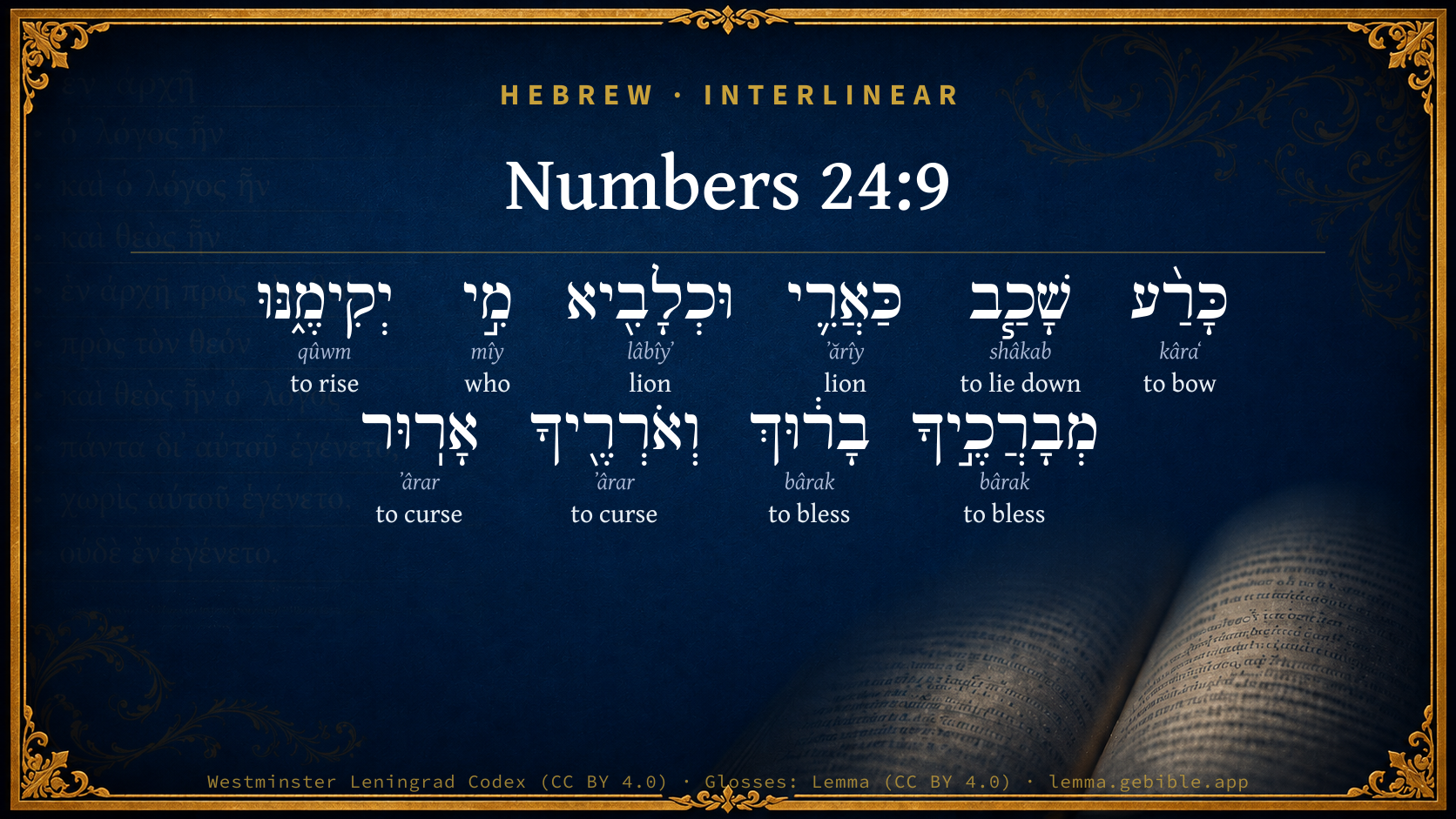
Hebrew (Westminster Leningrad Codex) Numbers 24:9 appears in the Hebrew Old Testament. The text above is from the Westminster Leningrad Codex. Each word links to its Strong’s number, a concise gloss, and parsing drawn from the Open Scriptures Hebrew Bible morphology. Click any word for its full Brown-Driver-Briggs (BDB) entry.
Download image
Cite this verse

Numbers 24:9 (World English Bible). Public Domain. Lemma interlinear Bible study tool, https://lemma.gebible.app/v/numbers/24/9.

Show BibTeX & RIS
BibTeX
RIS
English Translation
He couched, he lay down as a lion, As a lioness; who shall rouse him up? Blessed be everyone who blesses you, Cursed be everyone who curses you.
World English Bible · Public Domain
Download a study sheet

One document with this verse’s original text, its word-by-word gloss line, the meaning frame, cross-references with their text, attributed commentary, and full source and license credits — printable, and it pastes into notes with its structure intact.

This verse Autodidact and up

Study sheet (.html) Plain text (.txt)

A passage Seminary Student

Up to 50 verses in one chapter. A passage sheet keeps up to 6 commentary sources and 12 cross-references per verse, in the order this page ranks them, and says so on the sheet whenever that leaves anything out. Ask for a single verse and you get the Autodidact verse sheet above.

Everything on this page stays free to read, with no account — the sheet is a download of what is already on screen, not access to it.

Want to remove ads? Support Godless Engineer
Compare translations 3

The same verse in 3 English versions, stacked beneath the original-language interlinear above. Click any original word for its lexicon entry.

Each is an independent rendering of the whole verse — the interlinear is not word-aligned to these translations.

Highlighted words mark where these versions differ — a whole-verse word diff, not a word-by-word alignment.

  • World English Bible Public Domain
    He couched, he lay down as a lion, As a lioness; who shall rouse him up? Blessed be everyone who blesses you, Cursed be everyone who curses you.
  • King James Version Public Domain
    He couched, he lay down as a lion, and as a great lion: who shall stir him up? Blessed is he that blesseth thee, and cursed is he that curseth thee.
  • unfoldingWord Literal Text CC BY-SA 4.0
    He crouched, he lay down like a lion, and like a lioness. Who will get him up? Those who bless you are blessed; and those who curse you are cursed.”

unfoldingWord Literal Text — © unfoldingWord, licensed CC BY-SA 4.0. Word-aligned USFM3 via Door43 (git.door43.org/unfoldingWord/en_ult).

Versions to compare (up to 4)

3 of 4 selected

Show all 18 translations

Every available English version of this verse, each an independent rendering of the whole verse.

  • World English Bible Public Domain
    He couched, he lay down as a lion, As a lioness; who shall rouse him up? Blessed be everyone who blesses you, Cursed be everyone who curses you.
  • Berean Standard Bible Public Domain
    He crouches, he lies down like a lion; like a lioness, who dares to rouse him? Blessed are those who bless you and cursed are those who curse you.”
  • Majority Standard Bible Public Domain
    He crouches, he lies down like a lion, like a lioness—who dares to rouse him? Blessed are those who bless you and cursed are those who curse you.”
  • King James Version Public Domain
    He couched, he lay down as a lion, and as a great lion: who shall stir him up? Blessed is he that blesseth thee, and cursed is he that curseth thee.
  • American Standard Version (1901) Public Domain
    He couched, he lay down as a lion, And as a lioness; who shall rouse him up? Blessed be every one that blesseth thee, And cursed be every one that curseth thee.
  • Revised Version (1885) Public Domain
    He couched, he lay down as a lion, And as a lioness; who shall rouse him up? Blessed be every one that blesseth thee, And cursed be every one that curseth thee.
  • Geneva Bible (1599) Public Domain
    He coucheth and lieth downe as a yong lion, and as a lion: who shall stirre him vp? blessed is he that blesseth thee, and cursed is he that curseth thee.
  • Douay-Rheims (1899) Public Domain
    Lying down he hath slept as a lion, and as a lioness, whom none shall dare to rouse. He that blesseth thee, shall also himself be blessed: he that curseth thee shall be reckoned accursed.
  • Young's Literal Translation Public Domain
    He hath bent, he hath lain down as a lion, And as a lioness: who doth raise him up? He who is blessing thee `is' blessed, And he who is cursing thee `is' cursed.'
  • Literal Standard Version CC BY-SA 4.0
    He has bent, he has lain down as a lion, || And as a lioness, who raises him up? He who is blessing you [is] blessed, || And he who is cursing you [is] cursed.”
  • Unlocked Literal Bible CC BY-SA 4.0
    He crouches down like a lion, like a lioness. Who dares disturb him? May everyone who blesses him be blessed; may everyone who curses him be cursed.”
  • unfoldingWord Literal Text CC BY-SA 4.0
    He crouched, he lay down like a lion, and like a lioness. Who will get him up? Those who bless you are blessed; and those who curse you are cursed.”
  • Darby Bible Public Domain
    He stooped, he lay down like a lion, and like a lioness: who will stir him up? Blessed is he that blesseth thee, and cursed is he that curseth thee.
  • World Messianic Bible Public Domain
    He couched, he lay down as a lion, as a lioness; who shall rouse him up? Everyone who blesses you is blessed. Everyone who curses you is cursed.”
  • Webster's Bible Public Domain
    He couched, he lay down as a lion, and as a great lion: who shall rouse him? Blessed is he that blesseth thee, and cursed is he that curseth thee.
  • Free Bible Version CC BY-SA 4.0
    They are like a lion that crouches and lies down. They are like a lioness that nobody dares to disturb. Those who bless you will be blessed; those who curse you will be cursed.”
  • Bible in Basic English Public Domain
    He took his sleep stretched out like a lion, and like a she-lion: by whom will his rest be broken? May a blessing be on everyone who gives you blessing, and a curse on everyone by whom you are cursed.
  • JPS Tanakh (1917) Public Domain
    He couched, he lay down as a lion, and as a lioness; who shall rouse him up? Blessed be every one that blesseth thee, and cursed be every one that curseth thee.

Literal Standard Version (2020), Covenant Press — licensed CC BY-SA 4.0. Text via the HelloAO Bible API (eBible.org). Unlocked Literal Bible (unfoldingWord) — licensed CC BY-SA 4.0. Text via the HelloAO Bible API (eBible.org). unfoldingWord Literal Text — © unfoldingWord, licensed CC BY-SA 4.0. Word-aligned USFM3 via Door43 (git.door43.org/unfoldingWord/en_ult). Free Bible Version, Dr. Jonathan Gallagher — licensed CC BY-SA 4.0. Text via the HelloAO Bible API (eBible.org).

Word by word

More ways to search: Search by grammar → Find every occurrence → Compare this word →

Practice this passage: Drill this verse → Learn its vocabulary →

וּכְלָבִ֖יא
lâbîyʼ
H3833
“and · like/as · lion”
Conjunction + Preposition + Noun, Common, Both, Singular, Absolute
Part of Speech
Conjunction + Preposition + Noun
Type
Common
Gender
Both
Number
Singular
State
Absolute
Full BDB Definition

Origin: from an unused root men. to roar

TWOT: 1070b , 1070c

lion (noun masculine) - lioness (noun feminine)
  1. כָּרַ֨ע kâraʻ H3766 “to bow” Verb, Qal, Perfect, 3rd Person, Masculine, Singular
  2. שָׁכַ֧ב shâkab H7901 “to lie down” Verb, Qal, Perfect, 3rd Person, Masculine, Singular
  3. כַּאֲרִ֛י ʼărîy H738 “like/as · lion” Preposition + Noun, Common, Masculine, Singular, Absolute
  4. מִ֣י mîy H4310 “who” Particle, Interrogative
  5. יְקִימֶ֑נּוּ qûwm H6965 “to rise · him” Verb, Hiphil, Imperfect, 3rd Person, Masculine, Singular + Suffix, Personal, 3rd Person, Masculine, Singular
  6. מְבָרֲכֶ֣יךָ bârak H1288 “blessing · you” Verb, Piel, Participle Active, Masculine, Plural, Construct + Suffix, Personal, 2nd Person, Masculine, Singular
  7. בָר֔וּךְ bârak H1288 “blessed” Verb, Qal, Participle Passive, Masculine, Singular, Absolute
  8. וְאֹרְרֶ֖יךָ ʼârar H779 “and · cursing · you” Conjunction + Verb, Qal, Participle Active, Masculine, Plural, Construct + Suffix, Personal, 2nd Person, Masculine, Singular
  9. אָרֽוּר ʼârar H779 “cursed” Verb, Qal, Participle Passive, Masculine, Singular, Absolute

About this verse

These counts appear in no published source. They are computed here, from the morphology-tagged text and Lemma’s own curated glosses. What Lemma adds →

10
words
8
distinct lemmas
Pentateuch
section

Notable vocabulary

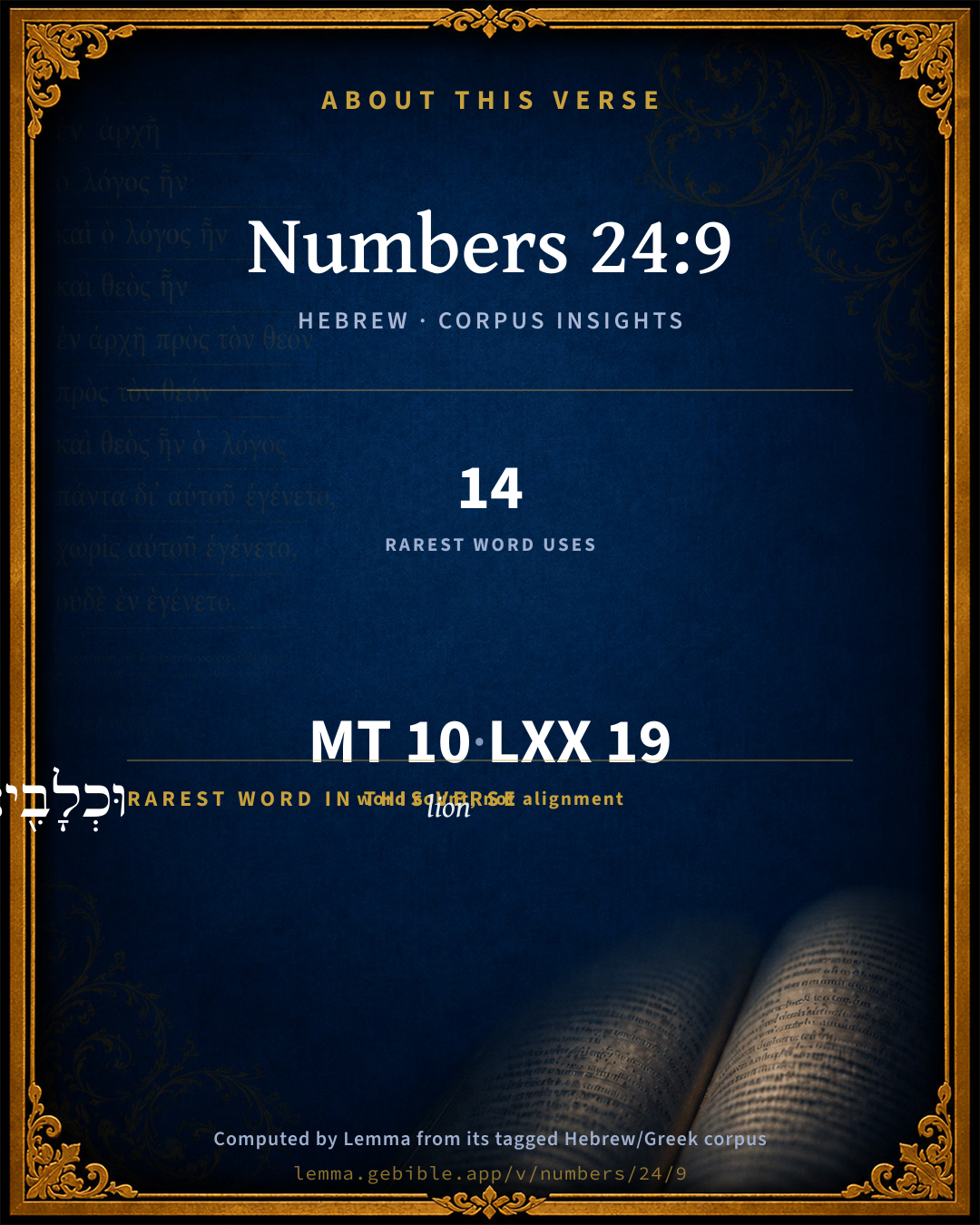
The rarest word here is וּכְלָבִ֖יא lion H3833 — appearing just 14 times in the whole Hebrew Bible.

Shared distinctive vocabulary

וּכְלָבִ֖יא lion H3833 occurs in 14 verses of the Hebrew Bible. Also found in:

Grammatical profile

  • 7 verbs
  • 2 nouns
  • 1 particle

Verb forms

  • כָּרַ֨ע Qal · Perfect
  • שָׁכַ֧ב Qal · Perfect
  • יְקִימֶ֑נּוּ Hiphil · Imperfect
  • מְבָרֲכֶ֣יךָ Piel · Participle Active
  • בָר֔וּךְ Qal · Participle Passive
  • וְאֹרְרֶ֖יךָ Qal · Participle Active
  • אָרֽוּר Qal · Participle Passive

Repetition

Words recur within this verse — often emphatic in Hebrew:

  • מְבָרֲכֶ֣יךָ to bless H1288 ×2
  • וְאֹרְרֶ֖יךָ to curse H779 ×2

Hebrew & Septuagint length

In English translation the verse runs 28 words from the Hebrew and 31 from the Septuagint (LXX English) — closely comparable.

A rough comparison of the two English renderings, which tokenize alike — not a word-level alignment.

Word counts can differ between the Hebrew and the Greek without any difference in meaning — e.g. the Hebrew direct-object marker אֵת has no separate Greek word, and Greek often adds the article ὁ.

In the original languages it is 10 Hebrew tokens and 19 Greek tokens — but the two are counted differently (Hebrew bundles its prefixes and suffixes into one token; the Greek is in lemma form), so that isn’t a like-for-like length.

Cross-references

11

Topical passages linked to Numbers 24:9 in the Treasury of Scripture Knowledge — connected by theme and wording, ordered by reader-vote popularity; previews shown in the World English Bible.

  • Genesis 12:3 I will bless those who bless you, and I will curse him who curses you. In you will all of the families of the earth be blessed."
  • Genesis 27:29 Let peoples serve you, Nations bow down to you. Be lord over your brothers, Let your mother's sons bow down to you. Cursed be everyone who curses you, Blessed be everyone who blesses you."
  • Genesis 49:9 Judah is a lion's cub. From the prey, my son, you have gone up. He stooped down, he crouched as a lion, As a lioness. Who will rouse him up?
  • Numbers 23:24 Behold, the people rises up as a lioness, As a lion does he lift himself up: He shall not lie down until he eat of the prey, Drink the blood of the slain.
  • Matthew 25:45 "Then he will answer them, saying, 'Most assuredly I tell you, inasmuch as you didn't do it to one of the least of these, you didn't do it to me.'
  • Job 38:39–40 "Can you hunt the prey for the lioness, Or satisfy the appetite of the young lions,
  • Matthew 25:40 "The King will answer them, 'Most assuredly I tell you, inasmuch as you did it to one of the least of these my brothers, you did it to me.'
  • Job 41:10 None is so fierce that he dare stir him up. Who then is he who can stand before me?
  • Psalms 2:12 Kiss the son, lest he be angry, and you perish in the way, For his wrath will soon be kindled. Blessed are all those who take refuge in him.
  • Psalms 122:6 Pray for the peace of Jerusalem. Those who love you will prosper.
  • Acts 9:5 He said, "Who are you, Lord?" The Lord said, "I am Jesus, whom you are persecuting.

Cross-references courtesy of OpenBible.info (CC BY 4.0).

Hebrew and Greek witnesses Masoretic Hebrew ↔ Greek Septuagint

The same verse in the two great witnesses to the Old Testament, shown verse-for-verse.

These are two independent witnesses, not word-aligned to each other, and the Septuagint is shown in lemma (dictionary) form.

Hebrew Numbers 24:9 Masoretic · Westminster Leningrad Codex

כָּרַ֨ע שָׁכַ֧ב כַּאֲרִ֛י וּכְלָבִ֖יא מִ֣י יְקִימֶ֑נּוּ מְבָרֲכֶ֣יךָ בָר֔וּךְ וְאֹרְרֶ֖יךָ אָרֽוּר

He couched, he lay down as a lion, As a lioness; who shall rouse him up? Blessed be everyone who blesses you, Cursed be everyone who curses you.

World English Bible · Public Domain

Greek LXX Numbers 24:9 Septuagint · lemma form

κατακλίνω ἀναπαύω ὡς λέων καί ὡς σκύμνος τίς ἀναἵστημι αὐτός ὁ εὐλογέω σύ εὐλογέω καί ὁ καταἀράομαι σύ καταἀράομαι

He lay down, he rested as a lion, and as a young lion; who shall stir him up? they that bless you are blessed, and they that curse you are cursed.

LXX2012 (modern English Septuagint) · Public Domain

Hebrew: Westminster Leningrad Codex (CC BY 4.0). Greek: Septuagint (public domain); English from LXX2012 (modern English Septuagint) (Public Domain). How the Septuagint differs from the Hebrew →

Targum (Aramaic paraphrase)

2

The Targum is the ancient Jewish Aramaic paraphrase of the Hebrew Scriptures — an interpretive translation, not the Hebrew text itself. Onkelos (literal) and Pseudo-Jonathan (expansive) render the Torah, and Jonathan the Prophets. Coverage is partial: where no permissively-licensed English translation exists for a verse, only the Aramaic is shown. This is verse-level text, not a word-by-word alignment to the Hebrew.

  1. Targum Onkelos Torah (Genesis–Deuteronomy)
    יְנוּחַ יִשְׁרֵי בִתְקוֹף כְּאַרְיָא וּכְלֵתָא לֵית מַלְכוּ דְתִזַעֲזְעִינֵיהּ בְּרִיכָךְ יְהוֹן בְּרִיכִין וְלִיטָךְ יְהוֹן לִיטִין

    (no public-domain English translation for this verse)

    Targum Onkelos — Aramaic: “Onkelos Genesis” (public domain); “Onkelos Exodus” (public domain); “Onkelos Leviticus” (public domain); “Onkelos Numbers” (public domain); “Onkelos Deuteronomy” (public domain). English: “Sefaria Community Translation” (CC0 1.0 (public-domain dedication)); “J.W. Etheridge. The Targums of Onkelos and Jonathan Ben Uzziel on the Pentateuch. London: Longmans, Green, 1862” (public domain). Text via Sefaria.

  2. Targum Pseudo-Jonathan Torah (Genesis–Deuteronomy)
    נַיְיחִין וְשַׁרְיַין כְּאַרְיָא וּכְלֵיתָא דְכַד דָמִיךְ מַאן יְקִימִינֵיהּ מְבָרְכְהוֹן יְהוֹן בְּרִיכִין כְּמשֶׁה נְבִייָא סַפְרֵיהוֹן דְיִשְרָאֵל וּמְלַטְטִינוּן יְהוֹן לִיטִין כְּבִלְעָם בַּר בְּעוֹר

    They shall repose and dwell as a lion, and as an old lion, that sleeping who will (dare to) awake? They who bless them are blessed, as Mosheh the prophet, the scribe of Israel; and they who curse them are accursed, as Bileam son of Beor.

    Targum Pseudo-Jonathan — Aramaic: “Targum Jonathan on Genesis” (public domain); “Targum Jonathan on Exodus” (public domain); “Targum Jonathan on Leviticus” (public domain); “Targum Jonathan on Numbers” (public domain); “Targum Jonathan on Deuteronomy” (public domain). English: “The Targum of Jonathan ben Uzziel, trans. J. W. Etheridge, London, 1862” (public domain). Text via Sefaria.

Commentary

Notes on Numbers 24:9 from classic Christian and Jewish commentators (each source and its license shown beneath its notes). The classic Christian expositions comment on the surrounding passage and are grouped to its opening verse, so a note may address several verses; the Jewish commentaries on the Tanakh (Rashi and others) are per-verse, so they appear only where the commentator wrote on this verse.

Lemma curates 59 commentaries, every one of them public domain or Creative Commons licensed, each selected and text-cleaned for this edition rather than reprinted as found. About our sources →

Trapp's Complete Commentary

John Trapp

Num 24:9 He couched, he lay down as a lion, and as a great lion: who shall stir him up? Blessed [is] he that blesseth thee, and cursed [is] he that curseth thee.

Ver. 9. He lay down as a lion.] {See Trapp on "Gen 49:9"}

And cursed is he.] Here the sorcerer pronounceth a curse upon himself; for he desired to curse Israel, and therefore in God’s account he did it.

“ Qui, quia non licuit, non facit, ille facit. ” - Ovid.

John Trapp, A Commentary or Exposition upon All the Books of the Old and New Testament (1647–1656) — public domain. Text from a community e-Sword module.

The Biblical Illustrator

Joseph S. Exell

Num_24:9

Blessed is he that blesseth thee, and cursed is he that curseth thee.

God will be merciful to such as be merciful to the Church

God will bless those that do good to His people, they shall not lose their labour that favour the Church, but such as are enemies unto them shall find God an enemy unto them. We see how God blessed the house of Laban for Jacobs sake (Gen_30:27); and the house of Potiphar for Josephs sake (Gen_39:3). Rahab, the harlot, receiving the spies and preferring their life before her own life, was herself saved from the common destruction. The widow of Sarepta giving hospitality to Elijah, and offering him part of that poor pittance which was left her and her son in those days of drought, was with all her family miraculously sustained in the famine, continuing three years and six months (1Ki_17:10). The Shunamite receiving the prophet Elisha, making him a chamber, providing all necessaries for him. She showed some mercy, but received more mercy; she ministered comfort to the prophet, but herself received more comfort.

1. First, God will honour all those that honour Him, He will despise all those that despise Him. This is the gracious promise that is gone out of His own mouth, which He cannot but verify, for He is not as man that He should lie; He is not as the son of man that He should deceive. This is it which the Lord spake by the mouth and ministry of Samuel concerning Eli and his house (1Sa_2:30). And, therefore, they shall prosper that love the Church (Psa_122:1-9).

2. Secondly, God hath appointed it to be the end of our obedience; our mercy to others shall procure mercy upon ourselves. This the apostle setteth down (Rom_2:10).

3. Thirdly, mercy, a notable fruit of love received, kindleth the hearts, and inflameth the affections of Gods people, both to praise God for them, and to pray unto God for them that have been helpful and serviceable to the Church.

The uses follow--

1. First, from hence we have the confirmation of another holy truth in our Christian religion, that merciful, liberal, and kind men, shall be surely blessed.

2. Secondly, it is our duty to love Gods people, seeing such as favour them do fare the better for them.

3. Thirdly, hereby we are warned to exhort one another to this duty, and by all means to provoke one another to mercy, in regard of the great recompense of reward that is laid up for merciful men.

4. Lastly, this doctrine is both a great encouragement unto us in well doing and a great comfort in all adversities. (W. Attersoll.)

The Biblical Illustrator, edited by Joseph S. Exell (c. 1880s–1900s) — public domain. Text from a community e-Sword module.

Adam Clarke's Commentary

Verse 9. He couched, he lay down as a lion, c.] See the original terms explained Nu 23:24.

These oracles, delivered by Balaam, are evident prophecies of the victories which the Israelites should gain over their enemies, and of their firm possession of the promised land. They may also refer to the great victories to be obtained by the Lord Jesus Christ, that Lion of the tribe of Judah, over sin, death, and Satan, the grand enemies of the human race and to that most numerous posterity of spiritual children which should be begotten by the preaching of the Gospel.

Adam Clarke's Commentary on the Bible (1810–1826) — public domain. Text from a community e-Sword/MySword module.

Ellicott's Commentary for English Readers

(9) He couched, he lay down as a lion, and as a great lion.—The Hebrew labi (great lion) should be rendered “a lioness,” as in Num_23:24. The image of a lion connects this verse with the preceding verse: “he shall eat up the nations.” (See Note on Num_23:24.)

Blessed is he that blesseth thee . . . —Compare the original blessing which was pronounced upon Abraham by the Lord (Gen_12:3), and which was afterwards adopted by Isaac in the blessing which he pronounced upon Jacob (Gen_27:29).

A Bible Commentary for English Readers, edited by Charles John Ellicott (1878–1897) — public domain. Text from a community e-Sword module.

The Cambridge Bible for Schools and Colleges

gen. ed. J. J. S. Perowne

9. Blessed be every one &c.] The clauses occur inverted in Gen_27:29.

The Cambridge Bible for Schools and Colleges (gen. ed. J. J. S. Perowne; Cambridge University Press, 1878–1918) — public domain. Text from a community e-Sword module.

John Gill's Exposition

He couched,.... Which may respect the posture of the armies of Israel in the plains of Moab:

he lay down as a lion, and as a great lion; as he would do, and did in the land of Canaan, when conquered by Israel; they took up their residence on it quietly, and dwelt in it securely, and in no more fear of their enemies than a lion, which lays itself down and sleeps without concern anywhere:

who shall stir him up? who dare do it? as it would be a very rash, bold, daring, and dangerous thing to rouse up a lion lying down; so it is suggested it would be alike to provoke Israel to war at some certain times, in the days of David more especially:

blessed is he that blesseth thee, and cursed is he that curseth thee; which are the very words in which Isaac blessed Jacob, the ancestor of these people, Gen 27:29 and which blessing is confirmed by Balaam against his will, and whereby he cursed himself instead of Israel; for though he could not curse him with words, he had cursed him in his heart, and would have done it verbally if he could (a).

(a) "Qui, quia non licuit, non facit, ille facit". Ovid.

John Gill's Exposition of the Whole Bible (1746–1763) — public domain (CC PDM 1.0). Text via the HelloAO Bible API.

Matthew Poole's English Annotations

Having conquered his enemies the Canaanites, and their land, he shall quietly and securely rest and settle himself there.

Stir him up, i.e. awake or provoke him.

Matthew Poole's English Annotations on the Holy Bible (1683–1685) — public domain. Text from a community e-Sword/MySword module.

Whedon's Commentary on the Bible

Daniel D. Whedon

9. He couched — This is Jacob’s blessing upon Judah, the ancestor of Jesus Christ, the lion of his tribe, predicting his final triumph over the world. Gen_49:9; Joh_16:33, notes.

Who shall stir him up — None. Hence his victory and peace will be lasting.

Blessed… blesseth — The conclusion of Isaac’s blessing upon Jacob, Gen_27:29, and of Jehovah’s upon Abraham. Gen_12:3. Thus God shows that he keeps in mind his own promises, puts honour upon words spoken centuries before, and shows Balak the immutability of his purposes.

Cursed — God so identifies himself with his people that he punishes malevolence toward them as a wrong to himself. Mat_25:41-45.

Daniel D. Whedon (gen. ed.), Commentary on the Old and New Testaments (1874–1909) — public domain. Text from a community e-Sword module.

The Pulpit Commentary

A lion. yria. A great lion. aybil. See on Num_23:24, and Gen_49:9. Blessed is he that blesseth thee, &c. In these words Balaam seems to refer to the terms of Balak"s first message. ; (Num_22:6) Far from being affected by blessings and cursings from without, Israel was itself a source of blessing or cursing to others according as they treated him.

The Pulpit Commentary (1880–1919), ed. H.D.M. Spence-Jones & Joseph S. Exell — public domain. Text from a community e-Sword module.

John Wesley's Explanatory Notes

He lay down - Having conquered his enemies the Canaanites, and their land, he shall quietly rest and settle himself there.

John Wesley, Explanatory Notes Upon the Whole Bible (1754–1765) — public domain. Text via the GEBible commentary corpus.

unfoldingWord translationNotes

Door43 World Missions Community

General Information:

Balaam finishes the prophecy under the control of the Spirit of God.

He crouches down like a lion, like a lioness

In this simile, Balaam compares the Israelites to both male and female lions. This means they are dangerous and always ready to attack. (See: Simile)

Who dares disturb him?

Balaam uses a question to warn all the people to not provoke the Israelites. This can be translated as a statement. AT: "No one dares to disturb him!" (See: Rhetorical Question)

May everyone who blesses him be blessed; may everyone who curses him be cursed

This can be stated in active form. AT: "May God bless those who bless the Israelites; may he curse those who curse the Israelites" (See: Active or Passive)

translationWords

lions

bless

curse

unfoldingWord translationNotes — © Distant Shores Media and the Door43 World Missions Community, licensed CC BY-SA 4.0. Source: git.door43.org/Door43/en_tn.

Rashi

Rabbi Shlomo Yitzchaki (Rashi)

כרע שכב כארי HE CROUCHED, HE LAY DOWN AS A LION — Understand this as the Targum does (“He will have rest, he will dwell in strength like a lion”), meaning, they will be settled in their land in strength and might.

Rashi on the Tanakh — English translations: “The Judaica Press complete Tanach with Rashi, translated by A. J. Rosenberg” (CC BY 4.0); “Pentateuch with Rashi's commentary by M. Rosenbaum and A.M. Silbermann, 1929-1934” (public domain); “The Metsudah Tanach series, Lakewood, N.J” (CC BY 4.0); and “The Book of Joshua, Metsudah Publications, 1997” (CC BY 4.0). Text via Sefaria.

Sforno

Rabbi Ovadia Sforno

Those who bless you are blessed. This will apply as it once was regarding Avraham, for the remnants of the Jewish People will be on the level of Avraham. This is stated in the verse (Devorim 30:9), for Adonoy will return to rejoice over you for benefit as He rejoiced over your forefathers.

Sforno on the Tanakh — English translation: “Yalkut, Sifsei Chachomim Chumash, Metsudah Publications, 2009” (CC BY 4.0). Text via Sefaria.

Lesson kit

Teaching starters — assembled from the data on this page, not authored interpretation. Every prompt links to the verse data it draws on. Edit before teaching.

Numbers, in the Pentateuch, opens this verse with 10 words (8 distinct Hebrew lemmas). Its most distinctive word is lâbîyʼ (“lion”). A historical commentator’s framing appears above. Read the whole chapter for the surrounding context.

Discussion questions

  1. The word lâbîyʼ carries the sense “lion.” How does it shape the verse?
  2. How does Genesis 49:9, which shares the word «lion», read alongside this verse?
  3. What does the repetition of “to bless” (2× in this one verse) do in this verse?
  4. These translations render this verse differently; the difference is in the English rendering, not the original. What questions does that raise?
  5. «כָּרַ֨ע» is a Qal Perfect verb. How does that grammatical form shape the action described?
  6. Compare how Trapp's Complete Commentary and The Biblical Illustrator read this verse. Where do they agree or differ?

Things to notice

Reading settings

Reading text

Shown beneath each verse's original-language words.

Old Testament
Old Testament edition

Read the OT as the Masoretic Hebrew (MT) or the Greek Septuagint (LXX).

English shown for the Greek Septuagint (in the Hebrew ↔ Greek comparison).

Comparing translations? Open the Compare panel on any verse page to stack up to four side by side.