
2 Kings 4:29

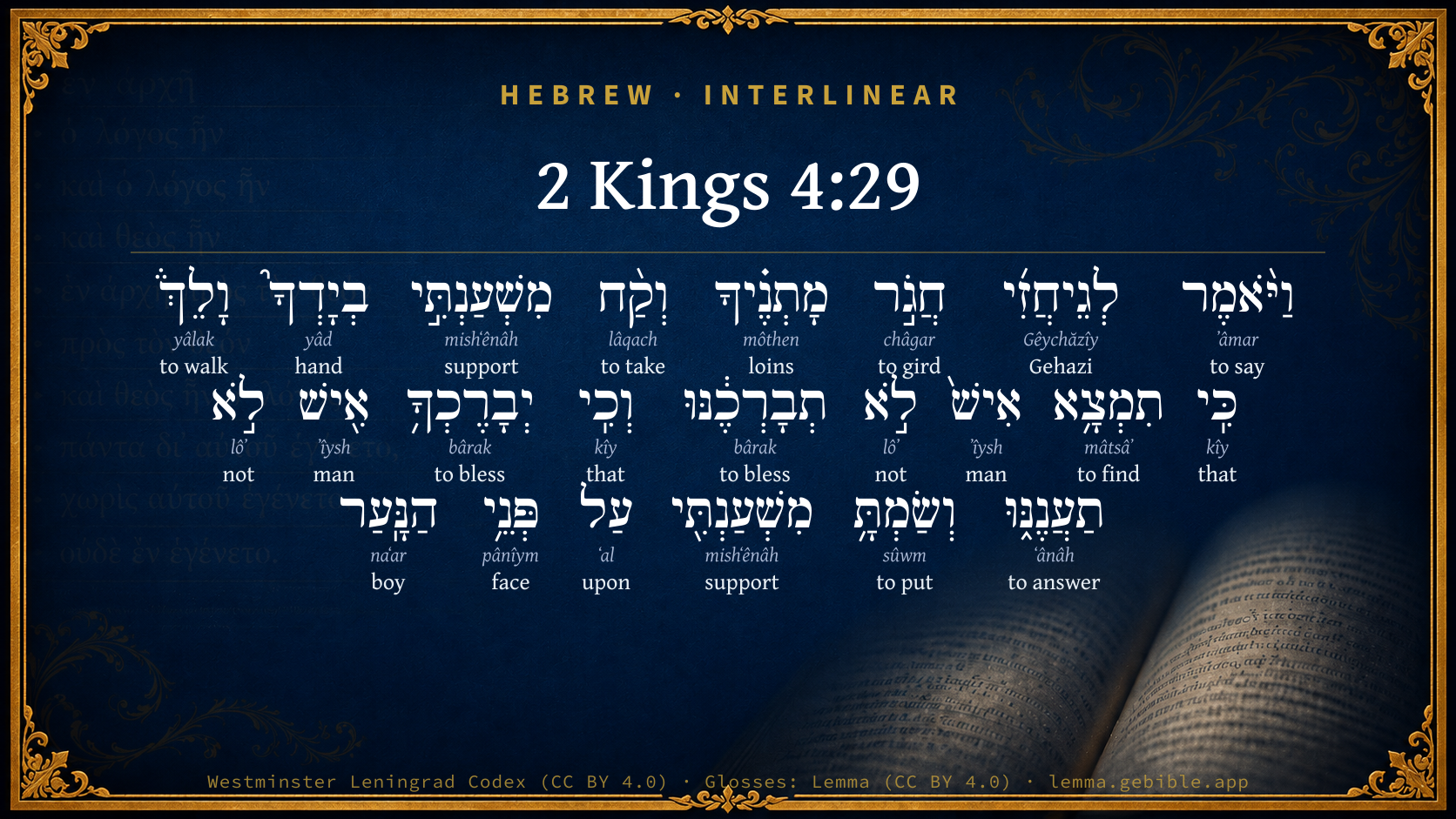
Hebrew (Westminster Leningrad Codex) 2 Kings 4:29 appears in the Hebrew Old Testament. The text above is from the Westminster Leningrad Codex. Each word links to its Strong’s number, a concise gloss, and parsing drawn from the Open Scriptures Hebrew Bible morphology. Click any word for its full Brown-Driver-Briggs (BDB) entry.
Download image
Cite this verse

2 Kings 4:29 (World English Bible). Public Domain. Lemma interlinear Bible study tool, https://lemma.gebible.app/v/2-kings/4/29.

Show BibTeX & RIS
BibTeX
RIS
English Translation
Then he said to Gehazi, Gird up your loins, and take my staff in your hand, and go your way: if you meet any man, Don't greet him; and if anyone greets you, don't answer him again: and lay my staff on the face of the child.
World English Bible · Public Domain
Download a study sheet

One document with this verse’s original text, its word-by-word gloss line, the meaning frame, cross-references with their text, attributed commentary, and full source and license credits — printable, and it pastes into notes with its structure intact.

This verse Autodidact and up

Study sheet (.html) Plain text (.txt)

A passage Seminary Student

Up to 50 verses in one chapter. A passage sheet keeps up to 6 commentary sources and 12 cross-references per verse, in the order this page ranks them, and says so on the sheet whenever that leaves anything out. Ask for a single verse and you get the Autodidact verse sheet above.

Everything on this page stays free to read, with no account — the sheet is a download of what is already on screen, not access to it.

Want to remove ads? Support Godless Engineer
Compare translations 3

The same verse in 3 English versions, stacked beneath the original-language interlinear above. Click any original word for its lexicon entry.

Each is an independent rendering of the whole verse — the interlinear is not word-aligned to these translations.

Highlighted words mark where these versions differ — a whole-verse word diff, not a word-by-word alignment.

  • World English Bible Public Domain
    Then he said to Gehazi, Gird up your loins, and take my staff in your hand, and go your way: if you meet any man, Don't greet him; and if anyone greets you, don't answer him again: and lay my staff on the face of the child.
  • King James Version Public Domain
    Then he said to Gehazi, Gird up thy loins, and take my staff in thine hand, and go thy way: if thou meet any man, salute him not; and if any salute thee, answer him not again: and lay my staff upon the face of the child.
  • unfoldingWord Literal Text CC BY-SA 4.0
    And he said to Gehazi, “Gird your loins, and take my staff in your hand, and go. If you find a man, you shall not bless him, and if a man blesses you, you shall not answer him. And you shall put my staff on the face of the young man.”

unfoldingWord Literal Text — © unfoldingWord, licensed CC BY-SA 4.0. Word-aligned USFM3 via Door43 (git.door43.org/unfoldingWord/en_ult).

Versions to compare (up to 4)

3 of 4 selected

Show all 18 translations

Every available English version of this verse, each an independent rendering of the whole verse.

  • World English Bible Public Domain
    Then he said to Gehazi, Gird up your loins, and take my staff in your hand, and go your way: if you meet any man, Don't greet him; and if anyone greets you, don't answer him again: and lay my staff on the face of the child.
  • Berean Standard Bible Public Domain
    So Elisha said to Gehazi, “Tie up your garment, take my staff in your hand, and go! If you meet anyone, do not greet him, and if anyone greets you, do not answer him. Then lay my staff on the boy’s face.”
  • Majority Standard Bible Public Domain
    So Elisha said to Gehazi, “Tie up your garment, take my staff in your hand, and go! If you meet anyone, do not greet him, and if anyone greets you, do not answer him. Then lay my staff on the boy’s face.”
  • King James Version Public Domain
    Then he said to Gehazi, Gird up thy loins, and take my staff in thine hand, and go thy way: if thou meet any man, salute him not; and if any salute thee, answer him not again: and lay my staff upon the face of the child.
  • American Standard Version (1901) Public Domain
    Then he said to Gehazi, Gird up thy loins, and take my staff in thy hand, and go thy way: if thou meet any man, salute him not; and if any salute thee, answer him not again: and lay my staff upon the face of the child.
  • Revised Version (1885) Public Domain
    Then he said to Gehazi, Gird up thy loins, and take my staff in thine hand, and go thy way: if thou meet any man, salute him not; and if any salute thee, answer him not again: and lay my staff upon the face of the child.
  • Geneva Bible (1599) Public Domain
    Then he sayd to Gehazi, Gird thy loynes, and take my staffe in thine hand, and goe thy way: if thou meete any, salute him not: and if any salute thee, answere him not: and laye my staffe vpon the face of the childe.
  • Douay-Rheims (1899) Public Domain
    Then he said to Giezi: Gird up thy loins, and take my staff in thy hand, and go. If any man meet thee, salute him not: and if any man salute thee, answer him not: and lay my staff upon the face of the child.
  • Young's Literal Translation Public Domain
    And he saith to Gehazi, `Gird up thy loins, and take my staff in thy hand, and go; when thou dost meet a man, thou dost not salute him; and when a man doth salute thee, thou dost not answer him; and thou hast laid my staff on the face of the youth.'
  • Literal Standard Version CC BY-SA 4.0
    And he says to Gehazi, “Gird up your loins, and take my staff in your hand, and go; when you meet a man, you do not greet him; and when a man greets you, you do not answer him; and you have laid my staff on the face of the youth.”
  • Unlocked Literal Bible CC BY-SA 4.0
    Then Elisha said to Gehazi, “Dress for travel and take my staff in your hand. Go to her home. If you meet any man, do not greet him, and if anyone greets you, do not answer him. Lay my staff on the child's face.”
  • unfoldingWord Literal Text CC BY-SA 4.0
    And he said to Gehazi, “Gird your loins, and take my staff in your hand, and go. If you find a man, you shall not bless him, and if a man blesses you, you shall not answer him. And you shall put my staff on the face of the young man.”
  • Darby Bible Public Domain
    And he said to Gehazi, Gird up thy loins, and take my staff in thy hand, and go thy way. If thou meet any man, salute him not, and if any salute thee, answer him not again; and lay my staff upon the face of the lad.
  • World Messianic Bible Public Domain
    Then he said to Gehazi, “Tuck your cloak into your belt, take my staff in your hand, and go your way. If you meet any man, don’t greet him; and if anyone greets you, don’t answer him again. Then lay my staff on the child’s face.”
  • Webster's Bible Public Domain
    Then he said to Gehazi, Gird up thy loins and take my staff in thy hand, and go thy way: and if thou shalt meet any man, salute him not; and if any shall salute thee, answer him not again: and lay my staff upon the face of the child.
  • Free Bible Version CC BY-SA 4.0
    Elisha said to Gehazi, “Tie up your cloak in your belt, pick up my staff, and go! Don't even say hello to anyone you meet, and if anyone says hello to you, don't reply. Place my staff on the boy's face.”
  • Bible in Basic English Public Domain
    Then he said to Gehazi, Make yourself ready, and take my stick in your hand, and go: if you come across anyone on the way, give him no blessing, and if anyone gives you a blessing, give him no answer. And put my stick on the child's face.
  • JPS Tanakh (1917) Public Domain
    Then he said to Gehazi: 'Gird up thy loins, and take my staff in thy hand, and go thy way; if thou meet any man, salute him not; and if any salute thee, answer him not; and lay my staff upon the face of the child.'

Literal Standard Version (2020), Covenant Press — licensed CC BY-SA 4.0. Text via the HelloAO Bible API (eBible.org). Unlocked Literal Bible (unfoldingWord) — licensed CC BY-SA 4.0. Text via the HelloAO Bible API (eBible.org). unfoldingWord Literal Text — © unfoldingWord, licensed CC BY-SA 4.0. Word-aligned USFM3 via Door43 (git.door43.org/unfoldingWord/en_ult). Free Bible Version, Dr. Jonathan Gallagher — licensed CC BY-SA 4.0. Text via the HelloAO Bible API (eBible.org).

Word by word

More ways to search: Search by grammar → Find every occurrence → Compare this word →

Practice this passage: Drill this verse → Learn its vocabulary →

לְגֵיחֲזִ֜י
Gêychăzîy
H1522
“to/for · Gehazi”
Preposition + Noun, Proper
Part of Speech
Preposition + Noun
Type
Proper
Full BDB Definition

Origin: apparently from H1516 and H2372

TWOT: None

Gehazi = "valley of vision" - the servant of Elisha
  1. וַיֹּ֨אמֶר ʼâmar H559 “and · to say” Conjunction + Verb, Qal, Sequential Imperfect, 3rd Person, Masculine, Singular
  2. חֲגֹ֣ר châgar H2296 “gird” Verb, Qal, Imperative, 2nd Person, Masculine, Singular
  3. מָתְנֶ֗יךָ môthen H4975 “loins · your” Noun, Common, Masculine, Dual, Construct + Suffix, Personal, 2nd Person, Masculine, Singular
  4. וְקַ֨ח lâqach H3947 “and · take” Conjunction + Verb, Qal, Imperative, 2nd Person, Masculine, Singular
  5. מִשְׁעַנְתִּ֣י mishʻênâh H4938 “support · my” Noun, Common, Feminine, Singular, Construct + Suffix, Personal, 1st Person, Common, Singular
  6. בְיָדְךָ֮ yâd H3027 “in/at · hand · your” Preposition + Noun, Common, Both, Singular, Construct + Suffix, Personal, 2nd Person, Masculine, Singular
  7. וָלֵךְ֒ yâlak H3212 “and · walk” Conjunction + Verb, Qal, Imperative, 2nd Person, Masculine, Singular
  8. כִּֽי kîy H3588 “that” Conjunction
  9. תִמְצָ֥א mâtsâʼ H4672 “to find” Verb, Qal, Imperfect, 2nd Person, Masculine, Singular
  10. אִישׁ֙ ʼîysh H376 “man” Noun, Common, Masculine, Singular, Absolute
  11. לֹ֣א lôʼ H3808 “not” Particle, Negative
  12. תְבָרְכֶ֔נּוּ bârak H1288 “to bless · us” Verb, Piel, Imperfect, 2nd Person, Masculine, Singular + Suffix, Personal, 1st Person, Common, Plural
  13. וְכִֽי kîy H3588 “and · that” Conjunction + Conjunction
  14. יְבָרֶכְךָ֥ bârak H1288 “to bless · you” Verb, Piel, Imperfect, 3rd Person, Masculine, Singular + Suffix, Personal, 2nd Person, Masculine, Singular
  15. אִ֖ישׁ ʼîysh H376 “man” Noun, Common, Masculine, Singular, Absolute
  16. לֹ֣א lôʼ H3808 “not” Particle, Negative
  17. תַעֲנֶנּ֑וּ ʻânâh H6030 “to answer · us” Verb, Qal, Imperfect, 2nd Person, Masculine, Singular + Suffix, Personal, 1st Person, Common, Plural
  18. וְשַׂמְתָּ֥ sûwm H7760 “and · to put” Conjunction + Verb, Qal, Sequential Perfect, 2nd Person, Masculine, Singular
  19. מִשְׁעַנְתִּ֖י mishʻênâh H4938 “support · my” Noun, Common, Feminine, Singular, Construct + Suffix, Personal, 1st Person, Common, Singular
  20. עַל ʻal H5921 “upon” Preposition
  21. פְּנֵ֥י pânîym H6440 “face(s) of” Noun, Common, Both, Plural, Construct
  22. הַנָּֽעַר naʻar H5288 “the · boy” Particle, Definite Article + Noun, Common, Masculine, Singular, Absolute

About this verse

These counts appear in no published source. They are computed here, from the morphology-tagged text and Lemma’s own curated glosses. What Lemma adds →

23
words
18
distinct lemmas
Historical
section

Notable vocabulary

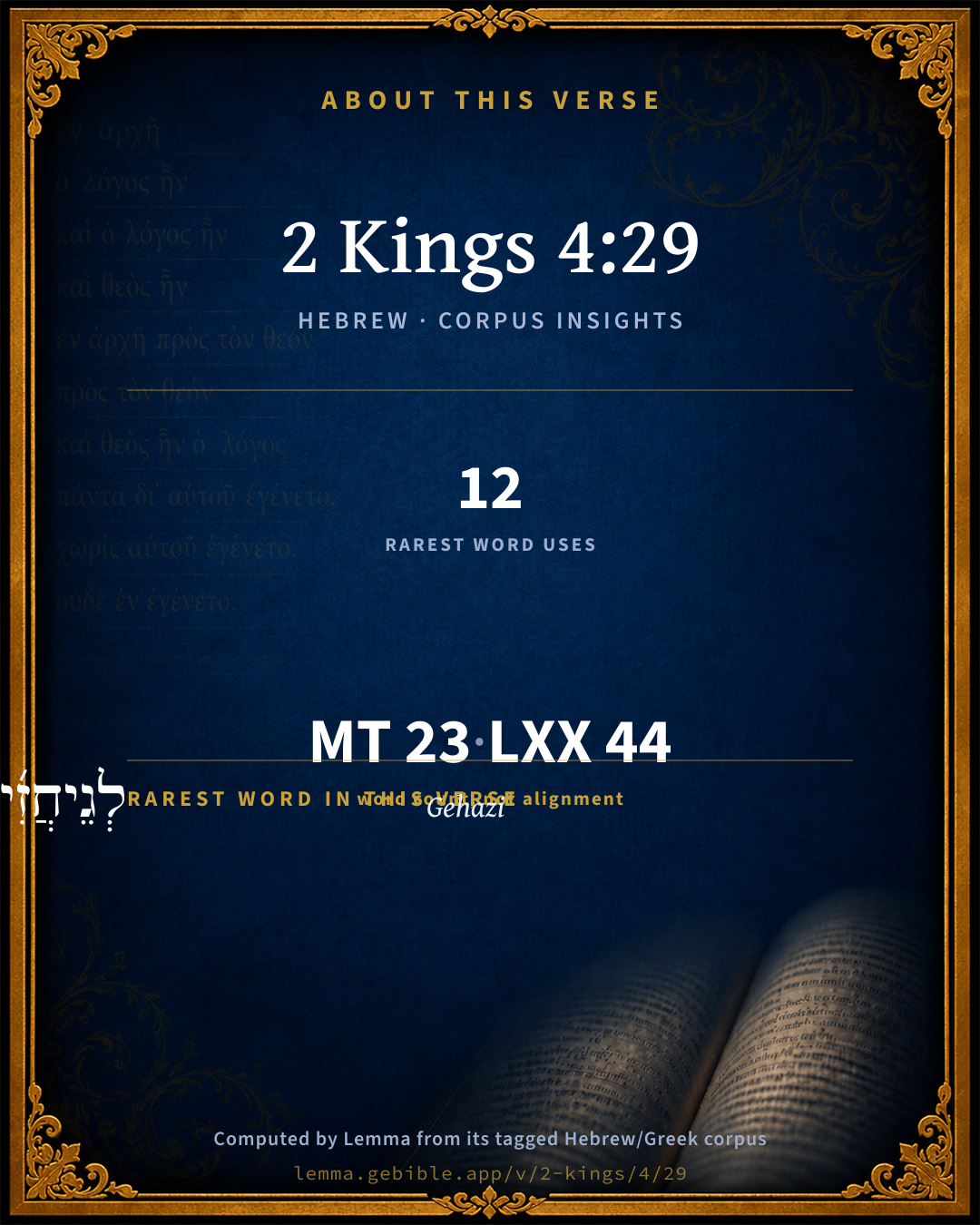
The rarest word here is לְגֵיחֲזִ֜י Gehazi H1522 — appearing just 12 times in the whole Hebrew Bible.

Shared distinctive vocabulary

לְגֵיחֲזִ֜י Gehazi H1522 occurs in 12 verses of the Hebrew Bible. Also found in:

Grammatical profile

  • 9 verbs
  • 9 nouns
  • 1 preposition
  • 2 conjunctions
  • 2 particles

Verb forms

  • וַיֹּ֨אמֶר Qal · Sequential Imperfect
  • חֲגֹ֣ר Qal · Imperative
  • וְקַ֨ח Qal · Imperative
  • וָלֵךְ֒ Qal · Imperative
  • תִמְצָ֥א Qal · Imperfect
  • תְבָרְכֶ֔נּוּ Piel · Imperfect
  • יְבָרֶכְךָ֥ Piel · Imperfect
  • תַעֲנֶנּ֑וּ Qal · Imperfect
  • וְשַׂמְתָּ֥ Qal · Sequential Perfect

Repetition

Words recur within this verse — often emphatic in Hebrew:

  • מִשְׁעַנְתִּ֣י support H4938 ×2
  • אִישׁ֙ man H376 ×2
  • תְבָרְכֶ֔נּוּ to bless H1288 ×2
  • כִּֽי that H3588 ×2
  • לֹ֣א not H3808 ×2

Hebrew & Septuagint length

In English translation the verse runs 47 words from the Hebrew and 49 from the Septuagint (LXX English) — closely comparable.

A rough comparison of the two English renderings, which tokenize alike — not a word-level alignment.

Word counts can differ between the Hebrew and the Greek without any difference in meaning — e.g. the Hebrew direct-object marker אֵת has no separate Greek word, and Greek often adds the article ὁ.

In the original languages it is 23 Hebrew tokens and 44 Greek tokens — but the two are counted differently (Hebrew bundles its prefixes and suffixes into one token; the Greek is in lemma form), so that isn’t a like-for-like length.

Cross-references

13

Topical passages linked to 2 Kings 4:29 in the Treasury of Scripture Knowledge — connected by theme and wording, ordered by reader-vote popularity; previews shown in the World English Bible.

  • 2 Kings 2:14 He took the mantle of Elijah that fell from him, and struck the waters, and said, Where is Yahweh, the God of Elijah? and when he also had struck the waters, they were divided here and there; and Elisha went over.
  • Exodus 14:16 Lift up your rod, and stretch out your hand over the sea, and divide it: and the children of Israel shall go into the midst of the sea on dry ground.
  • 1 Kings 18:46 and the hand of Yahweh was on Elijah; and he girded up his loins, and ran before Ahab to the entrance of Jezreel.
  • 2 Kings 9:1 Elisha the prophet called one of the sons of the prophets, and said to him, Gird up your loins, and take this vial of oil in your hand, and go to Ramoth-gilead.
  • Luke 10:4 Carry no purse, nor wallet, nor sandals. Greet no one on the way.
  • Exodus 4:17 You shall take this rod in your hand, with which you shall do the signs."
  • Exodus 7:19–20 Yahweh said to Moses, "Tell Aaron, 'Take your rod, and stretch out your hand over the waters of Egypt, over their rivers, over their streams, and over their pools, and over all their ponds of water, that they may become blood; and there shall be blood throughout all the land of Egypt, both in vessels of wood and in vessels of stone.'"
  • Acts 19:12 so that even handkerchiefs or aprons were carried away from his body to the sick, and the evil spirits went out.
  • 2 Kings 2:8 Elijah took his mantle, and wrapped it together, and struck the waters, and they were divided here and there, so that they two went over on dry ground.
  • Acts 3:16 By faith in his name has his name made this man strong, whom you see and know. Yes, the faith which is through him has given him this perfect soundness in the presence of you all.
  • Ephesians 6:14 Stand therefore, having the utility belt of truth buckled around your waist, and having put on the breastplate of righteousness,
  • Joshua 6:4–5 Seven priests shall bear seven trumpets of rams' horns before the ark: and the seventh day you shall compass the city seven times, and the priests shall blow the trumpets.
  • 1 Peter 1:13 Therefore, prepare your minds for action, be sober and set your hope fully on the grace that will be brought to you at the revelation of Jesus Christ--

Cross-references courtesy of OpenBible.info (CC BY 4.0).

Hebrew and Greek witnesses Masoretic Hebrew ↔ Greek Septuagint

The same verse in the two great witnesses to the Old Testament, shown verse-for-verse.

These are two independent witnesses, not word-aligned to each other, and the Septuagint is shown in lemma (dictionary) form.

Hebrew 2 Kings 4:29 Masoretic · Westminster Leningrad Codex

וַיֹּ֨אמֶר לְגֵיחֲזִ֜י חֲגֹ֣ר מָתְנֶ֗יךָ וְקַ֨ח מִשְׁעַנְתִּ֣י בְיָדְךָ֮ וָלֵךְ֒ כִּֽי תִמְצָ֥א אִישׁ֙ לֹ֣א תְבָרְכֶ֔נּוּ וְכִֽי יְבָרֶכְךָ֥ אִ֖ישׁ לֹ֣א תַעֲנֶנּ֑וּ וְשַׂמְתָּ֥ מִשְׁעַנְתִּ֖י עַל פְּנֵ֥י הַנָּֽעַר

Then he said to Gehazi, Gird up your loins, and take my staff in your hand, and go your way: if you meet any man, Don't greet him; and if anyone greets you, don't answer him again: and lay my staff on the face of the child.

World English Bible · Public Domain

Greek LXX 2 Kings 4:29 Septuagint · lemma form

καί εἶπον ελισαιε ὁ γιεζι ζώννυμι ὁ ὀσφύς σύ καί λαμβάνω ὁ βακτηρία ἐγώ ἐν ὁ χείρ σύ καί δεῦρο ὅτι ἐάν εὑρίσκω ἀνήρ οὐ εὐλογέω αὐτός καί ἐάν εὐλογέω σύ ἀνήρ οὐ ἀποκρίνω αὐτός καί ἐπιτίθημι ὁ βακτηρία ἐγώ ἐπί πρόσωπον ὁ παιδάριον

And Elisaie said to Giezi, Gird up your loins, and take my staff in your hand, and go: if you meet any man, you shall not salute him, and if a man salute you you shall not answer him: and you shall lay my staff on the child's face.

LXX2012 (modern English Septuagint) · Public Domain

Hebrew: Westminster Leningrad Codex (CC BY 4.0). Greek: Septuagint (public domain); English from LXX2012 (modern English Septuagint) (Public Domain). How the Septuagint differs from the Hebrew →

Targum (Aramaic paraphrase)

1

The Targum is the ancient Jewish Aramaic paraphrase of the Hebrew Scriptures — an interpretive translation, not the Hebrew text itself. Onkelos (literal) and Pseudo-Jonathan (expansive) render the Torah, and Jonathan the Prophets. Coverage is partial: where no permissively-licensed English translation exists for a verse, only the Aramaic is shown. This is verse-level text, not a word-by-word alignment to the Hebrew.

  1. Targum Jonathan Prophets (Joshua–Malachi)
    וַאֲמַר לְגֵיחֲזִי זְרִיז חַרְצָךְ וְסַב חוּטְרֵי בִידָךְ וְתֵיזִיל אֲרֵי תִשְׁכַּח גְבַר לָא תִשְׁאַל בִּשְׁלָמֵיהּ וַאֲרֵי יִשְׁאַל בִּשְׁלָמָךְ גַבְרָא לָא תְתֵבִינֵיהּ וּתְשַׁוֵי חוּטְרֵי עַל אַפֵּי רַבְיָא:

    (no public-domain English translation for this verse)

    Targum Jonathan — Aramaic: “Mikraot Gedolot” (public domain). English: “Sefaria Community Translation” (CC0 1.0 (public-domain dedication)); “London "Chaldee Paraphrase," 1871” (public domain). Text via Sefaria.

Commentary

Notes on 2 Kings 4:29 from classic Christian and Jewish commentators (each source and its license shown beneath its notes). The classic Christian expositions comment on the surrounding passage and are grouped to its opening verse, so a note may address several verses; the Jewish commentaries on the Tanakh (Rashi and others) are per-verse, so they appear only where the commentator wrote on this verse.

Lemma curates 59 commentaries, every one of them public domain or Creative Commons licensed, each selected and text-cleaned for this edition rather than reprinted as found. About our sources →

Trapp's Complete Commentary

John Trapp

2Ki 4:29 Then he said to Gehazi, Gird up thy loins, and take my staff in thine hand, and go thy way: if thou meet any man, salute him not; and if any salute thee, answer him not again: and lay my staff upon the face of the child.

Ver. 29. If thou meet any man, salute him not.] Stand not tattling, much less cracking, that thou shalt with that staff of mine raise a dead child. Some Rabbis think Gehazi did so; {a} and thence that means proved ineffectual. But it seemeth rather to be the mother’s unbelief that made it so.

{a} Ridebat Gehazi dicendo obviis, Credisne baculum istum vitam restituere? - R. Eliezer, cap. 33.

John Trapp, A Commentary or Exposition upon All the Books of the Old and New Testament (1647–1656) — public domain. Text from a community e-Sword module.

The Biblical Illustrator

Joseph S. Exell

2Ki_4:29

Gird up thy loins, and take my staff in thine hand.

The power and weakness of faith contrasted in Elisha

There are no less than five instances wherein the prophet exemplifies the man of faith and the man of love witnessing to the faith of God by his grateful deeds.

I. The power of Elishas faith, and the success which attended it.

II. This weakness and this failure is to be seen at the very dawn of the trial now coming upon the prophet. The Lord hath hid it from me, and hath not told me (2Ki_4:27), is the querulous expostulation of the now mortified prophet, even before the nature of the vexation had been ascertained. He is evidently greatly put out, not so much by the outward event itself, but at the circumstance of his friend being afflicted without his knowledge. How difficult it is to be honoured and lifted up, and yet to remain contented and humble! How many a follower of a great man upon earth is spoiled instead of improved by even just and moderate rewards of honour and confidence, and his previously gratified Lord has to take him down again! So it was with Elisha. He has a lesson to learn of dependent humility--and the Lord is going to teach it him. He follows up the hasty expression of his petulance and mortification by as hasty a proceeding, which, viewed in the most favourable light, is redolent of presumption and self-confidence: Then he said to Gehazi, Gird up thy loins and take my staff in thine hand; etc. Here is no prayer no earnest seeking, no humble inquiry of the Lord, What must I do? but, in the spirit of one aiming to work lying wonders rather than healing benefits, he puts his own staff into the hands of his servant, anticipating that a miracle might be wrought and a child restored to life by the simple touch of the holy staff, without his own presence or effort. Let us now examine ourselves on this event in Elishas history.

1. On the power of faith and its success, as exemplified by the prophet.

What is the working of faith in us? Have we faith?

2. Mark the weakness of faith and its consequent failure in Elisha. This weakness, we have seen, consisted in a self-confidence approaching presumption. (G. L. Glyn.)

The Biblical Illustrator, edited by Joseph S. Exell (c. 1880s–1900s) — public domain. Text from a community e-Sword module.

Joseph Benson's Commentary

2Ki 4:29. He said to Gehazi, Gird up thy loins — Tie up thy long garments about thy loins for expedition. If thou meet any man, &c. — Make no delays or stops by the way, either through words or actions, but go with all possible speed. See Luk 10:4. He requires this haste that the miracle might be done secretly and speedily, before the child’s death was divulged, which might cause many inconveniences. And lay my staff upon the face of the child — For God can work a miracle by the most unlikely and contemptible means, as he did by a rod, Exo 14:16; and a mantle, 2Ki 2:8.

Joseph Benson's Commentary on the Old and New Testaments (1811–1818) — public domain. Text from a community e-Sword module.

Tyndale Open Study Notes

Tyndale Open Resources

4:29 Elisha instructed Gehazi not to talk to anyone along the way, indicating the seriousness and urgency of the mission. Jesus gave similar instructions when he sent out the seventy-two disciples (Luke 10:4). • Laying Elisha’s staff on the child’s face signified the prophet’s intention to identify with the boy and claim God’s power.

Tyndale Open Study Notes — © Tyndale Open Resources, licensed CC BY-SA 4.0. Text via the HelloAO Bible API.

Geneva Bible (1599)

Geneva Bible translators

Make such speed that nothing may let thee in the way, Luke 10:4.

Geneva Bible (1599) marginal notes — public domain. Text via Bolls.life.

Jamieson, Fausset & Brown

Robert Jamieson, A. R. Fausset & David Brown

take my staff . . . and lay . . . upon the face of the child--The staff was probably an official rod of a certain form and size. Necromancers used to send their staff with orders to the messengers to let it come in contact with nothing by the way that might dissipate or destroy the virtue imparted to it. Some have thought that Elisha himself entertained similar ideas, and was under an impression that the actual application of his staff would serve as well as the touch of his hand. But this is an imputation dishonorable to the character of the prophet. He wished to teach the Shunammite, who obviously placed too great dependence upon him, a memorable lesson to look to God. By sending his servant forward to lay his staff on the child, he raised [the Shunammite's] expectations, but, at the same time, taught her that his own help was unavailing--"there was neither voice, nor hearing." The command, to salute no man by the way, showed the urgency of the mission, not simply as requiring the avoidance of the tedious and unnecessary greetings so common in the East (Luk 10:1), but the exercise of faith and prayer. The act of Gehazi was allowed to fail, in order to free the Shunammite, and the people of Israel at large, of the superstitious notion of supposing a miraculous virtue resided in any person, or in any rod, and to prove that it was only through earnest prayer and faith in the power of God and for His glory that this and every miracle was to be performed.

Jamieson, Fausset & Brown — Commentary Critical and Explanatory on the Whole Bible (1871) — public domain (CC PDM 1.0). Text via the HelloAO Bible API.

Adam Clarke's Commentary

Verse 29. Salute him not] Make all the haste thou possibly canst, and lay my staff on the face of the child; he probably thought that it might be a case of mere suspended animation or a swoon, and that laying the staff on the face of the child might act as a stimulus to excite the animal motions.

Adam Clarke's Commentary on the Bible (1810–1826) — public domain. Text from a community e-Sword/MySword module.

Ellicott's Commentary for English Readers

(29) If thou meet any man, salute him not.—An injunction of utmost haste. (Comp. the similar words of our Saviour, Luk_10:4.) A short greeting might end in a long halt. “Orientals lose much time in tedious salutations” (Keil).

Lay my staff upon the face of the child.—It seems to be implied that if the mother had had faith this would have sufficed for raising the child. (Comp. 2Ki_2:8; Act_19:12.) Keil supposes that the prophet foresaw the failure of this expedient, and intended by it to teach the Shunammitess and his followers generally that the power of working miracles was not magically inherent in himself or in his staff, as they might imagine, but only in Jehovah, who granted the temporary use of that power to faith and prayer. In other words, Elisha was seeking to lift the minds of his disciples to higher and more spiritual conceptions of the prophetic office. But this seems doubtful.

A Bible Commentary for English Readers, edited by Charles John Ellicott (1878–1897) — public domain. Text from a community e-Sword module.

The Cambridge Bible for Schools and Colleges

gen. ed. J. J. S. Perowne

29. Gird up thy loins] With the loose flowing garments of Orientals it is needful when haste is desired, to gather them up and bind them together so that they do not impede the traveller. This is done by a band round the waist.

take my staff in thine hand] It is not easy to see the purpose of this order. The staff was to be laid on the face of the child, but it produced no effect. It may be that Elisha thought God would allow the restoration of the child on the imposition of the staff. Some have supposed that the action was meant to teach those who knew of it, that the miracle was not to be ascribed to any external agency, but only to God’s intervention in answer to prayer. Others have thought that the lack of faith in the mother, who would not go back without Elisha, caused the first measures adopted to be ineffective. Perhaps the prophet only sent on Gehazi that the mother might feel that something was being done, and be soothed in her distress.

if thou meet any man, salute him not] An injunction necessary in the East where the salutations are full of form, and consume much time. Cf. our Lord’s language to the seventy (Luk_10:4).

The Cambridge Bible for Schools and Colleges (gen. ed. J. J. S. Perowne; Cambridge University Press, 1878–1918) — public domain. Text from a community e-Sword module.

John Gill's Exposition

Then he said to Gehazi, gird up thy loins,.... His loose and long garments about him, that he might make quicker dispatch in travelling:

and take my staff in thine hand, and go thy way; not for the sake of travelling with it, but for an end after mentioned:

if thou meet any man, salute him not; and if any salute thee, answer him not again; that so no time may be lost:

and lay my staff upon the face of the child; he not intending when he said this to go himself, but at the time, as near as he could, when this action was performed, would pray to God to restore life to the child; for he could not imagine that by this bare action it could be done.

John Gill's Exposition of the Whole Bible (1746–1763) — public domain (CC PDM 1.0). Text via the HelloAO Bible API.

Albert Barnes' Notes on the Bible

Salute him not - Compare the marginal reference. Salutation is the forerunner of conversation and one bent on speed would avoid every temptation to loiter.

Lay my staff upon the face of the child - Perhaps to assuage the grief of the mother, by letting her feel that something was being done for her child.

Albert Barnes' Notes on the Bible (1834–1885) — public domain. Text from a community e-Sword/MySword module.

Haydock's Catholic Bible Commentary

Salute him not. He that is sent to raise to life the sinner spiritually dead, must not suffer himself to be called off, or diverted from his enterprise, by the salutations or ceremonies of the world. (Challoner) --- So must the preachers of the gospel diligently fulfil their important office, Luke x. 4. (St. Gregory, hom. 17.) Urbanity is not reprehended; but no human transaction ought to impede what is divine. (St. Ambrose, ibid.[Luke x. 4.?]) In ancient comedies, slaves are always represented in a hurry. The Jews will not salute any person when they are going to their synagogues, for fear of being distracted in their devotions. (Calmet) --- Eliseus requires the utmost expedition, that the favour might be the greater, Qui cito dat, bis dat. (Menochius) --- He would also prevent his servant from telling any one what he was about, that he might not be touched with vanity, and thus hinder the miracle, which some think was nevertheless the case. (R. Salomon) (Theodoret, q. 17.) (Tirinus)

George Leo Haydock (1774–1849), Haydock's Catholic Family Bible and Commentary, 1859 edition — public domain. Excludes Psalms (Douay-Rheims chapter numbering differs from Protestant) and Deuterocanonical books (Catholic canon only).

Matthew Poole's English Annotations

Gird up thy loins; tie up thy long garments about thy loins for expedition. See 1Ki 18:46. Make no delays nor stops by the way, neither by words nor actions, but go with all possible speed. Compare Luk 10:4. He requires this haste, that the miracle might be done secretly and speedily, before the child’s death was divulged, which might cause many inconveniences. See Poole "2Ki 4:21". Lay my staff upon the face of the child; for God can work a miracle by the most unlikely and contemptible means, as he did by a rod, Exo 14:16, and a mantle, 2Ki 2:8.

Matthew Poole's English Annotations on the Holy Bible (1683–1685) — public domain. Text from a community e-Sword/MySword module.

Whedon's Commentary on the Bible

Daniel D. Whedon

29. If thou meet… salute him not — As though he had said, “You will have no time to linger, and a pausing to give or receive compliments may not only cause much waste of time, but so distract your thoughts as to frustrate the object of your mission.” When a miracle is wrought through many intermediate instruments and agencies it is necessary that those instruments be in perfect unison with each other, and in sympathy and harmony with the mind and will of Him with whom alone is the power to work miracles.

Lay my staff upon the face of the child — Did Elisha expect that the child would be raised by this means? The Scripture does not say, and all attempts to answer this question must be at best merely conjectural. Keil thinks that Elisha sent Gehazi, not expecting that he would raise the child, but to show the Shunammite, and perhaps Gehazi also, that the power to work a miracle did not lie magically in himself or his staff, but solely in the power of God, exerted in answer to the prayer of faith. It is possible, however, that the failure was owing to the unfitness of Gehazi to work his part of the miracle, or to the fact that after Elisha had given this command to Gehazi and sent him away, he changed his mind and went himself with the woman. See more on 2Ki_4:31.

Daniel D. Whedon (gen. ed.), Commentary on the Old and New Testaments (1874–1909) — public domain. Text from a community e-Sword module.

The Pulpit Commentary

Than he said to Gehazi, Gird up thy loins, and take my staff in thine hand, and go thy way: if thou meet any man, salute him not; and if any salute thee, answer him not again. The object of all these injunctions is haste. Lose not a moment. Go as quickly as thou canst to the house where the child lies. Spend no time in greetings on the way. Slack not. Tarry not. And lay my staff upon the face of the child. What effect the prophet expected from this act, we are not told. Gehazi appears to have expected that it would at once cause a resuscitation (ver. 31); but there is no evidence that the prophet participated in the expectation. He may have done so, for prophets are not infallible beyond the sphere of the revelations made to them; but he may only have intended to comfort and cheer the mother, and to raise in her an expectation of the resuscitation which he trusted it would be allowed him to effect.

The Pulpit Commentary (1880–1919), ed. H.D.M. Spence-Jones & Joseph S. Exell — public domain. Text from a community e-Sword module.

John Wesley's Explanatory Notes

Gird up - Tie up thy long garments about thy loins for expedition. If thou meet, &c. - Make no delay nor stop by the way, neither by words nor actions.

John Wesley, Explanatory Notes Upon the Whole Bible (1754–1765) — public domain. Text via the GEBible commentary corpus.

Rashi

Rabbi Shlomo Yitzchaki (Rashi)

Do not greet him. Do not inquire about his welfare. All this [was done] to discourage conversation, where one might ask him, “Where are you going?” and he would say, “To revive the dead.” It is not respectful for the miracle when the maker brags about it. But, he did not obey. When anyone asked him [where he was going], he responded, “My master sent me to revive the dead.”

Rashi on the Tanakh — English translations: “The Judaica Press complete Tanach with Rashi, translated by A. J. Rosenberg” (CC BY 4.0); “Pentateuch with Rashi's commentary by M. Rosenbaum and A.M. Silbermann, 1929-1934” (public domain); “The Metsudah Tanach series, Lakewood, N.J” (CC BY 4.0); and “The Book of Joshua, Metsudah Publications, 1997” (CC BY 4.0). Text via Sefaria.

Lesson kit

Teaching starters — assembled from the data on this page, not authored interpretation. Every prompt links to the verse data it draws on. Edit before teaching.

2 Kings, in the Historical, opens this verse with 23 words (18 distinct Hebrew lemmas). Its most distinctive word is Gêychăzîy (“Gehazi”). A historical commentator’s framing appears above. Read the whole chapter for the surrounding context.

Discussion questions

  1. What does “Gehazi” (Gêychăzîy) contribute to the verse as a whole?
  2. How does 2 Kings 4:12, which shares the word «Gehazi», read alongside this verse?
  3. What does the repetition of “support” (2× in this one verse) do in this verse?
  4. These translations render this verse differently; the difference is in the English rendering, not the original. What questions does that raise?
  5. «וַיֹּ֨אמֶר» is a Qal Sequential Imperfect verb. How does that grammatical form shape the action described?
  6. Compare how Trapp's Complete Commentary and The Biblical Illustrator read this verse. Where do they agree or differ?

Things to notice

Reading settings

Reading text

Shown beneath each verse's original-language words.

Old Testament
Old Testament edition

Read the OT as the Masoretic Hebrew (MT) or the Greek Septuagint (LXX).

English shown for the Greek Septuagint (in the Hebrew ↔ Greek comparison).

Comparing translations? Open the Compare panel on any verse page to stack up to four side by side.