
Genesis 14:19

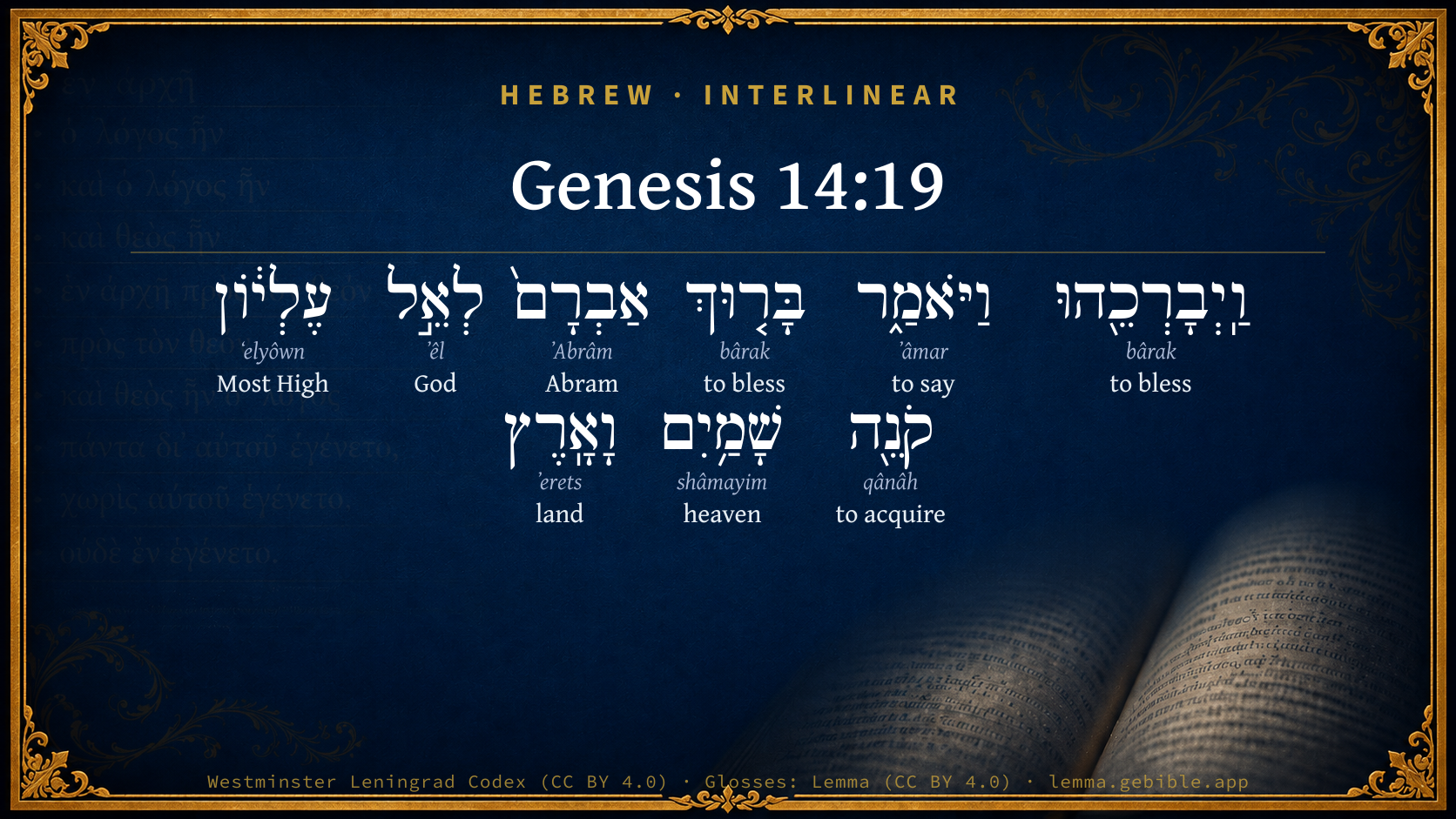
Hebrew (Westminster Leningrad Codex) Genesis 14:19 appears in the Hebrew Old Testament. The text above is from the Westminster Leningrad Codex. Each word links to its Strong’s number, a concise gloss, and parsing drawn from the Open Scriptures Hebrew Bible morphology. Click any word for its full Brown-Driver-Briggs (BDB) entry.
Download image
Cite this verse

Genesis 14:19 (World English Bible). Public Domain. Lemma interlinear Bible study tool, https://lemma.gebible.app/v/genesis/14/19.

Show BibTeX & RIS
BibTeX
RIS
English Translation
He blessed him, and said, "Blessed be Abram of God Most High, possessor of heaven and earth:
World English Bible · Public Domain
Download a study sheet

One document with this verse’s original text, its word-by-word gloss line, the meaning frame, cross-references with their text, attributed commentary, and full source and license credits — printable, and it pastes into notes with its structure intact.

This verse Autodidact and up

Study sheet (.html) Plain text (.txt)

A passage Seminary Student

Up to 50 verses in one chapter. A passage sheet keeps up to 6 commentary sources and 12 cross-references per verse, in the order this page ranks them, and says so on the sheet whenever that leaves anything out. Ask for a single verse and you get the Autodidact verse sheet above.

Everything on this page stays free to read, with no account — the sheet is a download of what is already on screen, not access to it.

Want to remove ads? Support Godless Engineer
Compare translations 3

The same verse in 3 English versions, stacked beneath the original-language interlinear above. Click any original word for its lexicon entry.

Each is an independent rendering of the whole verse — the interlinear is not word-aligned to these translations.

Highlighted words mark where these versions differ — a whole-verse word diff, not a word-by-word alignment.

  • World English Bible Public Domain
    He blessed him, and said, "Blessed be Abram of God Most High, possessor of heaven and earth:
  • King James Version Public Domain
    And he blessed him, and said, Blessed be Abram of the most high God, possessor of heaven and earth:
  • unfoldingWord Literal Text CC BY-SA 4.0
    And he blessed him and said, “May Abram be blessed by God Most High, the Possessor of heaven and earth.

unfoldingWord Literal Text — © unfoldingWord, licensed CC BY-SA 4.0. Word-aligned USFM3 via Door43 (git.door43.org/unfoldingWord/en_ult).

Versions to compare (up to 4)

3 of 4 selected

Show all 18 translations

Every available English version of this verse, each an independent rendering of the whole verse.

  • World English Bible Public Domain
    He blessed him, and said, "Blessed be Abram of God Most High, possessor of heaven and earth:
  • Berean Standard Bible Public Domain
    and he blessed Abram and said: “Blessed be Abram by God Most High, Creator of heaven and earth,
  • Majority Standard Bible Public Domain
    and he blessed Abram and said: “Blessed be Abram by God Most High, Creator of heaven and earth,
  • King James Version Public Domain
    And he blessed him, and said, Blessed be Abram of the most high God, possessor of heaven and earth:
  • American Standard Version (1901) Public Domain
    And he blessed him, and said, Blessed be Abram of God Most High, possessor of heaven and earth:
  • Revised Version (1885) Public Domain
    And he blessed him, and said, Blessed be Abram of God Most High, possessor of heaven and earth:
  • Geneva Bible (1599) Public Domain
    Therefore he blessed him, saying, Blessed art thou, Abram, of God most high possessour of heauen and earth,
  • Douay-Rheims (1899) Public Domain
    Blessed him, and said: Blessed be Abram by the most high God, who created heaven and earth.
  • Young's Literal Translation Public Domain
    and he blesseth him, and saith, `Blessed `is' Abram to God Most High, possessing heaven and earth;
  • Literal Standard Version CC BY-SA 4.0
    and he blesses him and says, “Blessed [is] Abram to God Most High, possessing the heavens and earth;
  • Unlocked Literal Bible CC BY-SA 4.0
    He blessed him saying, “Blessed be Abram by God Most High, Creator of heaven and earth.
  • unfoldingWord Literal Text CC BY-SA 4.0
    And he blessed him and said, “May Abram be blessed by God Most High, the Possessor of heaven and earth.
  • Darby Bible Public Domain
    And he blessed him, and said, Blessed be Abram of the Most High ùGod, possessor of heavens and earth.
  • World Messianic Bible Public Domain
    He blessed him, and said, “Blessed be Abram of God Most High, possessor of heaven and earth.
  • Webster's Bible Public Domain
    And he blessed him, and said, Blessed be Abram of the most high God, possessor of heaven and earth:
  • Free Bible Version CC BY-SA 4.0
    He blessed Abram, telling him, “May Abram be blessed by the Most High God, Creator of heaven and earth.
  • Bible in Basic English Public Domain
    And blessing him, said, May the blessing of the Most High God, maker of heaven and earth, be on Abram:
  • JPS Tanakh (1917) Public Domain
    And he blessed him, and said: 'Blessed be Abram of God Most High, Maker of heaven and earth;

Literal Standard Version (2020), Covenant Press — licensed CC BY-SA 4.0. Text via the HelloAO Bible API (eBible.org). Unlocked Literal Bible (unfoldingWord) — licensed CC BY-SA 4.0. Text via the HelloAO Bible API (eBible.org). unfoldingWord Literal Text — © unfoldingWord, licensed CC BY-SA 4.0. Word-aligned USFM3 via Door43 (git.door43.org/unfoldingWord/en_ult). Free Bible Version, Dr. Jonathan Gallagher — licensed CC BY-SA 4.0. Text via the HelloAO Bible API (eBible.org).

Word by word

More ways to search: Search by grammar → Find every occurrence → Compare this word →

Practice this passage: Drill this verse → Learn its vocabulary →

עֶלְי֔וֹן
ʻelyôwn
H5945
“Most High”
Adjective, Adjective, Masculine, Singular, Absolute
Part of Speech
Adjective
Type
Adjective
Gender
Masculine
Number
Singular
State
Absolute
Full BDB Definition

Origin: from H5927

TWOT: 1624g , 1624h

high, upper (adjective) - of Davidic king exalted above monarchs - Highest, Most High (noun masculine) - name of God - of rulers, either monarchs or angel-princes
  1. וַֽיְבָרְכֵ֖הוּ bârak H1288 “and · to bless · him” Conjunction + Verb, Piel, Sequential Imperfect, 3rd Person, Masculine, Singular + Suffix, Personal, 3rd Person, Masculine, Singular
  2. וַיֹּאמַ֑ר ʼâmar H559 “and · to say” Conjunction + Verb, Qal, Sequential Imperfect, 3rd Person, Masculine, Singular
  3. בָּר֤וּךְ bârak H1288 “blessed” Verb, Qal, Participle Passive, Masculine, Singular, Absolute
  4. אַבְרָם֙ ʼAbrâm H87 “Abram” Noun, Proper
  5. לְאֵ֣ל ʼêl H410 “to/for · God” Preposition + Noun, Common, Masculine, Singular, Absolute
  6. קֹנֵ֖ה qânâh H7069 “acquiring” Verb, Qal, Participle Active, Masculine, Singular, Construct
  7. שָׁמַ֥יִם shâmayim H8064 “heaven(s)” Noun, Common, Masculine, Plural, Absolute
  8. וָאָֽרֶץ ʼerets H776 “and · land” Conjunction + Noun, Common, Both, Singular, Absolute

About this verse

These counts appear in no published source. They are computed here, from the morphology-tagged text and Lemma’s own curated glosses. What Lemma adds →

9
words
8
distinct lemmas
Pentateuch
section

Shared distinctive vocabulary

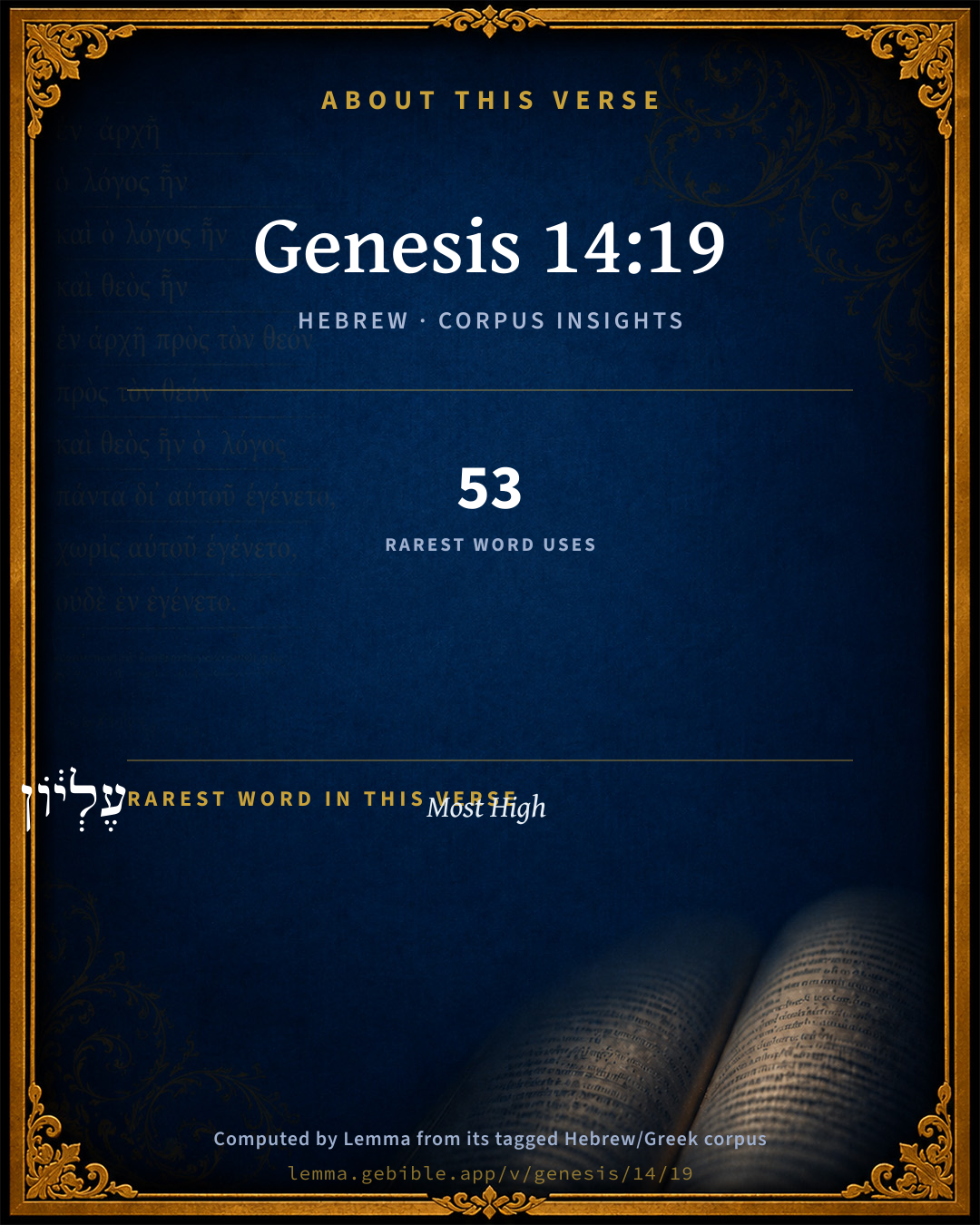
עֶלְי֔וֹן Most High H5945 occurs in 53 verses of the Hebrew Bible. Also found in:

Grammatical profile

  • 4 verbs
  • 4 nouns
  • 1 adjective

Verb forms

  • וַֽיְבָרְכֵ֖הוּ Piel · Sequential Imperfect
  • וַיֹּאמַ֑ר Qal · Sequential Imperfect
  • בָּר֤וּךְ Qal · Participle Passive
  • קֹנֵ֖ה Qal · Participle Active

Repetition

A word recurs within this verse — often emphatic in Hebrew:

  • וַֽיְבָרְכֵ֖הוּ to bless H1288 ×2

Hebrew & Septuagint length

In English translation the verse runs 17 words from the Hebrew and 19 from the Septuagint (LXX English) — closely comparable.

A rough comparison of the two English renderings, which tokenize alike — not a word-level alignment.

Word counts can differ between the Hebrew and the Greek without any difference in meaning — e.g. the Hebrew direct-object marker אֵת has no separate Greek word, and Greek often adds the article ὁ.

Cross-references

21

Topical passages linked to Genesis 14:19 in the Treasury of Scripture Knowledge — connected by theme and wording, ordered by reader-vote popularity; previews shown in the World English Bible.

  • Genesis 14:22 Abram said to the king of Sodom, "I have lifted up my hand to Yahweh, God Most High, possessor of heaven and earth,
  • Hebrews 7:6–7 but he whose genealogy is not counted from them has taken tithes of Abraham, and has blessed him who has the promises.
  • Ruth 3:10 He said, Blessed are you by Yahweh, my daughter: you have shown more kindness in the latter end than at the beginning, inasmuch as you didn't follow young men, whether poor or rich.
  • Numbers 6:23–27 "Speak to Aaron and to his sons, saying, 'This is how you shall bless the children of Israel.' You shall tell them,
  • Psalms 24:1 The earth is Yahweh's, with its fullness; The world, and those who dwell therein.
  • Matthew 11:25 At that time, Jesus answered, "I thank you, Father, Lord of heaven and earth, that you hid these things from the wise and understanding, and revealed them to infants.
  • Acts 16:17 Following Paul and us, she cried out, "These men are servants of the Most High God, who proclaim to us the way of salvation!"
  • Ephesians 1:3 Blessed be the God and Father of our Lord Jesus Christ, who has blessed us with every spiritual blessing in the heavenly places in Christ;
  • Genesis 27:25–29 He said, "Bring it near to me, and I will eat of my son's venison, that my soul may bless you." He brought it near to him, and he ate. He brought him wine, and he drank.
  • Genesis 47:10 Jacob blessed Pharaoh, and went out from the presence of Pharaoh.
  • Genesis 48:9–16 Joseph said to his father, "They are my sons, whom God has given me here." He said, "Please bring them to me, and I will bless them."
  • Genesis 49:28 All these are the twelve tribes of Israel, and this is what their father spoke to them and blessed them. He blessed everyone according to his blessing.
  • 2 Samuel 2:5 David sent messengers to the men of Jabesh Gilead, and said to them, Blessed be you of Yahweh, that you have shown this kindness to your lord, even to Saul, and have buried him.
  • Psalms 115:16 The heavens are the heavens of Yahweh; But the earth has he given to the children of men.
  • Micah 6:6 How shall I come before Yahweh, And bow myself before the exalted God? Shall I come before him with burnt offerings, With calves a year old?
  • Luke 10:21 In that same hour Jesus rejoiced in the Holy Spirit, and said, "I thank you, O Father, Lord of heaven and earth, that you have hidden these things from the wise and understanding, and revealed them to little children. Yes, Father, for so it was well-pleasing in your sight."
  • Ephesians 1:6 to the praise of the glory of his grace, by which he freely bestowed favor on us in the Beloved,
  • Genesis 27:4 Make me savory food, such as I love, and bring it to me, that I may eat, and that my soul may bless you before I die."
  • Genesis 47:7 Joseph brought in Jacob, his father, and set him before Pharaoh, and Jacob blessed Pharaoh.
  • Psalms 50:10 For every animal of the forest is mine, And the cattle on a thousand hills.
  • Mark 10:16 He took them in his arms, and blessed them, laying his hands on them.

Cross-references courtesy of OpenBible.info (CC BY 4.0).

Hebrew and Greek witnesses Masoretic Hebrew ↔ Greek Septuagint

The same verse in the two great witnesses to the Old Testament, shown verse-for-verse.

These are two independent witnesses, not word-aligned to each other, and the Septuagint is shown in lemma (dictionary) form.

Hebrew Genesis 14:19 Masoretic · Westminster Leningrad Codex

וַֽיְבָרְכֵ֖הוּ וַיֹּאמַ֑ר בָּר֤וּךְ אַבְרָם֙ לְאֵ֣ל עֶלְי֔וֹן קֹנֵ֖ה שָׁמַ֥יִם וָאָֽרֶץ

He blessed him, and said, "Blessed be Abram of God Most High, possessor of heaven and earth:

World English Bible · Public Domain

Greek LXX Genesis 14:19 Septuagint · lemma form

καί εὐλογέω ὁ αβραμ καί εἶπον εὐλογέω αβραμ ὁ θεός ὁ ὕψιστος ὅς κτίζω ὁ οὐρανός καί ὁ γῆ

And he blessed Abram, and said, Blessed be Abram of the most high God, who made heaven and earth,

LXX2012 (modern English Septuagint) · Public Domain

On this verse, The Pulpit Commentary discusses the Septuagint’s reading. Read the note in Commentary ↓

Hebrew: Westminster Leningrad Codex (CC BY 4.0). Greek: Septuagint (public domain); English from LXX2012 (modern English Septuagint) (Public Domain). How the Septuagint differs from the Hebrew →

Targum (Aramaic paraphrase)

2

The Targum is the ancient Jewish Aramaic paraphrase of the Hebrew Scriptures — an interpretive translation, not the Hebrew text itself. Onkelos (literal) and Pseudo-Jonathan (expansive) render the Torah, and Jonathan the Prophets. Coverage is partial: where no permissively-licensed English translation exists for a verse, only the Aramaic is shown. This is verse-level text, not a word-by-word alignment to the Hebrew.

  1. Targum Onkelos Torah (Genesis–Deuteronomy)
    וּבָרְכֵיהּ וַאֲמָר בְּרִיךְ אַבְרָם לְאֵל עִלָאָה דְקִנְיָנֵהּ שְׁמַיָא וְאַרְעָא

    and he blessed him, and said: "Blessed be Abram before El Illah, whose possession is heaven and earth;

    Targum Onkelos — Aramaic: “Onkelos Genesis” (public domain); “Onkelos Exodus” (public domain); “Onkelos Leviticus” (public domain); “Onkelos Numbers” (public domain); “Onkelos Deuteronomy” (public domain). English: “Sefaria Community Translation” (CC0 1.0 (public-domain dedication)); “J.W. Etheridge. The Targums of Onkelos and Jonathan Ben Uzziel on the Pentateuch. London: Longmans, Green, 1862” (public domain). Text via Sefaria.

  2. Targum Pseudo-Jonathan Torah (Genesis–Deuteronomy)
    וּבָרְכֵיהּ וַאֲמַר בְּרִיךְ אַבְרָם מִן יְיָ אֱלָהָא עִילָאָה דִבְגִין צַדִיקַיָא קְנָא שְׁמַיָא וְאַרְעָא

    And he blessed him, and said, Blessed be Abram of the Lord God Most High, who for the righteous possesseth the heavens and the earth.

    Targum Pseudo-Jonathan — Aramaic: “Targum Jonathan on Genesis” (public domain); “Targum Jonathan on Exodus” (public domain); “Targum Jonathan on Leviticus” (public domain); “Targum Jonathan on Numbers” (public domain); “Targum Jonathan on Deuteronomy” (public domain). English: “The Targum of Jonathan ben Uzziel, trans. J. W. Etheridge, London, 1862” (public domain). Text via Sefaria.

Commentary

Notes on Genesis 14:19 from classic Christian and Jewish commentators (each source and its license shown beneath its notes). The classic Christian expositions comment on the surrounding passage and are grouped to its opening verse, so a note may address several verses; the Jewish commentaries on the Tanakh (Rashi and others) are per-verse, so they appear only where the commentator wrote on this verse.

Lemma curates 59 commentaries, every one of them public domain or Creative Commons licensed, each selected and text-cleaned for this edition rather than reprinted as found. About our sources →

Trapp's Complete Commentary

John Trapp

Gen 14:19 And he blessed him, and said, Blessed [be] Abram of the most high God, possessor of heaven and earth:

Ver. 19. And he blessed him.] Lo, here an instance of the communion of saints: Melchizedek doth all good offices to Abram (a believer, though a stranger), not of courtesy only and humanity, but of charity and piety.

John Trapp, A Commentary or Exposition upon All the Books of the Old and New Testament (1647–1656) — public domain. Text from a community e-Sword module.

Joseph Benson's Commentary

Gen 14:19. Blessed be Abram of the most high God — Observe the titles he here gives to God, which are very glorious. 1st, The most high God, which speaks his absolute perfection in himself, and his sovereign dominion over all the creatures. 2d, Possessor of heaven and earth — That is, rightful owner and sovereign Lord of all the creatures; because he made them.

Joseph Benson's Commentary on the Old and New Testaments (1811–1818) — public domain. Text from a community e-Sword module.

Tyndale Open Study Notes

Tyndale Open Resources

14:19-20 By paying a tithe (a tenth) to Melchizedek, Abram acknowledged Melchizedek as a spiritual superior (see Heb 7:4) and affirmed that God had given him victory.

Tyndale Open Study Notes — © Tyndale Open Resources, licensed CC BY-SA 4.0. Text via the HelloAO Bible API.

Geneva Bible (1599)

Geneva Bible translators

In that Melchizedek fed Abram, he declared himself to represent a king, and in that he blessed him, the high Priest.

Geneva Bible (1599) marginal notes — public domain. Text via Bolls.life.

Adam Clarke's Commentary

Verse 19. And he blessed him] This was a part of the priest's office, to bless in the name of the Lord, for ever. See the form of this blessing, Nu 6:23-26; and for the meaning of the word to bless, see Ge 2:3.

Adam Clarke's Commentary on the Bible (1810–1826) — public domain. Text from a community e-Sword/MySword module.

John Calvin's Commentaries

19. And he blessed him. Unless these two members of the sentence, ‘He was the priest of God,’ and ‘He blessed,’ cohere together, Moses here relates nothing uncommon. For men mutually bless each other; that is, they wish well to each other. But here the priest of God is described, who, according to the right of his office, sanctifies one inferior and subject to himself. For he would never have dared to bless Abram, unless he had known, that in this respect he excelled him. In this manner the Levitical priests are commanded to bless the people; and God promises that the blessing should be efficacious and ratified, (Numbers 6:23.) So Christ, when about to ascend up to heaven, having lifted up his hands, blessed the Apostles, as a minister of the grace of God, (Luke 24:51;) and then was exhibited the truth of this figure. For he testifies that the office of blessing the Church, which had been adumbrated in Melchizedek, was assigned him by his Father.

Blessed be Abram of the most high God. The design of Melchizedek is to confirm and ratify the grace of the Divine vocation to holy Abram; for he points out the honor with which God had peculiarly dignified him by separating him from all others, and adopting him as his own son. And he calls God, by whom Abram had been chosen, the Possessor of heaven and earth, to distinguish him from the fictitious idols of the Gentiles. Afterwards, indeed, God invests himself with other titles; that, by some peculiar mark, he may render himself more clearly known to men, who, because of the vanity of their mind, when they simply hear of God as the Framer of heaven and earth, never cease to wander, till at length they are lost in their own speculations. But because God was already known to Abram, and his faith was founded upon many miracles, Melchizedek deems it sufficient to declare that, by the title of Creator, He whom Abram worshipped, is the true and only God. And although Melchizedek himself maintained the sincere worship of the true God, he yet calls Abram blessed of God, in respect of the eternal covenant: as if he would say, that, by a kind of hereditary right, the grace of God resided in one family and nation, because Abram alone had been chosen out of the whole world. Then is added a special congratulation on the victory obtained; not such as is wont to pass between profane men, who puff each other up with inflated encomiums; but Melchizedek gives thanks unto God, and regards the victory which the holy man had gained as a seal of his gratuitous calling.

John Calvin's Commentaries (1540-1563) — public domain. Text from the Calvin Translation Society English edition (1840s-50s) via the Christian Classics Ethereal Library (ccel.org). Calvin's coverage is partial (roughly two-thirds of the Bible); uncommented books and verses are honest gaps, never fabricated. The 19th-century editor's footnotes and remarks are omitted so the notes are faithfully Calvin's own voice.

Ellicott's Commentary for English Readers

(19) Possessor.—Literally, creator, or framer. It is a poetical word, as are also those for “delivered” and “enemies.” The form of the blessing, moreover, is poetical, as it is arranged in parallel clauses.

A Bible Commentary for English Readers, edited by Charles John Ellicott (1878–1897) — public domain. Text from a community e-Sword module.

The Cambridge Bible for Schools and Colleges

gen. ed. J. J. S. Perowne

19. he blessed him] Melchizedek, as a priest, blessed Abram for his courageous and chivalrous action. A stranger in the land, he had come to the rescue of its people.

of God Most High] i.e. by God Most High. The blessing of El Elyon is invoked by Melchizedek upon Abram, the servant of Jehovah.

possessor of heaven and earth] R.V. marg. maker. The word is poetical. It expresses the ideas of making, producing, creating, as in Deu_32:6, Psa_139:13, Pro_8:22. It is more often used for “acquiring” (cf. Gen_4:1), a sense which would not here be applicable. In Isa_1:3, it is found, as here, with the meaning of “owner.”

The Cambridge Bible for Schools and Colleges (gen. ed. J. J. S. Perowne; Cambridge University Press, 1878–1918) — public domain. Text from a community e-Sword module.

John Gill's Exposition

And he blessed him,.... Melchizedek blessed Abram, which was one part of his office as a priest, to wish and pray for a blessing on others, see Num 6:23, &c. and herein typified Christ, who really blesses or confers blessings on all his people, even spiritual blessings, such as redemption, remission of sins, and justifying righteousness, adoption, and eternal life:

and said, blessed be Abram of the most high God; that is, may he be blessed by him who is the most high God, with all kind of blessings, both temporal and spiritual; or he declares him to be blessed of him, as he undoubtedly was, or foretells that he would be, as was certainly his case: and another epithet of God is added, which abundantly shows he was able to bless him, since he is the

possessor of heaven and earth; is the Maker of both, and has a right to dispose of all things in them, both heavenly and earthly.

John Gill's Exposition of the Whole Bible (1746–1763) — public domain (CC PDM 1.0). Text via the HelloAO Bible API.

Haydock's Catholic Bible Commentary

Blessed him, as his inferior, and received tithes of him, Hebrews iv. 7. This shews the antiquity of the practice of supporting God’s priests by tithes.

George Leo Haydock (1774–1849), Haydock's Catholic Family Bible and Commentary, 1859 edition — public domain. Excludes Psalms (Douay-Rheims chapter numbering differs from Protestant) and Deuterocanonical books (Catholic canon only).

Matthew Poole's English Annotations

And, or therefore, ( as the particle is oft taken, i.e. because he was a priest of God),

he (i.e. Melchizedek)

blessed him, ( Abram,) which was one act of the priestly office. See Poole on "Heb 7:6" and "Heb 7:7". So it is a prayer for him, that God would confirm and increase the blessing which he had given him. Or, blessed is; so it is an acknowledgment of God's blessing conferred upon Abram both formerly, and in this late and great victory. Or, blessed shall be; so it is a prediction concerning his future and further blessedness, whereof this was only an earnest.

Matthew Poole's English Annotations on the Holy Bible (1683–1685) — public domain. Text from a community e-Sword/MySword module.

Whedon's Commentary on the Bible

Daniel D. Whedon

19. He blessed him — And to enhance the greatness and grandeur of Melchizedek, the writer of Hebrews (Heb_7:7) argues: “Without contradiction the less is blessed of the better.” This blessing pronounced on Abram rises to a poetic strain:

Blessed be Abram of God most high,

Possessor of heaven and earth.

And blessed be God most high,

Who has delivered thine enemies into thy hand.

The divine names here used are אל עליון, El Elion, God, the Highest; the Supreme God; that is, the one God over all. Note how Abram, in Gen_14:22, uses the same words but prefixes the name Jehovah.

Possessor — The Hebrew word קנה may be rendered maker or founder, (Sept. and Vulg. creator,) as well as possessor. The word ready involves both these meanings.

Hath delivered — Here the providential interposition of God in the affairs of man is recognised. Accordingly, in the words of Melchizedek, we find the doctrines, 1) of God’s unity and supremacy; 2) of his dominion of heaven and earth; 3) of the duty of praise and thanksgiving to him; 4) of divine Providence.

He gave him tithes of all — That is, Abram gave Melchizedek tithes of all the booty he had taken. Thus early do we find the mention of the tenth, as a suitable portion of things acquired to be devoted to religious purposes.

Daniel D. Whedon (gen. ed.), Commentary on the Old and New Testaments (1874–1909) — public domain. Text from a community e-Sword module.

The Pulpit Commentary

And he blessed him (in which act appears his distinctively sacerdotal character), and said (the form of the benediction is poetical, consisting of two parallel stanzas), Blessed be Abram so Isaac blessed, (Gen_27:27) and Jacob Joseph, (Gen_48:15) conveying in each case a Divine bone-dictionof the most high God 1 after a passive verb indicating the efficient cause (vide Gesenius, 2, and of. (Gen_31:15; Pro_14:5) possessor so Onkelos and Calvin; but koneh, from kanah, to erect, set up, hence found or create, means founder and creator (Gesenius), combines the meanings of ktizein and ktasqai (Keil), contains no indistinct allusion to the doctrine (Gen_1:1) (Murphy) and is rendered ov ektise (LXX) and qui creavit (Vulgate)of heaven and earth.

HOMILIES BY J.F. MONTGOMERY

Ver. 19.

Melchizedek blessing Abraham.

he blessed him, and said, "Blessed be Abram of the most high God, possessor of heaven and earth." Wherever in Scripture Melchizedek is spoken of, it is as a type of Christ. (Psa_110:4 Heb 5 Heb 6 Heb 7) We may so regard him here, and consider his act in its typical light. Outwardly the transaction was of little mark. A band of men under Chedorlaomer carried off Lot, along with other spoil, from Sodom. Abram, on learning this, armed his household, pursued the invaders, routed them, and set the captives free. On his return Melchizedek, the head of a tribe near the line of march, came out to offer refreshment to his men; and as priest of his tribe he blessed Abram. Whether the type was understood by Abram or Melchizedek matters not. These things are written for our learning. We see in them Christ bestowing his blessing.

I THE OCCASION OF THE BLESSING. After conflict. Our Lord the antitype of Melchizedek, as King of peace (Isa_9:6; cf. Joh_14:27) Yet the Christian life is emphatically one of warfare (Eph_6:11-13; 2Ti_2:3; cf. Gen_32:24; 1Pe_5:8; also Rev 2:, Rev_2:3. him that overcometh," &c.); The nature of that fight is against temptations to unbelief. The fight of faith. (1Ti_6:12) The renewal under Christ of the battle lost in Eden (2Ti_4:7; 1Jn_5:4) Circumstances may vary. The trial may be apparent or not. There may be no outward suffering, no visible hindrance. But what a struggle is implied in 2Co_10:5. It is the struggle against unbelief; to resist the power of things seen; to overcome "How can these things be?" to realize habitually the "city which hath foundations"; (cf. Php_3:20) to rest on God"s promises in simplicity. (Php_3:7) As often as this struggle is honestly waged a blessing is bestowed (Jam_1:2; cf. Mat_7:13 Mat_16:24; Act_14:22) We naturally love spiritual ease, but trial is better. (Psa_119:71)

II THE SOURCE OF THE BLESSING. "The most high God, possessor," &c. ;

1. All blessing is from God. We acknowledge this; but Isa_10:13 is anatural feeling. We instinctively look to second causes; yet without this "looking upward" we cannot truly pray, "Thy will be done;" we cannot really live a Godward life. Compare Melchizedek"s words with our Lord"s, (Joh_14:13-16 Joh_16:23) and their fulfillment in his receiving for men (Psa_68:18) all needful gifts forgiveness, sonship, right to pray, means of grace, opportunities of work.

2. All creation used by him as means of bestowing his blessing (cf. Rom_8:28) Sorrows (Rom_5:3; Heb_12:11) and joys (Rom_2:4) are alike instruments of good (cf. Psa_116:12 Psa_119:67)

III THE FRUIT OF THE BLESSING. Closer walk with God. The events of this chapter were followed by more vivid spiritual manifestations to Abram. And thus our spiritual life advances. The blessing is God"s free gift; but through conflict with evil the soul is prepared to receive it (cf. Psa_97:10) As in natural life powers are increased by exercise, or rather by God"s gift on this condition, so in the spiritual the conflict of self-denial, our Savior"s blessing, and the "spirit of adoption" are inseparably linked together. "Grace for grace" should be the Christian"s motto; ever pressing onwards. And as we can assign no limits to God"s blessing, so neither is there any limit to our nearness to him. M.

The Pulpit Commentary (1880–1919), ed. H.D.M. Spence-Jones & Joseph S. Exell — public domain. Text from a community e-Sword module.

John Wesley's Explanatory Notes

Blessed be Abram, of the most high God - Observe the titles he here gives to God, which are very glorious.

1. The most high God, which speaks his absolute perfections in himself, and his sovereign dominion over all the creatures.

2. Possessor of heaven and earth - That is, rightful owner and sovereign Lord of all the creatures; because he made them.

John Wesley, Explanatory Notes Upon the Whole Bible (1754–1765) — public domain. Text via the GEBible commentary corpus.

unfoldingWord translationNotes

Door43 World Missions Community

He blessed him

King Melchizedek blessed Abram.

Blessed be Abram by God Most High, Creator of heaven and earth

This can be stated in active form. AT: "May God Most High, the Creator of heaven and earth, bless Abram" (See: Active or Passive)

heaven

This refers to the place where God lives.

God Most High, who has given

"God Most High, because he has given." The phrase starting with "who has given" tells us something more about God Most High.

Blessed be God Most High

This is a way of praising God. See how you translated "blessed be" in Genesis 9:26.

into your hand

"into your control" or "into your power"

translationWords

bless

Abraham

God

Most High

create

heaven

hand

tenth

unfoldingWord translationNotes — © Distant Shores Media and the Door43 World Missions Community, licensed CC BY-SA 4.0. Source: git.door43.org/Door43/en_tn.

Rashi

Rabbi Shlomo Yitzchaki (Rashi)

קנה שמים וארץ MAKER, or POSSESSOR OF HEAVEN AND EARTH — similar to (Psalms 134:3) עשה שמים וארץ “Maker of heaven and earth”: through His having made them He acquired them as His possession.

Rashi on the Tanakh — English translations: “The Judaica Press complete Tanach with Rashi, translated by A. J. Rosenberg” (CC BY 4.0); “Pentateuch with Rashi's commentary by M. Rosenbaum and A.M. Silbermann, 1929-1934” (public domain); “The Metsudah Tanach series, Lakewood, N.J” (CC BY 4.0); and “The Book of Joshua, Metsudah Publications, 1997” (CC BY 4.0). Text via Sefaria.

Ramban (Nachmanides)

Rabbi Moshe ben Nachman (Ramban / Nachmanides)

KONEI (POSSESSOR) OF HEAVEN AND EARTH. Rashi wrote: “Konei is similar to osei (maker);. Psalms 134:3. through His having made them He acquired them as His possession.”But these are really two different interpretations. and kinyan — making and acquiring — constitute but one interpretation when in fact they are two: konei is similar to osei, and konei is like kinyan (acquisition). Perhaps it is indeed the case that the word kinyan (acquisition) is also used in the case of asiyah (making). Thus you find, For Thou ‘kanita’ (hast made) my reins, repeating the thought [expressed in the second half of the verse], Thou hast knit me together in my mother’s womb. must also refer to “making,” rather than “acquiring.” A similar case is the verse, Is He not ‘konecha’ thy father? Hath He not made thee, and established thee? is used together with asiyah, indicating that they have a similar connotation. Thus the Sacred Language uses kinyan in the case of “making.” Conversely, And the souls which ‘asu’ [literally, they made] in Haran, means “they acquired.” And of that which was our father’s ‘asah’ (hath he made) — [here too it means “hath he acquired.”]That which Rashi says further — “He acquired them as His possession,” is correct, for whatever belongs to a person is called kinyano (his acquisition). Sheep are called mikneh because they constitute the main wealth of a person. In the language of the Sages: “He who picks up a find for his friend, his friend kanah [has taken title to it];” does not mean that he acquired it from the other since he never picked it up for himself. Instead, it means taking title to it. “watching gives ‘keniya’ (the right of possession) in ownerless property;”, 118a. Here too konah does not mean that he acquired it from another person but that he took title to it. “a man’s yard koneh (obtains title) for him without his knowledge.”, 11a. This too is a similar case. Similarly, the Sages, in all places, use the expression of kinyan for taking possession, meaning that it is his. This was the intention of Onkelos when he translated konei (of heaven and earth) as d’kinyanei, [meaning “Whose possessions are heaven and earth”], and he did not say kanah (who acquired).

Ramban (Nachmanides) on the Tanakh — English translation: “Commentary on the Torah by Ramban (Nachmanides). Translated and annotated by Charles B. Chavel. New York, Shilo Pub. House, 1971-1976” (CC BY 4.0). Text via Sefaria.

Radak

Rabbi David Kimhi (Radak)

ויברכהו...קונה שמים וארץ, the word קונה here must not be understood in the customary sense of acquiring something from a third party. Malki Tzedek most certainly did not think that “the G’d of heaven and earth” had “bought” his position from some other force. The word is used in the sense of “having created, or having invented.” It was used in this sense by Chavah when she gave birth to Kayin and said קניתי איש את ה', “I have produced, brought forth a man, with G’d,” when she meant that she was now a partner to G’d.” Genesis 4,1)

Radak on the Tanakh — English translations: “Sefaria Community Translation” (CC0 1.0 (public-domain dedication)); “Eliyahu Munk, HaChut Hameshulash” (CC BY 4.0); “Rabbi Mike Feuer, Jerusalem Anthology” (CC BY 4.0); and “R. David Kimhi on the first book of Psalms, Translated by R.G. Finch, London, 1919” (public domain). Text via Sefaria.

Lesson kit

Teaching starters — assembled from the data on this page, not authored interpretation. Every prompt links to the verse data it draws on. Edit before teaching.

Genesis, in the Pentateuch, opens this verse with 9 words (8 distinct Hebrew lemmas). Its most distinctive word is ʻelyôwn (“Most High”). A historical commentator’s framing appears above. Read the whole chapter for the surrounding context.

Discussion questions

  1. The word ʻelyôwn carries the sense “Most High.” How does it shape the verse?
  2. How does Genesis 14:18, which shares the word «Most High», read alongside this verse?
  3. What does the repetition of “to bless” (2× in this one verse) do in this verse?
  4. The translations on this page render this verse differently — a whole-verse word diff, not a word-by-word alignment. What might account for the different wordings?
  5. «וַֽיְבָרְכֵ֖הוּ» is a Piel Sequential Imperfect verb. How does that grammatical form shape the action described?
  6. Compare how Trapp's Complete Commentary and Joseph Benson's Commentary read this verse. Where do they agree or differ?

Things to notice

  • These translations choose different wording for 1 word in this verse.
  • “to bless” occurs 2× in this single verse.
  • 8 distinct Hebrew lemmas span 9 words in this verse.

Reading settings

Reading text

Shown beneath each verse's original-language words.

Old Testament
Old Testament edition

Read the OT as the Masoretic Hebrew (MT) or the Greek Septuagint (LXX).

English shown for the Greek Septuagint (in the Hebrew ↔ Greek comparison).

Comparing translations? Open the Compare panel on any verse page to stack up to four side by side.