
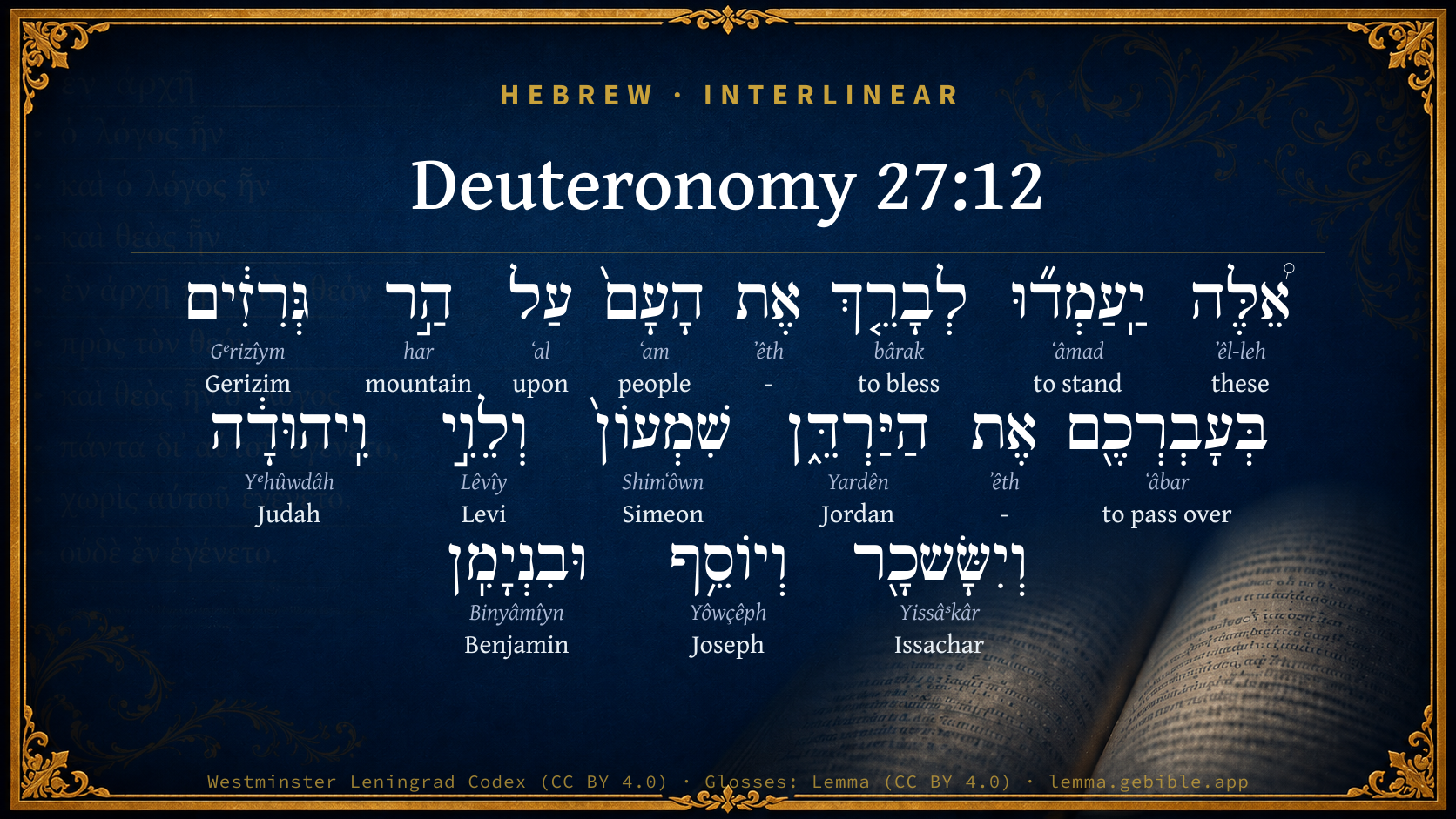
Deuteronomy 27:12

Hebrew (Westminster Leningrad Codex) Deuteronomy 27:12 appears in the Hebrew Old Testament. The text above is from the Westminster Leningrad Codex. Each word links to its Strong’s number, a concise gloss, and parsing drawn from the Open Scriptures Hebrew Bible morphology. Click any word for its full Brown-Driver-Briggs (BDB) entry.
Download image
Cite this verse

Deuteronomy 27:12 (World English Bible). Public Domain. Lemma interlinear Bible study tool, https://lemma.gebible.app/v/deuteronomy/27/12.

Show BibTeX & RIS
BibTeX
RIS
English Translation
These shall stand on Mount Gerizim to bless the people, when you are passed over the Jordan: Simeon, and Levi, and Judah, and Issachar, and Joseph, and Benjamin.
World English Bible · Public Domain
Download a study sheet

One document with this verse’s original text, its word-by-word gloss line, the meaning frame, cross-references with their text, attributed commentary, and full source and license credits — printable, and it pastes into notes with its structure intact.

This verse Autodidact and up

Study sheet (.html) Plain text (.txt)

A passage Seminary Student

Up to 50 verses in one chapter. A passage sheet keeps up to 6 commentary sources and 12 cross-references per verse, in the order this page ranks them, and says so on the sheet whenever that leaves anything out. Ask for a single verse and you get the Autodidact verse sheet above.

Everything on this page stays free to read, with no account — the sheet is a download of what is already on screen, not access to it.

Want to remove ads? Support Godless Engineer
Compare translations 3

The same verse in 3 English versions, stacked beneath the original-language interlinear above. Click any original word for its lexicon entry.

Each is an independent rendering of the whole verse — the interlinear is not word-aligned to these translations.

Highlighted words mark where these versions differ — a whole-verse word diff, not a word-by-word alignment.

  • World English Bible Public Domain
    These shall stand on Mount Gerizim to bless the people, when you are passed over the Jordan: Simeon, and Levi, and Judah, and Issachar, and Joseph, and Benjamin.
  • King James Version Public Domain
    These shall stand upon mount Gerizim to bless the people, when ye are come over Jordan; Simeon, and Levi, and Judah, and Issachar, and Joseph, and Benjamin:
  • unfoldingWord Literal Text CC BY-SA 4.0
    “These shall stand on Mount Gerizim to bless the people when you have crossed the Jordan: Simeon and Levi and Judah and Issachar and Joseph and Benjamin.

unfoldingWord Literal Text — © unfoldingWord, licensed CC BY-SA 4.0. Word-aligned USFM3 via Door43 (git.door43.org/unfoldingWord/en_ult).

Versions to compare (up to 4)

3 of 4 selected

Show all 18 translations

Every available English version of this verse, each an independent rendering of the whole verse.

  • World English Bible Public Domain
    These shall stand on Mount Gerizim to bless the people, when you are passed over the Jordan: Simeon, and Levi, and Judah, and Issachar, and Joseph, and Benjamin.
  • Berean Standard Bible Public Domain
    “When you have crossed the Jordan, these tribes shall stand on Mount Gerizim to bless the people: Simeon, Levi, Judah, Issachar, Joseph, and Benjamin.
  • Majority Standard Bible Public Domain
    “When you have crossed the Jordan, these tribes shall stand on Mount Gerizim to bless the people: Simeon, Levi, Judah, Issachar, Joseph, and Benjamin.
  • King James Version Public Domain
    These shall stand upon mount Gerizim to bless the people, when ye are come over Jordan; Simeon, and Levi, and Judah, and Issachar, and Joseph, and Benjamin:
  • American Standard Version (1901) Public Domain
    These shall stand upon mount Gerizim to bless the people, when ye are passed over the Jordan: Simeon, and Levi, and Judah, and Issachar, and Joseph, and Benjamin.
  • Revised Version (1885) Public Domain
    These shall stand upon mount Gerizim to bless the people, when ye are passed over Jordan; Simeon, and Levi, and Judah, and Issachar, and Joseph, and Benjamin:
  • Geneva Bible (1599) Public Domain
    These shall stand vpon mount Gerizzim, to blesse the people when ye shall passe ouer Iorden: Simeon, and Leui, and Iudah, and Issachar, and Ioseph, and Beniamin.
  • Douay-Rheims (1899) Public Domain
    These shall stand upon mount Garizim to bless the people, when you are passed the Jordan: Simeon, Levi, Juda, Issachar, Joseph, and Benjamin.
  • Young's Literal Translation Public Domain
    `These do stand, to bless the people, on mount Gerizzim, in your passing over the Jordan: Simeon, and Levi, and Judah, and Issachar, and Joseph, and Benjamin.
  • Literal Standard Version CC BY-SA 4.0
    “These stand on Mount Gerizzim to bless the people, in your passing over the Jordan: Simeon, and Levi, and Judah, and Issachar, and Joseph, and Benjamin.
  • Unlocked Literal Bible CC BY-SA 4.0
    “These tribes must stand on Mount Gerizim to bless the people after you have passed over the Jordan: Simeon, Levi, Judah, Issachar, Joseph, and Benjamin.
  • unfoldingWord Literal Text CC BY-SA 4.0
    “These shall stand on Mount Gerizim to bless the people when you have crossed the Jordan: Simeon and Levi and Judah and Issachar and Joseph and Benjamin.
  • Darby Bible Public Domain
    These shall stand to bless the people upon mount Gerizim, when ye have gone over the Jordan: Simeon, and Levi, and Judah, and Issachar, and Joseph, and Benjamin.
  • World Messianic Bible Public Domain
    “These shall stand on Mount Gerizim to bless the people, when you have crossed over the Jordan: Simeon, Levi, Judah, Issachar, Joseph, and Benjamin.
  • Webster's Bible Public Domain
    These shall stand upon mount Gerizim to bless the people, when ye have come over Jordan; Simeon, and Levi, and Judah, and Issachar, and Joseph, and Benjamin:
  • Free Bible Version CC BY-SA 4.0
    After you've crossed the Jordan, the following tribes are to stand on Mount Gerizim to bless the people: Simeon, Levi, Judah, Issachar, Joseph, and Benjamin.
  • Bible in Basic English Public Domain
    These are to take their places on Mount Gerizim for blessing the people when you have gone over Jordan: Simeon and Levi and Judah and Issachar and Joseph and Benjamin;
  • JPS Tanakh (1917) Public Domain
    'These shall stand upon mount Gerizim to bless the people, when ye are passed over the Jordan: Simeon, and Levi, and Judah, and Issachar, and Joseph, and Benjamin;

Literal Standard Version (2020), Covenant Press — licensed CC BY-SA 4.0. Text via the HelloAO Bible API (eBible.org). Unlocked Literal Bible (unfoldingWord) — licensed CC BY-SA 4.0. Text via the HelloAO Bible API (eBible.org). unfoldingWord Literal Text — © unfoldingWord, licensed CC BY-SA 4.0. Word-aligned USFM3 via Door43 (git.door43.org/unfoldingWord/en_ult). Free Bible Version, Dr. Jonathan Gallagher — licensed CC BY-SA 4.0. Text via the HelloAO Bible API (eBible.org).

Word by word

More ways to search: Search by grammar → Find every occurrence → Compare this word →

Practice this passage: Drill this verse → Learn its vocabulary →

גְּרִזִ֔ים
Gᵉrizîym
H1630
“Gerizim”
Noun, Proper
Part of Speech
Noun
Type
Proper
Full BDB Definition

Origin: plural of an unused noun from H1629

TWOT: None

Gerizim = "cuttings off" - a mountain in northern Israel in Ephraim near Shechem from which the blessings were read to the Israelites on entering Canaan; site of the Samaritan temple built after the captivity
  1. אֵ֠לֶּה ʼêl-leh H428 “these” Pronoun, Demonstrative, Common, Plural
  2. יַֽעַמְד֞וּ ʻâmad H5975 “to stand” Verb, Qal, Imperfect, 3rd Person, Masculine, Plural
  3. לְבָרֵ֤ךְ bârak H1288 “to bless” Preposition + Verb, Piel, Infinitive Construct
  4. אֶת ʼêth H853 “-” Particle, Direct Object
  5. הָעָם֙ ʻam H5971 “the · people” Particle, Definite Article + Noun, Common, Masculine, Singular, Absolute
  6. עַל ʻal H5921 “upon” Preposition
  7. הַ֣ר har H2022 “mountain of” Noun, Common, Masculine, Singular, Construct
  8. בְּעָבְרְכֶ֖ם ʻâbar H5674 “in/at · to pass over · you” Preposition + Verb, Qal, Infinitive Construct + Suffix, Personal, 2nd Person, Masculine, Plural
  9. אֶת ʼêth H853 “-” Particle, Direct Object
  10. הַיַּרְדֵּ֑ן Yardên H3383 “the · Jordan” Particle, Definite Article + Noun, Proper
  11. שִׁמְעוֹן֙ Shimʻôwn H8095 “Simeon” Noun, Proper
  12. וְלֵוִ֣י Lêvîy H3878 “and · Levi” Conjunction + Noun, Proper
  13. וִֽיהוּדָ֔ה Yᵉhûwdâh H3063 “and · Judah” Conjunction + Noun, Proper
  14. וְיִשָּׂשכָ֖ר Yissâˢkâr H3485 “and · Issachar” Conjunction + Noun, Proper
  15. וְיוֹסֵ֥ף Yôwçêph H3130 “and · Joseph” Conjunction + Noun, Proper
  16. וּבִנְיָמִֽן Binyâmîyn H1144 “and · Benjamin” Conjunction + Noun, Proper

About this verse

These counts appear in no published source. They are computed here, from the morphology-tagged text and Lemma’s own curated glosses. What Lemma adds →

17
words
16
distinct lemmas
Pentateuch
section

Notable vocabulary

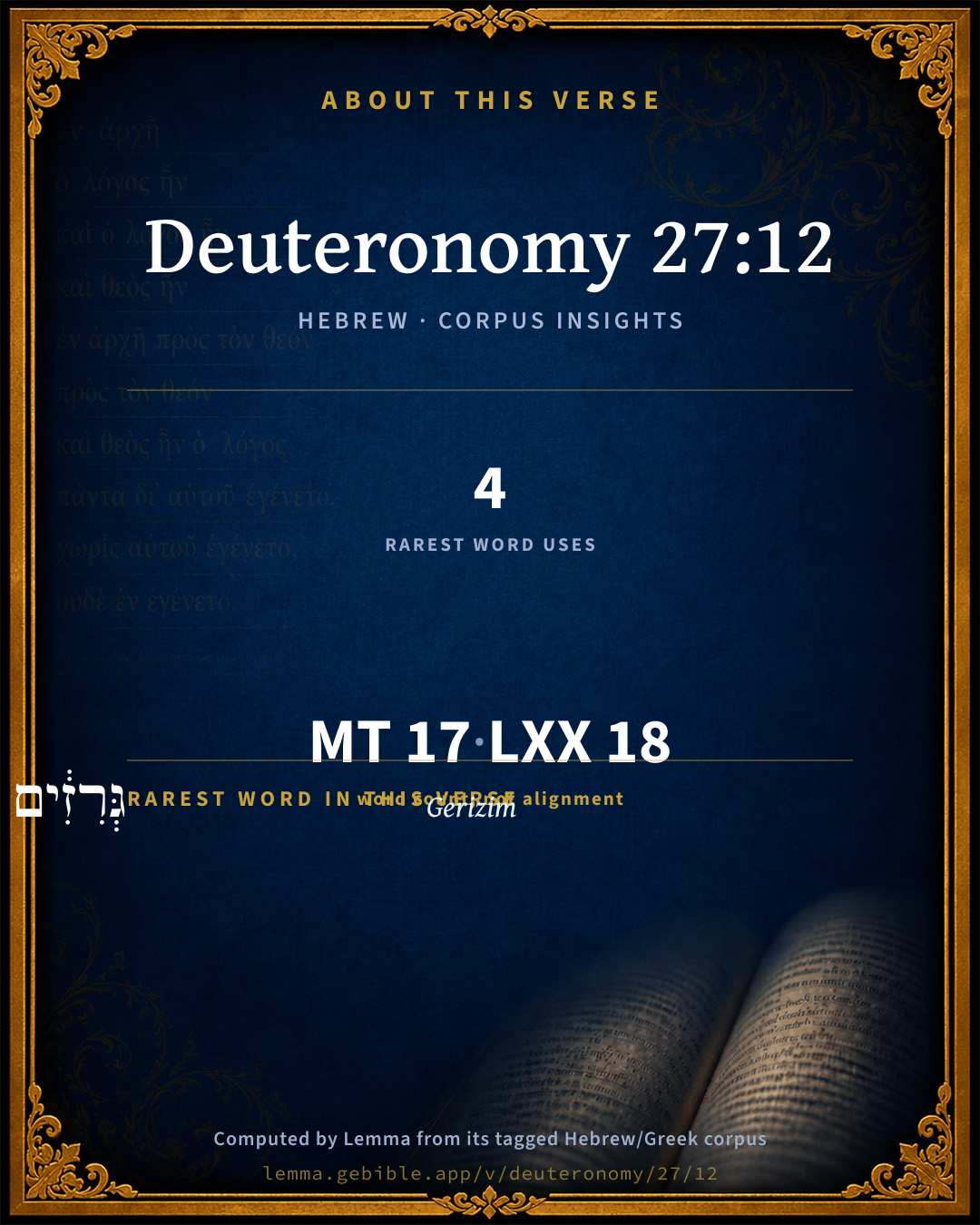
The rarest word here is גְּרִזִ֔ים Gerizim H1630 — appearing just 4 times in the whole Hebrew Bible.

Shared distinctive vocabulary

גְּרִזִ֔ים Gerizim H1630 occurs in 4 verses of the Hebrew Bible. Also found in:

Grammatical profile

  • 3 verbs
  • 10 nouns
  • 1 pronoun
  • 1 preposition
  • 2 particles

Verb forms

  • יַֽעַמְד֞וּ Qal · Imperfect
  • לְבָרֵ֤ךְ Piel · Infinitive Construct
  • בְּעָבְרְכֶ֖ם Qal · Infinitive Construct

Hebrew & Septuagint length

In English translation the verse runs 28 words from the Hebrew and 21 from the Septuagint (LXX English) — closely comparable.

A rough comparison of the two English renderings, which tokenize alike — not a word-level alignment.

Word counts can differ between the Hebrew and the Greek without any difference in meaning — e.g. the Hebrew direct-object marker אֵת has no separate Greek word, and Greek often adds the article ὁ.

In the original languages it is 17 Hebrew tokens and 18 Greek tokens — but the two are counted differently (Hebrew bundles its prefixes and suffixes into one token; the Greek is in lemma form), so that isn’t a like-for-like length.

Cross-references

7

Topical passages linked to Deuteronomy 27:12 in the Treasury of Scripture Knowledge — connected by theme and wording, ordered by reader-vote popularity; previews shown in the World English Bible.

  • Judges 9:7 When they told it to Jotham, he went and stood on the top of Mount Gerizim, and lifted up his voice, and cried, and said to them, Listen to me, you men of Shechem, that God may listen to you.
  • Genesis 29:33–35 She conceived again, and bare a son, and said, "Because Yahweh has heard that I am hated, he has therefore given me this son also." She named him Simeon.
  • Genesis 30:18 Leah said, "God has given me my hire, because I gave my handmaid to my husband." She named him Issachar.
  • Genesis 30:24 She named him Joseph, saying, "May Yahweh add another son to me."
  • Genesis 35:18 It happened, as her soul was departing (for she died), that she named him Ben-oni, but his father named him Benjamin.
  • Deuteronomy 11:26–29 Behold, I set before you this day a blessing and a curse:
  • Joshua 8:33–35 All Israel, and their elders and officers, and their judges, stood on this side of the ark and on that side before the priests the Levites, who bore the ark of the covenant of Yahweh, as well the foreigner as the native; half of them in front of Mount Gerizim, and half of them in front of Mount Ebal; as Moses the servant of Yahweh had commanded at the first, that they should bless the people of Israel.

Cross-references courtesy of OpenBible.info (CC BY 4.0).

Hebrew and Greek witnesses Masoretic Hebrew ↔ Greek Septuagint

The same verse in the two great witnesses to the Old Testament, shown verse-for-verse.

These are two independent witnesses, not word-aligned to each other, and the Septuagint is shown in lemma (dictionary) form.

Hebrew Deuteronomy 27:12 Masoretic · Westminster Leningrad Codex

אֵ֠לֶּה יַֽעַמְד֞וּ לְבָרֵ֤ךְ אֶת הָעָם֙ עַל הַ֣ר גְּרִזִ֔ים בְּעָבְרְכֶ֖ם אֶת הַיַּרְדֵּ֑ן שִׁמְעוֹן֙ וְלֵוִ֣י וִֽיהוּדָ֔ה וְיִשָּׂשכָ֖ר וְיוֹסֵ֥ף וּבִנְיָמִֽן

These shall stand on Mount Gerizim to bless the people, when you are passed over the Jordan: Simeon, and Levi, and Judah, and Issachar, and Joseph, and Benjamin.

World English Bible · Public Domain

Greek LXX Deuteronomy 27:12 Septuagint · lemma form

οὗτος ἵστημι εὐλογέω ὁ λαός ἐν ὄρος γαριζιν διαβαίνω ὁ ἰορδάνης συμεων λευί ἰούδας ισσαχαρ ιωσηφ καί βενιαμίν

These shall stand to bless the people on mount Garizin having gone over Jordan; Symeon, Levi, Judas, Issachar, Joseph, and Benjamin.

LXX2012 (modern English Septuagint) · Public Domain

Hebrew: Westminster Leningrad Codex (CC BY 4.0). Greek: Septuagint (public domain); English from LXX2012 (modern English Septuagint) (Public Domain). How the Septuagint differs from the Hebrew →

Targum (Aramaic paraphrase)

2

The Targum is the ancient Jewish Aramaic paraphrase of the Hebrew Scriptures — an interpretive translation, not the Hebrew text itself. Onkelos (literal) and Pseudo-Jonathan (expansive) render the Torah, and Jonathan the Prophets. Coverage is partial: where no permissively-licensed English translation exists for a verse, only the Aramaic is shown. This is verse-level text, not a word-by-word alignment to the Hebrew.

  1. Targum Onkelos Torah (Genesis–Deuteronomy)
    אִלֵין יְקוּמוּן לְבָרָכָא יָת עַמָא עַל טוּרָא דִגְרִזִים בְּמֵעֲבָרְכוֹן יָת יַרְדְנָא שִׁמְעוֹן וְלֵוִי וִיהוּדָה וְיִשָׂשכָר וְיוֹסֵף וּבִנְיָמִין

    (no public-domain English translation for this verse)

    Targum Onkelos — Aramaic: “Onkelos Genesis” (public domain); “Onkelos Exodus” (public domain); “Onkelos Leviticus” (public domain); “Onkelos Numbers” (public domain); “Onkelos Deuteronomy” (public domain). English: “Sefaria Community Translation” (CC0 1.0 (public-domain dedication)); “J.W. Etheridge. The Targums of Onkelos and Jonathan Ben Uzziel on the Pentateuch. London: Longmans, Green, 1862” (public domain). Text via Sefaria.

  2. Targum Pseudo-Jonathan Torah (Genesis–Deuteronomy)
    אִלֵין שִׁבְטַיָא יְקוּמוּן לְבָרְכָא יַת עַמָא עַל טַוְורָא דִגְרִיזִים בְּמֶעֱבַרְכוֹן יַת יוֹרְדְנָא שִׁמְעוֹן וְלֵוִי וִיהוּדָה וִישָשׁכָר וְיוֹסֵף וּבִנְיָמִין

    These tribes shall stand to bless the people on the mountain of Gerezim when you have passed the Jordan,-Shemeon, Levi, Jehudah, Issakar, Joseph, and Benjamin;

    Targum Pseudo-Jonathan — Aramaic: “Targum Jonathan on Genesis” (public domain); “Targum Jonathan on Exodus” (public domain); “Targum Jonathan on Leviticus” (public domain); “Targum Jonathan on Numbers” (public domain); “Targum Jonathan on Deuteronomy” (public domain). English: “The Targum of Jonathan ben Uzziel, trans. J. W. Etheridge, London, 1862” (public domain). Text via Sefaria.

Commentary

Notes on Deuteronomy 27:12 from classic Christian and Jewish commentators (each source and its license shown beneath its notes). The classic Christian expositions comment on the surrounding passage and are grouped to its opening verse, so a note may address several verses; the Jewish commentaries on the Tanakh (Rashi and others) are per-verse, so they appear only where the commentator wrote on this verse.

Lemma curates 59 commentaries, every one of them public domain or Creative Commons licensed, each selected and text-cleaned for this edition rather than reprinted as found. About our sources →

Joseph Benson's Commentary

Deu 27:12. Upon mount Gerizim — The original words may be rendered beside or near to mount Gerizim. There were in Canaan two mountains that lay near together, with a valley between, the one called Gerizim, the other Ebal. On the sides of these which faced each other, all the tribes were to be drawn up, six on a side, so that in the valley they came near each other, so near that the priests standing between them might be heard by them that were next them on both sides. Then one of the priests, or perhaps more, at some distance from each other, pronounced with a loud voice one of the curses following. And all the people who stood on the foot and side of mount Ebal (those further off taking the signal from those who were nearer) said, Amen! Then the contrary blessing was pronounced, “Blessed is he that doth so or so:” to which all who stood on the foot and side of mount Gerizim said, Amen! Simeon, Levi, &c. — All these were the children of the free-women, Leah and Rachel, to show both the dignity of the blessings above the curses, and that the blessings belong only to those who are evangelically free, as this is expounded and applied, Gal 4:22, even to those that receive the Spirit of adoption and liberty. Joseph is here put for both his sons and tribes, Manasseh and Ephraim, which are reckoned as one tribe, because Levi is here numbered; but when Levi is omitted, as it is where the division of the land is made, there Manasseh and Ephraim pass for two tribes.

Joseph Benson's Commentary on the Old and New Testaments (1811–1818) — public domain. Text from a community e-Sword module.

Tyndale Open Study Notes

Tyndale Open Resources

27:12-26 Mount Gerizim lies just west of Mount Ebal (27:4), and Shechem lies in the valley between (see 11:29; Josh 8:30-35). • proclaim a blessing: The tribes or their representatives were carefully placed so that as the Levites (Deut 27:14) read the covenant from the valley below, the other tribes antiphonally proclaimed their adherence to its terms by shouting Amen, a Hebrew term that means “May it be so.”

Tyndale Open Study Notes — © Tyndale Open Resources, licensed CC BY-SA 4.0. Text via the HelloAO Bible API.

Geneva Bible (1599)

Geneva Bible translators

Meaning, Ephraim and Manasseh.

Geneva Bible (1599) marginal notes — public domain. Text via Bolls.life.

Adam Clarke's Commentary

Verse 12. These shall stand upon Mount Gerizim to bless the people] Instead of upon Mount, c., we may translate by, as the particle על al is sometimes used for we do not find that the tribes did stand on either mount, for in Jos 8:33, when this direction was reduced to practice, we find the people did not stand on the mountains, but over against them on the plain. See the observations at the end of this chapter. See Clarke on De 27:26.

Adam Clarke's Commentary on the Bible (1810–1826) — public domain. Text from a community e-Sword/MySword module.

John Gill's Exposition

These shall stand upon Mount Gerizim to bless the people,

widen ye are come over Jordan,.... Which was a mountain in Samaria opposite to Mount Ebal, a valley of a furlong broad lay between them (y); and, according to Hillerus (z), had its name from being broken off from that, they being, as it should seem, originally one mountain, and now two tops of the same; so Burchard; but others think it signifies the mountain of the mowers or cutters down (a); that is, of grass or corn, being a very fruitful one; and Benjamin of Tudela says (b), that in his time, on Mount Gerizim were fountains and orchards; and being such a fertile mountain, it was very proper to bless upon. Mr. Maundrel (c), a late traveller in those parts, says,"though neither of the mountains have much to boast of as to their pleasantness, yet as one passes between them, Gerizim seems to discover a somewhat more verdant fruitful aspect than Ebal; the reason of which may be, because fronting towards the north it is sheltered from the heat of the sun by its own shade; whereas Ebal looking southward, and receiving the sun that comes directly upon it, must by consequence be rendered more scorched and unfruitful.''Josephus (d) says, that Gerizim was on the right hand, and Ebal on the left; which may serve to strengthen the observation of Ainsworth, in allusion hereunto, that in the last judgment those on the right hand will be pronounced blessed, and those on the left hand cursed:

Simeon, and Levi, and Judah, and Issachar, and Joseph, and Benjamin: these appointed for blessing were children of the mistress, or free woman, as Aben Ezra and many others have observed; the four first were the sons of Leah, and the two last the sons of Rachel, and therefore employed in the most honourable and desirable service: and who so proper to pronounce or receive the blessing as the children of the free woman, of Jerusalem above, which is free, the mother of us all that are born again, and are made free by the Son of God, and are free indeed, and are entitled to all the blessings of grace and glory?

(y) Vid. Maundrel's Journey from Aleppo, &c. p. 59, 62. (z) Onomastic. Sacr. p. 168. (a) Reland. Dissert. de Monte Gerizim. p. 128. (b) Itinerar. p. 40. (c) Journey from Aleppo, &c. p. 61. Edit. 7. (d) Antiqu. l. 4. c. 8. sect. 44.

John Gill's Exposition of the Whole Bible (1746–1763) — public domain (CC PDM 1.0). Text via the HelloAO Bible API.

Haydock's Catholic Bible Commentary

Garizim. The children of Jacob, by Lia and Rachel, have the more honourable function of blessing, while those of the handmaids, with Ruben and Zabulon, the first and the sons of Lia, at their head, on Hebal, have to answer to the various curses which were to be proclaimed by the priests and Levites, ver. 14. These were stationed with the ark, between the two mountains; and when they pronounced, for example, "Blessed is he that maketh not a graven or molten thing," &c., those on Garizim answered Amen; and when they turned towards those on Hebal, and said, Cursed, &c., they replied in like manner. In the mean time, the body of the Levites might be with the other five tribes on Mount Garizim, though the priests, and those of greater dignity, might remain beside the ark, to perform this sacred function; as we read in Josue that they were stationed between the two divisions of the army. (Bonfrere) --- Some think that Levi is placed with the rest only according to the order of his birth, and that Joseph stands for two tribes. (Vatable) --- Josephus asserts, that the whole army was divided into two parts, as well as the tribe of Levi, part of which stood on each of the mountains. Then the tribes on Garizim prayed that God would bless the observers of his law; and those on Hebal answered, Amen; and after they had repeated the same blessings, those on Garizim made a similar acclamation. In like manner they repeated the curses one after another. (Calmet) --- But this would make both the mountains equal in dignity. He places the altar likewise, with the inscription of blessings and curses on each side of it, in the midst of the valley, or rather nearer to Garizim; as he says it was not far from Sichem, which was built at the foot of that mountain, on the north side, while Hebal lay still farther to the north of the city, and being scorched with the sun-beams, was rendered fruitless and unpleasant. (Haydock) --- If Josephus afterwards (Antiquities v. 1) say that the altar was on Hebal, we must either acknowledge that his work has been there interpolated, or that he contradicts himself. Kennicott also takes notice of a strange mistake in the grand edition of St. Ephrem, in the Latin translation, by Benedict; which, in opposition to the Syriac, has (ver. 13,) "these shall rise to curse on Mount Garizim," though Hebal is universally allowed to be the mount of cursing.

George Leo Haydock (1774–1849), Haydock's Catholic Family Bible and Commentary, 1859 edition — public domain. Excludes Psalms (Douay-Rheims chapter numbering differs from Protestant) and Deuterocanonical books (Catholic canon only).

Matthew Poole's English Annotations

Object. In Jos 8:33, they stood over against Mount Gerizim.

Answ.

1. Both are true; they who stood upon the one mount, stood over against the other.

2. These words may be rendered beside or near to (as the Hebrew al oft signifies) Mount Gerizim, which might be over against it. To bless the people; whence it appears that the blessings also were pronounced as well as the curses, though they be not here mentioned. See Jos 8:33.

Simeon, and Levi, and Judah, and Issachar, and Joseph, and Benjamin were the children of the free-women, Leah and Rachel, to show both the dignity of the blessings above the curses, and that the blessings belong only to those as are evangelically such, as this is expounded and applied, Gal 4:22, &c., even to those that receive the Spirit of adoption and liberty. Joseph is here put for both his sons and tribes, Manasseh and Ephraim, which are here reckoned as one tribe, because Levi is here numbered; but when Levi is omitted, as it is where the division of the land is made, there Manasseh and Ephraim pass for two tribes.

Matthew Poole's English Annotations on the Holy Bible (1683–1685) — public domain. Text from a community e-Sword/MySword module.

Whedon's Commentary on the Bible

Daniel D. Whedon

12, 13. To bless… to curse — With the erection of the stones on which the law was written the people, in their collective capacity as a nation, were to ratify the solemn covenant. The six tribes that were to stand on Gerizim and respond Amen to the blessings were descendants of the sons of Jacob’s wives, Rachel and Leah. But Reuben, the firstborn of Leah, and Zebulun, her youngest son, were represented, together with the four sons of the handmaids of Rachel and Leah, on Ebal, where the solemn Amen to the curses was to be uttered. Comp. Jos_8:33.

Daniel D. Whedon (gen. ed.), Commentary on the Old and New Testaments (1874–1909) — public domain. Text from a community e-Sword module.

John Wesley's Explanatory Notes

Upon mount Gerizzim - These words may be rendered beside or near to mount Gerizzim. There were in Canaan two mountains that lay near together, with a valley between, one called Gerizzim, the other Ebal. On the sides of these which faced each other, all the tribes were to be drawn up, six on a side, so that in the valley they came near each other, so near that the priests standing between them, might be heard by them that were next them on both sides. Then one of the priests, or perhaps more, at some distance from each other, pronounced with a loud voice, one of the curses following. And all the people who stood on the foot and side of mount Ebal, (those farther off taking the signal from those who were nearer) said Amen! Then the contrary blessing was pronounced, "Blessed is he that doth so or so:" To which all who stood on the foot and side of mount Gerizzim, said, Amen! Simeon - All these were the children of the free-women, Leah and Rachel, to shew both the dignity of the blessings above the curses, and that the blessings belong only to those who are evangelically such, as this is expounded and applied, Gal. iv, 22, even to those that receive the Spirit of adoption and liberty. Joseph is here put for both his sons and tribes Manasseh and Ephraim, which are reckoned as one tribe, because Levi is here numbered; but when Levi is omitted, as it is where the division of the land is made, there Manasseh and Ephraim pass for two tribes.

John Wesley, Explanatory Notes Upon the Whole Bible (1754–1765) — public domain. Text via the GEBible commentary corpus.

Rashi

Rabbi Shlomo Yitzchaki (Rashi)

לברך את העם [THESE SHALL STAND UP …] TO BLESS THE PEOPLE — The procedure was as is found in Treatise Sotah 32a: Six tribes ascended the top of Mount Gerizim and the other six the top of Mount Ebal, the priests, the Levites and the Ark remaining below in the midst (i.e. in the valley between). The Levites turned their faces towards Mount Gerizim and began to recite the blessing: “Blessed be the man that does not make any graven or molten image etc.”, and both these and those (the tribes on Mount Gerizim and those on Mount Ebal) answered “Amen”! Then they turned their faces towards Mount Ebal and began to recite the curse, saying: “Cursed be the man who maketh any graven [or molten image]” — and so in the case of all of them (the curses set forth here) till the last: “Cursed be he that does not uphold [all the words of this law to do them]” (cf. Rashi on Deuteronomy 11:29).

Rashi on the Tanakh — English translations: “The Judaica Press complete Tanach with Rashi, translated by A. J. Rosenberg” (CC BY 4.0); “Pentateuch with Rashi's commentary by M. Rosenbaum and A.M. Silbermann, 1929-1934” (public domain); “The Metsudah Tanach series, Lakewood, N.J” (CC BY 4.0); and “The Book of Joshua, Metsudah Publications, 1997” (CC BY 4.0). Text via Sefaria.

Lesson kit

Teaching starters — assembled from the data on this page, not authored interpretation. Every prompt links to the verse data it draws on. Edit before teaching.

Deuteronomy, in the Pentateuch, opens this verse with 17 words (16 distinct Hebrew lemmas). Its most distinctive word is Gᵉrizîym (“Gerizim”). A historical commentator’s framing appears above. Read the whole chapter for the surrounding context.

Discussion questions

  1. The word Gᵉrizîym carries the sense “Gerizim.” How does it shape the verse?
  2. How does Deuteronomy 11:29, which shares the word «Gerizim», read alongside this verse?
  3. These translations render this verse differently. What is at stake in choosing one wording over another?
  4. «יַֽעַמְד֞וּ» is a Qal Imperfect verb. How does that grammatical form shape the action described?
  5. Compare how Joseph Benson's Commentary and Tyndale Open Study Notes read this verse. Where do they agree or differ?

Things to notice

Reading settings

Reading text

Shown beneath each verse's original-language words.

Old Testament
Old Testament edition

Read the OT as the Masoretic Hebrew (MT) or the Greek Septuagint (LXX).

English shown for the Greek Septuagint (in the Hebrew ↔ Greek comparison).

Comparing translations? Open the Compare panel on any verse page to stack up to four side by side.