
Job 1:10

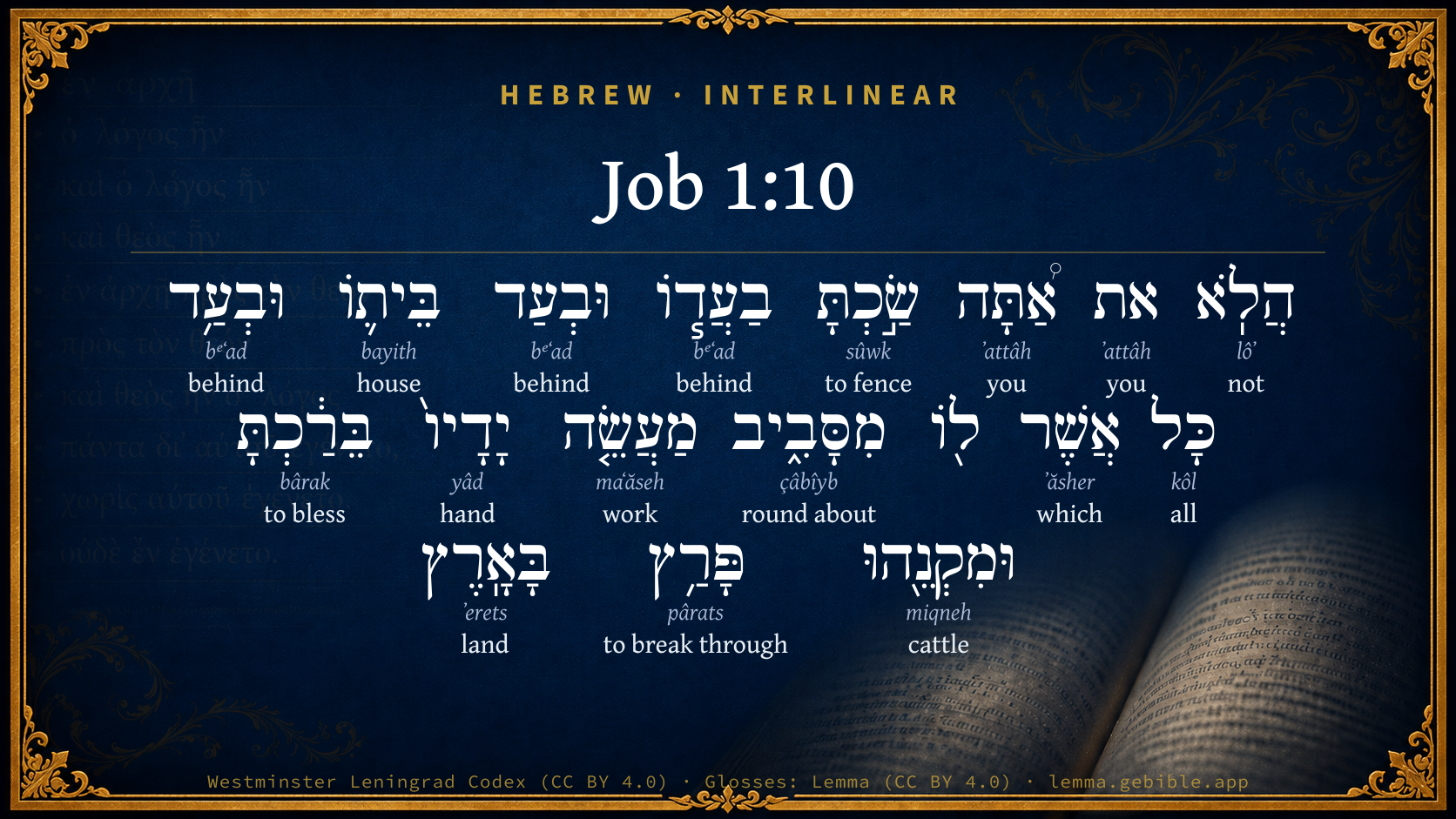
Hebrew (Westminster Leningrad Codex) Job 1:10 appears in the Hebrew Old Testament. The text above is from the Westminster Leningrad Codex. Each word links to its Strong’s number, a concise gloss, and parsing drawn from the Open Scriptures Hebrew Bible morphology. Click any word for its full Brown-Driver-Briggs (BDB) entry.
Download image
Cite this verse

Job 1:10 (World English Bible). Public Domain. Lemma interlinear Bible study tool, https://lemma.gebible.app/v/job/1/10.

Show BibTeX & RIS
BibTeX
RIS
English Translation
Haven't you made a hedge around him, and around his house, and around all that he has, on every side? You have blessed the work of his hands, and his substance is increased in the land.
World English Bible · Public Domain
Highlights
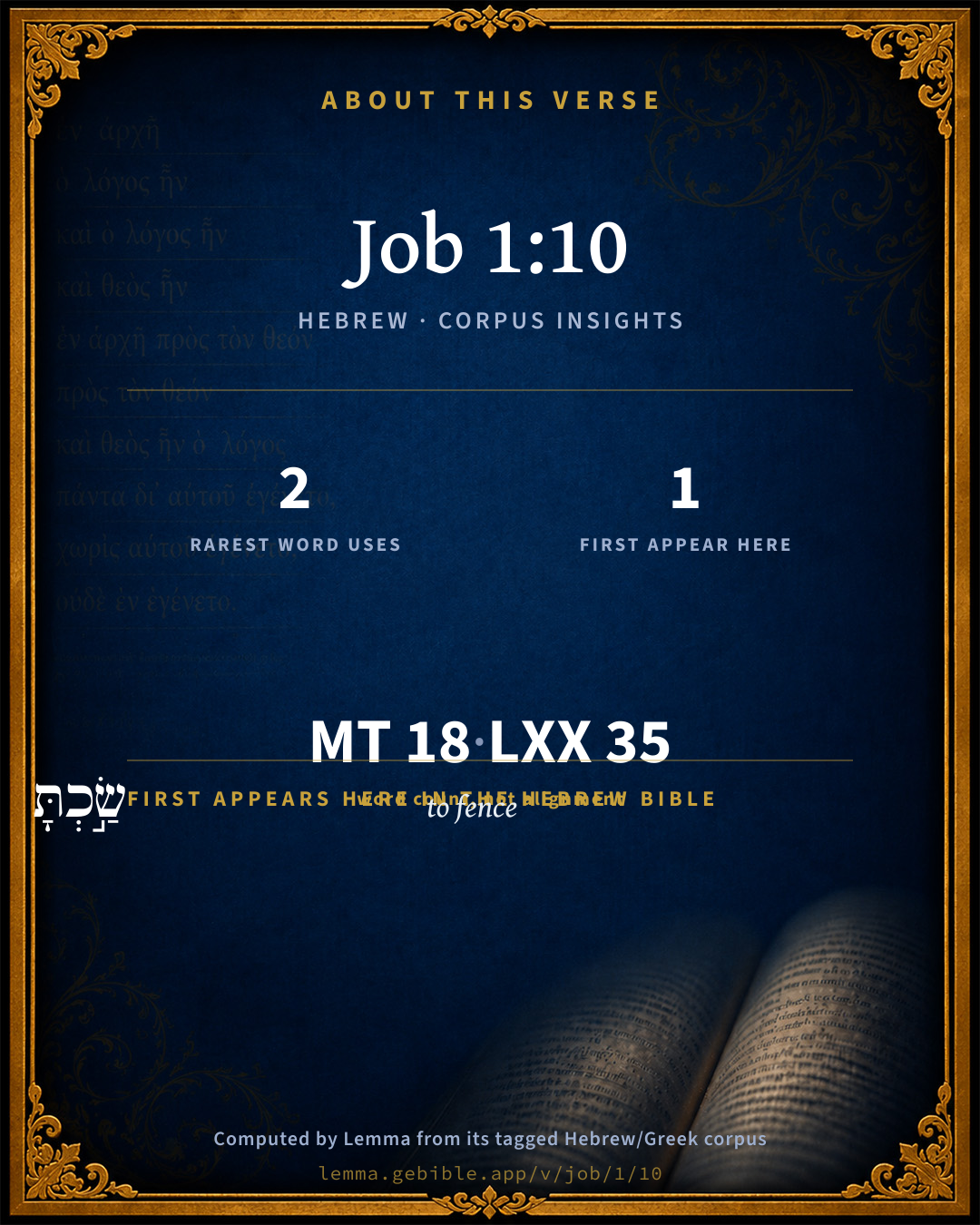
  • 1 first appearance in the Hebrew Bible
Full analysis ↓
Download a study sheet

One document with this verse’s original text, its word-by-word gloss line, the meaning frame, cross-references with their text, attributed commentary, and full source and license credits — printable, and it pastes into notes with its structure intact.

This verse Autodidact and up

Study sheet (.html) Plain text (.txt)

A passage Seminary Student

Up to 50 verses in one chapter. A passage sheet keeps up to 6 commentary sources and 12 cross-references per verse, in the order this page ranks them, and says so on the sheet whenever that leaves anything out. Ask for a single verse and you get the Autodidact verse sheet above.

Everything on this page stays free to read, with no account — the sheet is a download of what is already on screen, not access to it.

Want to remove ads? Support Godless Engineer
Compare translations 3

The same verse in 3 English versions, stacked beneath the original-language interlinear above. Click any original word for its lexicon entry.

Each is an independent rendering of the whole verse — the interlinear is not word-aligned to these translations.

Highlighted words mark where these versions differ — a whole-verse word diff, not a word-by-word alignment.

  • World English Bible Public Domain
    Haven't you made a hedge around him, and around his house, and around all that he has, on every side? You have blessed the work of his hands, and his substance is increased in the land.
  • King James Version Public Domain
    Hast not thou made an hedge about him, and about his house, and about all that he hath on every side? thou hast blessed the work of his hands, and his substance is increased in the land.
  • unfoldingWord Literal Text CC BY-SA 4.0
    Have you not put a hedge around him and around his house and around all that his, from every side? You have blessed the works of his hands, and his cattle have burst forth in the land.

unfoldingWord Literal Text — © unfoldingWord, licensed CC BY-SA 4.0. Word-aligned USFM3 via Door43 (git.door43.org/unfoldingWord/en_ult).

Versions to compare (up to 4)

3 of 4 selected

Show all 18 translations

Every available English version of this verse, each an independent rendering of the whole verse.

  • World English Bible Public Domain
    Haven't you made a hedge around him, and around his house, and around all that he has, on every side? You have blessed the work of his hands, and his substance is increased in the land.
  • Berean Standard Bible Public Domain
    Have You not placed a hedge on every side around him and his household and all that he owns? You have blessed the work of his hands, and his possessions have increased in the land.
  • Majority Standard Bible Public Domain
    Have You not placed a hedge on every side around him and his household and all that he owns? You have blessed the work of his hands, and his possessions have increased in the land.
  • King James Version Public Domain
    Hast not thou made an hedge about him, and about his house, and about all that he hath on every side? thou hast blessed the work of his hands, and his substance is increased in the land.
  • American Standard Version (1901) Public Domain
    Hast not thou made a hedge about him, and about his house, and about all that he hath, on every side? thou hast blessed the work of his hands, and his substance is increased in the land.
  • Revised Version (1885) Public Domain
    Hast not thou made an hedge about him, and about his house, and about all that he hath, on every side? thou hast blessed the work of his hands, and his substance is increased in the land.
  • Geneva Bible (1599) Public Domain
    Hast thou not made an hedge about him and about his house, and about all that he hath on euery side? thou hast blessed the worke of his hands, and his substance is increased in the land.
  • Douay-Rheims (1899) Public Domain
    Hast not thou made a fence for him, and his house, and all his substance round about, blessed the works of his hands, and his possession hath increased on the earth?
  • Young's Literal Translation Public Domain
    Hast not Thou made a hedge for him, and for his house, and for all that he hath -- round about?
  • Literal Standard Version CC BY-SA 4.0
    Have You not made a hedge for him, and for his house, and for all that he has—all around?
  • Unlocked Literal Bible CC BY-SA 4.0
    Have you not put a barrier around him, around his house, and around all that is his from every side? You have blessed the deeds of his hands, and his cattle have burst forth in the land.
  • unfoldingWord Literal Text CC BY-SA 4.0
    Have you not put a hedge around him and around his house and around all that his, from every side? You have blessed the works of his hands, and his cattle have burst forth in the land.
  • Darby Bible Public Domain
    Hast not thou made a hedge about him, and about his house, and about all that he hath on every side? Thou hast blessed the work of his hands, and his substance is spread abroad in the land.
  • World Messianic Bible Public Domain
    Haven’t you made a hedge around him, and around his house, and around all that he has, on every side? You have blessed the work of his hands, and his substance is increased in the land.
  • Webster's Bible Public Domain
    Hast not thou made a hedge about him, and about his house, and about all that he hath on every side? thou hast blessed the work of his hands, and his substance is increased in the land.
  • Free Bible Version CC BY-SA 4.0
    You have blessed everything he does. His flocks and herds have increased so much they fill the whole land!
  • Bible in Basic English Public Domain
    Have you yourself not put a wall round him and his house and all he has on every side, blessing the work of his hands, and increasing his cattle in the land?
  • JPS Tanakh (1917) Public Domain
    Hast not Thou made a hedge about him, and about his house, and about all that he hath, on every side? Thou hast blessed the work of his hands, and his possessions are increased in the land.

Literal Standard Version (2020), Covenant Press — licensed CC BY-SA 4.0. Text via the HelloAO Bible API (eBible.org). Unlocked Literal Bible (unfoldingWord) — licensed CC BY-SA 4.0. Text via the HelloAO Bible API (eBible.org). unfoldingWord Literal Text — © unfoldingWord, licensed CC BY-SA 4.0. Word-aligned USFM3 via Door43 (git.door43.org/unfoldingWord/en_ult). Free Bible Version, Dr. Jonathan Gallagher — licensed CC BY-SA 4.0. Text via the HelloAO Bible API (eBible.org).

Word by word

More ways to search: Search by grammar → Find every occurrence → Compare this word →

Practice this passage: Drill this verse → Learn its vocabulary →

שַׂ֣כְתָּ
sûwk
H7753
“to fence”
Verb, Qal, Perfect, 2nd Person, Masculine, Singular
Part of Speech
Verb
Stem
Qal
Form
Perfect
Person
2nd Person
Gender
Masculine
Number
Singular
Full BDB Definition

Origin: a primitive root

TWOT: 2241

to hedge or fence up or about - (Qal) to fence about, hedge up
  1. הֲלֹֽא lôʼ H3808 “not” Particle, Interrogative + Particle, Negative
  2. את ʼattâh H859 “you” Pronoun, Personal, 2nd Person, Masculine, Singular
  3. אַ֠תָּה ʼattâh H859 “you” Pronoun, Personal, 2nd Person, Masculine, Singular
  4. בַעֲד֧וֹ bᵉʻad H1157 “behind · him” Preposition + Suffix, Personal, 3rd Person, Masculine, Singular
  5. וּבְעַד bᵉʻad H1157 “and · behind” Conjunction + Preposition
  6. בֵּית֛וֹ bayith H1004 “house · his” Noun, Common, Masculine, Singular, Construct + Suffix, Personal, 3rd Person, Masculine, Singular
  7. וּבְעַ֥ד bᵉʻad H1157 “and · behind” Conjunction + Preposition
  8. כָּל kôl H3605 “all of” Noun, Common, Masculine, Singular, Construct
  9. אֲשֶׁר ʼăsher H834 “which” Particle, Relative
  10. מִסָּבִ֑יב çâbîyb H5439 “from · round about” Preposition + Noun, Common, Both, Singular, Absolute
  11. מַעֲשֵׂ֤ה maʻăseh H4639 “work of” Noun, Common, Masculine, Singular, Construct
  12. יָדָיו֙ yâd H3027 “hands · his” Noun, Common, Both, Dual, Construct + Suffix, Personal, 3rd Person, Masculine, Singular
  13. בֵּרַ֔כְתָּ bârak H1288 “to bless” Verb, Piel, Perfect, 2nd Person, Masculine, Singular
  14. וּמִקְנֵ֖הוּ miqneh H4735 “and · cattle · his” Conjunction + Noun, Common, Masculine, Singular, Construct + Suffix, Personal, 3rd Person, Masculine, Singular
  15. פָּרַ֥ץ pârats H6555 “to break through” Verb, Qal, Perfect, 3rd Person, Masculine, Singular
  16. בָּאָֽרֶץ ʼerets H776 “in/at the · land” Preposition, Determined + Noun, Common, Both, Singular, Absolute

About this verse

These counts appear in no published source. They are computed here, from the morphology-tagged text and Lemma’s own curated glosses. What Lemma adds →

18
words
14
distinct lemmas
Wisdom
section

Notable vocabulary

The rarest word here is שַׂ֣כְתָּ to fence H7753 — appearing just 2 times in the whole Hebrew Bible.

First appearance in Scripture

This word makes its first canonical appearance in the Hebrew Bible here:

  • שַׂ֣כְתָּ to fence H7753

Shared distinctive vocabulary

שַׂ֣כְתָּ to fence H7753 occurs in 2 verses of the Hebrew Bible. Also found in:

Grammatical profile

  • 3 verbs
  • 7 nouns
  • 2 pronouns
  • 4 prepositions
  • 2 particles

Verb forms

  • שַׂ֣כְתָּ Qal · Perfect
  • בֵּרַ֔כְתָּ Piel · Perfect
  • פָּרַ֥ץ Qal · Perfect

Repetition

Words recur within this verse — often emphatic in Hebrew:

  • בַעֲד֧וֹ behind H1157 ×3
  • את you H859 ×2

Hebrew & Septuagint length

In English translation the verse runs 36 words from the Hebrew and 35 from the Septuagint (LXX English) — closely comparable.

A rough comparison of the two English renderings, which tokenize alike — not a word-level alignment.

Word counts can differ between the Hebrew and the Greek without any difference in meaning — e.g. the Hebrew direct-object marker אֵת has no separate Greek word, and Greek often adds the article ὁ.

In the original languages it is 18 Hebrew tokens and 35 Greek tokens — but the two are counted differently (Hebrew bundles its prefixes and suffixes into one token; the Greek is in lemma form), so that isn’t a like-for-like length.

Cross-references

28

Topical passages linked to Job 1:10 in the Treasury of Scripture Knowledge — connected by theme and wording, ordered by reader-vote popularity; previews shown in the World English Bible.

  • Psalms 34:7 The angel of Yahweh encamps round about those who fear him, And delivers them.
  • Zechariah 2:5 For I,' says Yahweh, 'will be to her a wall of fire around it, and I will be the glory in the midst of her.
  • 1 Peter 1:5 who by the power of God are guarded through faith for a salvation ready to be revealed in the last time.
  • Deuteronomy 28:2–6 and all these blessings shall come on you, and overtake you, if you shall listen to the voice of Yahweh your God.
  • Proverbs 10:22 Yahweh's blessing brings wealth, And he adds no trouble to it.
  • Job 31:25 If I have rejoiced because my wealth was great, And because my hand had gotten much;
  • Zechariah 2:8 For thus says Yahweh of hosts: 'For honor he has sent me to the nations which plundered you; for he who touches you touches the apple of his eye.
  • Genesis 15:1 After these things the word of Yahweh came to Abram in a vision, saying, "Don't be afraid, Abram. I am your shield, your exceedingly great reward."
  • Psalms 107:38 He blesses them also, so that they are multiplied greatly. He doesn't allow their cattle to decrease.
  • Genesis 26:12 Isaac sowed in that land, and reaped in the same year one hundred times what he planted. Yahweh blessed him.
  • Deuteronomy 7:13 and he will love you, and bless you, and multiply you; he will also bless the fruit of your body and the fruit of your ground, your grain and your new wine and your oil, the increase of your cattle and the young of your flock, in the land which he swore to your fathers to give you.
  • Psalms 90:17 Let the favor of the Lord our God be on us; Establish the work of our hands for us; Yes, establish the work of our hands.
  • Isaiah 5:5 Now I will tell you what I will do to my vineyard. I will take away its hedge, and it will be eaten up. I will break down its wall of it, and it will be trampled down.
  • Genesis 30:43 The man increased exceedingly, and had large flocks, maid-servants and men-servants, and camels and donkeys.
  • Deuteronomy 33:27 The eternal God is [your] dwelling-place, Underneath are the everlasting arms. He thrust out the enemy from before you, Said, Destroy.
  • 1 Samuel 25:16 they were a wall to us both by night and by day, all the while we were with them keeping the sheep.
  • Job 42:12 So Yahweh blessed the latter end of Job more than his beginning. He had fourteen thousand sheep, six thousand camels, one thousand yoke of oxen, and a thousand female donkeys.
  • Isaiah 5:2 He dug it up, Gathered out its stones, Planted it with the choicest vine, Built a tower in its midst, And also cut out a winepress therein. He looked for it to yield grapes, But it yielded wild grapes.
  • Genesis 30:30 For it was little which you had before I came, and it has increased to a multitude. Yahweh has blessed you wherever I turned. Now when will I provide for my own house also?"
  • Genesis 49:25 Even by the God of your father, who will help you, By the Almighty, who will bless you, With blessings of heaven above, Blessings of the deep that lies below, Blessings of the breasts, and of the womb.
  • Psalms 71:21 Increase my honor, And comfort me again.
  • Psalms 128:1–4 Blessed is everyone who fears Yahweh, Who walks in his ways.
  • Genesis 39:5 It happened from the time that he made him overseer in his house, and over all that he had, that Yahweh blessed the Egyptian's house for Joseph's sake; and the blessing of Yahweh was on all that he had, in the house and in the field.
  • Deuteronomy 33:11 Bless, Yahweh, his substance, Accept the work of his hands: Smite through the loins of those who rise up against him, Of those who hate him, that they not rise again.
  • Job 29:6 When my steps were washed with butter, And the rock poured out streams of oil for me!
  • Psalms 5:12 For you will bless the righteous. Yahweh, you will surround him with favor as with a shield.
  • Job 1:3 His possessions also were seven thousand sheep, three thousand camels, five hundred yoke of oxen, five hundred she-donkeys, and a very great household; so that this man was the greatest of all the children of the east.
  • Psalms 80:12 Why have you broken down its walls, So that all those who pass by the way pluck it?

Cross-references courtesy of OpenBible.info (CC BY 4.0).

Hebrew and Greek witnesses Masoretic Hebrew ↔ Greek Septuagint

The same verse in the two great witnesses to the Old Testament, shown verse-for-verse.

These are two independent witnesses, not word-aligned to each other, and the Septuagint is shown in lemma (dictionary) form.

Hebrew Job 1:10 Masoretic · Westminster Leningrad Codex

הֲלֹֽא את אַ֠תָּה שַׂ֣כְתָּ בַעֲד֧וֹ וּבְעַד בֵּית֛וֹ וּבְעַ֥ד כָּל אֲשֶׁר ל֖וֹ מִסָּבִ֑יב מַעֲשֵׂ֤ה יָדָיו֙ בֵּרַ֔כְתָּ וּמִקְנֵ֖הוּ פָּרַ֥ץ בָּאָֽרֶץ

Haven't you made a hedge around him, and around his house, and around all that he has, on every side? You have blessed the work of his hands, and his substance is increased in the land.

World English Bible · Public Domain

Greek LXX Job 1:10 Septuagint · lemma form

οὐ σύ περιφράσσω ὁ ἔξω αὐτός καί ὁ ἔσω ὁ οἰκία αὐτός καί ὁ ἔξω πᾶς ὁ εἰμί αὐτός κύκλος ὁ ἔργον ὁ χείρ αὐτός εὐλογέω καί ὁ κτῆνος αὐτός πολύς ποιέω ἐπί ὁ γῆ

Have you not made a hedge about him, and about his household, and all his possessions round about? and have you not blessed the works of his hands, and multiplied his cattle upon the land?

LXX2012 (modern English Septuagint) · Public Domain

On this verse, Albert Barnes' Notes on the Bible discusses the Septuagint’s reading. Read the note in Commentary ↓

Hebrew: Westminster Leningrad Codex (CC BY 4.0). Greek: Septuagint (public domain); English from LXX2012 (modern English Septuagint) (Public Domain). How the Septuagint differs from the Hebrew →

Commentary

Notes on Job 1:10 from classic Christian and Jewish commentators (each source and its license shown beneath its notes). The classic Christian expositions comment on the surrounding passage and are grouped to its opening verse, so a note may address several verses; the Jewish commentaries on the Tanakh (Rashi and others) are per-verse, so they appear only where the commentator wrote on this verse.

Lemma curates 59 commentaries, every one of them public domain or Creative Commons licensed, each selected and text-cleaned for this edition rather than reprinted as found. About our sources →

Trapp's Complete Commentary

John Trapp

Job 1:10 Hast not thou made an hedge about him, and about his house, and about all that he hath on every side? thou hast blessed the work of his hands, and his substance is increased in the land.

Ver. 10. Hast not thou made an hedge about him?] Or, hast thou not trenched him in, and secured him with thine own bare hand, as in a town of war, or tower of brass? thou thyself either art the hedge, or makest it; and that not only about his person, but about his people, children, servants, &c., yea, about his whole estate, so that there is no coming at him: and this Satan seems to speak very angrily. {See Trapp on "Zec 2:5"}

On every side] Per circuitum, circumcirca. The devil could find never a gap, make never a breach. Oh the safety of a saint, that goes always under a double guard, the power of God without him, and the peace of God within him! The Lord himself is his keeper, the Lord his defence upon his right hand, Psa 121:5 Psa 91:1-16; How miraculously hath Geneva been upheld, a small city environed with enemies, and barred out from help of other Churches! How well may we sit and sing, If the Lord had not been on our side, now may England say, if the Lord had not been on our side, when men (or rather devils in the shape of men) rose up against us, then had they swallowed us up quick, when their wrath was kindled against us, Psa 124:1-2. They were not our wooden walls that saved us, &c., but thy right hand, and thine arm, and the light of thy countenance, because thou hadst a favour unto us, Psa 44:3. This was a better wall than that about China or Babylon, or that which David so soon leaped over by the help of his God, Psa 18:1-50, who is sic omnibus attentus ut non detentus a singulis, so helpful to the whole community of his people, as that he neglecteth not any one that pertaineth unto him.

Thou hast blessed the work of his hands] So that he hath good success in all his business, all things thrive well under his hand; this the devil stomached; and, because he could not come at Job’s heart, fed upon his own. Malice drinketh up the most part of its own venom. It pleaseth the Lord well that his people prosper, but the devil cannot endure it. Well might Austin say, Invidia est vitium diabolicum, envy is a devilish sin, for it transformeth men into so many breathing devils.

And his substance is increased in the land] Heb. Is broken forth; so that his house is too little to hold the precious and pleasant riches that are therein; his grounds cannot contain the increase of his cattle; ruperunt herrea messes. his barns overflow at harvest time. In fine, there is no end of his wealth.

John Trapp, A Commentary or Exposition upon All the Books of the Old and New Testament (1647–1656) — public domain. Text from a community e-Sword module.

The Biblical Illustrator

Joseph S. Exell

Job_1:10

Hast not Thou made an hedge about him?

Hedges

(To children):--Satan held that Job was such a good man just because God took such special care of him. Now, Satan very often says that of good men; and some of us have been guilty of repeating it. We are so apt to think that God has made It hedge to protect other lives far more than our own, and that the best people are as good as they are because of some special protection which God has granted them. The word hedge denotes that which protects or guards. Why does the farmer raise a hedge all round his field? And God does this. He seeks to protect all our lives. There is many a hedge that we have hardly ever noticed, and certainly have never properly valued. God has given some of us a hedge in the example and teaching of good and pious parents; in the influence of good teachers; in the form of good companionships; in the discipline we have to undergo in the home, in the school, and in life. Sometimes a schoolmasters cane is a very useful hedge. A hedge not only shelters, it often keeps us from wandering. Sometimes we do not like hedges; we should like to see more of the country, and wander at will. Gods way of hedging us in is not always by sending us blessings which we are pleased to accept, but sometimes by sending us sorrow and trial. He thus keeps us in our places, guards us against going astray. That was the kind of hedge that Job did not like. The farmer sometimes plants thorns in his hedges, and we must not be surprised if God does. After all, a hedge may become a very lovely thing. What would the landscape often be without hedges? God makes the hedges along the country full of beauty, poetry, and song. And in our lives here, this is just what the Lord Jesus has done. The old Law of Moses was like a stone hedge. The hedges of the Lord Jesus are like our quick-set hedges. He makes His commandments sweet and welcome, and the ways of His testimonies full of delight. It is the love of Christ constrains us, and that is always a sweet constraint. (David Davies.)

God protects His people

1. That the protection God gives to His people and servants is the vexation of Satan, and of all his instruments.

2. That Satan, the father of lies, sometimes speaks truth for his own advantage.

3. That the people and servants of God dwell in the midst of enemies, in the midst of dangers.

4. That God Himself doth undertake the guarding and protecting of His people.

5. You see how far the hedge goeth, not only about his person and household, but about all that he hath. His meanest thing was hedged about. (J. Caryl.)

Thou hast blessed the work of his hands.

Success the outcome of the Divine blessing

1. That all success in business is from the blessing of the Lord. Satan speaks very good Divinity here; Thou hast blessed: it is from the Lord (Gen_39:23). That whatsoever he did, the Lord made it to prosper. Working is our part, but prospering is the Lords part. Some take all to themselves, and thank their own labours, their own wisdom, policy, and parts; others ascribe all to their good fortune, etc. We see Satan himself here preacheth a truth that will confute them.

2. Everyone ought to be a man of employment. Everyone ought to have some business to turn his hand. God doth not love to bless those that are idle.

3. That the Lord delighteth to bless those who are industrious. It is seldom that there is an industrious hand, but there is a blessing of God upon it. Hence, as we find in one place, the diligent hand maketh rich (Pro_10:4; Pro_10:22).

4. The blessing of God where it falleth is effectual. If God doth but bless we shall increase, there is no question of it. Blessing and multiplying go together. The blessing of God is a powerful blessing. (J. Caryl.)

The Biblical Illustrator, edited by Joseph S. Exell (c. 1880s–1900s) — public domain. Text from a community e-Sword module.

Joseph Benson's Commentary

Job 1:10. Hast thou not made a hedge about him? — Protected him with a thorny and inaccessible defence, or secured him, by thy special care and providence, from all harm and inconveniences? which is sufficient to oblige and win persons of the worst tempers; and about his house — His children and servants; about all that he hath on every side — His whole property, which is all under thy protection. Thou hast blessed the work of his hands — Hast caused whatever he does to prosper. Observe, reader, without the divine blessing, be the hands ever so strong, ever so skilful, their work will not prosper. And his substance is increased in the land — The original word מקנהו, mickneehu, chiefly means his cattle; and the word פרצ, parets, here rendered increased, is a metaphor taken from waters which have burst their bounds, and spread themselves on all sides round; so Job’s substance had largely increased, and spread itself like a flowing torrent over the adjacent land. — Schultens.

Joseph Benson's Commentary on the Old and New Testaments (1811–1818) — public domain. Text from a community e-Sword module.

Tyndale Open Study Notes

Tyndale Open Resources

1:10 wall of protection: See 1 Sam 25:16; Pss 5:12; 34:7; Zech 2:5; cp. Isa 5:5.

Tyndale Open Study Notes — © Tyndale Open Resources, licensed CC BY-SA 4.0. Text via the HelloAO Bible API.

Geneva Bible (1599)

Geneva Bible translators

Meaning, the grace of God, which served Job as a rampart against all tentations.

Geneva Bible (1599) marginal notes — public domain. Text via Bolls.life.

Jamieson, Fausset & Brown

Robert Jamieson, A. R. Fausset & David Brown

his substance is increased--literally, "spread out like a flood"; Job's herds covered the face of the country.

Jamieson, Fausset & Brown — Commentary Critical and Explanatory on the Whole Bible (1871) — public domain (CC PDM 1.0). Text via the HelloAO Bible API.

Adam Clarke's Commentary

Verse 10. Hast not thou made a hedge about him] Thou hast fortified him with spikes and spears. Thou hast defended him as by an unapproachable hedge. He is an object of thy peculiar care; and is not exposed to the common trials of life.

Adam Clarke's Commentary on the Bible (1810–1826) — public domain. Text from a community e-Sword/MySword module.

John Gill's Exposition

Hast not thou made an hedge about him,.... A fence, a wall of protection all around him? he had; he encompassed him about with his love as with a shield, a hedge which could not be broken down by men or devils; he surrounded him with his almighty power, that none could hurt him; he guarded him by his providence, he caused his angels to encamp about him; yea, he himself was a wall of fire around him; the Targum interprets it the word of God: so thick was the hedge, so strong the fence, that Satan could not find the least gap to get in at, to do him any injury to his body or mind, without the divine permission; which he envied and was vexed at, and maliciously suggests that this was the motive of Job's fear of the Lord; and indeed it was an obligation upon him to fear him, but not the sole cause of it:

and about his house; not the house in which he dwelt; though Satan could have gladly pulled down that about his ears, as well as that in which his children were; but it designs his family, who were also by Providence protected in their persons and estates, and preserved from the temptations of Satan, at least from being overcome by them, and even at the times of their feasting before mentioned; this fence was about his servants also, so that Satan could not come at and hurt any one that belonged to him, which was a great grief and vexation of mind to him:

and about all that he hath on every side? his sheep, his camels, his oxen, and his asses; for otherwise these would not have escaped the malice and fury of this evil spirit they afterwards felt; but as these were the gifts of the providence of God to Job, they were guarded by his power, that Satan could not hurt them without leave:

thou hast blessed the work of his hands; not only what he himself personally wrought with his own hands, but was done by his servants through his direction, and by his order; the culture of his fields, the feeding and keeping of his flocks and herds; all succeeded well; whatever he did, or was concerned in, prospered:

and his substance is increased in the land; or "broke out" (t); like a breach of waters; see Sa2 5:20; exceeded all bounds; his riches broke forth on the right hand and on the left, and flowed in, so that there were scarce any limits to be set to them; he abounded in them; his sheep brought forth thousands; his oxen, camels, and asses, stood well, and were strong to labour; and his wealth poured in upon him in great plenty; all which was an eyesore to Satan, and therefore would insinuate that this was the sole spring and source of Job's religion, devotion, and obedience.

(t) "erupit", Montanus, Piscator; "eruperit", Junius & Tremellius; "prorupit", Schultens,

John Gill's Exposition of the Whole Bible (1746–1763) — public domain (CC PDM 1.0). Text via the HelloAO Bible API.

Albert Barnes' Notes on the Bible

Hast thou not made an hedge about him? - Dr. Good remarks, that to give the original word here its full force, it should be derived from the science of engineering, and be rendered, “Hast thou not raised a “palisado” about him?” The Hebrew word used here (שׂוּך śûk) properly means “to hedge”; to hedge in or about; and hence, to protect, as one is defended whose house or farm is hedged in either with a fence of thorns, or with an enclosure of stakes or palisades. The word in its various forms is used to denote, as a noun, “pricks in the eyes” Num 33:55; that is, that which would be like thorns; “barbed irons” Job 41:7, that is, the barbed iron used as a spear to take fish; and a hedge, and thorn hedge, Mic 7:4; Pro 15:19; Isa 5:5. The idea here is, that of making an enclosure around Job and his possessions to guard them from danger. The Septuagint renders it περιέφραξας periephracas, to make a defense around,” to “circumvallate” or inclose, as a camp is in war. In the Syriac and Arabic it is rendered, “Hast thou not protected him with thy hand? The Chaldee, “Hast thou protected him with thy word? The Septuagint renders the whole passage, “Hast thou not encircled the things which are without him” (τὰ ἔξω αὐτοῦ ta exō autou) that is, the things abroad which belong to him, “and the things within his house.” The sense of the whole passage is, that he was eminently under the divine protection, and that God had kept himself, his family, and property from plunderers, and that therefore he served and feared him.

Thou hast blessed the work of his hands - Thou hast greatly prospered him.

And his substance is increased in the land - His property, Job 1:3. Margin, “cattle.” The word “increased” here by no means expresses the force of the original. The word פרץ pârats means properly to break, to rend, then to break or burst forth as waters do that have been pent up; 2Sa 5:20, compare Pro 3:10, “So shall thy barns be filled with plenty, and thy presses “shall burst out” פרץ pârats with new wine;” that is, thy wine-fats shall be so full that they shall overflow, or “burst” the barriers, and the wine shall flow out in abundance. The Arabians, according to Schultens, employ this word still to denote the mouth or “embouchure” - the most; rapid part of a stream. So Golius, in proof of this, quotes from the Arabic writer Gjanhari, a couplet where the word is used to denote the mouth of the Euphrates:

“His rushing wealth o’er flowed him with its heaps;

So at its mouth the mad Euphrates sweeps.”

According to Sehultens, the word denotes a place where a river bursts forth, and makes a new way by rending the hills and rocks asunder. In like manner the flocks and herds of Job had burst, as it were, every barrier, and had spread like an inundation over the land; compare Gen 30:43; 2Ch 31:5; Exo 1:7; Job 16:14.

Albert Barnes' Notes on the Bible (1834–1885) — public domain. Text from a community e-Sword/MySword module.

Matthew Poole's English Annotations

Made a hedge about him, i.e. defended him by thy special care and providence from all harms and inconveniencies; which is able to oblige and win persons of the worst tempers.

His house; his children and servants.

Matthew Poole's English Annotations on the Holy Bible (1683–1685) — public domain. Text from a community e-Sword/MySword module.

Whedon's Commentary on the Bible

Daniel D. Whedon

10. Hast not thou — (את, thou, the very one whom Job fears) — made a hedge about him — The Chaldee paraphrases it: “Hast thou not covered him with thy word?” In his mind Satan sees a field or garden surrounded with a hedge as a protection against wild beasts. According to Thomson, (Land and Book, 1:299,) the stone walls which surround the sheepfolds of modern Palestine are frequently covered with sharp thorns. (Hos_2:6.) The fence was threefold — first, around Job himself; then another, an exterior hedge, around his house; and a third protection or fence around all that he possessed, somewhat after the manner of fortifying ancient cities. Such, Satan unwittingly says, is God’s mode of protecting those who are his.

Thou hast blessed — Wordsworth remarks: “Even Satan confesses that God’s benediction is the source of all good to man.”

Is increased — פרצsignifies to break through bounds. Not unlike a swollen stream, his herds had covered the land, (better, the earth,) thus showing the greatness of his possessions. The Arabs at the present day employ this word to express the mouth of a stream.

Daniel D. Whedon (gen. ed.), Commentary on the Old and New Testaments (1874–1909) — public domain. Text from a community e-Sword module.

The Pulpit Commentary

Hast not thou made a hedge about him? i.e. "hedged him around, protected him, made a sort of invisible fence about him, through which no evil could creep." This was undoubtedly true. God had so protected him. But the question was not as to this fact, but as to Job"s motive. Was it mere prudence? tile desire to secure a continuance of this protection? And about his house; i.e. "his family his sons and daughters the members of his household. And about all that he hath on every side. His possessions land, houses, cattle, live stock of all kinds, furniture, goods and chattels. Thou hast blessed the work of his hands. (comp. Psa_1:3, where it is said of the righteous man. that "whatsoever he doeth, it shall prosper So it was with Job. God"s blessing was upon him, and success crowned all his enterprises. "The work of his hands" will include everything that he attempted. And his substance is increased in the land. In the former clause we have the cause, God"s blessing; in the latter the effect, a great increase in Job"s "substance," or "cattle" (marginal reading). (On the final number of his cattle, see ver. 3.)

The Pulpit Commentary (1880–1919), ed. H.D.M. Spence-Jones & Joseph S. Exell — public domain. Text from a community e-Sword module.

Rashi

Rabbi Shlomo Yitzchaki (Rashi)

Haven’t You made a hedge around him Because he knows that You visit him frequently to perform miracles for him, and he is fruitful and multiplies; therefore he performs all these righteous deeds—but You have not tested him.

made a hedge around him You protected him like a wall, as in (Isa. 5:5) “I will remove its hedge (משוכתו),” its wall. Every expression of בעד stated in the Hebrew language is only an expression of “opposite and before him,” as in (Lev.16:6), “and he shall effect atonement for himself (וכפר בעדו),” he shall wipe away the sin from opposite you and before you (sic), so that the atonement shall be a shield about you. Similarly (Ps. 3:4), “[But You,] O Lord, are a shield about me (בעדי).”

spread out in the land Heb. פרץ, gained strength, as in (Exod. 1:12), “So would they gain strength (יפרץ), which the Targum renders: And so would they become strong. This is its simple meaning, but our Sages of blessed memory stated in the Aggadah (Baba Bathra 15b, 16a) that they broke the fence of the world, for the goats would slay the wolves.

Rashi on the Tanakh — English translations: “The Judaica Press complete Tanach with Rashi, translated by A. J. Rosenberg” (CC BY 4.0); “Pentateuch with Rashi's commentary by M. Rosenbaum and A.M. Silbermann, 1929-1934” (public domain); “The Metsudah Tanach series, Lakewood, N.J” (CC BY 4.0); and “The Book of Joshua, Metsudah Publications, 1997” (CC BY 4.0). Text via Sefaria.

Lesson kit

Teaching starters — assembled from the data on this page, not authored interpretation. Every prompt links to the verse data it draws on. Edit before teaching.

Job, in the Wisdom, opens this verse with 18 words (14 distinct Hebrew lemmas). Its most distinctive word is sûwk (“to fence”). A historical commentator’s framing appears above. Read the whole chapter for the surrounding context.

Discussion questions

  1. What does “to fence” (sûwk) contribute to the verse as a whole?
  2. This is the first place “to fence” appears in Scripture (first appears here). What does its debut here establish?
  3. How does Hosea 2:6, which shares the word «to fence», read alongside this verse?
  4. What does the repetition of “behind” (3× in this one verse) do in this verse?
  5. The translations on this page render this verse differently — a whole-verse word diff, not a word-by-word alignment. What might account for the different wordings?
  6. «שַׂ֣כְתָּ» is a Qal Perfect verb. How does that grammatical form shape the action described?
  7. Compare how Trapp's Complete Commentary and The Biblical Illustrator read this verse. Where do they agree or differ?

Things to notice

Reading settings

Reading text

Shown beneath each verse's original-language words.

Old Testament
Old Testament edition

Read the OT as the Masoretic Hebrew (MT) or the Greek Septuagint (LXX).

English shown for the Greek Septuagint (in the Hebrew ↔ Greek comparison).

Comparing translations? Open the Compare panel on any verse page to stack up to four side by side.