
Joshua 14:13

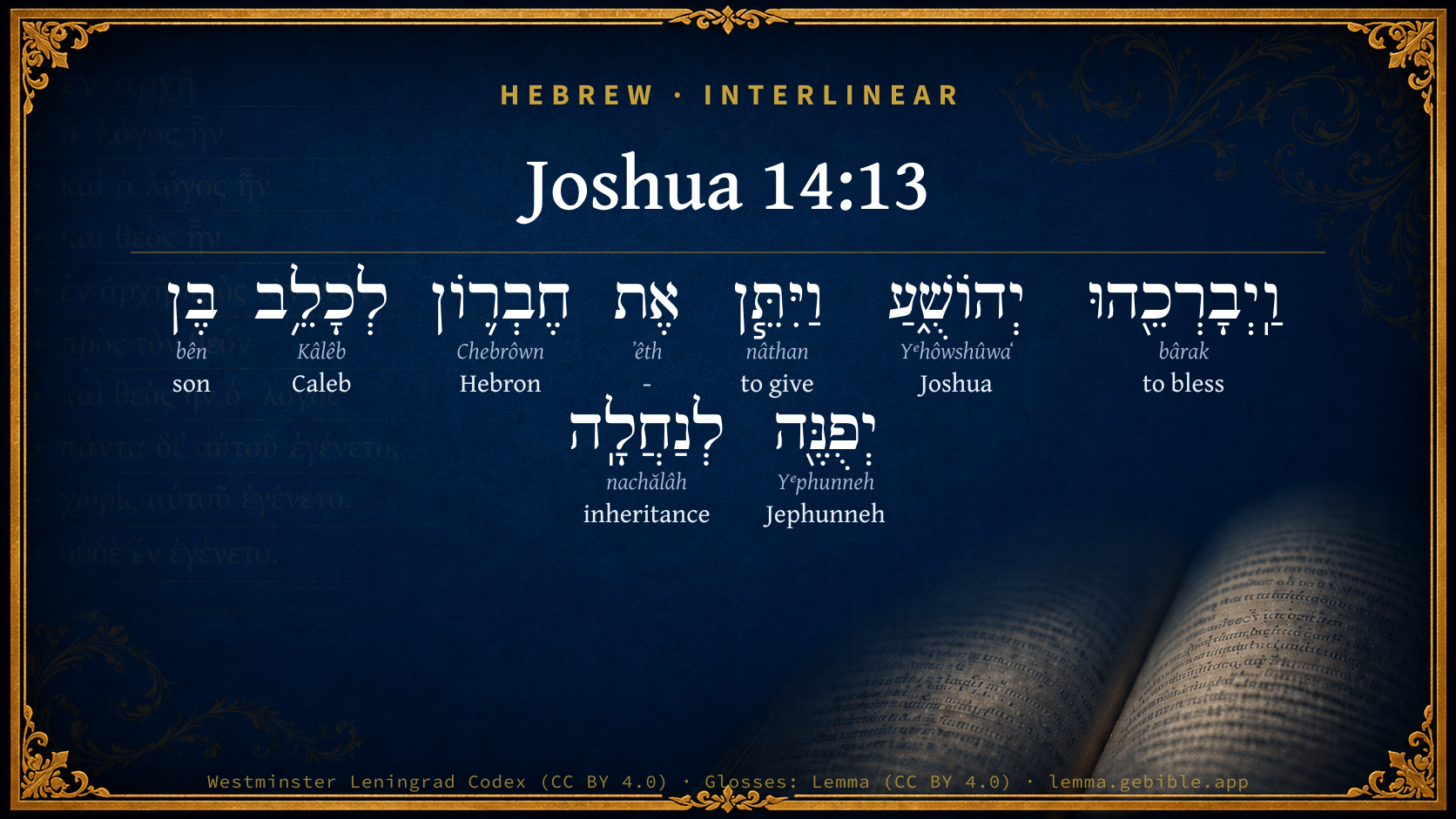
Hebrew (Westminster Leningrad Codex) Joshua 14:13 appears in the Hebrew Old Testament. The text above is from the Westminster Leningrad Codex. Each word links to its Strong’s number, a concise gloss, and parsing drawn from the Open Scriptures Hebrew Bible morphology. Click any word for its full Brown-Driver-Briggs (BDB) entry.
Download image
Cite this verse

Joshua 14:13 (World English Bible). Public Domain. Lemma interlinear Bible study tool, https://lemma.gebible.app/v/joshua/14/13.

Show BibTeX & RIS
BibTeX
RIS
English Translation
Joshua blessed him; and he gave Hebron to Caleb the son of Jephunneh for an inheritance.
World English Bible · Public Domain
Download a study sheet

One document with this verse’s original text, its word-by-word gloss line, the meaning frame, cross-references with their text, attributed commentary, and full source and license credits — printable, and it pastes into notes with its structure intact.

This verse Autodidact and up

Study sheet (.html) Plain text (.txt)

A passage Seminary Student

Up to 50 verses in one chapter. A passage sheet keeps up to 6 commentary sources and 12 cross-references per verse, in the order this page ranks them, and says so on the sheet whenever that leaves anything out. Ask for a single verse and you get the Autodidact verse sheet above.

Everything on this page stays free to read, with no account — the sheet is a download of what is already on screen, not access to it.

Want to remove ads? Support Godless Engineer
Compare translations 3

The same verse in 3 English versions, stacked beneath the original-language interlinear above. Click any original word for its lexicon entry.

Each is an independent rendering of the whole verse — the interlinear is not word-aligned to these translations.

Highlighted words mark where these versions differ — a whole-verse word diff, not a word-by-word alignment.

  • World English Bible Public Domain
    Joshua blessed him; and he gave Hebron to Caleb the son of Jephunneh for an inheritance.
  • King James Version Public Domain
    And Joshua blessed him, and gave unto Caleb the son of Jephunneh Hebron for an inheritance.
  • unfoldingWord Literal Text CC BY-SA 4.0
    And Joshua blessed him, and he gave Hebron to Caleb, the son of Jephunneh, for an inheritance.

unfoldingWord Literal Text — © unfoldingWord, licensed CC BY-SA 4.0. Word-aligned USFM3 via Door43 (git.door43.org/unfoldingWord/en_ult).

Versions to compare (up to 4)

3 of 4 selected

Show all 18 translations

Every available English version of this verse, each an independent rendering of the whole verse.

  • World English Bible Public Domain
    Joshua blessed him; and he gave Hebron to Caleb the son of Jephunneh for an inheritance.
  • Berean Standard Bible Public Domain
    Then Joshua blessed Caleb son of Jephunneh and gave him Hebron as his inheritance.
  • Majority Standard Bible Public Domain
    Then Joshua blessed Caleb son of Jephunneh and gave him Hebron as his inheritance.
  • King James Version Public Domain
    And Joshua blessed him, and gave unto Caleb the son of Jephunneh Hebron for an inheritance.
  • American Standard Version (1901) Public Domain
    And Joshua blessed him; and he gave Hebron unto Caleb the son of Jephunneh for an inheritance.
  • Revised Version (1885) Public Domain
    And Joshua blessed him; and he gave Hebron unto Caleb the son of Jephunneh for an inheritance.
  • Geneva Bible (1599) Public Domain
    Then Ioshua blessed him, and gaue vnto Caleb the sonne of Iephunneh, Hebron for an inheritance.
  • Douay-Rheims (1899) Public Domain
    And Josue blessed him, and gave him Hebron in possession.
  • Young's Literal Translation Public Domain
    And Joshua blesseth him, and giveth Hebron to Caleb son of Jephunneh for an inheritance,
  • Literal Standard Version CC BY-SA 4.0
    And Joshua blesses him, and gives Hebron to Caleb son of Jephunneh for an inheritance,
  • Unlocked Literal Bible CC BY-SA 4.0
    Then Joshua blessed him and gave Hebron as an inheritance to Caleb son of Jephunneh.
  • unfoldingWord Literal Text CC BY-SA 4.0
    And Joshua blessed him, and he gave Hebron to Caleb, the son of Jephunneh, for an inheritance.
  • Darby Bible Public Domain
    And Joshua blessed him, and gave Hebron to Caleb the son of Jephunneh for an inheritance.
  • World Messianic Bible Public Domain
    Joshua blessed him; and he gave Hebron to Caleb the son of Jephunneh for an inheritance.
  • Webster's Bible Public Domain
    And Joshua blessed him, and gave to Caleb the son of Jephunneh Hebron for an inheritance.
  • Free Bible Version CC BY-SA 4.0
    So Joshua blessed Caleb and granted him ownership of Hebron.
  • Bible in Basic English Public Domain
    And Joshua gave him his blessing; and he gave Hebron to Caleb, the son of Jephunneh, for his heritage.
  • JPS Tanakh (1917) Public Domain
    And Joshua blessed him; and he gave Hebron unto Caleb the son of Jephunneh for an inheritance.

Literal Standard Version (2020), Covenant Press — licensed CC BY-SA 4.0. Text via the HelloAO Bible API (eBible.org). Unlocked Literal Bible (unfoldingWord) — licensed CC BY-SA 4.0. Text via the HelloAO Bible API (eBible.org). unfoldingWord Literal Text — © unfoldingWord, licensed CC BY-SA 4.0. Word-aligned USFM3 via Door43 (git.door43.org/unfoldingWord/en_ult). Free Bible Version, Dr. Jonathan Gallagher — licensed CC BY-SA 4.0. Text via the HelloAO Bible API (eBible.org).

Word by word

More ways to search: Search by grammar → Find every occurrence → Compare this word →

Practice this passage: Drill this verse → Learn its vocabulary →

About this verse

These counts appear in no published source. They are computed here, from the morphology-tagged text and Lemma’s own curated glosses. What Lemma adds →

9
words
9
distinct lemmas
Historical
section

Notable vocabulary

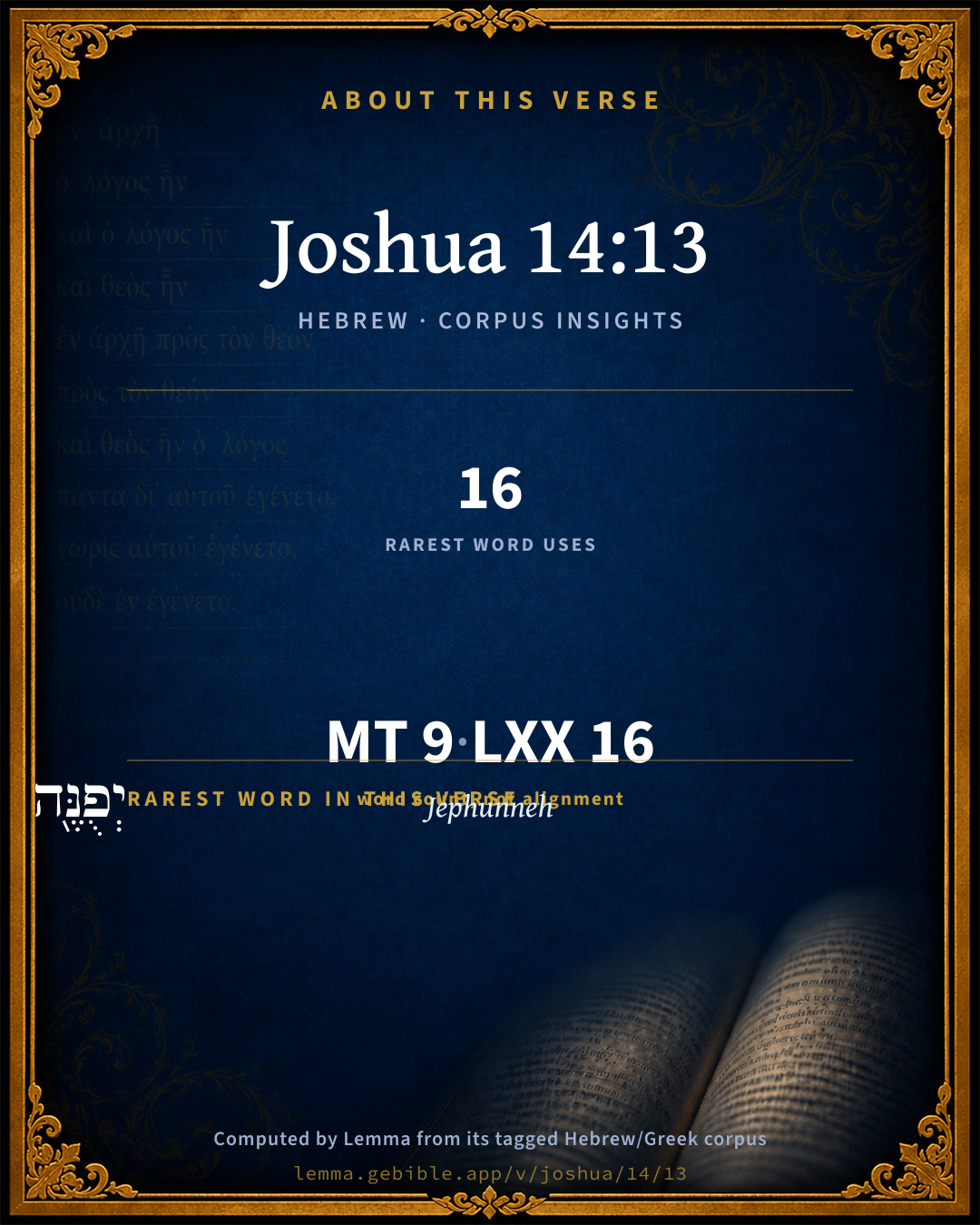
The rarest word here is יְפֻנֶּ֖ה Jephunneh H3312 — appearing just 16 times in the whole Hebrew Bible.

Shared distinctive vocabulary

יְפֻנֶּ֖ה Jephunneh H3312 occurs in 16 verses of the Hebrew Bible. Also found in:

Grammatical profile

  • 2 verbs
  • 6 nouns
  • 1 particle

Verb forms

  • וַֽיְבָרְכֵ֖הוּ Piel · Sequential Imperfect
  • וַיִּתֵּ֧ן Qal · Sequential Imperfect

Hebrew & Septuagint length

In English translation the verse runs 16 words from the Hebrew and 20 from the Septuagint (LXX English) — closely comparable.

A rough comparison of the two English renderings, which tokenize alike — not a word-level alignment.

Word counts can differ between the Hebrew and the Greek without any difference in meaning — e.g. the Hebrew direct-object marker אֵת has no separate Greek word, and Greek often adds the article ὁ.

In the original languages it is 9 Hebrew tokens and 16 Greek tokens — but the two are counted differently (Hebrew bundles its prefixes and suffixes into one token; the Greek is in lemma form), so that isn’t a like-for-like length.

Cross-references

10

Topical passages linked to Joshua 14:13 in the Treasury of Scripture Knowledge — connected by theme and wording, ordered by reader-vote popularity; previews shown in the World English Bible.

  • Judges 1:20 They gave Hebron to Caleb, as Moses had spoken: and he drove out there the three sons of Anak.
  • Joshua 22:6 So Joshua blessed them, and sent them away; and they went to their tents.
  • 1 Chronicles 6:55–56 to them they gave Hebron in the land of Judah, and the suburbs of it round about it;
  • Joshua 10:36–37 Joshua went up from Eglon, and all Israel with him, to Hebron; and they fought against it:
  • Joshua 15:13 To Caleb the son of Jephunneh he gave a portion among the children of Judah, according to the commandment of Yahweh to Joshua, even Kiriath Arba, [which Arba was] the father of Anak (the same is Hebron).
  • Joshua 21:11–12 They gave them Kiriath Arba, [which Arba was] the father of Anak (the same is Hebron), in the hill-country of Judah, with the suburbs of it round about it.
  • Genesis 47:7 Joseph brought in Jacob, his father, and set him before Pharaoh, and Jacob blessed Pharaoh.
  • Genesis 47:10 Jacob blessed Pharaoh, and went out from the presence of Pharaoh.
  • 1 Samuel 1:17 Then Eli answered, Go in peace; and the God of Israel grant your petition that you have asked of him.
  • Song of Solomon 6:9 My dove, my perfect one, is unique. She is her mother's only daughter. She is the favorite one of her who bore her. The daughters saw her, and called her blessed, The queens and the concubines, and they praised her.

Cross-references courtesy of OpenBible.info (CC BY 4.0).

Hebrew and Greek witnesses Masoretic Hebrew ↔ Greek Septuagint

The same verse in the two great witnesses to the Old Testament, shown verse-for-verse.

These are two independent witnesses, not word-aligned to each other, and the Septuagint is shown in lemma (dictionary) form.

Hebrew Joshua 14:13 Masoretic · Westminster Leningrad Codex

וַֽיְבָרְכֵ֖הוּ יְהוֹשֻׁ֑עַ וַיִּתֵּ֧ן אֶת חֶבְר֛וֹן לְכָלֵ֥ב בֶּן יְפֻנֶּ֖ה לְנַחֲלָֽה

Joshua blessed him; and he gave Hebron to Caleb the son of Jephunneh for an inheritance.

World English Bible · Public Domain

Greek LXX Joshua 14:13 Septuagint · lemma form

καί εὐλογέω αὐτός ἰησοῦς καί δίδωμι ὁ χεβρων ὁ χαλεβ υἱός ιεφοννη υἱός κενεζ ἐν κλῆρος

And Joshua blessed him, and gave Chebron to Chaleb the son of Jephone the son of Kenez for an inheritance.

LXX2012 (modern English Septuagint) · Public Domain

Hebrew: Westminster Leningrad Codex (CC BY 4.0). Greek: Septuagint (public domain); English from LXX2012 (modern English Septuagint) (Public Domain). How the Septuagint differs from the Hebrew →

Targum (Aramaic paraphrase)

1

The Targum is the ancient Jewish Aramaic paraphrase of the Hebrew Scriptures — an interpretive translation, not the Hebrew text itself. Onkelos (literal) and Pseudo-Jonathan (expansive) render the Torah, and Jonathan the Prophets. Coverage is partial: where no permissively-licensed English translation exists for a verse, only the Aramaic is shown. This is verse-level text, not a word-by-word alignment to the Hebrew.

  1. Targum Jonathan Prophets (Joshua–Malachi)
    וּבָרְכֵיהּ יְהוֹשֻׁעַ וִיהַב יַת חֶבְרוֹן לְכָּלֵב בַּר יְפֻנֶה לְאַחְסָנָא:

    (no public-domain English translation for this verse)

    Targum Jonathan — Aramaic: “Mikraot Gedolot” (public domain). English: “Sefaria Community Translation” (CC0 1.0 (public-domain dedication)); “London "Chaldee Paraphrase," 1871” (public domain). Text via Sefaria.

Commentary

Notes on Joshua 14:13 from classic Christian and Jewish commentators (each source and its license shown beneath its notes). The classic Christian expositions comment on the surrounding passage and are grouped to its opening verse, so a note may address several verses; the Jewish commentaries on the Tanakh (Rashi and others) are per-verse, so they appear only where the commentator wrote on this verse.

Lemma curates 59 commentaries, every one of them public domain or Creative Commons licensed, each selected and text-cleaned for this edition rather than reprinted as found. About our sources →

Trapp's Complete Commentary

John Trapp

Jos 14:13 And Joshua blessed him, and gave unto Caleb the son of Jephunneh Hebron for an inheritance.

Ver. 13. And Joshua blessed him.] He approved of his petition: he did not blame him for being too hasty, nor bid him stay till himself were first served; but granted him Hebron, helped him to gain it, {Jos 10:37} and wished him much joy of it. Some think that Caleb afterwards yielded up Hebron to the Levites, and the rest of the tribes did the like, as glad of their company, by whom they might learn the ways of holiness, that lead to happiness.

John Trapp, A Commentary or Exposition upon All the Books of the Old and New Testament (1647–1656) — public domain. Text from a community e-Sword module.

Joseph Benson's Commentary

Jos 14:13. Joshua blessed him — Commended his bravery, applauded and granted his request, and prayed to God to bless and help him according to his own desire. Joshua was both a prince and a prophet, and on both accounts it was proper for him to give Caleb his blessing.

Joseph Benson's Commentary on the Old and New Testaments (1811–1818) — public domain. Text from a community e-Sword module.

Jamieson, Fausset & Brown

Robert Jamieson, A. R. Fausset & David Brown

Joshua blessed him, and gave unto Caleb Hebron for an inheritance--Joshua, who was fully cognizant of all the circumstances, not only admitted the claim, but in a public and earnest manner prayed for the divine blessing to succor the efforts of Caleb in driving out the idolatrous occupiers.

Jamieson, Fausset & Brown — Commentary Critical and Explanatory on the Whole Bible (1871) — public domain (CC PDM 1.0). Text via the HelloAO Bible API.

Adam Clarke's Commentary

Verse 13. Joshua blessed him] As the word bless often signifies to speak good or well of or to any person, (See Clarke on Ge 2:3), here it may mean the praise bestowed on Caleb's intrepidity and faithfulness by Joshua, as well as a prayer to God that he might have prosperity in all things; and especially that the Lord might be with him, as himself had expressed in the preceding verse.

Adam Clarke's Commentary on the Bible (1810–1826) — public domain. Text from a community e-Sword/MySword module.

John Calvin's Commentaries

13. And Joshua blessed him, etc He prayed thus earnestly to show the delight he felt. For it was expedient by way of example to extol his valor, by which others might be incited to surmount all their fears. For it was just as if he had gained an eminence from which he could look down upon the giants. The blessing of Caleb, therefore, includes in it praise which may have the effect of an exhortation to the people. In the end of the chapter it is said, that the name of Hebron was Ciriath-Arba, (Kirjath-Arba.) Here it is to be observed, that it is not the mountain itself that is meant, but the principal city, of which there is frequent mention in Scripture. It is said to have received the surname from a giant famous for his stature. And this refutes the imagination of those expositors who insist that it was so called from having been the burial-place of four patriarchs — Adam, Abraham, Isaac, and Jacob.

It is plain that Caleb, in making the request, had not been looking to present ease or private advantage, since he does not aspire to the place that had been given him till many years after. Wherefore it was no less the interest of the whole people than of one private family, that that which as yet depended on the incomprehensible grace of God, and was treasured up merely in hope, should be bestowed as a special favor. A grant which could not take effect without a wonderful manifestation of divine agency could scarcely be invidious.

A question, however, arises. Since Hebron not only became the portion of the Levites, but was one of the cities of refuge, how could the grant stand good? If we say that Caleb was contented with other towns, and resigned his right to the Levites, it is obvious that the difficulty is not solved, because Caleb is distinctly appointed owner of that city. But if we reflect that the right of dwelling in the cities was all that was granted to the Levites, there will be no inconsistency. Meanwhile, no small praise is due to the moderation of Caleb, who, in a locality made his own by extraordinary privilege, did not refuse an hospitable reception to the Levites.

John Calvin's Commentaries (1540-1563) — public domain. Text from the Calvin Translation Society English edition (1840s-50s) via the Christian Classics Ethereal Library (ccel.org). Calvin's coverage is partial (roughly two-thirds of the Bible); uncommented books and verses are honest gaps, never fabricated. The 19th-century editor's footnotes and remarks are omitted so the notes are faithfully Calvin's own voice.

The Cambridge Bible for Schools and Colleges

gen. ed. J. J. S. Perowne

13. And Joshua blessed him] The Hebrew leader cheerfully granted the request of his old companion in the work of espial, and emphatically prayed for a successful issue to all his efforts against his gigantic foes.

The Cambridge Bible for Schools and Colleges (gen. ed. J. J. S. Perowne; Cambridge University Press, 1878–1918) — public domain. Text from a community e-Sword module.

John Gill's Exposition

And Joshua blessed him,.... By granting him his request, congratulating him upon it, and praying for and wishing him success in his attempt to drive out the giants, and possess their country:

and gave unto Caleb, the son of Jephunneh, Hebron for an inheritance; being satisfied of the justness of his suit, of its being the will of God, and the order of Moses, that he should have this for an inheritance, which he had heard himself, had knowledge of, and well remembered: this is to be understood not of the city of Hebron itself, for that was given to the Levites, and was a city of refuge, but the country round about in the fields and villages annexed to it, as appears from Jos 21:12.

John Gill's Exposition of the Whole Bible (1746–1763) — public domain (CC PDM 1.0). Text via the HelloAO Bible API.

Haydock's Catholic Bible Commentary

Blessed him, wishing him all success. --- Gave him. Some think that Josue himself attacked the giants of that country with all the forces, as it is mentioned by anticipation, chap. x. 28. But there seems to be no need of this, as Caleb might attack them a second time with his own family and the assistance of the tribe of Juda, after they had seized those places again, while Josue was in the north. Hebron was granted to him without drawing lots. When he was besieging Cariath Sepher, he promised his daughter to the person who should first enter; and Othoniel, his brother, or nephew, obtained her in marriage, chap. xv. 17., and Judges i. 10. It seems, therefore, that this family carried on this war, as the Fabii did at Rome, without the interference of the commonwealth, though Grotius asserts the contrary. (Calmet)

George Leo Haydock (1774–1849), Haydock's Catholic Family Bible and Commentary, 1859 edition — public domain. Excludes Psalms (Douay-Rheims chapter numbering differs from Protestant) and Deuterocanonical books (Catholic canon only).

Matthew Poole's English Annotations

Joshua either,

1. Prayed to God to bless and help him according to his own desire. Or,

2. Acknowledged his praiseworthy carriage in the matter of the spies, and the reasonableness of his request. Or,

3. Consented to his desire, and, as it follows, gave it to him; as God’s blessing is oft put for his actual conferring of favours upon men.

Matthew Poole's English Annotations on the Holy Bible (1683–1685) — public domain. Text from a community e-Sword/MySword module.

Whedon's Commentary on the Bible

Daniel D. Whedon

13. And Joshua blessed him — Bade him God speed in his warfare, and invoked the help of Jehovah to attend him.

And gave unto Caleb — Joshua could not resist an appeal from his venerable associate spy, based on facts of which he himself had been cognizant.

Daniel D. Whedon (gen. ed.), Commentary on the Old and New Testaments (1874–1909) — public domain. Text from a community e-Sword module.

The Pulpit Commentary

HOMILIES BY R. GLOVER Ver. 13. A true man.

Consider Caleb the companion of Joshua in early enterprise, constant faithfulness, Divine reward. From the epithet Kenazite, constantly applied to him; the fact that one of the "dukes of Edom" bears the name Kenaz; and the expression, "Unto Caleb he gave a part among the children of Judah, (Jos_15:13) which suggests that though settled amongst them he was not really of them, many have, with considerable probability, concluded that Caleb was a proselyte. One of those who, like Heber the Kenite, threw in his lot with Israel perhaps a Midianitish youth who attached himself to Moses and by force of faith, energy, and wisdom commended himself for any service of special difficulty. Whatever his origin, he was one of the twelve prominent men chosen to survey the land and report on the best method of invasion. The result of that expedition was, unfortunately, a unanimous testimony to the excellence of the land, but an all but unanimous testimony to the impossibility of taking it. Ten out of twelve declared its conquest impossible. Two only Caleb and Joshua asserted its practicability. They were too brave and too believing to yield to despair. They reckoned on more than natural probabilities, arguing, "The Lord is with us; and their defence is departed from them." But overborne by the numbers of those on the other side, and by the unbelief of the crowd, they can only grieve over what they cannot avert. And Israel turns back to the wilderness where the carcases of all the grown men except these two fall before they next approach to Canaan. Now he reappears after the conquest of the land to ask the fulfilment of the promise made by Moses to him. This district of Hebron was consecrated by early recollections of Abraham. The Amorites, though driven out from the city temporarily, are still in possession of the mountains about Hebron. Full of the old heroic fire, Caleb asks for a land still in the hands of enemies. Joshua grants it, and the Lord gives it him. And the land which saw his courage became his inheritance for generations. Let us consider a few features of this story in Nu 13 and Nu 14, and Jos 14 and Jos

15.

I First observe THERE IS NEED FOR GOOD MEN IN SUBORDINATE AS WELL AS IN EXALTED STATION. Caleb is not over all Israel, not even prince of Judah. Only a spy he is a man of eminence, but not of the highest. He fills a humbler place which some would have thought not worth while adorning. But, in addition to integrity and service in those at the head of the State, you want righteousness and courage throughout all classes of it. Had they had twelve Calebs for spies the land would have been theirs forty years before it was. As it was, the heroism of Caleb and Joshua was not wasted. Their testimony remained, inspiring wanderings; round it the purpose of the nation crystallised. Their testimony of the possibility, of conquering Canaan, helped to create the possibility. Their faith was a leaven that took forty years to do it, but ultimately leavened the whole lump. In whatever station we be, remember, there is need for faith, energy, and service, and there is reward for the exercise of these in the lowly as well as in the lofty sphere.

II Secondly observe GODLINESS BEGETS MANLINESS OF THE NOBLEST KIND. What a charm there is in manliness, in its vigour, its honesty, in its fortitude and daring. What worth is in the manliness that dares to differ from friends, as well as to defy foes. The happy union of strength and spirit, which knows not fear nor halting. Besides the charm and worth, there is great joy in it as well. It feels no dread or dismay. It enjoys the leisure of the lofty nature, and its quickening sell respect. "Add to your faith manliness, says Peter. Courage to avow and to obey your faith. Most failures in conduct are preceded by failures in courage. To face duty as well as danger requires hardihood of spirit. Now observe the magnificent manliness of Caleb. It gleams through his report as a spy. It is apparent in this choice of the as yet unconquered territory. It comes out in the energy of his old age. And this simple quality in one man was of incalculable service to Israel. We all need this quality, men and women, "Our doubts are traitors, And make us lose the good we oft might win, By fearing to attempt.

More manliness would mean less falsehood, less failure, less wretchedness of apprehension, more enterprise and grand success. And godliness begets it. For godliness gives larger thought, greater dignity, scope for grand purposes, consciousness of help laid up in all providential law and processes. By communion with God man attains calmness, wisdom, strength, and help. Neither David nor Elijah was less manly, but more so, for being devout. If you would form a list of the kingliest men you will be surprised how many of the godliest are in it. John Knox and Luther amongst teachers, Cromwell and William the Silent among statesmen, Sir Philip Sidney and Henry Havelock among soldiers. We are short of manliness because short of godliness. If religion ever enervates a man, or withers him, it is a superstitious and not the genuine thing. Nelson said his Methodists were his best sailors. Let the young note this. Godliness does not enfeeble, it enlarges every essential element of manhood.

III Thirdly observe THE GREAT REWARDS OF CONSECRATION. That manliness was its own magnificent reward, as it produced an expansion of nature, which would be immortal. But there were besides, special rewards.

(a) Accurate light. Good judgment grew from it. Knowledge of the possible, a grand self measurement, in which no vanity exaggerated nor dismay diminished powers marked him. "A good understanding have all they that love Thy law." Walk with God and the light in which you walk will illumine common as well as sacred things.

(b) Providential mercies attend him. With Joshua, he is only man who has length of days sufficiently given]aim to lead from Egypt to Canaan. Natural influences of devotion tend to preserve life, and they were in his case intensified by special providence. It may be said with all reverence and truth devotion saves numberless lives by preserving men from worry, folly, brooding, and needless quarrelling. God never fails to set His seal on goodness. "Corruption wins not more than honesty.

(c) Justice is done him in the judgment of his fellows. When he protested against the evil report of the other spies the people "sought to stone him with stones." But now all the princes of Judah are proud to come with him to support his prayer! He has the opportunity of justifying himself and his report, and he does it grandly.

(d) THE PLACE WHERE HIS FAITH TRIUMPHED OVER FEAR BECOMES THE PLACE OF HIS INHERITANCE. He believed Hebron could be won. He has liberty to win it and permission to keep it for himself when it is won. It had fallen to his lot to survey that district especially, and although three tribes of giants were there, yet he was fearless. That fastness against which his valour would have led his brethren becomes his own possession. Not only his in title and grant, but his in possession. Is there not something typical here? All things that threaten and oppose become serviceable when we face them bravely. That which threatens to destroy becomes a quiet resting-place and peaceable habitation. The enemies become the servants, the hindrances the helps, terrors change to fountains of refreshment. Let us be braver, refusing to despair, and refusing to shrink from difficulty. The same Saviour rules now as then, calls us to noble, and therefore difficult, duties. There are lots of children of Anak still; fear them, and you doom yourself to wilderness wanderings and a dishonourable grave. Meet them, and you conquer them easily. Shame and reproach for Christ are children of Anak; the fear of falling is another; a corrupting taste and an indolent inclination is another. Christ has grand rewards and blessed helps for such as face these. As to Caleb, so always,

He gives ultimate inheritance and present rewards. Let us not miss these, but seek to secure them with all our heart. G.

The Pulpit Commentary (1880–1919), ed. H.D.M. Spence-Jones & Joseph S. Exell — public domain. Text from a community e-Sword module.

John Wesley's Explanatory Notes

Blessed him - Prayed to God to bless and help him according to his own desire.

John Wesley, Explanatory Notes Upon the Whole Bible (1754–1765) — public domain. Text via the GEBible commentary corpus.

Keil & Delitzsch

C. F. Keil & F. Delitzsch

Then Joshua blessed Caleb, i.e., implored the blessing of God upon his undertaking, and gave him Hebron for an inheritance. Hebron is mentioned as the chief city, to which the surrounding country belonged; for Caleb had asked for the mountains (Jos 14:9), i.e., the mountainous country with and around Hebron, which included, for example, the fortified town of Debir also (Jos 15:15).

Keil & Delitzsch — Biblical Commentary on the Old Testament (1861–1891) — public domain (CC PDM 1.0). Text via the HelloAO Bible API. (Old Testament only.)

unfoldingWord translationNotes

Door43 World Missions Community

gave Hebron as an inheritance to Caleb

Hebron is spoken of as if it were an inheritance that Caleb received as a permanent possession. (See: Metaphor)

to this day

This refers to the period of time in which the author wrote this book.

he completely followed Yahweh

Being loyal to Yahweh is spoken of as if it were completely following Yahweh. AT: "he remained loyal to Yahweh" (See: Metaphor)

Kiriath Arba

This is the name of a place. (See: How to Translate Names)

Then the land had rest from war

The people no longer fighting wars is spoken of as if the land were a person who rested from war. See how you translated this phrase in Joshua 11:23. AT: "Then the people no longer fought wars in the land" (See: Personification and Metaphor)

translationWords

bless

Hebron

inherit

Caleb

God

unfoldingWord translationNotes — © Distant Shores Media and the Door43 World Missions Community, licensed CC BY-SA 4.0. Source: git.door43.org/Door43/en_tn.

Lesson kit

Teaching starters — assembled from the data on this page, not authored interpretation. Every prompt links to the verse data it draws on. Edit before teaching.

Joshua, in the Historical, opens this verse with 9 words (9 distinct Hebrew lemmas). Its most distinctive word is Yᵉphunneh (“Jephunneh”). A historical commentator’s framing appears above. Read the whole chapter for the surrounding context.

Discussion questions

  1. How does “Jephunneh” (Yᵉphunneh) shape what this verse is saying?
  2. How does Numbers 13:6, which shares the word «Jephunneh», read alongside this verse?
  3. «וַֽיְבָרְכֵ֖הוּ» is a Piel Sequential Imperfect verb. How does that grammatical form shape the action described?
  4. Compare how Trapp's Complete Commentary and Joseph Benson's Commentary read this verse. Where do they agree or differ?

Things to notice

Reading settings

Reading text

Shown beneath each verse's original-language words.

Old Testament
Old Testament edition

Read the OT as the Masoretic Hebrew (MT) or the Greek Septuagint (LXX).

English shown for the Greek Septuagint (in the Hebrew ↔ Greek comparison).

Comparing translations? Open the Compare panel on any verse page to stack up to four side by side.