
1 Kings 21:10

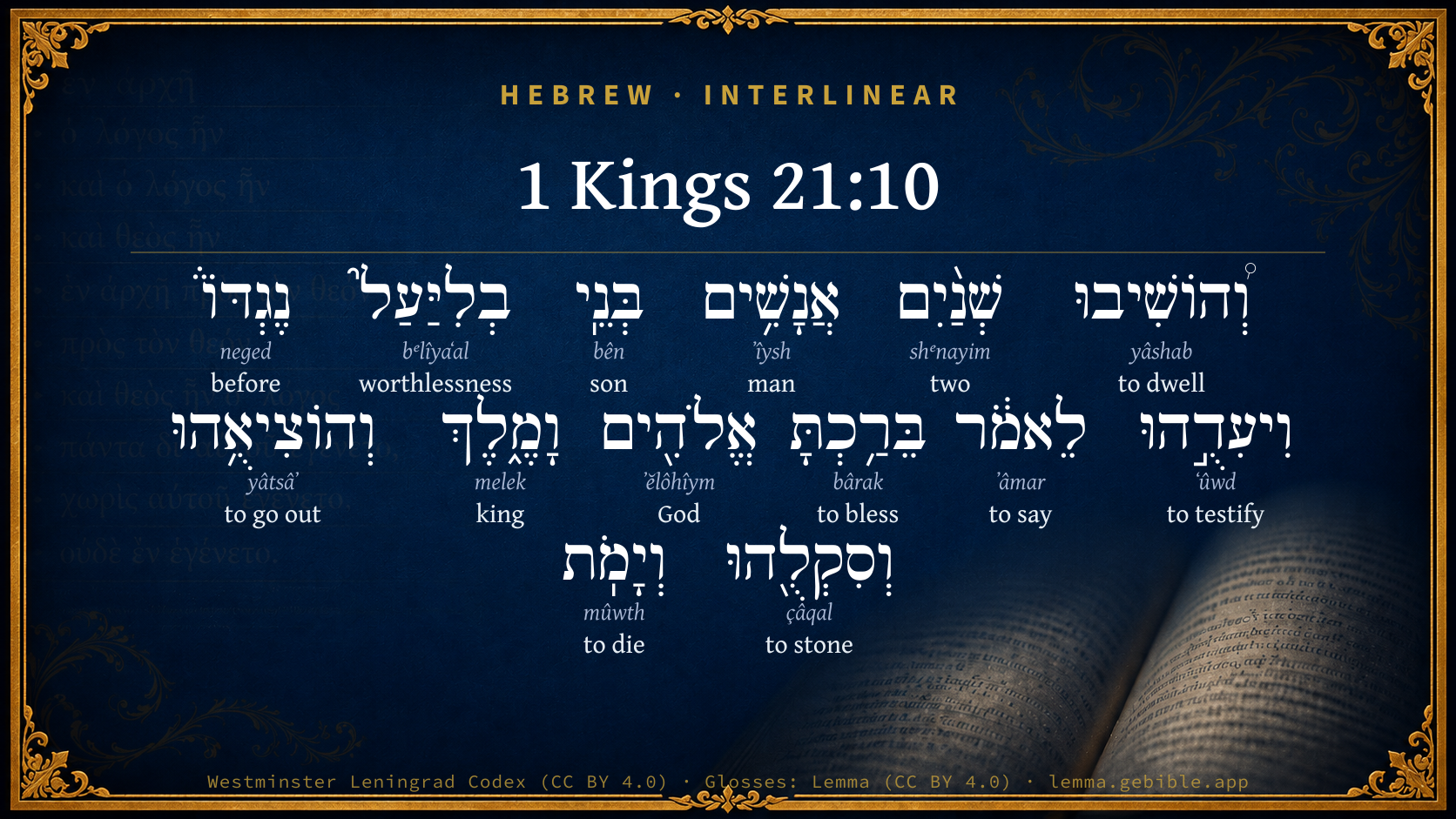
Hebrew (Westminster Leningrad Codex) 1 Kings 21:10 appears in the Hebrew Old Testament. The text above is from the Westminster Leningrad Codex. Each word links to its Strong’s number, a concise gloss, and parsing drawn from the Open Scriptures Hebrew Bible morphology. Click any word for its full Brown-Driver-Briggs (BDB) entry.
Download image
Cite this verse

1 Kings 21:10 (World English Bible). Public Domain. Lemma interlinear Bible study tool, https://lemma.gebible.app/v/1-kings/21/10.

Show BibTeX & RIS
BibTeX
RIS
English Translation
and set two men, base fellows, before him, and let them testify against him, saying, You did curse God and the king. Then carry him out, and stone him to death.
World English Bible · Public Domain
Download a study sheet

One document with this verse’s original text, its word-by-word gloss line, the meaning frame, cross-references with their text, attributed commentary, and full source and license credits — printable, and it pastes into notes with its structure intact.

This verse Autodidact and up

Study sheet (.html) Plain text (.txt)

A passage Seminary Student

Up to 50 verses in one chapter. A passage sheet keeps up to 6 commentary sources and 12 cross-references per verse, in the order this page ranks them, and says so on the sheet whenever that leaves anything out. Ask for a single verse and you get the Autodidact verse sheet above.

Everything on this page stays free to read, with no account — the sheet is a download of what is already on screen, not access to it.

Want to remove ads? Support Godless Engineer
Compare translations 3

The same verse in 3 English versions, stacked beneath the original-language interlinear above. Click any original word for its lexicon entry.

Each is an independent rendering of the whole verse — the interlinear is not word-aligned to these translations.

Highlighted words mark where these versions differ — a whole-verse word diff, not a word-by-word alignment.

  • World English Bible Public Domain
    and set two men, base fellows, before him, and let them testify against him, saying, You did curse God and the king. Then carry him out, and stone him to death.
  • King James Version Public Domain
    And set two men, sons of Belial, before him, to bear witness against him, saying, Thou didst blaspheme God and the king. And then carry him out, and stone him, that he may die.
  • unfoldingWord Literal Text CC BY-SA 4.0
    And seat two men, sons of wickedness, in front of him, and let them witness against him, saying, ‘You blessed God and the king.’ And take him out and stone him, and may he die.”

unfoldingWord Literal Text — © unfoldingWord, licensed CC BY-SA 4.0. Word-aligned USFM3 via Door43 (git.door43.org/unfoldingWord/en_ult).

Versions to compare (up to 4)

3 of 4 selected

Show all 18 translations

Every available English version of this verse, each an independent rendering of the whole verse.

  • World English Bible Public Domain
    and set two men, base fellows, before him, and let them testify against him, saying, You did curse God and the king. Then carry him out, and stone him to death.
  • Berean Standard Bible Public Domain
    But seat two scoundrels opposite him and have them testify, ‘You have cursed both God and the king!’ Then take him out and stone him to death.”
  • Majority Standard Bible Public Domain
    But seat two scoundrels opposite him and have them testify, ‘You have cursed both God and the king!’ Then take him out and stone him to death.”
  • King James Version Public Domain
    And set two men, sons of Belial, before him, to bear witness against him, saying, Thou didst blaspheme God and the king. And then carry him out, and stone him, that he may die.
  • American Standard Version (1901) Public Domain
    and set two men, base fellows, before him, and let them bear witness against him, saying, Thou didst curse God and the king. And then carry him out, and stone him to death.
  • Revised Version (1885) Public Domain
    and set two men, sons of Belial, before him, and let them bear witness against him, saying, Thou didst curse God and the king. And then carry him out, and stone him, that he die.
  • Geneva Bible (1599) Public Domain
    And set two wicked men before him, and let them witnesse against him, saying, Thou diddest blaspheme God and the King: then cary him out, and stone him that he may dye.
  • Douay-Rheims (1899) Public Domain
    And suborn two men, sons of Belial against him, and let them bear false witness: that he hath blasphemed God and the king: and then carry him out, and stone him, and so let him die.
  • Young's Literal Translation Public Domain
    and cause two men -- sons of worthlessness -- to sit over-against him, and they testify of him, saying, Thou hast blessed God and Melech; and they have brought him out, and stoned him, and he dieth.'
  • Literal Standard Version CC BY-SA 4.0
    and cause two men—sons of worthlessness—to sit opposite him, and they testify of him, saying, You have blessed [[or cursed]] God and [the] king; and they have brought him out, and stoned him, and he dies.”
  • Unlocked Literal Bible CC BY-SA 4.0
    Also place two dishonest men with him and let them testify against him, saying, 'You cursed God and the king.'” Then take him out and stone him to death.
  • unfoldingWord Literal Text CC BY-SA 4.0
    And seat two men, sons of wickedness, in front of him, and let them witness against him, saying, ‘You blessed God and the king.’ And take him out and stone him, and may he die.”
  • Darby Bible Public Domain
    and set two men, sons of Belial, before him, and they shall bear witness against him saying, Thou didst curse God and the king; and carry him out, and stone him, that he may die.
  • World Messianic Bible Public Domain
    Set two men, wicked fellows, before him, and let them testify against him, saying, ‘You cursed God and the king!’ Then carry him out, and stone him to death.”
  • Webster's Bible Public Domain
    And set two men, sons of Belial, before him, to bear witness against him, saying, Thou didst blaspheme God and the king. And then carry him out, and stone him, that he may die.
  • Free Bible Version CC BY-SA 4.0
    But seat two bad men opposite him and have them accuse him, saying, ‘You have cursed God and the king!’ Then take him out and stone him to death.”
  • Bible in Basic English Public Domain
    And get two good-for-nothing persons to come before him and give witness that he has been cursing God and the king. Then take him out and have him stoned to death.
  • JPS Tanakh (1917) Public Domain
    and set two men, base fellows, before him, and let them bear witness against him, saying: Thou didst curse God and the king. And then carry him out, and stone him, that he die.'

Literal Standard Version (2020), Covenant Press — licensed CC BY-SA 4.0. Text via the HelloAO Bible API (eBible.org). Unlocked Literal Bible (unfoldingWord) — licensed CC BY-SA 4.0. Text via the HelloAO Bible API (eBible.org). unfoldingWord Literal Text — © unfoldingWord, licensed CC BY-SA 4.0. Word-aligned USFM3 via Door43 (git.door43.org/unfoldingWord/en_ult). Free Bible Version, Dr. Jonathan Gallagher — licensed CC BY-SA 4.0. Text via the HelloAO Bible API (eBible.org).

Word by word

More ways to search: Search by grammar → Find every occurrence → Compare this word →

Practice this passage: Drill this verse → Learn its vocabulary →

וְסִקְלֻ֖הוּ
çâqal
H5619
“and · stone · him”
Conjunction + Verb, Qal, Imperative, 2nd Person, Masculine, Plural + Suffix, Personal, 3rd Person, Masculine, Singular
Part of Speech
Conjunction + Verb
Stem
Qal
Form
Imperative
Person
2nd Person
Gender
Masculine
Number
Plural
Full BDB Definition

Origin: a primitive root

TWOT: 1541

to stone (to death), put to death by stoning - (Qal) to pelt with stones, stone to death - (Niphal) to be stoned to death - (Piel) - to stone, pelt with stones - to free from stones (of vineyard, highway) - (Pual) to be stoned to death
  1. וְ֠הוֹשִׁיבוּ yâshab H3427 “and · dwell” Conjunction + Verb, Hiphil, Imperative, 2nd Person, Masculine, Plural
  2. שְׁנַ֨יִם shᵉnayim H8147 “two” Adjective, Cardinal number, Masculine, Dual, Absolute
  3. אֲנָשִׁ֥ים ʼîysh H376 “men” Noun, Common, Masculine, Plural, Absolute
  4. בְּנֵֽי bên H1121 “sons of” Noun, Common, Masculine, Plural, Construct
  5. בְלִיַּעַל֮ bᵉlîyaʻal H1100 “worthlessness” Noun, Common, Masculine, Singular, Absolute
  6. נֶגְדּוֹ֒ neged H5048 “before · him” Preposition + Suffix, Personal, 3rd Person, Masculine, Singular
  7. וִיעִדֻ֣הוּ ʻûwd H5749 “and · to testify · him” Conjunction + Verb, Hiphil, Jussive, 3rd Person, Masculine, Plural + Suffix, Personal, 3rd Person, Masculine, Singular
  8. לֵאמֹ֔ר ʼâmar H559 “to say” Preposition + Verb, Qal, Infinitive Construct
  9. בֵּרַ֥כְתָּ bârak H1288 “to bless” Verb, Piel, Perfect, 2nd Person, Masculine, Singular
  10. אֱלֹהִ֖ים ʼĕlôhîym H430 “God(s)” Noun, Common, Masculine, Plural, Absolute
  11. וָמֶ֑לֶךְ melek H4428 “and · king” Conjunction + Noun, Common, Masculine, Singular, Absolute
  12. וְהוֹצִיאֻ֥הוּ yâtsâʼ H3318 “and · go out · him” Conjunction + Verb, Hiphil, Imperative, 2nd Person, Masculine, Plural + Suffix, Personal, 3rd Person, Masculine, Singular
  13. וְיָמֹֽת mûwth H4191 “and · to die” Conjunction + Verb, Qal, Jussive, 3rd Person, Masculine, Singular

About this verse

These counts appear in no published source. They are computed here, from the morphology-tagged text and Lemma’s own curated glosses. What Lemma adds →

14
words
14
distinct lemmas
Historical
section

Notable vocabulary

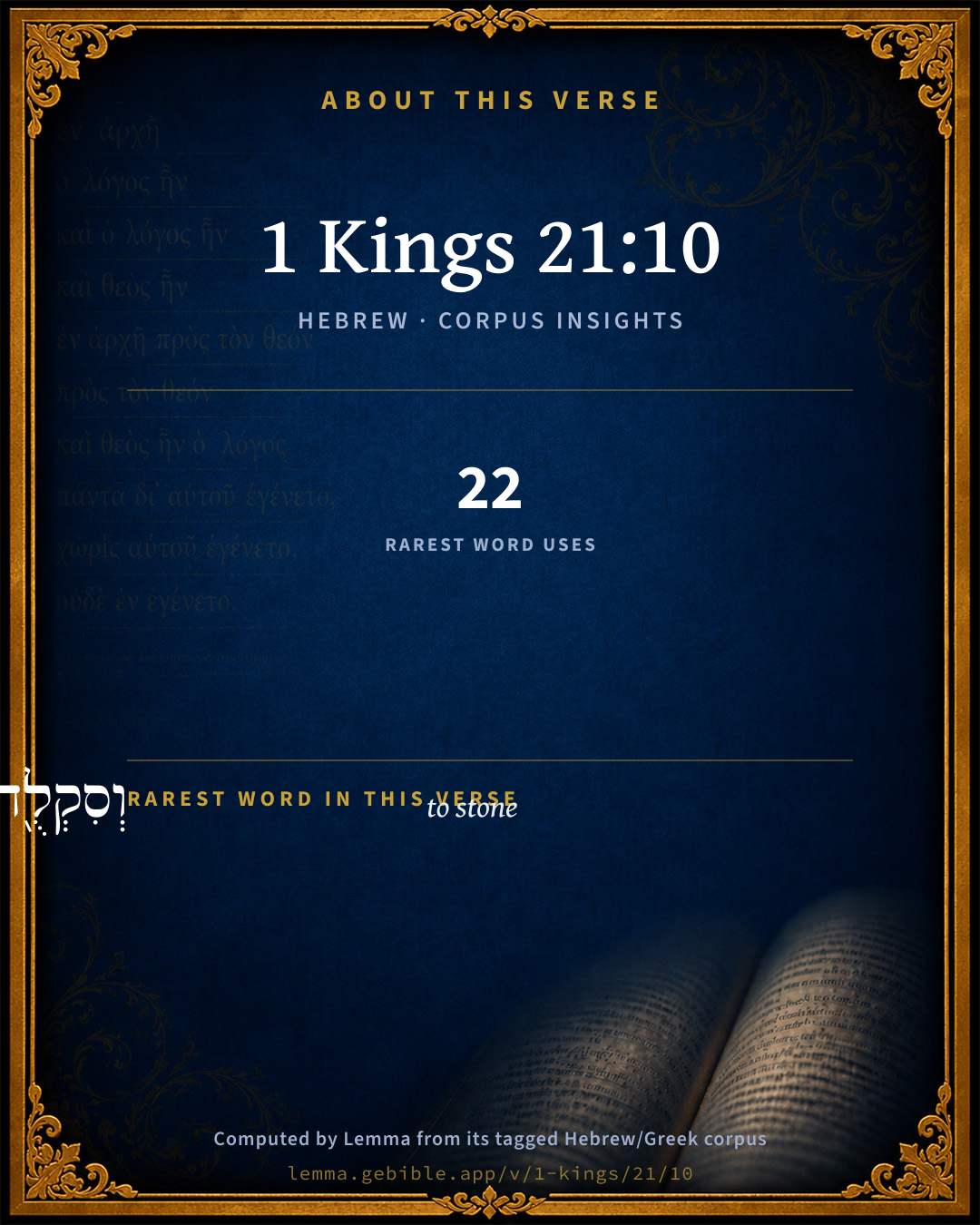
The rarest word here is וְסִקְלֻ֖הוּ to stone H5619 — appearing just 22 times in the whole Hebrew Bible.

Shared distinctive vocabulary

וְסִקְלֻ֖הוּ to stone H5619 occurs in 20 verses of the Hebrew Bible. Also found in:

Grammatical profile

  • 7 verbs
  • 5 nouns
  • 1 adjective
  • 1 preposition

Verb forms

  • וְ֠הוֹשִׁיבוּ Hiphil · Imperative
  • וִיעִדֻ֣הוּ Hiphil · Jussive
  • לֵאמֹ֔ר Qal · Infinitive Construct
  • בֵּרַ֥כְתָּ Piel · Perfect
  • וְהוֹצִיאֻ֥הוּ Hiphil · Imperative
  • וְסִקְלֻ֖הוּ Qal · Imperative
  • וְיָמֹֽת Qal · Jussive

Hebrew & Septuagint length

In English translation the verse runs 31 words from the Hebrew and 33 from the Septuagint (LXX English) — closely comparable.

A rough comparison of the two English renderings, which tokenize alike — not a word-level alignment.

Word counts can differ between the Hebrew and the Greek without any difference in meaning — e.g. the Hebrew direct-object marker אֵת has no separate Greek word, and Greek often adds the article ὁ.

Cross-references

9

Topical passages linked to 1 Kings 21:10 in the Treasury of Scripture Knowledge — connected by theme and wording, ordered by reader-vote popularity; previews shown in the World English Bible.

  • Exodus 22:28 "You shall not blaspheme God, nor curse a ruler of your people.
  • Acts 6:11 Then they secretly induced men to say, "We have heard him speak blasphemous words against Moses and God."
  • Leviticus 24:15–16 You shall speak to the children of Israel, saying, 'Whoever curses his God shall bear his sin.
  • Deuteronomy 13:13 Certain base fellows are gone out from the midst of you, and have drawn away the inhabitants of their city, saying, Let us go and serve other gods, which you have not known;
  • Deuteronomy 19:15 One witness shall not rise up against a man for any iniquity, or for any sin, in any sin that he sins: at the mouth of two witnesses, or at the mouth of three witnesses, shall a matter be established.
  • Judges 19:22 As they were making their hearts merry, behold, the men of the city, certain base fellows, beset the house round about, beating at the door; and they spoke to the master of the house, the old man, saying, Bring forth the man who came into your house, that we may know him.
  • Matthew 26:59–66 Now the chief priests, the elders, and the whole council sought false testimony against Jesus, that they might put him to death;
  • John 10:33 The Jews answered him, "We don't stone you for a good work, but for blasphemy: because you, being a man, make yourself God."
  • Acts 6:13 and set up false witnesses who said, "This man never stops speaking blasphemous words against this holy place and the law.

Cross-references courtesy of OpenBible.info (CC BY 4.0).

Hebrew and Greek witnesses Masoretic Hebrew ↔ Greek Septuagint

The same verse in the two great witnesses to the Old Testament, shown verse-for-verse.

These are two independent witnesses, not word-aligned to each other, and the Septuagint is shown in lemma (dictionary) form.

Hebrew 1 Kings 21:10 Masoretic · Westminster Leningrad Codex

וְ֠הוֹשִׁיבוּ שְׁנַ֨יִם אֲנָשִׁ֥ים בְּנֵֽי בְלִיַּעַל֮ נֶגְדּוֹ֒ וִיעִדֻ֣הוּ לֵאמֹ֔ר בֵּרַ֥כְתָּ אֱלֹהִ֖ים וָמֶ֑לֶךְ וְהוֹצִיאֻ֥הוּ וְסִקְלֻ֖הוּ וְיָמֹֽת

and set two men, base fellows, before him, and let them testify against him, saying, You did curse God and the king. Then carry him out, and stone him to death.

World English Bible · Public Domain

Greek LXX 1 Kings 21:10 Septuagint · lemma form

καί ἀντι ἀποστέλλω πρός αὐτός υἱός αδερ λέγω ὅδε ποιέω ἐγώ ὁ θεός καί ὅδε προςτίθημι εἰ ἐκποιέω ὁ χοῦς σαμαρεία ὁ ἀλώπηξ πᾶς ὁ λαός ὁ πεζός ἐγώ

And the son of Ader sent to him, saying, So do God to me, and more also, if the dust of Samaria shall suffice for foxes to all the people, even my infantry.

LXX2012 (modern English Septuagint) · Public Domain

On this verse, The Cambridge Bible for Schools and Colleges discusses the Septuagint’s reading. Read the note in Commentary ↓

Hebrew: Westminster Leningrad Codex (CC BY 4.0). Greek: Septuagint (public domain); English from LXX2012 (modern English Septuagint) (Public Domain). How the Septuagint differs from the Hebrew →

Targum (Aramaic paraphrase)

1

The Targum is the ancient Jewish Aramaic paraphrase of the Hebrew Scriptures — an interpretive translation, not the Hebrew text itself. Onkelos (literal) and Pseudo-Jonathan (expansive) render the Torah, and Jonathan the Prophets. Coverage is partial: where no permissively-licensed English translation exists for a verse, only the Aramaic is shown. This is verse-level text, not a word-by-word alignment to the Hebrew.

  1. Targum Jonathan Prophets (Joshua–Malachi)
    וְאוֹתִיבוּ תְּרֵין גַבְרִין בְּנֵי רִשְׁעָא לְקִבְּלֵיהּ וְיִסְהֲדוּנֵיהּ לְמֵימַר גַדֵיפְתָּא קֳדָם יְיָ וּמַלְכָּא לַטְתָּא וְאַפְקוּהִי וְרַגְמוּהִי וְיִתְקְטַל:

    (no public-domain English translation for this verse)

    Targum Jonathan — Aramaic: “Mikraot Gedolot” (public domain). English: “Sefaria Community Translation” (CC0 1.0 (public-domain dedication)); “London "Chaldee Paraphrase," 1871” (public domain). Text via Sefaria.

Commentary

Notes on 1 Kings 21:10 from classic Christian and Jewish commentators (each source and its license shown beneath its notes). The classic Christian expositions comment on the surrounding passage and are grouped to its opening verse, so a note may address several verses; the Jewish commentaries on the Tanakh (Rashi and others) are per-verse, so they appear only where the commentator wrote on this verse.

Lemma curates 59 commentaries, every one of them public domain or Creative Commons licensed, each selected and text-cleaned for this edition rather than reprinted as found. About our sources →

Trapp's Complete Commentary

John Trapp

1Ki 21:10 And set two men, sons of Belial, before him, to bear witness against him, saying, Thou didst blaspheme God and the king. And [then] carry him out, and stone him, that he may die.

Ver. 10. And set two men, sons of Belial.] Two such as she pointed out, and well knew to be for her purpose: knights of the post, as we call them, devils incarnate.

Thou didst blaspheme God and the king.] Heb., Thou didst bless: Euphemismus per antiphrasin. The Hebrews, saith Martyr, did so far abominate blasphemy, that they would not once name it, when the blaspheming of God was to be spoken of. See on Job 2:9.

And then carry him out.] As a καθαρμα, or public pest; not fit to breathe out his spirit in the city.

John Trapp, A Commentary or Exposition upon All the Books of the Old and New Testament (1647–1656) — public domain. Text from a community e-Sword module.

Joseph Benson's Commentary

1Ki 21:10. And set two men before him to bear witness — It was the Roman custom also; and was most rational, that the accused should have the accusers face to face, Act 25:16. Thou didst blaspheme God and the king — Hebrew, ברכת, beracta, thou didst bless. Blessing is here put for cursing and blaspheming, as in Job 1:5; Job 2:9, as is apparent, because his blessing God and the king would have been no crime. It was death by the law of Moses to blaspheme God, Lev 24:16; and by custom it was death to revile the king, which was forbidden, Exo 22:28. Now, in order to make sure work, the witnesses, as they were instructed, accused Naboth of both those crimes, that the people might be the better satisfied to see him stoned. There is, however, this difference to be observed between these two crimes, that by blaspheming God, a person only forfeited his life, not his estate, which went to his heirs; whereas, when a man was executed for treason, his estate was forfeited to him against whom the offence was committed. For this reason it was that Naboth was charged with this crime also, that his estate might be confiscated, and Ahab might, by that means, get possession of the vineyard. And then carry him out — Not merely out of the assembly, but out of the city, 1Ki 21:13. For while they were in the wilderness, and before the conquest of Canaan, they executed punishments without the camp, Lev 24:23; Jos 7:24; but afterward without the gates of their cities. By this they intended to signify, that they would take the evil out of the midst of them, and not suffer wickedness to remain among them.

Joseph Benson's Commentary on the Old and New Testaments (1811–1818) — public domain. Text from a community e-Sword module.

Tyndale Open Study Notes

Tyndale Open Resources

21:10 scoundrels (literally sons of Belial): The Hebrew expression refers to totally evil reprobates (Deut 13:13; Judg 19:22; 1 Sam 10:27; Prov 6:12). Later Jewish writings attributed the name Belial to Satan, a use reflected by Paul in the New Testament (2 Cor 6:15). • Legally, two witnesses were needed to establish a charge against a person (Deut 19:15; Matt 18:16). The twofold charge of Naboth’s blasphemy against God and against the king carried a penalty of death by stoning outside the city (Deut 17:5-6; 22:24). Naboth was apparently put to death on his own land (see 2 Kgs 9:21-26).

Tyndale Open Study Notes — © Tyndale Open Resources, licensed CC BY-SA 4.0. Text via the HelloAO Bible API.

Adam Clarke's Commentary

Verse 10. Set two men] For life could not be attainted but on the evidence of two witnesses at least.

Sons of Belial] Men who will not scruple to tell lies and take a false oath.

Thou didst blaspheme God and the king.] Thou art an atheist and a rebel. Thou hast spoken words injurious to the perfections and nature of God; and thou hast spoken words against the crown and dignity of the king. The words literally are, Naboth hath BLESSED God and the king; or, as Parkhurst contends, "Thou hast blessed the false gods and Molech," ברכת אלהים ומלך And though Jezebel was herself an abominable idolatress; yet, as the law of Moses still continued in force, she seems to have been wicked enough to have destroyed Naboth, upon the false accusation of blessing the heathen Aleim and Molech, which subjected him to death by De 12:6; De 17:2-7. The first meaning appears the most simple.

Many think that the word ברך barach signifies both to bless and curse; and so it is interpreted in most Lexicons: it is passing strange that out of the same word proceedeth blessing and cursing; and to give such opposite and self-destructive meanings to any word is very dangerous. Parkhurst denies that it ever has the meaning of cursing, and examines all the texts where it is said to occur with this meaning; and shows that blessing, not cursing, is to be understood in all those places: see him under ברך, sec. vi.

Adam Clarke's Commentary on the Bible (1810–1826) — public domain. Text from a community e-Sword/MySword module.

Ellicott's Commentary for English Readers

(10) Two men—in accordance with Num_35:30; Deu_17:6.

Sons of Belial.—See Jdg_19:22; Jdg_20:13; 1Sa_1:16; 1Sa_2:12; 1Sa_10:27; 1Sa_25:17; 1Sa_25:25; 1Sa_30:22; 2Sa_16:7; 2Sa_20:1, &c.; properly, “children of lawlessness, or worthlessness.”

Blaspheme.—The word is the same used in Job_1:5; Job_1:11; Job_2:5, there rendered “curse.” It properly signifies “to bless;” thence, to “part from with blessing;” finally to part from, or “disown.” It is, rather, therefore, “to renounce” than “to blaspheme.” The punishment, however, was stoning, as for positive blasphemy. (See Lev_24:16; Deu_13:9-10.)

A Bible Commentary for English Readers, edited by Charles John Ellicott (1878–1897) — public domain. Text from a community e-Sword module.

The Cambridge Bible for Schools and Colleges

gen. ed. J. J. S. Perowne

10. sons of Belial] In Deu_13:13, the R.V. has translated this expression ‘base fellows’, putting in the margin ‘sons of worthlessness’. This is the sense everywhere in the O.T. and should have been in the text. In N.T. times ‘Belial’ was personified (see 2Co_6:15), but there is no trace of this idea in the earlier Scriptures. The LXX. has υἱοὶ παρανόμων. The men were good-for-noughts, who would swear to anything for which they were paid. Josephus makes them three in number.

Thou didst blaspheme [R.V. curse] God and the king] The verb in the original ברך is very frequently used of blessing, but it had the opposite sense also. The root idea appears to be ‘to say adieu to’. This might be and most frequently was with a parting benediction; but it also might be a renunciation, a declaration of hostility. Hence the R.V. has put ‘renounce’ in the margin, to indicate how the sense of ‘curse’ is obtained. The verb is used in the bad sense also in Job_1:5; Job_2:9. It is remarkable that an accusation of this nature should have been set afoot by Jezebel. We need not however assume that she had any care about the cursing of God; only that she found this the first convenient mode of getting rid of Naboth. But amongst the people, who were to suppose Naboth justly executed, there must have still been some regard for the divine name and the divine law. The death stoning was appointed by the Mosaic code (Lev_24:16), and so was the necessity for two witnesses at least (Deu_17:6; Deu_19:15) before the accused could be put to death.

that he may die] The R.V. omits ‘may’.

The Cambridge Bible for Schools and Colleges (gen. ed. J. J. S. Perowne; Cambridge University Press, 1878–1918) — public domain. Text from a community e-Sword module.

John Gill's Exposition

They proclaimed a fast,.... Or called a court; see Gill on Kg1 21:9.

and set Naboth on high among the people; placed him at the bar as a criminal; see Gill on Kg1 21:9, though Josephus (c) thinks he was set on an high place in the court, because he was of an illustrious birth.

(c) Antiqu. l. 3. c. 13. sect. 8.

John Gill's Exposition of the Whole Bible (1746–1763) — public domain (CC PDM 1.0). Text via the HelloAO Bible API.

Albert Barnes' Notes on the Bible

Sons of Belial - i. e., “worthless persons” (Deu 13:13 note). Witnesses must be two in number according to the Law Num 35:30; Deu 17:6; Deu 19:15.

The word rendered “blaspheme” is that which commonly means “bless.” The opposite sense of “cursing,” seems, however, to be required here and in Job 1:5, Job 1:11; Job 2:5. Perhaps the best explanation of the bad sense of the original word is to be found in the practice of blessing by way of salutation, not only on meeting, but also on taking leave Gen 47:7, Gen 47:10. From the latter custom the word came to mean “bidding farewell to,” and so “renouncing,” “casting off,” “cursing.”

Carry him out and stone him - Naboth’s offence would be twofold, and in both cases capital; blasphemy against God being punishable with death by the Law (marginal reference), and blasphemy against the king being a capital offence by custom 1Ki 2:8; 2Sa 16:9; 2Sa 19:21. The punishment would be stoning, since the greater crime would absorb the lesser, and the Law made stoning the punishment for blasphemy against God. As stoning always took place outside the city (see Act 7:58), Jezebel told the elders to “carry Naboth out.”

Albert Barnes' Notes on the Bible (1834–1885) — public domain. Text from a community e-Sword/MySword module.

Haydock's Catholic Bible Commentary

Belial, without restraint or conscience. --- Blasphemed. Hebrew, "blessed." --- Elohim, (Haydock) or god, the gods, magistrates, &c. (Calmet) --- Blessing is equally put, to avoid the horrible sound of blaspheming. (Worthington) (Job i. 5., and ii. 9.) --- Martin de Roa (i. 9.) maintains, that the word implies to "bid adieu," or quit; as if Naboth had relinquished the service both of God and of the king. He was accused as a traitor. The law did not condemn the person to death who had spoken ill of the prince, Exodus xxii. 28. But the wicked judges complied with the intimation of Jezabel; (Calmet) as she pretended that he had also blasphemed God. (Haydock) --- Josephus introduces three witnesses, which was more conformable to the practice of the Jews. (Grotius) --- But the text specifies two; and that number would suffice. (Haydock) --- All Naboth’s family were involved in his ruin; (4 Kings ix. 26.; Tirinus) as it was necessary for Achab’s purpose. So Achan’s children perished with him, Josue vii. 25. (Haydock) --- What a complication of crime! (Tirinus) --- "They proclaimed a fast, in order to commit murder." (St. Chrysostom, ser. 68.) Hypocrisy, falsehoods, perjury, perversion of justice, all are employed to take away the life, honour, and property of the innocent. See St. Ambrose, Seneca Benef. ii. 27. (Tirinus)

George Leo Haydock (1774–1849), Haydock's Catholic Family Bible and Commentary, 1859 edition — public domain. Excludes Psalms (Douay-Rheims chapter numbering differs from Protestant) and Deuterocanonical books (Catholic canon only).

Matthew Poole's English Annotations

Thou didst blaspheme, Heb. bless. Blessing is put for cursing and blaspheming, as Job 1:5; 2:9, so also here, as is apparent, because his blessing God and the king had been no crime. It is a figure called euphemisms. God would have blasphemy so much abhorred, that it should not easily and unnecessarily be named by its proper name. Compare Psa 16:4.

Carry him out, to the place where malefactors were punished, which was out of the city, Lev 24:23; Jos 7:24; Mar 15:20; Heb 13:12, partly to show that they were unworthy of all human society, and abhorred by all the people; and partly because the place where they were killed was thereby ceremonially polluted.

Stone him; the proper punishment of blasphemers, Lev 24:15,16.

That he may die; as one that cursed his God, and his political father, his king. See Exo 21:17; 12:28.

Matthew Poole's English Annotations on the Holy Bible (1683–1685) — public domain. Text from a community e-Sword/MySword module.

Whedon's Commentary on the Bible

Daniel D. Whedon

10. Two men — The law required at least two witnesses to convict a man of murder or any great crime. See Num_35:30; Deu_17:6; Deu_19:15. So, says Wordsworth, “even Jezebel bears witness to the Pentateuch.”

Sons of Belial — Literally, sons of worthlessness; that is, worthless, good-for-nothing fellows. See note on 1Sa_1:16.

Thou didst blaspheme God and the king — The word rendered blaspheme is ברךְ, which usually means to bless, and is often used in the farewell blessing of one departing from the presence of another. Compare Gen_47:10; 1Ki_8:66. “To this latter signification,” says Furst, “belongs the meaning, to give the parting salutation to one in a bad sense, that is, to wish away, to imprecate upon one, to curse, to revile. Job_1:5; Job_2:5. Analogy in the Semitic dialects admits of directly opposite meanings in a word.” So, also, Gesenius in his Hebrews Lexicon. Some think that blasphemy of God and the king was so shocking to the Hebrew mind that it was expressed by this word euphemistically.

Stone him — According to Lev_24:16, the blasphemer of Jehovah is to be stoned to death; and according to Exo_22:28, cursing of the ruler is a kindred crime. The first martyr, Stephen, was stoned on the charge of blasphemy. According to 2Ki_9:26, Naboth’s sons were also put to death with him. They were, perhaps, the only heirs that could rightly claim the inheritance; or, like Achan’s children, they may have been regarded and treated as involved in the parent’s guilt. See note on Jos_7:24.

Daniel D. Whedon (gen. ed.), Commentary on the Old and New Testaments (1874–1909) — public domain. Text from a community e-Sword module.

The Pulpit Commentary

And set two men according to the previsions of the law (Deu_17:6, 7 19:5; Num_35:30) "Even Jezebel bears witness to the Pentateuch" (Wordsworth). Josephus speaks of three witnesses, sons of Belial i.e., worthless men. This use of the word "son", Psa_89:22, "son of wickedness" which is one of the commonest idioms of the East, throws some light on the expression "sons of the prophets" (see 1Ki_20:35, note; cf. Deu_13:13; , Mat_26:60) before him confronting him, to bear witness against him, saying, Thou didst blaspheme Heb. bless; cf.ghse. Job_1:5, 11 2:5; LXX eujlo The Lexicographers are not agreed as to how this word, the primary meaning of which is to kneel, hence to pray, to bless, came to signify curse or blaspheme. According to some, it is an euphemism, the idea of cursing God being altogether too horrible for the Jew to express in words; whilst others derive this signification from the fact that a curse is really a prayer addressed to God; and others, again, account for it by the consideration that a person who bids farewell to another sometimes does so in the sense of dismissing and cursing him. Anyhow, it is noticeable that the word "blessing" is sometimes used with a similar meaning amongst ourselves God and the king God and the representative of God in Israel are here coupled together, as in Exo_22:28. To curse the king was practically to curse Him whose vicegerent hewas. (cf Mat_23:18-22) Hence such cursing is called blasphemy and was punishable with death (Deu_13:11 Deu_17:5; 2Sa_16:9 2Sa_19:21; and see on. 1Ki_2:43, 1Ki_2:44) And then carry him out i.e. , out of the city (cf. Lev_24:14; Act_7:58; Luk_4:29; Heb_13:12) Locus lapidationis erat extra urbem, omnes enim civitates muris cinctae paritatem habent ad castra Israelis" (Babyl. Sanh.), and stone him the legal punishment for blasphemy, (Lev_24:16) that he may die. The terrible power accorded to "two or three witnesses," of denouncing a man to death, accounts for the prominence given to the sin of bearing false witness (Exo_20:16; Deu_19:16) It found a mention in the Decalogue.

The Pulpit Commentary (1880–1919), ed. H.D.M. Spence-Jones & Joseph S. Exell — public domain. Text from a community e-Sword module.

John Wesley's Explanatory Notes

Blaspheme God and the king - Indeed his blaspheming God would only be the forfeiture of his life, not his estate. Therefore he is charged with treason also, that his estate may be confiscated, and so Ahab have his vineyard.

John Wesley, Explanatory Notes Upon the Whole Bible (1754–1765) — public domain. Text via the GEBible commentary corpus.

Lesson kit

Teaching starters — assembled from the data on this page, not authored interpretation. Every prompt links to the verse data it draws on. Edit before teaching.

1 Kings, in the Historical, opens this verse with 14 words (14 distinct Hebrew lemmas). Its most distinctive word is çâqal (“to stone”). A historical commentator’s framing appears above. Read the whole chapter for the surrounding context.

Discussion questions

  1. What does “to stone” (çâqal) contribute to the verse as a whole?
  2. How does Exodus 8:26, which shares the word «to stone», read alongside this verse?
  3. These translations render this verse differently; the difference is in the English rendering, not the original. What questions does that raise?
  4. «וְ֠הוֹשִׁיבוּ» is a Hiphil Imperative verb. How does that grammatical form shape the action described?
  5. Compare how Trapp's Complete Commentary and Joseph Benson's Commentary read this verse. Where do they agree or differ?

Things to notice

Reading settings

Reading text

Shown beneath each verse's original-language words.

Old Testament
Old Testament edition

Read the OT as the Masoretic Hebrew (MT) or the Greek Septuagint (LXX).

English shown for the Greek Septuagint (in the Hebrew ↔ Greek comparison).

Comparing translations? Open the Compare panel on any verse page to stack up to four side by side.