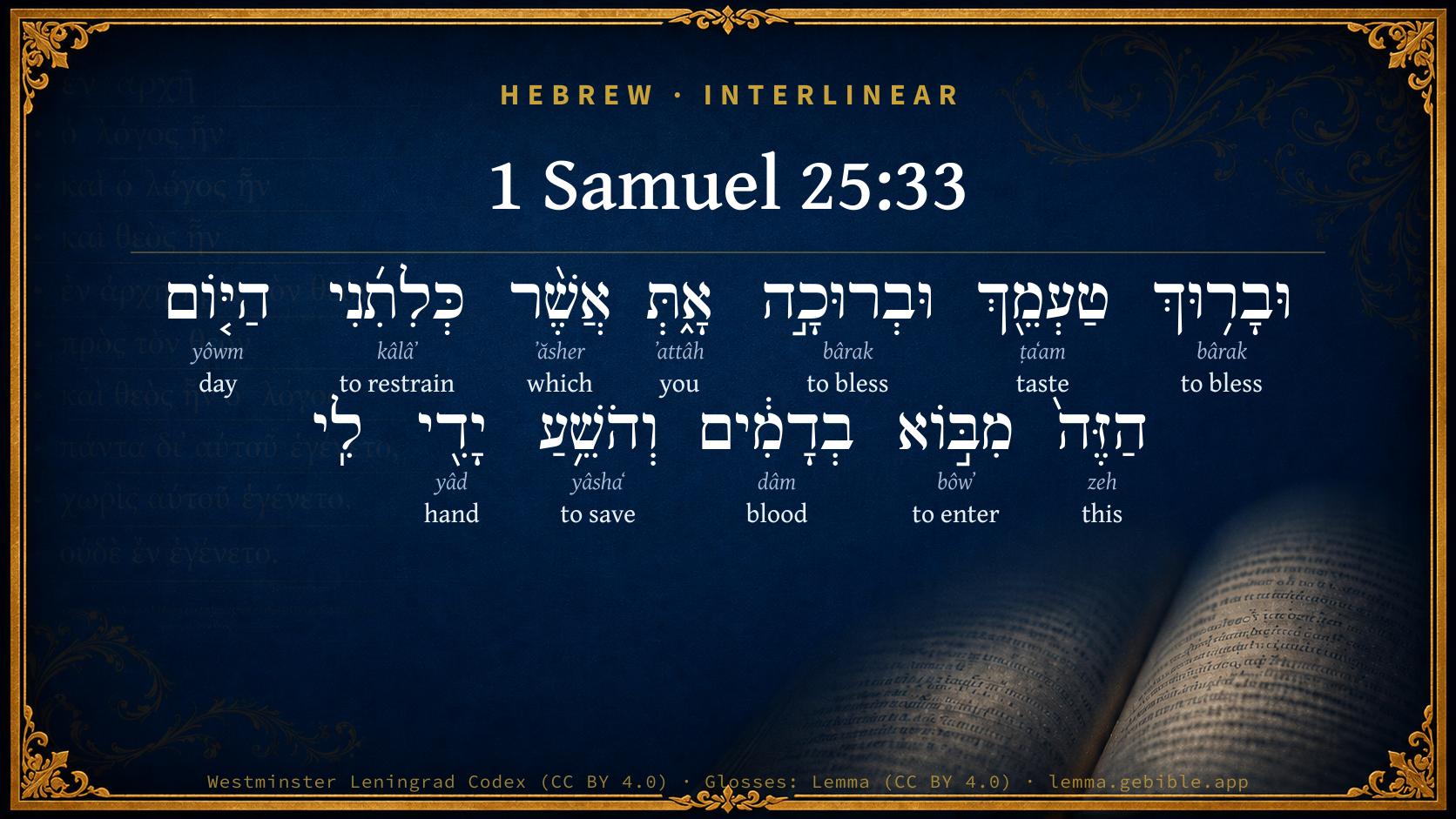
1 Samuel 25:33

Hebrew (Westminster Leningrad Codex) 1 Samuel 25:33 appears in the Hebrew Old Testament. The text above is from the Westminster Leningrad Codex. Each word links to its Strong’s number, a concise gloss, and parsing drawn from the Open Scriptures Hebrew Bible morphology. Click any word for its full Brown-Driver-Briggs (BDB) entry.
Download image
Cite this verse

1 Samuel 25:33 (World English Bible). Public Domain. Lemma interlinear Bible study tool, https://lemma.gebible.app/v/1-samuel/25/33.

Show BibTeX & RIS
BibTeX
RIS
English Translation
and blessed be your discretion, and blessed be you, that have kept me this day from blood guiltiness, and from avenging myself with my own hand.
World English Bible · Public Domain
Download a study sheet

One document with this verse’s original text, its word-by-word gloss line, the meaning frame, cross-references with their text, attributed commentary, and full source and license credits — printable, and it pastes into notes with its structure intact.

This verse Autodidact and up

Study sheet (.html) Plain text (.txt)

A passage Seminary Student

Up to 50 verses in one chapter. A passage sheet keeps up to 6 commentary sources and 12 cross-references per verse, in the order this page ranks them, and says so on the sheet whenever that leaves anything out. Ask for a single verse and you get the Autodidact verse sheet above.

Everything on this page stays free to read, with no account — the sheet is a download of what is already on screen, not access to it.

Want to remove ads? Support Godless Engineer
Compare translations 3

The same verse in 3 English versions, stacked beneath the original-language interlinear above. Click any original word for its lexicon entry.

Each is an independent rendering of the whole verse — the interlinear is not word-aligned to these translations.

Highlighted words mark where these versions differ — a whole-verse word diff, not a word-by-word alignment.

  • World English Bible Public Domain
    and blessed be your discretion, and blessed be you, that have kept me this day from blood guiltiness, and from avenging myself with my own hand.
  • King James Version Public Domain
    And blessed be thy advice, and blessed be thou, which hast kept me this day from coming to shed blood, and from avenging myself with mine own hand.
  • unfoldingWord Literal Text CC BY-SA 4.0
    And blessed be your discernment, and blessed be who have kept me this day from entering into bloodshed and my hand saving for myself!

unfoldingWord Literal Text — © unfoldingWord, licensed CC BY-SA 4.0. Word-aligned USFM3 via Door43 (git.door43.org/unfoldingWord/en_ult).

Versions to compare (up to 4)

3 of 4 selected

Show all 18 translations

Every available English version of this verse, each an independent rendering of the whole verse.

  • World English Bible Public Domain
    and blessed be your discretion, and blessed be you, that have kept me this day from blood guiltiness, and from avenging myself with my own hand.
  • Berean Standard Bible Public Domain
    Blessed is your discernment, and blessed are you, because today you kept me from bloodshed and from avenging myself by my own hand.
  • Majority Standard Bible Public Domain
    Blessed is your discernment, and blessed are you, because today you kept me from bloodshed and from avenging myself by my own hand.
  • King James Version Public Domain
    And blessed be thy advice, and blessed be thou, which hast kept me this day from coming to shed blood, and from avenging myself with mine own hand.
  • American Standard Version (1901) Public Domain
    and blessed be thy discretion, and blessed be thou, that hast kept me this day from bloodguiltiness, and from avenging myself with mine own hand.
  • Revised Version (1885) Public Domain
    and blessed be thy wisdom, and blessed be thou, which hast kept me this day from bloodguiltiness, and from avenging myself with mine own hand.
  • Geneva Bible (1599) Public Domain
    And blessed be thy counsel, and blessed be thou, which hast kept me this day from comming to shed blood, and that mine hand hath not saued me.
  • Douay-Rheims (1899) Public Domain
    And blessed be thou, who hast kept me to day, from coming to blood, and revenging me with my own hand.
  • Young's Literal Translation Public Domain
    and blessed `is' thy discretion, and blessed `art' thou in that thou hast restrained me this day from coming in with blood, and to restrain my hand to myself.
  • Literal Standard Version CC BY-SA 4.0
    and blessed [is] your discretion, and blessed [are] you in that you have restrained me this day from coming in with blood, and to restrain my hand to myself.
  • Unlocked Literal Bible CC BY-SA 4.0
    Your wisdom is blessed and you are blessed, because you have kept me today from bloodshed and from avenging myself with my own hand!
  • unfoldingWord Literal Text CC BY-SA 4.0
    And blessed be your discernment, and blessed be who have kept me this day from entering into bloodshed and my hand saving for myself!
  • Darby Bible Public Domain
    And blessed be thy discernment, and blessed be thou, who hast kept me this day from coming with bloodshed, and from avenging myself with mine own hand.
  • World Messianic Bible Public Domain
    Blessed is your discretion, and blessed are you, who have kept me today from blood guiltiness, and from avenging myself with my own hand.
  • Webster's Bible Public Domain
    And blessed be thy advice, and blessed be thou, who hast kept me this day from coming to shed blood, and from avenging myself with my own hand.
  • Free Bible Version CC BY-SA 4.0
    May you be rewarded for your wise decisions, for preventing me from shedding blood today and taking my own revenge.
  • Bible in Basic English Public Domain
    A blessing on your good sense and on you, who have kept me today from the crime of blood and from taking into my hands the punishment for my wrongs.
  • JPS Tanakh (1917) Public Domain
    and blessed be thy discretion, and blessed be thou, that hast kept me this day from bloodguiltiness, and from finding redress for myself with mine own hand.

Literal Standard Version (2020), Covenant Press — licensed CC BY-SA 4.0. Text via the HelloAO Bible API (eBible.org). Unlocked Literal Bible (unfoldingWord) — licensed CC BY-SA 4.0. Text via the HelloAO Bible API (eBible.org). unfoldingWord Literal Text — © unfoldingWord, licensed CC BY-SA 4.0. Word-aligned USFM3 via Door43 (git.door43.org/unfoldingWord/en_ult). Free Bible Version, Dr. Jonathan Gallagher — licensed CC BY-SA 4.0. Text via the HelloAO Bible API (eBible.org).

Word by word

More ways to search: Search by grammar → Find every occurrence → Compare this word →

Practice this passage: Drill this verse → Learn its vocabulary →

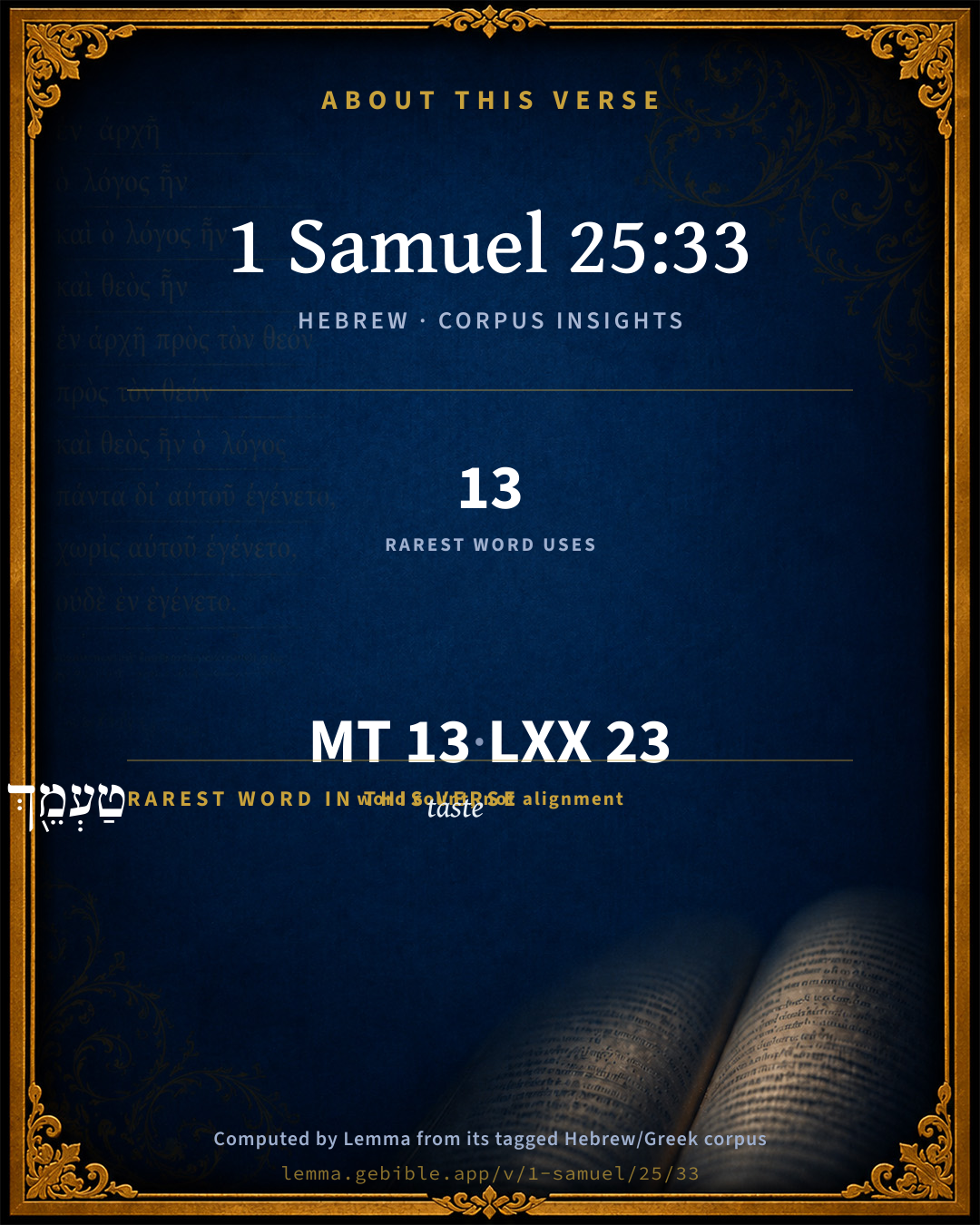
טַעְמֵ֖ךְ
ṭaʻam
H2940
“taste · your”
Noun, Common, Masculine, Singular, Construct + Suffix, Personal, 2nd Person, Feminine, Singular
Part of Speech
Noun
Type
Common
Gender
Masculine
Number
Singular
State
Construct
Full BDB Definition

Origin: from H2938

TWOT: 815a

taste, judgment - taste - judgment (figuratively) - decision, decree
  1. וּבָר֥וּךְ bârak H1288 “and · blessed” Conjunction + Verb, Qal, Participle Passive, Masculine, Singular, Absolute
  2. וּבְרוּכָ֣ה bârak H1288 “and · blessed” Conjunction + Verb, Qal, Participle Passive, Feminine, Singular, Absolute
  3. אָ֑תְּ ʼattâh H859 “you” Pronoun, Personal, 2nd Person, Feminine, Singular
  4. אֲשֶׁ֨ר ʼăsher H834 “which” Particle, Relative
  5. כְּלִתִ֜נִי kâlâʼ H3607 “to restrain · me” Verb, Qal, Perfect, 2nd Person, Feminine, Singular + Suffix, Personal, 1st Person, Common, Singular
  6. הַיּ֤וֹם yôwm H3117 “the · day” Particle, Definite Article + Noun, Common, Masculine, Singular, Absolute
  7. הַזֶּה֙ zeh H2088 “the · this” Particle, Definite Article + Pronoun, Demonstrative, Masculine, Singular
  8. מִבּ֣וֹא bôwʼ H935 “from · to enter” Preposition + Verb, Qal, Infinitive Construct
  9. בְדָמִ֔ים dâm H1818 “in/at · blood” Preposition + Noun, Common, Masculine, Plural, Absolute
  10. וְהֹשֵׁ֥עַ yâshaʻ H3467 “and · to save” Conjunction + Verb, Hiphil, Infinitive Absolute
  11. יָדִ֖י yâd H3027 “hand · my” Noun, Common, Both, Singular, Construct + Suffix, Personal, 1st Person, Common, Singular

About this verse

These counts appear in no published source. They are computed here, from the morphology-tagged text and Lemma’s own curated glosses. What Lemma adds →

13
words
11
distinct lemmas
Historical
section

Notable vocabulary

The rarest word here is טַעְמֵ֖ךְ taste H2940 — appearing just 13 times in the whole Hebrew Bible.

Shared distinctive vocabulary

טַעְמֵ֖ךְ taste H2940 occurs in 12 verses of the Hebrew Bible. Also found in:

Grammatical profile

  • 5 verbs
  • 4 nouns
  • 2 pronouns
  • 1 preposition
  • 1 particle

Verb forms

  • וּבָר֥וּךְ Qal · Participle Passive
  • וּבְרוּכָ֣ה Qal · Participle Passive
  • כְּלִתִ֜נִי Qal · Perfect
  • מִבּ֣וֹא Qal · Infinitive Construct
  • וְהֹשֵׁ֥עַ Hiphil · Infinitive Absolute

Repetition

A word recurs within this verse — often emphatic in Hebrew:

  • וּבָר֥וּךְ to bless H1288 ×2

Hebrew & Septuagint length

In English translation the verse runs 26 words from the Hebrew and 25 from the Septuagint (LXX English) — closely comparable.

A rough comparison of the two English renderings, which tokenize alike — not a word-level alignment.

Word counts can differ between the Hebrew and the Greek without any difference in meaning — e.g. the Hebrew direct-object marker אֵת has no separate Greek word, and Greek often adds the article ὁ.

In the original languages it is 13 Hebrew tokens and 23 Greek tokens — but the two are counted differently (Hebrew bundles its prefixes and suffixes into one token; the Greek is in lemma form), so that isn’t a like-for-like length.

Cross-references

10

Topical passages linked to 1 Samuel 25:33 in the Treasury of Scripture Knowledge — connected by theme and wording, ordered by reader-vote popularity; previews shown in the World English Bible.

  • 1 Samuel 25:26 Now therefore, my lord, as Yahweh lives, and as your soul lives, seeing Yahweh has withheld you from blood guiltiness, and from avenging yourself with your own hand, now therefore let your enemies, and those who seek evil to my lord, be as Nabal.
  • Psalms 141:5 Let the righteous strike me, it is kindness; Let him reprove me, it is like oil on the head; Don't let my head refuse it; Yet my prayer is always against evil deeds.
  • Proverbs 9:9 Instruct a wise man, and he will be still wiser. Teach a righteous man, and he will increase in learning.
  • Proverbs 17:10 A rebuke enters deeper into one who has understanding Than a hundred lashes into a fool.
  • Proverbs 25:12 As an ear-ring of gold, and an ornament of fine gold, So is a wise reprover to an obedient ear.
  • Proverbs 27:21 The crucible is for silver, And the furnace for gold; But man is refined by his praise.
  • Proverbs 28:23 One who rebukes a man will afterward find more favor Than one who flatters with the tongue.
  • 1 Samuel 24:19 For if a man finds his enemy, will he let him go away unharmed? Therefore may Yahweh reward you good for that which you have done to me this day.
  • 1 Samuel 25:31 that this shall be no grief to you, nor offense of heart to my lord, either that you have shed blood without cause, or that my lord has avenged himself. When Yahweh shall have dealt well with my lord, then remember your handmaid.
  • 1 Samuel 26:9–10 David said to Abishai, Don't destroy him; for who can put forth his hand against Yahweh's anointed, and be guiltless?

Cross-references courtesy of OpenBible.info (CC BY 4.0).

Hebrew and Greek witnesses Masoretic Hebrew ↔ Greek Septuagint

The same verse in the two great witnesses to the Old Testament, shown verse-for-verse.

These are two independent witnesses, not word-aligned to each other, and the Septuagint is shown in lemma (dictionary) form.

Hebrew 1 Samuel 25:33 Masoretic · Westminster Leningrad Codex

וּבָר֥וּךְ טַעְמֵ֖ךְ וּבְרוּכָ֣ה אָ֑תְּ אֲשֶׁ֨ר כְּלִתִ֜נִי הַיּ֤וֹם הַזֶּה֙ מִבּ֣וֹא בְדָמִ֔ים וְהֹשֵׁ֥עַ יָדִ֖י לִֽי

and blessed be your discretion, and blessed be you, that have kept me this day from blood guiltiness, and from avenging myself with my own hand.

World English Bible · Public Domain

Greek LXX 1 Samuel 25:33 Septuagint · lemma form

καί εὐλογητός ὁ τρόπος σύ καί εὐλογέω σύ ὁ ἀποκωλύω ἐγώ σήμερον ἐν οὗτος μή ἔρχομαι εἰς αἷμα καί σώζω χείρ ἐγώ ἐγώ

and blessed be your conduct, and blessed be you, who have hindered me this very day from coming to shed blood, and from avenging myself.

LXX2012 (modern English Septuagint) · Public Domain

Hebrew: Westminster Leningrad Codex (CC BY 4.0). Greek: Septuagint (public domain); English from LXX2012 (modern English Septuagint) (Public Domain). How the Septuagint differs from the Hebrew →

Targum (Aramaic paraphrase)

1

The Targum is the ancient Jewish Aramaic paraphrase of the Hebrew Scriptures — an interpretive translation, not the Hebrew text itself. Onkelos (literal) and Pseudo-Jonathan (expansive) render the Torah, and Jonathan the Prophets. Coverage is partial: where no permissively-licensed English translation exists for a verse, only the Aramaic is shown. This is verse-level text, not a word-by-word alignment to the Hebrew.

  1. Targum Jonathan Prophets (Joshua–Malachi)
    וּבְרִיךְ מַדָעִיךְ וּבְרִיכָא אַתְּ דִמְנַעְתַּנִי יוֹמָא הָדֵין מִלְמִשְׁפַּךְ דַם זַכַּאי וּלְמִפְרַק יְדֵי לִי:

    (no public-domain English translation for this verse)

    Targum Jonathan — Aramaic: “Mikraot Gedolot” (public domain). English: “Sefaria Community Translation” (CC0 1.0 (public-domain dedication)); “London "Chaldee Paraphrase," 1871” (public domain). Text via Sefaria.

Commentary

Notes on 1 Samuel 25:33 from classic Christian and Jewish commentators (each source and its license shown beneath its notes). The classic Christian expositions comment on the surrounding passage and are grouped to its opening verse, so a note may address several verses; the Jewish commentaries on the Tanakh (Rashi and others) are per-verse, so they appear only where the commentator wrote on this verse.

Lemma curates 59 commentaries, every one of them public domain or Creative Commons licensed, each selected and text-cleaned for this edition rather than reprinted as found. About our sources →

Trapp's Complete Commentary

John Trapp

1Sa 25:33 And blessed [be] thy advice, and blessed [be] thou, which hast kept me this day from coming to [shed] blood, and from avenging myself with mine own hand.

Ver. 33. And blessed be thou.] Whom God hath made instrumental to my great good; and therefore I may not defraud thee of thy due commendation. If Solomon have his thousand, yet the vinedressers, his labourers, may well have two hundred. {Son 8:11} We send thanks to the donor: we also thank and pay the messenger that bringeth a present to us.

John Trapp, A Commentary or Exposition upon All the Books of the Old and New Testament (1647–1656) — public domain. Text from a community e-Sword module.

Geneva Bible (1599)

Geneva Bible translators

Read verse 26.

Geneva Bible (1599) marginal notes — public domain. Text via Bolls.life.

Ellicott's Commentary for English Readers

(33) And blessed be thy advice.—David, with his usual frank generosity, allows he has been in the wrong in giving way to wild, ungovernable passion, and openly confesses that if Abigail had not met him and reasoned with him, he would have carried out his purpose, and stained his fair fame for ever with a terrible crime. His dark purpose was to cut off, root and branch, the whole house of Nabal, amongst others the woman standing before him there. It is noticeable how, in this age of deeper religion and of higher culture, the old superstitious reverence for vows, taken in moments of frenzy or of extreme excitement, had given place to a calmer and more reasonable spirit. Never had a more solemn vow been taken than David’s that morning, when he took a solemn oath that he would murder the whole house of Nabal; and yet, before the sun set he is convinced of the wickedness of his purpose, and sooner than carry it out he deliberately breaks the oath. Some years before, Saul—had he not been forcibly hindered by the people—would, by the murder of his son, the hero-prince Jonathan, have fulfilled the rash oath which he swore at the battle of Michmash (1Sa_14:24; 1Sa_14:45); and Jephthah, the judge of Israel, we know, in the person of his loved daughter, ruthlessly carried out his wild, useless oath (Jdg_11:34; Jdg_11:40).

A Bible Commentary for English Readers, edited by Charles John Ellicott (1878–1897) — public domain. Text from a community e-Sword module.

The Cambridge Bible for Schools and Colleges

gen. ed. J. J. S. Perowne

33. advice] Better, discretion.

from coming to shed blood] From coming into blood-guiltiness, as in 1Sa_25:26.

The Cambridge Bible for Schools and Colleges (gen. ed. J. J. S. Perowne; Cambridge University Press, 1878–1918) — public domain. Text from a community e-Sword module.

John Gill's Exposition

And blessed be thy advice,.... Thanks be to God, and to thee for it, being wise, good, and seasonable; or "thy taste" (g), thy good sense, knowledge, as the Targum, discretion, prudence, and understanding:

and blessed be thou which hast kept me this day from coming to shed blood; he came out with a full resolution to shed the blood of Nabal, and of all the males in his house, but was stopped by Abigail; who by her arguments so prevailed upon him as to cause him to desist from his design, and thankful he was to God for it; for though he had vowed he would destroy Nabal and his family, yet being a rash sinful vow, he saw it was better to break it than to keep it:

and from avenging myself with mine own hand; which to do would have been sinful, vengeance only belonging to God; and now he leaves it to him, and is very thankful that he was prevented doing it himself.

(g) "sapor tuus", Piscator; "discretio tua", Montanus.

John Gill's Exposition of the Whole Bible (1746–1763) — public domain (CC PDM 1.0). Text via the HelloAO Bible API.

Matthew Poole's English Annotations

Blessed be thy advice, and blessed be thou, i.e. the Lord bless and recompense thee for this thy good advice.

From coming to shed blood, which I had sworn to do. Hereby it plainly appears that oaths whereby men bind themselves to any sin are null and void; and as it was a sin to make them, so it is adding sin to sin to perform them.

Matthew Poole's English Annotations on the Holy Bible (1683–1685) — public domain. Text from a community e-Sword/MySword module.

John Wesley's Explanatory Notes

From coming, &c. - Which I had sworn to do. Hereby it plainly appears, that oaths whereby men bind themselves to any sin, are null and void: and as it was a sin to make them; so it is adding sin to sin to perform them.

John Wesley, Explanatory Notes Upon the Whole Bible (1754–1765) — public domain. Text via the GEBible commentary corpus.

Rashi

Rabbi Shlomo Yitzchaki (Rashi)

Who prevented me. You stopped me, as in, 'You shall not stop [תִכְלָא] your mercy,' [and] 'will not stop [יׅכְלֶה] you.'

And from avenging myself with my own hand. This is connected with [the phrase], 'from coming into bloodshed.' The 'מ' [=from] of [מִבּוֹא] is connected to 'and avenging,' meaning, 'from coming into bloodshed and from avenging myself with my own hand.'

Rashi on the Tanakh — English translations: “The Judaica Press complete Tanach with Rashi, translated by A. J. Rosenberg” (CC BY 4.0); “Pentateuch with Rashi's commentary by M. Rosenbaum and A.M. Silbermann, 1929-1934” (public domain); “The Metsudah Tanach series, Lakewood, N.J” (CC BY 4.0); and “The Book of Joshua, Metsudah Publications, 1997” (CC BY 4.0). Text via Sefaria.

Lesson kit

Teaching starters — assembled from the data on this page, not authored interpretation. Every prompt links to the verse data it draws on. Edit before teaching.

1 Samuel, in the Historical, opens this verse with 13 words (11 distinct Hebrew lemmas). Its most distinctive word is ṭaʻam (“taste”). A historical commentator’s framing appears above. Read the whole chapter for the surrounding context.

Discussion questions

  1. What does “taste” (ṭaʻam) contribute to the verse as a whole?
  2. How does Exodus 16:31, which shares the word «taste», read alongside this verse?
  3. What does the repetition of “to bless” (2× in this one verse) do in this verse?
  4. These translations render this verse differently; the difference is in the English rendering, not the original. What questions does that raise?
  5. «וּבָר֥וּךְ» is a Qal Participle Passive verb. How does that grammatical form shape the action described?
  6. Compare how Trapp's Complete Commentary and Geneva Bible (1599) read this verse. Where do they agree or differ?

Things to notice

Reading settings

Reading text

Shown beneath each verse's original-language words.

Old Testament
Old Testament edition

Read the OT as the Masoretic Hebrew (MT) or the Greek Septuagint (LXX).

English shown for the Greek Septuagint (in the Hebrew ↔ Greek comparison).

Comparing translations? Open the Compare panel on any verse page to stack up to four side by side.