Numbers 22:12

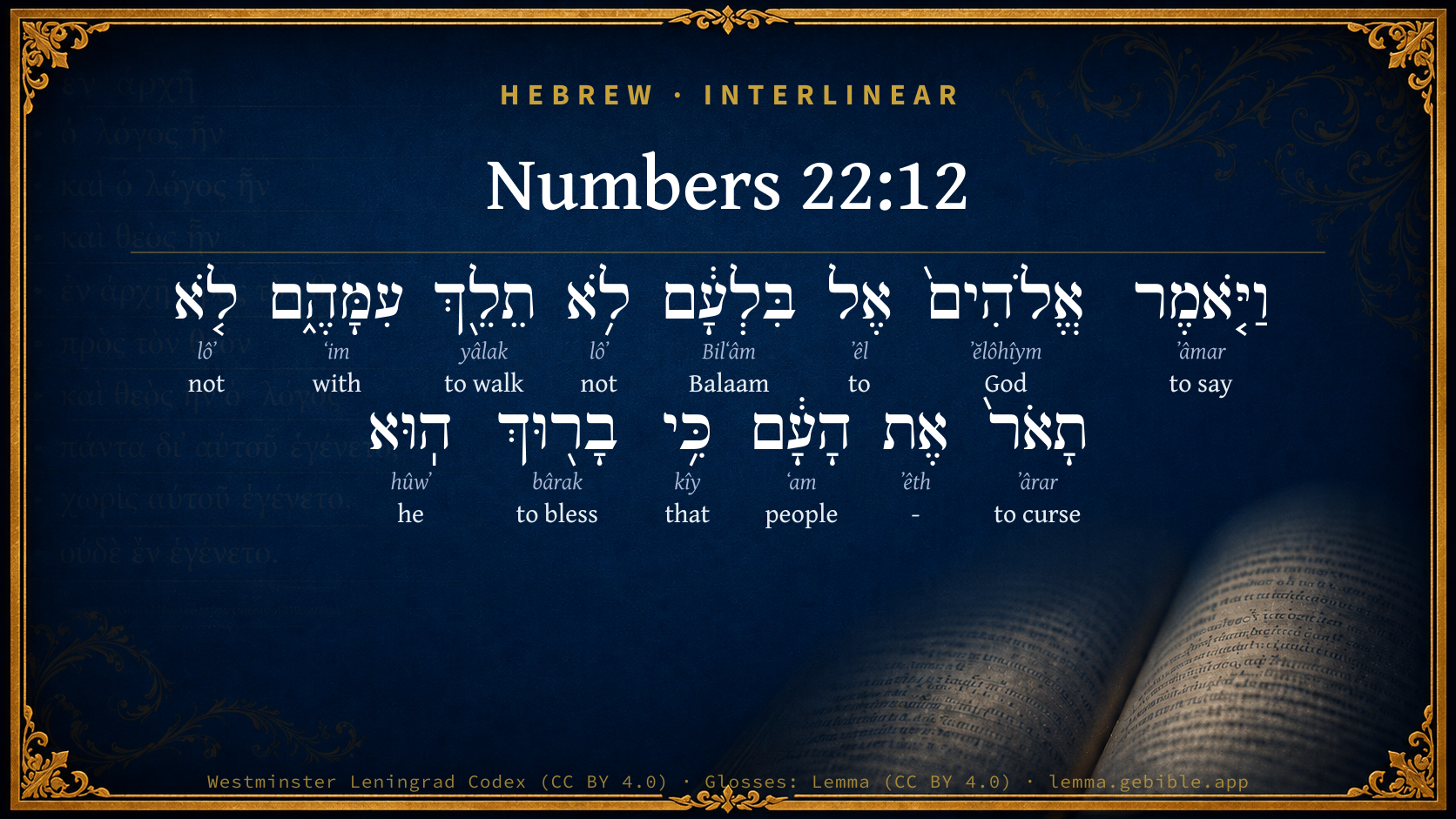
Hebrew (Westminster Leningrad Codex) Numbers 22:12 appears in the Hebrew Old Testament. The text above is from the Westminster Leningrad Codex. Each word links to its Strong’s number, a concise gloss, and parsing drawn from the Open Scriptures Hebrew Bible morphology. Click any word for its full Brown-Driver-Briggs (BDB) entry.
Download image
Cite this verse

Numbers 22:12 (World English Bible). Public Domain. Lemma interlinear Bible study tool, https://lemma.gebible.app/v/numbers/22/12.

Show BibTeX & RIS
BibTeX
RIS
English Translation
God said to Balaam, You shall not go with them; you shall not curse the people; for they are blessed.
World English Bible · Public Domain
Download a study sheet

One document with this verse’s original text, its word-by-word gloss line, the meaning frame, cross-references with their text, attributed commentary, and full source and license credits — printable, and it pastes into notes with its structure intact.

This verse Autodidact and up

Study sheet (.html) Plain text (.txt)

A passage Seminary Student

Up to 50 verses in one chapter. A passage sheet keeps up to 6 commentary sources and 12 cross-references per verse, in the order this page ranks them, and says so on the sheet whenever that leaves anything out. Ask for a single verse and you get the Autodidact verse sheet above.

Everything on this page stays free to read, with no account — the sheet is a download of what is already on screen, not access to it.

Want to remove ads? Support Godless Engineer
Compare translations 3

The same verse in 3 English versions, stacked beneath the original-language interlinear above. Click any original word for its lexicon entry.

Each is an independent rendering of the whole verse — the interlinear is not word-aligned to these translations.

Highlighted words mark where these versions differ — a whole-verse word diff, not a word-by-word alignment.

  • World English Bible Public Domain
    God said to Balaam, You shall not go with them; you shall not curse the people; for they are blessed.
  • King James Version Public Domain
    And God said unto Balaam, Thou shalt not go with them; thou shalt not curse the people: for they are blessed.
  • unfoldingWord Literal Text CC BY-SA 4.0
    And God said to Balaam, “You shall not go with them. You shall not curse the people, for it blessed.”

unfoldingWord Literal Text — © unfoldingWord, licensed CC BY-SA 4.0. Word-aligned USFM3 via Door43 (git.door43.org/unfoldingWord/en_ult).

Versions to compare (up to 4)

3 of 4 selected

Show all 18 translations

Every available English version of this verse, each an independent rendering of the whole verse.

  • World English Bible Public Domain
    God said to Balaam, You shall not go with them; you shall not curse the people; for they are blessed.
  • Berean Standard Bible Public Domain
    But God said to Balaam, “Do not go with them. You are not to curse this people, for they are blessed.”
  • Majority Standard Bible Public Domain
    But God said to Balaam, “Do not go with them. You are not to curse this people, for they are blessed.”
  • King James Version Public Domain
    And God said unto Balaam, Thou shalt not go with them; thou shalt not curse the people: for they are blessed.
  • American Standard Version (1901) Public Domain
    And God said unto Balaam, Thou shalt not go with them; thou shalt not curse the people; for they are blessed.
  • Revised Version (1885) Public Domain
    And God said unto Balaam, Thou shalt not go with them; thou shalt not curse the people: for they are blessed.
  • Geneva Bible (1599) Public Domain
    And God said vnto Balaam, Go not thou with them, neither curse the people, for they are blessed.
  • Douay-Rheims (1899) Public Domain
    And God said to Balaam: Thou shalt not go with them, nor shalt thou curse the people: because it is blessed.
  • Young's Literal Translation Public Domain
    and God saith unto Balaam, `Thou dost not go with them; thou dost not curse the people; for it `is' blessed.'
  • Literal Standard Version CC BY-SA 4.0
    and God says to Balaam, “You do not go with them; you do not curse the people, for it [is] blessed.”
  • Unlocked Literal Bible CC BY-SA 4.0
    God replied to Balaam, “You must not go with those men. You must not curse the people of Israel because they have been blessed.”
  • unfoldingWord Literal Text CC BY-SA 4.0
    And God said to Balaam, “You shall not go with them. You shall not curse the people, for it blessed.”
  • Darby Bible Public Domain
    And God said to Balaam, Thou shalt not go with them; thou shalt not curse the people; for they are blessed.
  • World Messianic Bible Public Domain
    God said to Balaam, “You shall not go with them. You shall not curse the people, for they are blessed.”
  • Webster's Bible Public Domain
    And God said to Balaam, Thou shalt not go with them; thou shalt not curse the people: for they are blessed.
  • Free Bible Version CC BY-SA 4.0
    But God told Balaam, “You are not to go back with them. You must not curse this people, for they are blessed.”
  • Bible in Basic English Public Domain
    And God said to Balaam, You are not to go with them, or put a curse on this people, for they have my blessing.
  • JPS Tanakh (1917) Public Domain
    And God said unto Balaam: 'Thou shalt not go with them; thou shalt not curse the people; for they are blessed.'

Literal Standard Version (2020), Covenant Press — licensed CC BY-SA 4.0. Text via the HelloAO Bible API (eBible.org). Unlocked Literal Bible (unfoldingWord) — licensed CC BY-SA 4.0. Text via the HelloAO Bible API (eBible.org). unfoldingWord Literal Text — © unfoldingWord, licensed CC BY-SA 4.0. Word-aligned USFM3 via Door43 (git.door43.org/unfoldingWord/en_ult). Free Bible Version, Dr. Jonathan Gallagher — licensed CC BY-SA 4.0. Text via the HelloAO Bible API (eBible.org).

Word by word

More ways to search: Search by grammar → Find every occurrence → Compare this word →

Practice this passage: Drill this verse → Learn its vocabulary →

בִּלְעָ֔ם
Bilʻâm
H1109
“Balaam”
Noun, Proper
Part of Speech
Noun
Type
Proper
Full BDB Definition

Origin: probably from H1077 and H5971

TWOT: 251b

Balaam = "not of the people" - the son of Beor, a man endowed with the gift of prophecy (noun proper masculine) - a town in Manasseh (noun proper locative)
  1. וַיֹּ֤אמֶר ʼâmar H559 “and · to say” Conjunction + Verb, Qal, Sequential Imperfect, 3rd Person, Masculine, Singular
  2. אֱלֹהִים֙ ʼĕlôhîym H430 “God(s)” Noun, Common, Masculine, Plural, Absolute
  3. אֶל ʼêl H413 “to” Preposition
  4. לֹ֥א lôʼ H3808 “not” Particle, Negative
  5. תֵלֵ֖ךְ yâlak H3212 “to walk” Verb, Qal, Imperfect, 2nd Person, Masculine, Singular
  6. עִמָּהֶ֑ם ʻim H5973 “with · them” Preposition + Suffix, Personal, 3rd Person, Masculine, Plural
  7. לֹ֤א lôʼ H3808 “not” Particle, Negative
  8. תָאֹר֙ ʼârar H779 “to curse” Verb, Qal, Imperfect, 2nd Person, Masculine, Singular
  9. אֶת ʼêth H853 “-” Particle, Direct Object
  10. הָעָ֔ם ʻam H5971 “the · people” Particle, Definite Article + Noun, Common, Masculine, Singular, Absolute
  11. כִּ֥י kîy H3588 “that” Conjunction
  12. בָר֖וּךְ bârak H1288 “blessed” Verb, Qal, Participle Passive, Masculine, Singular, Absolute
  13. הֽוּא hûwʼ H1931 “he” Pronoun, Personal, 3rd Person, Masculine, Singular

About this verse

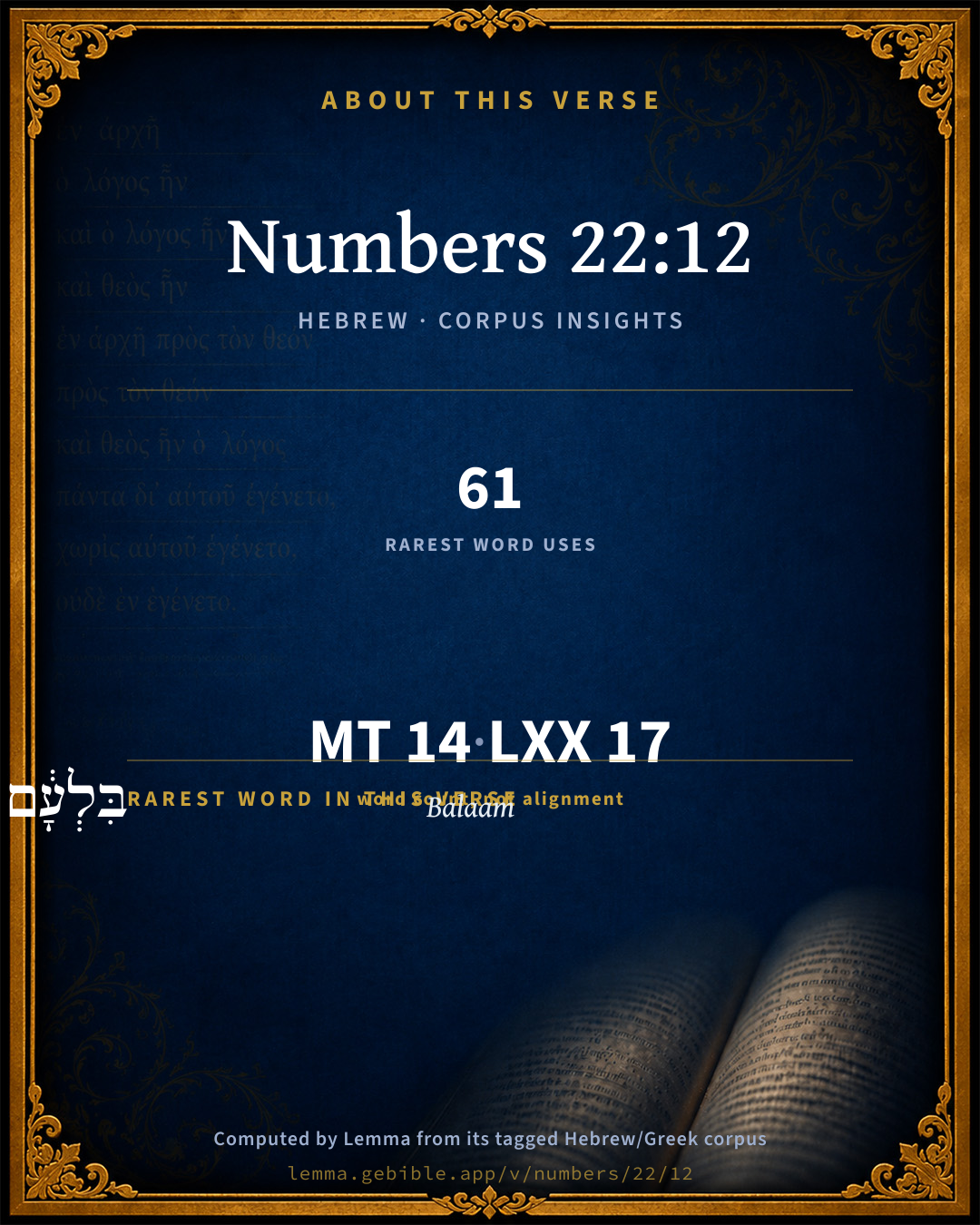
These counts appear in no published source. They are computed here, from the morphology-tagged text and Lemma’s own curated glosses. What Lemma adds →

14
words
13
distinct lemmas
Pentateuch
section

Grammatical profile

  • 4 verbs
  • 3 nouns
  • 1 pronoun
  • 2 prepositions
  • 1 conjunction
  • 3 particles

Verb forms

  • וַיֹּ֤אמֶר Qal · Sequential Imperfect
  • תֵלֵ֖ךְ Qal · Imperfect
  • תָאֹר֙ Qal · Imperfect
  • בָר֖וּךְ Qal · Participle Passive

Repetition

A word recurs within this verse — often emphatic in Hebrew:

Hebrew & Septuagint length

In English translation the verse runs 20 words from the Hebrew and 21 from the Septuagint (LXX English) — closely comparable.

A rough comparison of the two English renderings, which tokenize alike — not a word-level alignment.

Word counts can differ between the Hebrew and the Greek without any difference in meaning — e.g. the Hebrew direct-object marker אֵת has no separate Greek word, and Greek often adds the article ὁ.

In the original languages it is 14 Hebrew tokens and 17 Greek tokens — but the two are counted differently (Hebrew bundles its prefixes and suffixes into one token; the Greek is in lemma form), so that isn’t a like-for-like length.

Cross-references

17

Topical passages linked to Numbers 22:12 in the Treasury of Scripture Knowledge — connected by theme and wording, ordered by reader-vote popularity; previews shown in the World English Bible.

  • Deuteronomy 23:5 Nevertheless Yahweh your God wouldn't listen to Balaam; but Yahweh your God turned the curse into a blessing to you, because Yahweh your God loved you.
  • Ephesians 1:3 Blessed be the God and Father of our Lord Jesus Christ, who has blessed us with every spiritual blessing in the heavenly places in Christ;
  • Romans 11:29 For the gifts and the calling of God are irrevocable.
  • Genesis 12:2 I will make of you a great nation. I will bless you, and make your name great. You will be a blessing.
  • Numbers 23:19–20 God is not a man, that he should lie, Neither the son of man, that he should repent: Has he said, and will he not do it? Or has he spoken, and will he not make it good?
  • Deuteronomy 33:29 Happy are you, Israel: Who is like you, a people saved by Yahweh, The shield of your help, The sword of your excellency! Your enemies shall submit themselves to you; You shall tread on their high places.
  • Romans 4:6–7 Even as David also pronounces blessing on the man to whom God counts righteousness apart from works,
  • Genesis 22:16–18 and said, "I have sworn by myself, says Yahweh, because you have done this thing, and have not withheld your son, your only son,
  • Numbers 22:19–20 Now therefore, please wait also here this night, that I may know what Yahweh will speak to me more.
  • Psalms 146:5 Happy is he who has the God of Jacob for his help, Whose hope is in Yahweh, his God:
  • Micah 6:5 My people, remember now what Balak king of Moab devised, And what Balaam the son of Beor answered him from Shittim to Gilgal, That you may know the righteous acts of Yahweh."
  • Numbers 23:23 Surely there is no enchantment with Jacob; Neither is there any divination with Israel: Now shall it be said of Jacob and of Israel, What has God done!
  • Matthew 27:19 While he was sitting on the judgment seat, his wife sent to him, saying, "Have nothing to do with that righteous man, for I have suffered many things this day in a dream because of him."
  • Numbers 23:13–15 Balak said to him, Please come with me to another place, from whence you may see them; you shall see but the utmost part of them, and shall not see them all: and curse me them from there.
  • Job 33:15–17 In a dream, in a vision of the night, When deep sleep falls on men, In slumbering on the bed;
  • Psalms 144:15 Happy are the people who are in such a situation. Happy are the people whose God is Yahweh.
  • Numbers 23:3 Balaam said to Balak, Stand by your burnt offering, and I will go: perhaps Yahweh will come to meet me; and whatever he shows me I will tell you. He went to a bare height.

Cross-references courtesy of OpenBible.info (CC BY 4.0).

Hebrew and Greek witnesses Masoretic Hebrew ↔ Greek Septuagint

The same verse in the two great witnesses to the Old Testament, shown verse-for-verse.

These are two independent witnesses, not word-aligned to each other, and the Septuagint is shown in lemma (dictionary) form.

Hebrew Numbers 22:12 Masoretic · Westminster Leningrad Codex

וַיֹּ֤אמֶר אֱלֹהִים֙ אֶל בִּלְעָ֔ם לֹ֥א תֵלֵ֖ךְ עִמָּהֶ֑ם לֹ֤א תָאֹר֙ אֶת הָעָ֔ם כִּ֥י בָר֖וּךְ הֽוּא

God said to Balaam, You shall not go with them; you shall not curse the people; for they are blessed.

World English Bible · Public Domain

Greek LXX Numbers 22:12 Septuagint · lemma form

καί εἶπον ὁ θεός πρός βαλααμ οὐ πορεύομαι μετά αὐτός οὐδέ καταἀράομαι ὁ λαός εἰμί γάρ εὐλογέω

And God said to Balaam, You shall not go with them, neither shall you curse the people; for they are blessed.

LXX2012 (modern English Septuagint) · Public Domain

Hebrew: Westminster Leningrad Codex (CC BY 4.0). Greek: Septuagint (public domain); English from LXX2012 (modern English Septuagint) (Public Domain). How the Septuagint differs from the Hebrew →

Targum (Aramaic paraphrase)

2

The Targum is the ancient Jewish Aramaic paraphrase of the Hebrew Scriptures — an interpretive translation, not the Hebrew text itself. Onkelos (literal) and Pseudo-Jonathan (expansive) render the Torah, and Jonathan the Prophets. Coverage is partial: where no permissively-licensed English translation exists for a verse, only the Aramaic is shown. This is verse-level text, not a word-by-word alignment to the Hebrew.

  1. Targum Onkelos Torah (Genesis–Deuteronomy)
    וַאֲמַר יְיָ לְבִלְעָם לָא תֵיזִיל עִמְהוֹן לָא תְלוֹט יָת עַמָא אֲרֵי בְרִיךְ הוּא

    (no public-domain English translation for this verse)

    Targum Onkelos — Aramaic: “Onkelos Genesis” (public domain); “Onkelos Exodus” (public domain); “Onkelos Leviticus” (public domain); “Onkelos Numbers” (public domain); “Onkelos Deuteronomy” (public domain). English: “Sefaria Community Translation” (CC0 1.0 (public-domain dedication)); “J.W. Etheridge. The Targums of Onkelos and Jonathan Ben Uzziel on the Pentateuch. London: Longmans, Green, 1862” (public domain). Text via Sefaria.

  2. Targum Pseudo-Jonathan Torah (Genesis–Deuteronomy)
    וַאֲמַר יְיָ לְבִלְעָם לָא תֵזִיל עִמְהוֹן וְלָא תְלוּט יַת עַמָא אֲרוּם בָּרִיכִין הִינוּן מִנִי מִיוֹמָא דְאַבְהַתְהוֹן

    And the Lord said unto Bileam, Thou shalt not go with them, nor curse the people, for they are blessed of Me from the day of their fathers.

    Targum Pseudo-Jonathan — Aramaic: “Targum Jonathan on Genesis” (public domain); “Targum Jonathan on Exodus” (public domain); “Targum Jonathan on Leviticus” (public domain); “Targum Jonathan on Numbers” (public domain); “Targum Jonathan on Deuteronomy” (public domain). English: “The Targum of Jonathan ben Uzziel, trans. J. W. Etheridge, London, 1862” (public domain). Text via Sefaria.

Commentary

Notes on Numbers 22:12 from classic Christian and Jewish commentators (each source and its license shown beneath its notes). The classic Christian expositions comment on the surrounding passage and are grouped to its opening verse, so a note may address several verses; the Jewish commentaries on the Tanakh (Rashi and others) are per-verse, so they appear only where the commentator wrote on this verse.

Lemma curates 59 commentaries, every one of them public domain or Creative Commons licensed, each selected and text-cleaned for this edition rather than reprinted as found. About our sources →

Joseph Benson's Commentary

Num 22:12. They are blessed — They are conducted under the banner of heaven, and no imprecations can hinder their progress. Though Balaam’s cursing Israel signified nothing of itself, yet God would not permit it, because the Moabites would have paid so great a regard to it, that they would thereupon have attacked the Israelites in hopes of being able to overcome and drive them back, Num 22:11; and so this would have brought on a war between them, which God did not design at this time to permit, Deu 2:9.

Joseph Benson's Commentary on the Old and New Testaments (1811–1818) — public domain. Text from a community e-Sword module.

Scofield Reference Notes

C. I. Scofield

not go

Cf. Num 22:12. (See Scofield "Gen 46:3").

The Scofield Reference Bible (1917 edition), notes by C. I. Scofield — public domain. Text from a community e-Sword module.

Geneva Bible (1599)

Geneva Bible translators

He warned him by a dream, that he should not consent to the king’s wicked request.

Geneva Bible (1599) marginal notes — public domain. Text via Bolls.life.

Adam Clarke's Commentary

Verse 12. Thou shalt not go with them; thou shalt not curse the people] That is, Thou shalt not go with them to curse the people. With them he might go, as we find he afterwards did by God's own command, but not to curse the people; this was wholly forbidden. Probably the command, Thou shalt not go, refers here to that time, viz., the first invitation: and in this sense it was most punctually obeyed by Balaam; see Nu 22:13.

Adam Clarke's Commentary on the Bible (1810–1826) — public domain. Text from a community e-Sword/MySword module.

The Cambridge Bible for Schools and Colleges

gen. ed. J. J. S. Perowne

12. for they are blessed] It was necessary to inform Balaam of this; as a foreigner in far Mesopotamia he knew nothing of Israel and their relation to Jehovah.

The Cambridge Bible for Schools and Colleges (gen. ed. J. J. S. Perowne; Cambridge University Press, 1878–1918) — public domain. Text from a community e-Sword module.

John Gill's Exposition

And the princes of Moab rose up,.... And the princes of Midian also, immediately, without entering into a parley with him, to persuade him to go with them; perceiving by his answer that it would be to no purpose, and that he was determined to do as the Lord directed him:

and they went unto Balak, and said, Balaam refuseth to come with us; as Balaam told them less than what God had said to him, so they related less to Balak than what Balaam had said to them; saying nothing of the Lord's refusing to let him go with them, but represent it as a piece of pride and obstinacy in Balaam, and which Balak was left to understand; and it seems as if he did understand it as a piece of policy in Balaam, to get a larger offer of money or honour, or both, from him, and which the following account seems to confirm.

John Gill's Exposition of the Whole Bible (1746–1763) — public domain (CC PDM 1.0). Text via the HelloAO Bible API.

Matthew Poole's English Annotations

God revealeth his mind to Balaam, not for any love to him, but for the sake of his people concerned in it, as he did to Pharaoh, Gen 41:25, and to Nebuchadnezzar, Dan 2:45.

They are blessed by my irrevocable decree and sentence, and therefore it is in vain for men to curse them.

Matthew Poole's English Annotations on the Holy Bible (1683–1685) — public domain. Text from a community e-Sword/MySword module.

Whedon's Commentary on the Bible

Daniel D. Whedon

12. For they are blessed — The blessing here pronounced is national and not individual. They are included in the covenant in which not only they are blessed, but through them, as the progenitors of the Messiah, shall all the families of the earth be blessed.

Daniel D. Whedon (gen. ed.), Commentary on the Old and New Testaments (1874–1909) — public domain. Text from a community e-Sword module.

unfoldingWord translationNotes

Door43 World Missions Community

because they have been blessed

This can be stated in active form. AT: "because I have blessed them" (See: Active or Passive)

Balak

This is the name of a man. See how you translated this in Numbers 22:2.

translationWords

God

Balaam

Israel

raise

Moab

unfoldingWord translationNotes — © Distant Shores Media and the Door43 World Missions Community, licensed CC BY-SA 4.0. Source: git.door43.org/Door43/en_tn.

Rashi

Rabbi Shlomo Yitzchaki (Rashi)

לא תלך עמהם THOU SHALT NOT GO WITH THEM — He said: If so, I will curse them in my own place. Whereupon God answered: לא תאור את העם THOU SHALT NOT CURSE THE PEOPLE. — He said to Him: If so, I will bless them. He replied to him: They do not need your blessing, כי ברוך הוא FOR THEY ARE ALREADY BLESSED. A parable! People say to the hornet: neither any of your honey nor any of your sting! (Midrash Tanchuma, Balak 6).

Rashi on the Tanakh — English translations: “The Judaica Press complete Tanach with Rashi, translated by A. J. Rosenberg” (CC BY 4.0); “Pentateuch with Rashi's commentary by M. Rosenbaum and A.M. Silbermann, 1929-1934” (public domain); “The Metsudah Tanach series, Lakewood, N.J” (CC BY 4.0); and “The Book of Joshua, Metsudah Publications, 1997” (CC BY 4.0). Text via Sefaria.

Lesson kit

Teaching starters — assembled from the data on this page, not authored interpretation. Every prompt links to the verse data it draws on. Edit before teaching.

Numbers, in the Pentateuch, opens this verse with 14 words (13 distinct Hebrew lemmas). Its most distinctive word is Bilʻâm (“Balaam”). A historical commentator’s framing appears above. Read the whole chapter for the surrounding context.

Discussion questions

  1. What does “Balaam” (Bilʻâm) contribute to the verse as a whole?
  2. How does Deuteronomy 23:5, which shares this passage’s theme, read alongside this verse?
  3. What does the repetition of “not” (2× in this one verse) do in this verse?
  4. These translations render this verse differently; the difference is in the English rendering, not the original. What questions does that raise?
  5. «וַיֹּ֤אמֶר» is a Qal Sequential Imperfect verb. How does that grammatical form shape the action described?
  6. Compare how Joseph Benson's Commentary and Scofield Reference Notes read this verse. Where do they agree or differ?

Things to notice

Reading settings

Reading text

Shown beneath each verse's original-language words.

Old Testament
Old Testament edition

Read the OT as the Masoretic Hebrew (MT) or the Greek Septuagint (LXX).

English shown for the Greek Septuagint (in the Hebrew ↔ Greek comparison).

Comparing translations? Open the Compare panel on any verse page to stack up to four side by side.