

Psalms 26:12

Hebrew (Westminster Leningrad Codex) Psalms 26:12 appears in the Hebrew Old Testament. The text above is from the Westminster Leningrad Codex. Each word links to its Strong’s number, a concise gloss, and parsing drawn from the Open Scriptures Hebrew Bible morphology. Click any word for its full Brown-Driver-Briggs (BDB) entry.
Download image
Cite this verse

Psalms 26:12 (World English Bible). Public Domain. Lemma interlinear Bible study tool, https://lemma.gebible.app/v/psalms/26/12.

Show BibTeX & RIS
BibTeX
RIS
English Translation
My foot stands in an even place. In the congregations I will bless Yahweh.
World English Bible · Public Domain
Highlights
  • 1 first appearance in the Hebrew Bible
Full analysis ↓
Download a study sheet

One document with this verse’s original text, its word-by-word gloss line, the meaning frame, cross-references with their text, attributed commentary, and full source and license credits — printable, and it pastes into notes with its structure intact.

This verse Autodidact and up

Study sheet (.html) Plain text (.txt)

A passage Seminary Student

Up to 50 verses in one chapter. A passage sheet keeps up to 6 commentary sources and 12 cross-references per verse, in the order this page ranks them, and says so on the sheet whenever that leaves anything out. Ask for a single verse and you get the Autodidact verse sheet above.

Everything on this page stays free to read, with no account — the sheet is a download of what is already on screen, not access to it.

Want to remove ads? Support Godless Engineer
Compare translations 3

The same verse in 3 English versions, stacked beneath the original-language interlinear above. Click any original word for its lexicon entry.

Each is an independent rendering of the whole verse — the interlinear is not word-aligned to these translations.

Highlighted words mark where these versions differ — a whole-verse word diff, not a word-by-word alignment.

  • World English Bible Public Domain
    My foot stands in an even place. In the congregations I will bless Yahweh.
  • King James Version Public Domain
    My foot standeth in an even place: in the congregations will I bless the LORD.
  • unfoldingWord Literal Text CC BY-SA 4.0
    My foot stands on level ground; among the assemblies will I bless Yahweh!

unfoldingWord Literal Text — © unfoldingWord, licensed CC BY-SA 4.0. Word-aligned USFM3 via Door43 (git.door43.org/unfoldingWord/en_ult).

Versions to compare (up to 4)

3 of 4 selected

Show all 18 translations

Every available English version of this verse, each an independent rendering of the whole verse.

  • World English Bible Public Domain
    My foot stands in an even place. In the congregations I will bless Yahweh.
  • Berean Standard Bible Public Domain
    My feet stand on level ground; in the congregations I will bless the LORD.
  • Majority Standard Bible Public Domain
    My feet stand on level ground; in the congregations I will bless the LORD.
  • King James Version Public Domain
    My foot standeth in an even place: in the congregations will I bless the LORD.
  • American Standard Version (1901) Public Domain
    My foot standeth in an even place: In the congregations will I bless Jehovah. Psalm 27 `A Psalm' of David.
  • Revised Version (1885) Public Domain
    My foot standeth in an even place: in the congregations will I bless the LORD.
  • Geneva Bible (1599) Public Domain
    My foote standeth in vprightnesse: I will praise thee, O Lord, in the Congregations.
  • Douay-Rheims (1899) Public Domain
    My foot hath stood in the direct way: in the churches I will bless thee, O Lord.
  • Young's Literal Translation Public Domain
    My foot hath stood in uprightness, In assemblies I bless Jehovah!
  • Literal Standard Version CC BY-SA 4.0
    My foot has stood in uprightness, || In assemblies I bless YHWH!
  • Unlocked Literal Bible CC BY-SA 4.0
    My foot stands on level ground; in the assemblies will I bless Yahweh!
  • unfoldingWord Literal Text CC BY-SA 4.0
    My foot stands on level ground; among the assemblies will I bless Yahweh!
  • Darby Bible Public Domain
    My foot standeth in an even place; in the congregations will I bless Jehovah.
  • World Messianic Bible Public Domain
    My foot stands in an even place. In the congregations I will bless the LORD.
  • Webster's Bible Public Domain
    My foot standeth in an even place: in the congregations will I bless the LORD.
  • Free Bible Version CC BY-SA 4.0
    I stand for what's right, and I will praise the Lord when we meet together to worship him.
  • Bible in Basic English Public Domain
    I have a safe resting-place for my feet; I will give praise to the Lord in the meetings of the people.
  • JPS Tanakh (1917) Public Domain
    My foot standeth in an even place; in the congregations will I bless the LORD.

Literal Standard Version (2020), Covenant Press — licensed CC BY-SA 4.0. Text via the HelloAO Bible API (eBible.org). Unlocked Literal Bible (unfoldingWord) — licensed CC BY-SA 4.0. Text via the HelloAO Bible API (eBible.org). unfoldingWord Literal Text — © unfoldingWord, licensed CC BY-SA 4.0. Word-aligned USFM3 via Door43 (git.door43.org/unfoldingWord/en_ult). Free Bible Version, Dr. Jonathan Gallagher — licensed CC BY-SA 4.0. Text via the HelloAO Bible API (eBible.org).

Word by word

More ways to search: Search by grammar → Find every occurrence → Compare this word →

Practice this passage: Drill this verse → Learn its vocabulary →

About this verse

These counts appear in no published source. They are computed here, from the morphology-tagged text and Lemma’s own curated glosses. What Lemma adds →

6
words
6
distinct lemmas
Wisdom
section

Notable vocabulary

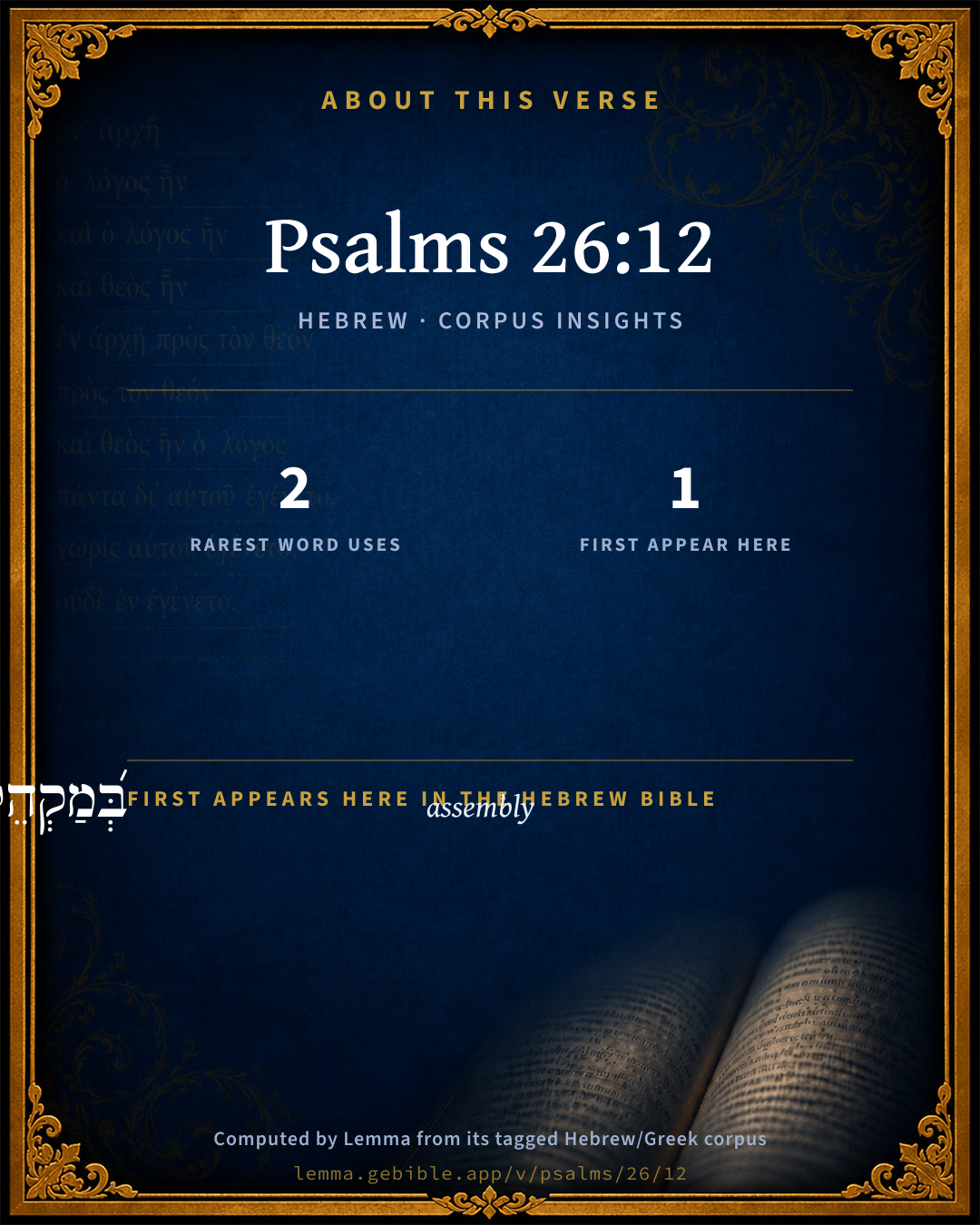
The rarest word here is בְּ֝מַקְהֵלִ֗ים assembly H4721 — appearing just 2 times in the whole Hebrew Bible.

First appearance in Scripture

This word makes its first canonical appearance in the Hebrew Bible here:

  • בְּ֝מַקְהֵלִ֗ים assembly H4721

Shared distinctive vocabulary

בְּ֝מַקְהֵלִ֗ים assembly H4721 occurs in 2 verses of the Hebrew Bible. Also found in:

Grammatical profile

  • 2 verbs
  • 4 nouns

Verb forms

  • עָֽמְדָ֣ה Qal · Perfect
  • אֲבָרֵ֥ךְ Piel · Imperfect

Hebrew & Septuagint length

In English translation the verse runs 14 words from the Hebrew and 16 from the Septuagint (LXX English) — closely comparable.

A rough comparison of the two English renderings, which tokenize alike — not a word-level alignment.

Word counts can differ between the Hebrew and the Greek without any difference in meaning — e.g. the Hebrew direct-object marker אֵת has no separate Greek word, and Greek often adds the article ὁ.

Cross-references

10

Topical passages linked to Psalms 26:12 in the Treasury of Scripture Knowledge — connected by theme and wording, ordered by reader-vote popularity; previews shown in the World English Bible.

  • Psalms 27:11 Teach me your way, Yahweh. Lead me in a straight path, because of my enemies.
  • Psalms 40:2 He brought me up also out of a horrible pit, Out of the miry clay. He set my feet on a rock, And gave me a firm place to stand.
  • 1 Samuel 2:9 He will keep the feet of his holy ones; But the wicked shall be put to silence in darkness; For by strength shall no man prevail.
  • Psalms 111:1 Praise Yah! I will give thanks to Yahweh with my whole heart, In the council of the upright, and in the congregation.
  • Psalms 22:22–25 I will declare your name to my brothers. In the midst of the assembly, I will praise you.
  • Proverbs 10:9 He who walks blamelessly walks surely, But he who perverts his ways will be found out.
  • Psalms 26:7 That I may make the voice of thanksgiving to be heard, And tell of all your wondrous works.
  • Hebrews 2:12 saying, "I will declare your name to my brothers. In the midst of the congregation I will sing your praise."
  • Psalms 107:32 Let them exalt him also in the assembly of the people, And praise him in the seat of the elders.
  • Psalms 122:4 Where the tribes go up, even Yah's tribes, According to an ordinance for Israel, To give thanks to the name of Yahweh.

Cross-references courtesy of OpenBible.info (CC BY 4.0).

Hebrew and Greek witnesses Masoretic Hebrew ↔ Greek Septuagint

The same verse in the two great witnesses to the Old Testament, shown verse-for-verse.

You’re reading Greek Psalm 25 (Hebrew Psalm 26). The Septuagint counts the superscription, so verse numbers can differ from the Hebrew — chapter-level alignment, not verse-by-verse. Numbering follows Rahlfs.

These are two independent witnesses, not word-aligned to each other, and the Septuagint is shown in lemma (dictionary) form.

Hebrew Psalms 26:12 Masoretic · Westminster Leningrad Codex

רַ֭גְלִי עָֽמְדָ֣ה בְמִישׁ֑וֹר בְּ֝מַקְהֵלִ֗ים אֲבָרֵ֥ךְ יְהוָֽה

My foot stands in an even place. In the congregations I will bless Yahweh.

World English Bible · Public Domain

Greek LXX Greek Psalm 25:12 Septuagint · lemma form

ὁ γάρ πούς ἐγώ ἵστημι ἐν εὐθύτης ἐν ἐκκλησία εὐλογέω σύ κύριος

My foot stands in an even place: in the congregations will I bless you, O Lord.

LXX2012 (modern English Septuagint) · Public Domain

On this verse, Keil & Delitzsch discusses the Septuagint’s reading. Read the note in Commentary ↓

Hebrew: Westminster Leningrad Codex (CC BY 4.0). Greek: Septuagint (public domain); English from LXX2012 (modern English Septuagint) (Public Domain). How the Septuagint differs from the Hebrew →

Commentary

Notes on Psalms 26:12 from classic Christian and Jewish commentators (each source and its license shown beneath its notes). The classic Christian expositions comment on the surrounding passage and are grouped to its opening verse, so a note may address several verses; the Jewish commentaries on the Tanakh (Rashi and others) are per-verse, so they appear only where the commentator wrote on this verse.

Lemma curates 59 commentaries, every one of them public domain or Creative Commons licensed, each selected and text-cleaned for this edition rather than reprinted as found. About our sources →

Adam Clarke's Commentary

Verse 12. My foot standeth in an even place] On the above principles I have taken my stand: to abhor evil; to cleave to that which is good; to avoid the company of wicked men; to frequent the ordinances of God; to be true and just in all my dealings with men; and to depend for my support and final salvation on the mere mercy of God. He who acts in this way, his feet stand in an even place.

I will bless the Lord.] In all my transactions with men, and in all my assemblings with holy people, I will speak good of the name of the Lord, having nothing but good to speak of that name.

ANALYSIS OF THE TWENTY-SIXTH PSALM

There are four general parts in this Psalm: -

I. An appeal of David to God to be his Judge, Ps 26:1-2.

II. The causes that induced him to make the appeal. His conscious innocence, integrity, c.

III. A petition, Ps 26:9-11.

IV. His gratitude, Ps 26:12.

I. He begins with his appeal to God, whom he knew to be a just Judge and therefore desires to be dealt with according to law: "Judge me; examine me; prove me; try me; even my reins and my heart."

II. Then he assigns two causes of it; his integrity and his faith.

1. His faith and confidence in God were such that he knew that the Judge of all the world would do him right. "I have trusted in the Lord, therefore, I shall not slide." I will not change my religion, though powerfully tempted to do so.

2. His integrity: "I have walked in my integrity." For which he assigns the cause: "Thy loving-kindness is before my eyes; I have walked in thy truth." I follow thy word, and the principle it lays down.

Next he sets down his integrity by an injunction of parts, which were two: 1. How he carried himself to men; 2. How he conducted himself towards God.

1. He abstained from all society, confederacy, counsels, and intimacy with wicked men; he did hate and abominate their ways: "I have not sat in counsel with vain persons, neither will I go in with dissemblers. I have hated the congregation of evil doers, and will not sit with the wicked."

2. The other degree of his integrity was, his piety: "I will wash my hands in innocence," i.e., I will worship thee; and for this end he would keep his hands from blood, oppression, c., in order that he "might publish with the voice of thanksgiving, and tell of all the wondrous works of the Lord."

3. He mentions a second act of his piety, his love to God's house, and the service done in it: "O Lord, I have loved the habitation of thy house, and the place where thy honour dwelleth."

III. Upon which conscientiousness of his integrity he falls to prayer, that God would not suffer him to be polluted with the conversation of wicked men, nor involved in their punishment: "Gather not my soul with sinners."

Observe the many titles he gives to wicked men: -

1. They are vain persons void of the fear of God; irreligious, Ps 26:4.

2. Deep, dark men; saying one thing with their mouth, and another with their heart, Ps 26:4.

3. Malignant; doing all for their own ends, Ps 26:5.

4. Impious; regardless of God and religion, Ps 26:5.

5. Sinners; traders in wickedness, Ps 26:9.

6. Blood-thirsty men; cruel and revengeful. Ps 26:9.

7. Mischievous; ready to execute with their hands what they had plotted in their heart, Ps 26:10.

8. Lovers of bribes; perverting judgment for the sake of money, Ps 26:10.

With such David will have nothing to do: "But as for me, I will walk in my integrity." Redeem me from such people, and be merciful to me.

IV. Lastly. He shows his gratitude. "My foot stands in an even place;" hitherto I am sure I am in the good way. I will therefore praise the Lord in the congregation; not only privately, but publicly.

My foot hath hitherto been kept right by thy grace and mercy; therefore, when thou shalt bring me back again to thy temple, I will not be ungrateful, but will sing praises to thy name in and with the great congregation. Amen.

Adam Clarke's Commentary on the Bible (1810–1826) — public domain. Text from a community e-Sword/MySword module.

Trapp's Complete Commentary

John Trapp

Psa 26:12 My foot standeth in an even place: in the congregations will I bless the LORD.

Ver. 12. My foot standeth in an even place] i.e. Mine affections are in an equal tenor. A good man is τετραγωνος ολοκληρος, the scales of his mind neither rise up toward the beam, through their own lightness, or their overly weened opinion of prosperity; nor are too much depressed with any load of sorrow, but hanging equal and unmoved between both, give him liberty in all occurrences to enjoy himself.

I will bless the Lord] For performance of promises; chiefly in that great panegyris {general assemble} Heb 12:23

John Trapp, A Commentary or Exposition upon All the Books of the Old and New Testament (1647–1656) — public domain. Text from a community e-Sword module.

The Biblical Illustrator

Joseph S. Exell

Psa_26:12

My foot standeth in an even place: in the congregations will I bless the Lord.

An even place

I. The even place on which the believers foot will stand.

II. The benefits in possession, in experience, and in prospect which he will derive from this standing.

III. The occasion, and the manner in which it will become him to express his gratitude. (Thomas Dale.)

Worship in the beauty of holiness

By the foot, the instrument of motion, we understand the whole turn and conduct of life. Thus the ways of a man denote his doings and his dealings, the affections which govern him, and the actions proceeding from them. When these are right, or even, we may appeal to God as Judge, worship Him in the beauty of holiness, bless Him in the congregations.

I. Holiness of life is a proper qualification for all who would worship God with acceptance. Holiness likens us to God. He desires the holy to worship Him, respects their service, and bestows His blessing.

II. Holiness of life is an essential as well as a proper qualification for all resorts to God in religious offices. Worship is not enjoined on us for the sake of God, but for our own benefit. Its main intent is to lodge with us a sense of our depending upon Him for all we have and all we hope for, to the end that it may secure our obedience to His commands and provide effectually for our final happiness. We cannot, therefore, approach Him in worship without a heart and life corresponding. (N. Marshall, D. D.)

Blessing God in the congregation

If a saints single voice in prayer is so sweet to Gods ear, much more His saints prayer and praise in consort together. A father is glad to see any one of his children, and makes him welcome when he visits him, but much more when they come together; the greatest feast is when they all meet at his house. The public praises of the Church are the emblem of heaven itself. There is a wonderful prevalence in the joint prayers of His people. When Peter was in prison the Church meets and prays him out of his enemies hands. A prince will grant a petition subscribed by the hands of a whole city, which, may be, he would not grant at the request of a private subject. (H. Gurnall.)

.

Psa_27:1-14

The Biblical Illustrator, edited by Joseph S. Exell (c. 1880s–1900s) — public domain. Text from a community e-Sword module.

Joseph Benson's Commentary

Psa 26:12. My foot standeth in an even place — Hebrew, במישׁור, bemishor, in rectitude. I stand upon a sure and solid foundation, being under the protection of God’s promise and his almighty and watchful providence. Or the sense may be, I do and will persist in my plain, righteous, and straight course of life, not using those frauds and wicked arts, and perverse and crooked paths, which mine enemies choose and walk in. And, thus understood, it is the same thing with his walking in his integrity, expressed in the foregoing verse and Psa 26:1. In the congregations will I bless the Lord — I will not only privately acknowledge, but publicly, and in the assemblies of thy people, celebrate thy praise.

Joseph Benson's Commentary on the Old and New Testaments (1811–1818) — public domain. Text from a community e-Sword module.

J. A. Alexander on Psalms

Joseph Addison Alexander

12. (Psa 26:12) My foot stands in an even place; in the assemblies will I bless Jehovah. As a state of danger and distress might be compared to a precipitous and rugged path, so one of ease and safety is denoted by a smooth or level path. My foot (now) stands, or has (at last) stood, found a resting-place, implying previous wanderings and hardships.—The assemblies primarily meant are no doubt the stated congregations at the sanctuary. The determination to praise God implies a strong assurance that the occasion for so doing will be granted. See above, on Psa 5:8 (7). The whole verse indeed is an expression of confident belief that God will hear and answer the foregoing prayers, and thus, as in many other psalms, we are brought back at the conclusion to the starting-point. Compare the last clause of Psa 26:1.

Joseph Addison Alexander, The Psalms Translated and Explained (1850) — public domain. Text from a community e-Sword module.

Tyndale Open Study Notes

Tyndale Open Resources

26:12 The psalmist’s footing on solid ground represents salvation (cp. 143:10). • publicly: Or in the great assembly at the Temple (26:6-8; 22:25).

Tyndale Open Study Notes — © Tyndale Open Resources, licensed CC BY-SA 4.0. Text via the HelloAO Bible API.

Geneva Bible (1599)

Geneva Bible translators

I am preserved from mine enemies by the power of God, and therefore will praise him openly.

Geneva Bible (1599) marginal notes — public domain. Text via Bolls.life.

Jamieson, Fausset & Brown

Robert Jamieson, A. R. Fausset & David Brown

even place--free from occasions of stumbling--safety in his course is denoted. Hence he will render to God his praise publicly.

Next: Psalms Chapter 27

Jamieson, Fausset & Brown — Commentary Critical and Explanatory on the Whole Bible (1871) — public domain (CC PDM 1.0). Text via the HelloAO Bible API.

John Calvin's Commentaries

This verse may be explained in two ways. Some are of opinion that David declares how carefully he had studied uprightness among men; but I rather think that he celebrates the grace of God towards him, and, at the same time, vows his gratitude. By the use of the metaphor, therefore, he tells us that he was preserved in safety. And as he knew that it was the hand of God alone which enabled him to stand, he therefore addresses himself to the exercise of praise and thanksgiving. Nor does he merely say, that he will acknowledge in private the goodness of God bestowed upon him, but in public also, that the assemblies of God’s people may be witnesses of it. It is highly necessary that every one should publicly celebrate his experience of the grace of God, as an example to others to confide in him. “Qu’elle soit celebree publiquement; afin qu’elle serve d’exempleaux autres pour se confermer en Dieu.” — Fr.

John Calvin's Commentaries (1540-1563) — public domain. Text from the Calvin Translation Society English edition (1840s-50s) via the Christian Classics Ethereal Library (ccel.org). Calvin's coverage is partial (roughly two-thirds of the Bible); uncommented books and verses are honest gaps, never fabricated. The 19th-century editor's footnotes and remarks are omitted so the notes are faithfully Calvin's own voice.

Ellicott's Commentary for English Readers

(12) My foot standeth.—It seems more in accordance with the general drift of the poem to take this verse, When I stand in an even or level place [i.e., when I am rescued from the difficulties which now beset me] I will praise Jehovah in the congregation.

A Bible Commentary for English Readers, edited by Charles John Ellicott (1878–1897) — public domain. Text from a community e-Sword module.

The Cambridge Bible for Schools and Colleges

gen. ed. J. J. S. Perowne

12. Faith realises the answer to its prayer as already granted, and security assured. He has traversed the rough winding path through the gloomy defile, and stands in the open plain, where there is no more fear of stumbling or sudden assault. Life thus prolonged is the reason and the opportunity for public thanksgiving. Cp. Psa_22:25.

The Cambridge Bible for Schools and Colleges (gen. ed. J. J. S. Perowne; Cambridge University Press, 1878–1918) — public domain. Text from a community e-Sword module.

John Gill's Exposition

My foot standeth in an even place,.... Or "in a plain" (b); in a sure place; on Christ the sure foundation, and who is the plain way and path to eternal life; see Psa 27:11; or in the ways and worship of God, prescribed by his word; and so denotes steadfastness and continuance in them;

in the congregations will I bless the Lord; in the assemblies of the saints, in the churches of Christ below, and in the great congregation above, in the general assembly and church of the firstborn; where it is the work of saints now, and will be hereafter, to praise the Lord, for all his mercies temporal and spiritual.

(b) "in plano", Musculus, Junius & Tremellius, Piscator, Cocceius, Michaelis; "in planitie", Gejerus.

Next: Psalms Chapter 27

John Gill's Exposition of the Whole Bible (1746–1763) — public domain (CC PDM 1.0). Text via the HelloAO Bible API.

Albert Barnes' Notes on the Bible

My foot standeth in an even place - The word rendered “even place” - מישׁור mı̂yshôr - means properly “righteousness,” or “justice;” then, “evenness, a level region, a plain:” Isa 40:4; Isa 42:16. DeWette renders it, “in a right path.” The idea is, either that he was standing now on smooth and level ground; or that he was walking in a straight path, in contradistinction from the crooked and perverse ways of the wicked; that is, he had found now a level road where he might walk securely. The latter is probably the true meaning. He had been anxious about his condition. He had been examining the evidences of his piety. He had had doubts and fears. He had seen much to apprehend, and he had appealed to God to determine the question on which he was so anxious - whether his hope was built on a solid foundation. His path in these inquiries, and while his mind was thus troubled, was like a journey over a rough and dangerous road - a road of hills and valleys - of rocks and ravines. Now he had found a smooth and safe path. The way was level. He felt secure; and he walked calmly and safely along, as a traveler does who has past over dangerous passes and who feels that he is on level ground. The idea is, that his doubts had been dissipated, and he now felt that his evidences of piety were well founded, and that he was truly a child of God.

In the congregations will I bless the Lord - In the assemblies of his people will I praise him. Compare Psa 22:22. The meaning is, that in the great assembly he would offer special praise that God had resolved his doubts, and had given him so clear evidence that he was truly his friend. He would go to the house of God, and there render to Him public praise that he had been able to find the evidence which he desired. No act could be more appropriate than such an act of praise, for there is nothing for which we should render more hearty thanks than for any evidence that we are truly the friends of God, and have a well-founded hope of heaven. The whole psalm should lead us carefully to examine the evidences of our piety; to bring before God all that we rely on as proof that we are His friends; and to pray that He will enable us to examine it aright; and, when the result is, as it was in the case of the psalmist - when we can feel that we have reached a level place and found a smooth path, then we should go, as he did, and offer hearty thanks to God that we have reason to believe we are His children and are heirs of salvation.

Albert Barnes' Notes on the Bible (1834–1885) — public domain. Text from a community e-Sword/MySword module.

Matthew Poole's English Annotations

In an even place, Heb. in rectitude, or

in a right, or straight, or plain, or even place; which may be understood either,

1. Civilly, or in regard of his outward condition. So this is opposed to the slippery places, in which wicked men are said to be, Psa 35:6; 73:18; Jer 23:12; and the sense is, I stand upon a sure and solid foundation, where I fear no fall, nor to be overthrown by the assaults of mine enemies, being under the protection of God’s promise, and his almighty and watchful providence. Or,

2. Morally, or in regard of his conversation. So the sense is, I do and will persist or continue (which is oft signified by standing, as Psa 1:1) in my plain, and righteous, and straight course of life, not using those frauds, and wicked arts, and perverse and crooked paths, which mine enemies choose and walk in, or whereof they do falsely accuse me. And so this is the same thing for substance with his

walking in his integrity, expressed in the foregoing verse, as also Psa 26:1.

In the congregations will I bless the Lord; I will not only privately acknowledge, but publicly, and in the assemblies of thy people, celebrate thy praises, both for thy grace enabling and inclining me to choose, and love, and persevere in the ways of holiness and righteousness, and for thy protection hitherto afforded to me in the midstof all my dangers and troubles, and for that well-grounded assurance which thou hast given me, of thy favour, and of thy future deliverance.

Matthew Poole's English Annotations on the Holy Bible (1683–1685) — public domain. Text from a community e-Sword/MySword module.

The Treasury of David

Charles H. Spurgeon

Ver. 12. The song began in the minor, but it has now reached the major key. Saints often sing themselves into happiness. The even place upon which our foot stands is the sure, covenant faithfulness, eternal promise and immutable oath of the Lord of Hosts; there is no fear of falling from this solid basis, or of its being removed from under us. Established in Christ Jesus, by being vitally united to him, we have nothing left to occupy our thoughts but the praises of our God. Let us not forsake the assembling of ourselves together, and when assembled, let us not be slow to contribute our portion of thanksgiving. Each saint is a witness to divine faithfulness, and should be ready with his testimony. As for the slanderers, let them howl outside the door while the children sing within.

Ver. 12. On an even place. As a man whose feet are firmly fixed upon even ground is apprehensive of no fall, so the pious worshippers of Jehovah feel no dread lest their adversaries should finally triumph over them. William Walford.

Ver. 12. Secure standing, honoured position, grateful praise.

Ver. 12 (last clause). Congregational Psalmody, and our personal share in it.

Charles H. Spurgeon's The Treasury of David (1869–1885) — public domain. Psalms only. Text from a community e-Sword/MySword module.

Whedon's Commentary on the Bible

Daniel D. Whedon

12. An even place—In a level and plain path.

In the congregations—In the public assemblies, which implies his restoration to Jerusalem and the regular worship—a pledge of the acceptance of all his petitions.

Daniel D. Whedon (gen. ed.), Commentary on the Old and New Testaments (1874–1909) — public domain. Text from a community e-Sword module.

The Pulpit Commentary

My foot standeth in an even place; or, on level ground where there is nothing to cause me to stumble. (comp. Psa_27:11) In the congregations will I bless the Lord; i.e. in the assemblies of the people for public worship. David constantly acknowledges this duty. (Psa_22:22, 25 27:6 35:18 40:9, 10 68:26, etc.) Indeed, it is the general idea that underlies all his psalms of praise, since they wore composed to be recited in the congregation.

The Pulpit Commentary (1880–1919), ed. H.D.M. Spence-Jones & Joseph S. Exell — public domain. Text from a community e-Sword module.

John Wesley's Explanatory Notes

Standeth - I stand upon a sure and solid foundation, being under the protection of God's promise, and his almighty and watchful providence. Congregations - I will not only privately, but in the assemblies of thy people celebrate thy praise.

John Wesley, Explanatory Notes Upon the Whole Bible (1754–1765) — public domain. Text via the GEBible commentary corpus.

Keil & Delitzsch

C. F. Keil & F. Delitzsch

The epilogue. The prayer is changed into rejoicing which is certain of the answer that shall be given. Hitherto shut in, as it were, in deep trackless gorges, he even now feels himself to be standing בּמישׁור,

(Note: The first labial of the combination בם, בף, when the preceding word ends with a vowel and the two words are closely connected, receives the Dagesh contrary to the general rule; on this orthophonic Dag. lene, vid., Luth. Zeitschr., 1863, S. 414.)

upon a pleasant plain commanding a wide range of vision (cf. בּמּרחב, Psa 31:9), and now blends his grateful praise of God with the song of the worshipping congregation, קהל (lxx ἐν ἐκκλησίαις), and its full-voiced choirs.

Keil & Delitzsch — Biblical Commentary on the Old Testament (1861–1891) — public domain (CC PDM 1.0). Text via the HelloAO Bible API. (Old Testament only.)

Rashi

Rabbi Shlomo Yitzchaki (Rashi)

My foot stood on a straight path Heb. במישור, on a straight path.

Rashi on the Tanakh — English translations: “The Judaica Press complete Tanach with Rashi, translated by A. J. Rosenberg” (CC BY 4.0); “Pentateuch with Rashi's commentary by M. Rosenbaum and A.M. Silbermann, 1929-1934” (public domain); “The Metsudah Tanach series, Lakewood, N.J” (CC BY 4.0); and “The Book of Joshua, Metsudah Publications, 1997” (CC BY 4.0). Text via Sefaria.

Lesson kit

Teaching starters — assembled from the data on this page, not authored interpretation. Every prompt links to the verse data it draws on. Edit before teaching.

Psalms, in the Wisdom, opens this verse with 6 words (6 distinct Hebrew lemmas). Its most distinctive word is maqhêl (“assembly”). A historical commentator’s framing appears above. Read the whole chapter for the surrounding context.

Discussion questions

  1. What does “assembly” (maqhêl) contribute to the verse as a whole?
  2. This is the first place “assembly” appears in Scripture (first appears here). What does its debut here establish?
  3. How does Psalms 68:26, which shares the word «assembly», read alongside this verse?
  4. These translations render this verse differently. What is at stake in choosing one wording over another?
  5. «עָֽמְדָ֣ה» is a Qal Perfect verb. How does that grammatical form shape the action described?
  6. Compare how Adam Clarke's Commentary and Trapp's Complete Commentary read this verse. Where do they agree or differ?

Things to notice

Reading settings

Reading text

Shown beneath each verse's original-language words.

Old Testament
Old Testament edition

Read the OT as the Masoretic Hebrew (MT) or the Greek Septuagint (LXX).

English shown for the Greek Septuagint (in the Hebrew ↔ Greek comparison).

Comparing translations? Open the Compare panel on any verse page to stack up to four side by side.