Genesis 31:55

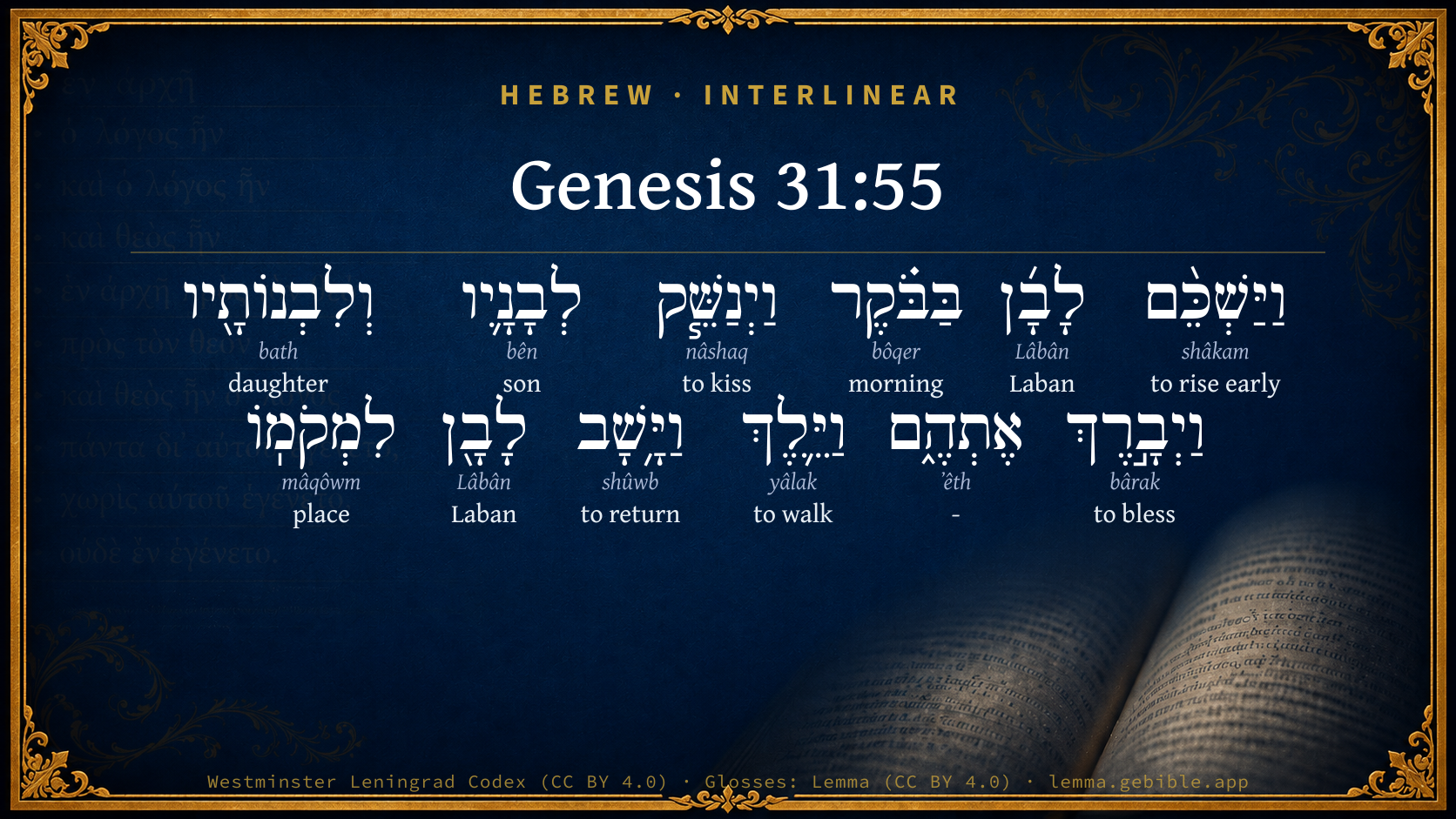
Hebrew (Westminster Leningrad Codex) Genesis 31:55 appears in the Hebrew Old Testament. The text above is from the Westminster Leningrad Codex. Each word links to its Strong’s number, a concise gloss, and parsing drawn from the Open Scriptures Hebrew Bible morphology. Click any word for its full Brown-Driver-Briggs (BDB) entry.
Download image
Cite this verse

Genesis 31:55 (World English Bible). Public Domain. Lemma interlinear Bible study tool, https://lemma.gebible.app/v/genesis/31/55.

Show BibTeX & RIS
BibTeX
RIS
English Translation
Early in the morning, Laban rose up, and kissed his sons and his daughters, and blessed them. Laban departed and returned to his place.
World English Bible · Public Domain
Download a study sheet

One document with this verse’s original text, its word-by-word gloss line, the meaning frame, cross-references with their text, attributed commentary, and full source and license credits — printable, and it pastes into notes with its structure intact.

This verse Autodidact and up

Study sheet (.html) Plain text (.txt)

A passage Seminary Student

Up to 50 verses in one chapter. A passage sheet keeps up to 6 commentary sources and 12 cross-references per verse, in the order this page ranks them, and says so on the sheet whenever that leaves anything out. Ask for a single verse and you get the Autodidact verse sheet above.

Everything on this page stays free to read, with no account — the sheet is a download of what is already on screen, not access to it.

Want to remove ads? Support Godless Engineer
Compare translations 3

The same verse in 3 English versions, stacked beneath the original-language interlinear above. Click any original word for its lexicon entry.

Each is an independent rendering of the whole verse — the interlinear is not word-aligned to these translations.

Highlighted words mark where these versions differ — a whole-verse word diff, not a word-by-word alignment.

  • World English Bible Public Domain
    Early in the morning, Laban rose up, and kissed his sons and his daughters, and blessed them. Laban departed and returned to his place.
  • King James Version Public Domain
    And early in the morning Laban rose up, and kissed his sons and his daughters, and blessed them: and Laban departed, and returned unto his place.
  • unfoldingWord Literal Text CC BY-SA 4.0
    Then in the morning Laban got up early and kissed his grandchildren and his daughters, and he blessed them. Then Laban left and returned to his place.

unfoldingWord Literal Text — © unfoldingWord, licensed CC BY-SA 4.0. Word-aligned USFM3 via Door43 (git.door43.org/unfoldingWord/en_ult).

Versions to compare (up to 4)

3 of 4 selected

Show all 18 translations

Every available English version of this verse, each an independent rendering of the whole verse.

  • World English Bible Public Domain
    Early in the morning, Laban rose up, and kissed his sons and his daughters, and blessed them. Laban departed and returned to his place.
  • Berean Standard Bible Public Domain
    Early the next morning, Laban got up and kissed his grandchildren and daughters and blessed them. Then he left to return home.
  • Majority Standard Bible Public Domain
    Early the next morning, Laban got up and kissed his grandchildren and daughters and blessed them. Then he left to return home.
  • King James Version Public Domain
    And early in the morning Laban rose up, and kissed his sons and his daughters, and blessed them: and Laban departed, and returned unto his place.
  • American Standard Version (1901) Public Domain
    And early in the morning Laban rose up, and kissed his sons and his daughters, and blessed them: and Laban departed and returned unto his place.
  • Revised Version (1885) Public Domain
    And early in the morning Laban rose up, and kissed his sons and his daughters, and blessed them: and Laban departed, and returned unto his place.
  • Geneva Bible (1599) Public Domain
    And earely in the morning Laban rose vp and kissed his sonnes and his daughters, and blessed them, and Laban departing, went vnto his place againe.
  • Douay-Rheims (1899) Public Domain
    But laban arose in the night, and kissed his sons, and daughters, and blessed them: and returned to his place.
  • Young's Literal Translation Public Domain
    and Laban riseth early in the morning, and kisseth his sons and his daughters, and blesseth them; and Laban goeth on, and turneth back to his place.
  • Literal Standard Version CC BY-SA 4.0
    and Laban rises early in the morning, and kisses his sons and his daughters, and blesses them; and Laban goes on, and turns back to his place.
  • Unlocked Literal Bible CC BY-SA 4.0
    Early in the morning Laban got up, kissed his grandsons and his daughters and blessed them. Then Laban left and returned home.
  • unfoldingWord Literal Text CC BY-SA 4.0
    Then in the morning Laban got up early and kissed his grandchildren and his daughters, and he blessed them. Then Laban left and returned to his place.
  • Darby Bible Public Domain
    And Laban rose early in the morning, and kissed his sons and his daughters, and blessed them; and Laban went and returned to his place.
  • World Messianic Bible Public Domain
    Early in the morning, Laban rose up, and kissed his sons and his daughters, and blessed them. Laban departed and returned to his place.
  • Webster's Bible Public Domain
    And early in the morning Laban arose, and kissed his sons and his daughters, and blessed them: and Laban departed, and returned to his place.
  • Free Bible Version CC BY-SA 4.0
    Laban got up early in the morning and kissed his grandchildren and his daughters goodbye. He blessed them, and then left to go back home.
  • Bible in Basic English Public Domain
    And early in the morning Laban, after kissing and blessing his daughters, went on his way back to his country.
  • JPS Tanakh (1917) Public Domain
    (32-1) And early in the morning Laban rose up, and kissed his sons and his daughters, and blessed them. And Laban departed, and returned unto his place.

Literal Standard Version (2020), Covenant Press — licensed CC BY-SA 4.0. Text via the HelloAO Bible API (eBible.org). Unlocked Literal Bible (unfoldingWord) — licensed CC BY-SA 4.0. Text via the HelloAO Bible API (eBible.org). unfoldingWord Literal Text — © unfoldingWord, licensed CC BY-SA 4.0. Word-aligned USFM3 via Door43 (git.door43.org/unfoldingWord/en_ult). Free Bible Version, Dr. Jonathan Gallagher — licensed CC BY-SA 4.0. Text via the HelloAO Bible API (eBible.org).

Word by word

More ways to search: Search by grammar → Find every occurrence → Compare this word →

Practice this passage: Drill this verse → Learn its vocabulary →

וַיְנַשֵּׁ֧ק
nâshaq
H5401
“and · to kiss”
Conjunction + Verb, Piel, Sequential Imperfect, 3rd Person, Masculine, Singular
Part of Speech
Conjunction + Verb
Stem
Piel
Form
Sequential Imperfect
Person
3rd Person
Gender
Masculine
Number
Singular
Full BDB Definition

Origin: a primitive root [identical with H5400 , through the idea of fastening up

TWOT: 1435 , 1436

to put together, kiss - (Qal) to kiss - (Piel) to kiss - (Hiphil) to touch gently - to handle, be equipped with - (Qal) to be equipped
  1. וַיַּשְׁכֵּ֨ם shâkam H7925 “and · to rise early” Conjunction + Verb, Hiphil, Sequential Imperfect, 3rd Person, Masculine, Singular
  2. לָבָ֜ן Lâbân H3837 “Laban” Noun, Proper
  3. בַּבֹּ֗קֶר bôqer H1242 “in/at the · morning” Preposition, Determined + Noun, Common, Masculine, Singular, Absolute
  4. לְבָנָ֛יו bên H1121 “to/for · sons · his” Preposition + Noun, Common, Masculine, Plural, Construct + Suffix, Personal, 3rd Person, Masculine, Singular
  5. וְלִבְנוֹתָ֖יו bath H1323 “and · to/for · daughters · his” Conjunction + Preposition + Noun, Common, Feminine, Plural, Construct + Suffix, Personal, 3rd Person, Masculine, Singular
  6. וַיְבָ֣רֶךְ bârak H1288 “and · to bless” Conjunction + Verb, Piel, Sequential Imperfect, 3rd Person, Masculine, Singular
  7. אֶתְהֶ֑ם ʼêth H853 “- · them” Particle, Direct Object + Suffix, Personal, 3rd Person, Masculine, Plural
  8. וַיֵּ֛לֶךְ yâlak H3212 “and · to walk” Conjunction + Verb, Qal, Sequential Imperfect, 3rd Person, Masculine, Singular
  9. וַיָּ֥שָׁב shûwb H7725 “and · to return” Conjunction + Verb, Qal, Sequential Imperfect, 3rd Person, Masculine, Singular
  10. לָבָ֖ן Lâbân H3837 “Laban” Noun, Proper
  11. לִמְקֹמֽוֹ mâqôwm H4725 “to/for · place · his” Preposition + Noun, Common, Masculine, Singular, Construct + Suffix, Personal, 3rd Person, Masculine, Singular

About this verse

These counts appear in no published source. They are computed here, from the morphology-tagged text and Lemma’s own curated glosses. What Lemma adds →

12
words
11
distinct lemmas
Pentateuch
section

Shared distinctive vocabulary

וַיְנַשֵּׁ֧ק to kiss H5401 occurs in 35 verses of the Hebrew Bible. Also found in:

Grammatical profile

  • 5 verbs
  • 6 nouns
  • 1 particle

Verb forms

  • וַיַּשְׁכֵּ֨ם Hiphil · Sequential Imperfect
  • וַיְנַשֵּׁ֧ק Piel · Sequential Imperfect
  • וַיְבָ֣רֶךְ Piel · Sequential Imperfect
  • וַיֵּ֛לֶךְ Qal · Sequential Imperfect
  • וַיָּ֥שָׁב Qal · Sequential Imperfect

Repetition

A word recurs within this verse — often emphatic in Hebrew:

  • לָבָ֜ן Laban H3837 ×2

Hebrew & Septuagint length

In English translation the verse runs 24 words from the Hebrew and 26 from the Septuagint (LXX English) — closely comparable.

A rough comparison of the two English renderings, which tokenize alike — not a word-level alignment.

Word counts can differ between the Hebrew and the Greek without any difference in meaning — e.g. the Hebrew direct-object marker אֵת has no separate Greek word, and Greek often adds the article ὁ.

Cross-references

17

Topical passages linked to Genesis 31:55 in the Treasury of Scripture Knowledge — connected by theme and wording, ordered by reader-vote popularity; previews shown in the World English Bible.

  • Genesis 31:28 and didn't allow me to kiss my sons and my daughters? Now have you done foolishly.
  • Genesis 18:33 Yahweh went his way, as soon as he had finished communing with Abraham, and Abraham returned to his place.
  • Genesis 30:25 It happened, when Rachel had borne Joseph, that Jacob said to Laban, "Send me away, that I may go to my own place, and to my country.
  • Deuteronomy 23:5 Nevertheless Yahweh your God wouldn't listen to Balaam; but Yahweh your God turned the curse into a blessing to you, because Yahweh your God loved you.
  • Genesis 24:60 They blessed Rebekah, and said to her, "Our sister, may you be the mother of thousands of ten thousands, and let your seed possess the gate of those who hate them."
  • Genesis 28:1 Isaac called Jacob, blessed him, and commanded him, "You shall not take a wife of the daughters of Canaan.
  • Genesis 31:43 Laban answered Jacob, "The daughters are my daughters, the children are my children, the flocks are my flocks, and all that you see is mine: and what can I do this day to these my daughters, or to their children whom they have borne?
  • Genesis 33:4 Esau ran to meet him, embraced him, fell on his neck, kissed him, and they wept.
  • Numbers 23:5 Yahweh put a word in Balaam's mouth, and said, Return to Balak, and thus you shall speak.
  • Numbers 23:8 How shall I curse, whom God has not cursed? How shall I defy, whom Yahweh has not defied?
  • Numbers 23:11 Balak said to Balaam, What have you done to me? I took you to curse my enemies, and, behold, you have blessed them altogether.
  • Numbers 24:25 Balaam rose up, and went and returned to his place; and Balak also went his way.
  • Deuteronomy 32:36 For Yahweh will judge his people, Repent himself for his servants; When he sees that [their] power is gone, There is none [remaining], shut up or left at large.
  • Ruth 1:14 They lifted up their voice, and wept again: and Orpah kissed her mother-in-law, but Ruth joined with her.
  • Psalms 76:10 Surely the wrath of man praises you. The survivors of your wrath are restrained.
  • Proverbs 16:7 When a man's ways please Yahweh, He makes even his enemies to be at peace with him.
  • Acts 28:4–5 When the natives saw the creature hanging from his hand, they said one to another, "No doubt this man is a murderer, whom, though he has escaped from the sea, yet Justice has not allowed to live."

Cross-references courtesy of OpenBible.info (CC BY 4.0).

Hebrew and Greek witnesses Masoretic Hebrew ↔ Greek Septuagint

The same verse in the two great witnesses to the Old Testament, shown verse-for-verse.

These are two independent witnesses, not word-aligned to each other, and the Septuagint is shown in lemma (dictionary) form.

Hebrew Genesis 31:55 Masoretic · Westminster Leningrad Codex

וַיַּשְׁכֵּ֨ם לָבָ֜ן בַּבֹּ֗קֶר וַיְנַשֵּׁ֧ק לְבָנָ֛יו וְלִבְנוֹתָ֖יו וַיְבָ֣רֶךְ אֶתְהֶ֑ם וַיֵּ֛לֶךְ וַיָּ֥שָׁב לָבָ֖ן לִמְקֹמֽוֹ

Early in the morning, Laban rose up, and kissed his sons and his daughters, and blessed them. Laban departed and returned to his place.

World English Bible · Public Domain

Greek LXX Genesis 31:55 Septuagint · lemma form
And Laban rose up in the morning, and kissed his sons and his daughters, and blessed them; and Laban having turned back, departed to his place.

LXX2012 (modern English Septuagint) · Public Domain

Hebrew: Westminster Leningrad Codex (CC BY 4.0). Greek: Septuagint (public domain); English from LXX2012 (modern English Septuagint) (Public Domain). How the Septuagint differs from the Hebrew →

Commentary

Notes on Genesis 31:55 from classic Christian and Jewish commentators (each source and its license shown beneath its notes). The classic Christian expositions comment on the surrounding passage and are grouped to its opening verse, so a note may address several verses; the Jewish commentaries on the Tanakh (Rashi and others) are per-verse, so they appear only where the commentator wrote on this verse.

Lemma curates 59 commentaries, every one of them public domain or Creative Commons licensed, each selected and text-cleaned for this edition rather than reprinted as found. About our sources →

Trapp's Complete Commentary

John Trapp

Gen 31:55 And early in the morning Laban rose up, and kissed his sons and his daughters, and blessed them: and Laban departed, and returned unto his place.

Ver. 55. Laban rose up.] Laban leaves him, Esau meets him, and both with a kiss. "When a man’s ways please the Lord, he maketh even his enemies to be at peace with him". {Pro 16:7}

John Trapp, A Commentary or Exposition upon All the Books of the Old and New Testament (1647–1656) — public domain. Text from a community e-Sword module.

Geneva Bible (1599)

Geneva Bible translators

We see that there is ever some seed of the knowledge of God in the hearts of the wicked.

Geneva Bible (1599) marginal notes — public domain. Text via Bolls.life.

Adam Clarke's Commentary

Verse 55. Kissed his sons and his daughters] That is, his grandchildren, Jacob's eleven sons with Dinah their sister, and their mothers Leah and Rachel. All these he calls his children, Ge 31:43. And blessed them - prayed heartily for their prosperity, though we find from Ge 31:29 that he came having bound himself by a vow to God to do them some injury. Thus God turned his intended curse into a blessing.

THE most important topics in this chapter have already been considered in the notes, and to those the reader is referred. Jacob's character we have already seen, and hitherto have met in it little to admire; but we shall soon find a blessed change both in his mind and in his conduct. Laban's character appears in almost every instance to disadvantage; he does not seem to be what we commonly term a wicked man, but he was certainly both weak and covetous; and covetousness extinguished in him, as it does in all its votaries, the principles of righteousness and benevolence, and the very charities of human life. Provided he could get an increase of property, he regarded not who was wronged or who suffered. In this case he hid himself even from his own bowels, and cared not that his own children should lack even the necessaries of life, provided he could increase his own store! How watchful should we be against this destructive, unnatural, and degrading vice! It is impossible for a man who loves money to love either God or man; and consequently he must be in the broad way that leads to destruction.

For the difficulties in the chronology of Jacob's sojourning in Padan-aram, I beg leave to refer to the following remarks.

Remarks upon Ge 31:38, c., relative to the time spent by Jacob in the service of his father-in-law Laban, in Mesopotamia from Dr. Kennicott.

"If every reading which introduces but a single difficulty demands our attention, much greater must that demand be when several difficulties are caused by any one mistake, or any one mistranslation. Of this nature is the passage before us, which therefore shall be here considered more fully, especially as I have not already submitted to the learned any remarks upon this subject. Jacob's age at the time of his going to Laban, has (till very lately) been fixed, perhaps universally, at seventy-seven years. But I think it has been shown by the learned Mr. Skinner, in an excellent dissertation, (4to. 1765,) that the number seventy-seven cannot here be right.

"Jacob was one hundred and thirty when he went down (with sixty-six persons) into Egypt. Joseph had then been governor ten years; and when made governor was thirty; therefore Jacob could not be more than ninety at the birth of Joseph. Now, upon supposition that Jacob was seventy-seven at going to Laban, and that he had no son till he was eighty-five, and that he, with eleven sons, left Laban at ninety-seven, there will follow these amongst other strange consequences which are enumerated by Mr. Skinner page 11, c.:

1. Though Isaac and Esau married at forty, Jacob goes at seventy-seven to look for a wife, and agrees to marry her seven years after.

2. Issachar is born after the affair of the mandrakes, which Reuben finds and brings home when he (Reuben) was about four years old that is, if Issachar was born before Joseph, agreeably to Ge 30:18; Ge 30:25.

3. Judah begets Er at thirteen; for in the first of the following tables Judah is born in Jacob's year eighty-eight, and Er in one hundred and two.

4. Er marries at nine, and is destroyed for profligacy. Er, born one hundred and two, marries in one hundred and eleven. See also Ge 38:7.

5. Onan marries at eight; for Onan, born in one hundred and three, marries in one hundred and eleven.

6. Shelah, being grown at ten, ought to be married; for Shelah, born in one hundred and four, is marriageable, but not married to Tamar in one hundred and fourteen. See Ge 38:14.

7. Pharez kept from marrying while young, yet has a son at thirteen; for Pharez, born in one hundred and fifteen, had two sons at going to Egypt in one hundred and thirty.

8. Esau goes to Ishmael and marries his daughter, after Jacob went to Laban at seventy-seven; though Ishmael died when Jacob was sixty-three.

9. If Jacob had no son till he was eighty-five, and if Joseph was born when his father was ninety, then the eleven sons and Dinah were born in five years.

Lastly, if Jacob had no son till eighty-five, and he went to Egypt at one hundred and thirty, with sixty-six persons, only forty-five years are allowed for his family; whereas the larger sum of sixty-five years seems necessary for the births of so many children and grandchildren. On this subject Le Clerc has pronounced, Hisce in rebus occurrunt nodi, quos nemo hactenus solvit; neque porro, ut opinor, solvet. There are difficulties here which have never been explained, and in my opinion never can be explained. But upon the single principle of Mr. Skinner, that Jacob went to Laban at fifty-seven, (instead of seventy-seven,) these difficulties are solved. And it only remains to wish that some authority may be found to support this conjecture, thus strongly founded on the exigentia loci. The common opinion is formed by reckoning back from the age of Joseph, when governor of Egypt, to the time of his birth, and from the twenty years which Jacob was with Laban. This number, Mr. Skinner thinks, was originally forty; and I think that the Hebrew text as it now stands confirms the conjecture, and furnishes the very authority which is so much wanted.

"After Jacob had served Laban fourteen years for his two wives, where was Jacob to reside? Esau was still living; and Jacob might well be afraid of returning to him, till more years of absence had disarmed his resentment; and had the death of Esau happened, Jacob would then have been secure. But let us also remember that Isaac was still alive, and that Esau had determined to kill Jacob whenever their father should die. It would therefore be no wonder if Jacob should have desired to continue longer in Haran. And to carry this point more effectually, he might offer to take care of Laban's cattle, and to live in his neighbourhood, upon such terms of advantage to Laban as could not easily be withstood. Lastly, when the good effects to Laban from this connection had been experienced, without profit, nay with some losses, to Jacob, for twenty years, Jacob might naturally grow tired of thus assisting Laban without providing for his own growing family. Accordingly we find that Jacob covenants with Laban for six years of more close attendance and service in Laban's own house, for which the wages were expressly settled. Agreeable to the preceding possibilities seems to have been the fact, Jacob living in Haran forty years, and in this manner: -

14 years in Laban's house, a covenant servant his wives.

20 in Laban's neighbourhood, as a friend.

6 in Laban's house, a covenant servant cattle.

40 "Now the twenty concurrent years of neighbourly assistance, and the disjointed twenty of covenant service, seem both of them distinguished in the history itself. For upon Laban's pursuit of Jacob he mentions twenty years twice; which two sets of twenty, if really different, make forty. Each mention of the twenty years is introduced with the word זה zeh, which word, when repeated, is used by way of distinction; as when we say, this and that, the one or the other. Thus, Ex 14:20: So that the one came not near the other. Ec 6:5: This hath more rest than the other. And with the two words at a great distance, Job 21:23: One dieth; Job 21:25; and another dieth, c. So here, in Ge 31:38, Jacob says to Laban, זה עשרים שנה אנכי עמך zeh esrim shanah anochi immach, during the ONE set of twenty years I was with thee, c. meaning the time in which he lived, not in Laban's house, but in his neighbourhood not as a servant, but a friend; after he had served in Laban's house fourteen years for his daughters, and before he served six years for his cattle. But then, as to the other twenty, he tells Laban, at Ge 31:41, varying the phrase very remarkably זה לי עשרים שנה בביתך עבדתיך zeh li esrim shanah bebeithecha abadticha, during the other twenty years (ל li) FOR MYSELF (for my own benefit) IN THY HOUSE; I served thee fourteen years, and six years, c. And during this last period, though only six years, he charges Laban with changing his wages ten times. So that Jacob insists upon having well earned his wages through the twenty years when he served for hire but he makes a far greater merit of having, for another twenty years, assisted him without wages, and even with some losses; and therefore, with particular propriety, he reminds Laban of that set of twenty years in the first place.

The following Tables, taken chiefly from Mr. Skinner, will greatly elucidate the true chronology of Jacob:

TABLE 1. - On Jacob's being at Haran only twenty years.

0 Jacob (and Esau) born.

40 Esau marries two wives, Hittites...........Ge 26:34.

63 Ishmael dies, aged 137.....................Ge 25:17.

77 Jacob goes to Haran.

84 marries Leah and Rachel.................Gen 29:20; Gen 29:21; Gen 29:27; Gen 29:28.

85 REUBEN born of Leah *

86 SIMEON do. *.....................Ge 29:32-35.

87 LEVI do. *

88 JUDAH do. *

89 Dan born of Bilhah *

Naphtali do.

Gad born of Zilpah *

Asher do. ...............Ge 30:6-24.

ISSACHAR born of Leah *

ZEBULUN and Dinah do.

91 JOSEPH born of Rachel *

97 Jacob returns from Haran.

98 dwells in Succoth.

99 comes to Shalem, and continues there eight years.

101 Judah marries Shuah's daughter.

102 Er born,-103 Onan,-104 Shelah.

106 Shechemites destroyed by Simeon and Levi.

107 BENJAMIN is born, and Rachel dies.

108 Joseph sold when seventeen.................Ge 37:2.

111 Tamar married to Er, and immediately afterwards to Onan.

114 Tamar's incest with Judah.

115 Pharez and Zarah born to Judah.

120 Isaac dies, aged 180.......................Ge 35:28.

121 Joseph is made governor of Egypt...........Ge 41:46.

130 Jacob goes into Egypt............................Ge 47:9.

147 and dies................................Gen 47:28; Gen 49:33.

TABLE II .- On Jacob's being at Haran forty years.

0 Jacob (and Esau) born.

40 Esau marries two wives, Hittites...........Ge 26:34.

1 57 Jacob goes to Haran.

4 58 Esau goes to Ishmael, and marries his daughter.Ge 28:9.

y 63 Ishmael dies, aged 137...................Ge 25:17.

e 64 Jacob marries Leah and Rachel.................Gen 29:20; Gen 29:21; Gen 29:27; Gen 29:28.

a 65 Reuben born of Leah *

r 66 Simeon do. *...................Ge 29:32-35.

s 67 Levi do. *

68 Judah do. *

s Rachel, not bearing, gives Bilhah *

v 69 Dan born of Bilhah

c 71 Naphtali do.

Leah, not bearing, gives Zilpah

2 *...Ge 30:6-24.

0 72 Gad born of Zilpah *

y 74 Asher do.

r 78 Reuben at 13 finds the mandrakes

s 79 Issachar born of Leah

- 81 Zebulun do. 82 Dinah *

a 86 Judah at 18 marries Shuah's daughter.***

s 87 Er born, - 88 Onan, - 89 Shelah.

s 91 Joseph born of Rachel.

t

6 ..................years service for cattle.

97 Jacob comes from Haran to Succoth and Shalem.

Dinah defiled, and the Shechemites destroyed.

98 Benjamin is born, and Rachel dies.

103 Beriah, fourth son of Asher, born.

105 Tamar married to Er-106 to Onan.

108 Joseph, at seventeen, is carried into Egypt..Ge 37:2.

109 Shelah, at twenty, not given to Tamar.

110 Pharez and Zarah born of Tamar, by Judah.

120 Isaac dies, aged 180.....................Ge 35:28.

121 Joseph, at thirty, governor of Egypt.....Ge 41:46.

123 Beriah, at twenty, marries.

125 Heber-127 Malchiel-born to Beriah.

128 Pharez, at eighteen, marries.

129 Hezron-130 Hamul-born to Pharez.

130 Benjamin, at thirty-two, has ten sons.

Jacob goes to Egypt...........................Ge 47:9.

147 and dies............................Gen 47:28; Gen 49:33.

*** Not placed in order of time, Ge 38.

57-71 = 14 years' service.

72-91 = 20 years' assistance.

"Our translation now is, Ge 31:38: THIS TWENTY YEARS HAVE I BEEN WITH THEE; thy ewes and thy she-goats have not cast their young, and the rams of thy flock have I not eaten. Ge 31:39. That which was torn of beasts I brought not unto thee; I bare the loss of it; of my hand didst thou require it, whether stolen by day or stolen by night.Ge 31:40. Thus I was; in the day the drought consumed me, and the frost by night; and my sleep departed from mine eyes.Ge 31:41. THUS HAVE I BEEN TWENTY YEARS IN THY HOUSE: I served thee fourteen years for thy two daughters, and six years for thy cattle; and thou hast changed my wages ten times.

"The alteration here recommended is this, Ge 31:38: DURING THE ONE TWENTY YEARS I WAS WITH THEE; thy ewes and thy she-goats have not cast their young, and the rams, c., c.Ge 31:41. DURING THE OTHER TWENTY YEARS FOR MYSELF, IN THY HOUSE, I served, &c. The same distinction is expressed in Ge 30:29: Thou knowest how I have served thee, and how thy cattle was with me i.e., how I behaved during the time I was with thee as thy servant, and how thy cattle fared during the time they were with me as thy friend.

"It must not be omitted that Archbishop Usher and Bishop Lloyd ascribe sons to Jacob very soon after his coming to Laban nay, assert that he was married almost as soon as he came to Haran, instead of waiting seven years, as he most evidently did. And Mr. Jackson allows that some of the sons of Benjamin, who are expressly numbered as going into Egypt with Jacob, might be born in Egypt! From such distresses, and such contradictions, does the distinction of two sets of twenty years happily deliver us,"

Hoc temporis intervallo nemo concipere poterit

tot res contingere potuisse. SPINOSA.

In such a short space of time, it is impossible that so many transactions could have taken place.

I shall leave this subject with chronologers and critics, and shall not attempt to decide on either opinion. That of Dr. Kennicott I think the most likely, and to it I have adapted the chronology in those cases to which it relates; but there are difficulties in both cases. See Clarke on Ge 38:1.

Adam Clarke's Commentary on the Bible (1810–1826) — public domain. Text from a community e-Sword/MySword module.

John Calvin's Commentaries

55. And blessed them. The character of the person is here to be noticed, because Laban, who had lapsed from true piety, and was a man of unholy and wicked manners, yet retained the habit of giving his blessing. For we are hereby taught, that certain principles of divine knowledge remain in the hearts of the wicked, so that no excuse may be left to them on the ground of ignorance; for the custom of pronouncing a blessing arises hence, that men are certainly persuaded that God alone is the author of all good things. For although they may proudly arrogate what they please to themselves; yet when they return to their right mind, they are compelled, whether they will or no, to acknowledge that all good proceeds from God alone.

John Calvin's Commentaries (1540-1563) — public domain. Text from the Calvin Translation Society English edition (1840s-50s) via the Christian Classics Ethereal Library (ccel.org). Calvin's coverage is partial (roughly two-thirds of the Bible); uncommented books and verses are honest gaps, never fabricated. The 19th-century editor's footnotes and remarks are omitted so the notes are faithfully Calvin's own voice.

The Cambridge Bible for Schools and Colleges

gen. ed. J. J. S. Perowne

55. sons and … daughters] Cf. Gen_31:28; Gen_31:43. His grandchildren as well as his two daughters.

unto his place] i.e. his home in Haran; cf. Gen_18:33; Num_24:25.

The Cambridge Bible for Schools and Colleges (gen. ed. J. J. S. Perowne; Cambridge University Press, 1878–1918) — public domain. Text from a community e-Sword module.

Haydock's Catholic Bible Commentary

Night (de nocte) when it was just at an end, and day-light appeared. --- His daughters, with Dina, &c. Thus all ended well and in peace, by the divine interposition, after the most serious alarms. (Haydock)

George Leo Haydock (1774–1849), Haydock's Catholic Family Bible and Commentary, 1859 edition — public domain. Excludes Psalms (Douay-Rheims chapter numbering differs from Protestant) and Deuterocanonical books (Catholic canon only).

Whedon's Commentary on the Bible

Daniel D. Whedon

55. Rose… kissed… blessed… departed… returned — There is something most touching and impressive in this affectionate farewell. The bad passions of the previous day and the wrongs of former years are all forgotten, and the two parties separate; the one to be the chosen people of God, the depositary of his oracles, the religious teachers of the world; the other to be lost from history.

Daniel D. Whedon (gen. ed.), Commentary on the Old and New Testaments (1874–1909) — public domain. Text from a community e-Sword module.

The Pulpit Commentary

And early in the morning Laban rose up, and kissed his sons and his daughters, i.e. Rachel and Leah and their children. It does not appear that Laban kissed Jacob on taking final leave of him as he did on first meeting him (Gen_29:3-9) and blessed them: (cf. Gen_14:6 Gen_28:1) and Laban departed, and returned unto his place Padan-aram (cf. Gen_18:33 Gen_30:25)

The Pulpit Commentary (1880–1919), ed. H.D.M. Spence-Jones & Joseph S. Exell — public domain. Text from a community e-Sword module.

Lesson kit

Teaching starters — assembled from the data on this page, not authored interpretation. Every prompt links to the verse data it draws on. Edit before teaching.

Genesis, in the Pentateuch, opens this verse with 12 words (11 distinct Hebrew lemmas). Its most distinctive word is nâshaq (“to kiss”). A historical commentator’s framing appears above. Read the whole chapter for the surrounding context.

Discussion questions

  1. What does “to kiss” (nâshaq) contribute to the verse as a whole?
  2. Genesis 27:26 shares the word «to kiss» with this verse. How do the two illuminate each other?
  3. “Laban” occurs 2× in this one verse. What is the effect of the repetition?
  4. These translations render this verse differently; the difference is in the English rendering, not the original. What questions does that raise?
  5. The verb «וַיַּשְׁכֵּ֨ם» is Hiphil Sequential Imperfect. How does its form color the action?
  6. Reading how Trapp's Complete Commentary and Geneva Bible (1599) read this verse, where do the two commentators agree and where do they part?

Things to notice

Reading settings

Reading text

Shown beneath each verse's original-language words.

Old Testament
Old Testament edition

Read the OT as the Masoretic Hebrew (MT) or the Greek Septuagint (LXX).

English shown for the Greek Septuagint (in the Hebrew ↔ Greek comparison).

Comparing translations? Open the Compare panel on any verse page to stack up to four side by side.