
Genesis 24:60

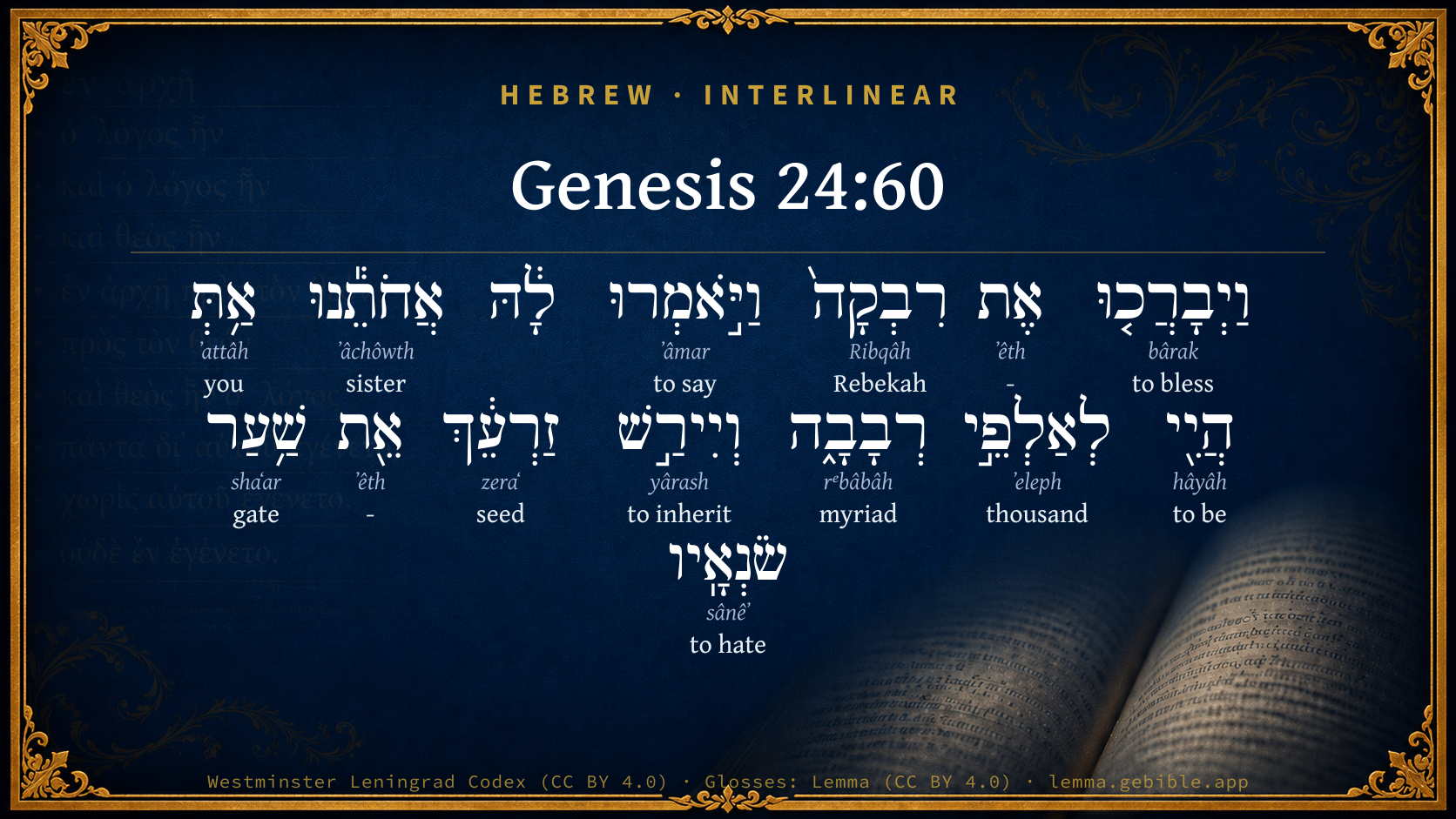
Hebrew (Westminster Leningrad Codex) Genesis 24:60 appears in the Hebrew Old Testament. The text above is from the Westminster Leningrad Codex. Each word links to its Strong’s number, a concise gloss, and parsing drawn from the Open Scriptures Hebrew Bible morphology. Click any word for its full Brown-Driver-Briggs (BDB) entry.
Download image
Cite this verse

Genesis 24:60 (World English Bible). Public Domain. Lemma interlinear Bible study tool, https://lemma.gebible.app/v/genesis/24/60.

Show BibTeX & RIS
BibTeX
RIS
English Translation
They blessed Rebekah, and said to her, "Our sister, may you be the mother of thousands of ten thousands, and let your seed possess the gate of those who hate them."
World English Bible · Public Domain
Highlights
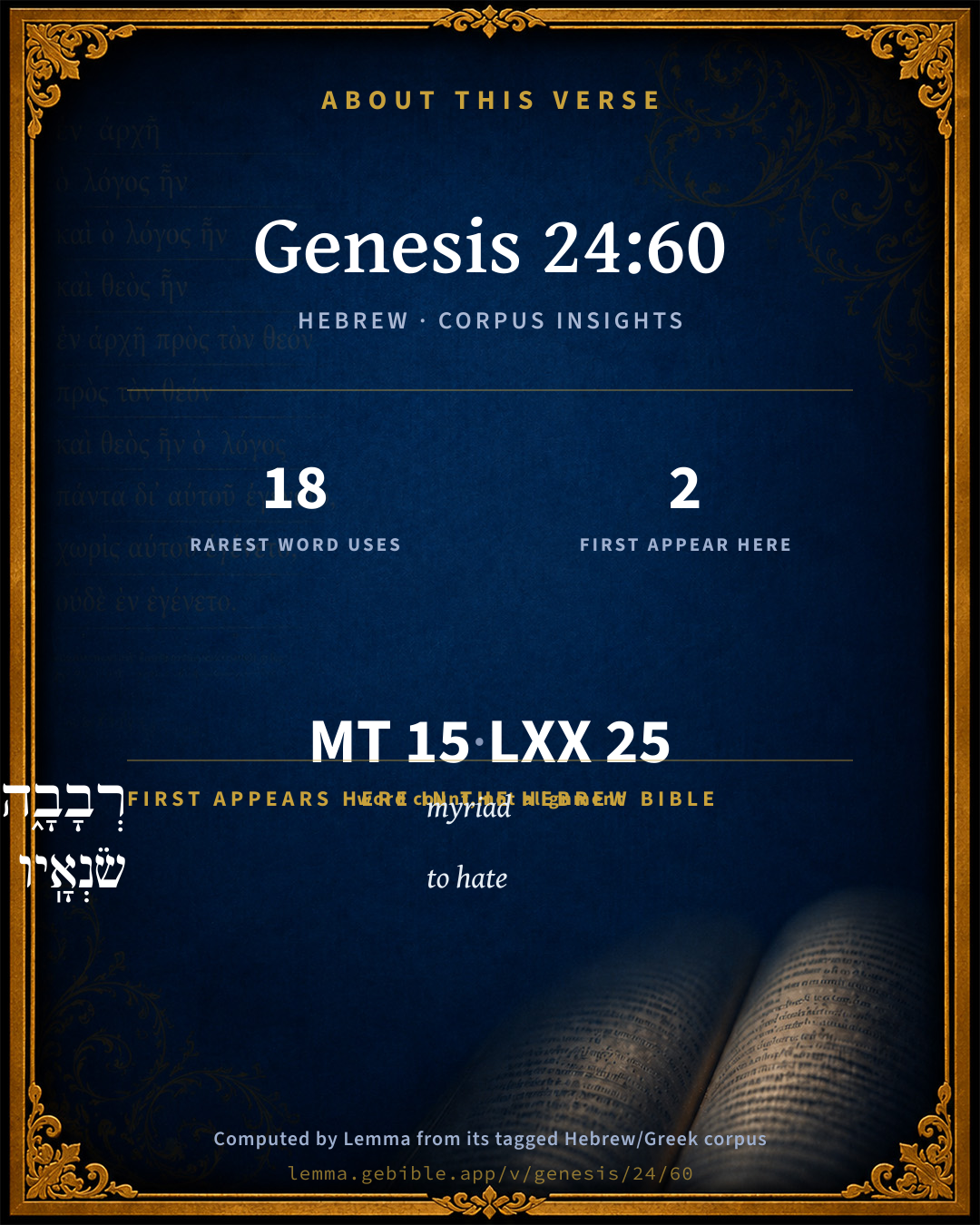
  • 2 first appearances in the Hebrew Bible
Full analysis ↓
Download a study sheet

One document with this verse’s original text, its word-by-word gloss line, the meaning frame, cross-references with their text, attributed commentary, and full source and license credits — printable, and it pastes into notes with its structure intact.

This verse Autodidact and up

Study sheet (.html) Plain text (.txt)

A passage Seminary Student

Up to 50 verses in one chapter. A passage sheet keeps up to 6 commentary sources and 12 cross-references per verse, in the order this page ranks them, and says so on the sheet whenever that leaves anything out. Ask for a single verse and you get the Autodidact verse sheet above.

Everything on this page stays free to read, with no account — the sheet is a download of what is already on screen, not access to it.

Want to remove ads? Support Godless Engineer
Compare translations 3

The same verse in 3 English versions, stacked beneath the original-language interlinear above. Click any original word for its lexicon entry.

Each is an independent rendering of the whole verse — the interlinear is not word-aligned to these translations.

Highlighted words mark where these versions differ — a whole-verse word diff, not a word-by-word alignment.

  • World English Bible Public Domain
    They blessed Rebekah, and said to her, "Our sister, may you be the mother of thousands of ten thousands, and let your seed possess the gate of those who hate them."
  • King James Version Public Domain
    And they blessed Rebekah, and said unto her, Thou art our sister, be thou the mother of thousands of millions, and let thy seed possess the gate of those which hate them.
  • unfoldingWord Literal Text CC BY-SA 4.0
    And they blessed Rebekah and said to her, “Our sister, may you become thousands of myriads, and may your offspring possess the gates of hating them!”

unfoldingWord Literal Text — © unfoldingWord, licensed CC BY-SA 4.0. Word-aligned USFM3 via Door43 (git.door43.org/unfoldingWord/en_ult).

Versions to compare (up to 4)

3 of 4 selected

Show all 18 translations

Every available English version of this verse, each an independent rendering of the whole verse.

  • World English Bible Public Domain
    They blessed Rebekah, and said to her, "Our sister, may you be the mother of thousands of ten thousands, and let your seed possess the gate of those who hate them."
  • Berean Standard Bible Public Domain
    And they blessed Rebekah and said to her, “Our sister, may you become the mother of thousands upon thousands. May your offspring possess the gates of their enemies.”
  • Majority Standard Bible Public Domain
    And they blessed Rebekah and said to her, “Our sister, may you become the mother of thousands upon thousands. May your offspring possess the gates of their enemies.”
  • King James Version Public Domain
    And they blessed Rebekah, and said unto her, Thou art our sister, be thou the mother of thousands of millions, and let thy seed possess the gate of those which hate them.
  • American Standard Version (1901) Public Domain
    And they blessed Rebekah, and said unto her, Our sister, be thou `the mother' of thousands of ten thousands, and let thy seed possess the gate of those that hate them.
  • Revised Version (1885) Public Domain
    And they blessed Rebekah, and said unto her, Our sister, be thou the mother of thousands of ten thousands, and let thy seed possess the gate of those which hate them.
  • Geneva Bible (1599) Public Domain
    And they blessed Rebekah, and sayde vnto her, Thou art our sister, growe into thousande thousands, and thy seede possesse the gate of his enemies.
  • Douay-Rheims (1899) Public Domain
    Wishing prosperity to their sister, and saying: Thou art our sister, mayst thou increase to thousands of thousands, and may thy seed possess the gates of their enemies.
  • Young's Literal Translation Public Domain
    and they bless Rebekah, and say to her, `Thou `art' our sister; become thou thousands of myriads, and thy seed doth possess the gate of those hating it.'
  • Literal Standard Version CC BY-SA 4.0
    and they bless Rebekah, and say to her, “You [are] our sister; become thousands of myriads, and your seed possesses the gate of those hating it.”
  • Unlocked Literal Bible CC BY-SA 4.0
    They blessed Rebekah, and said to her, “Our sister, may you be the mother of thousands of ten thousands, and may your descendants possess the gate of those who hate them.”
  • unfoldingWord Literal Text CC BY-SA 4.0
    And they blessed Rebekah and said to her, “Our sister, may you become thousands of myriads, and may your offspring possess the gates of hating them!”
  • Darby Bible Public Domain
    And they blessed Rebecca, and said to her, Thou art our sister; mayest thou become thousands of tens of thousands; and may thy seed possess the gate of their enemies!
  • World Messianic Bible Public Domain
    They blessed Rebekah, and said to her, “Our sister, may you be the mother of thousands of ten thousands, and let your offspring possess the gate of those who hate them.”
  • Webster's Bible Public Domain
    And they blessed Rebekah, and said to her, Thou art our sister, be thou the mother of thousands of millions, and let thy seed possess the gate of those who hate them.
  • Free Bible Version CC BY-SA 4.0
    They asked a blessing on her, saying, “Our dear sister, may you become the mother to thousands and thousands of descendants, and may they conquer their enemies.”
  • Bible in Basic English Public Domain
    And they gave Rebekah their blessing, saying, O sister, may you be the mother of thousands and ten thousands; and may your seed overcome all those who make war against them.
  • JPS Tanakh (1917) Public Domain
    And they blessed Rebekah, and said unto her: 'Our sister, be thou the mother of thousands of ten thousands, and let thy seed possess the gate of those that hate them.'

Literal Standard Version (2020), Covenant Press — licensed CC BY-SA 4.0. Text via the HelloAO Bible API (eBible.org). Unlocked Literal Bible (unfoldingWord) — licensed CC BY-SA 4.0. Text via the HelloAO Bible API (eBible.org). unfoldingWord Literal Text — © unfoldingWord, licensed CC BY-SA 4.0. Word-aligned USFM3 via Door43 (git.door43.org/unfoldingWord/en_ult). Free Bible Version, Dr. Jonathan Gallagher — licensed CC BY-SA 4.0. Text via the HelloAO Bible API (eBible.org).

Word by word

More ways to search: Search by grammar → Find every occurrence → Compare this word →

Practice this passage: Drill this verse → Learn its vocabulary →

רְבָבָ֑ה
rᵉbâbâh
H7233
“myriad”
Noun, Common, Feminine, Singular, Absolute
Part of Speech
Noun
Type
Common
Gender
Feminine
Number
Singular
State
Absolute
Full BDB Definition

Origin: from H7231

TWOT: 2099d

multitude, myriad, ten thousand
  1. וַיְבָרֲכ֤וּ bârak H1288 “and · to bless” Conjunction + Verb, Piel, Sequential Imperfect, 3rd Person, Masculine, Plural
  2. אֶת ʼêth H853 “-” Particle, Direct Object
  3. רִבְקָה֙ Ribqâh H7259 “Rebekah” Noun, Proper
  4. וַיֹּ֣אמְרוּ ʼâmar H559 “and · to say” Conjunction + Verb, Qal, Sequential Imperfect, 3rd Person, Masculine, Plural
  5. אֲחֹתֵ֕נוּ ʼâchôwth H269 “sister · our” Noun, Common, Feminine, Singular, Construct + Suffix, Personal, 1st Person, Common, Plural
  6. אַ֥תְּ ʼattâh H859 “you” Pronoun, Personal, 2nd Person, Feminine, Singular
  7. הֲיִ֖י hâyâh H1961 “be” Verb, Qal, Imperative, 2nd Person, Feminine, Singular
  8. לְאַלְפֵ֣י ʼeleph H505 “to/for · thousand” Preposition + Adjective, Cardinal number, Both, Plural, Construct
  9. וְיִירַ֣שׁ yârash H3423 “and · to inherit” Conjunction + Verb, Qal, Imperfect, 3rd Person, Masculine, Singular
  10. זַרְעֵ֔ךְ zeraʻ H2233 “seed · your” Noun, Common, Masculine, Singular, Construct + Suffix, Personal, 2nd Person, Feminine, Singular
  11. אֵ֖ת ʼêth H853 “-” Particle, Direct Object
  12. שַׁ֥עַר shaʻar H8179 “gate of” Noun, Common, Masculine, Singular, Construct
  13. שֹׂנְאָֽיו sânêʼ H8130 “hating · him” Verb, Qal, Participle Active, Masculine, Plural, Construct + Suffix, Personal, 3rd Person, Masculine, Singular

About this verse

These counts appear in no published source. They are computed here, from the morphology-tagged text and Lemma’s own curated glosses. What Lemma adds →

15
words
13
distinct lemmas
Pentateuch
section

Notable vocabulary

The rarest word here is רְבָבָ֑ה myriad H7233 — appearing just 18 times in the whole Hebrew Bible.

First appearance in Scripture

These words make their first canonical appearance in the Hebrew Bible here:

  • רְבָבָ֑ה myriad H7233
  • שֹׂנְאָֽיו to hate H8130

Shared distinctive vocabulary

רְבָבָ֑ה myriad H7233 occurs in 16 verses of the Hebrew Bible. Also found in:

Grammatical profile

  • 5 verbs
  • 5 nouns
  • 1 adjective
  • 1 pronoun
  • 1 preposition
  • 2 particles

Verb forms

  • וַיְבָרֲכ֤וּ Piel · Sequential Imperfect
  • וַיֹּ֣אמְרוּ Qal · Sequential Imperfect
  • הֲיִ֖י Qal · Imperative
  • וְיִירַ֣שׁ Qal · Imperfect
  • שֹׂנְאָֽיו Qal · Participle Active

Hebrew & Septuagint length

In English translation the verse runs 31 words from the Hebrew and 27 from the Septuagint (LXX English) — closely comparable.

A rough comparison of the two English renderings, which tokenize alike — not a word-level alignment.

Word counts can differ between the Hebrew and the Greek without any difference in meaning — e.g. the Hebrew direct-object marker אֵת has no separate Greek word, and Greek often adds the article ὁ.

In the original languages it is 15 Hebrew tokens and 25 Greek tokens — but the two are counted differently (Hebrew bundles its prefixes and suffixes into one token; the Greek is in lemma form), so that isn’t a like-for-like length.

Cross-references

12

Topical passages linked to Genesis 24:60 in the Treasury of Scripture Knowledge — connected by theme and wording, ordered by reader-vote popularity; previews shown in the World English Bible.

  • Genesis 22:17 that in blessing I will bless you, and in multiplying I will multiply your seed as the stars of the heavens, and as the sand which is on the seashore. Your seed will possess the gate of his enemies.
  • Genesis 17:16 I will bless her, and moreover I will give you a son by her. Yes, I will bless her, and she will be a mother of nations. Kings of peoples will come from her."
  • Ruth 4:11–12 All the people who were in the gate, and the elders, said, We are witnesses. Yahweh make the woman who has come into your house like Rachel and like Leah, which two built the house of Israel: and do you worthily in Ephrathah, and be famous in Bethlehem:
  • Genesis 28:3 May God Almighty bless you, and make you fruitful, and multiply you, that you may be a company of peoples,
  • Genesis 1:28 God blessed them. God said to them, "Be fruitful, multiply, fill the earth, and subdue it. Have dominion over the fish of the sea, over the birds of the sky, and over every living thing that moves on the earth."
  • Genesis 9:1 God blessed Noah and his sons, and said to them, "Be fruitful, and multiply, and replenish the earth.
  • Genesis 48:15–16 He blessed Joseph, and said, "The God before whom my fathers Abraham and Isaac did walk, the God who has fed me all my life long to this day,
  • Genesis 48:20 He blessed them that day, saying, "In you will Israel bless, saying, 'God make you as Ephraim and as Manasseh'" He set Ephraim before Manasseh.
  • Genesis 14:19 He blessed him, and said, "Blessed be Abram of God Most High, possessor of heaven and earth:
  • Leviticus 25:46 You may make them an inheritance for your children after you, to hold for a possession; of them may you take your slaves forever: but over your brothers the children of Israel you shall not rule, one over another, with harshness.
  • Deuteronomy 21:19 then shall his father and his mother lay hold on him, and bring him out to the elders of his city, and to the gate of his place;
  • Daniel 7:10 A fiery stream issued and came forth from before him: thousands of thousands ministered to him, and ten thousand times ten thousand stood before him: the judgment was set, and the books were opened.

Cross-references courtesy of OpenBible.info (CC BY 4.0).

Hebrew and Greek witnesses Masoretic Hebrew ↔ Greek Septuagint

The same verse in the two great witnesses to the Old Testament, shown verse-for-verse.

These are two independent witnesses, not word-aligned to each other, and the Septuagint is shown in lemma (dictionary) form.

Hebrew Genesis 24:60 Masoretic · Westminster Leningrad Codex

וַיְבָרֲכ֤וּ אֶת רִבְקָה֙ וַיֹּ֣אמְרוּ לָ֔הּ אֲחֹתֵ֕נוּ אַ֥תְּ הֲיִ֖י לְאַלְפֵ֣י רְבָבָ֑ה וְיִירַ֣שׁ זַרְעֵ֔ךְ אֵ֖ת שַׁ֥עַר שֹׂנְאָֽיו

They blessed Rebekah, and said to her, "Our sister, may you be the mother of thousands of ten thousands, and let your seed possess the gate of those who hate them."

World English Bible · Public Domain

Greek LXX Genesis 24:60 Septuagint · lemma form

καί εὐλογέω ρεβεκκα ὁ ἀδελφή αὐτός καί εἶπον αὐτός ἀδελφή ἐγώ εἰμί γίγνομαι εἰς χιλιάς μυριάς καί κληρονομέω ὁ σπέρμα σύ ὁ πόλις ὁ ὑπεναντίος

And they blessed Rebecca, and said to her, You are our sister; become you thousands of myriads, and let your seed possess the cities of their enemies.

LXX2012 (modern English Septuagint) · Public Domain

Hebrew: Westminster Leningrad Codex (CC BY 4.0). Greek: Septuagint (public domain); English from LXX2012 (modern English Septuagint) (Public Domain). How the Septuagint differs from the Hebrew →

Targum (Aramaic paraphrase)

2

The Targum is the ancient Jewish Aramaic paraphrase of the Hebrew Scriptures — an interpretive translation, not the Hebrew text itself. Onkelos (literal) and Pseudo-Jonathan (expansive) render the Torah, and Jonathan the Prophets. Coverage is partial: where no permissively-licensed English translation exists for a verse, only the Aramaic is shown. This is verse-level text, not a word-by-word alignment to the Hebrew.

  1. Targum Onkelos Torah (Genesis–Deuteronomy)
    וּבָרִיכוּ יָת רִבְקָה וַאֲמַרוּ לַהּ אֲחָתָנָא אַתְּ הֲוֵי לְאַלְפִין וּלְרִבְוָן וְיִרְתוּן בְּנַיְכִי יָת קִרְוֵי סַנְאֵיהוֹן

    (no public-domain English translation for this verse)

    Targum Onkelos — Aramaic: “Onkelos Genesis” (public domain); “Onkelos Exodus” (public domain); “Onkelos Leviticus” (public domain); “Onkelos Numbers” (public domain); “Onkelos Deuteronomy” (public domain). English: “Sefaria Community Translation” (CC0 1.0 (public-domain dedication)); “J.W. Etheridge. The Targums of Onkelos and Jonathan Ben Uzziel on the Pentateuch. London: Longmans, Green, 1862” (public domain). Text via Sefaria.

  2. Targum Pseudo-Jonathan Torah (Genesis–Deuteronomy)
    וּבָרִיכוּ יַת רִבְקָה וְאָמָרוּ לָהּ עַד כְּדוּן הֲוֵית אַחְתַן וּכְדוֹן אַתְּ אָזְלָא וּמִתְנַסְבָא לְצַדִיקָא יְהֵי רַעֲוָא דְמִינִיךְ יִפְקוּן אַלְפִין דְרִיבְוָון וְיֵירְתוּן בְּנַיְיכִי יַת קוּרְיֵי סַנְאֵיהוֹם

    And they blessed Rivekah, and said to her, Hitherto thou wast our sister; and now thou art going and art wedded to the righteous; so prosper thou, that from thee may come thousands of myriads; and may thy sons inherit the cities of those who hate them.

    Targum Pseudo-Jonathan — Aramaic: “Targum Jonathan on Genesis” (public domain); “Targum Jonathan on Exodus” (public domain); “Targum Jonathan on Leviticus” (public domain); “Targum Jonathan on Numbers” (public domain); “Targum Jonathan on Deuteronomy” (public domain). English: “The Targum of Jonathan ben Uzziel, trans. J. W. Etheridge, London, 1862” (public domain). Text via Sefaria.

Commentary

Notes on Genesis 24:60 from classic Christian and Jewish commentators (each source and its license shown beneath its notes). The classic Christian expositions comment on the surrounding passage and are grouped to its opening verse, so a note may address several verses; the Jewish commentaries on the Tanakh (Rashi and others) are per-verse, so they appear only where the commentator wrote on this verse.

Lemma curates 59 commentaries, every one of them public domain or Creative Commons licensed, each selected and text-cleaned for this edition rather than reprinted as found. About our sources →

Trapp's Complete Commentary

John Trapp

Gen 24:60 And they blessed Rebekah, and said unto her, Thou [art] our sister, be thou [the mother] of thousands of millions, and let thy seed possess the gate of those which hate them.

Ver. 60. Be thou the mother of thousands.] Votum nuptiale, Hebraeis solenne. We wish them joy, we assure them sorrow, and that in the flesh, where they look for most felicity.

John Trapp, A Commentary or Exposition upon All the Books of the Old and New Testament (1647–1656) — public domain. Text from a community e-Sword module.

Joseph Benson's Commentary

Gen 24:60. They blessed Rebekah — The meaning of this verse is, that they prayed God to make her very fruitful, and to render her posterity victorious over their enemies. They said, Thou art our sister — Our near kinswoman; distance of place shall not alienate our affections from thee; but we will still own thee as our sister, and be ready to perform all the duties of brethren to thee.

Joseph Benson's Commentary on the Old and New Testaments (1811–1818) — public domain. Text from a community e-Sword module.

Tyndale Open Study Notes

Tyndale Open Resources

24:60 At Rebekah’s departure, her family invoked the blessing that she would be a mother of many millions and that her descendants would conquer . . . their enemies. Rebekah’s marriage to Isaac was part of God’s plan to bless all humankind (12:1-3).

Tyndale Open Study Notes — © Tyndale Open Resources, licensed CC BY-SA 4.0. Text via the HelloAO Bible API.

Geneva Bible (1599)

Geneva Bible translators

That is, let it be victorious over his enemies: which blessing is fully accomplished in Jesus Christ.

Geneva Bible (1599) marginal notes — public domain. Text via Bolls.life.

Adam Clarke's Commentary

Verse 60. Be thou the mother of thousands of millions] לאלפי רבבה lealphey rebabah, for thousands ten thousand, or for myriads of thousands, a large family being ever considered, in ancient times, as a proof of the peculiar blessing and favour of God. Similar addresses to a daughter, when she is going from her father's house to live with her husband, are very common among the Hindoos; such as, "Be thou the mother of a son," "Be thou the wife of a king," &c. See Ward.

Adam Clarke's Commentary on the Bible (1810–1826) — public domain. Text from a community e-Sword/MySword module.

Ellicott's Commentary for English Readers

(60) Thousands of millions.—Heb., thousands of ten thousands. A million was a number which at this early period the Hebrews had no means of expressing. The blessing contains two parts: the first, the hope of fruitfulness founded on the primæval command (Gen_1:28); the second, that of victory in war (see Gen_22:17).

A Bible Commentary for English Readers, edited by Charles John Ellicott (1878–1897) — public domain. Text from a community e-Sword module.

The Cambridge Bible for Schools and Colleges

gen. ed. J. J. S. Perowne

60. And they blessed Rebekah] The farewell blessing and good wishes of the family referred in Oriental fashion to the two objects of desire, (1) that she should be the mother of many descendants; and (2) that they should be victorious over their enemies.

possess the gate of] Cf. Gen_22:17. “The possessors of the gate” were the controllers of the affairs of the city.

The Cambridge Bible for Schools and Colleges (gen. ed. J. J. S. Perowne; Cambridge University Press, 1878–1918) — public domain. Text from a community e-Sword module.

John Gill's Exposition

For she had said unto the servant,.... As soon as she saw a man walking towards them, who she thought with herself might be Isaac:

what man is this that walketh in the field to meet us? for by the course he steered, she perceived that he was coming towards them, and so concluded it must be one of the family, and probably the person she was to be married to; for otherwise, had he not by his look and motion discovered that he knew the servant, and was coming towards them, she would have took no notice of him

and the servant had said, it is my master: meaning not Abraham, but his son, who also was his master:

therefore she took a veil, and covered herself; both out of modesty, and as a token of subjection to him: for the veil was put on when the bride was introduced to the bridegroom, as among the Romans (x) in later times. The Arab women always have veils when they appear in public, so that their faces cannot be seen; and though in the summer months they walk abroad with less caution, yet then, upon the approach of a stranger, they put on their veils (y).

(x) Vid. Lucan. l. 2. & Martial. Epigr. l. 2. 74. (y) See Shaw's Travels, p. 228. Tertullian. de Virgin. Veland, c. 17.

John Gill's Exposition of the Whole Bible (1746–1763) — public domain (CC PDM 1.0). Text via the HelloAO Bible API.

Matthew Poole's English Annotations

Thou art our sister, i.e. our near kinswoman; distance of place shall not alienate our affections from thee, but we shall still own thee as our sister, and, as far as we can, be ready to perform all the duties of brethren to thee.

Matthew Poole's English Annotations on the Holy Bible (1683–1685) — public domain. Text from a community e-Sword/MySword module.

Whedon's Commentary on the Bible

Daniel D. Whedon

60. Blessed Rebekah — This parting blessing rises to the poetic fervor of a song, and may be put as follows:

And they blessed Rebekah,

And they said unto her,

Our sister art thou.

Be thou [increased] to thousands of myriads,

And let thy seed possess the gate of them that hate him.

The signal interpositions of Jehovah inspire them with a presentiment of Rebekah’s future honour.

Daniel D. Whedon (gen. ed.), Commentary on the Old and New Testaments (1874–1909) — public domain. Text from a community e-Sword module.

Rashi

Rabbi Shlomo Yitzchaki (Rashi)

את היי לאלפי רבבה MAYEST THOU BECOME THOUSANDS OF MYRIADS —May you and your seed receive that blessing which was promised to Abraham on Mount Moriah, (Genesis 22:17) “I will greatly multiply thy seed … [and let thy seed possess the gates of their enemies]”. May it be God’s will that that seed may proceed from you and not from another woman”.

Rashi on the Tanakh — English translations: “The Judaica Press complete Tanach with Rashi, translated by A. J. Rosenberg” (CC BY 4.0); “Pentateuch with Rashi's commentary by M. Rosenbaum and A.M. Silbermann, 1929-1934” (public domain); “The Metsudah Tanach series, Lakewood, N.J” (CC BY 4.0); and “The Book of Joshua, Metsudah Publications, 1997” (CC BY 4.0). Text via Sefaria.

Sforno

Rabbi Ovadia Sforno

May you become. May you so please your husband that all his offspring will come through you and your descendants will inherit Hashem’s vow to Avraham

Sforno on the Tanakh — English translation: “Yalkut, Sifsei Chachomim Chumash, Metsudah Publications, 2009” (CC BY 4.0). Text via Sefaria.

Radak

Rabbi David Kimhi (Radak)

ויברכו, when they came to the end of the distance they accompanied her away from Aram Naharayim and wanted to take final leave they blessed her as was customary.

היי, the letter ה has both the vowel patach and the semi-vowel sheva.

לאלפי רבבה, thousands which in due course would increase to become tens of thousands. Seeing that the largest individual number in the Holy Tongue is רבבה, i.e. 10,000, and they did not know a word for “million,” they had to express it in those terms.

וירש זרעך, it so happened that the wording of their blessing coincided with the wording used by the angel at the time of the binding of Yitzchok (22,17)

את שער שונאיו, we already explained this term in Genesis 22,16.

Radak on the Tanakh — English translations: “Sefaria Community Translation” (CC0 1.0 (public-domain dedication)); “Eliyahu Munk, HaChut Hameshulash” (CC BY 4.0); “Rabbi Mike Feuer, Jerusalem Anthology” (CC BY 4.0); and “R. David Kimhi on the first book of Psalms, Translated by R.G. Finch, London, 1919” (public domain). Text via Sefaria.

Lesson kit

Teaching starters — assembled from the data on this page, not authored interpretation. Every prompt links to the verse data it draws on. Edit before teaching.

Genesis, in the Pentateuch, opens this verse with 15 words (13 distinct Hebrew lemmas). Its most distinctive word is rᵉbâbâh (“myriad”). A historical commentator’s framing appears above. Read the whole chapter for the surrounding context.

Discussion questions

  1. The word rᵉbâbâh carries the sense “myriad.” How does it shape the verse?
  2. 2 words here appear for the first time in Scripture. What is being introduced at this debut?
  3. Leviticus 26:8 shares the word «myriad» with this verse. How do the two illuminate each other?
  4. These translations render this verse differently; the difference is in the English rendering, not the original. What questions does that raise?
  5. The verb «וַיְבָרֲכ֤וּ» is Piel Sequential Imperfect. How does its form color the action?
  6. Reading how Trapp's Complete Commentary and Joseph Benson's Commentary read this verse, where do the two commentators agree and where do they part?

Things to notice

Reading settings

Reading text

Shown beneath each verse's original-language words.

Old Testament
Old Testament edition

Read the OT as the Masoretic Hebrew (MT) or the Greek Septuagint (LXX).

English shown for the Greek Septuagint (in the Hebrew ↔ Greek comparison).

Comparing translations? Open the Compare panel on any verse page to stack up to four side by side.