Genesis 26:12

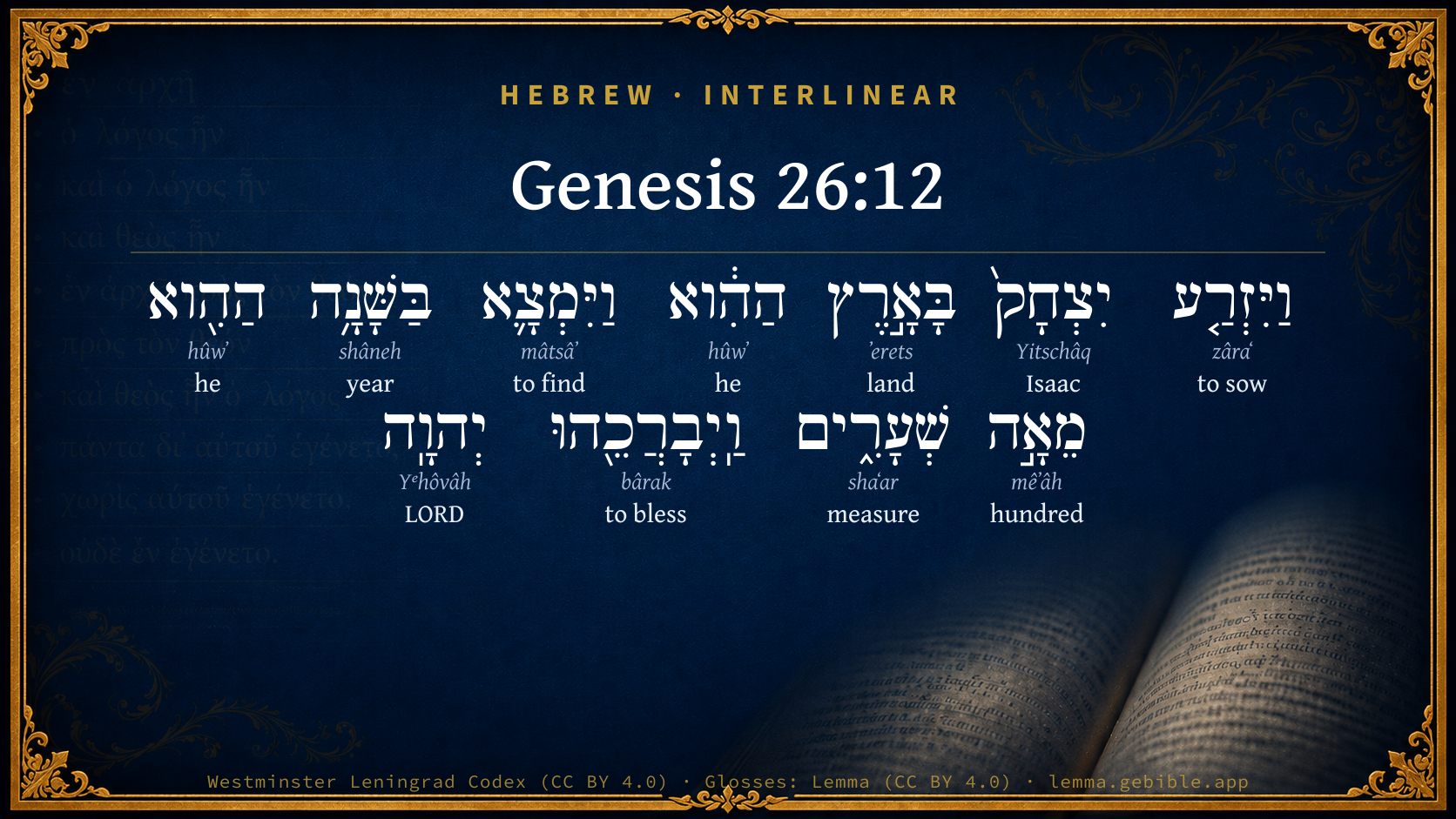
Hebrew (Westminster Leningrad Codex) Genesis 26:12 appears in the Hebrew Old Testament. The text above is from the Westminster Leningrad Codex. Each word links to its Strong’s number, a concise gloss, and parsing drawn from the Open Scriptures Hebrew Bible morphology. Click any word for its full Brown-Driver-Briggs (BDB) entry.
Download image
Cite this verse

Genesis 26:12 (World English Bible). Public Domain. Lemma interlinear Bible study tool, https://lemma.gebible.app/v/genesis/26/12.

Show BibTeX & RIS
BibTeX
RIS
English Translation
Isaac sowed in that land, and reaped in the same year one hundred times what he planted. Yahweh blessed him.
World English Bible · Public Domain
Highlights
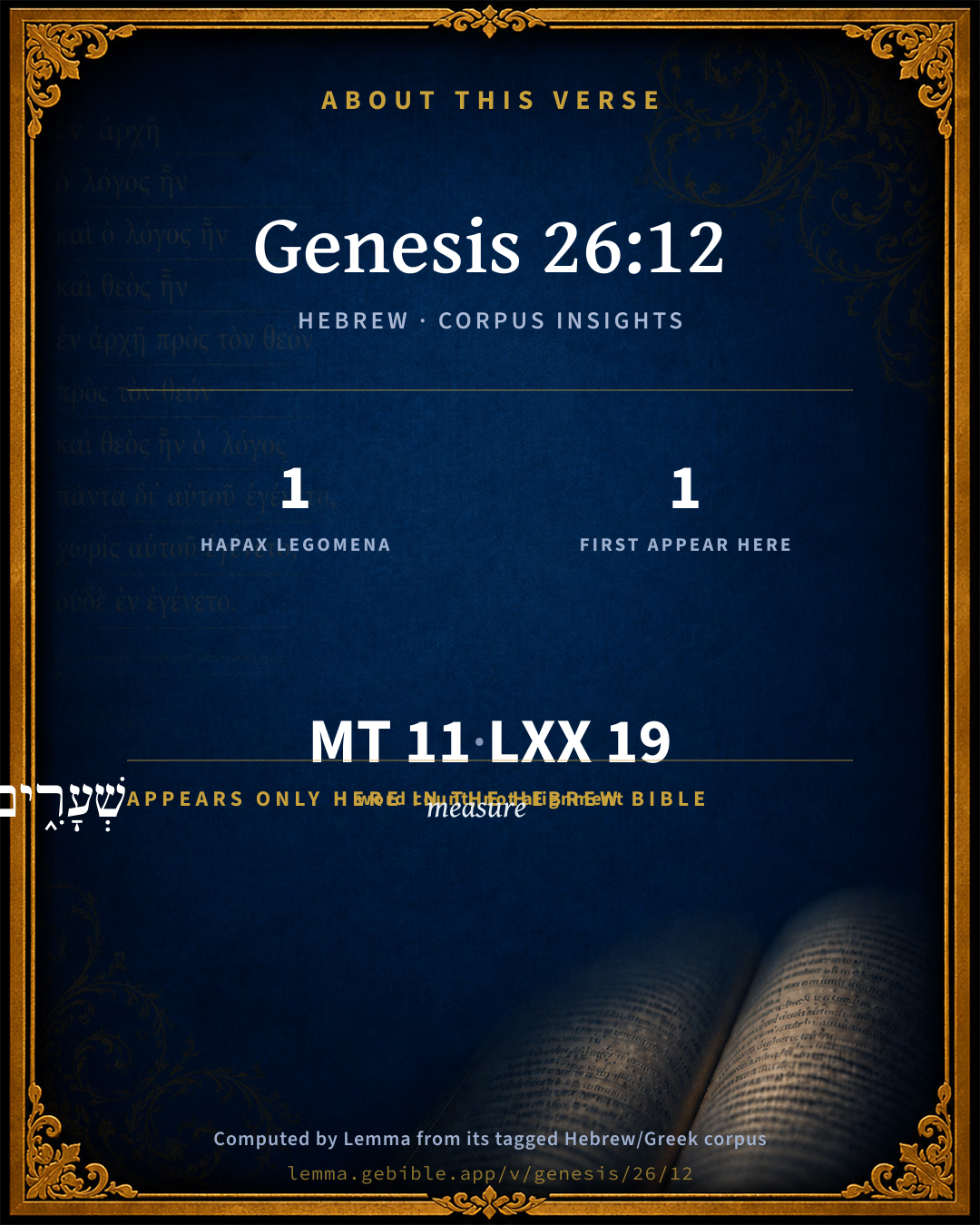
  • 1 hapax legomenon — only here in the Hebrew Bible
  • 1 first appearance in the Hebrew Bible
Full analysis ↓
Download a study sheet

One document with this verse’s original text, its word-by-word gloss line, the meaning frame, cross-references with their text, attributed commentary, and full source and license credits — printable, and it pastes into notes with its structure intact.

This verse Autodidact and up

Study sheet (.html) Plain text (.txt)

A passage Seminary Student

Up to 50 verses in one chapter. A passage sheet keeps up to 6 commentary sources and 12 cross-references per verse, in the order this page ranks them, and says so on the sheet whenever that leaves anything out. Ask for a single verse and you get the Autodidact verse sheet above.

Everything on this page stays free to read, with no account — the sheet is a download of what is already on screen, not access to it.

Want to remove ads? Support Godless Engineer
Compare translations 3

The same verse in 3 English versions, stacked beneath the original-language interlinear above. Click any original word for its lexicon entry.

Each is an independent rendering of the whole verse — the interlinear is not word-aligned to these translations.

Highlighted words mark where these versions differ — a whole-verse word diff, not a word-by-word alignment.

  • World English Bible Public Domain
    Isaac sowed in that land, and reaped in the same year one hundred times what he planted. Yahweh blessed him.
  • King James Version Public Domain
    Then Isaac sowed in that land, and received in the same year an hundredfold: and the LORD blessed him.
  • unfoldingWord Literal Text CC BY-SA 4.0
    Then Isaac sowed seeds in that land, and in that year he obtained a hundredfold, and Yahweh blessed him.

unfoldingWord Literal Text — © unfoldingWord, licensed CC BY-SA 4.0. Word-aligned USFM3 via Door43 (git.door43.org/unfoldingWord/en_ult).

Versions to compare (up to 4)

3 of 4 selected

Show all 18 translations

Every available English version of this verse, each an independent rendering of the whole verse.

  • World English Bible Public Domain
    Isaac sowed in that land, and reaped in the same year one hundred times what he planted. Yahweh blessed him.
  • Berean Standard Bible Public Domain
    Now Isaac sowed seed in the land, and that very year he reaped a hundredfold. And the LORD blessed him,
  • Majority Standard Bible Public Domain
    Now Isaac sowed seed in the land, and that very year he reaped a hundredfold. And the LORD blessed him,
  • King James Version Public Domain
    Then Isaac sowed in that land, and received in the same year an hundredfold: and the LORD blessed him.
  • American Standard Version (1901) Public Domain
    And Isaac sowed in that land, and found in the same year a hundredfold. And Jehovah blessed him.
  • Revised Version (1885) Public Domain
    And Isaac sowed in that land, and found in the same year an hundredfold: and the LORD blessed him.
  • Geneva Bible (1599) Public Domain
    Afterwarde Izhak sowed in that lande, and founde in the same yeere an hundreth folde by estimation: and so the Lord blessed him.
  • Douay-Rheims (1899) Public Domain
    And Isaac sowed in that land, and he found that same year a hundredfold: and the Lord blessed him.
  • Young's Literal Translation Public Domain
    And Isaac soweth in that land, and findeth in that year a hundredfold, and Jehovah blesseth him;
  • Literal Standard Version CC BY-SA 4.0
    And Isaac sows in that land, and finds in that year a hundredfold, and YHWH blesses him;
  • Unlocked Literal Bible CC BY-SA 4.0
    Isaac planted crops in that land and reaped in the same year a hundredfold, because Yahweh blessed him.
  • unfoldingWord Literal Text CC BY-SA 4.0
    Then Isaac sowed seeds in that land, and in that year he obtained a hundredfold, and Yahweh blessed him.
  • Darby Bible Public Domain
    And Isaac sowed in that land, and received in the same year a hundredfold; and Jehovah blessed him.
  • World Messianic Bible Public Domain
    Isaac sowed in that land, and reaped in the same year one hundred times what he planted. The LORD blessed him.
  • Webster's Bible Public Domain
    Then Isaac sowed in that land, and received in the same year a hundred-fold: and the LORD blessed him:
  • Free Bible Version CC BY-SA 4.0
    Isaac sowed grain that year, and the Lord blessed him with a harvest that was a hundred times what he planted.
  • Bible in Basic English Public Domain
    Now Isaac, planting seed in that land, got in the same year fruit a hundred times as much, for the blessing of the Lord was on him.
  • JPS Tanakh (1917) Public Domain
    And Isaac sowed in that land, and found in the same year a hundredfold; and the LORD blessed him.

Literal Standard Version (2020), Covenant Press — licensed CC BY-SA 4.0. Text via the HelloAO Bible API (eBible.org). Unlocked Literal Bible (unfoldingWord) — licensed CC BY-SA 4.0. Text via the HelloAO Bible API (eBible.org). unfoldingWord Literal Text — © unfoldingWord, licensed CC BY-SA 4.0. Word-aligned USFM3 via Door43 (git.door43.org/unfoldingWord/en_ult). Free Bible Version, Dr. Jonathan Gallagher — licensed CC BY-SA 4.0. Text via the HelloAO Bible API (eBible.org).

Word by word

More ways to search: Search by grammar → Find every occurrence → Compare this word →

Practice this passage: Drill this verse → Learn its vocabulary →

שְׁעָרִ֑ים
shaʻar
H8180
“measures”
Noun, Common, Masculine, Plural, Absolute
Part of Speech
Noun
Type
Common
Gender
Masculine
Number
Plural
State
Absolute
Full BDB Definition

Origin: from H8176

TWOT: 2438a

a unit of measure - 100 measures = 100 for 1 = 100 fold
  1. וַיִּזְרַ֤ע zâraʻ H2232 “and · to sow” Conjunction + Verb, Qal, Sequential Imperfect, 3rd Person, Masculine, Singular
  2. יִצְחָק֙ Yitschâq H3327 “Isaac” Noun, Proper
  3. בָּאָ֣רֶץ ʼerets H776 “in/at the · land” Preposition, Determined + Noun, Common, Both, Singular, Absolute
  4. הַהִ֔וא hûwʼ H1931 “the · he” Particle, Definite Article + Pronoun, Personal, 3rd Person, Feminine, Singular
  5. וַיִּמְצָ֛א mâtsâʼ H4672 “and · to find” Conjunction + Verb, Qal, Sequential Imperfect, 3rd Person, Masculine, Singular
  6. בַּשָּׁנָ֥ה shâneh H8141 “in/at the · year” Preposition, Determined + Noun, Common, Feminine, Singular, Absolute
  7. הַהִ֖וא hûwʼ H1931 “the · he” Particle, Definite Article + Pronoun, Personal, 3rd Person, Feminine, Singular
  8. מֵאָ֣ה mêʼâh H3967 “hundred” Adjective, Cardinal number, Both, Singular, Absolute
  9. וַֽיְבָרֲכֵ֖הוּ bârak H1288 “and · to bless · him” Conjunction + Verb, Piel, Sequential Imperfect, 3rd Person, Masculine, Singular + Suffix, Personal, 3rd Person, Masculine, Singular
  10. יְהוָֽה Yᵉhôvâh H3068 “LORD” Noun, Proper

About this verse

These counts appear in no published source. They are computed here, from the morphology-tagged text and Lemma’s own curated glosses. What Lemma adds →

11
words
10
distinct lemmas
Pentateuch
section

Notable vocabulary

1 hapax legomenon — a word that appears only here in the entire Hebrew Bible:

  • שְׁעָרִ֑ים measure H8180

First appearance in Scripture

This word makes its first canonical appearance in the Hebrew Bible here:

  • שְׁעָרִ֑ים measure H8180

Shared distinctive vocabulary

וַיִּזְרַ֤ע to sow H2232 occurs in 54 verses of the Hebrew Bible. Also found in:

Grammatical profile

  • 3 verbs
  • 5 nouns
  • 1 adjective
  • 2 pronouns

Verb forms

  • וַיִּזְרַ֤ע Qal · Sequential Imperfect
  • וַיִּמְצָ֛א Qal · Sequential Imperfect
  • וַֽיְבָרֲכֵ֖הוּ Piel · Sequential Imperfect

Repetition

A word recurs within this verse — often emphatic in Hebrew:

  • הַהִ֔וא he H1931 ×2

Hebrew & Septuagint length

In English translation the verse runs 20 words from the Hebrew and 20 from the Septuagint (LXX English) — the same length.

A rough comparison of the two English renderings, which tokenize alike — not a word-level alignment.

Word counts can differ between the Hebrew and the Greek without any difference in meaning — e.g. the Hebrew direct-object marker אֵת has no separate Greek word, and Greek often adds the article ὁ.

In the original languages it is 11 Hebrew tokens and 19 Greek tokens — but the two are counted differently (Hebrew bundles its prefixes and suffixes into one token; the Greek is in lemma form), so that isn’t a like-for-like length.

Cross-references

16

Topical passages linked to Genesis 26:12 in the Treasury of Scripture Knowledge — connected by theme and wording, ordered by reader-vote popularity; previews shown in the World English Bible.

  • Mark 4:8 Others fell into the good ground, and yielded fruit, growing up and increasing. Some brought forth thirty times, some sixty times, and some one hundred times as much."
  • Genesis 26:3 Sojourn in this land, and I will be with you, and will bless you. For to you, and to your seed, I will give all these lands, and I will establish the oath which I swore to Abraham your father.
  • Genesis 24:1 Abraham was old, and well stricken in age. Yahweh had blessed Abraham in all things.
  • Genesis 24:35 Yahweh has blessed my master greatly. He has become great. He has given him flocks and herds, silver and gold, men-servants and maid-servants, and camels and donkeys.
  • Zechariah 8:12 "For the seed of peace and the vine will yield its fruit, and the ground will give its increase, and the heavens will give their dew; and I will cause the remnant of this people to inherit all these things.
  • 2 Corinthians 9:10–11 Now may he who supplies seed to the sower and bread for food, supply and multiply your seed for sowing, and increase the fruits of your righteousness;
  • Job 42:12 So Yahweh blessed the latter end of Job more than his beginning. He had fourteen thousand sheep, six thousand camels, one thousand yoke of oxen, and a thousand female donkeys.
  • Psalms 67:6 The earth has yielded its increase. God, even our own God, will bless us.
  • Ecclesiastes 11:6 In the morning sow your seed, And in the evening don't withhold your hand; For you don't know which will prosper, whether this or that, Or whether they both will be equally good.
  • Galatians 6:7–8 Don't be deceived. God is not mocked, for whatever a man sows, that will he also reap.
  • 1 Corinthians 3:6 I planted. Apollos watered. But God gave the increase.
  • Genesis 30:30 For it was little which you had before I came, and it has increased to a multitude. Yahweh has blessed you wherever I turned. Now when will I provide for my own house also?"
  • Matthew 13:8 and others fell on good soil, and yielded fruit: some one hundred times as much, some sixty, and some thirty.
  • Psalms 72:16 There shall be abundance of grain throughout the land. Its fruit sways like Lebanon. Let it flourish, thriving like the grass of the field.
  • Genesis 26:29 that you will do us no harm, as we have not touched you, and as we have done to you nothing but good, and have sent you away in peace.' You are now the blessed of Yahweh."
  • Matthew 13:23 What was sown on the good ground, this is he who hears the word, and understands it, who most assuredly bears fruit, and brings forth, some one hundred times as much, some sixty, and some thirty."

Cross-references courtesy of OpenBible.info (CC BY 4.0).

Hebrew and Greek witnesses Masoretic Hebrew ↔ Greek Septuagint

The same verse in the two great witnesses to the Old Testament, shown verse-for-verse.

These are two independent witnesses, not word-aligned to each other, and the Septuagint is shown in lemma (dictionary) form.

Hebrew Genesis 26:12 Masoretic · Westminster Leningrad Codex

וַיִּזְרַ֤ע יִצְחָק֙ בָּאָ֣רֶץ הַהִ֔וא וַיִּמְצָ֛א בַּשָּׁנָ֥ה הַהִ֖וא מֵאָ֣ה שְׁעָרִ֑ים וַֽיְבָרֲכֵ֖הוּ יְהוָֽה

Isaac sowed in that land, and reaped in the same year one hundred times what he planted. Yahweh blessed him.

World English Bible · Public Domain

Greek LXX Genesis 26:12 Septuagint · lemma form

σπείρω δέ ισαακ ἐν ὁ γῆ ἐκεῖνος καί εὑρίσκω ἐν ὁ ἐνιαυτός ἐκεῖνος ἑκατοστεύω κριθή εὐλογέω δέ αὐτός κύριος

And Isaac sowed in that land, and he found in that year barley one hundred-fold, and the Lord blessed him.

LXX2012 (modern English Septuagint) · Public Domain

On this verse, The Pulpit Commentary discusses the Septuagint’s reading. Read the note in Commentary ↓

Hebrew: Westminster Leningrad Codex (CC BY 4.0). Greek: Septuagint (public domain); English from LXX2012 (modern English Septuagint) (Public Domain). How the Septuagint differs from the Hebrew →

Targum (Aramaic paraphrase)

2

The Targum is the ancient Jewish Aramaic paraphrase of the Hebrew Scriptures — an interpretive translation, not the Hebrew text itself. Onkelos (literal) and Pseudo-Jonathan (expansive) render the Torah, and Jonathan the Prophets. Coverage is partial: where no permissively-licensed English translation exists for a verse, only the Aramaic is shown. This is verse-level text, not a word-by-word alignment to the Hebrew.

  1. Targum Onkelos Torah (Genesis–Deuteronomy)
    וּזְרַע יִצְחָק בְּאַרְעָא הַהִיא וְאַשְׁכַּח בְּשַׁתָּא הַהִיא עַל חַד מְאָה בִדְשַׁעֲרוֹהִי וּבָרְכֵהּ יְיָ

    (no public-domain English translation for this verse)

    Targum Onkelos — Aramaic: “Onkelos Genesis” (public domain); “Onkelos Exodus” (public domain); “Onkelos Leviticus” (public domain); “Onkelos Numbers” (public domain); “Onkelos Deuteronomy” (public domain). English: “Sefaria Community Translation” (CC0 1.0 (public-domain dedication)); “J.W. Etheridge. The Targums of Onkelos and Jonathan Ben Uzziel on the Pentateuch. London: Longmans, Green, 1862” (public domain). Text via Sefaria.

  2. Targum Pseudo-Jonathan Torah (Genesis–Deuteronomy)
    וּזְרַע יִצְחָק לִצְדַקְתָּא בְּאַרְעָא הַהוּא וְאַשְׁכַּח בְּשַׁתָּא הַהוּא עַל חַד מְאָה בִּדְשַׁעֲרוֹי וּבָרְכֵיהּ יְיָ

    And Izhak sowed unto righteousness in that land, and found in that year a hundred for one, according to his measure. And the Lord blessed him,

    Targum Pseudo-Jonathan — Aramaic: “Targum Jonathan on Genesis” (public domain); “Targum Jonathan on Exodus” (public domain); “Targum Jonathan on Leviticus” (public domain); “Targum Jonathan on Numbers” (public domain); “Targum Jonathan on Deuteronomy” (public domain). English: “The Targum of Jonathan ben Uzziel, trans. J. W. Etheridge, London, 1862” (public domain). Text via Sefaria.

Commentary

Notes on Genesis 26:12 from classic Christian and Jewish commentators (each source and its license shown beneath its notes). The classic Christian expositions comment on the surrounding passage and are grouped to its opening verse, so a note may address several verses; the Jewish commentaries on the Tanakh (Rashi and others) are per-verse, so they appear only where the commentator wrote on this verse.

Lemma curates 59 commentaries, every one of them public domain or Creative Commons licensed, each selected and text-cleaned for this edition rather than reprinted as found. About our sources →

Matthew Henry's Commentary

Here we have,

I. The tokens of God's good-will to Isaac. He blessed him, and prospered him, and made all that he had to thrive under his hands. 1. His corn multiplied strangely, Gen 26:12. He had no land of his own, but took land of the Philistines, and sowed it; and (be it observed for the encouragement of poor tenants, that occupy other people's lands, and are honest and industrious) God blessed him with a great increase. He reaped a hundred fold; and there seems to be an emphasis laid upon the time: it was that same year when there was a famine in the land; while others scarcely reaped at all, he reaped thus plentifully. See Isa 65:13, My servants shall eat, but you shall be hungry, Psa 37:19, In the days of famine they shall be satisfied. 2. His cattle also increased, Gen 26:14. And then, 3. He had great store of servants, whom he employed and maintained. Note, As goods are increased those are increased that eat them, Ecc 5:11.

II. The tokens of the Philistines' ill-will to him. They envied him, Gen 26:14. It is an instance, 1. Of the vanity of the world that the more men have of it the more they are envied, and exposed to censure and injury. Who can stand before envy? Pro 27:4. See Ecc 4:4. 2. Of the corruption of nature; for that is a bad principle indeed which makes men grieve at the good of others, as if it must needs be ill with me because it is well with my neighbor. (1.) They had already shown their ill-will to his family, by stopping up the wells which his father had digged, Gen 26:15. This was spitefully done. Because they had not flocks of their own to water at these wells, they would not leave them for the use of others; so absurd a thing is malice. And it was perfidiously done, contrary to the covenant of friendship they had made with Abraham, Gen 21:31, Gen 21:32. No bonds will hold ill-nature. (2.) They expelled him out of their country, Gen 26:16, Gen 26:17. The king of Gerar began to look upon him with a jealous eye. Isaac's house was like a court, and his riches and retinue eclipsed Abimelech's; and therefore he must go further off. They were weary of his neighborhood, because they saw that the Lord blessed him; whereas, for that reason, they should the rather have courted his stay, that they also might be blessed for his sake. Isaac does not insist upon the bargain he had made with them for the lands he held, nor upon his occupying and improving them, nor does he offer to contest with them by force, though he had become very great, but very peaceably departs thence further from the royal city, and perhaps to a part of the country less fruitful. Note, We should deny ourselves both in our rights and in our conveniences, rather than quarrel: a wise and a good man will rather retire into obscurity, like Isaac here into a valley, than sit high to be the butt of envy and ill-will.

III. His constancy and continuance in his business still.

1. He kept up his husbandry, and continued industrious to find wells of water, and to fit them for his use, Gen 26:18, etc. Though he had grown very rich, yet he was as solicitous as ever about the state of his flocks, and still looked well to his herds; when men grow great, they must take heed of thinking themselves too big and too high for their business. Though he was driven from the conveniences he had had, and could not follow his husbandry with the same ease and advantage as before, yet he set himself to make the best of the country he had come into, which it is every man's prudence to do. Observe,

(1.) He opened the wells that his father had digged (Gen 26:18), and out of respect to his father called them by the same names that he had given them. Note, In our searches after truth, that fountain of living water, it is good to make use of the discoveries of former ages, which have been clouded by the corruptions of later times. Enquire for the old way, the wells which our fathers digged, which the adversaries of truth have stopped up: Ask thy elders, and they shall teach thee.

(2.) His servants dug new wells, Gen 26:19. Note, Though we must use the light of former ages, it does not therefore follow that we must rest in it, and make no advances. We must still be building upon their foundation, running to and fro, that knowledge may be increased, Dan 12:4.

(3.) In digging his wells he met with much opposition, Gen 26:20, Gen 26:21. Those that open the fountains of truth must expect contradiction. The first two wells which they dug were called Esek and Sitnah, contention and hatred. See here, [1.] What is the nature of worldly things; they are make-bates and occasions of strife. [2.] What is often the lot even of the most quiet and peaceable men in this world; those that avoid striving yet cannot avoid being striven with, Psa 120:7. In this sense, Jeremiah was a man of contention (Jer 15:10), and Christ himself, though he is the prince of peace. [3.] What a mercy it is to have plenty of water, to have it without striving for it. The more common this mercy is the more reason we have to be thankful for it.

(4.) At length he removed to a quiet settlement, cleaving to his peaceable principle, rather to fly than fight, and unwilling to dwell with those that hated peace, Psa 120:6. He preferred quietness to victory. He dug a well, and for this they strove not, Gen 26:22. Note, Those that follow peace, sooner or later, shall find peace; those that study to be quiet seldom fail of being so. How unlike was Isaac to his brother Ishmael, who, right or wrong, would hold what he had, against all the world! Gen 16:12. And which of these would we be found the followers of? This well they called Rehoboth, enlargements, room enough: in the two former wells we may see what the earth is, straitness and strife; men cannot thrive, for the throng of their neighbours. This well shows us what heaven is; it is enlargement and peace, room enough there, for there are many mansions.

2. He continued firm to his religion, and kept up his communion with God. (1.) God graciously appeared to him, Gen 26:24. When the Philistines expelled him, forced him to remove from place to place, and gave him continual molestation, then God visited him, and gave him fresh assurances of his favour. Note, When men are found false and unkind, we may comfort ourselves that God is faithful and gracious; and his time to show himself so is when we are most disappointed in our expectations from men. When Isaac had come to Beer-sheba (Gen 26:23) it is probable that it troubled him to think of his unsettled condition, and that he could not be suffered to stay long in a place; and, in the multitude of these thoughts within him, that same night that he came weary and uneasy to Beer-sheba God brought him his comforts to delight his soul. Probably he was apprehensive that the Philistines would not let him rest there: Fear not, says God to him, I am with thee, and will bless thee. Those may remove with comfort that are sure of God's presence with them wherever they go. (2.) He was not wanting in his returns of duty to God; for there he built an altar, and called upon the name of the Lord, Gen 26:25. Note, [1.] Wherever we go, we must take our religion along with us. Probably Isaac's altars and his religious worship gave offence to the Philistines, and provoked them to be the more troublesome to him; yet he kept up his duty, whatever ill-will he might be exposed to by it. [2.] The comforts and encouragements God gives us by his word should excite and quicken us to every exercise of devotion by which God may be honoured and our intercourse with heaven maintained.

Matthew Henry's Commentary on the Whole Bible (1708–1710) — public domain (CC PDM 1.0). Text via the HelloAO Bible API.

Trapp's Complete Commentary

John Trapp

Gen 26:12 Then Isaac sowed in that land, and received in the same year an hundredfold: and the LORD blessed him.

Ver. 12. Then Isaac sowed in that land.] In ground hired for his use, and managed by himself: for it was anciently a great commendation, saith Cicero, to be a good husbandman. {a} M. Curius, after three triumphs, returned to the plough, and held it no disgrace; neither ever was there more plenty at Rome than then, saith Pliny; Quasi gauderet terra laureato vomere, et Aratore triumphali. This good husbandman in the text, sowing in that barren land, and in a time of famine too, hath a hundredfold increase; which is the utmost that our Saviour mentioneth in the parable of the sower; {Mat 13:23} and in reference hereunto, he elsewhere assureth such as part with all for his sake and the gospel’s, they "shall receive a hundredfold here, and eternal life hereafter". {Mat 19:29} That which Herodotus and Pliny report of Babylon is beyond belief: that the land thereabouts returns two hundredfold increase. {b} But grant it were true, yet he that is a good husband for his soul, sows in a better ground, and shall have a better return: for, "he that soweth to the Spirit, shall, of the Spirit, reap life everlasting." Only it is required, that he "be not weary in well doing: for in due season we shall reap, if we faint not". {Gal 6:8-9} We must not look to sow and reap all in a day, as he {c} saith of the Hyperborean people far north; that they sow shortly after the sunrising, and reap before the sunset; because the whole half year is one continual day with them. We must "wait," with "the husbandman, for the precious fruit of the earth, and have long patience for it, until we receive the former and latter rain". {Jas 5:7} And "be diligent" in the meanwhile, that when Christ comes, "we may be found of him in peace". {2Pe 3:14} Heaven will pay for all our pains and patience. "He which soweth sparingly shall reap sparingly; and he that soweth bountifully shall reap bountifully," {2Co 9:6} even blessing upon blessing, as the word there (επ ευλογιαις) signifies: he "shall doubtless come again with joy, bringing his sheaves with him". {Psa 126:6}

{a} Veteres siquem virum bonum colonum appellassent, amplissime laudasse exstimabant. - Cic.

{b} Dιηκοσια μεν το παραπαν αποδιδοι. - Her., lib. i. - Plin., lib. vi. cap. 26.

{c} Heresbach., De Re Rustica.

John Trapp, A Commentary or Exposition upon All the Books of the Old and New Testament (1647–1656) — public domain. Text from a community e-Sword module.

The Biblical Illustrator

Joseph S. Exell

Gen_26:12

Isaac sowed . . . and the Lord blessed him

The prosperity of Isaac

In this narrative it is Isaac the prosperous man who comes to view.

Examine the sources and circumstances of his remarkable, unequalled prosperity.

I. ISAAC HAD A GOOD FATHER. Happy the son whose father was chosen partner with God in a divine covenant, and twice blessed the son whose father had this testimony that he pleased God in the fulfilment of such a covenant, Not only great favour rests upon the head of such a father, but the richest blessings are pledged to his posterity.

II. ISAAC HAD TRAITS OF HIS OWN TO WHICH HIS PROSPERITY WAS LARGELY INDEBTED. His very name indicates that he was a son of laughter and joy. True to his name, his nature was of the sunny and hopeful type. The value of this disposition in the successful conduct of life is simply incalculable. It is more than capital, for capital will perish. It is more than friends, for friends die. It is more than success, for it outlives success. When everything is gone, the man who has hope has all he needs. Thus Isaac went from well to well. He was envied at Gerar, and he moved to Esek. Esek was captured by the enemy. He hopefully journeyed to Sitnah, and dug again. But Sitnah was claimed. Should he give up now? No; all these choked wells were leading him to the broader valleys of Rehoboth, where was room--room for his still multiplying flocks and growing wealth.

III. The third secret of Isaacs prosperity was HIS EXTREME PEACEABLENESS. The spirit of the beatitudes dwelt in this man more than in any other man of his times.

IV. But there remains a fourth and final element to be noticed in the prosperity of Isaac. I have said that he had a good father behind him, a brave heart within him, a good will to men about him; but he put the crown upon his success by owning and seeking THE FAVOUR OF GOD ABOVE HIM. (J. B. Clark.)

The prosperity of Isaac

I. HIS PROSPERITY WAS EVIDENTLY DUE TO THE DIVINE BLESSING. His prosperity was wonderful. Thirty, sixty, and a hundred fold, is the range of fertility in that land. Thus the yield of Isaacs land reaches the highest degree of productiveness.

1. Such was the position of the sacred historian. He who relates this story, after describing the prosperity of this man, adds, And the Lord blessed him (Gen_26:12).

2. It was evident to Isaac himself. His prosperity, the rest he enjoyed from his enemies, and room to enlarge in, he ascribed all to God (Gen_26:22).

3. It was evident to his enemies. They were constrained to acknowledge that God was with him.

II. HIS PROSPERITY MADE HIM A MARK FOR ENVY. We are told that the Philistines envied him. His prosperity was not without alloy. Every blessing of this world is accompanied by some disadvantage or evil. We have to pay a price for every earthly good.

III. HIS PROSPERITY SERVED TO DEVELOP THE VIRTUES OF HIS CHARACTER. Bacon has said that Prosperity doth best discover vice, but adversity doth best discover virtue. And human experience shows that such are the usual effects of these conditions. But in the case of Isaac there were virtues that shined out in his prosperity.

1. The virtue of patience. The Philistines carried their envy into action. They stopped up the wells which he had inherited from his father (Gen_26:15).

But he met all this envy by patience. When persecuted in one place he fled to another. He removed from well to well (Gen_26:18-22).

(1) His patience was victorious. It won upon his enemies. The Philistines were at length wearied out. They came round, and asked for a treaty (Gen_26:28-30).

(2) His patience won the Divine approval. The Lord appeared to him and renewed the old promises. He was assured of perpetual protection and guidance.

2. The virtue of forgiveness. He had suffered a grievous wrong, but he forgave it on the entreaty of Abimelech. This was not the easy virtue of a man who has no strong feelings and who is soon won over. It was principle, and not a weak feeling, that made him forgive.

3. The virtue of reverence. He set up an altar for the worship of God, and pitched his tent there as if he would dwell in the Lords house (Gen_26:25). He bears a public testimony to the obligation of religion. Many a man forgets God with increasing prosperity, but it was not so with Isaac. With him it served to deepen the feeling of reverence and to strengthen every duty of piety. (T. H. Leale.)

Isaacs prosperity

I. ISAAC IN HIS BUSINESS RELATIONS.

1. He was active and enterprising (Gen_26:12-13).

2. His industry and enterprise under the blessing of God resulted in immense wealth.

II. ISAAC IN SOCIETY.

1. As tried by society (Gen_26:14; Gen_26:16; Gen_26:19-21).

2. His bearing under these trials.

(1) He bore envy and strife and hatred with perfect patience.

(2) He separated himself from those around him rather than contend with them.

(3) He recognized Gods hand in all (Gen_26:22).

(4) This example of Isaac, both in business and in society, is worthy of all commendation and imitation.

III. ISAAC IN HIS RELIGIOUS LIFE.

1. He was honoured with personal communications from God (Gen_26:24).

(1) This proves that his conduct was approved by God.

(2) This approval signified Gods encouragement to him in view of future trials.

2. Isaac evinced his appreciation of these Divine promises and privileges by a renewed consecration of himself to God (Gen_26:25).

Lessons:

1. Prosperity is as real a test of faith as adversity.

2. The test of prosperity is more severe than that of adversity.

3. Peace has ever been the choice of true believers.

4. Such a choice has ever met with the Divine approval.

5. Let Isaacs example be ours--in business, industrious and enterprizing; in society, peace-loving and yielding; in religion, ever prepared for communion with God, and ever yielding ourselves in consecration to God. (D. C. Hughes, M. A.)

Isaacs wanderings

I. ISAACS PATIENCE. An example of those who endure, instead of murmuring, rebelling, or despairing.

II. ISAACS PROTECTOR.

1. God directed Isaac.

2. God exhorted Isaac.

3. God encouraged Isaac.

III. ISAACS PROSPERITY.

1. The man waxed great. He grew very prosperous, and his prosperity was continuous.

2. The Lord blessed him. Gods blessing makes rich, whether it be in temporal or in spiritual things.

3. The Lord made room for him (Gen_26:22).

4. The Lord made his enemies to be at peace with him. (W. S. Smith, B. D.)

The Biblical Illustrator, edited by Joseph S. Exell (c. 1880s–1900s) — public domain. Text from a community e-Sword module.

Joseph Benson's Commentary

Gen 26:12. Isaac sowed in that land — Either in grounds which he had hired of the right owners, or in some which lay neglected, and therefore were free to the first occupier. That this should be the case, in that age of the world, is not strange, considering how few the inhabitants, even of Canaan, then were, in comparison of what they were three hundred years after, when the Israelites came out of Egypt. He received a hundred-fold — A hundred times as much as he sowed. The same degree of increase is spoken of Mat 13:8; and affirmed sometimes of other places by heathen writers. But then it was in a better soil and season than this was; for this was in a time of famine. Accordingly an emphasis is laid upon the time; it was the same year when there was a famine in the land; while others scarce reaped at all, he reaped thus plentifully, through the divine blessing.

Joseph Benson's Commentary on the Old and New Testaments (1811–1818) — public domain. Text from a community e-Sword module.

The Pulpit Commentary

CHAPTER 26:12-22

Then Isaac sowed in that land, viz., Philistia. Though a distinct advance on the purely nomadic life pursued by Abraham, this did not imply fixed property in, or even permanent settlement on, the soil, "but only annual tenancy" thereof. Robinson (1. 77) mentions a colony of the Tawarah Arabs, about fifty families, living near Abu Zabel, in Egypt, who cultivated the soil and yet dwelt in tents. "The Biblical patriarchs were not mere Bedawin wanderers, like those who now occupy the Eastern deserts. They had large herds of cattle, which genuine Bedawins have not; they tilled the ground, which these robbers never do; and they accommodated themselves, without difficulty or reluctance, to town and city when necessary, which wild Arabs cannot endure" ("Land and Book," p. 296)and received in the same year a hundred-fold literally, an hundred measures, i.e. for each measure of that which he sowed; an exceptional return even for Philistia, though "the country is no less fertile than the very best of the Mississippi Valley" ("Land and Book," p. 557); and Arab grain stores at Nuttar-abu-Sumar, in the vicinity of Gaza, still proclaim the remunerative yield of its harvests (Robinson, vol. 1. p. 292). Herodotus (1. 193) speaks of two and three hundred-fold as having been reaped on the plain of Babylonia; but in Palestine the usual rate of increase was from thirty to a hundred-fold. (vide Mat_13:23) The reading "a hundred of barley" (LXX, Syriac, Michaelis) is not to be preferred to that in the Textus Receptus. And the Lord blessed him as he had promised (ver. 3).

HOMILETICS.

Vers. 12-22.

A good man"s prosperity.

I WHENCE IT PROCEEDED.

1. The industry of Isaac. "Isaac sowed in that land, and received in the same year a hundredfold." An intimate connection subsists between diligence and prosperity.

(1) As there is no harvest without a seed-time, so there is no increase of wealth without the putting forth of personal labor in its acquisition (cf. Pro_10:4 Pro_13:4 Pro_28:19)

(2) As by God"s appointment harvest follows seed-time, so commonly "the hand of the diligent maketh rich" (cf. Pro_13:4 Pro_21:5 Pro_28:19)

2. The blessing of God. "And the Lord blessed him. As without Divine assistance the best contrived and most laboriously applied means may fail in the accumulation of material goods, so with heavenly succor the least likely instruments can achieve success. The harvests of the farmer depend more upon the goodness of God than upon the excellence of the plough. (Psa_127:1, Psa_127:2)

II IN WHAT IT RESULTED.

1. The envy of the Philistines. Envy, one of the works of the flesh (Gal_5:19; Jam_4:5) a frequent characteristic of evil men (1Co_3:3; Tit_3:3) an occasional infirmity of pious souls (1Co_3:3; Php_1:15; 1Pe_2:1) and straitly forbidden by the law of God (Exo_20:17; Psa_37:1; Jam_5:9) is commonly excited by observing the prosperity of others Psa_37:7 Psa_73:7; Ecc_4:4; cf. Rachel and Leah, Gen_30:1, Gen_30:15; Joseph"s brethren, Gen_37:4-11, Gen_37:19, Gen_37:20; Act_7:9; Miriam and Num_12:1-10; the princes of Darius, (Dan_4:4) is usually accompanied with some degree of hatred (Cain) Gen_4:4 Gen_4:8; Gen_16:5, Gen_16:6; Laban, (Gen_31:5) and inevitably tends, as in the case of the Philistines, to hostility, secret or open.

2. The suspicion of Abimelech. The growing power of the patriarch had filled the monarch"s mind with alarm. Interpreting the character of Isaac by his own, he conceived it impossible to possess large resources without using them to acquire dominion over others. Modern kings and statesmen are scarcely further advanced, the prosperity of neighboring empires being commonly regarded as a menace to the liberties of their own. It is the mission of Christianity, as regards both nations and individuals, to show how power of every kind can be possessed without injury, and wielded with advantage, to the highest interests of others.

III HOW IT WAS MAINTAINED. By

1. Patience, or the exhibition of a meek and unresisting spirit in submitting to injury. When Abimelech requested him to leave the town of Gerar, he left. When the Philistines filled up his father"s wells, he quietly dug them out again. When the herdmen of Gerar wrangled with his shepherds about a spring, he simply gave it up, and sought another; and when this too was disputed, he retired and sank a third. And all the while his flocks and herds kept on multiplying. A beautiful example of the spirit which Christ has enjoined: (Mat_5:39-42) and of the promise which Christ has made (Mat_5:5) to his followers.

1. Perseverance, or the diligent exercise of means in selecting pasture grounds and digging wells; not permitting himself to be discouraged by the opposition of his neighbors, but, while peacefully allowing himself to be despoiled, steadily attending to his business. An illustration of that quiet, determined, and unwearied application which often contributes more to success in life than brilliant abilities.

2. Piety, or the grateful recognition of God"s hand in putting an end to the irritation and annoyance of his neighbors, and giving him at last a comfortable settlement at Rehoboth. It is grace in God which affords quiet neighborhoods to reside in, easy circumstances to live in, and hopeful futures to trust in; and it is piety in us to acknowledge that grace.

Learn

1. That there is only one royal road to material prosperity, viz., diligence and devotion.

2. That if material prosperity can procure comforts, it is also attended by drawbacks.

3. That material prosperity is often thrown away in litigation when it might be preserved by submission.

4. That material prosperity should stir the heart"s gratitude to God.

The Pulpit Commentary (1880–1919), ed. H.D.M. Spence-Jones & Joseph S. Exell — public domain. Text from a community e-Sword module.

The Preacher's Complete Homiletical Commentary

Joseph S. Exell (gen. ed.)

CRITICAL NOTES.—

Gen_26:13. Went forward.] Heb. “Went or walked, going;” i.e., “Became increasingly greater.” The Heb. term for walk is frequently used in the sense of continued increase.

Gen_26:20. Strove.] Heb. “They oppressed him.”—

Gen_26:21. Strove for that also.] This is a different word from the former, and signifies contended. Situah. From the term Satan, meaning accusation.

Gen_26:22. Rehoboth.] Meaning space, enlargement.—

Gen_26:26. Ahuzzath.] Called here “one of his friends,” by which we are to understand his priry counsellor. Phichol. Probably an official name for the commander-in-chief. But Grove (Biblical Dict.) says that it is a Philistine name, of the meaning of which we are ignorant.—

Gen_26:33. And he called it Shebah; therefore the name of the city is Beer-sheba unto this day.] “He called the well Sheba (oath), in commemoration of the oath here made, thus confirming the name given the town by Abraham on the like occasion. (Gen_21:31.) It is not here said that the place now first took its name, but that it retained its name under this new confirmation up to the writer’s day. It was rather the well that was named by Abraham ‘Beer-sheba,’ meaning ‘Well of an oath.’ Now the name was again given to the well, and was therefore fixed upon the city.” (Jacobus)—

MAIN HOMILETICS OF THE PARAGRAPH.—Gen_26:12-33

THE PROSPERITY OF ISAAC

We have here a picture of the prosperity of the patriarch, and also of the blessings and dangers of that condition.

I. His prosperity was evidently due to the Divine blessing. His prosperity was wonderful. “Thirty, sixty, and a hundred fold,” is the range of fertility in that land. Thus the yield of Isaac’s land reaches the highest degree of productiveness. In ordinary cases the return is not greater than twenty-five or thirty fold. All this prosperity was due to the blessing of God.

1. Such was the position of the sacred historian. He who relates this history, after describing the prosperity of this man, adds, “And the Lord blessed him.” (Gen_26:12.)

2. It was evident to Isaac himself. His prosperity, the rest he enjoyed from his enemies, and room to enlarge in, he ascribed all to God. (Gen_26:22.)

3. It was evident to his enemies. They were constrained to acknowledge that God was with him. The impression made by Abraham’s character still lived in history, and they saw that the son was also a friend of God and enjoyed His presence and favour. (Gen_26:28.)

II. His prosperity made him a mark for envy. We are told that “the Philistines envied him.” His prosperity was not without alloy. Every blessing of this world is accompanied by some disadvantage or evil. Civilisation is a blessing, but we lose thereby some of the virtues and natural endowments of simpler times. Great possessions are a blessing, but they often rob us of our quiet and repose, and they bring us new anxieties. High station in society is a blessing, but it oftens renders a man the object of jealousy. He becomes public property, and he is robbed of his peace. We have to pay a price for every earthly good.

III. His prosperity served to develop the virtues of his character. Bacon has said that, “Prosperity doth best discover vice, but adversity doth best discover virtue.” And human experience shows that such are the usual effects of these conditions. But in the case of Isaac there were virtues that shined out in his prosperity.

1. The virtue of patience. The Philistines carried their envy into action. They stopped up the wells which he had inherited from his father. (Gen_26:15.) But he met all this envy by patience. When persecuted in one place he fled to another. He removed from well to well. (Gen_26:18-22.) (a.) His patience was victorious. It won upon his enemies. The Philistines were, at length wearied out. They came round, and asked for a treaty. (Gen_26:28-30.) (b.) His patience won the Divine approval. The Lord appeared to him and renewed the old promises. He was assured of perpetual protection and guidance.

2. The virtue of forgiveness. He had suffered a grievous wrong, but he forgave it on the entreaty of Abimelech. This was not the easy virtue of a man who has no strong feelings and who is soon won over. He keenly felt the wrong. His sense of honour was wounded, he smarted under the indignity. It was principle, and not a weak feeling, that made him forgive. So it was with our Lord Himself, who while He could forgive in the greatness of His love, could yet feel indignity and shame under the cruel taunts and ingratitude of His enemies. He could say, “Why smitest thou Me?” “Are ye come out against me as against a thief with swords and with staves.?”

3. The virtue of reverence. He set up an altar for the worship of God and pitched his tent there as if he would dwell in the Lord’s house. (Gen_26:25.) He bears a public testimony to the obligation of religion. Many a man forgets God with increasing prosperity, but it was not so with Isaac. With him it served to deepen the feeling of reverence and to strengthen every duty of piety. He kept up the old traditions of his father. (Gen_26:33.) When he opened again the wells which Abraham had digged he called them by the old names. (Gen_26:33.) This would remind him to follow in his father’s faith and footsteps.

SUGGESTIVE COMMENTS ON THE VERSES

Gen_26:12-13. It is a further stage in progress when a wandering tribe changes from a pastoral to an agricultural people. In this advance we see the preparation of the chosen people to become a great nation.

Gen_26:14. Here again we see how vanity attaches to every earthly good; prosperity begets envy, and from envy proceeds injury.—(Fuller.)

Envy is the constant companion of prosperity, as David felt and complained. Succoth and Peniel contemn Gideon, out of envy of his victory; Joseph’s brethren cannot abide him, because more favoured of his father. Korah maligneth Moses; Saul, David; the Pharisees, our Saviour; their malice wilfully crossing their consciences.—(Trapp.)

Gen_26:15. In those countries a good well of water was a possession of immense value; and hence in predatory wars it was always an object for either party to fill the wells with earth or sand in order to distress the enemy. Had the Philistines merely forced their way to these wells and drank of them, it might have been encased; but to stop them was an act of downright barbarity, and a gross violation of the treaty of peace which had been made between a former Abimelech and Abraham (Gen_21:25-31). But envy considers that which is lost to another as gained to itself, and not only delights in working gratuitous mischief, but will even punish itself, in a measure, to have the malicious satisfaction of doing a still greater injury to an enemy.—(Bush.)

Gen_26:16-17. Abimelech understood the temper of his people and therefore he sought to persuade Isaac to remove. He used the language of compliment and flattery. Isaac might have stood upon his ground and urged the rights of the covenant made with his father. But he was a man of peace, and choose rather to forego a right than enter into a quarrel. He acted upon the maxim of the wise man,—“yielding, pacifieth great offences.”

A little with peace and quietness is better than much with envy and contention.—(Fuller.)

Gen_26:18. It is a pious duty to keep up the memorials of the great and good.

It seems wherever Abraham went, he improved the country; and wherever the Philistines followed him, their study was to mar his improvements, and that for no other end than the pleasure of doing mischief. Isaac, however, is resolved to open these wells again. Their waters would be doubly sweet to him for their having been first tasted by his beloved father; and to show his filial affection still more, he “called their names after the names which his father had called them.” Many of our enjoyments, both civil and religious, are the sweeter for being the fruits of the labour of our fathers; and if they have been corrupted by adversaries since their days, we must restore them to their former purity.—(Fuller.)

Gen_26:19-20. Isaac’s servants also digged new wells, and which occasioned new strife. While we avail ourselves of the labours of our forefathers, we ought not to rest in them without making farther progress, even though it expose us to many unpleasant disputes. Envy and strife may be expected to follow those whose researches are really beneficial, provided they go a step beyond their forefathers. But let them not be discouraged: the wells of salvation are worth striving for, and after a few conflicts, they may enjoy the fruits of their labours in peace.—(Fuller.)

Gen_26:21-22. We are told that he met the envy with patience, and removed from well to well. At last the Philistines desisted. Thus patience wears the world out. Endurance, meekness, the Gospel spirit, this is the only true weapon against the world. Hence, Christianity can have no addition. It is final. There is nothing beyond this—“Love your enemies.” Isaac, like Christ, had conquered by meekness.—(Robertson.)

Gen_26:23-24. There is shed abroad in his heart that deep peace which is most profound in the midst of storm. God was with him. The waves which lash the surface of the sea are only on the surface; below, the depths are calm. And Isaac quietly leaving place after place felt the deeps of his soul untouched. What was the loss of a well, or ten wells, to him with whom God was, for his portion, his exceeding and all-sufficient great reward.—(Robertson.)

“God is not the God of the dead, but of the living.” Therefore Isaac is assured that his father has not perished by death, that he is not clean gone for ever with the breath which he gave up. God’s covenant with his friend was not annulled.

This is the same person as the Angel of the Covenant who appeared to Moses in Horeb, in the burning bush (Exo_3:2) and is therefore the Messiah. Abraham was the man of faith, Isaac the man of endurance, and Jacob was the man of prayer. God is God to each believer in his peculiar circumstances. Isaac is here promised the blessing for Abraham’s sake. This is the actual working of the household covenant. God has so displayed Himself in all the history of the Church as a covenant God to the families of His people.—(Jacobus.)

Gen_26:25. He called upon the name of the Lord that had made room for him; and now, by His presence and promise, comforted him. Let the streams of God’s bounty lead us, as the watercourse doth, either to the spring upward, or downward to the main ocean, to the source and fountain whence they flow. Let God taste of the fruit of His own planting. We are no better than brute beasts, if, contenting ourselves with a natural use of the creatures, we rise not up to the Author; if, instead of being temples to His praise, we become graves of His benefits. Isaac first built an altar, and then digged a well.—(Trapp.)

Every dwelling-place of the godly should be a sanctuary.

Gen_26:26-27. True meekness does not arise from insensibility. The meek keenly feel the wrongs and indignities committed against them.

Isaac, while they acted as enemies, bore it patiently, as a part of his lot in an evil world; but now that they want to be thought friends, and to renew covenant with him, he feels keenly, and speaks his mind. We can bear that from an avowed adversary which we cannot bear from a professed friend; nor is it any transgression of the law of meekness and love plainly to signify our strong perception of the injuries received, and to stand on our guard in dealing with those who have once acted unfairly.—(Bush.)

Gen_26:28. The world pays an involuntary tribute of respect and admiration to good men. This is the crown of glory which society places upon their head.

Gen_26:29. They had shown acts of hospitality to Isaac at first; but their kindness soon turned to hatred, and their hatred to persecution. Men magnify the few acts of kindness they have done for others, but forget the many wrongs they have committed against them.

“Thou art now the blessed of the Lord.” This explains the one-sidedness of the covenant. Isaac needed no guaranty from them as Jehovah was with him. This clause may refer to his being under the Divine protection, and therefore safe, or as being sufficiently provided for not to make account of the injury done him by the servants. Or it may express the king’s salaam at the conclusion of the treaty pronouncing him blessed, or supposing he makes the treaty as proposed, calling him blessed of Jehovah.—(Jacobus.)

Gen_26:30-31. It was a large-hearted generosity which was content to admit so poor a plea. He who would work out great purposes of charity towards mankind must be prepared to make large allowances.

This reconciliation between Isaac and Abimelech was pledged in a feast. They both sware unto one another; so is our reconciliation with God pledged in the Christian feast of the Lord’s Supper.—(Robertson.)

Gen_26:32. Blessings follow quickly in the path of a large-hearted charity. As Isaac forgave them for depriving him of his wells (rather than quarrel with them), so the Lord opened to him another well for his need the same day.—(Jacobus.)

Gen_26:33. Beer-Sheba unto this day. So it was before; but the name was almost worn out, the well being stopped up. Isaac therefore now names it, and so preserves it for a monument of God’s mercy to his father and to himself.—(Trapp.)

The Preacher's Complete Homiletical Commentary (gen. ed. Joseph S. Exell; Funk & Wagnalls, c. 1892) — public domain (pre-1929). A full-Bible homiletical/sermon-outline anthology covering 65 of 66 books (2 John is absent from the source module). Text from a community e-Sword module.

MacLaren's Expositions of Holy Scripture

Alexander MacLaren

Genesis

THE FIRST APOSTLE OF PEACE AT ANY PRICE

Gen 26:12 - Gen 26:25.

The salient feature of Isaac’s life is that it has no salient features. He lived out his hundred and eighty years in quiet, with little to make history. Few details of his story are given, and some of these are not very creditable. He seems never to have wandered far from the neighbourhood of Beersheba. These quiet, rolling stretches of thinly peopled land contented him, and gave pasture for his flocks, as well as fields for his cultivation. Like many of the tribes of that district still, he had passed from the purely nomad and pastoral life, such as Abraham led, and had begun to ‘sow in that land.’ That marks a stage in progress. His father’s life had been like a midsummer day, with bursts of splendour and heavy thunder-clouds; his was liker a calm day in autumn, windless and unchanging from morning till serene evening. The world thinks little of such lives, but they are fruitful.

Our text begins with a sweet little picture of peaceful industry, blessed by God, and therefore prospering. Travellers tell us that the land where Isaac dwelt is still marvellously fertile, even to rude farming. But to be merely a successful farmer and sheep-owner might have seemed poor work to the heir of such glowing promises, and the prospect of a high destiny often disgusts its possessor with lowly duties. ‘But if we hope for that which we see not, then do we with patience wait for it,’ and the best way to fit ourselves for great things in the future is to bend our backs and wills to humble toil in the present. Peter expected every day to see the risen Lord, when he said, ‘I go a-fishing.’

The Philistines’ envy was very natural, since Isaac was an alien, and, in some sense, an intruder. Their stopping of the wells was a common act of hostility, and an effectual one in that land, where everything lives where water comes, and dies if it is cut off. Abimelech’s reason for ‘extraditing’ Isaac might have provoked a more pugnacious person to stay and defy the Philistines to expel him. ‘Thou art much mightier than we,’ and so he could have said, ‘Try to put me out, then,’ and the result might have been that Abimelech and his Philistines would have been the ones to go. But the same spirit was in the man as had been in the lad, when he let his father bind him and lay him on the altar without a struggle or a word, and he quietly went, leaving his fields and pastures. ‘Very poor-spirited,’ says the world; what does Christ say?

Isaac was not ‘original.’ He cleaned out the wells which his father had digged, and with filial piety gave them again the old names ‘which his father had called them.’ Some of us nowadays get credit for being ‘advanced and liberal thinkers,’ because we regard our fathers’ wells as much too choked with rubbish to be worth clearing out, and the last thing we should dream of would be to revive the old names. But the old wells were not enough for the new time, and so fresh ones were added. Isaac and his servants did not say, ‘We will have no water but what is drawn from Abraham’s wells. What was enough for him is enough for us.’ So, like all wise men, they were conservatively progressive and progressively conservative. The Gerar shepherds were sharp lawyers. They took strong ground in saying, ‘The water is ours; you have dug wells, but we are ground-owners, and what is below the surface, as well as what is on it, is our property.’ Again Isaac fielded, moved on a little way, and tried again. A second well was claimed, and given up, and all that Isaac did was to name the two ‘Contention’ and ‘Enmity,’ as a gentle rebuke and memorial. Then, as is generally the result, gentleness wearied violence out, and the Philistines tired of annoying before Isaac tired of yielding. So he came into a quiet harbour at last, and traced his repose to God, naming his last well ‘Broad Places,’ because the Lord had made room for him.

Such a quiet spirit, strong in non-resistance, and ready to yield rather than quarrel, was strangely out of place in these wild days and lands. He obeyed the Sermon on the Mount millenniums before it was spoken. Whether from temperament or from faith, he is the first instance of the Christian type of excellence in the Old Testament. For there ought to be no question that the spirit of meekness, which will not meet violence by violence, is the Christian spirit. Christian morals alter the perspective of moral excellences, and exalt meekness above the ‘heroic virtues’ admired by the world. The violets and lilies in Christ’s garden outshine voluptuous roses and flaunting sunflowers. In this day, when there is a recrudescence of militarism, and we are tempted to canonise the soldier, we need more than ever to insist that the highest type is ‘the Lamb of God,’ who was ‘as a sheep before her shearers.’ To fight for my rights is not the Christian ideal, nor is it the best way to secure them. Isaac will generally weary out the Philistines, and get his well at last, and will have escaped much friction and many evil passions.

‘Tis safer being meek than fierce.’

Isaac won the friendship of his opponents by his patience, as the verses after the text tell. Their consciences and hearts were touched, and they ‘saw plainly that the Lord was with him,’ and sued him for alliance. It is better to turn enemies into friends than to beat them and have them as enemies still. ‘I’ll knock you down unless you love me’ does not sound a very hopeful way of cementing peaceful relations. But ‘when a man’s ways please the Lord, he maketh even his enemies to be at peace with him.’ But Isaac won more than the Philistines’ favour by his meek peacefulness, for ‘the Lord appeared unto him,’ and assured him that, undefended and unresisting as he was, he had a strong defence, and need not be afraid: ‘Fear not, for I am with thee.’ The ornament of a meek and quiet spirit is, in the sight of God, of great price, and that not only for ‘a woman’; and it brings visions of God, and assurances of tranquil safety to him who cherishes it. The Spirit of God comes down in the likeness of a dove, and that bird of peace sits ‘brooding "only" on the charmed wave’ of a heart stilled from strife and wrath, like a quiet summer’s sea.

Isaac’s new home at Beersheba, having been thus hallowed by the appearance of the Lord, was consecrated by the building of an altar. We should hallow by grateful remembrance the spots where God has made Himself known to us. The best beginning of a new undertaking is to rear an altar. It is well when new settlers begin their work by calling on the name of the Lord. Beersheba and Plymouth Rock are a pair. First comes the altar, then the tent can be trustfully pitched, but ‘except the Lord build the house, they labour in vain that build it.’ And if the house is built in faith, a well will not be lacking; for they who ‘seek first the kingdom of God’ will have all needful ‘things added unto them.’

Alexander MacLaren, Expositions of Holy Scripture (1904–1910) — public domain. Text from a community e-Sword module.

Tyndale Open Study Notes

Tyndale Open Resources

26:12-13 Isaac lived in the land as a temporary settler, enjoying abundant prosperity because of God’s blessing; his crops flourished and he became very rich.

Tyndale Open Study Notes — © Tyndale Open Resources, licensed CC BY-SA 4.0. Text via the HelloAO Bible API.

Geneva Bible (1599)

Geneva Bible translators

Or, an hundred measures.

Geneva Bible (1599) marginal notes — public domain. Text via Bolls.life.

Jamieson, Fausset & Brown

Robert Jamieson, A. R. Fausset & David Brown

Then Isaac sowed in that land--During his sojourn in that district he farmed a piece of land, which, by the blessing of God on his skill and industry, was very productive (Isa 65:13; Psa 37:19); and by his plentiful returns he increased so rapidly in wealth and influence that the Philistines, afraid or envious of his prosperity, obliged him to leave the place (Pro 27:4; Ecc 4:4). This may receive illustration from the fact that many Syrian shepherds at this day settle for a year or two in a place, rent some ground, in the produce of which they trade with the neighboring market, till the owners, through jealousy of their growing substance, refuse to renew their lease and compel them to remove elsewhere.

Jamieson, Fausset & Brown — Commentary Critical and Explanatory on the Whole Bible (1871) — public domain (CC PDM 1.0). Text via the HelloAO Bible API.

Adam Clarke's Commentary

Verse 12. Isaac sowed in that land] Being now perfectly free from the fear of evil, he betakes himself to agricultural and pastoral pursuits, in which he has the especial blessing of God, so that his property becomes greatly increased.

A hundred-fold] מאה שערים, meah shearim, literally, "A hundred-fold of barley;" and so the Septuagint, εκατοστευουσαν κριθην. Perhaps such a crop of this grain was a rare occurrence in Gerar. The words, however, may be taken in a general way, as signifying a very great increase; so they are used by our Lord in the parable of the sower.

Adam Clarke's Commentary on the Bible (1810–1826) — public domain. Text from a community e-Sword/MySword module.

John Calvin's Commentaries

12. Then Isaac sowed. Here Moses proceeds to relate in what manner Isaac reaped the manifest fruit of the blessing promised to him by God; for he says, that when he had sowed, the increase was a hundredfold: which was an extraordinary fertility, even in that land. He also adds, that he was rich in cattle, and had a very great household. Moreover, he ascribes the praise of all these things to the blessing of God; as it is also declared in the psalm, that the Lord abundantly supplies what will satisfy his people while they sleep. (Psalm 127:2.) It may, however, be asked, how could Isaac sow when God had commanded him to be a stranger all his life? Some suppose that he had bought a field, and so translate the word קנה (kanah) a possession; but the context corrects their error: for we find soon afterwards, that the holy man was not delayed, by having land to sell, from removing his effects elsewhere: besides, since the purchasing of land was contrary to his peculiar vocation and to the command of God, Moses undoubtedly would not have passed over such a notable offense. To this may be added, that since express mention is immediately made of a tent, we may hence infer, that wherever he might come, he would have to dwell in the precarious condition of a stranger. We must, therefore, maintain, that he sowed in a hired field. For although he had not a foot of land in his own possession, yet, that he might discharge the duty of a good householder, it behoved him to prepare food for his family; and perhaps hunger quickened his care and industry, that he might with the greater diligence make provision for himself against the future. Nevertheless, it is right to keep in mind, what I have lately alluded to, that he received as a divine favor the abundance which he had acquired by his own labor.

John Calvin's Commentaries (1540-1563) — public domain. Text from the Calvin Translation Society English edition (1840s-50s) via the Christian Classics Ethereal Library (ccel.org). Calvin's coverage is partial (roughly two-thirds of the Bible); uncommented books and verses are honest gaps, never fabricated. The 19th-century editor's footnotes and remarks are omitted so the notes are faithfully Calvin's own voice.

Ellicott's Commentary for English Readers

(12) Isaac sowed in that land.—When Abraham planted a tamarisk-tree at Beer-sheba (Gen_21:33) it showed that he regarded the place as a permanent residence, which it was worth his while to adorn, and to provide for its increasing pleasantness. Isaac and Jacob took a still further step in advance towards a settled life when they began to cultivate plots of ground. At first, however, Isaac did no more than the Bedaween do at present; for they often sow a piece of land, wait till the crop is ripe, and then resume their roving habits. Permanently to till the soil is with them a mark of inferiority (Gen_25:16). But the tendency, both with Abraham and Isaac, had long been to remain in the region about Beer-sheba. Isaac had been driven thence by the famine, by which he had probably lost much of his cattle, and many even of his people. Apparently he was even so weakened thereby as to be no match for the Philistines of Gerar. His large harvest recouped him for his losses, and made him once more a prosperous man; and in due time Beer-sheba was again his home, and with settled habits agriculture was sure to begin.

An hundredfold.—The Heb. is, a hundred measures, but the word is unknown elsewhere, and the LXX. and Syriac read, a hundred of barley, measures being understood, as in Rth_3:15. Herodotus (Book i. 193) mentions two—and even three—hundredfold as possible in Babylonia; but our Lord seems to give one hundredfold as the extreme measure of productiveness in Palestine (Mat_13:8). Such a return, like Isaac’s, would be rare and extraordinary.

A Bible Commentary for English Readers, edited by Charles John Ellicott (1878–1897) — public domain. Text from a community e-Sword module.

The Cambridge Bible for Schools and Colleges

gen. ed. J. J. S. Perowne

12–17 (J). Isaac’s Prosperity

12. an hundredfold] Lit. “a hundred measures.” LXX ἑκατοστεύουσαν κριθήν = “barley bearing a hundredfold,” mistaking the Hebrew word for “measure,” and confusing it with that for “barley.” So also the Syriac Pesh. “An hundredfold,” i.e. one hundred for one.

Isaac’s agricultural pursuits offer a contrast to the roaming life of a nomad. But see, in Jacob’s career, Gen_30:14, Gen_37:7.

blessed him] See Gen_26:3, Gen_24:1; Gen_24:35.

The Cambridge Bible for Schools and Colleges (gen. ed. J. J. S. Perowne; Cambridge University Press, 1878–1918) — public domain. Text from a community e-Sword module.

John Gill's Exposition

And the man waxed great,.... In substance, as well as in honour and glory, among men:

and went forward; in the world, and in the increase of worldly things:

and grew until he became very great: as he must needs be, since Abraham his father left him all that he had, who was very rich in cattle, in gold and silver, and had been increasing ever since; and especially since he came to Gerar, where he was gradually increasing, until he became to be exceeding great indeed, even the greatest man in all the country, yea, greater than King Abimelech himself, as it seems, from Gen 26:16.

John Gill's Exposition of the Whole Bible (1746–1763) — public domain (CC PDM 1.0). Text via the HelloAO Bible API.

Haydock's Catholic Bible Commentary

And the Lord. This is not mentioned as a miracle; for Egypt and many other countries produced 100 fold. Pliny, Natural History xviii. 10, says, some parts of Africa rendered 150 times as much as was sowed. The famine had now ceased. (Calmet)

George Leo Haydock (1774–1849), Haydock's Catholic Family Bible and Commentary, 1859 edition — public domain. Excludes Psalms (Douay-Rheims chapter numbering differs from Protestant) and Deuterocanonical books (Catholic canon only).

Matthew Poole's English Annotations

Isaac sowed in that land; either in the grounds which he had hired of the right owners, or in some grounds which lay neglected, and therefore were free to the first occupier; which was not strange in that age of the world, when the inhabitants of countries were not so numerous as afterward.

An hundredfold, i.e. a hundred times as much as he sowed. The same degree of increase is intimated Mat 13:8, and affirmed sometimes of other places by heathen writers; but then it was in a better soil and season than this was, for this was a time of famine or scarcity.

Matthew Poole's English Annotations on the Holy Bible (1683–1685) — public domain. Text from a community e-Sword/MySword module.

Whedon's Commentary on the Bible

Daniel D. Whedon

12. Isaac sowed — He now added agriculture to the pursuits of nomadic life.

Received — Hebrews, found.

A hundredfold — Or, a hundred measures. Some (Sept., Syr.) read, שׂערים, barley, instead of שׁערים, measures, or fold. The letters of the two words are the same. A hundredfold is a very large increase, but Herodotus (i, 193) writes of the Babylonian territory as “so fruitful in the produce of corn, that it yields continually two hundredfold, and when it produces its best, it yields even three hundredfold.”

Daniel D. Whedon (gen. ed.), Commentary on the Old and New Testaments (1874–1909) — public domain. Text from a community e-Sword module.

John Wesley's Explanatory Notes

Isaac received an hundred fold - And there seems to be an emphasis laid upon the time; it was that same year when there was a famine in the land; while others scarce reaped at all, he reaped thus plentifully.

John Wesley, Explanatory Notes Upon the Whole Bible (1754–1765) — public domain. Text via the GEBible commentary corpus.

Keil & Delitzsch

C. F. Keil & F. Delitzsch

Isaac's Increasing Wealth. - As Isaac had experienced the promised protection ("I will be with thee," Gen 26:3) in the safety of his wife, so did he received while in Gerar the promised blessing. He sowed and received in that year "a hundred measures," i.e., a hundred-fold return. This was an unusual blessing, as the yield even in very fertile regions is not generally greater than from twenty-five to fifty-fold (Niebuhr and Burckhardt), and it is only in the Ruhbe, that small and most fruitful plain of Syria, that wheat yields on an average eighty, and barley a hundred-fold. Agriculture is still practised by the Bedouins, as well as grazing (Robinson, Pal. i. 77, and Seetzen); so that Isaac's sowing was no proof that he had been stimulated by the promise of Jehovah to take up a settled abode in the promised land.

Gen 26:13-17

Being thus blessed of Jehovah, Isaac became increasingly (הלוך, vid., Gen 8:3) greater (i.e., stronger), until he was very powerful and his wealth very great; so that the Philistines envied him, and endeavoured to do him injury by stopping up and filling with rubbish all the wells that had been dug in his father's time; and even Abimelech requested him to depart, because he was afraid of his power. Isaac then encamped in the valley of Gerar, i.e., in the "undulating land of Gerar," through which the torrent (Jurf) from Gerar flows from the south-east (Ritter, Erdk. 14, pp. 1084-5).

Keil & Delitzsch — Biblical Commentary on the Old Testament (1861–1891) — public domain (CC PDM 1.0). Text via the HelloAO Bible API. (Old Testament only.)

unfoldingWord translationNotes

Door43 World Missions Community

General Information:

This begins a new part of the story. It changes from telling about Isaac calling Rebekah his sister, and it starts to tell about how Isaac became very rich and the Philistines were jealous of him.

in that land

"in Gerar"

a hundredfold

This means "one hundred times as much as he planted." It can be translated more generally as "a very large crop." (See: Numbers)

The man became rich

"Isaac became rich" or "He became rich"

grew more and more until he became very great

"he gained more and more until he became very wealthy"

sheep

This may also include goats. (See: Assumed Knowledge and Implicit Information)

a large household

Here "household" stands for workers or servants. AT: "many servants" (See: Metonymy)

The Philistines envied him

"The Philistines were jealous of him"

translationWords

Isaac

reap

year

Yahweh

bless

ewe

cow

household

Philistines

envy

unfoldingWord translationNotes — © Distant Shores Media and the Door43 World Missions Community, licensed CC BY-SA 4.0. Source: git.door43.org/Door43/en_tn.

Rashi

Rabbi Shlomo Yitzchaki (Rashi)

בארץ ההוא IN THAT LAND although it (Gerar) had not the sacred importance of Erez Yisroel proper — i. e., as the territory of the seven nations, and is therefore not as fertile as the Holy Land (cf. Ketubot 112a).

בשנה ההיא IN THAT YEAR although it was not a normal year, being a year of famine.

בארץ ההיה בשנה ההיא In that land and in that year. — Why is there mention of the two — that land and that year? To tell you that that soil was hard and that year was a hard one (Genesis Rabbah 64:6).

מאה שערים AN HUNDREDFOLD — for they had estimated how much it should have yielded and it yielded one hundred for every measure which they had estimated. Our Rabbis said that the estimate was made for the purpose of the tithe (Genesis Rabbah 64:6).

Rashi on the Tanakh — English translations: “The Judaica Press complete Tanach with Rashi, translated by A. J. Rosenberg” (CC BY 4.0); “Pentateuch with Rashi's commentary by M. Rosenbaum and A.M. Silbermann, 1929-1934” (public domain); “The Metsudah Tanach series, Lakewood, N.J” (CC BY 4.0); and “The Book of Joshua, Metsudah Publications, 1997” (CC BY 4.0). Text via Sefaria.

Radak

Rabbi David Kimhi (Radak)

ויזרע...מאה שערים, 100 times as much as they had expected to harvest from this planting.

'ויברכהו ה, He made him successful in all his undertakings.

Radak on the Tanakh — English translations: “Sefaria Community Translation” (CC0 1.0 (public-domain dedication)); “Eliyahu Munk, HaChut Hameshulash” (CC BY 4.0); “Rabbi Mike Feuer, Jerusalem Anthology” (CC BY 4.0); and “R. David Kimhi on the first book of Psalms, Translated by R.G. Finch, London, 1919” (public domain). Text via Sefaria.

Lesson kit

Teaching starters — assembled from the data on this page, not authored interpretation. Every prompt links to the verse data it draws on. Edit before teaching.

Genesis, in the Pentateuch, opens this verse with 11 words (10 distinct Hebrew lemmas). Its most distinctive word is shaʻar (“measure”). A historical commentator’s framing appears above. Read the whole chapter for the surrounding context.

Discussion questions

  1. The word shaʻar carries the sense “measure.” How does it shape the verse?
  2. 1 word here appears nowhere else in the Hebrew Bible. Why might the author reach for such rare wording?
  3. This is the first place “measure” appears in Scripture (first appears here). What does its debut here establish?
  4. How does Genesis 1:11, which shares the word «to sow», read alongside this verse?
  5. What does the repetition of “he” (2× in this one verse) do in this verse?
  6. These translations render this verse differently; the difference is in the English rendering, not the original. What questions does that raise?
  7. «וַיִּזְרַ֤ע» is a Qal Sequential Imperfect verb. How does that grammatical form shape the action described?
  8. Compare how Matthew Henry's Commentary and Trapp's Complete Commentary read this verse. Where do they agree or differ?

Things to notice

  • 1 word in this verse appears nowhere else in the Hebrew Bible.
  • 1 word makes its first canonical appearance in Scripture here.
  • This verse counts 11 Hebrew ↔ 19 Greek words.
  • These translations choose different wording for 13 words in this verse.
  • “he” occurs 2× in this single verse.

Reading settings

Reading text

Shown beneath each verse's original-language words.

Old Testament
Old Testament edition

Read the OT as the Masoretic Hebrew (MT) or the Greek Septuagint (LXX).

English shown for the Greek Septuagint (in the Hebrew ↔ Greek comparison).

Comparing translations? Open the Compare panel on any verse page to stack up to four side by side.