
Deuteronomy 15:18

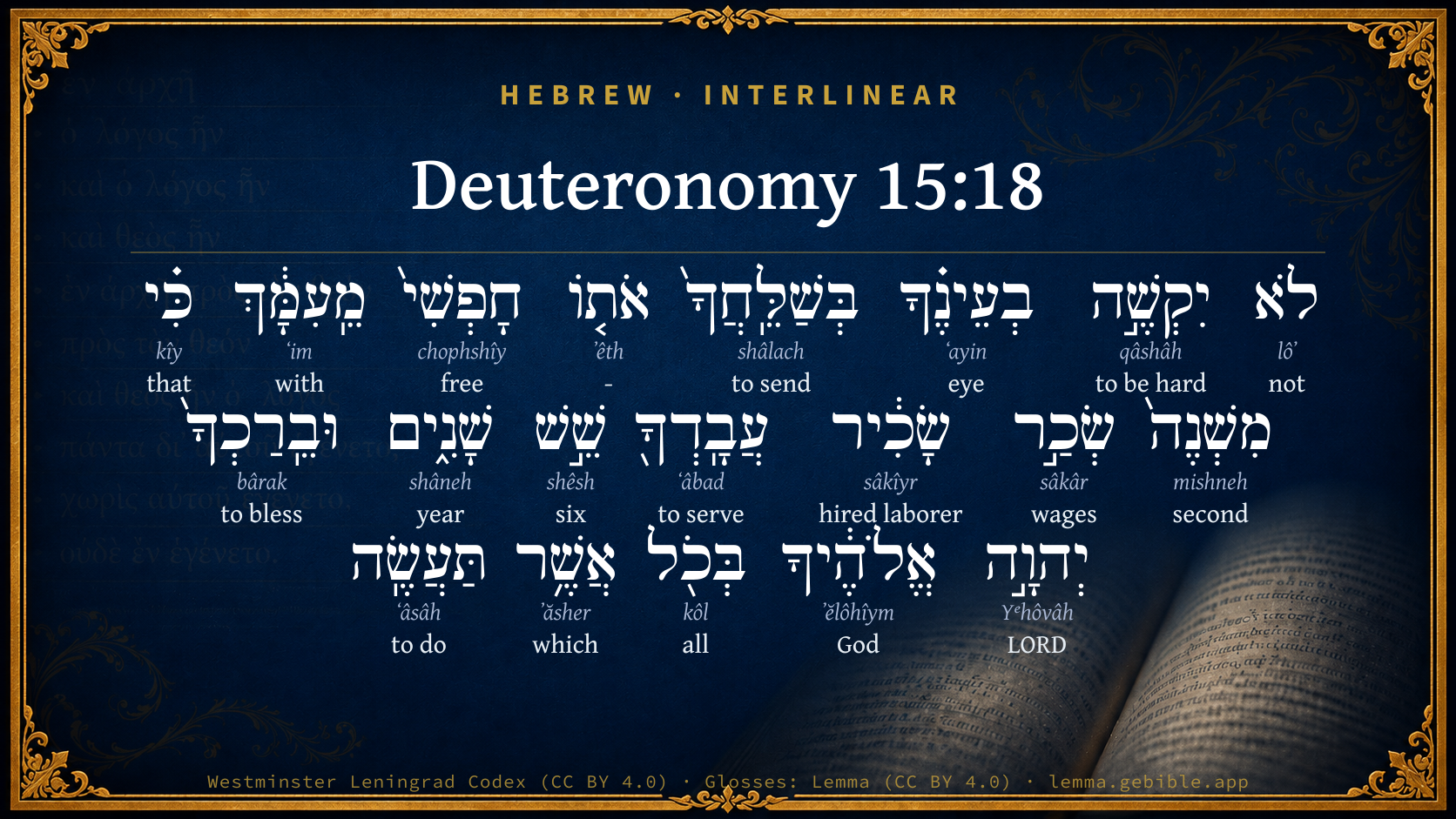
Hebrew (Westminster Leningrad Codex) Deuteronomy 15:18 appears in the Hebrew Old Testament. The text above is from the Westminster Leningrad Codex. Each word links to its Strong’s number, a concise gloss, and parsing drawn from the Open Scriptures Hebrew Bible morphology. Click any word for its full Brown-Driver-Briggs (BDB) entry.
Download image
Cite this verse

Deuteronomy 15:18 (World English Bible). Public Domain. Lemma interlinear Bible study tool, https://lemma.gebible.app/v/deuteronomy/15/18.

Show BibTeX & RIS
BibTeX
RIS
English Translation
It shall not seem hard to you, when you let him go free from you; for to the double of the hire of a hireling has he served you six years: and Yahweh your God will bless you in all that you do.
World English Bible · Public Domain
Download a study sheet

One document with this verse’s original text, its word-by-word gloss line, the meaning frame, cross-references with their text, attributed commentary, and full source and license credits — printable, and it pastes into notes with its structure intact.

This verse Autodidact and up

Study sheet (.html) Plain text (.txt)

A passage Seminary Student

Up to 50 verses in one chapter. A passage sheet keeps up to 6 commentary sources and 12 cross-references per verse, in the order this page ranks them, and says so on the sheet whenever that leaves anything out. Ask for a single verse and you get the Autodidact verse sheet above.

Everything on this page stays free to read, with no account — the sheet is a download of what is already on screen, not access to it.

Want to remove ads? Support Godless Engineer
Compare translations 3

The same verse in 3 English versions, stacked beneath the original-language interlinear above. Click any original word for its lexicon entry.

Each is an independent rendering of the whole verse — the interlinear is not word-aligned to these translations.

Highlighted words mark where these versions differ — a whole-verse word diff, not a word-by-word alignment.

  • World English Bible Public Domain
    It shall not seem hard to you, when you let him go free from you; for to the double of the hire of a hireling has he served you six years: and Yahweh your God will bless you in all that you do.
  • King James Version Public Domain
    It shall not seem hard unto thee, when thou sendest him away free from thee; for he hath been worth a double hired servant to thee, in serving thee six years: and the LORD thy God shall bless thee in all that thou doest.
  • unfoldingWord Literal Text CC BY-SA 4.0
    It must not seem difficult in your eyes when you send him out free from you, for double the wage of a hired man he has served you six years. And Yahweh your God will bless you in all that you do.

unfoldingWord Literal Text — © unfoldingWord, licensed CC BY-SA 4.0. Word-aligned USFM3 via Door43 (git.door43.org/unfoldingWord/en_ult).

Versions to compare (up to 4)

3 of 4 selected

Show all 18 translations

Every available English version of this verse, each an independent rendering of the whole verse.

  • World English Bible Public Domain
    It shall not seem hard to you, when you let him go free from you; for to the double of the hire of a hireling has he served you six years: and Yahweh your God will bless you in all that you do.
  • Berean Standard Bible Public Domain
    Do not regard it as a hardship to set your servant free, because his six years of service were worth twice the wages of a hired hand. And the LORD your God will bless you in all you do.
  • Majority Standard Bible Public Domain
    Do not regard it as a hardship to set your servant free, because his six years of service were worth twice the wages of a hired hand. And the LORD your God will bless you in all you do.
  • King James Version Public Domain
    It shall not seem hard unto thee, when thou sendest him away free from thee; for he hath been worth a double hired servant to thee, in serving thee six years: and the LORD thy God shall bless thee in all that thou doest.
  • American Standard Version (1901) Public Domain
    It shall not seem hard unto thee, when thou lettest him go free from thee; for to the double of the hire of a hireling hath he served thee six years: and Jehovah thy God will bless thee in all that thou doest.
  • Revised Version (1885) Public Domain
    It shall not seem hard unto thee, when thou lettest him go free from thee; for to the double of the hire of an hireling hath he served thee six years: and the LORD thy God shall bless thee in all that thou doest.
  • Geneva Bible (1599) Public Domain
    Let it not grieue thee, when thou lettest him goe out free from thee: for he hath serued thee sixe yeeres, which is the double worth of an hired seruant: and the Lord thy God shall blesse thee in all that thou doest.
  • Douay-Rheims (1899) Public Domain
    Turn not away thy eyes from them when thou makest them tree: because he hath served thee six years according to the wages of a hireling: that the Lord thy God may bless thee in all the works that thou dost.
  • Young's Literal Translation Public Domain
    `It is not hard in thine eyes, in thy sending him away free from thee; for the double of the hire of an hireling he hath served thee six years, and Jehovah thy God hath blessed thee in all that thou dost.
  • Literal Standard Version CC BY-SA 4.0
    It is not hard in your eyes in your sending him away free from you; for [his worth has been] double the hire of a hired worker [when] he has served you six years; and your God YHWH has blessed you in all that you do.
  • Unlocked Literal Bible CC BY-SA 4.0
    It must not seem difficult for you to let him go free from you, because he has served you for six years and given twice the value of a hired person. Yahweh your God will bless you in all that you do.
  • unfoldingWord Literal Text CC BY-SA 4.0
    It must not seem difficult in your eyes when you send him out free from you, for double the wage of a hired man he has served you six years. And Yahweh your God will bless you in all that you do.
  • Darby Bible Public Domain
    Let it not seem hard unto thee, when thou sendest him away free from thee; for double the worth of a hired servant hath he been to thee, [in] serving thee six years; and Jehovah thy God will bless thee in all that thou doest.
  • World Messianic Bible Public Domain
    It shall not seem hard to you when you let him go free from you, for he has been double the value of a hired hand as he served you six years. The LORD your God will bless you in all that you do.
  • Webster's Bible Public Domain
    It shall not seem hard to thee, when thou sendest him away free from thee; for he hath been of double the worth of a hired servant to thee, in serving thee six years: and the LORD thy God shall bless thee in all that thou doest.
  • Free Bible Version CC BY-SA 4.0
    Don't see it as a problem to free your slave, because your slave's six years of service to you was worth twice what you would have paid to hire someone. The Lord your God will bless you in everything you do for acting in this way.
  • Bible in Basic English Public Domain
    Let it not seem hard to you that you have to send him away free; for he has been working for you for six years, which is twice the regular time for a servant: and the blessing of the Lord your God will be on you in everything you do.
  • JPS Tanakh (1917) Public Domain
    It shall not seem hard unto thee, when thou lettest him go free from thee; for to the double of the hire of a hireling hath he served thee six years; and the LORD thy God will bless thee in all that thou doest.

Literal Standard Version (2020), Covenant Press — licensed CC BY-SA 4.0. Text via the HelloAO Bible API (eBible.org). Unlocked Literal Bible (unfoldingWord) — licensed CC BY-SA 4.0. Text via the HelloAO Bible API (eBible.org). unfoldingWord Literal Text — © unfoldingWord, licensed CC BY-SA 4.0. Word-aligned USFM3 via Door43 (git.door43.org/unfoldingWord/en_ult). Free Bible Version, Dr. Jonathan Gallagher — licensed CC BY-SA 4.0. Text via the HelloAO Bible API (eBible.org).

Word by word

More ways to search: Search by grammar → Find every occurrence → Compare this word →

Practice this passage: Drill this verse → Learn its vocabulary →

חָפְשִׁי֙
chophshîy
H2670
“free”
Adjective, Adjective, Masculine, Singular, Absolute
Part of Speech
Adjective
Type
Adjective
Gender
Masculine
Number
Singular
State
Absolute
Full BDB Definition

Origin: from H2666

TWOT: 717c

free - free (from slavery) - free (from taxes or obligations)
  1. לֹא lôʼ H3808 “not” Particle, Negative
  2. יִקְשֶׁ֣ה qâshâh H7185 “to be hard” Verb, Qal, Imperfect, 3rd Person, Masculine, Singular
  3. בְעֵינֶ֗ךָ ʻayin H5869 “in/at · eyes · your” Preposition + Noun, Common, Both, Dual, Construct + Suffix, Personal, 2nd Person, Masculine, Singular
  4. בְּשַׁלֵּֽחֲךָ֙ shâlach H7971 “in/at · to send · you” Preposition + Verb, Piel, Infinitive Construct + Suffix, Personal, 2nd Person, Masculine, Singular
  5. אֹת֤וֹ ʼêth H853 “- · him” Particle, Direct Object + Suffix, Personal, 3rd Person, Masculine, Singular
  6. מֵֽעִמָּ֔ךְ ʻim H5973 “from · with · you” Preposition + Preposition + Suffix, Personal, 2nd Person, Feminine, Singular
  7. כִּ֗י kîy H3588 “that” Conjunction
  8. מִשְׁנֶה֙ mishneh H4932 “second” Noun, Common, Masculine, Singular, Absolute
  9. שְׂכַ֣ר sâkâr H7939 “wages of” Noun, Common, Masculine, Singular, Construct
  10. שָׂכִ֔יר sâkîyr H7916 “hired laborer” Adjective, Adjective, Masculine, Singular, Absolute
  11. עֲבָֽדְךָ֖ ʻâbad H5647 “to serve · you” Verb, Qal, Perfect, 3rd Person, Masculine, Singular + Suffix, Personal, 2nd Person, Masculine, Singular
  12. שֵׁ֣שׁ shêsh H8337 “six” Adjective, Cardinal number, Feminine, Singular, Absolute
  13. שָׁנִ֑ים shâneh H8141 “years” Noun, Common, Feminine, Plural, Absolute
  14. וּבֵֽרַכְךָ֙ bârak H1288 “and · to bless · you” Conjunction + Verb, Piel, Sequential Perfect, 3rd Person, Masculine, Singular + Suffix, Personal, 2nd Person, Masculine, Singular
  15. יְהוָ֣ה Yᵉhôvâh H3068 “LORD” Noun, Proper
  16. אֱלֹהֶ֔יךָ ʼĕlôhîym H430 “God(s) · your” Noun, Common, Masculine, Plural, Construct + Suffix, Personal, 2nd Person, Masculine, Singular
  17. בְּכֹ֖ל kôl H3605 “in/at · all” Preposition + Noun, Common, Masculine, Singular, Absolute
  18. אֲשֶׁ֥ר ʼăsher H834 “which” Particle, Relative
  19. תַּעֲשֶֽׂה ʻâsâh H6213 “to do” Verb, Qal, Imperfect, 2nd Person, Masculine, Singular

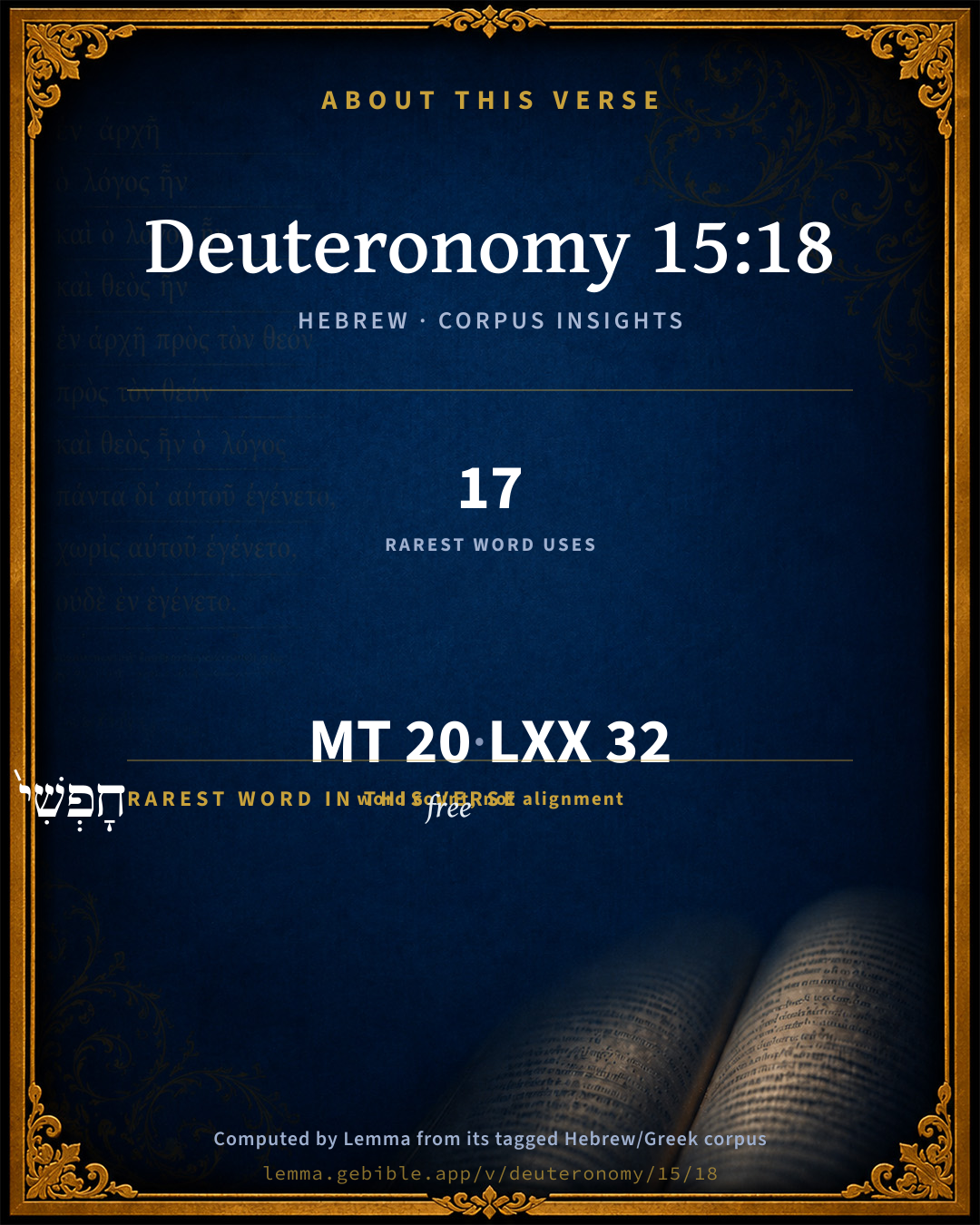
About this verse

These counts appear in no published source. They are computed here, from the morphology-tagged text and Lemma’s own curated glosses. What Lemma adds →

20
words
20
distinct lemmas
Pentateuch
section

Notable vocabulary

The rarest word here is חָפְשִׁי֙ free H2670 — appearing just 17 times in the whole Hebrew Bible.

Shared distinctive vocabulary

חָפְשִׁי֙ free H2670 occurs in 17 verses of the Hebrew Bible. Also found in:

Grammatical profile

  • 5 verbs
  • 7 nouns
  • 3 adjectives
  • 1 preposition
  • 1 conjunction
  • 3 particles

Verb forms

  • יִקְשֶׁ֣ה Qal · Imperfect
  • בְּשַׁלֵּֽחֲךָ֙ Piel · Infinitive Construct
  • עֲבָֽדְךָ֖ Qal · Perfect
  • וּבֵֽרַכְךָ֙ Piel · Sequential Perfect
  • תַּעֲשֶֽׂה Qal · Imperfect

Hebrew & Septuagint length

In English translation the verse runs 43 words from the Hebrew and 46 from the Septuagint (LXX English) — closely comparable.

A rough comparison of the two English renderings, which tokenize alike — not a word-level alignment.

Word counts can differ between the Hebrew and the Greek without any difference in meaning — e.g. the Hebrew direct-object marker אֵת has no separate Greek word, and Greek often adds the article ὁ.

In the original languages it is 20 Hebrew tokens and 32 Greek tokens — but the two are counted differently (Hebrew bundles its prefixes and suffixes into one token; the Greek is in lemma form), so that isn’t a like-for-like length.

Cross-references

3

Topical passages linked to Deuteronomy 15:18 in the Treasury of Scripture Knowledge — connected by theme and wording, ordered by reader-vote popularity; previews shown in the World English Bible.

  • Isaiah 16:14 But now Yahweh has spoken, saying, Within three years, as the years of a hireling, the glory of Moab shall be brought into contempt, with all his great multitude; and the remnant shall be very small and of no account.
  • Isaiah 21:16 For thus has the Lord said to me, Within a year, according to the years of a hireling, all the glory of Kedar shall fail;
  • Luke 17:7–8 But who is there among you, having a servant plowing or keeping sheep, that will say, when he comes in from the field, 'Come immediately and sit down at the table,'

Cross-references courtesy of OpenBible.info (CC BY 4.0).

Hebrew and Greek witnesses Masoretic Hebrew ↔ Greek Septuagint

The same verse in the two great witnesses to the Old Testament, shown verse-for-verse.

These are two independent witnesses, not word-aligned to each other, and the Septuagint is shown in lemma (dictionary) form.

Hebrew Deuteronomy 15:18 Masoretic · Westminster Leningrad Codex

לֹא יִקְשֶׁ֣ה בְעֵינֶ֗ךָ בְּשַׁלֵּֽחֲךָ֙ אֹת֤וֹ חָפְשִׁי֙ מֵֽעִמָּ֔ךְ כִּ֗י מִשְׁנֶה֙ שְׂכַ֣ר שָׂכִ֔יר עֲבָֽדְךָ֖ שֵׁ֣שׁ שָׁנִ֑ים וּבֵֽרַכְךָ֙ יְהוָ֣ה אֱלֹהֶ֔יךָ בְּכֹ֖ל אֲשֶׁ֥ר תַּעֲשֶֽׂה

It shall not seem hard to you, when you let him go free from you; for to the double of the hire of a hireling has he served you six years: and Yahweh your God will bless you in all that you do.

World English Bible · Public Domain

Greek LXX Deuteronomy 15:18 Septuagint · lemma form

οὐ σκληρός εἰμί ἐναντίον σύ ἐκ ἀποστέλλω αὐτός ἐλεύθερος ἀπό σύ ὅτι ἐφέτιος μισθός ὁ μισθωτός δουλεύω σύ ἕξ ἔτος καί εὐλογέω σύ κύριος ὁ θεός σύ ἐν πᾶς ὅς ἐάν ποιέω

It shall not seem hard to you when they are sent out free from you, because your servant has served you six years according to the annual hire of a hireling; so the Lord your God shall bless you in all things whatever you may do.

LXX2012 (modern English Septuagint) · Public Domain

Hebrew: Westminster Leningrad Codex (CC BY 4.0). Greek: Septuagint (public domain); English from LXX2012 (modern English Septuagint) (Public Domain). How the Septuagint differs from the Hebrew →

Targum (Aramaic paraphrase)

2

The Targum is the ancient Jewish Aramaic paraphrase of the Hebrew Scriptures — an interpretive translation, not the Hebrew text itself. Onkelos (literal) and Pseudo-Jonathan (expansive) render the Torah, and Jonathan the Prophets. Coverage is partial: where no permissively-licensed English translation exists for a verse, only the Aramaic is shown. This is verse-level text, not a word-by-word alignment to the Hebrew.

  1. Targum Onkelos Torah (Genesis–Deuteronomy)
    לָא יִקְשֵׁי בְעֵינָךְ בְּמִפְטְרָךְ יָתֵהּ בַּר חוֹרִין מֵעִמָךְ אֲרֵי עַל חַד תְּרֵין כַּאֲגַר אֲגִירָא פָּלְחָךְ שִׁית שְׁנִין וִיבָרֵכִנָךְ יְיָ אֱלָהָךְ בְּכֹל דִי תַעְבֵּד

    (no public-domain English translation for this verse)

    Targum Onkelos — Aramaic: “Onkelos Genesis” (public domain); “Onkelos Exodus” (public domain); “Onkelos Leviticus” (public domain); “Onkelos Numbers” (public domain); “Onkelos Deuteronomy” (public domain). English: “Sefaria Community Translation” (CC0 1.0 (public-domain dedication)); “J.W. Etheridge. The Targums of Onkelos and Jonathan Ben Uzziel on the Pentateuch. London: Longmans, Green, 1862” (public domain). Text via Sefaria.

  2. Targum Pseudo-Jonathan Torah (Genesis–Deuteronomy)
    לָא יִקְשֵׁי בְעֵינָךְ בְּמִפְטְרָךְ יָתֵיהּ לְבַר חוֹרִין מִן גַבָּךְ אֲרוּם בְּכוּפְלָא עַל אֲגַר אֲגִירָא פַּלְחָךְ שִׁית שְׁנִין וּבֵירְכָךְ מְטוּלֵיהּ יְיָ אֱלָהָךְ בְּכָל מַה דְּתֶעֱבַד

    It must not be a hardship in thy eyes when thou sendest him away from thee; for double the hire of an hireling hath he been of service to thee six years; and on his account the Lord thy God hath blessed thee in all that thou hast done.

    Targum Pseudo-Jonathan — Aramaic: “Targum Jonathan on Genesis” (public domain); “Targum Jonathan on Exodus” (public domain); “Targum Jonathan on Leviticus” (public domain); “Targum Jonathan on Numbers” (public domain); “Targum Jonathan on Deuteronomy” (public domain). English: “The Targum of Jonathan ben Uzziel, trans. J. W. Etheridge, London, 1862” (public domain). Text via Sefaria.

Commentary

Notes on Deuteronomy 15:18 from classic Christian and Jewish commentators (each source and its license shown beneath its notes). The classic Christian expositions comment on the surrounding passage and are grouped to its opening verse, so a note may address several verses; the Jewish commentaries on the Tanakh (Rashi and others) are per-verse, so they appear only where the commentator wrote on this verse.

Lemma curates 59 commentaries, every one of them public domain or Creative Commons licensed, each selected and text-cleaned for this edition rather than reprinted as found. About our sources →

Tyndale Open Study Notes

Tyndale Open Resources

15:18 worth double the wages: Because a bondservant worked all day, every day, his output was more than that of a day laborer, who merely put in his shift.

Tyndale Open Study Notes — © Tyndale Open Resources, licensed CC BY-SA 4.0. Text via the HelloAO Bible API.

Geneva Bible (1599)

Geneva Bible translators

For the hired servant served but three years, and he six.

Geneva Bible (1599) marginal notes — public domain. Text via Bolls.life.

Jamieson, Fausset & Brown

Robert Jamieson, A. R. Fausset & David Brown

he hath been worth a double hired servant to thee--that is, he is entitled to double wages because his service was more advantageous to you, being both without wages and for a length of time, whereas hired servants were engaged yearly (Lev 25:53), or at most for three years (Isa 16:14).

Jamieson, Fausset & Brown — Commentary Critical and Explanatory on the Whole Bible (1871) — public domain (CC PDM 1.0). Text via the HelloAO Bible API.

The Cambridge Bible for Schools and Colleges

gen. ed. J. J. S. Perowne

18. It shall not be hard in thine eye] See on Deu_15:9. How well this legislator knew the hearts of his people may be seen from Jer_34:8 ff.

for to the double of the hire of an hireling hath he served thee] Jewish commentators inferred from this that the hired servant served only for three years! (Cornelius a Lapide in loco). Calvin thinks that it means that a slave under compulsion worked twice as hard—which is contrary to experience. Rather, the cost of keeping a slave was only half of the current wage for a free servant.

and the Lord thy God shall bless thee] See Deu_15:10.

The Cambridge Bible for Schools and Colleges (gen. ed. J. J. S. Perowne; Cambridge University Press, 1878–1918) — public domain. Text from a community e-Sword module.

John Gill's Exposition

It shall not seem hard to thee when thou sendest him away free from thee,.... He should not grudge him his liberty, nor what he gives to him when he dismisses him:

for he hath been worth a double hired servant to thee in serving thee six years; since a hired servant a man is obliged to pay him wages for his work, besides his food, whereas a bondservant received no wages. Aben Ezra remarks, that this proves that a man might not hire himself for more than three years; or however, whereas a hired servant was sometimes hired for so many years, and this is the longest time of any we read of, a servant serving his master six years, his service must be worth double the service of an hired servant, which at most was but three years:

and the Lord thy God shall bless thee in all thou doest; thus well using thy servants, whether menservants or maidservants.

John Gill's Exposition of the Whole Bible (1746–1763) — public domain (CC PDM 1.0). Text via the HelloAO Bible API.

Haydock's Catholic Bible Commentary

Hireling. His freedom is due to him, as much as wages are due to the hireling. He is alse entitled to a decent provision, for which he has laboured. Hebrew, "he hath been worth twice as much to thee as a hired servant," by his greater diligence, labour, and fidelity. Servitude has also rendered his worth doubly severe. (Calmet)

George Leo Haydock (1774–1849), Haydock's Catholic Family Bible and Commentary, 1859 edition — public domain. Excludes Psalms (Douay-Rheims chapter numbering differs from Protestant) and Deuterocanonical books (Catholic canon only).

Matthew Poole's English Annotations

He hath been worth a double-hired servant to thee; or, he deserves double wages to an hired servant, because he served thee upon better terms, both without wages, which hired servants require, and for a longer time, even for six years, as it here follows, whereas servants were ordinarily hired but from year to year, Lev 25:53, or at most but for three years, as they gather from this place and Isa 16:14.

Matthew Poole's English Annotations on the Holy Bible (1683–1685) — public domain. Text from a community e-Sword/MySword module.

The Pulpit Commentary

Where a slave determined to have his freedom, the master was to set him free without grudge; for he hath been worth a double hired servant to thee, in serving thee six years; literally, double the hire of a hireling he hath served thee six years, i.e. he hath saved to thee as much again as it would have cost thee to pay a hired laborer to do the same amount of work.

The Pulpit Commentary (1880–1919), ed. H.D.M. Spence-Jones & Joseph S. Exell — public domain. Text from a community e-Sword module.

Keil & Delitzsch

C. F. Keil & F. Delitzsch

If, on the other hand, the servant (or maid) wished to be set free, the master was not to think it hard; "for the double of the wages of a day-labourer he has earned for thee for six years," i.e., not "twice the time of a day-labourer, so that he had really deserved twice the wages" (Vatablius, Ad. Osiander, J. Gerhard), for it cannot be proved from Isa 16:14, that a day-labourer generally hired himself out for three years; nor yet, "he has been obliged to work much harder than a day-labourer, very often by night as well as day" (Clericus, J. H. Michaelis, Rosenmller, Baumgarten); but simply, "he has earned and produced so much, that if you had been obliged to keep a day-labourer in his place, it would have cost you twice as much" (Schultz, Knobel).

Keil & Delitzsch — Biblical Commentary on the Old Testament (1861–1891) — public domain (CC PDM 1.0). Text via the HelloAO Bible API. (Old Testament only.)

unfoldingWord translationNotes

Door43 World Missions Community

It must not seem difficult for you to let him go free from you

This means that they are not resent it when they let someone go free. This can be stated in active form. AT: "Be pleased when you let him go free" (See: Litotes)

given twice the value of a hired person

This means the owner only had to pay have the amount for this slave to work than he would for a person he hired to do a job.

a hired person

This is a person who works for pay.

translationWords

free

servant

year

bless

unfoldingWord translationNotes — © Distant Shores Media and the Door43 World Missions Community, licensed CC BY-SA 4.0. Source: git.door43.org/Door43/en_tn.

Rashi

Rabbi Shlomo Yitzchaki (Rashi)

כי משנה שכר שכיר [IT SHALL NOT SEEM HARD UNTO THEE WHEN THOU LETTEST HIM GO FREE …] FOR [HE HATH BEEN WORTH] A DOUBLE HIRED SERVANT [UNTO THEE] — From here they (the Rabbis) derived the law that a Hebrew servant has to do service both by day and by night, and that is double as much as the labor of a man hired for day work only. And what is his service during the night? That his master gives him a Canaanite maid-servant with the object of raising children, and the children belong to the master (Sifrei Devarim 123:1; Kiddushin 15a).

Rashi on the Tanakh — English translations: “The Judaica Press complete Tanach with Rashi, translated by A. J. Rosenberg” (CC BY 4.0); “Pentateuch with Rashi's commentary by M. Rosenbaum and A.M. Silbermann, 1929-1934” (public domain); “The Metsudah Tanach series, Lakewood, N.J” (CC BY 4.0); and “The Book of Joshua, Metsudah Publications, 1997” (CC BY 4.0). Text via Sefaria.

Lesson kit

Teaching starters — assembled from the data on this page, not authored interpretation. Every prompt links to the verse data it draws on. Edit before teaching.

Deuteronomy, in the Pentateuch, opens this verse with 20 words (20 distinct Hebrew lemmas). Its most distinctive word is chophshîy (“free”). A historical commentator’s framing appears above. Read the whole chapter for the surrounding context.

Discussion questions

  1. How does “free” (chophshîy) shape what this verse is saying?
  2. Exodus 21:2 shares the word «free» with this verse. How do the two illuminate each other?
  3. The translations on this page render this verse differently — a whole-verse word diff, not a word-by-word alignment. What might account for the different wordings?
  4. The verb «יִקְשֶׁ֣ה» is Qal Imperfect. How does its form color the action?
  5. Reading how Tyndale Open Study Notes and Geneva Bible (1599) read this verse, where do the two commentators agree and where do they part?

Things to notice

Reading settings

Reading text

Shown beneath each verse's original-language words.

Old Testament
Old Testament edition

Read the OT as the Masoretic Hebrew (MT) or the Greek Septuagint (LXX).

English shown for the Greek Septuagint (in the Hebrew ↔ Greek comparison).

Comparing translations? Open the Compare panel on any verse page to stack up to four side by side.