Genesis 1:22

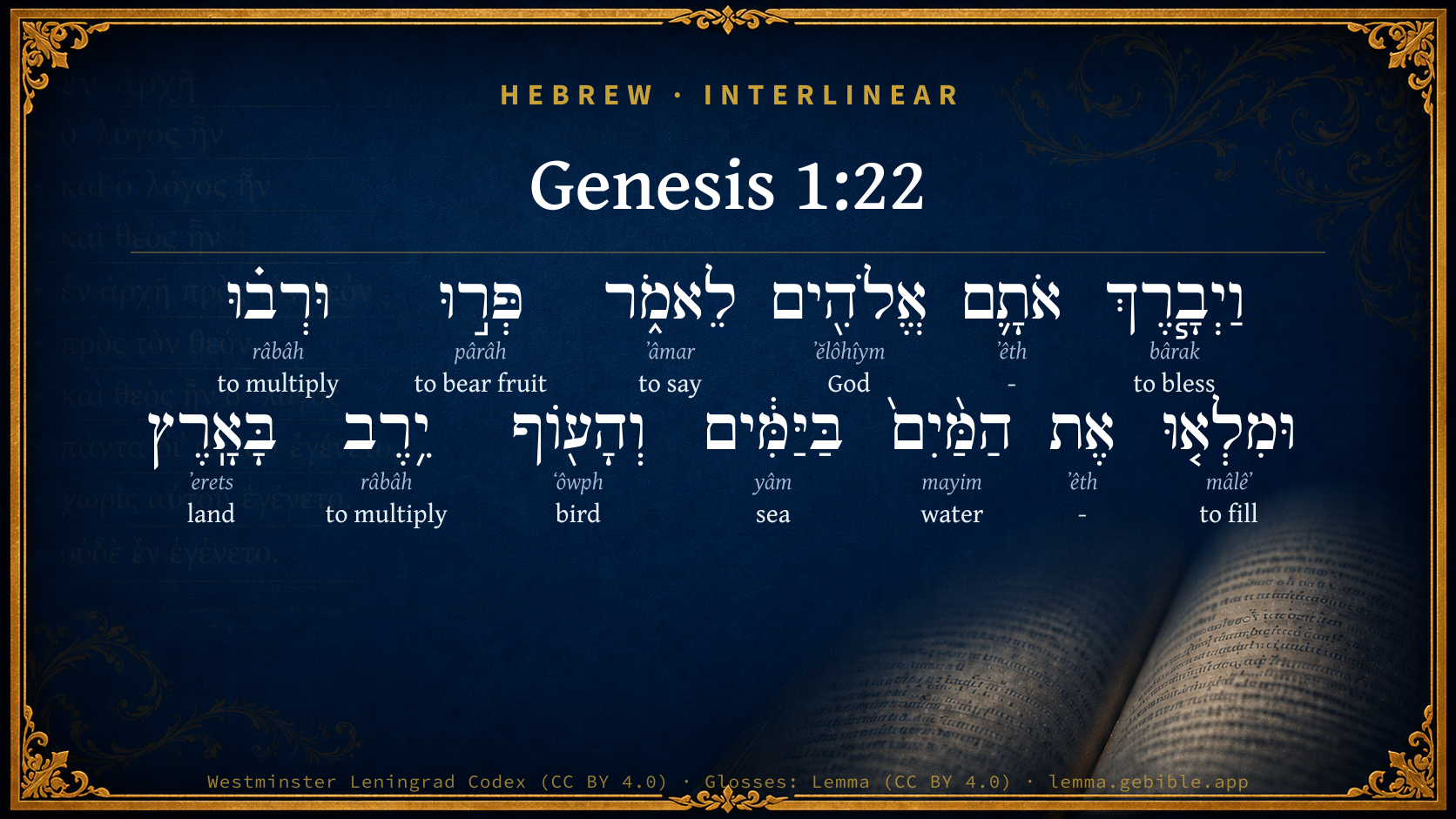
Hebrew (Westminster Leningrad Codex) Genesis 1:22 appears in the Hebrew Old Testament. The text above is from the Westminster Leningrad Codex. Each word links to its Strong’s number, a concise gloss, and parsing drawn from the Open Scriptures Hebrew Bible morphology. Click any word for its full Brown-Driver-Briggs (BDB) entry.
Download image
Cite this verse

Genesis 1:22 (World English Bible). Public Domain. Lemma interlinear Bible study tool, https://lemma.gebible.app/v/genesis/1/22.

Show BibTeX & RIS
BibTeX
RIS
English Translation
God blessed them, saying, "Be fruitful, and multiply, and fill the waters in the seas, and let birds multiply on the earth."
World English Bible · Public Domain
Highlights
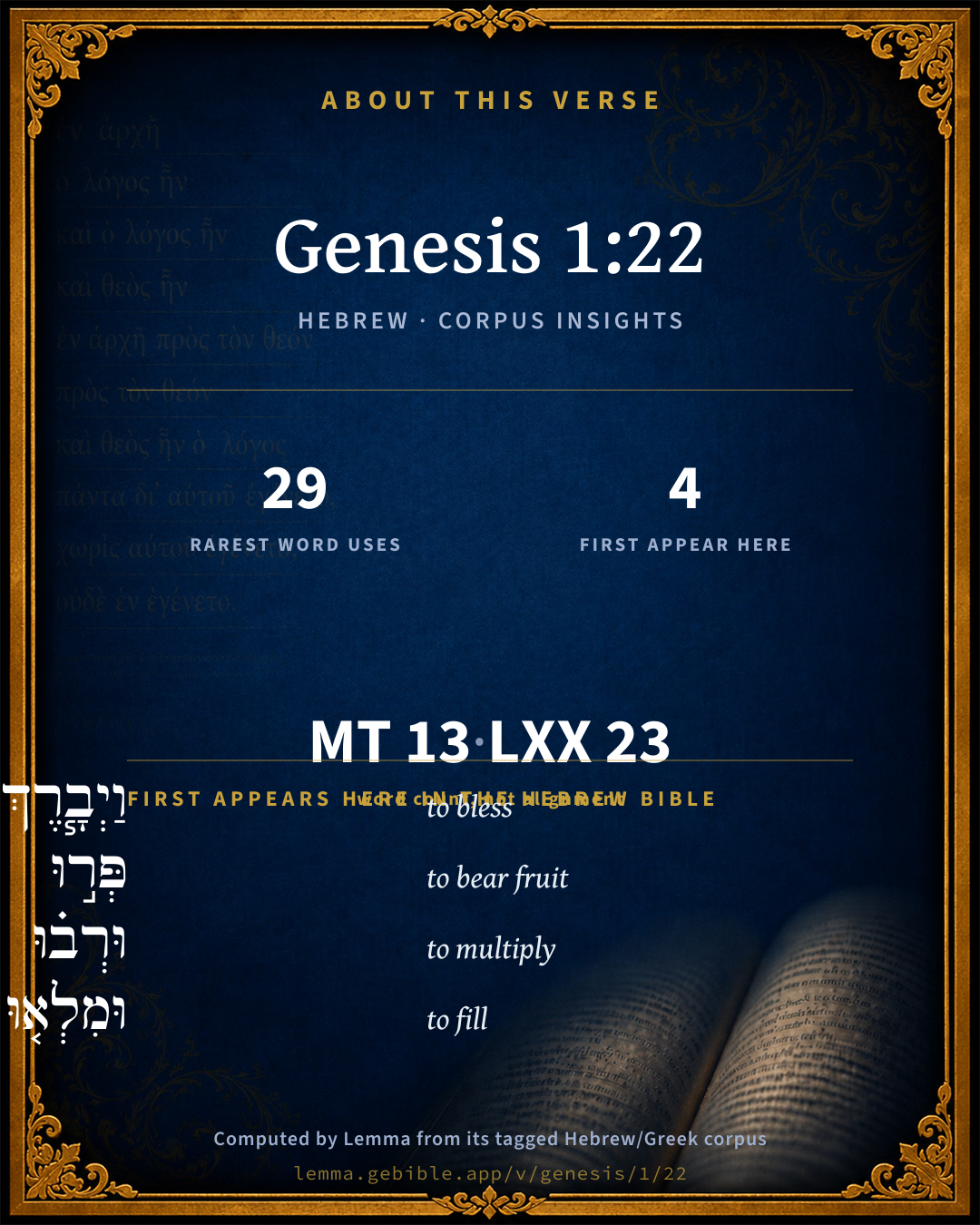
  • 4 first appearances in the Hebrew Bible
Full analysis ↓
Download a study sheet

One document with this verse’s original text, its word-by-word gloss line, the meaning frame, cross-references with their text, attributed commentary, and full source and license credits — printable, and it pastes into notes with its structure intact.

This verse Autodidact and up

Study sheet (.html) Plain text (.txt)

A passage Seminary Student

Up to 50 verses in one chapter. A passage sheet keeps up to 6 commentary sources and 12 cross-references per verse, in the order this page ranks them, and says so on the sheet whenever that leaves anything out. Ask for a single verse and you get the Autodidact verse sheet above.

Everything on this page stays free to read, with no account — the sheet is a download of what is already on screen, not access to it.

Want to remove ads? Support Godless Engineer
Compare translations 3

The same verse in 3 English versions, stacked beneath the original-language interlinear above. Click any original word for its lexicon entry.

Each is an independent rendering of the whole verse — the interlinear is not word-aligned to these translations.

Highlighted words mark where these versions differ — a whole-verse word diff, not a word-by-word alignment.

  • World English Bible Public Domain
    God blessed them, saying, "Be fruitful, and multiply, and fill the waters in the seas, and let birds multiply on the earth."
  • King James Version Public Domain
    And God blessed them, saying, Be fruitful, and multiply, and fill the waters in the seas, and let fowl multiply in the earth.
  • unfoldingWord Literal Text CC BY-SA 4.0
    Then God blessed them, saying, “Be fruitful and multiply and fill the waters in the seas, and let the bird multiply on the earth.”

unfoldingWord Literal Text — © unfoldingWord, licensed CC BY-SA 4.0. Word-aligned USFM3 via Door43 (git.door43.org/unfoldingWord/en_ult).

Versions to compare (up to 4)

3 of 4 selected

Show all 18 translations

Every available English version of this verse, each an independent rendering of the whole verse.

  • World English Bible Public Domain
    God blessed them, saying, "Be fruitful, and multiply, and fill the waters in the seas, and let birds multiply on the earth."
  • Berean Standard Bible Public Domain
    Then God blessed them and said, “Be fruitful and multiply and fill the waters of the seas, and let birds multiply on the earth.”
  • Majority Standard Bible Public Domain
    Then God blessed them and said, “Be fruitful and multiply and fill the waters of the seas, and let birds multiply on the earth.”
  • King James Version Public Domain
    And God blessed them, saying, Be fruitful, and multiply, and fill the waters in the seas, and let fowl multiply in the earth.
  • American Standard Version (1901) Public Domain
    And God blessed them, saying, Be fruitful, and multiply, and fill the waters in the seas, and let birds multiply on the earth.
  • Revised Version (1885) Public Domain
    And God blessed them, saying, Be fruitful, and multiply, and fill the waters in the seas, and let fowl multiply in the earth.
  • Geneva Bible (1599) Public Domain
    Then God blessed them, saying, Bring foorth fruite and multiplie, and fill the waters in the seas, and let the foule multiplie in the earth.
  • Douay-Rheims (1899) Public Domain
    And he blessed them, saying: Increase and multiply, and fill the waters of the sea: and let the birds be multiplied upon the earth.
  • Young's Literal Translation Public Domain
    And God blesseth them, saying, `Be fruitful, and multiply, and fill the waters in the seas, and the fowl let multiply in the earth:'
  • Literal Standard Version CC BY-SA 4.0
    And God blesses them, saying, “Be fruitful, and multiply, and fill the waters in the seas, and let the bird multiply in the earth”:
  • Unlocked Literal Bible CC BY-SA 4.0
    God blessed them, saying, “Be fruitful and multiply, and fill the waters in the seas. Let birds multiply on the earth.”
  • unfoldingWord Literal Text CC BY-SA 4.0
    Then God blessed them, saying, “Be fruitful and multiply and fill the waters in the seas, and let the bird multiply on the earth.”
  • Darby Bible Public Domain
    And God blessed them, saying, Be fruitful and multiply, and fill the waters in the seas, and let fowl multiply on the earth.
  • World Messianic Bible Public Domain
    God blessed them, saying, “Be fruitful, and multiply, and fill the waters in the seas, and let birds multiply on the earth.”
  • Webster's Bible Public Domain
    And God blessed them, saying, Be fruitful, and multiply, and fill the waters in the seas, and let fowl multiply in the earth.
  • Free Bible Version CC BY-SA 4.0
    God blessed them and said, “Reproduce and increase, and fill the waters of the seas, and let the birds increase on the earth.”
  • Bible in Basic English Public Domain
    And God gave them his blessing, saying, Be fertile and have increase, making all the waters of the seas full, and let the birds be increased in the earth.
  • JPS Tanakh (1917) Public Domain
    And God blessed them, saying: 'Be fruitful, and multiply, and fill the waters in the seas, and let fowl multiply in the earth.'

Literal Standard Version (2020), Covenant Press — licensed CC BY-SA 4.0. Text via the HelloAO Bible API (eBible.org). Unlocked Literal Bible (unfoldingWord) — licensed CC BY-SA 4.0. Text via the HelloAO Bible API (eBible.org). unfoldingWord Literal Text — © unfoldingWord, licensed CC BY-SA 4.0. Word-aligned USFM3 via Door43 (git.door43.org/unfoldingWord/en_ult). Free Bible Version, Dr. Jonathan Gallagher — licensed CC BY-SA 4.0. Text via the HelloAO Bible API (eBible.org).

Word by word

More ways to search: Search by grammar → Find every occurrence → Compare this word →

Practice this passage: Drill this verse → Learn its vocabulary →

פְּר֣וּ
pârâh
H6509
“bear fruit”
Verb, Qal, Imperative, 2nd Person, Masculine, Plural
Part of Speech
Verb
Stem
Qal
Form
Imperative
Person
2nd Person
Gender
Masculine
Number
Plural
Full BDB Definition

Origin: a primitive root

TWOT: 1809

to bear fruit, be fruitful, branch off - (Qal) to bear fruit, be fruitful - (Hiphil) - to cause to bear fruit - to make fruitful - to show fruitfulness, bear fruit
  1. וַיְבָ֧רֶךְ bârak H1288 “and · to bless” Conjunction + Verb, Piel, Sequential Imperfect, 3rd Person, Masculine, Singular
  2. אֹתָ֛ם ʼêth H853 “- · them” Particle, Direct Object + Suffix, Personal, 3rd Person, Masculine, Plural
  3. אֱלֹהִ֖ים ʼĕlôhîym H430 “God(s)” Noun, Common, Masculine, Plural, Absolute
  4. לֵאמֹ֑ר ʼâmar H559 “to say” Preposition + Verb, Qal, Infinitive Construct
  5. וּרְב֗וּ râbâh H7235 “and · multiply” Conjunction + Verb, Qal, Imperative, 2nd Person, Masculine, Plural
  6. וּמִלְא֤וּ mâlêʼ H4390 “and · fill” Conjunction + Verb, Qal, Imperative, 2nd Person, Masculine, Plural
  7. אֶת ʼêth H853 “-” Particle, Direct Object
  8. הַמַּ֨יִם֙ mayim H4325 “the · water(s)” Particle, Definite Article + Noun, Common, Masculine, Plural, Absolute
  9. בַּיַּמִּ֔ים yâm H3220 “in/at the · seas” Preposition, Determined + Noun, Common, Masculine, Plural, Absolute
  10. וְהָע֖וֹף ʻôwph H5775 “and · the · bird” Conjunction + Particle, Definite Article + Noun, Common, Masculine, Singular, Absolute
  11. יִ֥רֶב râbâh H7235 “to multiply” Verb, Qal, Jussive, 3rd Person, Masculine, Singular
  12. בָּאָֽרֶץ ʼerets H776 “in/at the · land” Preposition, Determined + Noun, Common, Both, Singular, Absolute

About this verse

These counts appear in no published source. They are computed here, from the morphology-tagged text and Lemma’s own curated glosses. What Lemma adds →

13
words
11
distinct lemmas
Pentateuch
section

First appearance in Scripture

These words make their first canonical appearance in the Hebrew Bible here:

  • וַיְבָ֧רֶךְ to bless H1288
  • פְּר֣וּ to bear fruit H6509
  • וּרְב֗וּ to multiply H7235
  • וּמִלְא֤וּ to fill H4390

Shared distinctive vocabulary

פְּר֣וּ to bear fruit H6509 occurs in 28 verses of the Hebrew Bible. Also found in:

Grammatical profile

  • 6 verbs
  • 5 nouns
  • 2 particles

Verb forms

  • וַיְבָ֧רֶךְ Piel · Sequential Imperfect
  • לֵאמֹ֑ר Qal · Infinitive Construct
  • פְּר֣וּ Qal · Imperative
  • וּרְב֗וּ Qal · Imperative
  • וּמִלְא֤וּ Qal · Imperative
  • יִ֥רֶב Qal · Jussive

Repetition

A word recurs within this verse — often emphatic in Hebrew:

  • וּרְב֗וּ to multiply H7235 ×2

Hebrew & Septuagint length

In English translation the verse runs 22 words from the Hebrew and 26 from the Septuagint (LXX English) — closely comparable.

A rough comparison of the two English renderings, which tokenize alike — not a word-level alignment.

Word counts can differ between the Hebrew and the Greek without any difference in meaning — e.g. the Hebrew direct-object marker אֵת has no separate Greek word, and Greek often adds the article ὁ.

In the original languages it is 13 Hebrew tokens and 23 Greek tokens — but the two are counted differently (Hebrew bundles its prefixes and suffixes into one token; the Greek is in lemma form), so that isn’t a like-for-like length.

Cross-references

14

Topical passages linked to Genesis 1:22 in the Treasury of Scripture Knowledge — connected by theme and wording, ordered by reader-vote popularity; previews shown in the World English Bible.

  • Genesis 8:17 Bring forth with you every living thing that is with you of all flesh, including birds, cattle, and every creeping thing that creeps on the earth; that they may breed abundantly in the earth, and be fruitful, and multiply on the earth."
  • Job 40:15 "See now, behemoth, which I made as well as you. He eats grass as an ox.
  • Genesis 1:28 God blessed them. God said to them, "Be fruitful, multiply, fill the earth, and subdue it. Have dominion over the fish of the sea, over the birds of the sky, and over every living thing that moves on the earth."
  • Psalms 107:38 He blesses them also, so that they are multiplied greatly. He doesn't allow their cattle to decrease.
  • Genesis 9:1 God blessed Noah and his sons, and said to them, "Be fruitful, and multiply, and replenish the earth.
  • Genesis 35:11 God said to him, "I am God Almighty. Be fruitful and multiply. A nation and a company of nations will be from you, and kings will come out of your loins.
  • Job 42:12 So Yahweh blessed the latter end of Job more than his beginning. He had fourteen thousand sheep, six thousand camels, one thousand yoke of oxen, and a thousand female donkeys.
  • Genesis 30:30 For it was little which you had before I came, and it has increased to a multitude. Yahweh has blessed you wherever I turned. Now when will I provide for my own house also?"
  • Leviticus 26:9 "'I will have respect for you, and make you fruitful, and multiply you, and will establish my covenant with you.
  • Psalms 107:31 Let them praise Yahweh for his loving kindness, For his wonderful works for the children of men!
  • Psalms 128:3 Your wife will be as a fruitful vine, In the innermost parts of your house; Your children like olive plants, Around your table.
  • Psalms 144:13–14 Our barns are full, filled with all kinds of provision. Our sheep bring forth thousands and ten thousands in our fields.
  • Proverbs 10:22 Yahweh's blessing brings wealth, And he adds no trouble to it.
  • Genesis 30:27 Laban said to him, "If now I have found favor in your eyes, stay here, for I have divined that Yahweh has blessed me for your sake."

Cross-references courtesy of OpenBible.info (CC BY 4.0).

Hebrew and Greek witnesses Masoretic Hebrew ↔ Greek Septuagint

The same verse in the two great witnesses to the Old Testament, shown verse-for-verse.

These are two independent witnesses, not word-aligned to each other, and the Septuagint is shown in lemma (dictionary) form.

Hebrew Genesis 1:22 Masoretic · Westminster Leningrad Codex

וַיְבָ֧רֶךְ אֹתָ֛ם אֱלֹהִ֖ים לֵאמֹ֑ר פְּר֣וּ וּרְב֗וּ וּמִלְא֤וּ אֶת הַמַּ֨יִם֙ בַּיַּמִּ֔ים וְהָע֖וֹף יִ֥רֶב בָּאָֽרֶץ

God blessed them, saying, "Be fruitful, and multiply, and fill the waters in the seas, and let birds multiply on the earth."

World English Bible · Public Domain

Greek LXX Genesis 1:22 Septuagint · lemma form

καί εὐλογέω αὐτός ὁ θεός λέγω αὐξάνω καί πληθύνω καί πληρόω ὁ ὕδωρ ἐν ὁ θάλασσα καί ὁ πετεινόν πληθύνω ἐπί ὁ γῆ

And God blessed them saying, Increase and multiply and fill the waters in the seas, and let the creatures that fly be multiplied on the earth.

LXX2012 (modern English Septuagint) · Public Domain

Hebrew: Westminster Leningrad Codex (CC BY 4.0). Greek: Septuagint (public domain); English from LXX2012 (modern English Septuagint) (Public Domain). How the Septuagint differs from the Hebrew →

Targum (Aramaic paraphrase)

2

The Targum is the ancient Jewish Aramaic paraphrase of the Hebrew Scriptures — an interpretive translation, not the Hebrew text itself. Onkelos (literal) and Pseudo-Jonathan (expansive) render the Torah, and Jonathan the Prophets. Coverage is partial: where no permissively-licensed English translation exists for a verse, only the Aramaic is shown. This is verse-level text, not a word-by-word alignment to the Hebrew.

  1. Targum Onkelos Torah (Genesis–Deuteronomy)
    וּבָרִיךְ יָתְהוֹן יְיָ לְמֵימָר פּוּשׁוּ וּסְגוּ וּמְלוּ יָת מַיָּא בְּיַמְמַיָּא וְעוֹפָא יִסְגֵּי בְּאַרְעָא

    (no public-domain English translation for this verse)

    Targum Onkelos — Aramaic: “Onkelos Genesis” (public domain); “Onkelos Exodus” (public domain); “Onkelos Leviticus” (public domain); “Onkelos Numbers” (public domain); “Onkelos Deuteronomy” (public domain). English: “Sefaria Community Translation” (CC0 1.0 (public-domain dedication)); “J.W. Etheridge. The Targums of Onkelos and Jonathan Ben Uzziel on the Pentateuch. London: Longmans, Green, 1862” (public domain). Text via Sefaria.

  2. Targum Pseudo-Jonathan Torah (Genesis–Deuteronomy)
    וּבָרִיךְ יַתְהוֹן יְיָ לְמֵימָר פּוּשׁוּ וּסְגוּ וּמְלוּ יַת מַיָא בְּיַמְמַיָא וְעוֹפָא יַפְשֵׁי בְּאַרְעָא

    And He blessed them, saying, Increase and multiply, and fill the waters of the seas, and let the fowl multiply upon the earth.

    Targum Pseudo-Jonathan — Aramaic: “Targum Jonathan on Genesis” (public domain); “Targum Jonathan on Exodus” (public domain); “Targum Jonathan on Leviticus” (public domain); “Targum Jonathan on Numbers” (public domain); “Targum Jonathan on Deuteronomy” (public domain). English: “The Targum of Jonathan ben Uzziel, trans. J. W. Etheridge, London, 1862” (public domain). Text via Sefaria.

Commentary

Notes on Genesis 1:22 from classic Christian and Jewish commentators (each source and its license shown beneath its notes). The classic Christian expositions comment on the surrounding passage and are grouped to its opening verse, so a note may address several verses; the Jewish commentaries on the Tanakh (Rashi and others) are per-verse, so they appear only where the commentator wrote on this verse.

Lemma curates 59 commentaries, every one of them public domain or Creative Commons licensed, each selected and text-cleaned for this edition rather than reprinted as found. About our sources →

Trapp's Complete Commentary

John Trapp

Gen 1:22 And God blessed them, saying, Be fruitful, and multiply, and fill the waters in the seas, and let fowl multiply in the earth.

Ver. 22. Be fruitful and multiply.] By bidding them do so, he made them do so, for his words are operative. Trismegist saith the self-same things in effect that Moses here doth. God, saith he, crieth out to his works by his holy word, saying, "Bring ye forth fruit, grow and increase," &c. Note the harmony here, and in twenty more passages, between Mercury and Moses. {a} God hath not left his truth without witness from the mouths of heathen writers. We may profitably read them, but not for ostentation. That were to make a calf of the treasure gotten out of Egypt.

{a} Morneus, De Verit. Relig. c. 9.

John Trapp, A Commentary or Exposition upon All the Books of the Old and New Testament (1647–1656) — public domain. Text from a community e-Sword module.

The Biblical Illustrator

Joseph S. Exell

Gen_1:22-23

And God blessed them, saying, Be fruitful and multiply

Gods blessing abundant

At the close of this day the Lord does what He has not done on any of the other four days; He blesses that which He has created, and the object of His blessing is an abundant and perpetual increase.

God is liberal; munificent in His donations both temporal and spiritual. Does He give joy? It is unspeakable joy. Does He give peace? It is a peace which passeth all understanding. Does He give pleasures? They are pleasures for evermore. Does He give glory: It is an exceeding eternal weight of glory. The close-handed and narrow-hearted Christian has not learned to be so in the school of the Master. All who are in His school, and who practice the lessons which they receive there, are open-handed and large-hearted. (A. McAuslane, D. D.)

Gods blessing upon the means of great importance

As in a course of physic, a diseased man is prescribed to boil certain midicinabble herbs in running water, and then to drink a quantity of that water, and so is cured of his disease; and yet we know that it is not the water, but the decoction or infusion, which cureth the patient: so it is not the bread that nourisheth, nor the abundance of outward things which enricheth or contenteth, but the infusion of Gods blessing, which is the staff of life, without which a man may starve for hunger with bread in his mouth, suffer the extremity of cold with good clothes on his back, and die like the children of Israel with the flesh of quails in his mouth. (J. Spencer.)

The Biblical Illustrator, edited by Joseph S. Exell (c. 1880s–1900s) — public domain. Text from a community e-Sword module.

Joseph Benson's Commentary

Gen 1:22. God blessed them — Behold the cause of the continuance in existence, and of the fruitfulness and multiplication, of the sundry kinds of creatures! It is owing to this word only that, though thousands of years have rolled away since their creation, not one species of them, amid so many, has been lost. Hence the inclination in every creature to propagate its species, and hence the wonderful and tender care they take of their young, till they are able to provide for themselves! So that, notwithstanding the daily great consumption of the creatures for the food of man, there is still such a succession of them, that the innumerable multitudes consumed for our use are not even missed. How wonderful that Being who is the author of this fertility and plenteousness!

Joseph Benson's Commentary on the Old and New Testaments (1811–1818) — public domain. Text from a community e-Sword module.

Tyndale Open Study Notes

Tyndale Open Resources

1:22 God blessed them: God’s blessing commissions and enables the fulfillment of what God has spoken (see “Blessing” Theme Note). • Let the fish . . . let the birds: These directives define the blessing. The fish and birds are fertile by God’s command, not by pagan ritual, as some of Israel’s neighbors thought.

Tyndale Open Study Notes — © Tyndale Open Resources, licensed CC BY-SA 4.0. Text via the HelloAO Bible API.

Geneva Bible (1599)

Geneva Bible translators

That is, by the virtue of his word he gave power to his creatures to engender.

Geneva Bible (1599) marginal notes — public domain. Text via Bolls.life.

Adam Clarke's Commentary

Verse 22. Let fowl multiply in the earth.] It is truly astonishing with what care, wisdom, and minute skill God has formed the different genera and species of birds, whether intended to live chiefly on land or in water. The structure of a single feather affords a world of wonders; and as God made the fowls that they might fly in the firmament of heaven, Ge 1:20, so he has adapted the form of their bodies, and the structure and disposition of their plumage, for that very purpose. The head and neck in flying are drawn principally within the breast-bone, so that the whole under part exhibits the appearance of a ship's hull. The wings are made use of as sails, or rather oars, and the tail as a helm or rudder. By means of these the creature is not only able to preserve the centre of gravity, but also to go with vast speed through the air, either straight forward, circularly, or in any kind of angle, upwards or downwards. In these also God has shown his skill and his power in the great and in the little-in the vast ostrich and cassowary, and In the beautiful humming-bird, which in plumage excels the splendour of the peacock, and in size is almost on a level with the bee.

Adam Clarke's Commentary on the Bible (1810–1826) — public domain. Text from a community e-Sword/MySword module.

John Calvin's Commentaries

22. And God blessed them What is the force of this benediction he soon declares. For God does not, after the manner of men, pray that we may be blessed; but, by the bare intimation of his purpose, effects what men seek by earnest entreaty. He therefore blesses his creatures when he commands them to increase and grow; that is, he infuses into them fecundity by his word. But it seems futile for God to address fishes and reptiles. I answer, this mode of speaking was no other than that which might be easily understood. For the experiment itself teaches, that the force of the word which was addressed to the fishes was not transient, but rather, being infused into their nature, has taken root, and constantly bears fruit.

John Calvin's Commentaries (1540-1563) — public domain. Text from the Calvin Translation Society English edition (1840s-50s) via the Christian Classics Ethereal Library (ccel.org). Calvin's coverage is partial (roughly two-thirds of the Bible); uncommented books and verses are honest gaps, never fabricated. The 19th-century editor's footnotes and remarks are omitted so the notes are faithfully Calvin's own voice.

Ellicott's Commentary for English Readers

(22) Be fruitful, and multiply.—This blessing shows that the earth was replenished with animal life from a limited number of progenitors, and probably from a small number of centres, both for the flora and for the fauna.

A Bible Commentary for English Readers, edited by Charles John Ellicott (1878–1897) — public domain. Text from a community e-Sword module.

The Cambridge Bible for Schools and Colleges

gen. ed. J. J. S. Perowne

22. God blessed them] With the creation of the living animals of the water and the air is introduced the mention of a new Divine act, that of blessing. It is connected with the gift of life (see note on Gen_1:21). The animal world differs from the vegetable world in its distinctive principle of life. The animals possess powers, instincts, and energies which are to be exercised, and on the exercise of which God gives His blessing. He has placed them in conditions favourable to their development and multiplication. Modern science, especially as represented by the honoured names of Darwin and Lyell, has shewn in what wonderful and varied ways the blessing of God has attended both the multiplication of animal life and the adaptation of the animals to their surroundings.

The Cambridge Bible for Schools and Colleges (gen. ed. J. J. S. Perowne; Cambridge University Press, 1878–1918) — public domain. Text from a community e-Sword module.

John Gill's Exposition

And God blessed them,.... With a power to procreate their kind, and continue their species, as it is interpreted in the next clause,

saying, be fruitful, and multiply, and fill the waters in the seas: and these creatures do multiply exceedingly, and vast quantities there are of them in the mighty waters, though the consumption of some sorts of them is very great. Our English word "fish" is derived from the Hebrew word "fush", which signifies to multiply and increase:

and let fowl multiply in the earth; as they did, and continue to do to this day.

John Gill's Exposition of the Whole Bible (1746–1763) — public domain (CC PDM 1.0). Text via the HelloAO Bible API.

Haydock's Catholic Bible Commentary

Blessed them, or enabled them to produce others. --- Multiply: the immense numbers and variety of fishes and fowls is truly astonishing.

George Leo Haydock (1774–1849), Haydock's Catholic Family Bible and Commentary, 1859 edition — public domain. Excludes Psalms (Douay-Rheims chapter numbering differs from Protestant) and Deuterocanonical books (Catholic canon only).

Matthew Poole's English Annotations

He gave them power of procreation and fruitfulness, which is justly mentioned as a great blessing, Psa 128:3-4.

Fill the waters in the seas; and consequently in the rivers, which come from the sea, and return into it.

Let fowl multiply in the earth, where they shall commonly have their habitation, though they had their original from the waters; of which see Poole on "Gen 1:20".

Matthew Poole's English Annotations on the Holy Bible (1683–1685) — public domain. Text from a community e-Sword/MySword module.

The Pulpit Commentary

And God blessed them. To bless is to wish well to (Gen_27:4; Num_6:23) In the case of God blessing inanimate things, it signifies to make them to prosper and be abundant (Exo_23:25; Job_1:10; Psa_65:11) The nature of the blessing pronounced upon the animal creation had reference to their propagation and increase. Be fruitful, and multiply, and fill the waters in the seas, and let fowl multiply in the earth. The paronomastic combination, be fruitful and multiply, became a regular formula of blessing (Gen_24:60 Gen_35:11 Gen_48:4; Psa_128:3, Psa_128:4) The Divine benediction was not simply a wish; but, adds Calvin, "by the bare intimation of his purpose he effects what men seek by entreaty." Nor was it meaningless that the words of benediction were addressed to the creatures; it was designed to teach that the "force of the Divine word was not meant to be transient, but, being infused into their natures, to take root and constantly bear fruit" (Calvin).

The Pulpit Commentary (1880–1919), ed. H.D.M. Spence-Jones & Joseph S. Exell — public domain. Text from a community e-Sword module.

unfoldingWord translationNotes

Door43 World Missions Community

blessed them

"blessed the animals that he had made"

Be fruitful and multiply

This is God's blessing. He told the sea animals to produce more sea animals like themselves, so that there would be many of them in the seas. The word "multiply" explains how they are to be "fruitful." (See: Doublet and Idiom)

multiply

increase greatly in number

Let birds multiply

This is a command. By commanding that birds should multiply, God made birds multiply. (See: Imperatives - Other Uses)

birds

"animals that fly" or "flying things." See how you translated this in Genesis 1:20.

evening and morning

This refers to the whole day. The writer speaks of the whole day as if it were these two parts. In the Jewish culture, a day begins when the sun sets. See how you translated this in Genesis 1:5. (See: Merism)

the fifth day

This refers to the fifth day that the universe existed. See how you translated "the first day" in Genesis 1:5 and decide if you should translate this the same way.

translationWords

God

bless

fruit

unfoldingWord translationNotes — © Distant Shores Media and the Door43 World Missions Community, licensed CC BY-SA 4.0. Source: git.door43.org/Door43/en_tn.

Rashi

Rabbi Shlomo Yitzchaki (Rashi)

ויברך אותם AND HE BLESSED THEM — Because people decreased their number, hunting them and eating them, they needed a blessing (Genesis Rabbah 11:2); it is true that beasts also were in need of a blessing, but on account of the serpent that was to be cursed in the future, He did not bless them, in order that it might not be included in the blessing.

פרו BE FRUITFUL — פרו is of the same root as פרי, and means bring forth fruit.

ורבו AND MULTIPLY — Had He said “Be fruitful” only, one creature might have brought forth a single one, and no more, therefore He added ורבו “and multiply”, implying that one should bring forth many.

Rashi on the Tanakh — English translations: “The Judaica Press complete Tanach with Rashi, translated by A. J. Rosenberg” (CC BY 4.0); “Pentateuch with Rashi's commentary by M. Rosenbaum and A.M. Silbermann, 1929-1934” (public domain); “The Metsudah Tanach series, Lakewood, N.J” (CC BY 4.0); and “The Book of Joshua, Metsudah Publications, 1997” (CC BY 4.0). Text via Sefaria.

Ramban (Nachmanides)

Rabbi Moshe ben Nachman (Ramban / Nachmanides)

AND G-D BLESSED THEM SAYING. He decreed the blessing on them and said of them that they should be fruitful and multiply, meaning that they should bring forth abundantly, that one creature should bring forth many like itself. The purport of the blessing is procreation, even as it says, And I will bless her, and she shall be a mother of nations. In connection with plants also, the term “blessing” applies: Then I will command My blessing upon you in the sixth year. However, it does not say so on the third day [when the plants and trees were created] because all created living beings were only a single pair, male and female, according to their kind, and therefore they were in need of a blessing to bring forth abundantly; but in the case of plants, they sprang up over the face of the entire earth in great abundance, just as they exist today. Nor did He mention a blessing on the sixth day for cattle and beasts because in the decree of abundancy which He decreed for the moving souls in the waters there were included the moving souls on the earth, as all living souls that do not speak are in the same class of creation. And our Rabbis have said that they [the fish and fowl] were in need of a blessing because people hunt them and eat them.

AND FILL THE WATERS IN THE SEA. He blessed them that in their abundancy they would fill the seas, the streams and the pools. Or it may be that their “filling” is to be in the seas only for in the streams they are few.

AND LET FOWL MULTIPLY IN THE EARTH. Although the fowl were created out of the waters, their blessing — that they be fruitful and multiply — was to be on the earth for there is no fowl that lays its eggs in the waters and has them grow there. Even those fowl which abide always in the waters and derive their food from them lay their eggs on the earth, and there they are born.

Ramban (Nachmanides) on the Tanakh — English translation: “Commentary on the Torah by Ramban (Nachmanides). Translated and annotated by Charles B. Chavel. New York, Shilo Pub. House, 1971-1976” (CC BY 4.0). Text via Sefaria.

Radak

Rabbi David Kimhi (Radak)

ויברך אותם...פרו ורבו, the land-based mammals were created on the sixth day, on the same day man was created, seeing that both categories of creatures make their habitat on the dry land.

את המים בימים, the waters which are in the oceans; for in the rivers and streams the fish do not reproduce at such rapid rates. The directive by G’d to multiply was not addressed to them directly, seeing they do not possess the intelligence to receive and understand such messages. What the Torah means is that G’d’s goodwill towards them was equivalent to His having addressed such a blessing to them directly.

והעוף ירב בארץ, the emphasis here is on the word הארץ, i.e. even though its origin is in the waters the birds will grow and generally behave more like land-based creatures.

Radak on the Tanakh — English translations: “Sefaria Community Translation” (CC0 1.0 (public-domain dedication)); “Eliyahu Munk, HaChut Hameshulash” (CC BY 4.0); “Rabbi Mike Feuer, Jerusalem Anthology” (CC BY 4.0); and “R. David Kimhi on the first book of Psalms, Translated by R.G. Finch, London, 1919” (public domain). Text via Sefaria.

Lesson kit

Teaching starters — assembled from the data on this page, not authored interpretation. Every prompt links to the verse data it draws on. Edit before teaching.

Genesis, in the Pentateuch, opens this verse with 13 words (11 distinct Hebrew lemmas). Its most distinctive word is pârâh (“to bear fruit”). A historical commentator’s framing appears above. Read the whole chapter for the surrounding context.

Discussion questions

  1. How does “to bear fruit” (pârâh) shape what this verse is saying?
  2. 4 words make their first appearance in Scripture here. What does this debut establish?
  3. How does Genesis 1:28, which shares the word «to bear fruit», read alongside this verse?
  4. What does the repetition of “to multiply” (2× in this one verse) do in this verse?
  5. These translations render this verse differently; the difference is in the English rendering, not the original. What questions does that raise?
  6. «וַיְבָ֧רֶךְ» is a Piel Sequential Imperfect verb. How does that grammatical form shape the action described?
  7. Compare how Trapp's Complete Commentary and The Biblical Illustrator read this verse. Where do they agree or differ?

Things to notice

Reading settings

Reading text

Shown beneath each verse's original-language words.

Old Testament
Old Testament edition

Read the OT as the Masoretic Hebrew (MT) or the Greek Septuagint (LXX).

English shown for the Greek Septuagint (in the Hebrew ↔ Greek comparison).

Comparing translations? Open the Compare panel on any verse page to stack up to four side by side.