
Genesis 28:3

Hebrew (Westminster Leningrad Codex) Genesis 28:3 appears in the Hebrew Old Testament. The text above is from the Westminster Leningrad Codex. Each word links to its Strong’s number, a concise gloss, and parsing drawn from the Open Scriptures Hebrew Bible morphology. Click any word for its full Brown-Driver-Briggs (BDB) entry.
Download image
Cite this verse

Genesis 28:3 (World English Bible). Public Domain. Lemma interlinear Bible study tool, https://lemma.gebible.app/v/genesis/28/3.

Show BibTeX & RIS
BibTeX
RIS
English Translation
May God Almighty bless you, and make you fruitful, and multiply you, that you may be a company of peoples,
World English Bible · Public Domain
Highlights
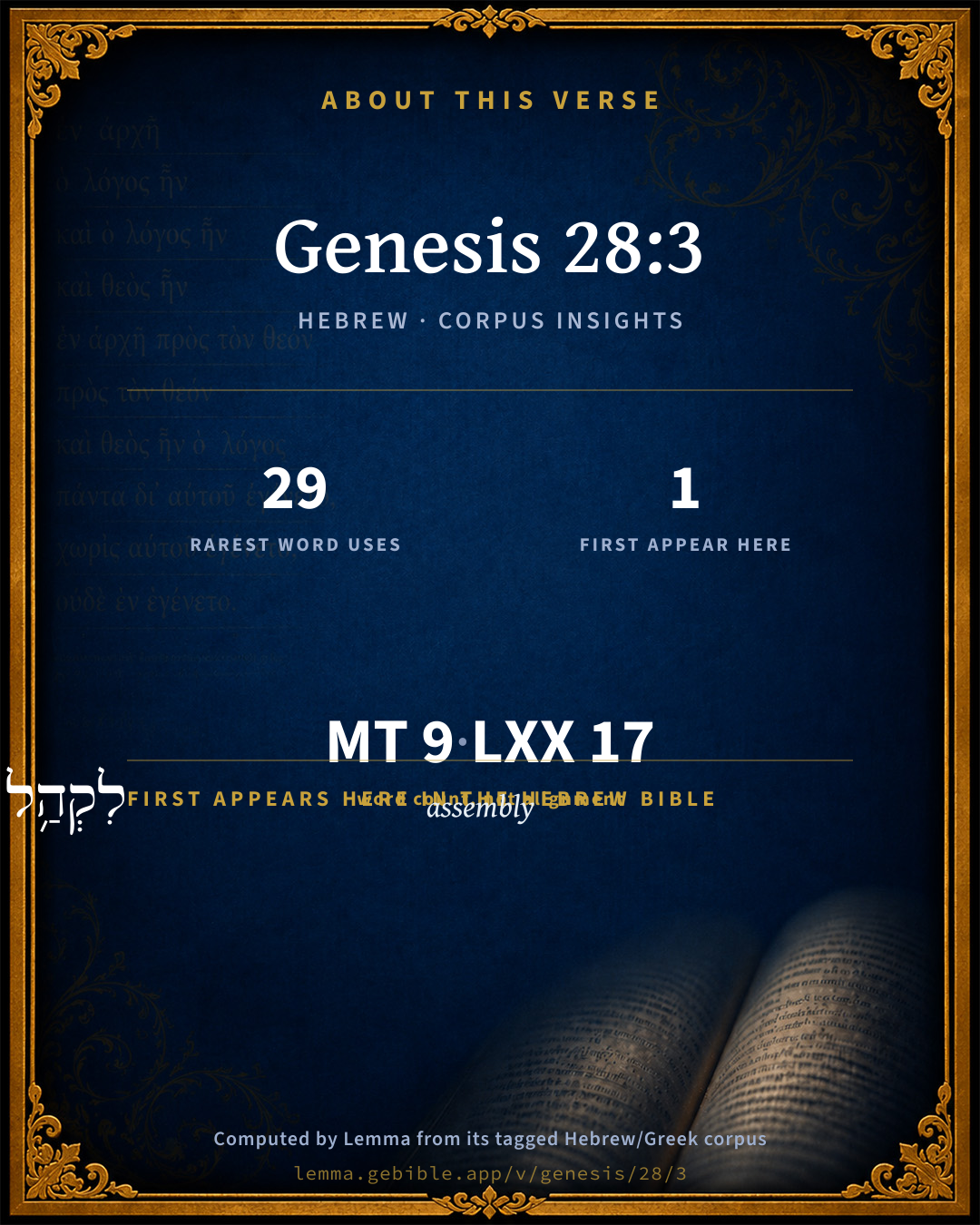
  • 1 first appearance in the Hebrew Bible
Full analysis ↓
Download a study sheet

One document with this verse’s original text, its word-by-word gloss line, the meaning frame, cross-references with their text, attributed commentary, and full source and license credits — printable, and it pastes into notes with its structure intact.

This verse Autodidact and up

Study sheet (.html) Plain text (.txt)

A passage Seminary Student

Up to 50 verses in one chapter. A passage sheet keeps up to 6 commentary sources and 12 cross-references per verse, in the order this page ranks them, and says so on the sheet whenever that leaves anything out. Ask for a single verse and you get the Autodidact verse sheet above.

Everything on this page stays free to read, with no account — the sheet is a download of what is already on screen, not access to it.

Want to remove ads? Support Godless Engineer
Compare translations 3

The same verse in 3 English versions, stacked beneath the original-language interlinear above. Click any original word for its lexicon entry.

Each is an independent rendering of the whole verse — the interlinear is not word-aligned to these translations.

Highlighted words mark where these versions differ — a whole-verse word diff, not a word-by-word alignment.

  • World English Bible Public Domain
    May God Almighty bless you, and make you fruitful, and multiply you, that you may be a company of peoples,
  • King James Version Public Domain
    And God Almighty bless thee, and make thee fruitful, and multiply thee, that thou mayest be a multitude of people;
  • unfoldingWord Literal Text CC BY-SA 4.0
    And may God Almighty bless you and make you fruitful and multiply you so that you become an assembly of peoples.

unfoldingWord Literal Text — © unfoldingWord, licensed CC BY-SA 4.0. Word-aligned USFM3 via Door43 (git.door43.org/unfoldingWord/en_ult).

Versions to compare (up to 4)

3 of 4 selected

Show all 18 translations

Every available English version of this verse, each an independent rendering of the whole verse.

  • World English Bible Public Domain
    May God Almighty bless you, and make you fruitful, and multiply you, that you may be a company of peoples,
  • Berean Standard Bible Public Domain
    May God Almighty bless you and make you fruitful and multiply you, so that you may become a company of peoples.
  • Majority Standard Bible Public Domain
    May God Almighty bless you and make you fruitful and multiply you, so that you may become a company of peoples.
  • King James Version Public Domain
    And God Almighty bless thee, and make thee fruitful, and multiply thee, that thou mayest be a multitude of people;
  • American Standard Version (1901) Public Domain
    And God Almighty bless thee, and make thee fruitful, and multiply thee, that thou mayest be a company of peoples.
  • Revised Version (1885) Public Domain
    And God Almighty bless thee, and make thee fruitful, and multiply thee, that thou mayest be a company of peoples;
  • Geneva Bible (1599) Public Domain
    And God all sufficient blesse thee, and make thee to encrease, and multiplie thee, that thou mayest be a multitude of people,
  • Douay-Rheims (1899) Public Domain
    And God almighty bless thee, and make thee to increase, and multiply thee: that thou mayst be a multitude of people.
  • Young's Literal Translation Public Domain
    and God Almighty doth bless thee, and make thee fruitful, and multiply thee, and thou hast become an assembly of peoples;
  • Literal Standard Version CC BY-SA 4.0
    and God Almighty bless you, and make you fruitful, and multiply you, and you have become an assembly of peoples;
  • Unlocked Literal Bible CC BY-SA 4.0
    May God Almighty bless you, make you fruitful and multiply you, so that you may become a multitude of peoples.
  • unfoldingWord Literal Text CC BY-SA 4.0
    And may God Almighty bless you and make you fruitful and multiply you so that you become an assembly of peoples.
  • Darby Bible Public Domain
    And the Almighty ùGod bless thee, and make thee fruitful and multiply thee, that thou mayest become a company of peoples.
  • World Messianic Bible Public Domain
    May God Almighty bless you, and make you fruitful, and multiply you, that you may be a company of peoples,
  • Webster's Bible Public Domain
    And God Almighty bless thee, and make thee fruitful, and multiply thee, that thou mayest be a multitude of people;
  • Free Bible Version CC BY-SA 4.0
    God Almighty bless you and may your descendants be so numerous that you become the ancestor of many nations.
  • Bible in Basic English Public Domain
    And may God, the Ruler of all, give you his blessing, giving you fruit and increase, so that you may become an army of peoples.
  • JPS Tanakh (1917) Public Domain
    And God Almighty bless thee, and make thee fruitful, and multiply thee, that thou mayest be a congregation of peoples;

Literal Standard Version (2020), Covenant Press — licensed CC BY-SA 4.0. Text via the HelloAO Bible API (eBible.org). Unlocked Literal Bible (unfoldingWord) — licensed CC BY-SA 4.0. Text via the HelloAO Bible API (eBible.org). unfoldingWord Literal Text — © unfoldingWord, licensed CC BY-SA 4.0. Word-aligned USFM3 via Door43 (git.door43.org/unfoldingWord/en_ult). Free Bible Version, Dr. Jonathan Gallagher — licensed CC BY-SA 4.0. Text via the HelloAO Bible API (eBible.org).

Word by word

More ways to search: Search by grammar → Find every occurrence → Compare this word →

Practice this passage: Drill this verse → Learn its vocabulary →

וְיַפְרְךָ֖
pârâh
H6509
“and · to bear fruit · you”
Conjunction + Verb, Hiphil, Jussive, 3rd Person, Masculine, Singular + Suffix, Personal, 2nd Person, Masculine, Singular
Part of Speech
Conjunction + Verb
Stem
Hiphil
Form
Jussive
Person
3rd Person
Gender
Masculine
Number
Singular
Full BDB Definition

Origin: a primitive root

TWOT: 1809

to bear fruit, be fruitful, branch off - (Qal) to bear fruit, be fruitful - (Hiphil) - to cause to bear fruit - to make fruitful - to show fruitfulness, bear fruit
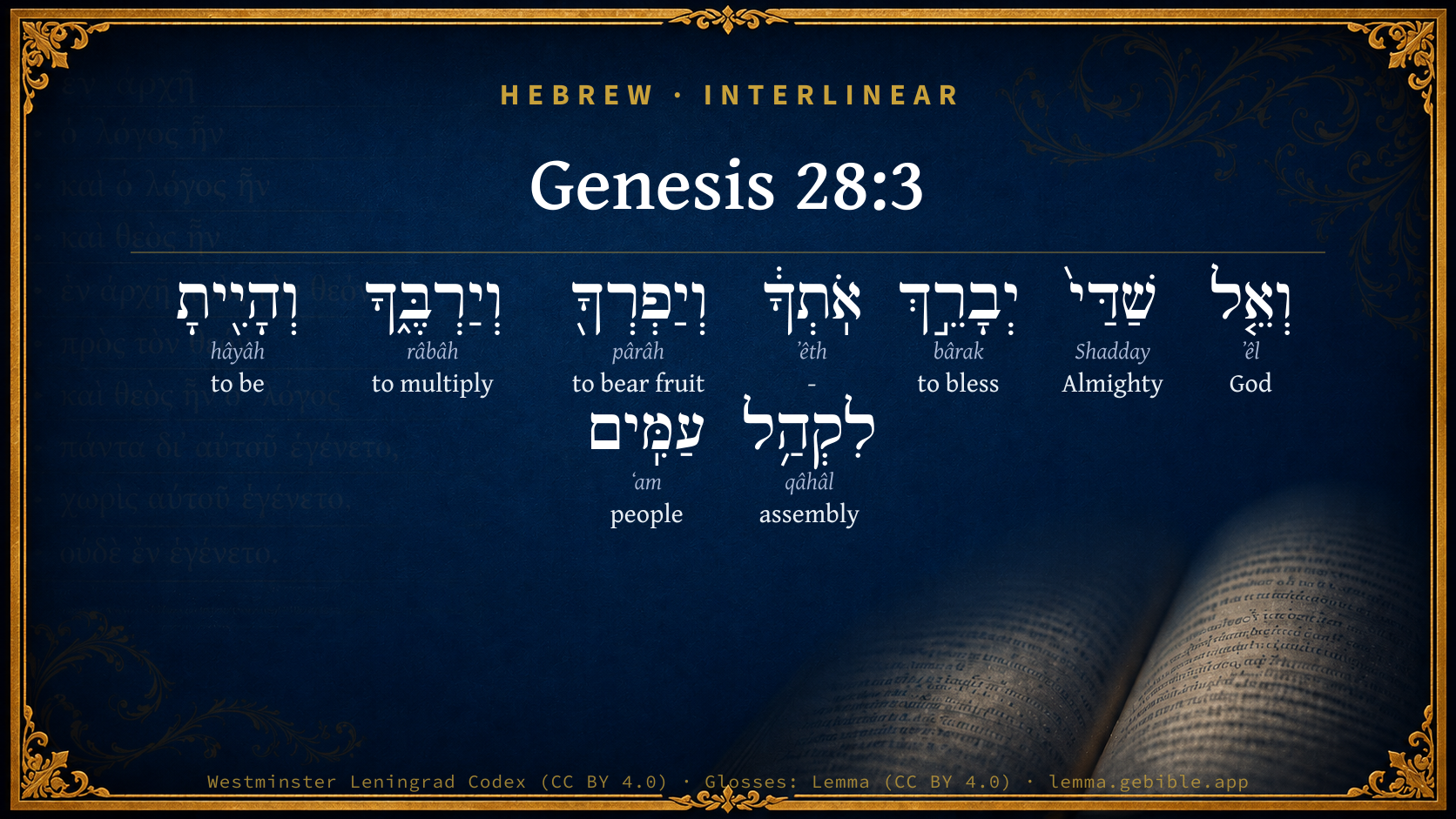
  1. וְאֵ֤ל ʼêl H410 “and · God” Conjunction + Noun, Proper
  2. שַׁדַּי֙ Shadday H7706 “Almighty” Noun, Proper
  3. יְבָרֵ֣ךְ bârak H1288 “to bless” Verb, Piel, Jussive, 3rd Person, Masculine, Singular
  4. אֹֽתְךָ֔ ʼêth H853 “- · you” Particle, Direct Object + Suffix, Personal, 2nd Person, Masculine, Singular
  5. וְיַרְבֶּ֑ךָ râbâh H7235 “and · to multiply · you” Conjunction + Verb, Hiphil, Jussive, 3rd Person, Masculine, Singular + Suffix, Personal, 2nd Person, Masculine, Singular
  6. וְהָיִ֖יתָ hâyâh H1961 “and · to be” Conjunction + Verb, Qal, Sequential Perfect, 2nd Person, Masculine, Singular
  7. לִקְהַ֥ל qâhâl H6951 “to/for · assembly of” Preposition + Noun, Common, Masculine, Singular, Construct
  8. עַמִּֽים ʻam H5971 “peoples” Noun, Common, Masculine, Plural, Absolute

About this verse

These counts appear in no published source. They are computed here, from the morphology-tagged text and Lemma’s own curated glosses. What Lemma adds →

9
words
9
distinct lemmas
Pentateuch
section

First appearance in Scripture

This word makes its first canonical appearance in the Hebrew Bible here:

  • לִקְהַ֥ל assembly H6951

Shared distinctive vocabulary

וְיַפְרְךָ֖ to bear fruit H6509 occurs in 28 verses of the Hebrew Bible. Also found in:

Grammatical profile

  • 4 verbs
  • 4 nouns
  • 1 particle

Verb forms

  • יְבָרֵ֣ךְ Piel · Jussive
  • וְיַפְרְךָ֖ Hiphil · Jussive
  • וְיַרְבֶּ֑ךָ Hiphil · Jussive
  • וְהָיִ֖יתָ Qal · Sequential Perfect

Hebrew & Septuagint length

In English translation the verse runs 20 words from the Hebrew and 19 from the Septuagint (LXX English) — closely comparable.

A rough comparison of the two English renderings, which tokenize alike — not a word-level alignment.

Word counts can differ between the Hebrew and the Greek without any difference in meaning — e.g. the Hebrew direct-object marker אֵת has no separate Greek word, and Greek often adds the article ὁ.

In the original languages it is 9 Hebrew tokens and 17 Greek tokens — but the two are counted differently (Hebrew bundles its prefixes and suffixes into one token; the Greek is in lemma form), so that isn’t a like-for-like length.

Cross-references

15

Topical passages linked to Genesis 28:3 in the Treasury of Scripture Knowledge — connected by theme and wording, ordered by reader-vote popularity; previews shown in the World English Bible.

  • Genesis 48:3 Jacob said to Joseph, "God Almighty appeared to me at Luz in the land of Canaan, and blessed me,
  • Genesis 35:11 God said to him, "I am God Almighty. Be fruitful and multiply. A nation and a company of nations will be from you, and kings will come out of your loins.
  • Genesis 1:28 God blessed them. God said to them, "Be fruitful, multiply, fill the earth, and subdue it. Have dominion over the fish of the sea, over the birds of the sky, and over every living thing that moves on the earth."
  • Genesis 17:1–6 When Abram was ninety-nine years old, Yahweh appeared to Abram, and said to him, "I am God Almighty. Walk before me, and be blameless.
  • Genesis 22:17–18 that in blessing I will bless you, and in multiplying I will multiply your seed as the stars of the heavens, and as the sand which is on the seashore. Your seed will possess the gate of his enemies.
  • Genesis 9:1 God blessed Noah and his sons, and said to them, "Be fruitful, and multiply, and replenish the earth.
  • Genesis 13:16 I will make your offspring as the dust of the earth, so that if a man can number the dust of the earth, then your seed may also be numbered.
  • Genesis 41:52 The name of the second, he called Ephraim: "For God has made me fruitful in the land of my affliction."
  • Genesis 43:14 May God Almighty give you mercy before the man, that he may release to you your other brother and Benjamin. If I am bereaved of my children, I am bereaved."
  • Genesis 24:60 They blessed Rebekah, and said to her, "Our sister, may you be the mother of thousands of ten thousands, and let your seed possess the gate of those who hate them."
  • Exodus 6:3 and I appeared to Abraham, to Isaac, and to Jacob, as God Almighty; but by my name Yahweh I was not known to them.
  • Psalms 127:3–128:6 Behold, children are a heritage of Yahweh. The fruit of the womb is his reward.
  • 2 Corinthians 6:18 I will be to you a Father. You will be to me sons and daughters,' says the Lord Almighty."
  • Revelation 21:22 I saw no temple in it, for the Lord God, the Almighty, and the Lamb, are its temple.
  • Psalms 127:1 Unless Yahweh builds the house, They labor in vain who build it. Unless Yahweh watches over the city, The watchman guards it in vain.

Cross-references courtesy of OpenBible.info (CC BY 4.0).

Hebrew and Greek witnesses Masoretic Hebrew ↔ Greek Septuagint

The same verse in the two great witnesses to the Old Testament, shown verse-for-verse.

These are two independent witnesses, not word-aligned to each other, and the Septuagint is shown in lemma (dictionary) form.

Hebrew Genesis 28:3 Masoretic · Westminster Leningrad Codex

וְאֵ֤ל שַׁדַּי֙ יְבָרֵ֣ךְ אֹֽתְךָ֔ וְיַפְרְךָ֖ וְיַרְבֶּ֑ךָ וְהָיִ֖יתָ לִקְהַ֥ל עַמִּֽים

May God Almighty bless you, and make you fruitful, and multiply you, that you may be a company of peoples,

World English Bible · Public Domain

Greek LXX Genesis 28:3 Septuagint · lemma form

ὁ δέ θεός ἐγώ εὐλογέω σύ καί αὐξάνω σύ καί πληθύνω σύ καί εἰμί εἰς συναγωγή ἔθνος

And may my God bless you, and increase you, and multiply you, and you shall become gatherings of nations.

LXX2012 (modern English Septuagint) · Public Domain

On this verse, The Cambridge Bible for Schools and Colleges discusses the Septuagint’s reading. Read the note in Commentary ↓

Hebrew: Westminster Leningrad Codex (CC BY 4.0). Greek: Septuagint (public domain); English from LXX2012 (modern English Septuagint) (Public Domain). How the Septuagint differs from the Hebrew →

Targum (Aramaic paraphrase)

2

The Targum is the ancient Jewish Aramaic paraphrase of the Hebrew Scriptures — an interpretive translation, not the Hebrew text itself. Onkelos (literal) and Pseudo-Jonathan (expansive) render the Torah, and Jonathan the Prophets. Coverage is partial: where no permissively-licensed English translation exists for a verse, only the Aramaic is shown. This is verse-level text, not a word-by-word alignment to the Hebrew.

  1. Targum Onkelos Torah (Genesis–Deuteronomy)
    וְאֵל שַׁדַּי יְבָרֵךְ יָתָךְ וְיַפְּשָׁךְ וְיַסְגִּנָּךְ וּתְהֵי לְכִנְשַׁת שִׁבְטִין

    (no public-domain English translation for this verse)

    Targum Onkelos — Aramaic: “Onkelos Genesis” (public domain); “Onkelos Exodus” (public domain); “Onkelos Leviticus” (public domain); “Onkelos Numbers” (public domain); “Onkelos Deuteronomy” (public domain). English: “Sefaria Community Translation” (CC0 1.0 (public-domain dedication)); “J.W. Etheridge. The Targums of Onkelos and Jonathan Ben Uzziel on the Pentateuch. London: Longmans, Green, 1862” (public domain). Text via Sefaria.

  2. Targum Pseudo-Jonathan Torah (Genesis–Deuteronomy)
    וְאֵל שַׁדַי יְבָרֵךְ יָתָךְ בְּנִיכְסִין סַגִיאִין וְיַפְשִׁינָךְ וְיַסְגִינָךְ לִתְלֵיסַר שִׁבְטִין וּתְהֵי זָכִי לְכִנְשַׁת דִבְנֵי סַנְהֶדְרִין דִסְכוּמְהוֹן שׁוּבְעִין כְּמִנְיָינָא עַמְמַיָא

    And El Shadai will bless thee with many possessions, and increase thee and multiply thee into twelve tribes, and thou shalt be worthy of the congregation of the sons of the Sanhedrin, the sum of which is seventy, according to the number of the nations.

    Targum Pseudo-Jonathan — Aramaic: “Targum Jonathan on Genesis” (public domain); “Targum Jonathan on Exodus” (public domain); “Targum Jonathan on Leviticus” (public domain); “Targum Jonathan on Numbers” (public domain); “Targum Jonathan on Deuteronomy” (public domain). English: “The Targum of Jonathan ben Uzziel, trans. J. W. Etheridge, London, 1862” (public domain). Text via Sefaria.

Commentary

Notes on Genesis 28:3 from classic Christian and Jewish commentators (each source and its license shown beneath its notes). The classic Christian expositions comment on the surrounding passage and are grouped to its opening verse, so a note may address several verses; the Jewish commentaries on the Tanakh (Rashi and others) are per-verse, so they appear only where the commentator wrote on this verse.

Lemma curates 59 commentaries, every one of them public domain or Creative Commons licensed, each selected and text-cleaned for this edition rather than reprinted as found. About our sources →

Trapp's Complete Commentary

John Trapp

Gen 28:3 And God Almighty bless thee, and make thee fruitful, and multiply thee, that thou mayest be a multitude of people;

Ver. 3. And God Almighty bless thee.] Here Isaac establishes the blessing to Jacob, lest haply he should think, that the blessing so got, would be of no force to him. God passeth by the evil of our actions, and blesseth the good.

John Trapp, A Commentary or Exposition upon All the Books of the Old and New Testament (1647–1656) — public domain. Text from a community e-Sword module.

Tyndale Open Study Notes

Tyndale Open Resources

28:3-5 Before Jacob departed, Isaac gave him a pure, legitimate blessing. He did not hold back, because he now knew what God wanted him to do. Isaac clearly passed on the blessing God Almighty (Hebrew El-Shaddai; see 17:1) had given to Abraham and to him regarding prosperity and the land (cp. 15:5, 18-20).

Tyndale Open Study Notes — © Tyndale Open Resources, licensed CC BY-SA 4.0. Text via the HelloAO Bible API.

Geneva Bible (1599)

Geneva Bible translators

Or, almighty.

Geneva Bible (1599) marginal notes — public domain. Text via Bolls.life.

Adam Clarke's Commentary

Verse 3. That thou mayest be a multitude of people] לקהל עמים likhal ammim. There is something very remarkable in the original words: they signify literally for an assembly, congregation, or church of peoples; referring no doubt to the Jewish Church in the wilderness, but more particularly to the Christian Church, composed of every kindred, and nation, and people, and tongue. This is one essential part of the blessing of Abraham. See Ge 28:4.

Adam Clarke's Commentary on the Bible (1810–1826) — public domain. Text from a community e-Sword/MySword module.

John Calvin's Commentaries

3. And God Almighty bless thee. Here follows the form of benediction, which slightly differs in words from the former, but nevertheless tends to the same end. First, he desires that Jacob should be blessed by God; that is, that he should be so increased and amplified in his own offspring, as to grow into a multitude of nations; or, in other words, that he should produce many people who might combine into one body under the same head; as if he had said, Let there arise from thee many tribes, who shall constitute one people. And this truly was, in some measure, fulfilled when Moses distributed the people into thirteen divisions. Nevertheless, Isaac looked for a further result, namely, that many were at length to be gathered together out of various nations, to the family of his son, that, in this manner, from a vast and previously scattered multitude, might be formed one assembly. For it is not to be doubted, that he wished to hand down what he had received; seeing that he immediately afterwards celebrates the memory of the original covenant, deriving his present benediction from thence as its source: as if he had said, that he transferred whatever right he had from his father; to his son Jacob, in order that the inheritance of life might remain with him, according to the covenant of God made with Abraham. They who expound this as being said in the way of comparison, as if Isaac wished those benefits which God had before conferred on Abraham to be in the same manner granted to his son, attenuate the meaning of the words. For since God, in making his covenant with Abraham, had annexed this condition, that it should descend to his posterity, it was necessary to trace its commencement to his person as its root. Therefore, Isaac constitutes his son Jacob the heir of Abraham, as successor to the benediction deposited with him, and promised to his seed. This also appears more clearly from the context following, where he assigns to him the dominion over the land, because it had been given to Abraham. Moreover, we perceive, in this member of the sentence, with what consistency of faith the holy fathers rested on the word of the Lord; for otherwise, they would have found it no small temptation to be driven about as strangers and pilgrims in the very land, the possession of which had been divinely assigned them a hundred years before. But we see, that in their wanderings and their unsettled mode of life, they no less highly estimated what God had promised them, than if they had already been in the full enjoyment of it. And this is the true trial of faith; when relying on the word of God alone, although tossed on the waves of the world, we stand as firmly as if our abode were already fixed in heaven. Isaac expressly fortifies his son against this temptation, when he calls the land of which he constitutes him lord, the land of his wanderings. For by these words he teaches him that it was possible he might be a wanderer all the days of his life: but this did not hinder the promise of God from being so ratified, that he, contented with that alone, might patiently wait for the time of revelation. Even the plural number seems to express something significant, namely, that Jacob would be a wanderer not once only, but in various ways and perpetually. Since, however, the Hebrew plural has not always such emphasis, I do not insist on this interpretation. It is more worthy of notice, that the faith of Jacob was proved by a severe and rigid trial, seeing, that for this very reason, the land is promised to him in word only, while in fact, he is cast far away from it. For he seems to be the object of ridicule, when he is commanded to possess the dominion of the land, and yet to leave it and to bid it farewell, and to depart into distant exile.

John Calvin's Commentaries (1540-1563) — public domain. Text from the Calvin Translation Society English edition (1840s-50s) via the Christian Classics Ethereal Library (ccel.org). Calvin's coverage is partial (roughly two-thirds of the Bible); uncommented books and verses are honest gaps, never fabricated. The 19th-century editor's footnotes and remarks are omitted so the notes are faithfully Calvin's own voice.

Ellicott's Commentary for English Readers

(3) God Almighty.—Heb., El Shaddai. As it was Isaac’s purpose in this blessing to confirm Jacob in the possession of the promises made to Abraham, he is careful to use the same title as that borne by God in the covenant whereby the land of Canaan was given to his seed, and of which the sacrament of circumcision was the seal. (See Gen_17:1.)

A multitude of people.—Heb., a congregation of peoples. This is not the word used in Gen_17:4, but one that signifies an assembly, especially one summoned for religious purposes. Like the Greek word for church, ecclesia, it comes from a root signifying” to convoke.” It subsequently became the regular phrase for “the congregation of Israel” (Lev_16:17), and implies even here that the nations descended from Jacob would have a religious significance.

A Bible Commentary for English Readers, edited by Charles John Ellicott (1878–1897) — public domain. Text from a community e-Sword module.

The Cambridge Bible for Schools and Colleges

gen. ed. J. J. S. Perowne

3. God Almighty] Heb. El Shaddai. This Divine Name is here communicated by Isaac to Jacob: see note on Gen_17:1 (P).

make … multiply] See note on Gen_1:22 : a phrase characteristic of P, cf. Gen_8:17, Gen_9:1; Gen_9:7, Gen_17:20, Gen_35:11, Gen_48:4.

a company of peoples] A phrase used in the blessings, in P’s narrative, Gen_35:11, Gen_48:4. The Heb. ḳ’hal ‘ammîm combines the two terms used for “assembly” (ḳâhâl) and “people” (‘am), as in Eze_23:24; Eze_32:3. LXX renders εἰς συναγωγὰς ἐθνῶν. Compare “a multitude of nations” in Gen_17:5 (P).

The Cambridge Bible for Schools and Colleges (gen. ed. J. J. S. Perowne; Cambridge University Press, 1878–1918) — public domain. Text from a community e-Sword module.

John Gill's Exposition

And God Almighty bless thee,.... This is not a new blessing, distinct from that in Gen 28:1, but the same; there it is expressed in general, here the particulars of it are given; and by which it appears, that Isaac's blessing Jacob was a prayer, wishing a blessing from God upon him, and was the prayer of faith, delivered out under the spirit of prophecy; and they are blessed indeed that are blessed of God, and they must needs be blessed who are blessed by the Almighty; for what is it he cannot do or give? The Targum of Jonathan adds,"with much riches;''but no doubt all kind of blessings are included, both temporal and spiritual:

and make thee fruitful, and multiply thee; with a numerous offspring:

that thou mayest be a multitude of people; or an "assembly" or "congregation" (g) of them; which may all unite in one body and make one nation, as the twelve tribes descending from Jacob did.

(g) "in Coetum", Pagninus, Montanus, &c.

John Gill's Exposition of the Whole Bible (1746–1763) — public domain (CC PDM 1.0). Text via the HelloAO Bible API.

Whedon's Commentary on the Bible

Daniel D. Whedon

3. God Almighty bless thee — This divine name, El Shaddai, is the same as that under which Jehovah appeared to Abraham when he instituted the covenant of circumcision, (see chap. 17:1,) and in this name Isaac now invokes on Jacob the blessings there promised to Abraham.

A multitude — Or, a congregation; קהל, an assembly. Here is a prophecy and promise of the Church of the living God. ESAU MARRIES MAHALATH, 6-9.

Daniel D. Whedon (gen. ed.), Commentary on the Old and New Testaments (1874–1909) — public domain. Text from a community e-Sword module.

The Pulpit Commentary

And God Almighty El Shaddai (vide Gen_17:1) bless thee, the Abrahamic benediction in its fullest form was given by El Shaddai (vide Gen_17:1-8) and make thee fruitful, and multiply thee, that thou mayest be literally, and thou shalt become (or grow to)a multitude an assembly, or congregation, or crowd called together, from a root signifying to call together (Gesenius), or to sweep up together (Furst); corresponding to ejkklhsia in Greekof people.

The Pulpit Commentary (1880–1919), ed. H.D.M. Spence-Jones & Joseph S. Exell — public domain. Text from a community e-Sword module.

John Wesley's Explanatory Notes

Two great promises Abraham was blessed with, and Isaac here entails them both upon Jacob. (1.) The promise of heirs, God make thee fruitful and multiply thee.

1. Through his loins that people should descend from Abraham which should be numerous as the stars of heaven.

2. Through his loins should descend from Abraham that person in whom all the families of the earth should be blessed. (2.) The promise of an inheritance for those heirs, ver. 4. That thou mayest inherit the land of thy sojournings - (So the Hebrew) Canaan was hereby entailed upon the seed of Jacob, exclusive of the seed of Esau. Isaac was now sending Jacob away into a distant country to settle there for some time; and lest this should look like disinheriting him, he here confirms the settlement of it upon him. This promise looks as high as heaven, of which Canaan was a type. That was the better country which Jacob, with the other patriarchs, had in his eye when he confessed himself a stranger and pilgrim on the earth, Heb. xi, 16. See note at "ver. 3"

John Wesley, Explanatory Notes Upon the Whole Bible (1754–1765) — public domain. Text via the GEBible commentary corpus.

unfoldingWord translationNotes

Door43 World Missions Community

General Information:

Isaac continues speaking to Jacob

make you fruitful and multiply you

The word "multiply" explains how God would make Jacob "fruitful." AT: "give you many children and descendants" (See: Doublet)

May he give you the blessing of Abraham, to you, and to your descendants after you

This speaks about blessing someone as if a blessing were an object that a person can give. The abstract noun "the blessing" can be stated as "bless." AT: "May God bless you and your descendants as he blessed Abraham" or "May God give to you and your descendants what he promised to Abraham" (See: Metaphor and Abstract Nouns)

that you may inherit the land

God giving the land of Canaan to Jacob and his descendants is spoken of as if a child were inheriting money or possessions from his father. (See: Metaphor)

the land where you have been living

"the land where you have been staying"

which God gave to Abraham

"which God promised to Abraham"

translationWords

God

Almighty

fruit

multiply

people group

Abraham

descend

inherit

unfoldingWord translationNotes — © Distant Shores Media and the Door43 World Missions Community, licensed CC BY-SA 4.0. Source: git.door43.org/Door43/en_tn.

Rashi

Rabbi Shlomo Yitzchaki (Rashi)

ואל שדי AND GOD ALMIGHTY —He who has a sufficiency of blessings שָׁדִּי for those who are blessed by Him, יברך אתך MAY HE BLESS THEE.

Rashi on the Tanakh — English translations: “The Judaica Press complete Tanach with Rashi, translated by A. J. Rosenberg” (CC BY 4.0); “Pentateuch with Rashi's commentary by M. Rosenbaum and A.M. Silbermann, 1929-1934” (public domain); “The Metsudah Tanach series, Lakewood, N.J” (CC BY 4.0); and “The Book of Joshua, Metsudah Publications, 1997” (CC BY 4.0). Text via Sefaria.

Sforno

Rabbi Ovadia Sforno

May the Almighty … bless you. With riches.

Make you fruitful. With offspring.

And multiply (or “magnify”) you. May He magnify your stature

Sforno on the Tanakh — English translation: “Yalkut, Sifsei Chachomim Chumash, Metsudah Publications, 2009” (CC BY 4.0). Text via Sefaria.

Lesson kit

Teaching starters — assembled from the data on this page, not authored interpretation. Every prompt links to the verse data it draws on. Edit before teaching.

Genesis, in the Pentateuch, opens this verse with 9 words (9 distinct Hebrew lemmas). Its most distinctive word is pârâh (“to bear fruit”). A historical commentator’s framing appears above. Read the whole chapter for the surrounding context.

Discussion questions

  1. What does “to bear fruit” (pârâh) contribute to the verse as a whole?
  2. This is the first place “assembly” appears in Scripture (first appears here). What does its debut here establish?
  3. How does Genesis 1:22, which shares the word «to bear fruit», read alongside this verse?
  4. The translations on this page render this verse differently — a whole-verse word diff, not a word-by-word alignment. What might account for the different wordings?
  5. «יְבָרֵ֣ךְ» is a Piel Jussive verb. How does that grammatical form shape the action described?
  6. Compare how Trapp's Complete Commentary and Tyndale Open Study Notes read this verse. Where do they agree or differ?

Things to notice

Reading settings

Reading text

Shown beneath each verse's original-language words.

Old Testament
Old Testament edition

Read the OT as the Masoretic Hebrew (MT) or the Greek Septuagint (LXX).

English shown for the Greek Septuagint (in the Hebrew ↔ Greek comparison).

Comparing translations? Open the Compare panel on any verse page to stack up to four side by side.