
Proverbs 22:9

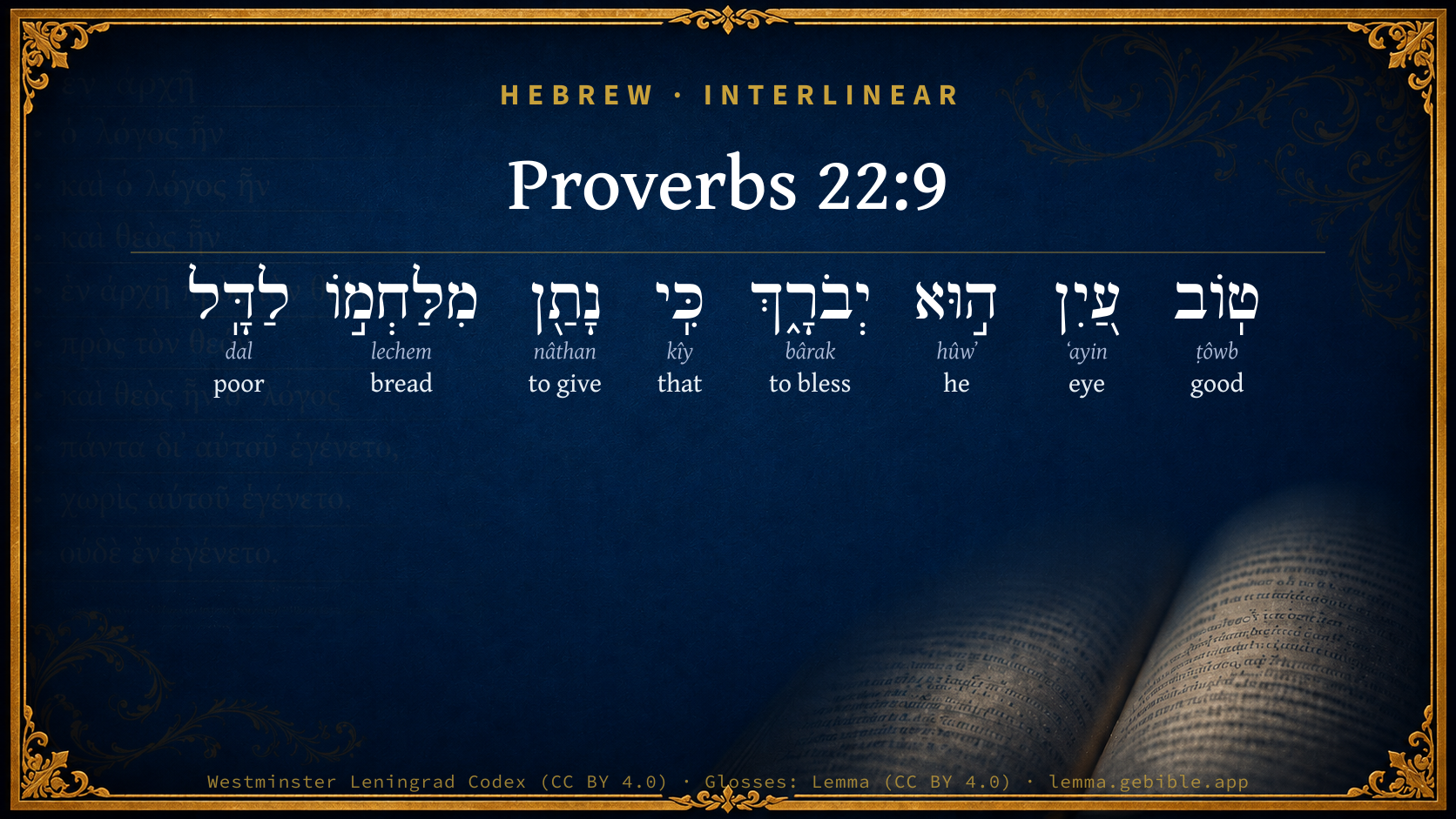
Hebrew (Westminster Leningrad Codex) Proverbs 22:9 appears in the Hebrew Old Testament. The text above is from the Westminster Leningrad Codex. Each word links to its Strong’s number, a concise gloss, and parsing drawn from the Open Scriptures Hebrew Bible morphology. Click any word for its full Brown-Driver-Briggs (BDB) entry.
Download image
Cite this verse

Proverbs 22:9 (World English Bible). Public Domain. Lemma interlinear Bible study tool, https://lemma.gebible.app/v/proverbs/22/9.

Show BibTeX & RIS
BibTeX
RIS
English Translation
He who has a generous eye will be blessed; For he shares his food with the poor.
World English Bible · Public Domain
Download a study sheet

One document with this verse’s original text, its word-by-word gloss line, the meaning frame, cross-references with their text, attributed commentary, and full source and license credits — printable, and it pastes into notes with its structure intact.

This verse Autodidact and up

Study sheet (.html) Plain text (.txt)

A passage Seminary Student

Up to 50 verses in one chapter. A passage sheet keeps up to 6 commentary sources and 12 cross-references per verse, in the order this page ranks them, and says so on the sheet whenever that leaves anything out. Ask for a single verse and you get the Autodidact verse sheet above.

Everything on this page stays free to read, with no account — the sheet is a download of what is already on screen, not access to it.

Want to remove ads? Support Godless Engineer
Compare translations 3

The same verse in 3 English versions, stacked beneath the original-language interlinear above. Click any original word for its lexicon entry.

Each is an independent rendering of the whole verse — the interlinear is not word-aligned to these translations.

Highlighted words mark where these versions differ — a whole-verse word diff, not a word-by-word alignment.

  • World English Bible Public Domain
    He who has a generous eye will be blessed; For he shares his food with the poor.
  • King James Version Public Domain
    He that hath a bountiful eye shall be blessed; for he giveth of his bread to the poor.
  • unfoldingWord Literal Text CC BY-SA 4.0
    The one good of eye, he will be blessed, for he gives from his bread to the lowly one.

unfoldingWord Literal Text — © unfoldingWord, licensed CC BY-SA 4.0. Word-aligned USFM3 via Door43 (git.door43.org/unfoldingWord/en_ult).

Versions to compare (up to 4)

3 of 4 selected

Show all 18 translations

Every available English version of this verse, each an independent rendering of the whole verse.

  • World English Bible Public Domain
    He who has a generous eye will be blessed; For he shares his food with the poor.
  • Berean Standard Bible Public Domain
    A generous man will be blessed, for he shares his bread with the poor.
  • Majority Standard Bible Public Domain
    A generous man will be blessed, for he shares his bread with the poor.
  • King James Version Public Domain
    He that hath a bountiful eye shall be blessed; for he giveth of his bread to the poor.
  • American Standard Version (1901) Public Domain
    He that hath a bountiful eye shall be blessed; For he giveth of his bread to the poor.
  • Revised Version (1885) Public Domain
    He that hath a bountiful eye shall be blessed; for he giveth of his bread to the poor.
  • Geneva Bible (1599) Public Domain
    He that hath a good eye, he shalbe blessed: for he giueth of his bread vnto the poore.
  • Douay-Rheims (1899) Public Domain
    He that is inclined to mercy shall be blessed: for of his bread he hath given to the poor. He that maketh presents shall purchase victory and honour: but he carrieth away the souls of the receivers.
  • Young's Literal Translation Public Domain
    The good of eye -- he is blessed, For he hath given of his bread to the poor.
  • Literal Standard Version CC BY-SA 4.0
    The good of eye—he is blessed, || For he has given of his bread to the poor.
  • Unlocked Literal Bible CC BY-SA 4.0
    The one who has a generous eye will be blessed, for he shares his bread with the poor.
  • unfoldingWord Literal Text CC BY-SA 4.0
    The one good of eye, he will be blessed, for he gives from his bread to the lowly one.
  • Darby Bible Public Domain
    He that hath a bountiful eye shall be blessed, for he giveth of his bread to the poor.
  • World Messianic Bible Public Domain
    He who has a generous eye will be blessed, for he shares his food with the poor.
  • Webster's Bible Public Domain
    He that hath a bountiful eye shall be blessed; for he giveth of his bread to the poor.
  • Free Bible Version CC BY-SA 4.0
    If you're generous, you'll be blessed, for you share your food with those in need.
  • Bible in Basic English Public Domain
    He who is kind will have a blessing, for he gives of his bread to the poor.
  • JPS Tanakh (1917) Public Domain
    He that hath a bountiful eye shall be blessed; for he giveth of his bread to the poor.

Literal Standard Version (2020), Covenant Press — licensed CC BY-SA 4.0. Text via the HelloAO Bible API (eBible.org). Unlocked Literal Bible (unfoldingWord) — licensed CC BY-SA 4.0. Text via the HelloAO Bible API (eBible.org). unfoldingWord Literal Text — © unfoldingWord, licensed CC BY-SA 4.0. Word-aligned USFM3 via Door43 (git.door43.org/unfoldingWord/en_ult). Free Bible Version, Dr. Jonathan Gallagher — licensed CC BY-SA 4.0. Text via the HelloAO Bible API (eBible.org).

Word by word

More ways to search: Search by grammar → Find every occurrence → Compare this word →

Practice this passage: Drill this verse → Learn its vocabulary →

About this verse

These counts appear in no published source. They are computed here, from the morphology-tagged text and Lemma’s own curated glosses. What Lemma adds →

8
words
8
distinct lemmas
Wisdom
section

Shared distinctive vocabulary

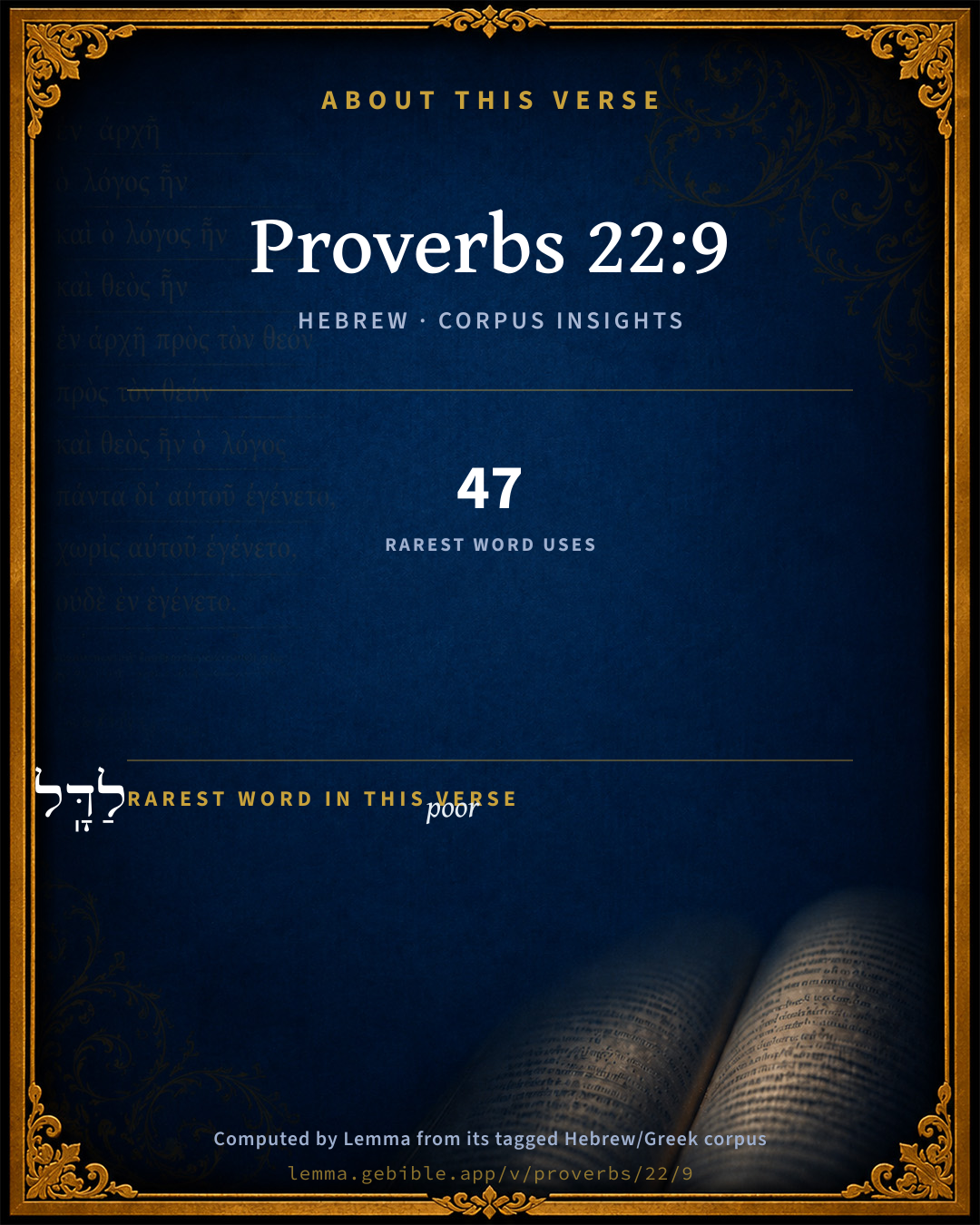
לַדָּֽל poor H1800 occurs in 46 verses of the Hebrew Bible. Also found in:

Grammatical profile

  • 2 verbs
  • 2 nouns
  • 2 adjectives
  • 1 pronoun
  • 1 conjunction

Verb forms

  • יְבֹרָ֑ךְ Pual · Imperfect
  • נָתַ֖ן Qal · Perfect

Hebrew & Septuagint length

In English translation the verse runs 17 words from the Hebrew and 41 from the Septuagint (LXX English) — the Septuagint runs noticeably longer here. See the side-by-side →

A rough comparison of the two English renderings, which tokenize alike — not a word-level alignment.

Word counts can differ between the Hebrew and the Greek without any difference in meaning — e.g. the Hebrew direct-object marker אֵת has no separate Greek word, and Greek often adds the article ὁ.

Cross-references

23

Topical passages linked to Proverbs 22:9 in the Treasury of Scripture Knowledge — connected by theme and wording, ordered by reader-vote popularity; previews shown in the World English Bible.

  • Proverbs 19:17 He who has pity on the poor lends to Yahweh; He will reward him.
  • Hebrews 6:10 For God is not unrighteous, so as to forget your work and the labor of love which you showed toward his name, in that you served the saints, and still do serve them.
  • 1 Timothy 6:18–19 that they do good, that they be rich in good works, that they be ready to distribute, willing to communicate;
  • Acts 20:35 In all things I gave you an example, that so laboring you ought to help the weak, and to remember the words of the Lord Jesus, that he himself said, 'It is more blessed to give than to receive.'"
  • 1 Peter 4:9 Be hospitable one to another without grumbling.
  • Hebrews 13:16 But don't forget to be doing good and sharing, for with such sacrifices God is well pleased.
  • Psalms 112:9 He has dispersed, he has given to the poor. His righteousness endures forever. His horn will be exalted with honor.
  • Luke 14:13 But when you make a feast, ask the poor, the maimed, the lame, or the blind;
  • Deuteronomy 15:7–11 If there be with you a poor man, one of your brothers, within any of your gates in your land which Yahweh your God gives you, you shall not harden your heart, nor shut your hand from your poor brother;
  • Job 31:16–20 "If I have withheld the poor from their desire, Or have caused the eyes of the widow to fail,
  • Proverbs 21:13 Whoever stops his ears at the cry of the poor, He will also cry out, but shall not be heard.
  • Ecclesiastes 11:1–2 Cast your bread on the waters; For you shall find it after many days.
  • Isaiah 32:8 But the noble devises noble things; and in noble things shall he continue.
  • Isaiah 58:7–12 Isn't it to deal your bread to the hungry, and that you bring the poor who are cast out to your house? when you see the naked, that you cover him; and that you not hide yourself from your own flesh?
  • Matthew 25:34–40 Then the King will tell those on his right hand, 'Come, blessed of my Father, inherit the Kingdom prepared for you from the foundation of the world;
  • Luke 6:35–38 But love your enemies, and do good, and lend, expecting nothing back; and your reward will be great, and you will be children of the Most High; for he is kind toward the unthankful and evil.
  • 2 Corinthians 8:1–2 Moreover, brothers, we make known to you the grace of God which has been given in the assemblies of Macedonia;
  • 2 Corinthians 9:6–11 Remember this: he who sows sparingly will also reap sparingly. He who sows bountifully will also reap bountifully.
  • Psalms 41:1–3 Blessed is he who considers the poor: Yahweh will deliver him in the day of evil.
  • Proverbs 11:25 The liberal soul shall be made fat. He who waters shall be watered also himself.
  • Mark 7:22 covetings, wickedness, deceit, lustful desires, an evil eye, blasphemy, pride, and foolishness.
  • Deuteronomy 28:56 The tender and delicate woman among you, who would not adventure to set the sole of her foot on the ground for delicateness and tenderness, her eye shall be evil toward the husband of her bosom, and toward her son, and toward her daughter,
  • Matthew 20:15 Isn't it lawful for me to do what I want to with what I own? Or is your eye evil, because I am good?'

Cross-references courtesy of OpenBible.info (CC BY 4.0).

Hebrew and Greek witnesses Masoretic Hebrew ↔ Greek Septuagint

The same verse in the two great witnesses to the Old Testament, shown verse-for-verse.

Here the Septuagint runs noticeably longer than the Hebrew — LXX2012 (modern English Septuagint) 41 words vs World English Bible 17. A rough length comparison of the two English translations, not a word-level alignment — read both below.

These are two independent witnesses, not word-aligned to each other, and the Septuagint is shown in lemma (dictionary) form.

Hebrew Proverbs 22:9 Masoretic · Westminster Leningrad Codex

טֽוֹב עַ֭יִן ה֣וּא יְבֹרָ֑ךְ כִּֽי נָתַ֖ן מִלַּחְמ֣וֹ לַדָּֽל

He who has a generous eye will be blessed; For he shares his food with the poor.

World English Bible · Public Domain

Greek LXX Proverbs 22:9 Septuagint · lemma form

ὁ ἐλεέω πτωχός αὐτός διατρέφω ὁ γάρ ἑαυτοῦ ἄρτος δίδωμι ὁ πτωχός νίκη καί τιμή περιποιέω ὁ δῶρον δίδωμι ὁ μέντοι ψυχή ἀποαἱρέω ὁ κτάομαι

He that has pity on the poor shall himself be maintained; for he has given of his own bread to the poor. He that gives liberally secures victory an honor; but he takes away the life of them that posses them.

LXX2012 (modern English Septuagint) · Public Domain

On this verse, Trapp's Complete Commentary discusses the Septuagint’s reading. Read the note in Commentary ↓

Hebrew: Westminster Leningrad Codex (CC BY 4.0). Greek: Septuagint (public domain); English from LXX2012 (modern English Septuagint) (Public Domain). How the Septuagint differs from the Hebrew →

Commentary

Notes on Proverbs 22:9 from classic Christian and Jewish commentators (each source and its license shown beneath its notes). The classic Christian expositions comment on the surrounding passage and are grouped to its opening verse, so a note may address several verses; the Jewish commentaries on the Tanakh (Rashi and others) are per-verse, so they appear only where the commentator wrote on this verse.

Lemma curates 59 commentaries, every one of them public domain or Creative Commons licensed, each selected and text-cleaned for this edition rather than reprinted as found. About our sources →

Trapp's Complete Commentary

John Trapp

Pro 22:9 He that hath a bountiful eye shall be blessed; for he giveth of his bread to the poor.

Ver. 9. He that hath a bountiful eye shall be blessed.] How Amalek, the licking people, as the name imports, I mean, the nation of usurers and proud lenders, shall speed, hath been spoken already. Now, on the other side, the bountiful eye, the cheerful giver (as the Septuagint, {a} and after them St Paul, render, or rather expound, this text), shall be abundantly blessed, for he gives with all his heart; he "draws out" not his sheaf only but "his soul to the hungry." {Isa 58:10} Dat bene, dat multum, quia dat cum munere vulture: He spares it out of his own belly to give to the hungry, as some have here gathered from the words "his bread," that which was appointed for his own eating - he voluntarily fasteth from a meal now and then that he may bestow it upon the needy, and he shall not lose his reward.

{a} Aνδρα ιλαρον και δοτην αγαπα ο Yεος. - Sept.

John Trapp, A Commentary or Exposition upon All the Books of the Old and New Testament (1647–1656) — public domain. Text from a community e-Sword module.

The Biblical Illustrator

Joseph S. Exell

Pro_22:9

He that hath a bountiful eye shall be blessed.

The bountiful eye

The passage before us speaks of bounty in man, and blessedness from God. What is a bountiful eye, and what is the blessing belonging to him who possesses it? The eye is a wonderful part of the curiously wrought human frame. But the term is used in Scripture in a moral point of view, and describes a peculiar state of the mind. Thus we read of the blinded eye, the enlightened eye, the single eye, the evil eye, all of which refer to the state of the mind or heart; and so does the term bountiful eye. Mind, it is not said a bountiful tongue--most men will proclaim every one his own goodness (Pro_20:6); nor a bountiful hand, for man may give all his goods to feed the poor, and lack charity (1Co_13:3); nor a bountiful head, for an ingenious mind may devise schemes of liberality for others and not be truly generous himself; but a bountiful eye--one through which the soul looks in tender compassion--one that considers the cause of the poor (Psa_41:1)--one that compares and contrives--one that affects the heart, stirs it up to feel, and moves the hand to minister. Such an eye looks in the right place to find appropriate objects. It does not shun misery, passing by (like the priest and Levite) on the other side. It looks through the right medium, even the love and compassion of God, and says, If God so loved us, we ought also to love one another. What shall I render to the Lord for all His benefits toward me? It looks to the right end, even the glory of God and the good of man; and looks for a right reward--not the approbation of man, but to please God. A bountiful eye does not say, How much can I give to save appearances, or pacify conscience; but, How much can I spare God and His cause? A bountiful eye may be considered in contrast with the evil eye. Eat not the bread of him that hath an evil eye (Pro_23:6). Why not? Such an one maketh haste to be rich (Pro_28:22). He attempts to serve God and mammon (Mat_7:12). Thus his eye is evil, and his whole body is full of darkness. Have you a bountiful eye? Be careful of it. The eye of the body wants guarding; so does the eye of the soul. It sometimes grows dim. Covetousness steals silent marches even on liberal souls. Happy is he of whom it can be said spiritually, as of Moses literally, that his eye is not dim, nor his spiritual force abated. The way to strengthen the habit is to be frequent in the act. (Christian Treasury.)

The Biblical Illustrator, edited by Joseph S. Exell (c. 1880s–1900s) — public domain. Text from a community e-Sword module.

Joseph Benson's Commentary

Pro 22:9. He that hath a bountiful eye — Hebrew, a good eye. He who looks upon the wants and miseries of others with compassion and kindness: as an evil eye is put for one that beholds others with envy and unmercifulness; shall be blessed — Both by God and men.

Joseph Benson's Commentary on the Old and New Testaments (1811–1818) — public domain. Text from a community e-Sword module.

The Preacher's Complete Homiletical Commentary

Joseph S. Exell (gen. ed.)

MAIN HOMILETICS OF Pro_22:9

THE BOUNTIFUL EYE

I. The eye is an index of the soul. This is true, not only of the expression of the eye but of its direction. What is in the mind can often be read in the eye; both evil passions and divine affections reveal themselves through it, but sometimes both depend very much upon where the eye looks—upon the objects towards which its glance is directed. Perhaps the text refers both to the eye that softens at the sight of another’s woe, and to the eye which makes it its business to look around and search for objects which the hand can help. For if the expression of the eye reveals the character so does the direction which it habitually takes. There is many an eye that readily moistens with sympathy at the tale or the spectacle of sorrow which can hardly be called a “bountiful eye,” for it is only by accident that it ever encounters anything to call forth its sympathy. But the eye that is ever on the watch for opportunities of doing good, of feeding the hungry and raising the fallen, is a much surer index of a godlike disposition. For such an eye has something in common with the eye of Him who looked upon the bond slaves of Egypt and said, “I have seen the affliction of My people and am come down to deliver them,” and who, manifest in a human body, “was moved with compassion” at the sight of “people who were as sheep not having a shepherd” (Mar_6:34). He whose bountiful eye brings down a blessing upon him is not one who now and then meets a needy brother and relieves him; still less is he one whose sympathy is shown only by the look. His is evidently one whose glance of pity is followed by a deed of kindness and whose habit it is to look out for opportunities of succouring the needy.

II. The soul is blest by the ministry of the hand. He who gives of His bread to the needy will have the gratitude of the needy, and there is not a more exquisite joy perhaps on the earth. But the blessing of God will be his in an especial manner. Upon both kinds of blessing see Homiletics on chap. Pro_11:25, page 234, and on chap. Pro_19:17, page 576.

OUTLINES AND SUGGESTIVE COMMENTS

Perhaps the expression—“he giveth of his bread to the poor,” may mean, that he is ready even to share his own provision with them; not merely to give a small portion of his superfluities, but to stint himself for their supply. And this is the spirit of true charity.—Wardlaw.

Some that have a bountiful eye have no bread to give, but they will give what will turn to as good an account to the donor, and sometimes will be as pleasing to the receiver; tears and attention, and offices of tenderness and prayers to Him that is able to help.—Lawson.

This bountifulness is a privilege, which earth possesses above heaven. Many a rich blessing is sealed to it. “Beneficence is the most exquisite luxury; and the good man is the genuine epicure.” He “hath a continual feast,” because his objects are always before him.—Bridges.

The Preacher's Complete Homiletical Commentary (gen. ed. Joseph S. Exell; Funk & Wagnalls, c. 1892) — public domain (pre-1929). A full-Bible homiletical/sermon-outline anthology covering 65 of 66 books (2 John is absent from the source module). Text from a community e-Sword module.

Geneva Bible (1599)

Geneva Bible translators

He that is merciful and liberal.

Geneva Bible (1599) marginal notes — public domain. Text via Bolls.life.

Matthew Henry's Commentary

Here is, 1. The description of a charitable man; he has a bountiful eye, opposed to the evil eye (Pro 23:6) and the same with the single eye (Mat 6:22), - an eye that seeks out objects of charity, besides those that offer themselves, - an eye that, upon the sight of one in want and misery, affects the heart with compassion, - an eye that with the alms gives a pleasant look, which makes the alms doubly acceptable. He has also a liberal hand: He gives of his bread to those that need - his bread, the bread appointed for his own eating. He will rather abridge himself than see the poor perish for want; yet he does not give all his bread, but of his bread; the poor shall have their share with his own family. 2. The blessedness of such a man. The loins of the poor will bless them, all about him will speak well of him, and God himself will bless him, in answer to many a good prayer put up for him, and he shall be blessed.

Matthew Henry's Commentary on the Whole Bible (1708–1710) — public domain (CC PDM 1.0). Text via the HelloAO Bible API.

Jamieson, Fausset & Brown

Robert Jamieson, A. R. Fausset & David Brown

a bountiful eye--that is, a beneficent disposition.

for he giveth . . . poor--His acts prove it.

Jamieson, Fausset & Brown — Commentary Critical and Explanatory on the Whole Bible (1871) — public domain (CC PDM 1.0). Text via the HelloAO Bible API.

Adam Clarke's Commentary

Verse 9. A bountiful eye] One that disposes him to help all that he sees to be in want; the bountiful eye means the bountiful heart; for the heart looks through the eye. The merciful heart, even when the hand has little or nothing to give, shall be blessed of the Lord.

Adam Clarke's Commentary on the Bible (1810–1826) — public domain. Text from a community e-Sword/MySword module.

The Cambridge Bible for Schools and Colleges

gen. ed. J. J. S. Perowne

9. bountiful] Lit. good, in contrast with an evil or grudging eye, Pro_23:6-7.

The Cambridge Bible for Schools and Colleges (gen. ed. J. J. S. Perowne; Cambridge University Press, 1878–1918) — public domain. Text from a community e-Sword module.

John Gill's Exposition

He that hath a bountiful eye shall be blessed,.... Or "a good eye" (y); who looks about him for proper objects to do good unto; looks pleasantly on them, and deals out cheerfully and bountifully to them; he shall be blessed with an increase of temporal good things, with spiritual blessings, and with eternal glory and happiness; when he does what he does from principles of grace, with a view to the glory of God, not depending on what he does, but upon the grace of God, and the righteousness of Christ;

for he giveth of his bread to the poor; what is his own and a part of it; not all, for he reserves some as he ought for himself and his; but he does not eat his morsel alone, he gives of it to the necessitous; his beneficent hand is a proof of his bountiful eye and liberal heart.

(y) "bonus oculus", Montanus, Vatablus, Cocceius; "bonus oculo", Junilus & Tremellius, Mercerus, Gejerus, Michaelis, Schultens.

John Gill's Exposition of the Whole Bible (1746–1763) — public domain (CC PDM 1.0). Text via the HelloAO Bible API.

Albert Barnes' Notes on the Bible

He that hath a bountiful eye - literally, as in the margin, contrasted with the “evil eye” of Pro 28:22.

Albert Barnes' Notes on the Bible (1834–1885) — public domain. Text from a community e-Sword/MySword module.

Haydock's Catholic Bible Commentary

Is. Hebrew, "has a good eye," in opposition to the evil, or malicious one, Matthew xx. 15. --- He, &c., is not in Hebrew, or in the Latin edition of Comp. and St. Jerome.

George Leo Haydock (1774–1849), Haydock's Catholic Family Bible and Commentary, 1859 edition — public domain. Excludes Psalms (Douay-Rheims chapter numbering differs from Protestant) and Deuterocanonical books (Catholic canon only).

Matthew Poole's English Annotations

He that hath a bountiful eye, Heb. a good eye, he who looks upon the wants and miseries of others with compassion and kindness, as this phrase is used, Mat 20:15; as an evil eye is put for one that beholds others with envy and unmercifulness, Deu 15:9; Pro 23:6; 28:22

Shall be blessed, both by God and men.

Matthew Poole's English Annotations on the Holy Bible (1683–1685) — public domain. Text from a community e-Sword/MySword module.

Whedon's Commentary on the Bible

Daniel D. Whedon

9. A bountiful eye — שׂוב עין, (tobh-‘hayin,) a good eye, that is, a kindly, compassionate eye, one that has pity for those in distress.

Shall be blessed — Both of God and man. For the opposite, compare Pro_23:6; Pro_28:22; Deu_15:9. The Septuagint and Vulgate add: “He that gives liberally secures victory: but he takes away the soul (ψυχην) of them that possess (receive) them.”

Daniel D. Whedon (gen. ed.), Commentary on the Old and New Testaments (1874–1909) — public domain. Text from a community e-Sword module.

The Pulpit Commentary

He that hath a bountiful eye shall be blessed. The "good of eye" is the kindly looking, the benevolent man, in contrast to him of the evil eye, the envious, the unfriendly and niggardly man. (Pro_23:6 Pro_28:22) St. Jerome renders, Qui pronus est ad misericordiam. Such a one is blessed by God in this world and the next, in time and in eternity, according to the sentiment of Pro_11:25. Thus in the temporal sense (Ecclus. 34 (31):23). "Him that is liberal in food lips shall bless, and the testimony of his liberality will be believed." Septuagint, "He that hath pity upon the poor shall himself be continually sustained (diatrafhsetai )." The reason is added, For he giveth of his brans to the poor. The blessing is the consequence of his charity and liberality. 2Co_9:6, "He that soweth bountifully shall reap also bountifully (ep aulogiaiv )." The Vulgate and Septuagint add a distich not in the Hebrew, Victoriam et honorem acquiret qui dat munera; animam autem aufert accipientium; Nikhn kai timhntoi quchnwnw , "Victory and honour he obtaineth who giveth gifts; but he takes away the life of the possessors." The first hemistich appears to be a variant of Pro_19:6, the second to be derived from Pro_1:19. The second portion of the Latin addition may mean that the liberal man wins and carries away with him the souls of the recipients of his bounty. But this, though Ewald would fain have it so, cannot be the signification of the corresponding Greek, which seems to mean that the man who is so liberal in distributing gifts obtains the power to do so by oppressing and wronging others.

The Pulpit Commentary (1880–1919), ed. H.D.M. Spence-Jones & Joseph S. Exell — public domain. Text from a community e-Sword module.

John Wesley's Explanatory Notes

He - Who looks upon the wants and miseries of others with compassion.

John Wesley, Explanatory Notes Upon the Whole Bible (1754–1765) — public domain. Text via the GEBible commentary corpus.

Keil & Delitzsch

C. F. Keil & F. Delitzsch

9 He who is friendly is blessed;

Because he giveth of his bread to the poor.

The thought is the same as at Pro 11:25. טוב עין (thus to be written without Makkeph, with Munach of the first word, with correct Codd., also 1294 and Jaman), the contrast of רע עין, Pro 23:6; Pro 22:22, i.e., the envious, evil-eyed, ungracious (post-bibl. also צר עין), is one who looks kindly, is good-hearted, and as ἱλαρὸς δότης, shows himself benevolent. Such gentleness and kindness is called in the Mishna עין טובה (Aboth ii. 13), or עין יפה. Such a friend is blessed, for he has also himself scattered blessings (cf. גּם־הוּא, Pro 11:25; Pro 21:13); he has, as is said, looking back from the blessing that has happened to him, given of his bread (Luther, as the lxx, with partitive genitive: seines brots = of his bread) to the poor; cf. the unfolding of this blessing of self-denying love, Isa 8. The lxx has also here another distich:

Νίκην καὶ τιμὴν περιποιεῖται ὁ δῶρα δοὺς,

Τὴν μέντοι ψυχὴν ἀφαιρεῖται τῶν κεκτημένων.

The first line appears a variant translation of Pro 19:6, and the second of Pro 1:19, according to which selfishness, in contrast to liberality, is the subject to be thought of. Ewald translates the second line: And he (who distributes gifts) conquers the soul of the recipients. But κεκτημένος = בּעל (בּעלים) signifies the possessor, not the recipient of anything as a gift, who cannot also be here meant because of the μέντοι.

Keil & Delitzsch — Biblical Commentary on the Old Testament (1861–1891) — public domain (CC PDM 1.0). Text via the HelloAO Bible API. (Old Testament only.)

Bridges on Proverbs

Charles Bridges

The heart often looks out at the eye.†1 The bountiful or good eye is contrasted with "the evil eye."†2 This man can look with indifference on distress,†3 satisfy himself with the heartless expression of good-will,†4 and find many reasons for withholding his charity. But the man of a good eye delighteth in contriving acts of kindness. (Isa 32:8 .) He not only relieves what is brought before him, but he looks out for objects, and looks pleasantly on them. Nehemiah, instead of using his ample power for his own aggrandizement, spent his substance in feeding the people at his own table, giving of his bread to the poor. (Neh 5:16-18 .) His great work required a large heart. And such a heart God had given him. Ever remember — Christian — that God’s standard is sacrifice, not convenience; giving of our bread; letting the poor share with ourselves. (Job 31:17 .) Nor must it be wrung from us by importunity. "God loveth a cheerful giver."†5 His "charge is, that we be ready to distribute, willing to communicate." (1Ti 6:17-18 .) This is his own pattern of bountifulness, "He openeth his hand, and satisfieth the desire of every living thing." (Psa 145:16 .) We are only the stewards of his bounty. Of our property, be it little or much, we must be ready to feel of that, as of ourselves†6 — It is ’not our own.’ But, let the motive be higher than the mere gratification of kindly feelings. Cherish carefully godly simplicity. "Let your light shine before men for your Father’s glory," not for your own.†7

This bountifulness is a privilege, which earth possesses above heaven. Many a rich blessing is sealed to it.†8 ’Beneficence is the most exquisite luxury; and the good man is the genuine epicure.’†9 He "hath a continual feast," because his objects are always before him. Man will bless him according to his ability;†10 and when "they cannot recompense thee, thou shalt be recompensed at the resurrection of the just;"†11 when ’one good work done for God will be seen’ — as Luther says — ’to shew more glory than the whole frame of heaven and earth.’ It is the working of his grace, the following of his pattern, the reflection of his image, the "shewing forth of his virtue." (1Pe 2:9, margin = {praises: or, virtues})

Footnotes:

†1 Luk 10:33-35.

†2 Pro 23:6. Deu 15:9 ; Deu 28:54, Deu 28:56 . Mat 20:15 .

†3 1Sa 25:3, 1Sa 25:10-11 . Luk 10:31-32 ; Luk 16:19-21 .

†4 Jas 2:15-16.

†5 2Co 9:6 . Deu 15:10 .

†6 1Co 6:19-20 .

†7 Mat 5:16, with Mat 6:1-3 ; Mat 25:34-40 . It is stated of a munificent Christian, that he strictly forbade the recipients of his bounty to return thanks. Probably the knowledge of his own heart suggested this prohibition.

†8 Deu 15:10. Isa 58:10-11 . Mat 5:7 . Compare Sir 31:23-24 .

†9 Bishop Horne’s Sermon on Psa 41:1 .

†10 Job 29:11-13; Job 31:16-29 .

†11 Psa 41:1-2. Luk 14:14 . 1Ti 6:19 .

Charles Bridges, An Exposition of the Book of Proverbs (1846) — public domain. Text from a community e-Sword module.

Kretzmann's Popular Commentary

Paul E. Kretzmann

v. 9. He that hath a bountiful eye, one which reflects kindness, friendliness, and charity, shall be blessed; for he giveth of his bread to the poor; as he dispenses blessing, he will receive blessing.

Paul E. Kretzmann, Popular Commentary of the Bible (1921–1924) — public domain. Text from a community e-Sword module.

unfoldingWord translationNotes

Door43 World Missions Community

The one who has a generous eye will be blessed

These words can be translated in active form. AT: "God will bless the one who has a generous eye" (See: Active or Passive)

one who has a generous eye

The eye is a metonym for seeing what other people need, and the "generous eye" not only sees but gives what the other people need. The eye is also a synecdoche for the whole person. AT: "generous person" or "person who is willing to give things to other people" (See: Metonymy and Synecdoche)

bread

Since bread was the main food for many people in biblical times, it is often used to refer to food in general. (See: Metonymy)

disputes and insults will cease

The abstract nouns "disputes" and "insults" can be translated as verbs. AT: "people will no longer argue with each other or say things to hurt each other" (See: Abstract Nouns)

translationWords

bless

bread

cast out

mock

strife

unfoldingWord translationNotes — © Distant Shores Media and the Door43 World Missions Community, licensed CC BY-SA 4.0. Source: git.door43.org/Door43/en_tn.

Lesson kit

Teaching starters — assembled from the data on this page, not authored interpretation. Every prompt links to the verse data it draws on. Edit before teaching.

Proverbs, in the Wisdom, opens this verse with 8 words (8 distinct Hebrew lemmas). Its most distinctive word is dal (“poor”). The Greek Septuagint runs longer here. A historical commentator’s framing appears above. Read the whole chapter for the surrounding context.

Discussion questions

  1. How does “poor” (dal) shape what this verse is saying?
  2. Exodus 23:3 shares the word «poor» with this verse. How do the two illuminate each other?
  3. Compared with the Hebrew, the Septuagint runs longer here. What questions does that raise?
  4. The translations on this page render this verse differently — a whole-verse word diff, not a word-by-word alignment. What might account for the different wordings?
  5. The verb «יְבֹרָ֑ךְ» is Pual Imperfect. How does its form color the action?
  6. Reading how Trapp's Complete Commentary and The Biblical Illustrator read this verse, where do the two commentators agree and where do they part?

Things to notice

Reading settings

Reading text

Shown beneath each verse's original-language words.

Old Testament
Old Testament edition

Read the OT as the Masoretic Hebrew (MT) or the Greek Septuagint (LXX).

English shown for the Greek Septuagint (in the Hebrew ↔ Greek comparison).

Comparing translations? Open the Compare panel on any verse page to stack up to four side by side.