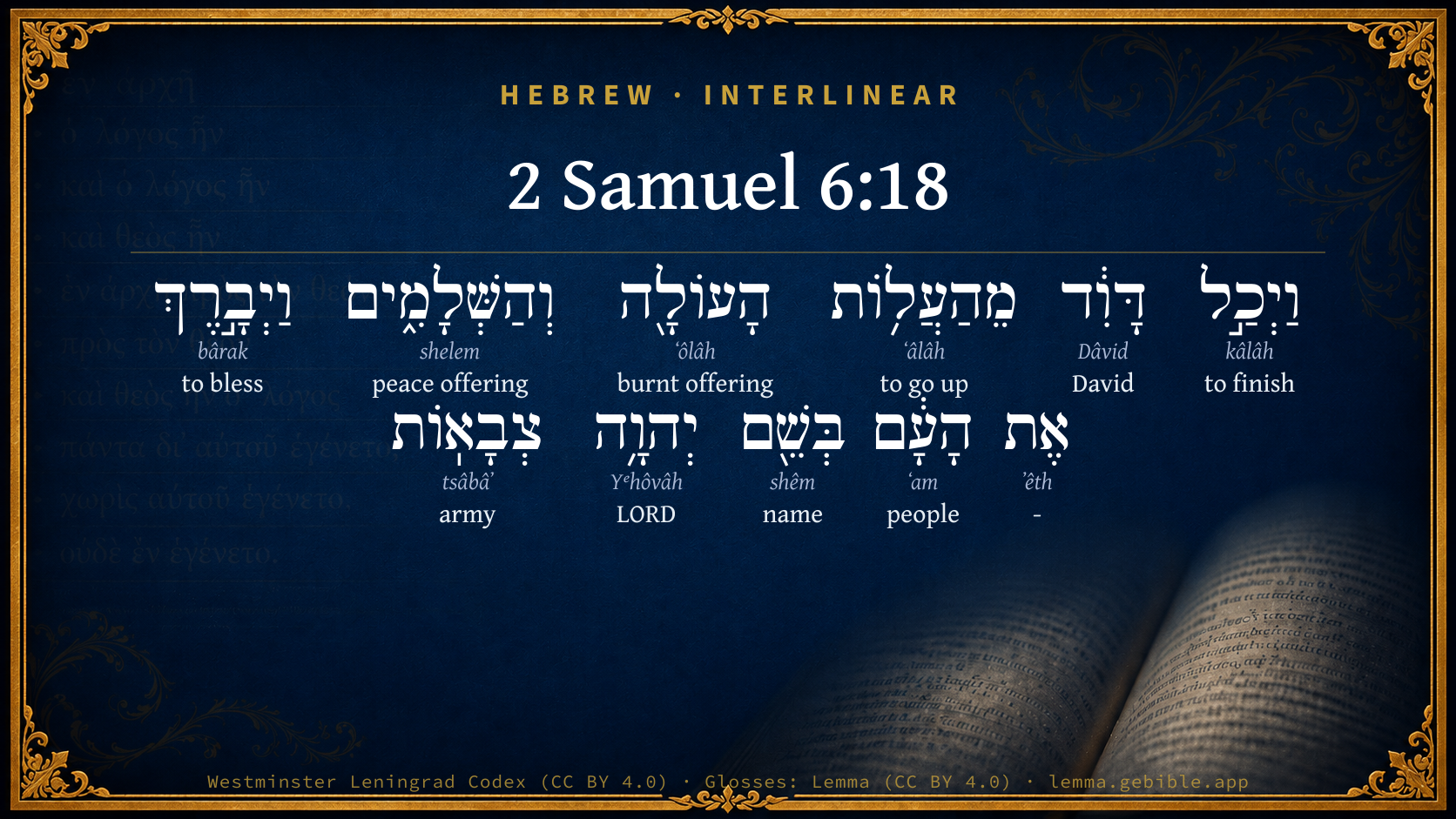
2 Samuel 6:18

Hebrew (Westminster Leningrad Codex) 2 Samuel 6:18 appears in the Hebrew Old Testament. The text above is from the Westminster Leningrad Codex. Each word links to its Strong’s number, a concise gloss, and parsing drawn from the Open Scriptures Hebrew Bible morphology. Click any word for its full Brown-Driver-Briggs (BDB) entry.
Download image
Cite this verse

2 Samuel 6:18 (World English Bible). Public Domain. Lemma interlinear Bible study tool, https://lemma.gebible.app/v/2-samuel/6/18.

Show BibTeX & RIS
BibTeX
RIS
English Translation
When David had made an end of offering the burnt offering and the peace-offerings, he blessed the people in the name of Yahweh of Hosts.
World English Bible · Public Domain
Download a study sheet

One document with this verse’s original text, its word-by-word gloss line, the meaning frame, cross-references with their text, attributed commentary, and full source and license credits — printable, and it pastes into notes with its structure intact.

This verse Autodidact and up

Study sheet (.html) Plain text (.txt)

A passage Seminary Student

Up to 50 verses in one chapter. A passage sheet keeps up to 6 commentary sources and 12 cross-references per verse, in the order this page ranks them, and says so on the sheet whenever that leaves anything out. Ask for a single verse and you get the Autodidact verse sheet above.

Everything on this page stays free to read, with no account — the sheet is a download of what is already on screen, not access to it.

Want to remove ads? Support Godless Engineer
Compare translations 3

The same verse in 3 English versions, stacked beneath the original-language interlinear above. Click any original word for its lexicon entry.

Each is an independent rendering of the whole verse — the interlinear is not word-aligned to these translations.

Highlighted words mark where these versions differ — a whole-verse word diff, not a word-by-word alignment.

  • World English Bible Public Domain
    When David had made an end of offering the burnt offering and the peace-offerings, he blessed the people in the name of Yahweh of Hosts.
  • King James Version Public Domain
    And as soon as David had made an end of offering burnt offerings and peace offerings, he blessed the people in the name of the LORD of hosts.
  • unfoldingWord Literal Text CC BY-SA 4.0
    And David finished offering the burnt offering and the peace offerings, and he blessed the people in the name of Yahweh of Armies.

unfoldingWord Literal Text — © unfoldingWord, licensed CC BY-SA 4.0. Word-aligned USFM3 via Door43 (git.door43.org/unfoldingWord/en_ult).

Versions to compare (up to 4)

3 of 4 selected

Show all 18 translations

Every available English version of this verse, each an independent rendering of the whole verse.

  • World English Bible Public Domain
    When David had made an end of offering the burnt offering and the peace-offerings, he blessed the people in the name of Yahweh of Hosts.
  • Berean Standard Bible Public Domain
    When David had finished sacrificing the burnt offerings and peace offerings, he blessed the people in the name of the LORD of Hosts.
  • Majority Standard Bible Public Domain
    When David had finished sacrificing the burnt offerings and peace offerings, he blessed the people in the name of the LORD of Hosts.
  • King James Version Public Domain
    And as soon as David had made an end of offering burnt offerings and peace offerings, he blessed the people in the name of the LORD of hosts.
  • American Standard Version (1901) Public Domain
    And when David had made an end of offering the burnt-offering and the peace-offerings, he blessed the people in the name of Jehovah of hosts.
  • Revised Version (1885) Public Domain
    And when David had made an end of offering the burnt offering and the peace offerings, he blessed the people in the name of the LORD of hosts.
  • Geneva Bible (1599) Public Domain
    And assoone as Dauid had made an ende of offring burnt offrings and peace offrings, hee blessed the people in the Name of the Lord of hostes,
  • Douay-Rheims (1899) Public Domain
    And when he had made an end of offering holocausts and peace offerings, he blessed the people in the name of the Lord of hosts.
  • Young's Literal Translation Public Domain
    And David finisheth from causing to ascend the burnt-offering, and the peace-offerings, and blesseth the people in the name of Jehovah of Hosts,
  • Literal Standard Version CC BY-SA 4.0
    And David finishes from causing the burnt-offering and the peace-offerings to ascend, and blesses the people in the Name of YHWH of Hosts,
  • Unlocked Literal Bible CC BY-SA 4.0
    When David had finished sacrificing the burnt offerings and the fellowship offerings, he blessed the people in the name of Yahweh of hosts.
  • unfoldingWord Literal Text CC BY-SA 4.0
    And David finished offering the burnt offering and the peace offerings, and he blessed the people in the name of Yahweh of Armies.
  • Darby Bible Public Domain
    And when David had ended offering up the burnt-offerings and the peace-offerings, he blessed the people in the name of Jehovah of hosts.
  • World Messianic Bible Public Domain
    When David had finished offering the burnt offering and the peace offerings, he blessed the people in the name of the LORD of Hosts.
  • Webster's Bible Public Domain
    And as soon as David had made an end of offering burnt-offerings and peace-offerings, he blessed the people in the name of the LORD of hosts.
  • Free Bible Version CC BY-SA 4.0
    Once he had finished offering the sacrifices, David blessed the people in the name of the Lord Almighty.
  • Bible in Basic English Public Domain
    And after David had made the burned offerings and the peace-offerings, he gave the people a blessing in the name of the Lord of armies.
  • JPS Tanakh (1917) Public Domain
    And when David had made an end of offering the burnt-offering and the peace-offerings, he blessed the people in the name of the LORD of hosts.

Literal Standard Version (2020), Covenant Press — licensed CC BY-SA 4.0. Text via the HelloAO Bible API (eBible.org). Unlocked Literal Bible (unfoldingWord) — licensed CC BY-SA 4.0. Text via the HelloAO Bible API (eBible.org). unfoldingWord Literal Text — © unfoldingWord, licensed CC BY-SA 4.0. Word-aligned USFM3 via Door43 (git.door43.org/unfoldingWord/en_ult). Free Bible Version, Dr. Jonathan Gallagher — licensed CC BY-SA 4.0. Text via the HelloAO Bible API (eBible.org).

Word by word

More ways to search: Search by grammar → Find every occurrence → Compare this word →

Practice this passage: Drill this verse → Learn its vocabulary →

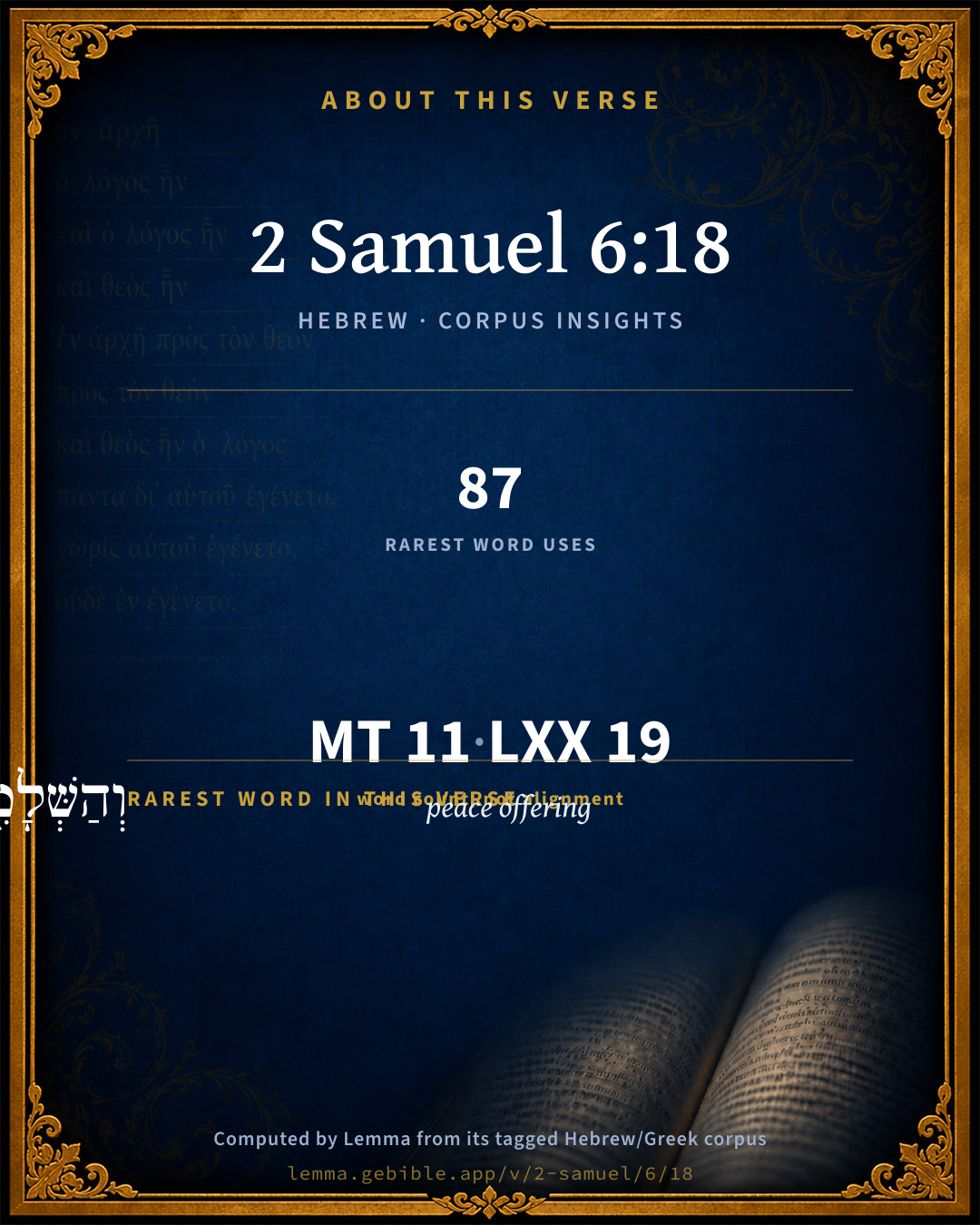
וְהַשְּׁלָמִ֑ים
shelem
H8002
“and · the · peace offerings”
Conjunction + Particle, Definite Article + Noun, Common, Masculine, Plural, Absolute
Part of Speech
Conjunction + Particle + Noun
Type
Common
Gender
Masculine
Number
Plural
State
Absolute
Full BDB Definition

Origin: from H7999

TWOT: 2401b

peace offering, requital, sacrifice for alliance or friendship - voluntary sacrifice of thanks
  1. וַיְכַ֣ל kâlâh H3615 “and · to finish” Conjunction + Verb, Piel, Sequential Imperfect, 3rd Person, Masculine, Singular
  2. דָּוִ֔ד Dâvid H1732 “David” Noun, Proper
  3. מֵהַעֲל֥וֹת ʻâlâh H5927 “from · to go up” Preposition + Verb, Hiphil, Infinitive Construct
  4. הָעוֹלָ֖ה ʻôlâh H5930 “the · burnt offering” Particle, Definite Article + Noun, Common, Feminine, Singular, Absolute
  5. וַיְבָ֣רֶךְ bârak H1288 “and · to bless” Conjunction + Verb, Piel, Sequential Imperfect, 3rd Person, Masculine, Singular
  6. אֶת ʼêth H853 “-” Particle, Direct Object
  7. הָעָ֔ם ʻam H5971 “the · people” Particle, Definite Article + Noun, Common, Masculine, Singular, Absolute
  8. בְּשֵׁ֖ם shêm H8034 “in/at · name of” Preposition + Noun, Common, Masculine, Singular, Construct
  9. יְהוָ֥ה Yᵉhôvâh H3068 “LORD” Noun, Proper
  10. צְבָאֽוֹת tsâbâʼ H6635 “armies” Noun, Common, Both, Plural, Absolute

About this verse

These counts appear in no published source. They are computed here, from the morphology-tagged text and Lemma’s own curated glosses. What Lemma adds →

11
words
11
distinct lemmas
Historical
section

Grammatical profile

  • 3 verbs
  • 7 nouns
  • 1 particle

Verb forms

  • וַיְכַ֣ל Piel · Sequential Imperfect
  • מֵהַעֲל֥וֹת Hiphil · Infinitive Construct
  • וַיְבָ֣רֶךְ Piel · Sequential Imperfect

Hebrew & Septuagint length

In English translation the verse runs 25 words from the Hebrew and 25 from the Septuagint (LXX English) — the same length.

A rough comparison of the two English renderings, which tokenize alike — not a word-level alignment.

Word counts can differ between the Hebrew and the Greek without any difference in meaning — e.g. the Hebrew direct-object marker אֵת has no separate Greek word, and Greek often adds the article ὁ.

In the original languages it is 11 Hebrew tokens and 19 Greek tokens — but the two are counted differently (Hebrew bundles its prefixes and suffixes into one token; the Greek is in lemma form), so that isn’t a like-for-like length.

Cross-references

11

Topical passages linked to 2 Samuel 6:18 in the Treasury of Scripture Knowledge — connected by theme and wording, ordered by reader-vote popularity; previews shown in the World English Bible.

  • 1 Kings 8:55 He stood, and blessed all the assembly of Israel with a loud voice, saying,
  • 1 Chronicles 16:2 When David had made an end of offering the burnt offering and the peace-offerings, he blessed the people in the name of Yahweh.
  • Genesis 14:19 He blessed him, and said, "Blessed be Abram of God Most High, possessor of heaven and earth:
  • Exodus 39:43 Moses saw all the work, and, behold, they had done it as Yahweh had commanded, even so had they done it: and Moses blessed them.
  • Leviticus 9:22–23 Aaron lifted up his hands toward the people, and blessed them; and he came down from offering the sin offering, and the burnt offering, and the peace offerings.
  • 1 Kings 8:14 The king turned his face about, and blessed all the assembly of Israel: and all the assembly of Israel stood.
  • 2 Chronicles 6:3 The king turned his face, and blessed all the assembly of Israel: and all the assembly of Israel stood.
  • 2 Chronicles 30:18–19 For a multitude of the people, even many of Ephraim and Manasseh, Issachar and Zebulun, had not cleansed themselves, yet did they eat the Passover otherwise than it is written. For Hezekiah had prayed for them, saying, The good Yahweh pardon everyone
  • 2 Chronicles 30:27 Then the priests the Levites arose and blessed the people: and their voice was heard, and their prayer came up to his holy habitation, even to heaven.
  • Acts 3:26 God, having raised up his servant, Jesus, sent him to you first, to bless you, in turning away everyone of you from your wickedness."
  • Hebrews 7:1–7 For this Melchizedek, king of Salem, priest of God Most High, who met Abraham returning from the slaughter of the kings and blessed him,

Cross-references courtesy of OpenBible.info (CC BY 4.0).

Hebrew and Greek witnesses Masoretic Hebrew ↔ Greek Septuagint

The same verse in the two great witnesses to the Old Testament, shown verse-for-verse.

These are two independent witnesses, not word-aligned to each other, and the Septuagint is shown in lemma (dictionary) form.

Hebrew 2 Samuel 6:18 Masoretic · Westminster Leningrad Codex

וַיְכַ֣ל דָּוִ֔ד מֵהַעֲל֥וֹת הָעוֹלָ֖ה וְהַשְּׁלָמִ֑ים וַיְבָ֣רֶךְ אֶת הָעָ֔ם בְּשֵׁ֖ם יְהוָ֥ה צְבָאֽוֹת

When David had made an end of offering the burnt offering and the peace-offerings, he blessed the people in the name of Yahweh of Hosts.

World English Bible · Public Domain

Greek LXX 2 Samuel 6:18 Septuagint · lemma form

καί συντελέω δαυίδ συν ἀναφέρω ὁ ὁλοκαύτωσις καί ὁ εἰρηνικός καί εὐλογέω ὁ λαός ἐν ὄνομα κύριος ὁ δύναμις

And David made an end of offering the whole burnt offerings and peace-offerings, and blessed the people in the name of the Lord of Hosts.

LXX2012 (modern English Septuagint) · Public Domain

Hebrew: Westminster Leningrad Codex (CC BY 4.0). Greek: Septuagint (public domain); English from LXX2012 (modern English Septuagint) (Public Domain). How the Septuagint differs from the Hebrew →

Targum (Aramaic paraphrase)

1

The Targum is the ancient Jewish Aramaic paraphrase of the Hebrew Scriptures — an interpretive translation, not the Hebrew text itself. Onkelos (literal) and Pseudo-Jonathan (expansive) render the Torah, and Jonathan the Prophets. Coverage is partial: where no permissively-licensed English translation exists for a verse, only the Aramaic is shown. This is verse-level text, not a word-by-word alignment to the Hebrew.

  1. Targum Jonathan Prophets (Joshua–Malachi)
    וְשֵׁיצֵי דָוִד מִלְאַסָקָא עֲלָתָא וְנִכְסַת קוּדְשַׁיָא וּבָרִיךְ יַת עַמָא בִּשְׁמָא דַייָ צְבָאוֹת:

    (no public-domain English translation for this verse)

    Targum Jonathan — Aramaic: “Mikraot Gedolot” (public domain). English: “Sefaria Community Translation” (CC0 1.0 (public-domain dedication)); “London "Chaldee Paraphrase," 1871” (public domain). Text via Sefaria.

Commentary

Notes on 2 Samuel 6:18 from classic Christian and Jewish commentators (each source and its license shown beneath its notes). The classic Christian expositions comment on the surrounding passage and are grouped to its opening verse, so a note may address several verses; the Jewish commentaries on the Tanakh (Rashi and others) are per-verse, so they appear only where the commentator wrote on this verse.

Lemma curates 59 commentaries, every one of them public domain or Creative Commons licensed, each selected and text-cleaned for this edition rather than reprinted as found. About our sources →

Trapp's Complete Commentary

John Trapp

2Sa 6:18 And as soon as David had made an end of offering burnt offerings and peace offerings, he blessed the people in the name of the LORD of hosts.

Ver. 18. He blessed the people.] And feasted them besides, which was more than he did when he was confirmed by them in his kingdom, {2Sa 5:1-3} to show his greater joy.

John Trapp, A Commentary or Exposition upon All the Books of the Old and New Testament (1647–1656) — public domain. Text from a community e-Sword module.

Joseph Benson's Commentary

2Sa 6:18-19. He blessed the people — That is, he heartily and solemnly prayed to God for his blessing upon them; which he did both as a prophet and as their king, to whom by office it belonged by all means to seek his people’s welfare. He also pronounced them blessed in God’s name. So all the people departed, every one to his house — Or rather, to his tent, pitched in or near Jerusalem on this occasion.

Joseph Benson's Commentary on the Old and New Testaments (1811–1818) — public domain. Text from a community e-Sword module.

Tyndale Open Study Notes

Tyndale Open Resources

6:18 blessed the people: Although blessing was typically the express function of priests, kings also offered blessings at significant national occasions (Solomon, 1 Kgs 8:14, 55; 2 Chr 6:3; Hezekiah, 2 Chr 31:8).

Tyndale Open Study Notes — © Tyndale Open Resources, licensed CC BY-SA 4.0. Text via the HelloAO Bible API.

Jamieson, Fausset & Brown

Robert Jamieson, A. R. Fausset & David Brown

he blessed the people--in the double character of prophet and king (see Kg1 8:55-56). [See on Ch1 16:2.]

Jamieson, Fausset & Brown — Commentary Critical and Explanatory on the Whole Bible (1871) — public domain (CC PDM 1.0). Text via the HelloAO Bible API.

Adam Clarke's Commentary

Verse 18. He blessed the people in the name of the Lord] David acted here as priest, for it was the general prerogative of the priests to bless the people, but it appears, by both David and Solomon, that it was the prerogative of the kings also.

Adam Clarke's Commentary on the Bible (1810–1826) — public domain. Text from a community e-Sword/MySword module.

Ellicott's Commentary for English Readers

(18) Peace offerings.—While the “burnt offerings” were dedicatory, the peace offerings were eucharistic, and were also intended here, as in 1Ki_8:62-65, to supply the wants of the people by a religious feast of communion with God.

He blessed the people.—As Solomon did at the dedication of the temple (1Ki_8:14; 1Ki_8:55), and in both cases this was eminently fitting; but such blessing is by no means to be mistaken for the peculiar priestly blessing for which the form was prescribed in Num_6:22-26.

A Bible Commentary for English Readers, edited by Charles John Ellicott (1878–1897) — public domain. Text from a community e-Sword module.

The Cambridge Bible for Schools and Colleges

gen. ed. J. J. S. Perowne

18. burnt offerings and peace offerings] The “burnt offerings” were dedicatory, the “peace offerings” eucharistic. The latter furnished the festival meal for the assembled people (Lev_7:15). Compare Solomon’s sacrifices at the dedication of the Temple (1Ki_8:62-65).

he blessed the people in the name of the Lord of hosts] As Solomon did (1Ki_8:14; 1Ki_8:55). “The name of the Lord” signifies “Jehovah as He has revealed Himself to men,” and “to bless in the name of the Lord” signifies ‘to invoke from Jehovah such blessings as He covenants to give in accordance with His revelation of Himself.’ Cp. Psa_129:8.

The Cambridge Bible for Schools and Colleges (gen. ed. J. J. S. Perowne; Cambridge University Press, 1878–1918) — public domain. Text from a community e-Sword module.

John Gill's Exposition

And he dealt among all the people,.... Gave a dole unto them, divided among them:

even among the whole multitude of Israel: and if there were so many as at first, there were thirty thousand of them, Sa2 6:1; and perhaps more, since it follows:

as well to the women as men; to both the one and the other; and the women, it is very probable, were not among those that went to fetch the ark, but assembled to attend the entrance of it into the city, and were present at the solemnities of its settlement:

to everyone a cake of bread; or a loaf of bread, of what quantity is not said, no doubt sufficient for anyone person, or more:

and a good piece of flesh: not only that was good in quality, but large in quantity, a very large piece of it; the Jews say (s) the sixth part of a bullock, they dividing it into six parts as we into four quarters; but it is not likely that such a quantity of flesh should be given to each person:

and a flagon of wine; but what such a vessel held cannot be said, though at least we may suppose it equal to a bottle of ours, or more; see Sol 2:5,

so all the people departed everyone to his house; to refresh themselves with the provisions David had given them.

(s) T. Bab. Pesachim, fol. 36. 3.

John Gill's Exposition of the Whole Bible (1746–1763) — public domain (CC PDM 1.0). Text via the HelloAO Bible API.

Albert Barnes' Notes on the Bible

He blessed the people - So did Solomon 1Ki 8:14.

Albert Barnes' Notes on the Bible (1834–1885) — public domain. Text from a community e-Sword/MySword module.

Haydock's Catholic Bible Commentary

Blessed. Wishing all sorts of happiness. Only priests and kings perform this function publicly, 3 Kings viii. 55. Afterwards David went to his palace, to impart the same blessing to his family, and particularly to the women, who had not been present. This is a vestige of the sacerdotal power, which masters of families formerly enjoyed.

George Leo Haydock (1774–1849), Haydock's Catholic Family Bible and Commentary, 1859 edition — public domain. Excludes Psalms (Douay-Rheims chapter numbering differs from Protestant) and Deuterocanonical books (Catholic canon only).

Matthew Poole's English Annotations

He blessed the people, i.e. he heartily and solemnly prayed to God for his blessing upon them; which he did both as prophet and as their king, to whom by office it belongs, by all means, to seek his people’s welfare.

Matthew Poole's English Annotations on the Holy Bible (1683–1685) — public domain. Text from a community e-Sword/MySword module.

The Pulpit Commentary

David... blessed the people in the name of Jehovah of hosts. Blessing the people was an important priestly function, for which a special formula was provided. (Num_6:22-26) But this did not deprive the king, who was Jehovah"s anointed representative, of the right of also blessing them, and Solomon, at the consecration of the temple, followed his father"s example in a very solemn manner. (2Ch_6:3)

The Pulpit Commentary (1880–1919), ed. H.D.M. Spence-Jones & Joseph S. Exell — public domain. Text from a community e-Sword module.

John Wesley's Explanatory Notes

He blessed - That is, he heartily and solemnly prayed to God for his blessing upon them: which he did both as a prophet, and as their king, to whom by office it belongs, by all means, to seek his people's welfare.

John Wesley, Explanatory Notes Upon the Whole Bible (1754–1765) — public domain. Text via the GEBible commentary corpus.

Keil & Delitzsch

C. F. Keil & F. Delitzsch

When the offering of sacrifice was over, David blessed the people in the name of the Lord, as Solomon did afterwards at the dedication of the temple (Kg1 8:55), and gave to all the (assembled) people, both men and women, to every one a slice of bread, a measure (of wine), and a cake for a festal meal, i.e., for the sacrificial meal, which was celebrated with the shelamim after the offering of the sacrifices, and after the king had concluded the liturgical festival with a benediction. לחם חלּת is a round cake of bread, baked for sacrificial meals, and synonymous with כּכּר־לחם (Ch1 16:3), as we may see from a comparison of Exo 29:23 with Lev 8:26 (see the commentary on Lev 8:2). But the meaning of the ἁπ. λεγ. אשׁפּר is uncertain, and has been much disputed. Most of the Rabbins understand it as signifying a piece of flesh or roast meat, deriving the word from אשׁ and פּר; but this is certainly false. There is more to be said in favour of the derivation proposed by L. de Dieu, viz., from the Ethiopic שׁפר, netiri, from which Gesenius and Roediger (Ges. Thes. p. 1470) have drawn their explanation of the word as signifying a measure of wine or other beverage. For אשׁישׁה, the meaning grape-cake or raisin-cake is established by Son of Sol 2:5 and Hos 3:1 (vid., Hengstenberg, Christol. on Hos 3:1). The people returned home after the festal meal.

Keil & Delitzsch — Biblical Commentary on the Old Testament (1861–1891) — public domain (CC PDM 1.0). Text via the HelloAO Bible API. (Old Testament only.)

unfoldingWord translationNotes

Door43 World Missions Community

he blessed the people in the name of Yahweh of hosts

To bless "in the name of Yahweh of hosts" means to bless with Yahweh's power and authority or as his representative. (See: Metonymy)

cake of raisins

a baked sweet bread made with dried grapes

translationWords

people group

name

Yahweh of hosts

bread

unfoldingWord translationNotes — © Distant Shores Media and the Door43 World Missions Community, licensed CC BY-SA 4.0. Source: git.door43.org/Door43/en_tn.

Lesson kit

Teaching starters — assembled from the data on this page, not authored interpretation. Every prompt links to the verse data it draws on. Edit before teaching.

2 Samuel, in the Historical, opens this verse with 11 words (11 distinct Hebrew lemmas). Its most distinctive word is shelem (“peace offering”). A historical commentator’s framing appears above. Read the whole chapter for the surrounding context.

Discussion questions

  1. How does “peace offering” (shelem) shape what this verse is saying?
  2. 1 Kings 8:55 shares this passage’s theme. How do the two illuminate each other?
  3. These translations render this verse differently. What is at stake in choosing one wording over another?
  4. The verb «וַיְכַ֣ל» is Piel Sequential Imperfect. How does its form color the action?
  5. Reading how Trapp's Complete Commentary and Joseph Benson's Commentary read this verse, where do the two commentators agree and where do they part?

Things to notice

Reading settings

Reading text

Shown beneath each verse's original-language words.

Old Testament
Old Testament edition

Read the OT as the Masoretic Hebrew (MT) or the Greek Septuagint (LXX).

English shown for the Greek Septuagint (in the Hebrew ↔ Greek comparison).

Comparing translations? Open the Compare panel on any verse page to stack up to four side by side.