
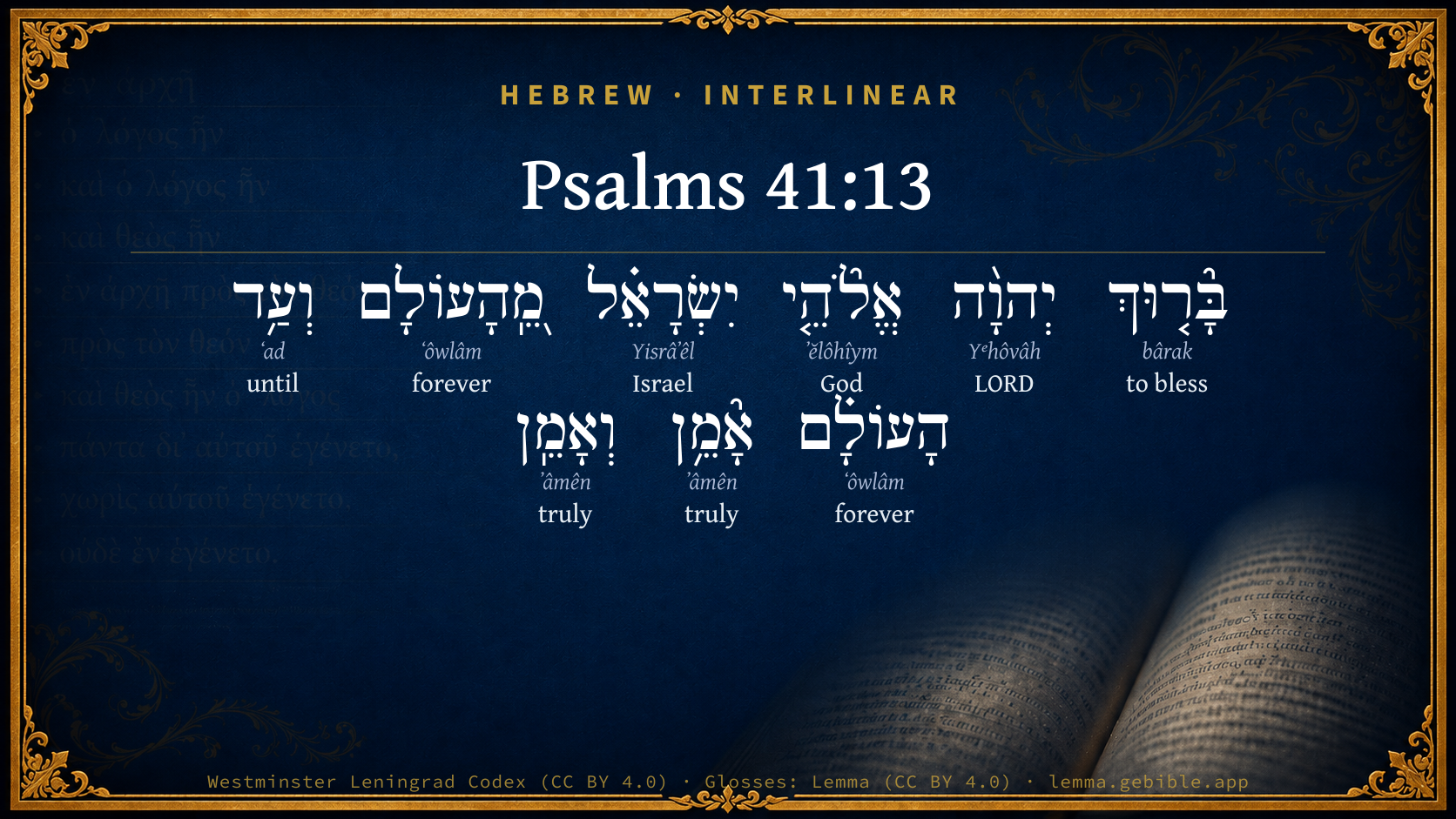
Psalms 41:13

Hebrew (Westminster Leningrad Codex) Psalms 41:13 appears in the Hebrew Old Testament. The text above is from the Westminster Leningrad Codex. Each word links to its Strong’s number, a concise gloss, and parsing drawn from the Open Scriptures Hebrew Bible morphology. Click any word for its full Brown-Driver-Briggs (BDB) entry.
Download image
Cite this verse

Psalms 41:13 (World English Bible). Public Domain. Lemma interlinear Bible study tool, https://lemma.gebible.app/v/psalms/41/13.

Show BibTeX & RIS
BibTeX
RIS
English Translation
Blessed be Yahweh, the God of Israel, From everlasting and to everlasting! Amen and amen.
World English Bible · Public Domain
Download a study sheet

One document with this verse’s original text, its word-by-word gloss line, the meaning frame, cross-references with their text, attributed commentary, and full source and license credits — printable, and it pastes into notes with its structure intact.

This verse Autodidact and up

Study sheet (.html) Plain text (.txt)

A passage Seminary Student

Up to 50 verses in one chapter. A passage sheet keeps up to 6 commentary sources and 12 cross-references per verse, in the order this page ranks them, and says so on the sheet whenever that leaves anything out. Ask for a single verse and you get the Autodidact verse sheet above.

Everything on this page stays free to read, with no account — the sheet is a download of what is already on screen, not access to it.

Want to remove ads? Support Godless Engineer
Compare translations 3

The same verse in 3 English versions, stacked beneath the original-language interlinear above. Click any original word for its lexicon entry.

Each is an independent rendering of the whole verse — the interlinear is not word-aligned to these translations.

Highlighted words mark where these versions differ — a whole-verse word diff, not a word-by-word alignment.

  • World English Bible Public Domain
    Blessed be Yahweh, the God of Israel, From everlasting and to everlasting! Amen and amen.
  • King James Version Public Domain
    Blessed be the LORD God of Israel from everlasting, and to everlasting. Amen, and Amen.
  • unfoldingWord Literal Text CC BY-SA 4.0
    Blessed Yahweh, the God of Israel, from the everlasting and unto the everlasting. Amen and amen.

unfoldingWord Literal Text — © unfoldingWord, licensed CC BY-SA 4.0. Word-aligned USFM3 via Door43 (git.door43.org/unfoldingWord/en_ult).

Versions to compare (up to 4)

3 of 4 selected

Show all 18 translations

Every available English version of this verse, each an independent rendering of the whole verse.

  • World English Bible Public Domain
    Blessed be Yahweh, the God of Israel, From everlasting and to everlasting! Amen and amen.
  • Berean Standard Bible Public Domain
    Blessed be the LORD, the God of Israel, from everlasting to everlasting. Amen and Amen.
  • Majority Standard Bible Public Domain
    Blessed be the LORD, the God of Israel, from everlasting to everlasting. Amen and Amen.
  • King James Version Public Domain
    Blessed be the LORD God of Israel from everlasting, and to everlasting. Amen, and Amen.
  • American Standard Version (1901) Public Domain
    Blessed be Jehovah, the God of Israel, From everlasting and to everlasting. Amen, and Amen. Psalm 42 For the Chief Musician. Maschil of the sons of Korah.
  • Revised Version (1885) Public Domain
    Blessed be the LORD, the God of Israel, from everlasting and to everlasting. Amen, and Amen.
  • Geneva Bible (1599) Public Domain
    Blessed be the Lord God of Israel worlde without ende. So be it, euen so be it.
  • Douay-Rheims (1899) Public Domain
    But thou hast upheld me by reason of my innocence: and hast established me in thy sight for ever.
  • Young's Literal Translation Public Domain
    Blessed `is' Jehovah, God of Israel, From the age -- and unto the age. Amen and Amen.
  • Literal Standard Version CC BY-SA 4.0
    Blessed [is] YHWH, God of Israel, || From age to age. Amen and Amen.
  • Unlocked Literal Bible CC BY-SA 4.0
    May Yahweh, the God of Israel be praised from everlasting to everlasting. Amen and Amen.
  • unfoldingWord Literal Text CC BY-SA 4.0
    Blessed Yahweh, the God of Israel, from the everlasting and unto the everlasting. Amen and amen.
  • Darby Bible Public Domain
    Blessed be Jehovah, the God of Israel, from eternity to eternity! Amen, and Amen.
  • World Messianic Bible Public Domain
    Blessed be the LORD, the God of Israel, from everlasting and to everlasting! Amen and amen.
  • Webster's Bible Public Domain
    \\41:12\\And as for me, thou upholdest me in my integrity, and settest me before thy face for ever.
  • Free Bible Version CC BY-SA 4.0
    Praise the Lord, the God of Israel, from eternity to eternity! Amen and amen!
  • Bible in Basic English Public Domain
    May the Lord God of Israel be praised, through eternal days and for ever. So be it. So be it.
  • JPS Tanakh (1917) Public Domain
    (41-14) Blessed be the LORD, the God of Israel, from everlasting and to everlasting. Amen, and Amen.

Literal Standard Version (2020), Covenant Press — licensed CC BY-SA 4.0. Text via the HelloAO Bible API (eBible.org). Unlocked Literal Bible (unfoldingWord) — licensed CC BY-SA 4.0. Text via the HelloAO Bible API (eBible.org). unfoldingWord Literal Text — © unfoldingWord, licensed CC BY-SA 4.0. Word-aligned USFM3 via Door43 (git.door43.org/unfoldingWord/en_ult). Free Bible Version, Dr. Jonathan Gallagher — licensed CC BY-SA 4.0. Text via the HelloAO Bible API (eBible.org).

Word by word

More ways to search: Search by grammar → Find every occurrence → Compare this word →

Practice this passage: Drill this verse → Learn its vocabulary →

About this verse

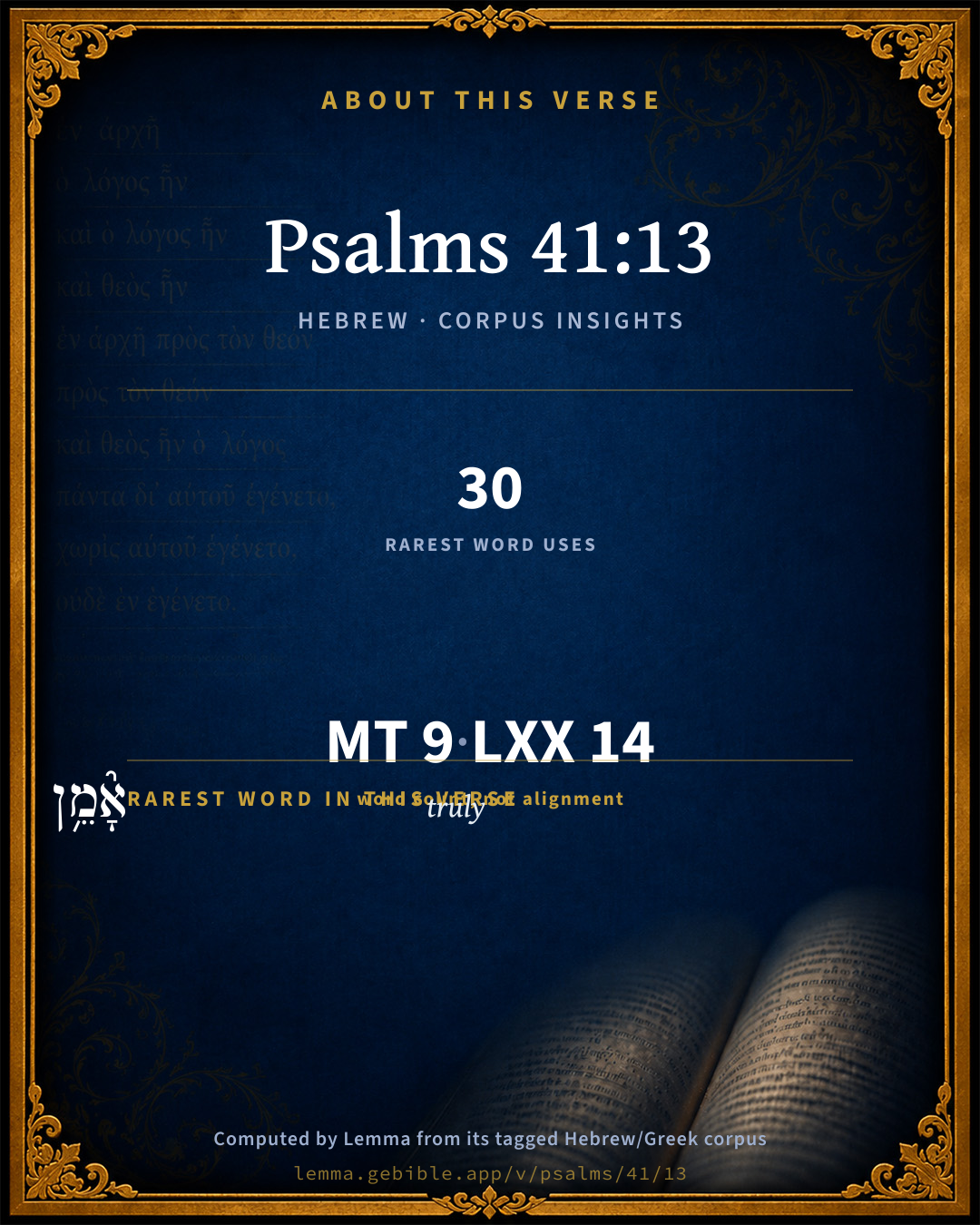
These counts appear in no published source. They are computed here, from the morphology-tagged text and Lemma’s own curated glosses. What Lemma adds →

9
words
7
distinct lemmas
Wisdom
section

Shared distinctive vocabulary

אָ֘מֵ֥ן truly H543 occurs in 24 verses of the Hebrew Bible. Also found in:

Grammatical profile

  • 1 verb
  • 5 nouns
  • 1 preposition
  • 2 adverbs

Verb forms

  • בָּ֘ר֤וּךְ Qal · Participle Passive

Repetition

Words recur within this verse — often emphatic in Hebrew:

  • מֵֽ֭הָעוֹלָם forever H5769 ×2
  • אָ֘מֵ֥ן truly H543 ×2

Hebrew & Septuagint length

In English translation the verse runs 15 words from the Hebrew and 18 from the Septuagint (LXX English) — closely comparable.

A rough comparison of the two English renderings, which tokenize alike — not a word-level alignment.

Word counts can differ between the Hebrew and the Greek without any difference in meaning — e.g. the Hebrew direct-object marker אֵת has no separate Greek word, and Greek often adds the article ὁ.

In the original languages it is 9 Hebrew tokens and 14 Greek tokens — but the two are counted differently (Hebrew bundles its prefixes and suffixes into one token; the Greek is in lemma form), so that isn’t a like-for-like length.

Cross-references

18

Topical passages linked to Psalms 41:13 in the Treasury of Scripture Knowledge — connected by theme and wording, ordered by reader-vote popularity; previews shown in the World English Bible.

  • Psalms 72:18–19 Praise be to Yahweh God, the God of Israel, Who alone does marvelous deeds.
  • Ephesians 1:3 Blessed be the God and Father of our Lord Jesus Christ, who has blessed us with every spiritual blessing in the heavenly places in Christ;
  • Revelation 4:8 The four living creatures, each one of them having six wings, are full of eyes around about and within. They have no rest day and night, saying, "Holy, holy, holy, holy, holy, holy, holy, holy, holy is the Lord God, the Almighty, who was and who is and who is to come!"
  • Revelation 5:9–14 They sang a new song, saying, "You are worthy to take the book, And to open its seals: For you were killed, And bought us for God with your blood, Out of every tribe, language, people, and nation,
  • Psalms 89:52 Blessed be Yahweh forevermore. Amen, and Amen.
  • Psalms 106:48 Blessed be Yahweh, the God of Israel, From everlasting even to everlasting! Let all the people say, "Amen." Praise Yah!
  • Psalms 150:6 Let everything that has breath praise Yah! Praise Yah!
  • Revelation 7:12 saying, "Amen! Blessing, glory, wisdom, thanksgiving, honor, power, and might, be to our God forever and ever! Amen."
  • 1 Chronicles 29:10 Therefore David blessed Yahweh before all the assembly; and David said, You are blessed, Yahweh, the God of Israel our father, forever and ever.
  • Matthew 6:13 Bring us not into temptation, but deliver us from the evil one. For yours is the Kingdom, the power, and the glory forever. Amen.'
  • 1 Chronicles 16:36 Blessed be Yahweh, the God of Israel, From everlasting even to everlasting. All the people said, Amen, and praised Yahweh.
  • Deuteronomy 27:15–26 Cursed be the man who makes an engraved or molten image, an abomination to Yahweh, the work of the hands of the craftsman, and sets it up in secret. All the people shall answer and say, Amen.
  • Jeremiah 28:6 even the prophet Jeremiah said, Amen: Yahweh do so; Yahweh perform your words which you have prophesied, to bring again the vessels of Yahweh's house, and all them of the captivity, from Babylon to this place.
  • 1 Corinthians 14:16 Otherwise if you bless with the spirit, how will he who fills the place of the unlearned say the "Amen" at your giving of thanks, seeing he doesn't know what you say?
  • 1 Kings 1:36 Benaiah the son of Jehoiada answered the king, and said, Amen: Yahweh, the God of my lord the king, say so [too].
  • Revelation 11:17 saying: "We give you thanks, Lord God, the Almighty, the one who is and who was; because you have taken your great power, and reigned.
  • Revelation 22:20 He who testifies these things says, "Yes, I come quickly." Amen! Yes, come, Lord Jesus.
  • Numbers 5:22 and this water that brings a curse will go into your bowels, and make your body swell, and your thigh fall away.' The woman shall say, 'Amen, Amen.'

Cross-references courtesy of OpenBible.info (CC BY 4.0).

Hebrew and Greek witnesses Masoretic Hebrew ↔ Greek Septuagint

The same verse in the two great witnesses to the Old Testament, shown verse-for-verse.

You’re reading Greek Psalm 40 (Hebrew Psalm 41). The Septuagint counts the superscription, so verse numbers can differ from the Hebrew — chapter-level alignment, not verse-by-verse. Numbering follows Rahlfs.

These are two independent witnesses, not word-aligned to each other, and the Septuagint is shown in lemma (dictionary) form.

Hebrew Psalms 41:13 Masoretic · Westminster Leningrad Codex

בָּ֘ר֤וּךְ יְהוָ֨ה אֱלֹ֘הֵ֤י יִשְׂרָאֵ֗ל מֵֽ֭הָעוֹלָם וְעַ֥ד הָעוֹלָ֗ם אָ֘מֵ֥ן וְאָמֵֽן

Blessed be Yahweh, the God of Israel, From everlasting and to everlasting! Amen and amen.

World English Bible · Public Domain

Greek LXX Greek Psalm 40:13 Septuagint · lemma form

ἐγώ δέ διά ὁ ἀκακία ἀντιλαμβάνω καί βεβαιόω ἐγώ ἐνώπιον σύ εἰς ὁ αἰών

Blessed be the Lord God of Israel from everlasting, and to everlasting. So be it, so be it.

LXX2012 (modern English Septuagint) · Public Domain

On this verse, Adam Clarke's Commentary discusses the Septuagint’s reading. Read the note in Commentary ↓

Hebrew: Westminster Leningrad Codex (CC BY 4.0). Greek: Septuagint (public domain); English from LXX2012 (modern English Septuagint) (Public Domain). How the Septuagint differs from the Hebrew →

Commentary

Notes on Psalms 41:13 from classic Christian and Jewish commentators (each source and its license shown beneath its notes). The classic Christian expositions comment on the surrounding passage and are grouped to its opening verse, so a note may address several verses; the Jewish commentaries on the Tanakh (Rashi and others) are per-verse, so they appear only where the commentator wrote on this verse.

Lemma curates 59 commentaries, every one of them public domain or Creative Commons licensed, each selected and text-cleaned for this edition rather than reprinted as found. About our sources →

Trapp's Complete Commentary

John Trapp

Psa 41:13 Blessed [be] the LORD God of Israel from everlasting, and to everlasting. Amen, and Amen.

Ver. 13. Blessed be the Lord God of Israel] Thus he sweetly shutteth up this first book of the psalms (as some distinguish) with a pathetic doxology, redoubling his Amen, Fiat, Fiat, to show his fervency, and most earnest desire that God should be blessed by his whole Israel. This was the custom of the Scribes to do, saith Kimchi, when they had finished any book. The other four books of psalms (as they are reckoned) end in like manner.

From everlasting to everlasting] i.e. From the beginning of the world to the end of it; or, as the Chaldee hath it, from this world unto the world to come.

Amen, and Amen] So be it, and so it shall be. Dictio est acclamationis, approbationis, et confirmationis. The Rabbis say, that our amen in the close of our prayers must not be, first, hasty, but with consideration, 1Co 14:16. Secondly, nor maimed or defective; we must fetch out our hearts after it, and be swallowed up in God. Thirdly, nor alone, or an orphan; that is, without faith, love, and holy confidence. The spirits of the whole prayer are contracted into it, and so should the spirit of him that prayeth.

John Trapp, A Commentary or Exposition upon All the Books of the Old and New Testament (1647–1656) — public domain. Text from a community e-Sword module.

Joseph Benson's Commentary

Psa 41:13. Blessed be the Lord God of Israel — A God in covenant with his people; who has done great and kind things for them, and has more and better in reserve; from everlasting to everlasting — Or, from age to age, as long as the world lasts, and to all eternity. Amen and amen — Amen, especially a double amen, signifies a hearty assent and approbation, and withal an earnest desire of the thing to which it is annexed. And as the Psalms are divided into five books, so each of them is closed with this word: the first here; the second, Psalms 72 : the third, Psalms 89 : the fourth, Psalms 106 : the last in the end of Psalm cl: the doubling of the word shows the fervency of his spirit in this work of praising God.

Joseph Benson's Commentary on the Old and New Testaments (1811–1818) — public domain. Text from a community e-Sword module.

J. A. Alexander on Psalms

Joseph Addison Alexander

14. (Psa 41:13). Blessed (be) Jehovah, the God of Israel, from everlasting and to everlasting. Amen and Amen. In such connections, blessed is nearly synonymous with praised or glorified. In the sense of happy, the Hebrew word can only be applied to creatures. From the perpetuity (already past) and even to the perpetuity (to come), is a paradoxical but strong expression for unlimited duration. Amen is a Hebrew verbal adjective meaning firm, sure, certain, true. It is used as an expression of assent, just as we use right, good, and true itself, for the same purpose. It was uttered by the people as an audible response, not only in the time of Moses (Num. v. 22, Deu 32:15-26), and of David (1Ch 16:36), but after the return from exile (Neh 5:13; Neh 8:6), and under the New Testament (1Co 14:16). Its repetition here and elsewhere simply makes it more emphatic and expressive of a stronger and more cordial acquiescence. The doxology before us marks the close of the first of the five books into which the Psalter is divided. See below, on Ps. 72:19, 89:53 (52), Psa 106:48.

Joseph Addison Alexander, The Psalms Translated and Explained (1850) — public domain. Text from a community e-Sword module.

Tyndale Open Study Notes

Tyndale Open Resources

41:13 This doxology closes Book One (Pss 1–41). Cp. 106:48.

Tyndale Open Study Notes — © Tyndale Open Resources, licensed CC BY-SA 4.0. Text via the HelloAO Bible API.

Geneva Bible (1599)

Geneva Bible translators

By this repetition he stirreth up the faithful to praise God.

Geneva Bible (1599) marginal notes — public domain. Text via Bolls.life.

Jamieson, Fausset & Brown

Robert Jamieson, A. R. Fausset & David Brown

Blessed--praised, usually applied to God. The word usually applied to men denotes happiness (Psa 1:1; Psa 32:1). With this doxology the first book closes.

Next: Psalms Chapter 42

Jamieson, Fausset & Brown — Commentary Critical and Explanatory on the Whole Bible (1871) — public domain (CC PDM 1.0). Text via the HelloAO Bible API.

Adam Clarke's Commentary

Verse 13. Blessed be the Lord God of Israel] By all these circumstances and events glory shall redound to the name of God for ever; for the record of these things shall never perish, but be published from one generation to another; and it has been so.

From everlasting, and to everlasting.] מהעולם ועד העולם mehaolam vead haolam; From the hidden time to the hidden time; from that which had no beginning to that which has no end.

To which he subscribes, Amen and Amen. Fiat, fiat. - Vulgate. Γενοιτο, γενοιτο. - Septuagint. The Chaldee says, "And let the righteous say, Amen, and Amen." [Anglo-Saxon] "Be blessed, Lord God of Israel, from world, and in world. Be it! So be it!" - Anglo-Saxon. To which the Old Psalter approaches very nearly: Blyssed Lord God of Isrel, fra werld, and in werld: Be it done! be it done. Thus illustrated by the same, Fra werld in werld; that es, fra the bygynnyng of this wereld, in til wereld that lastes ay. Be it done, be it done. This dubblying schews that it es at do of al men. In Latyn, it es, fiat, fiat! in Ebru, Amen Amen es writyn: tharfore that Aquila translated vere, vel fideliter, that es, sothfastly or trew.

Thus ends what the Hebrews call the first book of Psalms; for the reader will recollect that this book is divided by the Jews into five books, the first of which ends with this Psalm.

This doxology, Dr. Kennicott supposes, may have been added by the collector of this book; and he thinks that the division into books is not arbitrary; and that the Psalms were collected at different times by different persons. See the Introduction. There is certainly a considerable variety in the style of the several books; in the examination of which the Hebrew critic will not lose his labour.

ANALYSIS OF THE FORTY-FIRST PSALM

In this Psalm David shows how men should, and how commonly they do, carry themselves towards men in affliction and trouble.

I. They should behave compassionately and kindly, which would tend to their own happiness, and cause them to find mercy from God, Ps 41:1-4.

II. But they commonly behave unkindly, and afflict the afflicted, Ps 41:4-10.

III. On which unkindness he flies to God, and prays for mercy, Ps 41:11; shows his hope and confidence in God, Ps 41:11-12.

I. He begins with an excellent grave sentence: "Blessed is he who considereth the poor;" that is, any man in trouble and want, c. This is a happy man. His particular comforts and privileges are six: -

1. "The Lord will deliver him in the time of trouble."

2. The Lord will preserve him, "that he faint not in his troubles."

3. The Lord will keep him alive. Prolong his life and days.

4. "He shall be blessed upon earth: "God shall enrich him, and bless his substance.

5. He shall not be delivered unto the will of his enemies, - never to their full desires, though often into their hands.

6. "The Lord will strengthen him upon a bed of languishing," and make all his bed in his sickness: he shall have comfort and assurance of God's favour.

II. He begins the second part with an ejaculation: -

1. "I said, The Lord be merciful unto me!" pardon my sin.

2. "Heal my soul:" extract the sting of sin, and all inward corruption.

3. He prays thus, because he is sensible that he "has sinned against the Lord."

The complaint against himself being ended, he begins to complain of others.

1. Of their hatred and malice: "Mine enemies speak evil of me."

2. Of their cruelty they longed for his death: "When shall he die, and his name perish?" they would have even his memorial cut off.

3. Their perfidious dealing and dissimulation. They came to visit him: but it was fraudulently to search out his counsels, and to entrap him in his words; and then to detail them abroad: "If he come to see me," &c.

4. Of their plots and conspiracies: "All they that hate me whisper," &c.

5. Their exultation at his misery: "An evil disease, say they, cleaveth unto him," &c.

6. Of the perfidiousness of some particular friend, perhaps Ahithophel: "Yea, mine own familiar friend hath lifted up his heel against me."

III. And then, against all these evils, and in his own defence, he prays: "But thou, O Lord, be merciful unto me, and raise me up." For which he gives these reasons: -

1. That thereby, as a king, he should have power to do justice on traitors: "That I may requite them."

2. By this he should have experience of God's favour: "By this I know thou favourest me," &c.

3. It will be a testimony unto me that thou favourest not only my person, but my cause: "As for me, thou upholdest me in mine integrity, and settest me before thy face for ever."

The Psalm, and with it the first book of the Psalms, according to the Jewish division, is closed with a doxology to God: "Blessed be the Lord God of Israel, from everlasting to everlasting. Amen and Amen."

Adam Clarke's Commentary on the Bible (1810–1826) — public domain. Text from a community e-Sword/MySword module.

John Calvin's Commentaries

13 Blessed be Jehovah, the God of Israel, for ever and ever Here the Psalmist confirms and repeats the expression of thanksgiving contained in a preceding verse. By calling God expressly the God of Israel, he testifies that he cherished in his heart a deep and thorough impression of the covenant which God had made with the Fathers; because it was the source from which his deliverance proceeded. The term amen is repeated twice, to express the greater vehemence, and that all the godly might be the more effectually stirred up to praise God.

John Calvin's Commentaries (1540-1563) — public domain. Text from the Calvin Translation Society English edition (1840s-50s) via the Christian Classics Ethereal Library (ccel.org). Calvin's coverage is partial (roughly two-thirds of the Bible); uncommented books and verses are honest gaps, never fabricated. The 19th-century editor's footnotes and remarks are omitted so the notes are faithfully Calvin's own voice.

Ellicott's Commentary for English Readers

(13) Blessed.—This doxology is no part of the psalm, but a formal close to the first book of the collection. (See General Introduction.)

A Bible Commentary for English Readers, edited by Charles John Ellicott (1878–1897) — public domain. Text from a community e-Sword module.

The Cambridge Bible for Schools and Colleges

gen. ed. J. J. S. Perowne

13. This doxology is of course no part of the Psalm, but stands here to mark the close of Book i. Cp. Psa_72:18-19; Psa_89:52; Psa_106:48.

Blessed be the Lord God of Israel] Better as R.V., Blessed be the Lord, the God of Israel. Lord answers to the Name Jehovah, and is not an attribute to God of Israel. Cp. David’s doxology, 1Ki_1:48; 1Ch_29:10; and Solomon’s, 1Ki_8:15; also Ezr_7:27; Neh_9:5; Luk_1:68.

from everlasting, and to everlasting] From all eternity in the past to all eternity in the future: in the eternal present of the divine existence. Cp. Psa_90:2; Psa_93:2; Psa_103:17.

Amen, and Amen] So it is: the response of the congregation, affirming the ascription of praise on their own behalf (Psa_106:48).

The Cambridge Bible for Schools and Colleges (gen. ed. J. J. S. Perowne; Cambridge University Press, 1878–1918) — public domain. Text from a community e-Sword module.

John Gill's Exposition

Blessed be the Lord God of Israel,.... Which is said, either by the Messiah, on account of the delight his Father had in him; the favour he had shown him in raising him from the dead, maintaining his innocence, and exalting him at his own right hand; and for all the blessings of grace the whole Israel of God enjoyed through him: or else by the church, who is meant by Israel, the Lord is the God of in a covenant way; who, hearing such things done to her Lord and head, breaks out into an exclamation of praise, and ascribes blessing and glory to God for them, which is due to him;

from everlasting, and to everlasting; that is, throughout all ages, world without end, Eph 3:21.

Amen and Amen; which word, as Kimchi observes, signifies confirmation; and the doubling of it is for the greater confirmation of what is expressed. Here ends the first part of the book of Psalms, which is divided into five parts by the Jews (a).

(a) Midrash Tillim, fol. 2. 1. Kimchi Praefat. in Psal.

Next: Psalms Chapter 42

John Gill's Exposition of the Whole Bible (1746–1763) — public domain (CC PDM 1.0). Text via the HelloAO Bible API.

Albert Barnes' Notes on the Bible

Blessed be the Lord God of Israel - That is, Let the Lord God of Israel be praised, honored, adored. The language is an expression of desire that all honor, all happiness, might be His. It is a recognition of God as the source of the mercies referred to, and an expression of the feeling that he is entitled to universal praise. The word Israel here refers to the people of God as descended from Jacob or Israel.

From everlasting, and to everlasting - Through eternity, or eternal ages, - from all past duration to all future duration. The expression “from everlasting to everlasting,” would embrace eternity; and the idea is that God is deserving of eternal praise.

Amen, and amen - The word “amen” means properly surely, certainly, truly, and is a word expressive of solemn affirmation, or of the desire of the mind that this should be so. Its repetition is emphatic, expressing strong assent to what is said as certainly true, or as eminently the wish of the mind. This benediction marks the close of one of the five books into which the Psalms are commonly divided. See the General Introduction, Section 3.

Albert Barnes' Notes on the Bible (1834–1885) — public domain. Text from a community e-Sword/MySword module.

Matthew Poole's English Annotations

From everlasting, and to everlasting; or, from age to age, as long as the world lasts, and to all eternity. Amen signifies a hearty assent and approbation, and withal an earnest desire and confidence, of the thing to which it is annexed. And as the Psalms are divided into five books, so each of them is closed with this word; the first here, the second Psa 72, the third Psa 89, the fourth Psa 106, the last in the end of Psa 150; the doubling of the word shows the fervency of his spirit in this work of praising God.

Matthew Poole's English Annotations on the Holy Bible (1683–1685) — public domain. Text from a community e-Sword/MySword module.

The Treasury of David

Charles H. Spurgeon

Ver. 13. The Psalm ends with a doxology. Blessed be the Lord, i.e., let him be glorified. The blessing at the beginning from the mouth of God is returned from the mouth of his servant. We cannot add to the Lord's blessedness, but we can pour out our grateful wishes, and these he accepts, as we receive little presents of flowers from children who love us. Jehovah is the personal name of our God. God of Israel is his covenant title, and shows his special relation to his elect people. From everlasting and to everlasting. The strongest way of expressing endless duration. We die, but the glory of God goes on and on without pause. Amen and amen. So let it surely, firmly, and eternally be. Thus the people joined in the Psalm by a double shout of holy affirmation; let us unite in it with all out hearts. This last verse may serve for the prayer of the universal church in all ages, but none can sing it so sweetly as those who have experienced as David did the faithfulness of God in times of extremity.

Ver. 13. Blessed be the Lord God of Israel from everlasting, and to everlasting. Amen, and Amen. We are here taught, 1. To give glory to God, as the Lord God of Israel, a God in covenant with his people; that has done great and kind things for them, and has more and better in reserve. 2. To give him glory as an eternal God, that has both his being and his blessedness from everlasting and to everlasting. 3. To do this with great affection and fervour of spirit, intimated in a double seal set to it, Amen, and Amen. We say Amen to it, and let all others say Amen too. Matthew Henry.

Ver. 13. Amen and Amen. As the Psalms were not written by one man, so neither do they form one book. The Psalter is, in fact, a Pentateuch, and the lines of demarcation, which divide the five books one from another, are clear and distinct enough. At the end of the 41st Psalm, of the 72nd, of the 89th, and of the 106th, we meet with the solemn, Amen, single or redoubled, following on a doxology, which indicates that one book ends and that another is about to begin. A closer study of the Psalms shows that each book possesses characteristics of its own. Jehovah ("the Lord") for example, is prominent as the divine name in the first book, Elohim ("God") in the second. E. H. Plumptre, M.A., in "Biblical Studies, "1870.

Ver. 13. There is also another observable difference between the two books. In the first, all those Psalms which have any inscription at all are expressly assigned to David as their author, whereas in the second we find a whole series attributed to some of the Levitical singers. J. J. Stewart Perowne.

Ver. 13. How ancient the division is cannot now be clearly ascertained. Jerome, in his epistle to Marcella, and Epiphanius speak of the Psalms as having been divided by the Hebrews into five books, but when this division was made they do not inform us. The forms of ascription of praise, added at the end of each of the five books, are in the Septuagint version, from which we may conclude that this distribution had been made before that version was executed. It was probably made by Ezra, after the return of the Jews from Babylon to their own country, and the establishment of the worship of God in the new temple, and it was perhaps made in imitation of a similar distribution of the books of Moses. In making this division of the Hebrew Psalter, regard appears to have been paid to the subject matter of the Psalms. John Calvin.

Ver. 13. These forty-one Psalms, it has been observed, forming the first book, relate chiefly to the ministry of Christ upon earth, preparing those who were looking for the consolation of Israel, for his appearing amongst them. Accordingly, the second book, commencing with Psalm 42, may refer chiefly to the infant church of Christ. W. Wilson, D.D.

Ver. 13. May not the growth of the Book of Psalms be illustrated by the case of our Modern Hymn Books which in the course of years require first one appendix and then another, so as to incorporate the growing psalmody of the church? In this case the purely Davidic Psalms of the first division formed the nucleus to which other sacred songs were speedily added. C. H. S.

Ver. 13.

1. The object of praiseJehovah, the covenant God.

2. The nature of the praisewithout beginning or end.

3. Our participation in the praise"Amen and Amen."

The ancient rabbins saw in the Five Books of the Psalter the image of the Five Books of the Law. This way of looking on the Psalms as a second Pentateuch, the echo of the first, passed over into the Christian church, and found favour with some early fathers. It has commended itself to the acceptance of good recent expositors, like Dr. Delitzsch, who calls the Psalter "the congregation's five fold word to the Lord, even as the Thora (the Law) is the Lord's five fold word to the Congregation." This mat be mere fancy, but its existence from ancient times shows that the five fold division attracted early notice. William Binnie, D.D.

God presented Israel with the Law, a Pentateuch, and grateful Israel responded with a Psalter, a Pentateuch of praise. F.L.K.

Charles H. Spurgeon's The Treasury of David (1869–1885) — public domain. Psalms only. Text from a community e-Sword/MySword module.

Whedon's Commentary on the Bible

Daniel D. Whedon

13. From everlasting, and to everlasting—Literally, from the eternity, and unto the eternity. The sentence must be taken literally, and proves the faith of the author in the immortality of man. The Amen, and Amen, are a climax of the doctrine of the doxology, and of faith in the word of God.

Daniel D. Whedon (gen. ed.), Commentary on the Old and New Testaments (1874–1909) — public domain. Text from a community e-Sword module.

The Pulpit Commentary

Blessed be the Lord God of Israel from everlasting and to everlasting. Amen, and Amen. A similar doxology occurs at the end of Ps 72 Ps 89, and Ps 106, not (apparently) as part of the psalm to which it is attached, but as a mark of pause and separation. The Psalter is thus divided into five books (comp. Hippolyt., p. 153, edit. Lagarde, "The Hebrews divided the Psalter into five books, so that it is another Pentateuch").

The doxology of the Hebrew Church.

This doxology does not appear to be a part of the psalm to which it is annexed. The Psalms are divided into five books. The first book closes with the forty-first psalm. In all probability this was the earliest portion of the songs of the Hebrew sanctuary; and when made up (as we should say) into a volume, the collator added thereto a doxology as was done also at the end of Ps 72 Ps 89, and Ps 106. Perhaps the omission of any doxology after Psalm 150 is because that psalm is entirely one of praise. We have no information as to the name of the collator, nor as to the date at which this first division of the Psalms was made up, and the doxology appended thereto. But, nevertheless, it is of no small interest, and ought to convey no mean instruction; showing us, as it does, most strikingly what jubilation resulted from revelation. In pagan worship there is no delight in God; there is dread, there is homage to greatness, there is even thankfulness for a good harvest; but as for delight in God as God, there is none, and can be none, save where God has revealed himself; nor can there be any delight in adoring the Unknown, nor in the positivist"s worship of humanity. Religious worship, as glad and jubilant, belongs only to those to whom God is known; paganism, whether in ancient or modern days, knows no such songs of delight or ascriptions of loving praise as those which rise up from the lips and hearts of the saints of God.

I GOD, AS THE REVEALED GOD OF OUR SALVATION, IS THE FITTING OBJECT OF GLADSOME SONG. The declared name of God would yield delight to pious souls. (Exo_34:6, Exo_34:7) The various terms added to the covenant name Jehovah show how the saints rejoiced in God: Jehovah-jireh, Jehovah-rophi, Jehovah-nisei, Jehovah-tsidkenu. Many expressions in the Psalms show what God was to his people Rock, Fortress, Light, Strength, Refuge, their exceeding Joy, their Deliverer, their Sun, their Shield, pitying as a father, gentle and comforting as a mother, One who put beneath his people "everlasting arms." Well might their joy rise to songs of rapturous delight as in Deu_32:26-29. This joy in God would arise

(1) from what God is in himself as a God of power, wisdom, loving-kindness, faithfulness, pity, and love; and also

(2) from what he declared himself to be as Israels God giving pardon, help, strength, guidance, light, salvation. And now that, through the larger Scriptures, through the Person of Christ, and through the baptism of the Holy Ghost, our knowledge is so much the larger, our joy should be proportionately greater, and our songs the louder and sweeter, rising to such heights as Eph_3:20, 21 1Pe_1:3-5 Rev_1:5, 6 5:9-13 7:10 15:3.

II THE GLADSOME PRAISE OF THE SAINTS IS THE BEFITTING RESPONSE TO GOD"S REVELATION OF HIMSELF. "Blessed be," etc. Here believers have a changeless Object of delight. "From everlasting to everlasting." "The same yesterday, and to-day, and for ever." The response of believers to the revelation of so glorious a Being may be looked at in two ways.

1. As that which God desires to evoke by revealing himself. God, being love, yearns to be loved. Divine love yearns for its object to respond, even as our need yearns for a Being to meet that need.

2. With the Divine revelation of himself there is a power working in and on human souls, whereby such response is elicited. A mighty host of believers, whom their God has rescued from darkness and death, are now exulting in songs of praise to the God of their salvation, acknowledging that all good is from him, that all their trust is reposed on him, that all their love centres round him, that all their strength is derived from him, and that all their hopes are fixed on him; they know that he will never leave them nor forsake them. Yea, it is the revelation of a redeeming God to which we owe the happiest hearts, the noblest songs, the grandest music, and the highest inspiration. And this song will never die. First on earth, and then in heaven, the sacred will ascribe all honour to their God; while the vast redeemed host will never cease to add their grand "Amen. C.

The Pulpit Commentary (1880–1919), ed. H.D.M. Spence-Jones & Joseph S. Exell — public domain. Text from a community e-Sword module.

Keil & Delitzsch

C. F. Keil & F. Delitzsch

(Heb.: 41:14) The closing doxology of the First Book, vid., Introduction. Concerning בּרוּך vid., Psa 18:47. The expression "from aeon to aeon" is, according to Berachoth ix. 5, directed against those who deny the truth of the future world. אמן ואמן (a double aleethe's or aleethoo's) seals it in a climactic form.

Keil & Delitzsch — Biblical Commentary on the Old Testament (1861–1891) — public domain (CC PDM 1.0). Text via the HelloAO Bible API. (Old Testament only.)

unfoldingWord translationNotes

Door43 World Missions Community

General Information:

This verse is more than the end of this psalm. It is the closing statement for all of Book 1 of the Psalms, which starts at Psalm 1 and ends with Psalm 41.

from everlasting to everlasting

This refers to two extremes and means for all time. AT: "for all eternity" (See: Merism)

Amen and Amen

The word "Amen" is repeated to emphasize approval of what has been said. AT: "May it certainly be so" (See: Doublet)

translationWords

God

Israel

praise

eternity

amen

unfoldingWord translationNotes — © Distant Shores Media and the Door43 World Missions Community, licensed CC BY-SA 4.0. Source: git.door43.org/Door43/en_tn.

Lesson kit

Teaching starters — assembled from the data on this page, not authored interpretation. Every prompt links to the verse data it draws on. Edit before teaching.

Psalms, in the Wisdom, opens this verse with 9 words (7 distinct Hebrew lemmas). Its most distinctive word is ʼâmên (“truly”). A historical commentator’s framing appears above. Read the whole chapter for the surrounding context.

Discussion questions

  1. The word ʼâmên carries the sense “truly.” How does it shape the verse?
  2. How does Numbers 5:22, which shares the word «truly», read alongside this verse?
  3. What does the repetition of “forever” (2× in this one verse) do in this verse?
  4. These translations render this verse differently; the difference is in the English rendering, not the original. What questions does that raise?
  5. «בָּ֘ר֤וּךְ» is a Qal Participle Passive verb. How does that grammatical form shape the action described?
  6. Compare how Trapp's Complete Commentary and Joseph Benson's Commentary read this verse. Where do they agree or differ?

Things to notice

Reading settings

Reading text

Shown beneath each verse's original-language words.

Old Testament
Old Testament edition

Read the OT as the Masoretic Hebrew (MT) or the Greek Septuagint (LXX).

English shown for the Greek Septuagint (in the Hebrew ↔ Greek comparison).

Comparing translations? Open the Compare panel on any verse page to stack up to four side by side.