Exodus 39:43

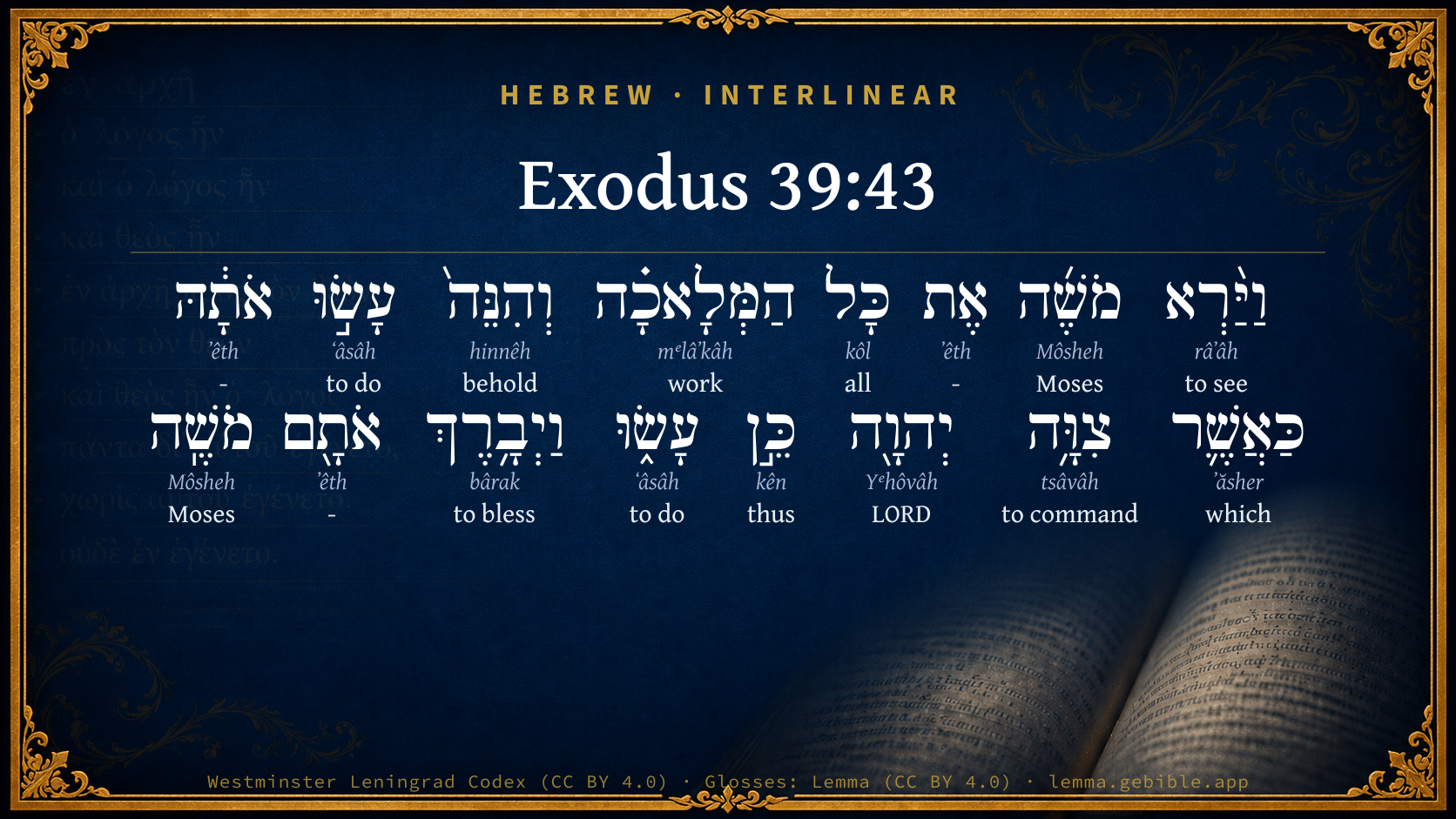
Hebrew (Westminster Leningrad Codex) Exodus 39:43 appears in the Hebrew Old Testament. The text above is from the Westminster Leningrad Codex. Each word links to its Strong’s number, a concise gloss, and parsing drawn from the Open Scriptures Hebrew Bible morphology. Click any word for its full Brown-Driver-Briggs (BDB) entry.
Download image
Cite this verse

Exodus 39:43 (World English Bible). Public Domain. Lemma interlinear Bible study tool, https://lemma.gebible.app/v/exodus/39/43.

Show BibTeX & RIS
BibTeX
RIS
English Translation
Moses saw all the work, and, behold, they had done it as Yahweh had commanded, even so had they done it: and Moses blessed them.
World English Bible · Public Domain
Download a study sheet

One document with this verse’s original text, its word-by-word gloss line, the meaning frame, cross-references with their text, attributed commentary, and full source and license credits — printable, and it pastes into notes with its structure intact.

This verse Autodidact and up

Study sheet (.html) Plain text (.txt)

A passage Seminary Student

Up to 50 verses in one chapter. A passage sheet keeps up to 6 commentary sources and 12 cross-references per verse, in the order this page ranks them, and says so on the sheet whenever that leaves anything out. Ask for a single verse and you get the Autodidact verse sheet above.

Everything on this page stays free to read, with no account — the sheet is a download of what is already on screen, not access to it.

Want to remove ads? Support Godless Engineer
Compare translations 3

The same verse in 3 English versions, stacked beneath the original-language interlinear above. Click any original word for its lexicon entry.

Each is an independent rendering of the whole verse — the interlinear is not word-aligned to these translations.

Highlighted words mark where these versions differ — a whole-verse word diff, not a word-by-word alignment.

  • World English Bible Public Domain
    Moses saw all the work, and, behold, they had done it as Yahweh had commanded, even so had they done it: and Moses blessed them.
  • King James Version Public Domain
    And Moses did look upon all the work, and, behold, they had done it as the LORD had commanded, even so had they done it: and Moses blessed them.
  • unfoldingWord Literal Text CC BY-SA 4.0
    And Moses saw all of the work, and behold, they had done it. Just as Yahweh had commanded, thus they had done. And Moses blessed them.

unfoldingWord Literal Text — © unfoldingWord, licensed CC BY-SA 4.0. Word-aligned USFM3 via Door43 (git.door43.org/unfoldingWord/en_ult).

Versions to compare (up to 4)

3 of 4 selected

Show all 18 translations

Every available English version of this verse, each an independent rendering of the whole verse.

  • World English Bible Public Domain
    Moses saw all the work, and, behold, they had done it as Yahweh had commanded, even so had they done it: and Moses blessed them.
  • Berean Standard Bible Public Domain
    And Moses inspected all the work and saw that they had accomplished it just as the LORD had commanded. So Moses blessed them.
  • Majority Standard Bible Public Domain
    And Moses inspected all the work and saw that they had accomplished it just as the LORD had commanded. So Moses blessed them.
  • King James Version Public Domain
    And Moses did look upon all the work, and, behold, they had done it as the LORD had commanded, even so had they done it: and Moses blessed them.
  • American Standard Version (1901) Public Domain
    And Moses saw all the work, and, behold, they had done it; as Jehovah had commanded, even so had they done it: and Moses blessed them.
  • Revised Version (1885) Public Domain
    And Moses saw all the work, and, behold, they had done it; as the LORD had commanded, even so had they done it: and Moses blessed them.
  • Geneva Bible (1599) Public Domain
    And Moses beheld al the worke, and behold, they had done it as the Lord had commanded: so had they done: and Moses blessed them.
  • Douay-Rheims (1899) Public Domain
    And when Moses saw all things finished, he blessed them.
  • Young's Literal Translation Public Domain
    and Moses seeth all the work, and lo, they have done it as Jehovah hath commanded; so they have done. And Moses doth bless them.
  • Literal Standard Version CC BY-SA 4.0
    and Moses sees all the work, and behold, they have done it as YHWH has commanded; so they have done. And Moses blesses them.
  • Unlocked Literal Bible CC BY-SA 4.0
    Moses examined all the work, and, behold, they had done it. As Yahweh had commanded, in that way they did it. Then Moses blessed them.
  • unfoldingWord Literal Text CC BY-SA 4.0
    And Moses saw all of the work, and behold, they had done it. Just as Yahweh had commanded, thus they had done. And Moses blessed them.
  • Darby Bible Public Domain
    And Moses saw all the work, and behold, they had done it as Jehovah had commanded -- so had they done [it]; and Moses blessed them.
  • World Messianic Bible Public Domain
    Moses saw all the work, and behold, they had done it as the LORD had commanded. They had done so; and Moses blessed them.
  • Webster's Bible Public Domain
    And Moses looked upon all the work, and behold, they had done it as the LORD had commanded, even so had they done it: and Moses blessed them.
  • Free Bible Version CC BY-SA 4.0
    Moses inspected all the work and made sure they had done it as the Lord had ordered. Then Moses blessed them.
  • Bible in Basic English Public Domain
    Then Moses, when he saw all their work and saw that they had done everything as the Lord had said, gave them his blessing.
  • JPS Tanakh (1917) Public Domain
    And Moses saw all the work, and, behold, they had done it; as the LORD had commanded, even so had they done it. And Moses blessed them.

Literal Standard Version (2020), Covenant Press — licensed CC BY-SA 4.0. Text via the HelloAO Bible API (eBible.org). Unlocked Literal Bible (unfoldingWord) — licensed CC BY-SA 4.0. Text via the HelloAO Bible API (eBible.org). unfoldingWord Literal Text — © unfoldingWord, licensed CC BY-SA 4.0. Word-aligned USFM3 via Door43 (git.door43.org/unfoldingWord/en_ult). Free Bible Version, Dr. Jonathan Gallagher — licensed CC BY-SA 4.0. Text via the HelloAO Bible API (eBible.org).

Word by word

More ways to search: Search by grammar → Find every occurrence → Compare this word →

Practice this passage: Drill this verse → Learn its vocabulary →

הַמְּלָאכָ֗ה
mᵉlâʼkâh
H4399
“the · work”
Particle, Definite Article + Noun, Common, Feminine, Singular, Absolute
Part of Speech
Particle + Noun
Type
Common
Gender
Feminine
Number
Singular
State
Absolute
Full BDB Definition

Origin: from the same as H4397

TWOT: 1068b

occupation, work, business - occupation, business - property - work (something done or made) - workmanship - service, use - public business - political - religious
  1. וַיַּ֨רְא râʼâh H7200 “and · to see” Conjunction + Verb, Qal, Sequential Imperfect, 3rd Person, Masculine, Singular
  2. מֹשֶׁ֜ה Môsheh H4872 “Moses” Noun, Proper
  3. אֶת ʼêth H853 “-” Particle, Direct Object
  4. כָּל kôl H3605 “all of” Noun, Common, Masculine, Singular, Construct
  5. וְהִנֵּה֙ hinnêh H2009 “and · behold” Conjunction + Particle, Demonstrative
  6. עָשׂ֣וּ ʻâsâh H6213 “to do” Verb, Qal, Perfect, 3rd Person, Common, Plural
  7. אֹתָ֔הּ ʼêth H853 “- · her” Particle, Direct Object + Suffix, Personal, 3rd Person, Feminine, Singular
  8. כַּאֲשֶׁ֛ר ʼăsher H834 “like/as · which” Preposition + Particle, Relative
  9. צִוָּ֥ה tsâvâh H6680 “to command” Verb, Piel, Perfect, 3rd Person, Masculine, Singular
  10. יְהוָ֖ה Yᵉhôvâh H3068 “LORD” Noun, Proper
  11. כֵּ֣ן kên H3651 “thus” Particle, Demonstrative
  12. עָשׂ֑וּ ʻâsâh H6213 “to do” Verb, Qal, Perfect, 3rd Person, Common, Plural
  13. וַיְבָ֥רֶךְ bârak H1288 “and · to bless” Conjunction + Verb, Piel, Sequential Imperfect, 3rd Person, Masculine, Singular
  14. אֹתָ֖ם ʼêth H853 “- · them” Particle, Direct Object + Suffix, Personal, 3rd Person, Masculine, Plural
  15. מֹשֶֽׁה Môsheh H4872 “Moses” Noun, Proper

About this verse

These counts appear in no published source. They are computed here, from the morphology-tagged text and Lemma’s own curated glosses. What Lemma adds →

16
words
12
distinct lemmas
Pentateuch
section

Grammatical profile

  • 5 verbs
  • 5 nouns
  • 6 particles

Verb forms

  • וַיַּ֨רְא Qal · Sequential Imperfect
  • עָשׂ֣וּ Qal · Perfect
  • צִוָּ֥ה Piel · Perfect
  • עָשׂ֑וּ Qal · Perfect
  • וַיְבָ֥רֶךְ Piel · Sequential Imperfect

Repetition

Words recur within this verse — often emphatic in Hebrew:

  • מֹשֶׁ֜ה Moses H4872 ×2
  • עָשׂ֣וּ to do H6213 ×2

Cross-references

14

Topical passages linked to Exodus 39:43 in the Treasury of Scripture Knowledge — connected by theme and wording, ordered by reader-vote popularity; previews shown in the World English Bible.

  • Leviticus 9:22–23 Aaron lifted up his hands toward the people, and blessed them; and he came down from offering the sin offering, and the burnt offering, and the peace offerings.
  • Numbers 6:23–27 "Speak to Aaron and to his sons, saying, 'This is how you shall bless the children of Israel.' You shall tell them,
  • 2 Samuel 6:18 When David had made an end of offering the burnt offering and the peace-offerings, he blessed the people in the name of Yahweh of Hosts.
  • 1 Kings 8:14 The king turned his face about, and blessed all the assembly of Israel: and all the assembly of Israel stood.
  • 2 Chronicles 30:27 Then the priests the Levites arose and blessed the people: and their voice was heard, and their prayer came up to his holy habitation, even to heaven.
  • Genesis 1:31 God saw everything that he had made, and, behold, it was very good. There was evening and there was morning, the sixth day.
  • Genesis 14:19 He blessed him, and said, "Blessed be Abram of God Most High, possessor of heaven and earth:
  • Joshua 22:6 So Joshua blessed them, and sent them away; and they went to their tents.
  • 2 Chronicles 6:3 The king turned his face, and blessed all the assembly of Israel: and all the assembly of Israel stood.
  • Psalms 104:31 Let the glory of Yahweh endure forever. Let Yahweh rejoice in his works.
  • Exodus 40:25 He lit the lamps before Yahweh, as Yahweh commanded Moses.
  • 1 Chronicles 16:2 When David had made an end of offering the burnt offering and the peace-offerings, he blessed the people in the name of Yahweh.
  • Nehemiah 11:2 The people blessed all the men who willingly offered themselves to dwell in Jerusalem.
  • Psalms 19:11 Moreover by them is your servant warned. In keeping them there is great reward.

Cross-references courtesy of OpenBible.info (CC BY 4.0).

Hebrew and Greek witnesses Masoretic Hebrew ↔ Greek Septuagint

The same verse in the two great witnesses to the Old Testament, shown verse-for-verse.

These are two independent witnesses, not word-aligned to each other, and the Septuagint is shown in lemma (dictionary) form.

Hebrew Exodus 39:43 Masoretic · Westminster Leningrad Codex

וַיַּ֨רְא מֹשֶׁ֜ה אֶת כָּל הַמְּלָאכָ֗ה וְהִנֵּה֙ עָשׂ֣וּ אֹתָ֔הּ כַּאֲשֶׁ֛ר צִוָּ֥ה יְהוָ֖ה כֵּ֣ן עָשׂ֑וּ וַיְבָ֥רֶךְ אֹתָ֖ם מֹשֶֽׁה

Moses saw all the work, and, behold, they had done it as Yahweh had commanded, even so had they done it: and Moses blessed them.

World English Bible · Public Domain

Hebrew: Westminster Leningrad Codex (CC BY 4.0). Greek: Septuagint (public domain); English from a public-domain English Septuagint. How the Septuagint differs from the Hebrew →

Targum (Aramaic paraphrase)

2

The Targum is the ancient Jewish Aramaic paraphrase of the Hebrew Scriptures — an interpretive translation, not the Hebrew text itself. Onkelos (literal) and Pseudo-Jonathan (expansive) render the Torah, and Jonathan the Prophets. Coverage is partial: where no permissively-licensed English translation exists for a verse, only the Aramaic is shown. This is verse-level text, not a word-by-word alignment to the Hebrew.

  1. Targum Onkelos Torah (Genesis–Deuteronomy)
    וַחֲזָא משֶׁה יָת כָּל עִבִדְתָּא וְהָא עֲבָדוּ יָתַהּ כְּמָא דִי פַקִיד יְיָ כֵּן עֲבָדוּ וּבָרִיךְ יָתְהוֹן משֶׁה:

    (no public-domain English translation for this verse)

    Targum Onkelos — Aramaic: “Onkelos Genesis” (public domain); “Onkelos Exodus” (public domain); “Onkelos Leviticus” (public domain); “Onkelos Numbers” (public domain); “Onkelos Deuteronomy” (public domain). English: “Sefaria Community Translation” (CC0 1.0 (public-domain dedication)); “J.W. Etheridge. The Targums of Onkelos and Jonathan Ben Uzziel on the Pentateuch. London: Longmans, Green, 1862” (public domain). Text via Sefaria.

  2. Targum Pseudo-Jonathan Torah (Genesis–Deuteronomy)
    וַחֲמָא משֶׁה יַת כָּל פּוּלְחָנָא וְהָא עָבָדוּ יָתָהּ הֵיכְמָא דְפַקֵּיד יְיָ הֵיכְדֵין עָבָדוּ וּבְרִיךְ יַתְהוֹן משֶׁה וַאֲמַר תִּשְׁרֵי שְׁכִינְתָּא דַיְיָ בְּעוֹבָדֵי יְדֵיכוֹן

    And Moshe surveyed all the service, and, behold, they had made it as the Lord had commanded, so had they made it. And Mosheh blessed them, and said, May the Shekinah of the Lord dwell within the work of your hands!

    Targum Pseudo-Jonathan — Aramaic: “Targum Jonathan on Genesis” (public domain); “Targum Jonathan on Exodus” (public domain); “Targum Jonathan on Leviticus” (public domain); “Targum Jonathan on Numbers” (public domain); “Targum Jonathan on Deuteronomy” (public domain). English: “The Targum of Jonathan ben Uzziel, trans. J. W. Etheridge, London, 1862” (public domain). Text via Sefaria.

Commentary

Notes on Exodus 39:43 from classic Christian and Jewish commentators (each source and its license shown beneath its notes). The classic Christian expositions comment on the surrounding passage and are grouped to its opening verse, so a note may address several verses; the Jewish commentaries on the Tanakh (Rashi and others) are per-verse, so they appear only where the commentator wrote on this verse.

Lemma curates 59 commentaries, every one of them public domain or Creative Commons licensed, each selected and text-cleaned for this edition rather than reprinted as found. About our sources →

Trapp's Complete Commentary

John Trapp

Exo 39:43 And Moses did look upon all the work, and, behold, they had done it as the LORD had commanded, even so had they done it: and Moses blessed them.

Ver. 43. And Moses blessed them.] He highly commended them, praised God for them, and prayed heartily for them, as afterwards David did, "The Lord, that made heaven and earth, bless thee out of Zion."

John Trapp, A Commentary or Exposition upon All the Books of the Old and New Testament (1647–1656) — public domain. Text from a community e-Sword module.

Joseph Benson's Commentary

Exo 39:43. And Moses did look upon all the work — Piece by piece; and behold they had done it according to the pattern showed him — For the same that showed him the pattern, guided their hand in the work. And Moses blessed them — He not only praised them, but prayed for them: he blessed them as one having authority. We read not of any wages Moses paid them for their work, but his blessing he gave them. For though ordinarily the labourer be worthy of his hire, yet in this case, they wrought for themselves. The honour and comfort of God’s tabernacle among them would be recompense enough. And they had their meat from heaven on free cost, for themselves and their families, and their raiment waxed not old upon them; so that they neither needed wages, nor had any reason to expect any. But indeed this blessing, in the name of the Lord, was wages enough for all their work. Those whom God employs he will bless, and those whom he blesseth they are blessed indeed. The blessing he commands is life for evermore.

Joseph Benson's Commentary on the Old and New Testaments (1811–1818) — public domain. Text from a community e-Sword module.

Geneva Bible (1599)

Geneva Bible translators

Praised God for the people’s diligence, and prayed for them.

Geneva Bible (1599) marginal notes — public domain. Text via Bolls.life.

Jamieson, Fausset & Brown

Robert Jamieson, A. R. Fausset & David Brown

Moses did look upon all the work, and, behold, they had done it as the Lord had commanded--A formal inspection was made on the completion of the tabernacle, not only with a view to have the work transferred from the charge of the workmen, but to ascertain whether it corresponded with "the pattern." The result of a careful and minute survey showed that every plank, curtain, altar, and vase had been most accurately made of the form, and in the place designed by the Divine Architect--and Moses, in accepting it of their hands, thanked God for them, and begged Him to bless them.

Next: Exodus Chapter 40

Jamieson, Fausset & Brown — Commentary Critical and Explanatory on the Whole Bible (1871) — public domain (CC PDM 1.0). Text via the HelloAO Bible API.

Adam Clarke's Commentary

Verse 43. And Moses did look upon all the work] As being the general superintendent of the whole, under whom Bezaleel and Aholiab were employed, as the other workmen were under them.

They had done it as the Lord had commanded] Exactly according to the pattern which Moses received from the Lord, and which he laid before the workmen to work by.

And Moses blessed them.] Gave them that praise which was due to their skill, diligence, and fidelity. See this meaning of the original word in the note on Ge 2:3. See Clarke on Ge 2:3. See also a fine instance of ancient courtesy between masters and their servants, in the case of Boaz and his reapers, Ru 2:4. Boaz came from Bethlehem, and said to the reapers, The Lord be with YOU! And they answered him, The Lord bless THEE! It is, however, very probable that Moses prayed to God in their behalf, that they might be prospered in all their undertakings, saved from every evil, and be brought at last to the inheritance that fadeth not away. This blessing seems to have been given, not only to the workmen, but to all the people. The people contributed liberally, and the workmen wrought faithfully, and the blessing of God was pronounced upon ALL.

THE promptitude, cordiality, and despatch used in this business cannot be too highly commended, and are worthy of the imitation of all who are employed in any way in the service of God. The prospect of having God to dwell among them inflamed every heart, because they well knew that on this depended their prosperity and salvation. They therefore hastened to build him a house, and they spared no expense or skill to make it, as far as a house made with hands could be, worthy of that Divine Majesty who had promised to take up his residence in it. This tabernacle, like the temple, was a type of the human nature of the Lord Jesus; that was a shrine not made with hands, formed by God himself, and worthy of that fulness of the Deity that dwelt in it.

It is scarcely possible to form an adequate opinion of the riches, costly workmanship, and splendour of the tabernacle; and who can adequately conceive the glory and excellence of that human nature in which the fulness of the Godhead bodily dwelt? That this tabernacle typified the human nature of Christ, and the Divine shechinah that dwelt in it the Deity that dwelt in the man Christ Jesus, these words of St. John sufficiently prove: In the beginning was the WORD, and the WORD was with God, and the WORD was GOD. And the WORD was made flesh, and dwelt among us, (εσκηνωσεν εν ημιν, made his TABERNACLE among us,) full of grace and truth - possessing the true Urim and Thummim; all the lights and perfections, the truth and the grace, typified by the Mosaic economy, Joh 1:1; Joh 1:14. And hence the evangelist adds, And we beheld his glory; as the Israelites beheld the glory of God resting on the tabernacle, so did the disciples of Christ see the Divine glory resting on him, and showing itself forth in all his words, spirit, and works. And for what purpose was the tabernacle erected? That God might dwell in it among the children of Israel. And for what purpose was the human nature of Christ so miraculously produced? That the Godhead might dwell in it; and that God and man might be reconciled through this wonderful economy of Divine grace, God being in Christ reconciling the world unto himself, 2Co 5:19. And what was implied by this reconciliation? The union of the soul with God, and the indwelling of God in the soul. Reader, has God yet filled thy tabernacle with his glory? Does Christ dwell in thy heart by faith; and dost thou abide in him, bringing forth fruit unto holiness? Then thy end shall be eternal life. Why shouldst thou not go on thy way rejoicing with Christ in thy heart, heaven in thine eye, and the world, the devil, and the flesh, under thy feet?

Adam Clarke's Commentary on the Bible (1810–1826) — public domain. Text from a community e-Sword/MySword module.

Ellicott's Commentary for English Readers

(43) Moses did look upon all the work—i.e., inspected it, examined it, to see if it was “according to the pattern” shown him. Being satisfied, he expressed his own and God’s approval by blessing those who had worked so faithfully.

A Bible Commentary for English Readers, edited by Charles John Ellicott (1878–1897) — public domain. Text from a community e-Sword module.

The Cambridge Bible for Schools and Colleges

gen. ed. J. J. S. Perowne

43. Moses found that all had been done according to Jehovah’s instructions.

blessed them] for the energy and promptitude which had been shewn.

The Cambridge Bible for Schools and Colleges (gen. ed. J. J. S. Perowne; Cambridge University Press, 1878–1918) — public domain. Text from a community e-Sword module.

Haydock's Catholic Bible Commentary

Finished, exactly according to God’s prescriptions. --- Blessed them, the people, who had contributed so liberally; and the workmen, who had performed their task so much to his satisfaction. (Calmet) --- He also blessed the sacred vessels, as they were destined for the worship of God. (Haydock)

George Leo Haydock (1774–1849), Haydock's Catholic Family Bible and Commentary, 1859 edition — public domain. Excludes Psalms (Douay-Rheims chapter numbering differs from Protestant) and Deuterocanonical books (Catholic canon only).

Matthew Poole's English Annotations

i.e. Both the people for their liberal contribution, and the workmen for their great care and industry.

Matthew Poole's English Annotations on the Holy Bible (1683–1685) — public domain. Text from a community e-Sword/MySword module.

The Pulpit Commentary

Ver. 43. A blessing upon obedience.

It is not every kind of obedience that brings down a blessing upon it. To deserve the Divine approval, and obtain the Divine benediction, obedience must be, as was that here recorded

I EXACT. "According to all that the Lord commanded, so the children of Israel made the work" (ver. 42). "As the Lord had commanded, even so had they done it" (ver. 43).

II PROMPT. The work could not have commenced before the sixth or the seventh month, since Sinai was not reached till the third month (ch. 19:1), and Moses passed in conference with God nearly three months. Yet the whole was finished before the year was out. (see Exo_40:1) Thus it appears that six months sufficed for the completion of everything.

III INTELLIGENT. There was little misunderstanding few, if any, mistakes. All comprehended the orders given to them, and each carried out his assigned portion. Unless this had been the case very generally, it is impossible that all would have been ready by the end of the year. The rapid completion of the work proves the intelligence of the workmen, Note what is said of their being "wise-hearted". (Exo_36:1, Exo_36:2, Exo_36:8) Men, for the most part, think to obtain the supreme blessing of eternal life, though their obedience has been

1. Partial and inexact;

2. tardy;

3. marred by misapprehension of the commands given them.

They do not seem to imagine that there will be any real inspection of their work, such as that which is here ascribed to Moses. "Moses did look upon all the work" (ver. 43). Yet surely at the last day, man"s work will be tested in some real, searching way. Whatever may be meant by the expression fire shall try every man"s work", (1Co_3:13) at any rate, some trial there will be. Faithful service to Christ will be rewarded by a blessing exceeding all that we can ask or think; but there will be minute inquiry, whether the service has been indeed faithful.

For further Homiletics on the subjects of this chapter, see those upon ch. 28.

The Pulpit Commentary (1880–1919), ed. H.D.M. Spence-Jones & Joseph S. Exell — public domain. Text from a community e-Sword module.

John Wesley's Explanatory Notes

And Moses did look upon all the work - Piece by Piece, and behold they had done it according to the pattern shewed him - For the same that shewed him the pattern, guided their hand in the work. And Moses blessed them - He not only praised them, but prayed for them: he blessed them as one having authority. We read not of any wages Moses paid them for their work, but his blessing he gave them. For though ordinarily the labourer be worthy of his hire, yet in this case, they wrought for themselves. The honour and comfort of God's tabernacle among them would be recompence enough. And they had their meat from heaven on free-cost, for themselves and their families, and their raiment waxed not old upon them; so that they neither needed wages, nor had reason to expect any. But indeed this blessing in the name of the Lord was wages enough for all their work. Those whom God employs he will bless, and those whom he blesseth, they are blessed indeed. The blessing he commands is life forevermore.

John Wesley, Explanatory Notes Upon the Whole Bible (1754–1765) — public domain. Text via the GEBible commentary corpus.

Rashi

Rabbi Shlomo Yitzchaki (Rashi)

ויברך אתם משה AND MOSES BLESSED THEM — He said to them “May it be the will of God that His Shechinah rest upon the work of your hands; ‘and let the beauty of the Lord our God be upon us and establish Thou the work of our hands upon us’” (Psalms 90:17.) (Sifra, Shemini, Mechilta d'Miluim 2 15) This (from ויהי נועם onward) is part of one of the eleven Psalms (90—100) that are in the section beginning with, תפלה למשה; (Numbers Rabbah 12:9).

Rashi on the Tanakh — English translations: “The Judaica Press complete Tanach with Rashi, translated by A. J. Rosenberg” (CC BY 4.0); “Pentateuch with Rashi's commentary by M. Rosenbaum and A.M. Silbermann, 1929-1934” (public domain); “The Metsudah Tanach series, Lakewood, N.J” (CC BY 4.0); and “The Book of Joshua, Metsudah Publications, 1997” (CC BY 4.0). Text via Sefaria.

Lesson kit

Teaching starters — assembled from the data on this page, not authored interpretation. Every prompt links to the verse data it draws on. Edit before teaching.

Exodus, in the Pentateuch, opens this verse with 16 words (12 distinct Hebrew lemmas). Its most distinctive word is mᵉlâʼkâh (“work”). A historical commentator’s framing appears above. Read the whole chapter for the surrounding context.

Discussion questions

  1. What does “work” (mᵉlâʼkâh) contribute to the verse as a whole?
  2. How does Leviticus 9:22–23, which shares this passage’s theme, read alongside this verse?
  3. What does the repetition of “Moses” (2× in this one verse) do in this verse?
  4. The translations on this page render this verse differently — a whole-verse word diff, not a word-by-word alignment. What might account for the different wordings?
  5. «וַיַּ֨רְא» is a Qal Sequential Imperfect verb. How does that grammatical form shape the action described?
  6. Compare how Trapp's Complete Commentary and Joseph Benson's Commentary read this verse. Where do they agree or differ?

Things to notice

Reading settings

Reading text

Shown beneath each verse's original-language words.

Old Testament
Old Testament edition

Read the OT as the Masoretic Hebrew (MT) or the Greek Septuagint (LXX).

English shown for the Greek Septuagint (in the Hebrew ↔ Greek comparison).

Comparing translations? Open the Compare panel on any verse page to stack up to four side by side.