
Deuteronomy 28:3

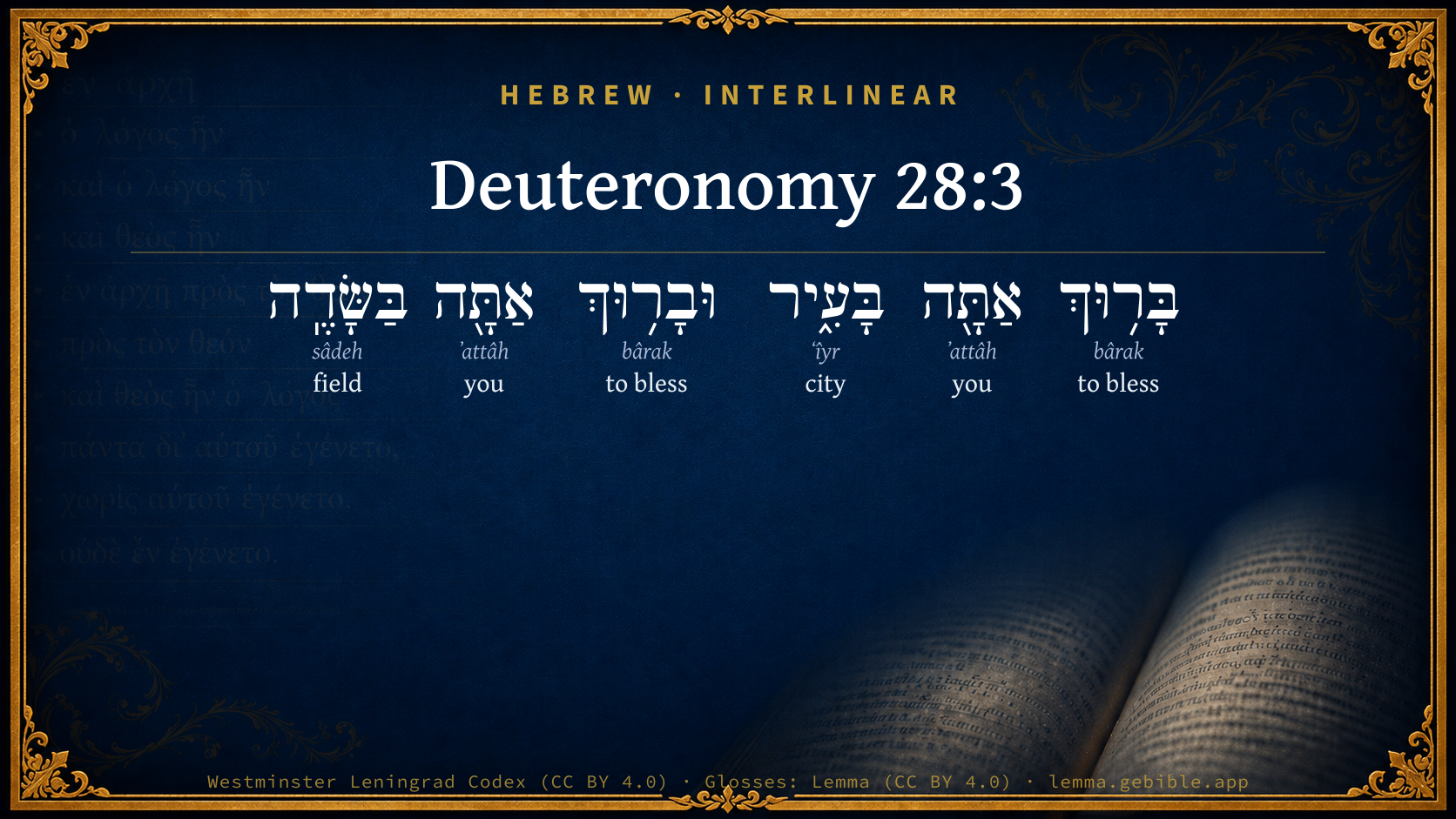
Hebrew (Westminster Leningrad Codex) Deuteronomy 28:3 appears in the Hebrew Old Testament. The text above is from the Westminster Leningrad Codex. Each word links to its Strong’s number, a concise gloss, and parsing drawn from the Open Scriptures Hebrew Bible morphology. Click any word for its full Brown-Driver-Briggs (BDB) entry.
Download image
Cite this verse

Deuteronomy 28:3 (World English Bible). Public Domain. Lemma interlinear Bible study tool, https://lemma.gebible.app/v/deuteronomy/28/3.

Show BibTeX & RIS
BibTeX
RIS
English Translation
Blessed shall you be in the city, and blessed shall you be in the field.
World English Bible · Public Domain
Download a study sheet

One document with this verse’s original text, its word-by-word gloss line, the meaning frame, cross-references with their text, attributed commentary, and full source and license credits — printable, and it pastes into notes with its structure intact.

This verse Autodidact and up

Study sheet (.html) Plain text (.txt)

A passage Seminary Student

Up to 50 verses in one chapter. A passage sheet keeps up to 6 commentary sources and 12 cross-references per verse, in the order this page ranks them, and says so on the sheet whenever that leaves anything out. Ask for a single verse and you get the Autodidact verse sheet above.

Everything on this page stays free to read, with no account — the sheet is a download of what is already on screen, not access to it.

Want to remove ads? Support Godless Engineer
Compare translations 3

The same verse in 3 English versions, stacked beneath the original-language interlinear above. Click any original word for its lexicon entry.

Each is an independent rendering of the whole verse — the interlinear is not word-aligned to these translations.

Highlighted words mark where these versions differ — a whole-verse word diff, not a word-by-word alignment.

  • World English Bible Public Domain
    Blessed shall you be in the city, and blessed shall you be in the field.
  • King James Version Public Domain
    Blessed shalt thou be in the city, and blessed shalt thou be in the field.
  • unfoldingWord Literal Text CC BY-SA 4.0
    Blessed you in the city, and blessed you in the field.

unfoldingWord Literal Text — © unfoldingWord, licensed CC BY-SA 4.0. Word-aligned USFM3 via Door43 (git.door43.org/unfoldingWord/en_ult).

Versions to compare (up to 4)

3 of 4 selected

Show all 18 translations

Every available English version of this verse, each an independent rendering of the whole verse.

  • World English Bible Public Domain
    Blessed shall you be in the city, and blessed shall you be in the field.
  • Berean Standard Bible Public Domain
    You will be blessed in the city and blessed in the country.
  • Majority Standard Bible Public Domain
    You will be blessed in the city and blessed in the country.
  • King James Version Public Domain
    Blessed shalt thou be in the city, and blessed shalt thou be in the field.
  • American Standard Version (1901) Public Domain
    Blessed shalt thou be in the city, and blessed shalt thou be in the field.
  • Revised Version (1885) Public Domain
    Blessed shalt thou be in the city, and blessed shalt thou be in the field.
  • Geneva Bible (1599) Public Domain
    Blessed shalt thou be in the citie, and blessed also in the fielde.
  • Douay-Rheims (1899) Public Domain
    Blessed shalt thou be in the city, and blessed in the field.
  • Young's Literal Translation Public Domain
    `Blessed `art' thou in the city, and blessed `art' thou in the field.
  • Literal Standard Version CC BY-SA 4.0
    Blessed [are] you in the city, and blessed [are] you in the field.
  • Unlocked Literal Bible CC BY-SA 4.0
    Blessed will you be in the city, and blessed will you be in the field.
  • unfoldingWord Literal Text CC BY-SA 4.0
    Blessed you in the city, and blessed you in the field.
  • Darby Bible Public Domain
    Blessed shalt thou be in the city, and blessed shalt thou be in the field.
  • World Messianic Bible Public Domain
    You shall be blessed in the city, and you shall be blessed in the field.
  • Webster's Bible Public Domain
    Blessed shalt thou be in the city, and blessed shalt thou be in the field.
  • Free Bible Version CC BY-SA 4.0
    You will be blessed when you're in the town; you will be blessed when you're in the countryside.
  • Bible in Basic English Public Domain
    A blessing will be on you in the town, and a blessing in the field.
  • JPS Tanakh (1917) Public Domain
    Blessed shalt thou be in the city, and blessed shalt thou be in the field.

Literal Standard Version (2020), Covenant Press — licensed CC BY-SA 4.0. Text via the HelloAO Bible API (eBible.org). Unlocked Literal Bible (unfoldingWord) — licensed CC BY-SA 4.0. Text via the HelloAO Bible API (eBible.org). unfoldingWord Literal Text — © unfoldingWord, licensed CC BY-SA 4.0. Word-aligned USFM3 via Door43 (git.door43.org/unfoldingWord/en_ult). Free Bible Version, Dr. Jonathan Gallagher — licensed CC BY-SA 4.0. Text via the HelloAO Bible API (eBible.org).

Word by word

More ways to search: Search by grammar → Find every occurrence → Compare this word →

Practice this passage: Drill this verse → Learn its vocabulary →

About this verse

These counts appear in no published source. They are computed here, from the morphology-tagged text and Lemma’s own curated glosses. What Lemma adds →

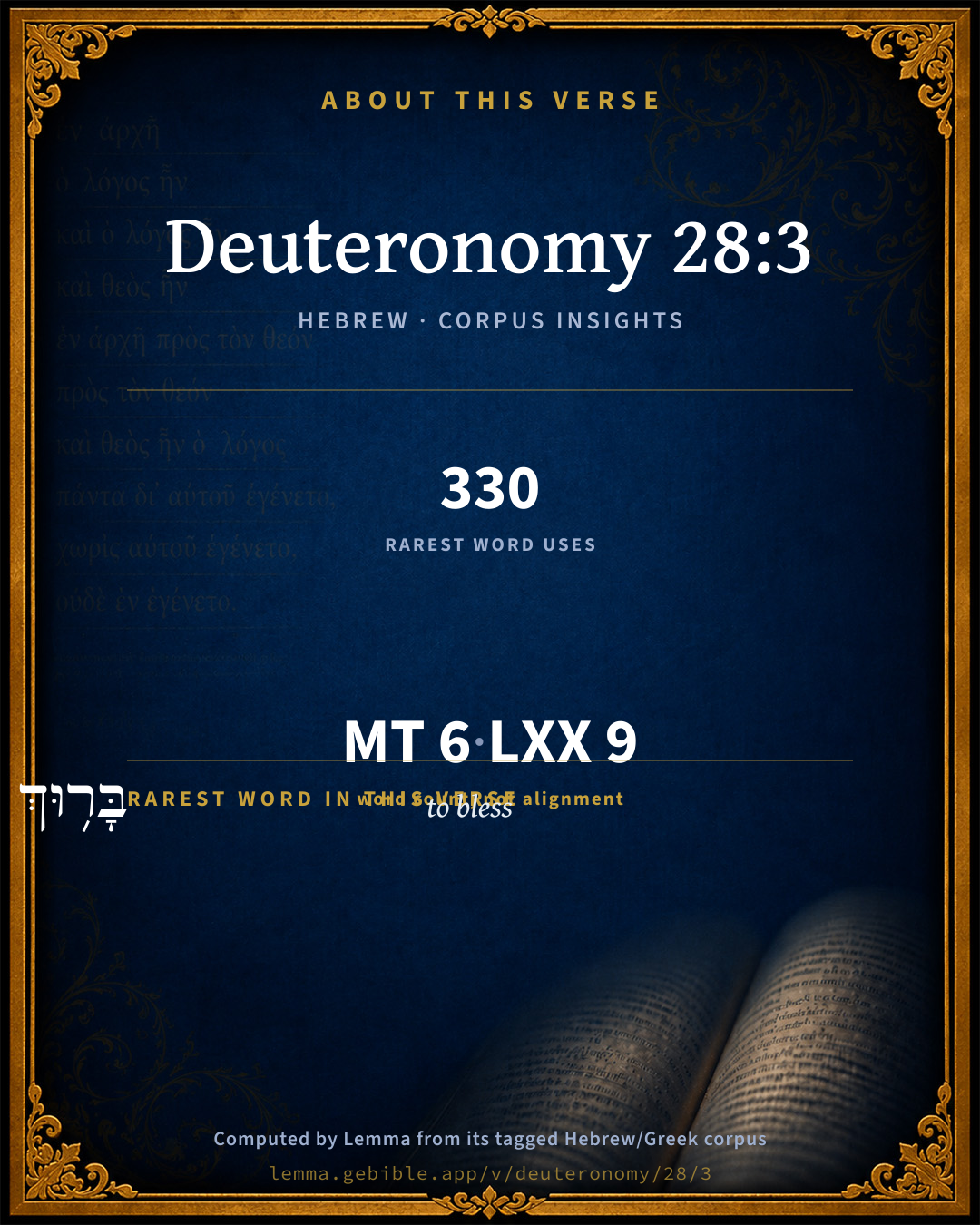
6
words
4
distinct lemmas
Pentateuch
section

Grammatical profile

  • 2 verbs
  • 2 nouns
  • 2 pronouns

Verb forms

  • בָּר֥וּךְ Qal · Participle Passive
  • וּבָר֥וּךְ Qal · Participle Passive

Repetition

Words recur within this verse — often emphatic in Hebrew:

  • בָּר֥וּךְ to bless H1288 ×2
  • אַתָּ֖ה you H859 ×2

Hebrew & Septuagint length

In English translation the verse runs 15 words from the Hebrew and 15 from the Septuagint (LXX English) — the same length.

A rough comparison of the two English renderings, which tokenize alike — not a word-level alignment.

Word counts can differ between the Hebrew and the Greek without any difference in meaning — e.g. the Hebrew direct-object marker אֵת has no separate Greek word, and Greek often adds the article ὁ.

In the original languages it is 6 Hebrew tokens and 9 Greek tokens — but the two are counted differently (Hebrew bundles its prefixes and suffixes into one token; the Greek is in lemma form), so that isn’t a like-for-like length.

Cross-references

10

Topical passages linked to Deuteronomy 28:3 in the Treasury of Scripture Knowledge — connected by theme and wording, ordered by reader-vote popularity; previews shown in the World English Bible.

  • Genesis 39:5 It happened from the time that he made him overseer in his house, and over all that he had, that Yahweh blessed the Egyptian's house for Joseph's sake; and the blessing of Yahweh was on all that he had, in the house and in the field.
  • Psalms 144:12–15 Then our sons will be like well-nurtured plants, Our daughters like pillars carved to adorn a palace.
  • Haggai 2:19 Is the seed yet in the barn? Yes, the vine, the fig tree, the pomegranate, and the olive tree haven't brought forth. From this day will I bless you.'"
  • Genesis 26:12 Isaac sowed in that land, and reaped in the same year one hundred times what he planted. Yahweh blessed him.
  • Psalms 107:36–37 There he makes the hungry live, That they may prepare a city to live in,
  • Isaiah 65:21–23 They shall build houses, and inhabit them; and they shall plant vineyards, and eat the fruit of them.
  • Malachi 3:10–11 Bring the whole tithe into the store-house, that there may be food in my house, and test me now in this," says Yahweh of hosts, "if I will not open you the windows of heaven, and pour you out a blessing, that there shall not be room enough for.
  • Psalms 128:1–5 Blessed is everyone who fears Yahweh, Who walks in his ways.
  • Amos 9:13–14 "Behold, the days come," says Yahweh, "That the plowman shall overtake the reaper, And the one treading grapes him who sows seed; And sweet wine will drip from the mountains, And flow from the hills.
  • Zechariah 8:3–5 Thus says Yahweh: "I have returned to Zion, and will dwell in the midst of Jerusalem. Jerusalem shall be called 'The City of Truth;' and the mountain of Yahweh of Hosts, 'The Holy Mountain.'"

Cross-references courtesy of OpenBible.info (CC BY 4.0).

Hebrew and Greek witnesses Masoretic Hebrew ↔ Greek Septuagint

The same verse in the two great witnesses to the Old Testament, shown verse-for-verse.

These are two independent witnesses, not word-aligned to each other, and the Septuagint is shown in lemma (dictionary) form.

Hebrew Deuteronomy 28:3 Masoretic · Westminster Leningrad Codex

בָּר֥וּךְ אַתָּ֖ה בָּעִ֑יר וּבָר֥וּךְ אַתָּ֖ה בַּשָּׂדֶֽה

Blessed shall you be in the city, and blessed shall you be in the field.

World English Bible · Public Domain

Greek LXX Deuteronomy 28:3 Septuagint · lemma form

εὐλογέω σύ ἐν πόλις καί εὐλογέω σύ ἐν ἀγρός

blessed shall you be in the city, and blessed shall you be in the field.

LXX2012 (modern English Septuagint) · Public Domain

On this verse, The Cambridge Bible for Schools and Colleges discusses the Septuagint’s reading. Read the note in Commentary ↓

Hebrew: Westminster Leningrad Codex (CC BY 4.0). Greek: Septuagint (public domain); English from LXX2012 (modern English Septuagint) (Public Domain). How the Septuagint differs from the Hebrew →

Targum (Aramaic paraphrase)

2

The Targum is the ancient Jewish Aramaic paraphrase of the Hebrew Scriptures — an interpretive translation, not the Hebrew text itself. Onkelos (literal) and Pseudo-Jonathan (expansive) render the Torah, and Jonathan the Prophets. Coverage is partial: where no permissively-licensed English translation exists for a verse, only the Aramaic is shown. This is verse-level text, not a word-by-word alignment to the Hebrew.

  1. Targum Onkelos Torah (Genesis–Deuteronomy)
    בְּרִיךְ אַתְּ בְּקַרְתָּא וּבְרִיךְ אַתְּ בְּחַקְלָא

    (no public-domain English translation for this verse)

    Targum Onkelos — Aramaic: “Onkelos Genesis” (public domain); “Onkelos Exodus” (public domain); “Onkelos Leviticus” (public domain); “Onkelos Numbers” (public domain); “Onkelos Deuteronomy” (public domain). English: “Sefaria Community Translation” (CC0 1.0 (public-domain dedication)); “J.W. Etheridge. The Targums of Onkelos and Jonathan Ben Uzziel on the Pentateuch. London: Longmans, Green, 1862” (public domain). Text via Sefaria.

  2. Targum Pseudo-Jonathan Torah (Genesis–Deuteronomy)
    בְּרִיכִין אַתּוּן בְּקַרְתָּא וּבְרִיכִין אַתּוּן בְּחַקְלָא

    Blessed shall you be in the city, and blessed in the field.

    Targum Pseudo-Jonathan — Aramaic: “Targum Jonathan on Genesis” (public domain); “Targum Jonathan on Exodus” (public domain); “Targum Jonathan on Leviticus” (public domain); “Targum Jonathan on Numbers” (public domain); “Targum Jonathan on Deuteronomy” (public domain). English: “The Targum of Jonathan ben Uzziel, trans. J. W. Etheridge, London, 1862” (public domain). Text via Sefaria.

Commentary

Notes on Deuteronomy 28:3 from classic Christian and Jewish commentators (each source and its license shown beneath its notes). The classic Christian expositions comment on the surrounding passage and are grouped to its opening verse, so a note may address several verses; the Jewish commentaries on the Tanakh (Rashi and others) are per-verse, so they appear only where the commentator wrote on this verse.

Lemma curates 59 commentaries, every one of them public domain or Creative Commons licensed, each selected and text-cleaned for this edition rather than reprinted as found. About our sources →

Trapp's Complete Commentary

John Trapp

Deu 28:3 Blessed [shalt] thou [be] in the city, and blessed [shalt] thou [be] in the field.

Ver. 3. Blessed shalt thou be.] What blessedness is, {See Trapp on "Mat 5:3"}

John Trapp, A Commentary or Exposition upon All the Books of the Old and New Testament (1647–1656) — public domain. Text from a community e-Sword module.

The Biblical Illustrator

Joseph S. Exell

Deu_28:3

Blessed shalt thou be in the city.

Blessed in the city

The city is full of care, and he who has to go there from day to day finds it to be a place of great wear and tear. It is full of noise, and stir, and bustle, and sore travail: many are its temptations, losses, and worries. But to go there with the Divine blessing takes off the edge of its difficulty; to remain there with that blessing is to find pleasure in its duties, and strength equal to its demands. A blessing in the city may not make us great, but it will keep us good; it may not make us rich, but it will preserve us honest. Whether we are porters, or clerks, or managers, or merchants, of magistrates, the city will afford us opportunities for usefulness. It is good fishing where there are shoals of fish, and it is hopeful to work for our Lord amid the thronging crowds. We might prefer the quiet of a country life; but if called to town, we may certainly prefer it because there is room for our energies. Today let us expect good things because of this promise, and let our care be to have an open car to the voice of the Lord, and a ready hand to execute His bidding. Obedience brings the blessing. In keeping His commandments there is great reward. (C. H. Spurgeon.)

City life

We have accustomed ourselves so long to think that the glory and beauty displayed on the open fields of the country, where life lies palpitating and warm with the impress of His creative hand, and where all the works of the Lord are ceaselessly singing His praise, must in itself impress more vividly those who linger amid its beauties, and do their work in the glow of its magnificence, than do the streets and lanes and the visible signs of man which stretch out through the city. And yet we do not seek from the hard-working farmer the highest appreciation of nature as such, nor from the toiling agricultural labourer the keenest poetic sentiment. Men are crowded into the city, the villages become more and more depleted. What does it mean? Ask them, and they would tell you that they are going to see life. To the labourer town life means a more stirring existence, he thinks he sees there a wider field, a quicker return, a more brilliant career, and too often he is bitterly disappointed in these hard times. To the pleasure seeker the city is the great lamp towards which he flies with outstretched wings to flicker for a short space around it, to scorch his wings, to burn himself in the nearest approach to nothingness. But life is a very real thing to seek for. In the city there are gathered together various forms of excellence. Here art treasures are collected, and art studies are at their fullest perfection; here music receives its fullest development; here perfection of all kinds tends to aggregate; here the blood courses fuller and stronger; here might be realised that which we speak of so often in the Creed--the communion of saints. (Canon Newbolt.)

Blessed shalt thou be in the field.

Blessed in the field

So was Isaac blessed when lie walked therein at eventide to meditate. How often has the Lord met us when we have been alone! The hedges and the trees can bear witness to our joy. We look for such blessedness again. So was Boaz blessed when he reaped his harvest, and his workmen met him with benedictions. May the Lord prosper all who drive the plough! Every farmer may urge this promise with God, if, indeed, he obeys the voice of the Lord God. We go to the field to labour as father Adam did; and since the curse fell on the soil through the sin of Adam the first, it is a great comfort to find a blessing through Adam the second. We go to the field for exercise, and we are happy in the belief that the Lord will bless that exercise, and give us health, which we will use to His glory. We go to the field to study nature, and there is nothing in a knowledge of the visible creation which may not be sanctified to the highest uses by the Divine benediction. We have at last to go to the field to bury our dead; yea, others will in their turn take us to Gods acre in the field: but we are blessed, whether weeping at the tomb or sleeping in it. (C. H. Spurgeon.)

The Biblical Illustrator, edited by Joseph S. Exell (c. 1880s–1900s) — public domain. Text from a community e-Sword module.

Geneva Bible (1599)

Geneva Bible translators

Thou shalt live wealthily.

Geneva Bible (1599) marginal notes — public domain. Text via Bolls.life.

Adam Clarke's Commentary

Verse 3. In the city] In all civil employments. In the field - in all agricultural pursuits.

Adam Clarke's Commentary on the Bible (1810–1826) — public domain. Text from a community e-Sword/MySword module.

The Cambridge Bible for Schools and Colleges

gen. ed. J. J. S. Perowne

3–6. Six forms of blessing, each introd. by the pass. part, of the vb. to bless. They cover Israel’s life: in town and field, in their offspring, crops and cattle, annual harvests and daily bread, all their movement out and in. The structure of the first two and last three is uniform: with 3 accents. The longer third, Deu_28:4, has been expanded; fruit of thy cattle does not appear in LXX nor in the parallel Deu_28:18, and is probably a gloss from Deu_28:11.

The Cambridge Bible for Schools and Colleges (gen. ed. J. J. S. Perowne; Cambridge University Press, 1878–1918) — public domain. Text from a community e-Sword module.

John Gill's Exposition

Blessed shalt thou be in the city,.... Not only in the city of Jerusalem, where the temple would be built, and there be blessed with the service, worship, and ordinances of God, but in all other cities of the land; where they should dwell in title, large, and spacious houses, and their cities should be walled and fenced, and be very populous; yet should enjoy health, and have plenty of all sorts of provisions brought unto them, as well as prosper in all kinds of merchandise there, as Aben Ezra notes:

and blessed shalt thou be in the field; in the country villages, and in all rural employments, in sowing and planting, as the same writer observes; in all kinds of husbandry, in the culture of the fields for corn, and of vineyards and oliveyards; all should prosper and succeed, and bring forth fruit abundantly.

John Gill's Exposition of the Whole Bible (1746–1763) — public domain (CC PDM 1.0). Text via the HelloAO Bible API.

Haydock's Catholic Bible Commentary

Field. Wherever thou art, all thy undertakings shall prosper. (Calmet)

George Leo Haydock (1774–1849), Haydock's Catholic Family Bible and Commentary, 1859 edition — public domain. Excludes Psalms (Douay-Rheims chapter numbering differs from Protestant) and Deuterocanonical books (Catholic canon only).

Whedon's Commentary on the Bible

Daniel D. Whedon

3-6. Blessed shall thou be — The manifold blessings in all the relations of life are expressed by six beatitudes. Israel will be blessed in the city and in the country; will be blessed with children, with productive fields, with countless flocks and herds; will be blessed in baskets in which the fruits are kept and in which provisions were carried; blessed in the kneading-trough in which the daily food was prepared; blessed will the nation be in all its relations.

Thy basket and thy store — The word rendered basket is the common basket or bag that is used in the East for carrying such articles as might be needed for personal use. Comp. Joh_13:29. Store should be translated kneading-trough. The Hebrew word here used is the same as we have in Exo_8:3; Exo_12:34, where it is correctly translated. Comp. Psa_121:8.

Daniel D. Whedon (gen. ed.), Commentary on the Old and New Testaments (1874–1909) — public domain. Text from a community e-Sword module.

The Pulpit Commentary

Vers. 3-7. The fullness of the blessing in all the relations of life, external and internal, is presented in six particulars, each introduced by the word "blessed." Israel should be blessed in the house and in the field, in the fruit of the body, in the productions of the soil and the increase of herd and flock, in the store and in the use of what nature provided, in all their undertakings, whether in peace or in war, at home or abroad. Basket and thy store; rather, basket and kneading-trough; (see Exo_8:3 Exo_12:34) "the basket" representing the store in which the fruits of the earth were laid up, the "kneading-trough" the use of these for the supply of daily needs. (ver. 6; cf. Num_27:17; Psa_121:8)

The Pulpit Commentary (1880–1919), ed. H.D.M. Spence-Jones & Joseph S. Exell — public domain. Text from a community e-Sword module.

John Wesley's Explanatory Notes

In the city, and in the field - Whether they were husbandmen or tradesmen, whether in the town or country, they should be preserved from the dangers of both, and have the comforts of both. How constantly must we depend upon God, both for the continuance and comfort of life! We need him at every turn: we cannot be safe, if he withdraw his protection, nor easy, if he suspends his savour: but if he bless us, go where we will, 'tis well with us.

John Wesley, Explanatory Notes Upon the Whole Bible (1754–1765) — public domain. Text via the GEBible commentary corpus.

unfoldingWord translationNotes

Door43 World Missions Community

General Information:

Moses speaks to the Israelites as if they were one man, so the words "you" and "your" here are singular. (See: Forms of You)

Blessed will you be

This can be stated in active form. AT: "Yahweh will bless you" (See: Active or Passive)

in the city ... in the field

This merism means that Yahweh will bless them everywhere. (See: Merism)

the fruit of your body, and the fruit of your ground, and the fruit of your beasts

These idioms for "your children, and your crops, and all your animals" form a merism for everything the Israelites valued. (See: Idiom and Merism)

the fruit of your beasts, the increase of your cattle, and the young of your flock

This doublet is three ways of saying that Yahweh will make the Israelites' animals many and strong. AT: "all of your animals along with the calves of the cattle and the lambs of the flocks" (See: Doublet)

translationWords

bless

fruit

body

beast

cow

flocks

unfoldingWord translationNotes — © Distant Shores Media and the Door43 World Missions Community, licensed CC BY-SA 4.0. Source: git.door43.org/Door43/en_tn.

Lesson kit

Teaching starters — assembled from the data on this page, not authored interpretation. Every prompt links to the verse data it draws on. Edit before teaching.

Deuteronomy, in the Pentateuch, opens this verse with 6 words (4 distinct Hebrew lemmas). Its most distinctive word is bârak (“to bless”). A historical commentator’s framing appears above. Read the whole chapter for the surrounding context.

Discussion questions

  1. What does “to bless” (bârak) contribute to the verse as a whole?
  2. Genesis 39:5 shares this passage’s theme. How do the two illuminate each other?
  3. “to bless” occurs 2× in this one verse. What is the effect of the repetition?
  4. The translations on this page render this verse differently — a whole-verse word diff, not a word-by-word alignment. What might account for the different wordings?
  5. The verb «בָּר֥וּךְ» is Qal Participle Passive. How does its form color the action?
  6. Reading how Trapp's Complete Commentary and The Biblical Illustrator read this verse, where do the two commentators agree and where do they part?

Things to notice

Reading settings

Reading text

Shown beneath each verse's original-language words.

Old Testament
Old Testament edition

Read the OT as the Masoretic Hebrew (MT) or the Greek Septuagint (LXX).

English shown for the Greek Septuagint (in the Hebrew ↔ Greek comparison).

Comparing translations? Open the Compare panel on any verse page to stack up to four side by side.