
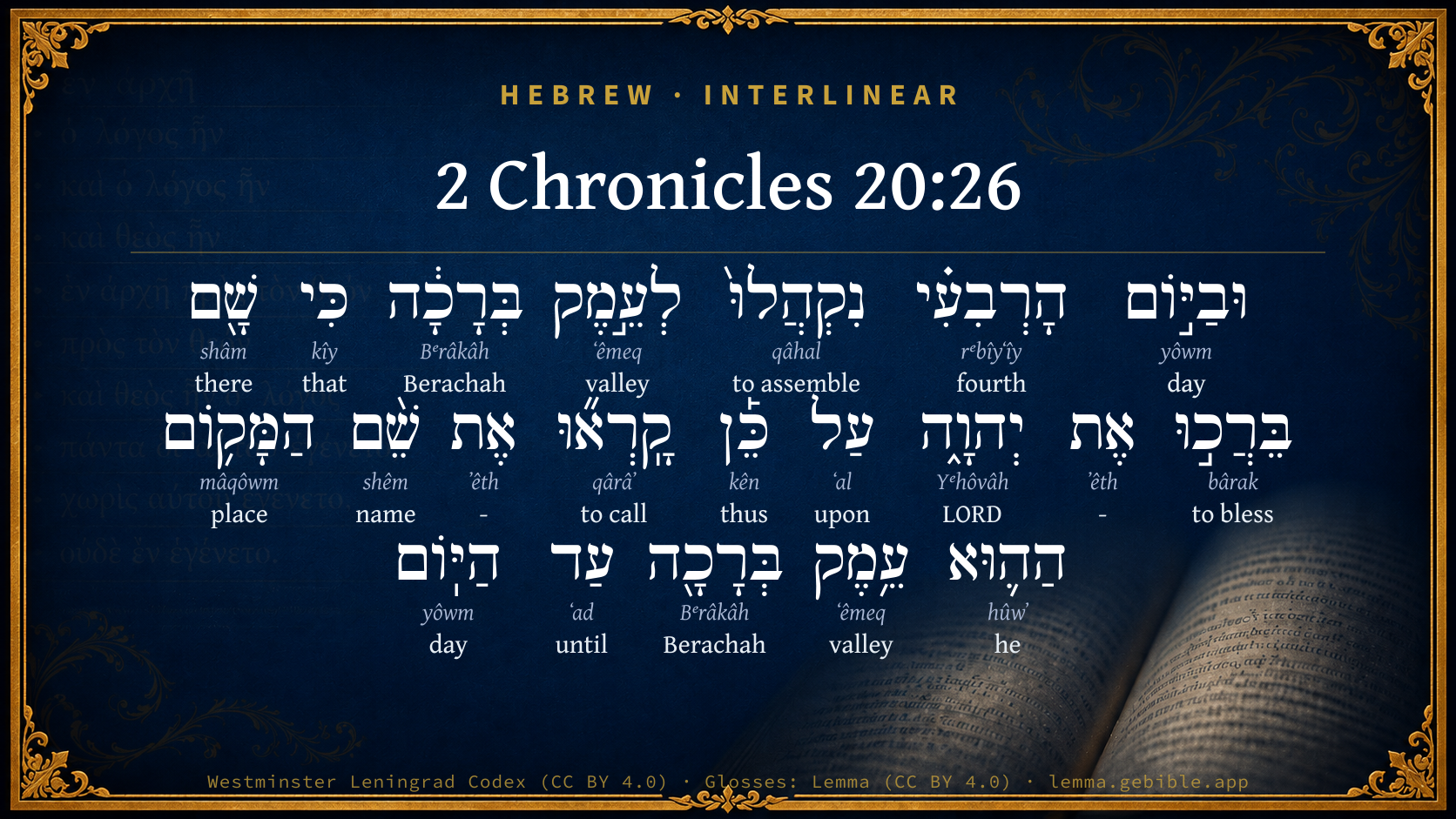
2 Chronicles 20:26

Hebrew (Westminster Leningrad Codex) 2 Chronicles 20:26 appears in the Hebrew Old Testament. The text above is from the Westminster Leningrad Codex. Each word links to its Strong’s number, a concise gloss, and parsing drawn from the Open Scriptures Hebrew Bible morphology. Click any word for its full Brown-Driver-Briggs (BDB) entry.
Download image
Cite this verse

2 Chronicles 20:26 (World English Bible). Public Domain. Lemma interlinear Bible study tool, https://lemma.gebible.app/v/2-chronicles/20/26.

Show BibTeX & RIS
BibTeX
RIS
English Translation
On the fourth day they assembled themselves in the valley of Beracah; for there they blessed Yahweh: therefore the name of that place was called The valley of Beracah to this day.
World English Bible · Public Domain
Download a study sheet

One document with this verse’s original text, its word-by-word gloss line, the meaning frame, cross-references with their text, attributed commentary, and full source and license credits — printable, and it pastes into notes with its structure intact.

This verse Autodidact and up

Study sheet (.html) Plain text (.txt)

A passage Seminary Student

Up to 50 verses in one chapter. A passage sheet keeps up to 6 commentary sources and 12 cross-references per verse, in the order this page ranks them, and says so on the sheet whenever that leaves anything out. Ask for a single verse and you get the Autodidact verse sheet above.

Everything on this page stays free to read, with no account — the sheet is a download of what is already on screen, not access to it.

Want to remove ads? Support Godless Engineer
Compare translations 3

The same verse in 3 English versions, stacked beneath the original-language interlinear above. Click any original word for its lexicon entry.

Each is an independent rendering of the whole verse — the interlinear is not word-aligned to these translations.

Highlighted words mark where these versions differ — a whole-verse word diff, not a word-by-word alignment.

  • World English Bible Public Domain
    On the fourth day they assembled themselves in the valley of Beracah; for there they blessed Yahweh: therefore the name of that place was called The valley of Beracah to this day.
  • King James Version Public Domain
    And on the fourth day they assembled themselves in the valley of Berachah; for there they blessed the LORD: therefore the name of the same place was called, The valley of Berachah, unto this day.
  • unfoldingWord Literal Text CC BY-SA 4.0
    And on the fourth day they assembled in the Valley of Berakah. For there they blessed Yahweh. Therefore they called the name of that place “Valley of Berakah” until today.

unfoldingWord Literal Text — © unfoldingWord, licensed CC BY-SA 4.0. Word-aligned USFM3 via Door43 (git.door43.org/unfoldingWord/en_ult).

Versions to compare (up to 4)

3 of 4 selected

Show all 18 translations

Every available English version of this verse, each an independent rendering of the whole verse.

  • World English Bible Public Domain
    On the fourth day they assembled themselves in the valley of Beracah; for there they blessed Yahweh: therefore the name of that place was called The valley of Beracah to this day.
  • Berean Standard Bible Public Domain
    On the fourth day they assembled in the Valley of Beracah, where they blessed the LORD. Therefore that place is called the Valley of Beracah to this day.
  • Majority Standard Bible Public Domain
    On the fourth day they assembled in the Valley of Beracah, where they blessed the LORD. Therefore that place is called the Valley of Beracah to this day.
  • King James Version Public Domain
    And on the fourth day they assembled themselves in the valley of Berachah; for there they blessed the LORD: therefore the name of the same place was called, The valley of Berachah, unto this day.
  • American Standard Version (1901) Public Domain
    And on the fourth day they assembled themselves in the valley of Beracah; for there they blessed Jehovah: therefore the name of that place was called The valley of Beracah unto this day.
  • Revised Version (1885) Public Domain
    And on the fourth day they assembled themselves in the valley of Beracah; for there they blessed the LORD: therefore the name of that place was called The valley of Beracah, unto this day.
  • Geneva Bible (1599) Public Domain
    And in the fourth day they assembled themselues in the valley of Berachah: for there they blessed the Lord: therefore they called the name of that place, The valley of Berachah vnto this day.
  • Douay-Rheims (1899) Public Domain
    And on the fourth day they were assembled in the valley of Blessing: for there they blessed the Lord, and therefore they called that place the valley of Blessing until this day.
  • Young's Literal Translation Public Domain
    And on the fourth day they have been assembled at the valley of Blessing, for there they blessed Jehovah: therefore they have called the name of that place, `Valley of Blessing,' unto this day.
  • Literal Standard Version CC BY-SA 4.0
    And on the fourth day they have been assembled at the Valley of Blessing, for there they blessed YHWH: therefore they have called the name of that place, “Valley of Blessing,” to this day.
  • Unlocked Literal Bible CC BY-SA 4.0
    On the fourth day they assembled in the Valley of Berakah. There they praised Yahweh, so the name of that place is the “Valley of Berakah” to this day.
  • unfoldingWord Literal Text CC BY-SA 4.0
    And on the fourth day they assembled in the Valley of Berakah. For there they blessed Yahweh. Therefore they called the name of that place “Valley of Berakah” until today.
  • Darby Bible Public Domain
    And on the fourth day they assembled themselves in the valley of Berachah, for there they blessed Jehovah; therefore the name of that place was called The valley of Berachah, to this day.
  • World Messianic Bible Public Domain
    On the fourth day, they assembled themselves in Beracah Valley, for there they blessed the LORD. Therefore the name of that place was called “Beracah Valley” to this day.
  • Webster's Bible Public Domain
    And on the fourth day they assembled themselves in the valley of Berachah; for there they blessed the LORD: therefore the name of the same place hath been called, The valley of Berachah, to this day.
  • Free Bible Version CC BY-SA 4.0
    On the fourth day they gathered in the Valley of Blessing. They gave it this name because this was where they blessed the Lord. It is still called the Valley of Blessing to this day.
  • Bible in Basic English Public Domain
    On the fourth day they all came together in the Valley of Blessing, and there they gave blessing to the Lord; for which cause that place has been named the Valley of Blessing to this day.
  • JPS Tanakh (1917) Public Domain
    And on the fourth day they assembled themselves in the valley of Beracah; for there they blessed the LORD; therefore the name of that place was called The valley of Beracah, unto this day.

Literal Standard Version (2020), Covenant Press — licensed CC BY-SA 4.0. Text via the HelloAO Bible API (eBible.org). Unlocked Literal Bible (unfoldingWord) — licensed CC BY-SA 4.0. Text via the HelloAO Bible API (eBible.org). unfoldingWord Literal Text — © unfoldingWord, licensed CC BY-SA 4.0. Word-aligned USFM3 via Door43 (git.door43.org/unfoldingWord/en_ult). Free Bible Version, Dr. Jonathan Gallagher — licensed CC BY-SA 4.0. Text via the HelloAO Bible API (eBible.org).

Word by word

More ways to search: Search by grammar → Find every occurrence → Compare this word →

Practice this passage: Drill this verse → Learn its vocabulary →

בְּרָכָ֔ה
Bᵉrâkâh
H1294
“Berachah”
Noun, Proper
Part of Speech
Noun
Type
Proper
Full BDB Definition

Origin: the same as H1293

TWOT: None

Berachah = "blessing" - a Benjamite, one of David's warriors (noun proper masculine) - a valley in the wilderness near Tekoa where Jehoshaphat and his people assembled to bless Jehovah after the overthrow of the hosts of the Moabites (noun proper locative)
  1. וּבַיּ֣וֹם yôwm H3117 “and · in/at the · day” Conjunction + Preposition, Determined + Noun, Common, Masculine, Singular, Absolute
  2. הָרְבִעִ֗י rᵉbîyʻîy H7243 “the · fourth” Particle, Definite Article + Adjective, Ordinal number, Masculine, Singular, Absolute
  3. נִקְהֲלוּ֙ qâhal H6950 “to assemble” Verb, Niphal, Perfect, 3rd Person, Common, Plural
  4. לְעֵ֣מֶק ʻêmeq H6010 “to/for · valley of” Preposition + Noun, Common, Masculine, Singular, Construct
  5. כִּי kîy H3588 “that” Conjunction
  6. שָׁ֖ם shâm H8033 “there” Adverb
  7. בֵּרֲכ֣וּ bârak H1288 “to bless” Verb, Piel, Perfect, 3rd Person, Common, Plural
  8. אֶת ʼêth H853 “-” Particle, Direct Object
  9. יְהוָ֑ה Yᵉhôvâh H3068 “LORD” Noun, Proper
  10. עַל ʻal H5921 “upon” Preposition
  11. כֵּ֡ן kên H3651 “thus” Particle, Demonstrative
  12. קָֽרְא֞וּ qârâʼ H7121 “to call” Verb, Qal, Perfect, 3rd Person, Common, Plural
  13. אֶת ʼêth H853 “-” Particle, Direct Object
  14. שֵׁ֨ם shêm H8034 “name of” Noun, Common, Masculine, Singular, Construct
  15. הַמָּק֥וֹם mâqôwm H4725 “the · place” Particle, Definite Article + Noun, Common, Masculine, Singular, Absolute
  16. הַה֛וּא hûwʼ H1931 “the · he” Particle, Definite Article + Pronoun, Personal, 3rd Person, Masculine, Singular
  17. עֵ֥מֶק ʻêmeq H6010 “valley of” Noun, Common, Masculine, Singular, Construct
  18. בְּרָכָ֖ה Bᵉrâkâh H1294 “Berachah” Noun, Proper
  19. עַד ʻad H5704 “until” Preposition
  20. הַיּֽוֹם yôwm H3117 “the · day” Particle, Definite Article + Noun, Common, Masculine, Singular, Absolute

About this verse

These counts appear in no published source. They are computed here, from the morphology-tagged text and Lemma’s own curated glosses. What Lemma adds →

21
words
17
distinct lemmas
Historical
section

Notable vocabulary

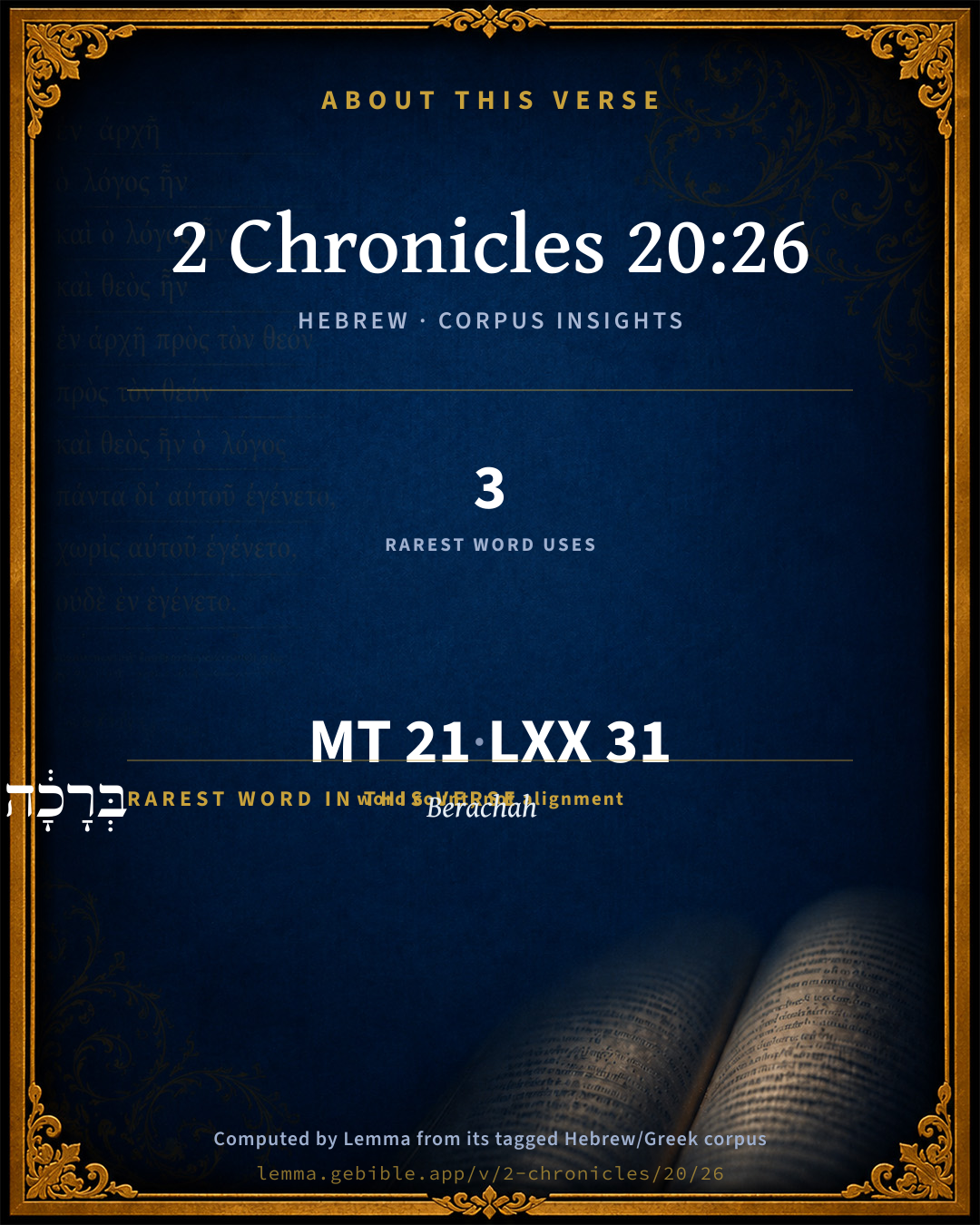
The rarest word here is בְּרָכָ֔ה Berachah H1294 — appearing just 3 times in the whole Hebrew Bible.

Shared distinctive vocabulary

בְּרָכָ֔ה Berachah H1294 occurs in 2 verses of the Hebrew Bible. Also found in:

Grammatical profile

  • 3 verbs
  • 9 nouns
  • 1 adjective
  • 1 pronoun
  • 2 prepositions
  • 1 conjunction
  • 1 adverb
  • 3 particles

Verb forms

  • נִקְהֲלוּ֙ Niphal · Perfect
  • בֵּרֲכ֣וּ Piel · Perfect
  • קָֽרְא֞וּ Qal · Perfect

Repetition

Words recur within this verse — often emphatic in Hebrew:

  • וּבַיּ֣וֹם day H3117 ×2
  • לְעֵ֣מֶק valley H6010 ×2
  • בְּרָכָ֔ה Berachah H1294 ×2

Hebrew & Septuagint length

In English translation the verse runs 32 words from the Hebrew and 38 from the Septuagint (LXX English) — closely comparable.

A rough comparison of the two English renderings, which tokenize alike — not a word-level alignment.

Word counts can differ between the Hebrew and the Greek without any difference in meaning — e.g. the Hebrew direct-object marker אֵת has no separate Greek word, and Greek often adds the article ὁ.

In the original languages it is 21 Hebrew tokens and 31 Greek tokens — but the two are counted differently (Hebrew bundles its prefixes and suffixes into one token; the Greek is in lemma form), so that isn’t a like-for-like length.

Cross-references

13

Topical passages linked to 2 Chronicles 20:26 in the Treasury of Scripture Knowledge — connected by theme and wording, ordered by reader-vote popularity; previews shown in the World English Bible.

  • Exodus 17:15 Moses built an altar, and called the name of it Yahweh our Banner.
  • Genesis 32:20 You shall say, 'Not only that, but behold, your servant, Jacob, is behind us.'" For, he said, "I will appease him with the present that goes before me, and afterward I will see his face. Perhaps he will accept me."
  • 2 Chronicles 5:9 The poles were so long that the ends of the poles were seen from the ark before the oracle; but they were not seen outside: and there it is to this day.
  • Psalms 107:21–22 Let them praise Yahweh for his loving kindness, For his wonderful works to the children of men!
  • Isaiah 62:4 You shall no more be termed Forsaken; neither shall your land any more be termed Desolate: but you shall be called Hephzibah, and your land Beulah; for Yahweh delights in you, and your land shall be married.
  • Luke 1:68 "Blessed be the Lord, the God of Israel, For he has visited and worked redemption for his people;
  • Exodus 15:1–19 Then Moses and the children of Israel sang this song to Yahweh, and said, "I will sing to Yahweh, for he has triumphed gloriously: The horse and his rider he has thrown into the sea.
  • 1 Samuel 7:12 Then Samuel took a stone, and set it between Mizpah and Shen, and called the name of it Ebenezer, saying, Hitherto has Yahweh helped us.
  • 2 Samuel 22:1 David spoke to Yahweh the words of this song in the day that Yahweh delivered him out of the hand of all his enemies, and out of the hand of Saul:
  • Psalms 103:1–2 Praise Yahweh, my soul! All that is within me, praise his holy name!
  • Genesis 28:19 He called the name of that place Bethel, but the name of the city was Luz at the first.
  • Acts 1:19 It became known to everyone who lived in Jerusalem that in their language that field was called 'Akeldama,' that is, 'The field of blood.'
  • Revelation 19:1–6 After these things I heard something like a loud voice of a great multitude in heaven, saying, "Hallelujah! Salvation, power, and glory belong to our God:

Cross-references courtesy of OpenBible.info (CC BY 4.0).

Hebrew and Greek witnesses Masoretic Hebrew ↔ Greek Septuagint

The same verse in the two great witnesses to the Old Testament, shown verse-for-verse.

These are two independent witnesses, not word-aligned to each other, and the Septuagint is shown in lemma (dictionary) form.

Hebrew 2 Chronicles 20:26 Masoretic · Westminster Leningrad Codex

וּבַיּ֣וֹם הָרְבִעִ֗י נִקְהֲלוּ֙ לְעֵ֣מֶק בְּרָכָ֔ה כִּי שָׁ֖ם בֵּרֲכ֣וּ אֶת יְהוָ֑ה עַל כֵּ֡ן קָֽרְא֞וּ אֶת שֵׁ֨ם הַמָּק֥וֹם הַה֛וּא עֵ֥מֶק בְּרָכָ֖ה עַד הַיּֽוֹם

On the fourth day they assembled themselves in the valley of Beracah; for there they blessed Yahweh: therefore the name of that place was called The valley of Beracah to this day.

World English Bible · Public Domain

Greek LXX 2 Chronicles 20:26 Septuagint · lemma form

καί ὁ ἡμέρα ὁ τέταρτος ἐπι συνἄγω εἰς ὁ αὐλών ὁ εὐλογία ἐκεῖ γάρ εὐλογέω ὁ κύριος διά οὗτος καλέω ὁ ὄνομα ὁ τόπος ἐκεῖνος κοιλάς εὐλογία ἕως ὁ ἡμέρα οὗτος

And it came to pass on the fourth day they were gathered to the Valley of Blessing; for there they blessed the Lord: therefore they called the name of the place the Valley of Blessing, until this day.

LXX2012 (modern English Septuagint) · Public Domain

Hebrew: Westminster Leningrad Codex (CC BY 4.0). Greek: Septuagint (public domain); English from LXX2012 (modern English Septuagint) (Public Domain). How the Septuagint differs from the Hebrew →

Commentary

Notes on 2 Chronicles 20:26 from classic Christian and Jewish commentators (each source and its license shown beneath its notes). The classic Christian expositions comment on the surrounding passage and are grouped to its opening verse, so a note may address several verses; the Jewish commentaries on the Tanakh (Rashi and others) are per-verse, so they appear only where the commentator wrote on this verse.

Lemma curates 59 commentaries, every one of them public domain or Creative Commons licensed, each selected and text-cleaned for this edition rather than reprinted as found. About our sources →

Trapp's Complete Commentary

John Trapp

2Ch 20:26 And on the fourth day they assembled themselves in the valley of Berachah; for there they blessed the LORD: therefore the name of the same place was called, The valley of Berachah, unto this day.

Ver. 26. And on the fourth day.] Whilst the mercy was yet fresh. We must hasten our praises: no part of the thank offering might be kept until the third day.

For there they blessed the Lord.] So did our Edward III after the victory at Poictiers, where he took the French king, A.D. 1356. Polydor Virgil telleth us, {a} that speedy order was taken that eight days together should be spent in giving God the thanks and glory. The like was done by our Richard I when he had beaten the king of France at Givors, A.D. 1195. {b} But especially by our Henry V after his victory at Agincourt. He gave strict orders, saith the chronicler, {c} that no ballad or song should be made or sung, more than of thanksgiving to the Lord alone. That victorious king of Sweden, Gustavus Adolphus, as he prayed much and often, on shipboard, on shore, in the field, in the midst of battle, so he was no less careful to glorify God the giver of victory: as making him not his refuge only, but his recompense also. {d}

Therefore the name of the place was called Berachah,] i.e., Blessing: so to perpetuate to posterity the memory of that great mercy. There are that think this valley is the same with that called the valley of Jehoshaphat, {Joe 3:2; Joe 3:12} and that there Christ shall sit in judgment.

{a} Lib. xix.

{b} Hoveden.

{c} Daniel.

{d} Speed.

John Trapp, A Commentary or Exposition upon All the Books of the Old and New Testament (1647–1656) — public domain. Text from a community e-Sword module.

The Biblical Illustrator

Joseph S. Exell

2Ch_20:26

The valley of Berachah.

Bible valleys

The word valley is a poem in itself; it is associated with a great deal that is beautiful, comforting, and that gives the soul a sense of security and plentifulness. The Bible is full of valleys, as it is full of wells. What is this valley of Berachah? In some senses I do not care much for it; I know it means the valley of blessing, and that the people, in whom I have not the slightest confidence at all, sang themselves hoarse in the valley of Berachah because they were fed like oxen that were to be slaughtered. That is what the people were doing in the valley of Berachah. To me their blessing goes for nothing until I have deeply inquired into the motive of the hymn, the intent and the genesis of the ringing psalm. It was all right enough within given limits, but the limits themselves were wrong. No doubt there had been great victories, no doubt Jehoshaphat and his people came to take away the spoil of them that had been overthrown; and they found abundance of riches. I listened with reluctance to their selfish psalm. God might see some good in it; God sees good wherever it exists, in how poor soever a form. Sometimes the goodness is like a little starveling thing that has got no blood, no fire in the eyes, and no real trust in the soul--a kind of living, self-vexing speculation. Who would not sing in carrying off all these precious jewels? There is a better time for singing than the time of all this commercial aggrandisement and secular comfort. One little song of patience is worth the whole of this blaring noise. There is another valley mentioned in Num_32:9 --the valley of Eshcol. What valley is that? Tis the valley of grapes and summer fruits, all of which we may pluck, because it is the intent of Divine love that we should possess ourselves of such luxuriant vineyards. Do we not suddenly come upon the grapes intellectual, social, educational, spiritual? Is not hunger itself often surprised by unexpected plentifulness? Yet sometimes men cannot believe even in this uncrushed wine of the grape; they will hasten home and say, Do not, we beseech thee, venture in that direction; grapes enough there may be, even to abundance, but we had better remain where we are; can a man live upon grapes? We cannot tell what there may be beyond the river or on the other side of the mountain; here, you see, we have grapes enough; until we have drunken of this wine why should we strike our tents and go ahead? We may pervert some little mean proverbs of our own, and say, Better bear the ills we have than fly to others that we know not of. We have grapes to-day: why should we care about to-morrow? Thus enthusiasm is killed, and all daring, high exploit, and noble endeavour. Ambition may be perverted, but ambition may be one of the forms or aspects of inspiration. It is the future that draws us on, it is the prophetic assurance of some fiery man that a mile further on and we shall have it that keeps the world young and keep the rust away. You cannot silence the divinely inspired and most restless man. We could rouse him and say, Now, why not be content? why not rest and be thankful? of course there may be higher heights and wider landscapes, let us admit all that for a moment; but why worry ourselves about it? there may be something beyond the grave; when we die we shall see what there is. Perhaps not; there is a right way of dying. The world has been kept going by what foolish people would call sensationalism. The very persons who now wrap their rugs around them and enjoy the immediate comfort of the day owe the very rugs in which they wrap themselves to the sensationalism of a former time that could not be kept back from the wilderness or the jungle or the far-away land, no, not by the roaring sea and the tempest that seemed to be an embodied destruction. Do not live yourselves down into saplessness and reluctance to move. And it is easy for some persons to come and sanction such indolence, but we want the true spies to say to us, We have seen a land worth going to; it grows life, it is warm with summer, it is boundless with an illimitable hospitality. Young souls, do not be frightened by the man sitting next you, for he is no man, he is hardly a figure in wax. In Hosea there is a glorious valley--the valley of Achor (2:15). What is the meaning of Achor in this connection? what is the broad spiritual interpretation of Achor? It may be given in two little words, each word a syllable, one of the words a letter. a door of hope. I have given thee a new beginning, new chances, new opportunities, new mornings; this is not the end, this is the beginning; there is the great wall, go grope in blindness, but with finger-tips that can see; thou wilt in that great blank wall find a door; it is there, I made it, I made it for thee; I know the blankness of the wall, but on my word go thou forth and grope for the door, the Achor that will give thee visions beyond big as horizons, big as firmaments, big as outlined heavens: go forth in the spirit of hope. We are saved by hope. We are not saved by depression. There is a new beginning for you if you please to avail yourself of it. I have heard your story about lost opportunities and a wasted life and failure upon failure. That is atheistic controversy; you had better know it, it spoils your life. What the preacher is set to do is to proclaim the door of hope; salvation by hope, hope that is in Christ Jesus our Lord. In the book of Isaiah we have a beautiful valley; in chapter 22:1 we read about the valley of vision. That is a large valley, that valley is worth living in. To live with people who have always seen new lights, new possibilities, and new and brighter interpretations than have ever been realised before; that is companionship, that is resurrection. Who cares for those dullards who never see new lights, new companions, and the outlines of new springs and summers in the morning sky? What a poor life it is to live without vision! In Isa_28:1 we come into fat valleys. The poor drunkards were all lying down dead drunk and choked and suffocated with their own wine of fatness. They were pampered creatures; their soul was subordinated to the body, they were all flesh and next to no spirit. There are fat valleys that have no fatness of the true sort. Then there are valleys that are spiritually rich with all manner of nutritious food. There is a wine that has no intoxication in it, there is a wine that does not carry the seal of death. Into those fat valleys, and not into the other, may God lead us. Can Ezekiel be alive and not take his position in this great question of valleys? Ezekiel saw a valley, it was a valley of dry bones. Read Eze_37:1 and the context. It was an awful valley, a valley of death. Son of man, can these bones live? And the son of man said, O Lord God, Thou knowest. The wisest answer to every Divine inquiry: refer the question back; let Him who propounds the problem solve it. I wish we could read all about the valleys. There is a beautiful historical expression: So we abode in the valley. We wanted to climb the green banks and get up to the points and coigns that catch the earliest kiss of the sun, but seeing that it was better for us to take another course, seeing that we had better obey God than obey your own fancy or whim, we abode in the valley. Abode in a dark, cold place? No; you are misinterpreting the word valley when you attach such epithets to it. I read of other valleys. The valleys are covered over with corn. That is never said about the snow mountains. Have the valleys no compensations? Is sickness itself without advantages? When you are weak are you not sometimes strong? Where did you get the little flower from? I know not that I have seen aught sweeter for many a day: what is it? The lily of the valley. Tell me there is no compensation in poverty, in sickness, in weakness, and even in failure and disappointment? It was in the valley that the lily grew. (J. Parker, D.D.)

Berachah

Suppose every place were to receive its name from what is done in it! How startling and varied would be some of the names! Berashah means a valley of blessing.

I. After prayer. Jehoshaphat pleads with God on various grounds.

II. After conflict in the spirit of praise.

III. After victory. The triumph was speedy, signal, and complete. Let the valley of our life often be made a Berachah. (H. Gammage.)

The Biblical Illustrator, edited by Joseph S. Exell (c. 1880s–1900s) — public domain. Text from a community e-Sword module.

Joseph Benson's Commentary

2Ch 20:26. On the fourth day, &c. — Undoubtedly many thanksgivings were offered to God immediately, and perhaps even a day of praise was kept in the camp, before they drew their forces out of the field: but in the fourth day they assembled in a valley, and blessed God with so much zeal and fervency, that a name was thereby given to the place, and the remembrance of that work of wonder perpetuated for the encouragement of succeeding generations to trust in God. Of Berachah — Hebrew, of blessing, so called, from the solemn blessings and praises given to God on that occasion.

Joseph Benson's Commentary on the Old and New Testaments (1811–1818) — public domain. Text from a community e-Sword module.

Geneva Bible (1599)

Geneva Bible translators

To give thanks to the Lord for the victory: and therefore the valley was called Berachah, that is, blessing or thanksgiving, which was also called the Valley of Jehoshaphat, Joel 3:2,12, because the Lord judged the enemies according to Jehoshaphat’s prayer.

Geneva Bible (1599) marginal notes — public domain. Text via Bolls.life.

Adam Clarke's Commentary

Verse 26. Assembled themselves in the valley of Berachah] "The valley of Benediction;" and so in the latter clause. - Targum.

Adam Clarke's Commentary on the Bible (1810–1826) — public domain. Text from a community e-Sword/MySword module.

Ellicott's Commentary for English Readers

(26) Valley of Berachah—i.e., blessing. The place is still called Wady Beraikut, a wide, open valley west of Tekoa, near the road from Hebron to Jerusalem. St. Jerome speaks of a Caphar Barucha, “village of blessing,” in the same neighbourhood.

For there . . . unto this day.—A notice after the manner of the ancient historians (Gen_11:9; Gen_28:19; Exo_17:7; 2Sa_5:20).

A Bible Commentary for English Readers, edited by Charles John Ellicott (1878–1897) — public domain. Text from a community e-Sword module.

The Cambridge Bible for Schools and Colleges

gen. ed. J. J. S. Perowne

26–30 (no parallel in Kings). The Sequel of the Deliverance

26. valley of Berachah] A wâdi Bereikût south of Tekoa is mentioned by Robinson. It is probable that also the “valley of Jehoshaphat” mentioned by Joel (3. [4. Heb.] 2) is to be identified with the scene of Jehoshaphat’s deliverance.

The Cambridge Bible for Schools and Colleges (gen. ed. J. J. S. Perowne; Cambridge University Press, 1878–1918) — public domain. Text from a community e-Sword module.

John Gill's Exposition

And on the fourth day they assembled themselves in the valley of Berachah,.... As it was afterwards called from what they did there, as follows, which was the reason of its name:

for there they blessed the Lord; returned thanks to him for this wonderful appearance on their behalf, and gave him the glory of it; no doubt but they had given him praise before in some sort and manner, but now in a set, solemn, and public manner, with one heart and voice they united in ascribing honour, blessing, and glory to him:

therefore the name of the same place was called the valley of Berachah unto this day; the valley of Blessing; this name it bore in the times of Ezra, the writer of this book, even after the Jews returned from the Babylonish captivity; it is thought to be the same that is called by Jerom (w) Cepharbarucha, which he speaks of as not far from Engedi, see Ch2 20:2, others will have it to be the same with the valley of Jehoshaphat, but not so likely, that seems to be nearer Jerusalem.

(w) Epitaph. Paulae.

John Gill's Exposition of the Whole Bible (1746–1763) — public domain (CC PDM 1.0). Text via the HelloAO Bible API.

Albert Barnes' Notes on the Bible

The valley of Berachah - Probably, the Wady Bereikut, which lies at a short distance from Tekoa toward the northwest.

Albert Barnes' Notes on the Bible (1834–1885) — public domain. Text from a community e-Sword/MySword module.

Haydock's Catholic Bible Commentary

Blessing. Sts. Jerom and Epiphanius place Caphar-barucha, "the field of blessing," near Hebron, on the east. Hither Abraham attended the Lord, when he was going to destroy Sodom. Epist. Paulæ.

George Leo Haydock (1774–1849), Haydock's Catholic Family Bible and Commentary, 1859 edition — public domain. Excludes Psalms (Douay-Rheims chapter numbering differs from Protestant) and Deuterocanonical books (Catholic canon only).

Matthew Poole's English Annotations

The valley of Berachah, Heb. of blessing; so called from their solemn blessings and praises given to God in it upon this occasion.

Matthew Poole's English Annotations on the Holy Bible (1683–1685) — public domain. Text from a community e-Sword/MySword module.

Whedon's Commentary on the Bible

Daniel D. Whedon

26. The valley of Berachah — That is, the valley of blessing, so called from the blessings and rejoicings of that day. This valley is doubtless to be identified with the modern Wady Bereikut, lying a little west of Tekoa.

Daniel D. Whedon (gen. ed.), Commentary on the Old and New Testaments (1874–1909) — public domain. Text from a community e-Sword module.

The Pulpit Commentary

Berachah. This is just the Hebrew fern. subst, from a verb. It is used in 1Ch_12:3 as the name of a man. The present name of the valley survives in the Waddy Bereikat on the Hebron road, beyond, therefore, the date unto this day of the writer.

The Pulpit Commentary (1880–1919), ed. H.D.M. Spence-Jones & Joseph S. Exell — public domain. Text from a community e-Sword module.

John Wesley's Explanatory Notes

Berachah - Hebrew. of blessing; so called from their solemn blessings and praises given to God in it upon this occasion.

John Wesley, Explanatory Notes Upon the Whole Bible (1754–1765) — public domain. Text via the GEBible commentary corpus.

Keil & Delitzsch

C. F. Keil & F. Delitzsch

On the fourth day the men of Judah gathered themselves together, to give thanks to God the Lord for this blessing, in a valley which thence received the name בּרכה עמק (valley of blessing), and which cannot have been far from the battle-field. Thence they joyfully returned, with Jehoshaphat at their head, to Jerusalem, and went up, the Levites and priests performing solemn music, to the house of God, to render further thanks to the Lord for His wondrous help (Ch2 20:27.). The ancient name בּרכה still exists in the Wady Bereikut, to the west of Tekoa, near the road which leads from Hebron to Jerusalem. "A wide, open valley, and upon its west side, on a small rising ground, are the ruins of Bereikut, which cover from three to four acres" (Robinson's New Biblical Researches, and Phys. Geogr. S. 106; cf. v. de Velde, Memoir, p. 292). Jerome makes mention of the place in Vita Paulae, where he narrates that Paula, standing in supercilio Caphar baruca, looked out thence upon the wide desert, and the former land of Sodom and Gomorrah (cf. Reland, Pal. illustr. pp. 356 and 685). There is no ground, on the other hand, for the identification of the valley of blessing with the upper part of the valley of Kidron, which, according to Joe 3:2, Joe 3:12, received the name of Valley of Jehoshaphat (see on Joe 3:2). - On Ch2 20:27, cf. Ezr 6:22; Neh 12:43.

Keil & Delitzsch — Biblical Commentary on the Old Testament (1861–1891) — public domain (CC PDM 1.0). Text via the HelloAO Bible API. (Old Testament only.)

Kretzmann's Popular Commentary

Paul E. Kretzmann

Summary of Jehoshaphat’s Reign

v. 26. And on the fourth day they assembled themselves in the Valley of Berachah (blessing, praise); for there they blessed the Lord, in this beautiful little valley west of Tekoa they expressed their gratitude to Jehovah in prayers of praise and thanksgiving; therefore the name of the same place was called the Valley of Berachah unto this day.

v. 27. Then they returned, every man of Judah and Jerusalem, the entire procession which had left Jerusalem four days before, and Jehoshaphat in the forefront of them, taking the lead in praising, as he had taken the lead in trusting the Lord’s promise, to go again to Jerusalem with joy; for the Lord had made them to rejoice over their enemies, and their gladness was expressed in the proper manner, in thanksgiving to Jehovah, who gave the victory.

v. 28. And they came to Jerusalem with psalteries and harps and trumpets, the usual instruments used for the Temple music, unto the house of the Lord.

v. 29. . And the fear of God was on all the kingdoms of those countries, they were deterred from undertaking hostilities by their dread of the God of Israel, when they had heard that the Lord fought against the enemies of Israel.

v. 30. So the realm of Jehoshaphat was quiet; for his God gave him rest round about. Peace in the land is ever a gift of God’s bountiful goodness.

v. 31. And Jehoshaphat reigned over Judah, over the southern kingdom only; he was thirty and five years old when he began to reign, and he reigned twenty and five years in Jerusalem. And his mother’s name was Azubah, the daughter of Shilhi.

v. 32. And he walked in the way of Asa, his father, in the fear of Jehovah, and departed not from it, being even more consistently faithful to Jehovah than his father, doing that which was right in the sight of the Lord.

v. 33. Howbeit, the high places were not taken away, the altars erected on the hills contrary to the will of God, whether expressly dedicated to idolatry or not; for as yet the people had not prepared their hearts unto the God of their fathers.

v. 34. Now, the rest of the acts of Jehoshaphat, first and last, behold, they are written in the Book of Jehu, the son of Hanani, who is mentioned in the Book of the Kings of Israel, 1Ki 16:1-7.

v. 35. And after this did Jehoshaphat, king of Judah, join himself with Ahaziah, king of Israel, as he had made a league with his father before him, who did very wickedly.

v. 36. And he joined himself with him to make ships to go to Tarshish, most likely Tartessus in Spain, after Ahazah had overcome the reluctance of Jehoshaphat, 1Ki 22:49; and they made the ships in Ezion-gaber, the harbor at the head of the Elanitic Gulf.

v. 37. Then Eliezer, the son of Dodavah of Mareshah, prophesied against Jehoshaphat, saying, Because thou hast joined thyself with Ahaziah, the Lord hath broken thy works. And the ships were broken, wrecked before they left the harbor, that they were not able to go to Tarshish. God has ways and means to keep men from yielding too much to pride and arrogance and thus losing their trust in Him.

Paul E. Kretzmann, Popular Commentary of the Bible (1921–1924) — public domain. Text from a community e-Sword module.

Rashi

Rabbi Shlomo Yitzchaki (Rashi)

they congregated to the valley of Berachah To the valley which was later called the valley of Berachah, because of the incident [that took place there], as is explained immediately following, as Scripture states for there they blessed the Lord and gave thanks for all the good that He had done for them, that He saved them from their enemies.

Rashi on the Tanakh — English translations: “The Judaica Press complete Tanach with Rashi, translated by A. J. Rosenberg” (CC BY 4.0); “Pentateuch with Rashi's commentary by M. Rosenbaum and A.M. Silbermann, 1929-1934” (public domain); “The Metsudah Tanach series, Lakewood, N.J” (CC BY 4.0); and “The Book of Joshua, Metsudah Publications, 1997” (CC BY 4.0). Text via Sefaria.

Lesson kit

Teaching starters — assembled from the data on this page, not authored interpretation. Every prompt links to the verse data it draws on. Edit before teaching.

2 Chronicles, in the Historical, opens this verse with 21 words (17 distinct Hebrew lemmas). Its most distinctive word is Bᵉrâkâh (“Berachah”). A historical commentator’s framing appears above. Read the whole chapter for the surrounding context.

Discussion questions

  1. What does “Berachah” (Bᵉrâkâh) contribute to the verse as a whole?
  2. 1 Chronicles 12:3 shares the word «Berachah» with this verse. How do the two illuminate each other?
  3. “day” occurs 2× in this one verse. What is the effect of the repetition?
  4. These translations render this verse differently; the difference is in the English rendering, not the original. What questions does that raise?
  5. The verb «נִקְהֲלוּ֙» is Niphal Perfect. How does its form color the action?
  6. Reading how Trapp's Complete Commentary and The Biblical Illustrator read this verse, where do the two commentators agree and where do they part?

Things to notice

Reading settings

Reading text

Shown beneath each verse's original-language words.

Old Testament
Old Testament edition

Read the OT as the Masoretic Hebrew (MT) or the Greek Septuagint (LXX).

English shown for the Greek Septuagint (in the Hebrew ↔ Greek comparison).

Comparing translations? Open the Compare panel on any verse page to stack up to four side by side.