
Deuteronomy 12:7

Hebrew (Westminster Leningrad Codex) Deuteronomy 12:7 appears in the Hebrew Old Testament. The text above is from the Westminster Leningrad Codex. Each word links to its Strong’s number, a concise gloss, and parsing drawn from the Open Scriptures Hebrew Bible morphology. Click any word for its full Brown-Driver-Briggs (BDB) entry.
Download image
Cite this verse

Deuteronomy 12:7 (World English Bible). Public Domain. Lemma interlinear Bible study tool, https://lemma.gebible.app/v/deuteronomy/12/7.

Show BibTeX & RIS
BibTeX
RIS
English Translation
and there you shall eat before Yahweh your God, and you shall rejoice in all that you put your hand to, you and your households, in which Yahweh your God has blessed you.
World English Bible · Public Domain
Highlights
  • 1 first appearance in the Hebrew Bible
Full analysis ↓
Download a study sheet

One document with this verse’s original text, its word-by-word gloss line, the meaning frame, cross-references with their text, attributed commentary, and full source and license credits — printable, and it pastes into notes with its structure intact.

This verse Autodidact and up

Study sheet (.html) Plain text (.txt)

A passage Seminary Student

Up to 50 verses in one chapter. A passage sheet keeps up to 6 commentary sources and 12 cross-references per verse, in the order this page ranks them, and says so on the sheet whenever that leaves anything out. Ask for a single verse and you get the Autodidact verse sheet above.

Everything on this page stays free to read, with no account — the sheet is a download of what is already on screen, not access to it.

Want to remove ads? Support Godless Engineer
Compare translations 3

The same verse in 3 English versions, stacked beneath the original-language interlinear above. Click any original word for its lexicon entry.

Each is an independent rendering of the whole verse — the interlinear is not word-aligned to these translations.

Highlighted words mark where these versions differ — a whole-verse word diff, not a word-by-word alignment.

  • World English Bible Public Domain
    and there you shall eat before Yahweh your God, and you shall rejoice in all that you put your hand to, you and your households, in which Yahweh your God has blessed you.
  • King James Version Public Domain
    And there ye shall eat before the LORD your God, and ye shall rejoice in all that ye put your hand unto, ye and your households, wherein the LORD thy God hath blessed thee.
  • unfoldingWord Literal Text CC BY-SA 4.0
    And there you shall eat to the face of Yahweh your God and rejoice in all the sending out of your hand, you and your households, where Yahweh your God has blessed you.

unfoldingWord Literal Text — © unfoldingWord, licensed CC BY-SA 4.0. Word-aligned USFM3 via Door43 (git.door43.org/unfoldingWord/en_ult).

Versions to compare (up to 4)

3 of 4 selected

Show all 18 translations

Every available English version of this verse, each an independent rendering of the whole verse.

  • World English Bible Public Domain
    and there you shall eat before Yahweh your God, and you shall rejoice in all that you put your hand to, you and your households, in which Yahweh your God has blessed you.
  • Berean Standard Bible Public Domain
    There, in the presence of the LORD your God, you and your households shall eat and rejoice in all you do, because the LORD your God has blessed you.
  • Majority Standard Bible Public Domain
    There, in the presence of the LORD your God, you and your households shall eat and rejoice in all you do, because the LORD your God has blessed you.
  • King James Version Public Domain
    And there ye shall eat before the LORD your God, and ye shall rejoice in all that ye put your hand unto, ye and your households, wherein the LORD thy God hath blessed thee.
  • American Standard Version (1901) Public Domain
    and there ye shall eat before Jehovah your God, and ye shall rejoice in all that ye put your hand unto, ye and your households, wherein Jehovah thy God hath blessed thee.
  • Revised Version (1885) Public Domain
    and there ye shall eat before the LORD your God, and ye shall rejoice in all that ye put your hand unto, ye and your households, wherein the LORD thy God hath blessed thee.
  • Geneva Bible (1599) Public Domain
    And there ye shall eate before the Lord your God, and ye shall reioyce in all that yee put your hand vnto, both ye, and your housholdes, because the Lord thy God hath blessed thee.
  • Douay-Rheims (1899) Public Domain
    And you shall eat there in the sight of the Lord your God: and you shall rejoice in all things, whereunto you shall put your hand, you and your houses wherein the Lord your God hath blessed you.
  • Young's Literal Translation Public Domain
    and ye have eaten there before Jehovah your God, and have rejoiced in every putting forth of your hand, ye and your households, with which Jehovah thy God hath blessed thee.
  • Literal Standard Version CC BY-SA 4.0
    and you have eaten there before your God YHWH, and have rejoiced in every putting forth of your hand, you and your households, with which your God YHWH has blessed you.
  • Unlocked Literal Bible CC BY-SA 4.0
    It is there that you will eat before Yahweh your God and rejoice about everything that you have put your hand to, you and your households, where Yahweh your God has blessed you.
  • unfoldingWord Literal Text CC BY-SA 4.0
    And there you shall eat to the face of Yahweh your God and rejoice in all the sending out of your hand, you and your households, where Yahweh your God has blessed you.
  • Darby Bible Public Domain
    and ye shall eat there before Jehovah your God, and ye shall rejoice, ye and your households, in all the business of your hand, wherein Jehovah thy God hath blessed thee.
  • World Messianic Bible Public Domain
    There you shall eat before the LORD your God, and you shall rejoice in all that you put your hand to, you and your households, in which the LORD your God has blessed you.
  • Webster's Bible Public Domain
    And there ye shall eat before the LORD your God, and ye shall rejoice in all that ye put your hand to, ye and your households, in which the LORD thy God hath blessed thee.
  • Free Bible Version CC BY-SA 4.0
    That's where, in the presence of the Lord your God, you and your families will eat and celebrate everything you've worked for, because the Lord your God has blessed you.
  • Bible in Basic English Public Domain
    There you and all your families are to make a feast before the Lord your God, with joy in everything to which you put your hand, because the Lord has given you his blessing.
  • JPS Tanakh (1917) Public Domain
    and there ye shall eat before the LORD your God, and ye shall rejoice in all that ye put your hand unto, ye and your households, wherein the LORD thy God hath blessed thee.

Literal Standard Version (2020), Covenant Press — licensed CC BY-SA 4.0. Text via the HelloAO Bible API (eBible.org). Unlocked Literal Bible (unfoldingWord) — licensed CC BY-SA 4.0. Text via the HelloAO Bible API (eBible.org). unfoldingWord Literal Text — © unfoldingWord, licensed CC BY-SA 4.0. Word-aligned USFM3 via Door43 (git.door43.org/unfoldingWord/en_ult). Free Bible Version, Dr. Jonathan Gallagher — licensed CC BY-SA 4.0. Text via the HelloAO Bible API (eBible.org).

Word by word

More ways to search: Search by grammar → Find every occurrence → Compare this word →

Practice this passage: Drill this verse → Learn its vocabulary →

מִשְׁלַ֣ח
mishlôwach
H4916
“pasture of”
Noun, Common, Masculine, Singular, Construct
Part of Speech
Noun
Type
Common
Gender
Masculine
Number
Singular
State
Construct
Full BDB Definition

Origin: from H7971

TWOT: 2394d , 2394e

outstretching, sending, sending forth - outstretching, undertaking (that to which one stretches out the hand), place of letting or turning loose, pasture (place where animals are let free)
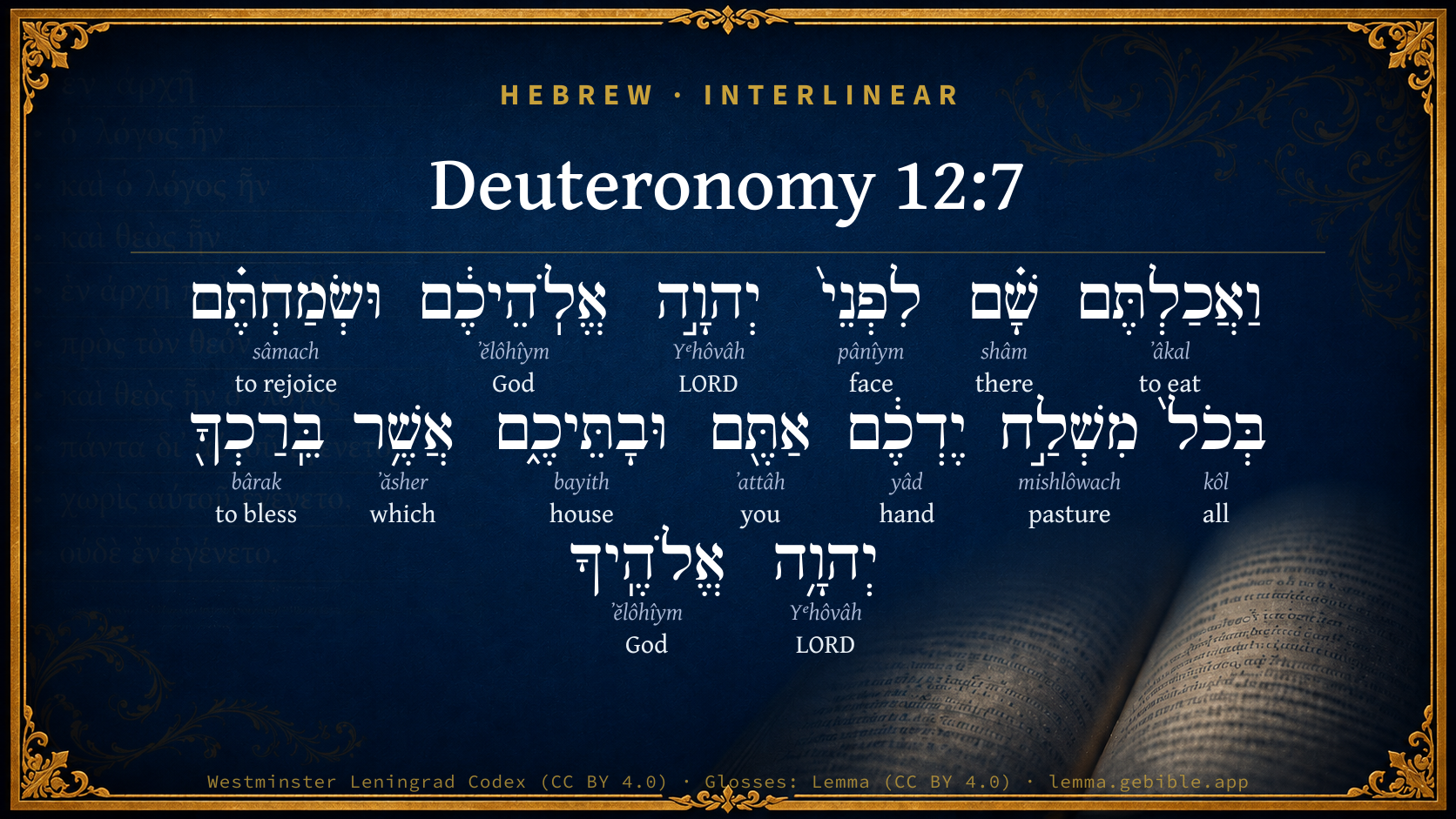
  1. וַאֲכַלְתֶּם ʼâkal H398 “and · to eat” Conjunction + Verb, Qal, Sequential Perfect, 2nd Person, Masculine, Plural
  2. שָׁ֗ם shâm H8033 “there” Adverb
  3. לִפְנֵי֙ pânîym H6440 “to/for · face(s) of” Preposition + Noun, Common, Both, Plural, Construct
  4. יְהוָ֣ה Yᵉhôvâh H3068 “LORD” Noun, Proper
  5. אֱלֹֽהֵיכֶ֔ם ʼĕlôhîym H430 “God(s) · your” Noun, Common, Masculine, Plural, Construct + Suffix, Personal, 2nd Person, Masculine, Plural
  6. וּשְׂמַחְתֶּ֗ם sâmach H8055 “and · to rejoice” Conjunction + Verb, Qal, Sequential Perfect, 2nd Person, Masculine, Plural
  7. בְּכֹל֙ kôl H3605 “in/at · all of” Preposition + Noun, Common, Masculine, Singular, Construct
  8. יֶדְכֶ֔ם yâd H3027 “hand · your” Noun, Common, Both, Singular, Construct + Suffix, Personal, 2nd Person, Masculine, Plural
  9. אַתֶּ֖ם ʼattâh H859 “you” Pronoun, Personal, 2nd Person, Masculine, Plural
  10. וּבָתֵּיכֶ֑ם bayith H1004 “and · houses · your” Conjunction + Noun, Common, Masculine, Plural, Construct + Suffix, Personal, 2nd Person, Masculine, Plural
  11. אֲשֶׁ֥ר ʼăsher H834 “which” Particle, Relative
  12. בֵּֽרַכְךָ֖ bârak H1288 “to bless · you” Verb, Piel, Perfect, 3rd Person, Masculine, Singular + Suffix, Personal, 2nd Person, Masculine, Singular
  13. יְהוָ֥ה Yᵉhôvâh H3068 “LORD” Noun, Proper
  14. אֱלֹהֶֽיךָ ʼĕlôhîym H430 “God(s) · your” Noun, Common, Masculine, Plural, Construct + Suffix, Personal, 2nd Person, Masculine, Singular

About this verse

These counts appear in no published source. They are computed here, from the morphology-tagged text and Lemma’s own curated glosses. What Lemma adds →

15
words
13
distinct lemmas
Pentateuch
section

Notable vocabulary

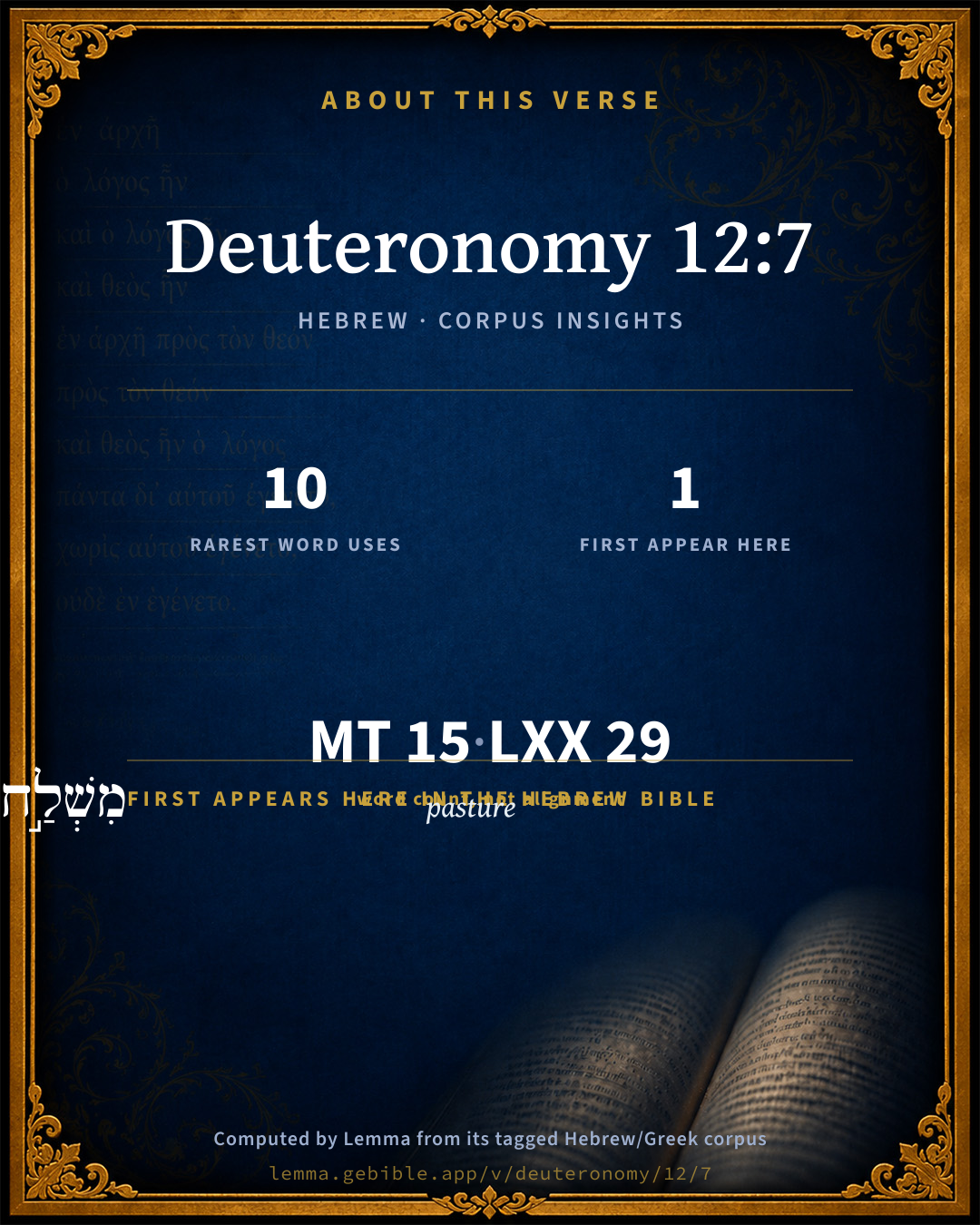
The rarest word here is מִשְׁלַ֣ח pasture H4916 — appearing just 10 times in the whole Hebrew Bible.

First appearance in Scripture

This word makes its first canonical appearance in the Hebrew Bible here:

  • מִשְׁלַ֣ח pasture H4916

Shared distinctive vocabulary

מִשְׁלַ֣ח pasture H4916 occurs in 10 verses of the Hebrew Bible. Also found in:

Grammatical profile

  • 3 verbs
  • 9 nouns
  • 1 pronoun
  • 1 adverb
  • 1 particle

Verb forms

  • וַאֲכַלְתֶּם Qal · Sequential Perfect
  • וּשְׂמַחְתֶּ֗ם Qal · Sequential Perfect
  • בֵּֽרַכְךָ֖ Piel · Perfect

Repetition

Words recur within this verse — often emphatic in Hebrew:

  • יְהוָ֣ה LORD H3068 ×2
  • אֱלֹֽהֵיכֶ֔ם God H430 ×2

Hebrew & Septuagint length

In English translation the verse runs 33 words from the Hebrew and 37 from the Septuagint (LXX English) — closely comparable.

A rough comparison of the two English renderings, which tokenize alike — not a word-level alignment.

Word counts can differ between the Hebrew and the Greek without any difference in meaning — e.g. the Hebrew direct-object marker אֵת has no separate Greek word, and Greek often adds the article ὁ.

In the original languages it is 15 Hebrew tokens and 29 Greek tokens — but the two are counted differently (Hebrew bundles its prefixes and suffixes into one token; the Greek is in lemma form), so that isn’t a like-for-like length.

Cross-references

14

Topical passages linked to Deuteronomy 12:7 in the Treasury of Scripture Knowledge — connected by theme and wording, ordered by reader-vote popularity; previews shown in the World English Bible.

  • Deuteronomy 12:18 but you shall eat them before Yahweh your God in the place which Yahweh your God shall choose, you, and your son, and your daughter, and your man-servant, and your maid-servant, and the Levite who is within your gates: and you shall rejoice before Yahweh your God in all that you put your hand to.
  • Leviticus 23:40 You shall take on the first day the fruit of goodly trees, branches of palm trees, and boughs of thick trees, and willows of the brook; and you shall rejoice before Yahweh your God seven days.
  • Deuteronomy 14:26 and you shall bestow the money for whatever your soul desires, for oxen, or for sheep, or for wine, or for strong drink, or for whatever your soul asks of you; and you shall eat there before Yahweh your God, and you shall rejoice, you and your household.
  • Deuteronomy 12:12 You shall rejoice before Yahweh your God, you, and your sons, and your daughters, and your men-servants, and your maid-servants, and the Levite who is within your gates, because he has no portion nor inheritance with you.
  • Psalms 128:1–2 Blessed is everyone who fears Yahweh, Who walks in his ways.
  • Philippians 4:4 Rejoice in the Lord always! Again I will say, Rejoice!
  • Deuteronomy 14:23 You shall eat before Yahweh your God, in the place which he shall choose, to cause his name to dwell there, the tithe of your grain, of your new wine, and of your oil, and the firstborn of your herd and of your flock; that you may learn to fear Yahweh your God always.
  • Deuteronomy 15:20 You shall eat it before Yahweh your God year by year in the place which Yahweh shall choose, you and your household.
  • Deuteronomy 16:11–15 and you shall rejoice before Yahweh your God, you, and your son, and your daughter, and your man-servant, and your maid-servant, and the Levite who is within your gates, and the foreigner, and the fatherless, and the widow, who are in the midst of you, in the place which Yahweh your God shall choose, to cause his name to dwell there.
  • Deuteronomy 27:7 and you shall sacrifice peace-offerings, and shall eat there; and you shall rejoice before Yahweh your God.
  • Deuteronomy 26:11 and you shall rejoice in all the good which Yahweh your God has given to you, and to your house, you, and the Levite, and the foreigner who is in the midst of you.
  • Isaiah 23:18 Her merchandise and her hire shall be holiness to Yahweh: it shall not be treasured nor laid up; for her merchandise shall be for those who dwell before Yahweh, to eat sufficiently, and for durable clothing.
  • Malachi 2:13 This again you do: you cover the altar of Yahweh with tears, with weeping, and with sighing, because he doesn't regard the offering any more, neither receives it with good will at your hand.
  • Acts 2:46 Day by day, continuing steadfastly with one accord in the temple, and breaking bread at home, they took their food with gladness and singleness of heart,

Cross-references courtesy of OpenBible.info (CC BY 4.0).

Hebrew and Greek witnesses Masoretic Hebrew ↔ Greek Septuagint

The same verse in the two great witnesses to the Old Testament, shown verse-for-verse.

These are two independent witnesses, not word-aligned to each other, and the Septuagint is shown in lemma (dictionary) form.

Hebrew Deuteronomy 12:7 Masoretic · Westminster Leningrad Codex

וַאֲכַלְתֶּם שָׁ֗ם לִפְנֵי֙ יְהוָ֣ה אֱלֹֽהֵיכֶ֔ם וּשְׂמַחְתֶּ֗ם בְּכֹל֙ מִשְׁלַ֣ח יֶדְכֶ֔ם אַתֶּ֖ם וּבָתֵּיכֶ֑ם אֲשֶׁ֥ר בֵּֽרַכְךָ֖ יְהוָ֥ה אֱלֹהֶֽיךָ

and there you shall eat before Yahweh your God, and you shall rejoice in all that you put your hand to, you and your households, in which Yahweh your God has blessed you.

World English Bible · Public Domain

Greek LXX Deuteronomy 12:7 Septuagint · lemma form

καί ἐσθίω ἐκεῖ ἐναντίον κύριος ὁ θεός σύ καί εὐφραίνω ἐπί πᾶς οὗ ἄν ὁ χείρ ἐπιβάλλω σύ καί ὁ οἶκος σύ καθότι εὐλογέω σύ κύριος ὁ θεός σύ

And you⌃ shall eat there before the Lord your God, and you⌃ shall rejoice in all the things on which you⌃ shall lay your hand, you⌃ and your houses, as the Lord your God has blessed you.

LXX2012 (modern English Septuagint) · Public Domain

On this verse, The Pulpit Commentary discusses the Septuagint’s reading. Read the note in Commentary ↓

Hebrew: Westminster Leningrad Codex (CC BY 4.0). Greek: Septuagint (public domain); English from LXX2012 (modern English Septuagint) (Public Domain). How the Septuagint differs from the Hebrew →

Targum (Aramaic paraphrase)

2

The Targum is the ancient Jewish Aramaic paraphrase of the Hebrew Scriptures — an interpretive translation, not the Hebrew text itself. Onkelos (literal) and Pseudo-Jonathan (expansive) render the Torah, and Jonathan the Prophets. Coverage is partial: where no permissively-licensed English translation exists for a verse, only the Aramaic is shown. This is verse-level text, not a word-by-word alignment to the Hebrew.

  1. Targum Onkelos Torah (Genesis–Deuteronomy)
    וְתֵיכְלוּן תַּמָן קֳדָם יְיָ אֱלָהֲכוֹן וְתֶחֱדוּן בְכֹל אוֹשָׁטוּת יֶדְכוֹן אַתּוּן וֶאֱנַשׁ בָּתֵּיכוֹן דִי בָרְכָךְ יְיָ אֱלָהָךְ

    (no public-domain English translation for this verse)

    Targum Onkelos — Aramaic: “Onkelos Genesis” (public domain); “Onkelos Exodus” (public domain); “Onkelos Leviticus” (public domain); “Onkelos Numbers” (public domain); “Onkelos Deuteronomy” (public domain). English: “Sefaria Community Translation” (CC0 1.0 (public-domain dedication)); “J.W. Etheridge. The Targums of Onkelos and Jonathan Ben Uzziel on the Pentateuch. London: Longmans, Green, 1862” (public domain). Text via Sefaria.

  2. Targum Pseudo-Jonathan Torah (Genesis–Deuteronomy)
    וְתֵיכְלוּן תַּמָּן קֳדָם יְיָ אֱלָהָכוֹן וְתֵחְדוּן בְּכָל אוֹשָׁטוּת יֶדְכוֹן אַתּוּן וְאֵינַשׁ בָּתֵּיכוֹן דִּי בְּרַכְכוֹן יְיָ אֱלָהָכוֹן

    And you shall there eat before the Lord your God, and rejoice in all that you put your hand unto, you and your households, in which the Lord your God will have blessed you.

    Targum Pseudo-Jonathan — Aramaic: “Targum Jonathan on Genesis” (public domain); “Targum Jonathan on Exodus” (public domain); “Targum Jonathan on Leviticus” (public domain); “Targum Jonathan on Numbers” (public domain); “Targum Jonathan on Deuteronomy” (public domain). English: “The Targum of Jonathan ben Uzziel, trans. J. W. Etheridge, London, 1862” (public domain). Text via Sefaria.

Commentary

Notes on Deuteronomy 12:7 from classic Christian and Jewish commentators (each source and its license shown beneath its notes). The classic Christian expositions comment on the surrounding passage and are grouped to its opening verse, so a note may address several verses; the Jewish commentaries on the Tanakh (Rashi and others) are per-verse, so they appear only where the commentator wrote on this verse.

Lemma curates 59 commentaries, every one of them public domain or Creative Commons licensed, each selected and text-cleaned for this edition rather than reprinted as found. About our sources →

Trapp's Complete Commentary

John Trapp

Deu 12:7 And there ye shall eat before the LORD your God, and ye shall rejoice in all that ye put your hand unto, ye and your households, wherein the LORD thy God hath blessed thee.

Ver. 7. And there ye shall eat before the Lord.] Lo, this ye shall have of God’s hand, as a recompense of all your charge and pains, ye shall feast before him with joy. This made those good souls go bodily on "from strength to strength"; though they took many a weary step, yet their comfort was, that they should "every one of them in Zion appear before the Lord." {Psa 84:7} This was the sweetmeats of that feast; other dainty dishes there might be, but this was the banquet.

John Trapp, A Commentary or Exposition upon All the Books of the Old and New Testament (1647–1656) — public domain. Text from a community e-Sword module.

Joseph Benson's Commentary

Deu 12:7. There — Not in the tabernacle or temple, where only the priests might eat the most holy things, (Num 18:10,) but in the court of the tabernacle, or in some place adjacent to the sanctuary. Ye shall eat — Your part of the things mentioned Deu 12:6; before the Lord — In the place of his peculiar presence, where his sanctuary shall be. And ye shall rejoice — For God is to be served with delight and gladness, and his worship ought to be a source of consolation to us, and it will be such if we worship him in spirit and truth. In all that you put your hand unto — In all your possessions and labours whatsoever, which shall otherwise be accursed to you.

Joseph Benson's Commentary on the Old and New Testaments (1811–1818) — public domain. Text from a community e-Sword module.

Geneva Bible (1599)

Geneva Bible translators

Where his Ark shall be.

Geneva Bible (1599) marginal notes — public domain. Text via Bolls.life.

Jamieson, Fausset & Brown

Robert Jamieson, A. R. Fausset & David Brown

there ye shall eat before the Lord--of the things mentioned (Deu 12:6); but of course, none of the parts assigned to the priests before the Lord--in the place where the sanctuary should be established, and in those parts of the Holy City which the people were at liberty to frequent and inhabit.

Jamieson, Fausset & Brown — Commentary Critical and Explanatory on the Whole Bible (1871) — public domain (CC PDM 1.0). Text via the HelloAO Bible API.

John Gill's Exposition

And there ye shall eat before the Lord your God,.... The priests and the Levites, what was their portion, so Aben Ezra; but the people also are included, and by what follows seem chiefly designed, who were to eat their part of the sacrifices, particularly of the tithes and peace offerings, in the holy place that should be chosen and appointed; see Deu 14:22.

and ye shall rejoice in all that ye put your hand unto; in all the labours of their hands, and what they got thereby, which they were cheerfully to enjoy, and express their thankfulness for it in this way; see Ecc 5:18.

ye and your households; their wives, sons, daughters, men and maid servants; yea, with them Levites, strangers, fatherless, and widows, were to partake of some of their freewill offerings, Deu 16:10.

wherein the Lord thy God hath blessed thee; and these offerings were eucharistical, and by way of thanksgiving for the blessing of God upon their labours, for it is that which maketh rich, Pro 10:22.

John Gill's Exposition of the Whole Bible (1746–1763) — public domain (CC PDM 1.0). Text via the HelloAO Bible API.

Albert Barnes' Notes on the Bible

An injunction that the feasts which accompanied certain offerings (not specified) were to be also held in the same place.

Albert Barnes' Notes on the Bible (1834–1885) — public domain. Text from a community e-Sword/MySword module.

Haydock's Catholic Bible Commentary

You. In gratitude, you shall therefore offer your victims. (Haydock) --- The Jews were accustomed to make a feast thrice a year in the holy city. They might also eat some parts of the peace-offerings. (Menochius)

George Leo Haydock (1774–1849), Haydock's Catholic Family Bible and Commentary, 1859 edition — public domain. Excludes Psalms (Douay-Rheims chapter numbering differs from Protestant) and Deuterocanonical books (Catholic canon only).

Matthew Poole's English Annotations

There; not in the most holy place, wherein only the priests might eat, Num 18:10, but more generally in places allowed to the people for this end in the holy city.

Ye shall eat, to wit, your part of the things mentioned Deu 12:6.

Before the Lord, i.e. in the place of God’s presence, where God’s sanctuary shall be.

All that ye put your hand unto; either to bestow your pains and labour upon it; or, to take and use or enjoy it. The sense is, You thus doing shall be blessed and enabled to rejoice, or to take comfort in all your labours and enjoyments, which otherwise would be accursed to you. We have the same phrase below, Deu 12:18; 15:10.

Matthew Poole's English Annotations on the Holy Bible (1683–1685) — public domain. Text from a community e-Sword/MySword module.

Whedon's Commentary on the Bible

Daniel D. Whedon

7. And there ye shall eat — That is, at this appointed place. The Israelites were accustomed to make these feasts of great importance. They were festal entertainments, not only for their families and friends, but also for Levites, widows, orphans, and strangers.

Daniel D. Whedon (gen. ed.), Commentary on the Old and New Testaments (1874–1909) — public domain. Text from a community e-Sword module.

The Pulpit Commentary

And there ye shall eat before the Lord. The injunction here and in ver. 17, respecting the eating by the offerer of the firstlings of his flocks and herds, appears to be inconsistent with the injunction in Num_18:18. There it seems as if the whole of the flesh was to be given to the priest. "And the flesh of them shall be thine the priest"s as the wave breast and as the right shoulder are thine." This may be taken to mean that just as the wave breast and the right shoulder are the perquisites of the priests in the case of other offerings, as e.g. the peace offering, so in the case of the firstling offering the whole flesh shall be the priest"s; and thus taken, the passage presents an unquestionable discrepancy to that in Deuteronomy. But probably the passage is not to be so taken. The particle translated "as" (K.) not infrequently occurs in the sense of "according to, after the manner of," implying conformity to some rule or model. (Gen_44:2; Exo_21:9 Exo_39:8; Lev_5:10; Num_8:4 Num_9:3 Num_29:18; Psa_7:1-8; Zec_2:10, etc.) The passage, therefore, may be rendered thus: And the flesh of them shalt thou take after the manner (or according to the rule), of the wave breast, etc., i.e. not the whole of it, but only these parts. So the LXX seem to have taken the passage: kai ta krea eujtai kasa kaimatov kai kata toona ton dexion soi estai. Of some of the offerings the whole was received by the priest, as in the case of the sin offering and trespass offering; (Lev_6:25, etc.; 7:1, etc.) while of others only certain portions, viz. the wave breast and the heave shoulder, were given to him, as in the case of the peace offering. (Lev_7:28, etc.) The purport of the law in Num_18:18 is that, in respect of the firstling offering, the allotment to the priest shall be after the same manner as in the peace offering. There is thus no discrepancy between the two passages. The animal belonged originally to the offerer; when he brought it before the Lord part of it was consumed on the altar, part of it was assigned to the priest, and the rest, as a matter of course, remained with himself. The law in Numbers, addressed to the priest, intimates what he might claim as his portion; the law in Deuteronomy, where the people are addressed, directs them how to use the portion that remained with them. It may be added that, even supposing that all the flesh was given to the priest, yet, as it had to be consumed on the day in which the sacrifice was offered, and as every clean person in the house might partake of it, it is almost certain that the offerer would, as a matter of course, share in the meal, as was usual in the case of sacrificial meals. Rejoice in all that ye put your hand unto; enjoy whatever your hand may gain, whatever you may earn, all the good which the Lord may give you (cf. ver. 18; 15:10; 23. 20; 28:8, 20). The phrase is peculiar to Deuteronomy; but comp. Gen_3:22; Isa_11:14.

The Pulpit Commentary (1880–1919), ed. H.D.M. Spence-Jones & Joseph S. Exell — public domain. Text from a community e-Sword module.

John Wesley's Explanatory Notes

There - Not in the most holy place, wherein only the priests might eat, but in places allowed to the people for this, end in the holy city. Ye shall eat - Your part of the things mentioned, ver. 6. Before the Lord - In the place of God's presence, where God's sanctuary shall be.

John Wesley, Explanatory Notes Upon the Whole Bible (1754–1765) — public domain. Text via the GEBible commentary corpus.

unfoldingWord translationNotes

Door43 World Missions Community

It is there

This refers to the place that Yahweh will choose for the children of Israel to worship.

rejoice about everything that you have put your hand to

Here "put your hand to" represents the whole person and work that he has done. AT: "rejoice about all the work you have done" (See: Synecdoche)

translationWords

Yahweh

God

joy

hand

household

bless

unfoldingWord translationNotes — © Distant Shores Media and the Door43 World Missions Community, licensed CC BY-SA 4.0. Source: git.door43.org/Door43/en_tn.

Rashi

Rabbi Shlomo Yitzchaki (Rashi)

אשר ברכך ה׳ ACCORDING AS THE LORD [YOUR GOD] HAS BLESSED YOU — in accordance with the blessing bring [the offerings of festive rejoicing] (Sifrei Devarim 64:5).

Rashi on the Tanakh — English translations: “The Judaica Press complete Tanach with Rashi, translated by A. J. Rosenberg” (CC BY 4.0); “Pentateuch with Rashi's commentary by M. Rosenbaum and A.M. Silbermann, 1929-1934” (public domain); “The Metsudah Tanach series, Lakewood, N.J” (CC BY 4.0); and “The Book of Joshua, Metsudah Publications, 1997” (CC BY 4.0). Text via Sefaria.

Lesson kit

Teaching starters — assembled from the data on this page, not authored interpretation. Every prompt links to the verse data it draws on. Edit before teaching.

Deuteronomy, in the Pentateuch, opens this verse with 15 words (13 distinct Hebrew lemmas). Its most distinctive word is mishlôwach (“pasture”). A historical commentator’s framing appears above. Read the whole chapter for the surrounding context.

Discussion questions

  1. How does “pasture” (mishlôwach) shape what this verse is saying?
  2. This is the first place “pasture” appears in Scripture (first appears here). What does its debut here establish?
  3. How does Deuteronomy 12:18, which shares the word «pasture», read alongside this verse?
  4. What does the repetition of “LORD” (2× in this one verse) do in this verse?
  5. The translations on this page render this verse differently — a whole-verse word diff, not a word-by-word alignment. What might account for the different wordings?
  6. «וַאֲכַלְתֶּם» is a Qal Sequential Perfect verb. How does that grammatical form shape the action described?
  7. Compare how Trapp's Complete Commentary and Joseph Benson's Commentary read this verse. Where do they agree or differ?

Things to notice

Reading settings

Reading text

Shown beneath each verse's original-language words.

Old Testament
Old Testament edition

Read the OT as the Masoretic Hebrew (MT) or the Greek Septuagint (LXX).

English shown for the Greek Septuagint (in the Hebrew ↔ Greek comparison).

Comparing translations? Open the Compare panel on any verse page to stack up to four side by side.