
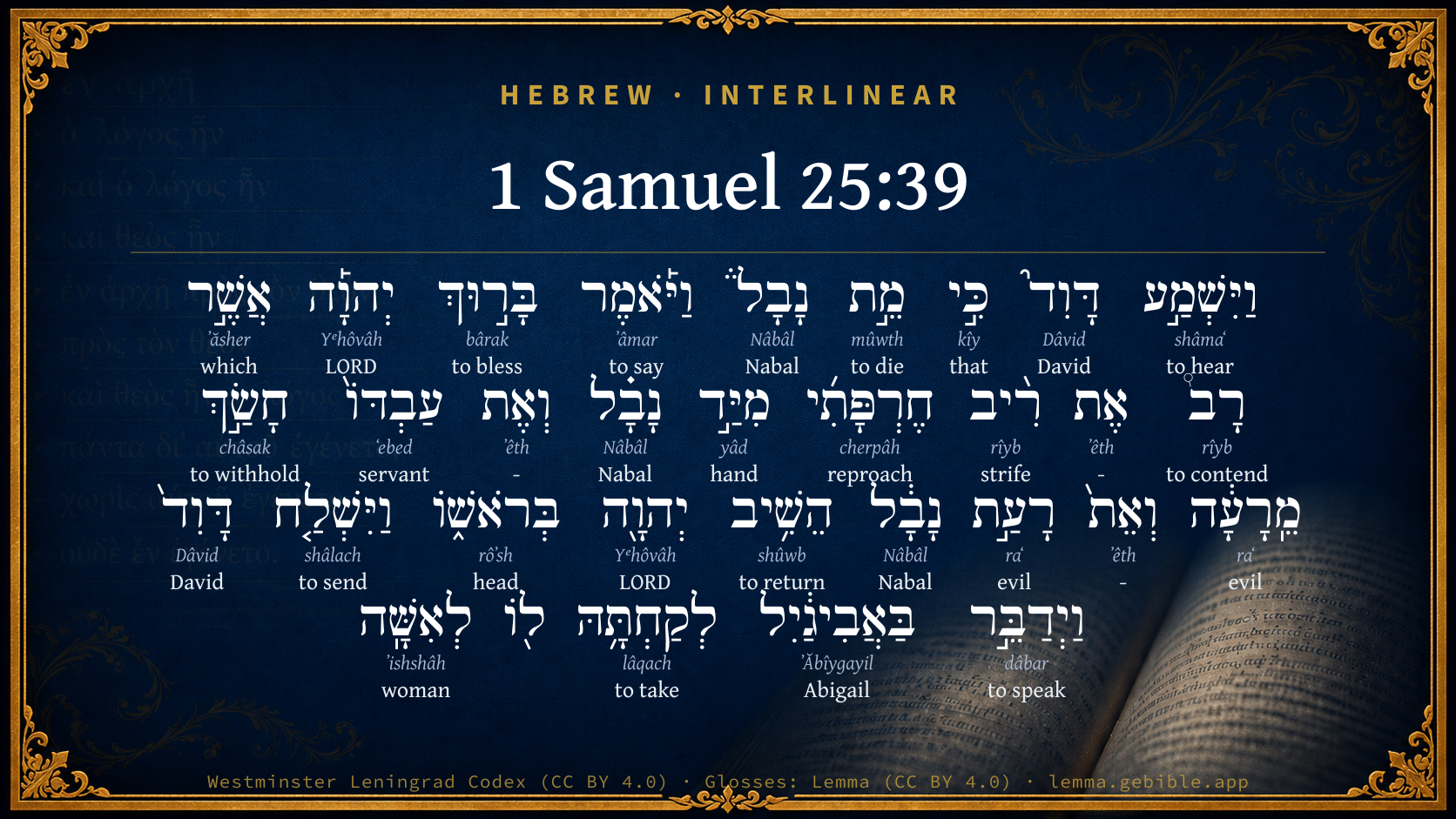
1 Samuel 25:39

Hebrew (Westminster Leningrad Codex) 1 Samuel 25:39 appears in the Hebrew Old Testament. The text above is from the Westminster Leningrad Codex. Each word links to its Strong’s number, a concise gloss, and parsing drawn from the Open Scriptures Hebrew Bible morphology. Click any word for its full Brown-Driver-Briggs (BDB) entry.
Download image
Cite this verse

1 Samuel 25:39 (World English Bible). Public Domain. Lemma interlinear Bible study tool, https://lemma.gebible.app/v/1-samuel/25/39.

Show BibTeX & RIS
BibTeX
RIS
English Translation
When David heard that Nabal was dead, he said, Blessed be Yahweh, who has pleaded the cause of my reproach from the hand of Nabal, and has kept back his servant from evil: and the evil-doing of Nabal has Yahweh returned on his own head. David sent and spoke concerning Abigail, to take her to him as wife.
World English Bible · Public Domain
Download a study sheet

One document with this verse’s original text, its word-by-word gloss line, the meaning frame, cross-references with their text, attributed commentary, and full source and license credits — printable, and it pastes into notes with its structure intact.

This verse Autodidact and up

Study sheet (.html) Plain text (.txt)

A passage Seminary Student

Up to 50 verses in one chapter. A passage sheet keeps up to 6 commentary sources and 12 cross-references per verse, in the order this page ranks them, and says so on the sheet whenever that leaves anything out. Ask for a single verse and you get the Autodidact verse sheet above.

Everything on this page stays free to read, with no account — the sheet is a download of what is already on screen, not access to it.

Want to remove ads? Support Godless Engineer
Compare translations 3

The same verse in 3 English versions, stacked beneath the original-language interlinear above. Click any original word for its lexicon entry.

Each is an independent rendering of the whole verse — the interlinear is not word-aligned to these translations.

Highlighted words mark where these versions differ — a whole-verse word diff, not a word-by-word alignment.

  • World English Bible Public Domain
    When David heard that Nabal was dead, he said, Blessed be Yahweh, who has pleaded the cause of my reproach from the hand of Nabal, and has kept back his servant from evil: and the evil-doing of Nabal has Yahweh returned on his own head. David sent and spoke concerning Abigail, to take her to him as wife.
  • King James Version Public Domain
    And when David heard that Nabal was dead, he said, Blessed be the LORD, that hath pleaded the cause of my reproach from the hand of Nabal, and hath kept his servant from evil: for the LORD hath returned the wickedness of Nabal upon his own head. And David sent and communed with Abigail, to take her to him to wife.
  • unfoldingWord Literal Text CC BY-SA 4.0
    And David heard that Nabal had died, and he said, “Blessed be Yahweh, who has conducted the case of my reproach from the hand of Nabal and has withheld his servant from evil. And Yahweh has returned the evil of Nabal on his head.” And David sent and spoke with Abigail, to take her for himself for a wife.

unfoldingWord Literal Text — © unfoldingWord, licensed CC BY-SA 4.0. Word-aligned USFM3 via Door43 (git.door43.org/unfoldingWord/en_ult).

Versions to compare (up to 4)

3 of 4 selected

Show all 18 translations

Every available English version of this verse, each an independent rendering of the whole verse.

  • World English Bible Public Domain
    When David heard that Nabal was dead, he said, Blessed be Yahweh, who has pleaded the cause of my reproach from the hand of Nabal, and has kept back his servant from evil: and the evil-doing of Nabal has Yahweh returned on his own head. David sent and spoke concerning Abigail, to take her to him as wife.
  • Berean Standard Bible Public Domain
    On hearing that Nabal was dead, David said, “Blessed be the LORD, who has upheld my cause against the reproach of Nabal and has restrained His servant from evil. For the LORD has brought the wickedness of Nabal down upon his own head.” Then David sent word to Abigail, asking for her in marriage.
  • Majority Standard Bible Public Domain
    On hearing that Nabal was dead, David said, “Blessed be the LORD, who has upheld my cause against the reproach of Nabal and has restrained His servant from evil. For the LORD has brought the wickedness of Nabal down upon his own head.” Then David sent word to Abigail, asking her to become his wife.
  • King James Version Public Domain
    And when David heard that Nabal was dead, he said, Blessed be the LORD, that hath pleaded the cause of my reproach from the hand of Nabal, and hath kept his servant from evil: for the LORD hath returned the wickedness of Nabal upon his own head. And David sent and communed with Abigail, to take her to him to wife.
  • American Standard Version (1901) Public Domain
    And when David heard that Nabal was dead, he said, Blessed be Jehovah, that hath pleaded the cause of my reproach from the hand of Nabal, and hath kept back his servant from evil: and the evil-doing of Nabal hath Jehovah returned upon his own head. And David sent and spake concerning Abigail, to take her to him to wife.
  • Revised Version (1885) Public Domain
    And when David heard that Nabal was dead, he said, Blessed be the LORD, that hath pleaded the cause of my reproach from the hand of Nabal, and hath kept back his servant from evil: and the evil-doing of Nabal hath the LORD returned upon his own head. And David sent and spake concerning Abigail, to take her to him to wife.
  • Geneva Bible (1599) Public Domain
    Now when Dauid heard, that Nabal was dead, he said, Blessed be the Lord that hath iudged the cause of my rebuke of ye hand of Nabal, and hath kept his seruant from euil: for the Lord hath recompensed the wickednesse of Nabal vpon his owne head. Also Dauid sent to commune with Abigail to take her to his wife.
  • Douay-Rheims (1899) Public Domain
    And when David had heard that Nabal was dead, he said: Blessed be the Lord, who hath judged the cause of my reproach at the hand of Nabal, and hath kept his servant from evil, and the Lord hath returned the wickedness of Nabal upon his head. The n David sent and treated with Abigail, that he might take her to himself for a wife.
  • Young's Literal Translation Public Domain
    and David heareth that Nabal `is' dead, and saith, `Blessed `is' Jehovah who hath pleaded the cause of my reproach from the hand of Nabal, and His servant hath kept back from evil, and the wickedness of Nabal hath Jehovah turned back on his own head;' and David sendeth and speaketh with Abigail, to take her to him for a wife.
  • Literal Standard Version CC BY-SA 4.0
    and David hears that Nabal [is] dead and says, “Blessed [is] YHWH who has pleaded the cause of my reproach from the hand of Nabal, and His servant has kept back from evil, and YHWH has turned back the wickedness of Nabal on his own head”; and David sends and speaks with Abigail, to take her to himself for a wife.
  • Unlocked Literal Bible CC BY-SA 4.0
    When David heard that Nabal was dead, he said, “May Yahweh be blessed, who has taken up the cause of my insult from the hand of Nabal and has kept back his servant from evil. He has turned Nabal's evil action back on his own head.” Then David sent and spoke to Abigail, to take her to himself as wife.
  • unfoldingWord Literal Text CC BY-SA 4.0
    And David heard that Nabal had died, and he said, “Blessed be Yahweh, who has conducted the case of my reproach from the hand of Nabal and has withheld his servant from evil. And Yahweh has returned the evil of Nabal on his head.” And David sent and spoke with Abigail, to take her for himself for a wife.
  • Darby Bible Public Domain
    And when David heard that Nabal was dead, he said, Blessed be Jehovah, who has pleaded the cause of my reproach from the hand of Nabal, and has kept back his servant from evil; but Jehovah has returned Nabal's evil upon his own head. And David sent and communed with Abigail, to take her as his wife.
  • World Messianic Bible Public Domain
    When David heard that Nabal was dead, he said, “Blessed is the LORD, who has pleaded the cause of my reproach from the hand of Nabal, and has kept back his servant from evil. The LORD has returned the evildoing of Nabal on his own head.” David sent and spoke concerning Abigail, to take her to himself as wife.
  • Webster's Bible Public Domain
    And when David heard that Nabal was dead, he said, Blessed be the LORD, that hath pleaded the cause of my reproach from the hand of Nabal, and hath kept his servant from evil: for the LORD hath returned the wickedness of Nabal upon his own head. And David sent and communed with Abigail, to take her to himself for a wife.
  • Free Bible Version CC BY-SA 4.0
    When David heard that Nabal was dead, he said, “Praise the Lord who has supported me against Nabal's insult and has kept me from doing evil. For the Lord made Nabal's wickedness fall back on himself.” Then David sent a message to Abigail, asking for her to marry him.
  • Bible in Basic English Public Domain
    And David, hearing that Nabal was dead, said, May the Lord be praised, who has taken up my cause against Nabal for the shame which he put on me, and has kept back his servant from evil, and has sent on Nabal's head the reward of his evil-doing. And David sent word to Abigail, desiring to take her as his wife.
  • JPS Tanakh (1917) Public Domain
    And when David heard that Nabal was dead, he said: 'Blessed be the LORD, that hath pleaded the cause of my reproach from the hand of Nabal, and hath kept back His servant from evil; and the evil-doing of Nabal hath the LORD returned upon his own head.' And David sent and spoke concerning Abigail, to take her to him to wife.

Literal Standard Version (2020), Covenant Press — licensed CC BY-SA 4.0. Text via the HelloAO Bible API (eBible.org). Unlocked Literal Bible (unfoldingWord) — licensed CC BY-SA 4.0. Text via the HelloAO Bible API (eBible.org). unfoldingWord Literal Text — © unfoldingWord, licensed CC BY-SA 4.0. Word-aligned USFM3 via Door43 (git.door43.org/unfoldingWord/en_ult). Free Bible Version, Dr. Jonathan Gallagher — licensed CC BY-SA 4.0. Text via the HelloAO Bible API (eBible.org).

Word by word

More ways to search: Search by grammar → Find every occurrence → Compare this word →

Practice this passage: Drill this verse → Learn its vocabulary →

בַּאֲבִיגַ֔יִל
ʼĂbîygayil
H26
“in/at · Abigail”
Preposition + Noun, Proper
Part of Speech
Preposition + Noun
Type
Proper
Full BDB Definition

Origin: from H1 and H1524

TWOT: None

Abigail = "my father is joy" - wife of Nabal, then of David - sister of David
  1. וַיִּשְׁמַ֣ע shâmaʻ H8085 “and · to hear” Conjunction + Verb, Qal, Sequential Imperfect, 3rd Person, Masculine, Singular
  2. דָּוִד֮ Dâvid H1732 “David” Noun, Proper
  3. כִּ֣י kîy H3588 “that” Conjunction
  4. מֵ֣ת mûwth H4191 “to die” Verb, Qal, Perfect, 3rd Person, Masculine, Singular
  5. נָבָל֒ Nâbâl H5037 “Nabal” Noun, Proper
  6. וַיֹּ֡אמֶר ʼâmar H559 “and · to say” Conjunction + Verb, Qal, Sequential Imperfect, 3rd Person, Masculine, Singular
  7. בָּר֣וּךְ bârak H1288 “blessed” Verb, Qal, Participle Passive, Masculine, Singular, Absolute
  8. יְהוָ֡ה Yᵉhôvâh H3068 “LORD” Noun, Proper
  9. אֲשֶׁ֣ר ʼăsher H834 “which” Particle, Relative
  10. רָב֩ rîyb H7378 “to contend” Verb, Qal, Perfect, 3rd Person, Masculine, Singular
  11. אֶת ʼêth H853 “-” Particle, Direct Object
  12. רִ֨יב rîyb H7379 “strife of” Noun, Common, Both, Singular, Construct
  13. חֶרְפָּתִ֜י cherpâh H2781 “reproach · my” Noun, Common, Feminine, Singular, Construct + Suffix, Personal, 1st Person, Common, Singular
  14. מִיַּ֣ד yâd H3027 “from · hand of” Preposition + Noun, Common, Both, Singular, Construct
  15. נָבָ֗ל Nâbâl H5037 “Nabal” Noun, Proper
  16. וְאֶת ʼêth H853 “and · -” Conjunction + Particle, Direct Object
  17. עַבְדּוֹ֙ ʻebed H5650 “servant · his” Noun, Common, Masculine, Singular, Construct + Suffix, Personal, 3rd Person, Masculine, Singular
  18. חָשַׂ֣ךְ châsak H2820 “to withhold” Verb, Qal, Perfect, 3rd Person, Masculine, Singular
  19. מֵֽרָעָ֔ה raʻ H7451 “from · evil” Preposition + Noun, Common, Feminine, Singular, Absolute
  20. וְאֵת֙ ʼêth H853 “and · -” Conjunction + Particle, Direct Object
  21. רָעַ֣ת raʻ H7451 “evil of” Noun, Common, Feminine, Singular, Construct
  22. נָבָ֔ל Nâbâl H5037 “Nabal” Noun, Proper
  23. הֵשִׁ֥יב shûwb H7725 “to return” Verb, Hiphil, Perfect, 3rd Person, Masculine, Singular
  24. יְהוָ֖ה Yᵉhôvâh H3068 “LORD” Noun, Proper
  25. בְּרֹאשׁ֑וֹ rôʼsh H7218 “in/at · head · his” Preposition + Noun, Common, Masculine, Singular, Construct + Suffix, Personal, 3rd Person, Masculine, Singular
  26. וַיִּשְׁלַ֤ח shâlach H7971 “and · to send” Conjunction + Verb, Qal, Sequential Imperfect, 3rd Person, Masculine, Singular
  27. דָּוִד֙ Dâvid H1732 “David” Noun, Proper
  28. וַיְדַבֵּ֣ר dâbar H1696 “and · to speak” Conjunction + Verb, Piel, Sequential Imperfect, 3rd Person, Masculine, Singular
  29. לְקַחְתָּ֥הּ lâqach H3947 “to take · her” Preposition + Verb, Qal, Infinitive Construct + Suffix, Personal, 3rd Person, Feminine, Singular
  30. לְאִשָּֽׁה ʼishshâh H802 “to/for · woman” Preposition + Noun, Common, Feminine, Singular, Absolute

About this verse

These counts appear in no published source. They are computed here, from the morphology-tagged text and Lemma’s own curated glosses. What Lemma adds →

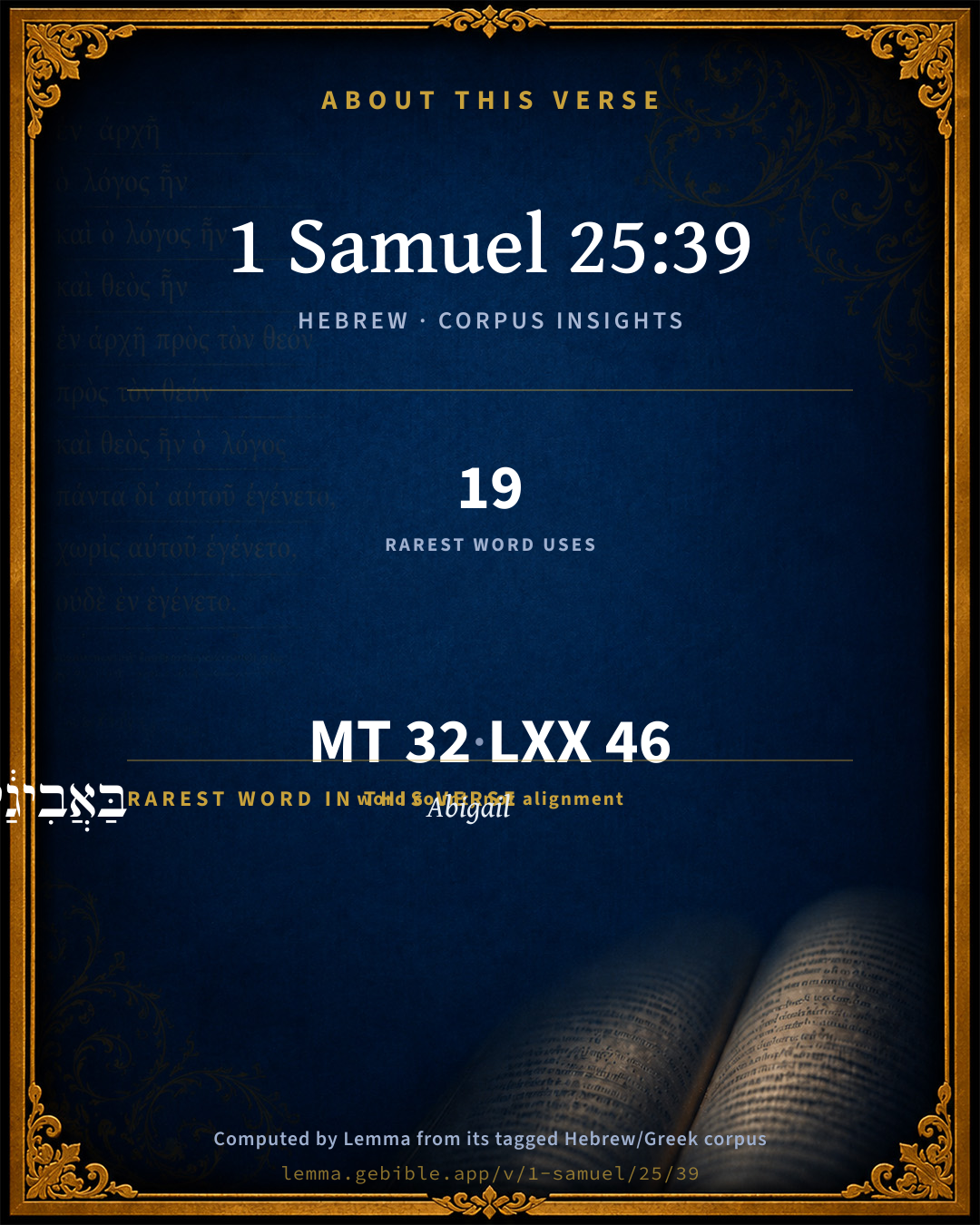
32
words
24
distinct lemmas
Historical
section

Notable vocabulary

The rarest word here is בַּאֲבִיגַ֔יִל Abigail H26 — appearing just 19 times in the whole Hebrew Bible.

Shared distinctive vocabulary

בַּאֲבִיגַ֔יִל Abigail H26 occurs in 17 verses of the Hebrew Bible. Also found in:

Grammatical profile

  • 10 verbs
  • 16 nouns
  • 1 preposition
  • 1 conjunction
  • 4 particles

Verb forms

  • וַיִּשְׁמַ֣ע Qal · Sequential Imperfect
  • מֵ֣ת Qal · Perfect
  • וַיֹּ֡אמֶר Qal · Sequential Imperfect
  • בָּר֣וּךְ Qal · Participle Passive
  • רָב֩ Qal · Perfect
  • חָשַׂ֣ךְ Qal · Perfect
  • הֵשִׁ֥יב Hiphil · Perfect
  • וַיִּשְׁלַ֤ח Qal · Sequential Imperfect
  • וַיְדַבֵּ֣ר Piel · Sequential Imperfect
  • לְקַחְתָּ֥הּ Qal · Infinitive Construct

Repetition

Words recur within this verse — often emphatic in Hebrew:

  • נָבָל֒ Nabal H5037 ×3
  • דָּוִד֮ David H1732 ×2
  • יְהוָ֡ה LORD H3068 ×2
  • מֵֽרָעָ֔ה evil H7451 ×2

Hebrew & Septuagint length

In English translation the verse runs 58 words from the Hebrew and 61 from the Septuagint (LXX English) — closely comparable.

A rough comparison of the two English renderings, which tokenize alike — not a word-level alignment.

Word counts can differ between the Hebrew and the Greek without any difference in meaning — e.g. the Hebrew direct-object marker אֵת has no separate Greek word, and Greek often adds the article ὁ.

In the original languages it is 32 Hebrew tokens and 46 Greek tokens — but the two are counted differently (Hebrew bundles its prefixes and suffixes into one token; the Greek is in lemma form), so that isn’t a like-for-like length.

Cross-references

24

Topical passages linked to 1 Samuel 25:39 in the Treasury of Scripture Knowledge — connected by theme and wording, ordered by reader-vote popularity; previews shown in the World English Bible.

  • 1 Samuel 25:26 Now therefore, my lord, as Yahweh lives, and as your soul lives, seeing Yahweh has withheld you from blood guiltiness, and from avenging yourself with your own hand, now therefore let your enemies, and those who seek evil to my lord, be as Nabal.
  • 1 Samuel 25:34 For in very deed, as Yahweh, the God of Israel, lives, who has withheld me from hurting you, except you had hurried and come to meet me, surely there wouldn't have been left to Nabal by the morning light so much as one man-child.
  • Proverbs 22:23 For Yahweh will plead their case, And plunder the life of those who plunder them.
  • 1 Samuel 24:15 Yahweh therefore be judge, and give sentence between me and you, and see, and plead my cause, and deliver me out of your hand.
  • 1 Samuel 25:32 David said to Abigail, Blessed be Yahweh, the God of Israel, who sent you this day to meet me:
  • 1 Kings 2:44 The king said moreover to Shimei, You know all the wickedness which your heart is privy to, that you did to David my father: therefore Yahweh shall return your wickedness on your own head.
  • Psalms 7:16 The trouble he causes shall return to his own head. His violence shall come down on the crown of his own head.
  • Judges 5:2 For that the leaders took the lead in Israel, For that the people offered themselves willingly, Bless you Yahweh.
  • 2 Samuel 3:28–29 Afterward, when David heard it, he said, I and my kingdom are guiltless before Yahweh forever of the blood of Abner the son of Ner:
  • 2 Samuel 22:47–49 Yahweh lives; Blessed be my rock; Exalted be God, the rock of my salvation,
  • Esther 7:10 So they hanged Haman on the gallows that he had prepared for Mordecai. Then was the king's wrath pacified.
  • Psalms 58:10–11 The righteous shall rejoice when he sees the vengeance. He shall wash his feet in the blood of the wicked;
  • Proverbs 18:22 Whoever finds a wife finds a good thing, And obtains favor of Yahweh.
  • Proverbs 19:14 House and riches are an inheritance from fathers, But a prudent wife is from Yahweh.
  • Proverbs 31:10 Who can find a worthy woman? For her price is far above rubies.
  • Proverbs 31:30 Charm is deceitful, and beauty is vain; But a woman who fears Yahweh, she shall be praised.
  • Song of Solomon 8:8 We have a little sister. She has no breasts. What shall we do for our sister In the day when she is to be spoken for?
  • Lamentations 3:58–60 Lord, you have pleaded the causes of my soul; you have redeemed my life.
  • Hosea 2:6–7 Therefore, behold, I will hedge up your way with thorns, And I will build a wall against her, That she can't find her way.
  • Micah 7:9 I will bear the indignation of Yahweh, Because I have sinned against him, Until he pleads my case, and executes judgment for me. He will bring me forth to the light. I will see his righteousness.
  • 1 Thessalonians 5:23 May the God of peace himself sanctify you completely. May your whole spirit, soul, and body be preserved blameless at the coming of our Lord Jesus Christ.
  • 2 Timothy 4:18 And the Lord will deliver me from every evil work, and will preserve me for his heavenly Kingdom; to whom be the glory forever and ever. Amen.
  • Revelation 19:1–4 After these things I heard something like a loud voice of a great multitude in heaven, saying, "Hallelujah! Salvation, power, and glory belong to our God:
  • 2 Corinthians 13:7 Now I pray to God that you do no evil; not that we may appear approved, but that you may do that which is honorable, though we are as reprobate.

Cross-references courtesy of OpenBible.info (CC BY 4.0).

Hebrew and Greek witnesses Masoretic Hebrew ↔ Greek Septuagint

The same verse in the two great witnesses to the Old Testament, shown verse-for-verse.

These are two independent witnesses, not word-aligned to each other, and the Septuagint is shown in lemma (dictionary) form.

Hebrew 1 Samuel 25:39 Masoretic · Westminster Leningrad Codex

וַיִּשְׁמַ֣ע דָּוִד֮ כִּ֣י מֵ֣ת נָבָל֒ וַיֹּ֡אמֶר בָּר֣וּךְ יְהוָ֡ה אֲשֶׁ֣ר רָב֩ אֶת רִ֨יב חֶרְפָּתִ֜י מִיַּ֣ד נָבָ֗ל וְאֶת עַבְדּוֹ֙ חָשַׂ֣ךְ מֵֽרָעָ֔ה וְאֵת֙ רָעַ֣ת נָבָ֔ל הֵשִׁ֥יב יְהוָ֖ה בְּרֹאשׁ֑וֹ וַיִּשְׁלַ֤ח דָּוִד֙ וַיְדַבֵּ֣ר בַּאֲבִיגַ֔יִל לְקַחְתָּ֥הּ ל֖וֹ לְאִשָּֽׁה

When David heard that Nabal was dead, he said, Blessed be Yahweh, who has pleaded the cause of my reproach from the hand of Nabal, and has kept back his servant from evil: and the evil-doing of Nabal has Yahweh returned on his own head. David sent and spoke concerning Abigail, to take her to him as wife.

World English Bible · Public Domain

Greek LXX 1 Samuel 25:39 Septuagint · lemma form

καί ἀκούω δαυίδ καί εἶπον εὐλογητός κύριος ὅς κρίνω ὁ κρίσις ὁ ὀνειδισμός ἐγώ ἐκ χείρ ναβαλ καί ὁ δοῦλος αὐτός περιποιέω ἐκ χείρ κακός καί ὁ κακία ναβαλ ἀποστρέφω κύριος εἰς κεφαλή αὐτός καί ἀποστέλλω δαυίδ καί λαλέω περί αβιγαιας λαμβάνω αὐτός ἑαυτοῦ εἰς γυνή

And David heard it and said, Blessed be the Lord, who has judged the cause of my reproach at the hand of Nabal, and has delivered his servant from the power of evil; and the Lord has returned the mischief of Nabal upon his own head. And David sent and spoke concerning Abigaia, to take her to himself for a wife.

LXX2012 (modern English Septuagint) · Public Domain

Hebrew: Westminster Leningrad Codex (CC BY 4.0). Greek: Septuagint (public domain); English from LXX2012 (modern English Septuagint) (Public Domain). How the Septuagint differs from the Hebrew →

Targum (Aramaic paraphrase)

1

The Targum is the ancient Jewish Aramaic paraphrase of the Hebrew Scriptures — an interpretive translation, not the Hebrew text itself. Onkelos (literal) and Pseudo-Jonathan (expansive) render the Torah, and Jonathan the Prophets. Coverage is partial: where no permissively-licensed English translation exists for a verse, only the Aramaic is shown. This is verse-level text, not a word-by-word alignment to the Hebrew.

  1. Targum Jonathan Prophets (Joshua–Malachi)
    וּשְׁמַע דָוִד אֲרֵי מִית נָבָל וַאֲמַר בְּרִיךְ יְיָ דְדָן יַת דִין חִיסוּדִי מִידָא דְנָבָל וְיַת עַבְדֵיהּ מְנַע מִלְמֶעְבַּד בִּישָׁא וְיַת בִּישַׁת נָבָל אֲתִיב יְיָ בְּרֵישֵׁיהּ וּשְׁלַח דָוִד וּשְׁאִיל בַּאֲבִיגַיִל לְמִסְבָהּ לֵיהּ לְאִתּוּ:

    (no public-domain English translation for this verse)

    Targum Jonathan — Aramaic: “Mikraot Gedolot” (public domain). English: “Sefaria Community Translation” (CC0 1.0 (public-domain dedication)); “London "Chaldee Paraphrase," 1871” (public domain). Text via Sefaria.

Commentary

Notes on 1 Samuel 25:39 from classic Christian and Jewish commentators (each source and its license shown beneath its notes). The classic Christian expositions comment on the surrounding passage and are grouped to its opening verse, so a note may address several verses; the Jewish commentaries on the Tanakh (Rashi and others) are per-verse, so they appear only where the commentator wrote on this verse.

Lemma curates 59 commentaries, every one of them public domain or Creative Commons licensed, each selected and text-cleaned for this edition rather than reprinted as found. About our sources →

Trapp's Complete Commentary

John Trapp

1Sa 25:39 And when David heard that Nabal was dead, he said, Blessed [be] the LORD, that hath pleaded the cause of my reproach from the hand of Nabal, and hath kept his servant from evil: for the LORD hath returned the wickedness of Nabal upon his own head. And David sent and communed with Abigail, to take her to him to wife.

Ver. 39. And hath kept his servant from evil.] It is a very great mercy when God either leadeth us not into temptation, or delivereth us from the evil of it, or, lastly, raiseth us again by repentance; since it is not the falling into the water that drowneth, but the too long lying under it.

For the Lord hath returned the wickedness of Nabal.] So, little is there lost by making God our umpire. He that saith, "Vengeance is mine, I will repay it," repayeth ofttimes when we have forgiven, when we have forgotten; and calleth to reckoning after our discharges.

To take her to him to wife.] Finding her every way so fit for him, and that it would be an honest, pleasant, profitable, and comfortable marriage.

John Trapp, A Commentary or Exposition upon All the Books of the Old and New Testament (1647–1656) — public domain. Text from a community e-Sword module.

Joseph Benson's Commentary

1Sa 25:39. Blessed, &c. — This was another instance of human infirmity in David. David sent — But this doubtless was not done immediately after Nabal’s death, but some time after it; though such circumstances be commonly omitted in the sacred history, which gives only the heads and most important passages of things.

Joseph Benson's Commentary on the Old and New Testaments (1811–1818) — public domain. Text from a community e-Sword module.

Tyndale Open Study Notes

Tyndale Open Resources

25:39 Nabal’s death was God’s punishment for his sin. David could not be accused of vengeful murder. • David lost no time in asking Abigail to become his wife. She had already shown herself to be a woman of good sense, and she was also beautiful (25:3).

Tyndale Open Study Notes — © Tyndale Open Resources, licensed CC BY-SA 4.0. Text via the HelloAO Bible API.

Geneva Bible (1599)

Geneva Bible translators

For he had experience of her great godliness, wisdom and humility.

Or, revenged.

Geneva Bible (1599) marginal notes — public domain. Text via Bolls.life.

Jamieson, Fausset & Brown

Robert Jamieson, A. R. Fausset & David Brown

the Lord hath returned the wickedness of Nabal upon his own head--If this was an expression of pleasure, and David's vindictive feelings were gratified by the intelligence of Nabal's death, it was an instance of human infirmity which we may lament; but perhaps he referred to the unmerited reproach (Sa1 25:10-11), and the contempt of God implied in it.

David sent and communed with Abigail, to take her to wife--This unceremonious proceeding was quite in the style of Eastern monarchs, who no sooner take a fancy for a lady than they despatch a messenger to intimate their royal wishes that she should henceforth reside in the palace; and her duty is implicitly to obey. David's conduct shows that the manners of the Eastern nations were already imitated by the great men in Israel; and that the morality of the times which God permitted, gave its sanction to the practice of polygamy. His marriage with Abigail brought him a rich estate.

Jamieson, Fausset & Brown — Commentary Critical and Explanatory on the Whole Bible (1871) — public domain (CC PDM 1.0). Text via the HelloAO Bible API.

Adam Clarke's Commentary

Verse 39. To take her to him to wife.] It is likely that he had heard before this that Saul, to cut off all his pretensions to the throne, had married Michal to Phalti; and this justified David in taking Abigail or any other woman; and, according to the then custom, it was not unlawful for David to take several wives. By his marriage with Abigail, it is probable he became possessed of all Nabal's property in Carmel and Maon.

Adam Clarke's Commentary on the Bible (1810–1826) — public domain. Text from a community e-Sword/MySword module.

The Cambridge Bible for Schools and Colleges

gen. ed. J. J. S. Perowne

39–44. David’s marriage with Abigail

39. pleaded the cause, &c.] Exacted from Nabal a due penalty for the injury he did me. Cp. 1Sa_24:15. In those days godly men looked for visible judgments upon the wicked in this world, and rejoiced in them as a vindication of God’s righteous government.

hath kept his servant from evil, &c.] The E. V. misses the striking contrast between David and Nabal. Render, hath restrained his servant from wickedness, but the wickedness of Nabal hath Jehovah returned upon his own head.

The Cambridge Bible for Schools and Colleges (gen. ed. J. J. S. Perowne; Cambridge University Press, 1878–1918) — public domain. Text from a community e-Sword module.

John Gill's Exposition

And when David heard that Nabal was dead,.... As he soon might, Maon and Carmel not being far from the wilderness where David was:

he said, blessed be the Lord, that hath pleaded the cause of my reproach from the hand of Nabal; not that he rejoiced at the death of Nabal, simply considered, or from a private spirit of revenge; but because of the glory of divine justice, which he had shown to him in vindicating him from the reproach Nabal had cast upon him, and particularly was thankful for what follows:

and hath kept his servant from evil; from slaying Nabal with his own hand, and doing hurt to his family:

for the Lord hath returned the wickedness of Nabal upon his own head; and upon no other, none of his family suffered but himself, and which was another cause of thankfulness to David; had he been suffered to have done as he in his wrath determined, not only Nabal, but all the males in his house, had been cut off; but now, through the righteous judgment of God, only Nabal suffered, and not any of his family:

and David sent and communed with Abigail; by his messengers to her; or "concerning" her (h), about marrying her:

to take her to him to wife; for being both a beautiful and wise woman, he thought her a proper person to be his wife; which she might lawfully become, Nabal being dead, and Michal, David's wife, being taken from him, and given to another man, with whom she lived in adultery; or as divorced by David, as the Jews say, David by the law of God was free from her. These messengers were sent by David at a convenient time, at a proper distance from the death of Nabal; and he chose rather to send messengers than to go himself, lest being denied he should be put to shame, she being a rich widow, and he a poor persecuted man, and that her answer might be entirely free and unawed by him, and that it might appear that she was not taken to him by force; and besides, such a method has been always reckoned most honourable with great personages.

(h) , Sept. "de Abigail", Vatabulus.

John Gill's Exposition of the Whole Bible (1746–1763) — public domain (CC PDM 1.0). Text via the HelloAO Bible API.

Haydock's Catholic Bible Commentary

Blessed be, &c. David praises God on this occasion, not out of joy for the death of Nabal, (which would have argued a rancour of heart) but because he saw that God had so visibly taken his cause in hand, in punishing the injury done to him; whilst, by a merciful providence, he kept him from revenging himself. (Challoner) (Psalm lvii. 10.)

George Leo Haydock (1774–1849), Haydock's Catholic Family Bible and Commentary, 1859 edition — public domain. Excludes Psalms (Douay-Rheims chapter numbering differs from Protestant) and Deuterocanonical books (Catholic canon only).

Matthew Poole's English Annotations

How could David rejoice at the death of his enemy?

Answ. Although it may be said that he rejoiced not in Nabal’s death as such, but only in the declaration of God’s justice in punishing so great a wickedness; which was an honour to God, and a document, and therefore a benefit to mankind, and so a public good, and cause of joy; yet the matter is not weighty, if we confess that this was another instance of human infirmity in David, and that it is not proposed for our imitation, but for our caution. Yet it may be further said, that this was not purely an act of private revenge, because David was a public person, and anointed king; and therefore Nabal’s reproach cast upon David above, 1Sa 25:10,11, was a contempt of God, and of his ordinance and appointment; which was vindicated by this remarkable judgment.

Hath kept his servant from evil, i.e. from the sin of bloodshed and self-revenge, 1Sa 25:33.

David sent, to wit, messengers; which he thought fitter than to go himself; partly because if he had met with a repulse, it had been less ignominious; and partly because he would leave her to her freedom and choice, and would not so much as seem to take her by violence. But this doubtless was not done immediately after Nabal’s death, but in some convenient space of time after it; though such circumstances be commonly omitted in the sacred history, which gives only the threads and most important passages of things.

Matthew Poole's English Annotations on the Holy Bible (1683–1685) — public domain. Text from a community e-Sword/MySword module.

Whedon's Commentary on the Bible

Daniel D. Whedon

39. My reproach — The disgrace and contempt David received from Nabal.

David sent… to take her to… wife — How soon after Nabal’s death is not said, but probably not long. She doubtless mourned, according to custom, a set time for her husband, (comp. 2Sa_11:26,) but the haste with which, seemingly, David consummated his marriage with her as ill agrees with our notions of propriety as does his polygamy with our Christian law of marriage.

Daniel D. Whedon (gen. ed.), Commentary on the Old and New Testaments (1874–1909) — public domain. Text from a community e-Sword module.

The Pulpit Commentary

Vers. 39-42. Hath pleaded the cause of my reproach. In the causes tried at the gate of an Israelite city the friends of the accused both pleaded his cause, defended him from wrong, and punished any who had wronged him. So God had avenged David, while preventing him by Abigail s interference from avenging himself. (see 1Sa_24:13) As a widow"s legal mourning seems to have lasted only seven days, David, on hearing of Nabal"s death, sent messengers to Abigail at Carmel to ask her in marriage. He was probably moved to this not merely by her sensible conduct, but also by the news that Michal had been given to another. She expresses her willingness in true Oriental fashion by saying she was ready to perform the most abject menial duties, even for his servants, and at once with five maidens proceeds to join him. It is a proof that David considered himself practically secure against Saul"s attempts that he thus married and allowed women to accompany his small force, as their presence would not only impede the rapidity of his movements, but also implies a certain amount of case and comfort for their maintenance.

The Pulpit Commentary (1880–1919), ed. H.D.M. Spence-Jones & Joseph S. Exell — public domain. Text from a community e-Sword module.

John Wesley's Explanatory Notes

Blessed, &c. - This was another instance of human infirmity in David. David sent - But this doubtless was not done immediately after Nabal's death, but some time after it; though such circumstances be commonly omitted in the sacred history; which gives only the heads, and most important passages of things.

John Wesley, Explanatory Notes Upon the Whole Bible (1754–1765) — public domain. Text via the GEBible commentary corpus.

unfoldingWord translationNotes

Door43 World Missions Community

General Information:

David offers to protect Abigail by marrying her.

May Yahweh be blessed

This can be translated in active form. See how you translated this in 1 Samuel 25:32. Possible meanings are 1) AT: "I praise Yahweh" or 2) AT: "May all people praise Yahweh" (See: Active or Passive)

has taken up the cause of my insult from the hand of Nabal

This is an idiom. AT: "has defended me after Nabal insulted me" (See: Idiom)

has taken up the cause of my insult

The abstract nouns "cause" and "insult" can be translated as verbs. Possible meanings are 1) AT: "has shown that what I was doing was right by punishing Nabal for insulting me" or 2) AT: "has acted, when Nabal insulted me, as if Nabal had insulted him" (See: Active or Passive)

has kept back his servant from evil

David speaks as if he were another person to show his respect for Yahweh. AT: "has kept me back from doing evil deeds" (See: Pronouns)

has turned Nabal's evil action back on his own head

The abstract noun "action" can be translated as a verb. AT: "has done to Nabal what Nabal planned to do to me" (See: Abstract Nouns)

on his own head

The head is a synecdoche for the person. AT: "on him" (See: Synecdoche)

sent and spoke to Abigail, to take her to himself as wife

You may make clear the understood information. AT: "sent men to speak to Abigail and tell her that David wanted to take her to be his wife" (See: Ellipsis)

translationWords

David

die

Yahweh

bless

evil

head

servant

Carmel

unfoldingWord translationNotes — © Distant Shores Media and the Door43 World Missions Community, licensed CC BY-SA 4.0. Source: git.door43.org/Door43/en_tn.

Rashi

Rabbi Shlomo Yitzchaki (Rashi)

The battle of my disgrace. My insult which he insulted me today [saying], 'Nowadays there are many servants who break away.'

And has spared His servant from evil. That I did not kill him.

Rashi on the Tanakh — English translations: “The Judaica Press complete Tanach with Rashi, translated by A. J. Rosenberg” (CC BY 4.0); “Pentateuch with Rashi's commentary by M. Rosenbaum and A.M. Silbermann, 1929-1934” (public domain); “The Metsudah Tanach series, Lakewood, N.J” (CC BY 4.0); and “The Book of Joshua, Metsudah Publications, 1997” (CC BY 4.0). Text via Sefaria.

Lesson kit

Teaching starters — assembled from the data on this page, not authored interpretation. Every prompt links to the verse data it draws on. Edit before teaching.

1 Samuel, in the Historical, opens this verse with 32 words (24 distinct Hebrew lemmas). Its most distinctive word is ʼĂbîygayil (“Abigail”). A historical commentator’s framing appears above. Read the whole chapter for the surrounding context.

Discussion questions

  1. What does “Abigail” (ʼĂbîygayil) contribute to the verse as a whole?
  2. How does 1 Samuel 25:3, which shares the word «Abigail», read alongside this verse?
  3. What does the repetition of “Nabal” (3× in this one verse) do in this verse?
  4. These translations render this verse differently; the difference is in the English rendering, not the original. What questions does that raise?
  5. «וַיִּשְׁמַ֣ע» is a Qal Sequential Imperfect verb. How does that grammatical form shape the action described?
  6. Compare how Trapp's Complete Commentary and Joseph Benson's Commentary read this verse. Where do they agree or differ?

Things to notice

Reading settings

Reading text

Shown beneath each verse's original-language words.

Old Testament
Old Testament edition

Read the OT as the Masoretic Hebrew (MT) or the Greek Septuagint (LXX).

English shown for the Greek Septuagint (in the Hebrew ↔ Greek comparison).

Comparing translations? Open the Compare panel on any verse page to stack up to four side by side.