Deuteronomy 33:11

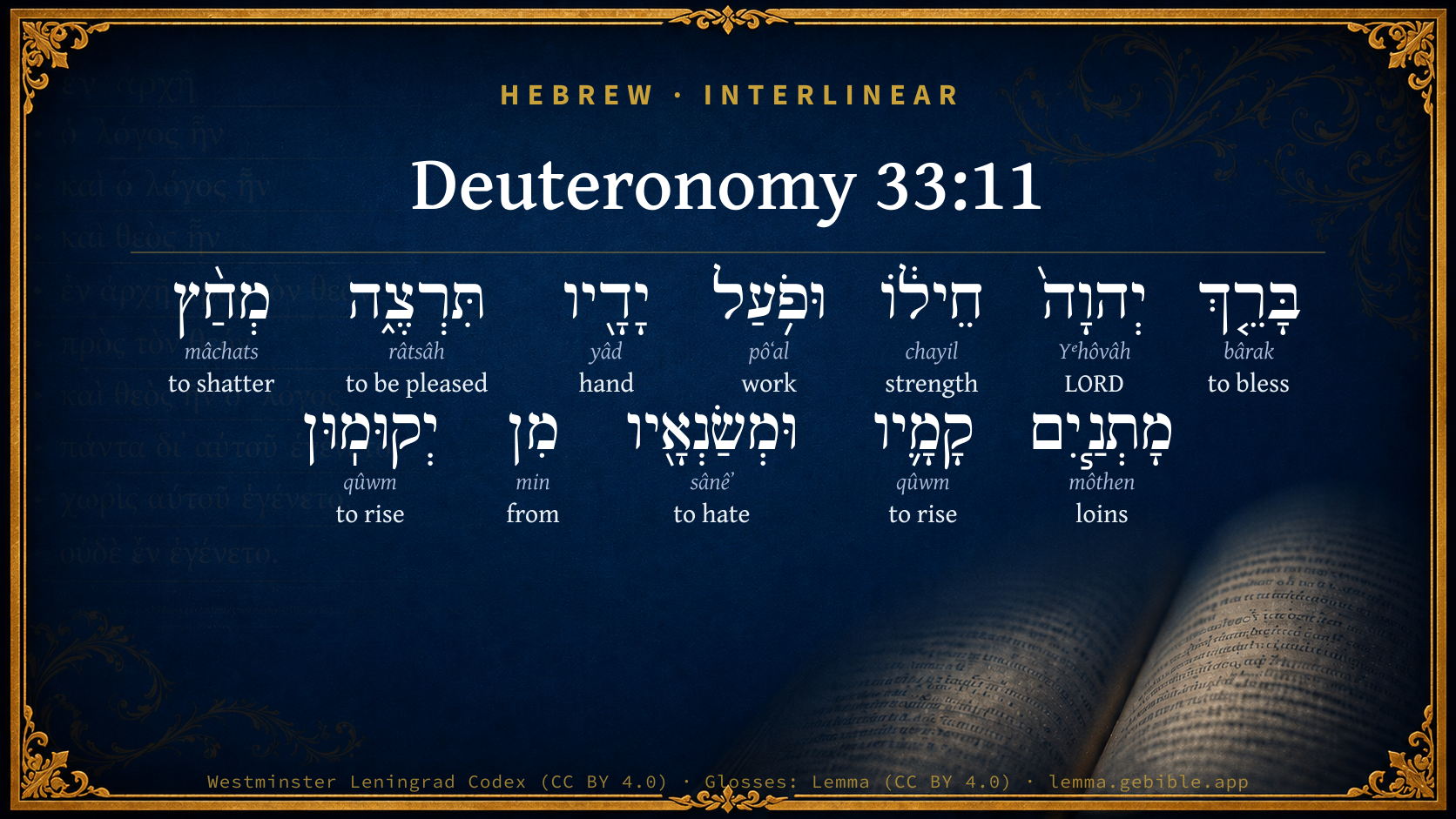
Hebrew (Westminster Leningrad Codex) Deuteronomy 33:11 appears in the Hebrew Old Testament. The text above is from the Westminster Leningrad Codex. Each word links to its Strong’s number, a concise gloss, and parsing drawn from the Open Scriptures Hebrew Bible morphology. Click any word for its full Brown-Driver-Briggs (BDB) entry.
Download image
Cite this verse

Deuteronomy 33:11 (World English Bible). Public Domain. Lemma interlinear Bible study tool, https://lemma.gebible.app/v/deuteronomy/33/11.

Show BibTeX & RIS
BibTeX
RIS
English Translation
Bless, Yahweh, his substance, Accept the work of his hands: Smite through the loins of those who rise up against him, Of those who hate him, that they not rise again.
World English Bible · Public Domain
Download a study sheet

One document with this verse’s original text, its word-by-word gloss line, the meaning frame, cross-references with their text, attributed commentary, and full source and license credits — printable, and it pastes into notes with its structure intact.

This verse Autodidact and up

Study sheet (.html) Plain text (.txt)

A passage Seminary Student

Up to 50 verses in one chapter. A passage sheet keeps up to 6 commentary sources and 12 cross-references per verse, in the order this page ranks them, and says so on the sheet whenever that leaves anything out. Ask for a single verse and you get the Autodidact verse sheet above.

Everything on this page stays free to read, with no account — the sheet is a download of what is already on screen, not access to it.

Want to remove ads? Support Godless Engineer
Compare translations 3

The same verse in 3 English versions, stacked beneath the original-language interlinear above. Click any original word for its lexicon entry.

Each is an independent rendering of the whole verse — the interlinear is not word-aligned to these translations.

Highlighted words mark where these versions differ — a whole-verse word diff, not a word-by-word alignment.

  • World English Bible Public Domain
    Bless, Yahweh, his substance, Accept the work of his hands: Smite through the loins of those who rise up against him, Of those who hate him, that they not rise again.
  • King James Version Public Domain
    Bless, LORD, his substance, and accept the work of his hands; smite through the loins of them that rise against him, and of them that hate him, that they rise not again.
  • unfoldingWord Literal Text CC BY-SA 4.0
    Bless, Yahweh, his possessions, and the work of his hands accept. Shatter the loins of those who rise up against him, and haters of him, lest they rise up.”

unfoldingWord Literal Text — © unfoldingWord, licensed CC BY-SA 4.0. Word-aligned USFM3 via Door43 (git.door43.org/unfoldingWord/en_ult).

Versions to compare (up to 4)

3 of 4 selected

Show all 18 translations

Every available English version of this verse, each an independent rendering of the whole verse.

  • World English Bible Public Domain
    Bless, Yahweh, his substance, Accept the work of his hands: Smite through the loins of those who rise up against him, Of those who hate him, that they not rise again.
  • Berean Standard Bible Public Domain
    Bless his substance, O LORD, and accept the work of his hands. Smash the loins of those who rise against him, and of his foes so they can rise no more.”
  • Majority Standard Bible Public Domain
    Bless his substance, O LORD, and accept the work of his hands. Smash the loins of those who rise against him, and of his foes so they can rise no more.”
  • King James Version Public Domain
    Bless, LORD, his substance, and accept the work of his hands; smite through the loins of them that rise against him, and of them that hate him, that they rise not again.
  • American Standard Version (1901) Public Domain
    Bless, Jehovah, his substance, And accept the work of his hands: Smite through the loins of them that rise up against him, And of them that hate him, that they rise not again.
  • Revised Version (1885) Public Domain
    Bless, LORD, his substance, And accept the work of his hands: Smite through the loins of them that rise up against him, And of them that hate him, that they rise not again.
  • Geneva Bible (1599) Public Domain
    Blesse, O Lord, his substance, and accept the worke of his handes: smite through ye loynes of them that rise against him, and of them that hate him, that they rise not againe.
  • Douay-Rheims (1899) Public Domain
    Bless, O Lord, his strength, and receive the works of his hands. Strike the backs of his enemies, and let not them that hate him rise.
  • Young's Literal Translation Public Domain
    Bless, O Jehovah, his strength, And the work of his hands Thou acceptest, Smite the loins of his withstanders, And of those hating him -- that they rise not!
  • Literal Standard Version CC BY-SA 4.0
    Bless, O YHWH, his strength, || And accept the work of his hands, || Strike the loins of his withstanders, || And of those hating him—that they do not rise!
  • Unlocked Literal Bible CC BY-SA 4.0
    Bless, Yahweh, his possessions, and accept the work of his hands. Shatter the loins of those who rise up against him, and those of the people who hate him, so that they do not rise up again.
  • unfoldingWord Literal Text CC BY-SA 4.0
    Bless, Yahweh, his possessions, and the work of his hands accept. Shatter the loins of those who rise up against him, and haters of him, lest they rise up.”
  • Darby Bible Public Domain
    Bless, Jehovah, his substance! And let the work of his hands please thee; Crush the loins of his adversaries, And of them that hate him, that they may never rise again!
  • World Messianic Bible Public Domain
    LORD, bless his skills. Accept the work of his hands. Strike through the hips of those who rise up against him, of those who hate him, that they not rise again.”
  • Webster's Bible Public Domain
    Bless, LORD, his substance, and accept the work of his hands: smite through the loins of them that rise against him, and of them that hate him, that they rise not again.
  • Free Bible Version CC BY-SA 4.0
    Lord, please bless what they have, and accept their service for you. Destroy those who attack them; make sure their enemies never rise again.”
  • Bible in Basic English Public Domain
    Let your blessing, O Lord, be on his substance, may the work of his hands be pleasing to you: may those who take up arms against him and all who have hate for him, be wounded through the heart, never to be lifted up again.
  • JPS Tanakh (1917) Public Domain
    Bless, LORD, his substance, and accept the work of his hands; smite through the loins of them that rise up against him, and of them that hate him, that they rise not again.

Literal Standard Version (2020), Covenant Press — licensed CC BY-SA 4.0. Text via the HelloAO Bible API (eBible.org). Unlocked Literal Bible (unfoldingWord) — licensed CC BY-SA 4.0. Text via the HelloAO Bible API (eBible.org). unfoldingWord Literal Text — © unfoldingWord, licensed CC BY-SA 4.0. Word-aligned USFM3 via Door43 (git.door43.org/unfoldingWord/en_ult). Free Bible Version, Dr. Jonathan Gallagher — licensed CC BY-SA 4.0. Text via the HelloAO Bible API (eBible.org).

Word by word

More ways to search: Search by grammar → Find every occurrence → Compare this word →

Practice this passage: Drill this verse → Learn its vocabulary →

מְחַ֨ץ
mâchats
H4272
“shatter”
Verb, Qal, Imperative, 2nd Person, Masculine, Singular
Part of Speech
Verb
Stem
Qal
Form
Imperative
Person
2nd Person
Gender
Masculine
Number
Singular
Full BDB Definition

Origin: a primitive root

TWOT: 1183

to smite through, shatter, wound severely - (Qal) - to shatter - shattering (participle)
  1. בָּרֵ֤ךְ bârak H1288 “bless” Verb, Piel, Imperative, 2nd Person, Masculine, Singular
  2. יְהוָה֙ Yᵉhôvâh H3068 “LORD” Noun, Proper
  3. חֵיל֔וֹ chayil H2428 “strength · his” Noun, Common, Masculine, Singular, Construct + Suffix, Personal, 3rd Person, Masculine, Singular
  4. וּפֹ֥עַל pôʻal H6467 “and · work of” Conjunction + Noun, Common, Masculine, Singular, Construct
  5. יָדָ֖יו yâd H3027 “hands · his” Noun, Common, Both, Dual, Construct + Suffix, Personal, 3rd Person, Masculine, Singular
  6. תִּרְצֶ֑ה râtsâh H7521 “to be pleased” Verb, Qal, Imperfect, 2nd Person, Masculine, Singular
  7. מָתְנַ֧יִם môthen H4975 “loins” Noun, Common, Masculine, Dual, Absolute
  8. קָמָ֛יו qûwm H6965 “rising · him” Verb, Qal, Participle Active, Masculine, Plural, Construct + Suffix, Personal, 3rd Person, Masculine, Singular
  9. וּמְשַׂנְאָ֖יו sânêʼ H8130 “and · hating · him” Conjunction + Verb, Piel, Participle Active, Masculine, Plural, Construct + Suffix, Personal, 3rd Person, Masculine, Singular
  10. מִן min H4480 “from” Preposition
  11. יְקוּמֽוּן qûwm H6965 “to rise” Verb, Qal, Imperfect, 3rd Person, Masculine, Plural + Suffix, n

About this verse

These counts appear in no published source. They are computed here, from the morphology-tagged text and Lemma’s own curated glosses. What Lemma adds →

12
words
11
distinct lemmas
Pentateuch
section

Notable vocabulary

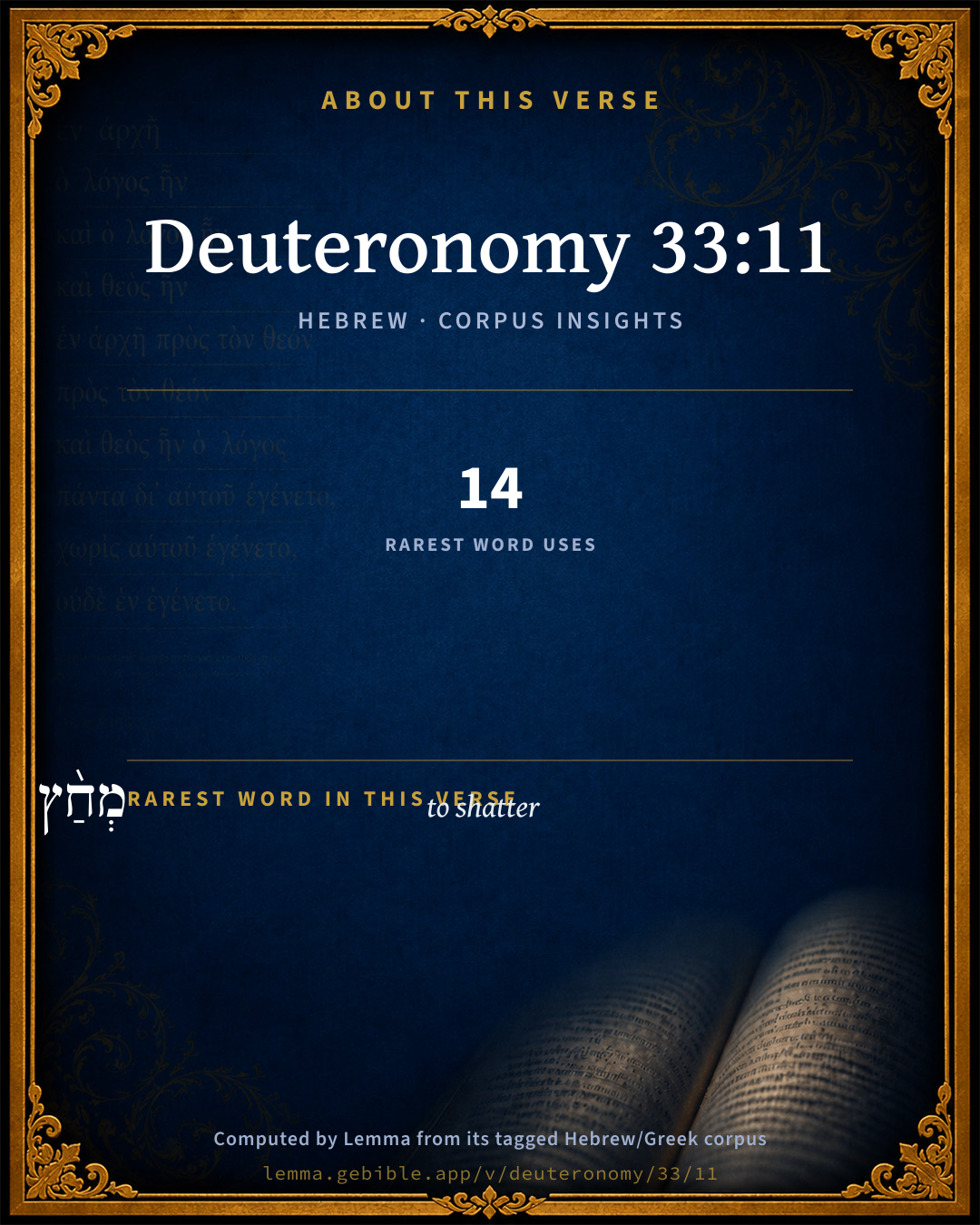
The rarest word here is מְחַ֨ץ to shatter H4272 — appearing just 14 times in the whole Hebrew Bible.

Shared distinctive vocabulary

מְחַ֨ץ to shatter H4272 occurs in 14 verses of the Hebrew Bible. Also found in:

Grammatical profile

  • 6 verbs
  • 5 nouns
  • 1 preposition

Verb forms

  • בָּרֵ֤ךְ Piel · Imperative
  • תִּרְצֶ֑ה Qal · Imperfect
  • מְחַ֨ץ Qal · Imperative
  • קָמָ֛יו Qal · Participle Active
  • וּמְשַׂנְאָ֖יו Piel · Participle Active
  • יְקוּמֽוּן Qal · Imperfect

Repetition

A word recurs within this verse — often emphatic in Hebrew:

  • קָמָ֛יו to rise H6965 ×2

Hebrew & Septuagint length

In English translation the verse runs 31 words from the Hebrew and 32 from the Septuagint (LXX English) — closely comparable.

A rough comparison of the two English renderings, which tokenize alike — not a word-level alignment.

Word counts can differ between the Hebrew and the Greek without any difference in meaning — e.g. the Hebrew direct-object marker אֵת has no separate Greek word, and Greek often adds the article ὁ.

Cross-references

15

Topical passages linked to Deuteronomy 33:11 in the Treasury of Scripture Knowledge — connected by theme and wording, ordered by reader-vote popularity; previews shown in the World English Bible.

  • 2 Samuel 24:23 all this, king, does Araunah give to the king. Araunah said to the king, Yahweh your God accept you.
  • Ezekiel 20:40–41 For in my holy mountain, in the mountain of the height of Israel, says the Lord Yahweh, there shall all the house of Israel, all of them, serve me in the land: there will I accept them, and there will I require your offerings, and the first fruits of your offerings, with all your holy things.
  • Ezekiel 43:27 When they have accomplished the days, it shall be that on the eighth day, and forward, the priests shall make your burnt offerings on the altar, and your peace-offerings; and I will accept you, says the Lord Yahweh.
  • Numbers 18:8–20 Yahweh spoke to Aaron, I, behold, I have given you the charge of my heave-offerings, even all the holy things of the children of Israel; to you have I given them by reason of the anointing, and to your sons, as a portion forever.
  • Numbers 35:2–8 Command the children of Israel that they give to the Levites of the inheritance of their possession cities to dwell in; and suburbs for the cities round about them shall you give to the Levites.
  • Deuteronomy 18:1–5 The priests the Levites, [even] all the tribe of Levi, shall have no portion nor inheritance with Israel: they shall eat the offerings of Yahweh made by fire, and his inheritance.
  • Psalms 20:3 Remember all your offerings, And accept your burnt sacrifice. Selah.
  • Isaiah 29:21 that make a man an offender in [his] cause, and lay a snare for him who reproves in the gate, and turn aside the just with a thing of nothing.
  • Jeremiah 15:10 Woe is me, my mother, that you have borne me a man of strife and a man of contention to the whole earth! I have not lent, neither have men lent to me; [yet] everyone of them does curse me.
  • Amos 5:10 They hate him who reproves in the gate, And they abhor him who speaks blamelessly.
  • Malachi 1:8–10 When you offer the blind for sacrifice, isn't that evil? And when you offer the lame and sick, isn't that evil? Present it now to your governor! Will he be pleased with you? Or will he accept your person?" says Yahweh of Hosts.
  • Matthew 10:14–15 Whoever doesn't receive you, nor hear your words, as you go out of that house or that city, shake off the dust from your feet.
  • Luke 10:10–12 But into whatever city you enter, and they don't receive you, go out into the streets of it and say,
  • Luke 10:16 Whoever listens to you listens to me, and whoever rejects you rejects me. Whoever rejects me rejects him who sent me."
  • 1 Thessalonians 4:8 Therefore he who rejects doesn't reject man, but God, who has also given his Holy Spirit to you.

Cross-references courtesy of OpenBible.info (CC BY 4.0).

Hebrew and Greek witnesses Masoretic Hebrew ↔ Greek Septuagint

The same verse in the two great witnesses to the Old Testament, shown verse-for-verse.

These are two independent witnesses, not word-aligned to each other, and the Septuagint is shown in lemma (dictionary) form.

Hebrew Deuteronomy 33:11 Masoretic · Westminster Leningrad Codex

בָּרֵ֤ךְ יְהוָה֙ חֵיל֔וֹ וּפֹ֥עַל יָדָ֖יו תִּרְצֶ֑ה מְחַ֨ץ מָתְנַ֧יִם קָמָ֛יו וּמְשַׂנְאָ֖יו מִן יְקוּמֽוּן

Bless, Yahweh, his substance, Accept the work of his hands: Smite through the loins of those who rise up against him, Of those who hate him, that they not rise again.

World English Bible · Public Domain

Greek LXX Deuteronomy 33:11 Septuagint · lemma form

εὐλογέω κύριος ὁ ἰσχύς αὐτός καί ὁ ἔργον ὁ χείρ αὐτός δέχομαι καταἄγω ὀσφύς ἐχθρός ἐπι ἀναἵστημι αὐτός καί ὁ μισέω αὐτός μή ἀναἵστημι

Bless, Lord, his strength, and accept the works of his hands; break the loins of his enemies that have risen up against him, and let not them that hate him rise up.

LXX2012 (modern English Septuagint) · Public Domain

Hebrew: Westminster Leningrad Codex (CC BY 4.0). Greek: Septuagint (public domain); English from LXX2012 (modern English Septuagint) (Public Domain). How the Septuagint differs from the Hebrew →

Targum (Aramaic paraphrase)

2

The Targum is the ancient Jewish Aramaic paraphrase of the Hebrew Scriptures — an interpretive translation, not the Hebrew text itself. Onkelos (literal) and Pseudo-Jonathan (expansive) render the Torah, and Jonathan the Prophets. Coverage is partial: where no permissively-licensed English translation exists for a verse, only the Aramaic is shown. This is verse-level text, not a word-by-word alignment to the Hebrew.

  1. Targum Onkelos Torah (Genesis–Deuteronomy)
    בָּרֵךְ יְיָ נִכְסוֹהִי וְקוּרְבַּן יְדוֹהִי תְּקַבֵּל בְּרַעֲוָא תְּבַר חַרְצָא דְסָנְאוֹהִי וּדְבֵעֲלֵי דְבָבוֹהִי דְלָא יְקוּמוּן

    (no public-domain English translation for this verse)

    Targum Onkelos — Aramaic: “Onkelos Genesis” (public domain); “Onkelos Exodus” (public domain); “Onkelos Leviticus” (public domain); “Onkelos Numbers” (public domain); “Onkelos Deuteronomy” (public domain). English: “Sefaria Community Translation” (CC0 1.0 (public-domain dedication)); “J.W. Etheridge. The Targums of Onkelos and Jonathan Ben Uzziel on the Pentateuch. London: Longmans, Green, 1862” (public domain). Text via Sefaria.

  2. Targum Pseudo-Jonathan Torah (Genesis–Deuteronomy)
    בְּרִיךְ יְיָ נִכְסוֹי דְבֵית לֵוִי דְיַהֲבִין מַעַשְרָא מִן מַעַשְרָא וְקָרְבַּן יְדוֹי דְאֵלִיָהוּ כַּהֲנָא דִמְקָרֵב בְּטַוְורָא כַּרְמְלָא תְּקַבֵּל בְּרַעֲוָא תְּבִיר חַרְצָא דְאַחְאָב סַנְאֵיהּ וּפוּרְקַת נְבִיֵי שִׁקְרָא דְקַיְימִין לְקוּבְלֵיהּ וְלָא יְהֵי לְסַנָאוֹי דְיוֹחָנָן כַּהֲנָא רַבָּא רֶגֶל לְמֵיקוּם

    Bless Lord, the sacrifice of the house of Levi, who give the tenth of the tenth; and the oblation of the hand of Elijah the priest, which he will offer on Mount Karmela, receive Thou with acceptance: break the lons of Achab his enemy, and the neck of the false prophets who rise up against him, that the enemies of Johanan the high priest may not have a foot to stand.

    Targum Pseudo-Jonathan — Aramaic: “Targum Jonathan on Genesis” (public domain); “Targum Jonathan on Exodus” (public domain); “Targum Jonathan on Leviticus” (public domain); “Targum Jonathan on Numbers” (public domain); “Targum Jonathan on Deuteronomy” (public domain). English: “The Targum of Jonathan ben Uzziel, trans. J. W. Etheridge, London, 1862” (public domain). Text via Sefaria.

Commentary

Notes on Deuteronomy 33:11 from classic Christian and Jewish commentators (each source and its license shown beneath its notes). The classic Christian expositions comment on the surrounding passage and are grouped to its opening verse, so a note may address several verses; the Jewish commentaries on the Tanakh (Rashi and others) are per-verse, so they appear only where the commentator wrote on this verse.

Lemma curates 59 commentaries, every one of them public domain or Creative Commons licensed, each selected and text-cleaned for this edition rather than reprinted as found. About our sources →

Trapp's Complete Commentary

John Trapp

Deu 33:11 Bless, LORD, his substance, and accept the work of his hands: smite through the loins of them that rise against him, and of them that hate him, that they rise not again.

Ver. 11 And of them that hate him.] Ministers shall be sure of many enemies: they hate him that reproveth in the gate. Veritas odium parit; praedieare nihil aliud est quam derivare in se furorem mundi, said Luther: to preach is to get the world’s ill-will. "Ye are the light," saith our Saviour, which is offensive to sore eyes; "ye are the salt of the earth," which is bitter to wounds, and causeth pain to ulcerated parts.

John Trapp, A Commentary or Exposition upon All the Books of the Old and New Testament (1647–1656) — public domain. Text from a community e-Sword module.

Joseph Benson's Commentary

Deu 33:11. Bless, Lord, his substance — Because he hath no inheritance of his own, and therefore wholly depends upon thy blessing. The work of his hands — All his holy administrations, which he fitly calls the work of his hands, because a great part of the service of the Levites and priests was done by the labour of their hand and body, whereas the service of evangelical ministers is more spiritual and heavenly. Smite — He prays thus earnestly for them, because he foresaw they who were to teach and reprove, and chastise others, would have many enemies, and because they were, under God, the great preservers and upholders of religion, and their enemies were the enemies of religion itself.

Joseph Benson's Commentary on the Old and New Testaments (1811–1818) — public domain. Text from a community e-Sword module.

Geneva Bible (1599)

Geneva Bible translators

He declareth that the ministers of God have many enemies, and therefore have need to be prayed for.

Geneva Bible (1599) marginal notes — public domain. Text via Bolls.life.

Adam Clarke's Commentary

Verse 11. Bless, Lord, his substance] The blessing of God to the tribe of Levi was peculiarly necessary, because they had no inheritance among the children of Israel, and lived more immediately than others upon the providence of GOD. Yet, as they lived by the offerings of the people and the tithes, the increase of their substance necessarily implied the increase of the people at large: the more fruitful the land was, the more abundant would the tithes of the Levites be; and thus in the increased fertility of the land the substance of Levi would be blessed.

Adam Clarke's Commentary on the Bible (1810–1826) — public domain. Text from a community e-Sword/MySword module.

Ellicott's Commentary for English Readers

(11) Bless, Lord, his substance.—This petition is consistent with the enactment that Levi should have no land. But a blessing on his substance means a blessing to the whole land of Israel. Levi’s substance Was Israel’s tithe.

Accept the work of his hands.—The chief “work of his hands” was mediatorial for all Israel. The “acceptance” of this work was essential to the welfare of the whole race.

Smite through the loins of them that rise against him.—Rashi refers to the great war begun by the Asmonæans. Mattathias, the father of the Maccabees, was “a priest of the sons of Joiarib from Jerusalem” (1Ma_2:1). In the time of Athaliah and of Antiochus Epiphanes alike, the restorers of the worship of Jehovah, and the deliverers of the nation from a foreign yoke, were priests.

A Bible Commentary for English Readers, edited by Charles John Ellicott (1878–1897) — public domain. Text from a community e-Sword module.

The Cambridge Bible for Schools and Colleges

gen. ed. J. J. S. Perowne

11. when evening cometh on] Gen_24:63. The new day began then.

bathe himself, etc.] Also prescribed in Lev_15:16.

11. substance] Better strength or efficiency and so service, parallel to work of his hands. Yet it might mean host, ranks or order. Calvin retaining substance says ‘it appears to have been intended tacitly to provide against the poverty which awaited the Levites,’ and quotes Psa_132:15.

that rise up against him … that hate him] To what this refers is unknown. Some refer it to Num_16:1 ff. or 1Ki_12:31; and the hostility of the prophets to the priests is well-known. As we have seen, others assign the lines to the ‘Blessing’ on Judah.

The Cambridge Bible for Schools and Colleges (gen. ed. J. J. S. Perowne; Cambridge University Press, 1878–1918) — public domain. Text from a community e-Sword module.

John Gill's Exposition

And of Benjamin he said,.... The tribe of Benjamin, as the Targums of Jonathan and Jerusalem; which is taken notice of next to Levi, because, as the priesthood was in the tribe of Levi, the temple in which the priests officiated was in the tribe of Benjamin, or near it; and is observed next but one to Judah, and before his elder brother Joseph, because his tribe lay between Judah and Joseph, Jos 18:11; and Levi having no inheritance in the land:

the beloved of the Lord shall dwell in safety by him; this is commonly understood of the tribe of Benjamin, beloved by the Lord, as the head of the tribe was by his father Jacob; the first king of Israel being of that tribe, and the temple built in it, or on the edge of it, and its land the most fat and fertile of the land of Canaan, as Josephus (m) observes; and may be said to "dwell by him", the Lord, because the tabernacle of the Lord was so near that tribe, and so to dwell "in safety" under his protection, and which was the means of preserving it from apostasy, when ten tribes revolted: though the Messiah may be intended, the Son of God, and man of God's right hand, the antitype of Benjamin, the beloved of the Lord, and dear son of his love; his Benjamin, who is now in human nature exalted at his right hand: and this may denote his inhabitation in the flesh, and dwelling by or near Benjamin, being born at Bethlehem in the tribe of Judah, bordering on Benjamin, and frequently had his abode in Jerusalem, which was in the tribe of Benjamin, Jos 18:28; and where he was in safety amidst his enemies, they not having power to lay hold on him until his hour was come:

and the Lord shall cover him all the day long; for ever, as Jarchi notes, because that, after Jerusalem was chosen, the divine Majesty dwelt in no other place: this may be understood either of the Messiah covering Benjamin and protecting him, as he is the covert of all his Benjamites and beloved ones, from all their enemies, from all evils and dangers, from all storms and tempests, and everything troublesome and distressing, see Isa 32:2; or the Lord's covering his beloved One the Messiah; as he did in his infancy, from the designs of Herod upon his life, and from the attempts of others before his time was come; he hid him in the shadow of his hand, Isa 49:2,

and he shall dwell between his shoulders; either the Lord shall dwell between the shoulders of Benjamin; the temple in which the Lord dwelt was built on Mount Moriah, in the tribe of Benjamin, in the highest part of his land, as Jarchi notes; the Targums of Jonathan and Jerusalem paraphrase the words,"in his border the Shechinah (or the glory of the Shechinah of the Lord) shall dwell,''for if the temple was not within the tribe of Benjamin, yet it was certainly on the borders of it: or Benjamin shall dwell between the shoulders of the Lord, being bore up and supported by him: Christ dwells in the hearts of his people, and over them as an head, and they dwell upon his shoulders, on which the care and government of them lies, Isa 9:6; in the Talmud (n) this passage is applied to the days of the Messiah.

(m) Antiqu. l. 5. c. 1. sect. 22. (n) T. Bab. Zebachim, fol. 118. 2.

John Gill's Exposition of the Whole Bible (1746–1763) — public domain (CC PDM 1.0). Text via the HelloAO Bible API.

Albert Barnes' Notes on the Bible

Smite through the loins - Rather, strike the loins, i. e., the seat of their strength.

Albert Barnes' Notes on the Bible (1834–1885) — public domain. Text from a community e-Sword/MySword module.

Haydock's Catholic Bible Commentary

Rise. The martial prowess of the Machabees, who were of this tribe, was conspicuous. (Menochius) --- As the Levites had no portion with the rest, but were to live by tithes, &c., Moses begs that God would bless their labours, (Calmet) and suffer none to defraud them of their right. (Haydock)

George Leo Haydock (1774–1849), Haydock's Catholic Family Bible and Commentary, 1859 edition — public domain. Excludes Psalms (Douay-Rheims chapter numbering differs from Protestant) and Deuterocanonical books (Catholic canon only).

Matthew Poole's English Annotations

His substance, i.e. his outward estate, as Deu 8:18, because he hath no inheritance of his own, and therefore wholly depends upon thy blessing. Or, his host or army, as the word is used Eze 37:10. The priests that attended upon God’s service in the tabernacle or temple are oft compared to an host or army in regard of their exquisite order and courses and constant watches there. See Num 4:3.

The work of his hands, i.e. all his holy administrations, which he fitly calls the works of his hands; either more largely, the hand, one great instrument of action being put for all the rest; or because a great part of the service of the Levites and priests was done by the labour of their hand and body, whereas the service of evangelical ministers is more spiritual and heavenly.

Smite through the loins of them that rise against him: he prays thus earnestly for them, partly because he foresaw they who were to teach, and admonish, and reprove, and chastise others would have many enemies, Jer 15:10; Amo 5:10; and partly because they were, under God, the great preservers and upholders of religion, and their enemies were the enemies of religion itself; as is evident from the history of the Old Testament.

Matthew Poole's English Annotations on the Holy Bible (1683–1685) — public domain. Text from a community e-Sword/MySword module.

Whedon's Commentary on the Bible

Daniel D. Whedon

11. Smite through the loins — The loins used to denote the seat of strength. Comp. Psa_69:23; Job_40:16; Pro_31:17.

Daniel D. Whedon (gen. ed.), Commentary on the Old and New Testaments (1874–1909) — public domain. Text from a community e-Sword module.

John Wesley's Explanatory Notes

His substance - Because he hath no inheritance of his own and therefore wholly depends upon thy blessing. The work of his hands - All his holy administrations, which he fitly calls the work of his hands, because a great part of the service of the Levites and priests was done by the labour of their hand and body, whereas the service of evangelical ministers is more spiritual and heavenly. Smite - He pray's thus earnestly for them, because he foresaw they who were to teach and reprove, and chastise others would have many enemies, and because they were under God, the great preservers and upholders of religion, and their enemies were the enemies of religion itself.

John Wesley, Explanatory Notes Upon the Whole Bible (1754–1765) — public domain. Text via the GEBible commentary corpus.

unfoldingWord translationNotes

Door43 World Missions Community

General Information:

Moses continues to bless the tribes of Israel; the blessings are short poems. He continues describing the tribe of Levi, which he began to do in Deuteronomy 33:8. (See: Parallelism)

accept

be pleased with

the work of his hands

Here the word "hands" refers to the whole person. AT: "all the work that he does" (See: Synecdoche)

Shatter the loins of

The loins were considered the center of strength, and are here represent strength. AT: "Take away the strength of" or "Utterly destroy" (See: Metonymy)

rise up ... rise up

This phrase is used twice as a metaphor. AT: "rise up to fight ... cause any more trouble" (See: Metaphor)

rise up against

This is an idiom. AT: "fight against" (See: Idiom)

translationWords

bless

Yahweh

possess

works

hand

loins

raise

unfoldingWord translationNotes — © Distant Shores Media and the Door43 World Missions Community, licensed CC BY-SA 4.0. Source: git.door43.org/Door43/en_tn.

Rashi

Rabbi Shlomo Yitzchaki (Rashi)

מחץ מתנים קמיו means, smite those who rise up against him with a smiting of the loins, similar to the idea that is expressed, (Psalms 69:24) “Make their loins continually to totter”. It was about those who contested the High priesthood that he spake thus. — Another explanation: He foresaw that Hasmon and his sons would in future war with the Greeks, and he therefore prayed for them, because they were few in number, viz., the twelve sons of Hasmon and Eleazar against several myriads of the enemy. On this account he prayed ברך ה׳ חילו ופעל ידיו תרצה BLESS, O LORD, HIS ARMY AND ACCEPT FAVOURABLY THE WORK OF HIS HANDS (cf. Genesis Rabbah 99:2; Midrash Tanchuma, Vayechi 14).

‎ ומשנאיו מן יקומון (The first word is, like קמיו, the object of the verb מחץ) — i.e. smite those who rise up against him and those who hate him (משנאיו), that they shall have no recovery.

Rashi on the Tanakh — English translations: “The Judaica Press complete Tanach with Rashi, translated by A. J. Rosenberg” (CC BY 4.0); “Pentateuch with Rashi's commentary by M. Rosenbaum and A.M. Silbermann, 1929-1934” (public domain); “The Metsudah Tanach series, Lakewood, N.J” (CC BY 4.0); and “The Book of Joshua, Metsudah Publications, 1997” (CC BY 4.0). Text via Sefaria.

Ramban (Nachmanides)

Rabbi Moshe ben Nachman (Ramban / Nachmanides)

BLESS, ETERNAL, ‘CHEILO’ — that they be a great chayil (army). And the meaning thereof is that they should increase and not decrease when they enter the Holiness, similar in meaning to the verse, Cut ye not off the tribe of the families of the Kohathites. It is similarly stated in the admonitions concerning [the Levites], and that they may not die., Verse 19. And Onkelos rendered cheilo — “his possessions,” from the expression and all their flocks, and all ‘cheilam’ (their possessions)., 31:9. He means what our Rabbis have said concerning the incense — that it bestows a blessing [upon the priest that performs that service]. The phrase [before us] is connected with the expression in [the preceding verse], they shall put incense before Thee, because, as a result of it, his possessions will be blessed, as we have been taught: “Fresh priests come and draw lots for the incense.” And in the Sifre it is stated: 352. “Bless, Eternal, ‘cheilo’ — his possessions. From here the Rabbis have deduced: Most priests are wealthy. In the name of Abba the Preacher the Rabbis have said: I have been young, and now am old; yet have I not seen the righteous forsaken — this refers to the seed of Aaron.”

Ramban (Nachmanides) on the Tanakh — English translation: “Commentary on the Torah by Ramban (Nachmanides). Translated and annotated by Charles B. Chavel. New York, Shilo Pub. House, 1971-1976” (CC BY 4.0). Text via Sefaria.

Lesson kit

Teaching starters — assembled from the data on this page, not authored interpretation. Every prompt links to the verse data it draws on. Edit before teaching.

Deuteronomy, in the Pentateuch, opens this verse with 12 words (11 distinct Hebrew lemmas). Its most distinctive word is mâchats (“to shatter”). A historical commentator’s framing appears above. Read the whole chapter for the surrounding context.

Discussion questions

  1. The word mâchats carries the sense “to shatter.” How does it shape the verse?
  2. How does Numbers 24:8, which shares the word «to shatter», read alongside this verse?
  3. What does the repetition of “to rise” (2× in this one verse) do in this verse?
  4. These translations render this verse differently; the difference is in the English rendering, not the original. What questions does that raise?
  5. «בָּרֵ֤ךְ» is a Piel Imperative verb. How does that grammatical form shape the action described?
  6. Compare how Trapp's Complete Commentary and Joseph Benson's Commentary read this verse. Where do they agree or differ?

Things to notice

Reading settings

Reading text

Shown beneath each verse's original-language words.

Old Testament
Old Testament edition

Read the OT as the Masoretic Hebrew (MT) or the Greek Septuagint (LXX).

English shown for the Greek Septuagint (in the Hebrew ↔ Greek comparison).

Comparing translations? Open the Compare panel on any verse page to stack up to four side by side.