

Judges 5:9

Hebrew (Westminster Leningrad Codex) Judges 5:9 appears in the Hebrew Old Testament. The text above is from the Westminster Leningrad Codex. Each word links to its Strong’s number, a concise gloss, and parsing drawn from the Open Scriptures Hebrew Bible morphology. Click any word for its full Brown-Driver-Briggs (BDB) entry.
Download image
Cite this verse

Judges 5:9 (World English Bible). Public Domain. Lemma interlinear Bible study tool, https://lemma.gebible.app/v/judges/5/9.

Show BibTeX & RIS
BibTeX
RIS
English Translation
My heart is toward the governors of Israel, Who offered themselves willingly among the people: Bless you Yahweh.
World English Bible · Public Domain
Download a study sheet

One document with this verse’s original text, its word-by-word gloss line, the meaning frame, cross-references with their text, attributed commentary, and full source and license credits — printable, and it pastes into notes with its structure intact.

This verse Autodidact and up

Study sheet (.html) Plain text (.txt)

A passage Seminary Student

Up to 50 verses in one chapter. A passage sheet keeps up to 6 commentary sources and 12 cross-references per verse, in the order this page ranks them, and says so on the sheet whenever that leaves anything out. Ask for a single verse and you get the Autodidact verse sheet above.

Everything on this page stays free to read, with no account — the sheet is a download of what is already on screen, not access to it.

Want to remove ads? Support Godless Engineer
Compare translations 3

The same verse in 3 English versions, stacked beneath the original-language interlinear above. Click any original word for its lexicon entry.

Each is an independent rendering of the whole verse — the interlinear is not word-aligned to these translations.

Highlighted words mark where these versions differ — a whole-verse word diff, not a word-by-word alignment.

  • World English Bible Public Domain
    My heart is toward the governors of Israel, Who offered themselves willingly among the people: Bless you Yahweh.
  • King James Version Public Domain
    My heart is toward the governors of Israel, that offered themselves willingly among the people. Bless ye the LORD.
  • unfoldingWord Literal Text CC BY-SA 4.0
    My heart is to the commanders of Israel, the ones volunteering themselves among the people. Bless Yahweh!

unfoldingWord Literal Text — © unfoldingWord, licensed CC BY-SA 4.0. Word-aligned USFM3 via Door43 (git.door43.org/unfoldingWord/en_ult).

Versions to compare (up to 4)

3 of 4 selected

Show all 18 translations

Every available English version of this verse, each an independent rendering of the whole verse.

  • World English Bible Public Domain
    My heart is toward the governors of Israel, Who offered themselves willingly among the people: Bless you Yahweh.
  • Berean Standard Bible Public Domain
    My heart is with the princes of Israel, with the volunteers among the people. Bless the LORD!
  • Majority Standard Bible Public Domain
    My heart is with the princes of Israel, with the volunteers among the people. Bless the LORD!
  • King James Version Public Domain
    My heart is toward the governors of Israel, that offered themselves willingly among the people. Bless ye the LORD.
  • American Standard Version (1901) Public Domain
    My heart is toward the governors of Israel, That offered themselves willingly among the people: Bless ye Jehovah.
  • Revised Version (1885) Public Domain
    My heart is toward the governors of Israel, that offered themselves willingly among the people: bless ye the LORD.
  • Geneva Bible (1599) Public Domain
    Mine heart is set on the gouernours of Israel, and on them that are willing among the people: praise ye the Lord.
  • Douay-Rheims (1899) Public Domain
    My heart loveth the princes of Israel: O you that of your own good will offered yourselves to danger, bless the Lord.
  • Young's Literal Translation Public Domain
    My heart `is' to the lawgivers of Israel, Who are offering themselves willingly among the people, Bless ye Jehovah!
  • Literal Standard Version CC BY-SA 4.0
    My heart [is] to the lawgivers of Israel, || Who are offering themselves willingly among the people, || Bless YHWH!
  • Unlocked Literal Bible CC BY-SA 4.0
    My heart goes out to the commanders of Israel, along with the people who gladly volunteered— we bless Yahweh for them!
  • unfoldingWord Literal Text CC BY-SA 4.0
    My heart is to the commanders of Israel, the ones volunteering themselves among the people. Bless Yahweh!
  • Darby Bible Public Domain
    My heart goes out to the commanders of Israel who offered themselves willingly among the people. Bless the LORD.
  • World Messianic Bible Public Domain
    My heart is toward the governors of Israel, who offered themselves willingly among the people. Bless the LORD!
  • Webster's Bible Public Domain
    My heart is towards the governors of Israel that offered themselves willingly among the people: Bless ye the LORD.
  • Free Bible Version CC BY-SA 4.0
    My thoughts are with the Israelite commanders and those people who volunteered. Praise the Lord!
  • Bible in Basic English Public Domain
    Come, you rulers of Israel, you who gave yourselves freely among the people: give praise to the Lord.
  • JPS Tanakh (1917) Public Domain
    My heart is toward the governors of Israel, that offered themselves willingly among the people. Bless ye the LORD.

Literal Standard Version (2020), Covenant Press — licensed CC BY-SA 4.0. Text via the HelloAO Bible API (eBible.org). Unlocked Literal Bible (unfoldingWord) — licensed CC BY-SA 4.0. Text via the HelloAO Bible API (eBible.org). unfoldingWord Literal Text — © unfoldingWord, licensed CC BY-SA 4.0. Word-aligned USFM3 via Door43 (git.door43.org/unfoldingWord/en_ult). Free Bible Version, Dr. Jonathan Gallagher — licensed CC BY-SA 4.0. Text via the HelloAO Bible API (eBible.org).

Word by word

More ways to search: Search by grammar → Find every occurrence → Compare this word →

Practice this passage: Drill this verse → Learn its vocabulary →

הַמִּֽתְנַדְּבִ֖ים
nâdab
H5068
“the · inciting”
Particle, Definite Article + Verb, Hithpael, Participle Active, Masculine, Plural, Absolute
Part of Speech
Particle + Verb
Stem
Hithpael
Form
Participle Active
Gender
Masculine
Number
Plural
State
Absolute
Full BDB Definition

Origin: a primitive root

TWOT: 1299

to incite, impel, make willing - (Qal) to incite, impel - (Hithpael) - to volunteer - to offer free-will offerings
  1. לִבִּי֙ lêb H3820 “heart · my” Noun, Common, Masculine, Singular, Construct + Suffix, Personal, 1st Person, Common, Singular
  2. לְחוֹקְקֵ֣י châqaq H2710 “to/for · decreeing” Preposition + Verb, Qal, Participle Active, Masculine, Plural, Construct
  3. יִשְׂרָאֵ֔ל Yisrâʼêl H3478 “Israel” Noun, Proper
  4. בָּעָ֑ם ʻam H5971 “in/at the · people” Preposition, Determined + Noun, Common, Masculine, Singular, Absolute
  5. בָּרֲכ֖וּ bârak H1288 “bless” Verb, Piel, Imperative, 2nd Person, Masculine, Plural
  6. יְהוָֽה Yᵉhôvâh H3068 “LORD” Noun, Proper

About this verse

These counts appear in no published source. They are computed here, from the morphology-tagged text and Lemma’s own curated glosses. What Lemma adds →

7
words
7
distinct lemmas
Historical
section

Notable vocabulary

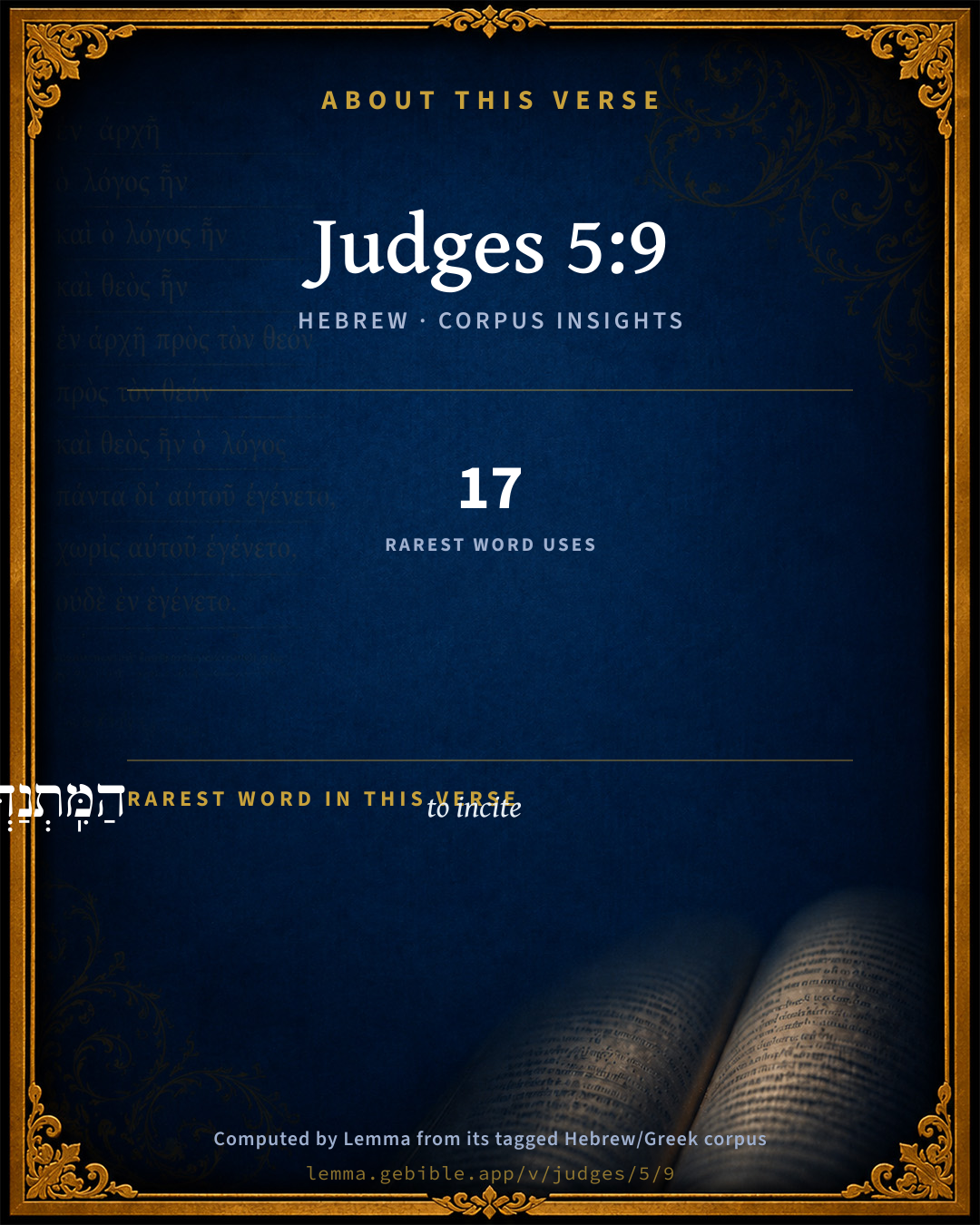
The rarest word here is הַמִּֽתְנַדְּבִ֖ים to incite H5068 — appearing just 17 times in the whole Hebrew Bible.

Shared distinctive vocabulary

הַמִּֽתְנַדְּבִ֖ים to incite H5068 occurs in 15 verses of the Hebrew Bible. Also found in:

Grammatical profile

  • 3 verbs
  • 4 nouns

Verb forms

  • לְחוֹקְקֵ֣י Qal · Participle Active
  • הַמִּֽתְנַדְּבִ֖ים Hithpael · Participle Active
  • בָּרֲכ֖וּ Piel · Imperative

Hebrew & Septuagint length

In English translation the verse runs 18 words from the Hebrew and 19 from the Septuagint (LXX English) — closely comparable.

A rough comparison of the two English renderings, which tokenize alike — not a word-level alignment.

Word counts can differ between the Hebrew and the Greek without any difference in meaning — e.g. the Hebrew direct-object marker אֵת has no separate Greek word, and Greek often adds the article ὁ.

Cross-references

6

Topical passages linked to Judges 5:9 in the Treasury of Scripture Knowledge — connected by theme and wording, ordered by reader-vote popularity; previews shown in the World English Bible.

  • Judges 5:2 For that the leaders took the lead in Israel, For that the people offered themselves willingly, Bless you Yahweh.
  • 1 Chronicles 29:9 Then the people rejoiced, because they offered willingly, because with a perfect heart they offered willingly to Yahweh: and David the king also rejoiced with great joy.
  • 2 Corinthians 8:3–4 For according to their power, I testify, yes and beyond their power, they gave of their own accord,
  • 2 Corinthians 8:12 For if the readiness is there, it is acceptable according to what you have, not according to what you don't have.
  • 2 Corinthians 8:17 For he indeed accepted our exhortation, but being himself very earnest, he went out to you of his own accord.
  • 2 Corinthians 9:5 I thought it necessary therefore to entreat the brothers that they would go before to you, and arrange ahead of time the generous gift that you promised before, that the same might be ready as a matter of generosity, and not of greediness.

Cross-references courtesy of OpenBible.info (CC BY 4.0).

Hebrew and Greek witnesses Masoretic Hebrew ↔ Greek Septuagint

The same verse in the two great witnesses to the Old Testament, shown verse-for-verse.

These are two independent witnesses, not word-aligned to each other, and the Septuagint is shown in lemma (dictionary) form.

Hebrew Judges 5:9 Masoretic · Westminster Leningrad Codex

לִבִּי֙ לְחוֹקְקֵ֣י יִשְׂרָאֵ֔ל הַמִּֽתְנַדְּבִ֖ים בָּעָ֑ם בָּרֲכ֖וּ יְהוָֽה

My heart is toward the governors of Israel, Who offered themselves willingly among the people: Bless you Yahweh.

World English Bible · Public Domain

Greek LXX Judges 5:9 Septuagint · lemma form

ὁ καρδία ἐγώ εἰς ὁ διατάσσω ὁ ἰσραήλ ὁ ἑκουσιάζομαι ἐν λαός εὐλογέω κύριος

My heart inclines to the orders given in Israel; you⌃ that are willing among the people, bless the Lord.

LXX2012 (modern English Septuagint) · Public Domain

Hebrew: Westminster Leningrad Codex (CC BY 4.0). Greek: Septuagint (public domain); English from LXX2012 (modern English Septuagint) (Public Domain). How the Septuagint differs from the Hebrew →

Targum (Aramaic paraphrase)

1

The Targum is the ancient Jewish Aramaic paraphrase of the Hebrew Scriptures — an interpretive translation, not the Hebrew text itself. Onkelos (literal) and Pseudo-Jonathan (expansive) render the Torah, and Jonathan the Prophets. Coverage is partial: where no permissively-licensed English translation exists for a verse, only the Aramaic is shown. This is verse-level text, not a word-by-word alignment to the Hebrew.

  1. Targum Jonathan Prophets (Joshua–Malachi)
    אֲמַרַת דְבוֹרָה בִּנְבוּאָה אֲנָא שְׁלִיחָא לְשַׁבָּחָא לְסַפְרֵי יִשְׂרָאֵל דְכַד הֲוַת עַקְתָא הַהִיא לָא פְּסָקוּ מִלְמִדְרַשׁ בְּאוֹרַיְתָא וּכְדוּ יָאֵי לְהוֹן דְיַתְבִין בְּבָתֵּי כְנִשְׁתָּא בְּרֵישׁ גְלֵי וּמְאַלְפִין יַת עַמָא פִּתְגָמֵי אוֹרַיְתָא וּמְבָרְכִין וּמוֹדִין קֳדָם יְיָ:

    (no public-domain English translation for this verse)

    Targum Jonathan — Aramaic: “Mikraot Gedolot” (public domain). English: “Sefaria Community Translation” (CC0 1.0 (public-domain dedication)); “London "Chaldee Paraphrase," 1871” (public domain). Text via Sefaria.

Commentary

Notes on Judges 5:9 from classic Christian and Jewish commentators (each source and its license shown beneath its notes). The classic Christian expositions comment on the surrounding passage and are grouped to its opening verse, so a note may address several verses; the Jewish commentaries on the Tanakh (Rashi and others) are per-verse, so they appear only where the commentator wrote on this verse.

Lemma curates 59 commentaries, every one of them public domain or Creative Commons licensed, each selected and text-cleaned for this edition rather than reprinted as found. About our sources →

The Cambridge Bible for Schools and Colleges

gen. ed. J. J. S. Perowne

9. governors] Apparently the same word as in Jdg_5:14, though the form is slightly different, lit. lawgivers, Isa_10:1; but in a primitive community the lawgivers would be the military leaders (Jdg_5:14), hence tr. commanders, cf. Deu_33:21, Isa_33:22; Vulgate principes.

That offered themselves willingly] See on Jdg_5:2. The verse seems to repeat the thought of Jdg_5:2, though the meaning of the latter is doubtful.

9–11. The celebration of Jehovah’s acts. This seems to be the meaning of Jdg_5:11; Jdg_5:9-10 are exceedingly obscure, owing to the condition of the text. After dwelling upon Israel’s sufferings, the poet, so far as we understand him, turns with thankful emotion to those who helped to put an end to them.

The Cambridge Bible for Schools and Colleges (gen. ed. J. J. S. Perowne; Cambridge University Press, 1878–1918) — public domain. Text from a community e-Sword module.

Trapp's Complete Commentary

John Trapp

Jdg 5:9 My heart [is] toward the governors of Israel, that offered themselves willingly among the people. Bless ye the LORD.

Ver. 9. My heart is toward the governors of Israel.] Heb., Those in whom was the legislative power, that they should lay by their parliament robes and gird on their swords to fight against the common enemy: that these he goats should go before the flocks, {Jer 50:8} this got them a great deal of love and honour.

John Trapp, A Commentary or Exposition upon All the Books of the Old and New Testament (1647–1656) — public domain. Text from a community e-Sword module.

Joseph Benson's Commentary

Jdg 5:9. My heart is toward the governors — I honour and love those, who, being the chief of the people in wealth and dignity, did not withdraw themselves from the work, as such usually do; but exposed themselves to the same hazards, and joined with their brethren in this noble but dangerous attempt. It seems by this that there were some of the greatest men in the tribes of Naphtali and Zebulun, who, of their own accord, hazarded their lives among the common people in this service. And toward these Deborah expresses singular affection; and with the praises of God intermixes the commendation of those who were his instruments in this deliverance. Bless ye the Lord — Who inclined their hearts to this undertaking, and gave them success in it. This she adds like a prophetess of the Lord, who, when she commends the most deserving of men, would not fail to raise their thoughts to God, the original source of all that is excellent and praiseworthy.

Joseph Benson's Commentary on the Old and New Testaments (1811–1818) — public domain. Text from a community e-Sword module.

Lange's Commentary on the Holy Scriptures

The summons to praise god for deliverance

Jdg_5:9-11

9My heart (was) with the Orderers of Israel,

Who devoted themselves among the people,—Praise God!

10 Ye who ride on beautifully-saddled asses,

Who sit on mats,

And walk through ways,—Sing!

11 Instead of the cry of the contending at the cisterns,

They praise there the benefaction of God,

The benefaction of his freedom in Israel,—

When the People of God hastened down to the gates.

EXEGETICAL AND DOCTRINAL

Jdg_5:9. Deborah has delineated, first, the glorious majesty of God; then, in contrast therewith, the ruin which overtook Israel because it forsook Him, and chose new gods who cannot help, till she arose, a mother in Israel. With that she returns to the beginning. For what had she done? She had called on the people to turn back, and consecrate themselves to God. When everything lay prostrate, Barak and his faithful followers had taken the vows of God upon themselves. If Deborah had become a “strong one” (gibbor) in Israel, so had those who followed her inspiring call. If she speaks of herself as Deliverer, it is not without including those to whom she imparted her faithful and courageous “heart.” Jdg_5:9 resumes Jdg_5:2. The ground of all her praise, is that Israel turned again to God. This had been stated in Jdg_5:2; here, by way of farther transition from Jdg_5:7, she adds the expression “my heart:” she has infused the new spirit into Israel. She has imparted her heart to the people, as a mother to her children. The “heart” is the seat of divine inspirations and hopes; it is the organ that praises, desires, and seeks after God. The contents of Deborah’s heart flowed over into Israel. “If thou wilt go with me,” says Barak, “then I will go.” “My heart,” she exclaims, “was with the orderers of Israel,” with those who devoted themselves, so that they devoted themselves, when they devoted themselves as חֹקְקֵי of Israel.23 The explanation of חֹקְקֵי has been thought more difficult than it is. It has already been remarked above, that the duty of a Judge was to execute the mishpat, the law of Israel, according to the ordinances of Moses. Whenever a Judge reintroduced the observance of the law, divine order sprang up anew among the people. Now, הֹק and מִשְׁפָּט are ever conjoined (cf. Exo_15:25). “What nation is there,” asks Deu_4:8, “that has such chukkim and mishpatim?” “Hear, O Israel, “reiterates Moses, in Deu_5:1, “the chukkim and mishpatim which I speak in your ears.” “Joshua made a covenant with the people (Jos_24:25), and set them chok and mishpat.” What the Shophet is for the mishpat, that the Chokek is for the chok. Both words have the same grammatical form; both have the same historical relations. Whoever watched over the chok of Israel, was a chokek. They were the Orderers of Israel; for chok is the “order” resulting from law. The men who followed Deborah, the leaders of the people, who staked their lives for Israel’s nationality in God, were not shophetim,—for that word was already used in a definitely restricted sense; but to the name chokekim, which the prophetess gives them, they were justly entitled. They were men of law and national order.

Jdg_5:10. Praise God. The Song of Deborah is a hymn of praise to God: praise forms the keynote to all its variations. The refrain of Jdg_5:2 is here repeated, because the thought of Jdg_5:2 has come up in a new form. The arrangement of the poem is delicate and beautiful. Jdg_5:2 called on all to praise God. Thereupon she herself began to sing, Jdg_5:3 : “I will praise;” her own personality comes to view in her song of God, and again in the saving power through which she became a mother of Israel. From Jdg_5:9 she transfers the work of praise to others. The self-devotion of “her heart” had communicated itself to the people. “Praise God,” she resumes; but now they are to sing who have been delivered, and enjoy the fruits of victory. The whole Song is a hymn of freedom. How extreme and miserable was the recent oppression! The country was full of danger, intercourse interrupted, life enslaved. But now everything is free again. Every kind of movement is practicable. The highways are secure Therefore, praise is to employ all who enjoy this return of rest. Whoever now is able to travel, without being hindered, robbed, or put in peril of his life, is to thank God who restored him this privilege. They who can ride, rest, or walk in peace again—for now animals are not stolen, tents are not plundered, foot-travellers are not murdered,—are to know and proclaim the preciousness of this new blessing. It is the habit of Biblical writers to comprehend the various movements of persons under the terms “walking, standing, and sitting” (cf. Psa_1:1). Here, where the freedom of the open country is spoken of, riding is naturally mentioned in the place of standing, which was included in the other expressions. The riders are represented as riding on אתֹנוֹת צחֹרוֹת. To ride on asses, was certainly a well-known custom (cf. Jdg_10:4; Jdg_12:14); but the mention of “white,” or as it is commonly rendered, “white-dappled” asses, would not be very suitable. Even though the connection of the word צְחֹרוֹת with those roots which signify “to glisten,” should be finally established, still it will always seem more appropriate to refer it to the beautiful, ornamented coverings that served for saddles. But there seems to be also a philological affinity between tsachar and what the Greeks and Romans called σάγμα, σάγη, sagma,24 and the Germans saumsattel (pack-saddle). Asses, we know, carried burdens: provisions, corn, wine, etc. (Gen_42:25; Gen_45:23; 1Sa_25:18; cf. Bochart, Hieroz. i. 184). They are to this day the important beast of burden in Palestine; and to leave the ass unladen, even on steep mountain paths, is considered injurious (Ritter, xvii. 295). The Targum (Jonathan), in its rendering of Lev_15:9, uses the word σάγη; for זָגָא, and not זוֹנָא, is to be read in its text at that place (a fact overlooked by Sachs, Beiträge zur Sprachf., note 2, 196). The thought suggests itself naturally that restored freedom and security must have been of special value to those who transported important and costly articles. The passage becomes peculiarly significant, if brought in to connection with the safety of traffic and intercourse, consequent upon the enemy’s destruction.—And sit on mats. Since here also the blessings of freedom are the subject of discourse, those only can be meant who were accustomed to sojourn in tents and tent-villages. “To spread the covering,” and “to pitch the tent,” are to this day equivalent expressions. “To sit on cloths,” was the poetic phrase for dwelling in the open country, in hamlets, oases, and on highways, without needing the protection of walls and fortifications. מִדִּין (mats) is undoubtedly a plural of מַד, garment. It is in keeping with the make of ancient, especially of oriental dress, that the various terms for garment, covering, cloth, are more indefinite and interchangeable than in modern times.25 Such, for instance, is the case with בֶּגֶד, garment (Num_4:6-13); compare also כְּסוּת, covering (Deu_22:12). For the establishment of this general signification of מִדִּין, Teller has rendered meritorious service. In a manuscript note in a copy of his “Notœ Criticœ,” now in my possession, he directs attention to ἱμάτιον as a cognate word. At all events, that also has the double sense of garment and covering, or cloth. The same, as is well known, is the case with ἐσθής and vestis. The word, mats (Latin, matta), in the translation above, is used merely for the sake of assonance; a philological connection between it and the Hebrew word is not discoverable.—הֹלְכֵי עַל־דֶּדִּ, foot-travellers, on the proper public roads. They too are no longer driven to seek winding paths. All, whether they ride, sit, or walk, have become free. Therefore, sing praise to God! שִׂיחוּ, to celebrate in song, as the Psalmist uses it (Psa_145:5): “Words of thy wonders will I sing” (אָשִׂיחָה).

Jdg_5:11. The prophetess continues to depict the wonderful change from servitude to freedom While the enemy had the upper hand, there was security only within the gates; up to the threshold of these, the inhabitants were hunted and pursued. A lively conception of such a condition of society, may be obtained from the history of Germany from the 13th to the 16th century, when it often happened that large cities were at war with their neighbors. In Palestine, cities being built on hilltops, water must be procured outside of the gates. It was at a well, at the time of water-drawing (Gen_24:11), that Eliezer met Rebecca, coming out of the city. In time of war, this water-drawing was a dangerous occupation. The crowd was great, and every one wished to be the first to get away. Consequently, there was no lack of contention and vociferation. How all that is changed! Now the maidens draw leisurely and merrily, praising God the while, who has restored quiet and security. The philological explanation agrees perfectly with this exposition, verse 11 does not depend on Jdg_5:10; it introduces a new thought. מְחַצְצִים is to be taken or read as מְהַצְצִים, i.e. as participle of the piel הִצָּה, to strive, quarrel, rixari (cf. Num_26:9; Psa_60:2; etc.), connected with the niphal נִצָּה, often used of persons who strive and contend with each other (Deu_25:11; Exo_2:13; etc.).26 The “voice” of those who thus contend is wont to attract attention; and a voice is now also heard: שָׁם יְתַנּוּ, there they sing aloud, there resounds the song of those who praise the mercy of God. (יְחַנּוּ from תָּנָה, piel, imperfect, 3d person, plural, to sound, to sing; Sanskrit, tâna, τόνος, German tönen.) The harsh voice of contention is replaced by the sounds of praise. The burden of this praise? The benefits of God—the benefits which his all-disposing arm has bestowed on Israel, in that, after their self-surrender and return to Him, He has made them free again from the enemy. The consequence of his interposition is פְּרָזוֹן, freedom: Israel is free again, and no longer depends on walls for safety. פְּרָזוֹן is derived from פָּרַז, just as חִפָּזוֹן from חָפַז. It contains the notion of that which is free, of freedom, as it is expressed by the prophet Zechariah, quite in the spirit of our Song, when he says (chapter Jdg_2:8-9 (4, 5)): “Jerusalem shall dwell open (פְּרָזוֹת, i.e. without walls); and I, saith the Lord, will be unto her a wall of fire round about.” When Israel devotes itself to God, it is at rest; accordingly, after the deeds of the several Judges are related, it is constantly added, “and the land had rest.” Then enemies are powerless; exposed hamlets are secure; God is their protection. There, at the cisterns, they praise the goodness of God which manifests itself in this newly recovered freedom.

When the people of God hastened down to the gates. Here also the beauty of the internal arrangement of the Song comes prominently to view. Verse 8 says, they chose themselves new gods, אָז לָחֶם שְׁעָרִים; verse 9—interrupted by the praise of God, but resumed in the last line of Jdg_5:11,—when they devoted themselves to God, לַשְּׁעָרִים אָזיָרְדוּ. When the people apostatized, they were pressed up to their very gates, and fled; when, by self-surrender, they became a people of God, they rushed boldly down to the gates and through them. The consequence of the first was flight; that of the second, impetuous attack.27 In the former case, among forty thousand there was not a man capable of making resistance; in the latter—and herewith the Song enters on the delineation of the conflict,—it was a small band who threw themselves upon the mighty. In Jdg_5:9-11 the prophetess, by praising God for freedom, interrupted the progress of her Song’s narrative, just as she does in Jdg_5:3-5 and in Jdg_5:12, to which and the following verses we now pass on.

Footnotes:

[23][In this sentence our author seems to combine two different explanations of לִבִּי, etc., namely: 1. I imparted my spirit to the “Orderers” of Israel, by virtue of which they became such; and, 2. My heart loves those who proved themselves “Orderers,” etc. The latter explanation, merely hinted at by Dr. Cassel, is that commonly adopted by expositors. Bachmann remarks that if the first idea had been intended, it would have been more clearly expressed Tr.]

[24]For further philological comparisons, see Benfey, i. 433, and Dieffenbach, Celtica, i. 85.

[25]The same may be said of the use of the articles themselves. The popular custom of spreading out garments, like carpets or cloths, for persons to ride or walk over, is sufficiently familiar from the history of our Lord and the usages of both Greeks and Romans.

[26][It does not appear how a piel הִצָּה can possibly be obtained from a niphal נִצָּה. The form מְחַצְצִים, in the text, can only be derived from חָצַע, either directly or indirectly. In the latter case if would be a denominative from הֵץ, an arrow, and would mean “archers;” so Bertheau, Keil, and many other interpreters, both ancient and modern. Many, perhaps most expositors, however, prefer the direct derivation from הָצַץ, to divide, but with various modifications of the radical idea. For a full discussion of the word and the interpretations it has received, see Bachmann, 1. pp. 351–359; it must suffice here to say that he translates it, Beutetheilenden, “those who divide the spoil” They (he explains) who frequent the places of drawing water are to praise the righteous acts of Jehovah, with the joyful voice of those who divide the spoil, cf. Isa_9:2 (3).—Tr.]

[27][Keil and others connect the last clause of Jdg_5:11, not with Jdg_5:9; but with the immediately preceding praise for victory. “After this victory,” says Keil, “the people descended again to its gates, from the mountains and hiding-places whither it had betaken itself for safety from the enemy (Jdg_5:6 f.)—entered again into the plains of the land, into the cities now relieved of enemies.” Similarly, Bachmann. Dr. Cassel’s translation of אָז by “when” is against the usage of the word.—Tr.]

Lange's Commentary on the Holy Scriptures (Critical, Doctrinal, and Homiletical), ed. John Peter Lange, English translation edited by Philip Schaff (1864–1880) — public domain. Text from a community e-Sword module.

Jamieson, Fausset & Brown

Robert Jamieson, A. R. Fausset & David Brown

expresses gratitude to the respective leaders of the tribes which participated in the contest; but, above all, to God, who inspired both the patriotic disposition and the strength.

Jamieson, Fausset & Brown — Commentary Critical and Explanatory on the Whole Bible (1871) — public domain (CC PDM 1.0). Text via the HelloAO Bible API.

Ellicott's Commentary for English Readers

(9) My heart is toward the governors of Israel.—The fact that even in this extremity Israel had men (literally, law-givers) who were willing to brave any danger to rescue their people fills Deborah with gratitude to them and to God.

Among the people.—When the leaders moved, the people moved with them.

A Bible Commentary for English Readers, edited by Charles John Ellicott (1878–1897) — public domain. Text from a community e-Sword module.

John Gill's Exposition

My heart is towards the governors of Israel,.... Most of the Jewish commentators interpret this of their wise men and Scribes, who were willing to teach the people the law and the commandments, even in times of trouble, and did not cease from doing it on that account, and therefore Deborah praises them for it; so the Targum; but Kimchi and Ben Melech understand by them the great men of the nation, their nobles and rulers, who enacted good laws and statutes; or at least took care to see that the good laws they had were put in execution; and these had a share in the affections and good wishes of Deborah, and that chiefly for the following reason:

that offered themselves willingly among the people; to go along with them, and march at the head of them, to fight Sisera and his army; thereby setting a good example, and animating the people to battle, and inspiring them with courage and intrepidity; when they saw their chiefs and the heads of them exposing their lives with them in defence of their country, and the rights of it:

bless ye the Lord; for giving them such spirits, to engage so willingly in this service, and for giving them success in it.

John Gill's Exposition of the Whole Bible (1746–1763) — public domain (CC PDM 1.0). Text via the HelloAO Bible API.

Albert Barnes' Notes on the Bible

My heart ... - In this deplorable weakness of Israel how noble was the conduct of the governors who volunteered to lead the people against their oppressors. Deborah’s heart was filled with admiration as she thought of their patriotic devotion, and broke out into thanksgiving to Yahweh.

Albert Barnes' Notes on the Bible (1834–1885) — public domain. Text from a community e-Sword/MySword module.

Haydock's Catholic Bible Commentary

Princes. Hebrew, "legislators," governors, judges. I cannot refuse them due praise, and I invite them earnestly to bless the Lord, ver. 2.

George Leo Haydock (1774–1849), Haydock's Catholic Family Bible and Commentary, 1859 edition — public domain. Excludes Psalms (Douay-Rheims chapter numbering differs from Protestant) and Deuterocanonical books (Catholic canon only).

Matthew Poole's English Annotations

I greatly honour and love those, who being the chief of the people in wealth and dignity, did not withdraw themselves from the work, as such usually do; but did expose themselves to the same hazards, and joined with their meaner brethren in this noble but dangerous attempt, and by their examples and countenance engaged others in it.

Bless ye the Lord; who inclined their hearts to this undertaking, and gave them success in it. As she gives instruments their due, so she is careful the sovereign Cause and Lord of all lose not his glory.

Matthew Poole's English Annotations on the Holy Bible (1683–1685) — public domain. Text from a community e-Sword/MySword module.

Whedon's Commentary on the Bible

Daniel D. Whedon

9. My heart is towards the rulers — That is, her heart now turns with feelings of gratitude towards those noble Israelitish heroes and chieftains who volunteered in the battle with Sisera.

Daniel D. Whedon (gen. ed.), Commentary on the Old and New Testaments (1874–1909) — public domain. Text from a community e-Sword module.

The Pulpit Commentary

What a contrast with that fainthearted submission was the recent triumphant rising! Exultation and thanksgiving for the devotion of the people break out again, as in ver. 2.

Self-dedication.

Deborah"s heart turns in motherly affection to those rulers of Israel who have willingly offered themselves to the service of their God and their country. It should be the aim of the Christian to emulate such self-devotion in the cause of Christ and of humanity.

I THE OFFERING WAS TO GOD AND THE COUNTRY.

1. It was to God. Though this fact is not expressly named here, as in the case of Jehoshaphat"s captain, Amasiah, (2Ch_17:16) it is plainly implied, inasmuch as the people had been incited by a Divine messenger and were living under a theocracy. God was the King, and the soldier"s fidelity to his king was fidelity to God. Men devote themselves to business, pleasure, art, literature, science. The highest object of devotion is to live to God. This may be pursued through the necessary earthly occupations, elevating and consecrating them by making them part of God"s service.

2. The devotion was also to the country. Patriotism is a Christian duty. But the Christian is called to care for the large human world. We are called upon to live for the good of others, to aim at increasing their happiness and spiritual welfare. This aim is not divergent from that of serving God. We render him service.by working for the good of others according to his will, and so as to render him honour.

II THE OFFERING OF THE GOVERNORS WAS OF THEMSELVES. God is not satisfied with our gifts; he asks for our hearts. (Pro_23:26) The true preachers of God"s will will say, "We seek not yours, but you". (2Co_12:14) No gifts will be acceptable to God until we have first given our own selves to him. (2Co_8:5) The sacrifice of self-dedication, which was symbolised to the Jew in the whole burnt offering, is a sacrifice still looked for under the Christian dispensation, not as a propitiation for sin, but as a thank offering. This, and no less, constitutes our reasonable service. (Rom_12:1) We offer ourselves to God when we render him the homage of our hearts in love, when we sacrifice our wills to his will in submission and obedience, when we make it the object of our life to please and serve and honour him. We cannot compensate for lack of personal devotion by payment, as in some countries the conscript can do in regard to military service. Our gifts will not take the place of our work. We cannot serve God by proxy. The work of the missionary or of any professional agent of the Church must not be regarded as a substitute for the work of the private Christian. God claims the personal service of all of us.

III THE OFFERING WAS VOLUNTARY. Deborah rejoices in the fact that the governors offered themselves willingly.

1. The only acceptable service of God must be willing service. God leaves us free to accept or reject his service, he uses no violent compulsion to drive us into it. There is no conscription for recruiting the regiments of the kingdom of heaven; all soldiers in that glorious army are volunteers. This is important, because

(1) only voluntary service can come from the heart, God values devotion of the heart more than work of the hands, and

(2) only voluntary service will be vigorous and enthusiastic and inspired with the devotion which insures success.

2. We have every motive to render this willing service. We are free from compulsion, but we are not free from obligation. We are to blame if we do not freely offer ourselves, and if we persist in refusing it will go ill with us at the last.

(1) Duty requires the service. The people were summoned by a Divine messenger. We are summoned by the preaching of the kingdom. They were living under the rule of God; God is our King and Lord. They were bound to defend their country in its need; we are bound by nature and Christianity to help our fellow-men in their distress and sin.

(2) Gratitude makes the service one of love. The Jews had seen mighty Divine deliverances; we have the sacrifice of Christ for us and his love constraining us. (2Co_5:15)

In application of these truths it may be noticed that some are waiting to be called into the Church or for service. Such waiting is a mistake. Christ is waiting for us. He has called us; he expects our free self-dedication. Let us not wait to be sought or asked, but freely offer ourselves to his service. A.

The Pulpit Commentary (1880–1919), ed. H.D.M. Spence-Jones & Joseph S. Exell — public domain. Text from a community e-Sword module.

John Wesley's Explanatory Notes

My heart is toward - I honour and love those, who being the chief of the people in wealth and dignity, did not withdraw themselves from the work, as such usually do; but exposed themselves to the same hazards, and joined with their brethren in this noble but dangerous attempt. The Lord - Who inclined their hearts to this undertaking, and gave them success in it. As she gives instruments their due, so she is careful the sovereign cause lose not his glory.

John Wesley, Explanatory Notes Upon the Whole Bible (1754–1765) — public domain. Text via the GEBible commentary corpus.

Keil & Delitzsch

C. F. Keil & F. Delitzsch

9 My heart inclines to the leaders of Israel;

To those who offered themselves willingly in the nation. Praise ye the Lord!

10 Ye that ride upon white asses;

Ye that sit upon covering,

And that walk in the way, reflect!

11 With the voice of the archers among drawers (of water),

There praise ye the righteous acts of the Lord,

The righteous acts of His villages in Israel.

Then the people of the Lord went down to the gates!

We must supply the subst. verb in connection with ל לבּי, "My heart is (sc., inclined) towards the leaders of Israel," i.e., feels itself drawn towards them. הוקק for מהוקק (Jdg 5:14), the determining one, i.e., the commander or leader in war: as in Deu 33:21. The leaders and willing ones are first of all to praise the Lord for having crowned their willingness with victory.

Keil & Delitzsch — Biblical Commentary on the Old Testament (1861–1891) — public domain (CC PDM 1.0). Text via the HelloAO Bible API. (Old Testament only.)

unfoldingWord translationNotes

Door43 World Missions Community

My heart goes out to the commanders of Israel

The word "heart" represents a person's emotions. The phrase "My heart goes out to" is a way of saying that Deborah feels gratitude or appreciation. AT: "I appreciate the commanders of Israel" (See: Metonymy and Idiom)

you who ride on white donkeys ... you who walk along the road

This contrast probably refers to rich people and poor people. AT: "you rich people who ride on white donkeys ... you poor people who walk along the road" (See: Merism)

sitting on rugs for saddles

These rugs were probably used as saddles on the donkey's back to make the rider more comfortable.

translationWords

heart

commander

Israel

bless

Yahweh

donkey

unfoldingWord translationNotes — © Distant Shores Media and the Door43 World Missions Community, licensed CC BY-SA 4.0. Source: git.door43.org/Door43/en_tn.

Rashi

Rabbi Shlomo Yitzchaki (Rashi)

My heart. I, Devorah, [my heart is out] to the legislators of Yisroel—with affection for the sages of Yisroel who volunteered, among the people, saying, "Bless Adonoy, return to Him".

Rashi on the Tanakh — English translations: “The Judaica Press complete Tanach with Rashi, translated by A. J. Rosenberg” (CC BY 4.0); “Pentateuch with Rashi's commentary by M. Rosenbaum and A.M. Silbermann, 1929-1934” (public domain); “The Metsudah Tanach series, Lakewood, N.J” (CC BY 4.0); and “The Book of Joshua, Metsudah Publications, 1997” (CC BY 4.0). Text via Sefaria.

Radak

Rabbi David Kimhi (Radak)

My heart is with Israel’s lawmakers: The great ones among Israel, and its Judges and leaders, who voluntarily offered themselves; my heart and will is for them. And she said to them, "Bless the Lord, who subdued your enemies before you." And the great ones are called, lawmakers, because they establish laws among the people. And "Israel's lawmakers," can [also] be explained [as] its scribes and its sages. So she is saying to them, that they should bless the Lord for this salvation; and the explanation of, "who voluntarily offer themselves among the people," is about teaching them Torah and the commandments.

Radak on the Tanakh — English translations: “Sefaria Community Translation” (CC0 1.0 (public-domain dedication)); “Eliyahu Munk, HaChut Hameshulash” (CC BY 4.0); “Rabbi Mike Feuer, Jerusalem Anthology” (CC BY 4.0); and “R. David Kimhi on the first book of Psalms, Translated by R.G. Finch, London, 1919” (public domain). Text via Sefaria.

Lesson kit

Teaching starters — assembled from the data on this page, not authored interpretation. Every prompt links to the verse data it draws on. Edit before teaching.

Judges, in the Historical, opens this verse with 7 words (7 distinct Hebrew lemmas). Its most distinctive word is nâdab (“to incite”). A historical commentator’s framing appears above. Read the whole chapter for the surrounding context.

Discussion questions

  1. How does “to incite” (nâdab) shape what this verse is saying?
  2. Exodus 25:2 shares the word «to incite» with this verse. How do the two illuminate each other?
  3. These translations render this verse differently. What is at stake in choosing one wording over another?
  4. The verb «לְחוֹקְקֵ֣י» is Qal Participle Active. How does its form color the action?
  5. Reading how The Cambridge Bible for Schools and Colleges and Trapp's Complete Commentary read this verse, where do the two commentators agree and where do they part?

Things to notice

Reading settings

Reading text

Shown beneath each verse's original-language words.

Old Testament
Old Testament edition

Read the OT as the Masoretic Hebrew (MT) or the Greek Septuagint (LXX).

English shown for the Greek Septuagint (in the Hebrew ↔ Greek comparison).

Comparing translations? Open the Compare panel on any verse page to stack up to four side by side.