
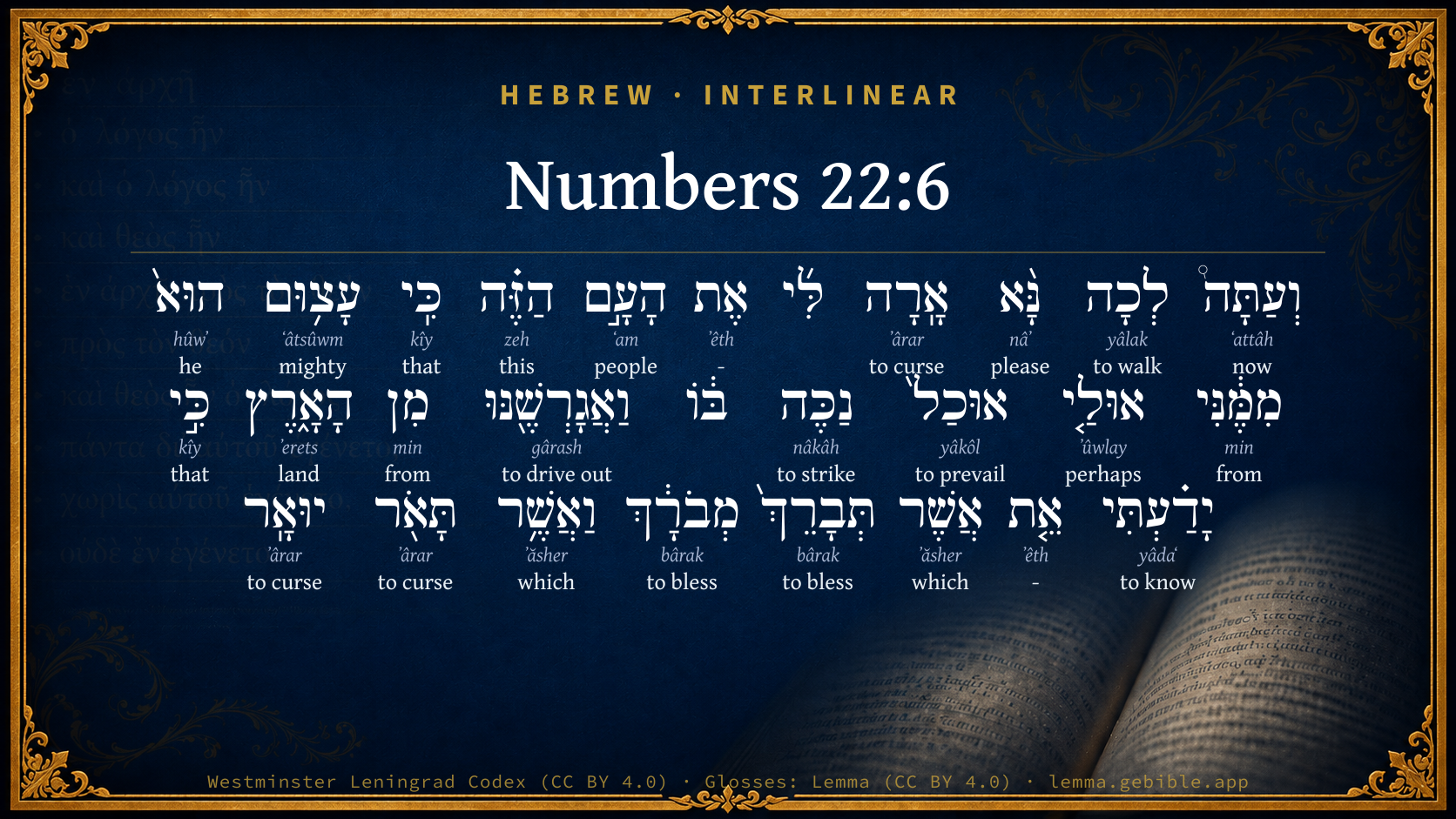
Numbers 22:6

Hebrew (Westminster Leningrad Codex) Numbers 22:6 appears in the Hebrew Old Testament. The text above is from the Westminster Leningrad Codex. Each word links to its Strong’s number, a concise gloss, and parsing drawn from the Open Scriptures Hebrew Bible morphology. Click any word for its full Brown-Driver-Briggs (BDB) entry.
Download image
Cite this verse

Numbers 22:6 (World English Bible). Public Domain. Lemma interlinear Bible study tool, https://lemma.gebible.app/v/numbers/22/6.

Show BibTeX & RIS
BibTeX
RIS
English Translation
Please come now therefore curse me this people; for they are too mighty for me: peradventure I shall prevail, that we may strike them, and that I may drive them out of the land; for I know that he whom you bless is blessed, and he whom you curse is cursed.
World English Bible · Public Domain
Download a study sheet

One document with this verse’s original text, its word-by-word gloss line, the meaning frame, cross-references with their text, attributed commentary, and full source and license credits — printable, and it pastes into notes with its structure intact.

This verse Autodidact and up

Study sheet (.html) Plain text (.txt)

A passage Seminary Student

Up to 50 verses in one chapter. A passage sheet keeps up to 6 commentary sources and 12 cross-references per verse, in the order this page ranks them, and says so on the sheet whenever that leaves anything out. Ask for a single verse and you get the Autodidact verse sheet above.

Everything on this page stays free to read, with no account — the sheet is a download of what is already on screen, not access to it.

Want to remove ads? Support Godless Engineer
Compare translations 3

The same verse in 3 English versions, stacked beneath the original-language interlinear above. Click any original word for its lexicon entry.

Each is an independent rendering of the whole verse — the interlinear is not word-aligned to these translations.

Highlighted words mark where these versions differ — a whole-verse word diff, not a word-by-word alignment.

  • World English Bible Public Domain
    Please come now therefore curse me this people; for they are too mighty for me: peradventure I shall prevail, that we may strike them, and that I may drive them out of the land; for I know that he whom you bless is blessed, and he whom you curse is cursed.
  • King James Version Public Domain
    Come now therefore, I pray thee, curse me this people; for they are too mighty for me: peradventure I shall prevail, that we may smite them, and that I may drive them out of the land: for I wot that he whom thou blessest is blessed, and he whom thou cursest is cursed.
  • unfoldingWord Literal Text CC BY-SA 4.0
    And now, please come, curse people this for me, for it mightier than I. Perhaps I will be able we strike against it and I drive it out from the land. For I know that whom you bless is blessed, and whom you curse will be cursed.”

unfoldingWord Literal Text — © unfoldingWord, licensed CC BY-SA 4.0. Word-aligned USFM3 via Door43 (git.door43.org/unfoldingWord/en_ult).

Versions to compare (up to 4)

3 of 4 selected

Show all 18 translations

Every available English version of this verse, each an independent rendering of the whole verse.

  • World English Bible Public Domain
    Please come now therefore curse me this people; for they are too mighty for me: peradventure I shall prevail, that we may strike them, and that I may drive them out of the land; for I know that he whom you bless is blessed, and he whom you curse is cursed.
  • Berean Standard Bible Public Domain
    So please come now and put a curse on this people, because they are too mighty for me. Perhaps I may be able to defeat them and drive them out of the land; for I know that those you bless are blessed, and those you curse are cursed.”
  • Majority Standard Bible Public Domain
    So please come now and put a curse on this people, because they are too mighty for me. Perhaps I may be able to defeat them and drive them out of the land; for I know that those you bless are blessed, and those you curse are cursed.”
  • King James Version Public Domain
    Come now therefore, I pray thee, curse me this people; for they are too mighty for me: peradventure I shall prevail, that we may smite them, and that I may drive them out of the land: for I wot that he whom thou blessest is blessed, and he whom thou cursest is cursed.
  • American Standard Version (1901) Public Domain
    Come now therefore, I pray thee, curse me this people; for they are too mighty for me: peradventure I shall prevail, that we may smite them, and that I may drive them out of the land; for I know that he whom thou blessest is blessed, and he whom thou cursest is cursed.
  • Revised Version (1885) Public Domain
    come now therefore, I pray thee, curse me this people; for they are too mighty for me: peradventure I shall prevail, that we may smite them, and that I may drive them out of the land: for I know that he whom thou blessest is blessed, and he whom thou cursest is cursed.
  • Geneva Bible (1599) Public Domain
    Come now therefore, I pray thee, and curse me this people (for they are stronger then I) so it may be that I shall be able to smite them, and to driue them out of the land: for I knowe that hee, whome thou blessest, is blessed, and he whom thou cursest, shall be cursed.
  • Douay-Rheims (1899) Public Domain
    Come therefore, and curse this people, because it is mightier than I: if by any means I may beat them and drive them out of my land: for I know that he whom thou shalt bless is blessed, and he whom thou shalt curse is cursed.
  • Young's Literal Translation Public Domain
    and now, come, I pray thee, curse for me this people, for it `is' mightier than I; it may be I prevail -- we smite it -- and I cast it out from the land; for I have known -- that which thou blessest is blessed, and that which thou cursest is cursed.'
  • Literal Standard Version CC BY-SA 4.0
    and now, come, please curse this people for me, for it [is] mightier than I. It may be I prevail, [and] we strike it, and I cast it out from the land; for I have known that which you bless is blessed, and that which you curse is cursed.”
  • Unlocked Literal Bible CC BY-SA 4.0
    So please come now and curse this nation for me, because they are too strong for me. Perhaps then I can manage to attack them and drive them out of the land. I know that whomever you bless will be blessed, and whomever you curse will be cursed.”
  • unfoldingWord Literal Text CC BY-SA 4.0
    And now, please come, curse people this for me, for it mightier than I. Perhaps I will be able we strike against it and I drive it out from the land. For I know that whom you bless is blessed, and whom you curse will be cursed.”
  • Darby Bible Public Domain
    And now come, I pray thee, curse me this people; for they are mightier than I: perhaps I may be able to smite them, and drive them out of the land; for I know that he whom thou blessest is blessed, and he whom thou cursest is cursed.
  • World Messianic Bible Public Domain
    Please come now therefore, and curse this people for me; for they are too mighty for me. Perhaps I shall prevail, that we may strike them, and that I may drive them out of the land; for I know that he whom you bless is blessed, and he whom you curse is cursed.”
  • Webster's Bible Public Domain
    Come now therefore, I pray thee, Curse for me this people; for they are too mighty for me: it may be I shall prevail, that we may smite them, and that I may drive them out of the land: for I know that he whom thou blessest is blessed, and he whom thou cursest is cursed.
  • Free Bible Version CC BY-SA 4.0
    Please come immediately and curse these people for me, because they are stronger than me. Maybe then I'll be able to attack them and drive them out of my country because I know that whoever you bless is blessed, and whoever you curse is cursed.”
  • Bible in Basic English Public Domain
    Come now, in answer to my prayer, and put a curse on this people, for they are greater than I: and then I may be strong enough to overcome them and send them out of the land: for it is clear that good comes to him who has your blessing, but he on whom you put your curse is cursed.
  • JPS Tanakh (1917) Public Domain
    Come now therefore, I pray thee, curse me this people; for they are too mighty for me; peradventure I shall prevail, that we may smite them, and that I may drive them out of the land; for I know that he whom thou blessest is blessed, and he whom thou cursest is cursed.'

Literal Standard Version (2020), Covenant Press — licensed CC BY-SA 4.0. Text via the HelloAO Bible API (eBible.org). Unlocked Literal Bible (unfoldingWord) — licensed CC BY-SA 4.0. Text via the HelloAO Bible API (eBible.org). unfoldingWord Literal Text — © unfoldingWord, licensed CC BY-SA 4.0. Word-aligned USFM3 via Door43 (git.door43.org/unfoldingWord/en_ult). Free Bible Version, Dr. Jonathan Gallagher — licensed CC BY-SA 4.0. Text via the HelloAO Bible API (eBible.org).

Word by word

More ways to search: Search by grammar → Find every occurrence → Compare this word →

Practice this passage: Drill this verse → Learn its vocabulary →

עָצ֥וּם
ʻâtsûwm
H6099
“mighty”
Adjective, Adjective, Masculine, Singular, Absolute
Part of Speech
Adjective
Type
Adjective
Gender
Masculine
Number
Singular
State
Absolute
Full BDB Definition

Origin: pass. part. of H6105

TWOT: 1673d

mighty, vast, numerous - mighty, strong (in number) - numerous, countless
  1. וְעַתָּה֩ ʻattâh H6258 “and · now” Conjunction + Adverb
  2. לְכָה yâlak H3212 “walk” Verb, Qal, Imperative, 2nd Person, Masculine, Singular + Suffix, h
  3. נָּ֨א nâʼ H4994 “please” Particle, Interjection
  4. אָֽרָה ʼârar H779 “curse” Verb, Qal, Imperative, 2nd Person, Masculine, Singular + Suffix, h
  5. אֶת ʼêth H853 “-” Particle, Direct Object
  6. הָעָ֣ם ʻam H5971 “the · people” Particle, Definite Article + Noun, Common, Masculine, Singular, Absolute
  7. הַזֶּ֗ה zeh H2088 “the · this” Particle, Definite Article + Pronoun, Demonstrative, Masculine, Singular
  8. כִּֽי kîy H3588 “that” Conjunction
  9. הוּא֙ hûwʼ H1931 “he” Pronoun, Personal, 3rd Person, Masculine, Singular
  10. מִמֶּ֔נִּי min H4480 “from · me” Preposition + Suffix, Personal, 1st Person, Common, Singular
  11. אוּלַ֤י ʼûwlay H194 “perhaps” Adverb
  12. אוּכַל֙ yâkôl H3201 “to prevail” Verb, Qal, Imperfect, 1st Person, Common, Singular
  13. נַכֶּה nâkâh H5221 “to strike” Verb, Hiphil, Imperfect, 1st Person, Common, Plural
  14. וַאֲגָרְשֶׁ֖נּוּ gârash H1644 “and · to drive out · him” Conjunction + Verb, Piel, Imperfect, 1st Person, Common, Singular + Suffix, Personal, 3rd Person, Masculine, Singular
  15. מִן min H4480 “from” Preposition
  16. הָאָ֑רֶץ ʼerets H776 “the · land” Particle, Definite Article + Noun, Common, Both, Singular, Absolute
  17. כִּ֣י kîy H3588 “that” Conjunction
  18. יָדַ֗עְתִּי yâdaʻ H3045 “to know” Verb, Qal, Perfect, 1st Person, Common, Singular
  19. אֵ֤ת ʼêth H853 “-” Particle, Direct Object
  20. אֲשֶׁר ʼăsher H834 “which” Particle, Relative
  21. תְּבָרֵךְ֙ bârak H1288 “to bless” Verb, Piel, Imperfect, 2nd Person, Masculine, Singular
  22. מְבֹרָ֔ךְ bârak H1288 “blessed” Verb, Pual, Participle Passive, Masculine, Singular, Absolute
  23. וַאֲשֶׁ֥ר ʼăsher H834 “and · which” Conjunction + Particle, Relative
  24. תָּאֹ֖ר ʼârar H779 “to curse” Verb, Qal, Imperfect, 2nd Person, Masculine, Singular
  25. יוּאָֽר ʼârar H779 “to curse” Verb, Hophal, Imperfect, 3rd Person, Masculine, Singular

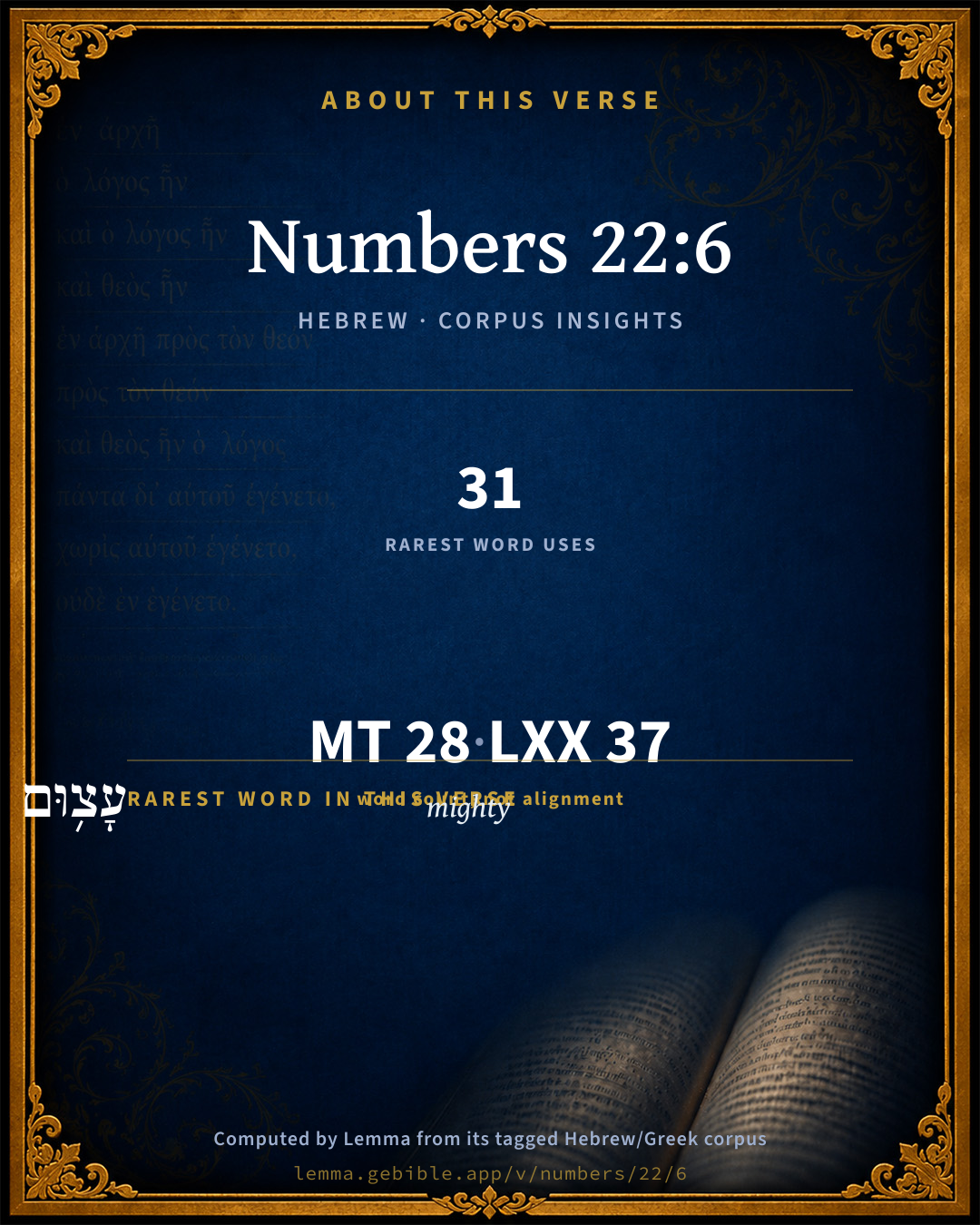
About this verse

These counts appear in no published source. They are computed here, from the morphology-tagged text and Lemma’s own curated glosses. What Lemma adds →

28
words
19
distinct lemmas
Pentateuch
section

Shared distinctive vocabulary

עָצ֥וּם mighty H6099 occurs in 31 verses of the Hebrew Bible. Also found in:

Grammatical profile

  • 10 verbs
  • 2 nouns
  • 1 adjective
  • 2 pronouns
  • 4 prepositions
  • 2 conjunctions
  • 2 adverbs
  • 5 particles

Verb forms

  • לְכָה Qal · Imperative
  • אָֽרָה Qal · Imperative
  • אוּכַל֙ Qal · Imperfect
  • נַכֶּה Hiphil · Imperfect
  • וַאֲגָרְשֶׁ֖נּוּ Piel · Imperfect
  • יָדַ֗עְתִּי Qal · Perfect
  • תְּבָרֵךְ֙ Piel · Imperfect
  • מְבֹרָ֔ךְ Pual · Participle Passive
  • תָּאֹ֖ר Qal · Imperfect
  • יוּאָֽר Hophal · Imperfect

Repetition

Words recur within this verse — often emphatic in Hebrew:

  • אָֽרָה to curse H779 ×3
  • תְּבָרֵךְ֙ to bless H1288 ×2
  • כִּֽי that H3588 ×2
  • מִמֶּ֔נִּי from H4480 ×2
  • אֲשֶׁר which H834 ×2

Hebrew & Septuagint length

In English translation the verse runs 51 words from the Hebrew and 51 from the Septuagint (LXX English) — the same length.

A rough comparison of the two English renderings, which tokenize alike — not a word-level alignment.

Word counts can differ between the Hebrew and the Greek without any difference in meaning — e.g. the Hebrew direct-object marker אֵת has no separate Greek word, and Greek often adds the article ὁ.

In the original languages it is 28 Hebrew tokens and 37 Greek tokens — but the two are counted differently (Hebrew bundles its prefixes and suffixes into one token; the Greek is in lemma form), so that isn’t a like-for-like length.

Cross-references

20

Topical passages linked to Numbers 22:6 in the Treasury of Scripture Knowledge — connected by theme and wording, ordered by reader-vote popularity; previews shown in the World English Bible.

  • Numbers 24:9 He couched, he lay down as a lion, As a lioness; who shall rouse him up? Blessed be everyone who blesses you, Cursed be everyone who curses you.
  • Numbers 23:7–8 He took up his parable, and said, From Aram has Balak brought me, The king of Moab from the mountains of the East: Come, curse me Jacob, Come, defy Israel.
  • Genesis 12:3 I will bless those who bless you, and I will curse him who curses you. In you will all of the families of the earth be blessed."
  • Genesis 27:29 Let peoples serve you, Nations bow down to you. Be lord over your brothers, Let your mother's sons bow down to you. Cursed be everyone who curses you, Blessed be everyone who blesses you."
  • Numbers 22:12 God said to Balaam, You shall not go with them; you shall not curse the people; for they are blessed.
  • Numbers 22:17 for I will promote you to very great honor, and whatever you say to me I will do. Please come therefore, and curse this people for me.
  • Deuteronomy 23:4 because they didn't meet you with bread and with water in the way, when you came forth out of Egypt, and because they hired against you Balaam the son of Beor from Pethor of Mesopotamia, to curse you.
  • 1 Samuel 17:43 The Philistine said to David, Am I a dog, that you come to me with sticks? The Philistine cursed David by his gods.
  • 1 Kings 22:6 Then the king of Israel gathered the prophets together, about four hundred men, and said to them, Shall I go against Ramoth-gilead to battle, or shall I forbear? They said, Go up; for the Lord will deliver it into the hand of the king.
  • 1 Kings 22:8 The king of Israel said to Jehoshaphat, there is yet one man by whom we may inquire of Yahweh, Micaiah the son of Imlah: but I hate him; for he does not prophesy good concerning me, but evil. Jehoshaphat said, "Don't let the king say so."
  • 1 Kings 22:13 The messenger who went to call Micaiah spoke to him, saying, See now, the words of the prophets [declare] good to the king with one mouth: please let your word be like the word of one of them, and speak you good.
  • Nehemiah 13:2 because they didn't meet the children of Israel with bread and with water, but hired Balaam against them, to curse them: however our God turned the curse into a blessing.
  • Psalms 109:17–18 Yes, he loved cursing, and it came to him. He didn't delight in blessing, and it was far from him.
  • Isaiah 47:12–13 Stand now with your enchantments, and with the multitude of your sorceries, in which you have labored from your youth; if so be you shall be able to profit, if so be you may prevail.
  • Ezekiel 13:6 They have seen falsehood and lying divination, who say, Yahweh says; but Yahweh has not sent them: and they have made men to hope that the word would be confirmed.
  • Acts 8:9–10 But there was a certain man, Simon by name, who used to practice sorcery in the city, and amazed the people of Samaria, making himself out to be some great one,
  • Acts 16:16 It happened, as we were going to prayer, that a certain girl having a spirit of divination met us, who brought her masters much gain by fortune telling.
  • Joshua 24:9 Then Balak the son of Zippor, king of Moab, arose and fought against Israel: and he sent and called Balaam the son of Beor to curse you;
  • Psalms 109:28 They may curse, but you bless. When they arise, they will be shamed, But your servant shall rejoice.
  • Proverbs 26:2 Like a fluttering sparrow, Like a darting swallow, So the undeserved curse doesn't come to rest.

Cross-references courtesy of OpenBible.info (CC BY 4.0).

Hebrew and Greek witnesses Masoretic Hebrew ↔ Greek Septuagint

The same verse in the two great witnesses to the Old Testament, shown verse-for-verse.

These are two independent witnesses, not word-aligned to each other, and the Septuagint is shown in lemma (dictionary) form.

Hebrew Numbers 22:6 Masoretic · Westminster Leningrad Codex

וְעַתָּה֩ לְכָה נָּ֨א אָֽרָה לִּ֜י אֶת הָעָ֣ם הַזֶּ֗ה כִּֽי עָצ֥וּם הוּא֙ מִמֶּ֔נִּי אוּלַ֤י אוּכַל֙ נַכֶּה בּ֔וֹ וַאֲגָרְשֶׁ֖נּוּ מִן הָאָ֑רֶץ כִּ֣י יָדַ֗עְתִּי אֵ֤ת אֲשֶׁר תְּבָרֵךְ֙ מְבֹרָ֔ךְ וַאֲשֶׁ֥ר תָּאֹ֖ר יוּאָֽר

Please come now therefore curse me this people; for they are too mighty for me: peradventure I shall prevail, that we may strike them, and that I may drive them out of the land; for I know that he whom you bless is blessed, and he whom you curse is cursed.

World English Bible · Public Domain

Greek LXX Numbers 22:6 Septuagint · lemma form

καί νῦν δεῦρο ἀράομαι ἐγώ ὁ λαός οὗτος ὅτι ἰσχύω οὗτος ἤ ἐγώ ἐάν δύναμαι πατάσσω ἐκ αὐτός καί ἐκβάλλω αὐτός ἐκ ὁ γῆ ὅτι οἶδα ὅς ἐάν εὐλογέω σύ εὐλογέω καί ὅς ἐάν καταἀράομαι σύ καταἀράομαι

And now come, curse me this people, for it is stronger than we; if we may be able to strike some of them, and I will cast them out of the land: for I know that whoever you do bless, they are blessed, and whoever you do curse, they are cursed.

LXX2012 (modern English Septuagint) · Public Domain

Hebrew: Westminster Leningrad Codex (CC BY 4.0). Greek: Septuagint (public domain); English from LXX2012 (modern English Septuagint) (Public Domain). How the Septuagint differs from the Hebrew →

Targum (Aramaic paraphrase)

2

The Targum is the ancient Jewish Aramaic paraphrase of the Hebrew Scriptures — an interpretive translation, not the Hebrew text itself. Onkelos (literal) and Pseudo-Jonathan (expansive) render the Torah, and Jonathan the Prophets. Coverage is partial: where no permissively-licensed English translation exists for a verse, only the Aramaic is shown. This is verse-level text, not a word-by-word alignment to the Hebrew.

  1. Targum Onkelos Torah (Genesis–Deuteronomy)
    וּכְעַן אִיתָא כְּעַן לוֹט לִי יָת עַמָא הָדֵין אֲרֵי תַקִיף הוּא מִנִי מָאִים אֵכוּל לְאַגָחָא בֵּיהּ קְרָב וַאֲתָרֵכִינֵיהּ מִן אַרְעָא אֲרֵי יְדַעֲנָא יָת דִי תְבָרַךְ מְבָרָךְ וְדִי תְלוֹט לִיט

    (no public-domain English translation for this verse)

    Targum Onkelos — Aramaic: “Onkelos Genesis” (public domain); “Onkelos Exodus” (public domain); “Onkelos Leviticus” (public domain); “Onkelos Numbers” (public domain); “Onkelos Deuteronomy” (public domain). English: “Sefaria Community Translation” (CC0 1.0 (public-domain dedication)); “J.W. Etheridge. The Targums of Onkelos and Jonathan Ben Uzziel on the Pentateuch. London: Longmans, Green, 1862” (public domain). Text via Sefaria.

  2. Targum Pseudo-Jonathan Torah (Genesis–Deuteronomy)
    וּכְדוּן אִיתָא בְּבָעוּ לוֹט בְּגִינִי יַת עַמָא הָדֵין אֲרוּם תַּקִיף הוּא מִנִי לְוַואי אֵיכוֹל לְאַזְעוֹרֵיהּ וְאִתְרְכִינֵיהּ מִן אַרְעָא אֲרוּם יַדְעִית יַת דִי תְבוֹרָךְ מְבוֹרָךְ וְדִי תְלוֹט לִיט יֵילוּט

    But now, I entreat, come, curse this people for me, for they are stronger than I, if I may but be able to meet them, though smaller than they, and drive them from the land. For I know that he whom thou dost bless is blessed, and he whom thou dost curse is cursed.

    Targum Pseudo-Jonathan — Aramaic: “Targum Jonathan on Genesis” (public domain); “Targum Jonathan on Exodus” (public domain); “Targum Jonathan on Leviticus” (public domain); “Targum Jonathan on Numbers” (public domain); “Targum Jonathan on Deuteronomy” (public domain). English: “The Targum of Jonathan ben Uzziel, trans. J. W. Etheridge, London, 1862” (public domain). Text via Sefaria.

Commentary

Notes on Numbers 22:6 from classic Christian and Jewish commentators (each source and its license shown beneath its notes). The classic Christian expositions comment on the surrounding passage and are grouped to its opening verse, so a note may address several verses; the Jewish commentaries on the Tanakh (Rashi and others) are per-verse, so they appear only where the commentator wrote on this verse.

Lemma curates 59 commentaries, every one of them public domain or Creative Commons licensed, each selected and text-cleaned for this edition rather than reprinted as found. About our sources →

Trapp's Complete Commentary

John Trapp

Num 22:6 Come now therefore, I pray thee, curse me this people; for they [are] too mighty for me: peradventure I shall prevail, [that] we may smite them, and [that] I may drive them out of the land: for I wot that he whom thou blessest [is] blessed, and he whom thou cursest is cursed.

Ver. 6. Peradventure I shall prevail.] Hence he is said to have warred against Israel. {Jos 24:9} He did not, because he durst not. Sed fieri dicitur, quod tentatur, aut intenditur, saith Ribera on Amo 9:5.

John Trapp, A Commentary or Exposition upon All the Books of the Old and New Testament (1647–1656) — public domain. Text from a community e-Sword module.

Joseph Benson's Commentary

Num 22:6. Curse me this people — Agreeably to a superstitious opinion which prevailed in ancient times, that some men were so much in favour with the gods, that by prayers or imprecations they were able to prosper or blast the designs, not only of particular persons, but of whole armies. Among the worshippers of the true God, the blessings or imprecations of the inspired prophets were, indeed, very justly to be regarded, as being proper predictions of prosperity or disaster; see Gen 49:1-2; and

2Ki 2:24. But it is certain that false prophets, or the worshippers of idols, having no intercourse with God, who alone presides over futurity, but relying only upon delusive and diabolical arts, were mere pretenders to that privilege, which the truly inspired prophets enjoyed.

Joseph Benson's Commentary on the Old and New Testaments (1811–1818) — public domain. Text from a community e-Sword module.

Jamieson, Fausset & Brown

Robert Jamieson, A. R. Fausset & David Brown

Come . . . curse me this people--Among the heathen an opinion prevailed that prayers for evil or curses would be heard by the unseen powers as well as prayers for good, when offered by a prophet or priest and accompanied by the use of certain rites. Many examples are found in the histories of the Greeks and Romans of whole armies being devoted to destruction, and they occur among the natives of India and other heathen countries still. In the Burmese war, magicians were employed to curse the British troops.

Jamieson, Fausset & Brown — Commentary Critical and Explanatory on the Whole Bible (1871) — public domain (CC PDM 1.0). Text via the HelloAO Bible API.

Adam Clarke's Commentary

Verse 6. Come now, therefore, I pray thee, curse me this people] Balaam, once a prophet of the true God, appears to have been one of the Moshelim, (see Nu 21:27), who had added to his poetic gift that of sorcery or divination. It was supposed that prophets and sorcerers had a power to curse persons and places so as to confound all their designs, frustrate their counsels, enervate their strength, and fill them with fear, terror, and dismay. See Ge 9:25; Ps 109:6; Ps 109:20; Jos 6:26; Jer 17:5-6.

Macrobius has a whole chapter De carmine quo evocari solebant dii tutelares, et aut urbes, aut exercitus devoveri. "Of the incantations which were used to induce the tutelary gods to forsake the cities, c., over which they presided, and to devote cities and whole armies to destruction." See Saturnal., lib. iii., cap. ix. He gives us two of the ancient forms used in reference to the destruction of Carthage the first, to call over the protecting deities, was pronounced by the dictator or general, and none other, when they began the siege. It is as follows, literatim et punctatim: -

Si. Deus. si. Dea. est. cui. popolus. civitas. que. Karthaginiensis. est in. tutela. te. que. maxime, ille. qui. urbis. hujus. popoli. que. tutelam. recepisti. precor. veneror, que. veniam. que. a. vobis. peto. ut. vos. popolum. civitatem. que. Karthaginiensem. deseratis. loca. templa. sacra. urbem. que. eorum. relinquatis. absque. his. abeatis. ei. que. popolo. civitati. que. metum. formidinem. oblivionem. injiciatis. proditi. que. Romam. ad. me. meos. que. veniatis. nostra. que. vobis. loca. templa. sacra. urbs. acceptior. probatior. que. sit. mihi. que. popolo. que. Romano. militibus. que. meis. praepositi. sitis. ut. sciamus. intelligamus. que. Si. ita. feceritis. voveo. vobis. templa. ludos. que. facturum.

"Whether it be god or goddess, under whose protection the people and city of Carthage are placed; and thee, especially, who hast undertaken to defend this city and people; I pray, beseech, and earnestly entreat that you would forsake the people and city of Carthage, and leave their places, temples, sacred things, and city, and depart from them: and that you would inspire this people and city with fear, terror, and forgetfulness: and that, coming out from them, you would pass over to Rome, to me, and to mine: and that our places, temples, sacred things, and city may be more agreeable and more acceptable to you: and that you would preside over me, the Roman people, and my soldiers; that we may know and perceive it. If ye will do this, I promise to consecrate to your honour both temples and games."

The second, to devote the city to destruction, which it was supposed the tutelary gods had abandoned, is the following:

Dis. Pater. Vejovis. Manes. sive. vos. quo. allo. nomine. fas. est. nominare. ut. omnes. iliam. urbem. Karthaginem. exercitum. que. quem. ego. me. sentio. dicere. fuga. formidine. terrore. que. compleatis. qui. que. adversum. legiones. exercitum. que. nostrum. arma. tela. que. ferent. Uti. vos. eum. exercitum. eos. hostes. eos. que. homines. urbes. agros. que. eorum. et. qui. in. his. locis. regionibus. que. agris. urbibus. ve. habitant. abducatis. lumine. supero. privetis. exercitum. que. hostium. urbes. agros. que. eorum. quos. me. sentio. dicere. uti. vos. eas. urbes. agros. que. capita. aetates. que. eorum. devotas. consecratas. que. habeatis. illis. legibus. quibus. quando. que. sunt. maxime. hostes. devoti. eos. que. ego. vicarios. pro. me. fide. magistratu. que. meo. pro. popolo. Romano. exercitibus. legionibus. que. nostris. do. devoveo. ut. me. meam. que. fidem. imperium. que. legiones. exercitum. que. nostrum. qui. in. his. rebus. gerundis. sunt. bene. salvos. siritis. esse. Si. haec. ita. faxitis. ut. ego. sciam. sentiam. intelligam. que. tune. quisquis. hoc. votum. faxit. ubi. ubi. faxit. recte. factum. esto. ovibus. atris. tribus. Tellus. mater. te. que. Juppiter. obtestor.

"Dis. Pater. Vejosis. Manes., or by whatsoever name you wish to be invoked, I pray you to fill this city of Carthage with fear and terror; and to put that army to flight which I mention, and which bears arms or darts against OUR legions and armies: and that ye may take away this army, those enemies, those men, their cities and their country, and all who dwell in those places, regions, countries, or cities; and deprive them of the light above: and let all their armies, cities, country, chiefs, and people be held by you consecrated and devoted, according to those laws by which, and at what time, enemies can be most effectually devoted. I also give and devote them as vicarious sacrifices for myself and my magistracy; for the Roman people, and for all our armies and legions; and for the whole empire, and that all the armies and legions which are employed in these countries may be preserved in safety. If therefore ye will do these things, as I know, conceive, and intend, then he who makes this vow wheresoever and whensoever he shall make it, I engage shall sacrifice three black sheep to thee, O mother Earth, and to thee. O Jupiter." "When the execrator mentions the earth, he stoops down and places both his hands on it; and when he names Jupiter, he lifts up both his hands to heaven; and when he mentions his vow, he places his hands upon his breast." Among the ancient records, Macrobius says he found many cities and people devoted in this way. The Romans held that no city could be taken till its tutelary god had forsaken it; or if it could be taken, it would be unlawful, as it would be sacrilegious to have the gods in captivity. They therefore endeavoured to persuade the gods of their enemies to come over to their party. Virgil intimates that Troy was destroyed, only because the tutelary gods had forsaken it: -

Excessere omnes, adytis arisque relictis,

Dii, quibus imperium hoc steterat.

AEn., lib. ii., ver. 351.

"All the gods, by whose assistance the empire had hitherto been preserved, forsook their altars and their temples." And it was on this account that the Greeks employed all their artifice to steal away the Palladium, on which they believed the safety of Troy depended.

Tacitus observes that when Suetonius Paulinus prepared his army to cross over into Mona, (Anglesea,) where the Britons and Druids made their last stand, the priestesses, with dishevelled hair, white vestments, and torches in their hands, ran about like furies, devoting their enemies to destruction; and he farther adds that the sight, the attitude, and horrible imprecations of these priestesses had such effect on the Roman soldiers, that for a while they stood still and suffered themselves to be pierced with the darts of the Britons, without making any resistance. Tacit. Ann., l. xiv., c. 29. Many accounts are related in the Hindoo Pooran of kings employing sages to curse their enemies when too powerful for them. - WARD'S Customs.

The Jews also had a most horrible form of execration, as may be seen in Buxtorf's Talmudical Lexicon under the word תדם. These observations and authorities, drawn out in so much detail, are necessary to cast light on the strange and curious history related in this and the two following chapters.

Adam Clarke's Commentary on the Bible (1810–1826) — public domain. Text from a community e-Sword/MySword module.

Ellicott's Commentary for English Readers

(6) Curse me this people.—Balak undoubtedly believed in the efficacy of Balaam’s magical incantations. It is deserving of observation, moreover, that, as has been remarked by Keil (in loc.), “it is frequently celebrated as a great favour displayed towards Israel that the Lord did not hearken to Balaam, but turned the curse into a blessing” (Deu_23:5; Jos_24:10; Neh_13:2).

A Bible Commentary for English Readers, edited by Charles John Ellicott (1878–1897) — public domain. Text from a community e-Sword module.

John Gill's Exposition

And the elders of Moab, and the elders of Midian, departed,.... By which it appears that they were princes and nobles; for such the elders were, that were sent on this errand to Balaam; and that they were some of both people, Midian and Moab, that went upon it, see Num 22:14 which shows, that if they were not one people, under one king, which yet seems likely, nevertheless they made a common cause of it, and joined in this expedient to save their country:

with the rewards of divination in their hands; not that diviners were sent along with them to Balsam, as Aben Ezra interprets it, that he might not deceive them, and put them off, by saying it was not a fit and proper day or hour to go out and curse, which these men would be able to refute; but if they were skilled in the art of divination as well as he, what need was there to send to him, when they had such at hand? nor instruments of divination, as Jarchi, which so famous a soothsayer could not be thought to be without; but, as we rightly render it, the rewards of divination, which were either fixed or left to the generosity of those that had recourse to such persons, and were presents which they brought them, in order to engage them to use the utmost of their art for them; and this sense is confirmed by the Apostles Peter and Jude, see Pe2 2:15,

and they came unto Balaam; at Pethor:

and spake unto him the words of Balak: told him the errand they were sent on to him by the king of Moab.

John Gill's Exposition of the Whole Bible (1746–1763) — public domain (CC PDM 1.0). Text via the HelloAO Bible API.

Haydock's Catholic Bible Commentary

Curse. The ancients placed great confidence in those whom they believed to be under the guidance of a superior spirit, whether good or bad. They thought their blessing or cursing would surely have its effect. By means of charms, they also strove to evoke or draw off the tutelary god of a place, before they could expect to take possession of it. Hence, as it was requisite to mention the true name of the place, fictitious names were given to most cities of importance, while the real appellation was kept a profound secret; and Valerius Soranus was severely punished for discovering the name of Rome, Valentia. See Pliny, [Natural History?] iii. 5.; Solin. ii.; Plut.[Plutarch?] prob. vi. (Calmet) --- Rome, in Greek, has the same import as Valentia in Latin, and signifies strength. (Haydock) --- Macrobius has preserved the form of a solemn curse, pronounced by the Roman general against the Carthaginians, Saturn iii. 9.: "Dis Pater, or Jupiter, or if you prefer any other title, I beg that you will send fright and terror, and put this city of Carthage, and this army which I intend to specify, to flight, &c. If you will perform these things, according to my intention, I promise to offer in sacrifice to you, O earth, mother of all things, and to you, great god Jupiter, three black sheep." Thus, probably, Balac wished the Hebrews to be devoted or cursed. (Calmet)

George Leo Haydock (1774–1849), Haydock's Catholic Family Bible and Commentary, 1859 edition — public domain. Excludes Psalms (Douay-Rheims chapter numbering differs from Protestant) and Deuterocanonical books (Catholic canon only).

Matthew Poole's English Annotations

Curse me this people, i.e. curse them for my sake and benefit; use thy utmost power, which thou hast with thy gods or infernal spirits, to blast and ruin them.

That we may smite them; thou by thy magical imprecations, and I by my sword joined with them. He had some experience of, or, at least, a great confidence in, Balaam’s skill and power in these matters.

Matthew Poole's English Annotations on the Holy Bible (1683–1685) — public domain. Text from a community e-Sword/MySword module.

Whedon's Commentary on the Bible

Daniel D. Whedon

6. Curse me this people — That is, in my interest. The belief was widely diffused among the ancient heathen nations that certain persons, holding a peculiar relation to the gods, could surely call down their vengeance by certain formulas of cursing. Traces of this are found in the Greek and Roman classics, on the Egyptian monuments, in the traditions of the mediaeval Arabs, and among rude nations of the present day, who ascribe invincible power to the precise words and figures of the curse. In countries purely papal this pretended power of calling down anathemas is a great instrument of priestly despotism.

Daniel D. Whedon (gen. ed.), Commentary on the Old and New Testaments (1874–1909) — public domain. Text from a community e-Sword module.

The Pulpit Commentary

I wot that he whom thou blessest is blessed, and he whom thou cursest is cursed. This was the language of flattery intended to secure the prophet"s services. No doubt, however, Balak, like other heathens, had a profound though capricious belief in the real effect of curses and anathemas pronounced by men who had private intercourse and influence with the unseen powers. That error, like most superstitions, was the perversion of a truth; there are both benedictions and censures which, uttered by human lips, carry with them the sanction and enforcement of Heaven. The error of antiquity lay in ignorance or forgetfulness that, as water cannot rise higher than its source, so neither blessing nor cursing can possibly take any effect beyond the will and purpose of the Father of our souls. Balaam knew this, but it was perhaps his misfortune to have been trained from childhood to maintain his position and his wealth by trading upon the superstitions of his neighbours.

The Pulpit Commentary (1880–1919), ed. H.D.M. Spence-Jones & Joseph S. Exell — public domain. Text from a community e-Sword module.

John Wesley's Explanatory Notes

Curse them for my sake and benefit; use thy utmost power, which thou hast with thy Gods, to blast and ruin them. We may smite them - Thou by thy imprecations, and I by my sword.

John Wesley, Explanatory Notes Upon the Whole Bible (1754–1765) — public domain. Text via the GEBible commentary corpus.

MacLaren's Expositions of Holy Scripture

Alexander MacLaren

Numbers

BALAAM

Num 22:5.

Give a general outline of the history. See Bishop Butler’s great sermon.

I. How much knowledge and love of good there may be in a bad man.

Balaam was a prophet:

{a} He knew something of the divine character,

{b} He knew what righteousness was {Mic 5:8}.

{c} He knew of a future state, and longed for ‘the last end of the righteous.’

He would not break the law of God, and curse by word of mouth:

But yet for all that he wanted to curse. He wanted to do the wrong thing, and that made him bad. And when he durst not do it in one way, he did it in another.

So he is a picture of the universal blending and mixture that there is even in bad men.

It is not knowledge that makes a man good.

It is not aspirations after righteousness. These dwell more or less in all souls.

It is not desire ‘to go to heaven’-everybody has that desire.

Perfectly vicious men are devils. There is always the blending.

Many of us are trusting to these vagrant wishes, but my friends, it is not what a man would sometimes like, but what the whole set and tenor of his life tends towards, that makes him. There may be plenty of backwater eddies and cross-currents in the sea, but the tide goes on all the same.

‘All these fancies and their whole array

One cunning bosom sin blows quite away,’

‘Let no man deceive you; he that doeth righteousness is righteous.’

Do not trust your convictions; they are powerless in the fight.

II. How men may deceive themselves about their condition, or the self-illusions and compromises of sin.

These convictions will never, by themselves, keep a man from evil, but they may lead men to try to compromise, just as Balaam did. He would go, but he would not, for the life of him, curse; and he evidently thought that he was a hero in firmness and a martyr to duty.

He would not curse in words, but he did it in another way-by means of Baal-peor.

So we find men making compromises between duty and inclination; keeping the letter and breaking the spirit; obeying in some respects and indemnifying themselves for their obedience by their disobedience in others; very devout, attentive to all religious observances, and yet sinning on. And we find such men playing tricks upon themselves, and really deluding themselves into the idea that they are very good men!

This is the great characteristic of sin, its deceitfulness. It always comes as an ‘angel of light,’ like some of those weird stories in which we read about a strange guest at a banquet who discloses a skeleton below the wedding garment!

‘Father of lies.’ ‘Nihil imbecillius denudato diabolo.’ The more one sins, the less capable he becomes of discerning evil. Conscience becomes sophisticated, and it is always possible to refine away its judgments.

‘By reason of use have their senses exercised to discern.’ ‘Take heed lest any of you be hardened through the deceitfulness of sin.’

III. The absurdity and unreasonableness of unrighteousness.

We look at Balaam, and think, how could a man purpose anything so foolish as to go on seeking for an opportunity to break a law which he knew to be irrevocable!

Yet what did he do but what every sinner does?

All sin is the breach of law which at the very moment of breaking is known to be imperative.

All sin is thus the overbearing of conscience, or the sophistication of conscience, and all sin is the incurring voluntarily of consequences which at the moment are or might be known to be certain, and far overbalancing any fancied ‘wages of unrighteousness.’

Thus all sin is the overbearing of reason or the sophisticating of reason by passion. Men know the absurdity of sin, and yet men will go on sinning. ‘A rogue is a roundabout fool.’ All wrongdoing is a mighty blunder. It is only righteousness which is congruous with a man’s reason, with a man’s conscience, with a man’s highest happiness. ‘The fear of the Lord,’ that is wisdom.

IV. The wages of unrighteousness.

How Balaam’s experiment ended-his death. He tried to make the ‘best of both worlds,’ so he ran with the hare and hunted with the hounds, and this was how it ended, as it always does, as it always will. How death ends all the illusions, sternly breaks down all the compromises, reveals all the absurdities!

Men are one thing or the other. Learn, then, the lesson that no gifts, no talents, no convictions, no aspirations will avail.

Let this sad figure which looks out upon us with grey streaming hair and uplifted hands from beside the altar on Pisgah speak to us.

How near the haven it is possible to be cast away! Like Bunyan’s way to hell from near the gate of the celestial city.

Balaam said, ‘Let me die the death of the righteous!’ and his death was thus:-’Balaam they slew with the sword,’ and his epitaph is ‘Balaam the son of Beor, who loved the wages of unrighteousness,’ got them, and perished!

Alexander MacLaren, Expositions of Holy Scripture (1904–1910) — public domain. Text from a community e-Sword module.

Rashi

Rabbi Shlomo Yitzchaki (Rashi)

נכה בו (this may mean, “we may smite them”) I and my people may smite them. — Another explanation is that this is a Mishnaic Hebrew expression as in (Bava Metzia 105b) “he deducts (מנכה) for him something from the price”, so that it means: [perhaps I may be able] to reduce them a little in numbers (Midrash Tanchuma, Balak 4).

כי ידעתי וגו׳ FOR I KNOW etc., through the war of Sihon against Moab, because you assisted him to smite Moab (Midrash Tanchuma, Balak 4; cf. Rashi on 21:27).

Rashi on the Tanakh — English translations: “The Judaica Press complete Tanach with Rashi, translated by A. J. Rosenberg” (CC BY 4.0); “Pentateuch with Rashi's commentary by M. Rosenbaum and A.M. Silbermann, 1929-1934” (public domain); “The Metsudah Tanach series, Lakewood, N.J” (CC BY 4.0); and “The Book of Joshua, Metsudah Publications, 1997” (CC BY 4.0). Text via Sefaria.

Ramban (Nachmanides)

Rabbi Moshe ben Nachman (Ramban / Nachmanides)

THAT WE MAY SMITE THEM — the meaning [of the plural “we,” although it is only Balaam who is speaking], is “I and Midian my ally.”

Ramban (Nachmanides) on the Tanakh — English translation: “Commentary on the Torah by Ramban (Nachmanides). Translated and annotated by Charles B. Chavel. New York, Shilo Pub. House, 1971-1976” (CC BY 4.0). Text via Sefaria.

Sforno

Rabbi Ovadia Sforno

Perhaps it will enable us. After you curse him.

To strike at him. I through war, and you through the curse.

Whomever you bless is blessed. Behold, Bil'am's power was not to bless but rather to curse — either by mentioning their sins or by knowing the moment of Hashem's anger, as our Sages explain. Therefore, Balak did not ask Bil'am to bless him for victory or to be able to withstand them. He said I know that whomever you bless is blessed out of respect to Bil'am, to show that he does not consider him as one who only does harm.

Sforno on the Tanakh — English translation: “Yalkut, Sifsei Chachomim Chumash, Metsudah Publications, 2009” (CC BY 4.0). Text via Sefaria.

Lesson kit

Teaching starters — assembled from the data on this page, not authored interpretation. Every prompt links to the verse data it draws on. Edit before teaching.

Numbers, in the Pentateuch, opens this verse with 28 words (19 distinct Hebrew lemmas). Its most distinctive word is ʻâtsûwm (“mighty”). A historical commentator’s framing appears above. Read the whole chapter for the surrounding context.

Discussion questions

  1. What does “mighty” (ʻâtsûwm) contribute to the verse as a whole?
  2. Genesis 18:18 shares the word «mighty» with this verse. How do the two illuminate each other?
  3. “to curse” occurs 3× in this one verse. What is the effect of the repetition?
  4. The translations on this page render this verse differently — a whole-verse word diff, not a word-by-word alignment. What might account for the different wordings?
  5. The verb «לְכָה» is Qal Imperative. How does its form color the action?
  6. Reading how Trapp's Complete Commentary and Joseph Benson's Commentary read this verse, where do the two commentators agree and where do they part?

Things to notice

Reading settings

Reading text

Shown beneath each verse's original-language words.

Old Testament
Old Testament edition

Read the OT as the Masoretic Hebrew (MT) or the Greek Septuagint (LXX).

English shown for the Greek Septuagint (in the Hebrew ↔ Greek comparison).

Comparing translations? Open the Compare panel on any verse page to stack up to four side by side.