
Deuteronomy 24:13

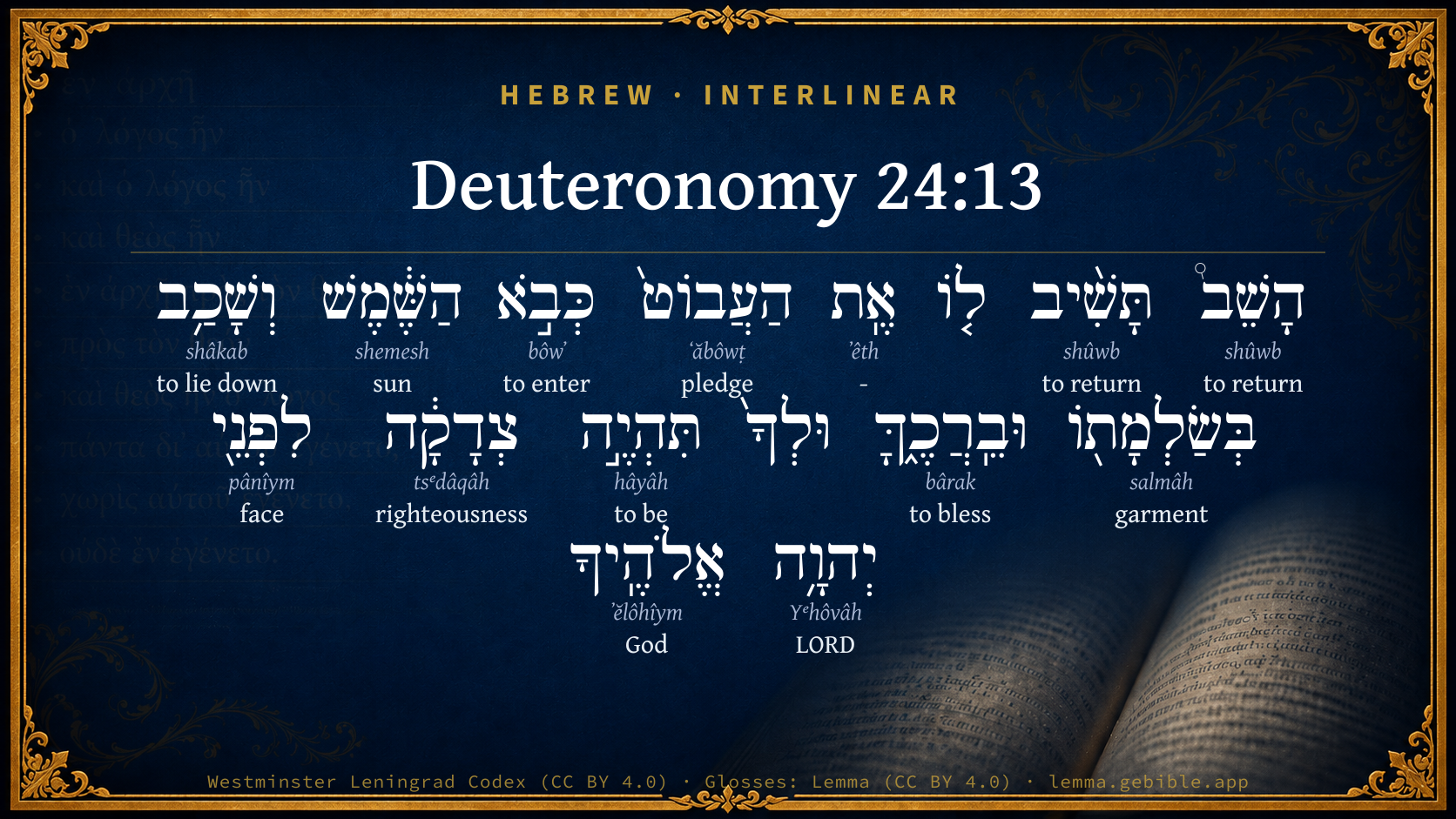
Hebrew (Westminster Leningrad Codex) Deuteronomy 24:13 appears in the Hebrew Old Testament. The text above is from the Westminster Leningrad Codex. Each word links to its Strong’s number, a concise gloss, and parsing drawn from the Open Scriptures Hebrew Bible morphology. Click any word for its full Brown-Driver-Briggs (BDB) entry.
Download image
Cite this verse

Deuteronomy 24:13 (World English Bible). Public Domain. Lemma interlinear Bible study tool, https://lemma.gebible.app/v/deuteronomy/24/13.

Show BibTeX & RIS
BibTeX
RIS
English Translation
you shall surely restore to him the pledge when the sun goes down, that he may sleep in his garment, and bless you: and it shall be righteousness to you before Yahweh your God.
World English Bible · Public Domain
Download a study sheet

One document with this verse’s original text, its word-by-word gloss line, the meaning frame, cross-references with their text, attributed commentary, and full source and license credits — printable, and it pastes into notes with its structure intact.

This verse Autodidact and up

Study sheet (.html) Plain text (.txt)

A passage Seminary Student

Up to 50 verses in one chapter. A passage sheet keeps up to 6 commentary sources and 12 cross-references per verse, in the order this page ranks them, and says so on the sheet whenever that leaves anything out. Ask for a single verse and you get the Autodidact verse sheet above.

Everything on this page stays free to read, with no account — the sheet is a download of what is already on screen, not access to it.

Want to remove ads? Support Godless Engineer
Compare translations 3

The same verse in 3 English versions, stacked beneath the original-language interlinear above. Click any original word for its lexicon entry.

Each is an independent rendering of the whole verse — the interlinear is not word-aligned to these translations.

Highlighted words mark where these versions differ — a whole-verse word diff, not a word-by-word alignment.

  • World English Bible Public Domain
    you shall surely restore to him the pledge when the sun goes down, that he may sleep in his garment, and bless you: and it shall be righteousness to you before Yahweh your God.
  • King James Version Public Domain
    In any case thou shalt deliver him the pledge again when the sun goeth down, that he may sleep in his own raiment, and bless thee: and it shall be righteousness unto thee before the LORD thy God.
  • unfoldingWord Literal Text CC BY-SA 4.0
    Returning, you shall return to him the pledge as the sun goes down, and he will sleep in his cloak and bless you; and it will be righteousness for you to the face of Yahweh your God.

unfoldingWord Literal Text — © unfoldingWord, licensed CC BY-SA 4.0. Word-aligned USFM3 via Door43 (git.door43.org/unfoldingWord/en_ult).

Versions to compare (up to 4)

3 of 4 selected

Show all 18 translations

Every available English version of this verse, each an independent rendering of the whole verse.

  • World English Bible Public Domain
    you shall surely restore to him the pledge when the sun goes down, that he may sleep in his garment, and bless you: and it shall be righteousness to you before Yahweh your God.
  • Berean Standard Bible Public Domain
    be sure to return it to him by sunset, so that he may sleep in his own cloak and bless you, and this will be credited to you as righteousness before the LORD your God.
  • Majority Standard Bible Public Domain
    be sure to return it to him by sunset, so that he may sleep in his own cloak and bless you, and this will be credited to you as righteousness before the LORD your God.
  • King James Version Public Domain
    In any case thou shalt deliver him the pledge again when the sun goeth down, that he may sleep in his own raiment, and bless thee: and it shall be righteousness unto thee before the LORD thy God.
  • American Standard Version (1901) Public Domain
    thou shalt surely restore to him the pledge when the sun goeth down, that he may sleep in his garment, and bless thee: and it shall be righteousness unto thee before Jehovah thy God.
  • Revised Version (1885) Public Domain
    thou shalt surely restore to him the pledge when the sun goeth down, that he may sleep in his garment, and bless thee: and it shall be righteousness unto thee before the LORD thy God.
  • Geneva Bible (1599) Public Domain
    But shalt restore him the pledge when the sunne goeth downe, that he may sleepe in his raiment, and blesse thee: and it shalbe righteousnesse vnto thee before the Lord thy God.
  • Douay-Rheims (1899) Public Domain
    But thou shalt restore it to him presently before the going down of the sun: that he may sleep in his own raiment and bless thee, and thou mayst have justice before the Lord thy God.
  • Young's Literal Translation Public Domain
    thou dost certainly give back to him the pledge at the going in of the sun, and he hath lain down in his own raiment, and hath blessed thee; and to thee it is righteousness before Jehovah thy God.
  • Literal Standard Version CC BY-SA 4.0
    you certainly give back the pledge to him at the going in of the sun, and he has lain down in his own raiment and has blessed you; and it is righteousness to you before your God YHWH.
  • Unlocked Literal Bible CC BY-SA 4.0
    You must surely restore to him the pledge by the time the sun goes down, so that he may sleep in his cloak and bless you; it will be righteousness for you before Yahweh your God.
  • unfoldingWord Literal Text CC BY-SA 4.0
    Returning, you shall return to him the pledge as the sun goes down, and he will sleep in his cloak and bless you; and it will be righteousness for you to the face of Yahweh your God.
  • Darby Bible Public Domain
    in any case thou shalt return him the pledge at the going down of the sun, that he may sleep in his own upper garment and bless thee; and it shall be righteousness unto thee before Jehovah thy God.
  • World Messianic Bible Public Domain
    You shall surely restore to him the pledge when the sun goes down, that he may sleep in his garment and bless you. It shall be righteousness to you before the LORD your God.
  • Webster's Bible Public Domain
    In any case thou shalt deliver to him the pledge again when the sun goeth down, that he may sleep in his own raiment, and bless thee; and it shall be righteousness to thee before the LORD thy God.
  • Free Bible Version CC BY-SA 4.0
    Make sure you give it back by sunset, so that he can sleep in his own cloak and thank you, and you will be counted as doing good by the Lord your God.
  • Bible in Basic English Public Domain
    But be certain to give it back to him when the sun goes down, so that he may have his clothing for sleeping in, and will give you his blessing: and this will be put to your account as righteousness before the Lord your God.
  • JPS Tanakh (1917) Public Domain
    thou shalt surely restore to him the pledge when the sun goeth down, that he may sleep in his garment, and bless thee; and it shall be righteousness unto thee before the LORD thy God.

Literal Standard Version (2020), Covenant Press — licensed CC BY-SA 4.0. Text via the HelloAO Bible API (eBible.org). Unlocked Literal Bible (unfoldingWord) — licensed CC BY-SA 4.0. Text via the HelloAO Bible API (eBible.org). unfoldingWord Literal Text — © unfoldingWord, licensed CC BY-SA 4.0. Word-aligned USFM3 via Door43 (git.door43.org/unfoldingWord/en_ult). Free Bible Version, Dr. Jonathan Gallagher — licensed CC BY-SA 4.0. Text via the HelloAO Bible API (eBible.org).

Word by word

More ways to search: Search by grammar → Find every occurrence → Compare this word →

Practice this passage: Drill this verse → Learn its vocabulary →

הַעֲבוֹט֙
ʻăbôwṭ
H5667
“the · pledge”
Particle, Definite Article + Noun, Common, Masculine, Singular, Absolute
Part of Speech
Particle + Noun
Type
Common
Gender
Masculine
Number
Singular
State
Absolute
Full BDB Definition

Origin: from H5670

TWOT: 1555a

pledge, a thing given as security, article pledged as security for debt
  1. הָשֵׁב֩ shûwb H7725 “to return” Verb, Hiphil, Infinitive Absolute
  2. תָּשִׁ֨יב shûwb H7725 “to return” Verb, Hiphil, Imperfect, 2nd Person, Masculine, Singular
  3. אֶֽת ʼêth H853 “-” Particle, Direct Object
  4. כְּבֹ֣א bôwʼ H935 “like/as · to enter” Preposition + Verb, Qal, Infinitive Construct
  5. הַשֶּׁ֔מֶשׁ shemesh H8121 “the · sun” Particle, Definite Article + Noun, Common, Both, Singular, Absolute
  6. וְשָׁכַ֥ב shâkab H7901 “and · to lie down” Conjunction + Verb, Qal, Sequential Perfect, 3rd Person, Masculine, Singular
  7. בְּשַׂלְמָת֖וֹ salmâh H8008 “in/at · garment · his” Preposition + Noun, Common, Feminine, Singular, Construct + Suffix, Personal, 3rd Person, Masculine, Singular
  8. וּבֵֽרֲכֶ֑ךָּ bârak H1288 “and · to bless · you” Conjunction + Verb, Piel, Sequential Perfect, 3rd Person, Masculine, Singular + Suffix, Personal, 2nd Person, Masculine, Singular
  9. תִּהְיֶ֣ה hâyâh H1961 “to be” Verb, Qal, Imperfect, 3rd Person, Feminine, Singular
  10. צְדָקָ֔ה tsᵉdâqâh H6666 “righteousness” Noun, Common, Feminine, Singular, Absolute
  11. לִפְנֵ֖י pânîym H6440 “to/for · face(s) of” Preposition + Noun, Common, Both, Plural, Construct
  12. יְהוָ֥ה Yᵉhôvâh H3068 “LORD” Noun, Proper
  13. אֱלֹהֶֽיךָ ʼĕlôhîym H430 “God(s) · your” Noun, Common, Masculine, Plural, Construct + Suffix, Personal, 2nd Person, Masculine, Singular

About this verse

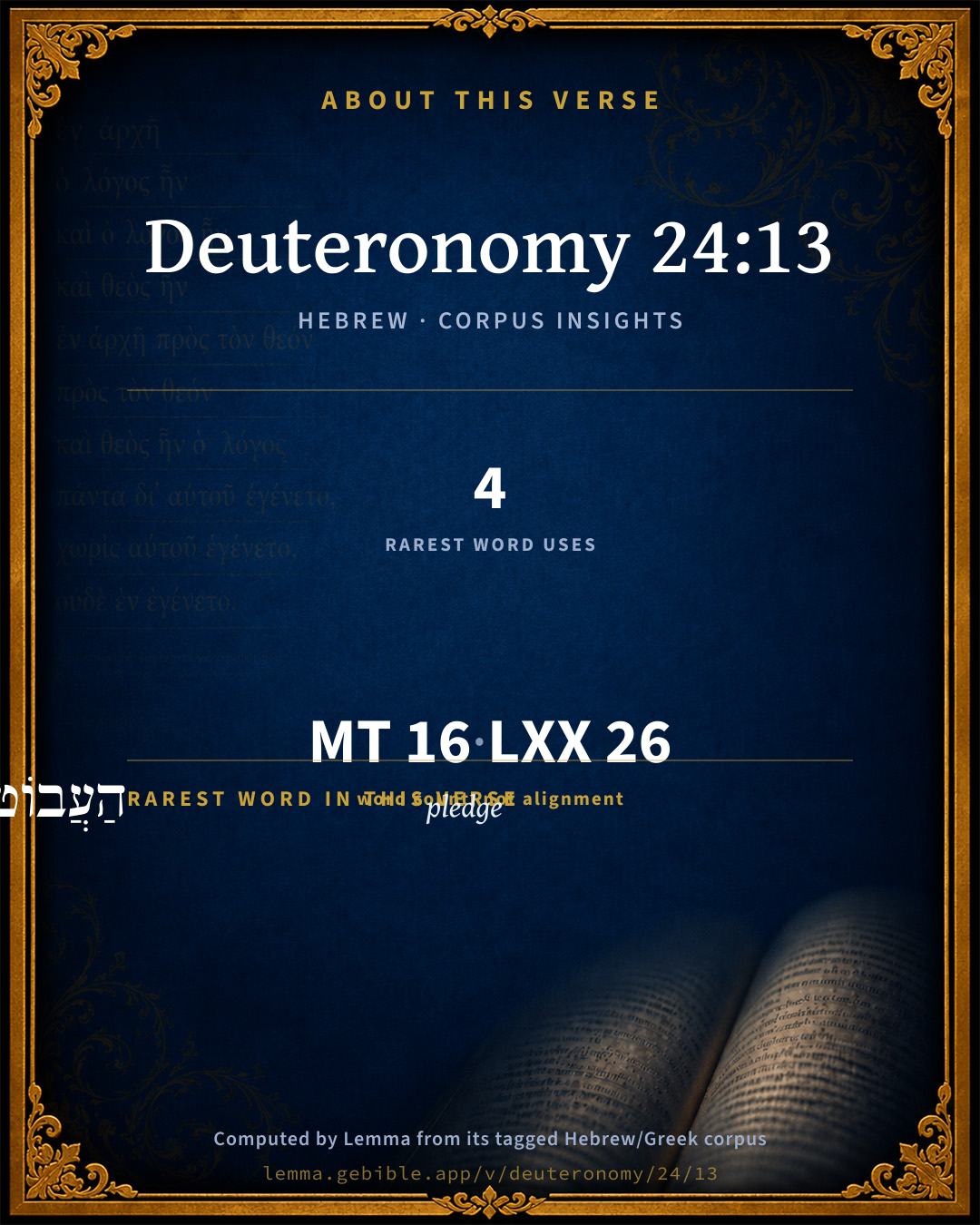
These counts appear in no published source. They are computed here, from the morphology-tagged text and Lemma’s own curated glosses. What Lemma adds →

16
words
13
distinct lemmas
Pentateuch
section

Notable vocabulary

The rarest word here is הַעֲבוֹט֙ pledge H5667 — appearing just 4 times in the whole Hebrew Bible.

Shared distinctive vocabulary

הַעֲבוֹט֙ pledge H5667 occurs in 4 verses of the Hebrew Bible. Also found in:

Grammatical profile

  • 6 verbs
  • 7 nouns
  • 2 prepositions
  • 1 particle

Verb forms

  • הָשֵׁב֩ Hiphil · Infinitive Absolute
  • תָּשִׁ֨יב Hiphil · Imperfect
  • כְּבֹ֣א Qal · Infinitive Construct
  • וְשָׁכַ֥ב Qal · Sequential Perfect
  • וּבֵֽרֲכֶ֑ךָּ Piel · Sequential Perfect
  • תִּהְיֶ֣ה Qal · Imperfect

Repetition

A word recurs within this verse — often emphatic in Hebrew:

  • הָשֵׁב֩ to return H7725 ×2

Hebrew & Septuagint length

In English translation the verse runs 34 words from the Hebrew and 19 from the Septuagint (LXX English) — the Septuagint runs noticeably shorter here. See the side-by-side →

A rough comparison of the two English renderings, which tokenize alike — not a word-level alignment.

Word counts can differ between the Hebrew and the Greek without any difference in meaning — e.g. the Hebrew direct-object marker אֵת has no separate Greek word, and Greek often adds the article ὁ.

In the original languages it is 16 Hebrew tokens and 26 Greek tokens — but the two are counted differently (Hebrew bundles its prefixes and suffixes into one token; the Greek is in lemma form), so that isn’t a like-for-like length.

Cross-references

22

Topical passages linked to Deuteronomy 24:13 in the Treasury of Scripture Knowledge — connected by theme and wording, ordered by reader-vote popularity; previews shown in the World English Bible.

  • Deuteronomy 6:25 It shall be righteousness to us, if we observe to do all this commandment before Yahweh our God, as he has commanded us.
  • Daniel 4:27 Therefore, O king, let my counsel be acceptable to you, and break off your sins by righteousness, and your iniquities by showing mercy to the poor; if there may be a lengthening of your tranquillity.
  • Exodus 22:26–27 If you take your neighbor's garment as collateral, you shall restore it to him before the sun goes down,
  • Deuteronomy 24:15 in his day you shall give him his hire, neither shall the sun go down on it; for he is poor, and sets his heart on it: lest he cry against you to Yahweh, and it be sin to you.
  • Genesis 15:6 He believed in Yahweh; and he reckoned it to him for righteousness.
  • Deuteronomy 15:9–10 Beware that there not be a base thought in your heart, saying, The seventh year, the year of release, is at hand; and your eye be evil against your poor brother, and you give him nothing; and he cry to Yahweh against you, and it be sin to you.
  • Job 24:7–8 They lie all night naked without clothing, And have no covering in the cold.
  • Job 29:11–13 For when the ear heard me, then it blessed me; And when the eye saw me, it commended me:
  • Job 31:16–20 "If I have withheld the poor from their desire, Or have caused the eyes of the widow to fail,
  • Psalms 106:30–31 Then Phinehas stood up, and executed judgment, So the plague was stopped.
  • Psalms 112:9 He has dispersed, he has given to the poor. His righteousness endures forever. His horn will be exalted with honor.
  • Isaiah 58:8 Then shall your light break forth as the morning, and your healing shall spring forth speedily; and your righteousness shall go before you; the glory of Yahweh shall by your rearward.
  • Ezekiel 18:7 and has not wronged any, but has restored to the debtor his pledge, has taken nothing by robbery, has given his bread to the hungry, and has covered the naked with a garment;
  • Ezekiel 18:12 has wronged the poor and needy, has taken by robbery, has not restored the pledge, and has lifted up his eyes to the idols, has committed abomination,
  • Ezekiel 33:15 if the wicked restore the pledge, give again that which he had taken by robbery, walk in the statutes of life, committing no iniquity; he shall surely live, he shall not die.
  • Amos 2:8 And they lay themselves down beside every altar on clothes taken in pledge; And in the house of their God they drink the wine of those who have been fined.
  • Ephesians 4:26 "Be angry, and don't sin." Don't let the sun go down on your wrath,
  • 2 Timothy 1:16–18 May the Lord grant mercy to the house of Onesiphorus, for he often refreshed me, and was not ashamed of my chain,
  • James 1:27 Pure religion and undefiled before our God and Father is this: to visit the fatherless and widows in their affliction, and to keep oneself unstained by the world.
  • James 2:13–23 For judgment is without mercy to him who has shown no mercy. Mercy triumphs over judgment.
  • Ezekiel 18:16 neither has wronged any, has not taken anything to pledge, neither has taken by robbery, but has given his bread to the hungry, and has covered the naked with a garment;
  • 2 Corinthians 9:13–14 seeing that through the proof given by this service, they glorify God for the obedience of your confession to the Gospel of Christ, and for the liberality of your contribution to them and to all;

Cross-references courtesy of OpenBible.info (CC BY 4.0).

Hebrew and Greek witnesses Masoretic Hebrew ↔ Greek Septuagint

The same verse in the two great witnesses to the Old Testament, shown verse-for-verse.

Here the Septuagint runs noticeably shorter than the Hebrew — LXX2012 (modern English Septuagint) 19 words vs World English Bible 34. A rough length comparison of the two English translations, not a word-level alignment — read both below.

These are two independent witnesses, not word-aligned to each other, and the Septuagint is shown in lemma (dictionary) form.

Hebrew Deuteronomy 24:13 Masoretic · Westminster Leningrad Codex

הָשֵׁב֩ תָּשִׁ֨יב ל֤וֹ אֶֽת הַעֲבוֹט֙ כְּבֹ֣א הַשֶּׁ֔מֶשׁ וְשָׁכַ֥ב בְּשַׂלְמָת֖וֹ וּבֵֽרֲכֶ֑ךָּ וּלְךָ֙ תִּהְיֶ֣ה צְדָקָ֔ה לִפְנֵ֖י יְהוָ֥ה אֱלֹהֶֽיךָ

you shall surely restore to him the pledge when the sun goes down, that he may sleep in his garment, and bless you: and it shall be righteousness to you before Yahweh your God.

World English Bible · Public Domain

Greek LXX Deuteronomy 24:13 Septuagint · lemma form

ἀπόδοσις ἀποδίδωμι ὁ ἐνέχυρον αὐτός περί δυσμή ἥλιος καί κοιμάω ἐν ὁ ἱμάτιον αὐτός καί εὐλογέω σύ καί εἰμί σύ ἐλεημοσύνη ἐναντίον κύριος ὁ θεός σύ

you shall stand without, and the man who is in your debt shall bring the pledge out to you.

LXX2012 (modern English Septuagint) · Public Domain

Hebrew: Westminster Leningrad Codex (CC BY 4.0). Greek: Septuagint (public domain); English from LXX2012 (modern English Septuagint) (Public Domain). How the Septuagint differs from the Hebrew →

Targum (Aramaic paraphrase)

2

The Targum is the ancient Jewish Aramaic paraphrase of the Hebrew Scriptures — an interpretive translation, not the Hebrew text itself. Onkelos (literal) and Pseudo-Jonathan (expansive) render the Torah, and Jonathan the Prophets. Coverage is partial: where no permissively-licensed English translation exists for a verse, only the Aramaic is shown. This is verse-level text, not a word-by-word alignment to the Hebrew.

  1. Targum Onkelos Torah (Genesis–Deuteronomy)
    אָתָבָא תָתֵב לֵהּ יָת מַשְׁכּוֹנָא כְּמֵעַל שִׁמְשָׁא וְיִשְׁכּוּב בִּכְסוּתֵהּ וִיבָרֵכִנָךְ וְלָךְ תְּהֵי זְכוּתָא קֳדָם יְיָ אֱלָהָךְ

    (no public-domain English translation for this verse)

    Targum Onkelos — Aramaic: “Onkelos Genesis” (public domain); “Onkelos Exodus” (public domain); “Onkelos Leviticus” (public domain); “Onkelos Numbers” (public domain); “Onkelos Deuteronomy” (public domain). English: “Sefaria Community Translation” (CC0 1.0 (public-domain dedication)); “J.W. Etheridge. The Targums of Onkelos and Jonathan Ben Uzziel on the Pentateuch. London: Longmans, Green, 1862” (public domain). Text via Sefaria.

  2. Targum Pseudo-Jonathan Torah (Genesis–Deuteronomy)
    אוֹתָבָא תְתִיב לֵיהּ יַת מַשְׁכּוֹנָא כַּד מִטְמַע שִׁימְשָׁא וְיִגְנֵי בִּגְלוֹפְקְרֵיהּ וִיבָרְכִינָךְ וְלָךְ תְּהֵי זְכוּ דְּיַסְהִיד עֲלָךְ שִׁימְשָׁא קֳדָם יְיָ אֱלָהָךְ

    as the sun goeth down, thou shalt return the pledge, that he may lie in his garment and may bless thee; and to thee it shall be righteousness, for the sun shall bear the witness of thee before the Lord thy God.

    Targum Pseudo-Jonathan — Aramaic: “Targum Jonathan on Genesis” (public domain); “Targum Jonathan on Exodus” (public domain); “Targum Jonathan on Leviticus” (public domain); “Targum Jonathan on Numbers” (public domain); “Targum Jonathan on Deuteronomy” (public domain). English: “The Targum of Jonathan ben Uzziel, trans. J. W. Etheridge, London, 1862” (public domain). Text via Sefaria.

Commentary

Notes on Deuteronomy 24:13 from classic Christian and Jewish commentators (each source and its license shown beneath its notes). The classic Christian expositions comment on the surrounding passage and are grouped to its opening verse, so a note may address several verses; the Jewish commentaries on the Tanakh (Rashi and others) are per-verse, so they appear only where the commentator wrote on this verse.

Lemma curates 59 commentaries, every one of them public domain or Creative Commons licensed, each selected and text-cleaned for this edition rather than reprinted as found. About our sources →

Trapp's Complete Commentary

John Trapp

Deu 24:13 In any case thou shalt deliver him the pledge again when the sun goeth down, that he may sleep in his own raiment, and bless thee: and it shall be righteousness unto thee before the LORD thy God.

Ver. 13. May bless thee.] Saying, as St Paul brings in the relieved poor Christian, {2Co 9:15} "Thanks be unto God for his unspeakable gift." God will surely bless thee for such a blessing.

And it shall be righteousness unto thee.] God will reckon it for a good work, and graciously reward it, he will turn paymaster to thee; thy righteousness, and thy riches too, shall endure for ever. {Psa 112:3}

John Trapp, A Commentary or Exposition upon All the Books of the Old and New Testament (1647–1656) — public domain. Text from a community e-Sword module.

The Biblical Illustrator

Joseph S. Exell

Deu_24:13-16

Thou shalt have a perfect and just weight, measure.

The Christian in commerce

I. Endeavour to point out what Christianity requires of a man in his dealings in business with his fellow men.

1. The most rigid adherence to the principles of moral integrity. Truth. Honesty.

2. The exercise of love and kindness.

3. That a man should preserve his soul in peace and patience.

4. That commerce be consecrated and elevated by the spirit of holiness.

II. Having described what a Christian should be in commerce briefly show why he should be it. All considerations by which religion and morality are commended and enforced are applicable here. The course pointed out is right in itself, what we owe to God and connected with eternal destiny. It is necessary to inherit the kingdom of heaven. It is presented to us in the example of Christ, whom all disciples should imitate. In one word, Christianity requires it; all its precepts, principles, blessings, and prospects require it. (A. J. Morris.)

Fluctuation of trade

Trade is a fluctuating thing; it passed from Tyre to Alexandria, from Alexandria to Venice, from Venice to Antwerp, from Antwerp to Amsterdam and London--the English rivalling the Dutch; the French are now rivalling both. All nations, almost, are wisely applying themselves to trade, and it behoves those who are in possession of it to take the greatest care that they do not lose it. It is a plant of tender growth; it requires sun and soil and fine seasons to make it thrive and flourish. It will not grow like the palm tree, which, with the more weight and pressure, rises the more. Liberty is a friend to that, as that is a friend to liberty. But the greatest enemy to both in licentiousness, which tramples upon all law and lawful authority, encourages riots and tumults, sticks at nothing to support its extravagance, practises every art of illicit gain, ruins credit and trade, and will ruin liberty itself. Neither kingdoms, commonwealths, public companies, nor private persons, can long carry on a beneficial and flourishing trade without virtue and what virtue teaches--sobriety, industry, frugality, modesty, honesty, punctuality, humanity, charity, the love of our country, and the fear of our God. (Bp. Newton.)

Justice

From these specific instances of justice let us extend our views to justice in general; let us consider its true nature and importance to human society; the obligations we are under to adhere to it inviolably; and the fatal consequences of every deviation. Justice is that virtue which teaches us to respect the rights of others, and to refrain from all injurious acts or purposes.

1. Some rights men are born to--such as the use of their own limbs, the free and uncontrolled exercise of their faculties of body and mind--these faculties, derived from the Author of life, sufficiently speak the intention of the Giver--that they should be freely, but at the same time innocently used--this is the equal birthright of every man.

2. Again, if every human being that God has made has a right to live, to breathe, to move, to think--he must also have a just claim to the product of his labour and his thought.

3. Another source of right springs from mutual, voluntary engagements--expressed, or implied--which ought all to be candidly interpreted, and conscientiously fulfilled.

4. Of all obligations the most binding and indispensable is to do no wrong to any; to hold the rightful claims of our fellow creatures sacred. First, all restraint upon personal liberty exercised by one man upon another--uncompelled by previous aggression--tends wantonly to defeat mans whole destination; and is therefore a daring outrage against the Author of his being. Equally, or rather more unjust and more criminal is it, to forge chains for the mind--to prohibit the use of reason--to compel men to violate their conscience. Next to the undisturbed use of our bodily and mental faculties, the fruits of their exertion, justice maintains inviolable--and consequently enjoins--the exact observance of those civil laws by which the disposal of property is regulated, not merely for wrath, but for conscience sake. Moreover, independently of government and laws, that those contracts which are entered into for mutual aid and benefit, and without which mankind could not act collectively and in concert, are to be formed on fair and upright principles, and fulfilled with punctuality--is as evident as that man was created to be a social being, and that no one should undermine that mutual confidence and that willingness to combine and to cooperate together, on which the common good so manifestly depends. Nor do commercial or pecuniary concerns form the only province of justice. She is equally solicitous to render unto all their dues of every kind. She abstains as carefully from violating anothers reputation as his property; of which, indeed, it often constitutes the most valuable part; and as scrupulously shuns taking any unfair advantage in the most secret transaction, as in the sight of all the world. Who is not sensible of the discordant and tumultuous state into which mankind would fall were justice to take her flight? Selfishness and rapine on all sides prevailing in a short time little would remain for the one to covet or the other to prey upon and monopolise. Justice is essential not only to the comfort, but to the subsistence of the species. But where neither the eye of man can penetrate, nor the hand of man can reach--there the claims of justice are felt by the truly upright; the reasonable expectations of their fellow creatures weighed in an impartial scale, and answered with the same conscientious care and unswerving rectitude, as if they were defined by the strictest statutes, and enforced by the severest penalties. Far beyond all formal compacts, all legal obligations, is the demand of reason and conscience on the just man. In comparing his own rights with those of others, his justice stretches into the domain of generosity; in comparing the claims of others between themselves his generosity never deviates from impartial justice. So imperceptible are the shades of difference that separate justice from generosity--whether we consider their motives, obligations, or effects--that, amongst the ancient philosophers justice was the common name assigned to both; and denoted the general principle of all the social virtues--and our Saviour comprehends all that is equitable and all that is kind and disinterested in one and the same precept--Do unto others, as ye would that they should do unto you. I shall only add, that as justice is that virtue which is most essential to every social state, and that state which is reserved for the spirits of the just will be preeminently social; so the habits of justice, which have in this world been interwoven with all their sentiments and actions, must there attain their highest perfection and produce the happiest issue. (P. Houghton.)

.

The Biblical Illustrator, edited by Joseph S. Exell (c. 1880s–1900s) — public domain. Text from a community e-Sword module.

Tyndale Open Study Notes

Tyndale Open Resources

24:13 Return the cloak . . . by sunset: The law was merciful.

Tyndale Open Study Notes — © Tyndale Open Resources, licensed CC BY-SA 4.0. Text via the HelloAO Bible API.

Geneva Bible (1599)

Geneva Bible translators

Though he would be unthankful, yet God will not forget it.

Geneva Bible (1599) marginal notes — public domain. Text via Bolls.life.

The Cambridge Bible for Schools and Colleges

gen. ed. J. J. S. Perowne

13. sleep in his garment] Heb. salmah (Deu_29:4 and E, Exodus 22), transp. from the more frequent simlah (Deu_8:4, Deu_10:18, Deu_21:13, Deu_22:3; Deu_22:17), the large outer robe which the peasant can dispense with by day while at work, but which he almost invariably sleeps in; cp. Amo_2:8, Job_22:6, Pro_20:16.

and it shall be righteousness unto thee] Characteristic of D (cp. Deu_6:25). E, Exo_22:27 (26): when he crieth unto me I will hear; for I am gracious.

The Cambridge Bible for Schools and Colleges (gen. ed. J. J. S. Perowne; Cambridge University Press, 1878–1918) — public domain. Text from a community e-Sword module.

John Gill's Exposition

In any case thou shalt deliver him the pledge again, when the sun goeth down,.... If it was a night covering, as Jarchi remarks; but if it was his day clothes, he was to return it in the morning, when the sun arose; and this was to be done every day, which resist occasion a great deal of trouble, and the pledge of little use; so that it seems as though they might as well be without it as have it, and lend freely; but the Jews say, that there was an advantage by it; for it is said in answer to such a question,"of what profit is the pledge? by this means the debt is not released on the seventh year, (when all other debts were released, Deu 15:1) nor could the borrower dispose of his goods to his children, but payment was made from the pledge after his death (m):''now this delivery of the pledge at sun setting was ordered:

that he may sleep in his own raiment; have his night covering to sleep in, his pillow, and bolster, and bedding to lie on, and bed clothes to cover him; and indeed the clothes they wore were made in such form, as would serve for covering to sleep in at night, as well as to wear in the day; and such is the clothing of the Arabs now, which they call "hykes"."The usual size of them (Dr. Shaw says (n)), is six yards long, and five or six feet broad, serving the Arab for a complete dress in the day; and as they "sleep in their raiment", it serves likewise for his bed and covering by night:"

and bless thee: for using him so mercifully and kindly, as to return him his pledge, which is so necessary to his comfortable repose in the night; and not only will he praise him, and speak well of him for it, and give him thanks; but will pray to God to bless him in soul, body, and estate, for such kindness shown him:

and it shall be righteousness unto thee before the Lord thy God; not his justifying righteousness before God, for by the deeds of the law shall no flesh living be justified in his sight; but it shall be owned and approved of as a good and righteous action, and answerable to the intention of this law, which is, that mercy should be shown to persons in distress; in which sense the word "righteousness" is sometimes used, even for a merciful action, Psa 112:9; so alms is called "righteousness", Mat 6:1, in some copies.

(m) Maimon Hilchot Milvah Velovah, c. 3. sect. 5. (n) Travels, p. 224. Ed. 2.

John Gill's Exposition of the Whole Bible (1746–1763) — public domain (CC PDM 1.0). Text via the HelloAO Bible API.

Haydock's Catholic Bible Commentary

Justice, or mercy, which never enters the breast of the unjust, Proverbs xii. 10. (Menochius)

George Leo Haydock (1774–1849), Haydock's Catholic Family Bible and Commentary, 1859 edition — public domain. Excludes Psalms (Douay-Rheims chapter numbering differs from Protestant) and Deuterocanonical books (Catholic canon only).

Matthew Poole's English Annotations

Bless thee, instrumentally, as ministers are said to convert and save sinners, to wit, bring down the blessing of God upon thee by his prayers; for though his prayers, if he be not a good man, shall not avail for his own behalf, yet they shall avail for thy benefit.

Righteousness unto thee before the Lord, i.e. esteemed and accepted by God as a work of righteousness, or holiness, or goodness and mercy, which oft is called righteousness, as Psa 107:9; Pro 10:2; Dan 4:27.

Matthew Poole's English Annotations on the Holy Bible (1683–1685) — public domain. Text from a community e-Sword/MySword module.

John Wesley's Explanatory Notes

Bless thee - Bring down the blessing of God upon thee by his prayers: for though his prayers, if he be not a good man, shall not avail for his own behalf, yet they shall avail for thy benefit. It shall be right - Esteemed and accepted by God as a work of righteousness, or mercy.

John Wesley, Explanatory Notes Upon the Whole Bible (1754–1765) — public domain. Text via the GEBible commentary corpus.

Rashi

Rabbi Shlomo Yitzchaki (Rashi)

כבוא השמש [THOU SHALT RESTORE HIM THE PLEDGE] WHEN THE SUN GOETH DOWN — if it be a night garment; whilst if it be a garment worn during the day restore it to him in the morning. This, indeed, has already been written in the section beginning with the words ואלה המשפטים (Exodus 22:25) “Restore it unto him till the going down of the sun” which means: restore it unto him for the whole day and at nightfall you may take it again [till the daybreak of the next morning] (Bava Metzia 114b; cf. Rashi on Exodus 22.25.2 and Note thereon).

וברכך AND HE WILL BLESS THEE — and even if he will not bless thee, in any case, ולך תהיה צדקה IT SHALL BE RIGHTEOUSNESS UNTO THEE [BEFORE THE LORD THY GOD] (Sifrei Devarim 277:4).

Rashi on the Tanakh — English translations: “The Judaica Press complete Tanach with Rashi, translated by A. J. Rosenberg” (CC BY 4.0); “Pentateuch with Rashi's commentary by M. Rosenbaum and A.M. Silbermann, 1929-1934” (public domain); “The Metsudah Tanach series, Lakewood, N.J” (CC BY 4.0); and “The Book of Joshua, Metsudah Publications, 1997” (CC BY 4.0). Text via Sefaria.

Lesson kit

Teaching starters — assembled from the data on this page, not authored interpretation. Every prompt links to the verse data it draws on. Edit before teaching.

Deuteronomy, in the Pentateuch, opens this verse with 16 words (13 distinct Hebrew lemmas). Its most distinctive word is ʻăbôwṭ (“pledge”). The Greek Septuagint runs shorter here. A historical commentator’s framing appears above. Read the whole chapter for the surrounding context.

Discussion questions

  1. How does “pledge” (ʻăbôwṭ) shape what this verse is saying?
  2. How does Deuteronomy 24:10, which shares the word «pledge», read alongside this verse?
  3. What does the repetition of “to return” (2× in this one verse) do in this verse?
  4. The Septuagint runs shorter here than the Hebrew. What might account for the difference?
  5. The translations on this page render this verse differently — a whole-verse word diff, not a word-by-word alignment. What might account for the different wordings?
  6. «הָשֵׁב֩» is a Hiphil Infinitive Absolute verb. How does that grammatical form shape the action described?
  7. Compare how Trapp's Complete Commentary and The Biblical Illustrator read this verse. Where do they agree or differ?

Things to notice

Reading settings

Reading text

Shown beneath each verse's original-language words.

Old Testament
Old Testament edition

Read the OT as the Masoretic Hebrew (MT) or the Greek Septuagint (LXX).

English shown for the Greek Septuagint (in the Hebrew ↔ Greek comparison).

Comparing translations? Open the Compare panel on any verse page to stack up to four side by side.