
Genesis 1:28

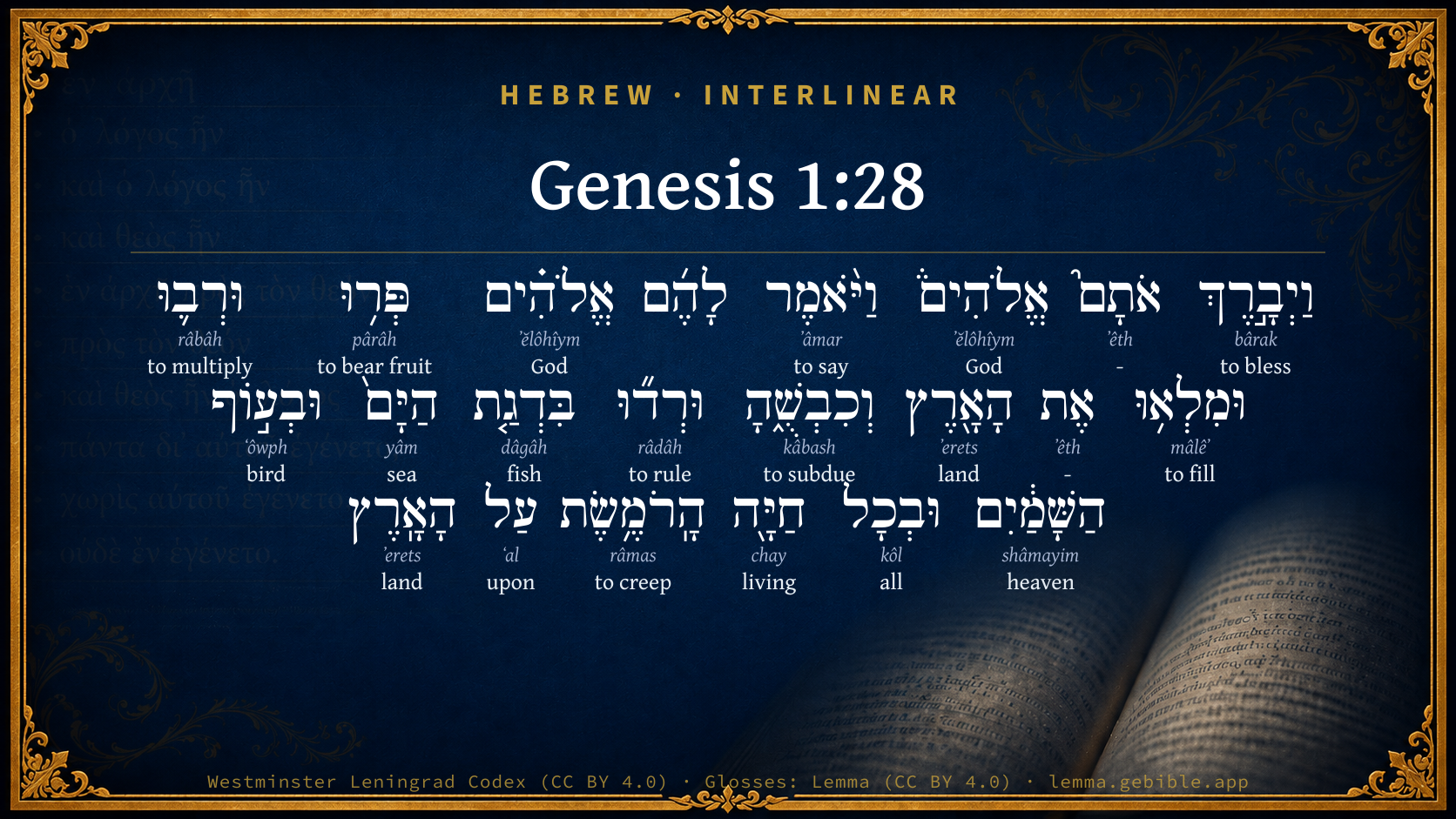
Hebrew (Westminster Leningrad Codex) Genesis 1:28 appears in the Hebrew Old Testament. The text above is from the Westminster Leningrad Codex. Each word links to its Strong’s number, a concise gloss, and parsing drawn from the Open Scriptures Hebrew Bible morphology. Click any word for its full Brown-Driver-Briggs (BDB) entry.
Download image
Cite this verse

Genesis 1:28 (World English Bible). Public Domain. Lemma interlinear Bible study tool, https://lemma.gebible.app/v/genesis/1/28.

Show BibTeX & RIS
BibTeX
RIS
English Translation
God blessed them. God said to them, "Be fruitful, multiply, fill the earth, and subdue it. Have dominion over the fish of the sea, over the birds of the sky, and over every living thing that moves on the earth."
World English Bible · Public Domain
Highlights
  • 1 first appearance in the Hebrew Bible
Full analysis ↓
Download a study sheet

One document with this verse’s original text, its word-by-word gloss line, the meaning frame, cross-references with their text, attributed commentary, and full source and license credits — printable, and it pastes into notes with its structure intact.

This verse Autodidact and up

Study sheet (.html) Plain text (.txt)

A passage Seminary Student

Up to 50 verses in one chapter. A passage sheet keeps up to 6 commentary sources and 12 cross-references per verse, in the order this page ranks them, and says so on the sheet whenever that leaves anything out. Ask for a single verse and you get the Autodidact verse sheet above.

Everything on this page stays free to read, with no account — the sheet is a download of what is already on screen, not access to it.

Want to remove ads? Support Godless Engineer
Compare translations 3

The same verse in 3 English versions, stacked beneath the original-language interlinear above. Click any original word for its lexicon entry.

Each is an independent rendering of the whole verse — the interlinear is not word-aligned to these translations.

Highlighted words mark where these versions differ — a whole-verse word diff, not a word-by-word alignment.

  • World English Bible Public Domain
    God blessed them. God said to them, "Be fruitful, multiply, fill the earth, and subdue it. Have dominion over the fish of the sea, over the birds of the sky, and over every living thing that moves on the earth."
  • King James Version Public Domain
    And God blessed them, and God said unto them, Be fruitful, and multiply, and replenish the earth, and subdue it: and have dominion over the fish of the sea, and over the fowl of the air, and over every living thing that moveth upon the earth.
  • unfoldingWord Literal Text CC BY-SA 4.0
    Then God blessed them, and God said to them, “Be fruitful and multiply, and fill the earth and subdue it. And rule over the fish of the sea and over the bird of the sky and over every living thing that moves on the earth.”

unfoldingWord Literal Text — © unfoldingWord, licensed CC BY-SA 4.0. Word-aligned USFM3 via Door43 (git.door43.org/unfoldingWord/en_ult).

Versions to compare (up to 4)

3 of 4 selected

Show all 18 translations

Every available English version of this verse, each an independent rendering of the whole verse.

  • World English Bible Public Domain
    God blessed them. God said to them, "Be fruitful, multiply, fill the earth, and subdue it. Have dominion over the fish of the sea, over the birds of the sky, and over every living thing that moves on the earth."
  • Berean Standard Bible Public Domain
    God blessed them and said to them, “Be fruitful and multiply, and fill the earth and subdue it; rule over the fish of the sea and the birds of the air and every creature that crawls upon the earth.”
  • Majority Standard Bible Public Domain
    God blessed them and said to them, “Be fruitful and multiply, and fill the earth and subdue it; rule over the fish of the sea and the birds of the air and every creature that crawls upon the earth.”
  • King James Version Public Domain
    And God blessed them, and God said unto them, Be fruitful, and multiply, and replenish the earth, and subdue it: and have dominion over the fish of the sea, and over the fowl of the air, and over every living thing that moveth upon the earth.
  • American Standard Version (1901) Public Domain
    And God blessed them: and God said unto them, Be fruitful, and multiply, and replenish the earth, and subdue it; and have dominion over the fish of the sea, and over the birds of the heavens, and over every living thing that moveth upon the earth.
  • Revised Version (1885) Public Domain
    And God blessed them: and God said unto them, Be fruitful, and multiply, and replenish the earth, and subdue it; and have dominion over the fish of the sea, and over the fowl of the air, and over every living thing that moveth upon the earth.
  • Geneva Bible (1599) Public Domain
    And God blessed them, and God said to them, Bring forth fruite and multiplie, and fill the earth, and subdue it, and rule ouer the fish of the sea, and ouer the foule of the heauen, and ouer euery beast that moueth vpon the earth.
  • Douay-Rheims (1899) Public Domain
    And God blessed them, saying: Increase and multiply, and fill the earth, and subdue it, and rule over the fishes of the sea, and the fowls of the air, and all living creatures that move upon the earth.
  • Young's Literal Translation Public Domain
    And God blesseth them, and God saith to them, `Be fruitful, and multiply, and fill the earth, and subdue it, and rule over fish of the sea, and over fowl of the heavens, and over every living thing that is creeping upon the earth.'
  • Literal Standard Version CC BY-SA 4.0
    And God blesses them, and God says to them, “Be fruitful, and multiply, and fill the earth, and subdue it, and rule over [the] fish of the sea, and over [the] bird of the heavens, and over every living thing that is creeping on the earth.”
  • Unlocked Literal Bible CC BY-SA 4.0
    God blessed them and said to them, “Be fruitful, and multiply. Fill the earth, and subdue it. Have dominion over the fish of the sea, over the birds of the sky, and over every living thing that moves upon the earth.”
  • unfoldingWord Literal Text CC BY-SA 4.0
    Then God blessed them, and God said to them, “Be fruitful and multiply, and fill the earth and subdue it. And rule over the fish of the sea and over the bird of the sky and over every living thing that moves on the earth.”
  • Darby Bible Public Domain
    And God blessed them; and God said to them, Be fruitful and multiply, and fill the earth, and subdue it; and have dominion over the fish of the sea, and over the fowl of the heavens, and over every animal that moveth on the earth.
  • World Messianic Bible Public Domain
    God blessed them. God said to them, “Be fruitful, multiply, fill the earth, and subdue it. Have dominion over the fish of the sea, over the birds of the sky, and over every living thing that moves on the earth.”
  • Webster's Bible Public Domain
    And God blessed them, and God said to them, Be fruitful, and multiply, and replenish the earth, and subdue it: and have dominion over the fish of the sea, and over the fowl of the air, and over every living animal that moveth upon the earth.
  • Free Bible Version CC BY-SA 4.0
    God blessed them and told them, “Reproduce, increase, and spread throughout the earth and control it; exercise authority over the fish of the sea and the birds of the air and every creature that moves on the earth.”
  • Bible in Basic English Public Domain
    And God gave them his blessing and said to them, Be fertile and have increase, and make the earth full and be masters of it; be rulers over the fish of the sea and over the birds of the air and over every living thing moving on the earth.
  • JPS Tanakh (1917) Public Domain
    And God blessed them; and God said unto them: 'Be fruitful, and multiply, and replenish the earth, and subdue it; and have dominion over the fish of the sea, and over the fowl of the air, and over every living thing that creepeth upon the earth.'

Literal Standard Version (2020), Covenant Press — licensed CC BY-SA 4.0. Text via the HelloAO Bible API (eBible.org). Unlocked Literal Bible (unfoldingWord) — licensed CC BY-SA 4.0. Text via the HelloAO Bible API (eBible.org). unfoldingWord Literal Text — © unfoldingWord, licensed CC BY-SA 4.0. Word-aligned USFM3 via Door43 (git.door43.org/unfoldingWord/en_ult). Free Bible Version, Dr. Jonathan Gallagher — licensed CC BY-SA 4.0. Text via the HelloAO Bible API (eBible.org).

Word by word

More ways to search: Search by grammar → Find every occurrence → Compare this word →

Practice this passage: Drill this verse → Learn its vocabulary →

וְכִבְשֻׁ֑הָ
kâbash
H3533
“and · subdue · her”
Conjunction + Verb, Qal, Imperative, 2nd Person, Masculine, Plural + Suffix, Personal, 3rd Person, Feminine, Singular
Part of Speech
Conjunction + Verb
Stem
Qal
Form
Imperative
Person
2nd Person
Gender
Masculine
Number
Plural
Full BDB Definition

Origin: a primitive root

TWOT: 951

to subject, subdue, force, keep under, bring into bondage - (Qal) - to bring into bondage, make subservient - to subdue, force, violate - to subdue, dominate, tread down - (Niphal) to be subdued - (Piel) to subdue - (Hiphil) to bring into bondage
  1. וַיְבָ֣רֶךְ bârak H1288 “and · to bless” Conjunction + Verb, Piel, Sequential Imperfect, 3rd Person, Masculine, Singular
  2. אֹתָם֮ ʼêth H853 “- · them” Particle, Direct Object + Suffix, Personal, 3rd Person, Masculine, Plural
  3. אֱלֹהִים֒ ʼĕlôhîym H430 “God(s)” Noun, Common, Masculine, Plural, Absolute
  4. וַיֹּ֨אמֶר ʼâmar H559 “and · to say” Conjunction + Verb, Qal, Sequential Imperfect, 3rd Person, Masculine, Singular
  5. אֱלֹהִ֗ים ʼĕlôhîym H430 “God(s)” Noun, Common, Masculine, Plural, Absolute
  6. פְּר֥וּ pârâh H6509 “bear fruit” Verb, Qal, Imperative, 2nd Person, Masculine, Plural
  7. וּרְב֛וּ râbâh H7235 “and · multiply” Conjunction + Verb, Qal, Imperative, 2nd Person, Masculine, Plural
  8. וּמִלְא֥וּ mâlêʼ H4390 “and · fill” Conjunction + Verb, Qal, Imperative, 2nd Person, Masculine, Plural
  9. אֶת ʼêth H853 “-” Particle, Direct Object
  10. הָאָ֖רֶץ ʼerets H776 “the · land” Particle, Definite Article + Noun, Common, Both, Singular, Absolute
  11. וּרְד֞וּ râdâh H7287 “and · rule” Conjunction + Verb, Qal, Imperative, 2nd Person, Masculine, Plural
  12. בִּדְגַ֤ת dâgâh H1710 “in/at · fish of” Preposition + Noun, Common, Feminine, Singular, Construct
  13. הַיָּם֙ yâm H3220 “the · sea” Particle, Definite Article + Noun, Common, Masculine, Singular, Absolute
  14. וּבְע֣וֹף ʻôwph H5775 “and · in/at · bird of” Conjunction + Preposition + Noun, Common, Masculine, Singular, Construct
  15. הַשָּׁמַ֔יִם shâmayim H8064 “the · heaven(s)” Particle, Definite Article + Noun, Common, Masculine, Plural, Absolute
  16. וּבְכָל kôl H3605 “and · in/at · all of” Conjunction + Preposition + Noun, Common, Masculine, Singular, Construct
  17. חַיָּ֖ה chay H2416 “living” Noun, Common, Both, Singular, Absolute
  18. הָֽרֹמֶ֥שֶׂת râmas H7430 “the · creeping” Particle, Definite Article + Verb, Qal, Participle Active, Feminine, Singular, Absolute
  19. עַל ʻal H5921 “upon” Preposition
  20. הָאָֽרֶץ ʼerets H776 “the · land” Particle, Definite Article + Noun, Common, Both, Singular, Absolute

About this verse

These counts appear in no published source. They are computed here, from the morphology-tagged text and Lemma’s own curated glosses. What Lemma adds →

22
words
18
distinct lemmas
Pentateuch
section

Notable vocabulary

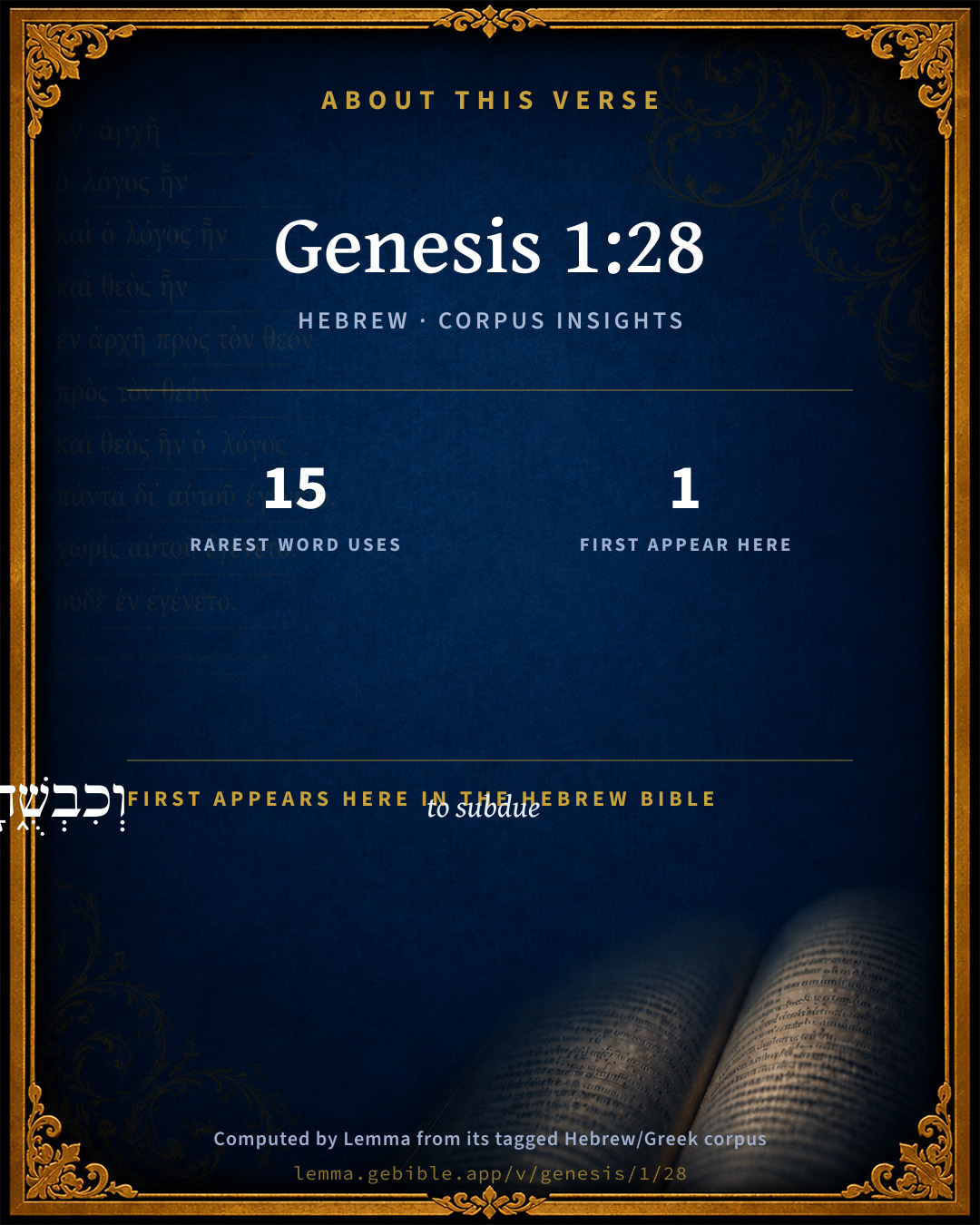
The rarest word here is וְכִבְשֻׁ֑הָ to subdue H3533 — appearing just 15 times in the whole Hebrew Bible.

First appearance in Scripture

This word makes its first canonical appearance in the Hebrew Bible here:

  • וְכִבְשֻׁ֑הָ to subdue H3533

Shared distinctive vocabulary

וְכִבְשֻׁ֑הָ to subdue H3533 occurs in 13 verses of the Hebrew Bible. Also found in:

Grammatical profile

  • 8 verbs
  • 10 nouns
  • 2 prepositions
  • 2 particles

Verb forms

  • וַיְבָ֣רֶךְ Piel · Sequential Imperfect
  • וַיֹּ֨אמֶר Qal · Sequential Imperfect
  • פְּר֥וּ Qal · Imperative
  • וּרְב֛וּ Qal · Imperative
  • וּמִלְא֥וּ Qal · Imperative
  • וְכִבְשֻׁ֑הָ Qal · Imperative
  • וּרְד֞וּ Qal · Imperative
  • הָֽרֹמֶ֥שֶׂת Qal · Participle Active

Repetition

Words recur within this verse — often emphatic in Hebrew:

  • אֱלֹהִים֒ God H430 ×2
  • הָאָ֖רֶץ land H776 ×2

Hebrew & Septuagint length

In English translation the verse runs 40 words from the Hebrew and 46 from the Septuagint (LXX English) — closely comparable.

A rough comparison of the two English renderings, which tokenize alike — not a word-level alignment.

Word counts can differ between the Hebrew and the Greek without any difference in meaning — e.g. the Hebrew direct-object marker אֵת has no separate Greek word, and Greek often adds the article ὁ.

Cross-references

22

Topical passages linked to Genesis 1:28 in the Treasury of Scripture Knowledge — connected by theme and wording, ordered by reader-vote popularity; previews shown in the World English Bible.

  • Genesis 9:1 God blessed Noah and his sons, and said to them, "Be fruitful, and multiply, and replenish the earth.
  • Genesis 9:7 Be fruitful, and multiply. Bring forth abundantly in the earth, and multiply in it."
  • Leviticus 26:9 "'I will have respect for you, and make you fruitful, and multiply you, and will establish my covenant with you.
  • Psalms 128:3–4 Your wife will be as a fruitful vine, In the innermost parts of your house; Your children like olive plants, Around your table.
  • Genesis 22:17–18 that in blessing I will bless you, and in multiplying I will multiply your seed as the stars of the heavens, and as the sand which is on the seashore. Your seed will possess the gate of his enemies.
  • Genesis 1:22 God blessed them, saying, "Be fruitful, and multiply, and fill the waters in the seas, and let birds multiply on the earth."
  • Genesis 17:20 As for Ishmael, I have heard you. Behold, I have blessed him, and will make him fruitful, and will multiply him exceedingly. He will become the father of twelve princes, and I will make him a great nation.
  • Psalms 127:1–5 Unless Yahweh builds the house, They labor in vain who build it. Unless Yahweh watches over the city, The watchman guards it in vain.
  • Isaiah 45:18 For thus says Yahweh who created the heavens, the God who formed the earth and made it, who established it and didn't create it a waste, who formed it to be inhabited: I am Yahweh; and there is no one else.
  • Genesis 8:17 Bring forth with you every living thing that is with you of all flesh, including birds, cattle, and every creeping thing that creeps on the earth; that they may breed abundantly in the earth, and be fruitful, and multiply on the earth."
  • Psalms 107:38 He blesses them also, so that they are multiplied greatly. He doesn't allow their cattle to decrease.
  • Genesis 26:3–4 Sojourn in this land, and I will be with you, and will bless you. For to you, and to your seed, I will give all these lands, and I will establish the oath which I swore to Abraham your father.
  • 1 Chronicles 4:10 Jabez called on the God of Israel, saying, Oh that you would bless me indeed, and enlarge my border, and that your hand might be with me, and that you would keep me from evil, that it not be to my sorrow! God granted him that which he requested.
  • Genesis 26:24 Yahweh appeared to him the same night, and said, "I am the God of Abraham your father. Don't be afraid, for I am with you, and will bless you, and multiply your seed for my servant Abraham's sake."
  • Genesis 49:25 Even by the God of your father, who will help you, By the Almighty, who will bless you, With blessings of heaven above, Blessings of the deep that lies below, Blessings of the breasts, and of the womb.
  • Genesis 17:16 I will bless her, and moreover I will give you a son by her. Yes, I will bless her, and she will be a mother of nations. Kings of peoples will come from her."
  • Genesis 24:60 They blessed Rebekah, and said to her, "Our sister, may you be the mother of thousands of ten thousands, and let your seed possess the gate of those who hate them."
  • Job 42:12 So Yahweh blessed the latter end of Job more than his beginning. He had fourteen thousand sheep, six thousand camels, one thousand yoke of oxen, and a thousand female donkeys.
  • Genesis 33:5 He lifted up his eyes, and saw the women and the children; and said, "Who are these with you?" He said, "The children whom God has graciously given your servant."
  • 1 Chronicles 26:5 Ammiel the sixth, Issachar the seventh, Peullethai the eighth; for God blessed him.
  • Psalms 69:34 Let heaven and earth praise him; The seas, and everything that moves therein!
  • 1 Timothy 4:3 forbidding marriage and commanding to abstain from foods which God created to be received with thanksgiving by those who believe and know the truth.

Cross-references courtesy of OpenBible.info (CC BY 4.0).

Hebrew and Greek witnesses Masoretic Hebrew ↔ Greek Septuagint

The same verse in the two great witnesses to the Old Testament, shown verse-for-verse.

These are two independent witnesses, not word-aligned to each other, and the Septuagint is shown in lemma (dictionary) form.

Hebrew Genesis 1:28 Masoretic · Westminster Leningrad Codex

וַיְבָ֣רֶךְ אֹתָם֮ אֱלֹהִים֒ וַיֹּ֨אמֶר לָהֶ֜ם אֱלֹהִ֗ים פְּר֥וּ וּרְב֛וּ וּמִלְא֥וּ אֶת הָאָ֖רֶץ וְכִבְשֻׁ֑הָ וּרְד֞וּ בִּדְגַ֤ת הַיָּם֙ וּבְע֣וֹף הַשָּׁמַ֔יִם וּבְכָל חַיָּ֖ה הָֽרֹמֶ֥שֶׂת עַל הָאָֽרֶץ

God blessed them. God said to them, "Be fruitful, multiply, fill the earth, and subdue it. Have dominion over the fish of the sea, over the birds of the sky, and over every living thing that moves on the earth."

World English Bible · Public Domain

Greek LXX Genesis 1:28 Septuagint · lemma form

καί εὐλογέω αὐτός ὁ θεός λέγω αὐξάνω καί πληθύνω καί πληρόω ὁ γῆ καί κατακυριεύω αὐτός καί ἄρχω ὁ ἰχθύς ὁ θάλασσα καί ὁ πετεινόν ὁ οὐρανός καί πᾶς ὁ κτῆνος καί πᾶς ὁ γῆ καί πᾶς ὁ ἑρπετόν ὁ ἕρπω ἐπί ὁ γῆ

And God blessed them, saying, Increase and multiply, and fill the earth and subdue it, and have dominion over the fish of the seas and flying creatures of heaven, and all the cattle and all the earth, and all the reptiles that creep on the earth.

LXX2012 (modern English Septuagint) · Public Domain

On this verse, The Pulpit Commentary discusses the Septuagint’s reading. Read the note in Commentary ↓

Hebrew: Westminster Leningrad Codex (CC BY 4.0). Greek: Septuagint (public domain); English from LXX2012 (modern English Septuagint) (Public Domain). How the Septuagint differs from the Hebrew →

Targum (Aramaic paraphrase)

2

The Targum is the ancient Jewish Aramaic paraphrase of the Hebrew Scriptures — an interpretive translation, not the Hebrew text itself. Onkelos (literal) and Pseudo-Jonathan (expansive) render the Torah, and Jonathan the Prophets. Coverage is partial: where no permissively-licensed English translation exists for a verse, only the Aramaic is shown. This is verse-level text, not a word-by-word alignment to the Hebrew.

  1. Targum Onkelos Torah (Genesis–Deuteronomy)
    וּבָרִיךְ יָתְהוֹן יְיָ וַאֲמַר לְהוֹן יְיָ פּוּשׁוּ וּסְגוּ וּמְלוּ יָת אַרְעָא וּתְקוּפוּ עֲלַהּ וּשְׁלוּטוּ בְּנוּנֵי יַמָּא וּבְעוֹפָא דִּשְׁמַיָּא וּבְכָל חַיְתָא דְּרָחֵשָׁא עַל אַרְעָא

    (no public-domain English translation for this verse)

    Targum Onkelos — Aramaic: “Onkelos Genesis” (public domain); “Onkelos Exodus” (public domain); “Onkelos Leviticus” (public domain); “Onkelos Numbers” (public domain); “Onkelos Deuteronomy” (public domain). English: “Sefaria Community Translation” (CC0 1.0 (public-domain dedication)); “J.W. Etheridge. The Targums of Onkelos and Jonathan Ben Uzziel on the Pentateuch. London: Longmans, Green, 1862” (public domain). Text via Sefaria.

  2. Targum Pseudo-Jonathan Torah (Genesis–Deuteronomy)
    וּבְרִיךְ יַתְהוֹן יְיָ וַאֲמַר לְהוֹן יְיָ פּוּשׁוּ וּסְגוּ וּמְלוּ יַת אַרְעָא בְּנִין וּבְנָן וּתְקוּפוּ עֲלָהּ בְּנִכְסִין וּשְׁלוּטוּ בְּכַוְורֵי יַמָא וּבְעוֹפָא דִשְׁמַיָא וּבְכָל רִיחֲשָׁא חַיְיתָא דְרַחֲשָׁא עֲלוֹי אַרְעָא

    And He blessed them, and the Lord said to them, Increase and multiply, and fill the earth with sons and daughters, and prevail over it, in its possessions; and have dominion over the fish of the sea and over the fowl of the heavens, and over every creeping animal that creepeth upon the earth.

    Targum Pseudo-Jonathan — Aramaic: “Targum Jonathan on Genesis” (public domain); “Targum Jonathan on Exodus” (public domain); “Targum Jonathan on Leviticus” (public domain); “Targum Jonathan on Numbers” (public domain); “Targum Jonathan on Deuteronomy” (public domain). English: “The Targum of Jonathan ben Uzziel, trans. J. W. Etheridge, London, 1862” (public domain). Text via Sefaria.

Commentary

Notes on Genesis 1:28 from classic Christian and Jewish commentators (each source and its license shown beneath its notes). The classic Christian expositions comment on the surrounding passage and are grouped to its opening verse, so a note may address several verses; the Jewish commentaries on the Tanakh (Rashi and others) are per-verse, so they appear only where the commentator wrote on this verse.

Lemma curates 59 commentaries, every one of them public domain or Creative Commons licensed, each selected and text-cleaned for this edition rather than reprinted as found. About our sources →

Trapp's Complete Commentary

John Trapp

Gen 1:28 And God blessed them, and God said unto them, Be fruitful, and multiply, and replenish the earth, and subdue it: and have dominion over the fish of the sea, and over the fowl of the air, and over every living thing that moveth upon the earth.

Ver. 28. Subdue the earth, and have dominion.] Make it habitable by driving out the wild beasts that infest and annoy it. Make it arable also, and useful to yourselves and yours. The creatures are man’s servants and household stuff. "God hath put all things under his feet," {Psa 8:1-9} that be may raise himself thereby to God his maker. {a} A wise philosopher could say, that man is the end of all things in a semicircle; that is, all things in the world are made for him, and he is made for God; to know and acknowledge him, to serve and express him, to say to him as David, and that Son of David, Lord, "a body (a soul) hast thou given me; behold I come to do thy will, O God" {Heb 10:5 Psa 40:6} The very Manichees, that denied God to be the author of the body, fasted on Sundays, and in fasting, exercised a humiliation of the body. The Paternians are not worth speaking of, who held this heresy {b} in the year of Christ 387, that the lower parts of man’s body were not made by God, but by the devil; and therefore allowing liberty of all wickedness to those parts, they lived most impurely. But if superstitious persons must reckon for it, that punish their bodies {Col 2:22} without commandment from God, where shall those beasts appear that defile their bodies, and damn their soul? How shall all the creatures, instead of serving them, take up arms for God, and serve against them, yea, rise up in judgment and condemn them, for that when all other things keep their fit and proper places in the frame, and observe their peculiar ends and uses whereunto they were created, men only, as so many Heteroclites and Irregulars, should prove unprofitable, unuseful, nay, hurtful to the whole frame, causing vanity and misery to the poor creature which groans under it, and so defiling the very visible heavens, that they must be purged by the last fire, as those vessels were in the law that held the sin-offering! As for those that are in Christ, they are restored to the privileges of their first creation, as fellowship with God, dominion over the creatures, &c. {Rom 8:1-39}, as appears by comparing Psa 8:6 Heb 2:6-7, &c., where whatever is spoken of man is applied to Christ, and so is proper to the Church, which is Christ mystical, union being the ground of communion. Christ is married to his people in faithfulness, and as part of a jointure, he hath taken and bound over the best of the creatures to serve them, and bring them in provision {Hos 2:20-22}

{a} Qui dominari in caetera possit, natus homo est.

{b} Alsted. Chron. p. 387.

John Trapp, A Commentary or Exposition upon All the Books of the Old and New Testament (1647–1656) — public domain. Text from a community e-Sword module.

The Biblical Illustrator

Joseph S. Exell

Gen_1:28

Have dominion

Mans dominion over the lower animals

I.

THIS DOMINION GOD HAS MADE TO ARISE FROM THAT MENTAL SUPERIORITY WHICH CONSTITUTES MANS DISTINCTION AND GLORY.

1. The power of man is in his mind.

2. The benefit and extent of mans dominion is made to depend on the moral as well as the intellectual nature with which he was originally endowed.

3. As God has thus fitted man, by his superior nature, for dominion; so, on the other hand, He has given to the inferior animals a corresponding disposition to acknowledge mans superiority.

4. Thus the comfort of man is evidently promoted when this dominion is wisely and justly exercised, according to the original design of the Creator.

The hay appeareth, and the tender grass showeth itself, and herbs of the mountains are gathered: the lambs are for thy clothing, and the goats are for the price of the field. But the dominion of man when justly exercised, is a mean of comfort also to the animals who are connected with him. Living in our society and neighbourhood, they become the objects of our care. Attached to our persons and homes, they feel pleasure in our service. They thus partake of our provision, and enjoy the advantage of our foresight.

II. THE MANNER IN WHICH OUR DOMINION OVER THE INFERIOR ANIMALS OUGHT TO BE EXERCISES. A right to rule is not a right to tyrannize; and a right to service extends only to such duties as are consistent with the powers of the servants, and with the place which is assigned to them. All power is of God, and can only be lawfully exercised when exercised according to His designs. That likeness to God in which we were originally created, should remind us that justice, and goodness, and mercy, are the chief distinctions after which we should aspire; and that our dominion was designed, like that of Him who designed it, to be exercised with wisdom, rectitude, and compassion. The consideration of our dominion, and the services by which those who are subjected to our power, in such numberless ways, minister to our comforts, only enforces on us more strongly the duty of providing for their comfort, and preserving them from injury. And is it not the very essence of benevolence to desire and to promote the happiness of every being within the sphere of our influence? (S. McGill, D. D.)

The Divine blessing

Every loving father wishes his children well. The Divine Father wishes the first human pair well, for such is the import of the words He blessed them. We can say, too, without any hesitancy, that He wishes every member of the human family well, both for time and eternity. Those who are not blessed, and there are thousands, ought not to ascribe this to God, but to themselves. (A. McAuslane, D. D.)

The Biblical Illustrator, edited by Joseph S. Exell (c. 1880s–1900s) — public domain. Text from a community e-Sword module.

Joseph Benson's Commentary

Gen 1:28. Be fruitful, and replenish the earth — A large estate is given them, and they are to fill it with inhabitants, to cultivate it, and enjoy the fruits it produces. But these words rather contain a benediction and a promise, than a command, as appears from Gen 1:22, where the same words are applied to the brute creatures, which are not capable of understanding or obeying a command.

Joseph Benson's Commentary on the Old and New Testaments (1811–1818) — public domain. Text from a community e-Sword module.

Scofield Reference Notes

C. I. Scofield

DISPENSATION

A dispensation is a period of time during which man is tested in respect of obedience to some specific revelation of the will of God. Seven such dispensations are distinguished in Scripture. (See Scofield "Gen 1:28"), note 5.

And God blessed them

The First Dispensation: Innocency. Man was created in innocency, placed in a perfect environment, subjected to an absolutely simple test, and warned of the consequence of disobedience. The woman fell through pride; the man deliberately. 1Ti 2:14 God restored His sinning creatures, but the dispensation of innocency ended in the judgment of the Expulsion Gen 3:24 See, for the other dispensations;

Conscience (See Scofield "Gen 3:23")

Human Government (See Scofield "Gen 8:21")

Promise (See Scofield "Gen 12:1")

Law (See Scofield "Exo 19:8")

Grace (See Scofield "Joh 1:17")

Kingdom (See Scofield "Eph 1:10")

Be fruitful

The Edenic Covenant, the first of the eight great covenants of Scripture which condition life and salvation, and about which all Scripture crystallizes, has seven elements. The man and woman in Eden were responsible:

(1) To replenish the earth with a new order--man;

(2) to subdue the earth to human uses;

(3) to have dominion over the animal creation;

(4) to eat herbs and fruits;

(5) to till and keep the garden;

(6) to abstain from eating of the tree of knowledge of good and evil;

(7) the penalty--death. See, for the other seven covenants:

ADAMIC (See Scofield "Gen 3:14")

NOAHIC (See Scofield "Gen 9:1")

ABRAHAMIC (See Scofield "Gen 15:18")

MOSAIC (See Scofield "Exo 19:25")

PALESTINIAN (See Scofield "Deu 30:3")

DAVIDIC (See Scofield "2Sa 7:16")

NEW (See Scofield "Heb 8:8")

The Scofield Reference Bible (1917 edition), notes by C. I. Scofield — public domain. Text from a community e-Sword module.

Tyndale Open Study Notes

Tyndale Open Resources

1:28 God blessed them: See study note on 1:22; see also 17:16; 48:16; Deut 7:13. • said: God’s message to humankind is direct and intimate; we are stewards of his delegated authority. • govern. . . . Reign: As God’s vice-regents, humans are entrusted with the care and management of the world God created (see also Gen 9:2; Ps 8:5-8).

Tyndale Open Study Notes — © Tyndale Open Resources, licensed CC BY-SA 4.0. Text via the HelloAO Bible API.

Geneva Bible (1599)

Geneva Bible translators

The propagation of man is the blessing of God, Ps. 128.

Geneva Bible (1599) marginal notes — public domain. Text via Bolls.life.

Jamieson, Fausset & Brown

Robert Jamieson, A. R. Fausset & David Brown

Be fruitful, &c.--The human race in every country and age has been the offspring of the first pair. Amid all the varieties found among men, some black, some copper-colored, others white, the researches of modern science lead to a conclusion, fully accordant with the sacred history, that they are all of one species and of one family (Act 17:26). What power in the word of God! "He spake and it was done. He commanded and all things stood fast" [Psa 33:9]. "Great and manifold are thy works, Lord God Almighty! in wisdom hast thou made them all" [Psa 104:24]. We admire that wisdom, not only in the regular progress of creation, but in its perfect adaptation to the end. God is represented as pausing at every stage to look at His work. No wonder He contemplated it with complacency. Every object was in its right place, every vegetable process going on in season, every animal in its structure and instincts suited to its mode of life and its use in the economy of the world. He saw everything that He had made answering the plan which His eternal wisdom had conceived; and, "Behold it was very good" [Gen 1:31].

Next: Genesis Chapter 2

Jamieson, Fausset & Brown — Commentary Critical and Explanatory on the Whole Bible (1871) — public domain (CC PDM 1.0). Text via the HelloAO Bible API.

Adam Clarke's Commentary

Verse 28. And God blessed them] Marked them as being under his especial protection, and gave them power to propagate and multiply their own kind on the earth. A large volume would be insufficient to contain what we know of the excellence and perfection of man, even in his present degraded fallen state. Both his body and soul are adapted with astonishing wisdom to their residence and occupations; and also the place of their residence, as well as the surrounding objects, in their diversity, colour, and mutual relations, to the mind and body of this lord of the creation. The contrivance, arrangement, action, and re-action of the different parts of the body, show the admirable skill of the wondrous Creator; while the various powers and faculties of the mind, acting on and by the different organs of this body, proclaim the soul's Divine origin, and demonstrate that he who was made in the image and likeness of God, was a transcript of his own excellency, destined to know, love, and dwell with his Maker throughout eternity.

Adam Clarke's Commentary on the Bible (1810–1826) — public domain. Text from a community e-Sword/MySword module.

John Calvin's Commentaries

28. And God blessed them This blessing of God may be regarded as the source from which the human race has flowed. And we must so consider it not only with reference to the whole, but also, as they say, in every particular instance. For we are fruitful or barren in respect of offspring, as God imparts his power to some and withholds it from others. But here Moses would simply declare that Adam with his wife was formed for the production of offspring, in order that men might replenish the earth. God could himself indeed have covered the earth with a multitude of men; but it was his will that we should proceed from one fountain, in order that our desire of mutual concord might be the greater, and that each might the more freely embrace the other as his own flesh. Besides, as men were created to occupy the earth, so we ought certainly to conclude that God has mapped, as with a boundary, that space of earth which would suffice for the reception of men, and would prove a suitable abode for them. Any inequality which is contrary to this arrangement is nothing else than a corruption of nature which proceeds from sin. In the meantime, however, the benediction of God so prevails that the earth everywhere lies open that it may have its inhabitants, and that an immense multitude of men may find, in some part of the globe, their home. Now, what I have said concerning marriage must be kept in mind; that God intends the human race to be multiplied by generation indeed, but not, as in brute animals, by promiscuous intercourse. For he has joined the man to his wife, that they might produce a divine, that is, a legitimate seed. Let us then mark whom God here addresses when he commands them to increase, and to whom he limits his benediction. Certainly he does not give the reins to human passions, but, beginning at holy and chaste marriage, he proceeds to speak of the production of offspring. For this is also worthy of notice, that Moses here briefly alludes to a subject which he afterwards means more fully to explain, and that the regular series of the history is inverted, yet in such a way as to make the true succession of events apparent. The question, however, is proposed, whether fornicators and adulterers become fruitful by the power of God; which, if it be true, then whether the blessing of God is in like manner extended to them? I answer, this is a corruption of the Divine institute; and whereas God produces offspring from this muddy pool, as well as from the pure fountain of marriage, this will tend to their greater destruction. Still that pure and lawful method of increase, which God ordained from the beginning, remains firm; this is that law of nature which common sense declares to be inviolable.

Subdue it He confirms what he had before said respecting dominion. Man had already been created with this condition, that he should subject the earth to himself; but now, at length, he is put in possession of his right, when he hears what has been given to him by the Lord: and this Moses expresses still more fully in the next verse, when he introduces God as granting to him the herbs and the fruits. For it is of great importance that we touch nothing of God’s bounty but what we know he has permitted us to do; since we cannot enjoy anything with a good conscience, except we receive it as from the hand of God. And therefore Paul teaches us that, in eating and drinking we always sin, unless faith be present, (Romans 14:23.) Thus we are instructed to seek from God alone whatever is necessary for us, and in the very use of his gifts, we are to exercise ourselves in meditating on his goodness and paternal care. For the words of God are to this effect: ‘Behold, I have prepared food for thee before thou wast formed; acknowledge me, therefore, as thy Father, who have so diligently provided for thee when thou wast not yet created. Moreover, my solicitude for thee has proceeded still further; it was thy business to nurture the things provided for thee, but I have taken even this charge also upon myself. Wherefore, although thou art, in a sense, constituted the father of the earthly family, it is not for thee to be overanxious about the sustenance of animals.’

Some infer, from this passage that men were content with herbs and fruits until the deluge, and that it was even unlawful for them to eat flesh. And this seems the more probable, because God confines, in some way, the food of mankind within certain limits. Then after the deluge, he expressly grants them the use of flesh. These reasons, however are not sufficiently strong: for it may be adduced on the opposite side, that the first men offered sacrifices from their flocks. This, moreover, is the law of sacrificing rightly, not to offer unto God anything except what he has granted to our use. Lastly men were clothed in skins; therefore it was lawful for them to kill animals. For these reasons, I think it will be better for us to assert nothing concerning this matter. Let it suffice for us, that herbs and the fruits of trees were given them as their common food; yet it is not to be doubted that this was abundantly sufficient for their highest gratification. For they judge prudently who maintain that the earth was so marred by the deluge, that we retain scarcely a moderate portion of the original benediction. Even immediately after the fall of man, it had already begun to bring forth degenerate and noxious fruits, but at the deluge, the change became still greater. Yet, however this may be, God certainly did not intend that man should be slenderly and sparingly sustained; but rather, by these words, he promises a liberal abundance, which should leave nothing wanting to a sweet and pleasant life. For Moses relates how beneficent the Lord had been to them, in bestowing on them all things which they could desire, that their ingratitude might have the less excuse.

John Calvin's Commentaries (1540-1563) — public domain. Text from the Calvin Translation Society English edition (1840s-50s) via the Christian Classics Ethereal Library (ccel.org). Calvin's coverage is partial (roughly two-thirds of the Bible); uncommented books and verses are honest gaps, never fabricated. The 19th-century editor's footnotes and remarks are omitted so the notes are faithfully Calvin's own voice.

The Cambridge Bible for Schools and Colleges

gen. ed. J. J. S. Perowne

28. The Blessing and the Command

28. replenish] The word is the same as that used in Gen_1:22 of the fishes, “be fruitful, and multiply, and fill the waters.”

and subdue it] A strong word, denoting subjugation to power. Man’s authority over the creatures of the earth confers upon him responsibility for the exercise of his powers. Supremacy over the fishes, the birds, and the beasts, will require courage, forethought, skill, observation, and judgement. The blessing, therefore, of “fruitfulness” is incomplete, until reinforced by the commission so to exercise the faculties as to ensure intellectual growth. In this connexion, compare Ray Lankester (“Rede Lecture, 1905”), “What we call the will or volition of Man … has become a power in nature, an imperium in imperio, which has profoundly modified not only Man’s own history, but that of the whole living world, and the face of the planet on which he lives.”

The Cambridge Bible for Schools and Colleges (gen. ed. J. J. S. Perowne; Cambridge University Press, 1878–1918) — public domain. Text from a community e-Sword module.

John Gill's Exposition

And God blessed them,.... The man and the woman he had made, with all the blessings of nature and Providence; with all the good things of life; with his presence, and with communion with himself in a natural way, through the creatures; and particularly with a power of procreating their species, as follows,

and God said unto them, be fruitful, and multiply, and replenish the earth: if this is not an express command, as the Jews understand it, for marriage and procreation of children, it seems to be more than a bare permission; at least it is a direction and an advice to what was proper and convenient for the increase of mankind, and for the filling of the earth with inhabitants, which was the end of its being made, Isa 45:18. This shows that marriage is an ordinance of God, instituted in paradise, and is honourable; and that procreation is a natural action, and might have been, and may be performed without sin,

and subdue it; the earth; not that it was in the hands of others, who had no right to it, and to be conquered and taken out of their hands; but is to be understood of their taking possession, and making use of it; of their tilling the land, and making it subservient to their use:

and have dominion over the fish of the sea, and over the fowl of the air, and over every living thing that moveth upon the face of the earth; which was giving them an universal and unlimited dominion over all the creatures; of which see an enumeration in Psa 8:6.

John Gill's Exposition of the Whole Bible (1746–1763) — public domain (CC PDM 1.0). Text via the HelloAO Bible API.

Haydock's Catholic Bible Commentary

Increase and multiply. This is not a precept, as some protestant controvertists would have it, but a blessing, rendering them fruitful: for God had said the same words to the fishes and birds, (ver. 22.) who were incapable of receiving a precept. (Challoner) --- Blessed them, not only with fecundity as he had done to other creatures, but also with dominion over them, and much more with innocence and abundance of both natural and supernatural gifts. --- Increase. The Hebrews understand this literally as a precept binding every man at twenty years of age (Calmet); and some of the Reformers argued hence, that Priests, &c. were bound to marry: very prudently they have not determined how soon! But the Fathers in general agree that if this were a precept with respect to Adam, for the purpose of filling the earth, it is no longer so, that end being sufficiently accomplished. Does not St. Paul wish all men to be like himself, unmarried? (1 Corinthians vii. 1, 7, 8.) (Haydock)

George Leo Haydock (1774–1849), Haydock's Catholic Family Bible and Commentary, 1859 edition — public domain. Excludes Psalms (Douay-Rheims chapter numbering differs from Protestant) and Deuterocanonical books (Catholic canon only).

Matthew Poole's English Annotations

Having blessed them with excellent natures, and heavenly gifts and graces, he further blesseth them with a special and temporal blessing expressed in the following words.

Replenish the earth, with inhabitants to be begotten by you.

Question. Whether this be a command obliging all men to marriage and procreation? So the Hebrew doctors think. It may be thus resolved:

1. It is a command obliging all men so far as not to suffer the extinction of mankind: thus it did absolutely bind Adam and Eve, as also Noah, and his sons and their wives, after the Flood.

2. It doth not oblige every particular person to marry, as appears both from the example of the Lord Jesus, who lived and died in an unmarried state, and from his commendation of those who made themselves eunuchs for the kingdom of God, Mat 19:12; and from St. Paul’s approbation of virginity, 1Co 7:1,8,26-27,32, &c.

3. It is here rather a promise or benediction than a command, as appears both from Gen 2:22, where the same words are applied to the brute beasts, who are not subject to a command; and because if this were a command, it would equally oblige every man to exercise dominion over fishes and fowls, &c., which is absurd. It is therefore a permission rather than a command, though it be expressed in the form of a command, as other permissions frequently are, as Gen 2:16; Deu 14:4.

Matthew Poole's English Annotations on the Holy Bible (1683–1685) — public domain. Text from a community e-Sword/MySword module.

The Pulpit Commentary

And God blessed them. Not him, as LXX As on the introduction of animal life the Divine Creator conferred on the creatures his blessing, so when the first pair of human beings are formed they are likewise enriched by their Creator"s benediction. And God said unto them, Be fruitful, and multiply. As in the case of the lower creatures the Divine blessing had respect in the first instance to the propagation and perpetuation of the species, which blessing," says Calvin, may be regarded as the source from which the human race has flowed," a thought in full accord with Scripture teaching generally (cf.; Psa_127:3) yet by making one man and one woman an important distinction was drawn between men and beasts as regards the development of their races and the multiplication of their kind. (Mal_2:7) "Carte fraenum viris et mulieribus non laxavit, at in vagus libidines ruerent, absque delectu et pudore; seda sancto castoque conjugio incipiens, descendit ad generationem" (Calvin). And replenish the earth. The new-created race was intended to occupy the earth. How far during the first age of the world this Divine purpose was realized continues matter of debate. (Ge 10) After the Flood the confusion of tongues effected a dispersion of the nations over the three great continents of the old world. At the present day man has wandered to the ends of the earth. Yet vast realms lie unexplored, waiting his arrival. This clause may be described as the colonists charter. And subdue it. The commission thus received was to utilize for his necessities the vast resources of the earth, by agricultural and mining operations, by geographical research, scientific discovery, and mechanical invention. And have dominion over the fish of the sea, &c. ;i.e. over the inhabitants of all the elements. The Divine intention with regard to his creation was thus minutely fulfilled by his investiture with supremacy over all the other works of the Divine hand. Psalm 8. is the "lyric echo" of this original sovereignty bestowed on man.

The Pulpit Commentary (1880–1919), ed. H.D.M. Spence-Jones & Joseph S. Exell — public domain. Text from a community e-Sword module.

unfoldingWord translationNotes

Door43 World Missions Community

God blessed them

The word "them" refers to the man and woman God had created.

Be fruitful, and multiply

God told the man and the woman to produce more people like themselves so that there would be many of them. The word "multiply" explains how they are to be "fruitful." See how you translated this in Genesis 1:22. (See: Doublet and Idiom)

Fill the earth

Fill the earth with people.

translationWords

God

bless

fruit

unfoldingWord translationNotes — © Distant Shores Media and the Door43 World Missions Community, licensed CC BY-SA 4.0. Source: git.door43.org/Door43/en_tn.

Rashi

Rabbi Shlomo Yitzchaki (Rashi)

וכבשה AND SUBDUE IT — The word lacks a ו after the ש so that it may be read as meaning: and subdue her (i. e. the woman), thereby teaching you that the male controls the female in order that she may not become a gad-about; teaching you also that to the man, whose nature is to master, was given the Divine command to have issue, and not to the woman (Yevamot 65b).

Rashi on the Tanakh — English translations: “The Judaica Press complete Tanach with Rashi, translated by A. J. Rosenberg” (CC BY 4.0); “Pentateuch with Rashi's commentary by M. Rosenbaum and A.M. Silbermann, 1929-1934” (public domain); “The Metsudah Tanach series, Lakewood, N.J” (CC BY 4.0); and “The Book of Joshua, Metsudah Publications, 1997” (CC BY 4.0). Text via Sefaria.

Ramban (Nachmanides)

Rabbi Moshe ben Nachman (Ramban / Nachmanides)

AND G-D BLESSED THEM. This is an actual blessing [unlike Verse 22 where the blessing of the fish and fowl consisted of bestowing upon them the power of procreation]. Therefore, it is written here, And G-d blessed them, and G-d said unto them. But above in Verse 22 it is written, And G-d blessed them, saying, [the word saying indicating] that the blessing is the command of procreation, that He gave them the power of bringing forth offspring, and no other command with which they are to be blessed. [But in the case of man, in addition to the power of being fruitful, he was also blessed that he have dominion over the earth, hence Scripture continues, and G-d said unto them.]

AND REPLENISH THE EARTH. This is a blessing that they fill the earth because of their numbers. In my opinion, He blessed them that they fill the whole earth, and that the nations should disperse according to their families and should populate the far ends of the world because of their numbers and not be concentrated in one place, as was the thought of the men of the generation of the dispersion.

AND SUBDUE IT. He gave them power and dominion over the earth to do as they wish with the cattle, the reptiles, and all that crawl in the dust, and to build, and to pluck up that which is planted, and from its hills to dig copper, and other similar things. This is included in what He said and over all the earth.

AND HAVE DOMINION OVER THE FISH OF THE SEA. He said that they should also have dominion over the fish that are concealed from them, And over the fowl of the heaven which are not on the ground, and also over every wild animal. He thus mentioned them in the order of their creation: first the fish and fowl, and afterwards the animals. So likewise Scripture says, Thou hast made him have dominion over the works of Thy hands; Thou hast put all things under his feet: sheep and oxen, all of them, yea, and the beasts of the field, the fowl of the air, and the fish of the sea. state them in this order” since in this quotation fowl and fish are after all mentioned last in order. Our Rabbis, however, have made a distinction between kvishah (subduing) and r’diyah (having dominion). and r’diyah imply power and dominion, r’diyah also suggests yeridah (sinking low). Thus, if man is worthy he dominates (rodeh) over the beasts and cattle; if he is not worthy, he sinks lower (yarud) than they, and the beasts rule over him.

Ramban (Nachmanides) on the Tanakh — English translation: “Commentary on the Torah by Ramban (Nachmanides). Translated and annotated by Charles B. Chavel. New York, Shilo Pub. House, 1971-1976” (CC BY 4.0). Text via Sefaria.

Radak

Rabbi David Kimhi (Radak)

ויברך..פרו ורבו, the word הפריה describes the fertilisation, leading up to birth; the word רביה refers to the quantitative development of such offspring. Even though, in the first instance this is a blessing, just as it is in verse 22 when G’d blessed the fish, our sages in Yevamot 65 and in Bereshit Rabbah 8,12 understand this verse as a commandment to the human race to reproduce. They say: “man is command to practice this commandment, whereas for woman it is not an active commandment.” Although the commandment was addressed to man in the plural mode,פרו ורבו, encouraging us to think that the commandment applies to males and females equally, this is not so. As far as the blessing contained in this verse is concerned, it applies to both males and females; the commandment part applies only to the males, and is based on the singular mode in the word וכבשה where the missing letter ו which would have made this a plural mode indicates to our sages that as a directive the whole verse is applicable only to the males of the species. They use psychology to arrive at this conclusion, saying that it is in the nature of the male to engage in conquest, כבוש, not in the mature of the females of the species. Even though this matter is the subject of some disagreement among the sages, (on that folio in Yevamot), the halachah has been decided according to the view that only the male is obligated to fulfill the commandment to have children. The defective spelling of the word וכבשה without the letter ו in the middle, gives rise to additional halachic points, such as that it is not the nature of a woman to go out into the public marketplace, and that the male is to be the instigator of marital intercourse and not his wife. (Bereshit Rabbah 8,12)

ורדו בדגת הים, we have already explained the meaning of this on verse 26.

ובכל חיה הרמשת על הארץ, the word רמשת here includes both the free roaming beasts and the domestic beasts seeing that all of them move about on the face of the earth.

Radak on the Tanakh — English translations: “Sefaria Community Translation” (CC0 1.0 (public-domain dedication)); “Eliyahu Munk, HaChut Hameshulash” (CC BY 4.0); “Rabbi Mike Feuer, Jerusalem Anthology” (CC BY 4.0); and “R. David Kimhi on the first book of Psalms, Translated by R.G. Finch, London, 1919” (public domain). Text via Sefaria.

Lesson kit

Teaching starters — assembled from the data on this page, not authored interpretation. Every prompt links to the verse data it draws on. Edit before teaching.

Genesis, in the Pentateuch, opens this verse with 22 words (18 distinct Hebrew lemmas). Its most distinctive word is kâbash (“to subdue”). A historical commentator’s framing appears above. Read the whole chapter for the surrounding context.

Discussion questions

  1. How does “to subdue” (kâbash) shape what this verse is saying?
  2. This is the first place “to subdue” appears in Scripture (first appears here). What does its debut here establish?
  3. How does Numbers 32:22, which shares the word «to subdue», read alongside this verse?
  4. What does the repetition of “God” (2× in this one verse) do in this verse?
  5. These translations render this verse differently; the difference is in the English rendering, not the original. What questions does that raise?
  6. «וַיְבָ֣רֶךְ» is a Piel Sequential Imperfect verb. How does that grammatical form shape the action described?
  7. Compare how Trapp's Complete Commentary and The Biblical Illustrator read this verse. Where do they agree or differ?

Things to notice

  • 1 word makes its first canonical appearance in Scripture here.
  • These translations choose different wording for 13 words in this verse.
  • “God” occurs 2× in this single verse.
  • 18 distinct Hebrew lemmas span 22 words in this verse.

Reading settings

Reading text

Shown beneath each verse's original-language words.

Old Testament
Old Testament edition

Read the OT as the Masoretic Hebrew (MT) or the Greek Septuagint (LXX).

English shown for the Greek Septuagint (in the Hebrew ↔ Greek comparison).

Comparing translations? Open the Compare panel on any verse page to stack up to four side by side.