Deuteronomy 15:14

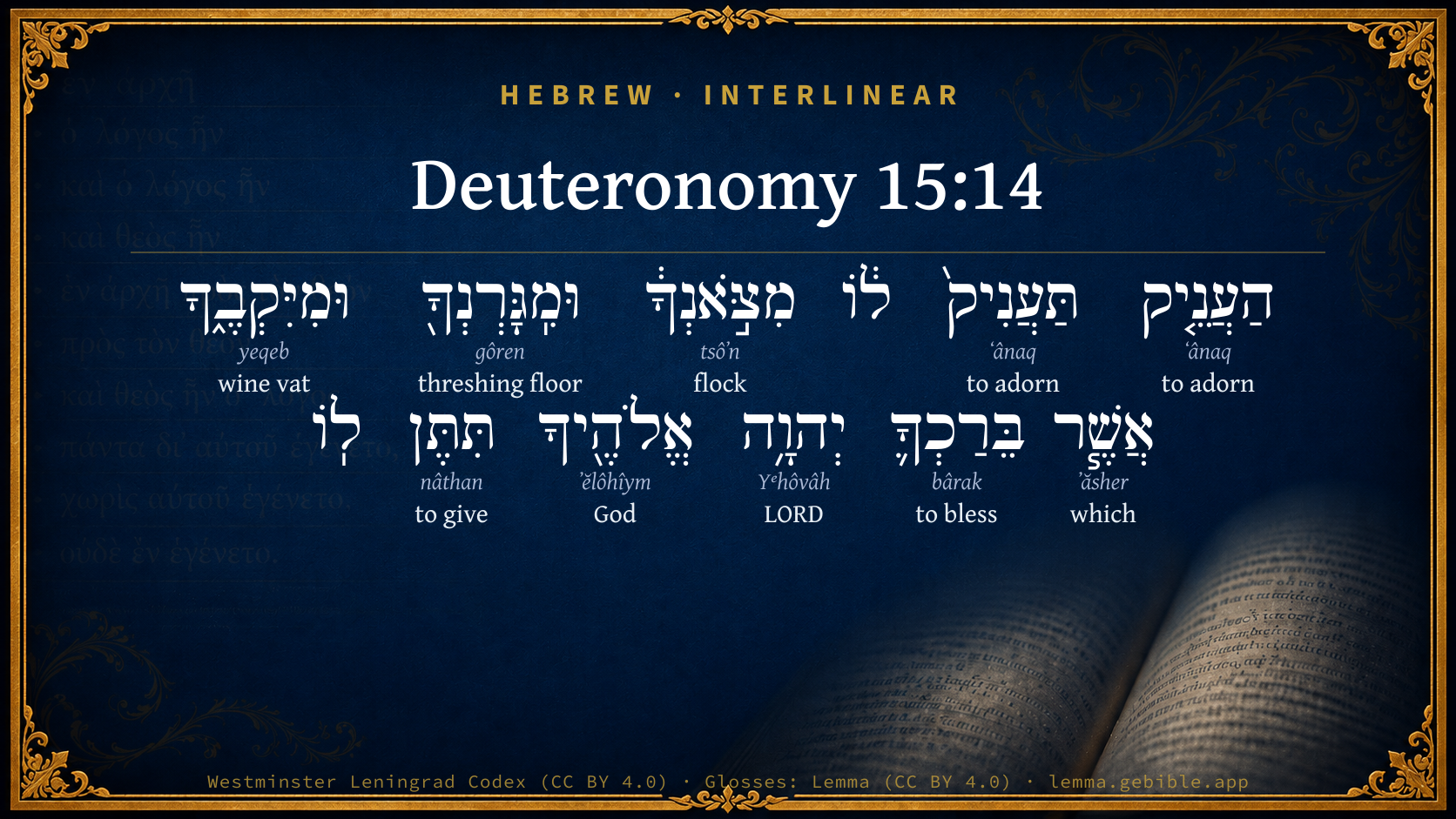
Hebrew (Westminster Leningrad Codex) Deuteronomy 15:14 appears in the Hebrew Old Testament. The text above is from the Westminster Leningrad Codex. Each word links to its Strong’s number, a concise gloss, and parsing drawn from the Open Scriptures Hebrew Bible morphology. Click any word for its full Brown-Driver-Briggs (BDB) entry.
Download image
Cite this verse

Deuteronomy 15:14 (World English Bible). Public Domain. Lemma interlinear Bible study tool, https://lemma.gebible.app/v/deuteronomy/15/14.

Show BibTeX & RIS
BibTeX
RIS
English Translation
you shall furnish him liberally out of your flock, and out of your threshing floor, and out of your winepress; as Yahweh your God has blessed you, you shall give to him.
World English Bible · Public Domain
Highlights
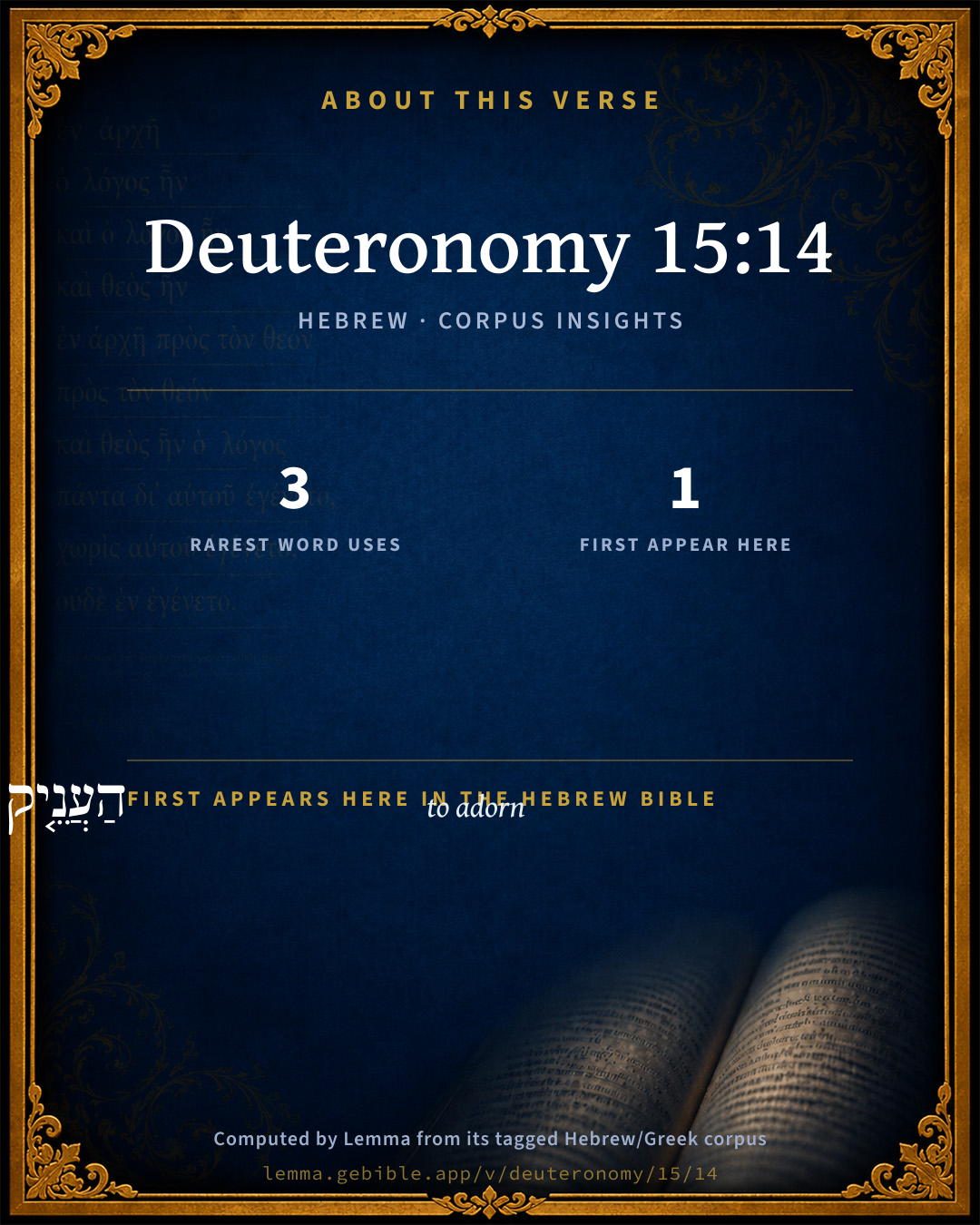
  • 1 first appearance in the Hebrew Bible
Full analysis ↓
Download a study sheet

One document with this verse’s original text, its word-by-word gloss line, the meaning frame, cross-references with their text, attributed commentary, and full source and license credits — printable, and it pastes into notes with its structure intact.

This verse Autodidact and up

Study sheet (.html) Plain text (.txt)

A passage Seminary Student

Up to 50 verses in one chapter. A passage sheet keeps up to 6 commentary sources and 12 cross-references per verse, in the order this page ranks them, and says so on the sheet whenever that leaves anything out. Ask for a single verse and you get the Autodidact verse sheet above.

Everything on this page stays free to read, with no account — the sheet is a download of what is already on screen, not access to it.

Want to remove ads? Support Godless Engineer
Compare translations 3

The same verse in 3 English versions, stacked beneath the original-language interlinear above. Click any original word for its lexicon entry.

Each is an independent rendering of the whole verse — the interlinear is not word-aligned to these translations.

Highlighted words mark where these versions differ — a whole-verse word diff, not a word-by-word alignment.

  • World English Bible Public Domain
    you shall furnish him liberally out of your flock, and out of your threshing floor, and out of your winepress; as Yahweh your God has blessed you, you shall give to him.
  • King James Version Public Domain
    Thou shalt furnish him liberally out of thy flock, and out of thy floor, and out of thy winepress: of that wherewith the LORD thy God hath blessed thee thou shalt give unto him.
  • unfoldingWord Literal Text CC BY-SA 4.0
    Providing, you shall liberally provide for him from your flock and from your threshing floor and from your winepress. As Yahweh your God has blessed you, you shall give to him.

unfoldingWord Literal Text — © unfoldingWord, licensed CC BY-SA 4.0. Word-aligned USFM3 via Door43 (git.door43.org/unfoldingWord/en_ult).

Versions to compare (up to 4)

3 of 4 selected

Show all 18 translations

Every available English version of this verse, each an independent rendering of the whole verse.

  • World English Bible Public Domain
    you shall furnish him liberally out of your flock, and out of your threshing floor, and out of your winepress; as Yahweh your God has blessed you, you shall give to him.
  • Berean Standard Bible Public Domain
    You are to furnish him liberally from your flock, your threshing floor, and your winepress. You shall give to him as the LORD your God has blessed you.
  • Majority Standard Bible Public Domain
    You are to furnish him liberally from your flock, your threshing floor, and your winepress. You shall give to him as the LORD your God has blessed you.
  • King James Version Public Domain
    Thou shalt furnish him liberally out of thy flock, and out of thy floor, and out of thy winepress: of that wherewith the LORD thy God hath blessed thee thou shalt give unto him.
  • American Standard Version (1901) Public Domain
    thou shalt furnish him liberally out of thy flock, and out of thy threshing-floor, and out of thy winepress; as Jehovah thy God hath blessed thee thou shalt give unto him.
  • Revised Version (1885) Public Domain
    thou shalt furnish him liberally out of thy flock, and out of thy threshing-floor, and out of thy winepress: as the LORD thy God hath blessed thee thou shalt give unto him.
  • Geneva Bible (1599) Public Domain
    But shalt giue him a liberall reward of thy sheepe, and of thy corne, and of thy wine: thou shalt giue him of that wherewith the Lord thy God hath blessed thee.
  • Douay-Rheims (1899) Public Domain
    But shalt give him for his way out of thy flocks, and out of thy barnfloor, and thy winepress, wherewith the Lord thy God shall bless thee.
  • Young's Literal Translation Public Domain
    thou dost certainly encircle him out of thy flock, and out of thy threshing-floor, and out of thy wine-vat; `of' that which Jehovah thy God hath blessed thee thou dost give to him,
  • Literal Standard Version CC BY-SA 4.0
    you certainly adorn him from your flock, and from your threshing-floor, and from your wine-vat; you give to him [from] that which your God YHWH has blessed you [with],
  • Unlocked Literal Bible CC BY-SA 4.0
    You must liberally provide for him out of your flock, out of your threshing floor, and out of your winepress. As Yahweh your God has blessed you, you must give to him.
  • unfoldingWord Literal Text CC BY-SA 4.0
    Providing, you shall liberally provide for him from your flock and from your threshing floor and from your winepress. As Yahweh your God has blessed you, you shall give to him.
  • Darby Bible Public Domain
    thou shalt certainly furnish him from thy sheep, and out of thy floor, and out of thy winepress: of what Jehovah thy God hath blessed thee with shalt thou give unto him.
  • World Messianic Bible Public Domain
    You shall furnish him liberally out of your flock, out of your threshing floor, and out of your wine press. As the LORD your God has blessed you, you shall give to him.
  • Webster's Bible Public Domain
    Thou shalt furnish him liberally out of thy flock, and out of thy floor, and out of thy wine-press: of that with which the LORD thy God hath blessed thee thou shalt give to him.
  • Free Bible Version CC BY-SA 4.0
    Give them plenty of gifts: animals from your flocks, grain from your threshing floor, and wine from your winepress. Give to them as generously as the Lord your God has blessed you.
  • Bible in Basic English Public Domain
    But give him freely from your flock and from your grain and your wine: in the measure of the wealth which the Lord your God has given you, you are to give to him.
  • JPS Tanakh (1917) Public Domain
    thou shalt furnish him liberally out of thy flock, and out of thy threshing-floor, and out of thy winepress; of that wherewith the LORD thy God hath blessed thee thou shalt give unto him.

Literal Standard Version (2020), Covenant Press — licensed CC BY-SA 4.0. Text via the HelloAO Bible API (eBible.org). Unlocked Literal Bible (unfoldingWord) — licensed CC BY-SA 4.0. Text via the HelloAO Bible API (eBible.org). unfoldingWord Literal Text — © unfoldingWord, licensed CC BY-SA 4.0. Word-aligned USFM3 via Door43 (git.door43.org/unfoldingWord/en_ult). Free Bible Version, Dr. Jonathan Gallagher — licensed CC BY-SA 4.0. Text via the HelloAO Bible API (eBible.org).

Word by word

More ways to search: Search by grammar → Find every occurrence → Compare this word →

Practice this passage: Drill this verse → Learn its vocabulary →

הַעֲנֵ֤יק
ʻânaq
H6059
“to adorn”
Verb, Hiphil, Infinitive Absolute
Part of Speech
Verb
Stem
Hiphil
Form
Infinitive Absolute
Full BDB Definition

Origin: a primitive root

TWOT: 1658c

to serve as a necklace, adorn with a neck ornament - (Qal) to serve as a necklace - (Hiphil) to make a necklace
  1. תַּעֲנִיק֙ ʻânaq H6059 “to adorn” Verb, Hiphil, Imperfect, 2nd Person, Masculine, Singular
  2. מִצֹּ֣אנְךָ֔ tsôʼn H6629 “from · flock · your” Preposition + Noun, Common, Both, Singular, Construct + Suffix, Personal, 2nd Person, Masculine, Singular
  3. וּמִֽגָּרְנְךָ֖ gôren H1637 “and · from · threshing floor · your” Conjunction + Preposition + Noun, Common, Both, Singular, Construct + Suffix, Personal, 2nd Person, Masculine, Singular
  4. וּמִיִּקְבֶ֑ךָ yeqeb H3342 “and · from · wine vat · your” Conjunction + Preposition + Noun, Common, Masculine, Singular, Construct + Suffix, Personal, 2nd Person, Masculine, Singular
  5. אֲשֶׁ֧ר ʼăsher H834 “which” Particle, Relative
  6. בֵּרַכְךָ֛ bârak H1288 “to bless · you” Verb, Piel, Perfect, 3rd Person, Masculine, Singular + Suffix, Personal, 2nd Person, Masculine, Singular
  7. יְהוָ֥ה Yᵉhôvâh H3068 “LORD” Noun, Proper
  8. אֱלֹהֶ֖יךָ ʼĕlôhîym H430 “God(s) · your” Noun, Common, Masculine, Plural, Construct + Suffix, Personal, 2nd Person, Masculine, Singular
  9. תִּתֶּן nâthan H5414 “to give” Verb, Qal, Imperfect, 2nd Person, Masculine, Singular

About this verse

These counts appear in no published source. They are computed here, from the morphology-tagged text and Lemma’s own curated glosses. What Lemma adds →

12
words
9
distinct lemmas
Pentateuch
section

Notable vocabulary

The rarest word here is הַעֲנֵ֤יק to adorn H6059 — appearing just 3 times in the whole Hebrew Bible.

First appearance in Scripture

This word makes its first canonical appearance in the Hebrew Bible here:

  • הַעֲנֵ֤יק to adorn H6059

Shared distinctive vocabulary

הַעֲנֵ֤יק to adorn H6059 occurs in 2 verses of the Hebrew Bible. Also found in:

Grammatical profile

  • 4 verbs
  • 5 nouns
  • 2 prepositions
  • 1 particle

Verb forms

  • הַעֲנֵ֤יק Hiphil · Infinitive Absolute
  • תַּעֲנִיק֙ Hiphil · Imperfect
  • בֵּרַכְךָ֛ Piel · Perfect
  • תִּתֶּן Qal · Imperfect

Repetition

A word recurs within this verse — often emphatic in Hebrew:

  • הַעֲנֵ֤יק to adorn H6059 ×2

Hebrew & Septuagint length

In English translation the verse runs 32 words from the Hebrew and 32 from the Septuagint (LXX English) — the same length.

A rough comparison of the two English renderings, which tokenize alike — not a word-level alignment.

Word counts can differ between the Hebrew and the Greek without any difference in meaning — e.g. the Hebrew direct-object marker אֵת has no separate Greek word, and Greek often adds the article ὁ.

Cross-references

5

Topical passages linked to Deuteronomy 15:14 in the Treasury of Scripture Knowledge — connected by theme and wording, ordered by reader-vote popularity; previews shown in the World English Bible.

  • Nehemiah 8:10 Then he said to them, Go your way, eat the fat, and drink the sweet, and send portions to him for whom nothing is prepared; for this day is holy to our Lord: neither be you grieved; for the joy of Yahweh is your strength.
  • Psalms 68:10 Your congregation lived therein. You, God, prepared your goodness for the poor.
  • Proverbs 10:22 Yahweh's blessing brings wealth, And he adds no trouble to it.
  • Acts 20:35 In all things I gave you an example, that so laboring you ought to help the weak, and to remember the words of the Lord Jesus, that he himself said, 'It is more blessed to give than to receive.'"
  • 1 Corinthians 16:2 On the first day of the week, let each one of you save, as he may prosper, that no collections be made when I come.

Cross-references courtesy of OpenBible.info (CC BY 4.0).

Hebrew and Greek witnesses Masoretic Hebrew ↔ Greek Septuagint

The same verse in the two great witnesses to the Old Testament, shown verse-for-verse.

These are two independent witnesses, not word-aligned to each other, and the Septuagint is shown in lemma (dictionary) form.

Hebrew Deuteronomy 15:14 Masoretic · Westminster Leningrad Codex

הַעֲנֵ֤יק תַּעֲנִיק֙ ל֔וֹ מִצֹּ֣אנְךָ֔ וּמִֽגָּרְנְךָ֖ וּמִיִּקְבֶ֑ךָ אֲשֶׁ֧ר בֵּרַכְךָ֛ יְהוָ֥ה אֱלֹהֶ֖יךָ תִּתֶּן לֽוֹ

you shall furnish him liberally out of your flock, and out of your threshing floor, and out of your winepress; as Yahweh your God has blessed you, you shall give to him.

World English Bible · Public Domain

Greek LXX Deuteronomy 15:14 Septuagint · lemma form

ἐφόδιον ἐφοδιάζω αὐτός ἀπό ὁ πρόβατον σύ καί ἀπό ὁ σῖτος σύ καί ἀπό ὁ ληνός σύ καθά εὐλογέω σύ κύριος ὁ θεός σύ δίδωμι αὐτός

You shall give him provision for the way from your flock, and from your corn, and from your wine; as the Lord your God has blessed you, you shall give to him.

LXX2012 (modern English Septuagint) · Public Domain

Hebrew: Westminster Leningrad Codex (CC BY 4.0). Greek: Septuagint (public domain); English from LXX2012 (modern English Septuagint) (Public Domain). How the Septuagint differs from the Hebrew →

Targum (Aramaic paraphrase)

2

The Targum is the ancient Jewish Aramaic paraphrase of the Hebrew Scriptures — an interpretive translation, not the Hebrew text itself. Onkelos (literal) and Pseudo-Jonathan (expansive) render the Torah, and Jonathan the Prophets. Coverage is partial: where no permissively-licensed English translation exists for a verse, only the Aramaic is shown. This is verse-level text, not a word-by-word alignment to the Hebrew.

  1. Targum Onkelos Torah (Genesis–Deuteronomy)
    אַפְרָשָׁא תַפְרֵשׁ לֵהּ מֵעָנָךְ וּמֵאִדְרָךְ וּמִמַעֲצַרְתָּךְ דִי בָרְכָךְ יְיָ אֱלָהָךְ תִּתֶּן לֵהּ

    (no public-domain English translation for this verse)

    Targum Onkelos — Aramaic: “Onkelos Genesis” (public domain); “Onkelos Exodus” (public domain); “Onkelos Leviticus” (public domain); “Onkelos Numbers” (public domain); “Onkelos Deuteronomy” (public domain). English: “Sefaria Community Translation” (CC0 1.0 (public-domain dedication)); “J.W. Etheridge. The Targums of Onkelos and Jonathan Ben Uzziel on the Pentateuch. London: Longmans, Green, 1862” (public domain). Text via Sefaria.

  2. Targum Pseudo-Jonathan Torah (Genesis–Deuteronomy)
    מְדַחֲרָא תְדַחֲרוּן לֵיהּ מִן עַנְכוֹן מִן אִידְרֵיכוֹן וּמִן מַעֲצַרְתְּכוֹן דְּבָרִיכֵיכוֹן יְיָ אֱלָהָכוֹן תִּתְּנוּן לֵיהּ

    Comforting thou shalt comfort him out of your flocks, your floors, and your wine presses; as the Lord hath blessed you ye shall give to him.

    Targum Pseudo-Jonathan — Aramaic: “Targum Jonathan on Genesis” (public domain); “Targum Jonathan on Exodus” (public domain); “Targum Jonathan on Leviticus” (public domain); “Targum Jonathan on Numbers” (public domain); “Targum Jonathan on Deuteronomy” (public domain). English: “The Targum of Jonathan ben Uzziel, trans. J. W. Etheridge, London, 1862” (public domain). Text via Sefaria.

Commentary

Notes on Deuteronomy 15:14 from classic Christian and Jewish commentators (each source and its license shown beneath its notes). The classic Christian expositions comment on the surrounding passage and are grouped to its opening verse, so a note may address several verses; the Jewish commentaries on the Tanakh (Rashi and others) are per-verse, so they appear only where the commentator wrote on this verse.

Lemma curates 59 commentaries, every one of them public domain or Creative Commons licensed, each selected and text-cleaned for this edition rather than reprinted as found. About our sources →

Geneva Bible (1599)

Geneva Bible translators

In token that thou dost acknowledge the benefit which God hath given thee by his labors.

Geneva Bible (1599) marginal notes — public domain. Text via Bolls.life.

Adam Clarke's Commentary

Verse 14. Thou shalt furnish him - out of thy flock] Thou shalt give him some cattle to breed with; out of thy floor - some corn for seed and for bread; and out of thy wine press - an adequate provision of wine for present necessity.

Adam Clarke's Commentary on the Bible (1810–1826) — public domain. Text from a community e-Sword/MySword module.

Ellicott's Commentary for English Readers

(14) Thou shalt furnish him liberally.—The beneficence of this provision is noticeable. Those who had fallen into poverty, when they had served their time, must be provided with means for a fresh start in life. And since the Jewish commentator regards the slavery of Hebrew men as chiefly a consequence of theft (If he be sold unto thee, “when the supreme court has sold him for his theft “), it would seem that, under Jewish law, even convicted thieves, when the term of their servitude was over, were to be provided with the means of obtaining an honest livelihood. This state of things is above the attainments of Christian England at the present date.

A Bible Commentary for English Readers, edited by Charles John Ellicott (1878–1897) — public domain. Text from a community e-Sword module.

The Cambridge Bible for Schools and Colleges

gen. ed. J. J. S. Perowne

14. thou shalt furnish him liberally] Lit. make-him-a-necklace (with emphatic repetition of the vb.). In this metaphor is the idea of loading or that of ornamenting (embellishing, equipping) the governing one? Probably both are combined; the metaphor rising from the primitive custom of hoarding the family wealth in heavy necklaces or headdresses. Less likely is the derivation from the use of the collar or necklace as a badge of rank or office (as it was in Egypt, Gen_41:42, and Persia, 1Es_3:6).

A similar liberality is exercised in Arabia (Doughty, Ar. Des. i. 554).

‘It is not many years, “if their house-lord fears Ullah,” before he will give them their liberty; and then he sends them not away empty; but in Upland Arabia (where only substantial persons are slave-holders) the good man will marry out his freed servants, male and female, endowing them with somewhat of his own substance, whether camels or palm-stems.’ Cp. Snouck-Hurgronje, Mekka, ii. 14: ‘the well-to-do owner feels himself bound where possible to provide for his loyal servant an establishment, and emancipation ranks in itself as a meritorious act: the family bond remains after as before it unbroken.’ Musil (Ethn. Ber. 225) quotes as part of the emancipation formula: ‘I dismiss my slave and endow him.’

flock, threshing-floor and wine-press] Cp. Deu_14:23, Deu_16:13.

as the Lord thy God hath blessed thee] Deu_7:13, Deu_12:15, Deu_16:17.

The Cambridge Bible for Schools and Colleges (gen. ed. J. J. S. Perowne; Cambridge University Press, 1878–1918) — public domain. Text from a community e-Sword module.

John Gill's Exposition

Thou shalt furnish him liberally,.... Not only to supply his present wants, but for his future use, and to set him up in the world: "loading thou shall load him" (h), so some render the words; give him as much as he can carry, and well stand up under; the word used has the signification of chains wore about the neck for honour or ornament, and so may signify he should be very honourably dismissed, with plain marks of honour and respect; and the order is, to supply him

out of thy flock, and out of thy floor, and out of thy winepress; with sheep or lambs out of the flock, with corn out of the floor, wheat, or barley, or both, and wine out of the winepress; which take in all the necessaries and comforts of life: of that

wherewith the Lord thy God hath blessed thee thou shall give unto him; be it what it will, and in proportion to it, as of money as well as goods; it is asked, how much shall be given to him? not less than the value of thirty shekels, whether of one kind or whether of many kinds, according to the thirty shekels for the price of a servant, Exo 21:32 (i). All this may be an emblem both of the servitude the people of God are in to sin, Satan, and the law, while in a state of nature; and of their freedom from it by Christ, and of the sufficiency and fulness of food and raiment, and large measures of divine grace; even all things richly to enjoy, all things pertaining to life and godliness, which are given to them when brought out of that state; who otherwise come out of it destitute of all good things, having neither food nor clothes, nor money to buy either, but have all from Christ freely and fully.

(h) "onerando oneratis", Munster, Pagninus, Vatablus. (i) Maimon. Hilchot Obedim, c. 3. sect. 14.

John Gill's Exposition of the Whole Bible (1746–1763) — public domain (CC PDM 1.0). Text via the HelloAO Bible API.

Albert Barnes' Notes on the Bible

Thou shalt furnish him liberally - The verb in the Hebrew is remarkable. It means “thou shalt lay on his neck,” “adorn his neck with thy gifts.”

Albert Barnes' Notes on the Bible (1834–1885) — public domain. Text from a community e-Sword/MySword module.

Haydock's Catholic Bible Commentary

Way. Hebrew literally, "Thou shalt put round his neck, (or furnish him abundantly) out of thy flock," &c. This is not specified in the Book of Exodus.

George Leo Haydock (1774–1849), Haydock's Catholic Family Bible and Commentary, 1859 edition — public domain. Excludes Psalms (Douay-Rheims chapter numbering differs from Protestant) and Deuterocanonical books (Catholic canon only).

Whedon's Commentary on the Bible

Daniel D. Whedon

14. Thou shalt furnish him liberally — The Hebrew verb that is used makes the expression very emphatic, Thou shalt load him bountifully.

Daniel D. Whedon (gen. ed.), Commentary on the Old and New Testaments (1874–1909) — public domain. Text from a community e-Sword module.

The Pulpit Commentary

Thou shalt furnish him liberally; literally, shalt lay on his neck, i.e. thou shalt load him. The meaning is well expressed in the Authorized Version. This is the new prescription added to the earlier law.

The Pulpit Commentary (1880–1919), ed. H.D.M. Spence-Jones & Joseph S. Exell — public domain. Text from a community e-Sword module.

Rashi

Rabbi Shlomo Yitzchaki (Rashi)

הענק תעניק THOU SHALT FURNISH HIM LIBERALLY — The noun from the root ענק denotes an ornament worn high up on the body which thus easily comes within sight of the eye (i.e. is conspicuous), (cf. ענק, a giant, someone who towers on high) — i.e. you shall furnish him with something that will make it patent that you have been kind to him. There are some who explain the word הענק to mean loading on his (the servant’s) neck.

מצאנך מגרנך ומיקבך [THOU SHALT FURNISH HIM LIBERALLY] OUT OF THY FLOCK, AND OUT OF THY FLOOR, AND OUT OF THY WINE PRESS — One might think I have this duty in respect to these things only! Scripture, however, states “that wherewith the Lord thy God hath blessed thee [shalt thou give him]” implying, of all with which thy Creator hath blessed thee. Why, then, are these alone specifically mentioned? To teach you the following: How is it with these things? They have the characteristic that they come under the term of “blessing”, (i.e. they possess the power of propagating) so, too, you are obliged to furnish him only with such things that come under the term “blessing”, thus excluding mules, (because they are sterile) (Sifrei Devarim 119:3; Kiddushin 17a). — Our Rabbis have derived in Treatise Kiddushin 17a by reasoning from the analogous expressions found in certain texts (גז"ש) what quantities one must give him of all the different kinds here mentioned.

Rashi on the Tanakh — English translations: “The Judaica Press complete Tanach with Rashi, translated by A. J. Rosenberg” (CC BY 4.0); “Pentateuch with Rashi's commentary by M. Rosenbaum and A.M. Silbermann, 1929-1934” (public domain); “The Metsudah Tanach series, Lakewood, N.J” (CC BY 4.0); and “The Book of Joshua, Metsudah Publications, 1997” (CC BY 4.0). Text via Sefaria.

Lesson kit

Teaching starters — assembled from the data on this page, not authored interpretation. Every prompt links to the verse data it draws on. Edit before teaching.

Deuteronomy, in the Pentateuch, opens this verse with 12 words (9 distinct Hebrew lemmas). Its most distinctive word is ʻânaq (“to adorn”). A historical commentator’s framing appears above. Read the whole chapter for the surrounding context.

Discussion questions

  1. How does “to adorn” (ʻânaq) shape what this verse is saying?
  2. The word “to adorn” first appears here in Scripture. What is being introduced at this debut?
  3. Psalms 73:6 shares the word «to adorn» with this verse. How do the two illuminate each other?
  4. “to adorn” occurs 2× in this one verse. What is the effect of the repetition?
  5. These translations render this verse differently; the difference is in the English rendering, not the original. What questions does that raise?
  6. The verb «הַעֲנֵ֤יק» is Hiphil Infinitive Absolute. How does its form color the action?
  7. Reading how Geneva Bible (1599) and Adam Clarke's Commentary read this verse, where do the two commentators agree and where do they part?

Things to notice

  • 1 word makes its first canonical appearance in Scripture here.
  • These translations choose different wording for 11 words in this verse.
  • “to adorn” occurs 2× in this single verse.
  • 9 distinct Hebrew lemmas span 12 words in this verse.

Reading settings

Reading text

Shown beneath each verse's original-language words.

Old Testament
Old Testament edition

Read the OT as the Masoretic Hebrew (MT) or the Greek Septuagint (LXX).

English shown for the Greek Septuagint (in the Hebrew ↔ Greek comparison).

Comparing translations? Open the Compare panel on any verse page to stack up to four side by side.