
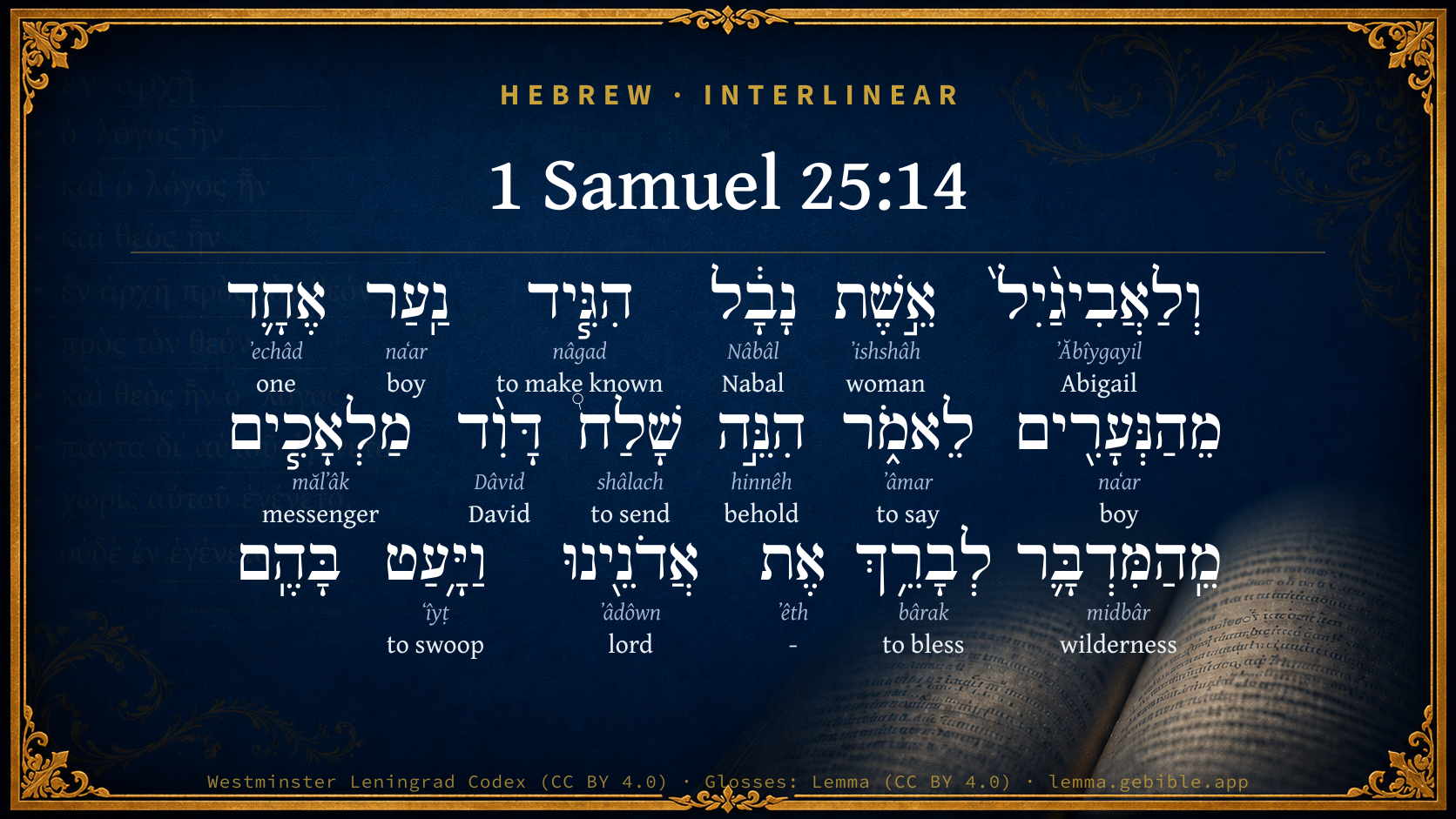
1 Samuel 25:14

Hebrew (Westminster Leningrad Codex) 1 Samuel 25:14 appears in the Hebrew Old Testament. The text above is from the Westminster Leningrad Codex. Each word links to its Strong’s number, a concise gloss, and parsing drawn from the Open Scriptures Hebrew Bible morphology. Click any word for its full Brown-Driver-Briggs (BDB) entry.
Download image
Cite this verse

1 Samuel 25:14 (World English Bible). Public Domain. Lemma interlinear Bible study tool, https://lemma.gebible.app/v/1-samuel/25/14.

Show BibTeX & RIS
BibTeX
RIS
English Translation
But one of the young men told Abigail, Nabal's wife, saying, Behold, David sent messengers out of the wilderness to Greet our master; and he railed at them.
World English Bible · Public Domain
Download a study sheet

One document with this verse’s original text, its word-by-word gloss line, the meaning frame, cross-references with their text, attributed commentary, and full source and license credits — printable, and it pastes into notes with its structure intact.

This verse Autodidact and up

Study sheet (.html) Plain text (.txt)

A passage Seminary Student

Up to 50 verses in one chapter. A passage sheet keeps up to 6 commentary sources and 12 cross-references per verse, in the order this page ranks them, and says so on the sheet whenever that leaves anything out. Ask for a single verse and you get the Autodidact verse sheet above.

Everything on this page stays free to read, with no account — the sheet is a download of what is already on screen, not access to it.

Want to remove ads? Support Godless Engineer
Compare translations 3

The same verse in 3 English versions, stacked beneath the original-language interlinear above. Click any original word for its lexicon entry.

Each is an independent rendering of the whole verse — the interlinear is not word-aligned to these translations.

Highlighted words mark where these versions differ — a whole-verse word diff, not a word-by-word alignment.

  • World English Bible Public Domain
    But one of the young men told Abigail, Nabal's wife, saying, Behold, David sent messengers out of the wilderness to Greet our master; and he railed at them.
  • King James Version Public Domain
    But one of the young men told Abigail, Nabal's wife, saying, Behold, David sent messengers out of the wilderness to salute our master; and he railed on them.
  • unfoldingWord Literal Text CC BY-SA 4.0
    But one young man from the young men declared to Abigail, the wife of Nabal, saying, “Behold, David sent messengers from the wilderness to bless our master, but he screamed at them.

unfoldingWord Literal Text — © unfoldingWord, licensed CC BY-SA 4.0. Word-aligned USFM3 via Door43 (git.door43.org/unfoldingWord/en_ult).

Versions to compare (up to 4)

3 of 4 selected

Show all 18 translations

Every available English version of this verse, each an independent rendering of the whole verse.

  • World English Bible Public Domain
    But one of the young men told Abigail, Nabal's wife, saying, Behold, David sent messengers out of the wilderness to Greet our master; and he railed at them.
  • Berean Standard Bible Public Domain
    Meanwhile, one of Nabal’s young men informed Nabal’s wife Abigail, “Look, David sent messengers from the wilderness to greet our master, but he scolded them.
  • Majority Standard Bible Public Domain
    Meanwhile, one of Nabal’s young men informed Nabal’s wife Abigail, “Look, David sent messengers from the wilderness to greet our master, but he screamed at them.
  • King James Version Public Domain
    But one of the young men told Abigail, Nabal's wife, saying, Behold, David sent messengers out of the wilderness to salute our master; and he railed on them.
  • American Standard Version (1901) Public Domain
    But one of the young men told Abigail, Nabal's wife, saying, Behold, David sent messengers out of the wilderness to salute our master; and he railed at them.
  • Revised Version (1885) Public Domain
    But one of the young men told Abigail, Nabal’s wife, saying, Behold, David sent messengers out of the wilderness to salute our master; and he flew upon them.
  • Geneva Bible (1599) Public Domain
    Nowe one of the seruantes tolde Abigail Nabals wife, saying, Beholde, Dauid sent messengers out of the wildernesse to salute our master, and he rayled on them.
  • Douay-Rheims (1899) Public Domain
    But one of the servants told Abigail the wife of Nabal, saying: Behold David sent messengers out of the wilderness, to salute our master: and he rejected them.
  • Young's Literal Translation Public Domain
    And to Abigail wife of Nabal hath one young man of the youths declared, saying, `Lo, David hath sent messengers out of the wilderness to bless our lord, and he flieth upon them;
  • Literal Standard Version CC BY-SA 4.0
    And one young man of the youths has declared [it] to Abigail wife of Nabal, saying, “Behold, David has sent messengers out of the wilderness to bless our lord, and he flies on them;
  • Unlocked Literal Bible CC BY-SA 4.0
    But one of the young men told Abigail, Nabal's wife; he said, “David sent messengers out of the wilderness to greet our master, and he insulted them.
  • unfoldingWord Literal Text CC BY-SA 4.0
    But one young man from the young men declared to Abigail, the wife of Nabal, saying, “Behold, David sent messengers from the wilderness to bless our master, but he screamed at them.
  • Darby Bible Public Domain
    And one of [Nabal's] young men told Abigail, Nabal's wife, saying, Behold, David sent messengers out of the wilderness to bless our master; and he has insulted them.
  • World Messianic Bible Public Domain
    But one of the young men told Abigail, Nabal’s wife, saying, “Behold, David sent messengers out of the wilderness to greet our master; and he insulted them.
  • Webster's Bible Public Domain
    But one of the young men told Abigail, Nabal's wife, saying, Behold, David sent messengers from the wilderness to salute our master; and he railed at them.
  • Free Bible Version CC BY-SA 4.0
    In the meantime one of Nabal's men told Abigail, Nabal's wife, “David sent some messengers from the wilderness to bring greetings to our master, but he only insulted them.
  • Bible in Basic English Public Domain
    But one of the young men said to Nabal's wife Abigail, David sent men from the waste land to say kind words to our master, and he gave them a rough answer.
  • JPS Tanakh (1917) Public Domain
    But one of the young men told Abigail, Nabal's wife, saying: 'Behold, David sent messengers out of the wilderness to salute our master; and he flew upon them.

Literal Standard Version (2020), Covenant Press — licensed CC BY-SA 4.0. Text via the HelloAO Bible API (eBible.org). Unlocked Literal Bible (unfoldingWord) — licensed CC BY-SA 4.0. Text via the HelloAO Bible API (eBible.org). unfoldingWord Literal Text — © unfoldingWord, licensed CC BY-SA 4.0. Word-aligned USFM3 via Door43 (git.door43.org/unfoldingWord/en_ult). Free Bible Version, Dr. Jonathan Gallagher — licensed CC BY-SA 4.0. Text via the HelloAO Bible API (eBible.org).

Word by word

More ways to search: Search by grammar → Find every occurrence → Compare this word →

Practice this passage: Drill this verse → Learn its vocabulary →

וַיָּ֥עַט
ʻîyṭ
H5860
“and · to swoop”
Conjunction + Verb, Qal, Sequential Imperfect, 3rd Person, Masculine, Singular
Part of Speech
Conjunction + Verb
Stem
Qal
Form
Sequential Imperfect
Person
3rd Person
Gender
Masculine
Number
Singular
Full BDB Definition

Origin: a primitive root

TWOT: 1610 , 1610b

to scream, shriek - (Qal) to scream - to dart greedily, swoop upon, rush upon - (Qal) to dart greedily
  1. וְלַאֲבִיגַ֨יִל֙ ʼĂbîygayil H26 “and · to/for · Abigail” Conjunction + Preposition + Noun, Proper
  2. אֵ֣שֶׁת ʼishshâh H802 “woman of” Noun, Common, Feminine, Singular, Construct
  3. נָבָ֔ל Nâbâl H5037 “Nabal” Noun, Proper
  4. הִגִּ֧יד nâgad H5046 “to make known” Verb, Hiphil, Perfect, 3rd Person, Masculine, Singular
  5. נַֽעַר naʻar H5288 “boy” Noun, Common, Masculine, Singular, Absolute
  6. אֶחָ֛ד ʼechâd H259 “one” Adjective, Cardinal number, Masculine, Singular, Absolute
  7. מֵהַנְּעָרִ֖ים naʻar H5288 “from · the · boys” Preposition + Particle, Definite Article + Noun, Common, Masculine, Plural, Absolute
  8. לֵאמֹ֑ר ʼâmar H559 “to say” Preposition + Verb, Qal, Infinitive Construct
  9. הִנֵּ֣ה hinnêh H2009 “behold” Particle, Demonstrative
  10. שָׁלַח֩ shâlach H7971 “to send” Verb, Qal, Perfect, 3rd Person, Masculine, Singular
  11. דָּוִ֨ד Dâvid H1732 “David” Noun, Proper
  12. מַלְאָכִ֧ים mălʼâk H4397 “messengers” Noun, Common, Masculine, Plural, Absolute
  13. מֵֽהַמִּדְבָּ֛ר midbâr H4057 “from · the · wilderness” Preposition + Particle, Definite Article + Noun, Common, Masculine, Singular, Absolute
  14. לְבָרֵ֥ךְ bârak H1288 “to bless” Preposition + Verb, Piel, Infinitive Construct
  15. אֶת ʼêth H853 “-” Particle, Direct Object
  16. אֲדֹנֵ֖ינוּ ʼâdôwn H113 “lords · our” Noun, Common, Masculine, Plural, Construct + Suffix, Personal, 1st Person, Common, Plural

About this verse

These counts appear in no published source. They are computed here, from the morphology-tagged text and Lemma’s own curated glosses. What Lemma adds →

18
words
16
distinct lemmas
Historical
section

Notable vocabulary

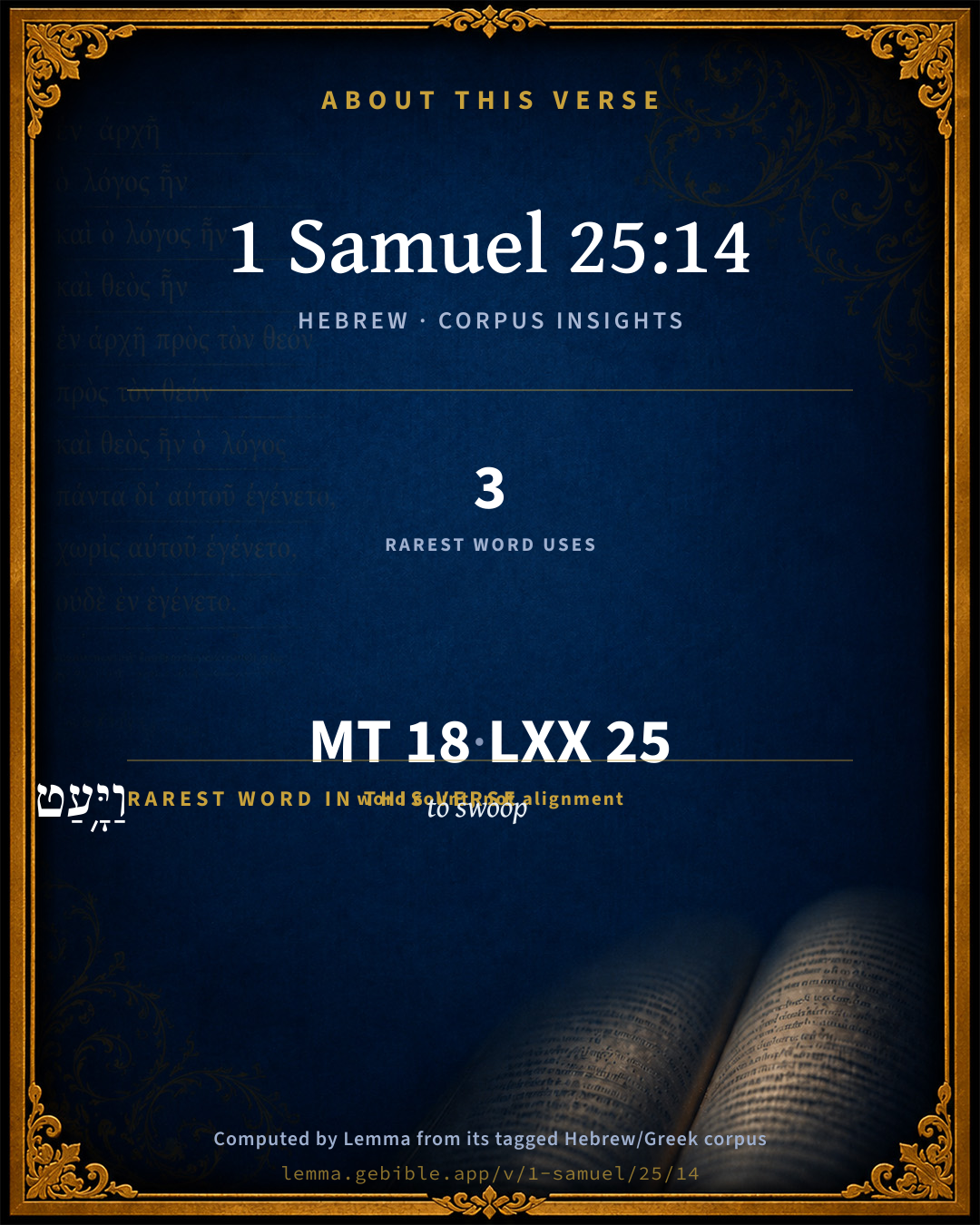
The rarest word here is וַיָּ֥עַט to swoop H5860 — appearing just 3 times in the whole Hebrew Bible.

Shared distinctive vocabulary

וַיָּ֥עַט to swoop H5860 occurs in 3 verses of the Hebrew Bible. Also found in:

Grammatical profile

  • 5 verbs
  • 9 nouns
  • 1 adjective
  • 1 preposition
  • 2 particles

Verb forms

  • הִגִּ֧יד Hiphil · Perfect
  • לֵאמֹ֑ר Qal · Infinitive Construct
  • שָׁלַח֩ Qal · Perfect
  • לְבָרֵ֥ךְ Piel · Infinitive Construct
  • וַיָּ֥עַט Qal · Sequential Imperfect

Repetition

A word recurs within this verse — often emphatic in Hebrew:

  • נַֽעַר boy H5288 ×2

Hebrew & Septuagint length

In English translation the verse runs 28 words from the Hebrew and 31 from the Septuagint (LXX English) — closely comparable.

A rough comparison of the two English renderings, which tokenize alike — not a word-level alignment.

Word counts can differ between the Hebrew and the Greek without any difference in meaning — e.g. the Hebrew direct-object marker אֵת has no separate Greek word, and Greek often adds the article ὁ.

In the original languages it is 18 Hebrew tokens and 25 Greek tokens — but the two are counted differently (Hebrew bundles its prefixes and suffixes into one token; the Greek is in lemma form), so that isn’t a like-for-like length.

Cross-references

2

Topical passages linked to 1 Samuel 25:14 in the Treasury of Scripture Knowledge — connected by theme and wording, ordered by reader-vote popularity; previews shown in the World English Bible.

  • 1 Samuel 13:10 It came to pass that as soon as he had made an end of offering the burnt offering, behold, Samuel came; and Saul went out to meet him, that he might greet him.
  • Mark 15:29 Those who passed by blasphemed him, wagging their heads, and saying, "Ha! You who destroy the temple, and build it in three days,

Cross-references courtesy of OpenBible.info (CC BY 4.0).

Hebrew and Greek witnesses Masoretic Hebrew ↔ Greek Septuagint

The same verse in the two great witnesses to the Old Testament, shown verse-for-verse.

These are two independent witnesses, not word-aligned to each other, and the Septuagint is shown in lemma (dictionary) form.

Hebrew 1 Samuel 25:14 Masoretic · Westminster Leningrad Codex

וְלַאֲבִיגַ֨יִל֙ אֵ֣שֶׁת נָבָ֔ל הִגִּ֧יד נַֽעַר אֶחָ֛ד מֵהַנְּעָרִ֖ים לֵאמֹ֑ר הִנֵּ֣ה שָׁלַח֩ דָּוִ֨ד מַלְאָכִ֧ים מֵֽהַמִּדְבָּ֛ר לְבָרֵ֥ךְ אֶת אֲדֹנֵ֖ינוּ וַיָּ֥עַט בָּהֶֽם

But one of the young men told Abigail, Nabal's wife, saying, Behold, David sent messengers out of the wilderness to Greet our master; and he railed at them.

World English Bible · Public Domain

Greek LXX 1 Samuel 25:14 Septuagint · lemma form

καί ὁ αβιγαια γυνή ναβαλ ἀποἀγγέλλω εἷς ὁ παιδάριον λέγω ἰδού δαυίδ ἀποστέλλω ἄγγελος ἐκ ὁ ἔρημος εὐλογέω ὁ κύριος ἐγώ καί ἐκκλίνω ἀπό αὐτός

And one of the servants reported to Abigaia the wife of Nabal, saying, Behold, David sent messengers out of the wilderness to salute our lord; but he turned away from them.

LXX2012 (modern English Septuagint) · Public Domain

Hebrew: Westminster Leningrad Codex (CC BY 4.0). Greek: Septuagint (public domain); English from LXX2012 (modern English Septuagint) (Public Domain). How the Septuagint differs from the Hebrew →

Targum (Aramaic paraphrase)

1

The Targum is the ancient Jewish Aramaic paraphrase of the Hebrew Scriptures — an interpretive translation, not the Hebrew text itself. Onkelos (literal) and Pseudo-Jonathan (expansive) render the Torah, and Jonathan the Prophets. Coverage is partial: where no permissively-licensed English translation exists for a verse, only the Aramaic is shown. This is verse-level text, not a word-by-word alignment to the Hebrew.

  1. Targum Jonathan Prophets (Joshua–Malachi)
    וְלַאֲבִיגַיִל אִתַּת נָבָל חֲוֵי עוּלֵמָא חַד מֵעוּלֵמַיָא לְמֵימָר הָא שְׁלַח דָוִד אִזְגַדַיָא מִמַדְבְּרָא לְבָרָכָא יַת רִבּוֹנָנָא וְקָץ בְּהוֹן:

    (no public-domain English translation for this verse)

    Targum Jonathan — Aramaic: “Mikraot Gedolot” (public domain). English: “Sefaria Community Translation” (CC0 1.0 (public-domain dedication)); “London "Chaldee Paraphrase," 1871” (public domain). Text via Sefaria.

Commentary

Notes on 1 Samuel 25:14 from classic Christian and Jewish commentators (each source and its license shown beneath its notes). The classic Christian expositions comment on the surrounding passage and are grouped to its opening verse, so a note may address several verses; the Jewish commentaries on the Tanakh (Rashi and others) are per-verse, so they appear only where the commentator wrote on this verse.

Lemma curates 59 commentaries, every one of them public domain or Creative Commons licensed, each selected and text-cleaned for this edition rather than reprinted as found. About our sources →

Jamieson, Fausset & Brown

Robert Jamieson, A. R. Fausset & David Brown

ABIGAIL PACIFIES HIM. (1Sa. 25:14-35)

Then Abigail made haste--The prudence and address of Nabal's wife were the means of saving him and family from utter destruction. She acknowledged the demand of her formidable neighbors; but justly considering, that to atone for the insolence of her husband, a greater degree of liberality had become necessary, she collected a large amount of food, accompanying it with the most valued products of the country.

bottles--goatskins, capable of holding a great quantity.

parched corn--It was customary to eat parched corn when it was fully grown, but not ripe.

Jamieson, Fausset & Brown — Commentary Critical and Explanatory on the Whole Bible (1871) — public domain (CC PDM 1.0). Text via the HelloAO Bible API.

Trapp's Complete Commentary

John Trapp

1Sa 25:14 But one of the young men told Abigail, Nabal’s wife, saying, Behold, David sent messengers out of the wilderness to salute our master; and he railed on them.

Ver. 14. And he railed on them.] Heb., He flew upon them; as a ravenous bird doth upon the prey. Or, He drove them away, sc., by his harsh and currish language wherewith he let fly at them.

John Trapp, A Commentary or Exposition upon All the Books of the Old and New Testament (1647–1656) — public domain. Text from a community e-Sword module.

Joseph Benson's Commentary

1Sa 25:14-17. But one of the young men told Abigail, &c. — One of those belonging to Nabal. Who can help admiring the wisdom and fidelity of this shepherd, who admonished his mistress of the danger her family was in; as he rationally concluded from the rude abuse that had been put upon David, whose merits he honestly set forth before her. They were a wall unto us — This servant says more than David’s men had said of themselves; that they not only did them no harm, but were a guard to them against robbers and against wild beasts. A man cannot speak to him — But he flies into a passion. Nabal must have been a most brutish, churlish man, to extort such a character of himself from his own servants.

Joseph Benson's Commentary on the Old and New Testaments (1811–1818) — public domain. Text from a community e-Sword module.

Geneva Bible (1599)

Geneva Bible translators

Hebrew, drove them away.

Geneva Bible (1599) marginal notes — public domain. Text via Bolls.life.

Ellicott's Commentary for English Readers

(14) But one of the young men told Abigail.—The servant of Nabal—accustomed, no doubt, to his master’s wild and ungovernable displays of temper had heard the insulting words which Nabal spoke to the armed messenger of the famous outlaw captain; and probably gathering from the angry demeanour of these warlike followers of David how deadly was the insult—aware, too, how great was the power of the man thus insulted—came at once, and recounted to his mistress what had taken place. Abigail had, no doubt, often acted as peace-maker between her intemperate husband and his neighbours, and on hearing the story and how imprudently her husband had behaved, saw that no time must be lost, for with a clever woman’s wit she saw that grave consequences would surely follow the churlish refusal and the rash words, which betrayed at once the jealous adherent of Saul and the bitter enemy of the powerful outlaw.

A Bible Commentary for English Readers, edited by Charles John Ellicott (1878–1897) — public domain. Text from a community e-Sword module.

The Cambridge Bible for Schools and Colleges

gen. ed. J. J. S. Perowne

14–22. Abigail’s wise counsel

14. to salute] Lit. to bless, as in ch. 1Sa_13:10. Cp. 2Ki_4:29, and the form of salutation in 1Sa_15:13.

he railed on them] Lit. flew upon them; the same word as in 1Sa_14:32.

The Cambridge Bible for Schools and Colleges (gen. ed. J. J. S. Perowne; Cambridge University Press, 1878–1918) — public domain. Text from a community e-Sword module.

John Gill's Exposition

But one of the young men told Abigail, Nabal's wife,.... Not one of David's young men, as what follows shows, but one of Nabal's young men or servants, one of those David directs him to for the truth of what he said, Sa1 25:8; this was one of those that had been employed in feeding sheep in the wilderness, where David was, and knew him, but was now at Carmel, and was present when David's messengers came to Nabal, and was privy to what passed:

saying, David sent messengers out of the wilderness to salute our master; in a very kind and handsome manner, to ask of his peace and welfare, and to wish him all happiness and prosperity; or "masters" (y) master and mistress, including both Nabal and Abigail:

and he railed on them; gave them very abusive language, represented David and his men as a parcel of scoundrels, fugitives, and runaway servants, Sa1 25:10; or "he flew at them" (z); or "upon" them, in great wrath and fury, calling them hard names, bidding them begone about their business; the allusion is to a ravenous bird, which will fly at persons when it apprehends its young in any danger.

(y) "dominus nostros", Malvenda. (z) "et involavit in eos", Coccei Lex. col. 607.

John Gill's Exposition of the Whole Bible (1746–1763) — public domain (CC PDM 1.0). Text via the HelloAO Bible API.

Albert Barnes' Notes on the Bible

Railed on them - The marginal reading, “flew upon them,” is nearer to the original.

Albert Barnes' Notes on the Bible (1834–1885) — public domain. Text from a community e-Sword/MySword module.

Haydock's Catholic Bible Commentary

Rejected them. Hebrew, "flew against them." Chaldean, "saw them with disgust."

George Leo Haydock (1774–1849), Haydock's Catholic Family Bible and Commentary, 1859 edition — public domain. Excludes Psalms (Douay-Rheims chapter numbering differs from Protestant) and Deuterocanonical books (Catholic canon only).

Matthew Poole's English Annotations

One of the young men told Abigail; wisely considering the mischievous effects likely to follow so churlish a message.

Matthew Poole's English Annotations on the Holy Bible (1683–1685) — public domain. Text from a community e-Sword/MySword module.

The Pulpit Commentary

ABIGAIL PACIFIES DAVID (vers. 14-35).

Vers. 14-17. One of the young men. Hebrew, "a lad of the lads," i.e. one of the servants; (see on the word 1Sa_1:24) when used in this sense it has no reference to age. (see 1Sa_2:17) This man was probably some old and confidential servitor. To salute. Hebrew, "to bless". (1Sa_13:10; 2Ki_4:29) He railed on them. Literally, "flew upon them like a bird of prey." We were not hurt. Literally, "not put to shame" (see on ver. 7). The language of a people always bears witness to their character, and it is a mark of the high spirit of the Israelites that they thought less of the loss than of the disgrace of an injury. As long as we were conversant with them. Hebrew, "as long as we went about with them." In the fields. Really, "in the field," the wilderness, the common pasture land. A wall. Ie. a sure protection both against wild beasts and Amalekite and other plunderers. A son of Belial. A worthless, bad man, (see on 1Sa_1:16) so coarse and violent that it is hopeless to expostulate with him.

Vers. 14-42. (CARMEL.)

Abigail.

Of her family and early life nothing is recorded. When first mentioned she was the wife of the wealthy and churlish Nabal. It was an ill-assorted union, probably due (like most Oriental marriages) to parental arrangement. She was distinguished by a beautiful countenance and form, and (what is not always associated therewith) by a beautiful mind and character, embodying the ideal of womanhood. (Pro_31:10-31) "Where do we find in all the heathen world a woman comparable with Abigail, the daughter of the wilderness?" She was a woman of

1. Superior intelligence, practical wisdom, prudence, tact, and good management. "Of good understanding" (ver. 3). The part she took in the affairs of her husband is evident from the servants telling her of the threatening danger (ver. 17), and her apology (ver. 25). Her discretion was also shown in her reserve (ver. 19).

2. Prompt decision, energy, and activity. "Abigail made haste," etc. (ver. 18). Not a moment was lost, and she was promptly obeyed.

3. Unaffected humility, meekness, modesty, and self-devotion. "She fell before David on her face," etc. (vers. 23, 41). Her meekness and patience must have been greatly tried by the temper of Nabal, and had doubtless previously averted many a disaster.

4. Noble generosity and sacrifice. "Two hundred loaves," etc. (ver. 18). She felt that no sacrifice was too great to save her husband and his household. "David"s men and David felt that these were not the gifts of a sordid calculation, but the offerings of a generous heart. And it won them, their gratitude, their enthusiasm, their unfeigned homage" (Robertson).

5. Conciliatory, faithful, eloquent speech, and pacifying, beneficent influence (vers. 24-31). Having taken the blame upon herself (as intercessor), and referred to her husband "with that union of playfulness and seriousness which above all things turns away wrath" (Stanley), she directed the thoughts of David to God, by the leadings of whose providence she had been sent to divert him from his purpose, utters the wish flint he to whom vengeance belongs would avenge him, humbly begs the acceptance of her offering for his young men, and beseeches his forgiveness. Then (assuming her prayer to be granted) she assures him of the brilliant future that awaited him, inasmuch as he would fulfil the purposes of Jehovah, and not his own; that, should any one seek to do him harm, Jehovah would preserve him in safety, and punish his adversaries; and that when he should be "ruler over Israel" it would be a source of comfort, and not of trouble, to him that he had not shed blood causelessly, nor taken vengeance into his own hand. Finally she says, "And Jehovah will do good to my lord, and thou wilt remember thine handmaid" (for good) the things which I have spoken" (Dathe). No dissuasions from revenge could be more effective.

When a world of men Could not prevail with all their oratory, Yet hath a woman"s kindness overruled.

"Doubtless she had not studied eloquence in the schools, but the Spirit of God alone made her such an orator. God put wisdom into her heart, and it flowed out in wise discourse" (Roos).

6 . Exalted piety; faith in the righteousness and goodness of God, his overruling providence, and the establishment of his kingdom (see the song of Hannah), devotion, spiritual insight, manifested in this appeal, and in her whole conduct. (Pro_31:26, Pro_31:30) It is not surprising that, after the death of Nabal, "David sent and communed with Abigail, to take her to him to wife" (ver. 39). D.

The Pulpit Commentary (1880–1919), ed. H.D.M. Spence-Jones & Joseph S. Exell — public domain. Text from a community e-Sword module.

Kretzmann's Popular Commentary

Paul E. Kretzmann

Abigail’s Tact and Prudence

v. 14. But one of the young men, of the servants of Nabal, told Abigail, Nabal’s wife, saying, Behold, David sent messengers out of the wilderness to salute our master; and he railed on them, drove over them, flew on them in a rage.

v. 15. But the men, namely, those of David, were very good unto us, and we were not hurt, injured, made subjects of shame and contempt, neither missed we anything as long as we were conversant with them, during all the time of their fellowship with them, when we were in the fields;

v. 16. they were a wall unto us both by night and day, all the while we were with them keeping the sheep, their presence had proved a powerful protection against the wild beasts as well as against the robbers of the desert.

v. 17. Now, therefore, know and consider what thou wilt do, Abigail was to find some way to avert a probable calamity;for evil is determined against our master and against all his household, this they might count on as firmly settled; for he, Nabal, is such a son of Belial, bad, foolish, and profitless, that a man cannot speak to him. That was the estimate in which Nabal was held by his household and by his servants.

v. 18. Then Abigail made haste, and took two hundred loaves, and two bottles of wine, the skins used for this purpose in the Orient, and five sheep ready dressed, and five measures of parched corn, more than forty quarts of roasted gram, and an hundred clusters of raisins, in the form of cakes made of pressed raisins, and two hundred cakes of figs, also in the pressed form, and laid them on asses.

v. 19. And she said unto her servants, Go on before me; behold, I come after you. Like Jacob, Gen 32:13-20, she sent the presents of reconciliation ahead of her. But she told not her husband Nabal, who would probably have interfered very decidedly.

v. 20. And it was so, as she rode on the ass, that she came down by the covert of the hill, probably a depression or pass between two peaks, hidden from sight at any distance, and, behold, David and his men came down against her; and she met them.

v. 21. Now, David had said, Surely in vain have I kept all that this fellow hath in the wilderness, in protecting his wealth in flocks, so that nothing was missed of all that pertained unto him; and he hath requited me evil for good. David had been bitterly disappointed in his expectation of receiving any recognition whatever on the part of Nabal and had now flared up in passionate anger, which was not right.

v. 22. So and more also do God unto the enemies of David if I leave of all that pertain to him by the morning light any that pisseth against the wall, so much as a single person. David wrongly considered the act of Nabal a manifestation of enmity against the cause of Jehovah.

v. 23. And when Abigail saw David, she hasted, and lighted off the ass, and fell before David on her face, in an attitude of supplication and subjection, and bowed herself to the ground,

v. 24. and fell at his feet, humbling herself more and more before him, and said, Upon me, my lord, upon me, let this iniquity be, the blame or guilt for this unfortunate affair; and let thine handmaid, I pray thee, speak in thine audience, and hear the words of thine handmaid. He was to consider her alone as the foolish and guilty person with whom he was to deal.

v. 25. Let not my lord, I pray thee, regard this man of Belial, even Nabal, he should not take his behavior to heart; for as his name is, so is he; Nabal (fool) is his name, and folly is with him; but I, thine handmaid, saw not the young men of my lord whom thou didst send. Having drawn attention to her own person, she proceeds with her arguments.

v. 26. Now, therefore, my lord, as the Lord liveth, and as thy soul liveth, seeing the Lord hath withholden thee from coming to shed blood, literally, "into blood-guiltiness," and from avenging thyself with thine own hand, by saving or procuring help for himself, thus making himself guilty of a serious crime, now let thine enemies, and they that seek evil to my lord, be as Nabal, sons of folly, the correlate of godlessness, which invariably brings the punishment of God upon the sinner. To these two points Abigail now adds the third argument, in offering her gift.

v. 27. And now this blessing, the present which she had sent before her, which thine handmaid hath brought unto my lord, let it even be given unto the young men that follow my lord, these words showing that she was a skilful diplomat. It is only now that she asks for pardon and forbearance.

v. 28. I pray thee, forgive the trespass of thine handmaid, the guilt which she had taken upon herself by her own confession; for the Lord will certainly make my lord a sure house, as a reward of his magnanimity in this case, because my lord fighteth the battles of the Lord, and evil hath not been found in thee all thy days, that is, bad luck, misfortune.

v. 29. Yet a man is risen to pursue thee and to seek thy soul, or, "Should a man arise and pursue," for she delicately omits a direct reference to Saul; but the soul of my lord shall be bound in the bundle of life with the Lord, thy God, said of the sure protection which the children of God enjoy in the merciful fellowship of the Lord here on earth; and the souls of thine enemies, them shall He sling out, as out of the middle of a sling, the pan of the sling where the missile is placed before it is shot. It is a strong expression for the total rejection which should strike the enemies of David by the divine punishment.

v. 30. And it shall come to pass, when the Lord shall have done to my lord according to all the good that He hath spoken concerning thee, for she knew that God had chosen and called David to be king of Israel, and shall have appointed thee ruler over Israel,

v. 31. that this shall be no grief unto thee nor offense of heart unto my lord, a stumbling-block or vexation, either that thou hast shed blood causeless, or that my lord hath avenged himself, bloodshed and self-help being the double sin that he would have been guilty of; but when the Lord shall have dealt well with my lord, then remember thine handmaid, not to forget her entirely in his own prosperity.

v. 32. And David said to Abigail, Blessed be the Lord God of Israel, which sent thee this day to meet me, for David ever acknowledged himself to be under divine guidance;

v. 33. and blessed be thy advice, her tactful wisdom, and blessed be thou, which hast kept me this day from coming to shed blood, and from avenging myself with mine own hand, thus accepting the correction in the two points which she made.

v. 34. For in very deed, as the Lord God of Israel liveth, which hath kept me back from hurting thee, except thou hadst hasted and come to meet me, surely there had not been left unto Nabal by the morning light, by tomorrow morning, any that pisseth against the wall.

v. 35. So David received of her hand that which she had brought him, the presents in food, and said unto her, Go up in peace to thine house, without anxiety; see, I have hearkened to thy voice, and have accepted thy person, her petition had been favorably regarded by him. Like David, all believers will find many an occasion for thanking the Lord for mercifully keeping them from some severe transgression, often in the very nick of time.

Paul E. Kretzmann, Popular Commentary of the Bible (1921–1924) — public domain. Text from a community e-Sword module.

unfoldingWord translationNotes

Door43 World Missions Community

But one of the young men told Abigail, Nabal's wife

You may need to make explicit what the young man did before he spoke with Abigail. AT: "One of Nabal's servants found out what David and his men were planning to do, so he went to Nabal's wife Abigail" (See: Assumed Knowledge and Implicit Information)

We were not harmed

This can be translated in active form. AT: "Nobody harmed us" or "We were safe" (See: Active or Passive)

did not miss anything as long as we went with them

"we did not lose anything when we were with them." David's men kept wild animals and other people from stealing Nabal's flocks.

translationWords

David

messenger

desert

lord

unfoldingWord translationNotes — © Distant Shores Media and the Door43 World Missions Community, licensed CC BY-SA 4.0. Source: git.door43.org/Door43/en_tn.

Rashi

Rabbi Shlomo Yitzchaki (Rashi)

One from among the youths. Of hers.

But he chased them away. He drove them away with words, an expression of עַיׅט [=bird].

Rashi on the Tanakh — English translations: “The Judaica Press complete Tanach with Rashi, translated by A. J. Rosenberg” (CC BY 4.0); “Pentateuch with Rashi's commentary by M. Rosenbaum and A.M. Silbermann, 1929-1934” (public domain); “The Metsudah Tanach series, Lakewood, N.J” (CC BY 4.0); and “The Book of Joshua, Metsudah Publications, 1997” (CC BY 4.0). Text via Sefaria.

Lesson kit

Teaching starters — assembled from the data on this page, not authored interpretation. Every prompt links to the verse data it draws on. Edit before teaching.

1 Samuel, in the Historical, opens this verse with 18 words (16 distinct Hebrew lemmas). Its most distinctive word is ʻîyṭ (“to swoop”). A historical commentator’s framing appears above. Read the whole chapter for the surrounding context.

Discussion questions

  1. What does “to swoop” (ʻîyṭ) contribute to the verse as a whole?
  2. 1 Samuel 14:32 shares the word «to swoop» with this verse. How do the two illuminate each other?
  3. “boy” occurs 2× in this one verse. What is the effect of the repetition?
  4. These translations render this verse differently; the difference is in the English rendering, not the original. What questions does that raise?
  5. The verb «הִגִּ֧יד» is Hiphil Perfect. How does its form color the action?
  6. Reading how Jamieson, Fausset & Brown and Trapp's Complete Commentary read this verse, where do the two commentators agree and where do they part?

Things to notice

Reading settings

Reading text

Shown beneath each verse's original-language words.

Old Testament
Old Testament edition

Read the OT as the Masoretic Hebrew (MT) or the Greek Septuagint (LXX).

English shown for the Greek Septuagint (in the Hebrew ↔ Greek comparison).

Comparing translations? Open the Compare panel on any verse page to stack up to four side by side.