Genesis 25:11

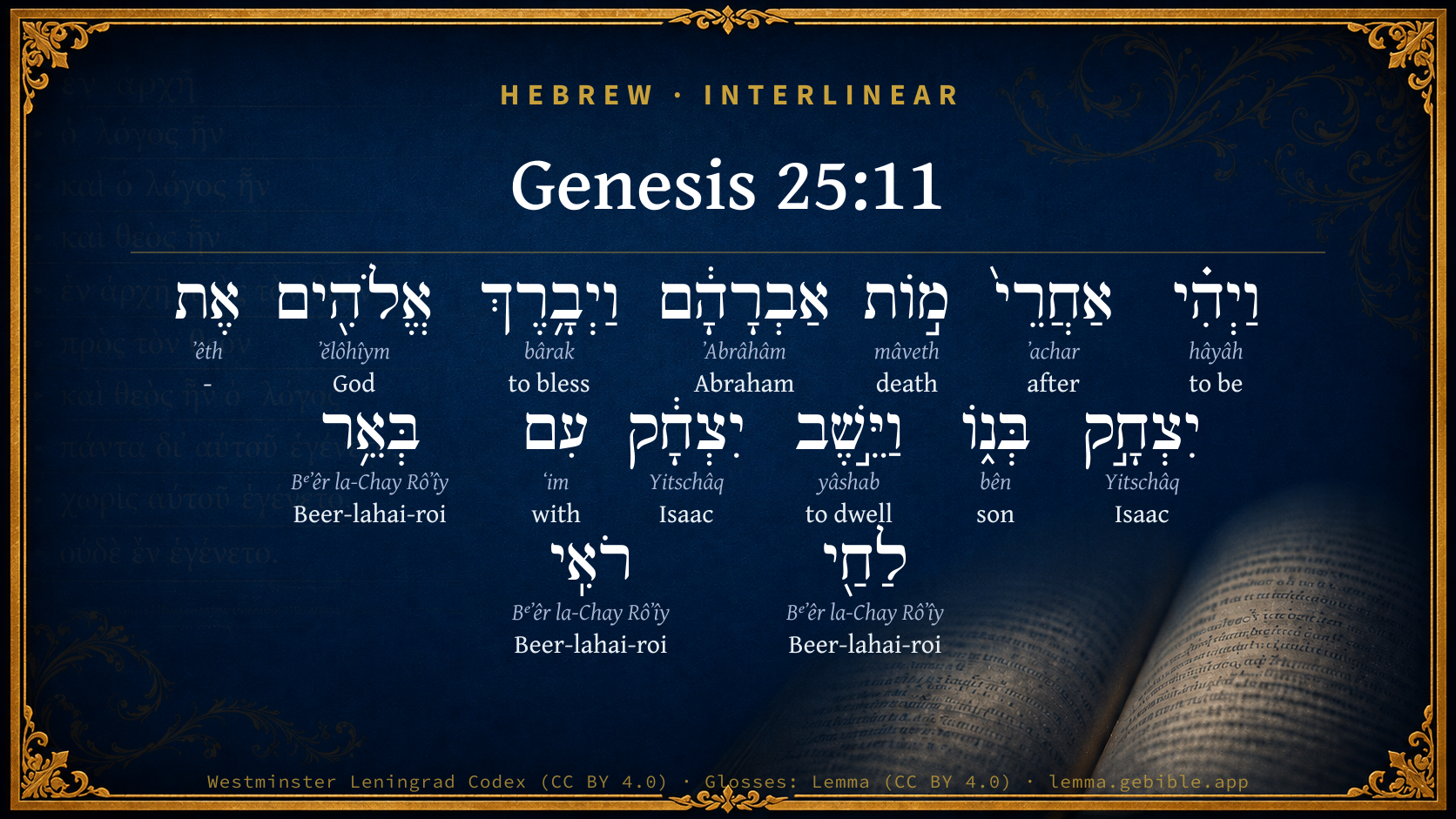
Hebrew (Westminster Leningrad Codex) Genesis 25:11 appears in the Hebrew Old Testament. The text above is from the Westminster Leningrad Codex. Each word links to its Strong’s number, a concise gloss, and parsing drawn from the Open Scriptures Hebrew Bible morphology. Click any word for its full Brown-Driver-Briggs (BDB) entry.
Download image
Cite this verse

Genesis 25:11 (World English Bible). Public Domain. Lemma interlinear Bible study tool, https://lemma.gebible.app/v/genesis/25/11.

Show BibTeX & RIS
BibTeX
RIS
English Translation
It happened after the death of Abraham, that God blessed Isaac, his son. Isaac lived by Beer Lahai Roi.
World English Bible · Public Domain
Download a study sheet

One document with this verse’s original text, its word-by-word gloss line, the meaning frame, cross-references with their text, attributed commentary, and full source and license credits — printable, and it pastes into notes with its structure intact.

This verse Autodidact and up

Study sheet (.html) Plain text (.txt)

A passage Seminary Student

Up to 50 verses in one chapter. A passage sheet keeps up to 6 commentary sources and 12 cross-references per verse, in the order this page ranks them, and says so on the sheet whenever that leaves anything out. Ask for a single verse and you get the Autodidact verse sheet above.

Everything on this page stays free to read, with no account — the sheet is a download of what is already on screen, not access to it.

Want to remove ads? Support Godless Engineer
Compare translations 3

The same verse in 3 English versions, stacked beneath the original-language interlinear above. Click any original word for its lexicon entry.

Each is an independent rendering of the whole verse — the interlinear is not word-aligned to these translations.

Highlighted words mark where these versions differ — a whole-verse word diff, not a word-by-word alignment.

  • World English Bible Public Domain
    It happened after the death of Abraham, that God blessed Isaac, his son. Isaac lived by Beer Lahai Roi.
  • King James Version Public Domain
    And it came to pass after the death of Abraham, that God blessed his son Isaac; and Isaac dwelt by the well Lahairoi.
  • unfoldingWord Literal Text CC BY-SA 4.0
    And it happened after the death of Abraham, then God blessed Isaac his son. And Isaac lived near Beer Lahai Roi. Ishmael’s Descendants 25:12-18

unfoldingWord Literal Text — © unfoldingWord, licensed CC BY-SA 4.0. Word-aligned USFM3 via Door43 (git.door43.org/unfoldingWord/en_ult).

Versions to compare (up to 4)

3 of 4 selected

Show all 18 translations

Every available English version of this verse, each an independent rendering of the whole verse.

  • World English Bible Public Domain
    It happened after the death of Abraham, that God blessed Isaac, his son. Isaac lived by Beer Lahai Roi.
  • Berean Standard Bible Public Domain
    After Abraham’s death, God blessed his son Isaac, who lived near Beer-lahai-roi.
  • Majority Standard Bible Public Domain
    After Abraham’s death, God blessed his son Isaac, who lived near Beer-lahai-roi.
  • King James Version Public Domain
    And it came to pass after the death of Abraham, that God blessed his son Isaac; and Isaac dwelt by the well Lahairoi.
  • American Standard Version (1901) Public Domain
    And it came to pass after the death of Abraham, that God blessed Isaac his son. And Isaac dwelt by Beer-lahai-roi.
  • Revised Version (1885) Public Domain
    And it came to pass after the death of Abraham, that God blessed Isaac his son; and Isaac dwelt by Beer-lahai-roi.
  • Geneva Bible (1599) Public Domain
    And after the death of Abraham God blessed Izhak his sonne, and Izhak dwelt by Beer-lahai-roi.
  • Douay-Rheims (1899) Public Domain
    And after his death, God blessed Isaac his son, who dwelt by the well named Of the living and seeing.
  • Young's Literal Translation Public Domain
    And it cometh to pass after the death of Abraham, that God blesseth Isaac his son; and Isaac dwelleth by the Well of the Living One, my Beholder.
  • Literal Standard Version CC BY-SA 4.0
    And it comes to pass after the death of Abraham, that God blesses his son Isaac; and Isaac dwells by the Well of the Living One, my Beholder.
  • Unlocked Literal Bible CC BY-SA 4.0
    After the death of Abraham, God blessed Isaac his son, and Isaac lived near Beer Lahai Roi.
  • unfoldingWord Literal Text CC BY-SA 4.0
    And it happened after the death of Abraham, then God blessed Isaac his son. And Isaac lived near Beer Lahai Roi. Ishmael’s Descendants 25:12-18
  • Darby Bible Public Domain
    And it came to pass after the death of Abraham, that God blessed his son Isaac. And Isaac dwelt at Beer-lahai-roi.
  • World Messianic Bible Public Domain
    After the death of Abraham, God blessed Isaac, his son. Isaac lived by Beer Lahai Roi.
  • Webster's Bible Public Domain
    And it came to pass after the death of Abraham, that God blessed his son Isaac: and Isaac dwelt by the well Lahai-roi.
  • Free Bible Version CC BY-SA 4.0
    After Abraham's death, God blessed his son Isaac, who was living near Beer-lahai-roi.
  • Bible in Basic English Public Domain
    Now after the death of Abraham, the blessing of God was with Isaac, his son.
  • JPS Tanakh (1917) Public Domain
    And it came to pass after the death of Abraham, that God blessed Isaac his son; and Isaac dwelt by Beer-lahai-roi.

Literal Standard Version (2020), Covenant Press — licensed CC BY-SA 4.0. Text via the HelloAO Bible API (eBible.org). Unlocked Literal Bible (unfoldingWord) — licensed CC BY-SA 4.0. Text via the HelloAO Bible API (eBible.org). unfoldingWord Literal Text — © unfoldingWord, licensed CC BY-SA 4.0. Word-aligned USFM3 via Door43 (git.door43.org/unfoldingWord/en_ult). Free Bible Version, Dr. Jonathan Gallagher — licensed CC BY-SA 4.0. Text via the HelloAO Bible API (eBible.org).

Word by word

More ways to search: Search by grammar → Find every occurrence → Compare this word →

Practice this passage: Drill this verse → Learn its vocabulary →

בְּאֵ֥ר
Bᵉʼêr la-Chay Rôʼîy
H883
“Beer-lahai-roi”
Noun, Proper
Part of Speech
Noun
Type
Proper
Full BDB Definition

Origin: from H875 and H2416 (with prefix) and H7203

TWOT: None

Beer-lahai-roi = "well of the Living One seeing me" - a well west of Kadesh, south of Israel
  1. וַיְהִ֗י hâyâh H1961 “and · to be” Conjunction + Verb, Qal, Sequential Imperfect, 3rd Person, Masculine, Singular
  2. אַחֲרֵי֙ ʼachar H310 “after” Preposition
  3. מ֣וֹת mâveth H4194 “death of” Noun, Common, Masculine, Singular, Construct
  4. אַבְרָהָ֔ם ʼAbrâhâm H85 “Abraham” Noun, Proper
  5. וַיְבָ֥רֶךְ bârak H1288 “and · to bless” Conjunction + Verb, Piel, Sequential Imperfect, 3rd Person, Masculine, Singular
  6. אֱלֹהִ֖ים ʼĕlôhîym H430 “God(s)” Noun, Common, Masculine, Plural, Absolute
  7. אֶת ʼêth H853 “-” Particle, Direct Object
  8. יִצְחָ֣ק Yitschâq H3327 “Isaac” Noun, Proper
  9. בְּנ֑וֹ bên H1121 “son · his” Noun, Common, Masculine, Singular, Construct + Suffix, Personal, 3rd Person, Masculine, Singular
  10. וַיֵּ֣שֶׁב yâshab H3427 “and · to dwell” Conjunction + Verb, Qal, Sequential Imperfect, 3rd Person, Masculine, Singular
  11. יִצְחָ֔ק Yitschâq H3327 “Isaac” Noun, Proper
  12. עִם ʻim H5973 “with” Preposition
  13. לַחַ֖י Bᵉʼêr la-Chay Rôʼîy H883 “Beer-lahai-roi” Noun, Proper
  14. רֹאִֽי Bᵉʼêr la-Chay Rôʼîy H883 “Beer-lahai-roi” Noun, Proper

About this verse

These counts appear in no published source. They are computed here, from the morphology-tagged text and Lemma’s own curated glosses. What Lemma adds →

15
words
12
distinct lemmas
Pentateuch
section

Notable vocabulary

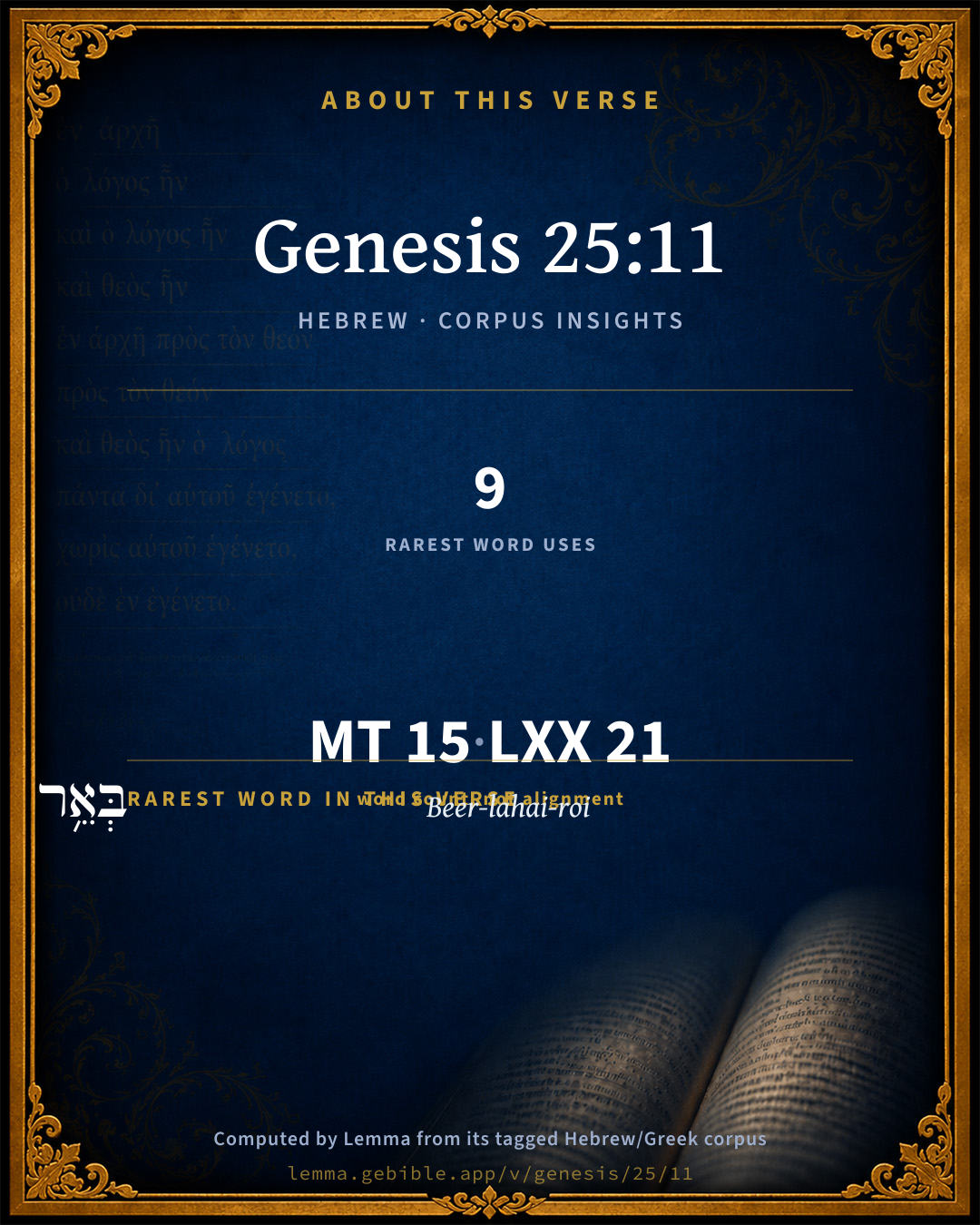
The rarest word here is בְּאֵ֥ר Beer-lahai-roi H883 — appearing just 9 times in the whole Hebrew Bible.

Shared distinctive vocabulary

בְּאֵ֥ר Beer-lahai-roi H883 occurs in 3 verses of the Hebrew Bible. Also found in:

Grammatical profile

  • 3 verbs
  • 9 nouns
  • 2 prepositions
  • 1 particle

Verb forms

  • וַיְהִ֗י Qal · Sequential Imperfect
  • וַיְבָ֥רֶךְ Piel · Sequential Imperfect
  • וַיֵּ֣שֶׁב Qal · Sequential Imperfect

Repetition

Words recur within this verse — often emphatic in Hebrew:

  • בְּאֵ֥ר Beer-lahai-roi H883 ×3
  • יִצְחָ֣ק Isaac H3327 ×2

Hebrew & Septuagint length

In English translation the verse runs 19 words from the Hebrew and 24 from the Septuagint (LXX English) — closely comparable.

A rough comparison of the two English renderings, which tokenize alike — not a word-level alignment.

Word counts can differ between the Hebrew and the Greek without any difference in meaning — e.g. the Hebrew direct-object marker אֵת has no separate Greek word, and Greek often adds the article ὁ.

In the original languages it is 15 Hebrew tokens and 21 Greek tokens — but the two are counted differently (Hebrew bundles its prefixes and suffixes into one token; the Greek is in lemma form), so that isn’t a like-for-like length.

Cross-references

6

Topical passages linked to Genesis 25:11 in the Treasury of Scripture Knowledge — connected by theme and wording, ordered by reader-vote popularity; previews shown in the World English Bible.

  • Genesis 16:14 Therefore the well was called Beer Lahai Roi. Behold, it is between Kadesh and Bered.
  • Genesis 22:17 that in blessing I will bless you, and in multiplying I will multiply your seed as the stars of the heavens, and as the sand which is on the seashore. Your seed will possess the gate of his enemies.
  • Genesis 12:2 I will make of you a great nation. I will bless you, and make your name great. You will be a blessing.
  • Genesis 17:19 God said, "No, but Sarah, your wife, will bear you a son. You shall call his name Isaac. I will establish my covenant with him for an everlasting covenant for his seed after him.
  • Genesis 24:62 Isaac came from the way of Beer Lahai Roi. For he lived in the land of the South.
  • Genesis 50:24 Joseph said to his brothers, "I am dying, but God will surely visit you, and bring you up out of this land to the land which he swore to Abraham, to Isaac, and to Jacob."

Cross-references courtesy of OpenBible.info (CC BY 4.0).

Hebrew and Greek witnesses Masoretic Hebrew ↔ Greek Septuagint

The same verse in the two great witnesses to the Old Testament, shown verse-for-verse.

These are two independent witnesses, not word-aligned to each other, and the Septuagint is shown in lemma (dictionary) form.

Hebrew Genesis 25:11 Masoretic · Westminster Leningrad Codex

וַיְהִ֗י אַחֲרֵי֙ מ֣וֹת אַבְרָהָ֔ם וַיְבָ֥רֶךְ אֱלֹהִ֖ים אֶת יִצְחָ֣ק בְּנ֑וֹ וַיֵּ֣שֶׁב יִצְחָ֔ק עִם בְּאֵ֥ר לַחַ֖י רֹאִֽי

It happened after the death of Abraham, that God blessed Isaac, his son. Isaac lived by Beer Lahai Roi.

World English Bible · Public Domain

Greek LXX Genesis 25:11 Septuagint · lemma form

γίγνομαι δέ μετά ὁ ἀποθνήσκω αβρααμ εὐλογέω ὁ θεός ισαακ ὁ υἱός αὐτός καί καταοἰκέω ισαακ παρά ὁ φρέαρ ὁ ὅρασις

And it came to pass after Abraam was dead, that God blessed Isaac his son, and Isaac lived by the well of the vision.

LXX2012 (modern English Septuagint) · Public Domain

On this verse, Lange's Commentary on the Holy Scriptures discusses the Septuagint’s reading. Read the note in Commentary ↓

Hebrew: Westminster Leningrad Codex (CC BY 4.0). Greek: Septuagint (public domain); English from LXX2012 (modern English Septuagint) (Public Domain). How the Septuagint differs from the Hebrew →

Targum (Aramaic paraphrase)

2

The Targum is the ancient Jewish Aramaic paraphrase of the Hebrew Scriptures — an interpretive translation, not the Hebrew text itself. Onkelos (literal) and Pseudo-Jonathan (expansive) render the Torah, and Jonathan the Prophets. Coverage is partial: where no permissively-licensed English translation exists for a verse, only the Aramaic is shown. This is verse-level text, not a word-by-word alignment to the Hebrew.

  1. Targum Onkelos Torah (Genesis–Deuteronomy)
    וַהֲוָה בָּתַר דְּמִית אַבְרָהָם וּבָרֵךְ יְיָ יָת יִצְחָק בְּרֵהּ וִיתֵב יִצְחָק עִם בֵּירָא דְמַלְאָךְ קַיָּמָא אִתְחֲזֵי עֲלַהּ

    (no public-domain English translation for this verse)

    Targum Onkelos — Aramaic: “Onkelos Genesis” (public domain); “Onkelos Exodus” (public domain); “Onkelos Leviticus” (public domain); “Onkelos Numbers” (public domain); “Onkelos Deuteronomy” (public domain). English: “Sefaria Community Translation” (CC0 1.0 (public-domain dedication)); “J.W. Etheridge. The Targums of Onkelos and Jonathan Ben Uzziel on the Pentateuch. London: Longmans, Green, 1862” (public domain). Text via Sefaria.

  2. Targum Pseudo-Jonathan Torah (Genesis–Deuteronomy)
    וּמִן בִּגְלַל דְלָא הֲוָה אַבְרָהָם צָבֵי לִבְרָכָא יַת יִשְׁמָעֵאל בְּגִין כֵּן לָא בְּרִיךְ יַת יִצְחָק דְאִין הֲוָה מְבָרֵךְ לְיִצְחָק וְלָא מְבָרֵךְ לְיִשְׁמָעֵאל הֲוָה נְטִיר לֵיהּ בָּבוֹי וּבָתַר דְמִית אַבְרָהָם בְּרִיךְ יְיָ יַת יִצְחָק וְיָתֵב יִצְחָק סָמִיךְ לְבֵירָא דְאִתְגְלֵי עֲלוֹי יְקַר חַי וְקַיָים דְחָמֵי וְלָא אִתְחָמֵי

    And because Abraham had not designed to bless Ishmael, therefore he blessed not Izhak; for had he blessed Izhak and not Ishmael, it would have kept them in enmity. But, after the death of Abraham, the Lord blessed Izhak; and Izhak dwelt near the well at which was revealed the glory of the Living and Eternal One, who seeth and is not seen.

    Targum Pseudo-Jonathan — Aramaic: “Targum Jonathan on Genesis” (public domain); “Targum Jonathan on Exodus” (public domain); “Targum Jonathan on Leviticus” (public domain); “Targum Jonathan on Numbers” (public domain); “Targum Jonathan on Deuteronomy” (public domain). English: “The Targum of Jonathan ben Uzziel, trans. J. W. Etheridge, London, 1862” (public domain). Text via Sefaria.

Commentary

Notes on Genesis 25:11 from classic Christian and Jewish commentators (each source and its license shown beneath its notes). The classic Christian expositions comment on the surrounding passage and are grouped to its opening verse, so a note may address several verses; the Jewish commentaries on the Tanakh (Rashi and others) are per-verse, so they appear only where the commentator wrote on this verse.

Lemma curates 59 commentaries, every one of them public domain or Creative Commons licensed, each selected and text-cleaned for this edition rather than reprinted as found. About our sources →

Matthew Henry's Commentary

Immediately after the account of Abraham's death, Moses begins the story of Isaac (Gen 25:11), and tells us where he dwelt and how remarkably God blessed him. Note, The blessing of Abraham did not die with him, but survived to all the children of the promise. But he presently digresses from the story of Isaac, to give a short account of Ishmael, forasmuch as he also was a son of Abraham, and God had made some promises concerning him, which it was requisite we should know the accomplishment of. Observe here what is said, 1. Concerning his children. He had twelve sons, twelve princes they are called (Gen 25:16), heads of families, which in process of time became nations, distinct tribes, numerous and very considerable. They peopled a very large continent, that lay between Egypt and Assyria, called Arabia. The names of his twelve sons are recorded. Midian and Kedar we often read of in scripture. And some very good expositors have taken notice of the signification of those three names which are put together (Gen 25:14), as containing good advice to us all, Mishma, Dumah, and Massa, that is, hear, keep silence, and bear; we have them together in the same order, Jam 1:19, Be swift to hear, slow to speak, slow to wrath. The posterity of Ishmael had not only tents in the fields, wherein they grew rich in times of peace; but they had towns and castles (Gen 25:16), wherein they fortified themselves in time of war. Now the number and strength of this family were the fruit of the promise made to Hagar concerning Ishmael (Gen 16:10), and to Abraham, Gen 17:20 and Gen 21:13. Note, Many that are strangers to the covenants of promise are yet blessed with outward prosperity for the sake of their godly ancestors. Wealth and riches shall be in their house. 2. Concerning himself. Here is an account of his age: He lived 137 years (Gen 25:17) which is recorded to show the efficacy of Abraham's prayer for him (Gen 17:18), O that Ishmael might live before thee! Here is also an account of his death; he too was gathered to his people; but it is not said that he was full of days, though he lived to so great an age: he was not so weary of the world, nor so willing to leave it, as his good father was. Those words, he fell in the presence of all his brethren, whether they mean, as we take them, he died, or, as others, his lot fell, are designed to show the fulfilling of that word to Hagar (Gen 16:12), He shall dwell in the presence of all his brethren, that is, he shall flourish and be eminent among them, and shall hold his own to the last. Or he died with his friends about him, which is comfortable.

Matthew Henry's Commentary on the Whole Bible (1708–1710) — public domain (CC PDM 1.0). Text via the HelloAO Bible API.

Trapp's Complete Commentary

John Trapp

Gen 25:11 And it came to pass after the death of Abraham, that God blessed his son Isaac; and Isaac dwelt by the well Lahairoi.

Ver. 11. Isaac dwelt by the well Lahairoi.] This had been his oratory, where he had formerly found God; {Gen 24:62} and he loved it the better ever after.

John Trapp, A Commentary or Exposition upon All the Books of the Old and New Testament (1647–1656) — public domain. Text from a community e-Sword module.

The Biblical Illustrator

Joseph S. Exell

Gen_25:11

God blessed his son Isaac

Divine blessing

Two large and perpetual principles, on which the government of God proceeds, are involved in such commonplace incidents, as death, benefits received, and access to a well of water--

(1) that God repeats Himself in His modes of training men; and

(2) that God does not repeat Himself.

God had blessed Abraham, and He blessed Isaac; He repeated His procedure. Isaac received the Divine blessing at the well Lahairoi--where Abraham did not dwell: God did not repeat Himself.

I. I ask you, fathers and mothers, to CONSIDER THE BEST INHERITANCE WHICH CAN BE LEFT TO CHILDREN. It is not property or riches. If your children never inherit from you anything but a few cheap well-used articles of furniture, yet can point to your grave and say, Under that grassy mound lie the remains of one who lived a life of faith in the Son of God, and tried to make the world of his neighbourhood better, be sure they will inherit from you that which is more helpful and ennobling than cartloads of gold or silver. Be it yours to secure that.

II. LET EACH ONE CONSIDER THE NECESSITY OF PERSONAL OBEDIENCE TO GOD, IN ORDER TO BE FULLY BLESSED. You may have not a few rich temporal blessings, but if you have not received the grace of the Holy Spirit so as to call Jesus Christ Lord, then you are rejecting that which alone conveys the favour in which is life eternal. No one can acquire this blessing for you.

III. CONSIDER THE VARYING CONDITIONS TO WHICH THE DIVINE BLESSING COMES. Abraham, Isaac, Jacob--so different in their character--all were blessed by the Lord.

IV. IN ORDER TO OBTAIN AND RETAIN DIVINE BLESSING, WE MUST KNOW THE SECRET OF SECURING IT. Isaacs knowledge of it is suggested by the words, He dwelt by the well Lahai-roi--the well of the Living, Seeing One. Have you no memory of a private room, or a sick bed, or a communion, when there came a flow of light and impulse into your heart, and Jesus appeared to be your life as never before? Do you never return in spirit to that scene, and endeavour again to refresh yourself with its intimations? The Lord who blessed you then is the same still. (D. G. Watt, M. A.)

A word for quiet people

1. After the death of Abraham, God blessed Isaac. What a contrast meets us as we turn to him. The longest lived of the patriarchs, yet what a little space he fills. Abraham has many chapters--so has Jacob, but Isaac has scarcely a single chapter to himself, this is the lesson of his life. We talk of most men because of their importance. I want to talk of Isaac because of his unimportance. His are the annals of a quiet life. God is the God of Abraham. Yes, we do not wonder at that--Abraham the hero, the warrior, the father and founder of great nations--the man of such gifts and such achievements. But God is the God of Isaac, too--the God of the quiet uneventful life. The heavenly Father hath room in His heart for all His children. He who maketh us to differ, loves us in all the separateness of our character.

2. Remember that Isaac is needed as well as Abraham. It is well that there should be some few men here and there, lifted up above the rest like the high hills that touch the sky. The sight of them is needful to refresh us, to expand our thought, to break the dead level of life, and to bring down blessings from heaven. But we need the quiet fields as well as the mountain heights--they give us the grass of the meadow and the corn of the valley. Earth has need of common people--and indeed most need of them. Some one said one day to Abraham Lincoln, referring to some prominent man, He is a common-looking person. Friend, said Abraham Lincoln, the Lord prefers common-looking people, that is why He has made so many of them. If folks were all splendid geniuses, whirling to heaven in chariots of fire, who would do the humdrum work of life? Let us learn to think rightly of common-place people, including ourselves. George Eliot preaches a needed gospel when she writes of one of her characters, He whose fortunes I have undertaken to relate was in no respect an ideal or exceptional character . . . a man whose virtues were not heroic, and who had no undetected crime within his heart; who had not the slightest mystery hanging about him, but was palpably and unmistakably common-place . . . But, dear madam, it is so very large a majority of your fellow-countrymen that are of this insignificant stamp. Yet these common-place people--many of them--bear a conscience, and have felt the sublime prompting to do the painful right; they have their unspoken sorrows and their sacred joys; their hearts have perhaps gone out towards their first-born, and they have mourned over the irreclaimable dead. Depend upon it you would gain unspeakably if you would learn to see more of the poetry and pathos, the tragedy and comedy, lying in the experience of a human soul that looks through dull grey eyes and that speaks in a voice of quite ordinary tones.

3. Remember the advantages of such a life. Isaac went into the field at eventide to meditate. Of such life, this is its distinction. If it have less of action, it certainly has more room for meditation. If it knows fewer things, yet it generally knows them better and deeper. If it has less glory and triumph, yet it has closer and steadier communion. If it cannot fight the Masters battles, it can sit at the Masters feet and learn of Him. The quiet life has its blessings. Down by the stream the little meadow lay; and it heard afar off the roar of the great city, and it saw the ruddy glare of its lights flung up against the murky sky. Alas! it sighed, how dull a life is mine! Yonder, in the city, with its thousands, one might do some good. But I am so far away and useless. But in the night time came the stars and sang to it--Foolish creature, we are thine in all our silvery brightness, we whom they scarcely see in the city. Then the dew fell and whispered to its heart--And I am thine, I that am of no use on the hard city ways. And up rose the sun and woke the flowers and painted them afresh, and it said--I am thine, I who have to fight with city fogs for many an hour yonder. And the meadow thought it had something to sing about after all, and the lark went soaring heavenward with music. But one day it heard some stray city sparrow tell a tale about the hungry little children, and the drunken men, and the wretched women, and about weary rich folks. And it grew sad again and said--What can I do down here, out of the way, and so common-place! Then came the breeze and it cried in a hurry, Quick! give us your freshness and fragrance that we may bless the crowded courts and streets, and it was off. And there came some that picked the flowers from beside the stream, and told how they should gladden many a weary heart, and smile upon sick children, and light up many a dreary home. Then the meadow sang a sweeter song than ever, and was glad that He who maketh all hath so much room for the quiet and unknown, and can turn these to such good account. God blessed Isaac.

4. Remember, again, that if quiet people do not go up so high as others, they do not go down so low. Happy is the nation whose annals are dull, said an authority. Think of Abraham and David and Elijah, and you will see that the life of Isaac has its compensations.

5. Again-there is a special beauty of character belonging to the quiet life. Take another of the few incidents in Isaacs life--that recorded in the sixty-seventh verse of the twenty-fourth chapter--And he brought

Rebekah into his mother Sarahs tent, and he loved her, and was comforted after his mothers death. The gentle heart grieving for his mother, and solaced by the love of Rebekah, is an aspect of the quiet life worth lingering over. These are the gifts with which the quiet people do enrich the world. We do not wonder now that God blessed Isaac.

6. Notice further--that the quiet life has its trials. We see it in the picture of the dim-eyed Isaac sitting in the tent door, bidding his son fetch for him the venison which his soul loved--an ease that breeds a self-indulgence is the besetment of the quiet life. It needs to be stirred up, and that sharply at times, and so there comes the famine, rousing him-making the somewhat sluggish life beat more vigorously. Bringing new wants that require new devices. Bringing new conditions that must be dealt with. No harvest ever did so much for Isaac as that famine. Yet another tendency of the quiet life is to fear and to cunning. We see it in Jacob the quiet man, the smooth man. But here in Isaac is the possibility. The story of the men of Gerar and Rebekah shows this tendency in Isaac. They who are weakest need most of all the help of God and have most room for it. They who have no other gifts must make the most of this.

7. Again, the quiet uneventful life has its victories--victories as brave and oftentimes alike more noble and complete than the victories of the warrior. Isaac pitched his tent in the Valley of Gerar and dwelt there, and Isaac digged the wells of water which they had digged in the days of Abraham his father (Gen_18:23). Then the Philistines came and stopped up the well. Ishmael would have fought for it, but that would have taken time and mens lives, and have established a feud between himself and his neighbours. And after all he would have had to dig out the well again. So it was a saving of trouble and time and of much else at once to dig the well. So he digged again, and the Philistines came and filled that also. Again he might have fought about that too--but all that made it worth while to dig before made it worth while to dig again. So he removed from thence and digged another well; and for that they strove not. He had got to Rehoboth--room. It is a good place to live, Rehoboth--where there is room for forgiveness and patience there is room for peace. And the Lord appeared to him the same night and said, Fear not, for I am with thee, and will bless thee. Where there is room for love there is room for God. Then came the kings and chief captains who had sent him away and won by his gentleness, they sought an alliance with him--We saw certainly that the Lord was with thee: and we said, let there now be an oath betwixt us, and let us make a covenant with thee. Thou art now the blessed of the Lord. And he made them a feast, and they did eat and drink. It was a great triumph of peace principles; as pure a victory as was ever won. So the quiet man was a hero all unbeknown to himself, and won a more noble victory then ever came of cruel bloodshed. These gentle souls have a mighty power, mightier than we reckon--like the silent stars that rule the darkness by shining. Lastly, let us remember that it was not Isaacs natural character that singled him out for distinction; but it was his relation to the coming Messiah, the Lord Jesus Christ. This was Abrahams greatness; and here was Isaac as great as Abraham. And herein is our greatness too. Not in what we are can we find our glory, but in Him, our Saviour and our King. (Mark Guy Pearse.)

Isaac

I. THE PERSONAL CHARACTER OF THIS MAN TAKES ROOT IN THE BLESSING OF GOD.

1. His natural life commences with a special benediction, for he was a child of promise.

2. Isaac had a remarkable dedication in his youth.

3. But it is now, when Abraham is dead, that he more largely receives the blessing.

4. More deeply impressed at the last than at the first, he solemnly prepares transmit that blessing which he had inherited.

II. THIS MANS MARKED INDIVIDUALITY GROWS UP AND SHAPES ITSELF IN THE GODLY HABITS OF A PROTRACTED LIFE.

1. His habit of thought.

2. His habit of dealing with men.

3. His habits at home.

III. THE MARKED INDIVIDUALITY OF THIS MAN IS SEEN IN THE AMPLE FRUIT WHICH IT BORE.

1. It is in Isaac that we get the best expression of patriotism.

2. Come within the radius of this mans influence, and you feel that he, too, in the best sense, was a man of the world.

3. But notably you feel in Isaacs case what is that influence which leads a man to make ample and timely disposition of his secular affairs, that he may give himself more fully to better things. (G. Woolnough, M. A.)

The Biblical Illustrator, edited by Joseph S. Exell (c. 1880s–1900s) — public domain. Text from a community e-Sword module.

Joseph Benson's Commentary

Gen 25:11-12. God blessed Isaac — For the blessing of Abraham did not die with him, but was perpetuated to his posterity, and especially to the children of the promise. The generations of Ishmael — God had made some promises concerning him, and this account of his posterity is given that we may know the accomplishment of them. He had twelve sons, the names of whom are here recorded; two of them, Midian and Kedan, we often read of in Scripture. They are termed twelve princes, Gen 25:16, or heads of families, which, in process of time, became nations, numerous, and very considerable. And his posterity had not only tents in fields, wherein they grew rich in time of peace, but they had towns and castles, wherein they fortified themselves in times of war. Their number and strength were the fruit of the promise made to Hagar, concerning Ishmael, Gen 16:10; and to Abraham, Gen 17:20; Gen 21:13.

Joseph Benson's Commentary on the Old and New Testaments (1811–1818) — public domain. Text from a community e-Sword module.

Lange's Commentary on the Holy Scriptures

B.

ISAAC, AND HIS FAITH-ENDURANCE. Gen_25:12 to Gen_28:9

FIRST SECTION

Isaac and Ishmael

Gen_25:11-18

11And it came to pass after the death of Abraham, that God blessed his son Isaac; and [but] Isaac dwelt by the well Lahai-roi [wells of the quickener of vision].

12Now [and] these are the generations [genealogies, Toledoth] of Ishmael, Abraham’s 13son, whom Hagar the Egyptian, Sarah’s handmaid, bare unto Abraham. And these are the names of the sons of Ishmael, by their names according to their generations: the first-born of Ishmael, Nebajoth [heights; Nabathei, a tribe of Northern Arabia]; and Kedar 14[dark skin. An Arabian tribe], and Adbeel [miracle of God], and Mibsam [sweet odor]. And Mishma [hearing, report, what is heard], and Dumah [silence, solitude], and Massah [bearing, burden, 15 uttering what is said], Hadar [inner apartment, tent], and Tema [desert, uncultivated region], Jetur 16[Seven? a nomadic village], Naphish [recreation], and Kedemah [eastward]; These are the sons of Ishmael, and these are their names, by their towns [fixed abodes], and by their castles; 17twelve princes according to their nations. And these are the years of the life of Ishmael: an hundred and thirty and seven years; and he gave up the ghost and died; and was gathered unto his people. 18And they dwelt from Havilah [a region of Arabia inhabited by the descendants of Joctan, upon the eastern boundary of the Ishmaelites] unto Shur [a place east of Egypt, in the borders of the desert], that is before Egypt, as thou goest toward [in the direction of] Assyria: and he died6 in the presence of all his brethren [he settled eastward of all his brethren].

GENERAL REMARKS

See the remarks upon the previous section.

EXEGETICAL AND CRITICAL

1. Gen_25:11. Isaac after the death of Abraham.—God blessed Isaac.—The blessing of Abraham continues in the blessing of Isaac; this is manifested in his welfare and prosperity, or rather in a grateful consciousness which refers his welfare to the kindness of God. We read: Elohim blessed Isaac; for Isaac, as future ancestor of Edom and Jacob, sustained now a universal relation. In earthly respects Edom is Isaac’s heir as well as Jacob, or even by preference.—By the well Lahai-roi.—By the well of Hagar. According to Gen_35:27, Jacob met his aged father Isaac at Hebron. Doubtless this city bore the same relation from the time of Abraham onwards; Hebron was the principal residence, Beer-sheba the principal station for overseeing their flocks. At this station Isaac, as steward of his father, had already taken up his abode, and in consequence of his love of solitude and seclusion he became so fond of it that now he dwelt here regularly, without yielding up the principal residence at Hebron; he even moved his tent from Beer-sheba farther into the deep solitude of Hagar’s well.

2. Gen_25:12-16. The Toledoth of Ishmael. [Upon the documentary hypothesis, each of these phrases marks the beginning of a new document. But if we are to regard each of these documents as the work of a separate author, then this author contributes only seven verses to the narrative. This is obviously running the theory into the ground, and shows how unreasonable it is to regard these phrases as indicating any change of author. They open new themes or sections of the history.—A. G.] Here also it is obvious that the Toledoth of Genesis does not begin the separate section of the history, but frequently concludes them. In Genesis 4, 5 the first human race, together with the Toledoth of Adam, is dismissed from history. So is it also in Genesis 10, in respect to the heathen nations, descendants of Japheth, Ham, and Shem. Ch. 11 dismisses the more theocratic Shemites, together with their Toledoth. In Gen_22:20, the Nahorites, the last of the Shemites and nearest to Abraham, retire from the history, just as the Haranites, or Lot and his descendants in Gen_19:36; and as the Abrahamites descending from Keturah, in Genesis 25; and in our section the Ishmaelites. After the close of the history of Isaac the Edomites, Gen_36:1, etc., appear. The theocracy permits no branch of the human race to vanish out of its circle of vision without fixing it in its consciousness. In Gen_37:2 Jacob also retires into the background as compared with the history of his sons. With the Toledoth of Ishmael comp. 1Ch_1:28-31.—Whom Hagar the Egyptian.—Besides the names of the twelve sons of Ishmael that here present themselves, there occurs also (1Ch_5:10) the name of the Hagarites, Ishmaelites called after the mother, whose name is no doubt assumed in one or more of the names before us. In respect to the frequent occurrence of the name Hagar in Arabic authors, see Knobel, p. 211.—Nebajoth and Kedar.—Delitzsch: “The names of the twelve sons of Ishmael are in part well known. Nebajoth and Kedar are not only mentioned together in Isa_60:7, but also by Plin.: Hisi. Nat., 6, 7 (Nabatæi et Cedrei; Kaidhâr and Nâbat (Nabt) are also known to Arabian historians as descendants of Ishmael. In respect to the meaning of the word Nabatæans, both in a stricter and a more comprehensive sense, as also in regard to their abodes in Arabia Petrea and beyond, see Knobel, Delitzsch, Keil.—The Kadarenes, described Isa_21:17 as good bowmen, lived in the desert between Arabia Petrea and Babylonia (Isa_42:11; Psa_120:5). “The Rabbins use their name to denote the Arabians in general.” Knobel.—Adbeel and Mibsam.—In respect to these names, as well as to that of Kedma, we can only reach conjectures (see Knobel).—Mishma (Septuagint and Vulgate: Masma).—Connected by Knobel with Μαισαμανε͂ις of Ptol., Gen_6:7; Gen_6:21. In Arabic authors we have beni Mismah.—Duma.—Probably Dumath al Djendel, on the border between Syria and Babylonia.—Massa.—Apparently the same as Μασανοί, on the northeast side of Duma according to Ptol., Gen_5:19; Gen_5:2.—Hadar (a more correct reading, 1Ch_1:30, is חֲדַד, as compared with the maritime country Chathth, famous among the ancient Arabians on account of its lances), between Omam and Bahrein. For further information see Knobel, etc.—Hadar is taken together with Thema, which Knobel connects with Θεμοί of Ptolemy, on the Persian Gulf, or with the Arabic banu Teim, a celebrated tribe in Hamasa, probably different from the Tema, Isa_21:14; Jer_25:23; Job_6:19.—Jetur, Naphisch (see 1Ch_5:18).—“Neighbors to the Israelites on the east side of Jordan. Knobel refers Jetur to the Ituræans. The present Druses are probably their descendants.” Kedma.—“As a separate Arabic tribe we can only refer it, in its narrower sense, to בְּנֵי קֶדֶם, who in Jdg_6:3; Jdg_6:33; Jdg_7:12, are distinguished from other Arabians, and must have dwelt in the vicinity of the country east of Jordan. Perhaps they are the same with those enumerated with the Moabites and Ammonites in Isa_11:14 and Eze_25:4; Eze_25:10.” Knobel. The sons of the East in a more comprehensive sense denotes the Arabians generally, the Saracens.—By their towns, and by their castles, i.e., their movable and fixed habitations.—Twelve princes according to their nations (Lange renders “to their nations”).—The translation, according to their nations, can only mean, as moulded, determined by their nations. We hold, therefore, the expression to mean: twelve princes chosen for governing and representing their twelve tribes.

3. Gen_25:17-18. The death of Ishmael and the expansion of the Ishmaelites.—The years of the life of Ishmael.—This hale man attained only an age of a hundred and thirty-seven years, while on the contrary, the more delicate appearing Isaac reaches the age of a hundred and eighty years. Possibly the natural passions of the one consumed life sooner; no doubt also the quiet, peaceful, believing disposition of the other, exercised a life-prolonging influence. Ishmael dies, the Ishmaelites spread themselves abroad.—From Havilah unto Shur.—Havilah, see Gen_10:29. Knobel: “From Chaulan in the south to the eastern boundary of Egypt.” Schur. From Egypt to the east in the direction of Assyria. According to Josephus: “Antiq.” i. 12, 4, the Ishmaelites dwelt from the Euphrates to the Red Sea.—In the presence of all his brethren, i.e., Hebrews, Edomites, and the children of Keturah. If we understand by Havilah the Chaulotæans on the boundary of Arabia Petrea (Keil), we must assign a different meaning to these words. Keil: “From southeast to southwest.” Knobel: “From southeast to northwest.” Delitzsch: “The capital of the Ishmaelitic tribes was Hezaz, situated south of Yemen. From this they spread themselves to the west side of the Siniaitic peninsula, and still further in a northerly and northeasterly direction beyond Arabia Petrea and Deserta to the countries under Assyrian sway.” [He died. He had fallen into the lot of his inheritance. The Heb. word includes the idea of a deliberate settlement, and an assertion by force of his rights and possessions. Thus the promise uttered before his birth was now fulfilled.—A. G.]

DOCTRINAL AND ETHICAL

1. Ishmael in his development precedes Isaac, as Esau precedes Jacob, as the world gets the start of the kingdom of heaven. It looks well for the development of Ishmael that he buries his father in company with his brother Isaac, though the latter had been preferred to him.

2. The twelve princes of Ishmael are also mentioned as witnesses that God has faithfully fulfilled his promises concerning their ancestor. The Arabs, too, count twelve sons of Ishmael.

3. The Ishmaelites, the germ of the Arabic people in its historic significance. The country of Arabia. Its history. Mohammed. The mission of the Mohammedans. The mission among the Mohammedans. Since Ishmael did not subject himself to Israel, he has become subject to the Turk.

4. Ishmael’s genealogy seems to have been preserved in the house of Isaac, just as Therah’s in the house of Abraham, or as the genealogy of the nations in house of Shem. The father’s house does not lose the memory or the trace of the lost son.

5. How the blessing of Abraham descends upon Isaac. The hereditary blessing in the descendants of Abraham, an antithesis to the hereditary curse in the descendants of Adam generally. The inclination to solitude in the life of Isaac. The nature, rights, and limit of contemplation. Contemplative characters. History of a contemplative life.

HOMILETICAL AND PRACTICAL

See Doctrinal and Ethical.—Isaac the blessed son of a blessed father. The great divine miracle, that the blessing of a saving faith was preserved in one line (in spite of all partial obscurations) from Adam to Christ.—Isaac’s inclination to solitary contemplation.—Perhaps he believed already that a special blessing was confined to that particular place, the well of vision.—That Isaac selected Hagar’s well as a favorite spot, testifies to the nobility of his soul (for Hagar was the rival of his mother, and Ishmael was her son).—Ishmael’s death; or the robust often die before the feeble.—From Ishmael, a child once languishing and perishing from thirst in the wilderness, God’s providence made a great (world-conquering) nation.—We may in fact best comprehend the patriarchal triad by regarding Abraham as constituting especially an example of faith, Isaac an example of love, Jacob an example of hope. We have prominently presented to us the still more predominating features: the man of the deeds of faith, the man of the sufferings of faith, the man of the struggles of faith.

Starke: The temporal blessing (of Isaac) a prelude: a. As an earnest for the whole land of Canaan; b. as a type and pledge of the eternal and spiritual blessing of salvation in Christ.—Misma, Duma, Masa. From these three names, meaning: hearing; silence, patience, the Hebrews formed the proverb: We must hear many things, keep secret many things, and suffer many things.—(The Ishmael ites called Hagarites after Hagar. In later times they preferred to be called Saracens, after Sarah, as if dwelling in the tents of Sarah.)

Ver, 17. Some cite this to prove the happy death of Ishmael, some to prove the contrary. Luther does not wish to decide, but leaves it with God

Gen_25:18. (Psa_112:2.)—What God promises he will surely perform. Let us only have faith in his promises (Gen_17:20; Gen_21:13).—Bibl. Wirt.: People of no note may become eminent and distinguished persons if it is God’s will (Gen_41:40-43).

Lisco: Ishmael becomes the ancestor of the Bedouins of Arabia; these, therefore, and the Edomites descending from Esau, are the nations nearest related to the Hebrews,—Calwer Handbuch: The father’s blessing descends upon the children.—After Abraham, that hero of faith, had gone to his rest, Isaac appears in the foreground of the history. In his character love appears predominant, the less powerful and independent love, or love itself with its weaknesses. He appears as a gentle, pliable link between Abraham and Jacob, possessing neither the manly strength of the father nor of the son. Nevertheless, he wears an amiable aspect, which, when closely viewed, immediately wins our affections. He does not make his appearance as a fictitious and an artfully embellished personage, but as a historical character; so much so, that his faults appear in the foreground, whilst his good qualities fall into the background and lie concealed to the superficial observer. Isaac is of a predominantly kind nature, and therefore appears reserved, outwardly, but inwardly and really, frank.—Schröder: As to the character of Abraham and Isaac, see pp. 442 and 443. With Abraham, who, as father of the faithful, was to begin the long line of believing souls, and in whose peculiar form of life their life was to have its way prepared, everything is vigorous and peculiarly independent. With Isaac, on the contrary, who only continues this line, everything appeared perfectly arranged, just as it is with Joshua in relation to Moses, etc.—(Hengstenberg: However, we must not mistake the peculiar characteristics of Isaac, Joshua, Elisha.)—It seems to me, one might know that he is the son of a dead body, but on this very account is he eminently a gift of God (Ziegler).—Could the memory of the knife drawn over him by the hand of the father ever become extinguished in the mind of the son? Perhaps this affords us a partial solution of his life and character (Krumm.).—Let us not overlook the fact that he was the only monogamist among the patriarchs, remaining satisfied with his Rebekah. Abraham’s piety descends as an heritage to Isaac, therefore the grace of God also descends upon Isaac (Val. Herberger)—The dwelling of Isaac at a place so important in the life of Ishmael (Hagar’s well), attests his friendly relation to his step-brother.—Gathered unto his people. A beautiful and charming description of immortality. We are now living among the gross people of this world, who seek but little after God, yea, in the very kingdom of the devil. But when we depart from this wretched life, we shall die peacefully, and be gathered unto our people, and there will be no distress, no misery, no tribulation, but peace and rest. (Luther).

Footnotes:

[6][Gen_25:18.—Lit., he fell down, or it fell to him.—A. G.]

Lange's Commentary on the Holy Scriptures (Critical, Doctrinal, and Homiletical), ed. John Peter Lange, English translation edited by Philip Schaff (1864–1880) — public domain. Text from a community e-Sword module.

Tyndale Open Study Notes

Tyndale Open Resources

25:11 God’s blessing transferred to Isaac; Abraham’s other sons had been sent away. Isaac lived near Beer-lahai-roi—a special place where God had answered prayer (16:14) and where Isaac waited on the Lord (24:62).

Tyndale Open Study Notes — © Tyndale Open Resources, licensed CC BY-SA 4.0. Text via the HelloAO Bible API.

Adam Clarke's Commentary

Verse 11. God blessed his son Isaac] The peculiar blessings and influences by which Abraham had been distinguished now rested upon Isaac; but how little do we hear in him of the work of faith, the patience of hope, and the labour of love! Only one Abraham and one Christ ever appeared among men; there have been some successful imitators, there should have been many.

Adam Clarke's Commentary on the Bible (1810–1826) — public domain. Text from a community e-Sword/MySword module.

Ellicott's Commentary for English Readers

(11) God blessed his son Isaac.—With this general summary the Tôldôth Terah concludes, and no portion of Holy Scripture is more interesting or valuable; for in it the broad foundation is laid for the fulfilment of the protevangelium contained in Gen_3:15, the progenitor of the chosen race is selected and proved on trial. and the preparation made for the giving of the Law, and for the growing light of prophecy, by the nearness wherewith Abraham walked with God.

A Bible Commentary for English Readers, edited by Charles John Ellicott (1878–1897) — public domain. Text from a community e-Sword module.

The Cambridge Bible for Schools and Colleges

gen. ed. J. J. S. Perowne

11. God blessed Isaac] The fulfilment of Gen_17:21. The traditions of Isaac are very meagre. Here, as in Gen_24:62, his dwelling-place is at Beer-lahai-roi, which was also connected with Ishmael (Gen_16:14). In Gen_35:27, Hebron is spoken of as the dwelling-place of Isaac at a later period of his life.

The Cambridge Bible for Schools and Colleges (gen. ed. J. J. S. Perowne; Cambridge University Press, 1878–1918) — public domain. Text from a community e-Sword module.

John Gill's Exposition

And it came to pass, after the death of Abraham, that God blessed his son Isaac,.... Yet more and more, both with spiritual and temporal blessings; showing hereby, that, though Abraham was dead, he was not unmindful of his covenant, which should be established with Isaac, Gen 17:19,

and Isaac dwelt by the well Lahairoi; which was near the wilderness of Beersheba and Paran, where Ishmael dwelt; so that they were not far from one another, see Gen 16:14.

John Gill's Exposition of the Whole Bible (1746–1763) — public domain (CC PDM 1.0). Text via the HelloAO Bible API.

Whedon's Commentary on the Bible

Daniel D. Whedon

11. God blessed… Isaac — This verse is a sort of appendix to Abraham’s death. The aged patriarch is buried, but the God of Abraham abides the God of Isaac, and ever lives to fulfil his word.

Lahai-roi — See on Gen_16:14; Gen_24:62. After this new sorrow Isaac might well betake him to the place so memorably associated with his first meeting with his beloved Rebekah, who comforted him after his mother’s death.

Daniel D. Whedon (gen. ed.), Commentary on the Old and New Testaments (1874–1909) — public domain. Text from a community e-Sword module.

The Pulpit Commentary

And it came to pass after the death of Abraham, that God Elohim; whence the preceding section is ascribed to the Elohist; but the general name of God is here employed because the statement partakes merely of the nature of an intimation that the Divine blessing descended upon Isaac by inheritance (Hengstenberg), and the particular blessing of which the historian speaks is not so much the spiritual and eternal blessings of the covenant, as the material and temporal prosperity with which Isaac, in comparison with other men, was enriched (Murphy)blessed his son Isaac; and Isaac dwelt by the well Lahai-roi. (vide Gen_16:14 Gen_24:62)

The Pulpit Commentary (1880–1919), ed. H.D.M. Spence-Jones & Joseph S. Exell — public domain. Text from a community e-Sword module.

John Wesley's Explanatory Notes

And God blessed Isaac - The blessing of Abraham did not die with him, but survived to all the children of the promise. But Moses presently digresseth from the story of Isaac, to give a short account of Ishmael, for as much as he also was a son of Abraham; and God had made some promises concerning him, which it was requisite we should know the accomplishment of. He had twelve sons, twelve princes they are called, ver. 16, heads of families, which, in process of time, became nations, numerous and very considerable. They peopled a very large continent that lay between Egypt and Assyria, called Arabia. The names of his twelve sons are recorded: Midian and Kedar we oft read of in scripture. And his posterity had not only tents in the fields wherein they grew rich in times of peace, but they had towns and castles, ver. 16, where in they fortified themselves in time of war. Their number and strength was the fruit of the promise made to Hagar concerning Ishmael, chap. xvi, 10. and to Abraham, chap. xvii, 20; xxi, 13.

John Wesley, Explanatory Notes Upon the Whole Bible (1754–1765) — public domain. Text via the GEBible commentary corpus.

Keil & Delitzsch

C. F. Keil & F. Delitzsch

After Abraham's death the blessing was transferred to Isaac, who took up his abode by Hagar's well, because he had already been there, and had dwelt in the south country (Gen 24:62). The blessing of Isaac is traced to Elohim, not to Jehovah; because it referred neither exclusively nor pre-eminently to the gifts of grace connected with the promises of salvation, but quite generally to the inheritance of earthly possessions, which Isaac had received from his father.

Keil & Delitzsch — Biblical Commentary on the Old Testament (1861–1891) — public domain (CC PDM 1.0). Text via the HelloAO Bible API. (Old Testament only.)

Rashi

Rabbi Shlomo Yitzchaki (Rashi)

ויהי אחרי מות אברהם ויברך וגו AND IT CAME TO PASS AFTER THE DEATH OF ABRAHAM THAT GOD BLESSED ISAAC etc. — He comforted him with the words of the formula of consolation which we offer to mourners (Sotah 14a). Another explanation is: Although the Holy One, blessed be He, had entrusted the blessings to Abraham to bless whomever he wished yet he (Abraham) feared to bless Isaac, because he foresaw that Esau would be born from him. He therefore said, “Let the Master of the blessings come himself and bless whomever it seems proper in his eyes” — God came and blessed him (Isaac)(Genesis Rabbah 61:6).

Rashi on the Tanakh — English translations: “The Judaica Press complete Tanach with Rashi, translated by A. J. Rosenberg” (CC BY 4.0); “Pentateuch with Rashi's commentary by M. Rosenbaum and A.M. Silbermann, 1929-1934” (public domain); “The Metsudah Tanach series, Lakewood, N.J” (CC BY 4.0); and “The Book of Joshua, Metsudah Publications, 1997” (CC BY 4.0). Text via Sefaria.

Ramban (Nachmanides)

Rabbi Moshe ben Nachman (Ramban / Nachmanides)

AND ISAAC DWELLED BY THE WELL LAHAI-ROI. I.e., near that place, or perhaps because it was not a city,. It was thus not a city. Scripture says that he pitched his tent near the well.

Ramban (Nachmanides) on the Tanakh — English translation: “Commentary on the Torah by Ramban (Nachmanides). Translated and annotated by Charles B. Chavel. New York, Shilo Pub. House, 1971-1976” (CC BY 4.0). Text via Sefaria.

Radak

Rabbi David Kimhi (Radak)

ויהי...ויברך, he made Yitzchok as successful in his undertakings as He made his father Avraham.

עם באר לחי ראי, as if the Torah had written בבאר, “at the well.” We have a similar construction in Deuteronomy 8,5 וידעת עם לבבך, “you shall know in your heart.” Or, compare Genesis 35,4 תחת האלה אשר עם שכם, “under the terebinth in Shechem.” Or, compare Samuel II 19,38 עם קבר אבו ואמי “by the graves of my father and mother.”

Radak on the Tanakh — English translations: “Sefaria Community Translation” (CC0 1.0 (public-domain dedication)); “Eliyahu Munk, HaChut Hameshulash” (CC BY 4.0); “Rabbi Mike Feuer, Jerusalem Anthology” (CC BY 4.0); and “R. David Kimhi on the first book of Psalms, Translated by R.G. Finch, London, 1919” (public domain). Text via Sefaria.

Lesson kit

Teaching starters — assembled from the data on this page, not authored interpretation. Every prompt links to the verse data it draws on. Edit before teaching.

Genesis, in the Pentateuch, opens this verse with 15 words (12 distinct Hebrew lemmas). Its most distinctive word is Bᵉʼêr la-Chay Rôʼîy (“Beer-lahai-roi”). A historical commentator’s framing appears above. Read the whole chapter for the surrounding context.

Discussion questions

  1. What does “Beer-lahai-roi” (Bᵉʼêr la-Chay Rôʼîy) contribute to the verse as a whole?
  2. How does Genesis 16:14, which shares the word «Beer-lahai-roi», read alongside this verse?
  3. What does the repetition of “Beer-lahai-roi” (3× in this one verse) do in this verse?
  4. These translations render this verse differently. What is at stake in choosing one wording over another?
  5. «וַיְהִ֗י» is a Qal Sequential Imperfect verb. How does that grammatical form shape the action described?
  6. Compare how Matthew Henry's Commentary and Trapp's Complete Commentary read this verse. Where do they agree or differ?

Things to notice

Reading settings

Reading text

Shown beneath each verse's original-language words.

Old Testament
Old Testament edition

Read the OT as the Masoretic Hebrew (MT) or the Greek Septuagint (LXX).

English shown for the Greek Septuagint (in the Hebrew ↔ Greek comparison).

Comparing translations? Open the Compare panel on any verse page to stack up to four side by side.