
Genesis 28:14

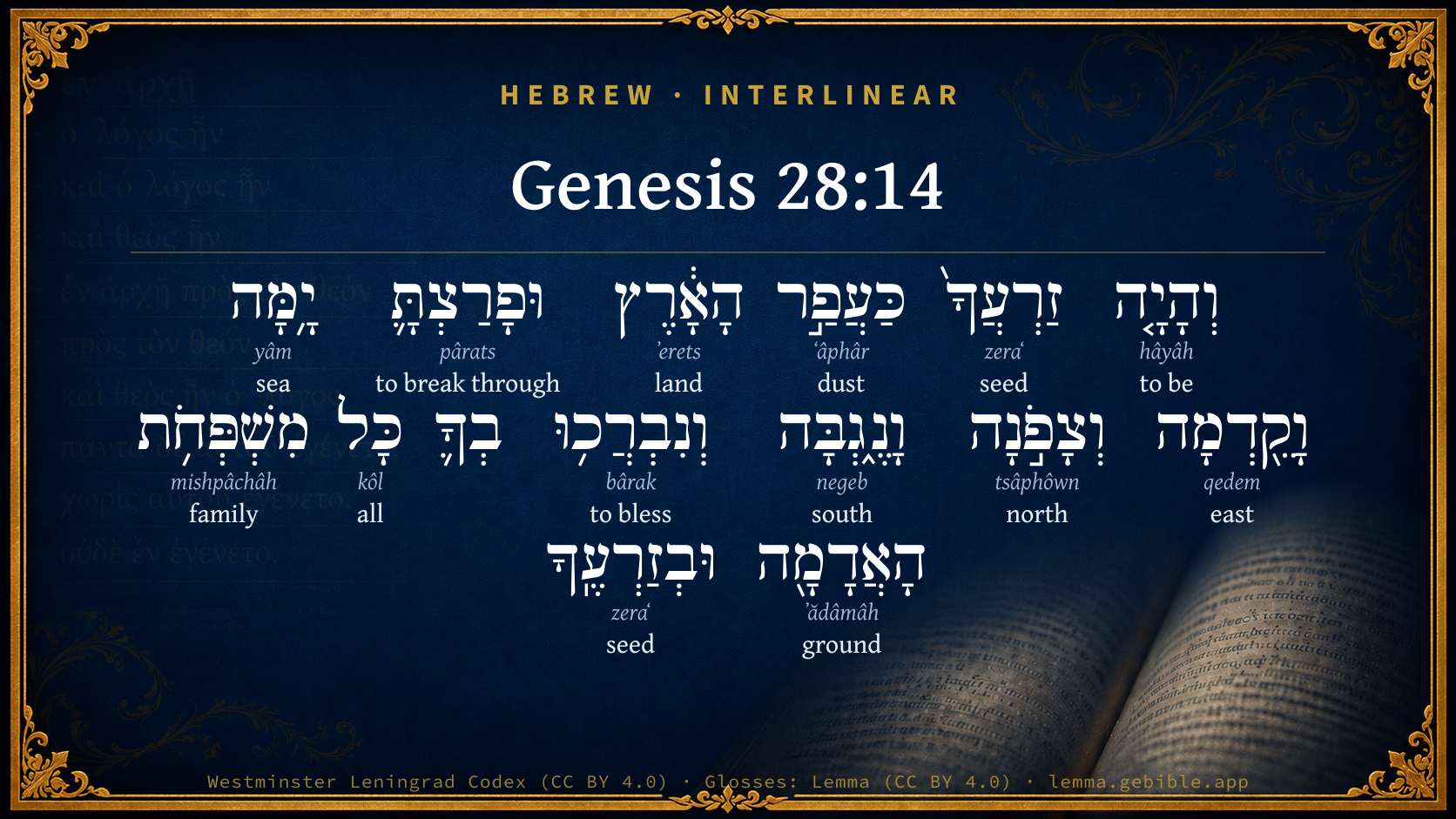
Hebrew (Westminster Leningrad Codex) Genesis 28:14 appears in the Hebrew Old Testament. The text above is from the Westminster Leningrad Codex. Each word links to its Strong’s number, a concise gloss, and parsing drawn from the Open Scriptures Hebrew Bible morphology. Click any word for its full Brown-Driver-Briggs (BDB) entry.
Download image
Cite this verse

Genesis 28:14 (World English Bible). Public Domain. Lemma interlinear Bible study tool, https://lemma.gebible.app/v/genesis/28/14.

Show BibTeX & RIS
BibTeX
RIS
English Translation
Your seed will be as the dust of the earth, and you will spread abroad to the west, and to the east, and to the north, and to the south. In you and in your seed will all the families of the earth be blessed.
World English Bible · Public Domain
Highlights
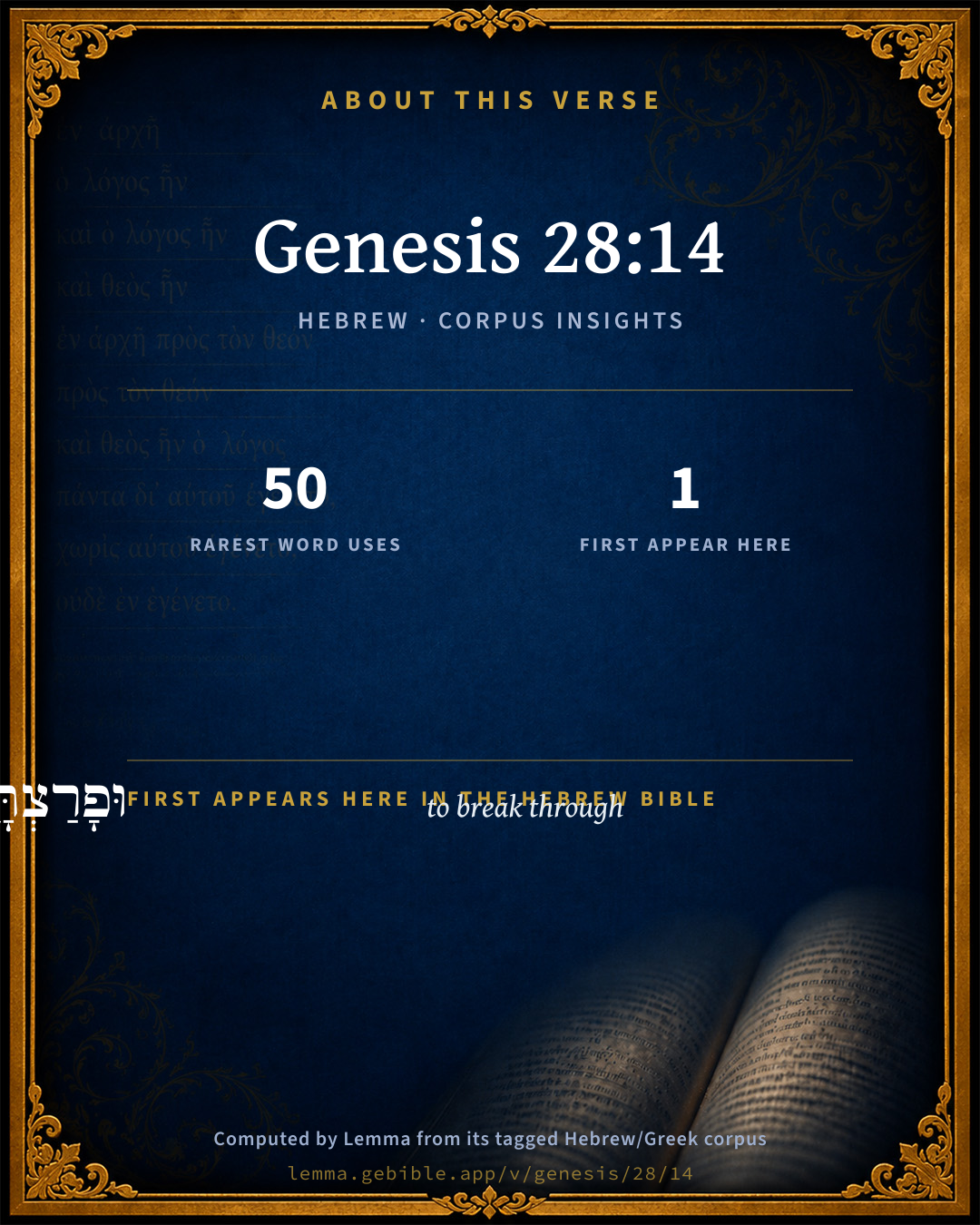
  • 1 first appearance in the Hebrew Bible
Full analysis ↓
Download a study sheet

One document with this verse’s original text, its word-by-word gloss line, the meaning frame, cross-references with their text, attributed commentary, and full source and license credits — printable, and it pastes into notes with its structure intact.

This verse Autodidact and up

Study sheet (.html) Plain text (.txt)

A passage Seminary Student

Up to 50 verses in one chapter. A passage sheet keeps up to 6 commentary sources and 12 cross-references per verse, in the order this page ranks them, and says so on the sheet whenever that leaves anything out. Ask for a single verse and you get the Autodidact verse sheet above.

Everything on this page stays free to read, with no account — the sheet is a download of what is already on screen, not access to it.

Want to remove ads? Support Godless Engineer
Compare translations 3

The same verse in 3 English versions, stacked beneath the original-language interlinear above. Click any original word for its lexicon entry.

Each is an independent rendering of the whole verse — the interlinear is not word-aligned to these translations.

Highlighted words mark where these versions differ — a whole-verse word diff, not a word-by-word alignment.

  • World English Bible Public Domain
    Your seed will be as the dust of the earth, and you will spread abroad to the west, and to the east, and to the north, and to the south. In you and in your seed will all the families of the earth be blessed.
  • King James Version Public Domain
    And thy seed shall be as the dust of the earth, and thou shalt spread abroad to the west, and to the east, and to the north, and to the south: and in thee and in thy seed shall all the families of the earth be blessed.
  • unfoldingWord Literal Text CC BY-SA 4.0
    And your offspring will be like the dust of the earth, and you will spread out to the west and to the east and to the north and to the south. And in you and in your offspring all the families of the earth will be blessed.

unfoldingWord Literal Text — © unfoldingWord, licensed CC BY-SA 4.0. Word-aligned USFM3 via Door43 (git.door43.org/unfoldingWord/en_ult).

Versions to compare (up to 4)

3 of 4 selected

Show all 18 translations

Every available English version of this verse, each an independent rendering of the whole verse.

  • World English Bible Public Domain
    Your seed will be as the dust of the earth, and you will spread abroad to the west, and to the east, and to the north, and to the south. In you and in your seed will all the families of the earth be blessed.
  • Berean Standard Bible Public Domain
    Your descendants will be like the dust of the earth, and you will spread out to the west and east and north and south. All the families of the earth will be blessed through you and your offspring.
  • Majority Standard Bible Public Domain
    Your descendants will be like the dust of the earth, and you will spread out to the west and east and north and south. All the families of the earth will be blessed through you and your offspring.
  • King James Version Public Domain
    And thy seed shall be as the dust of the earth, and thou shalt spread abroad to the west, and to the east, and to the north, and to the south: and in thee and in thy seed shall all the families of the earth be blessed.
  • American Standard Version (1901) Public Domain
    And thy seed shall be as the dust of the earth, and thou shalt spread abroad to the west, and to the east, and to the north, and to the south. And in thee and in thy seed shall all the families of the earth be blessed.
  • Revised Version (1885) Public Domain
    and thy seed shall be as the dust of the earth, and thou shalt spread abroad to the west, and to the east, and to the north, and to the south: and in thee and in thy seed shall all the families of the earth be blessed.
  • Geneva Bible (1599) Public Domain
    And thy seede shall be as the dust of the earth, and thou shalt spread abroad to the West, and to the East, and to the North, and to the South, and in thee and in thy seede shall all the families of the earth be blessed.
  • Douay-Rheims (1899) Public Domain
    And thy seed shall be as the dust of the earth: thou shalt spread abroad to the west, and to the east, and to the north, and to the south: and IN THEE and thy seed all the tribes of the earth SHALL BE BLESSED.
  • Young's Literal Translation Public Domain
    and thy seed hath been as the dust of the land, and thou hast broken forth westward, and eastward, and northward, and southward, and all families of the ground have been blessed in thee and in thy seed.
  • Literal Standard Version CC BY-SA 4.0
    and your seed has been as the dust of the land, and you have broken forth westward, and eastward, and northward, and southward, and all families of the ground have been blessed in you and in your seed.
  • Unlocked Literal Bible CC BY-SA 4.0
    Your descendants will be like the dust of the earth, and you will spread far out to the west, to the east, to the north, and to the south. Through you and through your descendants will all the families of the earth be blessed.
  • unfoldingWord Literal Text CC BY-SA 4.0
    And your offspring will be like the dust of the earth, and you will spread out to the west and to the east and to the north and to the south. And in you and in your offspring all the families of the earth will be blessed.
  • Darby Bible Public Domain
    And thy seed shall be as the dust of the earth, and thou shalt spread abroad to the west, and to the east, and to the north, and to the south; and in thee and in thy seed shall all the families of the earth be blessed.
  • World Messianic Bible Public Domain
    Your offspring will be as the dust of the earth, and you will spread abroad to the west, and to the east, and to the north, and to the south. In you and in your offspring, all the families of the earth will be blessed.
  • Webster's Bible Public Domain
    And thy seed shall be as the dust of the earth; and thou shalt spread abroad to the west, and to the east, and to the north, and to the south: and in thee and in thy seed shall all the families of the earth be blessed.
  • Free Bible Version CC BY-SA 4.0
    Your descendants will be as numerous as the dust of the earth, and will spread out west and east, and north and south. Everyone on earth will be blessed by your descendants.
  • Bible in Basic English Public Domain
    Your seed will be like the dust of the earth, covering all the land to the west and to the east, to the north and to the south: you and your seed will be a name of blessing to all the families of the earth.
  • JPS Tanakh (1917) Public Domain
    And thy seed shall be as the dust of the earth, and thou shalt spread abroad to the west, and to the east, and to the north, and to the south. And in thee and in thy seed shall all the families of the earth be blessed.

Literal Standard Version (2020), Covenant Press — licensed CC BY-SA 4.0. Text via the HelloAO Bible API (eBible.org). Unlocked Literal Bible (unfoldingWord) — licensed CC BY-SA 4.0. Text via the HelloAO Bible API (eBible.org). unfoldingWord Literal Text — © unfoldingWord, licensed CC BY-SA 4.0. Word-aligned USFM3 via Door43 (git.door43.org/unfoldingWord/en_ult). Free Bible Version, Dr. Jonathan Gallagher — licensed CC BY-SA 4.0. Text via the HelloAO Bible API (eBible.org).

Word by word

More ways to search: Search by grammar → Find every occurrence → Compare this word →

Practice this passage: Drill this verse → Learn its vocabulary →

וּפָרַצְתָּ֛
pârats
H6555
“and · to break through”
Conjunction + Verb, Qal, Sequential Perfect, 2nd Person, Masculine, Singular
Part of Speech
Conjunction + Verb
Stem
Qal
Form
Sequential Perfect
Person
2nd Person
Gender
Masculine
Number
Singular
Full BDB Definition

Origin: a primitive root

TWOT: 1826

to break through or down or over, burst, breach - (Qal) - to break or burst out (from womb or enclosure) - to break through or down, make a breach in - to break into - to break open - to break up, break in pieces - to break out (violently) upon - to break over (limits), increase - to use violence - to burst open - to spread, distribute - (Niphal) to be broken through - (Pual) to be broken down - (Hithpael) to break away
  1. וְהָיָ֤ה hâyâh H1961 “and · to be” Conjunction + Verb, Qal, Sequential Perfect, 3rd Person, Masculine, Singular
  2. זַרְעֲךָ֙ zeraʻ H2233 “seed · your” Noun, Common, Masculine, Singular, Construct + Suffix, Personal, 2nd Person, Masculine, Singular
  3. כַּעֲפַ֣ר ʻâphâr H6083 “like/as · dust of” Preposition + Noun, Common, Masculine, Singular, Construct
  4. הָאָ֔רֶץ ʼerets H776 “the · land” Particle, Definite Article + Noun, Common, Both, Singular, Absolute
  5. יָ֥מָּה yâm H3220 “sea · toward” Noun, Common, Masculine, Singular, Absolute + Suffix, Demonstrative
  6. וָקֵ֖דְמָה qedem H6924 “and · east · toward” Conjunction + Noun, Common, Masculine, Singular, Absolute + Suffix, Demonstrative
  7. וְצָפֹ֣נָה tsâphôwn H6828 “and · north · toward” Conjunction + Noun, Common, Feminine, Singular, Absolute + Suffix, Demonstrative
  8. וָנֶ֑גְבָּה negeb H5045 “and · south · toward” Conjunction + Noun, Common, Masculine, Singular, Absolute + Suffix, Demonstrative
  9. וְנִבְרֲכ֥וּ bârak H1288 “and · to bless” Conjunction + Verb, Niphal, Perfect, 3rd Person, Common, Plural
  10. כָּל kôl H3605 “all of” Noun, Common, Masculine, Singular, Construct
  11. מִשְׁפְּחֹ֥ת mishpâchâh H4940 “families of” Noun, Common, Feminine, Plural, Construct
  12. הָאֲדָמָ֖ה ʼădâmâh H127 “the · ground” Particle, Definite Article + Noun, Common, Feminine, Singular, Absolute
  13. וּבְזַרְעֶֽךָ zeraʻ H2233 “and · in/at · seed · your” Conjunction + Preposition + Noun, Common, Masculine, Singular, Construct + Suffix, Personal, 2nd Person, Masculine, Singular

About this verse

These counts appear in no published source. They are computed here, from the morphology-tagged text and Lemma’s own curated glosses. What Lemma adds →

15
words
13
distinct lemmas
Pentateuch
section

First appearance in Scripture

This word makes its first canonical appearance in the Hebrew Bible here:

  • וּפָרַצְתָּ֛ to break through H6555

Shared distinctive vocabulary

וּפָרַצְתָּ֛ to break through H6555 occurs in 48 verses of the Hebrew Bible. Also found in:

Grammatical profile

  • 3 verbs
  • 11 nouns
  • 1 preposition

Verb forms

  • וְהָיָ֤ה Qal · Sequential Perfect
  • וּפָרַצְתָּ֛ Qal · Sequential Perfect
  • וְנִבְרֲכ֥וּ Niphal · Perfect

Repetition

A word recurs within this verse — often emphatic in Hebrew:

  • זַרְעֲךָ֙ seed H2233 ×2

Hebrew & Septuagint length

In English translation the verse runs 45 words from the Hebrew and 45 from the Septuagint (LXX English) — the same length.

A rough comparison of the two English renderings, which tokenize alike — not a word-level alignment.

Word counts can differ between the Hebrew and the Greek without any difference in meaning — e.g. the Hebrew direct-object marker אֵת has no separate Greek word, and Greek often adds the article ὁ.

Cross-references

18

Topical passages linked to Genesis 28:14 in the Treasury of Scripture Knowledge — connected by theme and wording, ordered by reader-vote popularity; previews shown in the World English Bible.

  • Genesis 12:3 I will bless those who bless you, and I will curse him who curses you. In you will all of the families of the earth be blessed."
  • Genesis 18:18 seeing that Abraham has surely become a great and mighty nation, and all the nations of the earth will be blessed in him?
  • Genesis 22:18 In your seed will all the nations of the earth be blessed, because you have obeyed my voice."
  • Genesis 13:16 I will make your offspring as the dust of the earth, so that if a man can number the dust of the earth, then your seed may also be numbered.
  • Genesis 26:4 I will multiply your seed as the stars of the sky, and will give to your seed all these lands. In your seed will all the nations of the earth be blessed,
  • Acts 3:25 You are the children of the prophets, and of the covenant which God made with our fathers, saying to Abraham, 'In your seed will all the families of the earth be blessed.'
  • Genesis 13:14 Yahweh said to Abram, after Lot was separated from him, "Now, lift up your eyes, and look from the place where you are, northward and southward and eastward and westward,
  • Galatians 3:8 The Scripture, foreseeing that God would justify the Gentiles by faith, preached the Gospel beforehand to Abraham, saying, "In you all the nations will be blessed."
  • Genesis 32:12 You said, 'I will surely do you good, and make your seed as the sand of the sea, which can't be numbered because there are so many.'"
  • Genesis 35:11–12 God said to him, "I am God Almighty. Be fruitful and multiply. A nation and a company of nations will be from you, and kings will come out of your loins.
  • Deuteronomy 12:20 When Yahweh your God shall enlarge your border, as he has promised you, and you shall say, I will eat flesh, because your soul desires to eat flesh; you may eat flesh, after all the desire of your soul.
  • Galatians 3:16 Now the promises were spoken to Abraham and to his seed. He doesn't say, "To seeds," as of many, but as of one, "To your seed," which is Christ.
  • Numbers 23:10 Who can count the dust of Jacob, Or number the fourth part of Israel? Let me die the death of the righteous, Let my last end be like his!
  • Psalms 72:17 His name endures forever. His name continues as long as the sun. Men shall be blessed by him. All nations will call him blessed.
  • Ephesians 1:3 Blessed be the God and Father of our Lord Jesus Christ, who has blessed us with every spiritual blessing in the heavenly places in Christ;
  • Revelation 7:9 After these things I looked, and behold, a great multitude, which no man could number, out of every nation and of all tribes, peoples, and languages, standing before the throne and before the Lamb, dressed in white robes, with palm branches in their hands.
  • Matthew 8:11 I tell you that many will come from the east and the west, and will sit down with Abraham, Isaac, and Jacob in the Kingdom of Heaven,
  • Revelation 7:4 I heard the number of those who were sealed, one hundred forty-four thousand, sealed out of every tribe of the children of Israel:

Cross-references courtesy of OpenBible.info (CC BY 4.0).

Hebrew and Greek witnesses Masoretic Hebrew ↔ Greek Septuagint

The same verse in the two great witnesses to the Old Testament, shown verse-for-verse.

These are two independent witnesses, not word-aligned to each other, and the Septuagint is shown in lemma (dictionary) form.

Hebrew Genesis 28:14 Masoretic · Westminster Leningrad Codex

וְהָיָ֤ה זַרְעֲךָ֙ כַּעֲפַ֣ר הָאָ֔רֶץ וּפָרַצְתָּ֛ יָ֥מָּה וָקֵ֖דְמָה וְצָפֹ֣נָה וָנֶ֑גְבָּה וְנִבְרֲכ֥וּ בְךָ֛ כָּל מִשְׁפְּחֹ֥ת הָאֲדָמָ֖ה וּבְזַרְעֶֽךָ

Your seed will be as the dust of the earth, and you will spread abroad to the west, and to the east, and to the north, and to the south. In you and in your seed will all the families of the earth be blessed.

World English Bible · Public Domain

Greek LXX Genesis 28:14 Septuagint · lemma form

καί εἰμί ὁ σπέρμα σύ ὡς ὁ ἄμμος ὁ γῆ καί πλατύνω ἐπί θάλασσα καί ἐπί λίψ καί ἐπί βορέας καί ἐπί ἀνατολή καί ἐνεὐλογέω ἐν σύ πᾶς ὁ φυλή ὁ γῆ καί ἐν ὁ σπέρμα σύ

And your seed shall be as the sand of the earth; and it shall spread abroad to the sea, and the south, and the north, and to the east; and in you and in your seed shall all the tribes of the earth be blessed.

LXX2012 (modern English Septuagint) · Public Domain

Hebrew: Westminster Leningrad Codex (CC BY 4.0). Greek: Septuagint (public domain); English from LXX2012 (modern English Septuagint) (Public Domain). How the Septuagint differs from the Hebrew →

Targum (Aramaic paraphrase)

2

The Targum is the ancient Jewish Aramaic paraphrase of the Hebrew Scriptures — an interpretive translation, not the Hebrew text itself. Onkelos (literal) and Pseudo-Jonathan (expansive) render the Torah, and Jonathan the Prophets. Coverage is partial: where no permissively-licensed English translation exists for a verse, only the Aramaic is shown. This is verse-level text, not a word-by-word alignment to the Hebrew.

  1. Targum Onkelos Torah (Genesis–Deuteronomy)
    וִיהוֹן בְּנָיךְ סַגִּיאִין כְּעַפְרָא דְאַרְעָא וְתִתְקֵף לְמַעַרְבָא וּלְמַדִינְחָא וּלְצִפּוּנָא וּלְדָרוֹמָא וְיִתְבָּרְכוּן בְּדִילָךְ כָּל זַרְעֲיַת אַרְעָא וּבְדִיל בְּנָיךְ

    (no public-domain English translation for this verse)

    Targum Onkelos — Aramaic: “Onkelos Genesis” (public domain); “Onkelos Exodus” (public domain); “Onkelos Leviticus” (public domain); “Onkelos Numbers” (public domain); “Onkelos Deuteronomy” (public domain). English: “Sefaria Community Translation” (CC0 1.0 (public-domain dedication)); “J.W. Etheridge. The Targums of Onkelos and Jonathan Ben Uzziel on the Pentateuch. London: Longmans, Green, 1862” (public domain). Text via Sefaria.

  2. Targum Pseudo-Jonathan Torah (Genesis–Deuteronomy)
    וִיהוֹן בְּנָךְ סַגִיאִין הֵי כְעַפְרָא דְאַרְעָא וְתַתְקִיף לִמְעַרְבָא וּלְמַדִינְחָא לְצִיפוּנָא וּלְדָרוֹמָא וְיִתְבָּרְכוּן בְּגִין זַכְוָותָךְ כָּל יְחוּסֵי אַרְעָא וּבְגִין זַכְוַות בְּנָךְ

    And thy sons shall be many as the dust of the earth, and shall become strong on the west and on the east, on the north and on the south: and all the kindreds of the earth shall through thy rightneousness and the righteousness of thy sons be blessed.

    Targum Pseudo-Jonathan — Aramaic: “Targum Jonathan on Genesis” (public domain); “Targum Jonathan on Exodus” (public domain); “Targum Jonathan on Leviticus” (public domain); “Targum Jonathan on Numbers” (public domain); “Targum Jonathan on Deuteronomy” (public domain). English: “The Targum of Jonathan ben Uzziel, trans. J. W. Etheridge, London, 1862” (public domain). Text via Sefaria.

Commentary

Notes on Genesis 28:14 from classic Christian and Jewish commentators (each source and its license shown beneath its notes). The classic Christian expositions comment on the surrounding passage and are grouped to its opening verse, so a note may address several verses; the Jewish commentaries on the Tanakh (Rashi and others) are per-verse, so they appear only where the commentator wrote on this verse.

Lemma curates 59 commentaries, every one of them public domain or Creative Commons licensed, each selected and text-cleaned for this edition rather than reprinted as found. About our sources →

Trapp's Complete Commentary

John Trapp

Gen 28:14 And thy seed shall be as the dust of the earth, and thou shalt spread abroad to the west, and to the east, and to the north, and to the south: and in thee and in thy seed shall all the families of the earth be blessed.

Ver. 14, 15. And thy seed shall be as the dust.] Against his fourfold cross, here is a fourfold comfort, as Pererius well observeth, a plaster as broad as the sore, and sovereign for it. (1.) Against the loss of his friends, "I will be with thee": (2.) Of his country; "I will give thee this land": (3.) Against his poverty; "Thou shalt spread abroad, to the east, west," &c. (4.) His solitariness and aloneness; angels shall attend thee, and "thy seed shall be as the dust," &c. And "who can count the dust of Jacob?" {Num 23:10} saith Balaam, that spellman of the devil, as one calls him. Whereunto we may add that which surpasseth and comprehendeth all the rest; "In thee, and thy seed, shall all the families of the earth be blessed." Now whatsoever God spake here with Jacob, he spake with us, as well as with him, saith Hosea. {Hos 12:4}

John Trapp, A Commentary or Exposition upon All the Books of the Old and New Testament (1647–1656) — public domain. Text from a community e-Sword module.

Joseph Benson's Commentary

Gen 28:14. In thy seed shall the families of the earth be blessed — All that are blessed, whatever family they are of, are blessed in Christ, and none of any family are excluded from blessedness in him, but those that exclude themselves.

Joseph Benson's Commentary on the Old and New Testaments (1811–1818) — public domain. Text from a community e-Sword module.

Tyndale Open Study Notes

Tyndale Open Resources

28:14 Jacob inherited Abraham’s entire covenant (see 22:17), which confirmed Isaac’s blessing (28:3-4) and stipulated a temporary exile (28:15; see 15:12-16).

Tyndale Open Study Notes — © Tyndale Open Resources, licensed CC BY-SA 4.0. Text via the HelloAO Bible API.

Adam Clarke's Commentary

Verse 14. Thy seed shall be as the dust] The people that shall descend from thee shall be extremely numerous, and in thee and thy seed-the Lord JESUS descending from thee, according to the flesh, shall all the families of the earth - not only all of thy race, but all the other families or tribes of mankind which have not proceeded from any branch of the Abrahamic family, be blessed; for Jesus Christ by the grace of God tasted death FOR EVERY MAN, Heb 2:9.

Adam Clarke's Commentary on the Bible (1810–1826) — public domain. Text from a community e-Sword/MySword module.

John Calvin's Commentaries

14. And thy seed shall be as the dust of the earth. The sum of the whole is this, Whatever the Lord had promised to Abraham, Jacob transmitted to his sons. Meanwhile it behoved the holy man, in reliance on this divine testimony, to hope against hope; for though the promise was vast and magnificent, yet, wherever Jacob turned himself, no ray of good hope shone upon him. He saw himself a solitary man; no condition better than that of exile presented itself; his return was uncertain and full of danger; but it was profitable for him to be thus left destitute of all means of help, that he might learn to depend on the word of God alone. Thus, at the present time, if God freely promises to give us all things, and yet seems to approach us empty-handed, it is still proper that we should pay such honor and reverence to his word, that we may be enriched and filled with faith. At length, indeed, after the death of Jacob, the event declared how efficacious had been this promise: by which example we are taught that the Lord by no means disappoints his people, even when he defers the granting of those good things which he has promised, till after their death.

And in thee, and in thy seed, shall all the families of the earth be blessed This clause has the greater weight, because in Jacob and in his seed the blessing is to be restored from which the whole human race had been cut off in their first parent. But what this expression means, I have explained above; namely, that Jacob will not only be an exemplar, or formula of blessing, but its fountain, cause, or foundation; for though a certain exquisite degree of happiness is often signified by an expression of this kind; yet, in many passages of Scripture, it means the same as to desire from any one his blessing, and to acknowledge it as his gift. Thus men are said to bless themselves in God, when they acknowledge him as the author of all good. So here God promises that in Jacob and his seed all nations shall bless themselves, because no happiness will ever be found except what proceeds from this source. That, however, which is peculiar to Christ, is without impropriety transferred to Jacob, in whose loins Christ then was. Therefore, inasmuch as Jacob, at that time, represented the person of Christ, it is said that all nations are to be blessed in him; but, seeing that the manifestation of a benefit so great depended on another, the expression in thy seed is immediately added in the way of explanation. That the word seed is a collective noun, forms no objection to this interpretation, (as I have elsewhere said,) for since all unbelievers deprive themselves of honor and of grace, and are thus accounted strangers; it is necessary to refer to the Head, in order that the unity of the seed may appear. Whoever will reverently ponder this, will easily see that, in this interpretation, which is that of Paul, there is nothing tortuous or constrained.

John Calvin's Commentaries (1540-1563) — public domain. Text from the Calvin Translation Society English edition (1840s-50s) via the Christian Classics Ethereal Library (ccel.org). Calvin's coverage is partial (roughly two-thirds of the Bible); uncommented books and verses are honest gaps, never fabricated. The 19th-century editor's footnotes and remarks are omitted so the notes are faithfully Calvin's own voice.

The Cambridge Bible for Schools and Colleges

gen. ed. J. J. S. Perowne

14. as the dust of the earth] Cf. Gen_13:16.

spread abroad] Heb. break forth. Cf. Gen_30:30, “increased,” 43, Exo_1:12.

to the west] Cf. Gen_13:14.

in thee … be blessed] See note on Gen_12:3.

The Cambridge Bible for Schools and Colleges (gen. ed. J. J. S. Perowne; Cambridge University Press, 1878–1918) — public domain. Text from a community e-Sword module.

John Gill's Exposition

And thy seed shall be as the dust of the earth,.... Innumerable, see Gen 13:16,

and thou shalt spread abroad to the west; or "the sea", the Mediterranean sea, which was west of the land of Canaan:

and to the east, and to the north, and to the south; not of the whole world, but of the land of Canaan: the meaning is, that his posterity should be numerous, and break out and spread themselves like a flood of water, and reach to the utmost bounds of the land on all sides:

and in thee and in thy seed shall all the families of the earth be blessed; that is, in that eminent and principal seed that should spring from him, the Messiah, in whom some of all nations should, as they have been, be blessed with all spiritual blessings, as redemption, peace, pardon, justification, adoption, and eternal life; the same promise had been made to Abraham, was renewed to Isaac, and now confirmed to Jacob, see Gen 22:18.

John Gill's Exposition of the Whole Bible (1746–1763) — public domain (CC PDM 1.0). Text via the HelloAO Bible API.

Matthew Poole's English Annotations

i.e. The nations of the earth, as that word is used.

Matthew Poole's English Annotations on the Holy Bible (1683–1685) — public domain. Text from a community e-Sword/MySword module.

Whedon's Commentary on the Bible

Daniel D. Whedon

14. Thy seed shall be as the dust — Comp. Gen_12:2-3; Gen_13:16; Gen_18:18; Gen_22:17-18.

Daniel D. Whedon (gen. ed.), Commentary on the Old and New Testaments (1874–1909) — public domain. Text from a community e-Sword module.

The Pulpit Commentary

And thy seed shall be as the dust of the earth, promised to Abraham, Gen_13:16; to Isaac, under a different emblem, Gen 26:4and thou shalt spread abroad (literally, break forth) to the west, and to the east, to the north, and to the south: (cf. Gen_13:14; Deu_12:20) In its ultimate significance this points to the world-wide universality of the kingdom of Christ (Murphy) and in thee and in thy seed shall all the families of the earth be blessed; (vide Gen_12:3 Gen_18:18 Gen_22:18) (Abraham) 26:4 (Isaac).

The Pulpit Commentary (1880–1919), ed. H.D.M. Spence-Jones & Joseph S. Exell — public domain. Text from a community e-Sword module.

John Wesley's Explanatory Notes

In thy seed shall all the families of the earth be blessed - Christ is the great blessing of the world: all that are blessed, whatever family they are of, are blessed in him, and none of any family are excluded from blessedness in him, but those that exclude themselves.

John Wesley, Explanatory Notes Upon the Whole Bible (1754–1765) — public domain. Text via the GEBible commentary corpus.

unfoldingWord translationNotes

Door43 World Missions Community

General Information:

God continues to talk to Jacob in a dream.

Your descendants will be like the dust of the earth

God compares Jacob's descendants to the dust of the earth to emphasize their huge number. AT: "You will have more descendants than you can count" (See: Simile)

you will spread far out to the west

The word "you" is singular and refers to Jacob. Here Jacob represents his descendants. AT: "your descendants will spread out to the west" (See: Metonymy)

you will spread far out

This means the people will extend the borders of their land and occupy more territory.

to the west, to the east, to the north, and to the south

This phrases are used together to mean "all directions." AT: "in all directions" (See: Synecdoche)

Through you and through your descendants will all the families of the earth be blessed

This can be stated in active form. AT: "I will bless all families on the earth through you and your descendants" (See: Active or Passive)

Behold, I am

"Pay attention, because what I am about to say is both true and important: I am"

for I will not leave you. I will do all

"for I will not leave you until I have done all"

I will keep you

"I will keep you safe" or "I will protect you"

I will bring you into this land again

"I will bring you back to this land"

translationWords

descend

bless

promise

unfoldingWord translationNotes — © Distant Shores Media and the Door43 World Missions Community, licensed CC BY-SA 4.0. Source: git.door43.org/Door43/en_tn.

Rashi

Rabbi Shlomo Yitzchaki (Rashi)

ופרצת means AND THOU SHALT BECOME STRONG, like (Exodus 1:12) “the more they became strong".

Rashi on the Tanakh — English translations: “The Judaica Press complete Tanach with Rashi, translated by A. J. Rosenberg” (CC BY 4.0); “Pentateuch with Rashi's commentary by M. Rosenbaum and A.M. Silbermann, 1929-1934” (public domain); “The Metsudah Tanach series, Lakewood, N.J” (CC BY 4.0); and “The Book of Joshua, Metsudah Publications, 1997” (CC BY 4.0). Text via Sefaria.

Radak

Rabbi David Kimhi (Radak)

והיה...ופרצת, you and your descendants.

ונברכו בך, on your account and on account of your descendants all the families of the earth will experience Divine blessings. The reason for this is that He who performs G’d’s commandments and thereby acknowledges His existence and power, deserves that the world exist on his account. Everyone else who is alive and well on earth therefore owes his well being to the Jews keeping the Torah.

Radak on the Tanakh — English translations: “Sefaria Community Translation” (CC0 1.0 (public-domain dedication)); “Eliyahu Munk, HaChut Hameshulash” (CC BY 4.0); “Rabbi Mike Feuer, Jerusalem Anthology” (CC BY 4.0); and “R. David Kimhi on the first book of Psalms, Translated by R.G. Finch, London, 1919” (public domain). Text via Sefaria.

Lesson kit

Teaching starters — assembled from the data on this page, not authored interpretation. Every prompt links to the verse data it draws on. Edit before teaching.

Genesis, in the Pentateuch, opens this verse with 15 words (13 distinct Hebrew lemmas). Its most distinctive word is pârats (“to break through”). A historical commentator’s framing appears above. Read the whole chapter for the surrounding context.

Discussion questions

  1. What does “to break through” (pârats) contribute to the verse as a whole?
  2. This is the first place “to break through” appears in Scripture (first appears here). What does its debut here establish?
  3. How does Genesis 30:30, which shares the word «to break through», read alongside this verse?
  4. What does the repetition of “seed” (2× in this one verse) do in this verse?
  5. These translations render this verse differently; the difference is in the English rendering, not the original. What questions does that raise?
  6. «וְהָיָ֤ה» is a Qal Sequential Perfect verb. How does that grammatical form shape the action described?
  7. Compare how Trapp's Complete Commentary and Joseph Benson's Commentary read this verse. Where do they agree or differ?

Things to notice

  • 1 word makes its first canonical appearance in Scripture here.
  • These translations choose different wording for 8 words in this verse.
  • “seed” occurs 2× in this single verse.
  • 13 distinct Hebrew lemmas span 15 words in this verse.

Reading settings

Reading text

Shown beneath each verse's original-language words.

Old Testament
Old Testament edition

Read the OT as the Masoretic Hebrew (MT) or the Greek Septuagint (LXX).

English shown for the Greek Septuagint (in the Hebrew ↔ Greek comparison).

Comparing translations? Open the Compare panel on any verse page to stack up to four side by side.