

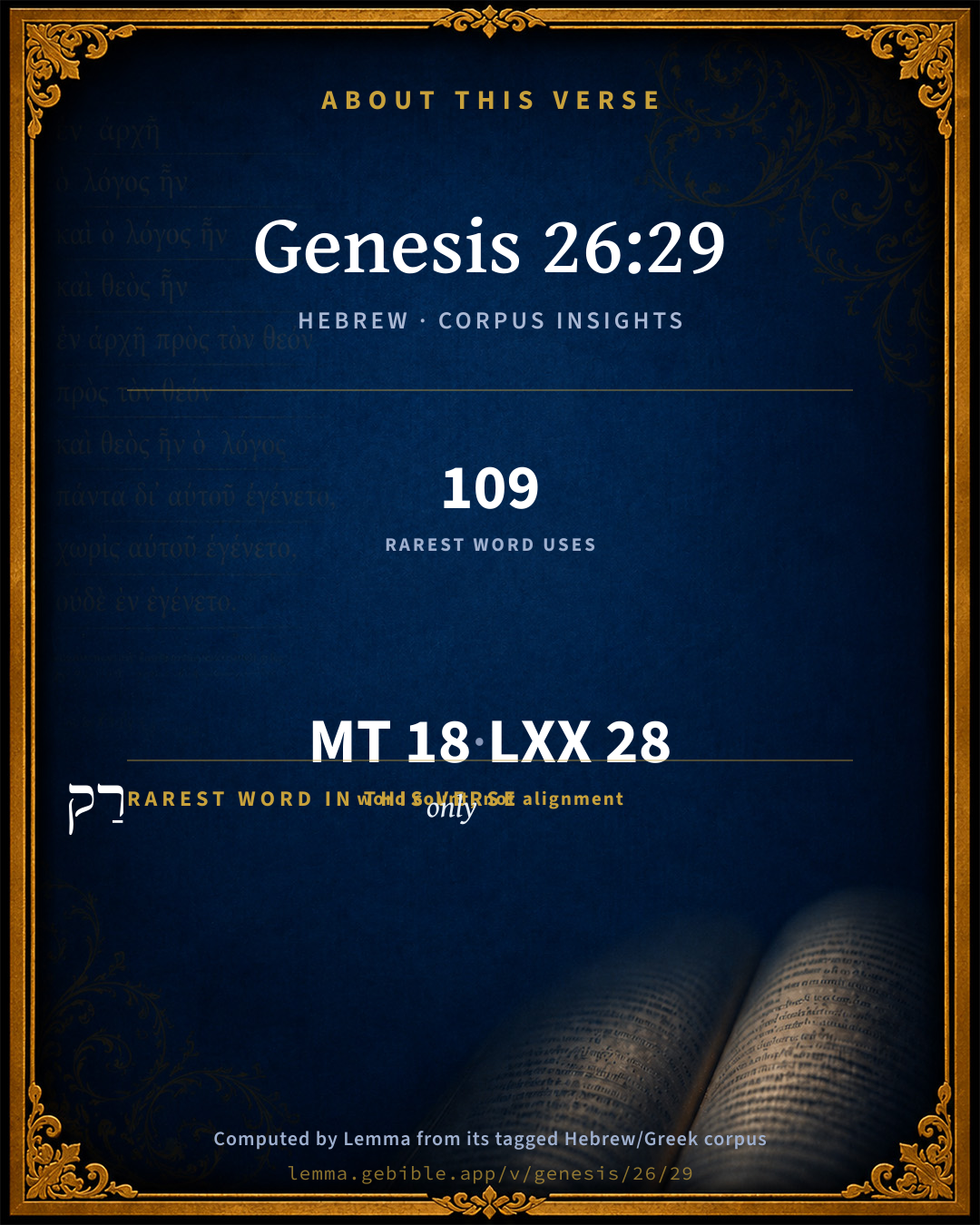
Genesis 26:29

Hebrew (Westminster Leningrad Codex) Genesis 26:29 appears in the Hebrew Old Testament. The text above is from the Westminster Leningrad Codex. Each word links to its Strong’s number, a concise gloss, and parsing drawn from the Open Scriptures Hebrew Bible morphology. Click any word for its full Brown-Driver-Briggs (BDB) entry.
Download image
Cite this verse

Genesis 26:29 (World English Bible). Public Domain. Lemma interlinear Bible study tool, https://lemma.gebible.app/v/genesis/26/29.

Show BibTeX & RIS
BibTeX
RIS
English Translation
that you will do us no harm, as we have not touched you, and as we have done to you nothing but good, and have sent you away in peace.' You are now the blessed of Yahweh."
World English Bible · Public Domain
Download a study sheet

One document with this verse’s original text, its word-by-word gloss line, the meaning frame, cross-references with their text, attributed commentary, and full source and license credits — printable, and it pastes into notes with its structure intact.

This verse Autodidact and up

Study sheet (.html) Plain text (.txt)

A passage Seminary Student

Up to 50 verses in one chapter. A passage sheet keeps up to 6 commentary sources and 12 cross-references per verse, in the order this page ranks them, and says so on the sheet whenever that leaves anything out. Ask for a single verse and you get the Autodidact verse sheet above.

Everything on this page stays free to read, with no account — the sheet is a download of what is already on screen, not access to it.

Want to remove ads? Support Godless Engineer
Compare translations 3

The same verse in 3 English versions, stacked beneath the original-language interlinear above. Click any original word for its lexicon entry.

Each is an independent rendering of the whole verse — the interlinear is not word-aligned to these translations.

Highlighted words mark where these versions differ — a whole-verse word diff, not a word-by-word alignment.

  • World English Bible Public Domain
    that you will do us no harm, as we have not touched you, and as we have done to you nothing but good, and have sent you away in peace.' You are now the blessed of Yahweh."
  • King James Version Public Domain
    That thou wilt do us no hurt, as we have not touched thee, and as we have done unto thee nothing but good, and have sent thee away in peace: thou art now the blessed of the LORD.
  • unfoldingWord Literal Text CC BY-SA 4.0
    that you will not do evil against us, just as we did not touch you, and just as we did only good to you and sent you away in peace. Now you are blessed by Yahweh.”

unfoldingWord Literal Text — © unfoldingWord, licensed CC BY-SA 4.0. Word-aligned USFM3 via Door43 (git.door43.org/unfoldingWord/en_ult).

Versions to compare (up to 4)

3 of 4 selected

Show all 18 translations

Every available English version of this verse, each an independent rendering of the whole verse.

  • World English Bible Public Domain
    that you will do us no harm, as we have not touched you, and as we have done to you nothing but good, and have sent you away in peace.' You are now the blessed of Yahweh."
  • Berean Standard Bible Public Domain
    that you will not harm us, just as we have not harmed you but have done only good to you, sending you on your way in peace. And now you are blessed by the LORD.”
  • Majority Standard Bible Public Domain
    that you will not harm us, just as we have not harmed you but have done only good to you, sending you on your way in peace. And now you are blessed by the LORD.”
  • King James Version Public Domain
    That thou wilt do us no hurt, as we have not touched thee, and as we have done unto thee nothing but good, and have sent thee away in peace: thou art now the blessed of the LORD.
  • American Standard Version (1901) Public Domain
    that thou wilt do us no hurt, as we have not touched thee, and as we have done unto thee nothing but good, and have sent thee away in peace. Thou art now the blessed of Jehovah.
  • Revised Version (1885) Public Domain
    that thou wilt do us no hurt, as we have not touched thee, and as we have done unto thee nothing but good, and have sent thee away in peace: thou art now the blessed of the LORD.
  • Geneva Bible (1599) Public Domain
    If thou shalt do vs no hurt, as we haue not touched thee, and as we haue done vnto thee nothing but good, and sent thee away in peace: thou nowe, the blessed of the Lord, doe this.
  • Douay-Rheims (1899) Public Domain
    That thou do us no harm, as we on our part have touched nothing of thine, nor have done any thing to hurt thee: but with peace have sent thee away increased with the blessing of the Lord.
  • Young's Literal Translation Public Domain
    do not evil with us, as we have not touched thee, and as we have only done good with thee, and send thee away in peace; thou `art' now blessed of Jehovah.'
  • Literal Standard Version CC BY-SA 4.0
    do no evil with us, as we have not touched you, and as we have only done good with you, and send you away in peace; you [are] now blessed of YHWH.”
  • Unlocked Literal Bible CC BY-SA 4.0
    that you will do us no harm, just as we have not harmed you, and as we have treated you well and have sent you away in peace. Indeed, you are blessed by Yahweh.”
  • unfoldingWord Literal Text CC BY-SA 4.0
    that you will not do evil against us, just as we did not touch you, and just as we did only good to you and sent you away in peace. Now you are blessed by Yahweh.”
  • Darby Bible Public Domain
    that thou wilt do us no wrong, as we have not touched thee, and as we have done to thee nothing but good, and have let thee go in peace; thou art now blessed of Jehovah.
  • World Messianic Bible Public Domain
    that you will do us no harm, as we have not touched you, and as we have done to you nothing but good, and have sent you away in peace.’ You are now the blessed of the LORD.”
  • Webster's Bible Public Domain
    That thou wilt do us no hurt, as we have not touched thee, and as we have done to thee nothing but good, and have sent thee away in peace: thou art now the blessed of the LORD.
  • Free Bible Version CC BY-SA 4.0
    You'll promise not to harm us in the same way we've never hurt you. You'll agree that we've always treated you well, and when we asked you to leave we did so kindly. Now look at how the Lord is blessing you!”
  • Bible in Basic English Public Domain
    That you will do us no damage, even as we put no hand on you, and did you nothing but good, and sent you away in peace: and now the blessing of the Lord is on you.
  • JPS Tanakh (1917) Public Domain
    that thou wilt do us no hurt, as we have not touched thee, and as we have done unto thee nothing but good, and have sent thee away in peace; thou art now the blessed of the LORD.'

Literal Standard Version (2020), Covenant Press — licensed CC BY-SA 4.0. Text via the HelloAO Bible API (eBible.org). Unlocked Literal Bible (unfoldingWord) — licensed CC BY-SA 4.0. Text via the HelloAO Bible API (eBible.org). unfoldingWord Literal Text — © unfoldingWord, licensed CC BY-SA 4.0. Word-aligned USFM3 via Door43 (git.door43.org/unfoldingWord/en_ult). Free Bible Version, Dr. Jonathan Gallagher — licensed CC BY-SA 4.0. Text via the HelloAO Bible API (eBible.org).

Word by word

More ways to search: Search by grammar → Find every occurrence → Compare this word →

Practice this passage: Drill this verse → Learn its vocabulary →

רַק
raq
H7535
“only”
Particle, Accusative
Part of Speech
Particle
Type
Accusative
Full BDB Definition

Origin: the same as H7534 as a noun

TWOT: 2218a

only, altogether, surely - only - only, nought but, altogether (in limitation) - save, except (after a negative) - only, altogether, surely (with an affirmative) - if only, provided only (prefixed for emphasis) - only, exclusively (for emphasis)
  1. אִם ʼim H518 “if” Conjunction
  2. תַּעֲשֵׂ֨ה ʻâsâh H6213 “to do” Verb, Qal, Imperfect, 2nd Person, Masculine, Singular
  3. עִמָּ֜נוּ ʻim H5973 “with · us” Preposition + Suffix, Personal, 1st Person, Common, Plural
  4. רָעָ֗ה raʻ H7451 “evil” Noun, Common, Feminine, Singular, Absolute
  5. כַּאֲשֶׁר֙ ʼăsher H834 “like/as · which” Preposition + Particle, Relative
  6. לֹ֣א lôʼ H3808 “not” Particle, Negative
  7. נְגַֽעֲנ֔וּךָ nâgaʻ H5060 “to touch · you” Verb, Qal, Perfect, 1st Person, Common, Plural + Suffix, Personal, 2nd Person, Masculine, Singular
  8. וְכַאֲשֶׁ֨ר ʼăsher H834 “and · like/as · which” Conjunction + Preposition + Particle, Relative
  9. עָשִׂ֤ינוּ ʻâsâh H6213 “to do” Verb, Qal, Perfect, 1st Person, Common, Plural
  10. עִמְּךָ֙ ʻim H5973 “with · you” Preposition + Suffix, Personal, 2nd Person, Masculine, Singular
  11. ט֔וֹב ṭôwb H2896 “good” Adjective, Adjective, Masculine, Singular, Absolute
  12. וַנְּשַׁלֵּֽחֲךָ֖ shâlach H7971 “and · to send · you” Conjunction + Verb, Piel, Sequential Imperfect, 1st Person, Common, Plural + Suffix, Personal, 2nd Person, Masculine, Singular
  13. בְּשָׁל֑וֹם shâlôwm H7965 “in/at · peace” Preposition + Noun, Common, Masculine, Singular, Absolute
  14. אַתָּ֥ה ʼattâh H859 “you” Pronoun, Personal, 2nd Person, Masculine, Singular
  15. עַתָּ֖ה ʻattâh H6258 “now” Adverb
  16. בְּר֥וּךְ bârak H1288 “blessed” Verb, Qal, Participle Passive, Masculine, Singular, Construct
  17. יְהוָֽה Yᵉhôvâh H3068 “LORD” Noun, Proper

About this verse

These counts appear in no published source. They are computed here, from the morphology-tagged text and Lemma’s own curated glosses. What Lemma adds →

18
words
15
distinct lemmas
Pentateuch
section

Grammatical profile

  • 5 verbs
  • 3 nouns
  • 1 adjective
  • 1 pronoun
  • 2 prepositions
  • 1 conjunction
  • 1 adverb
  • 4 particles

Verb forms

  • תַּעֲשֵׂ֨ה Qal · Imperfect
  • נְגַֽעֲנ֔וּךָ Qal · Perfect
  • עָשִׂ֤ינוּ Qal · Perfect
  • וַנְּשַׁלֵּֽחֲךָ֖ Piel · Sequential Imperfect
  • בְּר֥וּךְ Qal · Participle Passive

Repetition

Words recur within this verse — often emphatic in Hebrew:

  • תַּעֲשֵׂ֨ה to do H6213 ×2
  • עִמָּ֜נוּ with H5973 ×2
  • כַּאֲשֶׁר֙ which H834 ×2

Hebrew & Septuagint length

In English translation the verse runs 37 words from the Hebrew and 36 from the Septuagint (LXX English) — closely comparable.

A rough comparison of the two English renderings, which tokenize alike — not a word-level alignment.

Word counts can differ between the Hebrew and the Greek without any difference in meaning — e.g. the Hebrew direct-object marker אֵת has no separate Greek word, and Greek often adds the article ὁ.

In the original languages it is 18 Hebrew tokens and 28 Greek tokens — but the two are counted differently (Hebrew bundles its prefixes and suffixes into one token; the Greek is in lemma form), so that isn’t a like-for-like length.

Cross-references

7

Topical passages linked to Genesis 26:29 in the Treasury of Scripture Knowledge — connected by theme and wording, ordered by reader-vote popularity; previews shown in the World English Bible.

  • Genesis 24:31 He said, "Come in, you blessed of Yahweh. Why do you stand outside? For I have prepared the house, and room for the camels."
  • Genesis 21:22 It happened at that time, that Abimelech and Phicol the captain of his host spoke to Abraham, saying, "God is with you in all that you do.
  • Genesis 12:2 I will make of you a great nation. I will bless you, and make your name great. You will be a blessing.
  • Genesis 22:17 that in blessing I will bless you, and in multiplying I will multiply your seed as the stars of the heavens, and as the sand which is on the seashore. Your seed will possess the gate of his enemies.
  • Psalms 115:15 Blessed are you by Yahweh, Who made heaven and earth.
  • Genesis 26:11–12 Abimelech charged all the people, saying, "He who touches this man or his wife will surely be put to death."
  • Genesis 26:14–15 He had possessions of flocks, possessions of herds, and a great household. The Philistines envied him.

Cross-references courtesy of OpenBible.info (CC BY 4.0).

Hebrew and Greek witnesses Masoretic Hebrew ↔ Greek Septuagint

The same verse in the two great witnesses to the Old Testament, shown verse-for-verse.

These are two independent witnesses, not word-aligned to each other, and the Septuagint is shown in lemma (dictionary) form.

Hebrew Genesis 26:29 Masoretic · Westminster Leningrad Codex

אִם תַּעֲשֵׂ֨ה עִמָּ֜נוּ רָעָ֗ה כַּאֲשֶׁר֙ לֹ֣א נְגַֽעֲנ֔וּךָ וְכַאֲשֶׁ֨ר עָשִׂ֤ינוּ עִמְּךָ֙ רַק ט֔וֹב וַנְּשַׁלֵּֽחֲךָ֖ בְּשָׁל֑וֹם אַתָּ֥ה עַתָּ֖ה בְּר֥וּךְ יְהוָֽה

that you will do us no harm, as we have not touched you, and as we have done to you nothing but good, and have sent you away in peace.' You are now the blessed of Yahweh."

World English Bible · Public Domain

Greek LXX Genesis 26:29 Septuagint · lemma form

μή ποιέω μετά ἐγώ κακός καθότι ἐγώ σύ οὐ βδελύσσω καί ὅς τρόπος χράω σύ καλῶς καί ἐκ ἀποστέλλω σύ μετά εἰρήνη καί νῦν σύ εὐλογητός ὑπό κύριος

that you shall do no wrong by us, as we have not abhorred you, and according as we have treated you well, and have sent you forth peaceably; and now you are blessed of the Lord.

LXX2012 (modern English Septuagint) · Public Domain

Hebrew: Westminster Leningrad Codex (CC BY 4.0). Greek: Septuagint (public domain); English from LXX2012 (modern English Septuagint) (Public Domain). How the Septuagint differs from the Hebrew →

Targum (Aramaic paraphrase)

2

The Targum is the ancient Jewish Aramaic paraphrase of the Hebrew Scriptures — an interpretive translation, not the Hebrew text itself. Onkelos (literal) and Pseudo-Jonathan (expansive) render the Torah, and Jonathan the Prophets. Coverage is partial: where no permissively-licensed English translation exists for a verse, only the Aramaic is shown. This is verse-level text, not a word-by-word alignment to the Hebrew.

  1. Targum Onkelos Torah (Genesis–Deuteronomy)
    אִם תַּעְבֵּד עִמָּנָא בִּישָׁא כְּמָא דִּי לָא אַנְזִיקְנָךְ וּכְמָא דִּי עֲבַדְנָא עִמָךְ לְחוֹד טָב וַנְשַׁלְּחִנָּךְ בִּשְׁלָם אַתְּ כְּעַן בְּרִיכָא דַּיְיָ

    (no public-domain English translation for this verse)

    Targum Onkelos — Aramaic: “Onkelos Genesis” (public domain); “Onkelos Exodus” (public domain); “Onkelos Leviticus” (public domain); “Onkelos Numbers” (public domain); “Onkelos Deuteronomy” (public domain). English: “Sefaria Community Translation” (CC0 1.0 (public-domain dedication)); “J.W. Etheridge. The Targums of Onkelos and Jonathan Ben Uzziel on the Pentateuch. London: Longmans, Green, 1862” (public domain). Text via Sefaria.

  2. Targum Pseudo-Jonathan Torah (Genesis–Deuteronomy)
    אִם תַּעֲבֵיד עִמָנָא בִּישָׁא הֵיכְמָא דְלָא קְרִיבְנָא בָּךְ לְבִישׁ וְהֵיכְמָא דְעָבַדְנָא עִמָךְ לְחוֹד טַב וְשִׁילַחֲנָךְ פּוֹן בִּשְׁלָם אַנְתְּ כְּדוֹן בְּרִיכָה דַיְיָ

    lest thou do us evil. Forasmuch as we have not come nigh thee for evil, and as we have acted with thee only for good, and have indeed sent thee away in peace; thou art now blessed of the Lord.

    Targum Pseudo-Jonathan — Aramaic: “Targum Jonathan on Genesis” (public domain); “Targum Jonathan on Exodus” (public domain); “Targum Jonathan on Leviticus” (public domain); “Targum Jonathan on Numbers” (public domain); “Targum Jonathan on Deuteronomy” (public domain). English: “The Targum of Jonathan ben Uzziel, trans. J. W. Etheridge, London, 1862” (public domain). Text via Sefaria.

Commentary

Notes on Genesis 26:29 from classic Christian and Jewish commentators (each source and its license shown beneath its notes). The classic Christian expositions comment on the surrounding passage and are grouped to its opening verse, so a note may address several verses; the Jewish commentaries on the Tanakh (Rashi and others) are per-verse, so they appear only where the commentator wrote on this verse.

Lemma curates 59 commentaries, every one of them public domain or Creative Commons licensed, each selected and text-cleaned for this edition rather than reprinted as found. About our sources →

Trapp's Complete Commentary

John Trapp

Gen 26:29 That thou wilt do us no hurt, as we have not touched thee, and as we have done unto thee nothing but good, and have sent thee away in peace: thou [art] now the blessed of the LORD.

Ver. 29. Thou art now the blessed of the Lord.] This they had observed, and therefore did him this honour. So the king of Babylon sent ambassadors and a present to Hezekiah, because he had heard of the miracle of the sun’s going back for him. Now, because the sun, which was their god, had honoured him so much, the king of Babylon would honour him too, as Abulensis hath well observed. {a}

{a} Abulens. in 2Ki 20:1-21.

John Trapp, A Commentary or Exposition upon All the Books of the Old and New Testament (1647–1656) — public domain. Text from a community e-Sword module.

The Biblical Illustrator

Joseph S. Exell

Gen_26:29

Thou art now the blessed of the Lord

The favoured one

I.

THE BEING WHO BLESSED ISAAC.

1. It was the Lord, the omniscient and omnipresent Jehovah.

2. The Lord who blessed Isaac is omnipotent.

3. Isaacs God is infinite in wisdom.

4. The Being who blessed Isaac is a God of unspeakable goodness and mercy.

5. The God who blessed Isaac is immutable.

II. THE PERSON BLESSED. Isaac.

1. One excellent and early trait in his character was youthful piety.

2. He was an obedient son.

3. He possessed a tranquil and contemplative mind, and lived in the spirit of meditation and prayer.

III. CONSIDER SOME OF THE BLESSINGS OF WHICH ISAAC WAS THE RECIPIENT.

1. Peace.

(1) With God.

(2) With conscience.

(3) With his passions.

(4) With all men.

2. Worldly prosperity.

3. The special presence and protection of God.

4. He was blessed in his death. (Benson Bailey.)

Lessons

1. God maketh evident to the wicked sometimes His presence with His saints, that they confess it.

2. The sight of Gods presence with His people maketh enemies to seek to them.

3. Oaths and covenants are sacred bonds even in the account of natural men without the Church (Gen_26:28).

4. God makes aliens sometimes desire confederacy with His Church.

5. Enemies sometimes fear evil and desire good from the Church of God whom they have wronged.

6. Saints are the blessed of Jehovah in the confession of the wicked; therefore they seek after them (Gen_26:29). (G. Hughes, B. D.)

Lessons

1. It is not unbeseeming saints, in the day of peace and good events, to feast and rejoice.

2. Mutual rejoicing among parties reconciled and confederate is but equal and rational (Gen_26:30).

3. It beseemeth saints to yield all readiness unto a just peace with their enemies.

4. Swearing matters of peace between the Church and its enemies is warrantable.

5. Oaths are prudently and distinctly to be taken on just occasions from man to man.

6. It is but just to send away in peace those who come to seek it (Gen_26:31). (G. Hughes, B. D)

.

The Biblical Illustrator, edited by Joseph S. Exell (c. 1880s–1900s) — public domain. Text from a community e-Sword module.

Geneva Bible (1599)

Geneva Bible translators

The Hebrews in swearing begin commonly with If, and understand the rest, that is, that God shall punish him that breaketh the oath: here the wicked show that they are afraid lest that come to them which they would do to others.

Geneva Bible (1599) marginal notes — public domain. Text via Bolls.life.

John Calvin's Commentaries

29. As we have not touched thee. An accusing conscience urges them to desire to hold him closely bound unto them; and therefore they require an oath from him that he will not hurt them. For they knew that he might rightfully avenge himself on them for the sufferings he had endured: but they dissemble on this point, and even make a wonderful boast of their own acts of kindness. At first, indeed, the humanity of the king was remarkable, for he not only entertained Isaac with hospitality, but treated him with peculiar honor; yet he by no means continued to act thus to the end. It accords, however, with the common custom of men, to disguise their own faults by whatever artifice or color they can invent. But if we have committed any offense, it rather becomes us ingenuously to confess our fault, than by denying it, to wound still more deeply the minds of those whom we have injured. Nevertheless Isaac, since he had already sufficiently pierced their consciences, does not press them any further. For strangers are not to be treated by us as domestics; but if they do not receive profit, they are to be left to the judgment of God. Therefore, although Isaac does not extort from them a just confession; yet, that he may not be thought inwardly to cherish any hostility towards them, he does not refuse to strike a covenant with them. Thus we learn from his example, that if any have estranged themselves from us, they are not to be repelled when they again offer themselves to us. For if we are commanded to follow after peace, even when it seems to fly from us, it behoves us far less to be repulsive, when our enemies voluntarily seek reconciliation; especially if there be any hope of amendment in future, although true repentance may not yet appear. And he receives them to a feast, not only for the sake of promoting peace, but also for the sake of showing that he, having laid aside all offense, has become their friend.

Thou art now the blessed of the Lord. This is commonly explained to mean that they court his favor by flatteries, just as persons are accustomed to flatter when they ask favor; but I rather think this expression to have been added in a different sense. Isaac had complained of their injuries in having expelled him through envy: they answer, that there was no reason why any particle of grief should remain in his mind, since the Lord had treated him so kindly and so exactly according to his own wish; as if they had said, What dost thou want? Art thou not content with thy present success? Let us grant that we have not discharged the duty of hospitality towards thee; yet the blessing of God abundantly suffices to obliterate the memory of that time. Perhaps, however, by these words, they again assert that they are acting towards him with good faith, because he is under the guardianship of God.

John Calvin's Commentaries (1540-1563) — public domain. Text from the Calvin Translation Society English edition (1840s-50s) via the Christian Classics Ethereal Library (ccel.org). Calvin's coverage is partial (roughly two-thirds of the Bible); uncommented books and verses are honest gaps, never fabricated. The 19th-century editor's footnotes and remarks are omitted so the notes are faithfully Calvin's own voice.

The Cambridge Bible for Schools and Colleges

gen. ed. J. J. S. Perowne

29. as we have … but good] This statement, scarcely veracious in view of Gen_26:15; Gen_26:20-21, is evidently made in the interests of policy.

the blessed of the Lord] Cf. Gen_26:12 and Gen_24:31.

The Cambridge Bible for Schools and Colleges (gen. ed. J. J. S. Perowne; Cambridge University Press, 1878–1918) — public domain. Text from a community e-Sword module.

John Gill's Exposition

And they rose up betimes in the morning,.... Abimelech and his friends, in order to return home, and Isaac to take his leave of them, and both to make the covenant between them in form, and confirm it by an oath, for which the morning was the fitter time; when the mind is quite free and composed, and attentive to what is done, as so solemn a transaction should be performed with the utmost attention and seriousness:

and swore one to another; to live in amity and friendship, and not distress and disturb each other:

and Isaac sent them away, and they departed from him in peace; he took his leave of them in a friendly manner, and they departed well pleased with the reception they had met with, and the success they had had, having agreed on and settled articles of peace to mutual satisfaction.

John Gill's Exposition of the Whole Bible (1746–1763) — public domain (CC PDM 1.0). Text via the HelloAO Bible API.

Matthew Poole's English Annotations

We have not touched thee, to wit, so as to injure or hurt thee, as above, Gen 26:11.

Thou art now the blessed of the Lord; or, O thou who art now the with blessed of the Lord, whom God hath enriched great and manifold blessings, which we did not take away from thee, as we could easily have done, but thou dost still enjoy them; and now art, as thou wert amongst us, the blessed of the Lord. Or, Seeing God hath blessed thee, it will not become thee to curse us, or to bear any grudge against us for that little unkindness which we expressed to thee. Or it may be a wish: If thou makest this covenant with us, be thou now the blessed of the Lord, we heartily wish thy blessings and prosperity may increase.

Matthew Poole's English Annotations on the Holy Bible (1683–1685) — public domain. Text from a community e-Sword/MySword module.

Whedon's Commentary on the Bible

Daniel D. Whedon

29. Not touched thee… nothing but good… sent thee away in peace — Three falsehoods; for his servants had assailed Isaac’s, they had filled up his wells, and really persecuted him out of all the region of Gerar. And yet, perhaps, Abimelech was ignorant of these wrongs, as his father had before claimed to have been to Abraham. Gen_21:26.

Daniel D. Whedon (gen. ed.), Commentary on the Old and New Testaments (1874–1909) — public domain. Text from a community e-Sword module.

The Pulpit Commentary

That thou wilt do us no hurt, literally, if thou wilt do us evil (sc. thy curse come upon thee!); the force being to negative in the strongest way possible any intention of injury (cf. Gen_21:23) as we have not touched thee, i.e. injured thee; which was not true, as they, through their servants, had robbed Isaac of at least two wellsand as we have done unto thee nothing but good, Abimelech"s estimate of his own behavior, if exceedingly favorable to himself, is at least natural (Pro_16:2) and have sent thee away in peace (without open violence certainly, because of Isaac"s yielding, but scarcely without hostility): thou art now the blessed of the Lord. Regarded by some as an instance of adroit and pious flattery, these words are perhaps better understood as explaining either why Isaac should overlook the injuries which they had done to him (Calvin, Bush), or.why he should grant them the oath which they desired (Ainsworth), he requiring no guarantee of safety from them, since Jehovah was on his side (Murphy), or why they had been stirred up to seek his favor and alliance (Rosenm

The Pulpit Commentary (1880–1919), ed. H.D.M. Spence-Jones & Joseph S. Exell — public domain. Text from a community e-Sword module.

Rashi

Rabbi Shlomo Yitzchaki (Rashi)

לא נגענוך WE HAVE NOT TOUCHED THEE when we said to you “Go from us”.

אתה THOU — thou, also, do with us in a like manner.

Rashi on the Tanakh — English translations: “The Judaica Press complete Tanach with Rashi, translated by A. J. Rosenberg” (CC BY 4.0); “Pentateuch with Rashi's commentary by M. Rosenbaum and A.M. Silbermann, 1929-1934” (public domain); “The Metsudah Tanach series, Lakewood, N.J” (CC BY 4.0); and “The Book of Joshua, Metsudah Publications, 1997” (CC BY 4.0). Text via Sefaria.

Ramban (Nachmanides)

Rabbi Moshe ben Nachman (Ramban / Nachmanides)

IF THOU WILT DO US HURT, AS WE HAVE NOT TOUCHED THEE. The king is saying: “If you will do us hurt [and we could do nothing against you], just as we have not touched you because thou art now the blessed of the Eternal and we do not have it in our power to harm you, the time will yet change on account of the violence you will do against us and you will need to return to our land. Then we will requite you accordingly.”The meaning of the phrase, We have not touched thee, is: “We did not persuade our hearts concerning your wife, causing her to be touched by one of them.” This is similar in expression to the verse, He that toucheth this man or his wife. “We have done thee nothing but good, guarding whatever you had, by our commanding the people to beware of you. And we have sent thee away in peace for even when we were jealous of you we took nothing of all the wealth you amassed with us, and we sent you away in peace with all you had.” The reason for their being fearful of him could hardly have been the apprehension of the king of the Philistines lest Isaac come to war against him. Instead, it was because Abraham had promised them a covenant, “to him, to his son, and his son’s son,” and now they thought, “Since we annulled our covenant with Isaac and sent him away from us, he too will annul his covenant with us, and his children will drive our children from the land.” This was why they made a new covenant with him, excusing themselves by telling him that they did not annul the first covenant, since they have done him nothing but good. And this is the meaning of their saying, Let there now be an oath between us: “We will now come with you in oath to express a ban upon whoever will transgress the covenant.” This is similar in meaning to the verse, That thou shouldst enter into the covenant of the Lord thy G-d, and into His oath. It is possible that Abraham was very great and mighty in power, having in his household three hundred men that drew sword, and also many confederates; and he also that is valiant, whose heart is as the heart of a lion, and he chased after four powerful kings and subdued them. When they saw Abraham’s success which clearly was from G-d, the king of the Philistines was then fearful of him lest he conquer his kingdom, since this would be easier than the war against the four kings. Perhaps the king of the Philistines had also heard the matter of G-d having given the land to Abraham. Hence he made a covenant with him, making him swear that thou wilt not deal falsely with me, nor with my son, nor with my son’s son, it being considered an act of falsehood if Abraham were to rebel against the king, and considering it possible that Abraham might live until his grandson will rule, [he also mentioned my sons’s son]. And as the fathers are, so are the sons. Isaac was as great as his father, and the king therefore feared lest Isaac war against him because he had driven him from his land.

Ramban (Nachmanides) on the Tanakh — English translation: “Commentary on the Torah by Ramban (Nachmanides). Translated and annotated by Charles B. Chavel. New York, Shilo Pub. House, 1971-1976” (CC BY 4.0). Text via Sefaria.

Radak

Rabbi David Kimhi (Radak)

אם תעשה, they knew that if Yitzchok so intended he was able to harm them, seeing that the people of Beer Sheva would assist him in all that he would ask them to. [Avimelech’s trip to Yitzchok who had labeled him and his cohorts as hating him had been akin to going to the lion’s den. Ed.] For the people around Beer Sheva Yitzchok was a prince of G’d who could do no wrong. He was the personification of his father whom they had greatly admired. This is why Avimelech prefaced with words with the remark: אם תעשה עמנו רעה כאשר לא נגענוך, as if to say: “surely you are not going to repay our kindness with an act of hostility merely because you are now in a position to do so!” The phrase is to be understood as if the word אשר (כאשר) is to mean the same as בעבור, “on account of, in return for.” The word אשר appears in that sense in Kings I 15,13 אשר עשתה מפלצת לאשרה, “on account of the abominable thing she had done.” Another such usage of the word אשר occurs in Deuteronomy 4,40 אשר ייטב לך ולבניך אחריך, “in order that He will do good for you and your children.”

וכאשר עשינו עמך רק טוב, the word וכאשר at the beginning of Avimelech’s words must be imagined as having been repeated after the word טוב, as if he had said ובעבור שלא עשינו עמך רק טוב, “and on account of the fact that we have only treated you kindly.” We find a similar construction in Psalms 9,19 ותקות ענוים תאבד לעד,”the hope of the afflicted will not be lost forever;” in that phrase the word “not” appears in the first half of the verse, i.e. כי לא לנצח ישכח אביון, “for the hope of the destitute will not be ignored (forgotten) forever. There are many such constructions throughout Scripture where a word at the beginning of the verse is doing double-duty, i.e. must be assumed to have been written also in the second half of the same verse in order to make it intelligible.

'אתה עתה ברוך ה, seeing that G’d has made you so successful you are now in a position to do us harm if you so desire. This would not be appropriate seeing that we have throughout treated you in a friendly manner while we had been in a position to inflict harm upon you. Even when we expelled you we did so in a manner that did not make you suffer an indignity. When we told you to leave, this was only on account of the envy your success had aroused among the Philistine man in the street. We wanted to insure that they would not allow their envy of you to provoke them into harming you.

Radak on the Tanakh — English translations: “Sefaria Community Translation” (CC0 1.0 (public-domain dedication)); “Eliyahu Munk, HaChut Hameshulash” (CC BY 4.0); “Rabbi Mike Feuer, Jerusalem Anthology” (CC BY 4.0); and “R. David Kimhi on the first book of Psalms, Translated by R.G. Finch, London, 1919” (public domain). Text via Sefaria.

Lesson kit

Teaching starters — assembled from the data on this page, not authored interpretation. Every prompt links to the verse data it draws on. Edit before teaching.

Genesis, in the Pentateuch, opens this verse with 18 words (15 distinct Hebrew lemmas). Its most distinctive word is raq (“only”). A historical commentator’s framing appears above. Read the whole chapter for the surrounding context.

Discussion questions

  1. How does “only” (raq) shape what this verse is saying?
  2. How does Genesis 24:31, which shares this passage’s theme, read alongside this verse?
  3. What does the repetition of “to do” (2× in this one verse) do in this verse?
  4. These translations render this verse differently. What is at stake in choosing one wording over another?
  5. «תַּעֲשֵׂ֨ה» is a Qal Imperfect verb. How does that grammatical form shape the action described?
  6. Compare how Trapp's Complete Commentary and The Biblical Illustrator read this verse. Where do they agree or differ?

Things to notice

Reading settings

Reading text

Shown beneath each verse's original-language words.

Old Testament
Old Testament edition

Read the OT as the Masoretic Hebrew (MT) or the Greek Septuagint (LXX).

English shown for the Greek Septuagint (in the Hebrew ↔ Greek comparison).

Comparing translations? Open the Compare panel on any verse page to stack up to four side by side.