
Deuteronomy 16:15

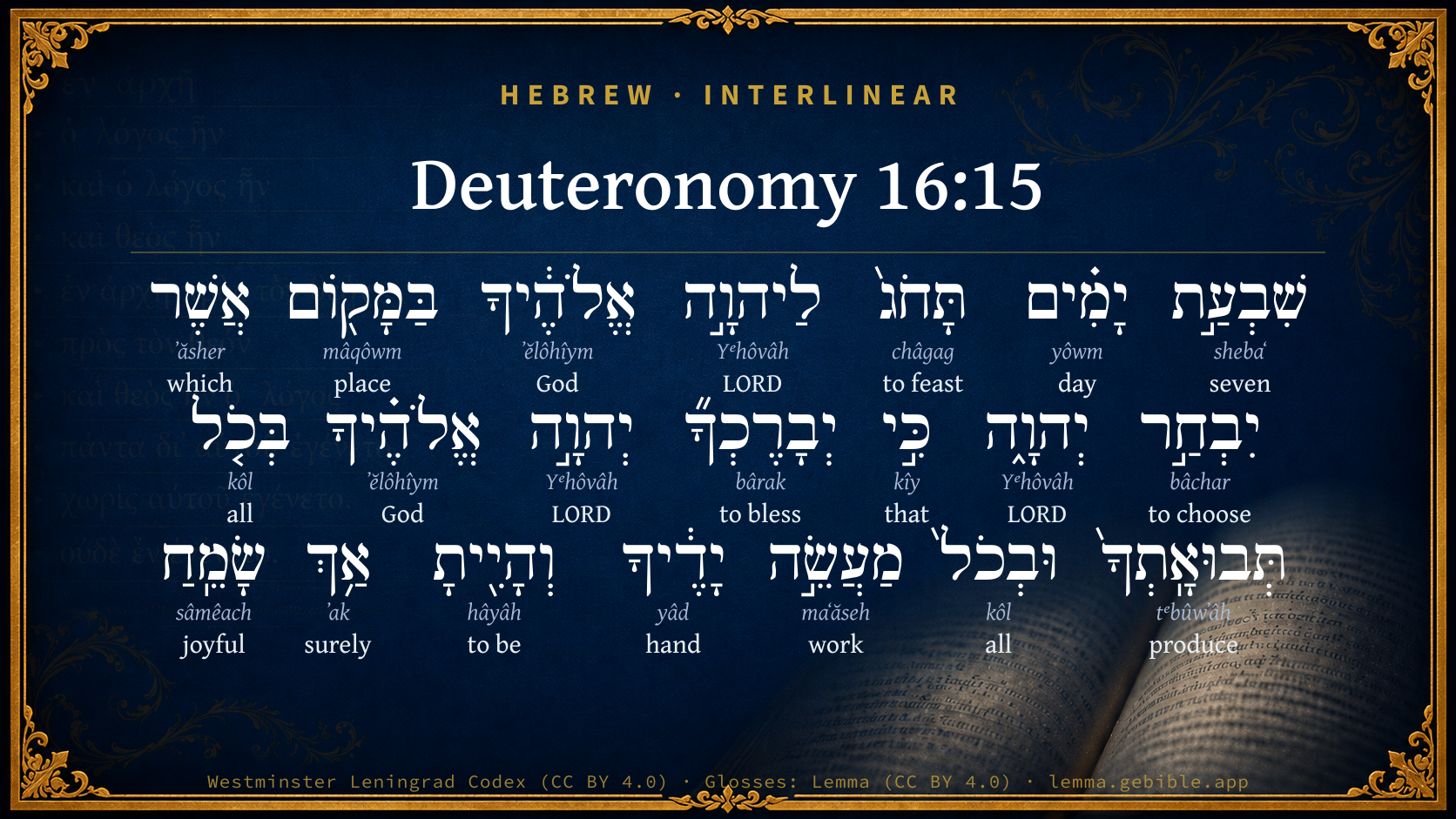
Hebrew (Westminster Leningrad Codex) Deuteronomy 16:15 appears in the Hebrew Old Testament. The text above is from the Westminster Leningrad Codex. Each word links to its Strong’s number, a concise gloss, and parsing drawn from the Open Scriptures Hebrew Bible morphology. Click any word for its full Brown-Driver-Briggs (BDB) entry.
Download image
Cite this verse

Deuteronomy 16:15 (World English Bible). Public Domain. Lemma interlinear Bible study tool, https://lemma.gebible.app/v/deuteronomy/16/15.

Show BibTeX & RIS
BibTeX
RIS
English Translation
Seven days shall you keep a feast to Yahweh your God in the place which Yahweh shall choose; because Yahweh your God will bless you in all your increase, and in all the work of your hands, and you shall be altogether joyful.
World English Bible · Public Domain
Highlights
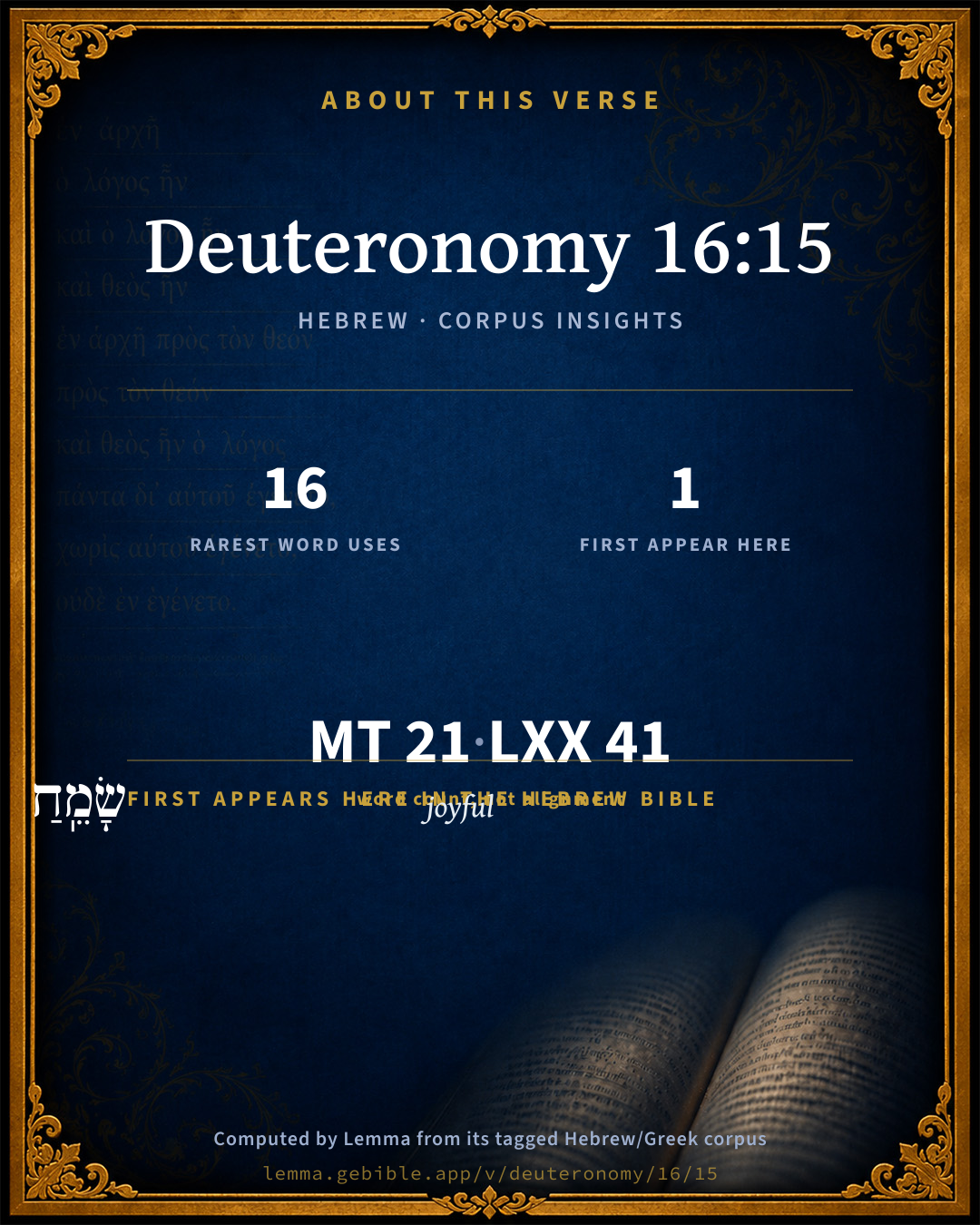
  • 1 first appearance in the Hebrew Bible
Full analysis ↓
Download a study sheet

One document with this verse’s original text, its word-by-word gloss line, the meaning frame, cross-references with their text, attributed commentary, and full source and license credits — printable, and it pastes into notes with its structure intact.

This verse Autodidact and up

Study sheet (.html) Plain text (.txt)

A passage Seminary Student

Up to 50 verses in one chapter. A passage sheet keeps up to 6 commentary sources and 12 cross-references per verse, in the order this page ranks them, and says so on the sheet whenever that leaves anything out. Ask for a single verse and you get the Autodidact verse sheet above.

Everything on this page stays free to read, with no account — the sheet is a download of what is already on screen, not access to it.

Want to remove ads? Support Godless Engineer
Compare translations 3

The same verse in 3 English versions, stacked beneath the original-language interlinear above. Click any original word for its lexicon entry.

Each is an independent rendering of the whole verse — the interlinear is not word-aligned to these translations.

Highlighted words mark where these versions differ — a whole-verse word diff, not a word-by-word alignment.

  • World English Bible Public Domain
    Seven days shall you keep a feast to Yahweh your God in the place which Yahweh shall choose; because Yahweh your God will bless you in all your increase, and in all the work of your hands, and you shall be altogether joyful.
  • King James Version Public Domain
    Seven days shalt thou keep a solemn feast unto the LORD thy God in the place which the LORD shall choose: because the LORD thy God shall bless thee in all thine increase, and in all the works of thine hands, therefore thou shalt surely rejoice.
  • unfoldingWord Literal Text CC BY-SA 4.0
    Seven days you shall celebrate for Yahweh your God at the place that Yahweh will choose, because Yahweh your God will bless you in all your harvest and in all the work of your hands, and you will be completely joyful.

unfoldingWord Literal Text — © unfoldingWord, licensed CC BY-SA 4.0. Word-aligned USFM3 via Door43 (git.door43.org/unfoldingWord/en_ult).

Versions to compare (up to 4)

3 of 4 selected

Show all 18 translations

Every available English version of this verse, each an independent rendering of the whole verse.

  • World English Bible Public Domain
    Seven days shall you keep a feast to Yahweh your God in the place which Yahweh shall choose; because Yahweh your God will bless you in all your increase, and in all the work of your hands, and you shall be altogether joyful.
  • Berean Standard Bible Public Domain
    For seven days you shall celebrate a feast to the LORD your God in the place He will choose, because the LORD your God will bless you in all your produce and in all the work of your hands, so that your joy will be complete.
  • Majority Standard Bible Public Domain
    For seven days you shall celebrate a feast to the LORD your God in the place He will choose, because the LORD your God will bless you in all your produce and in all the work of your hands, so that your joy will be complete.
  • King James Version Public Domain
    Seven days shalt thou keep a solemn feast unto the LORD thy God in the place which the LORD shall choose: because the LORD thy God shall bless thee in all thine increase, and in all the works of thine hands, therefore thou shalt surely rejoice.
  • American Standard Version (1901) Public Domain
    Seven days shalt thou keep a feast unto Jehovah thy God in the place which Jehovah shall choose; because Jehovah thy God will bless thee in all thine increase, and in all the work of thy hands, and thou shalt be altogether joyful.
  • Revised Version (1885) Public Domain
    Seven days shalt thou keep a feast unto the LORD thy God in the place which the LORD shall choose: because the LORD thy God shall bless thee in all thine increase, and in all the work of thine hands, and thou shalt be altogether joyful.
  • Geneva Bible (1599) Public Domain
    Seuen daies shalt thou keepe a feast vnto the Lord thy God in the place which the Lord shall chuse: when the Lord thy God shall blesse thee in all thine increase, and in all the workes of thine hands, thou shalt in any case be glad.
  • Douay-Rheims (1899) Public Domain
    Seven days shalt thou celebrate feasts to the Lord thy God in the place which the Lord shall choose: and the Lord thy God will bless thee in all thy fruits, and in every work of thy hands, and thou shalt be in joy.
  • Young's Literal Translation Public Domain
    Seven days thou dost feast before Jehovah thy God, in the place which Jehovah doth choose, for Jehovah thy God doth bless thee in all thine increase, and in every work of thy hands, and thou hast been only rejoicing.
  • Literal Standard Version CC BY-SA 4.0
    [For] seven days you celebrate before your God YHWH in the place which YHWH chooses, for your God YHWH blesses you in all your increase and in every work of your hands, and you have been only rejoicing.
  • Unlocked Literal Bible CC BY-SA 4.0
    For seven days you must observe the festival for Yahweh your God at the place that Yahweh will choose, because Yahweh your God will bless you in all your harvest and all the work of your hands, and you must be completely joyful.
  • unfoldingWord Literal Text CC BY-SA 4.0
    Seven days you shall celebrate for Yahweh your God at the place that Yahweh will choose, because Yahweh your God will bless you in all your harvest and in all the work of your hands, and you will be completely joyful.
  • Darby Bible Public Domain
    Seven days shalt thou hold a feast to Jehovah thy God in the place which Jehovah will choose; for Jehovah thy God will bless thee in all thy produce, and in all the work of thy hands, and thou shalt be wholly joyful.
  • World Messianic Bible Public Domain
    You shall keep a feast to the LORD your God seven days in the place which the LORD chooses, because the LORD your God will bless you in all your increase and in all the work of your hands, and you shall be altogether joyful.
  • Webster's Bible Public Domain
    Seven days shalt thou keep a solemn feast to the LORD thy God in the place which the LORD shall choose: because the LORD thy God shall bless thee in all thy increase, and in all the works of thy hands, therefore thou shalt surely rejoice.
  • Free Bible Version CC BY-SA 4.0
    Celebrate this Festival for seven days to honor the Lord your God in the place he will choose, because the Lord your God will bless your whole harvest and everything you do, so you will be really happy.
  • Bible in Basic English Public Domain
    Keep the feast to the Lord your God for seven days, in the place marked out by the Lord: because the blessing of the Lord your God will be on all the produce of your land and all the work of your hands, and you will have nothing but joy.
  • JPS Tanakh (1917) Public Domain
    Seven days shalt thou keep a feast unto the LORD thy God in the place which the LORD shall choose; because the LORD thy God shall bless thee in all thine increase, and in all the work of thy hands, and thou shalt be altogether joyful.

Literal Standard Version (2020), Covenant Press — licensed CC BY-SA 4.0. Text via the HelloAO Bible API (eBible.org). Unlocked Literal Bible (unfoldingWord) — licensed CC BY-SA 4.0. Text via the HelloAO Bible API (eBible.org). unfoldingWord Literal Text — © unfoldingWord, licensed CC BY-SA 4.0. Word-aligned USFM3 via Door43 (git.door43.org/unfoldingWord/en_ult). Free Bible Version, Dr. Jonathan Gallagher — licensed CC BY-SA 4.0. Text via the HelloAO Bible API (eBible.org).

Word by word

More ways to search: Search by grammar → Find every occurrence → Compare this word →

Practice this passage: Drill this verse → Learn its vocabulary →

תָּחֹג֙
châgag
H2287
“to feast”
Verb, Qal, Imperfect, 2nd Person, Masculine, Singular
Part of Speech
Verb
Stem
Qal
Form
Imperfect
Person
2nd Person
Gender
Masculine
Number
Singular
Full BDB Definition

Origin: a primitive root [compare H2283 , H2328 ]

TWOT: 602

to hold a feast, hold a festival, make pilgrimage, keep a pilgrim-feast, celebrate, dance, stagger - (Qal) - to keep a pilgrim-feast - to reel
  1. שִׁבְעַ֣ת shebaʻ H7651 “seven” Adjective, Cardinal number, Masculine, Singular, Construct
  2. יָמִ֗ים yôwm H3117 “days” Noun, Common, Masculine, Plural, Absolute
  3. לַיהוָ֣ה Yᵉhôvâh H3068 “to/for · LORD” Preposition + Noun, Proper
  4. אֱלֹהֶ֔יךָ ʼĕlôhîym H430 “God(s) · your” Noun, Common, Masculine, Plural, Construct + Suffix, Personal, 2nd Person, Masculine, Singular
  5. בַּמָּק֖וֹם mâqôwm H4725 “in/at the · place” Preposition, Determined + Noun, Common, Masculine, Singular, Absolute
  6. אֲשֶׁר ʼăsher H834 “which” Particle, Relative
  7. יִבְחַ֣ר bâchar H977 “to choose” Verb, Qal, Imperfect, 3rd Person, Masculine, Singular
  8. יְהוָ֑ה Yᵉhôvâh H3068 “LORD” Noun, Proper
  9. כִּ֣י kîy H3588 “that” Conjunction
  10. יְבָרֶכְךָ֞ bârak H1288 “to bless · you” Verb, Piel, Imperfect, 3rd Person, Masculine, Singular + Suffix, Personal, 2nd Person, Masculine, Singular
  11. יְהוָ֣ה Yᵉhôvâh H3068 “LORD” Noun, Proper
  12. אֱלֹהֶ֗יךָ ʼĕlôhîym H430 “God(s) · your” Noun, Common, Masculine, Plural, Construct + Suffix, Personal, 2nd Person, Masculine, Singular
  13. בְּכֹ֤ל kôl H3605 “in/at · all of” Preposition + Noun, Common, Masculine, Singular, Construct
  14. תְּבוּאָֽתְךָ֙ tᵉbûwʼâh H8393 “produce · your” Noun, Common, Feminine, Singular, Construct + Suffix, Personal, 2nd Person, Masculine, Singular
  15. וּבְכֹל֙ kôl H3605 “and · in/at · all of” Conjunction + Preposition + Noun, Common, Masculine, Singular, Construct
  16. מַעֲשֵׂ֣ה maʻăseh H4639 “work of” Noun, Common, Masculine, Singular, Construct
  17. יָדֶ֔יךָ yâd H3027 “hands · your” Noun, Common, Both, Dual, Construct + Suffix, Personal, 2nd Person, Masculine, Singular
  18. וְהָיִ֖יתָ hâyâh H1961 “and · to be” Conjunction + Verb, Qal, Sequential Perfect, 2nd Person, Masculine, Singular
  19. אַ֥ךְ ʼak H389 “surely” Particle, Accusative
  20. שָׂמֵֽחַ sâmêach H8056 “joyful” Adjective, Adjective, Masculine, Singular, Absolute

About this verse

These counts appear in no published source. They are computed here, from the morphology-tagged text and Lemma’s own curated glosses. What Lemma adds →

21
words
17
distinct lemmas
Pentateuch
section

Notable vocabulary

The rarest word here is תָּחֹג֙ to feast H2287 — appearing just 16 times in the whole Hebrew Bible.

First appearance in Scripture

This word makes its first canonical appearance in the Hebrew Bible here:

  • שָׂמֵֽחַ joyful H8056

Shared distinctive vocabulary

תָּחֹג֙ to feast H2287 occurs in 14 verses of the Hebrew Bible. Also found in:

Grammatical profile

  • 4 verbs
  • 12 nouns
  • 2 adjectives
  • 1 conjunction
  • 2 particles

Verb forms

  • תָּחֹג֙ Qal · Imperfect
  • יִבְחַ֣ר Qal · Imperfect
  • יְבָרֶכְךָ֞ Piel · Imperfect
  • וְהָיִ֖יתָ Qal · Sequential Perfect

Repetition

Words recur within this verse — often emphatic in Hebrew:

  • לַיהוָ֣ה LORD H3068 ×3
  • אֱלֹהֶ֔יךָ God H430 ×2
  • בְּכֹ֤ל all H3605 ×2

Hebrew & Septuagint length

In English translation the verse runs 43 words from the Hebrew and 48 from the Septuagint (LXX English) — closely comparable.

A rough comparison of the two English renderings, which tokenize alike — not a word-level alignment.

Word counts can differ between the Hebrew and the Greek without any difference in meaning — e.g. the Hebrew direct-object marker אֵת has no separate Greek word, and Greek often adds the article ὁ.

In the original languages it is 21 Hebrew tokens and 41 Greek tokens — but the two are counted differently (Hebrew bundles its prefixes and suffixes into one token; the Greek is in lemma form), so that isn’t a like-for-like length.

Cross-references

6

Topical passages linked to Deuteronomy 16:15 in the Treasury of Scripture Knowledge — connected by theme and wording, ordered by reader-vote popularity; previews shown in the World English Bible.

  • Leviticus 23:36–42 Seven days you shall offer an offering made by fire to Yahweh. On the eighth day shall be a holy convocation to you; and you shall offer an offering made by fire to Yahweh. It is a solemn assembly; you shall do no regular work.
  • Deuteronomy 30:16 in that I command you this day to love Yahweh your God, to walk in his ways, and to keep his commandments and his statutes and his ordinances, that you may live and multiply, and that Yahweh your God may bless you in the land where you go in to possess it.
  • Deuteronomy 7:13 and he will love you, and bless you, and multiply you; he will also bless the fruit of your body and the fruit of your ground, your grain and your new wine and your oil, the increase of your cattle and the young of your flock, in the land which he swore to your fathers to give you.
  • Deuteronomy 16:10 You shall keep the feast of weeks to Yahweh your God with a tribute of a freewill-offering of your hand, which you shall give, according as Yahweh your God blesses you:
  • Deuteronomy 28:8–12 Yahweh will command the blessing on you in your barns, and in all that you put your hand to; and he will bless you in the land which Yahweh your God gives you.
  • Numbers 29:12–38 On the fifteenth day of the seventh month you shall have a holy convocation; you shall do no servile work, and you shall keep a feast to Yahweh seven days:

Cross-references courtesy of OpenBible.info (CC BY 4.0).

Hebrew and Greek witnesses Masoretic Hebrew ↔ Greek Septuagint

The same verse in the two great witnesses to the Old Testament, shown verse-for-verse.

These are two independent witnesses, not word-aligned to each other, and the Septuagint is shown in lemma (dictionary) form.

Hebrew Deuteronomy 16:15 Masoretic · Westminster Leningrad Codex

שִׁבְעַ֣ת יָמִ֗ים תָּחֹג֙ לַיהוָ֣ה אֱלֹהֶ֔יךָ בַּמָּק֖וֹם אֲשֶׁר יִבְחַ֣ר יְהוָ֑ה כִּ֣י יְבָרֶכְךָ֞ יְהוָ֣ה אֱלֹהֶ֗יךָ בְּכֹ֤ל תְּבוּאָֽתְךָ֙ וּבְכֹל֙ מַעֲשֵׂ֣ה יָדֶ֔יךָ וְהָיִ֖יתָ אַ֥ךְ שָׂמֵֽחַ

Seven days shall you keep a feast to Yahweh your God in the place which Yahweh shall choose; because Yahweh your God will bless you in all your increase, and in all the work of your hands, and you shall be altogether joyful.

World English Bible · Public Domain

Greek LXX Deuteronomy 16:15 Septuagint · lemma form

ἑπτά ἡμέρα ἑορτάζω κύριος ὁ θεός σύ ἐν ὁ τόπος ὅς ἐάν ἐκλέγω κύριος ὁ θεός σύ αὐτός ἐάν δέ εὐλογέω σύ κύριος ὁ θεός σύ ἐν πᾶς ὁ γένημα σύ καί ἐν πᾶς ἔργον ὁ χείρ σύ καί εἰμί εὐφραίνω

Seven days shall you keep a feast to the Lord your God in the place which the Lord your God shall choose for himself; and if the Lord your God shall bless you in all your fruits, and in every work of your hands, then you shall rejoice.

LXX2012 (modern English Septuagint) · Public Domain

Hebrew: Westminster Leningrad Codex (CC BY 4.0). Greek: Septuagint (public domain); English from LXX2012 (modern English Septuagint) (Public Domain). How the Septuagint differs from the Hebrew →

Targum (Aramaic paraphrase)

2

The Targum is the ancient Jewish Aramaic paraphrase of the Hebrew Scriptures — an interpretive translation, not the Hebrew text itself. Onkelos (literal) and Pseudo-Jonathan (expansive) render the Torah, and Jonathan the Prophets. Coverage is partial: where no permissively-licensed English translation exists for a verse, only the Aramaic is shown. This is verse-level text, not a word-by-word alignment to the Hebrew.

  1. Targum Onkelos Torah (Genesis–Deuteronomy)
    שִׁבְעָא יוֹמִין תֵּחוֹג קָדָם יְיָ אֱלָהָךְ בְּאַתְרָא דִי יִתִּרְעֵי יְיָ אֲרֵי יְבָרֵכִנָךְ יְיָ אֱלָהָךְ בְּכָל עֲלַלְתָּךְ וּבְכָל עוֹבָדֵי יְדָיךְ וּתְהֵי בְּרַם חָדֵי

    (no public-domain English translation for this verse)

    Targum Onkelos — Aramaic: “Onkelos Genesis” (public domain); “Onkelos Exodus” (public domain); “Onkelos Leviticus” (public domain); “Onkelos Numbers” (public domain); “Onkelos Deuteronomy” (public domain). English: “Sefaria Community Translation” (CC0 1.0 (public-domain dedication)); “J.W. Etheridge. The Targums of Onkelos and Jonathan Ben Uzziel on the Pentateuch. London: Longmans, Green, 1862” (public domain). Text via Sefaria.

  2. Targum Pseudo-Jonathan Torah (Genesis–Deuteronomy)
    שׁוּבְעָא יוֹמָא תְּחַגּוּן קֳדָם יְיָ אֱלָהָכוֹן בְּאַתְרָא דְיִתְרְעֵי יְיָ אֲרוּם יְבָרֵיכְכוֹן יְיָ אֱלָהָכוֹן בְּכָל עֲלַלְתְּכוֹן וּבְכָל עוֹבָדֵי אִידֵיכוֹן וְתֶהֱווֹן בְּרַם חַדְוָן בְּאַצְלָחוּתָא

    Seven days you shall keep the feast before the Lord your God in the place which the Lord will choose, because the Lord your God will have blessed you in all your provision, and in all the work of your hands, and so shall you be joyful in prosperity.

    Targum Pseudo-Jonathan — Aramaic: “Targum Jonathan on Genesis” (public domain); “Targum Jonathan on Exodus” (public domain); “Targum Jonathan on Leviticus” (public domain); “Targum Jonathan on Numbers” (public domain); “Targum Jonathan on Deuteronomy” (public domain). English: “The Targum of Jonathan ben Uzziel, trans. J. W. Etheridge, London, 1862” (public domain). Text via Sefaria.

Commentary

Notes on Deuteronomy 16:15 from classic Christian and Jewish commentators (each source and its license shown beneath its notes). The classic Christian expositions comment on the surrounding passage and are grouped to its opening verse, so a note may address several verses; the Jewish commentaries on the Tanakh (Rashi and others) are per-verse, so they appear only where the commentator wrote on this verse.

Lemma curates 59 commentaries, every one of them public domain or Creative Commons licensed, each selected and text-cleaned for this edition rather than reprinted as found. About our sources →

Trapp's Complete Commentary

John Trapp

Deu 16:15 Seven days shalt thou keep a solemn feast unto the LORD thy God in the place which the LORD shall choose: because the LORD thy God shall bless thee in all thine increase, and in all the works of thine hands, therefore thou shalt surely rejoice.

Ver. 15. Thou shalt surely rejoice.] {See Trapp on "Deu 12:12"}

John Trapp, A Commentary or Exposition upon All the Books of the Old and New Testament (1647–1656) — public domain. Text from a community e-Sword module.

Jamieson, Fausset & Brown

Robert Jamieson, A. R. Fausset & David Brown

in all the works of thine hands . . . rejoice--that is, praising God with a warm and elevated heart. According to Jewish tradition, no marriages were allowed to be celebrated during these great festivals, that no personal or private rejoicings might be mingled with the demonstrations of public and national gladness.

Jamieson, Fausset & Brown — Commentary Critical and Explanatory on the Whole Bible (1871) — public domain (CC PDM 1.0). Text via the HelloAO Bible API.

The Cambridge Bible for Schools and Colleges

gen. ed. J. J. S. Perowne

15. the place which the Lord shall choose] On the effects of the centralisation of the feasts see introd. to Deu_16:1-17.

and thou shalt be altogether joyful] Heb. only, or nothing but, joyful. This emphatic repetition of the command is remarkable, but hardly sufficient to answer in the affirmative Steuernagel’s question whether the feast had before D’s time begun to lose its ancient, joyous character.

16, 17 summarise the laws of the three feasts. Deu_16:16 repeats (with a characteristic variation and addition of the divine title) the older commandment in J, Exo_34:23, repeated (editorially) in E, Deu_23:17; three times a year shall all thy males appear before the Lord Jehovah. That only males are mentioned here, while Deu_16:11; Deu_16:14 include among the worshippers daughters, bondwomen and widows, is no proof that this summary is from another hand than the three preceding laws (Steuern.). It is the same author but he is quoting the older law. In contrast with its confinement of the law to males D’s inclusion of women is characteristic; see on Deu_16:21.

shall appear before the Lord thy God] Heb. shall let himself be seen at the face of, a possible but awkward construction. It is probable that the original reading, which may be restored without the change of a consonant and by merely altering the vowel-points, was shall see the face of. The motive of the present punctuation would be the desire to avoid the anthropomorphism involved in the phrase ‘seeing the face of God.’

The Cambridge Bible for Schools and Colleges (gen. ed. J. J. S. Perowne; Cambridge University Press, 1878–1918) — public domain. Text from a community e-Sword module.

John Gill's Exposition

Seven days shalt thou keep a solemn feast unto the Lord thy God,.... The feast of tabernacles still spoken of:

in the place which the Lord thy God shall choose: the city of Jerusalem:

because the Lord thy God shall bless thee in all thy increase, and in all the works of thine hands; both in the increase of their fields, vineyards, and oliveyards, and also in their several handicraft trades and occupations they were employed in; so Aben Ezra interprets all the works of their hands of merchandise and manufactories:

therefore thou shalt surely rejoice; extremely, heartily, and sincerely, and not fail to express joy on this occasion, and manifest it by a generous freewill offering to the Lord, and a bountiful entertainment for himself, his family, friends, and others.

John Gill's Exposition of the Whole Bible (1746–1763) — public domain (CC PDM 1.0). Text via the HelloAO Bible API.

Haydock's Catholic Bible Commentary

In joy. Hebrew adds, "surely, or wholly." Hence the Rabbins esteem it unlawful to marry on these days, lest they should blend sacred and worldly joy together.

George Leo Haydock (1774–1849), Haydock's Catholic Family Bible and Commentary, 1859 edition — public domain. Excludes Psalms (Douay-Rheims chapter numbering differs from Protestant) and Deuterocanonical books (Catholic canon only).

Matthew Poole's English Annotations

To wit, in God and the effects of his favour, praising him with glad heart.

Matthew Poole's English Annotations on the Holy Bible (1683–1685) — public domain. Text from a community e-Sword/MySword module.

unfoldingWord translationNotes

Door43 World Missions Community

the festival

"the Festival of Shelters"

all the work of your hands

Here "hands" represents the whole person. AT: "all the work you do" (See: Synecdoche)

translationWords

bless

harvest

works

hand

joy

unfoldingWord translationNotes — © Distant Shores Media and the Door43 World Missions Community, licensed CC BY-SA 4.0. Source: git.door43.org/Door43/en_tn.

Rashi

Rabbi Shlomo Yitzchaki (Rashi)

והיית אך שמח ONLY BE REJOICED — According to its plain sense this is not the expression of a command but expresses an assurance: “thou will be rejoicing”. But according to the Halachic interpretation they (the Rabbis) derived from here that the night before the last day of the festival (that preceding the eighth day) is to be included in the obligation of rejoicing (Sukkah 48a; cf. Sifrei Devarim 142:4).

Rashi on the Tanakh — English translations: “The Judaica Press complete Tanach with Rashi, translated by A. J. Rosenberg” (CC BY 4.0); “Pentateuch with Rashi's commentary by M. Rosenbaum and A.M. Silbermann, 1929-1934” (public domain); “The Metsudah Tanach series, Lakewood, N.J” (CC BY 4.0); and “The Book of Joshua, Metsudah Publications, 1997” (CC BY 4.0). Text via Sefaria.

Lesson kit

Teaching starters — assembled from the data on this page, not authored interpretation. Every prompt links to the verse data it draws on. Edit before teaching.

Deuteronomy, in the Pentateuch, opens this verse with 21 words (17 distinct Hebrew lemmas). Its most distinctive word is châgag (“to feast”). A historical commentator’s framing appears above. Read the whole chapter for the surrounding context.

Discussion questions

  1. What does “to feast” (châgag) contribute to the verse as a whole?
  2. The word “joyful” first appears here in Scripture. What is being introduced at this debut?
  3. Exodus 5:1 shares the word «to feast» with this verse. How do the two illuminate each other?
  4. “LORD” occurs 3× in this one verse. What is the effect of the repetition?
  5. These translations render this verse differently; the difference is in the English rendering, not the original. What questions does that raise?
  6. The verb «תָּחֹג֙» is Qal Imperfect. How does its form color the action?
  7. Reading how Trapp's Complete Commentary and Jamieson, Fausset & Brown read this verse, where do the two commentators agree and where do they part?

Things to notice

Reading settings

Reading text

Shown beneath each verse's original-language words.

Old Testament
Old Testament edition

Read the OT as the Masoretic Hebrew (MT) or the Greek Septuagint (LXX).

English shown for the Greek Septuagint (in the Hebrew ↔ Greek comparison).

Comparing translations? Open the Compare panel on any verse page to stack up to four side by side.