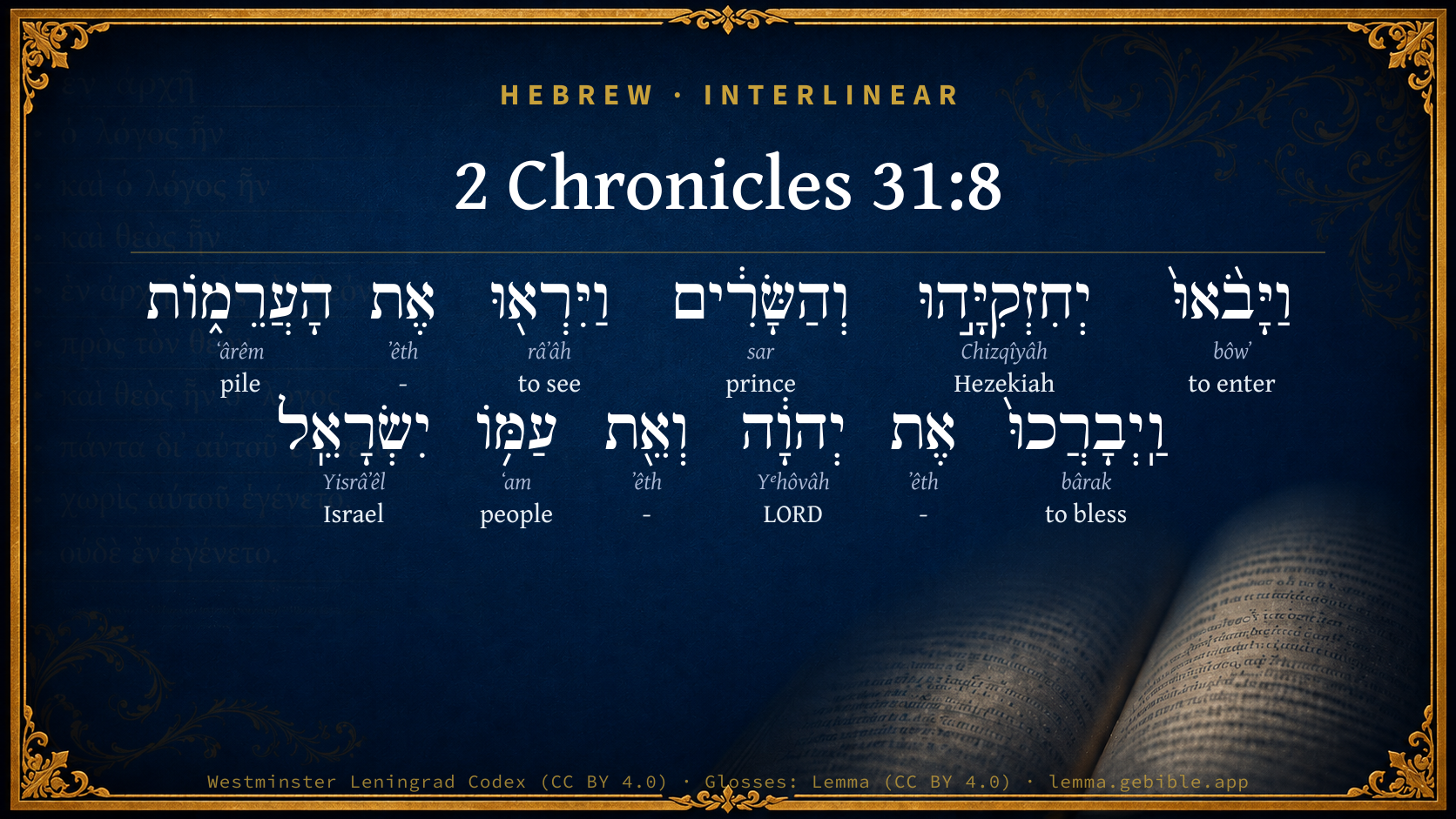
2 Chronicles 31:8

Hebrew (Westminster Leningrad Codex) 2 Chronicles 31:8 appears in the Hebrew Old Testament. The text above is from the Westminster Leningrad Codex. Each word links to its Strong’s number, a concise gloss, and parsing drawn from the Open Scriptures Hebrew Bible morphology. Click any word for its full Brown-Driver-Briggs (BDB) entry.
Download image
Cite this verse

2 Chronicles 31:8 (World English Bible). Public Domain. Lemma interlinear Bible study tool, https://lemma.gebible.app/v/2-chronicles/31/8.

Show BibTeX & RIS
BibTeX
RIS
English Translation
When Hezekiah and the princes came and saw the heaps, they blessed Yahweh, and his people Israel.
World English Bible · Public Domain
Download a study sheet

One document with this verse’s original text, its word-by-word gloss line, the meaning frame, cross-references with their text, attributed commentary, and full source and license credits — printable, and it pastes into notes with its structure intact.

This verse Autodidact and up

Study sheet (.html) Plain text (.txt)

A passage Seminary Student

Up to 50 verses in one chapter. A passage sheet keeps up to 6 commentary sources and 12 cross-references per verse, in the order this page ranks them, and says so on the sheet whenever that leaves anything out. Ask for a single verse and you get the Autodidact verse sheet above.

Everything on this page stays free to read, with no account — the sheet is a download of what is already on screen, not access to it.

Want to remove ads? Support Godless Engineer
Compare translations 3

The same verse in 3 English versions, stacked beneath the original-language interlinear above. Click any original word for its lexicon entry.

Each is an independent rendering of the whole verse — the interlinear is not word-aligned to these translations.

Highlighted words mark where these versions differ — a whole-verse word diff, not a word-by-word alignment.

  • World English Bible Public Domain
    When Hezekiah and the princes came and saw the heaps, they blessed Yahweh, and his people Israel.
  • King James Version Public Domain
    And when Hezekiah and the princes came and saw the heaps, they blessed the LORD, and his people Israel.
  • unfoldingWord Literal Text CC BY-SA 4.0
    And Hezekiah and the chiefs came, and they saw the heaps. And they blessed Yahweh and his people Israel.

unfoldingWord Literal Text — © unfoldingWord, licensed CC BY-SA 4.0. Word-aligned USFM3 via Door43 (git.door43.org/unfoldingWord/en_ult).

Versions to compare (up to 4)

3 of 4 selected

Show all 18 translations

Every available English version of this verse, each an independent rendering of the whole verse.

  • World English Bible Public Domain
    When Hezekiah and the princes came and saw the heaps, they blessed Yahweh, and his people Israel.
  • Berean Standard Bible Public Domain
    When Hezekiah and his officials came and viewed the heaps, they blessed the LORD and His people Israel.
  • Majority Standard Bible Public Domain
    When Hezekiah and his officials came and viewed the heaps, they blessed the LORD and His people Israel.
  • King James Version Public Domain
    And when Hezekiah and the princes came and saw the heaps, they blessed the LORD, and his people Israel.
  • American Standard Version (1901) Public Domain
    And when Hezekiah and the princes came and saw the heaps, they blessed Jehovah, and his people Israel.
  • Revised Version (1885) Public Domain
    And when Hezekiah and the princes came and saw the heaps, they blessed the LORD, and his people Israel.
  • Geneva Bible (1599) Public Domain
    And when Hezekiah and the princes came, and saw the heapes, they blessed the Lord and his people Israel.
  • Douay-Rheims (1899) Public Domain
    And when Ezechias and his princes came in, they saw the heaps, and they blessed the Lord and the people of Israel.
  • Young's Literal Translation Public Domain
    And Hezekiah and the heads come in and see the heaps, and bless Jehovah and His people Israel,
  • Literal Standard Version CC BY-SA 4.0
    And Hezekiah and the heads come in and see the heaps, and bless YHWH and His people Israel,
  • Unlocked Literal Bible CC BY-SA 4.0
    When Hezekiah and the leaders came and saw the heaps, they blessed Yahweh and his people Israel.
  • unfoldingWord Literal Text CC BY-SA 4.0
    And Hezekiah and the chiefs came, and they saw the heaps. And they blessed Yahweh and his people Israel.
  • Darby Bible Public Domain
    And Hezekiah and the princes came and saw the heaps, and they blessed Jehovah, and his people Israel.
  • World Messianic Bible Public Domain
    When Hezekiah and the princes came and saw the heaps, they blessed the LORD and his people Israel.
  • Webster's Bible Public Domain
    And when Hezekiah and the princes came and saw the heaps, they blessed the LORD, and his people Israel.
  • Free Bible Version CC BY-SA 4.0
    When Hezekiah and his officials came and saw what had been collected, they thanked the Lord and his people Israel.
  • Bible in Basic English Public Domain
    And when Hezekiah and the rulers came and saw all the store of goods, they gave praise to the Lord and to his people Israel.
  • JPS Tanakh (1917) Public Domain
    And when Hezekiah and the princes came and saw the heaps, they blessed the LORD, and His people Israel.

Literal Standard Version (2020), Covenant Press — licensed CC BY-SA 4.0. Text via the HelloAO Bible API (eBible.org). Unlocked Literal Bible (unfoldingWord) — licensed CC BY-SA 4.0. Text via the HelloAO Bible API (eBible.org). unfoldingWord Literal Text — © unfoldingWord, licensed CC BY-SA 4.0. Word-aligned USFM3 via Door43 (git.door43.org/unfoldingWord/en_ult). Free Bible Version, Dr. Jonathan Gallagher — licensed CC BY-SA 4.0. Text via the HelloAO Bible API (eBible.org).

Word by word

More ways to search: Search by grammar → Find every occurrence → Compare this word →

Practice this passage: Drill this verse → Learn its vocabulary →

הָעֲרֵמ֑וֹת
ʻârêm
H6194
“the · piles”
Particle, Definite Article + Noun, Common, Feminine, Plural, Absolute
Part of Speech
Particle + Noun
Type
Common
Gender
Feminine
Number
Plural
State
Absolute
Full BDB Definition

Origin: from H6192

TWOT: 1696a

heap, pile
  1. וַיָּבֹ֨אוּ֙ bôwʼ H935 “and · to enter” Conjunction + Verb, Qal, Sequential Imperfect, 3rd Person, Masculine, Plural
  2. יְחִזְקִיָּ֣הוּ Chizqîyâh H2396 “Hezekiah” Noun, Proper
  3. וְהַשָּׂרִ֔ים sar H8269 “and · the · princes” Conjunction + Particle, Definite Article + Noun, Common, Masculine, Plural, Absolute
  4. וַיִּרְא֖וּ râʼâh H7200 “and · to see” Conjunction + Verb, Qal, Sequential Imperfect, 3rd Person, Masculine, Plural
  5. אֶת ʼêth H853 “-” Particle, Direct Object
  6. וַֽיְבָרֲכוּ֙ bârak H1288 “and · to bless” Conjunction + Verb, Piel, Sequential Imperfect, 3rd Person, Masculine, Plural
  7. אֶת ʼêth H853 “-” Particle, Direct Object
  8. יְהוָ֔ה Yᵉhôvâh H3068 “LORD” Noun, Proper
  9. וְאֵ֖ת ʼêth H853 “and · -” Conjunction + Particle, Direct Object
  10. עַמּ֥וֹ ʻam H5971 “people · his” Noun, Common, Masculine, Singular, Construct + Suffix, Personal, 3rd Person, Masculine, Singular
  11. יִשְׂרָאֵֽל Yisrâʼêl H3478 “Israel” Noun, Proper

About this verse

These counts appear in no published source. They are computed here, from the morphology-tagged text and Lemma’s own curated glosses. What Lemma adds →

12
words
10
distinct lemmas
Historical
section

Notable vocabulary

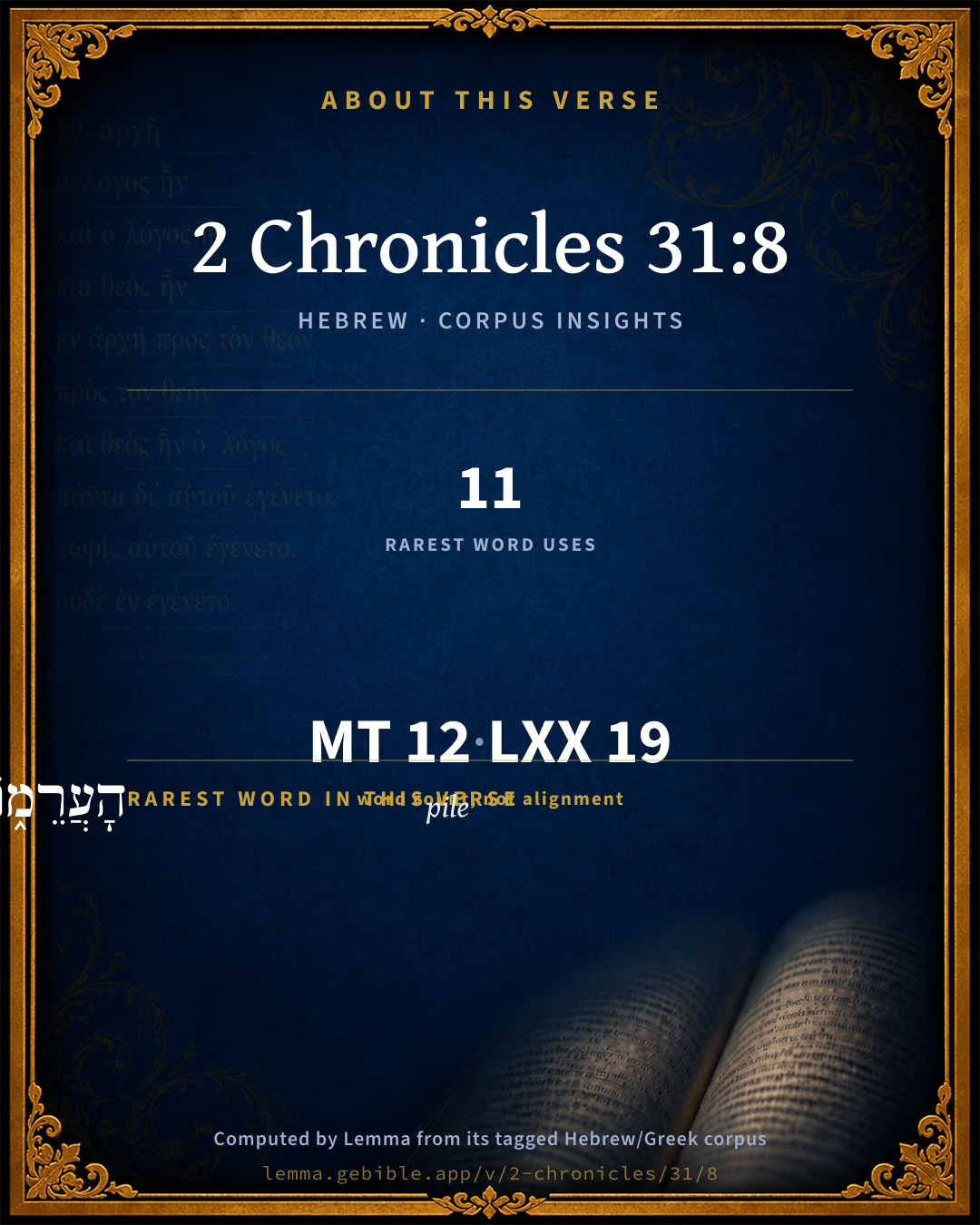
The rarest word here is הָעֲרֵמ֑וֹת pile H6194 — appearing just 11 times in the whole Hebrew Bible.

Shared distinctive vocabulary

הָעֲרֵמ֑וֹת pile H6194 occurs in 10 verses of the Hebrew Bible. Also found in:

Grammatical profile

  • 3 verbs
  • 6 nouns
  • 3 particles

Verb forms

  • וַיָּבֹ֨אוּ֙ Qal · Sequential Imperfect
  • וַיִּרְא֖וּ Qal · Sequential Imperfect
  • וַֽיְבָרֲכוּ֙ Piel · Sequential Imperfect

Hebrew & Septuagint length

In English translation the verse runs 17 words from the Hebrew and 18 from the Septuagint (LXX English) — closely comparable.

A rough comparison of the two English renderings, which tokenize alike — not a word-level alignment.

Word counts can differ between the Hebrew and the Greek without any difference in meaning — e.g. the Hebrew direct-object marker אֵת has no separate Greek word, and Greek often adds the article ὁ.

In the original languages it is 12 Hebrew tokens and 19 Greek tokens — but the two are counted differently (Hebrew bundles its prefixes and suffixes into one token; the Greek is in lemma form), so that isn’t a like-for-like length.

Cross-references

15

Topical passages linked to 2 Chronicles 31:8 in the Treasury of Scripture Knowledge — connected by theme and wording, ordered by reader-vote popularity; previews shown in the World English Bible.

  • Ephesians 1:3 Blessed be the God and Father of our Lord Jesus Christ, who has blessed us with every spiritual blessing in the heavenly places in Christ;
  • Genesis 14:19–20 He blessed him, and said, "Blessed be Abram of God Most High, possessor of heaven and earth:
  • Judges 5:9 My heart is toward the governors of Israel, Who offered themselves willingly among the people: Bless you Yahweh.
  • 2 Samuel 6:18 When David had made an end of offering the burnt offering and the peace-offerings, he blessed the people in the name of Yahweh of Hosts.
  • 1 Kings 8:14–15 The king turned his face about, and blessed all the assembly of Israel: and all the assembly of Israel stood.
  • 1 Kings 8:55 He stood, and blessed all the assembly of Israel with a loud voice, saying,
  • 1 Chronicles 29:10–20 Therefore David blessed Yahweh before all the assembly; and David said, You are blessed, Yahweh, the God of Israel our father, forever and ever.
  • 2 Chronicles 6:3 The king turned his face, and blessed all the assembly of Israel: and all the assembly of Israel stood.
  • Ezra 7:27 Blessed be Yahweh, the God of our fathers, who has put such a thing as this in the king's heart, to beautify the house of Yahweh which is in Jerusalem;
  • Psalms 144:15 Happy are the people who are in such a situation. Happy are the people whose God is Yahweh.
  • 2 Corinthians 8:16 But thanks be to God, who puts the same earnest care for you into the heart of Titus.
  • Philippians 4:10 But I rejoice in the Lord greatly, that now at length you have revived your thought for me; in which you did indeed take thought, but you lacked opportunity.
  • Philippians 4:19 My God will supply every need of yours according to his riches in glory in Christ Jesus.
  • 1 Thessalonians 3:9 For what thanksgiving can we render again to God for you, for all the joy with which we rejoice for your sakes before our God;
  • 1 Peter 1:3 Blessed be the God and Father of our Lord Jesus Christ, who according to his great mercy became our father again to a living hope through the resurrection of Jesus Christ from the dead,

Cross-references courtesy of OpenBible.info (CC BY 4.0).

Hebrew and Greek witnesses Masoretic Hebrew ↔ Greek Septuagint

The same verse in the two great witnesses to the Old Testament, shown verse-for-verse.

These are two independent witnesses, not word-aligned to each other, and the Septuagint is shown in lemma (dictionary) form.

Hebrew 2 Chronicles 31:8 Masoretic · Westminster Leningrad Codex

וַיָּבֹ֨אוּ֙ יְחִזְקִיָּ֣הוּ וְהַשָּׂרִ֔ים וַיִּרְא֖וּ אֶת הָעֲרֵמ֑וֹת וַֽיְבָרֲכוּ֙ אֶת יְהוָ֔ה וְאֵ֖ת עַמּ֥וֹ יִשְׂרָאֵֽל

When Hezekiah and the princes came and saw the heaps, they blessed Yahweh, and his people Israel.

World English Bible · Public Domain

Greek LXX 2 Chronicles 31:8 Septuagint · lemma form

καί ἔρχομαι εζεκιας καί ὁ ἄρχων καί ὁράω ὁ σωρός καί εὐλογέω ὁ κύριος καί ὁ λαός αὐτός ἰσραήλ

And Ezekias and the princes came and saw the heaps, and blessed the Lord, and his people Israel.

LXX2012 (modern English Septuagint) · Public Domain

Hebrew: Westminster Leningrad Codex (CC BY 4.0). Greek: Septuagint (public domain); English from LXX2012 (modern English Septuagint) (Public Domain). How the Septuagint differs from the Hebrew →

Commentary

Notes on 2 Chronicles 31:8 from classic Christian and Jewish commentators (each source and its license shown beneath its notes). The classic Christian expositions comment on the surrounding passage and are grouped to its opening verse, so a note may address several verses; the Jewish commentaries on the Tanakh (Rashi and others) are per-verse, so they appear only where the commentator wrote on this verse.

Lemma curates 59 commentaries, every one of them public domain or Creative Commons licensed, each selected and text-cleaned for this edition rather than reprinted as found. About our sources →

Trapp's Complete Commentary

John Trapp

2Ch 31:8 And when Hezekiah and the princes came and saw the heaps, they blessed the LORD, and his people Israel.

Ver. 8. They blessed the Lord.] For so good a year; but especially for so good a frame of spirit in the people.

John Trapp, A Commentary or Exposition upon All the Books of the Old and New Testament (1647–1656) — public domain. Text from a community e-Sword module.

Joseph Benson's Commentary

2Ch 31:8. They blessed the Lord — Both for giving such plentiful provisions to his land, and for giving his people such liberal hearts. And they praised the people for their forwardness and faithfulness in it.

Joseph Benson's Commentary on the Old and New Testaments (1811–1818) — public domain. Text from a community e-Sword module.

Geneva Bible (1599)

Geneva Bible translators

They praised the Lord and prayed for all prosperity to his people.

Geneva Bible (1599) marginal notes — public domain. Text via Bolls.life.

John Gill's Exposition

And when Hezekiah and the princes came and saw the heaps,.... Of the tithes and firstfruits:

they blessed the Lord; for the great increase of the fruits of the earth, and for making the people so willing to bring in the dues to the priests and Levites:

and his people Israel; wished all happiness and prosperity to them, being found in the way of their duty.

John Gill's Exposition of the Whole Bible (1746–1763) — public domain (CC PDM 1.0). Text via the HelloAO Bible API.

Matthew Poole's English Annotations

They blessed the Lord; both for giving such plentiful provisions to his land in this year, and for giving his people such liberal and pious hearts towards this good work.

And his people Israel; they praised them for their forwardness and faithfulness in it.

Matthew Poole's English Annotations on the Holy Bible (1683–1685) — public domain. Text from a community e-Sword/MySword module.

John Wesley's Explanatory Notes

Blessed the Lord - Both for giving such plentiful provisions to his land and for giving his people such liberal hearts. And they praised the people for their forwardness and faithfulness in it.

John Wesley, Explanatory Notes Upon the Whole Bible (1754–1765) — public domain. Text via the GEBible commentary corpus.

Rashi

Rabbi Shlomo Yitzchaki (Rashi)

and they blessed the Lord Who inspired Israel to separate their heave-offerings and their tithes.

Rashi on the Tanakh — English translations: “The Judaica Press complete Tanach with Rashi, translated by A. J. Rosenberg” (CC BY 4.0); “Pentateuch with Rashi's commentary by M. Rosenbaum and A.M. Silbermann, 1929-1934” (public domain); “The Metsudah Tanach series, Lakewood, N.J” (CC BY 4.0); and “The Book of Joshua, Metsudah Publications, 1997” (CC BY 4.0). Text via Sefaria.

Lesson kit

Teaching starters — assembled from the data on this page, not authored interpretation. Every prompt links to the verse data it draws on. Edit before teaching.

2 Chronicles, in the Historical, opens this verse with 12 words (10 distinct Hebrew lemmas). Its most distinctive word is ʻârêm (“pile”). A historical commentator’s framing appears above. Read the whole chapter for the surrounding context.

Discussion questions

  1. What does “pile” (ʻârêm) contribute to the verse as a whole?
  2. Ruth 3:7 shares the word «pile» with this verse. How do the two illuminate each other?
  3. The translations on this page render this verse differently — a whole-verse word diff, not a word-by-word alignment. What might account for the different wordings?
  4. The verb «וַיָּבֹ֨אוּ֙» is Qal Sequential Imperfect. How does its form color the action?
  5. Reading how Trapp's Complete Commentary and Joseph Benson's Commentary read this verse, where do the two commentators agree and where do they part?

Things to notice

Reading settings

Reading text

Shown beneath each verse's original-language words.

Old Testament
Old Testament edition

Read the OT as the Masoretic Hebrew (MT) or the Greek Septuagint (LXX).

English shown for the Greek Septuagint (in the Hebrew ↔ Greek comparison).

Comparing translations? Open the Compare panel on any verse page to stack up to four side by side.