
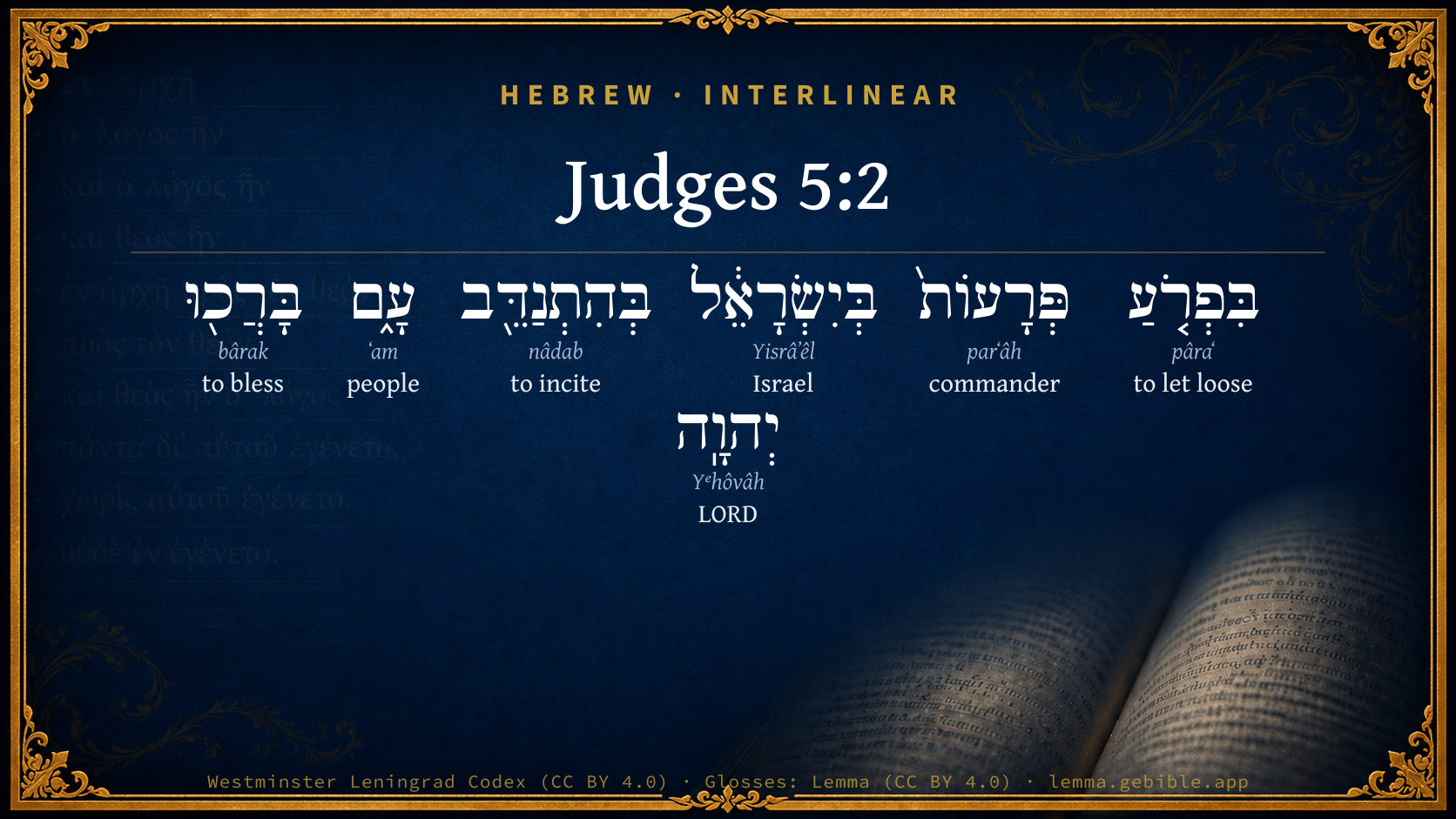
Judges 5:2

Hebrew (Westminster Leningrad Codex) Judges 5:2 appears in the Hebrew Old Testament. The text above is from the Westminster Leningrad Codex. Each word links to its Strong’s number, a concise gloss, and parsing drawn from the Open Scriptures Hebrew Bible morphology. Click any word for its full Brown-Driver-Briggs (BDB) entry.
Download image
Cite this verse

Judges 5:2 (World English Bible). Public Domain. Lemma interlinear Bible study tool, https://lemma.gebible.app/v/judges/5/2.

Show BibTeX & RIS
BibTeX
RIS
English Translation
For that the leaders took the lead in Israel, For that the people offered themselves willingly, Bless you Yahweh.
World English Bible · Public Domain
Download a study sheet

One document with this verse’s original text, its word-by-word gloss line, the meaning frame, cross-references with their text, attributed commentary, and full source and license credits — printable, and it pastes into notes with its structure intact.

This verse Autodidact and up

Study sheet (.html) Plain text (.txt)

A passage Seminary Student

Up to 50 verses in one chapter. A passage sheet keeps up to 6 commentary sources and 12 cross-references per verse, in the order this page ranks them, and says so on the sheet whenever that leaves anything out. Ask for a single verse and you get the Autodidact verse sheet above.

Everything on this page stays free to read, with no account — the sheet is a download of what is already on screen, not access to it.

Want to remove ads? Support Godless Engineer
Compare translations 3

The same verse in 3 English versions, stacked beneath the original-language interlinear above. Click any original word for its lexicon entry.

Each is an independent rendering of the whole verse — the interlinear is not word-aligned to these translations.

Highlighted words mark where these versions differ — a whole-verse word diff, not a word-by-word alignment.

  • World English Bible Public Domain
    For that the leaders took the lead in Israel, For that the people offered themselves willingly, Bless you Yahweh.
  • King James Version Public Domain
    Praise ye the LORD for the avenging of Israel, when the people willingly offered themselves.
  • unfoldingWord Literal Text CC BY-SA 4.0
    “For the loosening of long hair in Israel, for the volunteering of the people, bless Yahweh!

unfoldingWord Literal Text — © unfoldingWord, licensed CC BY-SA 4.0. Word-aligned USFM3 via Door43 (git.door43.org/unfoldingWord/en_ult).

Versions to compare (up to 4)

3 of 4 selected

Show all 18 translations

Every available English version of this verse, each an independent rendering of the whole verse.

  • World English Bible Public Domain
    For that the leaders took the lead in Israel, For that the people offered themselves willingly, Bless you Yahweh.
  • Berean Standard Bible Public Domain
    “When the princes take the lead in Israel, when the people volunteer, bless the LORD.
  • Majority Standard Bible Public Domain
    “When the princes take the lead in Israel, when the people volunteer, bless the LORD.
  • King James Version Public Domain
    Praise ye the LORD for the avenging of Israel, when the people willingly offered themselves.
  • American Standard Version (1901) Public Domain
    For that the leaders took the lead in Israel, For that the people offered themselves willingly, Bless ye Jehovah.
  • Revised Version (1885) Public Domain
    For that the leaders took the lead in Israel, for that the people offered themselves willingly, bless ye the LORD.
  • Geneva Bible (1599) Public Domain
    Praise ye the Lord for the auenging of Israel, and for the people that offred themselues willingly.
  • Douay-Rheims (1899) Public Domain
    O you of Israel, that have willingly offered your lives to danger, bless the Lord.
  • Young's Literal Translation Public Domain
    `For freeing freemen in Israel, For a people willingly offering themselves Bless ye Jehovah.
  • Literal Standard Version CC BY-SA 4.0
    “For freeing leaders in Israel, || For a people willingly offering themselves, || Bless YHWH.
  • Unlocked Literal Bible CC BY-SA 4.0
    “When the leaders take the lead in Israel, when the people gladly volunteer for war— we praise Yahweh!
  • unfoldingWord Literal Text CC BY-SA 4.0
    “For the loosening of long hair in Israel, for the volunteering of the people, bless Yahweh!
  • Darby Bible Public Domain
    "That the leaders took the lead in Israel, that the people offered themselves willingly, bless the LORD!
  • World Messianic Bible Public Domain
    “Because the leaders took the lead in Israel, because the people offered themselves willingly, be blessed, LORD!
  • Webster's Bible Public Domain
    Praise ye the LORD for the avenging of Israel, when the people willingly offered themselves.
  • Free Bible Version CC BY-SA 4.0
    “Israel's leaders took charge, and the people were totally committed. Praise the Lord!
  • Bible in Basic English Public Domain
    Because of the flowing hair of the fighters in Israel, because the people gave themselves freely, give praise to the Lord.
  • JPS Tanakh (1917) Public Domain
    When men let grow their hair in Israel, when the people offer themselves willingly, bless ye the LORD.

Literal Standard Version (2020), Covenant Press — licensed CC BY-SA 4.0. Text via the HelloAO Bible API (eBible.org). Unlocked Literal Bible (unfoldingWord) — licensed CC BY-SA 4.0. Text via the HelloAO Bible API (eBible.org). unfoldingWord Literal Text — © unfoldingWord, licensed CC BY-SA 4.0. Word-aligned USFM3 via Door43 (git.door43.org/unfoldingWord/en_ult). Free Bible Version, Dr. Jonathan Gallagher — licensed CC BY-SA 4.0. Text via the HelloAO Bible API (eBible.org).

Word by word

More ways to search: Search by grammar → Find every occurrence → Compare this word →

Practice this passage: Drill this verse → Learn its vocabulary →

About this verse

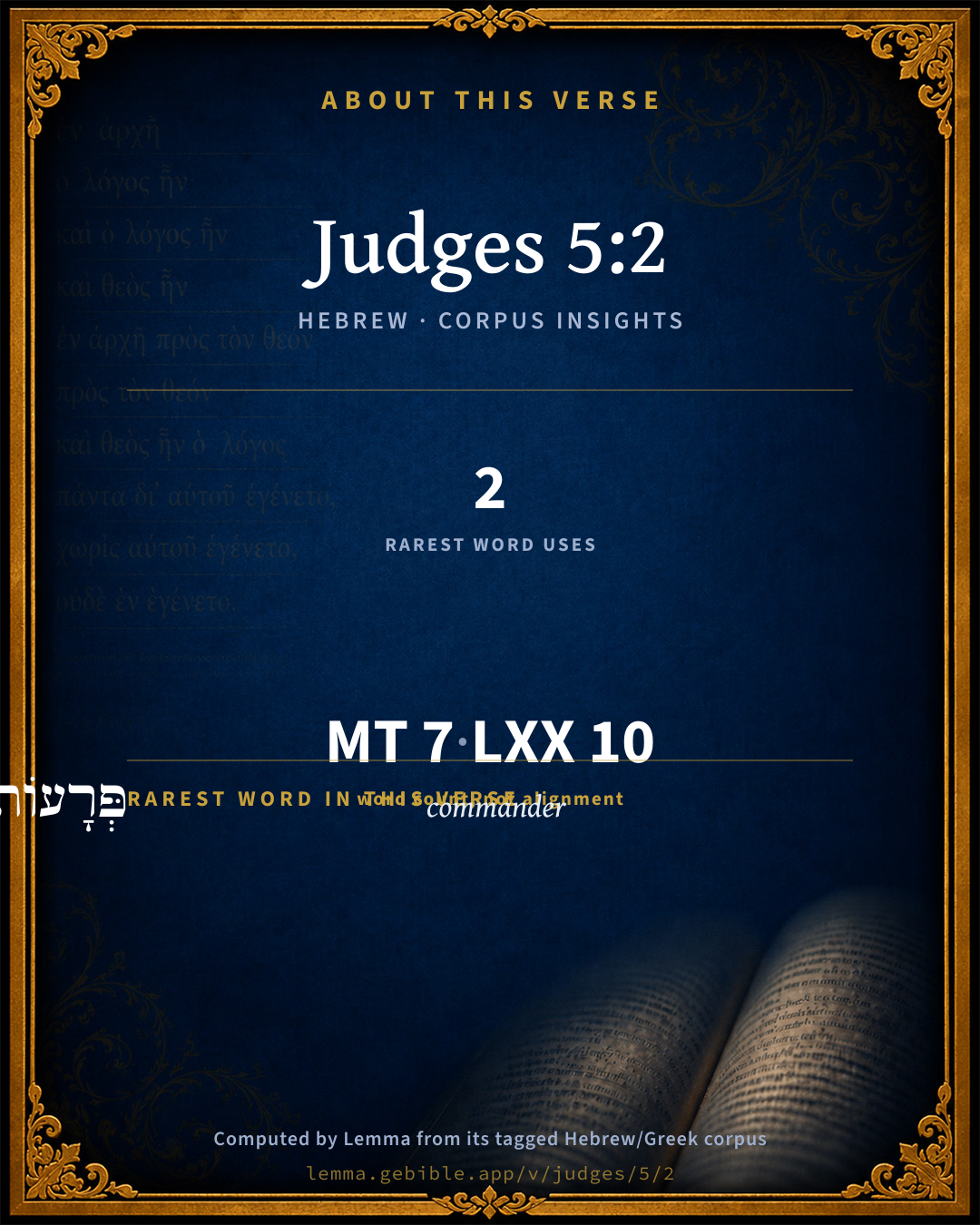
These counts appear in no published source. They are computed here, from the morphology-tagged text and Lemma’s own curated glosses. What Lemma adds →

7
words
7
distinct lemmas
Historical
section

Notable vocabulary

The rarest word here is פְּרָעוֹת֙ commander H6546 — appearing just 2 times in the whole Hebrew Bible.

Shared distinctive vocabulary

פְּרָעוֹת֙ commander H6546 occurs in 2 verses of the Hebrew Bible. Also found in:

Grammatical profile

  • 3 verbs
  • 4 nouns

Verb forms

  • בִּפְרֹ֤עַ Qal · Infinitive Construct
  • בְּהִתְנַדֵּ֖ב Hithpael · Infinitive Construct
  • בָּרֲכ֖וּ Piel · Imperative

Hebrew & Septuagint length

In English translation the verse runs 19 words from the Hebrew and 16 from the Septuagint (LXX English) — closely comparable.

A rough comparison of the two English renderings, which tokenize alike — not a word-level alignment.

Word counts can differ between the Hebrew and the Greek without any difference in meaning — e.g. the Hebrew direct-object marker אֵת has no separate Greek word, and Greek often adds the article ὁ.

In the original languages it is 7 Hebrew tokens and 10 Greek tokens — but the two are counted differently (Hebrew bundles its prefixes and suffixes into one token; the Greek is in lemma form), so that isn’t a like-for-like length.

Cross-references

21

Topical passages linked to Judges 5:2 in the Treasury of Scripture Knowledge — connected by theme and wording, ordered by reader-vote popularity; previews shown in the World English Bible.

  • Judges 5:9 My heart is toward the governors of Israel, Who offered themselves willingly among the people: Bless you Yahweh.
  • 2 Chronicles 17:16 and next to him Amasiah the son of Zichri, who willingly offered himself to Yahweh; and with him two hundred thousand mighty men of valor.
  • Psalms 110:3 Your people offer themselves willingly in the day of your power, in holy array. Out of the womb of the morning, you have the dew of your youth.
  • Philippians 2:13 For it is God who works in you both to will and to work, for his good pleasure.
  • Deuteronomy 32:43 Rejoice, you nations, [with] his people: For he will avenge the blood of his servants, Will render vengeance to his adversaries, Will make expiation for his land, for his people.
  • 2 Samuel 22:47–48 Yahweh lives; Blessed be my rock; Exalted be God, the rock of my salvation,
  • Nehemiah 11:2 The people blessed all the men who willingly offered themselves to dwell in Jerusalem.
  • Psalms 18:47 Even the God who executes vengeance for me, And subdues peoples under me.
  • Psalms 48:11 Let Mount Zion be glad! Let the daughters of Judah rejoice, Because of your judgments.
  • Psalms 94:1 Yahweh, you God to whom vengeance belongs, You God to whom vengeance belongs, shine forth.
  • Psalms 97:8 Zion heard and was glad. The daughters of Judah rejoiced, Because of your judgments, Yahweh.
  • Psalms 136:15 But overthrew Pharaoh and his host in the Red Sea; For his loving kindness endures forever:
  • Psalms 136:19–20 Sihon king of the Amorites; For his loving kindness endures forever;
  • Psalms 149:6–9 May the high praises of God be in their mouths, And a two-edged sword in their hand;
  • 1 Corinthians 9:17 For if I do this of my own will, I have a reward. But if not of my own will, I have a stewardship entrusted to me.
  • 2 Corinthians 8:12 For if the readiness is there, it is acceptable according to what you have, not according to what you don't have.
  • 2 Corinthians 9:7 Let each man give according as he has determined in his heart; not grudgingly, or under compulsion; for God loves a cheerful giver.
  • Philemon 1:14 But I was willing to do nothing without your consent, that your goodness would not be as of necessity, but of free will.
  • Revelation 16:5–6 I heard the angel of the waters saying, "You are righteous, who are and who were, you Holy One, because you have judged these things.
  • Revelation 18:20 Rejoice over her, O heaven, you saints, apostles, and prophets; for God has judged your judgment on her."
  • Revelation 19:2 for true and righteous are his judgments. For he has judged the great prostitute, who corrupted the earth with her sexual immorality, and he has avenged the blood of his servants at her hand."

Cross-references courtesy of OpenBible.info (CC BY 4.0).

Hebrew and Greek witnesses Masoretic Hebrew ↔ Greek Septuagint

The same verse in the two great witnesses to the Old Testament, shown verse-for-verse.

These are two independent witnesses, not word-aligned to each other, and the Septuagint is shown in lemma (dictionary) form.

Hebrew Judges 5:2 Masoretic · Westminster Leningrad Codex

בִּפְרֹ֤עַ פְּרָעוֹת֙ בְּיִשְׂרָאֵ֔ל בְּהִתְנַדֵּ֖ב עָ֑ם בָּרֲכ֖וּ יְהוָֽה

For that the leaders took the lead in Israel, For that the people offered themselves willingly, Bless you Yahweh.

World English Bible · Public Domain

Greek LXX Judges 5:2 Septuagint · lemma form

ἀποκαλύπτω ἀποκάλυμμα ἐν ἰσραήλ ἐν ὁ ἑκουσιάζομαι λαός εὐλογέω κύριος

A revelation was made in Israel when the people were made willing: Praise you⌃ the Lord.

LXX2012 (modern English Septuagint) · Public Domain

On this verse, Lange's Commentary on the Holy Scriptures discusses the Septuagint’s reading. Read the note in Commentary ↓

Hebrew: Westminster Leningrad Codex (CC BY 4.0). Greek: Septuagint (public domain); English from LXX2012 (modern English Septuagint) (Public Domain). How the Septuagint differs from the Hebrew →

Targum (Aramaic paraphrase)

1

The Targum is the ancient Jewish Aramaic paraphrase of the Hebrew Scriptures — an interpretive translation, not the Hebrew text itself. Onkelos (literal) and Pseudo-Jonathan (expansive) render the Torah, and Jonathan the Prophets. Coverage is partial: where no permissively-licensed English translation exists for a verse, only the Aramaic is shown. This is verse-level text, not a word-by-word alignment to the Hebrew.

  1. Targum Jonathan Prophets (Joshua–Malachi)
    כַּד מְרָדוּ בֵּית יִשְׂרָאֵל בְּאוֹרַיְתָא אֲתוֹ עֲלֵיהוֹן עַמְמַיָא וּטְרָדוּנוּן מִקְרְוֵיהוֹן וְכַד תָּבוּ לְמֶעְבַד אוֹרַיְתָא אִתְגַבָּרוּ אִנוּן עַל בַּעֲלֵי דְבָבֵיהוֹן וְסָרְכוּנוּן מִכָּל תְּחוּם אַרְעָא דְיִשְׂרָאֵל בְּכֵן עַל פּוּרְעָנוּת תְּבַר סִיסְרָא וְכָל מַשִׁרְיָתֵהּ וְעַל נִסָא וּפוּרְקָנָא דְאִתְעֲבֵיד לְהוֹן לְיִשְׂרָאֵל בְּכֵן תָּבוּ חַכִּימַיָא לְמֵתַב בְּבָתֵּי כְנִשְׁתָּא בְּרֵישׁ גְלֵי וּלְאַלְפָא יַת עַמָא פִּתְגָמֵי אוֹרַיְתָא בְּכֵן בָּרִיכוּ וְאוֹדוּ קֳדָם יְיָ:

    (no public-domain English translation for this verse)

    Targum Jonathan — Aramaic: “Mikraot Gedolot” (public domain). English: “Sefaria Community Translation” (CC0 1.0 (public-domain dedication)); “London "Chaldee Paraphrase," 1871” (public domain). Text via Sefaria.

Commentary

Notes on Judges 5:2 from classic Christian and Jewish commentators (each source and its license shown beneath its notes). The classic Christian expositions comment on the surrounding passage and are grouped to its opening verse, so a note may address several verses; the Jewish commentaries on the Tanakh (Rashi and others) are per-verse, so they appear only where the commentator wrote on this verse.

Lemma curates 59 commentaries, every one of them public domain or Creative Commons licensed, each selected and text-cleaned for this edition rather than reprinted as found. About our sources →

Trapp's Complete Commentary

John Trapp

Jdg 5:2 Praise ye the LORD for the avenging of Israel, when the people willingly offered themselves.

Ver. 2. When the people willingly offered themselves.] As Jdg 4:10. Barak had no power to press them, but did only persuade with them, as the word Mashar there importeth. He gave goodly words, as being of the tribe of Naphtali, {see Gen 49:21} and prevailed, God working their hearts thereunto, who is therefore worthily praised. All his people are volunteers, {Psa 110:3} he draweth them and they follow him. {Son 1:4}

John Trapp, A Commentary or Exposition upon All the Books of the Old and New Testament (1647–1656) — public domain. Text from a community e-Sword module.

Joseph Benson's Commentary

Jdg 5:2. Praise ye the Lord, &c. — This verse seems to be no more than the exordium, or preface to the song, expressing the subject or occasion of it, namely, the avenging of Israel, or the deliverance of them from Canaanitish slavery, and the people’s willingly offering themselves to battle. Houbigant renders the verse thus —

“Because the leaders of Israel undertook the war,

Because the people willingly offered themselves,

Praise ye the Lord.”

And Dr. Kennicott supposes that the first line was sung by Deborah: that Barak answered her in the second, and that they both joined in the last, which, according to the Hebrew, he more properly translates, Bless ye Jehovah.

Joseph Benson's Commentary on the Old and New Testaments (1811–1818) — public domain. Text from a community e-Sword module.

Lange's Commentary on the Holy Scriptures

Introduction

Jdg_5:2-5

2That in Israel wildly waved the hair

In the people’s self-devotion,—Praise God!

3Hear, O ye kings, give ear, O ye princes:

I for God,2 unto Him will I sing,

I will strike the strings unto God, the Lord of Israel!

4O God, at thy march from Seir,

At thy going forth from Edom’s fields,

The earth trembled, and the heavens dropped,

Yea, the clouds dropped down water.

5The mountains were dismayed before God,

Even this3 Sinai, before God, the Lord of Israel.

TEXTUAL AND GRAMMATICAL

[1 Jdg_5:3.—Dr. Cassel: Ich für Gott; but the accents separate אָנֹכִי from לַיהוָֹה, and there appears no good reason for disregarding them. The position and repetition of the subject אָנֹכִי serve to bring the person of the Singer prominently into view, and that not in her character as woman, but as prophetess, filled with the Spirit of God, and therefore entitled to challenge the attention of kings and princes. So Bachmann.—Tr.]

[2 Jdg_5:5.—זֶה סִינַי: literally, “this Sinai.” “Sinai is present to the poetic eye of Deborah” (Wordsworth). Dr. Cassel translates by the definite article, der Sinai.—Tr.]

EXEGETICAL AND DOCTRINAL

Jdg_5:2. The above translation of Jdg_5:24 differs from all earlier renderings, which however also differ more or less from each other. The most interesting among them is that of those Greek versions which render “ἐν τῷ ἄρξασθαι ἀρχηγόυς.” It has been followed by a multitude of esteemed expositors (Schnurrer, Rosenmüller, Ewald, Bertheau, Böttger, Kemink); and yet it betrays its Egyptian origin, since in connection with בִּפְרֹעַ פְּרָעוֹת it thought only of the Egyptian Pharaoh or king, and expounded accordingly. A similar, more homiletical interpretation proceeds from the Targum. This was more naturally reminded of פּוּרְעֲבוּת, ultio, vindicta; the Midrash, by speaking of the cessation of the sufferings, whose previous existence is implied in the necessity for vengeance, shows that it adopts the same interpretation. Teller also, perhaps unconsciously, arrived at the same explanation. The interpretation of Raschi, who takes פֶּרַע as equivalent to פֶּרֶץ, and of those who suppose it equivalent to פֶּרֶט, may, like various others, be passed over in silence. The natural exposition, which is always at the same time the poetical, has on all sides been overlooked. פֶּרַע is undoubtedly (as in Arabic) the hair of the head, and more particularly the long, waving nair, the coma,5 as appears from Eze_44:20. פְּרָעוֹת is its plural form, and is used in Deu_32:42, where blood is spoken of as flowing down from the hairy head (מֵראֹשׁ פַּרְעוֹת אוֹיֵב). Hence the verb פָּרַע, (cf. κομᾷν, to cultivate the hair), signifies “to make loose,” to allow to “become wild,” as when the hair flies wild and loose about the neck; wherefore it is said of Aaron (Exo_32:25) that he had caused the people פְּרָעֹה, “to grow wild,” and of the people that they “had grown wild” (פָּרֻעַ). The circumstances under which the hair was allowed to grow, are well known. The person who makes a vow, who would be holy unto God, is directed (Num_6:5) to let his hair grow (גַּדֵּל פֶּרַע). The instance of Samson, to which we shall come hereafter, is familiar. The present occasion for this observance arose בְּהִתְנַדֵּב עָם,6 when the people consecrated themselves, devoted themselves (se devovit), to God,—the people, namely, who gave heed to the voice of Deborah, and placed themselves in the position of one who called himself holy unto God. Israel, through disobedience, had fallen into servitude. Those who followed Barak, had faith in God; upon the strength of this faith they hazarded their lives. They devoted themselves wholly as a sacrifice to God. The verse therefore exhibits a profound apprehension of the essential nature of the national life. It sets forth the ground of the very possibility of the Song, and therefore stands at its head. Israel could be victorious only by repentance and return to obedience.7 The prophetess delineates, poetically and with forcible beauty, the people’s great act of self-devotion, when whole tribes give themselves to God,—their hair streaming, their hearts rejoicing,—and place their strength and trust in Him. They were the κάρηκομόωντες8 of a divine freedom. This interpretation also brings the parallelism out clearly: בִּפְרֹעַ stands in both causal and appositional correlation with בְּהִתְנַדֵּב. The preposition בְּ points out the condition of the people in which they conquered and sang. The Song is the people’s consecration hymn, and praises God for the prosperous and successful issue with which He has crowned their vows. “Praise ye God,” it exclaims, “for the long locks,”—i.e. for and in the people’s consecration. The result of every such consecration as God blesses, is his praise. And now, the nations must hear it! The object of Israel’s national pride, is its God. Hence, Israel’s song of triumph is a call upon surrounding kings to hear what God did for his people when they gave themselves up to Him.9

Jdg_5:3. Hear, O ye kings and princes. Both are expressions for the “mighty ones” among the nations, cf. Psa_2:2. רֹזְנִים are the great, the strong. Rosen manifestly answers to the Sanskrit vrisna (Benfey, i. 332), Old High German rîso, giant.—Deborah proposes not merely to sing, but adds, I will play (אֲזַמֵּר). As in the Psalms, singing and playing are joined together, one representing thought, the other sound. The action expressed by זִמֵּר, is performed on various instruments (cf. Psa_144:9, “ten-stringed lute”), chiefly on the cithern, a species of harp or lyre (Psa_98:5, etc.), but also with timbrels and citherns (Psa_149:3, cf. Psa_81:3). Miriam also accompanied her antiphonal song with timbrels (tympanis, Exo_15:20), Jephthah’s daughter used them as she came to meet her father (Jdg_11:34). Nor can they have failed as an accompaniment to the Song of our prophetess. Tympana (toph, timbrels) appear in antiquity as the special instrument of impassioned women (Creuzer, Symbolik, iii. 489). The derivation of the word זָמַר is not clear. Delitzsch is doubtless right in deciding (Psalter, i. 19) that it has nothing to do with the samar which signifies to “prune the vine.” That samar reminds one of the Greek σμίλη, a clasp and carving-knife. Simmer, to play (scil. mismor, ψαλμός), distinguishes itself as an onomatopoetic word. The primitive Greek singer, whose contest with the muses in cithern-playing Homer already relates, was named Thamyris (Il. ii. 594).

Jdg_5:4-5. O God at thy march from Seir. An Israelitish song can praise God only by rehearsing the history of Israel. For the fact that God is in its history constitutes the sole foundation of Israel’s national existence and rights over against other nations. But this immanence of God in the history of the people, manifests itself most wonderfully in those events through which, as by steps, Israel became a nation. For not in Egypt, where Israel was a servant, was the nation born, nor through the exodus alone; the nationality of Israel is the child of the desert. There, through the self-revelation of God, Israel became a free people. The journey through the desert—of which Sinai was the central point,—by the giving of the law and the impartation of doctrine, by the wonderful provision of food and the gift of victory, and by the infliction of awful judgments, became one continuous act of divine revelation. Thus, Israel came forth from the desert a perfected nation. The prophetic insight of the Hebrew poets, at one clear glance, traces the desert-birth of the nation back to the manifest nearness of God as its cause. All that happened to the people came from God. “The Lord came from Sinai,” says the Song of Moses (Deu_33:2), “and rose up from Seir; He shined forth from Mount Paran.” The 114th psalm (Jdg_5:2) represents the exodus from Egypt as the beginning of Israel’s nationality: “Then Judah became his sanctuary.” Deborah takes Seir and Edom, whence Israel entered history as a nation, as representatives of the whole desert; which from her position was, even geographically, quite natural. The 68th Psalm, borrowing from this passage, at the same time explains it by substituting more general terms for Seir and Edom:10 “When thou wentest forth before thy people, when thou didst march through the wilderness.” The wilderness was the theatre of the revelation of God. There He appeared to his people. Where is there another nation to whom this occurred? “Hear, ye kings,” cries the prophetess, what nation was ever raised up, instructed, and led, by the manifest presence of such a God?

The earth trembled. The superior grandeur of Scriptural over the noblest Hellenic conceptions, is scarcely anywhere more clearly apparent. The earthquake, with Hesiod and others, is symbolic of conflict between the powers above and those below, between Zeus and Typhon:—

“Great Olympus trembled beneath the immortal feet

Of the Ruler rising up, and hollow groaned the earth. …

The earth resounded, and the heavens around, and the floods of ocean.”11

To the prophetic spirit of Deborah, also, and of the Psalms, the earthquake becomes a powerful symbol; but it is the symbol of the creature’s humility and awe on account of the sacred nearness of God. For Israel’s sake, God descended from on high; the creature knows its Lord, and trembles. The earth trembles,12 and “the heavens pour.” (In the desert peninsula of Sinai the latter is a wonder. Even at this day, the Bedouins cherish the superstition that Moses had in his possession the book which determines the fall of rain.) The heavens lose their brazen aridity; whatever is hard and unyielding, firm as rock and stone, becomes soft and liquid:13 the mountains stagger, the rocks flow down like water (נָזְלוּ). The earthquake-belt that girdles the Mediterranean afforded numerous instances of such phenomena. Tremendous masses of rock have been shaken down from Mount Sinai by earthquakes (Ritter xiv. 601, etc.). Even this Sinai. That is, Sinai especially, Sinai before all others is the mountain that shook when God descended, according to the statement, Exo_19:18; “and the whole mount quaked greatly.” Thunders rolled and heavy clouds hung upon its summit (Exo_19:16). “The mountains saw thee,” says Habakkuk (Jdg_3:10), “and they trembled; the overflowing of the waters passed by.” “What ailed you, ye mountains, that ye trembled like lambs?” asks the Psalmist, Psa_114:6 : “Before the Lord the earth trembled, before the God of Jacob.”

These introductory ascriptions of praise to God, have no reference to the battle at the Kishon. They magnify the power and majesty of Israel’s God, as manifested in the nation’s earlier history. Such is the God of Israel, the nations are told. Such is He who has chosen Israel for his people. It was there in the desert that they became his; and for that reason the poet selects the scenes of the desert as the material of her praise. She speaks with great brevity: the 68th Psalm amplifies her conceptions. Very unfortunate is the conjecture (Böttger) that by Sinai Tabor is meant. It is altogether at variance with the spirit of the old covenant, which could never consent to make Sinai the representative of any less sacred mountain. Moreover, the battle was not on Tabor, but in the plain, near the Kishon. With Jdg_5:5 closes that part of the Song by which the “kings and princes” are informed that the God whom the elements fear, has become the Lord of Israel. With Jdg_5:6 the poetess first enters on the history of the state of affairs which existed in Israel previous to her great deed.

Footnotes:

[2][Jdg_5:3.—Dr. Cassel: Ich für Gott; but the accents separate אָנֹכִי from לַיהוָֹה, and there appears no good reason for disregarding them. The position and repetition of the subject אָנֹכִי serve to bring the person of the Singer prominently into view, and that not in her character as woman, but as prophetess, filled with the Spirit of God, and therefore entitled to challenge the attention of kings and princes. So Bachmann.—Tr.]

[3][Jdg_5:5.—זֶה סִינַי: literally, “this Sinai.” “Sinai is present to the poetic eye of Deborah” (Wordsworth). Dr. Cassel translates by the definite article, der Sinai.—Tr.]

[4]

בִּפְרֹעַ פְּרָעוֹת בְּישׂרָאֵל

בְּהִתְנַדֵּב עָם בָּרְכוּ יִהוָֹה

[5]That we must go back to the sense of this word, is also admitted by Keil; but he attaches a meaning to it which It never has. [Keil: פְּרָעוֹת here means properly comati, hairy persons, i. e. those who are endowed with strength. The champions in battle are meant, who by their prowess and valor preceded the people.”—Tr.]

[6]The verb נָדַב occurs only in Exodus, Ezra, Chronicles, and here.

[7]The Targum, though merely paraphrastic, in its spirt agrees entirely with this interpretation.

[8][“Long-haired,” cf. the Homeric καρηκομόωντας Αχαιοὺς, “long-haired Greeks,” Il. ii. 11, etc. Among the later Greeks, long hair was the badge of freedom, and hence was not allowed to slaves. See Smith’s Dict. Antiquities, s. v. “Coma.”—Tr.]

[9][Dr. Bachmann adopts the view of Jdg_5:2 given by the LXX. according to the Alexandrine Codex: ἐν τῷ ἄρξασθαι ἀρχηγοὺς ἐν ̓Ισραήλ, and translates, “that the leaders led,” etc. The idea of “leading” or “going before,” he says, may be readily derived from the radical meaning of פָּרַע, to break forth,” sc. into prominence (hervorbrechen). His criticism on our author’s translation is as follows: “To say nothing of the fact that the partitive (?) בְּיִשׂרָאֵל excites surprise, standing as it does in parallelism with עָם, it may well be doubted whether the expression taken in this sense would ever have been intelligible, notwithstanding the alleged explanatory apposition of the second member of the verse; at all events, in the language of the law פָּרַע denotes, not an act, but a condition (the consequence of the תַּעַר לֹא־יַעְבֹר, Num_6:5), such as at the beginning of the fulfillment of a vow of consecration—and to a beginning the reference would have to be here,—could have no existence.”—Tr.]

[10]For בְּצֵאתְךָ מִשֵּׂעִירִ, Psalms 68 substitutes לִפְנֵי עַמֶּךָ, and for בְּצַעְךְּךָ מִשְּׂדֵה אֱדוֹם it has בְּצַעְדְּךָ בִישִׁימוֹן.

[11]Hesiod, Theogon., v. 840, etc.

[12]Cf. Jer_10:10; Joel iv (iii.) :16, etc.

[13]“The mountains melt like wax,” cf. Psa_97:5.

Lange's Commentary on the Holy Scriptures (Critical, Doctrinal, and Homiletical), ed. John Peter Lange, English translation edited by Philip Schaff (1864–1880) — public domain. Text from a community e-Sword module.

Geneva Bible (1599)

Geneva Bible translators

To wit, the two tribes of Zebulun and Naphtali.

Geneva Bible (1599) marginal notes — public domain. Text via Bolls.life.

Jamieson, Fausset & Brown

Robert Jamieson, A. R. Fausset & David Brown

The meaning is obscurely seen in our version; it has been better rendered thus, "Praise ye Jehovah; for the free are freed in Israel--the people have willingly offered themselves" [ROBINSON].

Jamieson, Fausset & Brown — Commentary Critical and Explanatory on the Whole Bible (1871) — public domain (CC PDM 1.0). Text via the HelloAO Bible API.

Adam Clarke's Commentary

Verse 2. For the avenging of Israel] See the notes, &c., at the end of the chapter. Clarke "Jdg 5:28".

Adam Clarke's Commentary on the Bible (1810–1826) — public domain. Text from a community e-Sword/MySword module.

Ellicott's Commentary for English Readers

(2) For the avenging of Israel.—The Hebrew word peraoth cannot have this meaning, though it is found in the Syriac and implied by the Chaldee. The word only occurs in Deu_32:42, and there, as here, implies the notion of leading; so that the LXX. are doubtless right in rendering it, “In the leading of the leaders of Israel.” God is praised because both leaders and people (Jdg_5:9; Jdg_5:13) did their duty. Peraoth is derived from perang, “hair”; and whether the notion which it involves is that of comati, “nobles, who wear long hair” (comp. Homer’s “long-haired Greeks,” and Tennyson’s “his beard a yard before him, and his hair a yard behind “), or “hairy champions,” or the hair of warriors streaming behind them as they rode to battle (“His beard and hoary hair streamed like a meteor to the troubled air”: Gray), leadership seems to be the notion involved.

When the people willingly offered themselves.—Comp. Psa_110:3 : “Thy people shall be willing in the day of thy power.”

A Bible Commentary for English Readers, edited by Charles John Ellicott (1878–1897) — public domain. Text from a community e-Sword module.

The Cambridge Bible for Schools and Colleges

gen. ed. J. J. S. Perowne

2. The translation, after the LXX. cod. A, gives a good parallelism (leaders and people as in Jdg_5:9), but it rests on slender support. The noun rendered leaders has this meaning among others (such as abundant hair, in Arabic), but in Hebrew the verb ‘took the lead’ properly means to loosen Exo_5:4, especially to let the hair go loose Lev_10:6; Lev_13:45, and the noun is used of the long locks of the Nazirites Num_6:5. Wearing the hair long was the mark of a vow not to do certain things until a specified object had been attained; the practice was observed not only by the Nazirites but by warriors bent upon vengeance; for an illustration from Arabic see Wellhausen, Reste Arab. Heidenthums2, p. 123 n., and cf. Psa_68:21. Hence we may transl. when the locks grew long in Israel i.e. when the warriors took the vow of vengeance: this may be the meaning of the same word in Deu_32:42 ‘from the long-haired heads of the foe.’ Offered themselves willingly, of volunteering for battle, only again in 2Ch_17:16, cf. Psa_110:3; usually of offerings to the Temple in Chr., Ezr., Neh. The translation For that … For that … Bless ye is contrary to usage, which rather requires When … When, as in Jdg_5:4 where the same construction occurs; but this does not agree with Bless ye. The exact sense of the verse is doubtful.

2, 3. Exordium.

The Cambridge Bible for Schools and Colleges (gen. ed. J. J. S. Perowne; Cambridge University Press, 1878–1918) — public domain. Text from a community e-Sword module.

John Gill's Exposition

Praise ye the Lord for the avenging of Israel,.... The injuries done to Israel by any of their enemies, and particularly what wrongs had been done them by Jabin, king of Canaan, for twenty years past; though some understand it of the vengeance God took on Israel for their sins; and though praise is not given directly for that, yet inasmuch as, when that was the case, there were some whose spirits were stirred up to engage voluntarily in the deliverance of them from the oppression of their enemies, it was matter of praise:

when the people willingly offered themselves: to go and fight for Israel against their enemies, particularly those of the tribes of Zebulun and Naphtali, Jdg 5:18; though not excluding others that joined, who could not have been forced to it, had they not freely offered themselves; and which was owing to the secret influence of divine Providence on their hearts, moving and drawing them to this service; and therefore praise was due to the Lord on this account, who works in the hearts of men both to will and to do, as in things spiritual and religious, so in things natural and civil.

John Gill's Exposition of the Whole Bible (1746–1763) — public domain (CC PDM 1.0). Text via the HelloAO Bible API.

Albert Barnes' Notes on the Bible

Render “For the leading of the leaders in Israel (the princes), for the willingness of the people (to follow them) bless ye the Lord.” See Deu 32:42 note, and compare Jdg 5:9 and Jdg 5:13, where the nobles and the people are again contrasted.

Albert Barnes' Notes on the Bible (1834–1885) — public domain. Text from a community e-Sword/MySword module.

Haydock's Catholic Bible Commentary

Lord. Hebrew may have different senses: "bless the Lord for having avenged Israel, the people willingly exposing themselves, or shewing their concurrence." Roman Septuagint, "What was hidden has been disclosed in Israel, when the people shewed their good will, bless the Lord." Pora, which the Vulgate has not expressed, commonly means to disclose, liberate, &c.; ethondob signifies to give freely, to expose one’s self, &c. Septuagint and Theodotion together, (Calmet) and the Alexandrian copy have, "bless the Lord, for that leaders have risen up in Israel, and the people have shewn their good will." These two things were to be greatly desired, as a general can do but little without an obedient army, and the latter is, in a manner, useless, without a head. Both had been wanting in Israel for some time, and even still, some of the tribes seem to be blamed for not co-operating with zeal, ver. 15, &c. This verse is repeated as a kind of chorus, ver. 9. The zeal and concord of the little troop, which had met the formidable army of Sisara, deserved the highest applause. (Haydock) --- Men bless God when they give him thanks; superiors bless by imparting some spiritual benefit. (Worthington)

George Leo Haydock (1774–1849), Haydock's Catholic Family Bible and Commentary, 1859 edition — public domain. Excludes Psalms (Douay-Rheims chapter numbering differs from Protestant) and Deuterocanonical books (Catholic canon only).

Matthew Poole's English Annotations

Praise ye the Lord; give him the praise who hath done the work.

For the avenging of Israel; or, for taking vengeance, to wit, upon his and their enemies, by Israel, or for Israel, for Israel’s benefit, or for the injuries and violences offered by them to Israel. The people; chiefly Zebulun and Naphtali, below, Jdg 5:18; 4:6, and others hereafter mentioned.

Willingly offered themselves, when neither Deborah nor Barak had any power to compel them.

Matthew Poole's English Annotations on the Holy Bible (1683–1685) — public domain. Text from a community e-Sword/MySword module.

Whedon's Commentary on the Bible

Daniel D. Whedon

2. For the loosing of locks — A poetical expression denoting an act of self-consecration to God’s service, and to be explained, metaphorically, as an allusion to the unrestrained growth of the locks of one who took upon himself the Nazarite vow. The Hebrew is בפרע פרעות, which the English version, following substantially the Syriac and Arabic, renders, For the avenging; Septuagint, For the leading of the leaders; Luther, That Israel has again become free. These versions represent the principal explanations of the commentators, ancient and modern, but they have received various modifications, and, of course, each different rendering has the support of certain special reasons. But they all fail in this most important particular, that they are destitute of any sure support or ground in Hebrew usage. The verb פרע is used sixteen times in the Old Testament, and everywhere has the meaning of loosing, or letting loose, from some sort of restraint, but never, as Luther and others would have it, of the emancipation of a people from bondage. In Lev_10:6; Lev_13:45; Lev_21:10; Num_5:18, it is used of loosing the head of its covering or head-dress. In Exo_32:25, it is twice used of letting the people loose from all restraint, and giving them over to wild play and licentious revelling. Similar is the meaning in 2Ch_28:19. In Pro_1:25; Pro_4:15; Pro_8:33; Pro_13:18; Pro_15:32; Pro_29:18, it is used of breaking loose from, or abandoning, that which is good or evil: in Exo_5:4, of letting a laborer loose from his allotted task; and in Eze_24:14, of Jehovah loosing the guilty from penalty. In all these cases it is clear that the main idea of the word is that of loosing from restraint, and when used of the hair, as in our text, it naturally means letting it go loose and free from all artificial cuttings, shavings, or restraints. This was what the Nazarite did. The noun פרע occurs in the singular but twice, (Num_6:5; Eze_44:20,) and in both places means a lock of hair. This no one questions. Why, then, should the plural of the same word (occurring only here and in Deu_32:42) be rendered either revenges, or leaders, or freemen? The English version of Deu_32:42 — the beginning of revenges — makes no sense at all; but head of flowing locks, is a most simple and natural translation of the original. We therefore translate בפרע פרעות for the loosing of locks, and explain with Cassel, (in Lange’s Bibelwerk,) that the expression is a poetical allusion to the unrestrained growth of the locks of a Nazarite. Of Samson it was ordered that no razor should come upon his head, (Jdg_13:5,) and when Hannah vowed to consecrate her son to God’s service she said, “No razor shall come on his head;” that is, his locks shall be left loose and free to grow. The loosing of locks in Israel, as expressive of a solemn act of consecration to God’s service, is further explained and confirmed by the next line of the parallelism — for the free self-offering of the people. All the people who had taken part in this great war against the hosts of Jabin are conceived of as having taken on them a vow of consecration to Jehovah as solemn and divine as that of a Nazarite. “They were the long-haired heroes of a divine freedom.”

Bless Jehovah — For all this blessed and glorious consecration the prophetess first bursts out in an ascription of joyful praise to Jehovah.

Daniel D. Whedon (gen. ed.), Commentary on the Old and New Testaments (1874–1909) — public domain. Text from a community e-Sword module.

The Pulpit Commentary

Her first feeling was one of patriotic joy that her countrymen had been roused to the venture of war, and of gratitude to God that it was so. "For the bold leading of the leaders of Israel, for the willing following of the people, praise ye the Lord.

HOMILIES BY A.F. MUIR. Ver. 2. Self-sacrifice and its Inspirer.

There are two other renderings of this verse, viz., "That in Israel wildly waved the hair in the people"s self-devotion, praise God" (Cassel); and, "For the leading of the leaders in Israel, for the free self-offering of the people, praise Jehovah (Stanley, after LXX). It is immaterial which of these we prefer; the chief thought is evidently that which appears in all. It is the key-note of this heroic song, as it is the essence of heroism and true religion always self-sacrifice to God.

I THE SPIRIT IN WHICH GREAT DEEDS ARE WROUGHT. The outburst has its source in Divine patriotism or religious enthusiasm. A consciousness of a representative character and destiny animates the Israelites. Religious devotion binds them into complete communion. Private aims and interests are forgotten.

1. It is this spirit which rescues the war of deliverance from objections toward simply as such. As an act of self-devotion it was a truly devout, and therefore religiously legitimate, war. No hope of personal gain animates the host of Israel. It is patriotism in its noblest form. These soldiers are all volunteers; they obey a Divine voice. How many wars would cease were such feelings consulted! The saints" contest with evil should be con- ducted from a like principle. We should know what "manner of spirit" we are of.

2. It was this spirit which made so effectual the struggle in which they were engaged. They were desperate, devoted men. No half-measure would be tolerated. Having counted the cost, they were willing to carry it on an outrance. God"s battle with error and wickedness has suffered because of the half-heartedness of those who wage it.

3. It was this spirit which conferred upon the deed its aesthetic beauty and epic grandeur, It is a fine question to determine what that is that gives the essential character to the noble, chivalrous, and religious enthusiasms of men. A careful survey of any considerable number of them will show that not only unselfishness, but self-sacrifice, is their fundamental principle. Selfish aims, or the impulse of self-aggrandisement, vitiates the deed, however externally magnificent; and vice versa, the magnanimous forgetfulness of self, the conscious foregoing of personal ends and aims, will give nobility and piety even to works externally indifferent or apparently ignoble. The sentiment of a deed is its true character. Here it assumes a dignity and glory that command the admiration of the poet and the artist. It is part of the excellence of noble deeds to inspire. There is nothing so inspiring as self-devotion. But this is the vital breath of all true religion. Religious enthusiasm is contagious. The pious hero cannot long remain alone. True worship is the praise of the cross, where the power of darkness sustained its signal, final defeat. "By the obedience of one shall many be made righteous." If we are truly religious our lives also will blossom forth in acts that poets might sing and orators extol.

II THE INSPIRER OF GREAT DEEDS. That they are not a spontaneous outgrowth of our nature is the general confession of those who have wrought them. The object of Israel"s admiration and obedience was Jehovah. It was in the inspiration derived from him the deliverance was wrought. God in Christ, as embodying the highest excellency in sympathetic relation with ourselves, is an even more powerful stimulus to heroism and piety. "For Christ"s sake" is a formula that covers a vast proportion of "whatsoever things are true, whatsoever things are honest, whatsoever things are just, and pure, and lovely, and of good report," in the world"s history. M.

The Pulpit Commentary (1880–1919), ed. H.D.M. Spence-Jones & Joseph S. Exell — public domain. Text from a community e-Sword module.

John Wesley's Explanatory Notes

The Lord-Give him the praise who hath done the work. The people - Chiefly Zebulun and Naphtali. Offered themselves - When neither Deborah nor Barak had any power to compel them.

John Wesley, Explanatory Notes Upon the Whole Bible (1754–1765) — public domain. Text via the GEBible commentary corpus.

Keil & Delitzsch

C. F. Keil & F. Delitzsch

2 That the strong in Israel showed themselves strong,

That the people willingly offered themselves,

Praise ye the Lord!

The meaning of פּרע and פּרעות is a subject of dispute. According to the Septuagint rendering, and that of Theodot., ἐν τῷ ἄρξασθαι ἀρχηγοὺς ἐν Ἰσραήλ, many give it the meaning to begin or to lead, and endeavour to establish this meaning from an Arabic word signifying to find one's self at the head of an affair. But this meaning cannot be established in Hebrew. פּרע has no other meaning than to let loose from something, to let a person loose or free (see at Lev 10:6); and in the only other passage where פּרעות occurs (Deu 32:42), it does not refer to a leader, but to the luxuriant growth of the hair as the sign of great strength. Hence in this passage also פּרעות literally means comati, the hairy ones, i.e., those who possessed strength; and פּרע, to manifest or put forth strength. The persons referred to are the champions in the fight, who went before the nation with strength and bravery. The preposition בּ before פּרע indicates the reason for praising God, or rather the object with which the praise of the Lord was connected. וגו בּפרע, literally "in the showing themselves strong." The meaning is, "for the fact that the strong in Israel put forth strength." התנדּב, to prove one's self willing, here to go into the battle of their own free will, without any outward and authoritative command. This introduction transports us in the most striking manner into the time of the judges, when Israel had no king who could summon the nation to war, but everything depended upon the voluntary rising of the strong and the will of the nation at large. The manifestation of this strength and willingness Deborah praises as a gracious gift of the Lord. After this summons to praise the Lord, the first part of the song opens with an appeal to the kings and princes of the earth to hear what Deborah has to proclaim to the praise of God.

Keil & Delitzsch — Biblical Commentary on the Old Testament (1861–1891) — public domain (CC PDM 1.0). Text via the HelloAO Bible API. (Old Testament only.)

Rashi

Rabbi Shlomo Yitzchaki (Rashi)

When Yisroel was inundated with breaches. When breaches befell Yisroel; when their enemies invaded them because they deserted Adonoy, and yet the people volunteered to repent—at this point, bless Adonoy for bringing deliverance.

Rashi on the Tanakh — English translations: “The Judaica Press complete Tanach with Rashi, translated by A. J. Rosenberg” (CC BY 4.0); “Pentateuch with Rashi's commentary by M. Rosenbaum and A.M. Silbermann, 1929-1934” (public domain); “The Metsudah Tanach series, Lakewood, N.J” (CC BY 4.0); and “The Book of Joshua, Metsudah Publications, 1997” (CC BY 4.0). Text via Sefaria.

Radak

Rabbi David Kimhi (Radak)

When there was feroa peraot: When there was the takings of vengeance. As the Targum of (Numbers 31:2), "Nekom nikmat (Take vengeance)," is "Itpera puranuta."

When the people willingly offered themselves: When Israel volunteers and shows courage to go out to war - meaning against the bad and for the good - God blesses them. And Yonatan translated the verse like this (in the Targum), "When the House of Israel trembles [to follow] the Torah, etc."

Hear O kings: The kings of the land. And some explain that it is stated about Israel, like the matter that they said, "All of Israel are children of the straight (elevated) ones."

Radak on the Tanakh — English translations: “Sefaria Community Translation” (CC0 1.0 (public-domain dedication)); “Eliyahu Munk, HaChut Hameshulash” (CC BY 4.0); “Rabbi Mike Feuer, Jerusalem Anthology” (CC BY 4.0); and “R. David Kimhi on the first book of Psalms, Translated by R.G. Finch, London, 1919” (public domain). Text via Sefaria.

Lesson kit

Teaching starters — assembled from the data on this page, not authored interpretation. Every prompt links to the verse data it draws on. Edit before teaching.

Judges, in the Historical, opens this verse with 7 words (7 distinct Hebrew lemmas). Its most distinctive word is parʻâh (“commander”). A historical commentator’s framing appears above. Read the whole chapter for the surrounding context.

Discussion questions

  1. How does “commander” (parʻâh) shape what this verse is saying?
  2. How does Deuteronomy 32:42, which shares the word «commander», read alongside this verse?
  3. These translations render this verse differently; the difference is in the English rendering, not the original. What questions does that raise?
  4. «בִּפְרֹ֤עַ» is a Qal Infinitive Construct verb. How does that grammatical form shape the action described?
  5. Compare how Trapp's Complete Commentary and Joseph Benson's Commentary read this verse. Where do they agree or differ?

Things to notice

Reading settings

Reading text

Shown beneath each verse's original-language words.

Old Testament
Old Testament edition

Read the OT as the Masoretic Hebrew (MT) or the Greek Septuagint (LXX).

English shown for the Greek Septuagint (in the Hebrew ↔ Greek comparison).

Comparing translations? Open the Compare panel on any verse page to stack up to four side by side.