
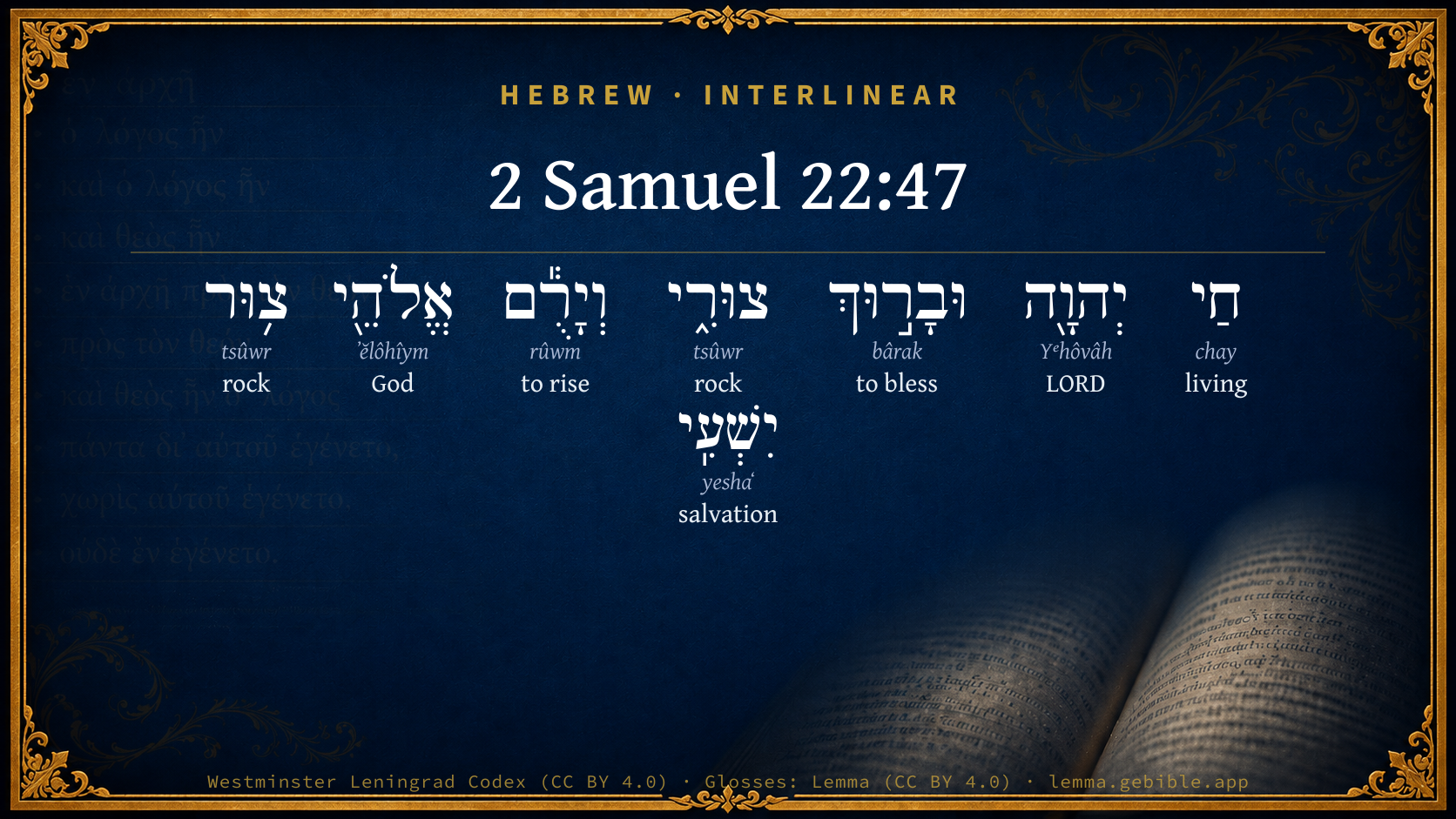
2 Samuel 22:47

Hebrew (Westminster Leningrad Codex) 2 Samuel 22:47 appears in the Hebrew Old Testament. The text above is from the Westminster Leningrad Codex. Each word links to its Strong’s number, a concise gloss, and parsing drawn from the Open Scriptures Hebrew Bible morphology. Click any word for its full Brown-Driver-Briggs (BDB) entry.
Download image
Cite this verse

2 Samuel 22:47 (World English Bible). Public Domain. Lemma interlinear Bible study tool, https://lemma.gebible.app/v/2-samuel/22/47.

Show BibTeX & RIS
BibTeX
RIS
English Translation
Yahweh lives; Blessed be my rock; Exalted be God, the rock of my salvation,
World English Bible · Public Domain
Download a study sheet

One document with this verse’s original text, its word-by-word gloss line, the meaning frame, cross-references with their text, attributed commentary, and full source and license credits — printable, and it pastes into notes with its structure intact.

This verse Autodidact and up

Study sheet (.html) Plain text (.txt)

A passage Seminary Student

Up to 50 verses in one chapter. A passage sheet keeps up to 6 commentary sources and 12 cross-references per verse, in the order this page ranks them, and says so on the sheet whenever that leaves anything out. Ask for a single verse and you get the Autodidact verse sheet above.

Everything on this page stays free to read, with no account — the sheet is a download of what is already on screen, not access to it.

Want to remove ads? Support Godless Engineer
Compare translations 3

The same verse in 3 English versions, stacked beneath the original-language interlinear above. Click any original word for its lexicon entry.

Each is an independent rendering of the whole verse — the interlinear is not word-aligned to these translations.

Highlighted words mark where these versions differ — a whole-verse word diff, not a word-by-word alignment.

  • World English Bible Public Domain
    Yahweh lives; Blessed be my rock; Exalted be God, the rock of my salvation,
  • King James Version Public Domain
    The LORD liveth; and blessed be my rock; and exalted be the God of the rock of my salvation.
  • unfoldingWord Literal Text CC BY-SA 4.0
    Yahweh alive! And blessed my rock, and may the God of the rock of my salvation be exalted,

unfoldingWord Literal Text — © unfoldingWord, licensed CC BY-SA 4.0. Word-aligned USFM3 via Door43 (git.door43.org/unfoldingWord/en_ult).

Versions to compare (up to 4)

3 of 4 selected

Show all 18 translations

Every available English version of this verse, each an independent rendering of the whole verse.

  • World English Bible Public Domain
    Yahweh lives; Blessed be my rock; Exalted be God, the rock of my salvation,
  • Berean Standard Bible Public Domain
    The LORD lives, and blessed be my Rock! And may God, the Rock of my salvation, be exalted—
  • Majority Standard Bible Public Domain
    The LORD lives, and blessed be my Rock! And may God, the Rock of my salvation, be exalted—
  • King James Version Public Domain
    The LORD liveth; and blessed be my rock; and exalted be the God of the rock of my salvation.
  • American Standard Version (1901) Public Domain
    Jehovah liveth; And blessed be my rock; And exalted be God, the rock of my salvation,
  • Revised Version (1885) Public Domain
    The LORD liveth; and blessed be my rock; and exalted be the God of the rock of my salvation:
  • Geneva Bible (1599) Public Domain
    Let the Lord liue, and blessed be my strength: and God, euen the force of my saluation be exalted.
  • Douay-Rheims (1899) Public Domain
    The Lord liveth, and my God is blessed: and the strong God of my salvation shall be exalted:
  • Young's Literal Translation Public Domain
    Jehovah liveth, and blessed `is' my Rock, And exalted is my God -- The Rock of my salvation.
  • Literal Standard Version CC BY-SA 4.0
    YHWH lives, and blessed [is] my Rock, || And exalted is my God—The Rock of my salvation.
  • Unlocked Literal Bible CC BY-SA 4.0
    Yahweh lives! May my rock be praised. May God be exalted, the rock of my salvation.
  • unfoldingWord Literal Text CC BY-SA 4.0
    Yahweh alive! And blessed my rock, and may the God of the rock of my salvation be exalted,
  • Darby Bible Public Domain
    Jehovah liveth; and blessed be my rock; And exalted be the God, the rock of my salvation,
  • World Messianic Bible Public Domain
    The LORD lives! Blessed be my rock! Exalted be God, the rock of my salvation,
  • Webster's Bible Public Domain
    The LORD liveth; and blessed be my rock; and exalted be the God of the rock of my salvation.
  • Free Bible Version CC BY-SA 4.0
    The Lord lives! Blessed be my Rock! May the God who saves me be praised!
  • Bible in Basic English Public Domain
    The Lord is living; praise be to my Rock, and let the God of my salvation be honoured:
  • JPS Tanakh (1917) Public Domain
    The LORD liveth, and blessed be my Rock; and exalted be the God, my Rock of salvation;

Literal Standard Version (2020), Covenant Press — licensed CC BY-SA 4.0. Text via the HelloAO Bible API (eBible.org). Unlocked Literal Bible (unfoldingWord) — licensed CC BY-SA 4.0. Text via the HelloAO Bible API (eBible.org). unfoldingWord Literal Text — © unfoldingWord, licensed CC BY-SA 4.0. Word-aligned USFM3 via Door43 (git.door43.org/unfoldingWord/en_ult). Free Bible Version, Dr. Jonathan Gallagher — licensed CC BY-SA 4.0. Text via the HelloAO Bible API (eBible.org).

Word by word

More ways to search: Search by grammar → Find every occurrence → Compare this word →

Practice this passage: Drill this verse → Learn its vocabulary →

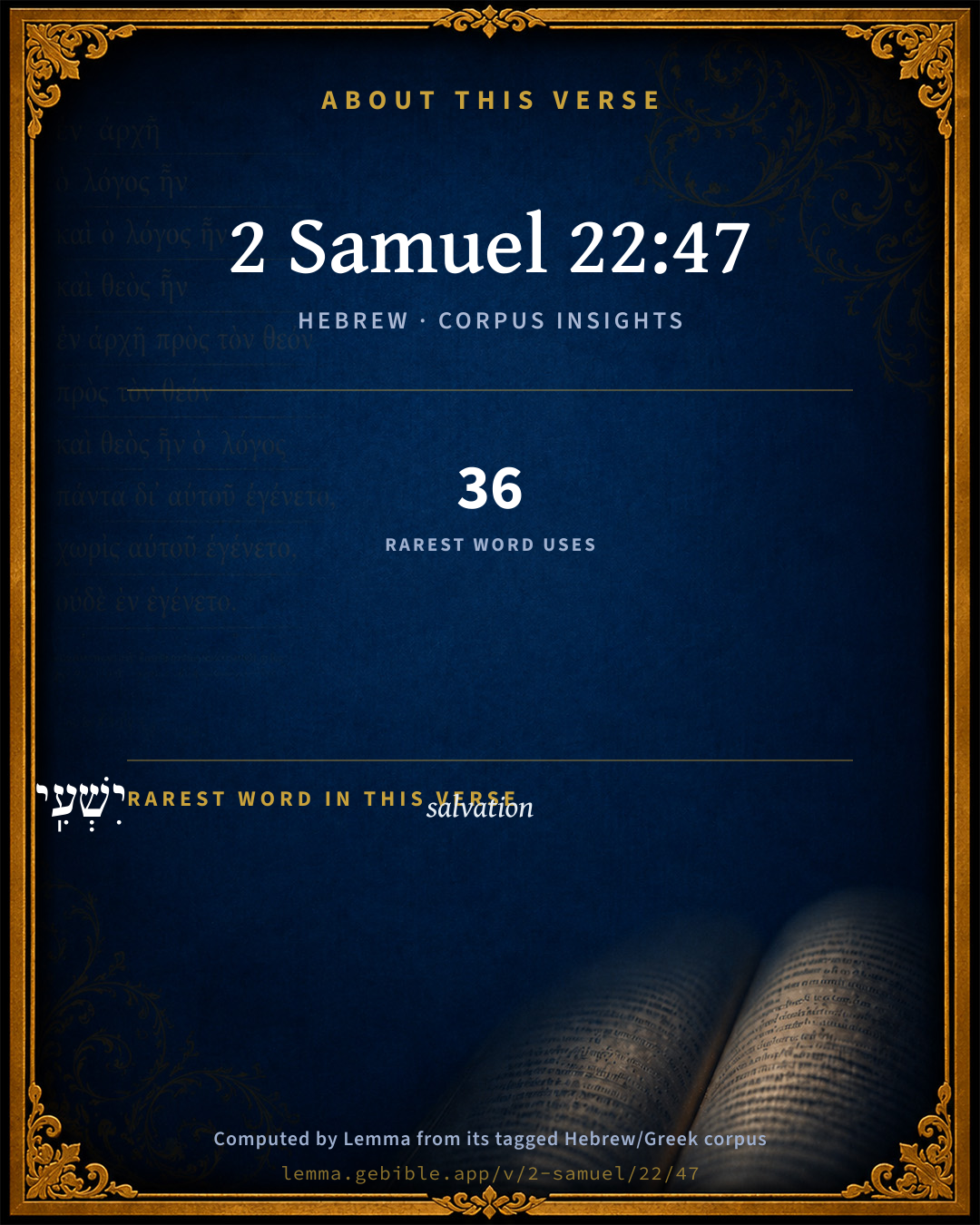
About this verse

These counts appear in no published source. They are computed here, from the morphology-tagged text and Lemma’s own curated glosses. What Lemma adds →

8
words
7
distinct lemmas
Historical
section

Shared distinctive vocabulary

יִשְׁעִֽי salvation H3468 occurs in 35 verses of the Hebrew Bible. Also found in:

Grammatical profile

  • 2 verbs
  • 5 nouns
  • 1 adjective

Verb forms

  • וּבָר֣וּךְ Qal · Participle Passive
  • וְיָרֻ֕ם Qal · Jussive

Repetition

A word recurs within this verse — often emphatic in Hebrew:

  • צוּרִ֑י rock H6697 ×2

Hebrew & Septuagint length

In English translation the verse runs 14 words from the Hebrew and 17 from the Septuagint (LXX English) — closely comparable.

A rough comparison of the two English renderings, which tokenize alike — not a word-level alignment.

Word counts can differ between the Hebrew and the Greek without any difference in meaning — e.g. the Hebrew direct-object marker אֵת has no separate Greek word, and Greek often adds the article ὁ.

Cross-references

5

Topical passages linked to 2 Samuel 22:47 in the Treasury of Scripture Knowledge — connected by theme and wording, ordered by reader-vote popularity; previews shown in the World English Bible.

  • Psalms 89:26 He will call to me, 'You are my Father, My God, and the rock of my salvation!'
  • 2 Samuel 22:3 God, my rock, in him will I take refuge; My shield, and the horn of my salvation, my high tower, and my refuge; My savior, you save me from violence.
  • Job 19:25 But as for me, I know that my Redeemer lives. In the end, he will stand upon the earth.
  • Deuteronomy 32:39–40 See now that I, even I, am he, There is no god with me: I kill, and I make alive; I wound, and I heal; There is none who can deliver out of my hand.
  • Luke 1:47 My spirit has rejoiced in God my Savior,

Cross-references courtesy of OpenBible.info (CC BY 4.0).

Hebrew and Greek witnesses Masoretic Hebrew ↔ Greek Septuagint

The same verse in the two great witnesses to the Old Testament, shown verse-for-verse.

These are two independent witnesses, not word-aligned to each other, and the Septuagint is shown in lemma (dictionary) form.

Hebrew 2 Samuel 22:47 Masoretic · Westminster Leningrad Codex

חַי יְהוָ֖ה וּבָר֣וּךְ צוּרִ֑י וְיָרֻ֕ם אֱלֹהֵ֖י צ֥וּר יִשְׁעִֽי

Yahweh lives; Blessed be my rock; Exalted be God, the rock of my salvation,

World English Bible · Public Domain

Greek LXX 2 Samuel 22:47 Septuagint · lemma form

ζάω κύριος καί εὐλογητός ὁ φύλαξ ἐγώ καί ὑψόω ὁ θεός ἐγώ ὁ φύλαξ ὁ σωτηρία ἐγώ

The Lord lives, and blessed be my guardian, and my God, my strong keeper, shall be exalted.

LXX2012 (modern English Septuagint) · Public Domain

Hebrew: Westminster Leningrad Codex (CC BY 4.0). Greek: Septuagint (public domain); English from LXX2012 (modern English Septuagint) (Public Domain). How the Septuagint differs from the Hebrew →

Targum (Aramaic paraphrase)

1

The Targum is the ancient Jewish Aramaic paraphrase of the Hebrew Scriptures — an interpretive translation, not the Hebrew text itself. Onkelos (literal) and Pseudo-Jonathan (expansive) render the Torah, and Jonathan the Prophets. Coverage is partial: where no permissively-licensed English translation exists for a verse, only the Aramaic is shown. This is verse-level text, not a word-by-word alignment to the Hebrew.

  1. Targum Jonathan Prophets (Joshua–Malachi)
    בְּכֵן עַל נִיסָא וּפוּרְקָנָא דַעֲבַדְתָּא לְעַמָךְ בֵּית יִשְׂרָאֵל אוֹדִיאוּ וַאֲמַרוּ קַיָים הוּא יְיָ וּבְרִיךְ תַּקִיפָא דְמִן קֳדָמוֹהִי מִתְיְהִיב לָנָא תְּקוֹף וּפּוּרְקַן וּמְרוֹמֵם אֱלָהָא תְּקוֹף פּוּרְקָנָנָא:

    (no public-domain English translation for this verse)

    Targum Jonathan — Aramaic: “Mikraot Gedolot” (public domain). English: “Sefaria Community Translation” (CC0 1.0 (public-domain dedication)); “London "Chaldee Paraphrase," 1871” (public domain). Text via Sefaria.

Commentary

Notes on 2 Samuel 22:47 from classic Christian and Jewish commentators (each source and its license shown beneath its notes). The classic Christian expositions comment on the surrounding passage and are grouped to its opening verse, so a note may address several verses; the Jewish commentaries on the Tanakh (Rashi and others) are per-verse, so they appear only where the commentator wrote on this verse.

Lemma curates 59 commentaries, every one of them public domain or Creative Commons licensed, each selected and text-cleaned for this edition rather than reprinted as found. About our sources →

The Biblical Illustrator

Joseph S. Exell

2Sa_22:47

The Lord liveth.

A live Christ

One day the late Dr. Dale, of Birmingham, was writing a sermon, and when half-way through, the thought of the living and risen Lord broke in upon him as it had never done before. Christ is alive! I said to myself. Alive! and then I paused. Alive! And then I paused again. Alive! Can that really be true? Living as really as I myself am? I got up and walked about, repeating, Christ is living! Christ is living! At first it seemed strange and hardly true, but at last it came upon me as a burst of sudden glory. It was to me a new discovery. I thought all along I had believed it, but not until that morning did I feel sure about it. For months afterwards the one great theme of his preaching was the living Christ.

The Biblical Illustrator, edited by Joseph S. Exell (c. 1880s–1900s) — public domain. Text from a community e-Sword module.

The Preacher's Complete Homiletical Commentary

Joseph S. Exell (gen. ed.)

CRITICAL AND EXPOSITORY NOTES

2Sa_22:47. “The Lord liveth.” In contrast to imaginary gods or dead idols. Some modern expositors understand this to be equivalent to the acclamation uttered at the coronation of an earthly monarch, but Keil, Alexander, Erdrnann, and others, point out that this would be inappropriate to any but a mortal being. They take it simply as a declaration which “itself is to be taken as praise of God” (Keil), for “praising God is simply ascribing to Him the glorious perfections which belong to Him; we have only to give Him what is His own.” (Hengstenberg.) “Blessed,” i.e., praised, or worthy to be praised. “Rock.” (See on 2Sa_22:2; 2Sa_22:32.)

2Sa_22:49. “The violent man.” Most writers take this to refer in the first instance to Saul, but to him as typical of a class.

2Sa_22:50. “Among the heathen.” Or, the nations. “This indicates that David’s experienced mercies were so great, that the praise of them should not be confined within the narrow bounds of Palestine, He can only have a proper auditory in the nations of the whole earth.” (Hengstenberg.) “Paul was therefore perfectly justified in quoting the verse in Rom_16:9, along with Deu_32:43 and Psa_117:1, as a proof that the salvation of God was intended for Gentiles also.” (Keil.)

2Sa_22:51. “His king … His anointed.” “The king whose salvation the Lord had magnified was not David as an individual, but David and his seed for ever—that is to say, the royal family of David which culminated in Christ. David could thus sing praises on the ground of the promise which he had received (2Sa_7:12-16), and which is repeated almost verbatim in the last clause of this verse.” (Keil)

MAIN HOMILETICS OF THE PARAGRAPH.—2Sa_22:47-51

DAVID’S SOGS.—PART IV

I. That Jehovah lives ought to be enough to satisfy every human soul. All that David has said or can say is wrapped up in the words, “The Lord liveth.” That God lives is a sufficient guarantee, not only that His children will live, but that the best that is possible will be done for them and with them. Man feels conscious that he does not exist of himself and that he needs a stronger, a better, a higher life than his own upon which he can rest and whence he can draw supplies. In God, those who seek, find this need supplied—they testify, “With Thee is the fountain of life, in thy light shall we see light” (Psa_36:9). They feel that the bodily and the spiritual life they now possess is from this living Jehovah, that He who gave them existence has given them what alone makes it worth having, a participation in His own Divine nature (2Pe_1:4), and they rejoice in the confidence that while He lives they shall also live in the highest and best sense of the word. The life of God is a life separated from all injustice and unkindness, and it is a life not merely without any shadow of unrighteousness but a life of active justice and mercy. This being so, His existence ought to be for all men what it was to the Psalmist, a ground for hope and exultation. We cannot explain all the mysteries of His dealings with the children of men, some of David’s own words here do but remind us that clouds and darkness are often round about Him, but the simple fact of the existence of such a God is a rock upon which we may rest.

II. Every human life lived to purpose is lived in dependence upon the living God. It is David’s constant testimony that so far as he had fulfilled the high destiny to which he had been called, he had done so by remembering that he was nothing and that God was everything. “The Lord is my strength,” was his watchword on the day when he slew the giant, and, with few exceptions, it continued to be so until the hour in which he went “the way of all the earth” (1Ki_2:2). He has left it upon record that every deed of his life that had been worth doing had been done in dependence upon the Lord who took him from the sheepfold and who had never failed him whenever he had sought His help. Every man who has lived a life worth living has lived it by putting his trust in David’s God, and every life has been worth living that has been so lived. The narrow circle of every man’s experience, and the wider range of history, furnish abundant proofs how poor a record the greatest leave behind them when they try to stand alone, and how blessed and honoured is the memory of many a lowly servant of God, who, when on earth, lived a life of faith, and therefore was enabled to fulfil the end of his being. But it is not only obscure lives that have been thus en-nobled—all the greatest names that adorn the pages of human history belong to those who have said with David, “God is my strength and power” and with Paul, “Yet not I, but Christ liveth in me” (Gal_2:20).

OUTLINES AND SUGGESTIVE COMMENTS

2Sa_22:47. A certain sense of solitariness grows upon a man as he becomes older. Those who were venerable in his youthful days, and to whom he looked for counsel, are one by one carried to the tomb. The companions of his early manhood fall at his side. He comes at length to a time when he does not care to make many new friends; and when he reaches the limit of three-score years and ten, he begins to feel himself almost a stranger, even in the place where he has spent his life. Perhaps a king, more than most other men, will realize this experience. The poet has spoken of “the lonely glory of a throne.” The monarch has no equals, and, from the nature of the case, can have few confidants and counsellors, except such as are venerable for age. But as his reign wears on, one after another of these early friends are taken away; and as each is removed, he is apt to think that a part of himself has been withdrawn from him. Thus loneliness steals over him, and he comes at length to be, like Moses among the tribes, the solitary survivor of a buried generation. Something like this, I doubt not, was felt by David as he advanced into old age. Samuel was gone; Jonathan was no more; Ahithophel had proved a traitor; Joab had become a thorn in his side; but there was One always true, and it was with no ordinary emotion, we may be sure, that out of his earthly solitude he sang of his fidelity and deathlessness: “The Lord liveth, and blessed be my rock, and exalted be the God of my salvation.” Let the aged among us fall back on this assurance, and find their solace in the companionship of the Most High. He hath said, “I will never leave thee nor forsake thee.”—Dr. Taylor.

Why do you not boast in your God and bear up yourselves big with your expectations from him? Do you not see young heirs to great estates act and spend accordingly? And why shall you, being the King of Heaven’s son, be lean and ragged from day to day, as though you were not worth a groat? Oh, sirs, live upon your portion; chide yourselves for living beside what you have! There are great and precious promises; rich, enriching mercies; you may make use of God’s all-sufficiency; you can blame none but yourselves if you be defective or discouraged.… Ask your fainting spirits under pressing outward sorrows, is not God alive? And why, then, doth not thy soul revive? Why doth thy heart die within thee when comforts die? Cannot a living God support thy dying hopes?—Oliver Heywood.

2Sa_22:50. Paul cites this verse (Rom_15:9). This is clear evidence that David’s Lord is here, but David is here too, and is to be viewed as an example of a holy soul making its boast in God, even in the presence of ungodly men. Who are the despisers of God that we should stop our mouths for them? We will sing to our God whether they like it or no, and force upon them the knowledge of His goodness. Too much politeness to traitors may be treason to our King.—Spurgeon.

Whole chapter. This psalm is called by Michaelis more artificial, and less truly terrible, than the Mosaic odes. In structure it may be so, but surely not in spirit. It appears to many besides us, one of the most magnificent lyrical raptures in the Scriptures. As if the poet had dipped his pen in “the brightness of that light which was before his eye;” so he describes the descending God. Perhaps it may be objected that the nodus is hardly worthy of the vindex—to deliver David from his enemies, could Deity ever be imagined to come down? But the objector knows not the character of the ancient Hebrew mind. God in His view had not to descend from heaven; He was nigh—a cloud like a man’s hand might conceal—a cry, a look, might bring him down. And why should not David’s fancy clothe Him, as He came, in a panoply befitting His dignity, in clouds spangled with coals of fire? If he was to descend, why not in state? The proof of the grandeur of this psalm is in the fact that it has borne the test of almost every translation, and made doggerel itself erect itself and become Divine. Even Sternhold and Hopkins its fiery whirlwind lifts up, purifies, touches into true power and then throws down, helpless and panting, upon their ancient common. Perhaps its great charm, apart from the poetry of the descent, is the exquisite and subtle alternation of I and Thou. We have spoken of parallelism, as the key to the mechanism of Hebrew song. We find this existing between David and God—the delivered and the Deliverer—beautifully pursued throughout the whole of this psalm.… It has been ingeniously argued that the existence of the I suggests inevitably as a polar opposite the thought of the Thou, that the personality of man proves thus the personality of God; but, be this as it may, David’s perception of that personality is nowhere so intense as here. He seems not only to see, but to feel and touch, the object of his gratitude and worship.—Gillfilan.

The Preacher's Complete Homiletical Commentary (gen. ed. Joseph S. Exell; Funk & Wagnalls, c. 1892) — public domain (pre-1929). A full-Bible homiletical/sermon-outline anthology covering 65 of 66 books (2 John is absent from the source module). Text from a community e-Sword module.

Geneva Bible (1599)

Geneva Bible translators

Let him show his power, that he is the governor of all the world.

Geneva Bible (1599) marginal notes — public domain. Text via Bolls.life.

The Cambridge Bible for Schools and Colleges

gen. ed. J. J. S. Perowne

47–51. Concluding thanksgiving and doxology

47. The Lord liveth] Life is the essential attribute of Jehovah, Who is the Living God in contrast to the dead idols of the heathen. The experience of David’s life was to him a certain proof that God is the living, acting Ruler of the World. Cp. Jos_3:10.

the God of the rock of my salvation] God who is strong and faithful to work out deliverance for me. Cp. 2Sa_22:3. Psa_18:46 has merely “the God of my salvation.”

The Cambridge Bible for Schools and Colleges (gen. ed. J. J. S. Perowne; Cambridge University Press, 1878–1918) — public domain. Text from a community e-Sword module.

The Pulpit Commentary

Vers. 47-49.

Jehovah liveth; and blessed be my Rock, And exalted be the God of the rock of my salvation, Even the God that giveth me avengements, And bringeth down peoples under me. And bringeth me forth from my enemies. Yea, thou liftest me up above those that rise up against me; From the violent man thou deliverest me.

Psa_18:46 we find simply "the God of my salvation." Perhaps there seemed to the compiler to be some confusion in calling Jehovah, first David"s Rock, and then the God of his rock (but see note on ver. 3). Avengements, in the plural. In the Law the sanctions were chiefly temporal, and therefore the saints of old watched anxiously for, and were strengthened by observing, the constantly recurring proofs of God"s righteous government of men. Peoples, in the plural; heathen nations. The violent man may especially be Saul, as is supposed in the title prefixed to this song in the Book of Psalms. There probably it is general, and includes all who were bitter in their hostility to David.

Praise to God as the ever living Saviour.

The whole psalm is a song of praise to God, but some parts bear more distinctively this character. This verse is one of them.

I THE TITLES HERE GIVEN TO GOD.

1. Rock. (See on ver. 32.) My Rock." The Rock to which I have fled, and where I have found safety and repose. The Rock in which I still trust and will trust with full assurance of its stability and security, whatever be the confidences of others. It is a blessed thing, in speaking of God, to be able to use this word "my," as expressive of personal experience, choice, and confidence.

2. The God of the Rock of my salvation; equivalent to "the God who is the Rock of my salvation," "my mighty Saviour." David had experienced salvation from enemies and dangers many times and in many ways; and he ascribes all to God. By whatever means and instruments, it was God who had delivered him. He had been manifested in his history as the God of salvation; and in saving him had shown himself a Rock, the Rock in which alone safety was to be found. The higher and better salvation which is presented to us in the gospel is from God. With him it originated; by him in Christ it is wrought. Christians joyfully recognize God as the God of salvation, the Rock of salvation. It is for men one of the most glorious and encouraging names of God. God the Creator, God the Preserver, God the Ruler, are glorious names; but unless to them could be added God the Saviour, they would afford no hope or comfort. It is this which renders all other names of God attractive and inspiring. Specially gladdening is it to be able to say, "The God of my salvation," the Rock of ages in which I find refuge, the God who has saved me and is saving me, and in whom I trust that he will fully save me, from the guilt, power, and consequences of my sins, and all the assaults of the deadly enemies of my soul.

II THE DECLARATION MADE RESPECTING HIM. "The Lord liveth." Which expresses:

1. His real existence. In contrast with idols, which are dead, helpless, and unable to help.

2. His continued existence. In contrast with men, who die and pass away.

3. His manifested existence. He lives and works in the world, in the Church, in each believer. By his operations for the good of his people, he shows himself the living God.

4. The satisfaction which his servants feel in him as ever living.

(1) Joy that such a Being is their God. That they know and worship the true and living God.

(2) Confidence that his life renders all their interests secure for this world and the next. And not only their interests as individuals, but those of the whole Church of God. Because he lives, his Church cannot perish.

(3) Comfort under the death of Christian friends. He lives; and therefore their death was his act. It did not befall them because he had ceased to be or to be able to deliver. He lives, to support and comfort those who survive. He lives, to supply the place of the departed in the family, the Church, the world. He lives, and therefore they live and will live forever. For through Christ their life was and is rooted in his. He is their abiding Dwelling place.

III THE PRAISE RENDERED TO HIM. "Blessed" (equivalent to "praised"), "exalted

1. Praise is the utterance of exalted thoughts and feelings respecting him.Without these the language of praise is of no value.

2. To publish his praise by speech or writing is to exalt him in view ofothers.

3. Praise in such words as are here employed expresses the desire that allshould exalt him by accepting, loving, obeying, and extolling him.

4. The publication of his praise is adapted to produce this result.

5. The exaltation of God should ever be sought in our services of praise.Some such services tend rather to the exaltation of musical composers, organists, and choirs. G.W.

The Pulpit Commentary (1880–1919), ed. H.D.M. Spence-Jones & Joseph S. Exell — public domain. Text from a community e-Sword module.

Keil & Delitzsch

C. F. Keil & F. Delitzsch

47 Jehovah liveth, and blessed is my rock,

And the God of my refuge of salvation is exalted.

48 The God who giveth me vengeance,

And bringeth nations under me;

49 Who leadeth me out from mine enemies,

And exalteth me above mine adversaries,

Delivereth me from the man of violence.

The formula חי־יהוה does not mean "let Jehovah live," for the word יחי would be used for that (vid., Sa2 16:16; Sa1 10:24), but is a declaration: "the Lord is living." The declaration itself is to be taken as praise of God, for "praising God is simply ascribing to Him the glorious perfections which belong to him; we have only to give Him what is His own" (Hengstenberg). The following clauses also contain simply declarations; this is evident from the word ירוּם, since the optative ירם would be used to denote a wish. The Lord is living or alive when He manifests His life in acts of omnipotence. In the last clause, the expression צוּר (rock) is intensified into ישׁעי צוּר אלהי (the God of my refuge, or rock, of salvation), i.e., the God who is my saving rock (cf. Sa2 22:3). In the predicates of God in Sa2 22:48, Sa2 22:49, the saving acts depicted by David in vv. 5-20 and 29-46 are summed up briefly. Instead of מוריד, "He causes to go down under me," i.e., He subjects to me, we find in the psalm ויּדבּר, "He drives nations under me," and מפלטי instead of מוציאי; and lastly, instead of חמס אישׁ in the psalm, we have here חמסים אישׁ, as in Psa 140:2. Therefore the praise of the Lord shall be sounded among all nations.

Keil & Delitzsch — Biblical Commentary on the Old Testament (1861–1891) — public domain (CC PDM 1.0). Text via the HelloAO Bible API. (Old Testament only.)

unfoldingWord translationNotes

Door43 World Missions Community

May my rock be praised. May God be exalted

These sentences have similar meaning and are used for emphasis. These may be stated in active form. AT: "May everyone praise my rock. May everyone exalt God" (See: Parallelism and Active or Passive)

my rock ... the rock

David compares Yahweh to a rock to emphasize his power to protect his people. (See: Metaphor)

the one who brings down peoples under me

"the one who puts the people of other nations under my rule"

you lifted me up above those who rose up against me

"you saved me from my enemies and gave me honor"

from violent men

"from those who want to harm me"

translationWords

life

praise

exalt

save

avenge

people group

free

raise

unfoldingWord translationNotes — © Distant Shores Media and the Door43 World Missions Community, licensed CC BY-SA 4.0. Source: git.door43.org/Door43/en_tn.

Rashi

Rabbi Shlomo Yitzchaki (Rashi)

Adonoy lives. Who does all of this for me.

Rashi on the Tanakh — English translations: “The Judaica Press complete Tanach with Rashi, translated by A. J. Rosenberg” (CC BY 4.0); “Pentateuch with Rashi's commentary by M. Rosenbaum and A.M. Silbermann, 1929-1934” (public domain); “The Metsudah Tanach series, Lakewood, N.J” (CC BY 4.0); and “The Book of Joshua, Metsudah Publications, 1997” (CC BY 4.0). Text via Sefaria.

Lesson kit

Teaching starters — assembled from the data on this page, not authored interpretation. Every prompt links to the verse data it draws on. Edit before teaching.

2 Samuel, in the Historical, opens this verse with 8 words (7 distinct Hebrew lemmas). Its most distinctive word is yeshaʻ (“salvation”). A historical commentator’s framing appears above. Read the whole chapter for the surrounding context.

Discussion questions

  1. What does “salvation” (yeshaʻ) contribute to the verse as a whole?
  2. 2 Samuel 22:3 shares the word «salvation» with this verse. How do the two illuminate each other?
  3. “rock” occurs 2× in this one verse. What is the effect of the repetition?
  4. The translations on this page render this verse differently — a whole-verse word diff, not a word-by-word alignment. What might account for the different wordings?
  5. The verb «וּבָר֣וּךְ» is Qal Participle Passive. How does its form color the action?
  6. Reading how The Biblical Illustrator and The Preacher's Complete Homiletical Commentary read this verse, where do the two commentators agree and where do they part?

Things to notice

Reading settings

Reading text

Shown beneath each verse's original-language words.

Old Testament
Old Testament edition

Read the OT as the Masoretic Hebrew (MT) or the Greek Septuagint (LXX).

English shown for the Greek Septuagint (in the Hebrew ↔ Greek comparison).

Comparing translations? Open the Compare panel on any verse page to stack up to four side by side.