
Exodus 20:24

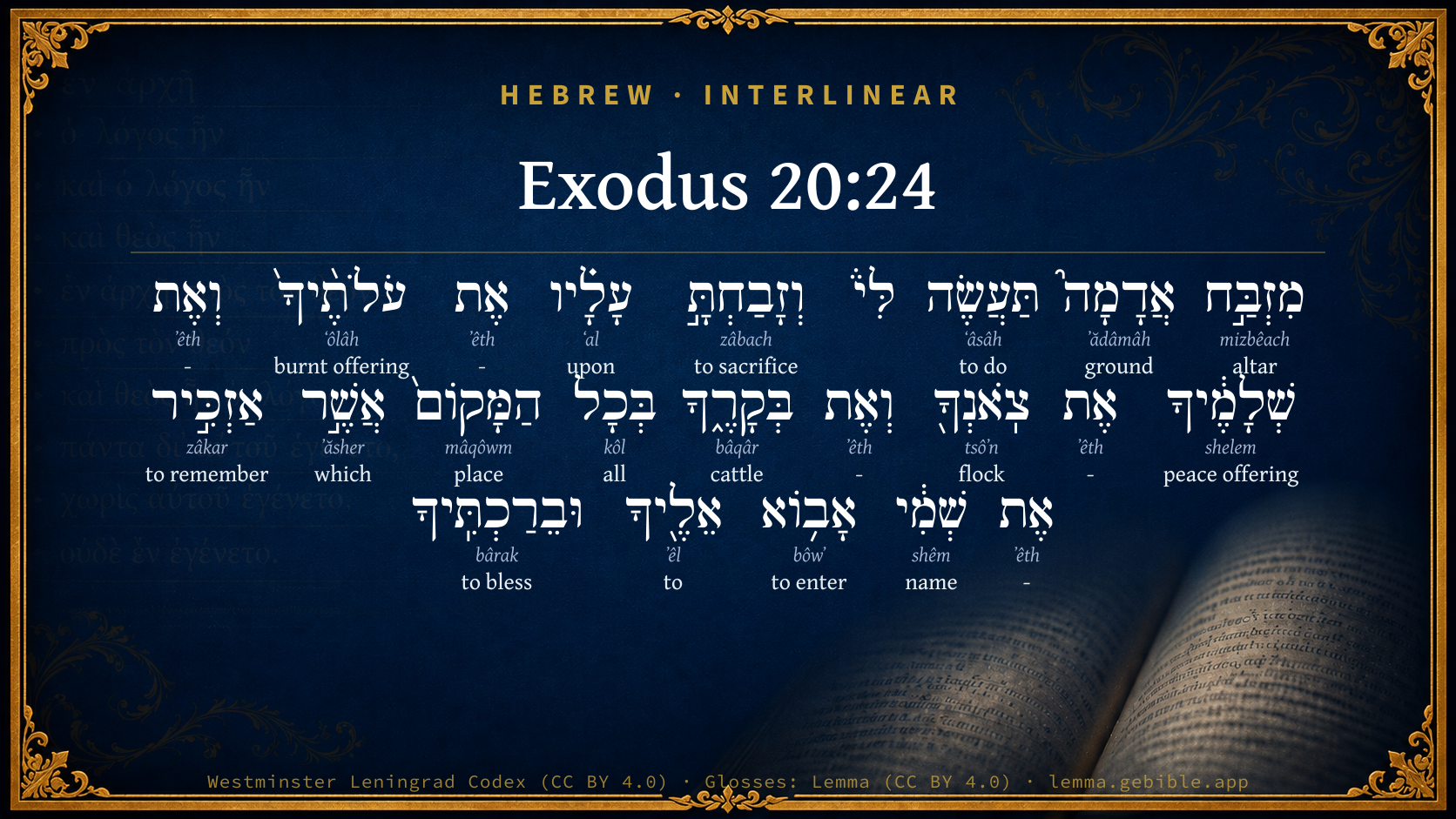
Hebrew (Westminster Leningrad Codex) Exodus 20:24 appears in the Hebrew Old Testament. The text above is from the Westminster Leningrad Codex. Each word links to its Strong’s number, a concise gloss, and parsing drawn from the Open Scriptures Hebrew Bible morphology. Click any word for its full Brown-Driver-Briggs (BDB) entry.
Download image
Cite this verse

Exodus 20:24 (World English Bible). Public Domain. Lemma interlinear Bible study tool, https://lemma.gebible.app/v/exodus/20/24.

Show BibTeX & RIS
BibTeX
RIS
English Translation
You shall make an altar of earth for me, and shall sacrifice on it your burnt offerings and your peace-offerings, your sheep and your oxen. In every place where I record my name I will come to you and I will bless you.
World English Bible · Public Domain
Highlights
  • 1 first appearance in the Hebrew Bible
Full analysis ↓
Download a study sheet

One document with this verse’s original text, its word-by-word gloss line, the meaning frame, cross-references with their text, attributed commentary, and full source and license credits — printable, and it pastes into notes with its structure intact.

This verse Autodidact and up

Study sheet (.html) Plain text (.txt)

A passage Seminary Student

Up to 50 verses in one chapter. A passage sheet keeps up to 6 commentary sources and 12 cross-references per verse, in the order this page ranks them, and says so on the sheet whenever that leaves anything out. Ask for a single verse and you get the Autodidact verse sheet above.

Everything on this page stays free to read, with no account — the sheet is a download of what is already on screen, not access to it.

Want to remove ads? Support Godless Engineer
Compare translations 3

The same verse in 3 English versions, stacked beneath the original-language interlinear above. Click any original word for its lexicon entry.

Each is an independent rendering of the whole verse — the interlinear is not word-aligned to these translations.

Highlighted words mark where these versions differ — a whole-verse word diff, not a word-by-word alignment.

  • World English Bible Public Domain
    You shall make an altar of earth for me, and shall sacrifice on it your burnt offerings and your peace-offerings, your sheep and your oxen. In every place where I record my name I will come to you and I will bless you.
  • King James Version Public Domain
    An altar of earth thou shalt make unto me, and shalt sacrifice thereon thy burnt offerings, and thy peace offerings, thy sheep, and thine oxen: in all places where I record my name I will come unto thee, and I will bless thee.
  • unfoldingWord Literal Text CC BY-SA 4.0
    You shall make an altar of earth for me, and you shall sacrifice on it your burnt offerings, and peace offerings, sheep, and oxen. In every place where I cause my name to be remembered, I will come to you and bless you.

unfoldingWord Literal Text — © unfoldingWord, licensed CC BY-SA 4.0. Word-aligned USFM3 via Door43 (git.door43.org/unfoldingWord/en_ult).

Versions to compare (up to 4)

3 of 4 selected

Show all 18 translations

Every available English version of this verse, each an independent rendering of the whole verse.

  • World English Bible Public Domain
    You shall make an altar of earth for me, and shall sacrifice on it your burnt offerings and your peace-offerings, your sheep and your oxen. In every place where I record my name I will come to you and I will bless you.
  • Berean Standard Bible Public Domain
    You are to make for Me an altar of earth, and sacrifice on it your burnt offerings and peace offerings, your sheep and goats and cattle. In every place where I cause My name to be remembered, I will come to you and bless you.
  • Majority Standard Bible Public Domain
    You are to make for Me an altar of earth, and sacrifice on it your burnt offerings and peace offerings, your sheep and goats and cattle. In every place where I cause My name to be remembered, I will come to you and bless you.
  • King James Version Public Domain
    An altar of earth thou shalt make unto me, and shalt sacrifice thereon thy burnt offerings, and thy peace offerings, thy sheep, and thine oxen: in all places where I record my name I will come unto thee, and I will bless thee.
  • American Standard Version (1901) Public Domain
    An altar of earth thou shalt make unto me, and shalt sacrifice thereon thy burnt-offerings, and thy peace-offerings, thy sheep, and thine oxen: in every place where I record my name I will come unto thee and I will bless thee.
  • Revised Version (1885) Public Domain
    An altar of earth thou shalt make unto me, and shalt sacrifice thereon thy burnt offerings, and thy peace offerings, thy sheep, and thine oxen: in every place where I record my name I will come unto thee and I will bless thee.
  • Geneva Bible (1599) Public Domain
    An altar of earth thou shalt make vnto me, and thereon shalt offer thy burnt offerings, and thy peace offerings, thy sheepe, and thine oxen: in all places, where I shall put the remembrance of my Name, I will come vnto thee, and blesse thee.
  • Douay-Rheims (1899) Public Domain
    You shall make an altar of earth unto me, and you shall offer upon it your holocausts and peace offerings, your sheep and oxen, in every place where the memory of my name shall be: I will come to thee, and will bless thee.
  • Young's Literal Translation Public Domain
    `An altar of earth thou dost make for Me, and thou hast sacrificed on it thy burnt-offerings and thy peace-offerings, thy flock and thy herd; in every place where I cause My name to be remembered I come in unto thee, and have blessed thee.
  • Literal Standard Version CC BY-SA 4.0
    You make an altar of earth for Me, and you have sacrificed on it your burnt-offerings and your peace-offerings, your flock and your herd; in every place where I cause My Name to be remembered I come to you, and have blessed you.
  • Unlocked Literal Bible CC BY-SA 4.0
    You must make an earthen altar for me, and you must sacrifice on it your burnt offerings, fellowship offerings, sheep, and oxen. In every place where I cause my name to be honored, I will come to you and bless you.
  • unfoldingWord Literal Text CC BY-SA 4.0
    You shall make an altar of earth for me, and you shall sacrifice on it your burnt offerings, and peace offerings, sheep, and oxen. In every place where I cause my name to be remembered, I will come to you and bless you.
  • Darby Bible Public Domain
    An altar of earth shalt thou make unto me, and shalt sacrifice on it thy burnt-offerings, and thy peace-offerings, thy sheep and thine oxen: in all places where I shall make my name to be remembered, I will come unto thee, and bless thee.
  • World Messianic Bible Public Domain
    You shall make an altar of earth for me, and shall sacrifice on it your burnt offerings and your peace offerings, your sheep and your cattle. In every place where I record my name I will come to you and I will bless you.
  • Webster's Bible Public Domain
    An altar of earth thou shalt make to me, and shalt sacrifice thereon thy burnt-offerings, and thy peace-offerings, thy sheep, and thy oxen: in all places where I record my name I will come to thee, and I will bless thee.
  • Free Bible Version CC BY-SA 4.0
    Make me an altar of earth, and sacrifice on it your burnt offerings and peace offerings, your sheep, goats, and cattle. Wherever I decide to be worshiped, I will come to you and bless you.
  • Bible in Basic English Public Domain
    Make for me an altar of earth, offering on it your burned offerings and your peace-offerings, your sheep and your oxen: in every place where I have put the memory of my name, I will come to you and give you my blessing.
  • JPS Tanakh (1917) Public Domain
    (20-21) An altar of earth thou shalt make unto Me, and shalt sacrifice thereon thy burnt-offerings, and thy peace-offerings, thy sheep, and thine oxen; in every place where I cause My name to be mentioned I will come unto thee and bless thee.

Literal Standard Version (2020), Covenant Press — licensed CC BY-SA 4.0. Text via the HelloAO Bible API (eBible.org). Unlocked Literal Bible (unfoldingWord) — licensed CC BY-SA 4.0. Text via the HelloAO Bible API (eBible.org). unfoldingWord Literal Text — © unfoldingWord, licensed CC BY-SA 4.0. Word-aligned USFM3 via Door43 (git.door43.org/unfoldingWord/en_ult). Free Bible Version, Dr. Jonathan Gallagher — licensed CC BY-SA 4.0. Text via the HelloAO Bible API (eBible.org).

Word by word

More ways to search: Search by grammar → Find every occurrence → Compare this word →

Practice this passage: Drill this verse → Learn its vocabulary →

שְׁלָמֶ֔יךָ
shelem
H8002
“peace offerings · your”
Noun, Common, Masculine, Plural, Construct + Suffix, Personal, 2nd Person, Masculine, Singular
Part of Speech
Noun
Type
Common
Gender
Masculine
Number
Plural
State
Construct
Full BDB Definition

Origin: from H7999

TWOT: 2401b

peace offering, requital, sacrifice for alliance or friendship - voluntary sacrifice of thanks
  1. מִזְבַּ֣ח mizbêach H4196 “altar of” Noun, Common, Masculine, Singular, Construct
  2. אֲדָמָה֮ ʼădâmâh H127 “ground” Noun, Common, Feminine, Singular, Absolute
  3. תַּעֲשֶׂה ʻâsâh H6213 “to do” Verb, Qal, Imperfect, 2nd Person, Masculine, Singular
  4. וְזָבַחְתָּ֣ zâbach H2076 “and · to sacrifice” Conjunction + Verb, Qal, Sequential Perfect, 2nd Person, Masculine, Singular
  5. עָלָ֗יו ʻal H5921 “upon · him” Preposition + Suffix, Personal, 3rd Person, Masculine, Singular
  6. אֶת ʼêth H853 “-” Particle, Direct Object
  7. עֹלֹתֶ֨יךָ֙ ʻôlâh H5930 “burnt offerings · your” Noun, Common, Feminine, Plural, Construct + Suffix, Personal, 2nd Person, Masculine, Singular
  8. וְאֶת ʼêth H853 “and · -” Conjunction + Particle, Direct Object
  9. אֶת ʼêth H853 “-” Particle, Direct Object
  10. צֹֽאנְךָ֖ tsôʼn H6629 “flock · your” Noun, Common, Both, Singular, Construct + Suffix, Personal, 2nd Person, Masculine, Singular
  11. וְאֶת ʼêth H853 “and · -” Conjunction + Particle, Direct Object
  12. בְּקָרֶ֑ךָ bâqâr H1241 “cattle · your” Noun, Common, Both, Singular, Construct + Suffix, Personal, 2nd Person, Masculine, Singular
  13. בְּכָל kôl H3605 “in/at · all of” Preposition + Noun, Common, Masculine, Singular, Construct
  14. הַמָּקוֹם֙ mâqôwm H4725 “the · place” Particle, Definite Article + Noun, Common, Masculine, Singular, Absolute
  15. אֲשֶׁ֣ר ʼăsher H834 “which” Particle, Relative
  16. אַזְכִּ֣יר zâkar H2142 “to remember” Verb, Hiphil, Imperfect, 1st Person, Common, Singular
  17. אֶת ʼêth H853 “-” Particle, Direct Object
  18. שְׁמִ֔י shêm H8034 “name · my” Noun, Common, Masculine, Singular, Construct + Suffix, Personal, 1st Person, Common, Singular
  19. אָב֥וֹא bôwʼ H935 “to enter” Verb, Qal, Imperfect, 1st Person, Common, Singular
  20. אֵלֶ֖יךָ ʼêl H413 “to · you” Preposition + Suffix, Personal, 2nd Person, Masculine, Singular
  21. וּבֵרַכְתִּֽיךָ bârak H1288 “and · to bless · you” Conjunction + Verb, Piel, Sequential Perfect, 1st Person, Common, Singular + Suffix, Personal, 2nd Person, Masculine, Singular

About this verse

These counts appear in no published source. They are computed here, from the morphology-tagged text and Lemma’s own curated glosses. What Lemma adds →

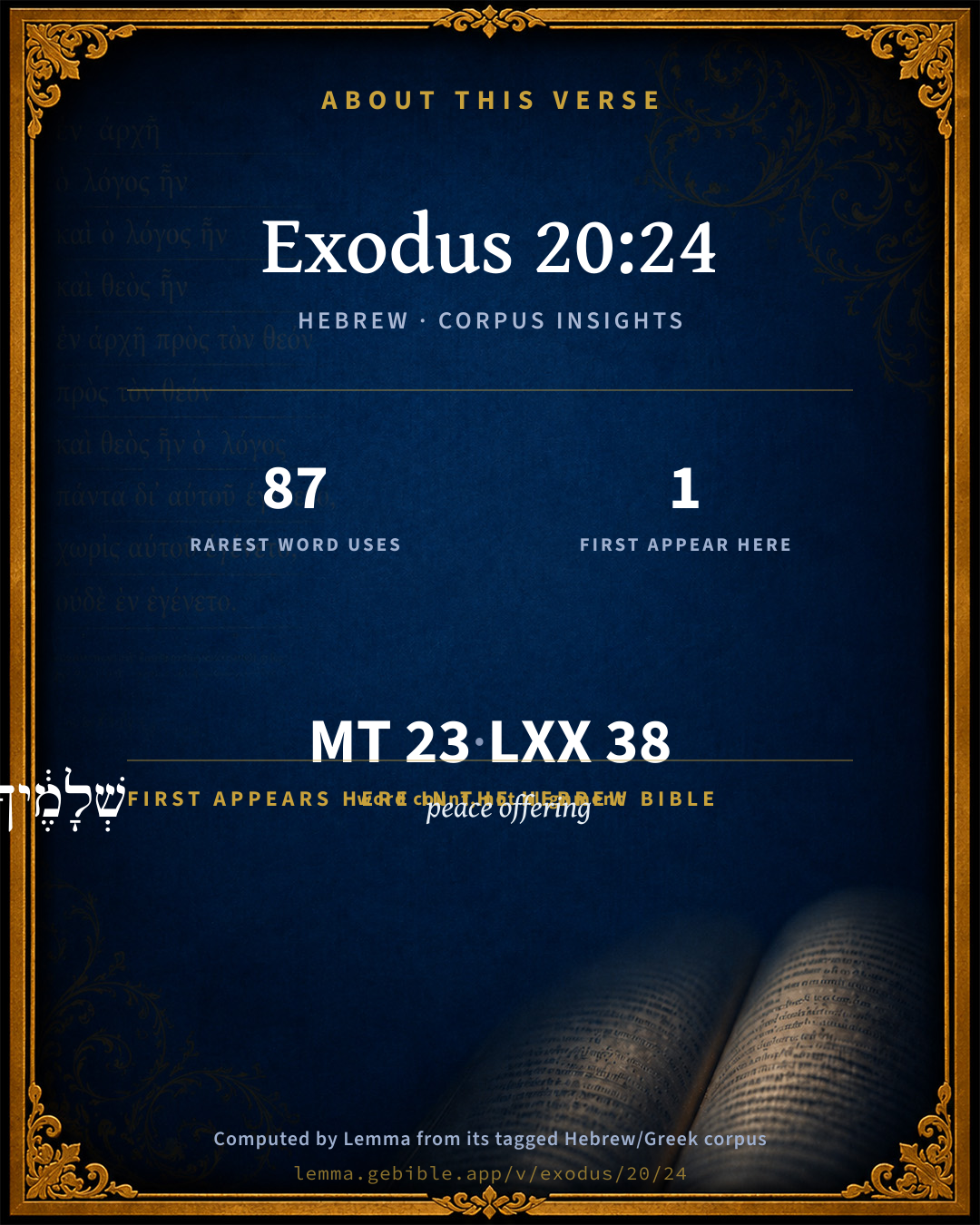
23
words
18
distinct lemmas
Pentateuch
section

First appearance in Scripture

This word makes its first canonical appearance in the Hebrew Bible here:

  • שְׁלָמֶ֔יךָ peace offering H8002

Grammatical profile

  • 5 verbs
  • 9 nouns
  • 3 prepositions
  • 6 particles

Verb forms

  • תַּעֲשֶׂה Qal · Imperfect
  • וְזָבַחְתָּ֣ Qal · Sequential Perfect
  • אַזְכִּ֣יר Hiphil · Imperfect
  • אָב֥וֹא Qal · Imperfect
  • וּבֵרַכְתִּֽיךָ Piel · Sequential Perfect

Hebrew & Septuagint length

In English translation the verse runs 43 words from the Hebrew and 46 from the Septuagint (LXX English) — closely comparable.

A rough comparison of the two English renderings, which tokenize alike — not a word-level alignment.

Word counts can differ between the Hebrew and the Greek without any difference in meaning — e.g. the Hebrew direct-object marker אֵת has no separate Greek word, and Greek often adds the article ὁ.

In the original languages it is 23 Hebrew tokens and 38 Greek tokens — but the two are counted differently (Hebrew bundles its prefixes and suffixes into one token; the Greek is in lemma form), so that isn’t a like-for-like length.

Cross-references

32

Topical passages linked to Exodus 20:24 in the Treasury of Scripture Knowledge — connected by theme and wording, ordered by reader-vote popularity; previews shown in the World English Bible.

  • Deuteronomy 12:5 But to the place which Yahweh your God shall choose out of all your tribes, to put his name there, even to his habitation shall you seek, and there you shall come;
  • Psalms 132:13–14 For Yahweh has chosen Zion. He has desired it for his habitation.
  • 2 Chronicles 6:6 but I have chosen Jerusalem, that my name might be there; and have chosen David to be over my people Israel.
  • 1 Kings 9:3 Yahweh said to him, I have heard your prayer and your supplication, that you have made before me: I have made this house holy, which you have built, to put my name there forever; and my eyes and my heart shall be there perpetually.
  • Deuteronomy 12:11 then it shall happen that to the place which Yahweh your God shall choose, to cause his name to dwell there, there shall you bring all that I command you: your burnt offerings, and your sacrifices, your tithes, and the heave-offering of your hand, and all your choice vows which you vow to Yahweh.
  • 2 Chronicles 7:16 For now have I chosen and made this house holy, that my name may be there forever; and my eyes and my heart shall be there perpetually.
  • Deuteronomy 16:11 and you shall rejoice before Yahweh your God, you, and your son, and your daughter, and your man-servant, and your maid-servant, and the Levite who is within your gates, and the foreigner, and the fatherless, and the widow, who are in the midst of you, in the place which Yahweh your God shall choose, to cause his name to dwell there.
  • Deuteronomy 26:2 that you shall take of the first of all the fruit of the ground, which you shall bring in from your land that Yahweh your God gives you; and you shall put it in a basket, and shall go to the place which Yahweh your God shall choose, to cause his name to dwell there.
  • 2 Chronicles 12:13 So king Rehoboam strengthened himself in Jerusalem, and reigned: for Rehoboam was forty-one years old when he began to reign, and he reigned seventeen years in Jerusalem, the city which Yahweh had chosen out of all the tribes of Israel, to put his name there: and his mother's name was Naamah the Ammonitess.
  • Numbers 6:24–27 'Yahweh bless you, and keep you.
  • Ezra 6:12 and the God who has caused his name to dwell there overthrow all kings and peoples who shall put forth their hand to alter [the same], to destroy this house of God which is at Jerusalem. I Darius have made a decree; let it be done with all diligence.
  • 1 Kings 8:29 that your eyes may be open toward this house night and day, even toward the place of which you have said, My name shall be there; to listen to the prayer which your servant shall pray toward this place.
  • Matthew 18:20 For where two or three are gathered together in my name, there I am in the midst of them."
  • Deuteronomy 14:23 You shall eat before Yahweh your God, in the place which he shall choose, to cause his name to dwell there, the tithe of your grain, of your new wine, and of your oil, and the firstborn of your herd and of your flock; that you may learn to fear Yahweh your God always.
  • Deuteronomy 16:5–6 You may not sacrifice the Passover within any of your gates, which Yahweh your God gives you;
  • 1 Kings 8:43 hear in heaven, your dwelling-place, and do according to all that the foreigner calls to you for; that all the peoples of the earth may know your name, to fear you, as does your people Israel, and that they may know that this house which I have built is called by my name.
  • John 4:20–24 Our fathers worshiped in this mountain, and you Jews say that in Jerusalem is the place where people ought to worship."
  • Psalms 74:7 They have burned your sanctuary to the ground. They have profaned the dwelling-place of your Name.
  • 2 Samuel 6:12 It was told king David, saying, Yahweh has blessed the house of Obed-edom, and all that pertains to him, because of the ark of God. David went and brought up the ark of God from the house of Obed-edom into the city of David with joy.
  • Nehemiah 1:9 but if you return to me, and keep my commandments and do them, though your outcasts were in the uttermost part of the heavens, yet will I gather them from there, and will bring them to the place that I have chosen, to cause my name to dwell there.
  • Deuteronomy 12:21 If the place which Yahweh your God shall choose, to put his name there, be too far from you, then you shall kill of your herd and of your flock, which Yahweh has given you, as I have commanded you; and you may eat within your gates, after all the desire of your soul.
  • Jeremiah 7:10–12 and come and stand before me in this house, which is called by my name, and say, We are delivered; that you may do all these abominations?
  • Malachi 1:11 For from the rising of the sun even to the going down of the same, my name is great among the nations, and in every place incense will be offered to my name, and a pure offering: for my name is great among the nations," says Yahweh of Hosts.
  • Matthew 28:20 teaching them to observe all things that I commanded you. Behold, I am with you always, even to the end of the age." Amen.
  • Psalms 76:2 His tent is also in Salem; His dwelling place in Zion.
  • Psalms 78:68 But chose the tribe of Judah, Mount Zion which he loved.
  • 1 Timothy 2:8 I desire therefore that the men in every place pray, lifting up holy hands without wrath and doubting.
  • Psalms 128:5 May Yahweh bless you out of Zion, And may you see the good of Jerusalem all the days of your life.
  • Genesis 12:2 I will make of you a great nation. I will bless you, and make your name great. You will be a blessing.
  • Leviticus 1:1–17 Yahweh called to Moses, and spoke to him out of the Tent of Meeting, saying,
  • Leviticus 3:1–17 "'If his offering is a sacrifice of peace offerings; if he offers it from the herd, whether male or female, he shall offer it without blemish before Yahweh.
  • Psalms 134:3 May Yahweh bless you from Zion; Even he who made heaven and earth.

Cross-references courtesy of OpenBible.info (CC BY 4.0).

Hebrew and Greek witnesses Masoretic Hebrew ↔ Greek Septuagint

The same verse in the two great witnesses to the Old Testament, shown verse-for-verse.

These are two independent witnesses, not word-aligned to each other, and the Septuagint is shown in lemma (dictionary) form.

Hebrew Exodus 20:24 Masoretic · Westminster Leningrad Codex

מִזְבַּ֣ח אֲדָמָה֮ תַּעֲשֶׂה לִּי֒ וְזָבַחְתָּ֣ עָלָ֗יו אֶת עֹלֹתֶ֨יךָ֙ וְאֶת שְׁלָמֶ֔יךָ אֶת צֹֽאנְךָ֖ וְאֶת בְּקָרֶ֑ךָ בְּכָל הַמָּקוֹם֙ אֲשֶׁ֣ר אַזְכִּ֣יר אֶת שְׁמִ֔י אָב֥וֹא אֵלֶ֖יךָ וּבֵרַכְתִּֽיךָ

You shall make an altar of earth for me, and shall sacrifice on it your burnt offerings and your peace-offerings, your sheep and your oxen. In every place where I record my name I will come to you and I will bless you.

World English Bible · Public Domain

Greek LXX Exodus 20:24 Septuagint · lemma form

θυσιαστήριον ἐκ γῆ ποιέω ἐγώ καί θύω ἐπί αὐτός ὁ ὁλοκαύτωμα καί ὁ σωτήριον σύ ὁ πρόβατον καί ὁ μόσχος σύ ἐν πᾶς τόπος οὗ ἐάν ἐπιὀνομάζω ὁ ὄνομα ἐγώ ἐκεῖ καί ἥκω πρός σύ καί εὐλογέω σύ

You⌃ shall make to me an altar of earth; and upon it you⌃ shall sacrifice your whole burnt offerings, and your peace-offerings, and your sheep and your calves in every place, where I shall record my name; and I will come to you and bless you.

LXX2012 (modern English Septuagint) · Public Domain

On this verse, The Cambridge Bible for Schools and Colleges discusses the Septuagint’s reading. Read the note in Commentary ↓

Hebrew: Westminster Leningrad Codex (CC BY 4.0). Greek: Septuagint (public domain); English from LXX2012 (modern English Septuagint) (Public Domain). How the Septuagint differs from the Hebrew →

Commentary

Notes on Exodus 20:24 from classic Christian and Jewish commentators (each source and its license shown beneath its notes). The classic Christian expositions comment on the surrounding passage and are grouped to its opening verse, so a note may address several verses; the Jewish commentaries on the Tanakh (Rashi and others) are per-verse, so they appear only where the commentator wrote on this verse.

Lemma curates 59 commentaries, every one of them public domain or Creative Commons licensed, each selected and text-cleaned for this edition rather than reprinted as found. About our sources →

Trapp's Complete Commentary

John Trapp

Exo 20:24 An altar of earth thou shalt make unto me, and shalt sacrifice thereon thy burnt offerings, and thy peace offerings, thy sheep, and thine oxen: in all places where I record my name I will come unto thee, and I will bless thee.

Ver. 24. An altar of earth.] In opposition to the costly shrines and services of those dunghill deities. God cares not for outward pomp: Popery is all for it, and scoffs at our simplicity. The God of the Protestants, saith a blasphemous popeling, is the most uncivil and unmannered God of all those that have borne the names of gods upon earth; yea, worse than Pan, the god of the clowns, which can endure no ceremonies, nor good manners at all. {a}

{a} John Hunt, in his Appeal to King James, cap. 6.

John Trapp, A Commentary or Exposition upon All the Books of the Old and New Testament (1647–1656) — public domain. Text from a community e-Sword module.

The Biblical Illustrator

Joseph S. Exell

Exo_20:24

In all places where I record My name, I will come unto thee.

The gospel in Exodus

I. That God demands from His creature man reverent and intelligent worship.

II. That such worship, to be acceptable to God, must always be associated with Divinely-appointed sacrifice.

III. That such worship and sacrifice obtain for man the best blessings of heaven. (F. W. Brown.)

Gods promised presence essential to constitute a Church

I. The extent of the promise. What and where are the places where we are to receive this blessing? Before God gave the promise, He gave instructions to the children of Israel about sacrifices--what kind of offerings to bring, what animals to offer, what kind of altars to build; and having given these instructions, He follows them by the promise that in all places where I record My name, I will come unto thee and bless thee. We must easily see that the places where God recorded His name were places where altars were built to Him--where lambs bled in sacrifice, and where the ordinances and commands of God were observed by the people.

II. The blessing promised.

1. I will come to thee. Gods gracious presence.

2. I will bless thee. Remind Him of His promise.

3. Make this a house of prayer. (T. Guthrie, D. D.)

Sanctuary blessings

I. What is meant by recording the name of the Lord in any place?

1. By the name of the Lord is often understood God Himself, or the display of His infinite perfections in those works, whereby He makes His being and nature known.

Thus, Psa_20:1. But the name of the Lord, when used in a particular reference to the covenant of grace, always respects God considered as a Redeemer; and expresses His Divine perfections, as they are gloriously displayed in the salvation of sinners.

2. Let us now see in what respects that name may be said to be recorded in any place. The words might be rendered, In all places where I shall fix the memory of My name; or, In all places where I shall make My name to be invoked. The Chaldaic paraphrase has it, In every place where I shall make My majesty dwell. The phrase, agreeably to either of these translations, evidently refers to the public worship of God, and has respect both to the place when, and the manner in which, it was to be celebrated. It is well known that the tabernacle was the place of public worship which God, exclusively of all others, determined for the Israelites while they were in the wilderness. After they had possession of the promised land, the ark of the covenant was lodged at Shiloh, and there, for a long while, the people celebrated Divine service. When the temple was finished, Jerusalem was fixed upon as the permanent seat,

3. If you now inquire how the name of the Lord was recorded in all these places, and by what means it might be said that He made Himself to be there remembered as the God of Salvation; we refer you, for a general answer, to the genius and scope of the Mosaic institution.

4. But this great end was more especially attained by the sacrifices and burnt-offerings, which formed an essential part of the daily worship in Israel. Believers were then looking for the appearance of the promised Seed who was not yet come. What could be better calculated to assist their faith, to establish their hope, and instruct them in the method of salvation, than to be commanded of God to substitute a bloody offering in their own stead, and thus transfer the legal guilt and punishment upon a sacrifice? In this act of worship, the bleeding lamb and smoking altar directed them to the promised Surety, the precious Lamb of God, who, by His sufferings and death, was fully to atone for His people, and, by one perfect sacrifice, became the Author of salvation unto all that obey Him.

II. The import of these words, I will come unto thee, and bless thee. The blessing of the Lord is always upon His people in every place. He hears their prayers in secret, and in their families. He has never said to the seed of Jacob, Seek ye Me in vain. But to public worship peculiar mercies are annexed.

1. The Lord blesses His Church when He gives it a pure and faithful ministry.

2. The Lord blesses His Church when, in His good Providence, He preserves His people together in mutual peace, and prevents confusion, animosities, and schisms.

3. But especially He blesses His people in the place where He records His name, when He bestows that blessing of all blessings, the Holy Spirit.

4. The protection and defence of the Most High, whereby He preserves His Churches in the enjoyment of their privileges, and continues His blessing from the fathers to the children.

Application:

1. We learn, that the Son of God, from the beginning to the end of the world, gathers, defends, and preserves to Himself, by His Spirit and Word, out of the whole human race, a Church chosen to everlasting life and agreeing in true faith.

2. We learn, that there is forgiveness with our God, that He may be feared; and thus a foundation laid for true and spiritual worship.

3. We see, that the doctrines of the gospel, like their Divine Author, are the same yesterday, to-day, and for ever. (J. H. Livingstone, D. D.)

The promise of God at Sinai

I. The promise is evidently of universal application. Its language implies or rather asserts this. It speaks of all places, and consequently it takes in or may take in the whole world, and every spot in the world. The Lord records His name in a place, when He declares His perfections and makes Himself known there; when He tells us what He is; unfolds to us His character. Now comes the question, Where has the Holy One of Israel thus revealed Himself? Where has He thus recorded His great name? It is engraven on the face of universal nature. The Cross of the Lord Jesus Christ is, in fact, the one great manifestation of a hidden God.

II. Let us go on to consider his promise.

1. It encourages us to expect in this house of prayer the presence of God with us. I will come unto thee. And what more can we desire? It is rest to the soul; a something which not only quiets, and strengthens, and raises it, but leaves it nothing to wish for; it is the fulness of joy; no cistern of happiness, which a few moments or hours of enjoyment can empty; but a fountain of life, a spring that eternity cannot dry up nor a universe exhaust. I will come unto thee, and I will bless thee; so bless thee, that My presence shall be known by the happiness I communicate, and the mercies I bestow.

2. We are warranted then to look for blessings from heaven in this place, and these real blessings, great blessings, mercies which God Himself esteems blessings. But here we must remember that anything, in order to be a blessing, must be adapted to the situation and condition of those to whom it is given. Hence when the Lord Jehovah says, I will bless thee, before we can understand His words, we must have some acquaintance with the character and circumstances of those to whom they are addressed. If spoken to an angel or a redeemed saint in heaven, they may mean one thing; addressed to this sinner on the earth, another thing; and sent home to the heart of that poor child of the dust, yet something different. We must look to ourselves then. We must ask where we are standing and whither we are going; where we are and what we are. And to what a multitude of thoughts do such questions as these give rise! What wants, and burdens, and sins, and fears, do they bring before us! (C. Bradley, M. A.)

The presence of God in His Church

I will come unto thee, and I will bless thee, said a faithful God on Sinai. And did the words, as they died on His lips, pass away from His remembrance? No; His Church in the wilderness beheld and owned His presence. He shone forth between the cherubim; He met His people in His tabernacle, and made them joyful in His house of prayer. And when a temple was built at Jerusalem for His rest, He dwelt visibly in it. The glory of the Lord filled the house of the Lord; and this was His promise concerning it, I have chosen this place to Myself for an house of sacrifice. Now Mine eyes shall be open, and Mine ears attend unto the prayer that is made in this place. Mine eyes and Mine heart shall be there perpetually. And when He left the heaven of His glory, and came down a Man of sorrows to the earth, was Sinai forgotten amidst His labours and griefs? A thousand years had not erased from His memory one word of the promise He had uttered there. He remembers it; He takes it up as His own; He confirms and extends it. In all places, was His language on the mountain; Wheresoever any are gathered together, is His language now. I will come unto thee, said He to the hosts of Israel; He says to us, Where only two or three are met together, I am. I will come, was His promise in the wilderness; but this is His declaration in His Church, I am come; there am I in the midst; His presence is no longer a mercy to be hoped for, it is a blessing to be enjoyed. But all this, it may be said, was addressed to His disciples; and was intended only for the early ages of His Church. He foresaw the objection. Hear Him again; Lo, I am with you always, even unto the end of the world. What then is this house of prayer? It is a place where we are to meet our God. We see Him not, perhaps we think not of His presence; but if only two or three of us are seeking our happiness in Him, He is here, and here to bless us. His own faithful lips have told us so. May His Spirit grant that our own experience may often tell us the same! (C. Bradley, M. A.)

The Biblical Illustrator, edited by Joseph S. Exell (c. 1880s–1900s) — public domain. Text from a community e-Sword module.

Joseph Benson's Commentary

Exo 20:24. An altar of earth — It is meant of occasional altars, such as they reared in the wilderness before the tabernacle was erected, and afterward upon special emergencies, for present use. They are appointed to make these very plain, either of earth or of unhewn stones. That they might not be tempted to think of a graven image, they must not so much as hew the stones into shape that they made their altars of, but pile them up as they were in the rough. In all places where I record my name — Or where my name is recorded; that is, where I am worshipped in sincerity; I will come unto thee, and will bless thee.

Joseph Benson's Commentary on the Old and New Testaments (1811–1818) — public domain. Text from a community e-Sword module.

Jamieson, Fausset & Brown

Robert Jamieson, A. R. Fausset & David Brown

An altar of earth thou shalt make unto me--a regulation applicable to special or temporary occasions.

Jamieson, Fausset & Brown — Commentary Critical and Explanatory on the Whole Bible (1871) — public domain (CC PDM 1.0). Text via the HelloAO Bible API.

Adam Clarke's Commentary

Verse 24. Thy burnt-offerings, and thy peace-offerings] The law concerning which was shortly to be given, though sacrifices of this kind were in use from the days of Abel.

In all places where I record my name] Wherever I am worshipped, whether in the open wilderness, at the tabernacle, in the temple, the synagogues, or elsewhere, I will come unto thee and bless thee. These words are precisely the same in signification with those of our Lord, Mt 18:20: For where two or three are gathered together in my name, there am I in the midst of them. And as it was JESUS who was the angel that spoke to them in the wilderness, Ac 7:38, from the same mouth this promise in the law and that in the Gospel proceeded.

Adam Clarke's Commentary on the Bible (1810–1826) — public domain. Text from a community e-Sword/MySword module.

Ellicott's Commentary for English Readers

(24) An altar of earth thou shalt make unto me.—The earliest altars were, naturally, either of earth, or of unhewn stones, gathered into a heap, since these could be constructed with little labour, and without tools. But, as civilisation advanced, more elaborate structures took the place of the primitive ones. It became usual to erect altars of hewn stone, adorned with carvings more or less rich, among which might often be introduced human and animal forms. We must understand the command here given, and that of Exo_20:25, as intended to forbid structures of this latter kind, which, if allowed, might have led on to idolatry.

Thy burnt offerings and thy peace offerings.—Sacrifice began soon after Paradise was quitted (Gen_4:3-4), and shortly became a universal practice. Noah offered sacrifice on leaving the ark (Gen_8:20); and in the family of Abraham the rite was an established one (Gen_12:7; Gen_15:9; Gen_22:7; Gen_26:25; Gen_31:54, &c.). Egyptians, Assyrians, Babylonians, Persians, Phœnicians, Greeks, Romans, Scythians, Celts, Germans, all equally regarded sacrifice as a main element of their religion; and if the Hebrews had not offered actual sacrifices during their oppression in Egypt, they had, at any rate, maintained the wish to offer them, and it was (primarily) for the purpose of sacrificing that they had quitted Egypt. The legislation assumes that they are acquainted with the difference between “burnt offerings and “peace offerings,” and desirous of offering both kinds.

A Bible Commentary for English Readers, edited by Charles John Ellicott (1878–1897) — public domain. Text from a community e-Sword module.

The Cambridge Bible for Schools and Colleges

gen. ed. J. J. S. Perowne

24. altar] The word in Heb. (mizbçaḥ) means a ‘place of slaughter or sacrifice.’ Altars of earth were also common among the Romans (Tert. Apol. 25 attributes temeraria de caespite altaria to the earliest times; cf. the arae gramineae of Aen. xii. 118 f., and the ‘positusque carbo in Caespite vivo’ of Hor. Od. iii. 8. 3 f., &c.), and, according to Sil. Ital. iv. 703, the Carthaginians: for an example of a large natural stone, extemporized rapidly into an altar, see 1Sa_14:32-35. On the probable primitive idea of an altar among the Semites, as an artificial substitute for a natural object, especially a rock or boulder, supposed—like other striking natural objects, as a tree, stream, or spring (EB. iii. 2981 f.)—to be the abode of a deity or numen loci, see Rel. Sem.2 206 ff., or DB. s.v. Altar. Ancient rock-altars have been discovered recently in Palestine; see the writer’s Schweich Lectures on Modern Research as illustrating the Bible (1908), p. 66 f.; and cf. Jdg_6:20 f.

shalt sacrifice, &c.] ‘The words are addressed not to the priests, but to Israel at large, and imply that any Israelite may approach the altar, (W. R. Smith, OTJC.2[181] p. 358: so Di., pp. 385, 457, 460 [ed. 2, pp. 425, 500, 503]; Baudissin, DB. iv. 70a; cf. Kautzsch, DB. v. 648 f.). The right of sacrificing was not limited to the priestly class till long afterwards. For examples of laymen offering sacrifice, see 1Sa_6:14; 1Sa_13:9 f., 2Sa_6:13; 2Sa_6:17; 2Sa_24:25, 1Ki_1:9; 1Ki_3:4; in 2Sa_8:18 = 2Sa_20:26 David’s sons are priests (so Di.).

[181] W. R. Smith, Old Testament in the Jewish Church, ed. 2, 1892.

sacrifice] lit. kill or slay. The verb (zâbaḥ) may be used of killing domestic animals for food without religious rites (see in the Heb. Deu_12:15; Deu_12:21, 1Sa_28:24); but since in early times animals were seldom, if ever, killed without an accompanying sacrifice, it commonly denotes sacrificial slaying.

burnt offerings, and … peace offerings] The two commonest kinds of sacrifice, often mentioned together, especially in the earlier historical books, but also elsewhere: see e.g. Exo_24:5, Exo_32:6, Deu_27:7 (E), 1Sa_10:8; 1Sa_13:9, 2Sa_6:17; 2Sa_24:25, and with ‘sacrifices’ for ‘peace-offerings,’ Exo_10:25 (see note), Exo_18:12, 1Sa_6:15; 1Sa_15:22, 2Ki_5:17. In the burnt-offering (Heb. ‘ôlâh, that which goes up—most probably upon the altar, though according to others in κνίση or ‘sweet smoke’ [Exo_29:13] to heaven), the whole animal was laid on the altar, and consumed there by fire (cf. LXX. ὁλοκαύτωμα ‘something wholly burnt,’ Vulg. holocaustum; hence some moderns render by holocaust); in the peace-offering, the fat and certain of the entrails having been consumed upon the altar, and certain parts of the flesh having been given (at least in later times) to the priest, the rest of the flesh was eaten by the worshipper and his friends at a sacred meal (cf. Exo_18:12). The later ritual of these two species of sacrifice is given in Lev_1:3.

peace offerings] shelâmim: LXX. (in Sam. Kgs.) εἰρηνικά, i.e. sacrifices symbolizing mutual peace and amity between those who participated in the sacred meal (which was the distinctive feature in this sacrifice), both among themselves and also with God. This explanation seems the most probable; but others have been adopted. LXX. render mostly by θυσία σωτηρίου ‘safety- (or welfare-) sacrifice’: in this case, the ‘peace,’ or ‘welfare,’ implied would be that of the worshipper, for which, by his sacrifice, he either petitioned, or returned thanks (so Keil). Ges. Ew. Kn. render thank-offering (so Lev_3:1 RVm.; Josephus χαριστήρια), from the sense of the root in Piel, to make good or pay (Psa_66:13, &c., Pro_7:14). See further on Leviticus 3. The word occurs in the Carthaginian inscription now at Marseilles (Auth. and Arch. p. 77 f.), as the name of a sacrifice; but it is not known of what nature the sacrifice was.

in every place where I cause my name to be remembered (marg.)] viz. by a theophany, a victory (Exo_17:15), or other manifestation of My presence: those who offer sacrifice at places thus distinguished may expect Jehovah’s presence and blessing. A plurality of altars is thus sanctioned: but they must be erected not at places chosen arbitrarily, but at places which have been marked in some way by Jehovah’s favour and approval (cf. Rel. Sem.2[182] p. 115 f.). The reference cannot be to the altar of Burnt offering before the Tabernacle (Exo_27:1-8, &c.): not only is a far simpler structure evidently in the writer’s mind, but the alternatives offered (earth, or unhewn stone, v. 25) shew that altars in general are referred to, and that the intention of the law is to authorize the erection of altars, built in the manner prescribed, in any part of the land. With the liberty of sacrifice thus permitted, as Di. points out (pp. 224, 384 f., ed. 2, pp. 247 f., 425), the practice in Israel for ‘a series of centuries after Moses’ conforms: in Jos.—1 K. sacrifices are frequently mentioned as offered in different parts of the land, without the smallest indication on the part of either the actor or the narrator that any law is being infringed. An altar, or sacrifice, is authorized by a theophany, or special command, Gen_35:7, Jos_8:30 f. (on mount Ebal; see Deu_27:5-7 a), Jdg_2:5; Jdg_6:24; Jdg_6:26 f., 1Sa_16:1-3, 2Sa_24:18; 2Sa_24:25, by a victory, Exo_17:15, 1Sa_14:35 : in other cases the occasion is not stated, though the places mentioned are often ancient sanctuaries, consecrated by traditions of the patriarchs, Jos_24:1; Jos_24:26 (the ‘sanctuary’ at Shechem, cf. Gen_33:20), 1Sa_7:9 f. (at Mizpah, v. 6; cf. Jdg_20:1 ‘unto Jehovah at Mizpah,’ 1Sa_10:17), 1Sa_7:17; 1Sa_9:12 f., 1Sa_10:3 (at Bethel, Gen_28:11-22; Gen_35:1), 1Sa_10:8 (at Gilgal—like Bethel, known independently to have been a sanctuary; so 1Sa_11:15), 1Sa_14:35 (the first of the altars built by Saul),1Sa_20:6, 2Sa_15:7 f., 2Sa_15:12 (at Hebron, Gen_13:18), 2Sa_15:32 (‘where men used to worship God’), 1Ki_3:4; 1Ki_18:30; 1Ki_19:10; 1Ki_19:14. A tendency towards centralization, due to the natural preeminence of the sanctuary at which the Ark was stationed, and afterwards to the prestige of Solomon’s Temple, no doubt made itself felt before the principle of the single sanctuary was finally codified in Deuteronomy 12; but it cannot be doubted that for long after the time when Israel was first settled in Canaan, numerous local sanctuaries existed, and sacrifice at them was habitually offered—both the sanctuaries and the sacrifices being justified by the present law (see further Di. ll.cc.; DB. v. 661a; or the writer’s Comment. on Deut. pp. xliii f., 136–8; and cf. on Exo_22:29).

[182] W. R. Smith, The Religion of the Semites, ed. 2, 1894.

24, 25. Altars were to be of the simplest material, of earth, or, if of stone, of unhewn stone: they might be erected wherever Jehovah gave occasion for His name to be commemorated; and any Israelite might sacrifice upon them. The passage evidently reflects an early stage of Heb. usage: in later times much more elaborate altars were constructed (Exo_27:1-8, 1Ki_8:64, 2Ch_4:1), and the right of sacrifice was ultimately restricted to the priests.

24–26. Altars, their construction, and the places at which they may be erected.

The Cambridge Bible for Schools and Colleges (gen. ed. J. J. S. Perowne; Cambridge University Press, 1878–1918) — public domain. Text from a community e-Sword module.

John Gill's Exposition

Neither shalt thou go up by steps unto mine altar,.... That is, you priests, the sons of Aaron, as the Targums of Jonathan and Jerusalem paraphrase the words; the altar of burnt offering built when the tabernacle was seemed not to require any, being but three cubits high, Exo 27:1 but that in Solomon's temple did, being ten cubits high, Ch2 4:1 and therefore some method must be used to ascend it, and do the business that was to be done on it: now the Jews say (b), there was what they call "Kibbesh", a sort of a causeway made of earth thrown up, which rose gradually and led to the top of the altar, and was about thirty two cubits long and sixteen broad: and so the Targum of Jonathan paraphrases the words,"thou shalt not go up by steps to mine altar, but by bridges;''express mention is made of stairs to the altar in Ezekiel's vision, Eze 43:17.

that thy nakedness be not discovered thereon; that part of the body which is not to be named, and ought not to be seen, and which would be exposed if there were many steps, and these at a distance from each other; which would oblige them to take large strides, and so be in danger of discovering those parts which would make them the object of contempt and ridicule with the people; since as yet breeches were not used, and the garments were long loose ones, which were easily turned aside, or the parts under them seen by those below; to prevent which, afterwards linen breeches were ordered to be made for the priests, and to be used by them in their service: Maimonides (c) thinks the reason of this was, because formerly the idolatrous worship of Peor was performed by uncovering of their nakedness before it; and so by this is expressed God's detestation of such an impure and abominable practice; but this is uncertain; however, this we may be sure of, that this is the will of God, that all immodesty and indecency, and whatever tends to create impure thoughts and stir up unclean lusts, should be carefully avoided in his worship.

(b) Middot, c. 3. sect. 3. (c) Ut supra. (Apud L'Empereur in Middot, ib.)

Next: Exodus Chapter 21

John Gill's Exposition of the Whole Bible (1746–1763) — public domain (CC PDM 1.0). Text via the HelloAO Bible API.

Haydock's Catholic Bible Commentary

CHAPTER XX.

Earth, which may be destroyed with ease, to prevent any profanation. --- Place. Where the tabernacle shall be fixed, you shall offer sacrifice, and I will hear you. The ark was afterwards deposited in the temple, where alone the Jews were, consequently, allowed to sacrifice. (Haydock) --- Samuel offered victims at Mespha and Ramatha, by the dispensation of God, 1 Kings vii. 9, 17. (Menochius)

George Leo Haydock (1774–1849), Haydock's Catholic Family Bible and Commentary, 1859 edition — public domain. Excludes Psalms (Douay-Rheims chapter numbering differs from Protestant) and Deuterocanonical books (Catholic canon only).

Matthew Poole's English Annotations

An altar thou shalt make for thy present use, or whilst thou art in the wilderness: this he commanded, partly, that they might easily and readily erect an altar upon all occasions, which it might be hard for them to do there of better materials; partly, to mind them how much more God regarded the inward holiness than the outward pomp of their devotions; partly, because God would make a conspicuous difference between them and idolaters, who used much cost and curiosity about their altars; partly, that the altars might, after they left them, fall down and moulder away, and not remain as lasting monuments, which might be afterward abused to idolatry by any persons that came thither; partly, because they were uncertain of their stay any where, except at Sinai, and therefore must raise such altars as they could suddenly do. But this command only concerned their wilderness state; for there were better and more durable altars in the tabernacle and temple.

In all places, therefore there is no need of building any stately altar in a certain place, as if my presence were fixed there, and not to be enjoyed elsewhere.

Where I record my name, or, cause my name to be remembered by you; i.e. not in every place which you shall invent, but in all such places as I shall appoint for the remembrance or celebration of my name, or for the service of my majesty, whether it be in the wilderness, and in divers parts thereof, or in the tabernacle and temple.

Matthew Poole's English Annotations on the Holy Bible (1683–1685) — public domain. Text from a community e-Sword/MySword module.

Whedon's Commentary on the Bible

Daniel D. Whedon

24. An altar of earth — Having repeated the prohibition of gold and silver images of Deity, he most appropriately passes first to give some general directions for altar-building. These had probably been observed in the construction of altars by the patriarchs, as Noah, (Gen_8:20,) Abraham, (Gen_12:7; Gen_13:18,) Isaac, (Gen_26:25,) and Jacob, (Gen_35:7,) but, like other ancient usages set forth in this collection, they are now written down as a part of the book of the covenant. An altar of earth is one constructed of turfs or sod, and was most convenient and suitable for a wandering people. Jehovah would have his altars builded in the most simple form, and thus avoid any occasion of attempts at architectural display in them. Burnt offerings and peace offerings are here mentioned as representative of all sacrifices of sheep and oxen which would be offered on an altar. This is the first mention of peace offerings, but the language of Exo_24:5, implies that they were not now for the first time offered; the distinction between them and burnt offerings was already known to the people. The burnt offering was wholly consumed upon the altar, but only a part of the flesh of the peace offering was thus consumed; the other portions were eaten by the worshippers, and the sacrifice was made the occasion of a joyful feast. The “burnt offering and sacrifices” which Jethro offered (Exo_18:12) appear to have been of both these kinds; first, the burnt offering, which was offered whole, and then the peace offering, at which Aaron and all the elders of Israel feasted together.

In all places where I record my name — There is nothing in these words which requires us to suppose a simultaneous plurality of altars in Israel, nor any thing to forbid our supposing that Jehovah might have recorded his name in several different places at the same time. But the most obvious meaning is, that successive altars are contemplated. During the journey to Canaan, and until some central seat of national worship should be ordained, there would be occasion for the erection of altars in divers places, just as the patriarchs had done in their wanderings to and fro. But this law expressly forbids their setting up altars anywhere they pleased by limiting them to such places as were consecrated by some memorable revelation or act of Jehovah. There is therefore no conflict between this law and that of Deu_12:4-14, which provided for one central sanctuary. After such a place should be chosen “to cause his name to dwell there,” no other spot would accord with the expressed limitations of this ancient law, for there only would he record his name.

Daniel D. Whedon (gen. ed.), Commentary on the Old and New Testaments (1874–1909) — public domain. Text from a community e-Sword module.

The Pulpit Commentary

An altar of earth. Among the nations of antiquity altars were indispensable to Divine worship, which everywhere included sacrifice. They were often provided on the spur of the occasion, and were then "constructed of earth, sods, or stones, collected upon the spot." The patriarchal altars bad probably been of this character, and it was now provided that the same usage should continue: at any rate, elaborate structures of hewn and highly ornamented stone should not be allowed, lest thus idolatry should creep in, the images engraved upon the altars becoming the objects of worship. Thy burnt offerings and thy peace offerings. The mode in which these are introduced implies that sacrifice was already a long-standing practice. The patriarchal sacrifices are well. (Gen_8:20 Gen_12:7 Gen_22:9 Gen_35:1) Jethro had recently offered sacrifice in the camp of Israel. (Exo_18:12) If the Israelites had not sacrificed to God during the sojourn in Egypt, at any rate they had kept up the idea of sacrifice; and it was for the purpose of offering sacrifices that Moses had demanded permission to go with all his nation into the wilderness. I will come unto thee and I will bless thee. The promise is conditional on the observance of the command. If the altars are rightly constructed, and proper victims offered, then, in all places where he allows the erection of an altar, God will accept the sacrifices offered upon it and bless the worshippers.

The Pulpit Commentary (1880–1919), ed. H.D.M. Spence-Jones & Joseph S. Exell — public domain. Text from a community e-Sword module.

John Wesley's Explanatory Notes

An altar of earth - It is meant of occasional altars, such as they reared in the wilderness before the tabernacle was erected, and afterwards upon special emergencies, for present use. They are appointed to make these very plain, either of earth or of unhewn stones. That they might not be tempted to think of a graven image, they must not so much as hew the stones into shape, that they made their altars of, but pile them up as they were in the rough. In all places where I record my name - Or where my name is recorded, that is, where I am worshipped in sincerity, I will come unto thee, and will bless thee.

John Wesley, Explanatory Notes Upon the Whole Bible (1754–1765) — public domain. Text via the GEBible commentary corpus.

Keil & Delitzsch

C. F. Keil & F. Delitzsch

For the worship of Jehovah, the God of heaven, Israel needed only an altar, on which to cause its sacrifices to ascend to God. The altar, as an elevation built up of earth or rough stones, was a symbol of the elevation of man to God, who is enthroned on high in the heaven; and because man was to raise himself to God in his sacrifices, Israel also was to make an altar, though only of earth, or if of stones, not of hewn stones. "For if thou swingest thy tool (חרב lit., sharpness, then any edge tool) over it (over the stone), thou defilest it" (Exo 20:25). "Of earth:" i.e., not "of comparatively simple materials, such as befitted a representation of the creature" (Schultz on Deut 12); for the altar was not to represent the creature, but to be the place to which God came to receive man into His fellowship there. For this reason the altar was to be made of the same material, which formed the earthly soil for the kingdom of God, either of earth or else of stones, just as they existed in their natural state; not, however, "because unpolished stones, which retain their true and native condition, appear to be endowed with a certain native purity, and therefore to be most in harmony with the sanctity of an altar" (Spencer de legg. Hebr. rit. lib. ii. c. 6), for the "native purity" of the earth does not agree with Gen 3:17; but because the altar was to set forth the nature of the simple earthly soil, unaltered by the hand of man. The earth, which has been involved in the curse of sin, is to be renewed and glorified into the kingdom of God, not by sinful men, but by the gracious hand of God alone. Moreover, Israel was not to erect the altar for its sacrifices in any place that it might choose, but only in every place in which Jehovah should bring His name to remembrance. וגו שׁם הזכּיר does not mean "to make the name of the Lord remembered," i.e., to cause men to remember it; but to establish a memorial of His name, i.e., to make a glorious revelation of His divine nature, and thereby to consecrate the place into a holy soil (cf. Exo 3:5), upon which Jehovah would come to Israel and bless it. Lastly, the command not to go up to the altar by steps (Exo 20:26) is followed by the words, "that thy nakedness be not discovered thereon." It was in the feeling of shame that the consciousness of sin first manifested itself, and it was in the shame that the sin was chiefly apparent (Gen 3:7); hence the nakedness was a disclosure of sin, through which the altar of God would be desecrated, and for this reason it was forbidden to ascend to the altar by steps. These directions with reference to the altar to be built do not refer merely to the altar, which was built for the conclusion of the covenant, nor are they at variance with the later instructions respecting the one altar at the tabernacle, upon which all the sacrifices were to be presented (Lev 17:8-9; Deu 12:5.), nor are they merely "provisional" but they lay the foundation for the future laws with reference to the places of worship, though without restricting them to one particular locality on the one hand, or allowing an unlimited number of altars on the other. Hence "several places and altars are referred to here, because, whilst the people were wandering in the desert, there could be no fixed place for the tabernacle" (Riehm). But the erection of the altar is unquestionably limited to every place which Jehovah appointed for the purpose by a revelation. We are not to understand the words, however, as referring merely to those places in which the tabernacle and its altar were erected, and to the site of the future temple (Sinai, Shilloh, and Jerusalem), but to all those places also where altars were built and sacrifices offered on extraordinary occasions, on account of God, - appearing there such, for example, as Ebal (Jos 8:30 compared with Deu 27:5), the rock in Ophrah (Jdg 6:25-26), and many other places besides.

Keil & Delitzsch — Biblical Commentary on the Old Testament (1861–1891) — public domain (CC PDM 1.0). Text via the HelloAO Bible API. (Old Testament only.)

unfoldingWord translationNotes

Door43 World Missions Community

earthen altar

an altar made of materials from the ground, such as stone, soil, or clay

cause my name to be honored

Here "name" is a metonym for God's being. This can be stated in active form. AT: "choose for you to honor me" (See: Metonymy and Active or Passive)

You must not go up to my altar on steps

"Do not build steps up to the altar and go up to it on those steps"

your nakedness

"your private parts"

translationWords

altar

sacrifice

burnt offering

fellowship offering

ewe

cow

name

honor

bless

defile

unfoldingWord translationNotes — © Distant Shores Media and the Door43 World Missions Community, licensed CC BY-SA 4.0. Source: git.door43.org/Door43/en_tn.

Lesson kit

Teaching starters — assembled from the data on this page, not authored interpretation. Every prompt links to the verse data it draws on. Edit before teaching.

Exodus, in the Pentateuch, opens this verse with 23 words (18 distinct Hebrew lemmas). Its most distinctive word is shelem (“peace offering”). A historical commentator’s framing appears above. Read the whole chapter for the surrounding context.

Discussion questions

  1. What does “peace offering” (shelem) contribute to the verse as a whole?
  2. The word “peace offering” first appears here in Scripture. What is being introduced at this debut?
  3. Deuteronomy 12:5 shares this passage’s theme. How do the two illuminate each other?
  4. The translations on this page render this verse differently — a whole-verse word diff, not a word-by-word alignment. What might account for the different wordings?
  5. The verb «תַּעֲשֶׂה» is Qal Imperfect. How does its form color the action?
  6. Reading how Trapp's Complete Commentary and The Biblical Illustrator read this verse, where do the two commentators agree and where do they part?

Things to notice

Reading settings

Reading text

Shown beneath each verse's original-language words.

Old Testament
Old Testament edition

Read the OT as the Masoretic Hebrew (MT) or the Greek Septuagint (LXX).

English shown for the Greek Septuagint (in the Hebrew ↔ Greek comparison).

Comparing translations? Open the Compare panel on any verse page to stack up to four side by side.