
Deuteronomy 24:19

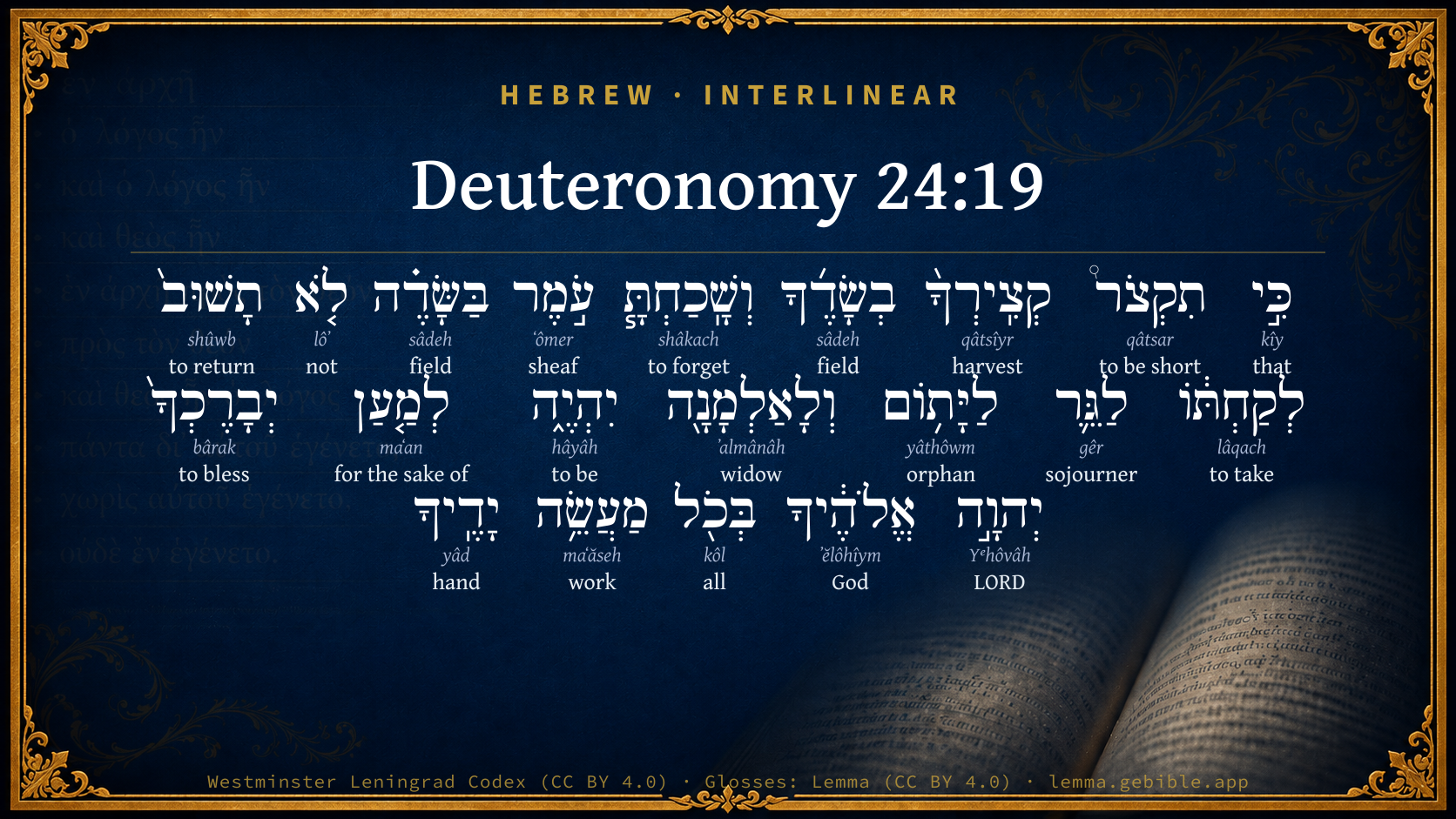
Hebrew (Westminster Leningrad Codex) Deuteronomy 24:19 appears in the Hebrew Old Testament. The text above is from the Westminster Leningrad Codex. Each word links to its Strong’s number, a concise gloss, and parsing drawn from the Open Scriptures Hebrew Bible morphology. Click any word for its full Brown-Driver-Briggs (BDB) entry.
Download image
Cite this verse

Deuteronomy 24:19 (World English Bible). Public Domain. Lemma interlinear Bible study tool, https://lemma.gebible.app/v/deuteronomy/24/19.

Show BibTeX & RIS
BibTeX
RIS
English Translation
When you reap your harvest in your field, and have forgot a sheaf in the field, you shall not go again to get it: it shall be for the foreigner, for the fatherless, and for the widow; that Yahweh your God may bless you in all the work of your hands.
World English Bible · Public Domain
Download a study sheet

One document with this verse’s original text, its word-by-word gloss line, the meaning frame, cross-references with their text, attributed commentary, and full source and license credits — printable, and it pastes into notes with its structure intact.

This verse Autodidact and up

Study sheet (.html) Plain text (.txt)

A passage Seminary Student

Up to 50 verses in one chapter. A passage sheet keeps up to 6 commentary sources and 12 cross-references per verse, in the order this page ranks them, and says so on the sheet whenever that leaves anything out. Ask for a single verse and you get the Autodidact verse sheet above.

Everything on this page stays free to read, with no account — the sheet is a download of what is already on screen, not access to it.

Want to remove ads? Support Godless Engineer
Compare translations 3

The same verse in 3 English versions, stacked beneath the original-language interlinear above. Click any original word for its lexicon entry.

Each is an independent rendering of the whole verse — the interlinear is not word-aligned to these translations.

Highlighted words mark where these versions differ — a whole-verse word diff, not a word-by-word alignment.

  • World English Bible Public Domain
    When you reap your harvest in your field, and have forgot a sheaf in the field, you shall not go again to get it: it shall be for the foreigner, for the fatherless, and for the widow; that Yahweh your God may bless you in all the work of your hands.
  • King James Version Public Domain
    When thou cuttest down thine harvest in thy field, and hast forgot a sheaf in the field, thou shalt not go again to fetch it: it shall be for the stranger, for the fatherless, and for the widow: that the LORD thy God may bless thee in all the work of thine hands.
  • unfoldingWord Literal Text CC BY-SA 4.0
    When you reap your harvest in your field, and you forget a sheaf in the field, you shall not go back to take it; it shall be for the foreigner, for the fatherless, or for the widow, so that Yahweh your God may bless you in all the work of your hands.

unfoldingWord Literal Text — © unfoldingWord, licensed CC BY-SA 4.0. Word-aligned USFM3 via Door43 (git.door43.org/unfoldingWord/en_ult).

Versions to compare (up to 4)

3 of 4 selected

Show all 18 translations

Every available English version of this verse, each an independent rendering of the whole verse.

  • World English Bible Public Domain
    When you reap your harvest in your field, and have forgot a sheaf in the field, you shall not go again to get it: it shall be for the foreigner, for the fatherless, and for the widow; that Yahweh your God may bless you in all the work of your hands.
  • Berean Standard Bible Public Domain
    If you are harvesting in your field and forget a sheaf there, do not go back to get it. It is to be left for the foreigner, the fatherless, and the widow, so that the LORD your God may bless you in all the work of your hands.
  • Majority Standard Bible Public Domain
    If you are harvesting in your field and forget a sheaf there, do not go back to get it. It is to be left for the foreigner, the fatherless, and the widow, so that the LORD your God may bless you in all the work of your hands.
  • King James Version Public Domain
    When thou cuttest down thine harvest in thy field, and hast forgot a sheaf in the field, thou shalt not go again to fetch it: it shall be for the stranger, for the fatherless, and for the widow: that the LORD thy God may bless thee in all the work of thine hands.
  • American Standard Version (1901) Public Domain
    When thou reapest thy harvest in thy field, and hast forgot a sheaf in the field, thou shalt not go again to fetch it: it shall be for the sojourner, for the fatherless, and for the widow; that Jehovah thy God may bless thee in all the work of thy hands.
  • Revised Version (1885) Public Domain
    When thou reapest thine harvest in thy field, and hast forgot a sheaf in the field, thou shalt not go again to fetch it: it shall be for the stranger, for the fatherless, and for the widow: that the LORD thy God may bless thee in all the work of thine hands.
  • Geneva Bible (1599) Public Domain
    When thou cuttest downe thine haruest in thy fielde, and hast forgotten a sheafe in the fielde, thou shalt not goe againe to fet it, but it shalbe for the stranger, for the fatherles, and for the widowe: that the Lord thy God may blesse thee in all the workes of thine hands.
  • Douay-Rheims (1899) Public Domain
    When thou hast reaped the corn in thy field, and hast forgot and left a sheaf, thou shalt not return to take it away: but thou shalt suffer the stranger, and the fatherless and the widow to tabs it away: that the Lord thy God may bless thee in all the works of thy hands.
  • Young's Literal Translation Public Domain
    `When thou reapest thy harvest in thy field, and hast forgotten a sheaf in a field, thou dost not turn back to take it; to the sojourner, to the fatherless, and to the widow, it is; so that Jehovah thy God doth bless thee in all the work of thy hands.
  • Literal Standard Version CC BY-SA 4.0
    When you reap your harvest in your field, and have forgotten a sheaf in a field, you do not return to take it; it is for the sojourner, for the fatherless, and for the widow, so that your God YHWH blesses you in all the work of your hands.
  • Unlocked Literal Bible CC BY-SA 4.0
    When you reap your harvest in your field, and if you have forgotten an omer of grain in the field, you must not go back to get it; it must be for the foreigner, for the fatherless, or for the widow, so that Yahweh your God may bless you in all the work of your hands.
  • unfoldingWord Literal Text CC BY-SA 4.0
    When you reap your harvest in your field, and you forget a sheaf in the field, you shall not go back to take it; it shall be for the foreigner, for the fatherless, or for the widow, so that Yahweh your God may bless you in all the work of your hands.
  • Darby Bible Public Domain
    When thou reapest thy harvest in thy field, and forgettest a sheaf in the field, thou shalt not return to fetch it; it shall be for the stranger, for the fatherless, and for the widow; that Jehovah thy God may bless thee in all the work of thy hands.
  • World Messianic Bible Public Domain
    When you reap your harvest in your field, and have forgotten a sheaf in the field, you shall not go again to get it. It shall be for the foreigner, for the fatherless, and for the widow, that the LORD your God may bless you in all the work of your hands.
  • Webster's Bible Public Domain
    When thou cuttest down thy harvest in thy field, and hast forgot a sheaf in the field, thou shalt not go again to fetch it: it shall be for the stranger, for the fatherless, and for the widow: that the LORD thy God may bless thee in all the work of thy hands.
  • Free Bible Version CC BY-SA 4.0
    If when you're harvesting in your field you forget a sheaf there, don't go back for it. Leave it for the foreigners, the orphans, and the widows, so that the Lord your God may bless you in everything you do.
  • Bible in Basic English Public Domain
    When you get in the grain from your field, if some of the grain has been dropped by chance in the field, do not go back and get it, but let it be for the man from a strange land, the child without a father, and the widow: so that the blessing of the Lord your God may be on all the work of your hands.
  • JPS Tanakh (1917) Public Domain
    When thou reapest thy harvest in thy field, and hast forgot a sheaf in the field, thou shalt not go back to fetch it; it shall be for the stranger, for the fatherless, and for the widow; that the LORD thy God may bless thee in all the work of thy hands.

Literal Standard Version (2020), Covenant Press — licensed CC BY-SA 4.0. Text via the HelloAO Bible API (eBible.org). Unlocked Literal Bible (unfoldingWord) — licensed CC BY-SA 4.0. Text via the HelloAO Bible API (eBible.org). unfoldingWord Literal Text — © unfoldingWord, licensed CC BY-SA 4.0. Word-aligned USFM3 via Door43 (git.door43.org/unfoldingWord/en_ult). Free Bible Version, Dr. Jonathan Gallagher — licensed CC BY-SA 4.0. Text via the HelloAO Bible API (eBible.org).

Word by word

More ways to search: Search by grammar → Find every occurrence → Compare this word →

Practice this passage: Drill this verse → Learn its vocabulary →

עֹ֣מֶר
ʻômer
H6016
“sheaf”
Noun, Common, Masculine, Singular, Absolute
Part of Speech
Noun
Type
Common
Gender
Masculine
Number
Singular
State
Absolute
Full BDB Definition

Origin: from H6014

TWOT: 1645b , 1645a

omer - a dry measure of 1/10 ephah (about 2 litres) - sheaf
  1. כִּ֣י kîy H3588 “that” Conjunction
  2. תִקְצֹר֩ qâtsar H7114 “to be short” Verb, Qal, Imperfect, 2nd Person, Masculine, Singular
  3. קְצִֽירְךָ֨ qâtsîyr H7105 “harvest · your” Noun, Common, Masculine, Singular, Construct + Suffix, Personal, 2nd Person, Masculine, Singular
  4. בְשָׂדֶ֜ךָ sâdeh H7704 “in/at · field · your” Preposition + Noun, Common, Masculine, Singular, Construct + Suffix, Personal, 2nd Person, Masculine, Singular
  5. וְשָֽׁכַחְתָּ֧ shâkach H7911 “and · to forget” Conjunction + Verb, Qal, Sequential Perfect, 2nd Person, Masculine, Singular
  6. בַּשָּׂדֶ֗ה sâdeh H7704 “in/at the · field” Preposition, Determined + Noun, Common, Masculine, Singular, Absolute
  7. לֹ֤א lôʼ H3808 “not” Particle, Negative
  8. תָשׁוּב֙ shûwb H7725 “to return” Verb, Qal, Imperfect, 2nd Person, Masculine, Singular
  9. לְקַחְתּ֔וֹ lâqach H3947 “to take · him” Preposition + Verb, Qal, Infinitive Construct + Suffix, Personal, 3rd Person, Masculine, Singular
  10. לַגֵּ֛ר gêr H1616 “to/for the · sojourner” Preposition, Determined + Noun, Common, Masculine, Singular, Absolute
  11. לַיָּת֥וֹם yâthôwm H3490 “to/for the · orphan” Preposition, Determined + Noun, Common, Masculine, Singular, Absolute
  12. וְלָאַלְמָנָ֖ה ʼalmânâh H490 “and · to/for the · widow” Conjunction + Preposition, Determined + Noun, Common, Feminine, Singular, Absolute
  13. יִהְיֶ֑ה hâyâh H1961 “to be” Verb, Qal, Imperfect, 3rd Person, Masculine, Singular
  14. לְמַ֤עַן maʻan H4616 “for the sake of” Preposition
  15. יְבָרֶכְךָ֙ bârak H1288 “to bless · you” Verb, Piel, Imperfect, 3rd Person, Masculine, Singular + Suffix, Personal, 2nd Person, Masculine, Singular
  16. יְהוָ֣ה Yᵉhôvâh H3068 “LORD” Noun, Proper
  17. אֱלֹהֶ֔יךָ ʼĕlôhîym H430 “God(s) · your” Noun, Common, Masculine, Plural, Construct + Suffix, Personal, 2nd Person, Masculine, Singular
  18. בְּכֹ֖ל kôl H3605 “in/at · all of” Preposition + Noun, Common, Masculine, Singular, Construct
  19. מַעֲשֵׂ֥ה maʻăseh H4639 “work of” Noun, Common, Masculine, Singular, Construct
  20. יָדֶֽיךָ yâd H3027 “hands · your” Noun, Common, Both, Dual, Construct + Suffix, Personal, 2nd Person, Masculine, Singular

About this verse

These counts appear in no published source. They are computed here, from the morphology-tagged text and Lemma’s own curated glosses. What Lemma adds →

21
words
20
distinct lemmas
Pentateuch
section

Notable vocabulary

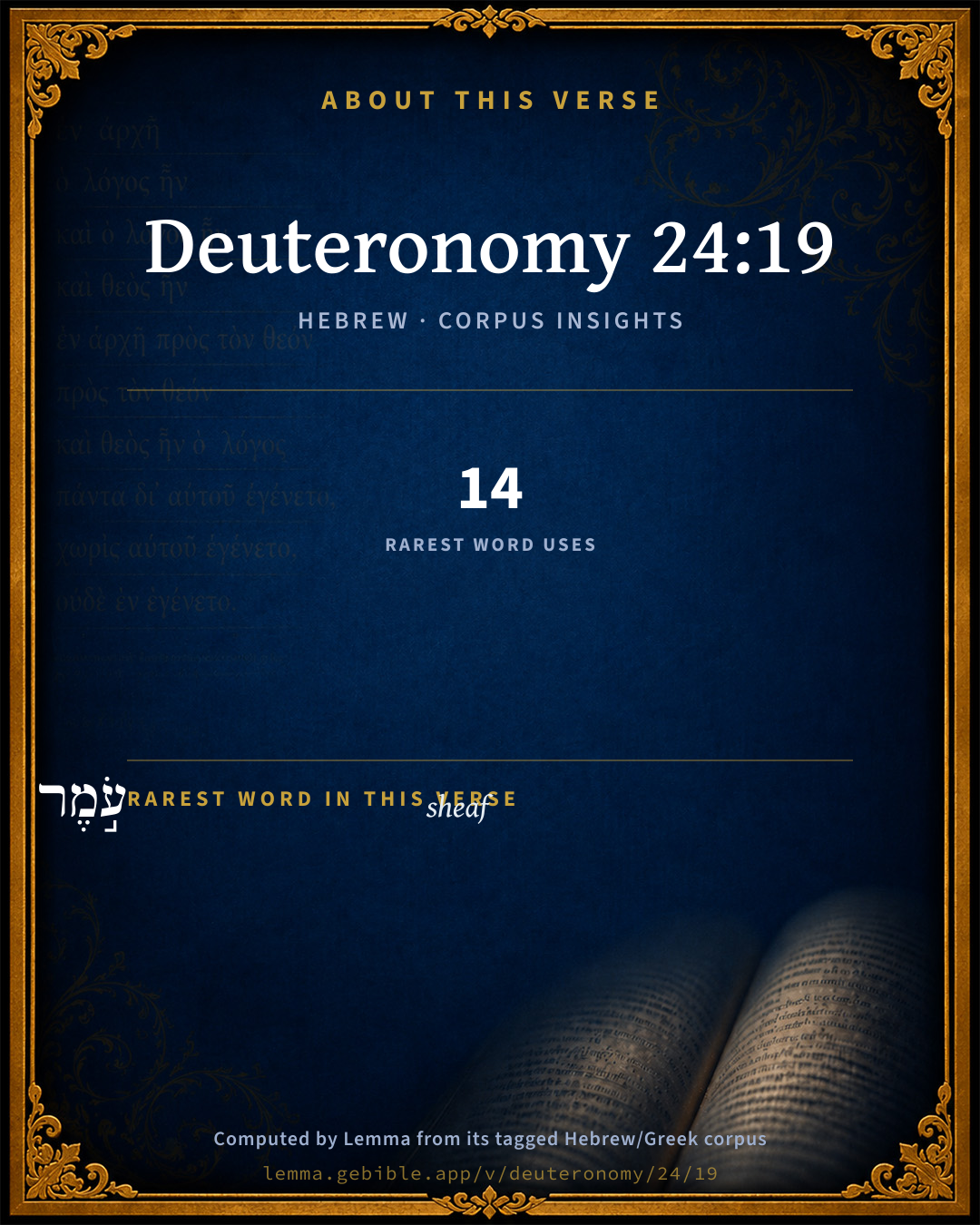
The rarest word here is עֹ֣מֶר sheaf H6016 — appearing just 14 times in the whole Hebrew Bible.

Shared distinctive vocabulary

עֹ֣מֶר sheaf H6016 occurs in 14 verses of the Hebrew Bible. Also found in:

Grammatical profile

  • 6 verbs
  • 12 nouns
  • 1 preposition
  • 1 conjunction
  • 1 particle

Verb forms

  • תִקְצֹר֩ Qal · Imperfect
  • וְשָֽׁכַחְתָּ֧ Qal · Sequential Perfect
  • תָשׁוּב֙ Qal · Imperfect
  • לְקַחְתּ֔וֹ Qal · Infinitive Construct
  • יִהְיֶ֑ה Qal · Imperfect
  • יְבָרֶכְךָ֙ Piel · Imperfect

Repetition

A word recurs within this verse — often emphatic in Hebrew:

  • בְשָׂדֶ֜ךָ field H7704 ×2

Hebrew & Septuagint length

In English translation the verse runs 51 words from the Hebrew and 24 from the Septuagint (LXX English) — the Septuagint runs noticeably shorter here. See the side-by-side →

A rough comparison of the two English renderings, which tokenize alike — not a word-level alignment.

Word counts can differ between the Hebrew and the Greek without any difference in meaning — e.g. the Hebrew direct-object marker אֵת has no separate Greek word, and Greek often adds the article ὁ.

Cross-references

21

Topical passages linked to Deuteronomy 24:19 in the Treasury of Scripture Knowledge — connected by theme and wording, ordered by reader-vote popularity; previews shown in the World English Bible.

  • Leviticus 23:22 "'When you reap the harvest of your land, you shall not wholly reap into the corners of your field, neither shall you gather the gleanings of your harvest: you shall leave them for the poor, and for the foreigner. I am Yahweh your God.'"
  • Proverbs 19:17 He who has pity on the poor lends to Yahweh; He will reward him.
  • Leviticus 19:9–10 "'When you reap the harvest of your land, you shall not wholly reap the corners of your field, neither shall you gather the gleanings of your harvest.
  • Deuteronomy 14:29 and the Levite, because he has no portion nor inheritance with you, and the foreigner living among you, and the fatherless, and the widow, who are within your gates, shall come, and shall eat and be satisfied; that Yahweh your God may bless you in all the work of your hand which you do.
  • Luke 14:13–14 But when you make a feast, ask the poor, the maimed, the lame, or the blind;
  • Luke 6:38 "Give, and it will be given to you: good measure, pressed down, shaken together, and running over, will be given to you. For with the same measure you measure it will be measured back to you."
  • Psalms 112:9 He has dispersed, he has given to the poor. His righteousness endures forever. His horn will be exalted with honor.
  • Proverbs 11:24–25 There is one who scatters, and increases yet more. There is one who withholds more than is appropriate, but gains poverty.
  • Isaiah 32:8 But the noble devises noble things; and in noble things shall he continue.
  • Isaiah 58:7–11 Isn't it to deal your bread to the hungry, and that you bring the poor who are cast out to your house? when you see the naked, that you cover him; and that you not hide yourself from your own flesh?
  • 2 Corinthians 9:6–8 Remember this: he who sows sparingly will also reap sparingly. He who sows bountifully will also reap bountifully.
  • Deuteronomy 26:13 You shall say before Yahweh your God, I have put away the holy things out of my house, and also have given them to the Levite, and to the foreigner, to the fatherless, and to the widow, according to all your commandment which you have commanded me: I have not transgressed any of your commandments, neither have I forgotten them:
  • Job 42:12 So Yahweh blessed the latter end of Job more than his beginning. He had fourteen thousand sheep, six thousand camels, one thousand yoke of oxen, and a thousand female donkeys.
  • Psalms 41:1–3 Blessed is he who considers the poor: Yahweh will deliver him in the day of evil.
  • Deuteronomy 15:10 You shall surely give him, and your heart shall not be grieved when you give to him; because that for this thing Yahweh your God will bless you in all your work, and in all that you put your hand to.
  • Deuteronomy 24:20–21 When you beat your olive tree, you shall not go over the boughs again: it shall be for the foreigner, for the fatherless, and for the widow.
  • Ruth 2:16 Also pull out some for her from the bundles, and leave it, and let her glean, and don't rebuke her.
  • Job 31:16–22 "If I have withheld the poor from their desire, Or have caused the eyes of the widow to fail,
  • Proverbs 14:21 He who despises his neighbor sins, But blessed is he who has pity on the poor.
  • Luke 6:35 But love your enemies, and do good, and lend, expecting nothing back; and your reward will be great, and you will be children of the Most High; for he is kind toward the unthankful and evil.
  • 1 John 3:17–19 But whoever has the world's goods, and sees his brother in need, and closes his heart of compassion against him, how does the love of God remain in him?

Cross-references courtesy of OpenBible.info (CC BY 4.0).

Hebrew and Greek witnesses Masoretic Hebrew ↔ Greek Septuagint

The same verse in the two great witnesses to the Old Testament, shown verse-for-verse.

Here the Septuagint runs noticeably shorter than the Hebrew — LXX2012 (modern English Septuagint) 24 words vs World English Bible 51. A rough length comparison of the two English translations, not a word-level alignment — read both below.

These are two independent witnesses, not word-aligned to each other, and the Septuagint is shown in lemma (dictionary) form.

Hebrew Deuteronomy 24:19 Masoretic · Westminster Leningrad Codex

כִּ֣י תִקְצֹר֩ קְצִֽירְךָ֨ בְשָׂדֶ֜ךָ וְשָֽׁכַחְתָּ֧ עֹ֣מֶר בַּשָּׂדֶ֗ה לֹ֤א תָשׁוּב֙ לְקַחְתּ֔וֹ לַגֵּ֛ר לַיָּת֥וֹם וְלָאַלְמָנָ֖ה יִהְיֶ֑ה לְמַ֤עַן יְבָרֶכְךָ֙ יְהוָ֣ה אֱלֹהֶ֔יךָ בְּכֹ֖ל מַעֲשֵׂ֥ה יָדֶֽיךָ

When you reap your harvest in your field, and have forgot a sheaf in the field, you shall not go again to get it: it shall be for the foreigner, for the fatherless, and for the widow; that Yahweh your God may bless you in all the work of your hands.

World English Bible · Public Domain

Greek LXX Deuteronomy 24:19 Septuagint · lemma form

ἐάν δέ ἀμάω ἀμητός ἐν ὁ ἀγρός σύ καί ἐπιλανθάνω δράγμα ἐν ὁ ἀγρός σύ οὐ ἐπι ἀναστρέφω λαμβάνω αὐτός ὁ πτωχός καί ὁ προσήλυτος καί ὁ ὀρφανός καί ὁ χήρα εἰμί ἵνα εὐλογέω σύ κύριος ὁ θεός σύ ἐν πᾶς ὁ ἔργον ὁ χείρ σύ

You shall not wrest the judgment of the stranger and the fatherless, and widow; you shall not take the widow's garment for a pledge.

LXX2012 (modern English Septuagint) · Public Domain

Hebrew: Westminster Leningrad Codex (CC BY 4.0). Greek: Septuagint (public domain); English from LXX2012 (modern English Septuagint) (Public Domain). How the Septuagint differs from the Hebrew →

Targum (Aramaic paraphrase)

2

The Targum is the ancient Jewish Aramaic paraphrase of the Hebrew Scriptures — an interpretive translation, not the Hebrew text itself. Onkelos (literal) and Pseudo-Jonathan (expansive) render the Torah, and Jonathan the Prophets. Coverage is partial: where no permissively-licensed English translation exists for a verse, only the Aramaic is shown. This is verse-level text, not a word-by-word alignment to the Hebrew.

  1. Targum Onkelos Torah (Genesis–Deuteronomy)
    אֲרֵי תַחְצוֹד חֲצָדָךְ בְּחַקְלָךְ וְתִנְשֵׁי עֻמְרָא בְחַקְלָא לָא תְתוּב לְמִסְבֵהּ לְגִיוֹרָא לְיִתַּמָא וּלְאַרְמְלָא יְהֵי בְּדִיל דִיבָרֵכִנָךְ יְיָ אֱלָהָךְ בְּכֹל עוֹבָדֵי יְדָךְ

    (no public-domain English translation for this verse)

    Targum Onkelos — Aramaic: “Onkelos Genesis” (public domain); “Onkelos Exodus” (public domain); “Onkelos Leviticus” (public domain); “Onkelos Numbers” (public domain); “Onkelos Deuteronomy” (public domain). English: “Sefaria Community Translation” (CC0 1.0 (public-domain dedication)); “J.W. Etheridge. The Targums of Onkelos and Jonathan Ben Uzziel on the Pentateuch. London: Longmans, Green, 1862” (public domain). Text via Sefaria.

  2. Targum Pseudo-Jonathan Torah (Genesis–Deuteronomy)
    אֲרוּם תְּחַצְדוּן חַצְדֵיכוֹן בְּחַקְלֵיכוֹן וְתִתְנְשׁוּן עוּמְרָא בְּחַקְלָא לָא תְתוּבוּן לְמִסְבֵיהּ לְגִיּוֹרָא לְיַתְמָא וּלְאַרְמַלְתָּא יְהֵי מְטוּל דִּי יְבָרְכֵכוּן מֵימְרָא דַיְיָ אֱלָהָכוֹן בְּכָל עוֹבָדֵי יְדֵיכוֹן

    When you have reaped your harvests in your fields, and have forgotten a sheaf in the field, you shall not return to take it; let it be for the stranger, the orphan, and the widow, that the Word of the Lord your God may bless you in all the works of your hands.

    Targum Pseudo-Jonathan — Aramaic: “Targum Jonathan on Genesis” (public domain); “Targum Jonathan on Exodus” (public domain); “Targum Jonathan on Leviticus” (public domain); “Targum Jonathan on Numbers” (public domain); “Targum Jonathan on Deuteronomy” (public domain). English: “The Targum of Jonathan ben Uzziel, trans. J. W. Etheridge, London, 1862” (public domain). Text via Sefaria.

Commentary

Notes on Deuteronomy 24:19 from classic Christian and Jewish commentators (each source and its license shown beneath its notes). The classic Christian expositions comment on the surrounding passage and are grouped to its opening verse, so a note may address several verses; the Jewish commentaries on the Tanakh (Rashi and others) are per-verse, so they appear only where the commentator wrote on this verse.

Lemma curates 59 commentaries, every one of them public domain or Creative Commons licensed, each selected and text-cleaned for this edition rather than reprinted as found. About our sources →

The Biblical Illustrator

Joseph S. Exell

Deu_24:19-21

It shall be for the stranger.

Care for others

This beautiful passage speaks of the harvest, of the olive, and of the grape. You say, Well, I am not a farmer, I know nothing of the harvest. Olives do not grow in this cold country. And it is only a few people in England who can grow grapes. What is the meaning of this? I will tell you what it means, because when God tells us to deal in this way with the stranger, and the fatherless, and the widow, He means us to do it. You know what the harvest means. It was the in-gathering of the corn, and you know what that was for--to be made into bread. And you know what bread was for--to give strength. The olive was a symbol of fruitfulness, and the grape typified joy. So that the three things God teaches us here to do, are to give strength and peace and joy to the stranger, the fatherless, and the widow. How can we do that? Turn to Pro_12:25, and let us see how we can do it for the Master. (I am going to take the very lowest thing it is possible for a child of God to do. I am not going to speak to those who can give their hundreds and thousands of pounds and be none the poorer; but let the very poorest of us here today see if we cannot be the means of bringing strength and peace and joy to those who need it.) Heaviness in the heart of man maketh it stoop. We all know that is true. What is going to make it glad? A fifty-pound note? No! But a good word maketh it glad. It is not only the wealth or the riches that God speaks about. Here it is a kind, loving word, a good word, that makes the heart glad. I was thinking only today about the words of the Lord Jesus Christ, and about the works, the miracles of Christ. Why, the Lord Jesus accomplished more by His words than by His miracles. And He wants us to be imitators of Him. When He was here He had no long purse, but He had a kind word for everybody except the self-satisfied, the self-righteous, the Scribes and Pharisees. We too can give these and be none the poorer for it. Turn to Isa_50:4 : The Lord God hath given me the tongue of the learned, that I should know how to speak a word in season to him that is weary. Perhaps you say, Oh, I would like to have the tongue of the learned to show people how clever I am! The Lord Jesus had the tongue of the learned for one purpose, and that was to know how to speak a word in season to him that was weary. Here again it is the word; it is not the power or the miracle. Read also in Col_3:17 : Whatsoever ye do in word or deed, do all in the name of the Lord Jesus, giving thanks to God and the Father by Him. Has it ever struck you that this is a very strange way of putting it, Whatsoever ye do in word or deed? We may be disposed to think it ought to have been, Whatsoever ye say in word or do in deed. But it is not so: Whatsoever ye do in word or deed. As if God said, Every word you speak for Me is a good work. And what we want is to have the tongue of the learned, to know how to speak a word to those that are weary. If we want to be happy, if we want to be joyful and glad, let us try to make others glad. Let us try to give them strength and peace and joy. The most miserable man here today is the man who lives for self; the happiest man is the one who forgets self, and lives for others. What a sweet thing it is to know that God has told us, Whatsoever ye do in word. Up yonder He is keeping a record of it. (H. Moorhouse.)

.

The Biblical Illustrator, edited by Joseph S. Exell (c. 1880s–1900s) — public domain. Text from a community e-Sword module.

Joseph Benson's Commentary

Deu 24:19-22. It shall be for the stranger — Moses here exhorts them to be mindful of those provisions made for the poor by this law, (Lev 19:9-10; Lev 23:22,) wherein they are ordered not to be over exact in reaping the fruits of their fields and vineyards, but to leave something to be gathered by their poor neighbours. When thou beatest thine olive-tree — As they were wont to do, with sticks, to bring down the olives. It shall be for the fatherless, &c. — Surely nothing can be more just, humane, or merciful, than all these laws here recited.

Joseph Benson's Commentary on the Old and New Testaments (1811–1818) — public domain. Text from a community e-Sword module.

Jamieson, Fausset & Brown

Robert Jamieson, A. R. Fausset & David Brown

When thou cuttest down thine harvest in thy field--The grain, pulled up by the roots or cut down with a sickle, was laid in loose sheaves; the fruit of the olive was obtained by striking the branches with long poles; and the grape clusters, severed by a hook, were gathered in the hands of the vintager. Here is a beneficent provision for the poor. Every forgotten sheaf in the harvest-field was to lie; the olive tree was not to be beaten a second time; nor were grapes to be gathered, in order that, in collecting what remained, the hearts of the stranger, the fatherless, and the widow might be gladdened by the bounty of Providence.

Next: Deuteronomy Chapter 25

Jamieson, Fausset & Brown — Commentary Critical and Explanatory on the Whole Bible (1871) — public domain (CC PDM 1.0). Text via the HelloAO Bible API.

Adam Clarke's Commentary

Verse 19. When thou cuttest down thine harvest] This is an addition to the law, Le 19:9; Le 23:22. The corners of the field, the gleanings, and the forgotten sheaf, were all the property of the poor. This the Hebrews extended to any part of the fruit or produce of a field, which had been forgotten in the time of general ingathering, as appears from the concluding verses of this chapter.

Adam Clarke's Commentary on the Bible (1810–1826) — public domain. Text from a community e-Sword/MySword module.

The Cambridge Bible for Schools and Colleges

gen. ed. J. J. S. Perowne

19–22. Of Generosity to the Landless. To the gçr, the orphan and the widow shall be left the gleanings of fields, olive-groves and vineyards. It is interesting that no parallels are found in the earlier legislation of J or E. H, Lev_19:9 f. forbids the full reaping of the corners of the field and gathering of the gleanings (repeated Deu_23:22) and the gleaning of the vines and their fallen fruit; these are for the poor and the gçr. This seems not earlier (Dillm., etc.), but later than D, for the deliberate reservation of the corners is a more developed provision than the allotment of what was left through carelessness. Why D alone includes olives is not clear, except that this agrees with its careful regard of the details of rural life. Both laws sanction an existing practice described in Ruth 2 as dependent on the generosity of the cultivator.

Was there anything more behind it? Attention has been drawn to the fact that some peoples leave the last sheaf on the field under the superstition that it contains the corn-spirit, and being therefore dangerous is easily relinquished to strangers (Frazer, Golden Bough, ii. 171 f., 232 f.). I am told that in the shires of Lincoln and Norfolk it was the practice till 60 or 80 years ago to shape part of a sheaf into a ‘corn-baby’ and to bury it in the field, in order to ensure the next crop. It is possible that in some cases the custom of leaving the gleanings to the poor may have started from such superstitions. But those who see in these the sole origin of the custom ignore the natural promptings of the hearts of simple, peasant peoples to care for the needy. There are no traces of the superstition in D, H or Ruth 2. D’s appeal to the self-interest of the harvesters (that thy God may bless thee, etc.) is rather one of his many illustrations of his favourite principle that obedience to God’s ethical demands will be rewarded by prosperity (cp. Deu_14:29, Deu_15:4 f., 10, 18, Deu_23:20; cp. Deu_17:20). Otherwise the motives of the laws are purely humane and in both sets the humanity is enforced by religious considerations. In D the motive is characteristically gratitude to God (Deu_24:22), in H it is as characteristically the simple fact: I am Jehovah thy God.—The duties enforced are observed at this day in Palestine. ‘The poorest among the people, the widow and the orphan, are not infrequently seen following the reapers’; and ‘the poor are often seen after the gathering in of the crop going from tree to tree and collecting the few olives that may have been left’ (Van Lennep, Bible Lands, etc., 78, 128). ‘It is natural with them not to gather stray ears or to cut all the standing ones which would be looked upon as avarice; every bad act is avoided as much as possible “before the blessing,” as the corn is very often called; the law of Moses … is innate with them. The produce of the gleanings … may enable a widow to have bread enough for the winter’ (Baldensperger, PEFQ, 1907, 19). On the Arabs kindness to the sojourner see Doughty, i. 345.

The Cambridge Bible for Schools and Colleges (gen. ed. J. J. S. Perowne; Cambridge University Press, 1878–1918) — public domain. Text from a community e-Sword module.

John Gill's Exposition

When thou cuttest down thine harvest in thy field,.... Whether barley harvest or wheat harvest, when either of them are ripe for cutting, mowing, or reaping, and are cutting down:

and hast forgot a sheaf in the field; Jarchi says the phrase "in the field" is to include standing corn, some of which is forgotten in cutting down, and so is subject to this law as well as a sheaf; and a sheaf claimed by this name is one that is forgotten both by the workman and the owner; if by the one and not by the other, it could not be so called. The canon runs thus (t),"a sheaf which the workmen forget, and not the owner, or the owner forgets, and not the workman, before which the poor stand, or is covered with straw or stubble, is not a forgotten sheaf.''And about this they have various other rules;"a sheaf that is near the gate (of a field), or to an heap (of sheaves), or to oxen, or to instruments, and left, the house of Shammai say it is not to be reckoned a forgotten sheaf; but the house of Hillell say it is;--two sheaves are reckoned forgotten, three are not; a sheaf in which there are two seahs (about a peck and a half), and they leave it, it is not reckoned forgotten (u):"

thou shall not go again to fetch it; which supposes a remembrance of it, or some intelligence about it when at home, and after the field has been cleared, and all carried in but this sheaf; then the owner might not go nor send to fetch it: the beginnings of the rows, they say, show when a sheaf is forgotten, or not; particularly the adverse sheaf, or that over against it, shows it (w); so Jarchi:

it shall be for the stranger; or proselyte; the proselyte of righteousness; of this there is no doubt, but it seems to be for the proselyte of the gate also:

for the fatherless and for the widow; which of them soever should first find it:

that the Lord thy God may bless thee in all the work of thine hands; in the culture of their ground the next year, and give them large and fruitful crops; they either purposely leaving the sheaf for the poor, or however suffer them to take it unmolested when found by them. The Targum of Jonathan is, "that the word of the Lord thy God may bless thee", &c.

(t) Misn. Peah, c. 5. sect. 7. (u) Misn. Peah, c. 6. sect. 2, 5, 6. (w) Ib. sect. 3, 4.

John Gill's Exposition of the Whole Bible (1746–1763) — public domain (CC PDM 1.0). Text via the HelloAO Bible API.

Haydock's Catholic Bible Commentary

Forget. The Rabbins say, that both the owner and the labourers must forget the sheaf: but his is a vain subtlety. (Calmet) --- Josephus ([Antiquities?] iv. 8,) is more agreeable to the spirit of the law, when he (Haydock) observes that gleanings, and some of the fruit of the vine and olive trees, were to be left on purpose for the poor, Leviticus xix. 9. (Menochius)

George Leo Haydock (1774–1849), Haydock's Catholic Family Bible and Commentary, 1859 edition — public domain. Excludes Psalms (Douay-Rheims chapter numbering differs from Protestant) and Deuterocanonical books (Catholic canon only).

Whedon's Commentary on the Bible

Daniel D. Whedon

19-22. Harvest… olive tree… grapes — Strangers, widows, and orphans were to be allowed to glean in the time of the harvest and the vintage. Comp. Lev_19:9-10; Lev_23:22.

Daniel D. Whedon (gen. ed.), Commentary on the Old and New Testaments (1874–1909) — public domain. Text from a community e-Sword module.

The Pulpit Commentary

Vers. 19-22. (cf. Lev_19:9, 10 23:23) Not only was no injustice to be done to the poor, but, out of the abundance of those in better estate, were they to be helped.

Vers. 19-22. Autumn generosity.

If a man is not generous towards his poorer neighbors in time of harvest, he will never be generous. If the profuse generosity of God be lavished upon him in vain, his moral nature must be hard indeed. As men "make hay while the sun shines," so should we yield to benevolent impulses while God surrounds us with sunshine of kindness. As we are undeserving recipients, we should share our unpurchased bounty with others.

I WE HAVE HERE A FITTING OCCASION FOR GENEROSITY. God supplies us with fitting seasons for getting good and for doing good. It is not always autumn. We cannot gather corn and olives when we please. We have to wait the arrival of the season, and this season is God"s provision. We must gather then or never. Opportunity can never be trifled with. If abundance has been put into our bands, let us forthwith use it well, or it may be suddenly taken from us. If an unusual generous impulse be upon us, it is wisest to respond to it freely, to give it largest scope, for this is a visit of God to us for good.

II FITTING OBJECTS FOR GENEROSITY ARE PROVIDED. Were it not for the existence of the poor, there would be no outlet for generosity in a practical and material form. There would be no discipline for the best part of our nature. It would be a pain and a loss to us if the instinct of benevolence within us found no field for its exercise. Thankful ought we to be that the poor shall not cease out of the land. The fatherless and the widow come to us as the sent of God, to loosen the sluices of our generosity, and to do us good. We are almoners of God"s royal bounty.

III DELICATE PLANS FOR CONVEYING GENEROSITY. The finer forces of our bodily nature are conveyed to every part by most delicate, almost invisible, ducts. Nerve-power is distributed from the center to the circumference by minutest channels. So, too, should we employ the most refined delicacy in relieving the necessities of the poor. Let not our gift be spoilt by any assumption of superiority, nor by any arrogant rudeness. It is a noble thing to respect the manly feelings of the poor, and to touch with fairy finger the sensibilities of the suffering. We are to study, not only how much we can give, but especially how best to give it. From the harvest-field and the olive-grove we may learn this delicacy of kindness. Both the quantity and the quality of our service are important in God"s esteem.

IV THE POTENT MOTIVE TO GENEROSITY. Remembrance of their own redemption was the mighty motive for all good deeds. This is the constant refrain of God"s message. As God is not wearied in reiterating the lesson, neither should we be wearied in hearing it. We are the objects of God"s tenderest love. He has set in motion his most prodigious energies to rescue us from misery. He has emptied his treasury of blessings so as to enrich us, and the end for which he has enriched us is that we may enrich others. Ye have been ineffably blessed, do you bless in return. D.

The Pulpit Commentary (1880–1919), ed. H.D.M. Spence-Jones & Joseph S. Exell — public domain. Text from a community e-Sword module.

Keil & Delitzsch

C. F. Keil & F. Delitzsch

Directions to allow strangers, widows, and orphans to glean in time of harvest (as in Lev 19:9-10, and Lev 23:22). The reason is given in Deu 24:22, viz., the same as in Deu 24:18 and Deu 15:15.

Keil & Delitzsch — Biblical Commentary on the Old Testament (1861–1891) — public domain (CC PDM 1.0). Text via the HelloAO Bible API. (Old Testament only.)

unfoldingWord translationNotes

Door43 World Missions Community

General Information:

Moses speaks to the Israelites as if they were one man, so the words "you" and "your" here are singular. (See: Forms of You)

When you reap your harvest in your field

"When you cut down the grain in your field"

an omer of grain

Some versions translate this as "a sheaf." Either translation refers to stalks of grain, enough to be easily carried, possibly tied in a bundle.

it must be for the foreigner, for the fatherless, or for the widow

You can make clear the understood information. AT: "you must leave the sheaf so a foreigner, an orphan, or a widow can take it" (See: Ellipsis)

in all the work of your hands

Here "hands" refers to the whole person. AT: "in all the work that you do" (See: Synecdoche)

When you shake your olive tree

You can make clear the understood information. AT: "When you shake the branches of your olive tree, causing the olives to fall to the ground so you can pick them up" (See: Ellipsis)

you must not go over the branches again

"do not pick every single olive from the tree"

it will be for the foreigner, for the fatherless, or for the widow

You can make clear the understood information. AT: "the olives that stay on the branches are for foreigners, orphans, and widows to pick and take with them" (See: Ellipsis)

translationWords

reap

harvest

alien

bless

works

olive

unfoldingWord translationNotes — © Distant Shores Media and the Door43 World Missions Community, licensed CC BY-SA 4.0. Source: git.door43.org/Door43/en_tn.

Rashi

Rabbi Shlomo Yitzchaki (Rashi)

ושכחת עמר [WHEN THOU REAPEST THY HARVEST IN THY FIELD] AND HAST FORGOT A SHEAF … [THOU SHALT NOT RETURN TO TAKE IT] — a sheaf, but not a stack of corn (Sifrei Devarim 283:1). Hence they (the Rabbis) said, “A sheaf that contains two Seahs of grain which one has forgotten in the field, does not come under the term of שכחה (a forgotten sheaf)” (Mishnah Peah 6:6).

בשדה [AND HAST FORGOT …] IN THE FIELD — This apparently redundant word (it has just stated בשדך) is intended to include under this law forgotten “standing corn” (קמה) — that one has forgotten to cut down part of it (Sifrei Devarim 283:2).

לא תשוב לקחתו THOU SHALT NOT GO BACK TO TAKE IT — Hence they (the Rabbis) said: A sheaf that is behind him is considered as שכחה, that which is in front of him is not considered שכחה, for the expression “thou shalt not go back [to take it]” is not applicable to it (Mishnah Peah 6:4; Bava Metzia 11a).

למען יברכך THAT [THE LORD THY GOD] BLESS THEE — although it came into his (the stranger’s or the orphan’s) hand without him (the owner) intending this; it follows logically that he will certainly receive a blessing if he does this intentionally! — You must therefore admit that if a Sela fell out of one’s hand and a poor man found it and supports himself by it, then he will surely be blessed on that account (Sifrei Devarim 283:6; cf. Rashi on Leviticus 5:17 end).

Rashi on the Tanakh — English translations: “The Judaica Press complete Tanach with Rashi, translated by A. J. Rosenberg” (CC BY 4.0); “Pentateuch with Rashi's commentary by M. Rosenbaum and A.M. Silbermann, 1929-1934” (public domain); “The Metsudah Tanach series, Lakewood, N.J” (CC BY 4.0); and “The Book of Joshua, Metsudah Publications, 1997” (CC BY 4.0). Text via Sefaria.

Lesson kit

Teaching starters — assembled from the data on this page, not authored interpretation. Every prompt links to the verse data it draws on. Edit before teaching.

Deuteronomy, in the Pentateuch, opens this verse with 21 words (20 distinct Hebrew lemmas). Its most distinctive word is ʻômer (“sheaf”). The Greek Septuagint runs shorter here. A historical commentator’s framing appears above. Read the whole chapter for the surrounding context.

Discussion questions

  1. How does “sheaf” (ʻômer) shape what this verse is saying?
  2. How does Exodus 16:16, which shares the word «sheaf», read alongside this verse?
  3. What does the repetition of “field” (2× in this one verse) do in this verse?
  4. The Septuagint runs shorter here than the Hebrew. What might account for the difference?
  5. The translations on this page render this verse differently — a whole-verse word diff, not a word-by-word alignment. What might account for the different wordings?
  6. «תִקְצֹר֩» is a Qal Imperfect verb. How does that grammatical form shape the action described?
  7. Compare how The Biblical Illustrator and Joseph Benson's Commentary read this verse. Where do they agree or differ?

Things to notice

Reading settings

Reading text

Shown beneath each verse's original-language words.

Old Testament
Old Testament edition

Read the OT as the Masoretic Hebrew (MT) or the Greek Septuagint (LXX).

English shown for the Greek Septuagint (in the Hebrew ↔ Greek comparison).

Comparing translations? Open the Compare panel on any verse page to stack up to four side by side.