Deuteronomy 33:20

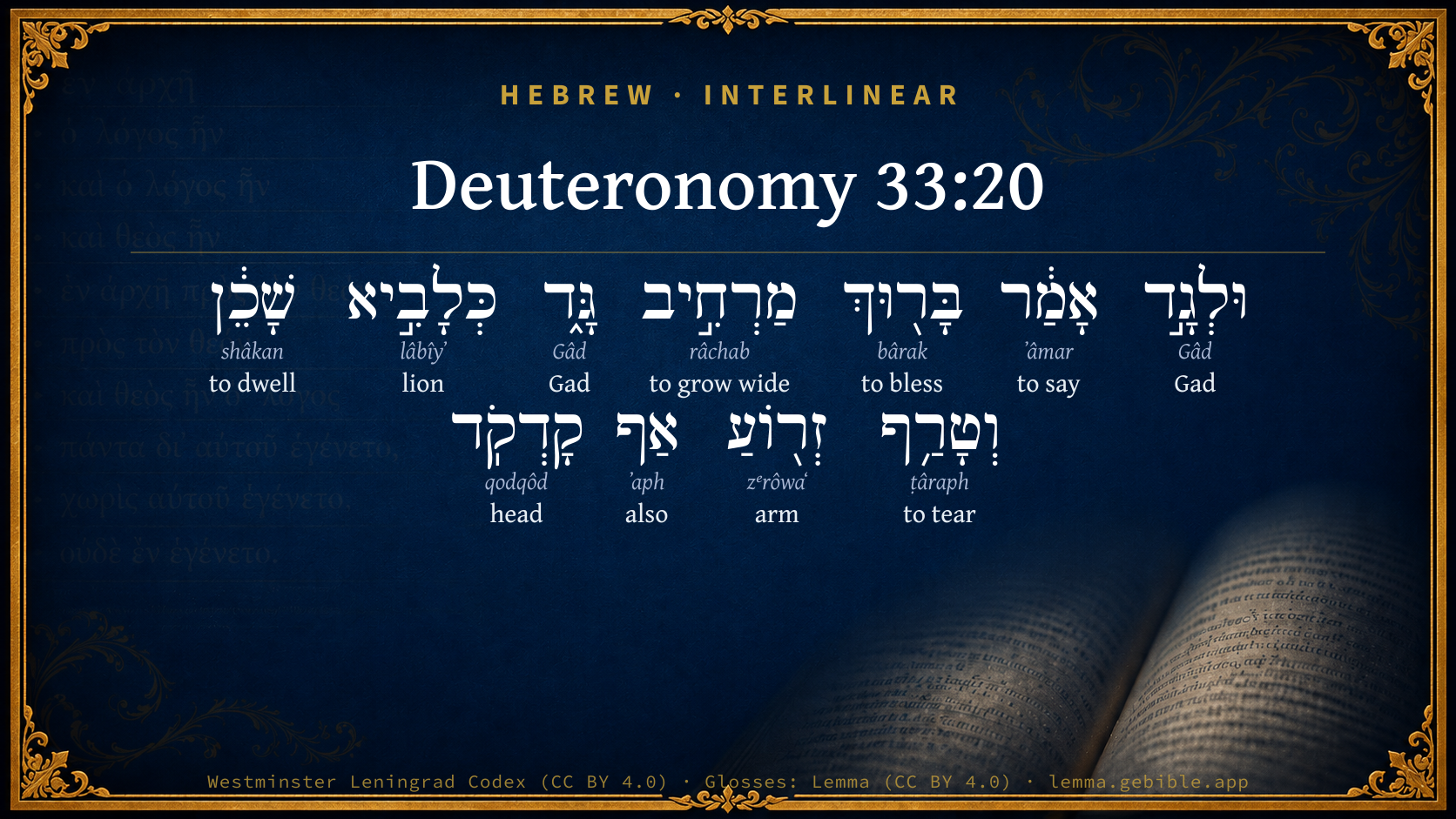
Hebrew (Westminster Leningrad Codex) Deuteronomy 33:20 appears in the Hebrew Old Testament. The text above is from the Westminster Leningrad Codex. Each word links to its Strong’s number, a concise gloss, and parsing drawn from the Open Scriptures Hebrew Bible morphology. Click any word for its full Brown-Driver-Briggs (BDB) entry.
Download image
Cite this verse

Deuteronomy 33:20 (World English Bible). Public Domain. Lemma interlinear Bible study tool, https://lemma.gebible.app/v/deuteronomy/33/20.

Show BibTeX & RIS
BibTeX
RIS
English Translation
Of Gad he said, Blessed be he who enlarges Gad: He dwells as a lioness, Tears the arm, yes, the crown of the head.
World English Bible · Public Domain
Download a study sheet

One document with this verse’s original text, its word-by-word gloss line, the meaning frame, cross-references with their text, attributed commentary, and full source and license credits — printable, and it pastes into notes with its structure intact.

This verse Autodidact and up

Study sheet (.html) Plain text (.txt)

A passage Seminary Student

Up to 50 verses in one chapter. A passage sheet keeps up to 6 commentary sources and 12 cross-references per verse, in the order this page ranks them, and says so on the sheet whenever that leaves anything out. Ask for a single verse and you get the Autodidact verse sheet above.

Everything on this page stays free to read, with no account — the sheet is a download of what is already on screen, not access to it.

Want to remove ads? Support Godless Engineer
Compare translations 3

The same verse in 3 English versions, stacked beneath the original-language interlinear above. Click any original word for its lexicon entry.

Each is an independent rendering of the whole verse — the interlinear is not word-aligned to these translations.

Highlighted words mark where these versions differ — a whole-verse word diff, not a word-by-word alignment.

  • World English Bible Public Domain
    Of Gad he said, Blessed be he who enlarges Gad: He dwells as a lioness, Tears the arm, yes, the crown of the head.
  • King James Version Public Domain
    And of Gad he said, Blessed be he that enlargeth Gad: he dwelleth as a lion, and teareth the arm with the crown of the head.
  • unfoldingWord Literal Text CC BY-SA 4.0
    And to Gad, he said, “Blessed be the increaser of Gad. Like a lioness he will live, and tear off an arm, also a head.

unfoldingWord Literal Text — © unfoldingWord, licensed CC BY-SA 4.0. Word-aligned USFM3 via Door43 (git.door43.org/unfoldingWord/en_ult).

Versions to compare (up to 4)

3 of 4 selected

Show all 18 translations

Every available English version of this verse, each an independent rendering of the whole verse.

  • World English Bible Public Domain
    Of Gad he said, Blessed be he who enlarges Gad: He dwells as a lioness, Tears the arm, yes, the crown of the head.
  • Berean Standard Bible Public Domain
    Concerning Gad he said: “Blessed is he who enlarges the domain of Gad! He lies down like a lion and tears off an arm or a head.
  • Majority Standard Bible Public Domain
    Concerning Gad he said: “Blessed is he who enlarges the domain of Gad! He lies down like a lion and tears off an arm or a head.
  • King James Version Public Domain
    And of Gad he said, Blessed be he that enlargeth Gad: he dwelleth as a lion, and teareth the arm with the crown of the head.
  • American Standard Version (1901) Public Domain
    And of Gad he said, Blessed be he that enlargeth Gad: He dwelleth as a lioness, And teareth the arm, yea, the crown of the head.
  • Revised Version (1885) Public Domain
    And of Gad he said, Blessed be he that enlargeth Gad: He dwelleth as a lioness, And teareth the arm, yea, the crown of the head.
  • Geneva Bible (1599) Public Domain
    Also of Gad he said, Blessed be hee that enlargeth Gad: he dwelleth as a lion, that catcheth for his praye the arme with the head.
  • Douay-Rheims (1899) Public Domain
    And to Gad he said: Blessed be Gad in his breadth: he hath rested as a lion, and hath seized upon the arm and the top of the head.
  • Young's Literal Translation Public Domain
    And of Gad he said: -- Blessed of the Enlarger `is' Gad, As a lioness he doth tabernacle, And hath torn the arm -- also the crown!
  • Literal Standard Version CC BY-SA 4.0
    And of Gad he said: Blessed is he who is enlarging Gad, || He dwells as a lioness, || And has torn the arm—also the crown!
  • Unlocked Literal Bible CC BY-SA 4.0
    About Gad, Moses said: Blessed be he who enlarges Gad. He will live there like a lioness, and he will tear off an arm or a head.
  • unfoldingWord Literal Text CC BY-SA 4.0
    And to Gad, he said, “Blessed be the increaser of Gad. Like a lioness he will live, and tear off an arm, also a head.
  • Darby Bible Public Domain
    And of Gad he said, Blessed be he that enlargeth Gad! As a lion doth he dwell, and teareth the arm, even the top of the head.
  • World Messianic Bible Public Domain
    About Gad he said, “He who enlarges Gad is blessed. He dwells as a lioness, and tears the arm and the crown of the head.
  • Webster's Bible Public Domain
    And of Gad he said: Blessed be he that enlargeth Gad: he dwelleth as a lion, and teareth the arm with the crown of the head.
  • Free Bible Version CC BY-SA 4.0
    To Gad he said: “Blessed is he who makes Gad's territory larger! Gad is like a lion lying in wait, ready to rip off an arm or a head.
  • Bible in Basic English Public Domain
    Of Gad he said, A blessing be on him who makes wide the limits of Gad: he takes his rest like a she-lion, taking for himself the arm and the crown of the head.
  • JPS Tanakh (1917) Public Domain
    And of Gad he said: Blessed be He that enlargeth Gad; he dwelleth as a lioness, and teareth the arm, yea, the crown of the head.

Literal Standard Version (2020), Covenant Press — licensed CC BY-SA 4.0. Text via the HelloAO Bible API (eBible.org). Unlocked Literal Bible (unfoldingWord) — licensed CC BY-SA 4.0. Text via the HelloAO Bible API (eBible.org). unfoldingWord Literal Text — © unfoldingWord, licensed CC BY-SA 4.0. Word-aligned USFM3 via Door43 (git.door43.org/unfoldingWord/en_ult). Free Bible Version, Dr. Jonathan Gallagher — licensed CC BY-SA 4.0. Text via the HelloAO Bible API (eBible.org).

Word by word

More ways to search: Search by grammar → Find every occurrence → Compare this word →

Practice this passage: Drill this verse → Learn its vocabulary →

קָדְקֹֽד
qodqôd
H6936
“head”
Noun, Common, Masculine, Singular, Absolute
Part of Speech
Noun
Type
Common
Gender
Masculine
Number
Singular
State
Absolute
Full BDB Definition

Origin: from H6915

TWOT: 1986a

head, crown of head, top of head, hairy crown, scalp
  1. וּלְגָ֣ד Gâd H1410 “and · to/for · Gad” Conjunction + Preposition + Noun, Proper
  2. אָמַ֔ר ʼâmar H559 “to say” Verb, Qal, Perfect, 3rd Person, Masculine, Singular
  3. בָּר֖וּךְ bârak H1288 “blessed” Verb, Qal, Participle Passive, Masculine, Singular, Absolute
  4. מַרְחִ֣יב râchab H7337 “growing wide” Verb, Hiphil, Participle Active, Masculine, Singular, Construct
  5. גָּ֑ד Gâd H1410 “Gad” Noun, Proper
  6. כְּלָבִ֣יא lâbîyʼ H3833 “like/as · lion” Preposition + Noun, Common, Both, Singular, Absolute
  7. שָׁכֵ֔ן shâkan H7931 “to dwell” Verb, Qal, Perfect, 3rd Person, Masculine, Singular
  8. וְטָרַ֥ף ṭâraph H2963 “and · to tear” Conjunction + Verb, Qal, Sequential Perfect, 3rd Person, Masculine, Singular
  9. זְר֖וֹעַ zᵉrôwaʻ H2220 “arm” Noun, Common, Both, Singular, Absolute
  10. אַף ʼaph H637 “also” Particle, Accusative

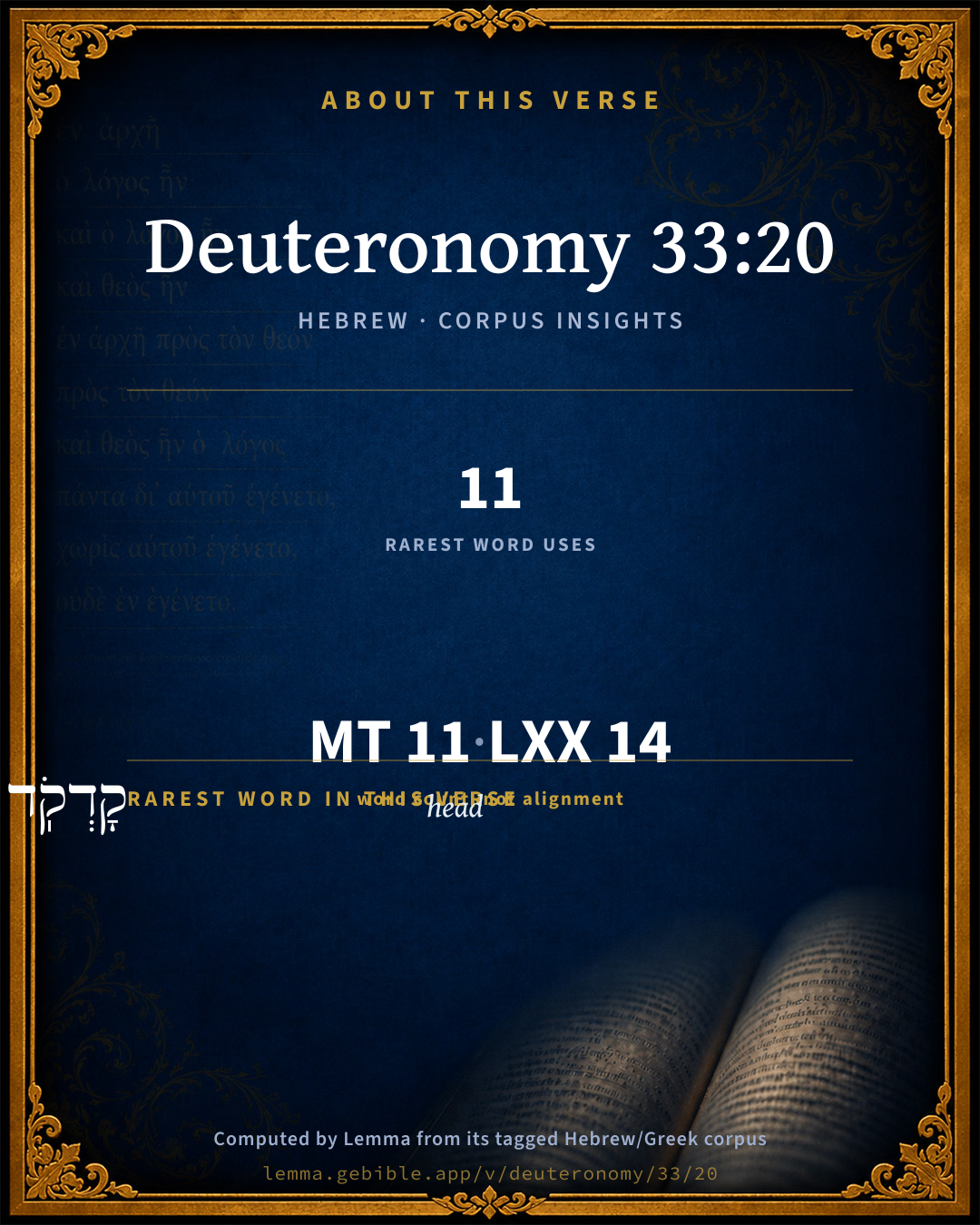
About this verse

These counts appear in no published source. They are computed here, from the morphology-tagged text and Lemma’s own curated glosses. What Lemma adds →

11
words
10
distinct lemmas
Pentateuch
section

Notable vocabulary

The rarest word here is קָדְקֹֽד head H6936 — appearing just 11 times in the whole Hebrew Bible.

Shared distinctive vocabulary

קָדְקֹֽד head H6936 occurs in 11 verses of the Hebrew Bible. Also found in:

Grammatical profile

  • 5 verbs
  • 5 nouns
  • 1 particle

Verb forms

  • אָמַ֔ר Qal · Perfect
  • בָּר֖וּךְ Qal · Participle Passive
  • מַרְחִ֣יב Hiphil · Participle Active
  • שָׁכֵ֔ן Qal · Perfect
  • וְטָרַ֥ף Qal · Sequential Perfect

Repetition

A word recurs within this verse — often emphatic in Hebrew:

  • וּלְגָ֣ד Gad H1410 ×2

Hebrew & Septuagint length

In English translation the verse runs 24 words from the Hebrew and 23 from the Septuagint (LXX English) — closely comparable.

A rough comparison of the two English renderings, which tokenize alike — not a word-level alignment.

Word counts can differ between the Hebrew and the Greek without any difference in meaning — e.g. the Hebrew direct-object marker אֵת has no separate Greek word, and Greek often adds the article ὁ.

In the original languages it is 11 Hebrew tokens and 14 Greek tokens — but the two are counted differently (Hebrew bundles its prefixes and suffixes into one token; the Greek is in lemma form), so that isn’t a like-for-like length.

Cross-references

12

Topical passages linked to Deuteronomy 33:20 in the Treasury of Scripture Knowledge — connected by theme and wording, ordered by reader-vote popularity; previews shown in the World English Bible.

  • Genesis 49:19 "Gad, a troop will press on him; But he will press on their heel.
  • Genesis 9:26–27 He said, "Blessed be Yahweh, the God of Shem; Let Canaan be his servant.
  • Joshua 13:8 With him the Reubenites and the Gadites received their inheritance, which Moses gave them, beyond the Jordan eastward, even as Moses the servant of Yahweh gave them:
  • Joshua 13:10 and all the cities of Sihon king of the Amorites, who reigned in Heshbon, to the border of the children of Ammon;
  • Joshua 13:24–28 Moses gave to the tribe of Gad, to the children of Gad, according to their families.
  • 1 Chronicles 4:10 Jabez called on the God of Israel, saying, Oh that you would bless me indeed, and enlarge my border, and that your hand might be with me, and that you would keep me from evil, that it not be to my sorrow! God granted him that which he requested.
  • 1 Chronicles 5:18–21 The sons of Reuben, and the Gadites, and the half-tribe of Manasseh, of valiant men, men able to bear buckler and sword, and to shoot with bow, and skillful in war, were forty-four thousand seven hundred and sixty, that were able to go forth to war.
  • 1 Chronicles 12:8–14 Of the Gadites there separated themselves to David to the stronghold in the wilderness, mighty men of valor, men trained for war, that could handle shield and spear; whose faces were like the faces of lions, and they were as swift as the roes on the mountains;
  • 1 Chronicles 12:37–38 On the other side of the Jordan, of the Reubenites, and the Gadites, and of the half-tribe of Manasseh, with all manner of instruments of war for the battle, one hundred twenty thousand.
  • Psalms 18:19 He brought me forth also into a large place. He delivered me, because he delighted in me.
  • Psalms 18:36 You have enlarged my steps under me, My feet have not slipped.
  • Micah 5:8 The remnant of Jacob will be among the nations, In the midst of many peoples, Like a lion among the animals of the forest, Like a young lion among the flocks of sheep; Who, if he goes through, treads down and tears in pieces, And there is no one to deliver.

Cross-references courtesy of OpenBible.info (CC BY 4.0).

Hebrew and Greek witnesses Masoretic Hebrew ↔ Greek Septuagint

The same verse in the two great witnesses to the Old Testament, shown verse-for-verse.

These are two independent witnesses, not word-aligned to each other, and the Septuagint is shown in lemma (dictionary) form.

Hebrew Deuteronomy 33:20 Masoretic · Westminster Leningrad Codex

וּלְגָ֣ד אָמַ֔ר בָּר֖וּךְ מַרְחִ֣יב גָּ֑ד כְּלָבִ֣יא שָׁכֵ֔ן וְטָרַ֥ף זְר֖וֹעַ אַף קָדְקֹֽד

Of Gad he said, Blessed be he who enlarges Gad: He dwells as a lioness, Tears the arm, yes, the crown of the head.

World English Bible · Public Domain

Greek LXX Deuteronomy 33:20 Septuagint · lemma form

καί ὁ γαδ εἶπον εὐλογέω ἐνπλατύνω γαδ ὡς λέων ἀναπαύω συντρίβω βραχίων καί ἄρχων

And to Gad he said, Blessed be he that enlarges Gad: as a lion he rested, having broken the arm and the ruler.

LXX2012 (modern English Septuagint) · Public Domain

On this verse, The Cambridge Bible for Schools and Colleges discusses the Septuagint’s reading. Read the note in Commentary ↓

Hebrew: Westminster Leningrad Codex (CC BY 4.0). Greek: Septuagint (public domain); English from LXX2012 (modern English Septuagint) (Public Domain). How the Septuagint differs from the Hebrew →

Targum (Aramaic paraphrase)

2

The Targum is the ancient Jewish Aramaic paraphrase of the Hebrew Scriptures — an interpretive translation, not the Hebrew text itself. Onkelos (literal) and Pseudo-Jonathan (expansive) render the Torah, and Jonathan the Prophets. Coverage is partial: where no permissively-licensed English translation exists for a verse, only the Aramaic is shown. This is verse-level text, not a word-by-word alignment to the Hebrew.

  1. Targum Onkelos Torah (Genesis–Deuteronomy)
    וּלְגָד אֲמַר בְּרִיךְ דְאַפְתֵּי לְגָד כְּלֵיתָא שָׁרֵי וְיִקְטוֹל שִׁלְטוֹנִין עִם מַלְכִין

    (no public-domain English translation for this verse)

    Targum Onkelos — Aramaic: “Onkelos Genesis” (public domain); “Onkelos Exodus” (public domain); “Onkelos Leviticus” (public domain); “Onkelos Numbers” (public domain); “Onkelos Deuteronomy” (public domain). English: “Sefaria Community Translation” (CC0 1.0 (public-domain dedication)); “J.W. Etheridge. The Targums of Onkelos and Jonathan Ben Uzziel on the Pentateuch. London: Longmans, Green, 1862” (public domain). Text via Sefaria.

  2. Targum Pseudo-Jonathan Torah (Genesis–Deuteronomy)
    וּלְשִׁבְטָא דְגָד בְּרִיךְ משֶׁה נְבִיָא דַיְיָ וַאֲמַר בְּרִיךְ דְאַפְתֵּי תְחוּמֵיהּ דְגָד נְיָיח כְּאַרְיָא לְמֵישְׁרֵיהּ וְכַד נְפִיק לְסִדְרֵי קְרָבָא קֳבֵל בַּעֲלֵי דְבָבוֹי מִקְטַל מַלְכִין עִם שִׁלְטוֹנִין וּקְטוּלוֹי חַכִּימִין מִן כָּל קָטוֹלַיָא דְמִגְרַר אֶדְרְעָא עִם קוֹדְקְדָא

    Mosheh the prophet of the Lord blessed the tribe of Gad, and said: Blessed be He who hath made wide the border of Gad. He reposeth as a lion in his habitation; but when he goeth out to battle against his adversaries, he slayeth kings and rulers, and his slaughtered ones are known from all the slain, for he striketh off the arm with the crown (of the head).

    Targum Pseudo-Jonathan — Aramaic: “Targum Jonathan on Genesis” (public domain); “Targum Jonathan on Exodus” (public domain); “Targum Jonathan on Leviticus” (public domain); “Targum Jonathan on Numbers” (public domain); “Targum Jonathan on Deuteronomy” (public domain). English: “The Targum of Jonathan ben Uzziel, trans. J. W. Etheridge, London, 1862” (public domain). Text via Sefaria.

Commentary

Notes on Deuteronomy 33:20 from classic Christian and Jewish commentators (each source and its license shown beneath its notes). The classic Christian expositions comment on the surrounding passage and are grouped to its opening verse, so a note may address several verses; the Jewish commentaries on the Tanakh (Rashi and others) are per-verse, so they appear only where the commentator wrote on this verse.

Lemma curates 59 commentaries, every one of them public domain or Creative Commons licensed, each selected and text-cleaned for this edition rather than reprinted as found. About our sources →

The Cambridge Bible for Schools and Colleges

gen. ed. J. J. S. Perowne

20. foreigner] See on Deu_15:3.

that the Lord thy God … thine hand unto] See on Deu_12:7.

the land whither thou goest in, etc.] See on Deu_7:1, Deu_8:1.

20 And of Gad he said:

Blessed be the Broadener of Gad,

Like a lion he haunts

And tears the arm, yea the scalp.

21 And he saw to the best for himself,

[For there was the lot of the leader (?)]

Yet he went with the heads of the people,

He wrought the just will of the Lord,

And his judgements along with Israel.

On Gad’s territory see Deu_3:16 f. (mingled with that of Reuben); and Jos_13:24-28, where he extends from Aroer on Arnon northward through Moab and all the cities of Gilead to Lidebir (just S. of the Yarmûk) unto the uttermost part of the sea of Chinnereth: truly the broadest of the tribal territories, the lot of the leader(?), as this oracle describes it. On the obscure oracle upon Gad in Gen_49:19, little more than a play upon his name, see Ryle’s notes in this series. It is not possible to deduce a date from this oracle; see on Deu_33:20.

20. he that enlargeth, etc.] Jehovah. The reference is usually interpreted of the recovery of Gad’s territory from the Syrians, 2Ki_14:25 f., and as proof of a date for the poem between that and the conquest by Tiglath Pileser (1Ch_5:26). But it may as well be a reference to the original allotment of so vast a territory to Gad, Jos_13:24 ff.

dwelleth] So Sam. Haunts is more appropriate. LXX ἀνεπαύσατο.

as a lioness] Cp. 1Ch_12:8 : Gadites … whose faces were like the faces of lions.

The Cambridge Bible for Schools and Colleges (gen. ed. J. J. S. Perowne; Cambridge University Press, 1878–1918) — public domain. Text from a community e-Sword module.

Trapp's Complete Commentary

John Trapp

Deu 33:20 And of Gad he said, Blessed [be] he that enlargeth Gad: he dwelleth as a lion, and teareth the arm with the crown of the head.

Ver. 20. He dwelleth as a lion.] That should make his party good with the enemy, upon whom he bordereth, and by whom he is often invaded. See Gen 49:19 Jdg 11:5; Jdg 11:13 1Ch 12:8.

John Trapp, A Commentary or Exposition upon All the Books of the Old and New Testament (1647–1656) — public domain. Text from a community e-Sword module.

The Biblical Illustrator

Joseph S. Exell

Deu_33:20-21

Blessed be He that enlargeth Gad.

Gad

We are able to form a more than usually distinct idea of the personal character which pertained to Gad, and which he transmitted to his descendants. Scripture hints and Jewish traditions bear one another out in suggesting that this man was wild and turbulent and headstrong above his brethren; and that, being by no means content with the peaceful occupations of pastoral life which belonged to his family, he threw himself with ardour into the fierce forays which then, as now, kept the land of Canaan in a state of chronic warfare and unsettlement. It was to this feature that Jacob probably referred in his dying prophecy, in which he introduces a characteristic play upon the name which Leah had bestowed--

Gad, a plundering troop is plundering him,

But he is plundering at their heels.

-- Gen_49:19.

When the children of Israel went out of Egypt, Gad marched and encamped, not as we might have expected with his whole brother Asher, but with Reuben and with Simeon, two tribes which closely resembled his own in character and occupation. All these three retained the nomad habits of their fathers earlier life in a marked degree, and had not, like some other Hebrew tribes, settled down in Egypt into the ways of an organised and civilised nation. They still preferred to live in tents as did the unreclaimed Ishmaelites of the desert. All their wealth consisted in huge flocks and herds of cattle. All their sympathies were with the freebooting mode of life which lies on the border line between civilisation and barbarism. Thus, when Canaan was settled, although Simeon parted from his former companions and sought his fortunes alone in the dry south land of Judah, Gad and Reuben kept their alliance fast, and took possession of the country east of Jordan, where alone there was room for their immense flocks, and opportunity for predatory raids. In this alliance Reuben seems to have willingly yielded the first place to his younger brother, whose character was evidently stronger than his own; and it is curious to notice how invariably Gad speaks and acts as the leader in all the transactions that attended this settlement. We recognise the same masterful character in all the men who rise up before us in the after history of the Bible as members of the tribe of Gad; namely, Jephthah, the eleven heroes who joined David at the most critical period of his fortunes, and Elijah the Tishbite, in whose rude strength and fearlessness we seem to behold the Gadite type in its best development, and to recognise the noblest aspect of the comparison which Moses had instituted in his blessing between this tribe and the shaggy forest lord which is mightiest among beasts, and turneth not away for any. (T. G. Rooke, B. A.)

The Biblical Illustrator, edited by Joseph S. Exell (c. 1880s–1900s) — public domain. Text from a community e-Sword module.

Joseph Benson's Commentary

Deu 33:20. Blessed be he that enlargeth Gad — That bringeth him out of his straits and troubles, which he was often engaged in, because he was encompassed with potent enemies. As a lion — Safe and secure from his enemies, and terrible to them when they rouse and molest him. Teareth the arm — Utterly destroys his enemies, both the head, the seat of the crown, their dignity and principality, and the arm, the subject of strength and instrument of action; both chief princes, and their subjects.

Joseph Benson's Commentary on the Old and New Testaments (1811–1818) — public domain. Text from a community e-Sword module.

Tyndale Open Study Notes

Tyndale Open Resources

33:20 Gad was the elder of two sons of Jacob by Leah’s servant Zilpah (Gen 30:10-11). His name means “good fortune,” but the message is that the one who enables the tribe to enlarge its territory is the fortunate one. That territory was east of the Jordan and the Sea of Galilee.

Tyndale Open Study Notes — © Tyndale Open Resources, licensed CC BY-SA 4.0. Text via the HelloAO Bible API.

Jamieson, Fausset & Brown

Robert Jamieson, A. R. Fausset & David Brown

of Gad he said--Its possessions were larger than they would have been had they lain west of Jordan; and this tribe had the honor of being settled by Moses himself in the first portion of land conquered. In the forest region, south of the Jabbok, "he dwelt as a lion" (compare Gen 30:11; Gen 49:19). Notwithstanding, they faithfully kept their engagement to join the "heads of the people" [Deu 33:21] in the invasion of Canaan.

Jamieson, Fausset & Brown — Commentary Critical and Explanatory on the Whole Bible (1871) — public domain (CC PDM 1.0). Text via the HelloAO Bible API.

Adam Clarke's Commentary

Verse 20. Blessed be he that enlargeth Gad] As deliverance out of distress is termed enlarging, (see Ps 4:1), this may refer to God's deliverance of the tribe of Gad out of that distress mentioned Ge 49:19, and to the enlargement obtained through means of Jephthah, Jdg 11:33, and probably also to the victories obtained by Gad and Reuben over the Hagarites, 1Ch 5:18-20.

He dwelleth as a lion] Probably the epithet of lion or lion-like was applied to this tribe from their fierce and warlike disposition. And on this supposition, 1Ch 12:8, will appear to be a sufficient comment: And of the Gadites there were-men of might, men of war for the battle, that could handle shield and buckler, whose faces were LIKE THE FACES OF LIONS, and were as swift as the roes upon the mountains. Tearing the arm or shoulder with the crown of the head seems simply to mean that no force should be able to prevail over them, or stand against them; as the arm or shoulder signifies dominion, and the crown of the head, sovereign princes.

Adam Clarke's Commentary on the Bible (1810–1826) — public domain. Text from a community e-Sword/MySword module.

Ellicott's Commentary for English Readers

(20) Blessed be he that enlargeth Gad.—The mountains of Gilead shut him in.

He dwelleth as a lion.—See 1Ch_12:8, for eleven Gadites, “whose faces were as the faces of lions.”

A Bible Commentary for English Readers, edited by Charles John Ellicott (1878–1897) — public domain. Text from a community e-Sword module.

John Gill's Exposition

And he provided a first part for himself,.... That is, the portion of the land of Sihon and Og, as Jarchi rightly interprets it; which was the beginning or firstfruits of the subduing of the land that was promised; this he looked at, chose, and desired it as his inheritance, Num 32:1,

because there, in a portion of the lawgiver, was he seated; or in the portion and part of the inheritance of Israel was he placed by Moses the lawgiver, according to the will of God; or because there were in it palaces and towers of great personages, lawgivers, kings, and princes, well covered and strongly fortified; or here he was "hid", or "protected", i.e. their families, wives, and children, while they assisted their brethren in subduing Canaan:

and he came with the heads of the people; either "to" them, to Moses, Eleazar, and the seventy elders, and the heads of the tribes of Israel, to ask leave to have his part and portion on the other side Jordan, or "with" them, as we supply it; came with them over Jordan armed, to assist in the conquest and subduing of the land of Canaan:

he executed the justice of the Lord, and his judgments with Israel; that is, either he justly and truly fulfilled all his promises and engagements, on condition of which he was placed on the other side; or he, together with the rest of the Israelites, executed the righteous judgment of God upon the Canaanites, in the expulsion and destruction of them.

John Gill's Exposition of the Whole Bible (1746–1763) — public domain (CC PDM 1.0). Text via the HelloAO Bible API.

Albert Barnes' Notes on the Bible

i. e., Blessed be God who shall grant to Gad a spacious territory. Compare the blessing of Shem Gen 9:26.

With the crown - Rather, yea, the crown. The warlike character of this tribe is shown by their leading the van in the long campaigns of Joshua (compare Jos 4:12-13; Jos 22:1-4). Compare also 1Ch 5:18-22; 1Ch 12:8 ff, and the acts of Jehu, the Gadite, in 2 Kings 9; 10.

Albert Barnes' Notes on the Bible (1834–1885) — public domain. Text from a community e-Sword/MySword module.

Haydock's Catholic Bible Commentary

Breadth. The tribe of Gad, &c., slew or drove the Agarites from their neighbourhood, and seized their country, 1 Paralipomenon v. 18, 22. Hebrew, Septuagint, and Chaldean, "Blessed be he that enlargeth Gad," which was verified in Jephte, Josue xi. 33. (Calmet)

George Leo Haydock (1774–1849), Haydock's Catholic Family Bible and Commentary, 1859 edition — public domain. Excludes Psalms (Douay-Rheims chapter numbering differs from Protestant) and Deuterocanonical books (Catholic canon only).

Matthew Poole's English Annotations

By praising God for enlarging Gad he supposeth the ground of these praises, that God would enlarge Gad, i.e. either.

1. Enlarge his territories; which seems needless, because they had a very large portion now when Moses uttered these words. Or,

2. Bring him out of his straits and troubles, which he was likely to be oft engaged in, because he was encompassed with potent enemies. And in this sense the phrase is used Psa 4:1; compare Psa 31:8; 118:5. One instance of the fulfilling hereof we have Jdg 11.

He dwelleth as a lion, i.e. safe and secure from his enemies, and terrible to them when they rouse and molest him. See 1Ch 5:18, &c.; 1Ch 12:8.

Teareth the arm with the crown of the head, i.e. utterly destroys his enemies; both the head, the seat of the crown, their dignity and principality, and the arm, the subject of strength and instrument of action; both chief princes, and their instruments and subjects.

Matthew Poole's English Annotations on the Holy Bible (1683–1685) — public domain. Text from a community e-Sword/MySword module.

Whedon's Commentary on the Bible

Daniel D. Whedon

20, 21. Blessed be he that enlargeth Gad — The territory of Gad was east of the Jordan. At the time of the pronouncing of this blessing the warlike character of the tribe was seen. It had gained a broad territory.

He dwelleth as a lion — This expression was applied to the tribe on account of their warlike disposition. Comp. 1Ch_12:8, where the Gadites are described as men of might and men of war fit for the battle, that could handle shield and buckler, whose faces were like the faces of lions.

Teareth the arm with the crown of the head — More literally rendered, Teareth the arm, yea, the crown of the head.

Daniel D. Whedon (gen. ed.), Commentary on the Old and New Testaments (1874–1909) — public domain. Text from a community e-Sword module.

The Pulpit Commentary

Vers. 20, 21. As in the blessing of Shem by Noah, God is praised for Shem"s prosperity, (Gen_9:26) so here God is praised for the enlargement of the warlike tribe of Gad. (cf. Gen_49:19) He dwelleth as a lion; rather, as a lioness. Though the noun aybil; has a masc. termination, usage shows that it was the female and not the male that was thereby designated. (see e.g. Gen_49:9; Num_24:9, where it can hardly, be a mere synonym; and Job_4:11 Job_38:39, wherethe reference to the young of the animal accords better with the lioness than with the lion, Gesenius)

Vers. 20, 21. Gad; or, a place in the Church and the world for lionlike strength.

territory of Gad lay in the east of the Jordan... it included several cities remarkable in the history of the patriarchs and of the judges, as Mahanaim, Ramoth, Mizpeh, Succoth, and Peniel; but it was pre-eminently remarkable because it contained the grave of the great general and lawgiver, Moses a fact which so decidedly invested the province with a character of holiness that, though situated on the east of the river, it was regarded as one of the most honored parts of the Promised Land, from which the leaders of the people might legitimately arise". (Kalisch on Gen_49:19)

The blessing of Moses, like that of Jacob, upon Gad, has a warlike ring about it. He is spoken of here as lionlike in courage and strength, and also as being charged with the execution of the justice of the Lord and his ordinances with Israel. "The clause, "He came to the heads of the people," expresses the thought that Gad joined the heads of the people to go at the head of the tribes of Israel, (comp. Jos_1:14 Jos_4:12, with Num_32:17, Num_32:21, Num_32:32) to conquer Canaan with the whole nation, and root out the Canaanites" (Keil, in loc.). The character of this tribe is described with remarkable vividness in the Book of Chronicles. It was strong, hardy, fierce, warlike, magnificent in heroism, invaluable to friends, terrible to foes. Among them were "strong men of might, men of war for the battle, that could handle shield and buckler, their faces the faces of lions, and like rues upon the mountain for swiftness:" "the least of them more than equal to a hundred, and the greatest to a thousand". (1Ch_12:8, 1Ch_12:14) And amid all the conflicts which were inevitable to the Hebrews with the nations round about, such lionlike courage and hardiness would be invaluable in leading them on to victory, and in helping them through great crises of their political and military history. And when such courage and valor are animated by the right spirit, and engaged on the side of righteousness, upon them an aged saint may well pronounce his blessing. It is indicative of the spirit, which pervaded this tribe that such men as Jephthah, Barzillai, and (probably) Elijah were of it. Our theme for homiletic teaching isThat the special qualities of courage and strength have a valuable place in carrying out God"s work both in the Church and the world.

I THERE ARE NOT UNFREQUENTLY GREAT CRISES WHICH ARISE IN THE CHURCH OR IN THE WORLD. Work has to be done which requires no ordinary amount of independence and assurance; as e.g. when a way has to be opened up through new and untried districts; or a step has to be taken on which the weal or woe of ages may depend. Sometimes in the military career of a nation a giant foe has to be grappled with, or, in the progress of a Church, some heresy has to be attacked, and battles, harder than any on a nation"s battle-field, have to be fought in the name of the Lord of hosts. Perchance some Ahab with his pride and covetousness, or some Herod or Felix rioting in lust and splendor, may have to be sternly addressed for righteousness" sake. Or there may come a time when the flood-gates of iniquity are burst open, and sin rushes forth in torrents, and the wicked ride high and triumph over the righteous, and the greater part of men are cowed before the storm-blast.

II THE WORK OF GOD AT SUCH TIMES MAY BE STERN AND HARD. It may be that some special form of service is just then imperatively needed. "Who will rise up for me against the evil-doers? Who will stand up for me against the workers of iniquity?" The quiet souls, precious as they are, will seem to be at a discount then. There requires:

1. Leadership in the cause of the right.

2. Men who can venture all, to clear the way to an unknown region.

3. Men who can endure hardness as good soldiers of Jesus Christ.

4. Men who can fearlessly rebuke ill, and fear the face of neither man nor devil.

III FOR THIS SPECIAL FORM OF SERVICE, ENTERPRISE, COURAGE, BRAVERY, AND THE STERNER VIRTUES ARE REQUIRED. Those who are naturally timid and retiring will probably be out of sight at such times. Their work, indeed, is not lost. Their sighs and cries and prayers do enter into the ears of the Lord of sabaoth. But still there then is need of the shaggier spirits to come to the front. There was time when evil so overspread Israel, and persecution was so sore, that it seemed as if virtue would soon become extinct unless God arose in his might. There were seven thousand souls hidden in obscurity. But one man, stern and strong, must be to the front. It was Elijah (cf. also John the Baptist).

IV GOD IN MERCY, AS HE FORESEES THESE CRISES, PREPARES MEN FOR THEM. The Hebrews could not have dispensed with the men of Gad. Their strength was required as much as the sanctity of the Levites. Every virtue, every grace, has its own distinctive sphere of service. God gives some more of the kindlier graces, that they may be comforters; and others more of the hardier ones, that they may be awakeners. One is a Barnabas; another a Boanerges.

V THEREFORE, WHATEVER OUR NATURAL GIFTS MAY BE, LET US BE SUPREMELY CONCERNED TO SANCTIFY THEM FOR GOD. Let no one reset that he cannot be anybody else. Rather, "as much as in him is," let him use his powers, whatever they may be, for his redeeming God. The meek, quiet, gentle, retiring souls have their work. The rougher, sterner ones have also theirs. Each one in his place is best." Be it ours every day to ask, "Lord, what wilt thou have me to do?" In a great house there are not only vessels of gold and of silver, but also of wood and of earth; some to honor and some to dishonor. If a man, therefore, purge himself from these, he shall be a vessel unto honor, sanctified and meet for the Master"s use, and prepared unto every good work.

Vers. 20-25. Gad, Dan, Naphtali, Asher.

The blessings on these tribes are connected with

I PROWESS. (Vers. 20, 21.) The chivalrous heroic spirit, which, as well as in bloodier conflicts, finds scope for its exercise in the battles of the cross, has here its appropriate recognition. A first portion is reserved for it.

II ACTIVITY. Dan"s characteristic was agility. In Genesis, the dart of the serpent (49:17); here, the leap of the lion"s whelp (ver. 22). A counterpart in minds of bold, nimble, adventurous type; prompt in decision, subtle in thought, swift in action. Such minds, if to the wisdom of the serpent is added the dove"s harmlessness, (Mat_10:16) are of immense service in Christian enterprises needing bold pioneers or swift and decided action.

III CONTENTMENT. (Ver. 23.) Naphtali was less active than receptive. Did less, but received more. Possessed a region of great sweetness and beauty, and dwelt in it with unambitious satisfaction. Such dispositions are needed as a balance to the others.

IV SKILL IN THE ARTS. (Vers. 24, 25.) Iron and brass. Asher appears to have wrought these metals, whether from mines in its own district or brought from a distance does not appear.

Lessons

1. Talents are diverse.

2. All have their place.

3. A community needs all.

4. The blessing of God rests on a faithful use of all.

5. All should cooperate. J.O.

Vers. 20, 21. Gad"s valor and chivalry commended.

Gad had been prematurely hasty in seeking an allotment in Canaan. When the heads of this tribe perceived how suitable were the hills of Gilead for pasturing their extensive flocks, they clamored at once for this possession, ere yet an inch of land had been gained on the west of Jordan. Moses yielded to their request, on condition only that they should go over Jordan armed with their brethren, and should fight in the front of battle. This they nobly did, and returned to their families and flocks only when Joshua released them from further service. We see

I A HASTY CHOICE OVERRULED FOR GOOD. There can be little doubt that selfishness was the originating motive for this choice. The wellbeing of other tribes was not, for the time, weighed. Yet it was a choice beset with perils. The district coveted lay on the borders of the wilderness, and was exposed to raid and depredation from foes. It is wiser always to look heavenward and to say, "Thou shalt choose our inheritance for us." Yet, though selfishness was for the hour dominant, other and better qualities dwelt in the tribe. As often happens, God allowed their choice, and then led them through severe discipline to enable them to enjoy it.

II THEIR CHOICE WAS PURCHASED BY HARD AND PERILOUS WARFARE. "He came with the heads of the people, he executed the justice of the Lord, and his judgments with Israel." To acquire this territory, Moses stated at once the simple condition, viz. that they should fight in the van of Israel"s battalions. This condition they accepted, and bravely they acquitted themselves. The event taught them valuable lessons. It taught them that they were an integral part of a great commonwealth, and could not separate themselves, without injury, from it. It taught them to look, not only on their own welfare, but also to consult for the welfare of others. It taught them that rest and quiet possession were more valued after a hard-fought campaign than before.

III THEIR CHIVALROUS CONDUCT DEVELOPED THEIR LATENT QUALITIES OF MARTIAL PROWESS. The greatest advantage resulting from their military encounters was the personal strength and heroism which were developed in themselves. They were better, braver, nobler men afterwards than ever before. Now, and not till now, they were qualified to protect their own hills and flocks. This advantage they had not foreseen, yet it was the best and most enduring. Now the men of Gad "dwelt like a lion" in fearless possession; now they were able, when assailed," to tear the arm" of a foe, "with the crown of the head." This heroic quality reappeared, in brighter form, in the person of Elijah, and probably also in the forerunner of our Lord.

IV THIS FEARLESS COURAGE OBTAINS A PRAYER FOR STEADY ENLARGEMENT. "Blessed be he that enlargeth Gad." It was a boon to the whole of Israel to have such a martial tribe occupying an outpost in the land. To enlarge and strengthen Gad was to strengthen their military defense, was to increase their own safety, was to perpetuate their own peace. So long as the lion-hearted tribe of Gad had a numerous generation, no foe could invade Israel from that side. The very reputation of Gad eastward kept the nations in salutary awe. The welfare of Gad was the welfare of all. D.

The Pulpit Commentary (1880–1919), ed. H.D.M. Spence-Jones & Joseph S. Exell — public domain. Text from a community e-Sword module.

John Wesley's Explanatory Notes

Enlargeth - That bringeth him out of his straits amid troubles, which he was often engaged in, because he was encompassed with potent enemies. As a lion - Safe and secure from his enemies, and terrible to them when they rouse and molest him. Teareth the arm - Utterly destroys his enemies, both the head, the seat of the crown, their dignity and principality, and the arm, the subject of strength and instrument of action; both chief princes, and their subjects.

John Wesley, Explanatory Notes Upon the Whole Bible (1754–1765) — public domain. Text via the GEBible commentary corpus.

Keil & Delitzsch

C. F. Keil & F. Delitzsch

Gad. - "Blessed be He that enlargeth Gad: like a lioness he lieth down, and teareth the arm, yea, the crown of the head. And he chose his first-fruit territory, for there was the leader's portion kept; and he came to the heads of the people, he executed the justice of the Lord, and his rights with Israel." Just as in the blessing of Noah (Gen 9:26) the God of Shem is praised, to point out the salvation appointed by God for Shem, so here Moses praises the Lord, who enlarged Gad, i.e., who not only gave him a broad territory in the conquered kingdom of Sihon, but furnished generally an unlimited space for his development (vid., Gen 26:22), so that he might unfold his lion-like nature in conflict with his foes. On the figure of a lioness, see Gen 49:9; and on the warlike character of the Gadites, the remarks on the blessing of Jacob upon Gad (Gen 49:19). The second part of the blessing treats of the inheritance which Gad obtained from Moses at his own request beyond Jordan. ראה, with an accusative and ל, signifies to look out something for oneself (Gen 22:8; Sa1 16:17). The "first-fruit" refers here to the first portion of the land which Israel received for a possession; this is evident from the reason assigned, חלקת שׁם כּי, whilst the statement that Gad chose the hereditary possession is in harmony with Num 32:2, Num 32:6, Num 32:25., where the children of Gad are described as being at the head of the tribes, who came before Moses to ask for the conquered land as their possession. The meaning of the next clause, of which very different explanations have been given, can only be, that Gad chose such a territory for its inheritance as became a leader of the tribes. מחקק, he who determines, commands, organizes; hence both a commander and also a leader in war. It is in the latter sense that it occurs both here and in Jdg 5:14. מחקק חלקת, the field, or territory of the leader, may either be the territory appointed or assigned by the lawgiver, or the territory falling to the lot of the leader. According to the former view, Moses would be the mechokek. But the thought, that Moses appointed or assigned him his inheritance, could be no reason why Gad should choose it for himself. Consequently מחקק חלקת can only mean the possession which the mechokek chose for himself, as befitting him, or specially adapted for him. Consequently the mechokek was not Moses, but the tribe of Gad, which was so called because it unfolded such activity and bravery at the head of the tribes in connection with the conquest of the land, that it could be regarded as their leaders. This peculiar prominence on the part of the Gadites may be inferred from the fact, that they distinguished themselves above the Reubenites in the fortification of the conquered land (Num 32:34.). ספוּן, from ספן, to cover, hide, preserve, is a predicate, and construed as a noun, "a thing preserved." - On the other hand, the opinion has been very widely spread, from the time of Onkelos down to Baumgarten and Ewald, that this hemistich refers to Moses: "there is the portion of the lawgiver hidden," or "the field of the hidden leader," and that it contains an allusion to the fact that the grave of Moses was hidden in the inheritance of Gad. But this is not only at variance with the circumstance, that a prophetic allusion to the grave of Moses such as Baumgarten assumes is apparently inconceivable, from the simple fact that we cannot imagine the Gadites to have foreseen the situation of Moses' grave at the time when they selected their territory, but also with the fact that, according to Jos 13:20, the spot where this grave was situated (Deu 34:5) was not allotted to the tribe of Gad, but to that of Reuben; and lastly, with the use of the word chelkah, which does not signify a burial-ground or grave. - But although Gad chose out an inheritance for himself, he still went before his brethren, i.e., along with the rest of the tribes, into Canaan, to perform in connection with them, what the Lord demanded of His people as a right. This is the meaning of the second half of the verse. The clause, "he came to the heads of the people," does not refer to the fact that the Gadites came to Moses and the heads of the congregation, to ask for the conquered land as a possession (Num 32:2), but expressed the thought that Gad joined the heads of the people to go at the head of the tribes of Israel (comp. Jos 1:14; Jos 4:12, with Num 32:17, Num 32:21, Num 32:32), to conquer Canaan with the whole nation, and root out the Canaanites. The Gadites had promised this to Moses and the heads of the people; and this promise Moses regarded as an accomplished act, and praised in these words with prophetic foresight as having been already performed, and that not merely as one single manifestation of their obedience towards the word of the Lord, but rather as a pledge that Gad would always manifest the same disposition. "To do the righteousness of Jehovah," i.e., to do what Jehovah requires of His people as righteousness - namely, to fulfil the commandments of God, in which the righteousness of Israel was to consist (Deu 6:25). יתא, imperfect Kal for יאהת or יאתּה; see Ges. 76, 2, c., and Ewald, 142, c. "With Israel:" in fellowship with (the rest of) Israel.

Keil & Delitzsch — Biblical Commentary on the Old Testament (1861–1891) — public domain (CC PDM 1.0). Text via the HelloAO Bible API. (Old Testament only.)

unfoldingWord translationNotes

Door43 World Missions Community

General Information:

Moses continues to bless the tribes of Israel; the blessings are short poems. (See: Parallelism)

Blessed be he who enlarges Gad

This can stated in active form. AT: Possible meanings are 1) "May Yahweh bless Gad and give him much land to live in" or 2) "People should say that Yahweh is good because he has given Gad much land to live in" (See: Active or Passive)

He will live there like a lioness, and he will tear off an arm or a head

This means the people of Gad are strong and secure, and they will defeat their enemies in war. (See: Simile)

translationWords

Gad

lions

unfoldingWord translationNotes — © Distant Shores Media and the Door43 World Missions Community, licensed CC BY-SA 4.0. Source: git.door43.org/Door43/en_tn.

Rashi

Rabbi Shlomo Yitzchaki (Rashi)

ברוך מרחיב גד BLESSED BE HE THAT ENLARGES GAD — this teaches us that Gad’s territory extended far eastward (Sifrei Devarim 355:2).

כלביא שכן HE DWELLETH AS A LIONESS — Because he was near the border it therefore compares him to lions, for all who are near the border must be strong (that they may repulse attacks from neighbours) (Sifrei Devarim 355:3).

וטרף זרוע אף קדקד TEARING THE ARM WITH THE CROWN OF THE HEAD — Those whom they slew could be easily recognised, because they used to cut off the head together with the arm at one blow.

Rashi on the Tanakh — English translations: “The Judaica Press complete Tanach with Rashi, translated by A. J. Rosenberg” (CC BY 4.0); “Pentateuch with Rashi's commentary by M. Rosenbaum and A.M. Silbermann, 1929-1934” (public domain); “The Metsudah Tanach series, Lakewood, N.J” (CC BY 4.0); and “The Book of Joshua, Metsudah Publications, 1997” (CC BY 4.0). Text via Sefaria.

Ramban (Nachmanides)

Rabbi Moshe ben Nachman (Ramban / Nachmanides)

BLESSED BE HE THAT ENLARGETH GAD. “This teaches that Gad’s border was enlarged toward the east.” [Since his territory was east of the Jordan it could be extended towards the east.] This is Rashi’s language from the Sifre. 355. And Rabbi Abraham ibn Ezra commented that because Moses likened Gad to a lion [he dwelleth as a lioness], he said, “Blessed be He Who enlarges Gad, Who gives him strength so that whoever [any enemy] sees him will flee him, and no one will trouble him.” The correct interpretation is that it refers to Gad’s inheritance, for the two tribes [Reuben and Gad] that took their inheritance on the east bank of the Jordan did not take it by the lot. Instead Moses gave them the entire kingdoms of Sihon and Og and their inheritance was broader as it wound about higher than all the tribes. Moses did not mention this [blessing] in the case of Reuben, for his prayer was sufficient. It is also possible that the children of Gad took more territory than the children of Reuben for they were mighty and therefore Moses gave them the entire [eastern] border. The cities which they built were also more numerous than those of Reuben., Verses 37-38. In addition, it was the Gadites who first requested that land [east of the Jordan as their inheritance] as I have explained there, Verse 2 (Vol. IV, pp. 370-371). and thus they were the cause of this expansion.

Ramban (Nachmanides) on the Tanakh — English translation: “Commentary on the Torah by Ramban (Nachmanides). Translated and annotated by Charles B. Chavel. New York, Shilo Pub. House, 1971-1976” (CC BY 4.0). Text via Sefaria.

Lesson kit

Teaching starters — assembled from the data on this page, not authored interpretation. Every prompt links to the verse data it draws on. Edit before teaching.

Deuteronomy, in the Pentateuch, opens this verse with 11 words (10 distinct Hebrew lemmas). Its most distinctive word is qodqôd (“head”). A historical commentator’s framing appears above. Read the whole chapter for the surrounding context.

Discussion questions

  1. What does “head” (qodqôd) contribute to the verse as a whole?
  2. How does Genesis 49:26, which shares the word «head», read alongside this verse?
  3. What does the repetition of “Gad” (2× in this one verse) do in this verse?
  4. These translations render this verse differently. What is at stake in choosing one wording over another?
  5. «אָמַ֔ר» is a Qal Perfect verb. How does that grammatical form shape the action described?
  6. Compare how The Cambridge Bible for Schools and Colleges and Trapp's Complete Commentary read this verse. Where do they agree or differ?

Things to notice

Reading settings

Reading text

Shown beneath each verse's original-language words.

Old Testament
Old Testament edition

Read the OT as the Masoretic Hebrew (MT) or the Greek Septuagint (LXX).

English shown for the Greek Septuagint (in the Hebrew ↔ Greek comparison).

Comparing translations? Open the Compare panel on any verse page to stack up to four side by side.