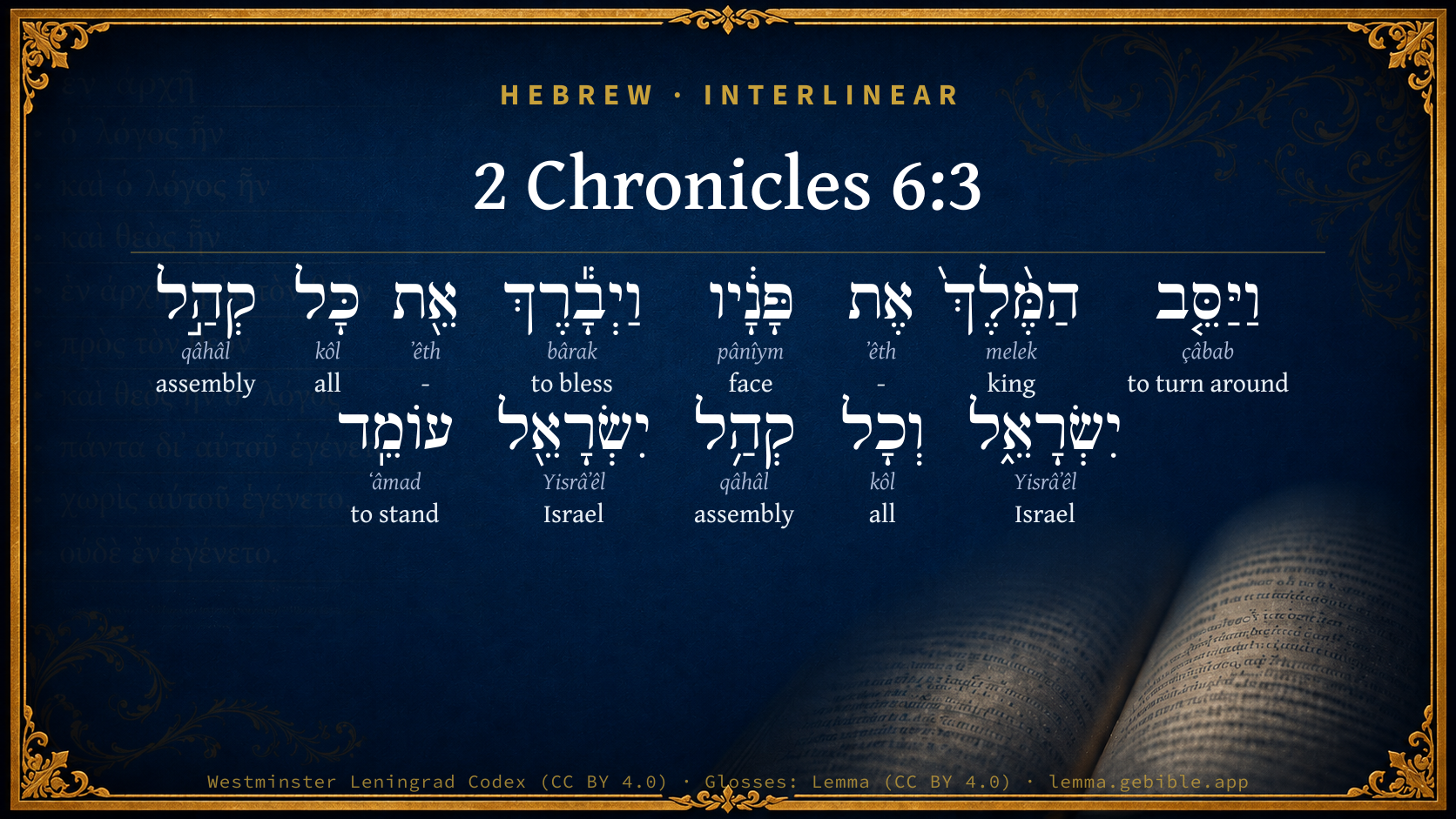
2 Chronicles 6:3

Hebrew (Westminster Leningrad Codex) 2 Chronicles 6:3 appears in the Hebrew Old Testament. The text above is from the Westminster Leningrad Codex. Each word links to its Strong’s number, a concise gloss, and parsing drawn from the Open Scriptures Hebrew Bible morphology. Click any word for its full Brown-Driver-Briggs (BDB) entry.
Download image
Cite this verse

2 Chronicles 6:3 (World English Bible). Public Domain. Lemma interlinear Bible study tool, https://lemma.gebible.app/v/2-chronicles/6/3.

Show BibTeX & RIS
BibTeX
RIS
English Translation
The king turned his face, and blessed all the assembly of Israel: and all the assembly of Israel stood.
World English Bible · Public Domain
Download a study sheet

One document with this verse’s original text, its word-by-word gloss line, the meaning frame, cross-references with their text, attributed commentary, and full source and license credits — printable, and it pastes into notes with its structure intact.

This verse Autodidact and up

Study sheet (.html) Plain text (.txt)

A passage Seminary Student

Up to 50 verses in one chapter. A passage sheet keeps up to 6 commentary sources and 12 cross-references per verse, in the order this page ranks them, and says so on the sheet whenever that leaves anything out. Ask for a single verse and you get the Autodidact verse sheet above.

Everything on this page stays free to read, with no account — the sheet is a download of what is already on screen, not access to it.

Want to remove ads? Support Godless Engineer
Compare translations 3

The same verse in 3 English versions, stacked beneath the original-language interlinear above. Click any original word for its lexicon entry.

Each is an independent rendering of the whole verse — the interlinear is not word-aligned to these translations.

Highlighted words mark where these versions differ — a whole-verse word diff, not a word-by-word alignment.

  • World English Bible Public Domain
    The king turned his face, and blessed all the assembly of Israel: and all the assembly of Israel stood.
  • King James Version Public Domain
    And the king turned his face, and blessed the whole congregation of Israel: and all the congregation of Israel stood.
  • unfoldingWord Literal Text CC BY-SA 4.0
    And the king turned his face, and he blessed all the assembly of Israel, and all the assembly of Israel was standing.

unfoldingWord Literal Text — © unfoldingWord, licensed CC BY-SA 4.0. Word-aligned USFM3 via Door43 (git.door43.org/unfoldingWord/en_ult).

Versions to compare (up to 4)

3 of 4 selected

Show all 18 translations

Every available English version of this verse, each an independent rendering of the whole verse.

  • World English Bible Public Domain
    The king turned his face, and blessed all the assembly of Israel: and all the assembly of Israel stood.
  • Berean Standard Bible Public Domain
    And as the whole assembly of Israel stood there, the king turned around and blessed them all
  • Majority Standard Bible Public Domain
    And as the whole assembly of Israel stood there, the king turned around and blessed them all
  • King James Version Public Domain
    And the king turned his face, and blessed the whole congregation of Israel: and all the congregation of Israel stood.
  • American Standard Version (1901) Public Domain
    And the king turned his face, and blessed all the assembly of Israel: and all the assembly of Israel stood.
  • Revised Version (1885) Public Domain
    And the king turned his face, and blessed all the congregation of Israel: and all the congregation of Israel stood.
  • Geneva Bible (1599) Public Domain
    And the King turned his face, and blessed all the Congregation of Israel (for all the Congregation of Israel stoode there)
  • Douay-Rheims (1899) Public Domain
    And the king turned his face, and blessed all the multitude of Israel (for all the multitude stood attentive) and he said:
  • Young's Literal Translation Public Domain
    And the king turneth round his face, and blesseth the whole assembly of Israel, and the whole assembly of Israel is standing,
  • Literal Standard Version CC BY-SA 4.0
    And the king turns around his face, and blesses the whole assembly of Israel, and the whole assembly of Israel is standing,
  • Unlocked Literal Bible CC BY-SA 4.0
    Then the king turned around and blessed all the assembly of Israel, while all the assembly of Israel was standing.
  • unfoldingWord Literal Text CC BY-SA 4.0
    And the king turned his face, and he blessed all the assembly of Israel, and all the assembly of Israel was standing.
  • Darby Bible Public Domain
    And the king turned his face and blessed the whole congregation of Israel; and the whole congregation of Israel stood.
  • World Messianic Bible Public Domain
    The king turned his face, and blessed all the assembly of Israel; and all the assembly of Israel stood.
  • Webster's Bible Public Domain
    And the king turned his face, and blessed the whole congregation of Israel: and all the congregation of Israel stood.
  • Free Bible Version CC BY-SA 4.0
    Then the king turned and blessed the whole assembly of Israel, as they all stood.
  • Bible in Basic English Public Domain
    Then, turning his face about, the king gave a blessing to all the men of Israel; and they were all on their feet together.
  • JPS Tanakh (1917) Public Domain
    And the king turned his face, and blessed all the congregation of Israel; and all the congregation of Israel stood.

Literal Standard Version (2020), Covenant Press — licensed CC BY-SA 4.0. Text via the HelloAO Bible API (eBible.org). Unlocked Literal Bible (unfoldingWord) — licensed CC BY-SA 4.0. Text via the HelloAO Bible API (eBible.org). unfoldingWord Literal Text — © unfoldingWord, licensed CC BY-SA 4.0. Word-aligned USFM3 via Door43 (git.door43.org/unfoldingWord/en_ult). Free Bible Version, Dr. Jonathan Gallagher — licensed CC BY-SA 4.0. Text via the HelloAO Bible API (eBible.org).

Word by word

More ways to search: Search by grammar → Find every occurrence → Compare this word →

Practice this passage: Drill this verse → Learn its vocabulary →

קְהַ֣ל
qâhâl
H6951
“assembly of”
Noun, Common, Masculine, Singular, Construct
Part of Speech
Noun
Type
Common
Gender
Masculine
Number
Singular
State
Construct
Full BDB Definition

Origin: from H6950

TWOT: 1991a

assembly, company, congregation, convocation - assembly - for evil counsel, war or invasion, religious purposes - company (of returning exiles) - congregation - as organised body
  1. וַיַּסֵּ֤ב çâbab H5437 “and · to turn around” Conjunction + Verb, Hiphil, Sequential Imperfect, 3rd Person, Masculine, Singular
  2. הַמֶּ֨לֶךְ֙ melek H4428 “the · king” Particle, Definite Article + Noun, Common, Masculine, Singular, Absolute
  3. אֶת ʼêth H853 “-” Particle, Direct Object
  4. פָּנָ֔יו pânîym H6440 “face(s) · his” Noun, Common, Both, Plural, Construct + Suffix, Personal, 3rd Person, Masculine, Singular
  5. וַיְבָ֕רֶךְ bârak H1288 “and · to bless” Conjunction + Verb, Piel, Sequential Imperfect, 3rd Person, Masculine, Singular
  6. אֵ֖ת ʼêth H853 “-” Particle, Direct Object
  7. כָּל kôl H3605 “all of” Noun, Common, Masculine, Singular, Construct
  8. יִשְׂרָאֵ֑ל Yisrâʼêl H3478 “Israel” Noun, Proper
  9. וְכָל kôl H3605 “and · all of” Conjunction + Noun, Common, Masculine, Singular, Construct
  10. קְהַ֥ל qâhâl H6951 “assembly of” Noun, Common, Masculine, Singular, Construct
  11. יִשְׂרָאֵ֖ל Yisrâʼêl H3478 “Israel” Noun, Proper
  12. עוֹמֵֽד ʻâmad H5975 “standing” Verb, Qal, Participle Active, Masculine, Singular, Absolute

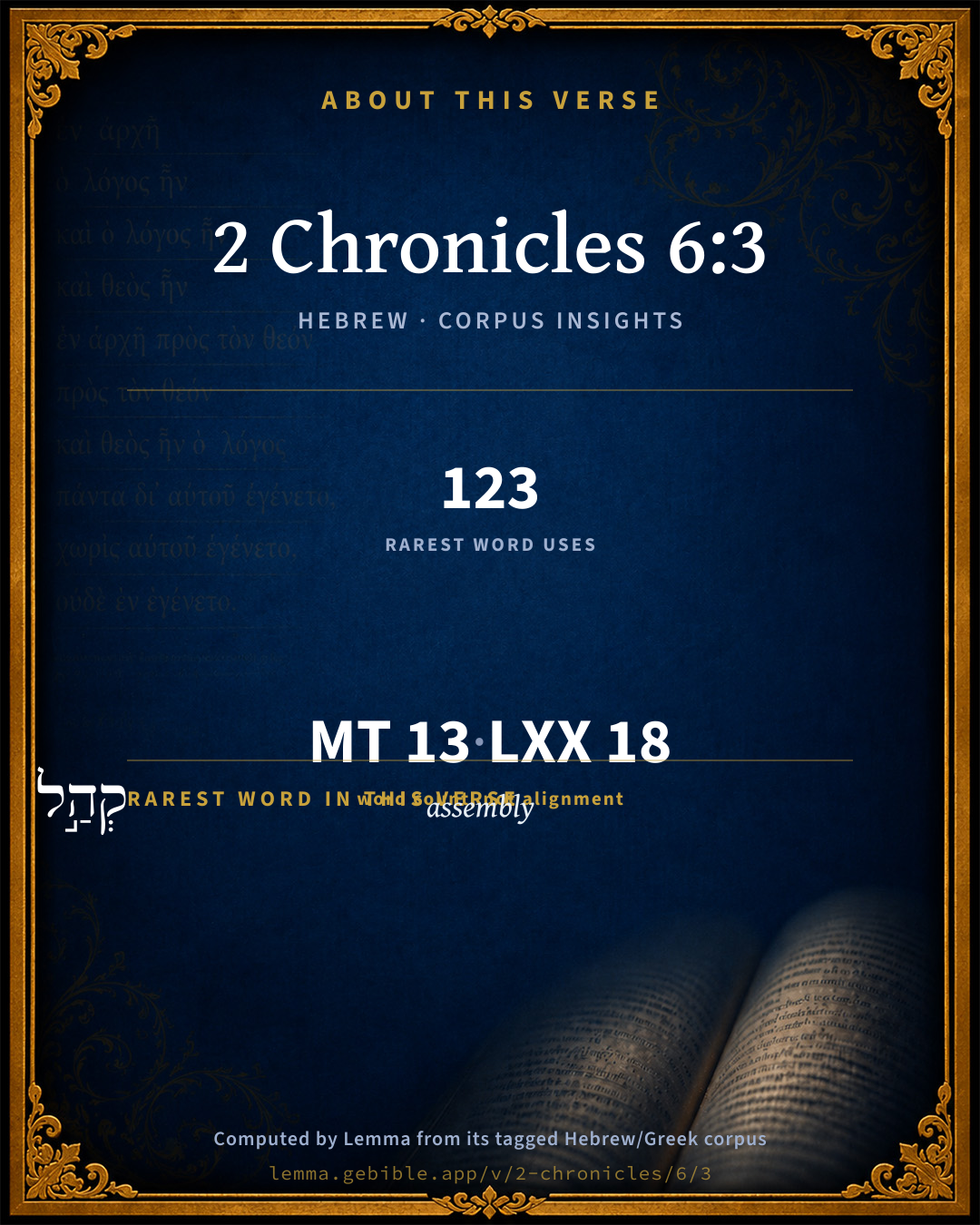
About this verse

These counts appear in no published source. They are computed here, from the morphology-tagged text and Lemma’s own curated glosses. What Lemma adds →

13
words
9
distinct lemmas
Historical
section

Grammatical profile

  • 3 verbs
  • 8 nouns
  • 2 particles

Verb forms

  • וַיַּסֵּ֤ב Hiphil · Sequential Imperfect
  • וַיְבָ֕רֶךְ Piel · Sequential Imperfect
  • עוֹמֵֽד Qal · Participle Active

Repetition

Words recur within this verse — often emphatic in Hebrew:

  • כָּל all H3605 ×2
  • קְהַ֣ל assembly H6951 ×2
  • יִשְׂרָאֵ֑ל Israel H3478 ×2

Hebrew & Septuagint length

In English translation the verse runs 19 words from the Hebrew and 21 from the Septuagint (LXX English) — closely comparable.

A rough comparison of the two English renderings, which tokenize alike — not a word-level alignment.

Word counts can differ between the Hebrew and the Greek without any difference in meaning — e.g. the Hebrew direct-object marker אֵת has no separate Greek word, and Greek often adds the article ὁ.

In the original languages it is 13 Hebrew tokens and 18 Greek tokens — but the two are counted differently (Hebrew bundles its prefixes and suffixes into one token; the Greek is in lemma form), so that isn’t a like-for-like length.

Cross-references

9

Topical passages linked to 2 Chronicles 6:3 in the Treasury of Scripture Knowledge — connected by theme and wording, ordered by reader-vote popularity; previews shown in the World English Bible.

  • 1 Kings 8:14 The king turned his face about, and blessed all the assembly of Israel: and all the assembly of Israel stood.
  • Numbers 6:23–27 "Speak to Aaron and to his sons, saying, 'This is how you shall bless the children of Israel.' You shall tell them,
  • Joshua 22:6 So Joshua blessed them, and sent them away; and they went to their tents.
  • 1 Kings 8:55–61 He stood, and blessed all the assembly of Israel with a loud voice, saying,
  • 1 Chronicles 16:2 When David had made an end of offering the burnt offering and the peace-offerings, he blessed the people in the name of Yahweh.
  • 2 Chronicles 29:29 When they had made an end of offering, the king and all who were present with him bowed themselves and worshiped.
  • Nehemiah 8:5–7 Ezra opened the book in the sight of all the people; (for he was above all the people;) and when he opened it, all the people stood up:
  • Matthew 13:2 Great multitudes gathered to him, so that he entered into a boat, and sat, and all the multitude stood on the beach.
  • Luke 24:50–51 He led them out as far as Bethany, and he lifted up his hands, and blessed them.

Cross-references courtesy of OpenBible.info (CC BY 4.0).

Hebrew and Greek witnesses Masoretic Hebrew ↔ Greek Septuagint

The same verse in the two great witnesses to the Old Testament, shown verse-for-verse.

These are two independent witnesses, not word-aligned to each other, and the Septuagint is shown in lemma (dictionary) form.

Hebrew 2 Chronicles 6:3 Masoretic · Westminster Leningrad Codex

וַיַּסֵּ֤ב הַמֶּ֨לֶךְ֙ אֶת פָּנָ֔יו וַיְבָ֕רֶךְ אֵ֖ת כָּל קְהַ֣ל יִשְׂרָאֵ֑ל וְכָל קְהַ֥ל יִשְׂרָאֵ֖ל עוֹמֵֽד

The king turned his face, and blessed all the assembly of Israel: and all the assembly of Israel stood.

World English Bible · Public Domain

Greek LXX 2 Chronicles 6:3 Septuagint · lemma form

καί ἐπιστρέφω ὁ βασιλεύς ὁ πρόσωπον αὐτός καί εὐλογέω ὁ πᾶς ἐκκλησία ἰσραήλ καί πᾶς ἐκκλησία ἰσραήλ παραἵστημι

And the king turned his face, and blessed all the congregation of Israel: and all the congregation of Israel stood by.

LXX2012 (modern English Septuagint) · Public Domain

Hebrew: Westminster Leningrad Codex (CC BY 4.0). Greek: Septuagint (public domain); English from LXX2012 (modern English Septuagint) (Public Domain). How the Septuagint differs from the Hebrew →

Commentary

Notes on 2 Chronicles 6:3 from classic Christian and Jewish commentators (each source and its license shown beneath its notes). The classic Christian expositions comment on the surrounding passage and are grouped to its opening verse, so a note may address several verses; the Jewish commentaries on the Tanakh (Rashi and others) are per-verse, so they appear only where the commentator wrote on this verse.

Lemma curates 59 commentaries, every one of them public domain or Creative Commons licensed, each selected and text-cleaned for this edition rather than reprinted as found. About our sources →

Ellicott's Commentary for English Readers

(3) And the king.—The verse is word for word as in Kings.

Turned.—Turned round (1Ch_10:14).

Stood.—Was standing.

A Bible Commentary for English Readers, edited by Charles John Ellicott (1878–1897) — public domain. Text from a community e-Sword module.

The Pulpit Commentary

Reading between the lines, this verse shows us that the face of Solomon had been turned to the symbol of God"s presence, while he addressed to him the words of our second verse, since he now faces round to the assembly of the congregation. What words Solomon used in thus blessing the whole congregation are not given either here or in the parallel. The impression one takes is that the blessing was, in fact, wrapt up tacitly in all that Solomon recounts, when he said, Blessed be the Lord God of Israel, etc. (ver. 4). However, it is not impossible that, with the variation of the tense in ver. 59, the verses of 1Ki_8:55-61 may contain the substance of it, if not itself.

The Pulpit Commentary (1880–1919), ed. H.D.M. Spence-Jones & Joseph S. Exell — public domain. Text from a community e-Sword module.

Rashi

Rabbi Shlomo Yitzchaki (Rashi)

and blessed all the congregation of Israel the blessing stated at the end of the episode.

Rashi on the Tanakh — English translations: “The Judaica Press complete Tanach with Rashi, translated by A. J. Rosenberg” (CC BY 4.0); “Pentateuch with Rashi's commentary by M. Rosenbaum and A.M. Silbermann, 1929-1934” (public domain); “The Metsudah Tanach series, Lakewood, N.J” (CC BY 4.0); and “The Book of Joshua, Metsudah Publications, 1997” (CC BY 4.0). Text via Sefaria.

Lesson kit

Teaching starters — assembled from the data on this page, not authored interpretation. Every prompt links to the verse data it draws on. Edit before teaching.

2 Chronicles, in the Historical, opens this verse with 13 words (9 distinct Hebrew lemmas). Its most distinctive word is qâhâl (“assembly”). A historical commentator’s framing appears above. Read the whole chapter for the surrounding context.

Discussion questions

  1. What does “assembly” (qâhâl) contribute to the verse as a whole?
  2. How does 1 Kings 8:14, which shares this passage’s theme, read alongside this verse?
  3. What does the repetition of “all” (2× in this one verse) do in this verse?
  4. The translations on this page render this verse differently — a whole-verse word diff, not a word-by-word alignment. What might account for the different wordings?
  5. «וַיַּסֵּ֤ב» is a Hiphil Sequential Imperfect verb. How does that grammatical form shape the action described?
  6. Compare how Ellicott's Commentary for English Readers and The Pulpit Commentary read this verse. Where do they agree or differ?

Things to notice

Reading settings

Reading text

Shown beneath each verse's original-language words.

Old Testament
Old Testament edition

Read the OT as the Masoretic Hebrew (MT) or the Greek Septuagint (LXX).

English shown for the Greek Septuagint (in the Hebrew ↔ Greek comparison).

Comparing translations? Open the Compare panel on any verse page to stack up to four side by side.